




Abstract
The Work Volition Scale (WVS) is a brief measure of the perceived capacity to make career decisions despite constraints; however, systematic validation of item responses to the scale is still in its infancy. The present article reports on research conducted to investigate the latent structure of WVS, its invariance across gender, and mean differences in work volition across income in a sample of retail workers. A bifactor structure of the WVS accounted for construct-relevant multidimensionality in scores due to the presence of general and specific volition dimensions. Tests of gender invariance revealed the equivalence of item loadings, thresholds, uniquenesses, and factor means. Support was also found for plausible latent mean differences in general volition across income, with retail workers earning high wages reporting greater volition than those earning low wages. Finally, evidence was obtained for theoretically meaningful relations of the general and specific volition dimensions with career control.
Changes in economy, technology, and the society over the past three decades have resulted in unpredictable job markets that impose constraints on individuals’ career choices. Indeed, the global impact of COVID-19 may have a lasting impact on individuals’ career choices. In response to this uncertainty, a bourgeoning interest in the factors that enable individuals to exercise agency in their career decision-making has emerged in the vocational psychology literature (Lent et al., 1994; Savickas et al., 2009). Among the agentic constructs scrutinized in this literature is volition. The systematic study of work volition emerged from the theoretical position that the assumption of volition in people's career decision-making may not be true, particularly for individuals from marginalized backgrounds (Blustein, 2006). Evidence demonstrates that work volition is associated with positive affect and work self-efficacy (Duffy et al., 2013b), and work-meaning and job satisfaction in employed individuals (Duffy et al., 2015a), optimism, job-search self-efficacy, and life satisfaction in unemployed individuals (Duffy et al., 2013a), and academic satisfaction and career decision-making efficacy in college students (Jadidian & Duffy, 2012). Work volition has also been found to mediate the link between perceiving a calling and living a calling (Duffy & Autin, 2013). Although this research yields important insights into the nature and meaning of work volition and its role in the career development process, there have been recent calls for further work into the construct validity of volition (Brown & Lent, 2016).
The aim of the current study is to further examine the construct validity of work volition data drawn from the Work Volition Scale (WVS; Duffy et al., 2012b). First, the latent structure underlying the WVS data is examined in a sample of retail workers. The espoused correlated three-factor model (Duffy et al., 2012b) is tested against the competing unidimensional, correlated two-factor, higher-order, and bi-factor structures. In addition, we examine the complete measurement and structural invariance of WVS responses across gender using multiple-group models. We also investigate latent mean differences in work volition across income levels using Multiple-Indicators-Multiple-Causes (MIMIC) models. Finally, we investigate the validity of WVS scores with respect to the career control subdomain of career adaptability.
Theoretical grounding and latent structure
Work volition can be grounded in the psychology of working framework (PWF; Blustein, 2006) and psychology of working theory (PWT; Duffy et al., 2016). A core tenet of PWF and PWT is that many workers perceive a lack a power of choice in career decision-making to meet these needs, particularly the higher level needs of connectedness and intrinsic fulfillment (Blustein, 2006). Indeed, financial and structural constraints may prohibit individuals from making career choices that align with their interests, skills, and values, potentially leading to lower work and life meaning and satisfaction (Duffy et al., 2016). These perceptions of control in decision-making, or lack thereof, and the presence or absence of volitional constraints, together, reflect the construct of work volition (Duffy et al., 2012b). Although a formal definition of work volition was not initially elaborated in the PWF, Blustein (2006) conceptualized the construct as a choice in work. Based on these principles of PWF and a general definition of volition, Duffy et al. (2012b) formally conceived of work volition as the perceived capacity to make career choices despite constraints.
From the PWF/PWT perspective, work volition is conceptualized as multidimensional, reflecting perceptions of control in career decision-making as well as perceived structural and financial barriers (Duffy et al., 2012b). Individuals with high work volition are likely to perceive control in career decision-making, a breadth of career opportunities, and few financial and structural constraints on their decision-making. Contrariwise, those with low work volition are likely to perceive little choice in their career decision-making, few job opportunities, and multiple structural or financial barriers (Duffy et al., 2012a).
Consistent with this multidimensionality perspective, in the original validation study, Duffy et al. (2012b) found support for a correlated-three-factor structure of the WVS data, comprising volition, financial constraints and structural constraints dimensions. Notwithstanding the retention of this multidimensional solution, one dominant approach to scoring the WVS data, as per the a priori scoring key, is the aggregation of all 13 item scores to yield a total WVS score. This total score approach assumes strict unidimensionality of the WVS structure. Although a unidimensional model has not been fitted to the WVS data, in the three-factor confirmatory factor analysis (CFA) solution retained by Duffy et al. (2012b), factor correlations were strong (rs = .62–.79; M = .71), indicating substantial construct overlap or even the presence of a general volition dimension. However, these correlations are not so high as to suggest complete unidimensionality of the data. In the absence of strict unidimensionality, computing sum scores confounds the common variance shared by all items and specific variance shared by the subset of items (Perera, 2016; Perera & Ganguly, 2018).
Both second-order and bifactor models can accommodate general constructs in the presence of multidimensionality. The rationale for the higher-order specification is that the volition and perceived financial and structural constraint dimensions share sufficient common variation to assume the existence of a global factor underlying these dimensions. However, higher-order models rely on restrictive proportionality constraints, as reflected in the Schmid and Leiman (1957) transformation procedure, which render the structure somewhat implausible under realistic modeling conditions. Bifactor models provide an alternative to higher-order structures in modeling simultaneous generality and specificity in item responses. For any set of k items, a bifactor model posits an f-factor solution with one general factor (G-factor) and f-1 specific or group factors (S-factors). All items are specified to load onto the general factor and only one S-factor, with correlations among the general and specific factors typically fixed to zero. As applied to the WVS data, the bifactor model partitions item response variance into a (a) general volition factor reflecting common variation shared by all items and (b) three S-factors that account for additional common variance in item subsets beyond the general factor.
Although a bifactor model has not been fitted to the WVS data, the structure is theoretically plausible. The bifactor model may account for a general sense of volition in career decision-making as argued in a recent research (Brown & Lent, 2016) while upholding the multidimensionality perspective on work volition espoused by (Duffy et al., 2012b). Conceptually, it is plausible that individuals possess a generalized sense of volition in work life that integrates cognitions about their general capacity to make career decisions with general perceptions of structural and financial constraints. This generalized volition dimension is likely to reflect the capacity for career decision-making despite barriers, which represents the core of work volition from the PWF perspective (Blustein, 2006; Duffy et al., 2012b). In addition to this holistic sense of power in career domains, people may possess more differentiated perceptions of control in decision-making and specific financial and structural constraints that may be job or even task specific. To the extent that both these general and specific aspects of volition are of substantive interest, the bifactor model is the only straightforward analytic framework for appropriately decomposing item response variance into general and specific factors and examining covariate-based differences on these factors and their effects on substantively meaningful outcomes (Chen et al., 2006).
A final model that may provide a suitable structural representation of the WVS data is a correlated two-factor model. Duffy et al. (2012a) found support for a two-factor model of volition based on data drawn from the student version of the WVS. This solution was characterized by a volition factor, as in the adult three-factor structure, and a general constraints factor reflecting both financial and structural barriers. The collapsing of the financial and structural constraints factors into a general constraints factor may reflect the view that students, who have not typically entered the labor market in a full-time capacity, may not discriminate between financial and structural constraints in evaluating their future capacity to make career decisions (Duffy et al., 2012a). This lack of differentiation in constraints may also be true of the retail workers constituting the present sample, many of whom work in a part-time capacity. Thus, alongside the unidimensional, three-factor, and bifactor models, we test the correlated two-factor structure.
Latent mean differences
Relations with career control
Relations of work volition with career control would yield evidence of the validity of WVS responses. Career control is a dimension of career adaptability as per the career construction theory, denoting an individual's sense of ownership in managing career development tasks (Savickas & Porfeli, 2012). In the PWT (Duffy et al., 2016), work volition and career adaptability are posited to be mediators in the relationships between contextual experiences (e.g., economic constraints and marginalization) and securing decent work. From the PWT perspective, volition and adaptability are hypothesized to be correlated and, empirically, the constructs have been shown to be associated (Buyukgoze-Kavas et al., 2015; Duffy et al., 2015b). However, the relation is not so high as to suggest dimensional redundancy. Indeed, from a conceptual standpoint, work volition is distinct from career control as volition refers to the perception of control in relation to career choice whereas career control is concerned with career development tasks broadly (Buyukgoze-Kavas et al., 2015). Nevertheless, to the extent that career decision-making is a core career development task, at least moderate-sized associations between the constructs should be expected.
The present research
Retail workers are the third largest industrial segment of the Australian labor market (National Careers Institute, 2023). Jobs in retail provide vital opportunities for young people learning and transitioning from school to the workforce, and for people who do not have degree qualifications. However, these workers who are essential to community functioning and commerce are virtually invisible in the career development literature; they fall into the class of workers who are understudied by vocational psychologists (Casper & Swanberg, 2011). Thus, the present research partly closes a gap in knowledge about the career motivations of these essential workers. Data were collected prior to the onset of pandemic lockdowns in Australia.
Methods
Participants and procedure
Participants included 394 adults working in the retail sector in Australia. The mean age of participants was 25.90 (SD = 9.52) and 72.1% (n = 284) were female. Two participants (0.51%) did not report their age. To be eligible for the study, participants were required to be aged 18 years or older and working in a retail position. For the current sample, average net fortnightly income (i.e., after tax) in AUD is as follows: 25.4% (n = 100) of the sample earned $250.00 or less; 32.5% (n = 128) earned between $251.00 and $500.00; 16.8% (n = 66) earned between $501.00 and $750.00; 10.9% (n = 43) earned between $751.00 and $1000.00; 9.1% (n = 36) earned between $1001.00 and $1500.00; and 5.3% (n = 21) earned over $1501.00. Evidently, the majority of participants were earning less than the average weekly income; however, it should be noted that the mean hours worked weekly was 17.13 (SD = 11.09; Mdn = 15.00). Participation involved the completion of questionnaires via an online platform. The study protocols were approved by the Human Research Ethics Committee of the University of Southern Queensland.
Measures
Statistical analyses
Statistical analyses were conducted in four phases. First, CFA tests of the WVS data were conducted. For the unidimensional model, all WVS items were specified to load onto a single work volition factor. The two-factor model was characterized by Items 1, 2, 9, and 12 specified to load onto a volition factor and the remaining items loading on the general constraints factor. The correlation between the volition and constraints factors was freely estimated. For the a priori three-factor structure, each WVS item was specified to load onto the factor it designed to measure, with correlations among the three factors freely estimated. Finally, for the bifactor model, all items were specified to load onto a general work volition factor as well as one of the specific volition, financial constraints or structural constraints factors as per the scoring key. Null relations among the general and specific factors were specified.
The second phase of the analyses involved tests of the complete measurement and structural invariance of the retained WVS measurement structure across gender. These tests were conducted in a multiple-group framework in line with Millsap and Yun-Tein's (2004) taxonomy of invariance tests for models based on polytomous data. This taxonomy of invariance tests includes the sequential testing of configural invariance, and the invariance of item loadings, thresholds, uniquenesses, factor variances and covariances, and factor means (Perera et al., 2015). The equivalence of item loadings, thresholds and residual variances constitutes measurement invariance, and the equivalence of factor variances and covariances and factor means constitutes structural invariance. For these multiple-group tests, females served as the baseline group.
Next, we examined the latent mean differences in work volition based on the retained measurement structure across income using the MIMIC models. The MIMIC approach to examining between-group differences in latent means may be preferred to structured means modeling with multiple-groups where group-specific sample sizes may be small, such as for the income groups in the present study. The MIMIC modeling involved the estimation and comparison of the following two models: (a) a saturated MIMIC model with paths from income (operationalized as five dummy-coded variables with “$250.00 AUD or less” as the baseline category) to all item indicators but not the latent variables; and (b) a threshold-invariant model, with paths from the dummy-coded income variables to the latent variables but not indicators. If the threshold-invariant model does not result in an appreciable decrement in fit relative to the saturated model, support is found for the equivalence of indicator thresholds and, accordingly, group differences can be interpreted as entirely attributable to differences on the latent variables and not (monotonic) differential item functioning. In both MIMIC models, we controlled for the potentially confounding effects of weekly work hours.
The final phase of the analyses involved tests of the relations of work volition with career control. A general latent variable model was specified with the retained WVS measurement structure and a unidimensional career control factor indicated by six items from the CAAS. The associations of work volition with career control were freely estimated.
Statistical analyses were performed using Mplus 7.4 (Muthén & Muthén, 1998–2015). All solutions were estimated using robust diagonal weighted least squares with a mean-and-variance adjusted test statistic, operationalized as the WLSMV estimator in Mplus. This estimation routine is suited to ordered-categorical data (Rhemtulla et al., 2012). Model fit assessment involved an evaluation of fit indices and parameters estimates. As the χ2 can be oversensitive to even minor model misspecifications given moderately large samples and contains a restrictive hypothesis test (i.e., exact fit), three approximate fit indices were considered: comparative fit index (CFI) and Tucker–Lewis index (TLI), > .900 and .950 for acceptable and excellent fits, respectively; and root mean square error of approximation (RMSEA), < .050 and .080 for close and reasonable fits, respectively (Marsh et al., 2004). For nested model comparisons, because the adjusted χ2 difference (MD χ2) test appropriate for the WLSMV estimator also tends to be sensitive to even trivial differences in moderately large samples, changes in the CFI (ΔCFI) and RMSEA (ΔRMSEA) were primarily used. A decrease in the CFI and an increase in the RMSEA of < .010 and .015, respectively, are suggestive of support for a more restrictive model (Chen, 2007; Cheung & Rensvold, 2002).
Results
Descriptive statistics
Sample polychoric correlations for the item responses from the WVS and Control subscale of the CAAS are shown in Table 1. As expected, WVS items were uniformly positively related. In general, within-construct item correlations were stronger than between-construct item correlations; however, across the items, the strength of the correlations suggests the potential presence of a general dimension underlying the observed responses. Furthermore, relations of the WVS items with the Control items were weak-to-moderate and positive, except for the relation of WVS Item 7 with Item 2 of the Control scale.
Sample polychoric correlations for the work volition scale and career control items.
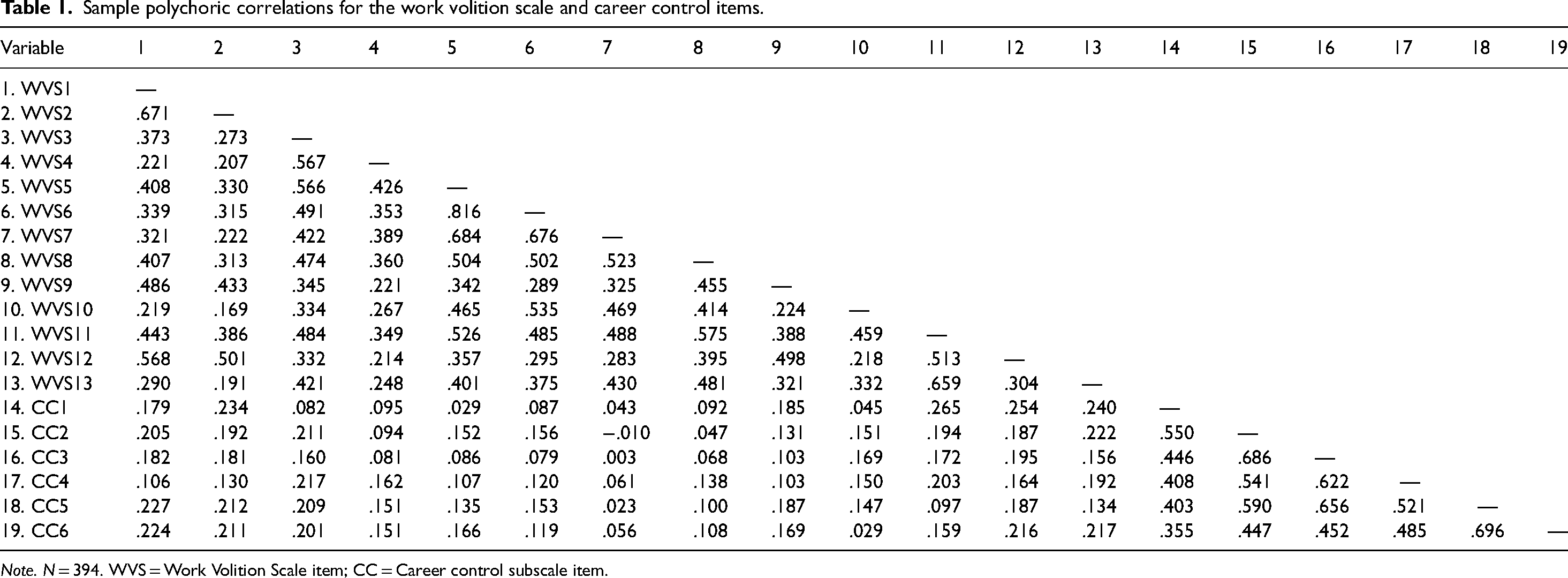
Note. N = 394. WVS = Work Volition Scale item; CC = Career control subscale item.
Latent structure
Results of the tests of the measurement models are shown in Table 2. The test of the unidimensional structure resulted in an unacceptable fit to the data. Likewise, the correlated two-factor model did not fit the data. For the correlated three-factor CFA, though the CFI and TLI were indicative of acceptable fit, the RMSEA exceeded the commonly-used cut-off of .080 for inferring reasonable fit. For this solution, factor correlations were high (r = .563−.798, M = .662) and several large modification indices suggested the presence of strong cross-loadings, with some expected parameters values for these cross-loadings exceeding the magnitude of primary loadings. This pattern of cross-loadings is indicative of the presence of a general factor underlying scores in addition to the three existing dimensions, which can be accounted for by a bifactor model. The test of the bifactor CFA structure resulted in a reasonable-to-excellent fit to the data in absolute terms, and, relative to the unidimensional, two-factor, and three-factor structures, provided a superior fit to the data.
Model fit statistics for the measurement structures.
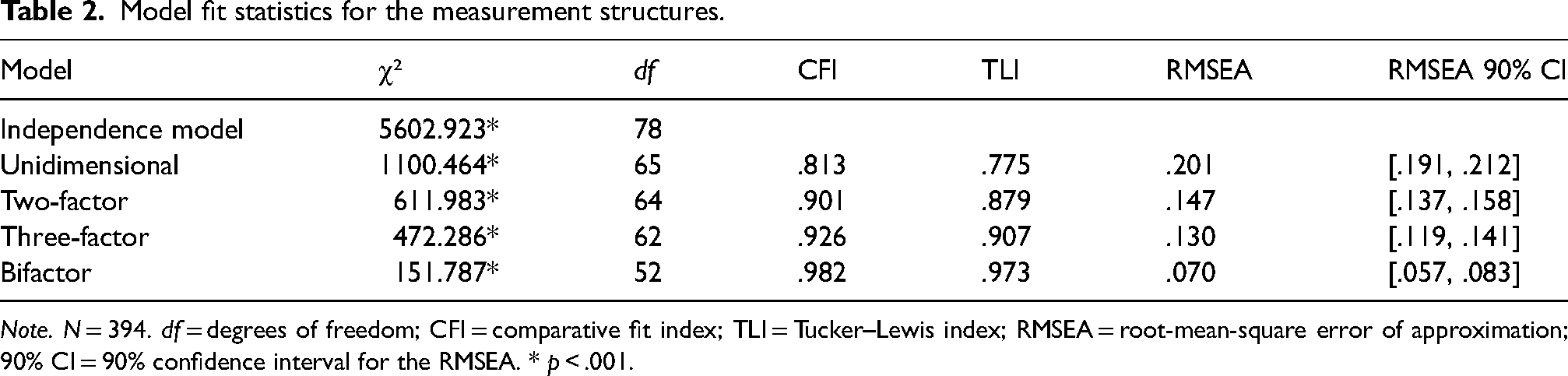
Note. N = 394. df = degrees of freedom; CFI = comparative fit index; TLI = Tucker–Lewis index; RMSEA = root-mean-square error of approximation; 90% CI = 90% confidence interval for the RMSEA. * p < .001.
The bifactor model with parameter estimates is shown in Figure 1. The G-factor was well defined with uniformly moderate-to-strong and statistically significant loadings (|λ| = .412−.837, M = .604, ω 1 = .923). The items designed to measure the absence of financial and structural constraints showed particularly strong loadings on the G-factor. The cohesiveness of the G-factor is noteworthy considering that the WVS items were intended to measure the distinct dimensions of volition. Beyond the G-factor, the volition (|λ| = .371−.677, M = .544, ω = .726), financial constraints (|λ| = .079−.697, M = .417, ω = .697) and structural constraints (|λ| = .272−.403, M = .348, ω = .557) S-factors were also reasonably well defined with seemingly meaningful residual specificity that may be substantively interpreted and necessitates statistical control to sufficiently partition item variance. Based on the good fit of the bifactor model and adequacy of the parameters estimated in the solution, we retained this model for further examination.
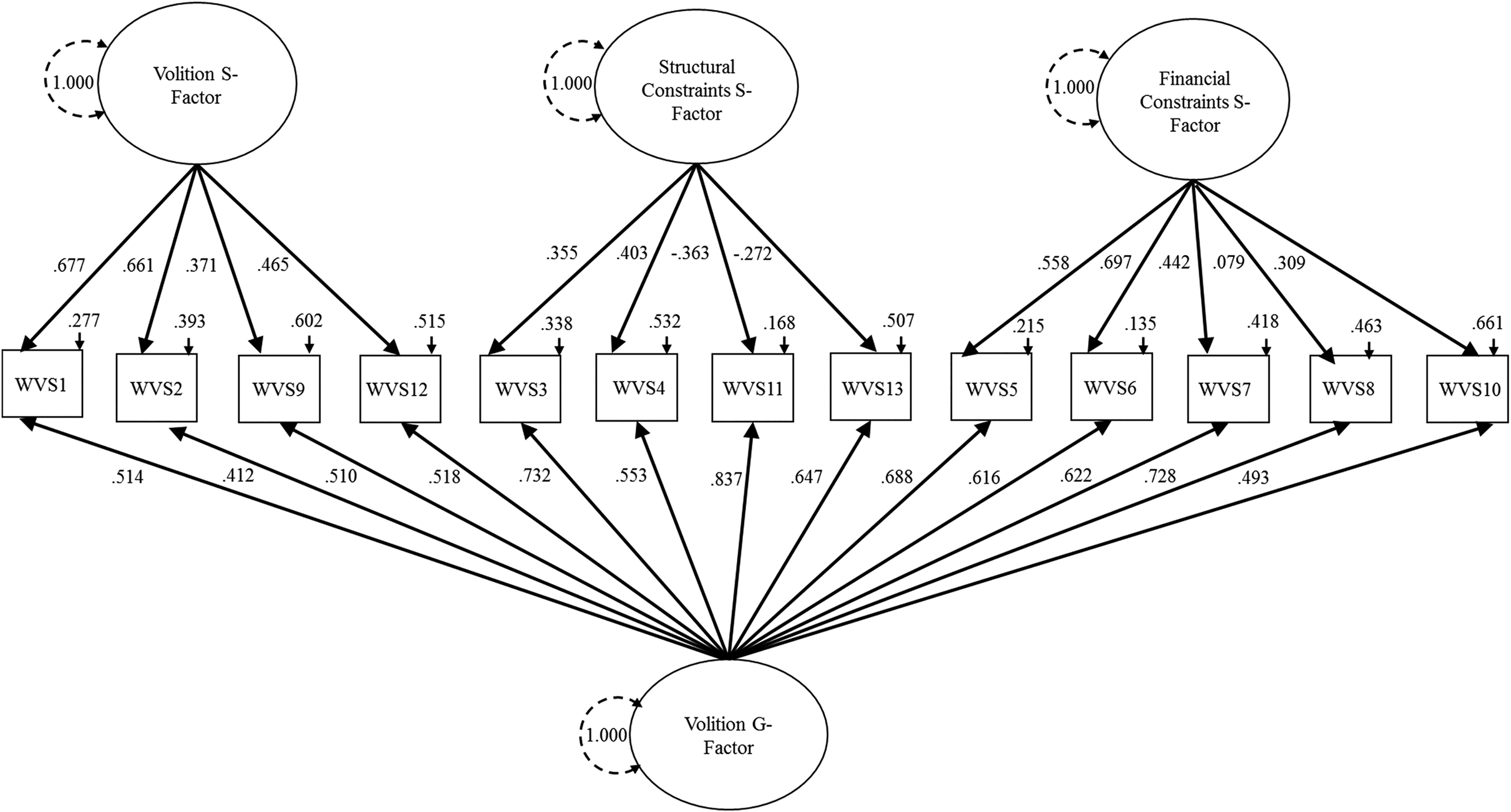
Retained bifactor model with standardized estimates of general and specific factor loadings and residual variances. Note. N = 394. S-factor = specific factor; G-factor = general factor; WVS = Work Volition Scale item. All factor loadings are statistically significant at p < .001, excepting for the specific loading of WVS8 on the financial constraints S-factor.
Gender invariance
Table 3 shows the fit indices for the tests of gender invariance of the retained bifactor model. The configurally-invariant model provided an acceptable-to-good fit to the data. This baseline structure was compared to the more restrictive weak invariance model with factor loadings constrained to be equal across gender. The weak-invariant model provided an excellent fit to the data and, notably, no decrement in fit relative to the configural model. Indeed, the parsimony-corrected TLI and RMSEA fit indices increased and decreased, respectively, suggesting that the gain in parsimony outweighs any loss in fit in equality constraining the factor loading. Support was also found for the invariance of item thresholds. For the model of strict invariance, with item uniquenesses constrained to equality, fit indices were indicative of decreased fit relative to the threshold-invariant model; however, a decrement in these indices did not reach the commonly-used heuristics for inferring an appreciable degradation in fit. No support was found for the invariance of the factor variances as the model showed an appreciable degradation in fit relative to the strict invariance model; however, the model of latent mean invariance was supported. Taken together, the results of the invariance tests indicate complete measurement invariance of the bifactor model as well as the latent mean equivalence across gender.
Fit statistics for the multiple-group models of gender invariance.
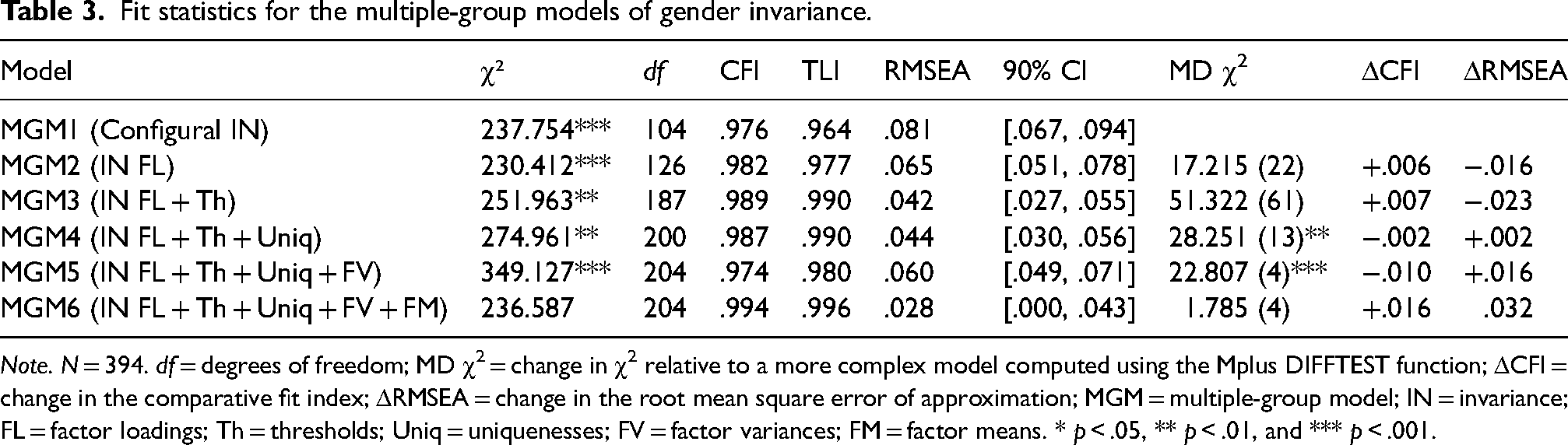
Note. N = 394. df = degrees of freedom; MD χ2 = change in χ2 relative to a more complex model computed using the Mplus DIFFTEST function; ΔCFI = change in the comparative fit index; ΔRMSEA = change in the root mean square error of approximation; MGM = multiple-group model; IN = invariance; FL = factor loadings; Th = thresholds; Uniq = uniquenesses; FV = factor variances; FM = factor means. * p < .05, ** p < .01, and *** p < .001.
Income effects
We next examined latent mean differences in the work volition dimensions across income levels, controlling for average weekly hours worked. The test of the saturated model resulted in a good fit to the data, χ2 (61) = 151.770, p < .001, CFI = .982, TLI = .954, RMSEA = .062, 95% CI [.050, .075]. The threshold invariant model also provided a good fit to the data, χ2 (106) = 175.376, p < .001, CFI = .986, TLI = .980, RMSEA = .041, 95% CI [.030, .052], and, notably, no decrement in fit relative to the saturated model, MD χ2 (45) = 43.453, p = .538, ΔCFI = + .004, ΔTLI = + .026, and ΔRMSEA = −.021. Parameter estimates from the final threshold-invariant model are shown in Table 4. As expected, for the volition G-factor, there was significant effect of income, such that those earning greater than $1500.00 AUD per fortnight reported higher general volition than individuals earning less than $250.00 AUD. No other substantively meaningful or significant effects of income were found.
Unstandardized regression coefficients from the retained MIMIC model.
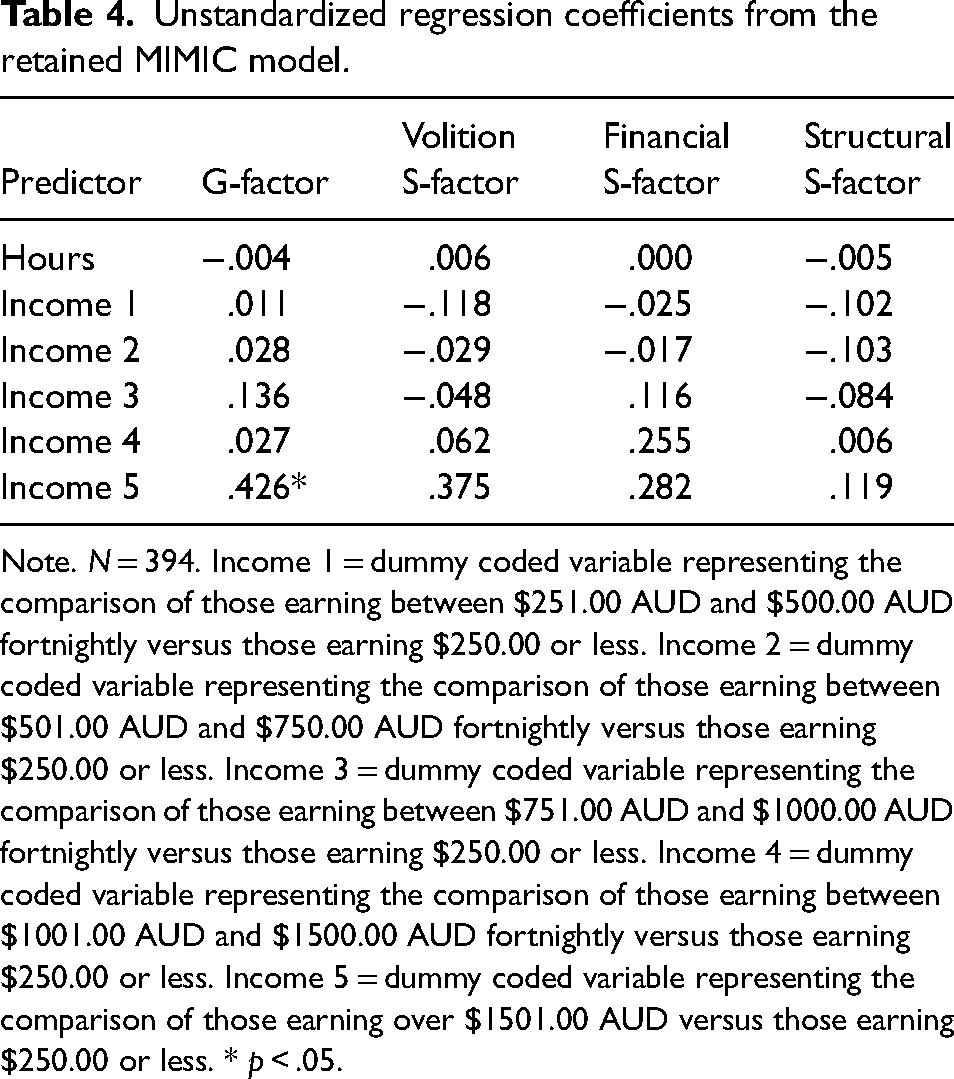
Note. N = 394. Income 1 = dummy coded variable representing the comparison of those earning between $251.00 AUD and $500.00 AUD fortnightly versus those earning $250.00 or less. Income 2 = dummy coded variable representing the comparison of those earning between $501.00 AUD and $750.00 AUD fortnightly versus those earning $250.00 or less. Income 3 = dummy coded variable representing the comparison of those earning between $751.00 AUD and $1000.00 AUD fortnightly versus those earning $250.00 or less. Income 4 = dummy coded variable representing the comparison of those earning between $1001.00 AUD and $1500.00 AUD fortnightly versus those earning $250.00 or less. Income 5 = dummy coded variable representing the comparison of those earning over $1501.00 AUD versus those earning $250.00 or less. * p < .05.
Relations with career control
A GLMV was specified to test the relations of the WVS scores, as per the retained bifactor structure, with career control. The test of this model resulted in a good fit to the data, χ2 (135) = 316.720, p < .001, CFI = .976, TLI = .969, RMSEA = .058, 95% CI [.050, .067]. The general volition factor was moderately and positively associated with career control (r = .302, SE = .047, p < .001). The volition S-factor was also positively associated with career control, though the effect was weaker (r = .181, SE = .054, p < .001). Both the financial (r = −.112, SE = .059, p > .05) and structural (r = −.018, SE = .068, p > .05) constraint S-factors were not significantly related to career control.
Discussion
The present research examined the validity of WVS item responses in a sample of retail workers. We examined the latent structure of WVS responses, the gender invariance of the retained measurement structure, latent means differences in volition across income levels and the relations of work volition dimensions with career control. The results of the study demonstrate that the best representation of WVS data is a bifactor model with a general work volition factor and specific volition, financial constraints, and structural constraints factors. In addition, evidence was found for the complete factorial invariance of the WVS structure across gender. Data were also obtained supporting plausible latent mean differences in work volition over income levels. Finally, theoretically consistent relations of the volition dimensions with career control were found.
Four competing measurement structures presumed to underlie the WVS item data were tested. No support was found for the unidimensional representation of work volition implied by the total-score approach to scoring the instrument espoused in the WVS scoring key. Furthermore, no support was obtained for the correlated two-factor structure of work volition, which has previously been found to provide an adequate representation of work volition based on the data drawn from the student version of the WVS (Duffy et al., 2012a). Even the espoused correlated three-factor model was shown to provide a suboptimal fit to the WVS data. In this solution, factor correlations were high and modification indices were indicative of the presence of several large cross-loadings, with some standardized expected parameter change values for the cross-loadings exceeding the magnitude of estimated primary loadings. These results are suggestive of a potential general factor underlying the WVS data in addition to multidimensionality attributable to the presence of distinct volition and constraints factors (Perera, 2016; Perera & Ganguly, 2018).
The bifactor CFA model can accommodate general and specific dimensions of work volition. In the present study, the bifactor structure provided an excellent fit to the data and an appreciably better fit than the competing unidimensional, correlated two-factor, and correlated three-factor models. For this solution, the G-factor was well defined with variance significantly different from zero and all 13 standardized loadings statistically significant and exceeding a magnitude of .412. The cohesion of the general factor is remarkable given that the WVS is designed to measure distinct components of work volition (Duffy et al., 2012b). Over and above the G-factor, the volition, financial constraints, and structural constraints S-factors were also relatively well defined with variance significantly different from zero and seemingly meaningful content specificity.
The bifactor model is consistent with not only the multidimensionality perspective on volition espoused in the PWF and PWT (Duffy et al., 2012b) but also emerging perspectives suggesting that work volition reflects a general sense of agency (Brown and Lent, 2016) in career decision-making. In the retained solution, the general factor reflects the perceptions of control in career decision-making and captures considerable variance related to perceptions of financial and structural barriers. In this regard, the G-factor better reflects the PWF/PWT conceptualization of work volition—the perceived capacity to make career decisions integrating cognitions about financial and structural constraints (Duffy et al., 2012b)—than each of the three distinct volition dimensions. The volition S-factor was largely defined by items reflecting autonomy in decision-making; the S-factor structural constraints were primarily indexed by items reflecting market barriers to pursuing desired work or the absence thereof; and the financial S-factor was indicated by items tapping (low) inflexibility in career choice due to personal economic conditions. Conceptually, the bifactor model may reflect the view that individuals possess a general sense of power in their career decision-making in addition to more differentiated perceptions of control and constraints. For example, if an individual was queried about his/her job decision, it may be that upon reflection people perceive that they have generally been able to readily make job decisions over the course of their career. These perceptions may be distinct from their perceptions of specific aspects of control and constraints that may be time or job specific. The bifactor structure can sufficiently decompose item variance into these general and specific components.
Tests of gender equivalence of the WVS scores as represented in the retained bifactor structure yielded support for full measurement and partial structural invariance of the WVS scores. To the authors’ knowledge, this is the first report of tests of the complete factorial invariance of the WVS structure. Multi-group tests supported the invariance of item factor loadings, thresholds and uniquenesses, which is indicative of full measurement invariance. In addition, support was found for the equivalence of latent means but not factor variances, supporting partial structural invariance of the WVS scores. The finding of equivalent latent means replicates recent evidence showing no appreciable differences in work volition between men and women (Duffy et al., 2012a, 2015a). Notably, these findings extend previous literature by demonstrating the invariance of latent means in a categorical-variable bifactor framework that (a) accounts for the threshold structure of the polytomous WVS items, (b) establishes the requisite level of measurement invariance to examine the factor variance and mean invariance, and (c) disentangles variance associated with the general volition factor from variance associated with the specific volition and constraints dimensions.
Evidence was also obtained for plausible latent mean differences in work volition over the income levels. The MIMIC modeling revealed a significant income effect on the volition G-factor, with retail employees earning more than $1500.00 AUD per fortnight reporting higher general volition than employees earning less than $250.00 AUD, controlling for the effects of average weekly hours worked. This effect of income replicates previous data showing an association of higher income with greater work volition (Duffy et al., 2015a, 2015c). The finding also extends prior evidence by demonstrating that the effect of income is unique to the volition G-factor and does not extend to the specific volition dimensions. This effect has been attributed to greater economic resources, which provide better access to educational, internship, and employment opportunities, potentially leading to more flexibility and options in choosing careers (Duffy et al., 2016). However, it should be noted that no other effects of income levels were found. These findings may reflect the possibility that retail workers perceive a strong sense of power in making occupational decisions, which integrates their perceptions of structural and financial barriers, only when their financial resources exceed average levels, allowing for expenditure beyond that required for basic subsistence needs.
Finally, evidence from the tests of the relations of the work volition dimensions with career control also supports the validity of WVS responses. The volition G-factor was found to be moderately and positively associated with career control. These findings underpin the PWT (Duffy et al., 2016), which holds that the constructs are related but distinct factors that allow individuals to exercise agency in career developmental tasks. The relation may be attributed to shared conceptual content reflecting control in career developmental tasks. As career control refers to people's ownership in shaping their vocational futures (Savickas, 1997), and the volition G-factor reflects a general sense of power in making vocational choices, which is a crucial career development task in people's vocational futures, the finding of a moderate relation is theoretically plausible (Duffy et al., 2015b). It may also be that career control, as a self-regulatory resource, enables people to overcome career barriers, which may lead to greater perceptions of the capacity to make career decisions involving the perception of low financial and structural constraints (Buyukgoze-Kavas et al., 2015). The results also show that the volition S-factor, over and above the G-factor, was positively, albeit modestly, associated with career control whereas the financial and structural constraint S-factors were not significantly related to career control. The relationship of the volition S-factor with career control may reflect modest overlapping content related to autonomy in decision-making.
Limitations and future research
We note a few limitations to this research that serve to qualify the results and guide future research efforts. First, though the advantage of this study is the recruitment of a unique understudied sample, it is not known whether the results obtained, particularly those concerning the retained bifactor model, are idiosyncratic to this sample. Future research would do well to examine the replicability of the retained bifactor structure in diverse populations. A second limitation of this study is the small male-group sample in the multi-group tests of invariance, which may lead to biased standard errors and underpowered tests of parameter differences. Future researchers may profitably re-examine the complete factorial invariance of the WVS scores over gender with larger samples. A third limitation concerns the use of MIMIC models to investigate latent means differences in work volition over income levels. MIMIC models assume, but cannot straightforwardly tests for, the invariance of factor loadings, uniquenesses, and the factor variance (and covariance) matrix, thereby potentially limiting inferences. A related limitation is the very small samples of some of the income sub-groups in the present study, which raises concerns about statistical power to detect the differences in item thresholds and latent means. Accordingly, we urge caution in the interpretation of results obtained from the MIMIC modeling and encourage replication in larger samples. Finally, data collection for this study was conducted prior to the pandemic lockdowns in Australia which had a significant impact on the retail industry. Australia's retail sector is recovering economically, and the impact on the sector's workforce's motivations is yet to be fully understood. Future research should explore how the pandemic lockdowns affected retail workers’ motivations and job satisfaction and use the present findings as a quasi-baseline study of their volition.
Conclusion
The present study makes important advances in validating responses to the WVS. The study has shown that the WVS data are consistent with a bifactor structure, which accounts for construct-relevant multidimensionality in the data due to the coexistence of general and specific constructs underlying the responses. Notably, the volition G-factor was well defined, and the three S-factors showed meaningful residual specificity over and above the G-factor. In addition, support was found for the complete measurement and partial structural invariance of scores implied by the bifactor model over gender, including the equivalence of latent means for the volition G-factor and S-factors. Support was also found for a significant latent mean difference in the volition G-factor across income, such that retail workers with high fortnightly net incomes reported higher general volition than those with low incomes. Finally, evidence was obtained for meaningful relations of the general and specific volition dimensions with career control. The present findings can be used by human resources recruitment and management experts to better understand retail workers’ motivation and how to attract and retain these workers in an industry sector that is essential for societies and economies.
Footnotes
Declaration of conflicting interests
The author(s) declare no potential conflicts of interest with respect to the research, authorship, and/or publication of this article.
Funding
The author(s) received no financial support for the research, authorship, and/or publication of this article.
