




Abstract
The present article proposes to broaden the understanding of the life courses of women executives to include an experiential perspective of meaning built around their different life projects. Our study is based on a qualitative approach employing narrative research methodology to analyze interviews with a sample of 51 women executives. Our findings reveal key experiences and events and a diversity of transitions between hierarchical levels that characterize their career development. They also show a number of possible configurations of rapprochement, integration, distancing, or separation between the different spheres of life and their influence on executive careers through ascending, lateral, or descending career paths. These findings contribute to a deeper insight into the complex career paths of women executives and underscore the value of including these different dimensions when considering guidance support strategies for this clientele.
Introduction
Recent years have seen persistent under-representation of women in senior management positions (Baumgartner & Schneider, 2010; Ezzedeen et al., 2015; Guillaume & Pochic, 2009). Beyond research on this specific issue, a number of studies have examined levers and barriers that can influence upward mobility, the challenge of balancing work and family, aspects of working life, and strategies adopted to steer the career development of women executives (Baumgartner & Schneider, 2010; Ekonen & Heilmann, 2021; Ezzedeen et al., 2015; Guillaume & Pochic, 2009). Additionally, some scholars have built models to gain better insight into the careers of women executives (Mainiero & Sullivan, 2005; Shaw & Leberman, 2015). Yet despite considerable research interest in the challenges these women face in advancing their careers, relatively few studies have employed a diachronic perspective of career trajectories that would take into account events and experiences that can shape the different spheres of life. Expanding on these perspectives, this article seeks to broaden the understanding of women executives’ life courses in early, mid, and late career to include an experiential perspective of meaning built around their different life projects. We consider past and current experiences and events in different spheres of life (professional, family, committed relationship, and personal) to glean the extent to which they can influence transitioning between different hierarchical levels and career development. To this end, we construct theoretical frameworks based on career path analysis and feminist standpoint theory. We will begin with an overview of current scholarship on issues surrounding career development in women executives.
Current scholarship on executive career development
The executive career, for both men and women, is a rather complex and multifaceted phenomenon (Baruch & Vardi, 2016; Bozionelos & Baruch, 2016). The traditional executive career has tended to be an intraorganizational one, seen through the lens of opportunities to pursue upward mobility synonymous with career advancement and success within the same company (Bozionelos & Baruch, 2016; Powell et al., 2019). During the 1990s, however, researchers noted the decline of this trajectory and the emergence of a new career conceptualized as “boundaryless” (Arthur & Rousseau, 1996). Executives nowadays move from one organization to the next to acquire the necessary skills and experience to advance their careers (Bozionelos & Baruch, 2016; Inglis & Cray, 2012; Powell et al., 2019). The contributions of this research notwithstanding, the myriad specificities of today's management careers, and the models that characterize them remain largely unexplored. Additionally, the latter leaves little room for different life projects, committed relationships, and family plans, with executive career development centered primarily around professional life. Indeed, some researchers have pointed out that omitting interactions between work and the different spheres of life represents a major shortcoming in prevailing theories of career development (Jung & O’Brien, 2019; Schultheiss, 2009). Failing to see the importance of these interactions in the field of vocational psychology could limit the opportunity to gain a holistic insight into people's lives (Jung & O’Brien, 2019). Lastly, another limitation noted in current scholarship concerns the makeup of the executive group itself implicitly understood to be male owing to the absence of gender-related dimensions (e.g., the work of Inglis and Cray, 2012).
In a considerable number of studies that have examined women's careers (Elley-Brown et al., 2018; Patton, 2013), a few scholars have developed models to conceptualize the efficacy of career development for women executives (Mainiero & Sullivan, 2005). Mainiero and Sullivan's “Kaleidoscope Career Model” work on a relationship-based concept to suggest a new definition of women's careers. Using the metaphor of a kaleidoscope that changes and reveals a new pattern each time it is rotated, Mainiero and Sullivan illustrate how the career decision-making process of women executives is a shifting, interconnected web of factors, issues, and people that impacts loved ones and different spheres of life (Mainiero & Sullivan, 2005). Their research reveals that women executives do wish to move up the corporate ladder, but not at any cost—their careers must above all be meaningful and suit their lifestyle, rather than consume their entire life. Throughout their careers, these women are faced with three main questions: 1) authenticity (with this choice, can I remain true to myself?); 2) balance (would this choice fit my vision of work–family balance?); and 3) challenge (if I go for this choice, will it be challenging enough for me?) (Mainiero & Sullivan, 2005). Drawing on the Kaleidoscope Career Model, Shaw and Leberman (2015) studied the careers of senior women executives in an effort to document their meaningful career experiences. Their work has been useful in nuancing various elements surrounding the notion of authenticity, broadening the concept of balance in the nonwork sphere of women executives to include more than just family, and clarifying the different degrees of challenges they face in their careers. Although their study does not attempt to link career concerns with the stages in Mainiero and Sullivan's work, Shaw and Leberman propose adapting the latter's basic model to include the complexities and nuances of lived experiences (Shaw & Leberman, 2015).
Other scholars have focused on how the challenges of balancing work and family can influence career development, demonstrating that the careers of women executives are co-constructed, interrelated, and interdependent with their different spheres of life (Guillaume & Pochic, 2009; Mainiero & Sullivan, 2005; O’Neil et al., 2008), and that this may also explain the heterogeneity of their management career trajectories (Ekonen & Heilmann, 2021). A number of studies have documented the different strategies women adopt, such as planning to have children at a given point in their career to limit jeopardizing upward mobility (Ezzedeen et al., 2015; Guillaume & Pochic, 2009). Many leverage flexible work schedules and places to optimally juggle the gamut of their responsibilities (Guillaume & Pochic, 2009; Shaw & Leberman, 2015). Other support strategies also include outsourcing household chores and family responsibilities, such as employing domestic workers or enlisting the help of extended family (Baumgartner & Schneider, 2010; Guillaume & Pochic, 2009).
Using the wider lens of the glass ceiling metaphor, some researchers have examined factors that can hinder the upward mobility of women executives, such as the existence of gender stereotypes and the dogged persistence of the “old boys’ club” (Ekonen & Heilmann, 2021; Ezzedeen et al., 2015). In contrast, others have focused on factors promoting women's advancement to senior leadership roles (Guillaume & Pochic, 2009). These studies reveal that adopting masculine behaviors that comply with the unwritten rules and norms of corporate culture can be an effective lever in a woman's career path (Guillaume & Pochic, 2009). They cite, for example, behaviors that enable women to demonstrate self-determination and perseverance (Baumgartner & Schneider, 2010), obtain the support of a mentor or influential person such as an immediate superior (Baumgartner & Schneider, 2010), gain access to certain networks (Ekonen & Heilmann, 2021), or accept functional or geographical mobility opportunities as well as demonstrate extensive availability (Guillaume & Pochic, 2009).
In brief, some studies have brought to light career-specific issues at stake in the professional lives of executives (Baruch & Vardi, 2016; Bozionelos & Baruch, 2016), while others have revealed strategies developed in the area of family dimensions interacting with executive career development (Ezzedeen et al., 2015; Mainiero & Sullivan, 2005; O’Neil et al., 2008; Shaw & Leberman, 2015). Additionally, some scholarship has highlighted factors that can hinder the upward mobility of women in management (Ekonen & Heilmann, 2021; Ezzedeen et al., 2015; Guillaume & Pochic, 2009) and the means to promote their advancement (Baumgartner & Schneider, 2010; Ekonen & Heilmann, 2021; Guillaume & Pochic, 2009). In sum, current scholarship on careers among women executives has brought to the fore not only dimensions associated with a successful career but also the challenges, pressures, and sacrifices involved in climbing the corporate ladder. Drawing on these contributions, our article seeks to broaden the understanding of women executives’ life courses in early, mid, and late career to include the experiential perspective of meaning built around their different life projects. To do so, it considers past and current experiences and events in their different spheres of life (professional, family, committed relationship, and personal) to glean the extent to which they can influence transitioning between different hierarchical levels and building career paths. To this end, career path analysis and feminist standpoint theory are used as theoretical frameworks.
Theoretical frameworks
Career path analysis
We began with Fournier et al.'s (2016) framework for analyzing “work life courses,” which encompasses several elements: labor market transformations and their impact on life courses (Kohli, 2009), constructivist and systemic perspectives of career development (Patton & McMahon, 2014; Savickas et al., 2009), and life course research (Elder, 2009). This framework also places events at the core of interactions between people and their environment by considering the interdependence of different life courses (e.g., professional, personal, familial) viewed diachronically (past, present, and future) (Fournier et al., 2016). We also considered the concept of experience, or how people navigate different situations or events in their lives (Craig, 2008) and how the content of lived experiences is intrinsically tied to the effects these experiences produce (Jodelet, 2006). More specifically, we examined how the work experiences of women executives are understood by considering the contributions of living work theory, particularly with regard to performing visible and invisible work tasks (Dejours, 2009; Molinier, 2006). This theoretical approach attaches great importance to how individuals narrate their own experiences, the reconstruction of the meaning they give to these experiences, and the analysis of the subjective and intersubjective dynamics therein (Dejours, 2009). Overall, these approaches are particularly relevant to the field of vocational psychology, both to capture the interactions between work and the different spheres of life and to arrive at a holistic insight into people's lives (Jung & O’Brien, 2019; Schultheiss, 2009).
Feminist standpoint theory
Our study also incorporates a framework of feminist standpoint theory to acknowledge and make visible the lived experiences of women executives (Kergoat, 2012; Leavy & Harris, 2018). This framework allows for research questions that are woven into the everyday nature of women's experiences, bearing in mind specific contexts in cases where social relations produce different points of view (Harding, 1993; Leavy & Harris, 2018). Feminist standpoint theory considers actual or concrete daily life events and practices as the subject of the workplace experience, which encompasses bodily, biological, relational, social, and societal dimensions framed by a sociohistorical context (Harding, 1993; Leavy & Harris, 2018). This approach enables concurrent examination of work experiences, events shaping different life projects, and their impact on the possible configurations of career development.
Methodology
To identify past and current experiences and events in the different spheres of life (professional, family, committed relationship, and personal) of women executives to glean the extent to which these can influence transitions between different hierarchical levels as well as building career paths, we conducted qualitative research using narrative interview methodology (Lieblich et al., 1998), chosen primarily because it allows participants to provide a firsthand account of experienced events and share the meaning they attach to their journey (Clandinin & Connelly, 2000). More broadly, this methodology is particularly effective in the field of career development to capture the meaning people give to their experiences (Bujold, 2004). Without formulating specific questions, we designed an interview guide to qualitatively describe and document in particular themes of education, managerial work, and work–family balance. Lasting on average an hour and a half, each interview began with a general opening question so participants could ease into and take the wheel of the narrative themes (e.g., career paths, work experiences, work–family balance). The interviews were conducted in different stages to introduce an iterative process between field and theory, with data being processed and analyzed as they were collected (Paillé & Muchielli, 2016). This back-and-forth method allowed us to analyze new data as soon as they become available and at the same time open the door to new questions or clarify certain points, which helped guide subsequent interviews (Paillé & Muchielli, 2016).
Recruitment
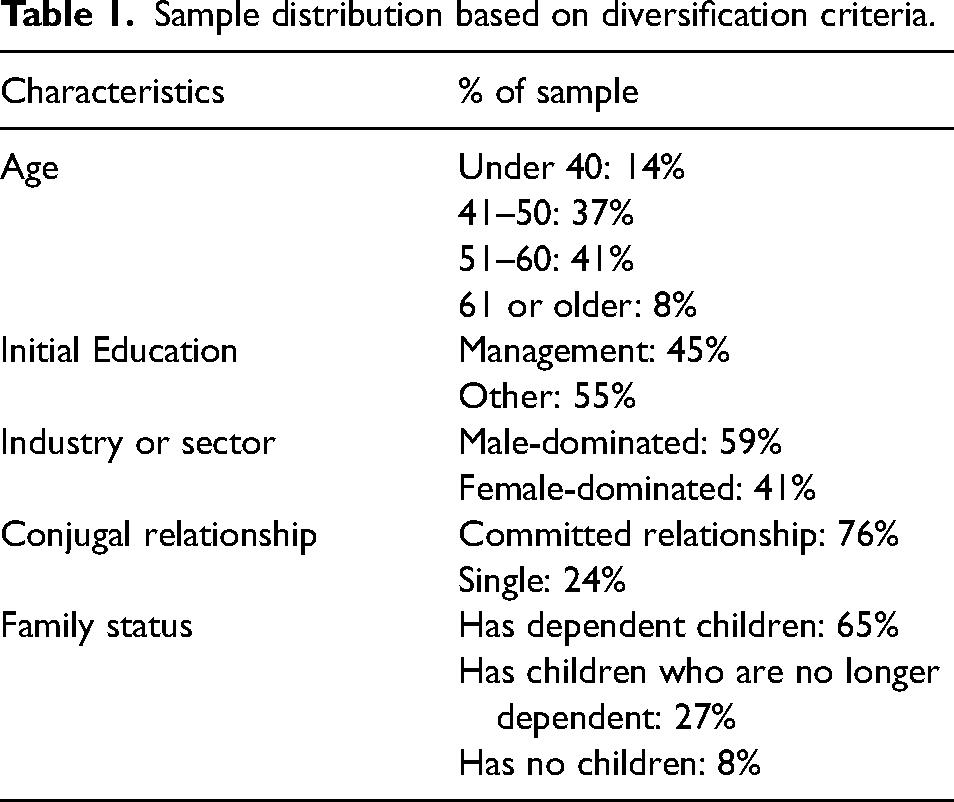
The cohort for our study was made up of women executives with top administrative powers and positions in the hierarchy such as CEOs, vice presidents, and directors (Júlíusdóttir et al., 2018) and who have direct reports. To create a robust cross-sectional sample, our recruitment strategy elicited the participation of different stakeholders and organizations associated with women executives. A participant recruitment leaflet was sent via email and social media using the snowball sampling technique to increase sample diversity (Merriam & Tisdell, 2016). The sample was homogenized using saturation (which allows for the intensive study of a given subject by considering criteria common to all participants) and diversification (which seeks to achieve a high internal sample diversity by using different criteria to maximize the intensive study of the given subject within the group) (Merriam & Tisdell, 2016). Our saturation criteria comprised: 1) having been in a management position for at least two years; 2) having direct reports; and 3) working in an organization with more than 250 employees. Our diversification criteria were as follows: hierarchical level, age, type of training, industry or sector, family, and marital status. In addition, our research project received approval from the relevant research ethics board of our institution. In all, a total of 51 Canadian women executives participated in our narrative interviews. Table 1 shows the sample distribution based on diversification criteria.
Sample distribution based on diversification criteria.
Data processing and analysis
Each narrative interview with participants was transcribed verbatim while safeguarding the confidentiality of the experiences disclosed—for example, personal information such as names and addresses was anonymized. Pseudonyms were also used to ensure participant confidentiality. From individual narrative interviews with the participants, a temporal reconstruction of the career path of each was undertaken to identify and situate, from a diachronic perspective, events and experiences in her professional, family, school, and personal spheres. We then carried out a phenomenological analysis of this data through sensitive listening to the interviews and careful reading and rereading of the transcripts (Paillé & Muchielli, 2016; Tengelyi, 2006). At the same time, we began conceptualizing and theorizing, using conceptualizing categories (Paillé & Muchielli, 2016) to deepen our understanding of the participants’ experiences over time. With this approach, we were able to progressively categorize phenomena captured during the interviews through comparison, as well as through reflective, progressive, and recursive “theoretical” constructions (Paillé & Muchielli, 2016). More specifically, the conceptualizing categories were created dynamically through analytical description, interpretative deduction, and inductive theorizing throughout (Paillé & Muchielli, 2016) using Microsoft Word software. A back-and-forth process between these results and current scholarship in the field of career development for women executives as well as from the theoretical framework of the present study took place to determine the contributions of our research. Data processing and analysis thus resulted in a deep understanding of issues impacting the various life courses of women executives, configurations of rapprochement, integration, distancing, and separation, as well as the choices, renunciations, and compromises involved over the courses of their careers. Lastly, these issues were analyzed against their career trajectories, in terms of transitioning between hierarchical levels and career development.
Results and discussion
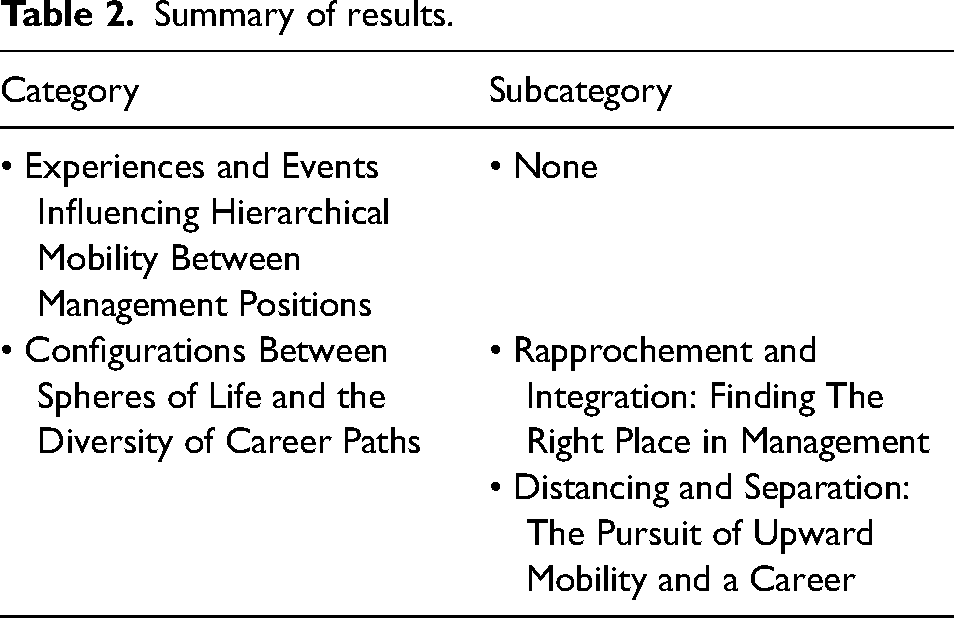
The results of the data processing and analysis can largely be divided into two main groupings: 1) experiences and events in professional, family, committed relationship, and personal spheres of life that can influence hierarchical mobility between management positions, and 2) configurations of rapprochement, integration, distancing and separation between the different spheres of life and ascending, lateral, or descending career paths. Table 2 presents a summary of categories and subcategories derived from the data processing and analysis.
Summary of results.
Experiences and events influencing hierarchical mobility between management positions
Our data processing and analysis made it possible from a diachronic perspective to identify experiences and events that characterize the career paths of women executives and that can result in wide-ranging hierarchical mobility. This mobility can be ascending (e.g., promotion), lateral (e.g., equivalent position), or descending (e.g., demotion), all either within or between organizations. These experiences and events as well as their effect on their possible hierarchical mobility can be grouped into three broad categories, to be discussed in the paragraphs below.
In the first category, we found experiences and events related to restructuring or changes in departments, services, or at the organizational level. These work situations can result in some women executives being promoted (upward hierarchical mobility), transferring to an equivalent position in the organization (lateral hierarchical mobility), or moving down to a lower-level position (downward hierarchical mobility or career regression). In Emmanuelle's case, when her senior management position was eliminated due to restructuring, she ended up accepting a lesser position in a different organization. By doing so, Emmanuelle had stepped down the corporate ladder—a career regression: When the X announcement came, we knew that we were going to lose our places given that the restructuring targeted the elimination of a few hundred management jobs, it was a huge change […] When they re-opened the position for director, a former colleague of mine got the job. She asked me: “What are you going to apply for?” I said: “Listen, I’d like to stay in senior management, I think I’d make a good assistant director.” She said: “That's good.” She called me in for an interview. She didn't hire me. The message came across loud and clear: “Find yourself a job somewhere else.” And that's what I did. I got a middle management job with X [names the organization].—Emmanuelle
The second category comprises challenging workplace situations marked by tension between assigned responsibilities and the participant's work values, which pushed some women executives to switch positions or leave organizations altogether. Similarly, competitive workplace relationships and power struggles for senior leadership roles that might escalate to intimidation, contempt, or even harassment can temporarily slow down or permanently limit upward mobility or—conversely—result in a favorable outcome. Judy spoke of how colleagues tried to intimidate her by discouraging her from applying for CEO—a position she was nevertheless able to land, allowing her to move up the corporate ladder and remain in the same organization: There's constant wrangling for senior jobs or positions at the top of organizations. I waited until 24 h before the deadline to apply for CEO, a position which I currently hold. There were several fellow VPs who were after the same job and tried to intimidate me into not applying […] trying to damage my reputation and credibility by spreading false rumors about me.—Judy
The third category includes experiences and events associated with women executives’ professional, family, committed relationship, or personal spheres of life, such as the kind of work responsibilities or assignments, partner career mobility, relationship breakdowns, and/or blended families that can result in various hierarchical moves (ascending, lateral, or descending) or, in a few cases, temporary career breaks. For example, when her boss asked her to take on new responsibilities, Adrienne was required to move laterally between two management positions, when in fact she was expecting a promotion for the good job she believed she had done: My boss asked me to go and take an equivalent position in the X department within our organization. There had been a problem […] My boss was asking me to go and pick up the pieces, that's why I was a bit disappointed. I said to myself “I thought I did a good job in that role, and I think I deserve to move up in the organization,” and yet I was asked to make more of a lateral move, specifically to fix a problem … no raise, no promotion.—Adrienne
Put simply, all these diverse events and experiences—organizational changes, challenging work environments, tensions surrounding workplace values, competitive relationships and struggles for positions of power, responsibilities and mandates, specific demands from superiors, as well as partner career mobility, relationship breakdowns, and/or blended families—signpost the career trajectories of women executives and can result in ascending, lateral, or descending hierarchical moves between management positions. These findings largely align with the work of Arthur and Rousseau (1996) and their concept of the “boundaryless career” where individuals relocate from one organization to another. At the same time, they also tell a story of complex hierarchical moves between management positions, which goes beyond skill development and the accretion of experiences required for career advancement, as posited by Bozionelos and Baruch (2016). Career development can also be embedded in the different types of moves between management positions. This interpretation of women executives’ workplace and life events and experiences transcends the issue of climbing the corporate ladder and paves the way for a holistic understanding of the social, organizational, professional, family, committed relationship, and personal dimensions of their life projects that may involve lateral or downward moves. In this respect, our findings help fill in some of the gaps noted by researchers in the field of career development theories (Jung & O’Brien, 2019; Schultheiss, 2009).
More broadly, the range of possible experiences and events in the professional, family, committed relationship, or personal spheres of life that underpin the hierarchical moves of women executives between management positions can affect the type of trajectory their career paths take. The temporal analysis of these experiences and events for each participant was followed by a comparison across the group, which allowed us to tease out variably ascending, lateral, or descending trajectories. In comparing the multiplicity of their career paths, it is evident from our findings that not very many have had a linear and continuously upward career trajectory. This corroborates many other studies on the career development of women executives (Ekonen & Heilmann, 2021; Mainiero & Sullivan, 2005; O’Neil et al., 2008). Even among those women with an upward executive career trajectory, many have experienced lateral and sometimes downward moves before climbing back up or reaching the top. At times, these trajectories can resemble a staircase, or a peak, where women remain at the top of the staircase or peak. Those with more lateral career moves tend to have more horizontal than vertical job changes, with their trajectory resembling a sawtooth wave. The few women who have had downward executive career trajectories tend to come down from a peak after having had an upward one. By considering the meaning given to the events and experiences in different life spheres (professional, family, committed relationship, and personal), it made it possible to identify configurations of rapprochement, integration, distancing, and separation underlying this range of career paths. These will be discussed in the next section.
Configurations between spheres of life and the diversity of career paths
Consistent with experiences and events presented in the previous section, the processing and analysis of the material reveal a variety of career paths among women executives that can be divided into two broad processes, which will be described in more detail in the sections that follow: 1) rapprochement and integration: finding the right place in management and 2) distancing and separation: the pursuit of upward mobility and a career.
Rapprochement and integration: Finding the right place in management
In moving between hierarchical levels, many women executives have changed jobs and/or organizations to find the right place in management where they can advance and devote themselves to their careers while reconciling the demands of work with other spheres of their lives (e.g., committed relationships and family). I love my job and it's important to be dedicated, but for me, success in life is not the same as succeeding in my life. For me, for success in my life, the family is a big part of it. I can well succeed in life, but that's at the career level, with all the money and everything that comes with it, but did I really succeed in my life? No, because for me, I have this thing and I say to myself, “No, these different things need to be there for me to be fulfilled.”—Mireille
Although some participants admitted wanting to pursue upward mobility and had offers to do so, there were limits to how much they were willing to sacrifice. For example, if a position required a transfer away from their family, they were not willing to risk separation or being away from their children and/or partners for the sake of an upward move. For these reasons, they either deferred or turned down promotions, opportunities, transfers, or assignments abroad to have time for their children and/or partners and remain faithful to the values in all spheres of their lives. Many of these women embarked on an ascending trajectory and stopped at the second tier of the hierarchy, eschewing the number one position. Others who relinquished the opportunity to move up took a lateral route that allowed them to keep the different spheres of their lives aligned. This way they were able to find the right place in management, a place affording them the possibility of a fulfilling and satisfying career while keeping their professional aspirations balanced with the other spheres of their lives, with the only price to pay a willingness to forego reaching the top. I met a former professional now retired who said to me: “Come on, Marguerite! When are you going to go for senior management?” Never. Because I find that balancing professional and personal life is challenging enough as it is. When you’re in senior management, you don't have a life anymore.—Marguerite
I was truly able to find a place where I belong and can thrive. As long as I can keep on being part of a team that creates shows or do some mentoring, I find that this would be a nice way to ease out the door into retirement [laughter] some time down the road.—Éva
Similarly to those who relinquished the top tier of the hierarchy or made lateral career moves, some women executives have found themselves in work situations that compelled them to step back and accept a downward career path. These women spoke of having to deal with managerial work demands that ran contrary to their values, particularly in the aftermath of organizational change. Faced with these issues and want to preserve their integrity, some downshifted their hierarchical aspirations rather than trade in their values.
Distancing and separation: The pursuit of upward mobility and a career
Not all women executives were willing to settle for lower rungs on the corporate ladder, some changing positions, and organizations with a goal of long-term upward career mobility. In several instances, they went through a process of distancing aspects of other spheres of their life (e.g., committed relationships, family) to devote themselves first and foremost to their career. I remember the summer when my sister-in-law said to me “I’ll take the kids” because I was practically working 24/7; I was working all the time.—Olivia
When it came to their committed relationships, some mentioned the little time they had to spend—or the lack of a relationship at all—with their partner because of this commitment. As for family, some women executives put these relationships in storage to make room for their career aspirations. A few confided they still felt regret, sadness, or guilt years after their decisions. Others said they could no longer feel involved even when they were at home with the children, as if overwhelmed by work. Some opened up about feeling unfulfilled or a void once they had reached the top, almost as if they had not quite found the right place in management, and that self-doubt or challenges related to staying at the top persisted. These feelings and doubts may seem paradoxical and contradictory given all their efforts to reach the top and the sense of success and self-fulfillment that should have compensated for everything they had to forsake. Yet rather than speak of this success and self-fulfillment, some dwelled on the price they had to pay to reach the top, lingering disillusionment or regret: I feel very sad whenever I think of my children, especially when they were in elementary school and I wasn't there to see what was going on. Sometimes we’d be around the dinner table […] they’d be talking about school […] I’d try to follow, and at a certain point I’m there but my mind is somewhere else when I’m sitting around the table, and sometimes I miss out on bits and pieces.—Élodie
As for the small number of women executives who were childless, some pointed out that work had taken over their lives once they decided to have an upwardly mobile career. There were times they had envisioned becoming mothers or having a family, but making this a reality did not quite align with their career: when they felt the time was right in their professional life to have children, the time was not right in their personal life because they were not in a committed relationship. When I was at [names place], it would’ve been very difficult for me to have a family. And when I left and had a bit more time, I didn't have a partner.—Adrienne
Conversely, when they were in a relationship, their demanding careers made it difficult or next to impossible for them to even consider having a child. With the passing of time and as their careers progressed, there was less and less room for a family, particularly because of their demanding or risky management positions.
In sum, these two groupings allowed us to identify several possible configurations of life courses (rapprochement, integration, distancing, and separation) involving choices, renunciations, and compromises that can influence the career paths of women executives, be they ascending, lateral, or descending. Whether through processes of rapprochement and integration or distancing and separation, our analysis shows that for women executives, in one way or another there is either a social or organizational price to pay. The processes of rapprochement and integration can compel them to forego high-altitude careers through fewer chances to align the different spheres of their life. Some give up career aspirations to be part of life projects shared with those dear to them, while also seeking to be fulfilled in their managerial work. Others forsake their professional life to achieve a certain rapprochement, coherence, and alignment between their personal needs and wishes and those of the other important people in their lives in a form of compromise. Conversely, the processes of distancing and separation can mean major renunciations in other spheres of life. This may involve sacrifices both for executive women and the important people in their lives—carrying a higher price given they tend to be more personal in nature—and can also affect a feeling of isolation or loneliness. Do the benefits of breaking the glass ceiling, then, outweigh the cost for women executives? Our answer to this question would be “it depends.” It depends on their life projects. It depends on the meaning given to the experiences and events in their professional, family, committed relationships, or personal life spheres that steer hierarchical moves between management positions and the broader organizational, social, and political backdrops of these experiences and events. It also depends on the configurations of rapprochement, integration, distancing, or separation built between their spheres of life and the diversity of their ascending, lateral, or descending career paths. Yet when and in what contexts will women in management positions are able to climb the corporate ladder without having to give up on one or more of their other life projects? Our findings stake out common ground with studies that show the persistence of sexist stereotypes and the old boys’ club, which can hinder the upward mobility of women in management (Ekonen & Heilmann, 2021; Ezzedeen et al., 2015) and studies that confirm the continuance of conceptualizing career and management work by and for men (Molinier, 2006).
Conclusion
Overall, the findings of the present research open the door to the key experiences, events, and diversity of transitions between hierarchical levels that characterize the career development of women executives. They also show a number of possible configurations of rapprochement, integration, distancing, or separation between the different spheres of life and their influence on executive careers through ascending, lateral, or descending career paths. By highlighting the multiplicity of influential events and experiences of women executives, not only in their career paths but also in the different spheres of their lives, our findings offer a deeper understanding of the issues at stake in their career development. In terms of advancing scholarship, the qualitative outcomes of our study attest to the validity of adopting career path analysis and feminist standpoint theory as frameworks. A narrative research methodology based on women executives’ own accounts of the events and transitions that signpost their life projects and career paths in a perspective that considers the interactions between women and their contexts is also consistent with constructivist and systemic theories of career development (Patton & McMahon, 2014; Savickas et al., 2009). This approach enabled us to peel back the layers of their trajectories and tease out meaning constructed from events and transitions in a diachronic perspective. At the same time, our findings underscore the relevance of adopting a constructivist, systemic, and narrative approach for understanding the events and transitions that characterize professional life courses (Bimrose et al., 2015; Bujold, 2004). Feminist standpoint theory proved indispensable as well, zeroing in on the everyday experiences of women executives’ work by including their different perspectives, these experiences being bodily, biological, relational, social, and societal, framed by a sociohistorical context (Harding, 1993; Leavy & Harris, 2018). Our study also documented lived experiences of women executives that all too often remain ignored or invisible in scholarship on the prevailing research paradigms in the field of management (Harding, 1993; Leavy & Harris, 2018).
Beyond the career models for women executives proposed by a number of researchers (Mainiero & Sullivan, 2005; Shaw & Leberman, 2015), we wish to emphasize the importance of developing an integrated and holistic approach to the dimensions characterizing events and experiences within the different spheres of life. This approach makes it possible to capture the complexities of women executives’ career development and the meaning given to their hierarchical moves and careers through ascending, lateral, or downward trajectories. These findings can be valuable for practitioners, especially those in guidance and counseling, in grasping the complex issues related to how women executives’ career paths are constructed and ultimately supporting this group in their career aspirations. More broadly, these perspectives are promising not only in supporting today's women executives but also for a younger generation of women seeking, in many cases, to build a life by combining several projects in the same time and space (Méda & Vendramin, 2013; Mercure & Vultur, 2010). To this end, a comparative study of the life paths along gender lines would merit further research and enrich academic knowledge of executive career development. Similarly, these new avenues could prove useful for future research in a post-COVID-19 context of change, as the pandemic may have disrupted career advancement for some, particularly women. In our view, more research studies are needed to document the lived experiences of executives in a work environment impacted by COVID-19.
In closing, our research has several limitations. The first involves the lack of generalizability. Although our decision to choose a qualitative research methodology may be limited in applicability to all Canadian women, our sampling strategy was by no means intended to meet representativeness and generalizability criteria (Glaser & Strauss, 1967). Instead, it was designed to find participants with diverse characteristics to gain a deeper understanding of their experiences, a choice that incidentally allowed for greater authenticity in the experiences collected. A second limitation relates to the sector or industry in which the participants worked (male-dominated vs. female-dominated), which is also not representative of all sectors and industries in Canada, especially in the case of traditionally male-dominated ones. A final limitation applies to the definition of our executive group (managers who have direct reports), which may have excluded other types of executives found in the literature, such as those in expert, planning, or functional management positions. In this respect, we admit our study does not cover the gamut of work realities of Canadian women executives, nor the different management positions that could possibly fall under the broad category of “executives.”
Footnotes
Declaration of conflicting interests
The author(s) declared no potential conflicts of interest with respect to the research, authorship, and/or publication of this article.
Funding
The author(s) disclosed receipt of the following financial support for the research, authorship, and/or publication of this article: This work was supported by the Fonds de recherche du Québec – Société et culture (FRQSC).
