




Abstract
This study presents a systematic literature review about career interventions for university students exploring (1) which theoretical framework; (2) structure; (3) evaluation system; and (4) outcomes are reported. Fourteen keywords, five databases, and six eligibility criteria were defined. Among the 596 articles collected, 26 remained for meta-synthesis. Results indicated a predominance of (1) three theoretical frameworks, (2) group intervention modality, (3) pre-and post-test evaluation system, and (4) the positive development of skills in decision-making. Recommendations are presented to guide future research and practice in the field. For example, this study indicates the importance of providing updated information about the world of work within career interventions or educational programs.
Keywords
Technological advances, such as artificial intelligence and robotics, are impacting job structures (Pabollet et al., 2019; Savickas, 2011). Over the last 10 years, new jobs have been emerging (e.g., Airbnb host, influencer, drone operator) and, as a consequence, new abilities are required for people (Pabollet et al., 2019; World Economic Forum, 2018). This volatility can make the academic experience more frequent, as skills training is a requirement for job market progression (Hauschildt et al., 2018; OECD, 2020; Pabollet et al., 2019; World Economic Forum, 2018). Therefore, it is necessary to look at university students. Particularly, due to their increasing heterogeneity (Martins et al., 2018; OECD, 2020) that hinders a prompt and effective response from universities and other professionals who accompany them (Hauschildt et al., 2018).
This inability to meet university students’ needs may increase their anxiety, contributing to maladaptive coping strategies (e.g., drugs or alcohol abuse, Böke et al., 2019). Moreover, students may begin to question their abilities (Marcotte & Lévesque, 2018). Together, these maladaptive strategies contribute to lower levels of well-being, which may result in dropout or major change decisions (Guimarães et al., 2010; Mestan, 2016). In contrast, permanence in higher education will contribute to the human capital building, necessary for one's employability (De Vos et al., 2021; Lo Presti et al., 2020) and to the country human and financial capital (Becker, 1962; Cabrito & Cerdeira, 2018). To this end, Halstead and Lare (2018) recommended higher education professionals develop students’ career skills (e.g., self and environmental exploration, planning, role management). These skills seem to have a positive outcome on people's life (Berg & Lanáreth, 1990; Cardoso et al., 2018; Hughes et al., 2016; Langher et al., 2018; Maree, 2019; Santilli et al., 2019; Whiston et al., 2017). Two recent meta-analyses proved career interventions’ efficacy in improving career maturity, career decidedness, vocational identity, and career decision-making self-efficacy (Langher et al., 2018; Whiston et al., 2017). Specifically, among university students, effect sizes seem to be higher at the career certainty level (Langher et al., 2018). This is relevant once career-decided students get more involved in their studies (Yu et al., 2018). As a result, they will be eager to continue their personal development at their chosen higher education institution (Bargmann et al., 2021).
Over history, to respond to societal questions, vocational psychology sought to develop methods and models that fit personal career goals with society's economic activities (Savickas, 2011). As a result, different theories were emerging. The first theory of career intervention emerged in 1909 with Parson, to respond to immigration, urbanization, and industrialization questions (Savickas, 2011). This framework tried to establish a perfect fit between people's interests and environmental needs. Posteriorly, the rise of middle-class individuals employed by a hierarchical structure originated new approaches such as Super's vocational development theory. It postulates that in certain moments of lifespan, people need to resolve specific career tasks. Nowadays, other approaches are being stated along with new research works (Blustein, 2013; De Vos et al., 2016; Lent & Brown, 2013; Pryor & Bright, 2011; Savickas, 2013) trying to answer to a 21st-century major question: “How might individuals cope with the re-organization of work and employment in multicultural information societies?” (Savickas, 2011, p. 5). This may encourage new career intervention designs. As a result, it is relevant to detail what has been studied in this field, synthesizing evidence for scholars and counselors working with university students.
Until now, two recent systematic reviews were published. However, considering the wider population Oliveira et al. (2017) study focused on career interventions applied from 2010 to 2014, while Hughes et al. (2016) performed research between 1996 and 2016. The first defined career interventions as any direct support to help individuals face career development difficulties. The latter focused on career education programs (e.g., mentoring, job shadowing, work experience), aimed at training the technical skills required for each particular job. To our best knowledge, the last literature review focused on university students dates back to the late 20th century (Pickering & Vacc, 1984). These authors define career intervention as any direct support to facilitate individuals’ career development. For the current 21st century, in particular, for the interval of 2000 to 2015, only Langher et al.’s (2018) meta-analysis was found. These authors include an initial detailed description of all analyzed studies. However, their approach is limited to experimental or quasi-experimental studies due to their primary goal of testing interventions’ efficacy. This excludes, for example, interventions reported in case studies. Furthermore, the search was restricted to ProQuest, Web of Science, and SCOPUS excluding, for example, Latin databases as RCAAP.
Hence, there is a need to complement these studies with a broad and up-to-date approach focused on career interventions for university students. For this purpose, a review study was conducted, defining career intervention as a comprehensive and systematic action adapted to clients’ characteristics, which aims to promote adaptative career skills (e.g., decision-making, planning; Hutchison et al., 2016). These actions may be employed through different modalities (e.g., workshops, psychological counseling; Watts, 2006). Considering the entry into the 21st century as a new milestone in career theories and practices ( Pabollet et al., 2019; Savickas, 2011), this review will include articles published between 2000 and 2021. After study selection, interventions’ theoretical framework, structure (i.e. modality and skills developed), evaluation system and outcomes achieved will be synthesized. One thus hopes to inform on the current career interventions’ state-of-the-art, motivating new studies and empirically validated practices.
Method
PRISMA protocol (Moher et al., 2016) was used to conduct this systematic literature review, answering the following questions: (Q1) “What are the theoretical frameworks behind university students’ career interventions?”; (Q2) “What is the structure of these interventions?”; (Q3) “How the quality of these interventions have been evaluated?”; and (Q4) “What outcomes have been produced?”.
Databases
Five databases were used. Four multidisciplinary (Web of Science, ProQuest, RCAAP, and Redib), and one focused on education topics (ERIC). The Web of Science, ERIC, and ProQuest databases were selected based on the studies performed by Whiston et al. (2017) and Langher et al. (2018). Meanwhile, selecting RCAAP and Redib had the purpose of broadening the knowledge of career interventions in the Latin context. Specifically, including Portuguese and Spanish publications. The research was performed between 16 and 25 of June 2021.
Eligibility criteria
To guide publication selection, six eligibility criteria and 14 keywords were defined.
The six eligibility criteria included publications’ language and year, type of document, population, career intervention description, and evaluation system. Specifically, only scientific articles published between 2000 and 2021 and written in English, Portuguese, and Spanish were considered. Also, the selected scientific articles had to include a career intervention description, an evaluation system and a sample of university students. For our study, the evaluation system was defined as any quantitative and/or qualitative method that sought to analyze differences before and after the applied intervention and/or across the intervention process (e.g., clients’ perception, pre-test and post-test administration). Here, the differences found across or after the career intervention include both expected or unexpected, positive and/or negative changes in clients’ career skills (e.g., decision-making, planning, and career certainty). When articles were not available, the first step was to contact colleagues from other universities with broader access to databases. The second step was to email the article's authors, explaining our study aim and requesting access.
The 14 keywords followed Whiston et al. (2017) and Langher et al. (2018) parameters and were combined by Boolean operators “AND” and “OR”: (“career counseling” OR “career education” OR “career guidance” OR “career intervention” OR “occupational counseling” OR “occupational education” OR “occupational guidance” OR “occupational intervention” OR “vocational counseling” OR “vocational education” OR “vocational guidance” OR “vocational intervention”) AND (“college students” OR “university students”).
Data extraction and analysis
First, each article’s title and abstract were analyzed. This step was performed independently by two researchers to minimize biases. The objective was to understand if the study was focused on university students, presented a career intervention, and an interventions evaluation system. As a result, the first filter was applied. Afterward, the same researchers independently read each accepted article from the previous step, following the same criteria. In the end, only the articles answering these criteria remained. For both filtering steps, disagreements were resolved through discussions between the researchers. Any remaining disagreements were resolved by a third researcher.
After article selection, information was organized and summarized according to the following topics: theoretical framework, career intervention structure, evaluation system and interventions’ outcomes.
Results
Main findings and studies’ characteristics
Five hundred ninety-six articles were identified through database searches. The articles were first exported to Microsoft Excel to eliminate duplicates. Five hundred nineteen (87%) articles remained and were screened for title and abstract. This first screening assessed whether the articles met the eligibility criteria. In case of doubt, the article proceeded to the second phase of screening. As represented in Figure 1, among the 519 non-duplicated articles, the first screening phase identified 461 (88.8%) articles with no career intervention, 4 (0.8%) with no sample of university students and 11 (2.1%) with an evaluation system not focused on the interventions’ content. The remaining 43 (8.3%) went through the second screening phase, where the same eligibility criteria were applied to the full article reading. Among these, 17 (39.5%) articles were excluded (Figure 1), leaving 26 (60.5%) for meta-synthesis.
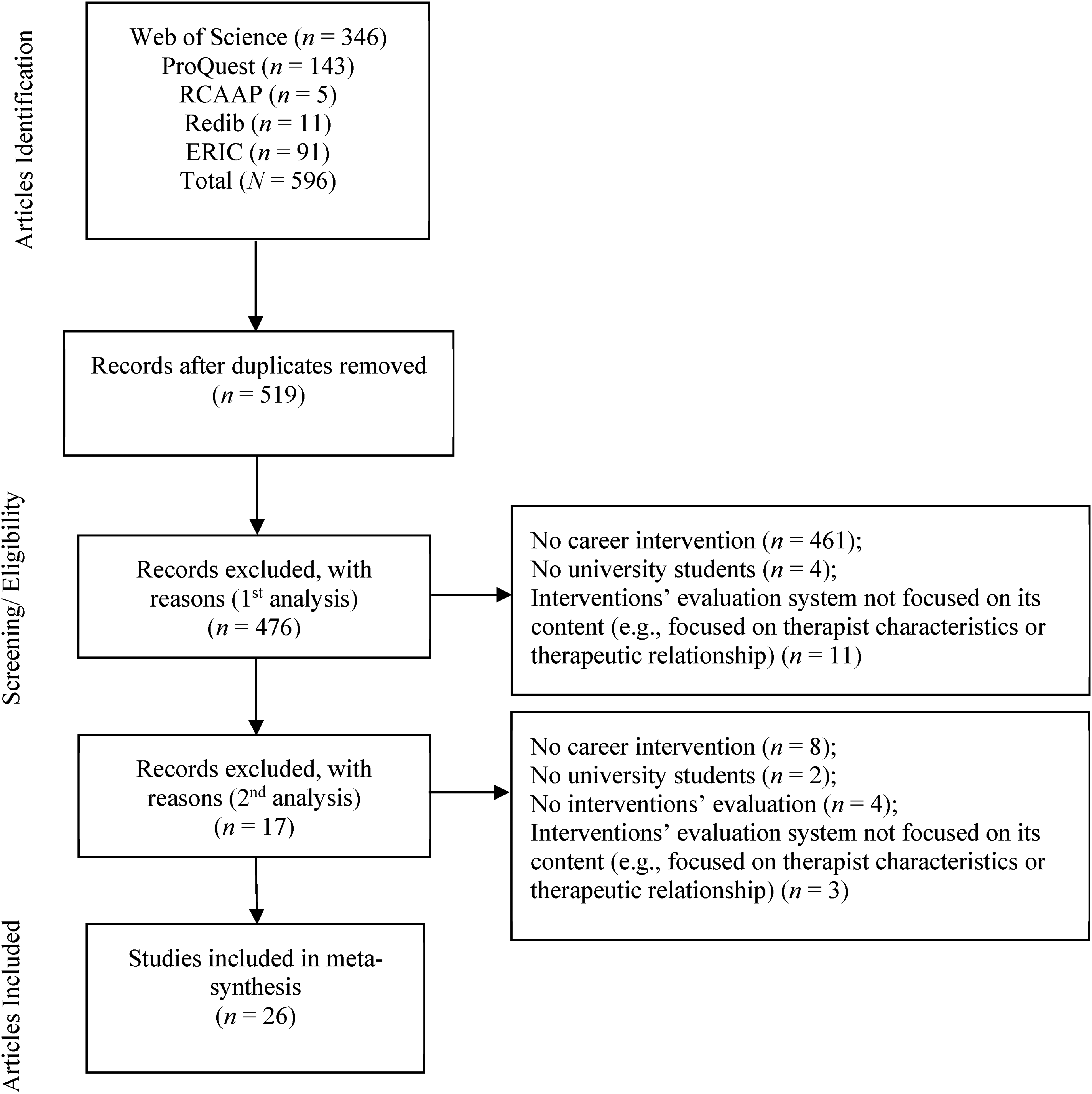
Research and selection process.
There has been a consistent growth in the number of studies published on career interventions for university students: 77% (n = 20) were published after 2010 and, of these, 25% (n = 5) were published in 2018. Only 23% (n = 6) of the included studies were published between 2000 and 2010. The distribution of the studies by country is as follows: United States, 42.3% (n = 11); United Kingdom, 7.7% (n = 2); China, 7.7% (n = 2); Malaysia, 7.7% (n = 2); Nigeria, 7.7% (n = 2); Australia, 3.8% (n = 1); Portugal, 3.8% (n = 1); Korea, 3.8% (n = 1); Turkey, 3.8% (n = 1); Italy, 3.8% (n = 1); Iran, 3.8% (n = 1); and Taiwan, 3.8% (n = 1). As for journals, most of the studies appear published in The Career Development Quarterly (n = 5, 19.2%). The others appear in The Journal of Employment Counseling (n = 3, 11.5%), Psychological Reports (n = 3, 11.5%), Journal of College Counseling (n = 2, 7.7%), Journal of Counseling & Development (n = 2, 7.7%), International Journal of Educational and Vocational Guidance (n = 2, 7.7%), Journal of Career Assessment (n = 2, 7.7%), Journal of Vocational Education and Training (n = 1, 3.8%), Journal of Teaching and Learning for Graduate Employability (n = 1, 3.8%), The International Journal of Management Science and Information Technology (n = 1, 3.8%), Journal of Students Affairs Research and Practice (n = 1, 3.8%), KEDI Journal of Educational Policy (n = 1, 3.8%), Education and Information Technologies (n = 1, 3.8%), and The Australian Journal of Career Development (n = 1, 3.8%).
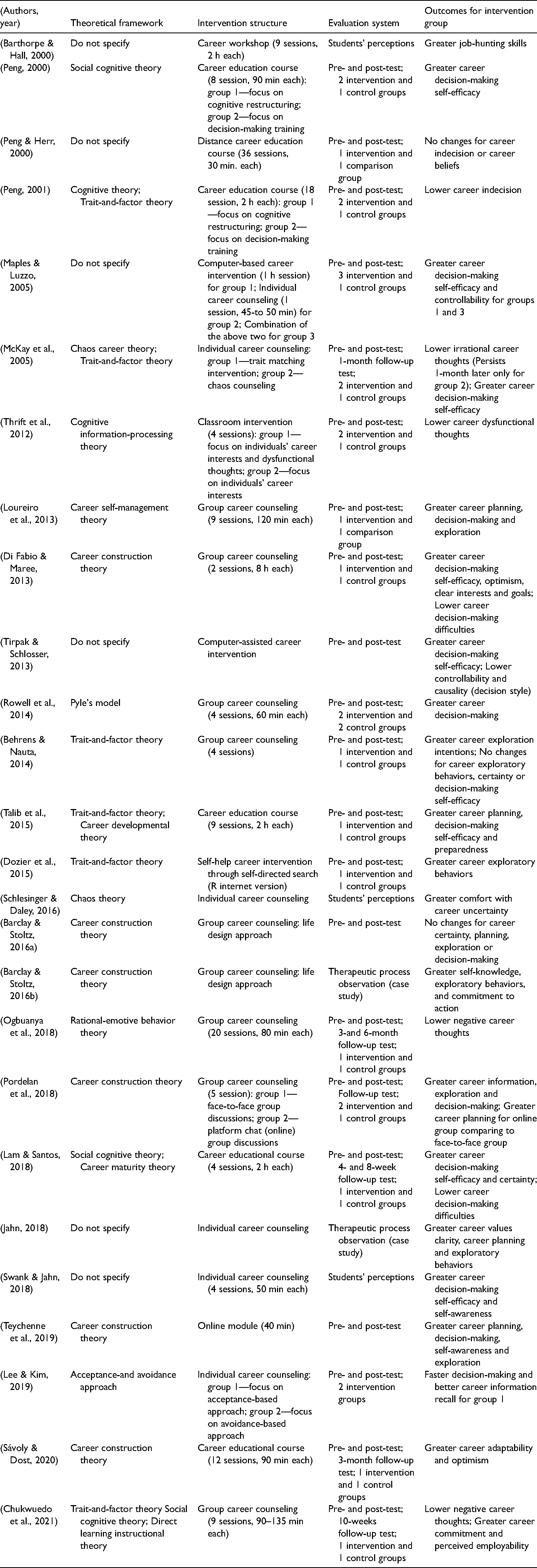
Information regarding the theoretical rationale, intervention structure, evaluation system, and intervention outcomes per study are presented in Table 1 and detailed below.
Research summary.
Theoretical framework
Among the 26 articles included, six (23%) do not detail the theoretical framework underpinning the applied career intervention (Barthorpe & Hall, 2000; Jahn, 2018; Peng & Herr, 2000). The remaining articles indicate some heterogeneity. Although three rationales are noteworthy: the trait-and-factor theory mentioned in six (23%) articles (Behrens & Nauta, 2014; Chukwuedo et al., 2021; Dozier et al., 2015; McKay et al., 2005; Peng, 2001; Talib et al., 2015), the career construction theory also mentioned in six (23%) articles (Barclay & Stoltz, 2016a, 2016b; Di Fabio & Maree, 2013; Pordelan et al., 2018; Sávoly & Dost, 2020; Teychenne et al., 2019), and the social cognitive theory mentioned in three (11.5%) articles (Chukwuedo et al., 2021; Lam & Santos, 2018; Peng, 2000).
Intervention structure
Among the articles included, different intervention's designs emerge. A majority (n = 9, 34.6%) mentions the application of group career counseling (Di Fabio & Maree, 2013; Loureiro et al., 2013; Rowell et al., 2014), followed by individual career counseling (n = 6, 23%) (Jahn, 2018; Schlesinger & Daley, 2016; Swank & Jahn, 2018) and career educational course (n = 6, 23%) (Lam & Santos, 2018; Sávoly & Dost, 2020; Talib et al., 2015). The others are evenly distributed (n = 1, 3.8%) through the following designs: workshop (Barthorpe & Hall, 2000), computer-based intervention (Maples & Luzzo, 2005), classroom intervention (Thrift et al., 2012), computer-assisted intervention (Tirpak & Schlosser, 2013), self-help intervention (Dozier et al., 2015), and online module intervention (Teychenne et al., 2019).
For sessions’ number and duration, 18 articles provide information (Chukwuedo et al., 2021; Di Fabio & Maree, 2013; Loureiro et al., 2013; Ogbuanya et al., 2018; Peng, 2000). The sessions range from 2 (Di Fabio & Maree, 2013) to 36 (Peng & Herr, 2000), lasting 40 min (Teychenne et al., 2019) to 480 min (Di Fabio & Maree, 2013). Out of the eight articles not providing this detail, six present an individual format, either in the presence (Jahn, 2018) or in the absence of the psychologist/researcher (Dozier et al., 2015), and only two present a group format (Barclay & Stoltz, 2016a, 2016b).
Overall, the domains covered in sessions were the following: job opportunities/world of work information (Barthorpe & Hall, 2000; Lam & Santos, 2018; Teychenne et al., 2019), job search training (Barthorpe & Hall, 2000; Chukwuedo et al., 2021; Sávoly & Dost, 2020), skills awareness (Chukwuedo et al., 2021; McKay et al., 2005), application process training (Barthorpe & Hall, 2000; Talib et al., 2015; Teychenne et al., 2019), interview training (Sávoly & Dost, 2020; Talib et al., 2015; Teychenne et al., 2019), personal interests’ exploration (Dozier et al., 2015; Lam & Santos, 2018; Peng, 2001; Thrift et al., 2012), career goals/aspirations exploration and setting (Loureiro et al., 2013; Maples & Luzzo, 2005; Pordelan et al., 2018; Sávoly & Dost, 2020), internship preparation (Schlesinger & Daley, 2016), adaptability training for uncertainty (Schlesinger & Daley, 2016), career decision-making training (Loureiro et al., 2013; Peng, 2000; Rowell et al., 2014), identify and reframe dysfunctional (Thrift et al., 2012) or negative career thoughts (Ogbuanya et al., 2018), define life roles (Sávoly & Dost, 2020), list possible career barriers (Sávoly & Dost, 2020), and reflect on personal career values (Maples & Luzzo, 2005; Peng, 2000, 2001).
Evaluation system and interventions outcomes
Overall, the studies included adopting an evaluation system with pre-and post-testing (n = 21, 80.7%) (Chukwuedo et al., 2021; Loureiro et al., 2013; Ogbuanya et al., 2018; Peng, 2000), including a control (n = 15, 57.7%) (Dozier et al., 2015; McKay et al., 2005; Peng, 2001; Sávoly & Dost, 2020) or comparison group (n = 2, 7.7%) (Loureiro et al., 2013; Peng & Herr, 2000). Four studies (15.4%) report working only with one (Tirpak & Schlosser, 2013) or two (Lee & Kim, 2019) intervention groups. As for the intervention results monitorization across time, only six (23%) studies reported doing so (McKay et al., 2005; Ogbuanya et al., 2018; Pordelan et al., 2018). Under a qualitative approach, three (11.5%) studies (Barthorpe & Hall, 2000; Schlesinger & Daley, 2016; Swank & Jahn, 2018) focus on the evaluation of students’ perception, regarding the progress felt in career skills development across the intervention, and two (7.7%) studies (Barclay & Stoltz, 2016b; Jahn, 2018) report on the therapist's perception regarding this same progress. Next, the evaluated dimensions are detailed, together with the strategies/instruments applied and the results obtained per study.
Career decision-making
Decision-making is the most evaluated dimension among the included studies, and was organized into the following categories: (a) difficulties in career decision-making, (b) self-efficacy in career decision-making, (c) certainty, (d) decision-making skills/readiness, (e) commitment to a career choice, and (f) career decision-making attributional style. Category (a) has been assessed by the Career Decision-Making Difficulties Questionnaire (Di Fabio & Maree, 2013; Lam & Santos, 2018; Rowell et al., 2014). Category (b) has been assessed by the Career Decision-Making Self-efficacy Scale–Short Form (Behrens & Nauta, 2014; Maples & Luzzo, 2005; McKay et al., 2005; Talib et al., 2015; Tirpak & Schlosser, 2013), the Career Decision Self-Efficacy Scale–Short Form (Di Fabio & Maree, 2013; Lam & Santos, 2018; Teychenne et al., 2019), and the Career Confidence Scale (Peng, 2000). Category (c) has been assessed by the Career Decision Scale (Barclay & Stoltz, 2016a; Lam & Santos, 2018; Peng, 2001; Peng & Herr, 2000) and the Career Factory Inventory (Behrens & Nauta, 2014; Teychenne et al., 2019). To answer the purpose of their study, Teychenne et al. (2019) also developed a single item to assess participants’ level of clarity regarding a future career path. Category (d) has been assessed by the Decision-Making subscale of the Career Development Inventory (Barclay & Stoltz, 2016a; Loureiro et al., 2013; Pordelan et al., 2018) and the Career Maturity Inventory-Revised (Talib et al., 2015). Category (e) was evaluated only by one study (Chukwuedo et al., 2021) through two subscales of Vocational Identity Statuses Assessment (i.e., the Career Commitment Making subscale and the Identification with Commitment subscale). Finally, category (f) has been assessed by the Assessment of Attributions for Career Decision-Making (Maples & Luzzo, 2005; Tirpak & Schlosser, 2013). Overall, intervention groups presented greater career decision-making self-efficacy (Di Fabio & Maree, 2013; Lam & Santos, 2018; Maples & Luzzo, 2005; McKay et al., 2005; Peng, 2000; Talib et al., 2015; Teychenne et al., 2019; Tirpak & Schlosser, 2013), readiness (Loureiro et al., 2013; Pordelan et al., 2018; Talib et al., 2015), certainty (Lam & Santos, 2018; Peng, 2001; Teychenne et al., 2019) and commitment to a choice (Chukwuedo et al., 2021), as well as, lower decision-making difficulties (Di Fabio & Maree, 2013; Lam & Santos, 2018; Rowell et al., 2014). Three studies found no changes after career intervention for certainty (Barclay & Stoltz, 2016a; Behrens & Nauta, 2014; Peng & Herr, 2000), readiness (Barclay & Stoltz, 2016a), and decision-making self-efficacy (Behrens & Nauta, 2014). As for the attributional decision-making style, Maples and Luzzo (2005) found greater controllability among the intervention group, while Tirpak and Schlosser (2013) found lower controllability and causality. For a qualitative approach, Schlesinger and Daley (2016) share students’ greater perceived comfort with career uncertainty, after the intervention process. Meanwhile, Swank and Jahn (2018) share students’ greater self-efficacy in career decision-making.
Career exploration
Career exploration is the second most evaluated dimension among the included studies. This dimension has been assessed by the Career Exploration Survey (Behrens & Nauta, 2014; Loureiro et al., 2013) and the Career Exploration subscale of the Career Development Inventory (Pordelan et al., 2018). To measure this same dimension, also Dozier et al. (2015) and Teychenne et al. (2019) asked participants about the number of career choices considered. Studies found greater career exploration for the intervention groups, except in Behrens and Nauta’s (2014) study where no changes were found. Meanwhile, in a qualitative approach, Barclay and Stoltz (2016b) share the counselor’s narrative about clients’ progress on career exploratory behaviors and self-awareness. The same is reported by Jahn (2018), and Swank and Jahn (2018).
Career planning
Career planning has been assessed by the Career Planning Ability Questionnaire (Talib et al., 2015), the career planning subscale of the Career Development Inventory (Loureiro et al., 2013; Pordelan et al., 2018), and the career concern subscale of the Career Adapt-Abilities Scale (Teychenne et al., 2019). To answer the purpose of their study, Teychenne et al. (2019) also developed a seven-item scale assessing individuals planning strategies. These studies reported higher levels of career planning after career interventions. For a qualitative approach, Jahn (2018) shares the counselor's narrative about clients’ progress in career planning skills.
Career beliefs
Career beliefs have been assessed by the Career Beliefs Checklist (Peng & Herr, 2000), Irrational Career-Related Thoughts (McKay et al., 2005), Career Thought Inventory (Thrift et al., 2012), and the College Students Career Thoughts Scale (Ogbuanya et al., 2018). Overall, these studies indicated fewer career beliefs blocking individuals’ career progress after the intervention. Only Peng and Herr (2000) found no changes.
Career adaptability
Career adaptability was assessed by one study (Sávoly & Dost, 2020) through the Career Adapt-Abilities Scale. According to the authors, this scale evaluates individuals’ resources to cope with career transitions, work traumas, and future goals. Sávoly and Dost (2020) found greater career adaptability among the intervention group compared to the control group. Furthermore, this difference was sustained three months after the intervention.
Career optimism
Career optimism was assessed by one study (Sávoly & Dost, 2020) through the Career Optimism Scale. Compared with the control group, the intervention group had higher levels of optimism, which remained three months after the intervention.
World of work information
World of work information was assessed in two studies, using the respective subscale of the Career Development Inventory (Loureiro et al., 2013; Pordelan et al., 2018). Both studies indicated more information among intervention group participants.
Perceived employability
Perceived employability was assessed only by one study through the Perceived Future Labor Market Knowledge subscale of the Perceived Future Employability Scale for young adults (Chukwuedo et al., 2021). Greater perceived employability was found in the intervention group.
Job-hunting skills
Job-hunting skills are a competence worked by more than one study. However, only Barthorpe and Hall (2000) directly evaluated it by asking participants’ opinions about eventual change felt after career intervention.
Discussion
This systematic literature review attempted to summarize the evidence regarding career interventions for university students. The number of articles meeting the inclusion criteria was 26, which were further read and detailed regarding the theoretical framework, intervention structure, evaluation system, and outcomes produced.
According to our results, most studies report relying on at least one theoretical framework for the career intervention construction (Q1). Among these frameworks, trait-factor theory, career construction theory and social-cognitive career theory prevail. Although it remains important helping students find a job aligned with their interests and skills, current labor market volatility poses additional challenges (Pabollet et al., 2019; Savickas, 2011; World Economic Forum, 2018). Therefore, although these three theories remain valid, it is not recommended to use the trait-factor theory isolated. Langher et al.’s (2018) meta-analysis of university students indicates larger effects for the career construction theory when compared with the social-cognitive career theory or trait-factor theory. Authors suggest that enhancing students’ career adaptability and flexibility to cope with environmental challenges can better succeed in facilitating career decision-making processes. Providing these career resources to university students may simplify labor market challenges, reducing this population's anxiety. Thereby, future career interventions may consider this framework for developing new career interventions or improving the extant. Another useful rationale that may complement the career construction theory is the chaos theory (Pryor & Bright, 2011). This rationale also considers current labor market uncertainty, warning about the importance of accepting the unexpected and being able to respond to flexibility, reformulating previous career plans. However, studies are needed to understand which effect is produced when considering chaos theory as a framework for career interventions.
With regard to interventions’ structure, group modality seems to predominate with sessions’ time and number varying (Q2). This modality preference is also observed in previous studies (Langher et al., 2018; Oliveira et al., 2017; Whiston et al., 2017). This may be justified by its utility. On the one hand, the group modality encourages personal growth and fosters a supportive environment through dialogue and counselor support. On the other hand, a group structure is cost- and time-effective (Langher et al., 2018; Whiston et al., 2017). Nevertheless, Oliveira et al. (2017) stress a relevant aspect when suggesting the need to evaluate the adequate number of participants per group before implementing the intervention. As for the number and time per session, it seems to vary even for the same modality. For example, Loureiro et al. (2013) present a group intervention with nine sessions of 120 min each, while Di Fabio and Maree (2013) present a group intervention with two sessions of eight hours each. According to Langher et al.’s (2018) meta-analysis, neither time nor session number is associated with the intervention size effect. Therefore, it is recommended to adjust this parameter to sessions’ objectives and activities, finding a fair balance across sessions. Furthermore, it is also important to note the variability of domains covered in the interventions analyzed (e.g., job search training, skills awareness, interview training, personal interests exploration (Barthorpe & Hall, 2000; Chukwuedo et al., 2021; Dozier et al., 2015; Lam & Santos, 2018; Sávoly & Dost, 2020; Talib et al., 2015). According to Whiston et al.’s (2017) meta-analysis, one of the most important career dimensions to be currently worked on is the world of work information (i.e., its structure and challenges). This information is useful to simplify labor market perceived challenges, enabling individuals to quickly and effectively respond to work reorganization and multiculturalization (Halstead & Lare, 2018; Savickas, 2011). Therefore, future career interventions among university students should include this dimension (i.e., world of work information). Moreover, higher education institutions could adopt programs or materials providing this information to their students. As a result, they will be able to better prepare their students for the university-employment transition (Hauschildt et al., 2018).
Regarding the interventions’ quality assessment (Q3), quantitative studies with pre-and post-test prevail (Chukwuedo et al., 2021; Peng, 2001; Pordelan et al., 2018; Talib et al., 2015), as well as studies with at least one comparison or control group (Loureiro et al., 2013; Ogbuanya et al., 2018; Peng, 2000; Sávoly & Dost, 2020). For pre-and-post assessment, our results indicate a preference for using already validated instruments. We agree with this choice due to the results’ greater reliability. Nevertheless, future studies could use a mixed design, complement the quantitative assessment with a qualitative one. This would allow, for example, comparing and reflecting on instruments’ results and clients’ perception of a specific worked dimension (e.g., self-awareness, exploratory behaviors). It is still relevant to note the scarcity of studies with follow-up assessments (Loureiro et al., 2013; Peng, 2000; Talib et al., 2015; Teychenne et al., 2019). Although recognizing the difficulty in maintaining students’ involvement through the end, one highlights the follow-up utility of acknowledging interventions’ long-standing effects. Therefore, more studies with longitudinal designs are encouraged.
The results regarding intervention outcomes also strengthen previous evidence (Langher et al., 2018; Oliveira et al., 2017; Whiston et al., 2017). Specifically, the present study findings indicate, generally, positive effects on career decision-making, planning, exploration, adaptability, optimism, and perceived employability, among others (Chukwuedo et al., 2021; Lam & Santos, 2018; Loureiro et al., 2013; McKay et al., 2005; Pordelan et al., 2018; Sávoly & Dost, 2020; Teychenne et al., 2019). Among these reviewed studies, the assessment focus on career decision-making skills prevails. Pickering and Vacc’s (1984) systematic review, in tandem with recent meta-analyses on the general population (Whiston et al., 2017) and university students (Langher et al., 2018), likewise indicate concern in assessing career decision-making skills. Specifically, career decision-making self-efficacy and certainty (Langher et al., 2018; Whiston et al., 2017). These results seem to indicate that the assessment pattern barely changed across time. Therefore, aware of current labor market volatility and competitiveness (Pabollet et al., 2019; Savickas, 2011), the following reflection should be taken into account: Would it be advantageous to broaden the focus to other competencies’ development and assessment, such as adaptability and exploration? While the ability to make informed and committed choices will continue to be relevant in the current 21st century, developing skills that allow students to respond to a constantly reorganizing environment will also be fruitful. Another issue highlighted is the importance of developing studies evaluating career interventions in specific university students’ subgroups. Overall, studies do not contemplate targeting vulnerable groups as working students or students with physical or mental disabilities. Considering university students’ heterogeneity (Martins et al., 2018; OECD, 2020), this analysis will be relevant to understanding different problems and needs, adjusting career intervention. As a result, higher education institutions and employers will get more accomplished and work-motivated students, which contribute to population qualification and sustainable economic growth (Guimarães et al., 2010; Halstead & Lare, 2018; Marcotte & Lévesque, 2018; Mestan, 2016).
In short, the present study offers relevant contributions for career counselors and higher education institutions envisioning better-prepared students in dealing with labor market challenges. Topics discussed include: (1) the importance of complementing the trait-and-factor approach with constructivist or other approaches that consider a contextual dimension, (2) include the world of work information in career interventions or even (3) attending skills as adaptability to complement the current focus on career decision-making skills training and assessment. In the last 20 years of research about career practices, one still observes a predominant focus on career decision-making skills training, despite the advances. Today's labor market volatility imposes additional challenges diminishing these skills’ salience (Pabollet et al., 2019; Savickas, 2011; World Economic Forum, 2018). More than being able to make decisions, students need to develop skills that increase their self-efficacy and decrease their anxiety about uncertainty. A career choice made at a given moment may need to be adjusted. Therefore, one recommends an emphasis on perspectives that consider career self-management (e.g., goal setting, career planning) as a continuous adaptation process to an ever-changing work environment (Lent & Brown, 2013; Savickas, 2013). Raising awareness among university students to continuously self-regulate their career path and be flexible should be a goal for future career interventions. Students’ career flexibility in the face of adversity (e.g., pandemic context, loss) may be accomplished through practice. Specifically, through self- and environmental exploration skills, setting goals anticipating barriers and considering alternative career plans (Lent & Brown, 2013; Pryor & Bright, 2011; Savickas, 2013). This will enable a sustainable (i.e., flexible and meaningful) career path and may be applied to every student, regardless of their developmental stage (De Vos et al., 2016; Lent & Brown, 2013). As mentioned by Savickas (2013), career develops through environmental adaptation rather than inner structures’ maturation. As a result, it is recommended to develop these skills among university students without underestimating human idiosyncrasies throughout the process. In other words, one might expect that different students display different characteristics (e.g., career beliefs, past experiences), which may condition future career goals and behaviors (Lent & Brown, 2013). Therefore, career counselors need to integrate these aspects during the intervention activities, for example, by helping students formulate specific goals in line with their values, skills and interests. Or by considering their specific vulnerabilities to the desired career path.
Without lessening these contributions, some limitations need to be highlighted. Specifically, recalling that the present study only focuses on scientific articles and presents a restricted number of databases and languages (i.e., only include articles written in Portuguese, English, or Spanish). Future studies may overcome these limitations, considering other databases and document types as master or doctoral dissertations. Furthermore, as suggested by an editorial board reviewer, it would be relevant that future studies include the use of bibliometric databases (Bibliometrix, VOS Viewer) to identify key thematic cores and other important features. As for the language, the established criteria met the available resources of the present study's authors. Considering that other people may also present these limited resources, future studies could prioritize English as the primary means of communication. Therefore, more people, including academics and career counselors may understand the study, updating their knowledge and practices.
Footnotes
Declaration of conflicting interests
The authors declared no potential conflicts of interest with respect to the research, authorship, and/or publication of this article.
Funding
The authors received no financial support for the research, authorship, and/or publication of this article.
