




Abstract
To boost the existence of career-learning environments in Dutch vocational education, the innovation project ‘Career Orientation and Guidance (COG) in Secondary Vocational Education’ started in 2012. In this article, we describe the effects of this project on the level of policy formulation and implementation by means of three case studies. Data were collected at three schools through interviews, observations of meetings and teacher training, and analysis of policy documents. We conclude that a dialogue between managers and teachers, as well as among teachers is essential for changes in the learning environment of the students, since formulating a school-wide strategic policy requires communication between the different levels of the organisation, and clear tactical policy or operational plans require teacher teams and their team leaders to engage in substantive dialogues about the Career Orientation and Guidance innovation process. Instructional as well as transformational leadership stimulates a dialogical work environment for teachers and their managers, which is necessary for a dialogical career-learning environment for students.
Keywords
Introduction
In Dutch vocational education, teachers are mainly responsible for career guidance, as the delivery by external career services has been mostly eliminated (Hooley, Watts, & Andrews, 2015; Hughes, Meijers, & Kuijpers, 2015). Secondary vocational education institutes in the Netherlands offer vocational training on four different levels with different duration (one to four years), including work place as well as school-based training. Most Dutch schools do not have the financial means to provide students with career guidance by professional career counsellors. Therefore, teachers in Dutch vocational education must fulfil the role of career counsellors, typically without receiving suitable training and support to do so (Oomen, Van den Dungen, Pijls, & Egelie, 2012). This role is quite difficult for teachers to fulfil, as it requires a different approach towards their students than regular teaching activities (Winters, 2012; Mittendorff, 2010). Furthermore, policy on innovative career guidance in Dutch education is mostly missing (Bakkenes, Oomen, & Meijers, 2002; Meijers, 2001; Hughes et al., 2015).
Meijers, Kuijpers, and Bakker (2006) and Kuijpers, Meijers, and Gundy (2011) investigated under which conditions students (age 12 to 24) were most able to develop career competencies, which are needed for today’s labour market and to build a career identity. What appeared the most essential were (a) a practice-based curriculum, where real-life experiences can be gained and (b) a career dialogue at school and in work placements (i.e. dialogues that teachers have with their students, in which meaning is attached to concrete experiences with work). This learning environment differs considerably from a traditional one by not primarily focusing on information transfer and monologue, and not being geared towards a standard learning-route (Draaisma, Meijers, & Kuijpers, 2017; Den Boer & Hoeve, 2017). Such a practice-based and dialogical learning environment contributes to the use of so-called career competencies (Kuijpers et al., 2011) In higher education, it also contributes to increased motivation for learning, certainty with regards to career choice and a decreased risk of drop out (Meijers & Kuijpers, 2014). However, Meijers et al. (2006) showed that a strong career-learning environment was present in only 3 of the 226 classrooms studied.
Oomen (2010) concluded that guidance services in Dutch vocational education are more developed than in general education, but the guidance provided focuses primarily on supplying information about further education. Research by Winters, Meijers, Kuijpers, & Baert, (2009) showed that, in conversations about students’ experiences in work placements, teachers talk to students 65% of the time, 21% of the time they talk about the students, and only 9% of the time was spent talking with students. The underlying reason seems to be a lack of teachers’ dialogical skills in combination with a professional identity that is focused on transfer of knowledge and providing feedback in a rather monological manner (Winters, 2012; Den Boer & Hoeve, 2017).
In 2012, the Dutch Ministry of Education launched the national innovation project ‘Career Orientation and Guidance (COG) in Secondary Vocational Education (SVE)’. The purpose of the project was to provide more training for teachers, to formulate and implement a clear policy on COG in schools, and – more generally – to boost the existence of a career-learning environment in vocational education. In this article, we present results from a study into the effectiveness of this national project on the level of policy formulation and implementation with respect to the creation of a so-called ‘strong’ career-learning environment, by describing the influence on the policy of three schools that participated in the project. In exploring this process, we hope to contribute to the international issue of implementing 21st-century school-based career guidance (Hughes, Law, & Meijers, 2017; Hooley et al., 2015).
Project COG/SVE
In the Netherlands, vocational training in SVE varies in duration (from one year up to four years), school level (from level 1 to level 4, with level 4 being the most difficult) and type of training. A distinction is made between school-based (between 20 and 60% includes practical/workplace training and the remaining time is spent at school) and work-based training (a minimum of 60% includes practical/workplace training and the remaining time is spent at school; Ketelaar, Beijaard, Boshuizen, & Den Brok, 2012). The vocational education sector in the Netherlands consists of 66 vocational education colleges comprising multidisciplinary, agricultural and specialised colleges (for more details see www.mboraad.nl/english).
In 2012, the project ‘Career Orientation and Guidance in Secondary Vocational Education (COG/SVE)’ was implemented by MBO Diensten (SVE services), a project office that carries out different innovative projects in vocational education financed by the Dutch Ministry of Education. In the project, 37 secondary vocational schools (students age 16–20) in the Netherlands received professional guidance (a) to develop a ‘strong’ (i.e. dialogical) career-learning environment by training teachers in conducting dialogical career conversations and (b) to underpin this strong learning environment by a well-developed vision and policy on career guidance in schools.
The training program consisted of an off-the-job and on-the-job stage, because an off-the-job training program for teachers proved to be insufficient to achieve significant changes in guidance conversations (Meijers & Kuijpers, 2014). In combination with individual coaching and team coaching on-the-job, the program proved to be effective in improving guidance conversations (Kuijpers & Meijers, 2017). In the training program, emphasis was placed on explaining theory regarding narrative career guidance and putting theory into practice in career conversations through using video-recorded conversations of the teachers with their students (for more details on the training program see Draaisma et al., 2017).
Furthermore, schools were offered support in creating a vision and a policy for the creation of a strong career-learning environment that was consistent with the schools’ values. In the project COG/SVE, the formulation of a vision and policy was the responsibility of the schools themselves. If requested, schools (i.e. the project managers) could receive guidance from professional experts. This guidance focused on formulating a vision and policy on offering students more freedom of choice and real-life work experiences (e.g. through new guidelines for curricula and creating more room for work placements). Schools were encouraged to concentrate on their own needs, since every school had a different starting situation regarding career guidance. It was hoped that the project managers could persuade their managers (i.e. team leaders, managing directors and executive board) to invest in the learning processes on career guidance and to focus on the formulation of long-term policy and school investment plans. The project COG/SVE focused primarily on the teachers and project managers; management (i.e. team leaders, managing directors and executive board) was not explicitly involved. In this article, we focus on the process of formulating and implementing this vision and policy within three schools.
Collective learning
The project COG/SVE aimed for a reculturing of the participating schools towards a non-traditional learning environment for students, where career dialogues were used to attach meaning to experiences between teachers and students, occupied a central role. Essential to this process is developing the values and professional identities of the teachers to be more career oriented than previously. An organisational vision to direct the process of knowledge creation, information for those concerned, and some disruption that stimulates the interaction with the environment, drives this collective learning process (Lodders, 2013; Nonaka & Takeuchi, 1995). Lodders (2013, p. 15) defined collective learning as ‘the work-related learning processes that arise when the members of a collective collaborate and consciously strive for common learning and/or working outcomes. Such learning may result in long term changes in skills, knowledge attitudes and learning abilities, or changes in work processes or work outcomes, signifying development and change respectively’. This collective learning cycle ideally starts with a shared vision or ambition. Thereafter, the teacher teams generate information, distribute this information, and engage in a dialogue on this information to collectively interpret the information, which eventually leads to collective action. Evaluation and reflection on the other aspects of the learning cycle can lead to reengaging in the other aspects, and different aspects of the cycle can occur at the same time (Lodders, 2013, Castelijns, Vermeulen, & Kools, 2013). As the last phase of the cycle is completed, new ambitions can be defined and a new cycle can start. Collective learning is a continuous process, aimed at gaining collectively shared knowledge. Other characteristics that influence the outcome of the phases of the collective learning cycle are shared influence, shared interest, and variety in perspective for engaging in a constructive dialogue on the aimed learning outcome (Castelijns et al., 2013).
Changing a school’s culture (i.e. reculturing) requires changing deeply embedded patterns and shared values, and this happens gradually over a long period of time (Blood & Thorsborne, 2005; Fullan, Cuttress, & Kilcher, 2009). Reculturing is a process of co-creating and applying new meanings to situations of ambiguity and uncertainty on a dialogical basis (Fullan, 2007; Geijsel, Meijers, & Wardekker, 2007). Therefore, in order to establish reculturing, the teachers need to engage in an implementation cycle through collective learning for realising the envisioned change, and to develop a shared understanding and definition of the learning process and the knowledge outcome (Gubbins & MacCurtain, 2008).
Educational leadership
Reculturing and collective learning do not occur without educational leadership. In previous research on the implementation of new forms of COG in Dutch vocational education, transformational leadership was often lacking and specifically desired by the teachers. In particular, the aspect of developing and communicating a shared vision on the envisioned change process was mostly absent (Draaisma et al., 2017). Besides this vision building, transformational leadership is characterised by two other elements: intellectual stimulation and individual support (Geijsel, 2015). Recent work on educational leadership practices emphasises the effective combination of transformational leadership and instructional leadership (Day, Gu, & Sammons, 2016; Geijsel, 2015). An instructional leadership style is being executed by one expert principal in a directive and charismatic way to establish clear education goals, to control and supervise the curriculum and instruction in the school. Moreover, this style focuses on enhancing the measurable outcomes for students (Bush & Glover, 2014; Day et al., 2016; Hallinger, 2003). While transformational leadership focuses on the goal of improving student learning via teachers, it focuses primarily on the process of how leaders influence their employees. In a mixed mode, instructional (top–down, structural) and transformational (bottom–up, cultural) leadership each have their place and seem to complement one another instead of being distinguished. Instructional leadership is characterised as seeking direct influence on the quality of the curriculum and the instruction in the classroom, while transformational leadership seeks to increase the capacity of employees to produce this quality of the curriculum and the instruction. Research by Day et al. (2016) found evidence for this effective leadership integration: ‘In the effective and improving schools in our study, principals palpably exercised both “transformational” and “instructional” leadership’ (p. 252). This suggests that a strategy where top–down or instructional leadership and bottom–up or transformational leadership work simultaneously on designing and implementing the innovation process can be successful.
Dialogues
Dialogue is a fundamental aspect of collective learning as well, as the members of the collective do not just learn from one another, but need to develop a shared understanding and meaning of the learning process for a successful innovation (Garavan & McCarthy, 2008). The type of dialogue needed for collective learning does not, by definition, seek consensus, but assumes pluralism and even benefits of conflict (Chiva, Alegre, & Lapiedra, 2007, Castelijns et al., 2013). Within an educational organisation, three relevant levels of dialogue can be distinguished: a dialogue between a teacher and a manager or supervisor; a dialogue between teachers and a (career) dialogue between a teacher and a student (Day et al., 2016; Geijsel, 2015; Gronn, 2009; Hallinger, 2003).
Communication between the higher management of the school (i.e. the executive board and the managing directors) and their teachers and team leaders seems essential to (a) gather information and perspectives for developing a vision on the (culture) change, (b) provide individual support and intellectual stimulation, (c) share their frames and boundaries in the form of a strategic policy and (d) engage in dialogues about the space and autonomy that (teams of) teachers and the team leaders have regarding developing a tactical policy in the form of operational plans on the envisioned change (Kotter & Cohen, 2002). To be effective, in the strategic policy, the higher management must clearly formulate what the school-wide problem is, and in what direction the solution can be sought (Yorks, 2005). This strategic policy must be feasible and is ideally supported by long-term funding and sufficient staffing (Weggeman, 2015). A strategic policy differs from a vision, as a strategy is more specific in the focal points, timeline, and accompanying actions than the mostly rather ambiguous vision.
Alongside sharing the strategic policy with the teachers and team leaders in a dialogical way, it is up to the teacher teams to develop their operational plans collaboratively, guided by their team leaders (Spillane, Harris, Jones, & Mertz, 2015; Yorks, 2005; Weggeman, 2015). In this way, operational plans or tactics can be constructed on a team level within the frame of the strategic policy. This distinction between strategic and tactical policies is well known in the management literature, but to a large extent neglected in literature regarding innovation in an educational context. The development of the tactical policies in the form of operational plans requires dialogues among the teachers to construct policies that are unfolded from a shared vision of the team and respond to the needs and wishes of the individual team members so as to eventually to lead in collective action (Lodders, 2013, Lodders & Meijers, 2017). The required dialogues differ from information exchange, as they are essential to build bridges between all the informed individuals. The operational plans need to be annually evaluated and adjusted, and higher management should regularly inform their employees regarding the strategy. On a management level, feedback should be given continuously on the operational plans or tactical policy; otherwise the implementation of these plans will not endure (Versnel & Brouwer, 2011). Furthermore, dialogue between the higher management (i.e. the executive board and the managing directors) and team leaders and teachers is beneficial after evaluation of the operational plans in order to agree on adjustments within the strategy where needed.
Aim and method
Research questions
The aim of this study is to describe the policy-shaping process and implementation in three vocational education institutes that participated in the project COG/SVE. We conducted three case studies to gain deep insight (a) into the innovation process initiated by the project regarding the formulation and implementation of a policy on career guidance and (b) into the role of dialogues and leadership during this process. We aim to answer the following research questions:
To what extent are dialogues conducted between managers and teachers, and among teachers? How is collective learning realised, and what leadership style of management stimulates this collective learning process? To what extent is a clear distinction visible between strategic policy and tactical policy? Does the dialogue between managers and teachers, as well as among teachers, contribute to the realisation of strong career-learning environments?
Data collection
Our research design was multiple case, descriptive and theory testing (De Vaus, 2001; Wester & Peters, 2004). We strategically selected three schools that participated in project COG/SVE since 2012 on a voluntary basis, in order to establish a diverse selection representing many of the other cases in the project (Seawright & Gerring, 2008). School 1 was selected because of its relatively isolated project group that worked on the COG policy alone. School 2 was selected because of its strong efforts to involve the managers (i.e. the team leaders, the managing directors and the executive board) in the dialogues on COG. School 3 was selected because of its priorities in attuning policy and practice on different levels of the organisation. As we were familiar with the chosen schools and their strongly different contexts (they had participated in earlier studies on the project), we knew the population and could select our cases based on their suitability to answer our research questions. This context-sensitive case selection, therefore, increased the validity of our study (Poulis, Poulis, & Plakoyiannaki, 2013).
All data collection was executed by the first author, as part of a longitudinal research project into the structural and cultural effects of the project COG/SVE. Since this research project started in 2013, the author was familiar with the circumstances of the three schools regarding COG, and an open and informal relationship with the teachers and project managers was already established. We evaluated the situation of each school by conducting semi-structured interviews with project managers, participant observation of meetings regarding the strategic and operational vision and policy, and participant observation of training sessions for teams (see Appendix 1 for an overview of the collected and analysed data).
The nature of the semi-structured interviews with the project managers was open and informal, but a list of topics was used that had to be covered: the process of creating, documenting and distributing the renewed policy on career guidance, and the perceived results of and changes since the start of the project COG/SVE. Furthermore, various aspects of career development and a career-learning environment were discussed using a schema (see Figure 1). Example questions of the semi-structured interviews are: What aspects of the schema should be prioritised in the process of COG policy formulation? What is still needed on these aspects? How is the developed vision on COG established within your school? What is the role of your manager in this process? With whom do you talk about COG, how, and what are the consequences of these conversations? and What has specifically changed on the aspects of career development and the learning environment?
Schema used as interview guideline: aspects of career development and learning environment.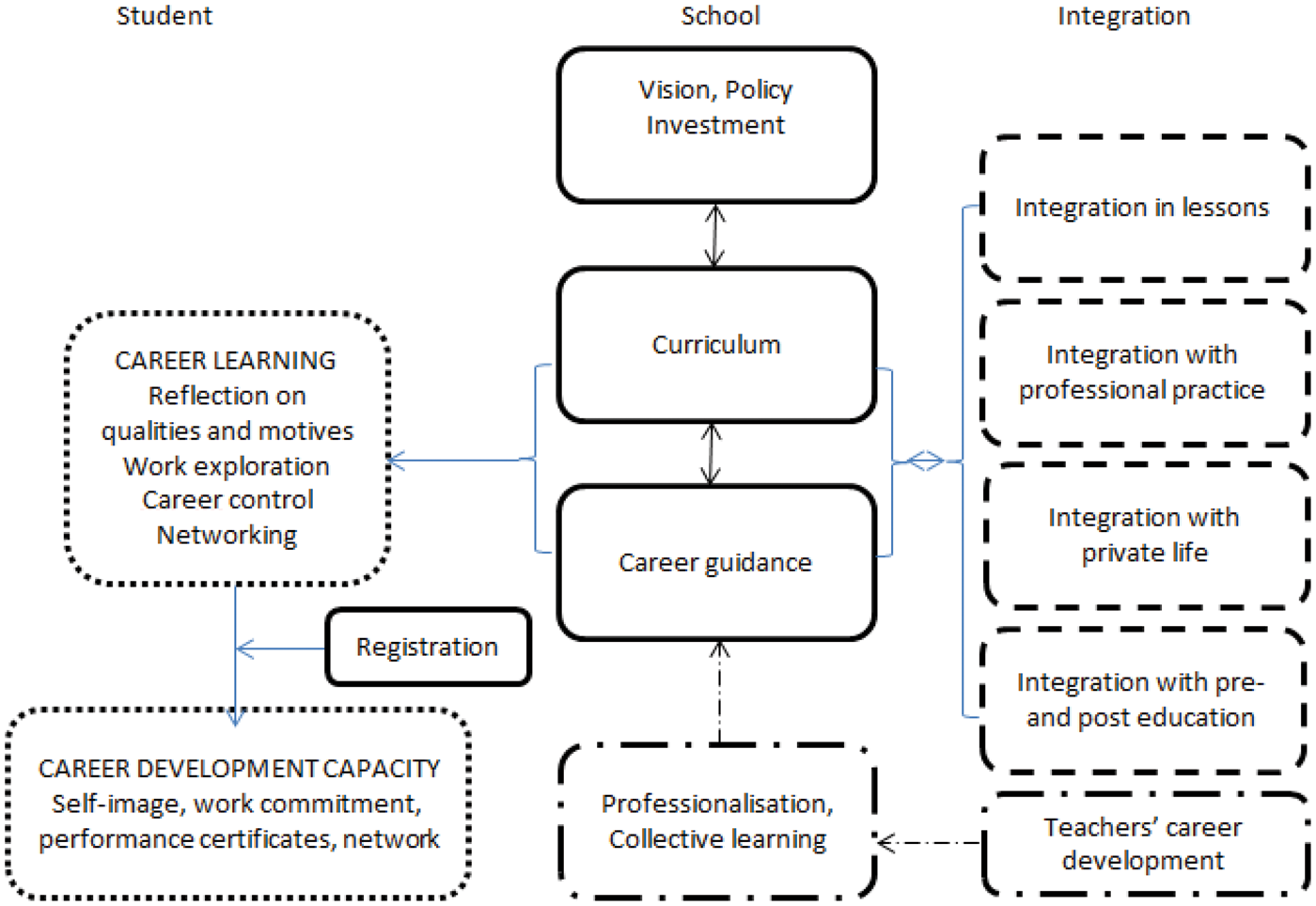
The interviews took 52, 39 and 54 min, respectively, were digitally audio recorded, and transcribed verbatim. Direct observations of project group meetings and training sessions allowed a closer investigation of dialogue, leadership involvement and teacher work in progress, which became a useful complement to the interviews. Field notes were taken during observations, and all field notes resulted in reports of the meetings. Furthermore, we studied policy plans regarding COG of each of the schools to find out if strategic and tactical policy was developed. These data were collected over a period of 10 months, from March 2015 to December 2015. In all three cases, the concluding, semi-structured interviews with the project managers were held in May or June 2016.
Data analysis
To undertake the coding process, empirical data from the three case schools were analysed using within-case and across-case analyses. Each observation and interview was studied by the authors in order to identify prominent themes or patterns. Thereafter, the observations, field notes and interview transcripts were analysed with the qualitative data analysis program Nvivo 11 by the first author, by use of a bottom–up, iterative and inductive coding approach (Miles, Huberman, & Saldaña, 2014; Mortelmans, 2011). Nvivo is an often used qualitative data analysis program in educational sciences, since it allows the user to conduct constant comparison analysis (Leech & Onwuegbuzie, 2011; Mortelmans, 2011). To analyse our qualitative data, categories and relationships between the categories were formulated by observations of the data, and descriptive codes and sub-codes were given to different categories. Examples of codes are: Obstacles policy implementation, Conducted dialogues and Management support for collective learning. This adding of codes continued until saturation took place. Strongly overlapping codes were merged (see Appendix 2 for the final coding schema). Within-case analysis was performed by including all interviews and observations from one school. Across-case analysis was conducted, and variations between schools were identified and their impact on the results of the innovation process was described (Miles et al., 2004; Wester & Peters, 2004). During and after the phase of analysis, meetings between the authors were regularly planned to discuss the methods, procedure and (preliminary) findings.
Finally, we studied the policy plans regarding COG of each of the three schools to discover if, and to what extent, strategic and tactical policy was developed. If possible, we analysed the policy documents in Nvivo 11 as well, using the same method and coding schema as the analyses for the observations and interviews. Policy documents that were received in print or in Portable Document Format (PDF) were thoroughly read and marked to link segments to the categories developed in Nvivo 11 during the analysis of the other documents, observations and interviews.
Results
School 1
Dialogues
The implementation of COG at School 1 was undertaken by a small group of teachers and policy makers. This group focused on writing a renewed vision on career guidance and sharing this vision with the managing directors of the four different locations. This group of five described themselves as devoted, and almost all of them finished the off-the-job training days of the project COG/SVE. They met on a regular basis to work on the career guidance vision and consequently engaged in dialogues regarding COG together. However, the dialogues did not extend much further than this group. This process of documenting a vision document and thereafter trying to share it with the managing directors of the four locations had occurred twice during the project COG/SVE, with an interval of two years between each attempt.
The first time, the vision was barely spread; it was just shown to the director of Educational Development for signing. The second time, the project manager gave the vision document to the director of Educational Development, and the director was supposed to communicate this vision with the managing directors of the different locations. This mirrored the first procedure, and the vision again failed to spread within the school. They did, however, try to inform the managing directors of the different locations of their renewed vision, but there seemed to be no dialogue between the members of the project group and the managing directors. The project manager of the project COG/SVE of School 1 emphasised that she was disappointed in the spreading process; she said that the vision document did not leave the desk of the managing directors, and it was not shared with the teacher team leaders.
It is again a document that remained with the managing directors too much. Not enough shared with the team leaders, not enough. But well, that says something about our project group as well, I think, that we might did not do enough ourselves, did not put enough effort in it and so on. (Project manager, School 1)
The teacher team leaders were not well informed by the managing director of their location on the school’s vision on career guidance or the project COG/SVE the school was participating in. As a consequence, they were unable to communicate this with their teacher team. Moreover, they did not feel it was necessary to do so. During the observed team sessions, the team leaders were mostly absent and therefore unable to answer the many questions on the how, why and who of the training in the context of the innovation process. For the teams that participated in the in-school team sessions on COG with an external trainer, there was a significant lack of clarity, and many questions were raised.
Multiple sessions are planned for us, but for me it is completely unclear what we are going to do with this information. (Teacher, School 1)
Collective learning
The collective learning of School 1 was mostly organised through team training on COG, which was provided by an external trainer. Since the policy of this school was that a desire for this training (or a desire for specific tools, guidance methods, etc.) had to arise from the teams themselves, it was up to the teams to initiate their team sessions regarding COG. This occurred on a very small scale. Further, the teams that did participate in the observed organised training sessions had clearly not signed up themselves; there was barely any knowledge of COG beforehand. Constructing a shared vision with the team, which is the first phase of the collective learning process, was attempted by the external trainer, but because of a lack of awareness of a framework of reference and expected direction, this team-specific vision failed to be established during the team sessions. Therefore, the other phases of the collective learning process were not reached and there was no sign of collective action after participating in the training days.
Strategic and tactical policy
School 1 adopted a bottom–up approach, which was explicitly emphasised by the project group.
Thinking the other way around, which is very propagated here at school, is entirely how we want COG to settle in the teacher teams. To let the teacher teams ask for it [training sessions] themselves. (Project manager, School 1).
What is it that we do with this, school-wide? I feel like it is a bit unsettled. The direction is not yet clear, there is also no policy or vision or something. (Team leader, School 1)
School 2
It was our ideal that we would bring people into a different mind-set, that this is the approach for a dialogue, a progress review or a performance review or however you want to call it in this organisation. That results in a very different perspective than if you keep persisting in your own way. (Project group member, School 2)
Subsequently I did not notice what I hoped for, firstly that they [the managers] would adopt this, but secondly that it would help to enthuse teachers within their own location for career dialogues, but I did not notice any difference on that. (Project group member, School 2)
Collective learning
School 2 intended to train all teachers, managing directors and the executive board, which was a total of 1073 employees, between 2014 and 2016. This training consisted of four half days; teams could sign up together, or teachers, intake coordinators and managers could sign up individually. The school organised multiple workshops and presentations on COG during professional development days for teachers and managing directors. These sessions were carried out by external trainers with the aim of providing information on the concept and creating enthusiasm for extended training. Teachers that conducted intakes with new students were obliged to participate in the training. However, despite their obligation, they frequently cancelled their participation in COG training.
They all should participate in a COG training, but they ‘must go’, and as a consequence no one shows up. There is something fundamentally wrong. A culture of ‘saying yes, doing no’. They apparently do not recognise the importance. (Project group member, School 2).
It really is micro work. It is not one big movement, you can forget about that, it does not work, because you would be blasting down from your fortress. No, you have to try to find the people, and make that connection, and that is what we are doing in this way. (Project group member, School 2)
Strategic and tactical policy
The project group of School 2 developed a vision document with focal points and ambitions shortly after the start of their participation in the project. In 2014, a school-wide vision and implementation plan was documented, which included concrete steps to start ‘train-the-trainer’ training, as well as training for (teams of) teachers. This plan focused strongly on training the teachers of the school to conduct meaningful career dialogues. The implementation started with a two-day training of the executive board and the managing directors (the higher management), and thereafter teachers were offered to participate in the training. The final step involved the teachers training their colleagues in conducting career dialogues. Teachers who conducted the intakes with their new students were obliged to participate in the training. However, this training process stagnated at the first step, as the executive board and the managing directors mostly did not participate in the training that was organised for them. Consequently, the train-the-trainer approach did not advance. Due to these issues, the managing directors were mostly unaware of project COG/SVE and the content of the training, as well as the direction the school wanted to take regarding career guidance. This lack of awareness by the managing directors, who were responsible for developing policy on COG in their own departments according to the project group, led to a lack of knowledge and priority on the subject throughout their departments.
This places teachers in an awkward position, as they are handed things according to paradigm A by their managers, but they are expected to handle their students according to paradigm B. We still have a lot of work to do there. (Project group member, School 2)
In the new organisational structure they ask for more educational leadership from the directors, because that does not really happen right now. By that I mean: you can conduct dialogues with the teams and demonstrate the importance of what is needed. The responsibility now lies with the teams, who apparently don’t see the importance. (Project group member, School 2)
School 3
Dialogues
At School 3, dialogues on different levels within the school took place. First of all, dialogues took place between the COG/SVE project manager, policymakers, work placement supervisors, team leaders and teachers to establish the renewed vision and policy. Different sessions were organised to collect visions and ideas on a renewed career guidance policy. When this was developed and documented by the project manager and policy makers, they gave it back to the team leaders and teams for their feedback. Managing directors of the four departments were involved in this process as well, through requesting feedback and eventually giving final approval for the policy. This structure of consultation at School 3 was maintained in different situations as well, and consequently, it was evident who engaged in which dialogues and with whom.
It has been quite well structured with us, and you feel supported by this structure. So COG is addressed the same way as many other cases, since we have the same structure of consultation, the same contact persons. So in that way I think, it is just, it stands strong, and that is easy for me too. If something does not work, I know who to consult. (Project manager, School 3).
I noticed that my contact with the school coaches was diluting a bit, because it was all going quite well, A few weeks ago I got a message from [school coach]: hey, we have not talked to each other in quite a while and we as school coaches feel like we miss the connection with the policy department. I said: yes, that is true, you are absolutely right. So now we have agreed again to sit down together at least two or three times a year, and talk to each other to keep that connection between policy and school coaches. (Project manager, School 3)
With new team members it works the same. They are asked questions, instead of told how it must go. (Teacher, School 3)
Regarding the dialogue between teachers and their students, not many changes in their learning environment are yet perceived by the teachers and project manager. However, some teachers of the observed team spoke about focusing on COG in their mentor lessons in small classes and their plans to conduct individual dialogues with their students.
Collective learning
The collective learning of School 3 was mostly organised through team training on COG. One of the school coaches of this school met with the different teams of teachers to conduct ‘teaser training’: a short workshop on COG where teams and their managers are given a taste of what the elaborate COG training consists. Thereafter, either school coaches or trained team leaders provided multiple day training, which was tailored to the types of students and teachers operating in that department.
One team participated in a three-day training on COG provided by a school coach. At the last training session, the team brainstormed, evaluated and made plans for reflection on the learning process. Further, the team planned to organise a recurrent meeting for sharing experiences with career guidance and other educational activities. With this team, the team leader felt like she provided the terms and was supporting the team, but the teachers were responsible for their own performance. This became apparent from a special request from this team for more accountability to tighten the framework in which they were operating. Other teams did not desire more accountability; however, the other teams did ask the project manager for specific facilitation and support during the innovation process to help them realise the strong career-learning environment of their students.
Strategic and tactical policy
This school labelled their approach for implementing COG as top–down. They departed from a strategy that was developed by the project manager and other policy makers, but this development occurred through multiple sessions with team leaders and teachers, so as to collect visions and ideas on a renewed career guidance policy. Therefore, it can be argued that a bottom–up approach was also recognisable. An implementation plan of this strategy was also constructed by a policy maker and a team leader, who explained this plan in a meeting with the other team leaders. The team leaders participated in train-the-trainer training where they learned to train their own team to conduct career dialogues and develop the career competencies of their students. Thereafter, it was the responsibility of the team leaders, in cooperation with the managing directors of the departments, to develop tactical policy for the embedding of COG in the learning environment of their students. Because of this, the different teams had the liberty to organise COG the way they thought was fit for their own students.
The team leaders are involved in the policy development groups, and they have been present at the initial retrieval sessions. And thereafter the contact was between the managing directors and the team leaders, and I did not have any role in that as a contact person. That is the moment where I let go and everyone can go on with their own plan. (Project manager, School 3)
This top–down approach concerning ‘the what and why’ and the opportunity for the teams to exert influence on ‘the who and how’ were guided by a documented vision on career guidance for the whole school and a policy document, which contained a table indicating what employees should contribute to the innovation and their roles. In this document, it was also emphasised that facilitation of the teams to implement and execute COG was essential, along with support in the form of organised peer-to-peer coaching and training for broadening and deepening of the COG material. Furthermore, a service document was developed, where tools for integrating the new vision and policy into the team plans were provided. In this service document, the vision was articulated, as well as the framework in which the team plans should be developed. Examples were also given of ways to fill in this framework, like a checklist for curricula builders. It was up to the teams to use whatever tools they wanted within this framework. The project manager stated that this system had led to a school-wide knowledge of COG and completed training on COG for almost all the relevant employees.
Conclusion and discussion
To thoroughly describe the policy-shaping processes of three vocational education institutes that participated in the Dutch project COG in SVE, we conducted three case studies by means of interviews, observations of meetings and training sessions and by studying policy documents. Thereby, we sought insight into the innovation process regarding the formulation and implementation of a renewal policy on career guidance and the role of dialogues, collective learning and leadership during this policy formulation and implementation. We found that all three schools were working seriously on the formulation of new policy on career guidance, which was executed with some external guidance in the form of tools from the project. However, only School 3 attained the formulation of a clear strategy and tactics and started to succeed in implementing these policies.
School 1 aimed for a bottom–up process by letting the teams of teachers decide if and when they wanted to start their team sessions on COG, but without offering a strategy, so the direction of the school regarding COG was unclear. The teachers of School 1 were not able to engage in dialogues about COG within the teams, as they experienced a lack of direction and clarity on the topic. This lack of direction resulted in a lack of knowledge on the vision and a lack of operational plans or tactics. Except for a (rather vague) vision document that was developed in the isolated project group, and scarcely distributed, there is no indication of either a strategy or a tactical policy on COG, and therefore, no changes in the learning environment of the students of this school.
School 2 focused on realising dialogues between the project group and the higher management by organising COG training days for the managing directors and the executive board, but for unknown reasons, the participants often cancelled or did not show up. Clear policy documents were developed during the managers’ training in 2014 by the project group, but since that point no strategic policy has been developed by the higher management. It seems likely there was no top–down nor bottom–up approach chosen, and both instructional and transformational leadership were not recognised. We can conclude that in both schools, the (partial) absence of dialogues between managers and the rest of the institution led to barriers for organised collective learning, and no concrete policies on COG were formulated. Therefore, any changes in the students’ learning environment were highly fragmented and undefinable.
School 3 worked on the policy formulation by means of continuous communication between the policy makers, teachers and (higher) managers. This was possible because of the clear structure of the school’s policy formulation through a standard dialogical process. Clarity on the structure of consultation ensured opportunity for dialogues. This school eventually seemed to succeed in formulating a concrete strategic and tactical policy, where tasks and responsibilities were clear and the ratio of direction (top–down) and space (bottom–up) was balanced enough to stimulate dialogues, collective learning and eventually changes in the learning environment of the students. As Fullan (1994) stated: neither a top–down nor a bottom–up approach in itself is effective, but policy formulating and change processes are complex and need ‘a more sophisticated blend of the two’ (p. 7), as suitable for the context of the school. Dialogues between the different levels of the organisation about the strategic policy were continuously enabled, and this strategy kept being shared and supported by the managers. Furthermore, many teachers and other relevant employees are trained, mostly via a train-the-trainer method delivered by their team leader. At the team sessions, a highly dialogical culture was present, and the members of the team were active and inventive during their collective learning process. During this process, tactical policy for implementing COG was eventually developed.
We conclude that a dialogue between managers and teachers, as well as among teachers, appears to be essential for changes in the learning environment of the vocational education students. Formulating a school-wide strategic policy requires communication between the different levels of the organisation to construct and collect visions, ideas and (foreseen) obstacles and difficulties, and create space for feedback. Furthermore, clearly framed space in the form of time, money and support is advisable, and it gives teachers a sense of direction if organisational goals are communicated. Without a strategy, it seems that there is too much space and too little direction for the teacher teams and their team leaders to engage in substantive dialogues about the COG innovation process. The dialogical attitude is, therefore, advisable for communication between teachers, team leaders and the higher management.
Through embracing the dialogical attitude, managers can support the collective learning process by collaborating with the teacher teams and their team leaders about the framework they can use to form their team’s operational plans. Furthermore, through dialogue between the teachers in a team, the tactical policy is formulated. Without the dialogues among themselves, teachers are unable to attach meaning and shared ambition to the innovation process, and a tactical policy at the teacher team level is not developed. Moreover, the distinction between strategy and tactic leads to a clear definition of roles and responsibilities. This definition of roles and responsibilities should provide clarity on ‘with whom’ and ‘over which’ dialogues are needed in order to implement the policies for effective career dialogues between teachers and students. The dialogues between managers and teachers remain essential throughout the implementation process and are required to simultaneously set boundaries and create space at the organisational as well as the individual level. Therefore, a distinct structure of consultation with frequent meet-ups is recommended.
In line with recent research by Day et al. (2016), we found that a combination of instructional (top–down) leadership and transformational (stimulating bottom–up processes) leadership was advisable. In interplay with each other, management is likely to construct and implement strategic and tactical policy on career guidance and to simultaneously set outlines and communicate the direction the organisation wants to take. This suggests a more emphasised role for communication between managers and teachers in the process of policy formulation than the project COG/SVE anticipated. In this way, a dialogical work environment for teachers and their managers can be realised, which will eventually stimulate a dialogical career-learning environment for their students.
Strengths, limitations and future research
This article describes the process initiated by the innovation project COG/SVE in Dutch vocational education, by analysing how this process has been undertaken in three different schools. It provides clear and detailed insight into the contributory factors as well as the obstacles for development of educational policy, and this ‘thick description’ (i.e. rich and thorough presentment of the situation) helps with the transferability to other contexts (Lincoln & Guba, 1985). However, reporting case studies also means that the generalisability of the results is limited and conclusions should be drawn with caution and seen in the context of the project. The results are nonetheless credible, since prolonged engagement was established, persistent observation and triangulation were accomplished, and member checking was executed with some of the data (Lincoln & Guba, 1985).
Dialogues between teachers, and between teachers and their managers, were an important focus of this study. However, informally conducted dialogues on COG (e.g. during coffee breaks or in the hallway) were not included in our study since we were unable to observe these. Furthermore, the first author was noticeably present at all the observed meetings of the teacher teams and project groups, and it is anticipated that this presence influenced the form and content of the gatherings (although this seems unlikely for Schools 1 and 2, since they did not present us with a rosy picture). It would be advisable to conduct future research on the relationship between a dialogical work environment and policy formulation and implementation in educational organisations with respect to the role of (a combination of) different leadership styles. The exploratory findings of the current study can contribute a model of policy formulation and implementation on school-based career guidance, since this policy is mostly missing, nationally as well as internationally (Hughes et al., 2015). As Fullan (1994) stated: ‘How change is supported through policy can make the work of those implementing the change more or less difficult’ (p. 38). Educational innovation processes are famous for being long-term efforts with a high failure rate, and by gaining more insight into strategic and tactical policy shaping in education, the required innovation and change will be more likely to succeed and be sustainable.
Footnotes
Declaration of Conflicting Interests
The author(s) declared no potential conflicts of interest with respect to the research, authorship and/or publication of this article.
Funding
The author(s) received no financial support for the research, authorship and/or publication of this article.