



Abstract
Evidence shows that realist evaluations have increasingly used interviews, observations, surveys, and to some extent, other innovative methods such as photovoice, social media, pictures, and diaries. This article describes how the storytelling approach, an indigenous research method, can be applied to uncover latent mechanism in a realist evaluation. This is part of an indigenous – inspired realist evaluation that examined how, why, for whom and under what circumstances the ‘African Research Initiative for Scientific Excellence’ (ARISE) program works to strengthen health research capacity. A multi-case study design was employed. The storytelling approach was used among the masters/doctoral trainees. Retroductive reasoning was applied to data analysis. This article demonstrates that the storytelling approach generates rich data on context and, to some extent, outcomes. However, to unearth ontologically deep evidence on mechanism, follow-up interviews should be conducted following the realist interviewing technique. The storytelling approach in realist evaluation centres the voices of the participants and addresses the power asymmetry between the researcher and the researched, thus making it a useful research tool in furthering the decolonisation agenda. This article provides practical guidance to future evaluators on how to apply the storytelling approach in [indigenous] realist evaluation.
Keywords
• Realist evaluation is a theory-driven evaluation approach which uses Context Mechanism and Outcome (CMO) configurations to explain what works, how, why, for whom, and under what circumstances. • Various research methods have been applied in realist evaluations, with in-depth interviews being the most commonly used, followed by surveys and other innovative approaches, namely, photovoice. • The storytelling approach, deemed an indigenous research method, has not been applied in realist evaluations, and therefore, it is not known how and to what extent it can be applied to elucidate contexts, mechanisms, and outcomes.
• This study is the first of its kind to apply the storytelling approach in an indigenous-inspired realist evaluation • The article shows that although the narrative phase of the storytelling approach generates rich data related to context and, to some extent, outcomes, it cannot elicit meaningful evidence on mechanism and, therefore, the follow-up phase must be conducted following the realist interviewing technique. • The article concludes that the storytelling approach, if appropriately applied, can promote shared power between the researcher and the participants and also centre the voices of the participants by giving them the opportunity to share their own theories and challenge the researcher’s theories of how and why an intervention works.What we already know
The original contribution the article makes to theory and/or practice
Introduction
Realist evaluation, one type of theory-driven evaluation approach, is based on Pawson and Tilley’s seminal work and seeks to understand what works, for whom, why, and under what circumstances (Pawson & Tilley, 1997). The approach uses Context, Mechanism and Outcomes (CMO) configuration as the analytical framework (Mukumbang et al., 2018) to offer generative causal explanations of how program resources interact with the context to trigger specific mechanism that are responsible for generating program outcomes (Westhorp, 2014).
Randell et al. (2014) have termed realist evaluation as methodologically pragmatic in its approach to data collection. Pawson and Tilley (1997) and Pawson et al. (2005) have encouraged realist evaluators to explore mixed methods approaches but, at the same time, remain methodologically innovative. Researchers argue that quantitative methods may be more effective for identifying outcomes and certain aspects of context, while qualitative methods can help to investigate mechanisms and identify unanticipated aspects of context and outcomes (Westhorp et al., 2011). There is a consensus that realist evaluation questions should first be defined before choosing the appropriate methods required to address those questions (Randell et al., 2014; Rycroft-Malone et al., 2010; Westhorp et al., 2011, 2014). Any method used in realist evaluation, according to Westhorp and Feeny (2025), should be ‘fit for realist purpose’ allowing the analysis of the relationships between contexts, mechanisms, outcomes, and ultimately contributing to building, testing, and refining realist programme theories.
In terms of data collection methods, realist studies have employed a wide range of research methods. A recent review by Renmans and Castellano Pleguezuelo (2023) established that out of the 166 articles included, interviews were the most used (97%) followed by observations (55%) and surveys (26%). Other innovative data collection techniques such as photovoice, social media, pictures, and diaries were the least used methods (8%) in realist studies. There are increasing calls for researchers to employ more culturally responsive research methods, particularly in indigenous or formerly colonised societies. In her article, Chilisa (2015) has called on the evaluators to design evaluations that give primacy to the African and indigenous data collection methods such as storytelling and oral traditions. Additionally, Mbava and Chapman (2020) have recommended the inclusion of indigenous methods such as storytelling in realist evaluation. Notably, Chilisa and Mertens (2021) have recommended that evaluations that integrate an indigenous lens should include methods such as talking circles and storying (p. 251). Despite these calls, there is little practical guidance on how to apply some of the indigenous research methods in realist evaluation. This article, therefore, seeks to explore how storytelling – one of the indigenous research methods – can be applied in an evaluation consistent with the realist philosophy.
Storytelling
The term ‘storytelling’ has been used interchangeably with ‘narrative’ (Parks, 2023). In their article, McCall et al. (2019) argued that ‘while the events that comprise a certain story can be presented in many different ways forming different narratives, chronologically or not, the story remains the same’ (p. 2). According to Krueger (2015), a story is a narrative account of someone’s experience [with a program or activity] which can provide insight about their experience. Storytelling is a part of indigenous methodology, which seeks to actively engage and work with rather than on people (Kovach, 2009) in indigenous settings and/or formerly colonised societies.
Kovach (2009) argued that indigenous methods reassure the indigenous communities or formerly colonised people that the research is not ‘taking something away from them’; rather, there is a pursuit for accountability and respect of their knowledge. Storytelling allows the participant to reclaim and own their experience/story rather than being (mis)represented in other people’s (researchers’) stories (Chan, 2021). This has been advanced within the ‘decolonisation of evaluation’ movement, and it is unsurprising that decolonisation is one of the indigenous research principles (Chilisa & Mertens, 2021). The decolonisation principle simply encourages evaluators to ‘resist blindly borrowing Western values and standards’ in the evaluation of programmes in Africa (Chilisa & Mertens, 2021). The decolonisation movement recognises that Western research theories and practices apply assumptions of universal truths, which consequently dismiss local knowledge systems and values (Chilisa, 2015). Further, the Western belief that researchers must remain neutral to preclude bias consequently objectifies the researched communities by ignoring their human needs and emotions and ultimately compromising their sense of agency and power (Zavala, 2013). The relationship between the researcher and the researched, in Western practice, is almost always asymmetrical since the researcher defines the research subject and questions and what information is relevant (Skille, 2022). In indigenous or formerly colonised settings, there is a need for researchers to embrace methods that promote shared power and mutual relationship between them and the researched (Wilson, 2008).
The storytelling approach can challenge the dominance of Western worldviews in research since they hold holistic knowledge and provide a culturally nuanced way of knowing and a legitimate form of understanding complex phenomenon (Kovach, 2010). In fact, as an art-based inquiry, storytelling is congruent with indigenous values since the approach actively engages participants and shifts the power from the researcher to the researched, thus providing a vessel for the holistic knowledge (Chan, 2021). Storytelling can help address some of the ills inflicted by researchers upon indigenous or formerly colonised people by giving them a voice and the opportunity to create their narrative (Wright, 2018). The Western-based research ideologies give the researcher the power to determine the value of programs and, by doing so, end up telling somebody else’s story/ narrative (Wright, 2018). If research utilises the storytelling approach, the participants usually take ‘ownership of their words in the creation of narratives’ (Chan, 2021, p. 182), and this can have far-reaching effects for the storyteller as self-perceptions change and the capacity to share and reflect is enhanced. For storytelling to be effective, researchers (as knowledge seekers) need to build respectful relationships with the participants, as this will fundamentally establish reciprocal and collaborative relationships that are needed to understand their lived experiences (Wright, 2018). It is probably for this reason that stories can never be decontextualised from the teller.
Study aim
This article explores how the storytelling approach, an indigenous research method, can be applied in an indigenous-inspired realist evaluation. The study was positioned within the ‘African Research Initiative for Scientific Excellence’ (ARISE) program.
The ARISE program
The ARISE program is a five-year initiative (2022–2026) jointly implemented by the African Academy of Sciences and the African Union with financial support from the European Union. The initiative seeks to strengthen the capacities of the emerging African research leaders committed to a research and teaching career in Africa, strengthen institutional research management and support systems for research to thrive, and support the generation of cutting-edge research that will contribute towards the transformation of lives in Africa.
The ARISE program supports African early-career researchers/principal investigators who are on a trajectory to becoming research leaders in their fields. The principal investigators are offered up to €500,000 to implement research projects exploring a wide range of research questions related to health and climate change, among others. They are expected and encouraged to establish their research teams comprising of collaborators, research assistants (i.e. PhD and master’s trainees) and research support staff whose composition depends on their research projects’ objectives. While the principal investigators are financially supported and encouraged to participate in research capacity strengthening initiatives, they are in turn expected to build/strengthen the research capacities of their teams, specifically the masters/PhD students. For instance, the principal investigators are expected to undertake specialised training/workshops in leadership, grantsmanship, community and policy engagement, and science communication while supporting their master’s/ PhD students (also referred to as trainees) through training and supervision.
By the time of this evaluation, the ARISE program had not matured enough to generate long-term outcomes; therefore, this process evaluation captured more short – and medium – term outcomes.
Research design and methods
An indigenous-inspired realist approach was employed. The indigenous research principles, Chilisa and Mertens (2021) namely, relationality, responsibility, reverence, reciprocity, respectful representation, reflexivity, responsivity, rights and regulations, and decolonisation, were infused across the different stages of the realist evaluation. This is detailed in a protocol published elsewhere (Mutua & Nakidde, 2024).
This study employed a multiple case study design. The case study design aligns well with realist evaluation (Koenig, 2009) as it allows for richer exploration of comparisons between (sub)groups. Given the in-depth analysis that is characteristic of realist evaluation, coupled with the limited resources, three cases (labelled as Case A, B and C) were selected out of the 15 health research projects supported by the ARISE program. The selection criteria considered the size of the host research institution (university), the economic status of the host country, and the nature of the research project (i.e. laboratory-based, innovation-based or policy-based research). The case studies were sequentially implemented. Each case formed a unit of analysis, and both within-case and cross-case syntheses were conducted in line with Yin’s (2017) works. The study used qualitative methods only. This included: a. In-depth interviews with the principal investigators, research collaborators, and research support staff, b. Participant observation of the principal investigators and, c. Storytelling sessions with masters and PhD students.
Data were collected to test and refine the initial program theory, which had been developed in an initial study phase. The initial program theory was elicited through a review of the ARISE program documents, focus group discussions with the program stakeholders and a review of published literature (covering health research capacity strengthening). Retroductive theorising was applied in data analysis, applying both deductive and inductive reasoning to identify CMOs. Inductive reasoning was applied to identify any new CMOs that were not aligned with the initial program theory on student training. Deductive reasoning was applied to identify new CMOs that were aligned with the initial program theory. Given the aim of this article, attention was primarily given to the application of the storytelling approach without providing the causal explanations between the C, M, and O elements identified from the data.
The ethics clearance for this study was obtained from the University of Cape Town’s Research Ethics Committee (Reference number REC, 2022/12/008).
Storytelling sessions
The storytelling sessions were aimed at documenting the experiences of the trainees in relation to their training and supervision and examining how context mediated the program outcomes. When using a storytelling approach, a researcher elicits a participant’s experience by asking them a question(s) and giving them time to remember and respond to the question with a story (McCall et al., 2021). In this study, the storytelling sessions consisted of two phases: 1. In the storytelling phase, the participant was asked, ‘Tell me a story about your experience with the [ARISE program]?’ or ‘Can you tell me how you have been involved in the ARISE program and your experience?’ Active listening, nodding, silence and probing phrases such as ‘Do you remember anything else about…?’ or ‘What happened after that?’ were used to encourage the participant to continue sharing their story. 2. In the follow-up interview phase, clarification about the story was sought and/or additional information elicited. The researcher would pose questions like ‘Tell me more about [specific contexts or outcomes]’. Some of the context elements probed in this phase include research equipment and resources, specialised training skills, research collaborations, institutional leadership, networking, and the trainees’ research career growth and prospects.
Storytelling participants
To help the reader to contextualise the results, this sub-section provides an overview of the ‘student training’ component of the ARISE program and the storytelling participants. Under the ARISE program, all the principal investigators were expected to recruit, train, and supervise up to four masters and two PhD students over their research project duration. However, different contextual challenges affected the recruitment, training and supervision of the students. By the time of the evaluation, only Cases A and C had recruited and onboarded six and two students, respectively. Case B research project sought to introduce new masters and PhD academic programs at the host university and, although the curricula materials had been developed and submitted to the relevant higher education regulatory body, they had not been approved by the time of the evaluation. The delay in obtaining approvals for the academic programs meant that the PI could not recruit and train students. As such, the storytelling interviews were conducted among the eight students who had been onboarded and were at different stages in their research projects. The objective was to test and refine the ‘student training’ initial program theory, which was framed as follows:
If the ARISE researchers (principal investigators) have sufficient supervisory capacity, have established intra-African research collaborations, and are based in a research institution that has adequate government funding to support the training of masters/PhD students (context), the training and supervision will empower the students with the right technical and soft skills (mechanism), thus making it more likely for them to become full-time health researchers in Africa (outcome).
Results
To ensure that the storytelling approach was elucidating meaningful evidence on contexts, mechanism, and outcomes, the researcher explored (on a real-time basis) the emerging evidence using a CMO lens. Following the initial two storytelling sessions (with PhD students in Case A), the researcher realised that the storytelling phase was generating rich data on context and, to some extent, outcomes, with no meaningful mechanism. The follow-up interview phase had to take a realist interviewing perspective – by focussing the discussions on the CMOs – for ontologically deep evidence on mechanism to be uncovered. During the storytelling phase, shorthand notes were taken, and the participant’s story was concurrently examined with a CMO frame in order to identify the different CMO aspects which needed to be probed in the follow-up phase.
Below, the researcher has presented two examples to show some of the evidence that was generated at the storytelling phase and also demonstrate how the follow-up realist interviews were conducted to elicit meaningful evidence on CMOs. The two excerpts have been extracted from two different ‘student’ transcripts across Cases A and C to demonstrate the general approach taken by the researcher to probe the context and outcome elements emerging from the participants’ stories. Each of the storytelling excerpts and the follow-up realist interview responses have been examined below.
Example 1
This is an excerpt from a PhD student’s transcript (Case A). The participant narrated their experience growing up in their home country and how their experience shaped their career trajectory. The participant goes on to narrate about their current university, the available research equipment and technologies, and the nature of their research project.
Excerpt 1: Narrative phase
Prior to joining [university], I was a lecturer back in [home country] and I was a Lecturer in [specialised field]. Side by side I was building small devices for people, things like solar panel installation, helping people repair their devices, basically hands-on engineering stuff while still teaching first year and second year students. So, my career prospect in that direction would have been just to continue to be a lecturer and maybe doing my PhD in [home country], and then becoming a senior lecturer. Of course, growing up in [home country] life was really tough, and I knew earlier on in my life that I needed to work hard and be the best version of myself as I could. I got involved in hands-on stuff like building toy cars since I was young, and I totally enjoyed it. That experience has kinda defined the person that I am today, and I am able to thrive in my academic journey because of that. So, when I got the opportunity to join [university], I would say that a paradigm shift happened because now I got exposed to great research facilities and technology that is not available back in [home country] and all the great researchers in our department. …I have really enjoyed the program here at [university]. So, one thing that stands out for me about the program in this department is the multidisciplinary nature of the program and that reflects even the kind of supervision that we have. Dr [name] speciality, for example, is more in telecommunications networking sites and my secondary supervisor’s speciality is in imaging. We have that multi-disciplinarity so if I need help in telecoms or networking stuff, I get from Dr [name] and if I need help with imaging stuff, I then talk to my other supervisor. So that is one thing I would say has been my best experience compared to the way the PhD is done back at home, and which has helped strengthen my technical research skills.
Follow-up realist interview phase.
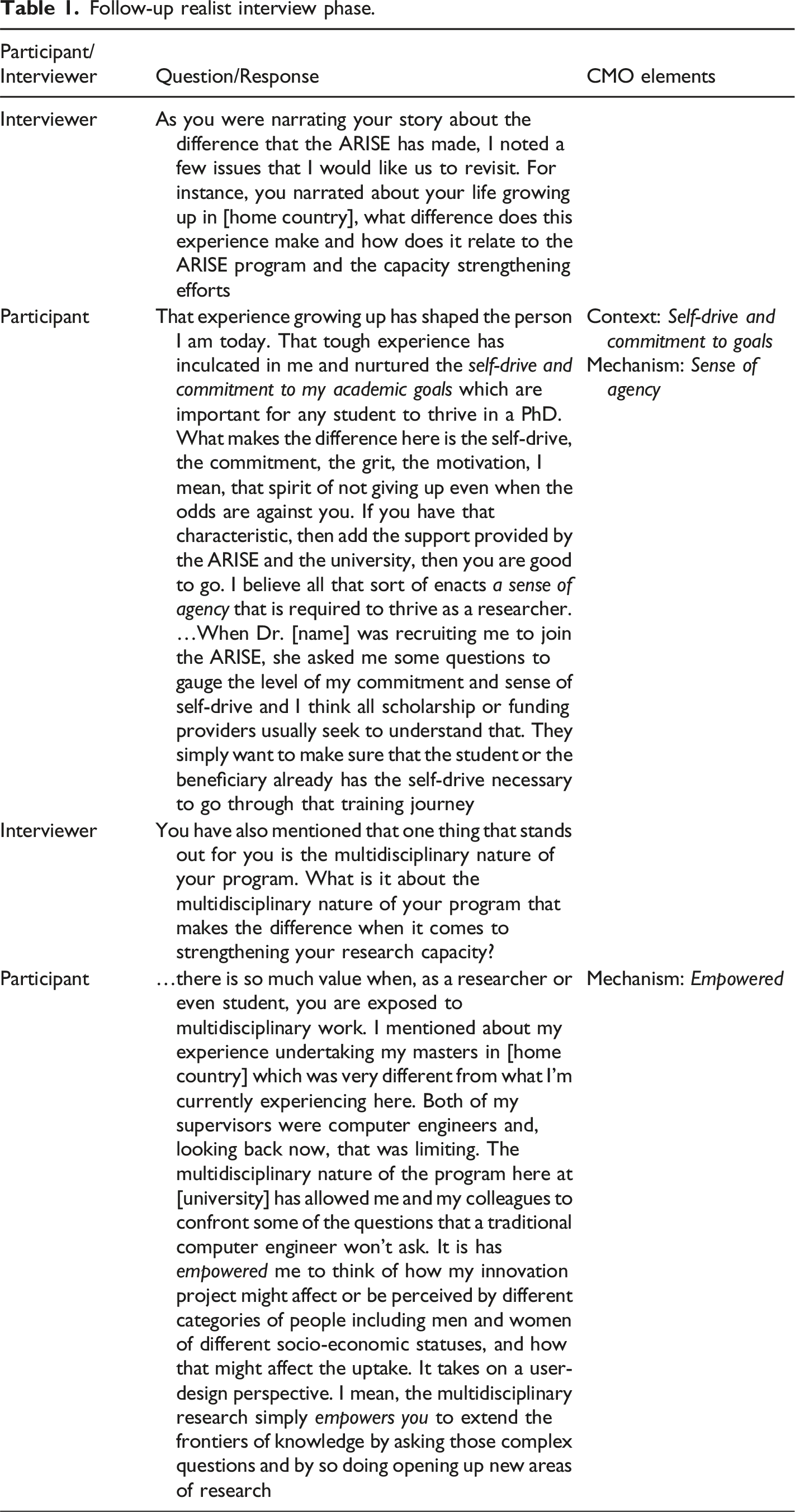
As shown in Table 1 above, the student’s life ‘growing up in their home country’ had inculcated or nurtured the spirit of self-drive and commitment which are critical in the context of student training. As highlighted by the participant, it is the self-drive and commitment coupled with the program resources which triggered a ‘sense of agency’ needed to thrive as a PhD trainee. Notably, the participant highlighted that the multidisciplinary nature of the research program had empowered them to confront some of the complex research questions thus ensuring that their research innovations were user-centred.
Example 2
This is an excerpt from a PhD student’s transcript (Case C). The participant narrates about their role in the university (as a junior faculty staff), their collaborative research work and their long-term career plans.
Excerpt 2: Narrative phase
…I’m hoping that it [ARISE] can help me build my research and academic profile as I undertake the PhD. It has been a great experience so far and I’m making baby steps in becoming the researcher I have envisioned for a very long time. I think I’m well placed, given that I’ve been working as a junior faculty staff and thus part of the university. As a faculty staff here, there’s a huge opportunity for me to grow as a researcher and become a research leader. My desire is to be able to apply for funding and have my own research team someday and that can help me transition into an independent researcher. My goal is to continue working for the University of [name] after completing my PhD and actively pursue grants opportunities in order to establish a research program and team. And I can tell you that it’s possible because I have seen young researchers complete their PhD and go on to establish their research programs and teams here in the university, and so, that has sort of been a huge inspiration on my part. I have worked closely with other researchers in the university, who are not affiliated to the ARISE program, and I have seen how they have set up their laboratories and I’m picking from that.
Follow-up realist interview phase.
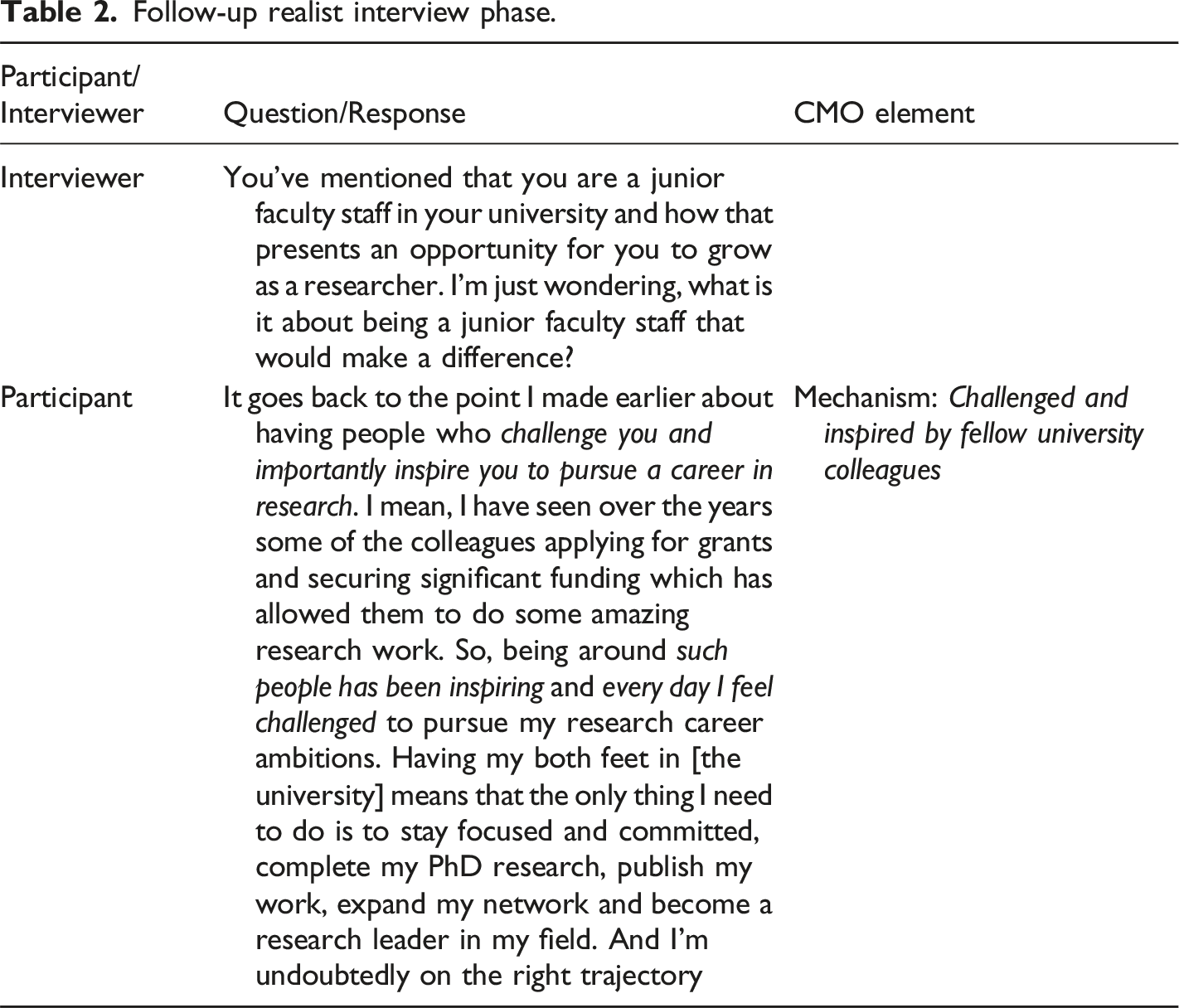
Since the follow-up sessions mainly involved revisiting what the participant had already said, they ended up being repetitive, with the participants often using the phrase ‘as I’ve already said…’ in their responses. To ensure that the participants were not frustrated by the repetitive nature of the follow-up interview questions, the phrases ‘probably you’ve already mentioned it, but I would really like to confirm that I understand what you mean, …’ or ‘you earlier said …., what did you mean by that and why is it significant in this context?’ were used.
During the follow-up interviews, the researcher posed the ‘student training’ initial program\theory to the participants and allowed them to explain how their experiences with the ARISE did or did not square with the initial theory. This allowed the participants and the researcher to share their views/theory of how the program was envisioned to work to generate research capacity outcomes. The participants and the researcher took a teacher-learner role, discussing how the program worked to strengthen the trainees’ capacity and how the different contexts moderated the outcomes. For instance, after posing the initial theory to one of the participants, the participant highlighted that although the ultimate outcome (i.e. trainees become full-time health researchers in Africa) had not been achieved by the time of the evaluation, several changes had happened because of the ARISE program, and that didn’t mean that the program was failing. The participant pointed out that the desired outcome was a long-term one and that he was on a trajectory to achieving it. This is captured in the participant’s quote below. You have mentioned transition into full-time health researchers in Africa as the outcome, but I think there’s so much that has happened, like my confidence has improved so much, I have had so much learning and knowledge improvement, and we cannot ignore that. Before I can transition into full-time researcher, so much has changed in me, and I attribute that to the ARISE and the team here. Obviously, once I complete my PhD, the plan is to resume my lecture and research role at [university] and hopefully grow through the ranks. If that happens, then it means that your outcome will be achieved in like 10 years’ time, you know. Probably, you need to look at some of these shorter-term changes that have happened but that you’ve not captured in your theory. [PhD Student, Case A]
Notably, none of the study participants reported the ultimate outcome (i.e. trainees becoming full-time health researchers in Africa). This is potentially because the program had not ‘matured’ enough to generate the desired long-term outcome. By the time of the evaluation, the ARISE program was in its second year of implementation, and only short-term outcomes had been realised. The evaluation process, therefore, was useful in capturing short-term and medium-term outcomes that were not envisioned by the researcher.
Discussion
The aim of this article was to explore how the storytelling approach could be meaningfully applied to elucidate CMOs in a realist evaluation. The study has established that to elicit meaningful evidence on mechanism, the storytelling approach needs to be adapted accordingly. While the storytelling was effective in generating rich data on contexts and, to some extent, outcomes and importantly, in giving voice to the participants to share their experiences with the program, it quickly became clear that the mechanism were not being uncovered. The indigenous responsivity principle emphasises that the evaluator should learn from the process and appropriately adapt their methodologies and tools (Chilisa & Mertens, 2021). Based on this, the follow-up phase of the storytelling was adapted to employ the realist interviewing technique, which allowed for ontologically deep evidence on mechanism to be elicited.
The follow-up phase allowed the probing of the different aspects noted from the participant’s story, thus laying bare the different CMO elements. In addition to probing on the participant’s story, the follow-up interviews allowed the participant and the researcher to share ideas on how the program was envisioned to generate research capacity outcomes. This took a teacher-learner role consistent with Mukumbang et al. (2020) and Jagosh (2023). The researcher would pose his initial theory and allow the participant to confirm or challenge the theory based on their own experiences with the ARISE program. In the era of decolonising development programs, including global health research, centring the voices of the participants is critical (Renmans et al., 2022), and this is what the storytelling approach achieved in this study. In fact, the entire exercise of testing, refining or further theory development centres the voices and experiences of the participants, and this advances the decolonisation agenda (Renmans et al., 2022).
In Western research practice, a power asymmetry exists between the researcher and the researched as the researcher is left to determine what counts as knowledge (Skille, 2022); however, appropriate use of the storytelling approach in realist evaluation can address such asymmetry. In the storytelling phase, for instance, the participant is handed a ‘blank cheque’ to choose whatever aspects of their experience to share and thus define their own story. This fosters shared power as the participants actively engage in sharing their experiences, becoming a source of knowledge and learning (Rooney et al., 2016). Giving the participants the opportunity to choose their significant stories can empower them and enhance relationship building (Datta, 2018; Kovach, 2010; McCall et al., 2021; Rooney et al., 2016), making storytelling a powerful tool in realist evaluation. Notably, the follow-up realist interview session was also characterised by shared power between the participant and the researcher. For instance, both the participant and the researcher assumed teacher-learner roles while discussing how they theorised the program works to strengthen research capacity in line with Pawson and Tilley (1997). The reciprocal relationship inherent to this enabled the nuanced and context-specific realities of the program to emerge. The participant-centred nature of the storytelling and the teacher-learner dynamic in the follow-up interviews phase helped to strengthen the participant-researcher relationship. The participants remained visibly enthusiastic throughout the storytelling session, likely because their stories and experiences were central to the discussion.
The researcher, based on Western-based research ideologies, determines the value of programs, and this makes it easy for them to tell somebody else’s [participant’s] story (Wright, 2018). An indigenous realist evaluation employing a storytelling approach will inspire the researcher to differentiate what they know or perceive (theory) as the value of the program and what the participant experiences and reports as the actual value. To achieve this, Nakaima and Sridharan (2023) argue that greater humility in practice is required from researchers to recognise uncertainty. To elicit meaningful evidence on CMOs, the researcher must demonstrate humility by encouraging the participant to share their thoughts and experiences regarding how the program works and, at the same time, remaining an active listener. In instances where the participant presents an idea and the researcher is uncertain, the researcher should exercise humility by probing for more information or seeking clarification. In the follow-up realist interviews, it is unsurprising that questions like ‘Maybe you’ve already mentioned it, but just to make sure that I’ve gotten it right, would you mind restating what is it about programe X that generates Y outcomes?’ are common (Jagosh, 2023). It is possible that if the researcher was not keen to probe what it is about the participant’s life growing up in their home country that made the difference (see Example 1 in the Results section), then the opportunity to distinguish context from mechanism would have been missed. It is not surprising that researchers’ understanding is usually limited, and their theoretical models or explanations do not fully capture the complexity or nuances of the real-world mechanism (Pawson & Tilley, 1997). Nonetheless, this conceptual gap can be bridged if researchers pay attention to the participants’ stories and experiences, as demonstrated in this study.
While the realist interviewing technique has been widely applied in interviews (Brönnimann, 2022; Manzano, 2016; O’Rourke et al., 2022; Verkooijen et al., 2020) and to some extent in focus groups (Manzano, 2022), no published study has explored how the realist interviewing technique can be applied in storytelling. So, this article addresses the methodological gap by providing practical guidance on how to complement the narrative phase of storytelling with follow-up realist interviews aimed at eliciting ontologically deeper evidence on CMOs. Notably, this article adds to the array of methods that have been applied in realist evaluations, such as interviews, surveys, observations, and other innovative methods (Renmans & Castellano Pleguezuelo, 2023).
Besides providing a practical guidance on how to apply the storytelling approach in a realist evaluation, this article raises a fundamental question about the point, over the program period, when the storytelling approach can generate rich evidence on CMOs. As highlighted in the results, even after conducting the follow-up realist interviews, the desired ultimate outcome was not reported. It turned out, from the participants’ responses, that the ARISE program had not ‘matured’ enough to generate the ultimate [long-term] outcome. The shortcoming can be attributed to the timing of the evaluation rather than a methodological limitation of the storytelling approach. In their article, Rooney et al. (2016) argued that storytelling is relevant in particular contexts, specifically those which demonstrate deeper participant involvement, high levels of complexity and a possible shared social dimension (p. 149), and therefore, engaging program beneficiaries at or towards the end of a program may yield deeper insights. Nonetheless, it is important for future studies to examine when, over the program period, the storytelling approach can yield rich evidence on CMOs. This could help realist evaluators to determine if the program is ‘ready’ for evaluation using the storytelling approach.
Conclusion
This article aimed to determine how the storytelling approach, an indigenous research method, can be applied to effectively uncover context, mechanisms, and outcomes in a realist evaluation. It has demonstrated that the storytelling approach can generate rich evidence on context and outcomes; however, the follow-up phase should adopt a realist interviewing perspective to uncover ontologically deep evidence on mechanisms. Importantly, with its follow-up realist interview phase, the storytelling approach centres the participants’ voices and promotes shared power between the researcher and the researched. The researcher must exercise humility when applying the storytelling approach in [indigenous] realist evaluation, which will help prioritise participants’ voices and experiences, thus ensuring that their stories are not misrepresented. By doing so, the storytelling approach can serve as a valuable research tool for advancing the decolonisation agenda. Since this study was a proof of concept, further research is needed to strengthen evidence on the application of the storytelling approach in realist evaluation, particularly in indigenous settings where local languages are used.
Footnotes
Declaration of conflicting interests
The author(s) declared no potential conflicts of interest with respect to the research, authorship, and/or publication of this article.
Funding
The author(s) disclosed receipt of the following financial support for the research, authorship, and/or publication of this article: This study was supported through research funds from the School of Management Studies, University of Cape Town.
