



Abstract
This article focuses on the 1923–1937 period when the rise of Benito Mussolini's Fascist regime drove public works programmes. The 1908 earthquake almost destroyed Messina and, in the Fascist period Angelo Paino, the new Metropolitan Archbishop of Messina, fostered the reconstruction of the ecclesiastical heritage of the city and surrounding villages. Primary and secondary sources were collected and analysed to investigate the role of accounting and calculation practices in interpreting the urban reconstruction programme that the Fascist government actively supported. This research contributes to accounting history research adding the new reading of accounting, disasters and urban reconstruction, and highlighting the relations between the Fascist regime and the Catholic Church within an urban reconstruction programme following one of history's major catastrophes. We obtained several findings, including an interpretation of the Fascist regime's reconstruction of the city's churches and key public buildings as an instrument of consensus among the Catholic electorate.
Keywords
Introduction
The 1908 earthquake of Messina was one of the twentieth century's most disastrous seismic events and certainly Europe's most significant earthquake in terms of number of victims, displaced persons and amount of damage inflicted (Barbano et al., 2005; Guidoboni and Mariotti, 2008). The city of Messina was almost destroyed, and a few minutes after the earthquake, both sides of the Strait of Messina were inundated by a disastrous tsunami that caused tremendous ripple effects on the populations and the built environment (Comerci et al., 2015).
There is wide coverage of this devastating event in various fields of research. Indeed, earth scientists and seismologists highlight how the 1908 earthquake is still the largest seismic event ever recorded in southern Europe although its causative seismic and tsunami sources are still unknown (Barreca et al., 2021; Ridente et al., 2014; Valensise and Pantosti, 2001). From a sociological perspective, Farinella and Saitta (2019) shed light on the social, urban, and economic impacts of disaster, arguing that the interminable reconstruction of Messina influenced the spatial and social configurations of inequality that still characterise the city of Messina.
Notwithstanding this broad coverage, a further examination of this catastrophic event in the fields of disaster management and accounting is warranted.
Thus, echoing the literature's systematisation by Sargiacomo et al. (2021) and their call to deepen academic research in ‘accounting, city reconstruction and disaster literature’, the article provides two main contributions. First, it sheds light on one of the most significant disasters that occurred worldwide in the last century (the 1908 earthquake of Messina) which has so far remained unexplored by the accounting and disaster management literature. At the same time, it contributes to literature on the interrelations between local government and central government (Gomes and Sargiacomo, 2013; Sargiacomo, 2014). Second, it broadens knowledge on the subject of ‘accounting and disaster’ (Lai et al., 2014; Miley and Read, 2013; Sargiacomo, 2014, 2015; Sargiacomo and Walker, 2022; Sargiacomo et al., 2014; Servalli, 2020; Vosslamber, 2015) focusing on the intervention of the Fascist regime in the reconstruction of an enormous ecclesiastical heritage in a disaster setting.
This study focuses on Messina's reconstruction from 1923 to 1937 as a significant period to determine results that will contribute to accounting history. The investigated historical period is characterised by the rise of Benito Mussolini's Fascist regime and the appointment of the Metropolitan Archbishop of Messina Angelo Paino, which both led to a strong drive towards public works programmes and reconstruction of key public buildings and churches. The analysis is based on primary sources collected in the Archivio Centrale di Stato (CSA), Archivio Diocesano di Messina (DAM), Lipari e Santa Lucia del Mela and Biblioteca Regionale di Messina (RULM).
Lastly, we propose our results in the context of accounting history using accounting data and link them to studies on accounting and Fascism. As noted: looking at the past…. The past and history are not the same things. History is the process or the means by which we attain an understanding of the past. To know how this is achieved involves epistemological considerations. (Gaffikin, 2011: 238)
This study is located in the context of accounting history allowing the understanding of the past, present and future of accounting in the analysed phenomenon (Fowler and Keeper, 2016). As argued by Fowler and Keeper (2016: 389), It also allows us to examine the influence of the emergence of accounting on individuals, organisations and society over time, and within the economic, political, social and environmental contexts in which accounting exists.
Previous research has framed the significant role of accounting and accountability under Fascism (Antonelli et al., 2018; Bigoni, 2021; Bigoni et al., 2021; Cinquini, 2007; Cinquini et al., 2016; Sargiacomo et al., 2016) or other totalitarian regimes (Funnell, 1998a, 1998b, 2013, 2015; Twyford, 2021; Walker, 2000; Xu et al., 2014; 2018).
The study represents the reconstruction of the city's churches and key public buildings as an extraordinary instrument of consensus among the Catholic electorate for the nascent Fascist regime led by Mussolini. Hence, this research adds to this strand of accounting history research, a new reading of relations between the Fascist regime and the Catholic Church in the realm of an urban reconstruction programme following one of history's major catastrophes.
The remainder of the article is organised as follows. The next section presents the theoretical background. The third section illustrates the research methodology and provides a brief historical overview of the events and of the urban reconstruction process. The fourth section illustrates the findings, and the last section discusses the study's main implications, its limitations and suggestions for future research.
Theoretical background
In recent decades, accounting literature has debated the relationship between accounting and ideology, although the multifaceted role of accounting in totalitarian regimes has so far received scant attention compared with other research trajectories, notwithstanding the historical relevance of some political eras and the broad archival heritage supporting potential research on the subject (Cinquini et al., 2016; Twyford, 2021). The main research trajectories have focused on how ideology facilitates or inhibits the use of specific accounting concepts (Ezzamel et al., 2007); the role of accounting and other calculation practices in the context in which they operate – for example, Andrew and Cortese (2013) in the era of neoliberalism, Goddard (2002) in the public sector; and accounting and political regimes – namely, Nazism in Germany (Detzen and Hoffman, 2020; Funnell, 1998a, 1998b, 2013, 2015; Lippman and Wilson, 2007; Twyford, 2021; Walker 2000), Fascism in Italy (Antonelli et al., 2018; Bigoni, 2021; Bigoni et al., 2021; Cinquini, 2007; Cinquini et al., 2016; Sargiacomo et al., 2016), and Communism in China (Ezzamel et al., 2007; Xu et al., 2014).
For instance, Funnell (1998a, 1998b, 2013, 2015) studied the ethical and social significance of accounting as a component of bureaucratic practices. His studies highlighted how accounting was involved in all stages of the Holocaust as a means of disguise to facilitate the efficient implementation of the Nazis' programme.
Walker (2000) provided a fascinating insight into the profession's response to Nazi propaganda, retracing the history of the Fifth International Congress of British Accountants, hosted in Berlin in 1938 under the Nazi regime's auspices. His work pointed out how an international accounting institution accidentally supported the National Socialist Party's ideology and the totalitarian state's propaganda.
Lippman and Wilson (2007) focused on accounting's culpability in slave trading during Nazi Germany, arguing that accountants were culpable in perpetuating the Holocaust by providing information used to facilitate decision-making during the genocide and disregarding the human value of labourers, who were treated as mere commodities.
More recently, Detzen and Hoffman (2021) demonstrated how, during the Nazi regime, accountability norms shifted from professional values surrounding academic education and research to demonstrating political alignment with the Hitler regime.
Combining the reflections about ‘thanatology’ proposed by the contemporary philosopher Agamben (2002) and ‘modern racism’ theorised by Foucault (1976), Twyford (2021: 369) argued how the mobilisation of accounting during the Nazi regime contributed to ‘mystifying death in its financial, political and actual forms by using one-dimensional integers to mask the amorality of such action on systems, human behaviour and political action, which directly impacts people's lives’.
Looking at different international settings, Ezzamel et al. (2007) analysed how ideology facilitates or inhibits the use of specific accounting concepts and the impact of political ideology on accounting regulation, focusing on the transition from Maoism to Dengism in China in the mid-late 1900s. Xu et al. (2014), adopting Gramsci's theory of hegemony (1971), explained the extent to which, in Communist Chinese regimes, accounting discourse has been used to support the ruling power's privilege and has become ‘an important mechanism to facilitate the spread of political ideologies’. In recent decades and in different institutional and business settings, the rise of Mussolini and the Fascist ideology in Italy (1922–1943) has been the subject of important studies by accounting historians.
Accounting and fascism
In his study on Italian Fascism in the 1930s, Cinquini (2007) proposed the Fascist doctrine's key principles (i.e., extreme statism, integral politicisation of human life, state interventionism in the economy) and analysed the extent to which the Fascist corporatist ideology influenced the debate and direction of studies in Italian accounting and business disciplines.
Sargiacomo et al. (2016) framed accounting within the ascent of Fascist discourse on the ‘Agricultural Corporatist Economy of the Nation’. Applying a governmentality framework (Foucault, 1988, 1991) to the agricultural domain, they demonstrated how new technologies of government were embedded both at a macro level in the ‘Serpieri Reclamation Reform’ and other regulations, and at a micro level, thus contributing ‘to the spread of a new economic language and the inculcation of new habits (Miller and Rose, 1990) among the agricultural population as well as in the public sector’.
It has been noted (Cinquini et al., 2016: 449) that ‘the development of corporatism and Fascist ideology did not keep accounting and business studies free from influence’. The authors highlight the experience of the ‘Uniconti Commission’, an accounting standard-setter promoted by the Fascist Government and the Industry Confederation to define uniform standardised procedures in accounting and schemes for financial and cost accounting practices. Their study documented the complex interplay among knowledge, techniques, institutions and ideology in setting accounting rules under the Italian Fascist regime.
Antonelli et al. (2018) investigated accounting's significant role in the expropriation of Jewish real estate properties starting from 1938, when Italy set up the race laws under Benito Mussolini's Fascist regime. Thus, accounting used by the Fascist regime was crucial to managing the seizure of Jewish property, its subsequent sale and distribution of the funds received. The ‘shield’ of bureaucratic procedures and accounting practices also ‘provided the means for bureaucrats to separate, and thereby absolve themselves, from their immoral actions’ (Antonelli et al., 2018: 2182).
Recently, Bigoni (2021) provided valuable evidence on the adaptability of accounting to different settings in the achievement of ideological goals and in the pursuit of hegemonic power. The author presented the case of two Italian institutions in the educational (University of Ferrara) and cultural (Teatro alla Scala opera house in Milan) domains. In those settings, accounting practices were ‘exploited in multifaceted ways’ (Bigoni, 2021: 642) contributing to the spread of the Fascist ideological message. In a further study, Bigoni et al. (2021) proposed the case ‘Alla Scala Opera House [sic]’, showing how accounting documents and commentaries of La Scala were not just ‘a means to mirror external facts’ but rather a tool ‘to be used by those who had to render an account to the State to construct a reality which was consistent with, and supportive of, the Fascist discourse’ (Bigoni et al., 2021: 213).
The ancillary role of accounting and new technologies of government in supporting the rise of Mussolini and the development of the future authoritarian regime in several fields of action (e.g., bureaucracy, agriculture, culture and education) clearly emerges from the main literature, as previously reported. However, there are further interesting contexts (so far neglected) in which accounting and other technologies of government can help us to understand and visualise both Mussolini's rise to power and the dissemination of the Fascist strategy in the Italian national landscape. For example, construction and urban town planning programmes were part of this strategy and were exploited as a flywheel for the nation's economy and a means of promoting the regime's efficiency.
Methodology
This study applied a document analysis technique to interpret all archival sources (i.e., documents, images, maps and charts, letters and memoranda, newspaper clippings, etc.), adopting the inductive approach (Bowen, 2009; Miley and Read, 2021; Prior, 2003; Sy and Tinker, 2005) to contribute to accounting history. Document analysis appears the most appropriate technique for representing historical events and finding a connection between accounting and calculation practices and urban reconstruction interventions after the 1908 earthquake of Messina.
Prior (2003) argues that source document contents need to be reviewed and analysed to achieve results. As sources of evidence, documents are supported by factors and processes in the analysis to pose ‘an image of science as a set of activities that interrogates “nature”, and subsequently produces true and useful knowledge about how the natural world works’ (Prior, 2003: 129). Such document analysis is based on the selection of principles to theoretically sample documents that constitute the phenomenon for interpretation and determining results.
In particular, archival research in accounting history is well grounded in several studies providing primary and secondary sources in the analysis developed by researchers (Fleischman and Tyson, 1997; Giroux, 1999; Miley and Read, 2021; Sy and Tinker, 2005). Archival research is directed to reviewing, analysing and interpreting sources which originated in the past, assuming several analysis perspectives such as economic, political, social and so on (Carnegie, 1995). Additionally, verifiable sources in the population of sources in the archive allow increasing transparency in analysis and replicating research (Miley and Read, 2021).
The document analysis in this research has been conducted on written documents (e.g., technical, administrative and accounting documents) from the main Italian archives in the field held by the (a) CSA in Rome, (b) DAM in Messina, (c) digital archive BeWeb by the Italian ecclesial portal for cultural goods, and (d) RULM in Messina.
Even if part of archival sources were destroyed by several historical events, the retrieved sources provide cogent evidence (Fleischman and Tyson, 1997; Giroux, 1999; Miley and Read, 2021) for this analysis. They allowed the interpretation of official governmental and archdiocese reports of the timeframe 1923–1937: such sources were directed to the institutions and community at the time mainly to foster the reconstruction of the area. Particularly, the verification of archival sources has been assured by (a) constant and fluid conversations with the coordinator of the DAM in Messina, which helped in searching archival sources also in the digital archive BeWeb and (b) documents' references allow future replication of this research. As conversations with the coordinator were directed to retrieve primary sources, they are not quoted in the research. Numerous physical visits were made to the archives to retrieve, analyse and scan primary documents as well as to retrieve and consult documents such as bills, contracts, budgets, project documents and newspaper clippings aligned to the research aims. Additionally, the credibility in the research has been increased by adding secondary sources to the analysis.
Data collection was undertaken over a period of 10 months following a three-stage iterative process. The first stage was the acquisition of archival documents on the historical events (the earthquake, urban reconstruction, the political context) and the key figures (Benito Mussolini and Angelo Paino, the archbishop of Messina). The second stage consisted of selection of archival documents with a major focus on the period of urban reconstruction – 1923–1937 – characterised by the rise of Mussolini and the appointment of the archbishop. The selection of archival documents was firstly based on the (a) reading of titles, quotations and short syntheses of archival documents, and (b) interpretation of documents' elements. Thus, guided by intuition and pre-cognitive knowledge, we considered and selected archival documents when we found recurring meaning and/or words and/or timeline of events (e.g., years) related to Messina's reconstruction from 1923 to 1937. We interpreted the archival documents’ meanings from relevant sources in discussing focused topics such as the entity and speed of the reconstruction programme and the financial engagement (grants) for the reconstruction of churches.
In this scenario, the visits to the CSA in Rome and at RULM of Messina allowed us to retrieve archival evidence on actions implemented by the Fascist government for reconstruction in disaster-stricken regions and particularly for the city of Messina in response to the 1908 earthquake. We collected official laws, ministerial decrees and official reports. The visits to the DAM in Messina allowed us to retrace the history of reconstruction of ecclesiastical heritage destroyed by the 1908 earthquake within the archdiocese of Messina.
We classified the selected archival sources into technical, administrative and accounting documents. Technical documents refer to land registry maps, graphic tables, planimetry, measurement booklets, metric calculations, tests, and so on. Administrative documents analysed consist of opinions and authorisations issued by the Municipal Office of Civil Engineering, the Superintendency of Mediaeval and Modern Art of Sicily, the Superior Council of Public Works, and the Prefecture of Messina, as well as procurement contracts and work progress reports drafted by building contractors and others. Accounting documents refer to estimates, Libri Giornale, financial reports, invoices, mandates issued by the Ministries, and bank statements which helped to trace the progress made in reconstruction of the ecclesial heritage.
The third stage was based on identifying and interpreting accounting documents with other archival sources, thus supporting the research's aims and interpretive framework. Our analysis has been based on archival evidence directed to show the entirety of the reconstruction programme which increased over the Fascist period. For example, tables (see below) provide the financial requirements by Mussolini's government in the period. Additionally, archival evidence shows relevant accounting data from one parish church – Chiesa di San Giuliano in Messina – one of the most relevant churches by the twelfth (XII) century. Such elements allowed us to emphasise the contribution of accounting tools in monitoring the reconstruction process that took place under the Fascist regime. Thus, evidence enriches the analysis of the central government's engagements in the churches' reconstruction plan.
A combination of financial and non-financial documents was explored to understand the government programme of ecclesiastical heritage reconstruction. However, primary sources were collected at both local (i.e., DAM, RULM in Messina) and national levels (i.e., CSA in Rome) and consist of accounting documents and registers, contracts, laws, letters, tables and figures from official governmental and archdiocese reports of the time. We corroborated our findings through the analysis of secondary sources: historical books, physical artefacts and archival images.
Timeframe of city reconstruction after the 1908 earthquake
To analyse the subsequent reconstruction of Messina after the earthquake, the study proposes the timeline adopted by the authoritative Italian urbanist Cardullo (1993), which divides the urban reconstruction into four phases as follows:
wooden city (1908–1912). In this phase, in the aftermath of the catastrophe and according to the technical knowledge of that time, wooden constructions were perceived as the most suitable solution for a prompt emergency response. planned city (1913–1922). This is the phase in which, based on the new City Master Plan, the city foundations were laid. However, some circumstances significantly delayed the city's reconstruction. These included ‘a capitalist use of the earthquake’ (Barone, 1982) by the local élites of a liberal-Masonic matrix; problems in rescue operations, debris removal, land and building expropriation, and financing issues due to national reasons such as the Libyan War (1911–1912) and the Great War (1915–1918). stone city (1923–1933). This period marked an important acceleration of the reconstruction programme due to the Fascist government's intervention. During this decade, ignoring the laudatory tones of Fascist propaganda, there were several tangible signs of the will of the Mussolini government to support the city of Messina and its swift reconstruction. Moreover, during this timeframe, the rise of Benito Mussolini's Fascist regime coincided with the arrival of Metropolitan Archbishop of Messina, Angelo Paino, leading to a strong impulse towards public works programmes and the reconstruction of key public buildings and churches of the city of Messina and its surrounding villages. At the same time, the city reconstruction became a means for enhancing Fascism's political power towards the Catholic electorate. marble city (1934–1940). This last phase, on a political level, evokes one of the darkest historical periods for Italy as it coincides with the full revelation of the regime's authoritarian nature. From the lens of city reconstruction, it is characterised by just a few architectural interventions used to symbolise, shape and reproduce the Fascist ideology's strength.
The four phases of urban reconstruction of the city of Messina describe the priorities and evolution of urban town planning following the 1908 earthquake. This approach seems the most suitable for developing the analysis in this study. Moreover, it allows us to isolate the time segment 1923–1937, which represents the study's core focus.
The city of Messina and the 1908 earthquake
Over the centuries, the city of Messina has overcome traumatic and devastating situations such as the anti-Spanish revolt of 1674, the plague epidemics and the earthquake of 1783 (Checco, 1989). At the beginning of the twentieth century, there was a steady rise in maritime trade, and the port of Messina was among the most important in Italy (Mortara, 1913). The city faced the twentieth century with a relatively robust economic and social fabric and with considerable potential for development opportunities (Musolino and Perna, 2007; Pascuzzi, 2010). The economy was healthily balanced among productive, commercial and tertiary activities, with the citrus fruit trade driving exports through large international companies.
On 28 December 1908, an earthquake of magnitude 7.1 by today's Richter scale, located in the Strait of Messina impacted the south-western Calabrian coast and the north-eastern coast of Sicily. Even today, the earthquake represents an epochal wound in Messina's history, deeply upsetting the urban fabric, the economic activities and even the identity of the city (Baglio, 2016; Noto, 2008). As noted by Farinella and Saitta (2019), the earthquake of Messina was the first massive disaster to hit Italy after its unification. Before the earthquake, city inhabitants numbered around 120,000. The earthquake killed about 80,000 people and razed almost 90 per cent of existing buildings to the ground, marking an irreversible historical break with the past (Figure 1).
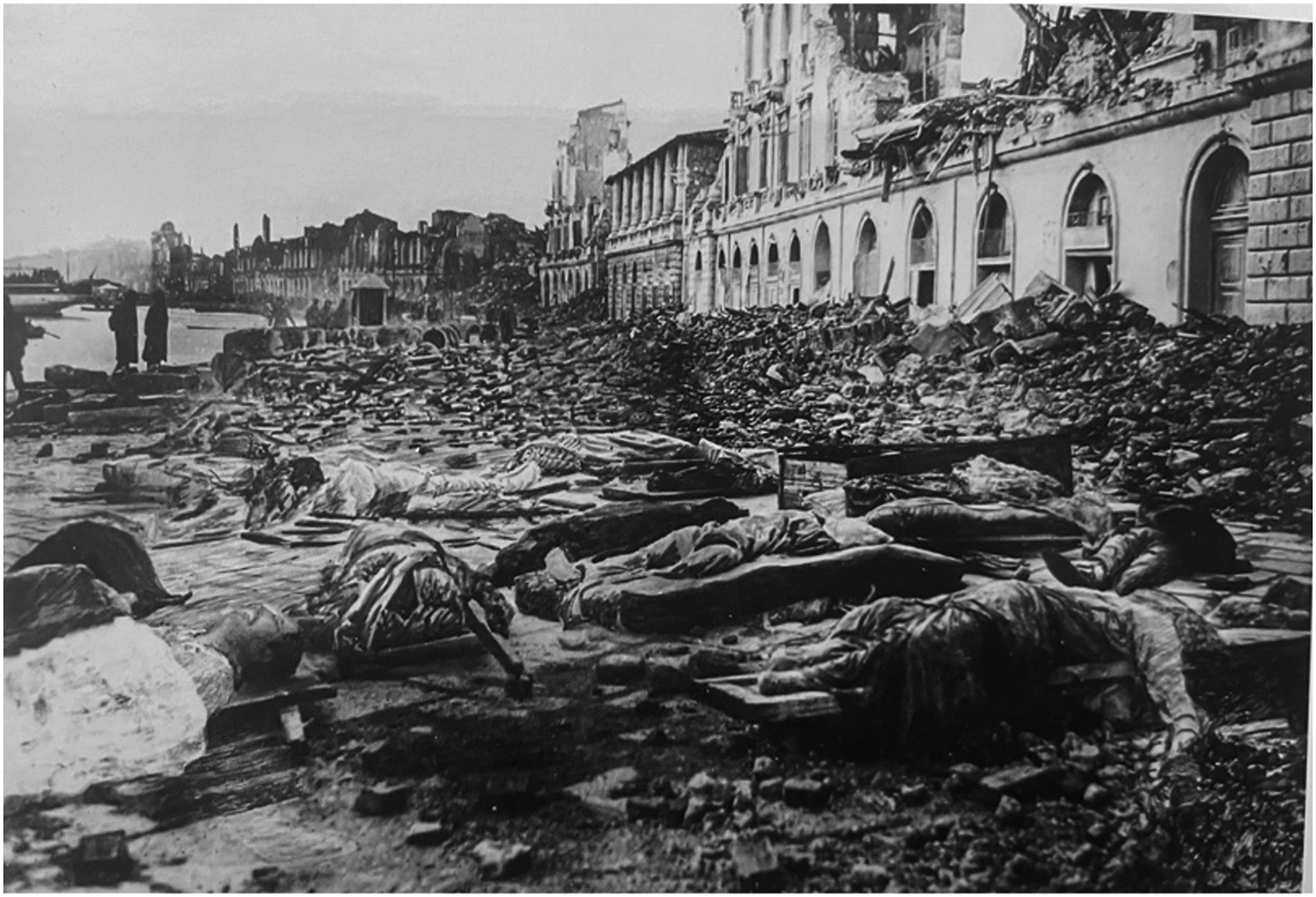
The seafront of Messina after the earthquake.
The day after the earthquake, King Vittorio Emanuele and his wife Queen Elena travelled to Messina to support the initial relief operations. Hundreds of spontaneous committees arose worldwide to provide first aid through the International Red Cross. In the weeks following, the city's harbour hosted dozens of Russian, English and French ships carrying food, blankets, timber and all kinds of comfort items. The U.S. president at the time, Theodore Roosevelt, urgently convened Congress, which unanimously decided to allocate $50,000 and send 16 American ships to the earthquake zones. Emperor Wilhelm II of Germany also sent ships, food and timber to build temporary shelters for the displaced.
In the aftermath of the earthquake, the first measures taken by central and peripheral authorities were mostly aimed at rescuing survivors, extracting corpses from the rubble and constructing small wooden houses in debris-free areas on the edge of the old town (Licordari, 2016). Prime Minister Giovanni Giolitti instated the Central Relief Committee with the Ministerial Decree of 29 December 1908. The committee's tasks included collection and distribution of the aid that arrived from all over the world and coordination of relief efforts with the local committees.
Through Law No. 12, 12 January 1909, the national government assigned the sum of 30 million lire from the net cash surpluses of the 1907–1908 fiscal years to provide for the urgent needs of the survivors and to repair or rebuild public buildings damaged by the earthquake. Once the initial emergency phases ended, urgent rebuilding commenced because, as mentioned, such a high percentage of existing constructions were razed.
The first initiatives following the aftermath included constructing huts for hosting both survivors and the key administrative functions in the city (namely, hospitals, police headquarters, municipal offices, and churches). In the five years of the wooden city, approximately 21,700 small wooden houses and key public buildings (i.e., Police headquarters, Fire department, public offices, etc.) were rebuilt thanks to financial and humanitarian aid received from Italian municipalities, private donors, international institutions and foreign countries. At the same time, during that period, the City Council appointed the Head of Civil Engineering, Luigi Borzì, to draft the City Master Plan (hereafter, ‘Piano Borzì’). Although the Municipal Council approved the first issue of the City Master Plan in June 1910, 18 months after the catastrophe, the reconstruction envisaged in the Plan had not begun. As of 1914 further variants of the Plan were requested by the clearing operations in the following years.
The City Master Plan, which ideally marks the transition from ‘wooden’ to ‘planned’, city, was rooted in two main concepts, the city's reconstruction in the previous setting and expansion along the urban territory's main axes. The new seismic regulations required significant changes to the urban fabric, especially regarding the width of the city streets and the size and height of buildings. The Piano Borzì included only 500 blocks, compared to the 800 blocks that existed before the earthquake. With Law n. 466/1910, the Italian government entrusted the management of the reconstruction programme to the Unione Edilizia Messinese (Messina Construction Union), a private consortium of owners whose properties had been damaged by the earthquake. These circumstances led to a convergence of interests among local élites, building contractors, big property owners and political power that opened the way to the ‘capitalist use of the earthquake’ (Barone, 1982; Mercadante, 2009) which was, as noted by Farinella and Saitta (2019: 30), ‘a source of Messina's urban social stratification of over time’. This latter element recalled Klein's notion of ‘disaster capitalism’ – meaning the ‘orchestrated raids on the public sphere in the wake of a catastrophic event, combined with the treatment of disasters as exciting market opportunities’ (Klein, 2007). During this phase, the city's reconstruction became a field for local élites of a liberal-Masonic matrix to exercise political control: these men represented the main centres of local economic, cultural and entrepreneurial power (Barone, 1982, 1987). Following the stasis caused by the Great War, from 1915 to 1922, the city reconstruction had no impetus, except for completion of the sewer system and some social housing and residential buildings.
Archival evidence of the National Construction Union, which in 1917 replaced the Messina Construction Union to provide for reconstruction of the cities of Marsica (Abruzzo) affected by an earthquake in 1915, demonstrates that as of June 1917, a total of 551 apartments and 34 stores were rebuilt for a cost of 1,930,000 Italian lire (equivalent to about € 4.421.507 in current value). Although some public buildings were completed (Civil Engineering, Central Postal Office, the Prefecture), as noted by Longo (1933: 246), at the end of the Great War, ‘Messina realised that it was not a city. It was a field of old, soggy shacks’. From then on, the reconstruction underwent a rapid acceleration, driven by the advent of Mussolini and the Fascist government (Cardullo, 1993: 24).
The rise of Mussolini and the appointment of the new Archbishop Angelo Paino
The main phase of city reconstruction (the stone city) relates to the timeframe from 1923 to 1937 when the reconstruction of Messina took on ever greater symbolic and political significance. It coincided with the arrival of two key figures in the national and local political scenario: Benito Mussolini and the Fascist regime that took power in 1922, and Angelo Paino, appointed as archbishop of Messina in 1923.
Benito Mussolini made the reconstruction of Messina a matter of national politics. This also became a way to undermine the power of local political forces and was a means of increasing consensus around the Fascist ideology. During his first visit to Messina on 22 June 1923, Mussolini stated that: The city of Messina must completely rise and return to being as beautiful, great and prosperous as it was once. It is not only a local interest; it is a purely national interest.
As a result, two months later, the Mussolini Government decreed to allocate 500 million lire (which is equivalent to about €520.213.228,54 in current value) to reconstruction of private buildings in the cities of Messina and Reggio Calabria (Decree n. 2309, 27 September 1923). Benito Mussolini wrote to the prefect of Messina with the aim to inform the population of the Government's decision. The Prime Minister said: A dimostrazione dell’impegno del Governo per la ricostruzione di queste nobili regioni ed in linea con le rassicurazioni che avevo personalmente dato, il Consiglio dei Ministri ha destinato la somma di 500 milioni di lire da rimborsare in sette anni per la ricostruzione degli edifici privati… Con altre misure già approvate per la ricostruzione di case economiche ed edifici pubblici, il Governo traduce la propria inflessibile volontà di far tornare queste popolazioni laboriose e fedeli ad una vita normale.
[As a demonstration of the Government's concern for the reconstruction of these noble regions, and in accordance with the assurances I personally gave, the Council of Ministers resolved to allocate the sum of 500 million to be disbursed over seven years for the reconstruction of private buildings […] With the other measures already approved for the construction of economical houses and public buildings, the Government translates the inflexible will to return these hard-working and faithful populations to a condition of normal life.]
In the following years, the Fascist Party made a great effort to foster the reconstruction programme. The following archival evidence from the Ministry of Public Works Directorate of Special Services provides evidence of the results obtained by the Fascist government in terms of clearing and reconstruction operations (Figure 2).
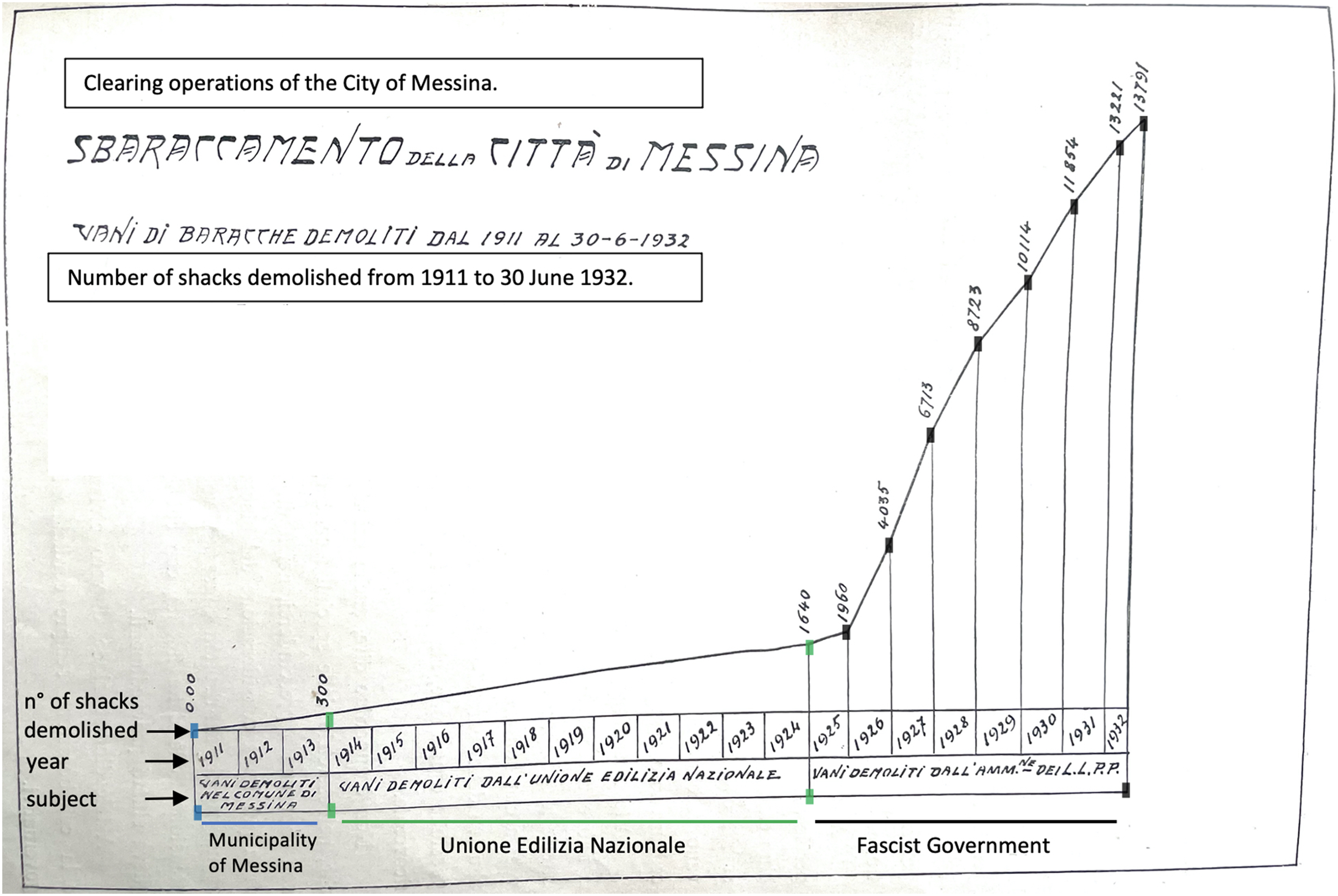
Clearing operations following the 1908 earthquake of Messina. Timeframe 1911–1932.
The figure demonstrates that clearing operations saw a significant acceleration starting from 1925 when the Directorate for the Special Services took over the management previously entrusted to the National Building Union. Furthermore, the amount of public works performed since 1922 compared with the previous periods – as shown in Figure 3 – clearly demonstrates the Fascist government's strong impetus since the early years of activity (Federazione Provinciale del Partito Fascista, 1932).

Reconstruction programme developed in the area of Messina, Reggio Calabrica and Catanzaro following the 1908 earthquake.
Works made in the period 1909–1922.
Works made in the period
1923–1932.
Data shown in Figure 3 are summarised in Table 1.
Value of the reconstruction programme for the cities of Messina, Reggio Calabria and Catanzaro following the 1908 earthquake. Timeframe 1909–1932.
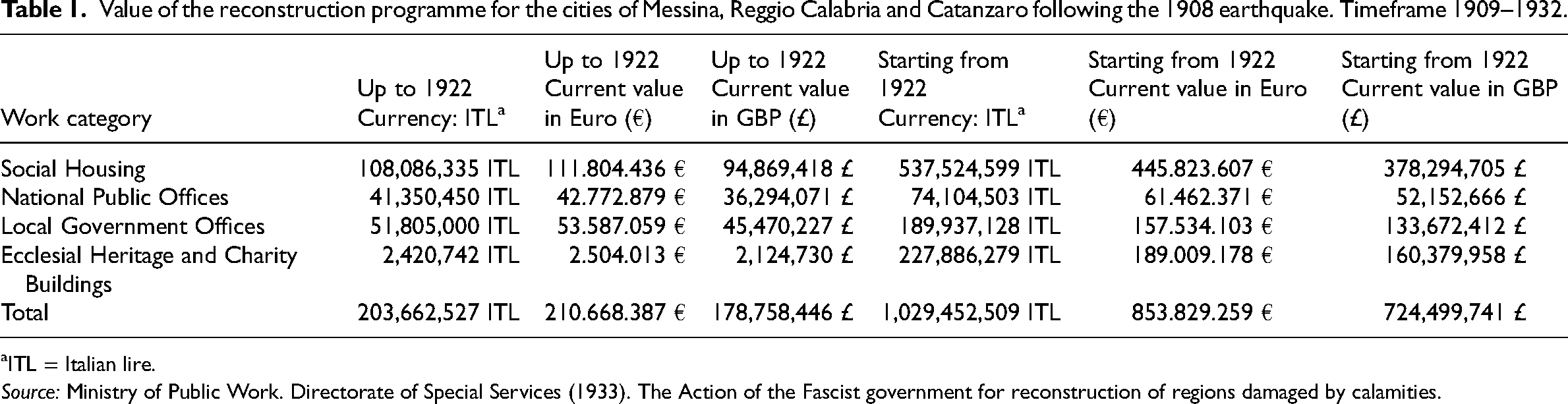
ITL = Italian lire.
Source: Ministry of Public Work. Directorate of Special Services (1933). The Action of the Fascist government for reconstruction of regions damaged by calamities.
Archbishop Angelo Paino and the reconstruction of ecclesiastical heritage under the fascist regime
Angelo Paino was born in 1870 in Santa Marina di Salina, in the Aeolian Islands archipelago. In 1909, he became bishop in Lipari, and seven years later he moved to Messina as auxiliary bishop.
The early years of the Messina episcopate, in continuity with the work of his predecessor Mons. The early years of the episcopate in Messina were characterised by a strenuous commitment to alleviating the survivors' suffering and obtaining financing for reconstruction of the ecclesiastical heritage destroyed by the earthquake of 28 December 1908. The archbishop's moral and spiritual authority embodied a strong leadership for the community and the reconstruction of churches had a symbolic relevance for the sense of trust they produced in event-stricken people (Baglio, 2016). However, in the aftermath of the disaster, only 40 wooden churches were rebuilt, and in the following years, the ‘Piano Borzì’ relegated the churches to a marginal role in the reconstruction programme.
Before the earthquake, there were 119 churches in the city of Messina, some with high architectural value. As noted by Longo (1933: 246), until 1922 the matter of ecclesiastical heritage in the national government agenda consisted of ‘flowering of laws but without any effect … as almost all the churches were to be rebuilt’.
During his first visit to Messina in 1923, Mussolini met the new Archbishop Angelo Paino, who replaced the former archbishop Letterio D’Arrigo when he died in December 1922. Paino was very concerned about the fate of the Cathedral, which in 1923 had not yet been rebuilt, neither had most of the city's churches. The meeting assumed special significance, and the attention Mussolini paid to the local diocese and the Catholic electorate grew considerably. In this respect, Sale (2011) observed that Mussolini was conscious that the ‘average Italian’ was Catholic and that the Italian Church had a power both in forging the conscience of the people and in directing their action. The ‘Catholic option’ became a valuable source of empowerment of the Fascist discourse throughout the country. Moreover, in the case of Messina, Mussolini exploited this option by unhinging both the liberal-masonic and democratic-popular blocks that had until then ruled in the city. The vast majority of the churches erected before the earthquake were destroyed, and the remaining ones were expropriated by the local government to fulfil the new seismic regulations of the Master Plan. Only 10 areas previously assigned as places of worship maintained their original sites. This led to the widespread opinion among local Catholics of the time that the Borzì Plan was influenced by an ‘anticlerical’ vision (Foti, 1983, Pracanica, 2009) inspired by the liberal-masonic forces that governed the city before Mussolini.
Archival evidence clearly shows that the Fascist regime's attention to the needs of the archdiocese of Messina was outstanding. Some financial and juridical data support this latter statement. First, Decree No. 2220, 10 September 1923 charged a contribution equal to 8/9 of the whole amount for reconstruction of the cathedral in Messina to the National Budget, to be paid in 10 years (reduced to five years by Decree No. 701, 8 May 1924). Then, in April 1925, a further 14 million Italian lire (equivalent to € 12.5 million in current value) was contributed for the reconstruction of the cathedral and the archiepiscopal seminary. On 1 July 1923, Mussolini wrote a letter to Mons. Paino concerning the contribution for the cathedral (see Figure 6 in the Appendix): Sono molto lieto, Eccellenza, di rimettere questa comunicazione e mi auguro di sapere, tra quindici giorni, che i lavori sono cominciati. Mi senta, con ossequio, di Vostra Grazia. Mussolini.
[I am very happy, your Excellency, to send you this notice and I hope to hear, in the next fifteen days, that the reconstruction has started. With deference, Mussolini.]
In the following years (1925–1928), the Fascist government recognised further privileges and contributions to the archbishop of Messina. Indeed, Mons. Paino purchased the mortgage rights to the buildings and areas of the entire province of Messina and transferred the mortgage rights to the State, in return obtaining the sum of 175 million lire (equivalent to € 171.3 million in current value) for completion of all the church rebuilding work. The contribution was recognised through an agreement, signed on 30 March 1928, between Archbishop Paino and the key ministers involved in the reconstruction (namely, Internal Affairs, Public Works, and Finance).
The agreement states that the archbishop undertook to reconstruct or repair the following categories of buildings: the city cathedral, the churches located in the archdiocese's territory, the archiepiscopal seminary, rectories, clergy training institutes and several social welfare institutions in the territory of the archdiocese. The Italian government recognised the amount of 175 million lire, charged to the financial statements in the financial years from 1927 to 1933.
The following table summarises Annex D of the agreement, which lists the churches involved in the reconstruction plan and illustrates the breakdown of the forecast expenses for each building category (see Table 2).
Financial support by the Fascist government for the reconstruction of the ecclesiastical heritage in the archdiocese of Messina in 1928.
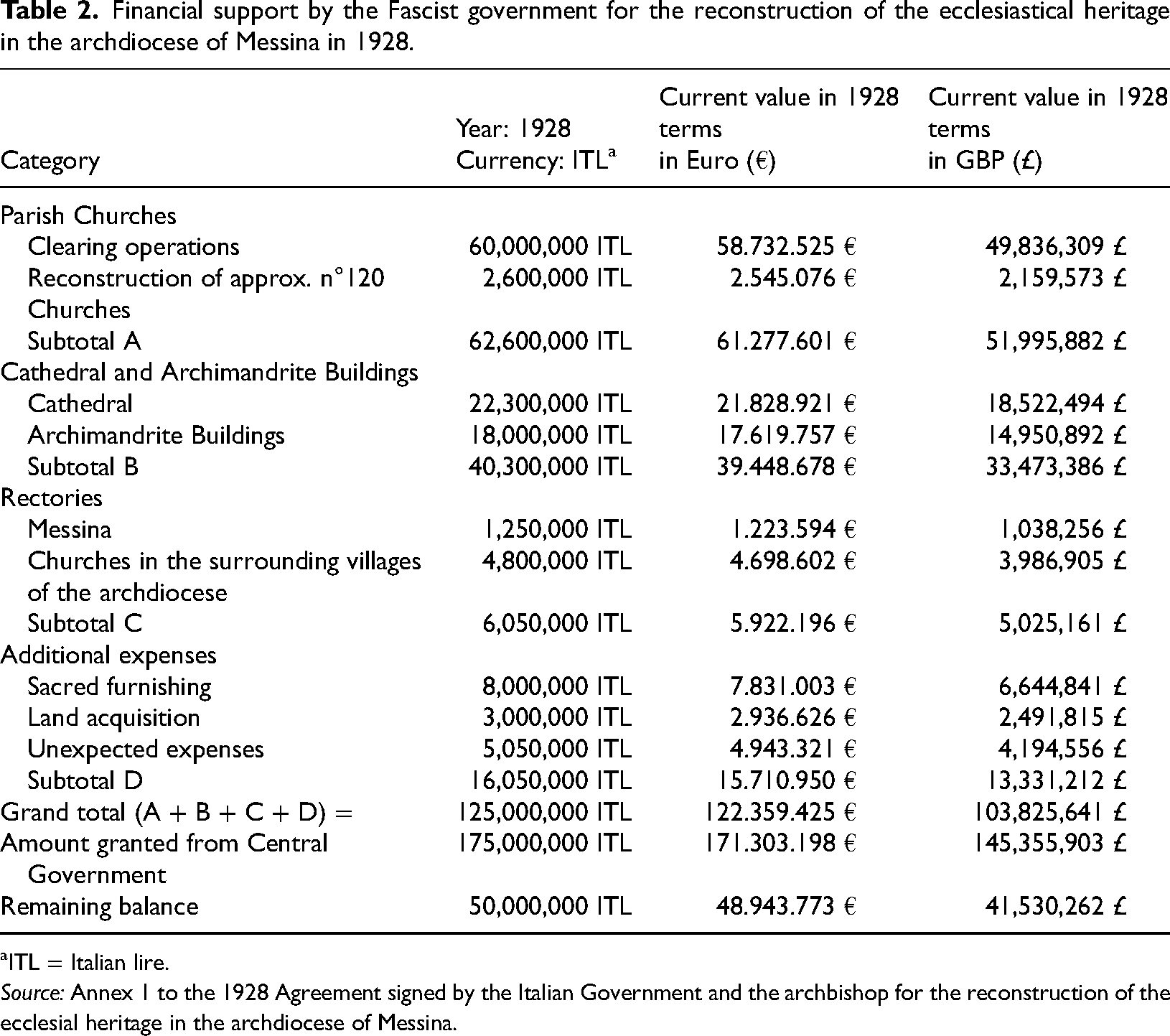
ITL = Italian lire.
Source: Annex 1 to the 1928 Agreement signed by the Italian Government and the archbishop for the reconstruction of the ecclesial heritage in the archdiocese of Messina.
In the following years, with Decree Law No. 917, 1931, the Fascist government recognised a further 40 million lire (equivalent to € 44 million in current value) for completion of the reconstruction programme of ecclesiastical heritage, charitable institutions, nursery schools, and so on.
Apart from the numbers that clearly demonstrate the huge amount of money that the Fascist government devoted to the reconstruction of the Archdiocese of Messina's ecclesiastical heritage, the massive construction programme determined significant changes in the Archdiocese's organisational and accounting structure. First, the archbishop established the Ufficio Tecnico Diocesano (TDO), a new department to which he assigned 30 employees, mainly architects, civil engineers, surveyors and accountants (Cardullo, 1993: 53); the TDO was in charge of several tasks (namely, supervision, administration and execution of the reconstruction plan).
The accounting documents and other archival sources collected at the archdiocese in Messina allow us to retrace the history of the reconstruction of each church included in the agreement.
Each project was accompanied by technical, administrative and accounting documents. In more detail, technical documents refer to land registry maps, graphic tables, planimetry, measurement booklets, metric calculations, tests, and so on. Administrative documents consist of opinions and authorisations issued by the Municipal Office of Civil Engineering, the Superintendency of Mediaeval and Modern Art of Sicily, the Superior Council of Public Works, and the Prefecture of Messina, as well as procurement contracts and work progress drafted by building contractors and others.
Accounting documents refer to estimates, Libri Giornale, financial reports, invoices, mandates issued by the Ministries, bank statements, and so on, which helped to trace the progress made in reconstruction of the city churches. The following figures illustrate the final account for the reconstruction of the San Giuliano Church, which is among the few urban parishes that pre-existed the earthquake, whose origin dates back to 1332 (Figure 4).
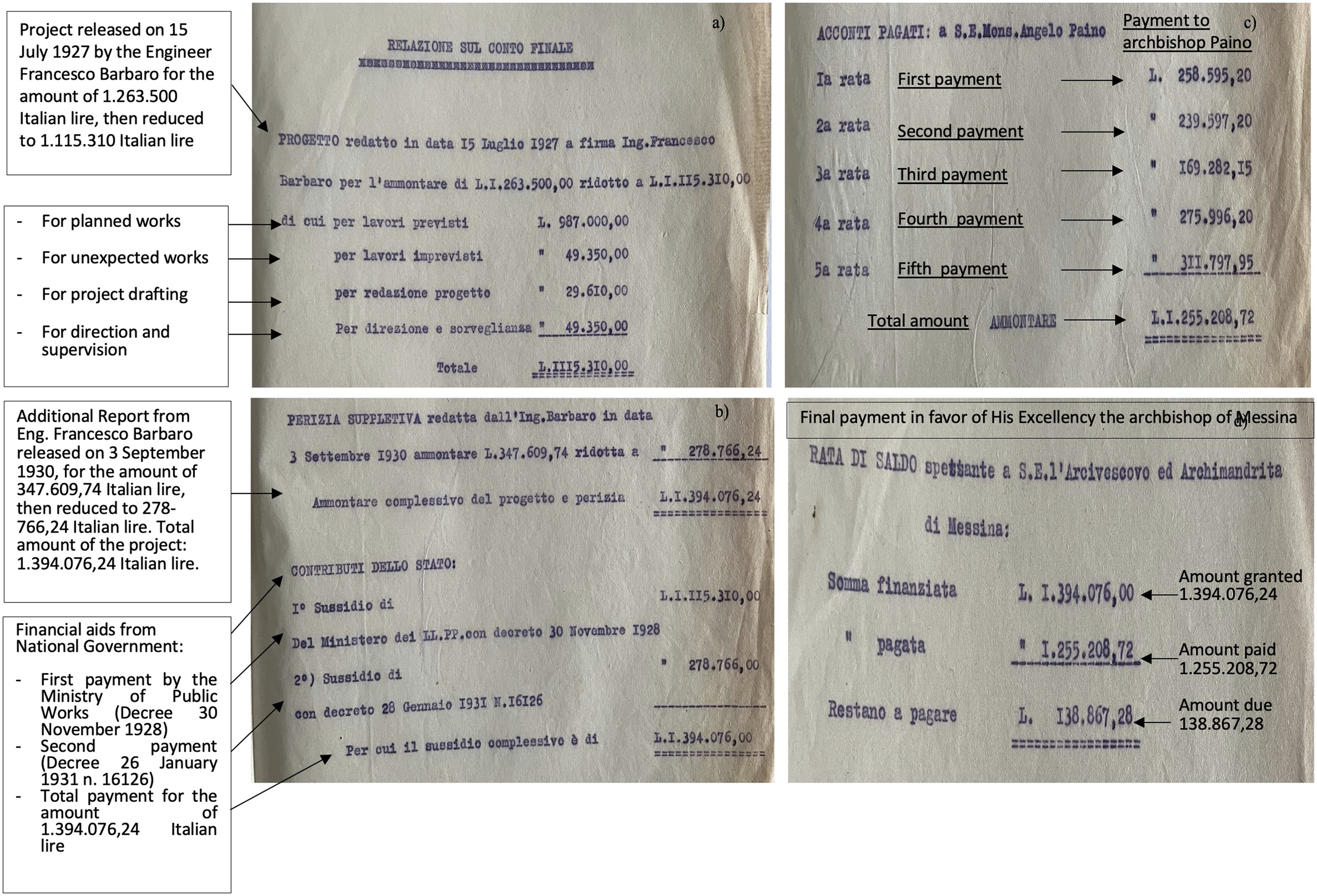
Final report of reconstruction programme for the church of San Giuliano.
The report shows:
the breakdown of costs for each activity (i.e., design, construction, supervision), as included in the amended budget for the total amount of 1,115,310 million lire (which is equivalent to about € 1 million in current value). a further assignment of 278,766 Italian lire (which is about € 277.375 in current value) that brought the final budget of the project up to the amount of 1,394,076 Italian lire (about € 1.38 million in current value); the two subsidies obtained by the Ministry of Public Works for the whole amount requested. five payments made by the Ministry of Public Works in favour of the Archbishop Paino for the amount of 1,255,208.72 Italian lire (about € 1.24 million in current value). the remaining balance of 138,867.24 Italian lire (about € 138.174 in current value) due to Archbishop Paino.
Most of all, the magnitude of the reconstruction programme can also be visualised from the data shown in Table 3.
Resources granted by the National Government for the reconstruction in disaster-stricken regions. Timeframe 1923–1932.
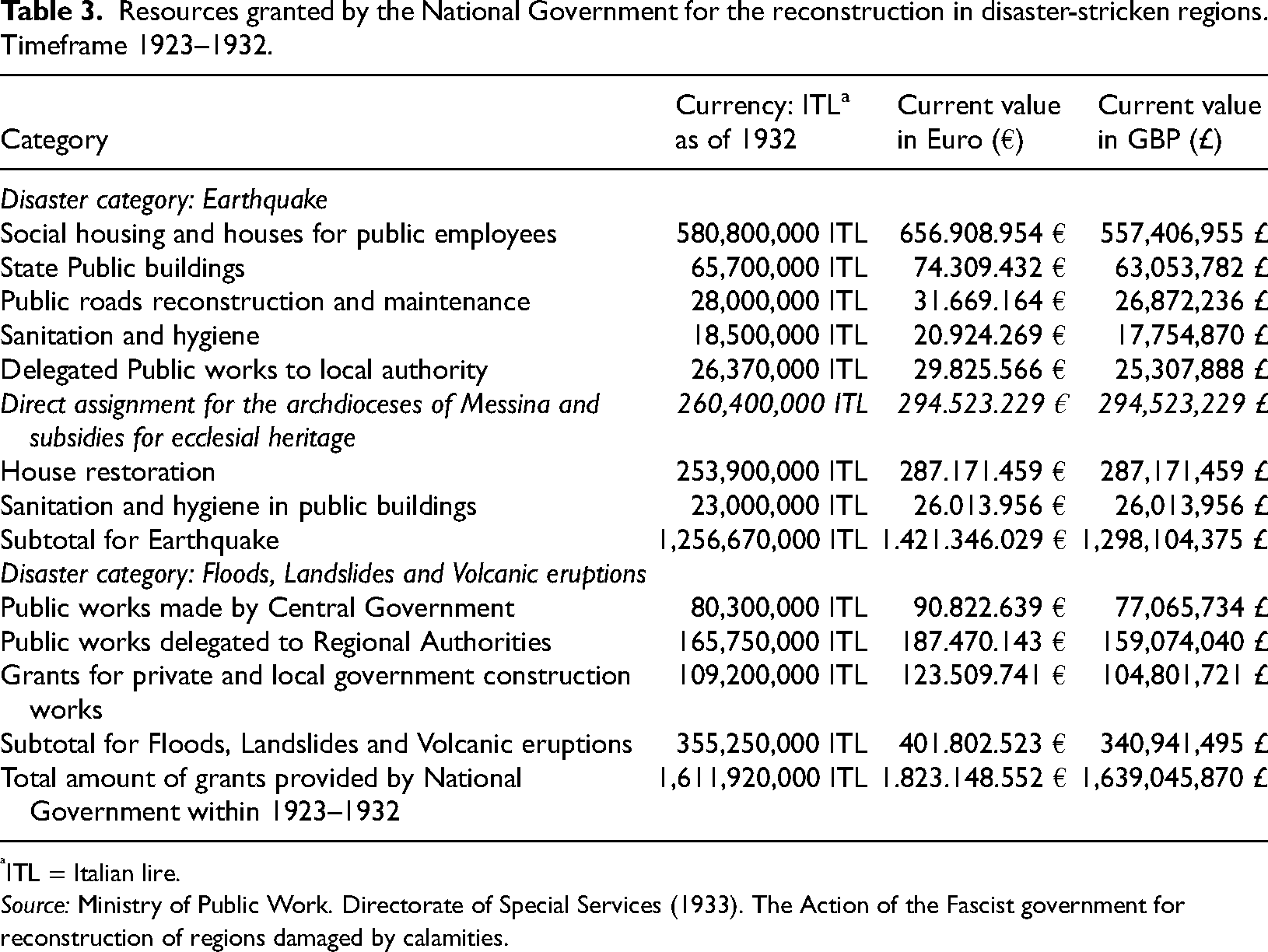
ITL = Italian lire.
Source: Ministry of Public Work. Directorate of Special Services (1933). The Action of the Fascist government for reconstruction of regions damaged by calamities.
The table consists of the final report made by the Directorate of Special Services of the Public Works Ministry on the resources granted by the Fascist government for the reconstruction of several Italian areas stricken by natural disasters: namely, Messina and Reggio Calabria by the earthquake in 1908; Marsica (Abruzzo) in 1915; Pesaro and Forli (Emilia Romagna) in 1916; Arezzo (Tuscany) and Perugia (Umbria) in 1917; Arezzo, Firenze (Tuscany) and Forlì (Emilia Romagna); Mugello (Tuscany) in 1919; Garfagnana (between Tuscany and Emilia Romagna) in 1920; Rome, in 1921; and Siena and Grosseto (Tuscany) in 1926.
In the selected timeframe 1923–1932, out of a total of 260 million lire (€235 million in current value), the Fascist government granted approximately 215 million lire (195 million in current value) for reconstruction of the ecclesiastical heritage of the archdiocese of Messina. Up to the amount of 130,886,000 Italian lire (€ 148 million in current value) had been spent at the end of 1932 (Report of Ministry of Public Works, 1933: 100). In the following years (1934–1935) the central government also financed the reconstruction of the ecclesiastical heritage in the villages surrounding the city of Messina, which were part of the territory of the archdiocese (see Figure 5).
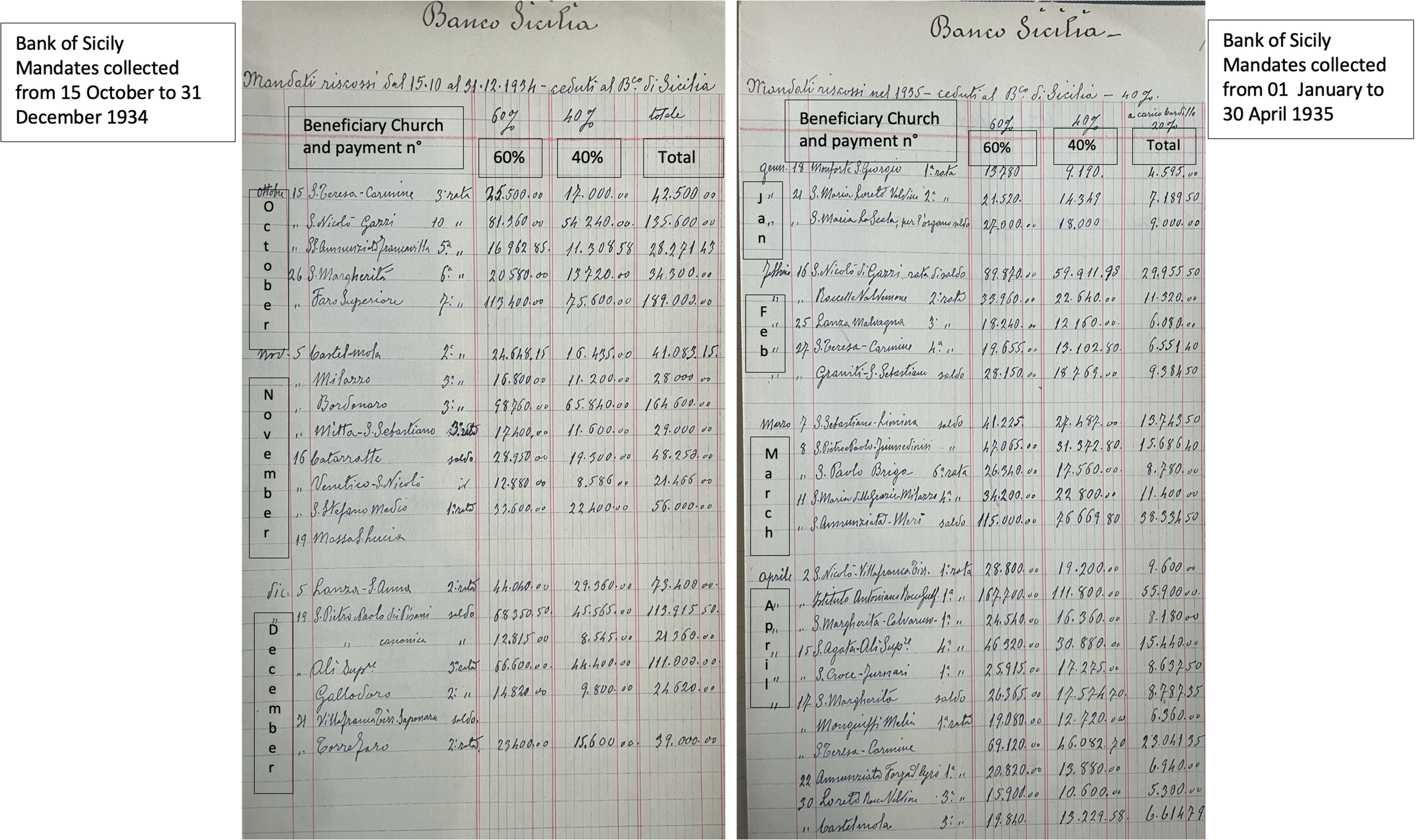
Mandates collected by Bank of Sicily (1934–1935) for reconstruction programme of churches in the surrounding villages of Messina.
The accounting records illustrate the mandates collected by the Bank of Sicily in 1934 and 1935 in two tranches (60 per cent and 40 per cent) for the reconstruction of a significant number of churches in the surrounding villages of Messina, as stated in the agreement signed in 1928 by the Archbishop and the Fascist government.
Archival sources gave substance to the previous sections’ assumptions about the great impact that the Fascist regime had on the city of Messina's reconstruction programme and, more specifically, regarding the reconstruction on the ecclesiastical heritage. To testify to his gratitude to Mussolini for the signing of the agreement, Mons. Paino wrote in the June 1928 the Bollettino Ecclesiastico Messinese as follows: Non so come esprimere imperitura gratitudine cittadinanza messinese e mia per il decreto approvante mia recente convenzione con amministrazione Stato. Nuove opere culto beneficenza consentiranno ritorno a Messina suo volto di gentilezza e fiorita carità cristiana che nei secoli aveva formato suo vanto. Grazie, Eccellenza; da pastore delle anime pregherò che alta intonazione data dall’Eccellenza Vostra alle nuove concessioni, riaffermi nella città risorta le avite virtà religiose e civili! Messina per la storia deve Governo Eccellenza Vostra sua resurrezione, sua vita. Con profondo ossequio. Arcivescovo Messina.
[I do not know how to express the everlasting gratitude of the citizens of Messina and myself for the decree that approved my recent agreement with the state administration. New buildings of worship will allow Messina to recover its kindness and charity which over the centuries had been its pride. Thank you, your Excellency; as shepherd of souls, I will pray that the high priority given by Your Excellency to the new concessions will reaffirm the religious and civil virtues in the risen city. Messina, for its history owes its resurrection, its life to Your Excellency's government. With deep deference, Archbishop of Messina.]
It is therefore not surprising that once the reconstruction programme envisaged by the 1928 Convention was completed, the archbishop gave an interview to Il Popolo d’Italia, the newspaper of the National Fascist Party, in which he stated: Fu allora che Iddio mi concesse di conoscere e di avvicinare il Duce. Dopo tre minuti di colloqui con Lui, il problema della cattedrale di Messina era pianamente risolto. Dopo un altro brevissimo colloquio furono assicurati i primi vistosi fondi per le chiese parrocchiali. Un terzo ed un quarto colloquio mi disse chiaro che ormai era suonata per Messina l’ora della misericordia di Dio. Questi colloqui furono molti, molti; e non uno rimase senza frutto. Non di raro mi ebbi più di quanto sperassi (e le mie speranze erano davvero esorbitanti) più per sinodi quanto chiedessi.
Giunsi a tale che non sapevo concepire un’udienza del Duce, senza salutare in anticipo un nuovo vantaggio per la mia Diocesi. Devo dire di più (oh!) il gran cuore, il mobilissimo cuore di Mussolini); mi pareva talora che fosse mio dovere imporre un limite alle richieste, visto che Egli non riusciva ad imporre un limite alle sue concessioni.
[Then, God allowed me to know and approach the Duce. After three minutes of talks with him, the problem of the cathedral of Messina was easily resolved. After another very brief interview, the first conspicuous funds for the parish churches were secured. A third and fourth meeting made it clear to me that the hour of God's mercy had now struck for Messina. These talks were many, many; and not one was left without fruit. Frequently, I got more than I hoped for (and my hopes were truly exorbitant), more than I asked for. I reached such a point that I could not conceive of an audience with the Duce, without obtaining in advance a new advantage for my Diocese. I must say more (oh! The great heart, the noble heart of Mussolini); it sometimes seemed to me that it was my duty to impose a limit on requests, since he was unable to impose a limit on his concessions.]
One of the last (and most significant) proofs of thankfulness from the Diocese of Messina towards Mussolini, and of Archbishop's devotion and gratitude to Mussolini's government can be seen from the content of the letter to the clergy and the faithful published in the Bollettino Ecclesiastico Messinese in June 1937 in view of Mussolini's second visit to Messina: Sua Eccellenza Benito Mussolini sarà in mezzo a noi fra qualche giorno. Io vi invito a manifestarGli solennemente tutta la vostra gratitudine. Se Messina, risorgendo dalle rovine ha potuto ruavere le sue belle Chiese ed ha il vanto di magnifici Istituti di Assistenza e di Cultura lo dobbiamo a Lui. Non vi erano che poche e monche e quasi irrisorie leggi a prò della nostra diocesi, prima di Lui. E per giunta mancava il cuore e l’energia per applicarle nella stessa loro picciolezza.
Io avevo per mesi e mesi lavorato duramente ma anche vanamente. Quando invece potei per pochi istanti parlare con Lui, vidi senz’altro che l’ora di Dio per noi era scoccata: mi bastarono tre minuti per convincermi che la nostra diocesi poteva già salutare in Mussolini il suo ricostruttore…
Non ho mai trasandato, giorno per giorno, di pregare per Lui, lieto ed orgoglioso di sapere che il Supremo Reggitore della Chiesa, l’immortale Pontefice Pio XI, ogni mattina prega per quest’uomo mandato dalla Provvidenza […]
[His Excellency Benito Mussolini will be among us in a few days. I invite you to solemnly express all your gratitude to him. If Messina, rising from the ruins, was able to get its churches back and has the pride of magnificent institutions of assistance and culture, we owe it to him.
There were only a few, incomplete and almost derisory laws in favour of our Diocese before him. And there was no heart and energy to apply them. I had worked hard for months but also in vain. When, on the other hand, I was able to speak with him for a few moments, I certainly saw that God's hour had struck for us and that Messina could greet Mussolini as his rebuilder […]
I have never ceased to pray for him, happy to know that the supreme ruler of the Church, Pope Pius XI, fervently prays for this man sent by providence. […]]
From 1937 onwards, the reconstruction process continued, albeit with less momentum. As in other Italian cities, the regime devoted itself to ‘celebratory architecture’ or ‘regime architecture’. Tangible signs of this model can be found in Messina in the Palazzo Littorio built in 1940, the Central Station in 1939 and the embellishment of the Palazzo di Giustizia by Marcello Piacentini and the City Hall by Antonio Zanca in 1935, an architect close to the regime who oversaw the construction of many buildings in Rome. At this stage, which Cardullo (1993: 30) named the ‘marble city’ to emphasise the symbolic value of the physical artefacts, the Fascist regime exalted the sense of power through the exploitation of urban space which become an orchestrated narrative to create and reinforce the Fascist political identity (Marcello, 2011; Malone, 2018).
Discussion
As noted by Siodla (2017), history matters in the study of cities, and cities are dotted with events that have changed, wholly or in part, the urban layout and their consequent economic and social development. Over the centuries, war events have required the construction of specific fortifications, lookout areas, and the transfer of buildings of high strategic or symbolic value to more protected areas of cities. Natural disasters (earthquakes, hurricanes, epidemics, etc.) have determined the most significant urban changes over time. As for Italy, earthquakes have had a strong impact on historic cities, causing considerable upheavals to the built environment (Giuliani et al., 2020).
The evolution of urban structures and forms expresses the way of being of a society and the spatial projection of political, social and environmental phenomena that have occurred over time. When dealing with disasters, which are ‘settings for the activation of the “exceptional” government of economic life’ (Sargiacomo and Walker, 2022: 890), the relevance of accounting emerges as a territorializing activity ‘by making physical spaces calculable’ (Mennicken and Miller, 2012: 20).
Accounting and calculative practices have supported the acquisition and accumulation of knowledge in the areas impacted by disasters (Sargiacomo and Walker, 2022) and paved the way to the strengthening of the interrelations between local government and central government (Gomes and Sargiacomo, 2013). Thus, the literature review has provided much evidence of how the Fascist Party exploited it to symbolise the regime's efficiency in various settings (agriculture, education, culture, urban planning, etc.).
The primary and secondary sources collected allowed us to visualise, appraise and describe the urban reconstruction process that took place under the Fascist regime and the appointment of the new archbishop at the head of the Archdiocese of Messina. Available data show that in the timeframe up to 1937, the reconstruction by the Fascist government consisted, among other, of 5,492 social housing units, 30 schools, 14 military buildings, the new Regina Margherita Hospital and the City Hall. For reconstruction of the ecclesiastical heritage, the archival evidence of the selected timeframe demonstrates that 132 churches were built from the ground up and 72 were restored, in addition to 133 rectories and seven primary and secondary schools, 12 social welfare institutions, 10 nurseries, two libraries and two archepiscopal seminaries.
Our results are consistent with previous studies which also observed that, in a disaster situation (Vosslamber, 2015), the core functions of accounting include the provision of information for decision-making, allocation of resources, and maintenance of institutional accountability and stewardship (Burchell et al., 1980).
The selected analysis period of urban reconstruction gave us a twofold set of findings. The primary and secondary sources examined enhanced our understanding of the disaster, highlighting the translational nature of accounting (Neu and Graham, 2006). It helped, at a macro level, to translate and visualise policymakers' abstract objectives (the city reconstruction) into concrete field-specific actions and results, also allowing action at a distance from those (Mussolini and the Fascist regime) who held power (Latour, 1987; Sargiacomo, 2009; Mennicken and Miller, 2012). On the other hand, at the micro level, the archdiocese organised an analytical accounting and accountability system, creating ad hoc reporting on each church and institution the government financed. In this way, the churches' reconstruction also brought about a major change in the diocese's organisational structure.
In the period analysed, the reconstruction was marked by rules, procedures and pertinent phases on an administrative, accounting and technical level which led the Fascist government to monitor the reconstruction programme's evolution at a distance in line with the propaganda's ambitious proclamations.
Conclusions, limitations and future research
The Fascist period left ‘indelible marks’ on Italy's cities (Malone, 2017) in the form of urban projects, churches, monuments, and so on. All these architectural forms became part of the ‘media’ used to symbolise the Fascist regime's power. Even today, the architectural legacy is clearly visible in many Italian cities, where it symbolises what historians have called the country's ‘difficult heritage’ (Carter and Martin, 2017: 340) or ‘undesirable heritage’ (Macdonald, 2006: 9) to describe buildings recalling a ‘discredited past’.
Without diminishing the atrocities of the Fascist ideology that resulted in the authoritarian regime, the rise of Mussolini and the efficiency of his government's early stage greatly contributed to several construction programmes in some key economic and societal sectors (school buildings, theatres, social housing, sports facilities). The Fascist Government invested huge financial resources to start and support reconstruction programmes in several cities totally or partially destroyed by natural disasters during or immediately prior to the Fascist period.
For the devastating extent of human, physical and economic damage that it caused and for the historical moment in which it took place, the 1908 earthquake of Messina represents an event of extraordinary importance on a global scale, although unexplored by the accounting history and disaster literature. It follows that the underlying implications and the Fascist rationale of reconstruction of the city and its ecclesiastical heritage, following the 1908 earthquake, seemed to be topics of great interest for several research purposes and calls among the purpose of the Accounting History special issue ‘Accounting for Natural Disasters: An Historical Perspective’.
This research has several implications and items of originality. First al all, our analysis confirms connections among accounting history, city reconstruction and disasters (Vosslamber, 2015; Sargiacomo et al., 2021; Sargiacomo and Walker, 2022) and contributes to identify the research stream. Among the relevant findings, the role of the reconstruction of the city churches and key public buildings in the nascent Fascist regime led by Mussolini is regarded as an instrument of consensus among the Catholic electorate. To some extent, the study contributes to unveiling the ‘mystery [which] surrounds the accounting implications connected with the reconstruction in the aftermath’ of the 1908 Messina earthquake (Sargiacomo et al., 2021: 193). This contribution is directed towards integrating accounting history, city reconstruction and disasters.
Additional contributions are based on the drafting of the state of the art in the most significant disasters that occurred worldwide in the last century and examining urban reconstruction in a disaster setting proposing an archival source analysis of unexplored primary sources. Indeed, to the best of our knowledge, our research is the first study which addresses the topic of 1908 earthquake of Messina through archival accounting evidence. The article develops the strand of ‘accounting, city reconstruction and disasters’ under the Fascist period, which scholars have considered a promising and topical avenue of research (Sargiacomo et al., 2021: 193) in accounting history studies. In this perspective, the study could stimulate further theorisations and case study analysis on previous and future calamities worldwide. An additional reason of interest for contemporary accounting historians' audience lies in the contribution that accounting evidence could provide in monitoring the progress of governmental reconstruction programmes following natural disasters that might occur in the future. Our results confirm that: numbers are integral to the problematizations that shape what is to be governed, to the programs that seek to give effect to government, and to the unrelenting evaluation of the performance of government that characterizes modern political culture. (Rose, 1991: 675)
The role of accounting in supporting and explaining the previous phenomena appears as a positive lens through which to interpret interventions of urban reconstruction after the 1908 earthquake of Messina. However, this article has limitations, such as the analysis of one case study and the methodological choice of the theory adopted to frame the study. Thus, future research is directed to investigating other catastrophes that required huge reconstruction programmes (e.g., the Vajont dam, the collapse of Ponte Morandi in Genoa, etc.). Another path of research is based on assuming different analysis perspectives through additional theoretical lenses.
Footnotes
Declaration of conflicting interests
The authors declared no potential conflicts of interest with respect to the research, authorship, and/or publication of this article.
Funding
The authors received no financial support for the research, authorship, and/or publication of this article.
