




Abstract
Music listening can serve an affect-regulatory function. For instance, someone who feels anxious may listen to music with the goal of evoking a different, desired feeling (e.g., calmness), labelled ‘compensatory’ listening. However, music therapists recommend starting with music matching one’s current feelings before gradually shifting to music that evokes desired feelings, following the ‘iso principle’. Some evidence supports the effectiveness of the iso principle for affect regulation in clinical populations. However, randomised experiments comparing the iso principle with other music-listening interventions are rare, especially with non-clinical participants. To address this gap, the current study compared the effectiveness of iso-principle, compensatory-principle, and unguided music listening for modulating anxiety among healthy participants (N = 193) in a randomised experiment. Participants completed an anxiety induction before listening to a Spotify playlist in one of three randomly assigned conditions: participants in the iso and compensatory conditions listened to five-song iso- and compensatory-principle playlists respectively, curated by the researchers using participants’ self-selected songs, whereas participants in the unguided condition self-ordered their songs. Participants rated their momentary affect at baseline, post-anxiety-induction, and post-listening. Our pre-registered analyses revealed no significant difference in the affect-regulatory consequences of iso versus compensatory listening. However, post-hoc exploratory analyses revealed that participants in the guided (iso, compensatory) conditions reported significantly greater increases in calmness than unguided participants. Moreover, exploratory analyses of unguided listening sequences revealed seven distinct patterns of spontaneous music listening, which differed in perceived effectiveness. Findings from this study may inform the development of (digital) music interventions to improve well-being.
Keywords
Listening to music can powerfully influence listeners’ affective experience. 1 For instance, music can increase arousal – a key component of affective experience – through ‘sudden, loud, or dissonant’ sounds, which activate brainstem reflexes (Juslin, 2013, p. 241). Music can also induce affect through repeated pairing with positive or negative events, a process known as evaluative conditioning, while the emotions perceived to be expressed by the music itself can also induce the same emotions in listeners (e.g., a listener may internally emulate the happiness expressed by a song through contagion; Juslin, 2013).
Harnessing music’s affect-inducing properties, music therapists routinely use guided music listening to help individuals with affective disorders (e.g., anxiety and depression) and other clinical conditions to manage emotional distress. In the music therapy literature, the iso principle is an influential approach for regulating affect of patients in clinical settings. First proposed by Altshuler (1944), the iso principle refers to first, matching the patient’s current mood with music that expresses the same mood, before gradually introducing music that helps shift their feelings towards a desired mood (Jacobsen et al., 2019). For example, Altshuler (1944) proposed that a patient with hypomania and who is talking fast should first be played music that has a fast tempo before being exposed to slower tempo music. Similarly, following the iso principle, patients who are feeling sad should first be played music with a perceived sad mood, as abrupt exposure to music perceived as happy may cause irritation. The ‘step-wise changes in the music’ (Shatin, 1970, p. 81) that transitions a listener from their current mood to their desired mood is also referred to as ‘mood vectoring’ (Shatin, 1970).
Although music therapists routinely adopt the iso principle in their practice, there is limited evidence of its efficacy relative to other forms of music listening, such as the compensatory principle, which assumes that listening to music with affective qualities that contrast with one’s current feelings will be effective in modulating emotional experience (Jacobsen et al., 2019). Qualitative case studies (Heiderscheit & Madson, 2015), quantitative studies (Lázaro-García et al., 2024; Ratcliff et al., 2014) and mixed-methods studies (Bautch, 2021) provide some evidence that iso-principle listening is generally an effective approach to affect regulation in clinical populations, although not necessarily more effective than other (music) interventions. For instance, Bautch (2021) tested the effectiveness of a two-week intervention involving 11 participants with generalised anxiety symptoms self-administering a seven-song iso-principle-based playlist, curated collaboratively with a music therapist. Results showed that both state and trait anxiety significantly decreased in this clinical group from pre- to post-intervention. However, as Bautch (2021) did not include a control condition or comparison treatment, it is not possible to know if the observed symptom improvements were due to the iso-principle music intervention, or would have been observed with any other (or no) intervention. Other studies with appropriate control groups have found limited evidence for the relative efficacy of iso-principle music listening. For example, Ratcliff et al. (2014) found that iso-principle listening immediately helped improve mood among hematopoietic stem-cell transplant patients, although compensatory-principle-based listening improved mood to a similar or greater degree. Similarly, Lázaro-García et al. (2024) conducted a randomised controlled trial (RCT) whereby acute myeloid leukaemia patients received either daily iso-principle-based music therapy or (non-music) standard care and found similar improvements in symptoms in both groups. A recent usability study (N = 24) of an intervention that creates ‘dynamic’ (i.e., iso principle) playlists and ‘static’ (i.e., compensatory principle) playlists showed that participants with clinical depression experienced clinically significant reductions of depression from pre- to post intervention, however, the effects of the two types of playlist were not distinguished (Coutinho et al., 2021). Thus, empirical evidence for the effectiveness of iso-principle music listening in clinical populations is limited, especially relative to other modes of music listening.
Evidence for the effectiveness of the iso principle in regulating the everyday emotions among healthy participants in the general population is even more scarce. Thus, it remains unclear to what extent the iso principle would be effective if deployed in the context of large-scale music interventions targeting the general community. Such interventions could, for instance, be integrated into digital music streaming services (e.g., Spotify) that are used by hundreds of millions of people around the world (Spotify, 2025).
Music streaming services provide access to music at virtually any time and place, making them potentially a highly scalable and convenient affect-regulation tool. Research has shown that one of the reasons why people listen to music via mobile devices is to regulate their feelings in everyday life, such as ‘to relax/de-stress’, ‘for enjoyment’, ‘to raise energy/get pumped up’ or ‘to improve [their] mood’ (Randall & Rickard, 2017, p. 484). While music streaming services, such as Spotify, offer a vast catalogue of mood-based playlists (e.g., Life Sucks or Happy Hits), these playlists are emotionally homogenous. In other words, existing mood-based playlists support compensatory (or mood-congruent) listening, but not iso-principle listening. Recognising this gap, researchers have been experimenting with emotion-regulation playlist interventions that integrate users’ familiar music and the iso principle for clinical populations (Coutinho et al., 2021; Hides et al., 2019), and iso-principle interventions targeting the general population (Lowe-Brown et al., 2024). Therefore, it is timely to explore how these playlist interventions should be designed, and how iso-principle playlists may be experienced by the general population.
To our knowledge, only three empirical studies to date have investigated the effectiveness of the iso principle versus the compensatory principle with non-clinical samples. Using a within-subjects design, Goldschmidt (2020) had N = 9 participants complete compensatory, iso, and (non-music) control conditions in one of six randomly assigned orders while continuously measuring their galvanic skin response – an indicator of emotional arousal. No significant differences emerged between the iso and compensatory conditions; however, these two conditions showed significantly greater arousal than the control condition. Thus, Goldschmidt’s (2020) findings suggest that iso- and compensatory-principle listening may be equally effective in up-regulating affect. In a larger study (N = 107), Starcke et al. (2021) exposed participants to a sadness induction and then randomly allocated them to one of four listening conditions, in which participants listened to two classical music excerpts in one of four listening orders: (i) sad music followed by happy music (i.e., iso principle); (ii) two happy excerpts (i.e., compensatory principle); (iii) happy music followed by sad music (i.e., an inverse-iso principle condition), or (iv) two sad excerpts (i.e., affect-congruent listening). Participants in the iso-principle condition reported significantly higher positive affect post-listening than those assigned to the inverse-iso and affect-congruent conditions. However, participants in the iso and compensatory conditions did not report significantly different affect levels. Thus, Starcke et al.’s (2021) findings suggest that iso- and compensatory-based listening may have similar affective benefits. However, to further explore possible differences between iso and compensatory listening, Starcke and von Georgi (2024) randomly allocated N = 59 healthy university students to an iso (sad song, happy song) or compensatory (two happy songs) music-listening task following a lab-based sadness induction. Contrary to their 2021 study, Starcke and von Georgi (2024) selected perceived happy and sad pop songs for the music-listening task instead of classical music excerpts and ensured that the final happy song was the same for both groups. Post-listening, participants in the iso group reported significantly lower negative affect compared to the compensatory group (Cohen’s d = 0.52), supporting the hypothesis that the iso principle is a more effective method for affect regulation than compensatory listening.
Taken together, the few studies comparing the affect-regulatory outcomes of iso- versus compensatory-based music listening have yielded mixed results. One possible explanation for these inconsistent findings is that previous studies have used small samples (n ~ 30 per condition) and may have therefore lacked sufficient statistical power to reliably detect differences. Moreover, it is unclear how effective iso and compensatory listening are (i) for participant-selected rather than experimenter-selected music; (ii) for regulating unpleasant feelings other than sadness (e.g., activated negative affect, such as anxiety); and (iii) compared with naturalistic, unguided music listening.
We aimed to address these questions in the current study, extending Starcke and von Georgi's (2024) study comparing the affect-regulatory outcomes of iso- and compensatory-based music listening following a standardised affect induction. Our study differed from Starcke and von Georgi’s in the following ways: (1) to increase ecological validity, we used participant-selected rather than researcher-selected songs (though the order of the songs was researcher-manipulated); (2) to test a longer affective trajectory, participants listened to five songs rather than two; (3) we investigated the affect-regulatory function of music listening following an anxiety (rather than a sadness) induction given that anxiety is more common in daily life (Trampe et al., 2015); (4) we included an ‘unguided’ listening (control) condition, in which participants listened to five songs in a self-selected order to mimic naturalistic music listening in everyday life; and (5) we recruited a larger sample with twice as many participants (n ~ 60 vs. 30) per experimental condition to increase the precision and robustness of our findings.
In sum, the current study aimed to investigate to what extent iso-principle music listening would decrease anxiety relative to compensatory-principle and unguided listening in a sample of healthy (non-clinical) individuals. We pre-registered two hypotheses: that participants randomised to the iso condition would show larger decreases in anxiety and larger increases in calmness than participants in the compensatory condition (H1); and that participants in the unguided condition would show larger variance in their post-listening affect ratings than participants in the two guided conditions (H2). 2 We also explored differences in the affect-regulatory consequences of the two guided (iso and compensatory) conditions relative to the unguided condition, and explored how participants in the unguided condition spontaneously selected and ordered songs.
Method
We pre-registered the methods, hypotheses, and data-analysis plan for the current study prior to commencing data collection (https://osf.io/kmu4g). Raw data and analysis scripts are available at https://osf.io/br37e. This study was approved by the University of Melbourne’s human research ethics committee.
Participants
We determined our target sample size based on an a priori power analysis conducted in G*Power 3 (Faul et al., 2007). Specifically, we aimed to determine the minimum sample size required to detect an effect equal to the difference between the iso and compensatory groups (d = 0.52) reported by Starcke and von Georgi (2024) with 80% power and alpha = .05. Our analysis showed that we needed a sample of N = 60 participants per condition (i.e., total N = 180 across our three experimental conditions). We aimed to recruit N = 200 participants to allow for up to 10% attrition or data loss. 3
We recruited predominantly staff and students from our University by advertising in the University’s staff and student notices, placing posters around campus, and via social media posts, which also allowed for snowball sampling. A total of N = 343 participants completed an initial screening survey to assess eligibility, of whom N = 279 met eligibility criteria and N = 252 were invited to complete the main study. Participants were eligible if they (a) could provide written consent; (b) were 18 years or older; (c) had a Spotify Premium account (to ensure the music-listening task would not be interrupted by advertisements); (d) could attend an in-person lab session in the following weeks; and (e) did not have a current diagnosed mental health condition (to mitigate risks associated with the anxiety induction).
We also recruited N = 89 first-year psychology students via the Melbourne School of Psychological Science’s undergraduate research pool. Participants recruited via this channel were eligible if they were a student enrolled in a relevant undergraduate psychology subject and were able to give consent. This included some students under the age of 18 years.
We excluded participants who did not complete or who incorrectly completed Part 1 (i.e., an online Spotify song selection task; N = 136) as well as participants who did not show up for Part 2 (i.e., a lab session comprising our main experiment; N = 12). Thus, after exclusions, our final sample size for all analyses was N = 193, which slightly exceeded our target sample size (N = 180). Participants were aged 17–73 years (M = 23.767, Mdn = 20, SD = 8.258) and predominantly identified as female (71%). Participants’ self-reported ethnicities were predominantly Caucasian/White (28%), Chinese (23%), or Other Asian (17%). Full demographic information is provided in Supplementary Tables S1 and S2. Community participants received a $20 GiftPay voucher for their participation and psychology students received course credit.
Materials and procedure
The study involved two parts: Part 1 was an online questionnaire, in which participants were prompted to select songs from their Spotify library with specific affective qualities. Part 2 was an in-person lab session, in which participants individually completed an anxiety induction followed by a music-listening task.
Part 1
In Part 1, eligible participants were sent a Qualtrics survey including information about the study, a consent form, and the Spotify activity. For the Spotify activity, participants were asked to create two five-song lists: (1) An ‘anxious songs’ list with five songs that sound anxious, stressed or angry, ordered from the most anxious, stressed or angry to least and (2) A ‘calm songs’ list with five songs that sound calm or relaxed, ordered from the most calm or relaxed to least (see Supplemental Materials for full instructions). At the end of this activity, participants provided their two Spotify lists to the researchers and booked a time for the Part 2 lab session.
Part 2
Part 2 comprised the main experiment, in which participants attended the lab individually to complete an anxiety induction procedure, followed by a music-listening task in one of three randomly assigned conditions: an iso-principle condition, a compensatory-principle condition, or an unguided condition (described further below). During the experimental session, participants rated their momentary affect at three timepoints: a baseline (T0) rating prior to the anxiety induction, a post-induction (T1) rating immediately after the anxiety induction; and a post-listening (T2) rating immediately after the music-listening task. Thus, our experiment used a mixed 3 (condition: iso vs. compensatory vs. unguided) × 3 (time: baseline vs post-induction vs post-listening) design, with condition as the between-subjects factor, and time as the within-subjects factor.
Baseline (T0) affect measure
Participants completed demographic questions (age, gender, ethnicity, occupation) and rated their momentary affect.
Momentary affect items
Following a recent experiment using a similar affect-induction procedure as the current study (Nasarudin et al., 2023), we measured participants’ momentary feelings with 23 affect items, predominantly drawn from the Positive and Negative Affect Schedule-Expanded Form (PANAS-X; Watson & Clark, 1994). We included 17 negative affect items (e.g., ‘nervous’, ‘upset’) and six positive affect items (e.g., ‘calm’, ‘joyful’). At all three timepoints (T0, T1, & T2), participants rated the extent to which they were ‘experiencing each feeling right now’ on a scale from 1 (not at all) to 6 (extremely). Affect items were presented in a random order. Our main dependent variables were anxiety/fear, operationalised as the mean of participants’ ratings of ‘Afraid’, ‘Scared’, ‘Frightened’, ‘Nervous’, ‘Jittery’, ‘Anxious’, and ‘Stressed’; and calmness, operationalised as the mean of ‘Calm’, ‘Relaxed’, and ‘At Ease’ ratings. Both of these formed reliable scales with Cronbach’s alpha values ranging from .83 to .91. 4 We included an additional affect item (EmojiGrid) for exploratory analyses purposes (see Supplemental Materials).
Anxiety induction procedure
After completing the baseline measures, participants completed an autobiographical recall task, in which they were instructed to reflect on ‘the most anxiety-provoking experience you’ve had in the last five years’ and to write a brief description of their anxiety-provoking experience in enough detail that another person might begin to feel anxious when reading it (see Supplemental Materials for full instructions). Participants wrote a description of their anxiety-provoking event on a piece of paper, which they took with them at the conclusion of the study to ensure complete anonymity. For privacy reasons, we did not read participants’ written descriptions. Participants could not proceed to the next step until three minutes had passed.
We chose this method of affect induction as the results of a recent meta-analysis (Joseph et al., 2020) showed that it is the most effective induction for anxiety and anger specifically (both unpleasant, activated affective experiences). While Joseph et al. (2020) showed that autobiographical recall is more effective in inducing anxiety when paired with music, we chose not to include music as we deemed that it would interfere with the music-listening task following the induction. The recall task instructions were in line with previous studies using this method of affect induction (Mills & D’Mello, 2014; Nasarudin et al., 2023).
Post-induction (T1) affect measure
Participants once again rated their momentary affect immediately following the anxiety induction using the same affect items as at T0 (described above).
Music-listening task
Next, participants completed a music-listening task in the iso (n = 64), compensatory (n = 66), or unguided (n = 63) conditions, with each participant’s condition determined by random assignment using a randomisation sequence generated at https://www.randomizer.org/. We manually created Spotify playlists for each participant, comprising songs drawn from lists provided by the participant in Part 1, prior to Part 2 based on their allocated condition (see Table 1). The first author used their own Spotify account to create participants’ playlists. Therefore, the first author removed these playlists from their public Spotify profile to protect participants’ privacy. The first author sent the Spotify playlist URLs to each participant on the morning of their lab session and instructed them not to open their playlist prior to the lab session.
Method of creating participants’ Spotify playlists.
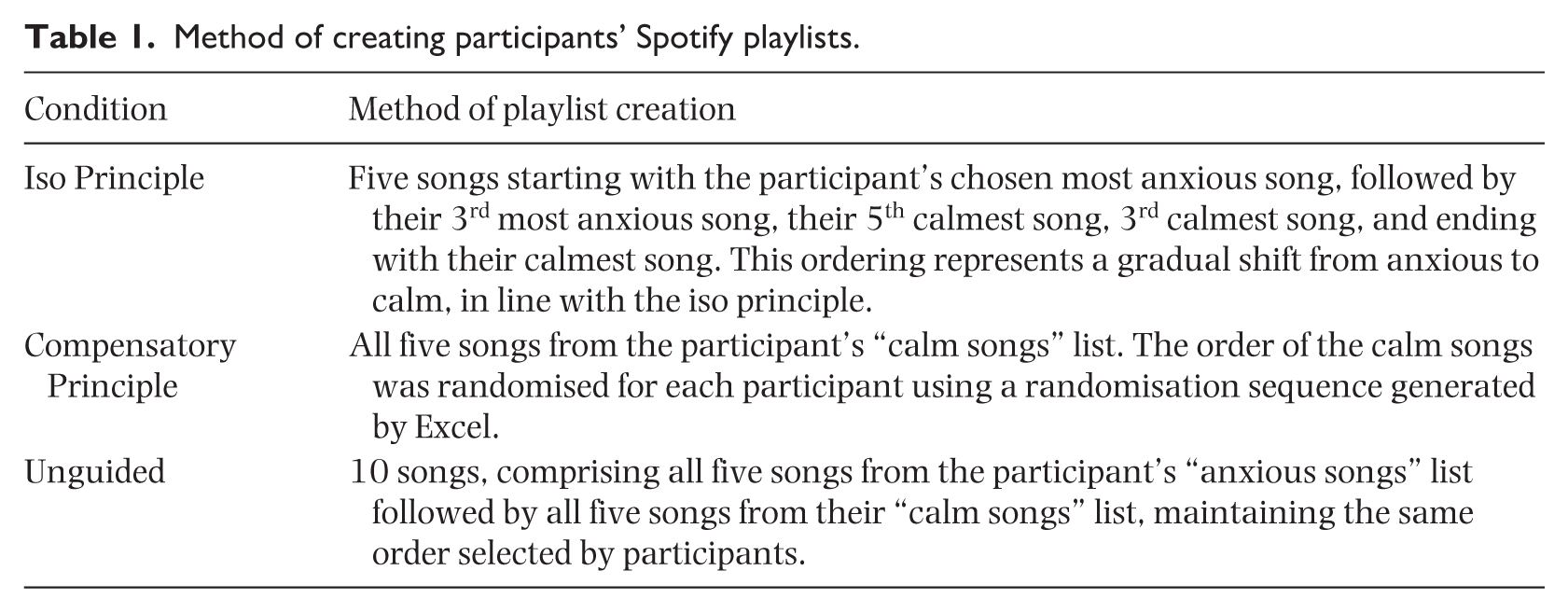
At the start of the music-listening task, participants were instructed to open their personal device (e.g., smartphone, laptop) and to click on the playlist URL provided to them, without checking notifications or exiting Spotify. Participants in the iso-principle and compensatory-principle conditions were instructed to ensure the ‘shuffle’ feature was turned off and were reminded not to skip songs or change the order of songs in their allocated five-song playlist.
Participants in the unguided condition were instructed to listen to any five songs of their choice from their 10-song playlist (comprising five calm and five anxious songs, as described in Table 1), in any order, with the option of listening to the same song more than once, for a total duration of 15–20 minutes. At the end of the music-listening task, participants in the unguided condition were asked to check their Spotify listening history and record which songs they had listened to in order (including any repeats).
All participants were required to listen through their headphones, remain seated, and try to focus on the music, and were encouraged to make themselves comfortable (e.g., by closing their eyes).
Post-listening (T2) affect measure
After completing the music-listening task, participants once again rated their momentary affect using the same items as before and also rated the extent to which ‘the playlist help[ed] [them] feel calm’ on a scale from 1 (not at all) to 6 (extremely) along with additional playlist-related items that are described in the Supplemental Materials.
Data analyses
We completed all data preprocessing and analyses using R (version 4.4.1).
To check the success of our anxiety induction, we ran one-way repeated-measures ANOVAs, with time (T0 vs. T1) as the within-subjects factor, and separate models with anxiety/fear and calmness as dependent variables.
To test H1 – that participants in the iso condition would report greater decreases in anxiety/fear and greater increases in calmness than participants in the compensatory condition – we ran two separate 2 (time: T1 vs. T2) × 2 (condition: iso vs. compensatory) mixed ANOVAs, with time as the within-subjects factor, condition as the between-subjects factor, and separate models with anxiety/fear and calmness as dependent variables. 5 These analyses only include data from the iso and compensatory groups (i.e., excluding participants in the unguided condition). Further, we ran exploratory analyses with data from all participants testing for differences in the effectiveness of guided (iso, compensatory) vs. unguided music listening. We thus ran two additional 2 (time: T1 vs. T2) × 2 (condition: guided vs. unguided) mixed ANOVAs with time as the within-subjects factor, condition as the between-subjects factor, and separate models with anxiety/fear and calmness as dependent variables.
To test H2 – that participants in the unguided condition would show greater variability in their affect ratings than participants in the two guided conditions – we compared variances between guided and unguided participants using Levene’s test for equality of variances.
We also conducted several other exploratory follow-up analyses, which we describe briefly below and provide further details of in the Supplemental Materials.
Results
Manipulation check: Did the anxiety induction work?
One-way repeated-measures ANOVAs with time (T0 vs. T1) as the within-subjects factor yielded significant main effects for both anxiety/fear (F(1, 192) = 99.96, p < .001, Cohen’s d = 0.72) and calmness (F(1, 192) = 330.27, p < .001, Cohen’s d = 1.31). Thus, on average, participants in our study reported significant increases in anxiety/fear from T0 (M = 1.92, SD = 0.72) to T1 (M = 2.60, SD = 1.09), and significant decreases in calmness from T0 (M = 4.06, SD = 1.06) to T1 (M = 2.59, SD = 1.15), supporting the effectiveness of our anxiety induction.
Relative effectiveness of iso vs. compensatory music listening (H1)
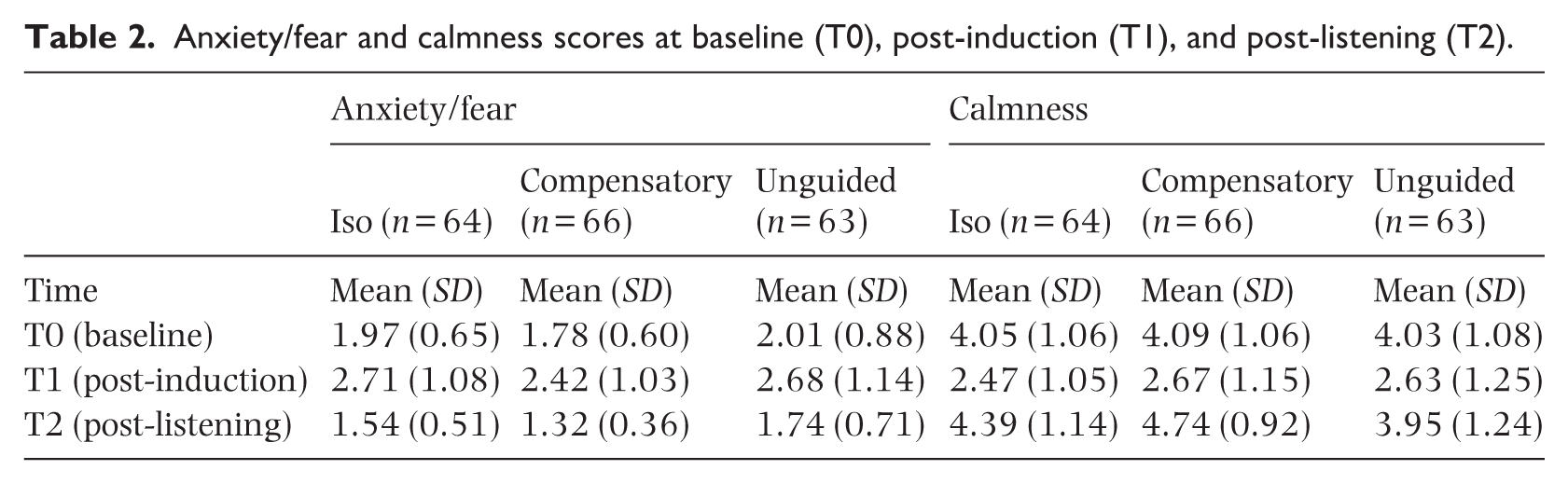
Means and standard deviations of anxiety/fear and calmness scores reported by participants in each listening condition at each time-point are presented in Table 2.
Anxiety/fear and calmness scores at baseline (T0), post-induction (T1), and post-listening (T2).
Change in anxiety/fear from T1 to T2
The 2 (time: T1 vs. T2) × 2 (condition: iso vs. compensatory) mixed ANOVA with anxiety/fear scores as the dependent variable yielded significant main effects of time (F(1, 128) = 182.26, p < .001, Cohen’s d = 1.19) and condition (F(1, 128) = 4.92, p = .028, Cohen’s d = 0.26), but no significant time × condition interaction (F(1, 128) = 0.20, p = .659, Cohen’s d = 0.08). The main effect of time indicates that the approximately 1-point decrease in anxiety/fear (measured on a 1–6 scale) from post-induction (T1: M = 2.57; SD = 1.06) to post-listening (T2: M = 1.43, SD = 0.45), across both the guided listening (i.e., iso and compensatory) conditions, was statistically significant. Further, the main effect of condition indicates that participants in the iso condition reported significantly (albeit only slightly) higher anxiety/fear across timepoints (see Table 2). However, contrary to H1, participants in the iso-principle condition did not show a larger decrease in anxiety/fear after the music-listening task compared with participants in the compensatory condition (see Figure 1).
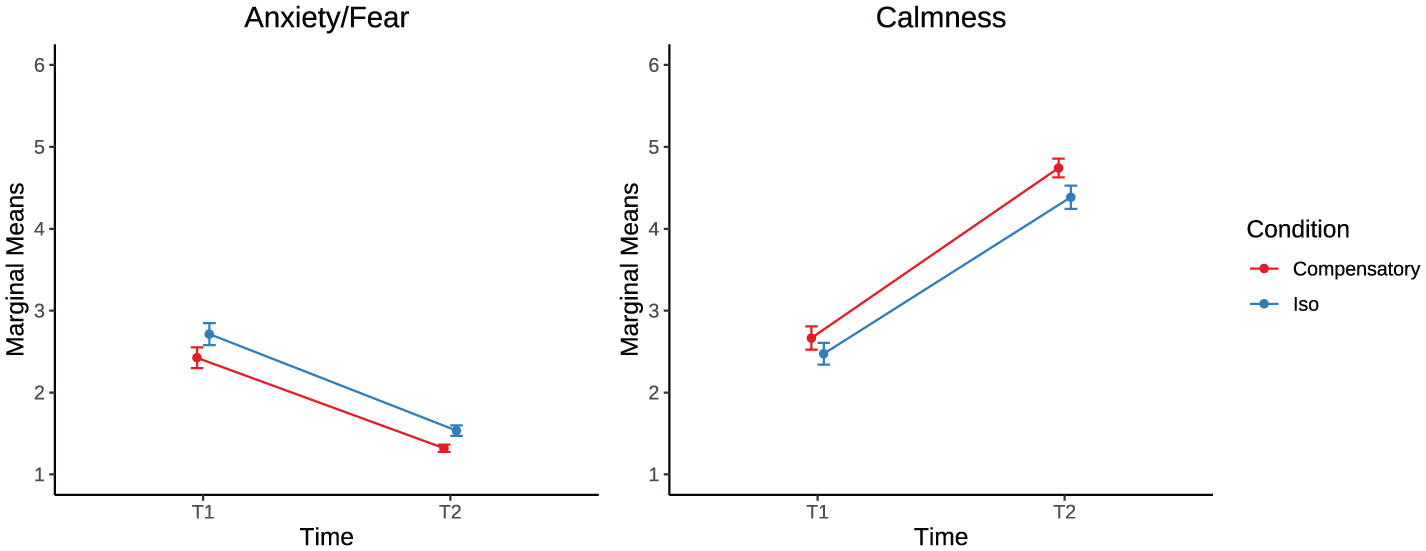
Changes in anxiety/fear (left) and calmness (right) from post-induction (T1) to post-listening (T2) for iso-principle condition and compensatory-principle condition.
Change in calmness from T1 to T2
The 2 (time: T1 vs. T2) × 2 (condition: iso vs. compensatory) mixed ANOVA for calmness ratings yielded a significant main effect of time (F(1, 128) = 363.72, p < .001, Cohen’s d = 1.68), but no significant main effect of condition (F(1, 128) = 3.12, p = .080, Cohen’s d = 0.19) and no significant time × condition interaction (F(1, 128) = 0.62, p = .433, Cohen’s d = 0.14). The main effect of time indicates that the approximately 2-point increase in calmness from post-induction (T1: M = 2.57; SD = 1.10) to post-listening (T2: M = 4.57, SD = 1.04), across both the guided listening (i.e., iso and compensatory) conditions, was statistically significant. Thus, contrary to H1, participants in the iso-principle condition did not show larger increases in feelings of calmness compared to those in the compensatory condition; rather both groups reported a similar and substantial increase in calmness, as shown in Figure 1. 6
Exploratory follow-up analyses: relative effectiveness of guided vs. unguided music listening
Given that participants in the iso and compensatory conditions showed similar changes in anxiety/fear and calmness after completing the music-listening task, we combined these two conditions into an overall ‘guided’ group (n = 130) for comparison with the unguided condition (n = 63) using 2 (time: T1 vs. T2) × 2 (condition: guided vs. unguided) mixed ANOVAs.
The ANOVA for anxiety/fear scores yielded a significant main effect for time (F(1, 191) = 206.32, p < .001, Cohen’s d = 1.14), but no main effect of condition (F(1, 191) = 3.59, p = .060, Cohen’s d = 0.20) and no significant time × condition interaction (F(1, 191) = 1.95, p = .165, Cohen’s d = 0.22). The main effect of time indicates that the approximately 1-point decrease in anxiety/fear reported by participants in both the guided and unguided groups from T1 (M = 2.60; SD = 1.09) to T2 (M = 1.53, SD = 0.57) was statistically significant, and the groups did not differ in the extent to which their anxiety/fear scores decreased as a function of listening (see Figure 2).
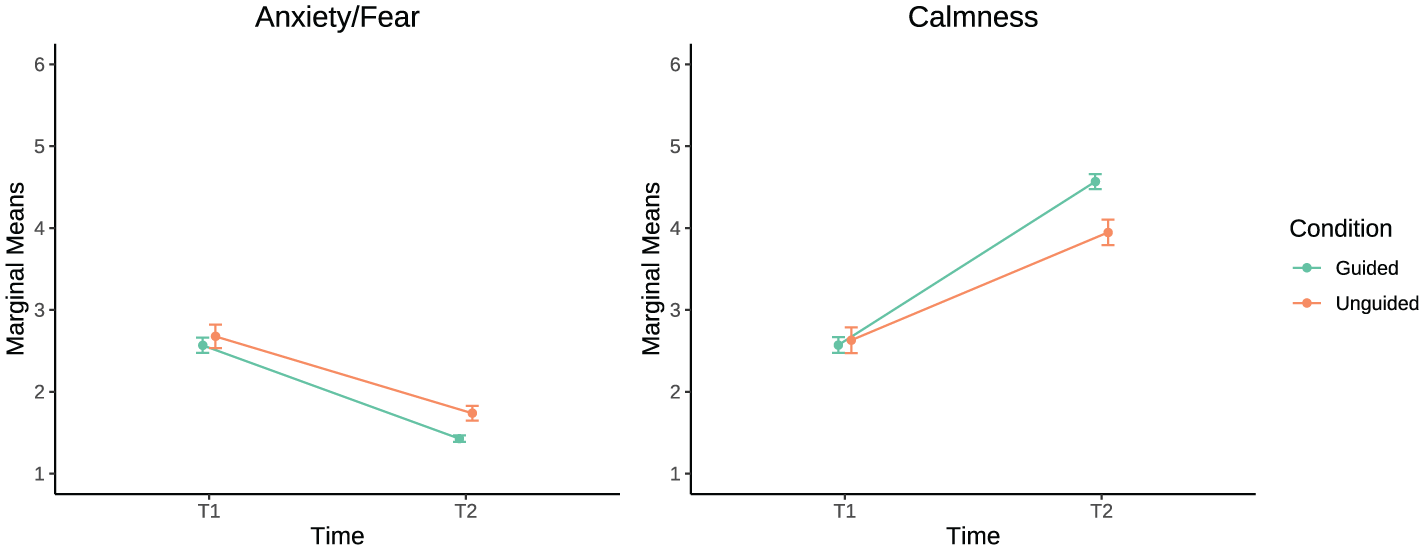
Changes in anxiety/fear (left) and calmness (right) from post-induction (T1) to post-listening (T2) for guided and unguided conditions.
Similarly, the ANOVA for calmness scores yielded a significant main effect of time (F(1, 191) = 293.72, p < .001, Cohen’s d = 1.37), and no main effect of condition (F(1, 191) = 3.79, p = .053, Cohen’s d = 0.20). In contrast, however, we also found a significant time × condition interaction (F(1, 191) = 12.29, p < .001, Cohen’s d = 0.52). As shown in Figure 2, participants in the ‘guided’ group showed a larger increase in calmness from T1 to T2 than participants in the unguided group. Post-hoc tests revealed that although participants in the guided and unguided conditions did not differ in their calmness scores immediately after the anxiety induction at T1 (p = .744), after completing the music-listening task (i.e., at T2), participants in the guided music-listening conditions reported significantly higher calmness than participants in the unguided condition (p < .001).
Effect of guided (vs. unguided) listening on individual differences in affect (H2)
Per our second pre-registered hypothesis (H2), we expected that unguided listening would produce larger individual variation in post-listening affect relative to guided listening. To test this, we ran Levene’s tests for both anxiety/fear and calmness, comparing the within-group variation in the guided vs. unguided conditions.
Levene’s tests revealed that, after music-listening (i.e., T2), the unguided and guided listening groups differed significantly from each other in terms of their within-group variances for both anxiety/fear (F = 9.82, p = .002) and calmness (F = 4.01, p = .047). As shown in Figure 3, participants in the unguided condition showed significantly larger individual differences in their feelings of anxiety/fear and calmness at T2, supporting our second hypothesis.
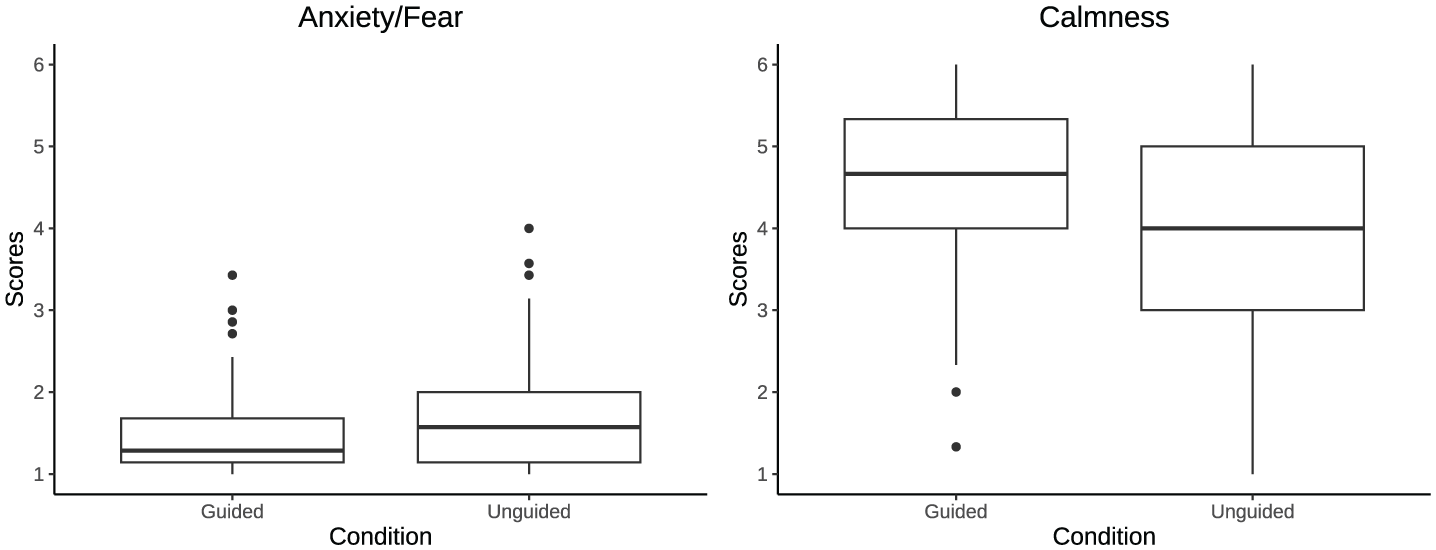
Variability in anxiety/fear scores (left) and calmness scores (right) at T2 for the guided and unguided conditions.
Spontaneous listening patterns in the unguided condition
To better understand the more variable affective experience demonstrated by participants in the unguided listening condition, we explored their spontaneous listening patterns. Specifically, we counted the number of calm vs. anxious songs each unguided participant chose to listen to, and in which order, revealing seven main listening patterns (see Table 3). Over half of the unguided participants spontaneously curated a playlist that closely resembled either the iso principle (34%) or the compensatory principle (23%). However, others chose listening patterns that are as-yet unnamed in the literature, including (inverted) u-curve listening patterns involving a shift from anxious to calm songs before returning to anxious songs (or vice versa); a gradual shift from calm to anxious songs that we label ‘inverse-iso principle’ listening; a ‘ruminative’ pattern involving listening to only anxious songs; or an oscillatory pattern, involving back-and-forth shifts between anxious and calm songs.
Spontaneous music-listening patterns (most-to-least prevalent) observed in the unguided condition.
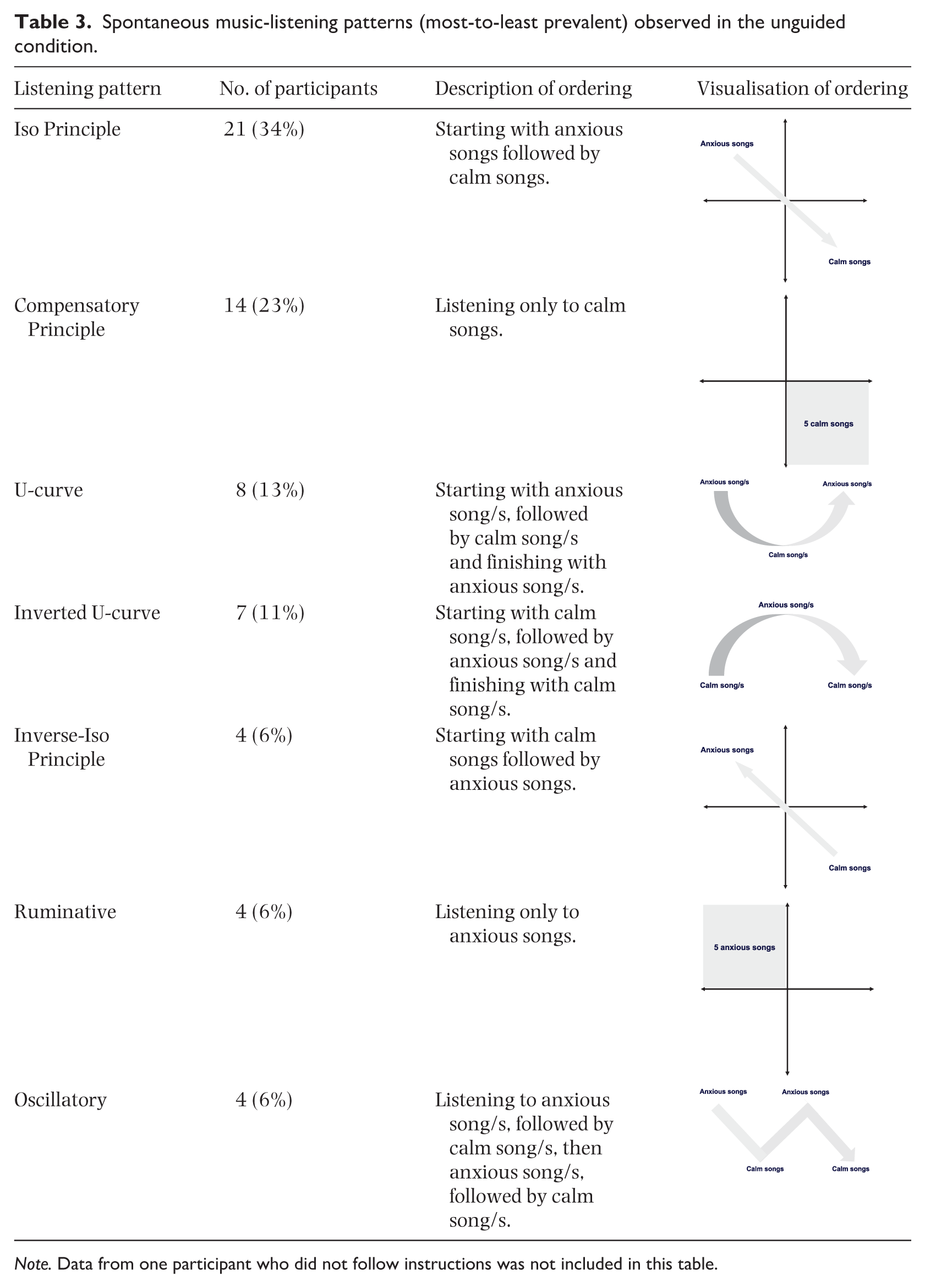
Note. Data from one participant who did not follow instructions was not included in this table.
Notably, most of these spontaneous listening patterns ended in a calm song except for the u-curve, inverse-iso principle, and ruminative patterns. This suggests that most participants in the unguided condition (N = 46, 74%) chose to finish their listening session with a calm song.
Exploring the effect of the last song on affective outcomes
To explore whether there was a difference in affect-regulation outcomes among participants in the unguided group who ended their listening session with a calm (n = 47) vs. an anxious (n = 16) song, we ran 2 (time: T1 vs. T2) × 2 (last song: anxious vs. calm) mixed ANOVAs, separately for anxiety/fear and calmness scores as dependent variables.
The ANOVA for anxiety/fear scores yielded a significant main effect of the last song (F(1, 61) = 5.82, p = .019, Cohen’s d = 0.55) and time (F(1, 61) = 47.25, p < .001, Cohen’s d = 1.04), but no significant time × last song interaction (F(1, 61) = 0.26, p = .615, Cohen’s d = 0.16).
The ANOVA for calmness scores also yielded significant main effects of the last song (F(1, 61) = 10.66, p = .002, Cohen’s d = 0.71) and time (F(1, 61) = 30.83, p < .001, Cohen’s d = 0.95), as well as a significant interaction (F(1, 61) = 6.91, p = .011, Cohen’s d = 0.80). Post-hoc tests indicated that participants who selected a calm (M = 2.73; SD = 1.26) versus an anxious (M = 2.33; SD = 1.19) last song did not significantly differ in calmness prior to music-listening at T1 (p = .274). However, after music-listening (i.e., at T2), participants who finished their playlist with a calm song reported significantly higher calmness (M = 4.30; SD = 1.13) than those who finished with an anxious song (M = 2.90; SD = 0.89; p < .001; see Figure 4). Moreover, participants who finished their playlist with a calm song experienced a significant increase in calmness from T1 to T2 (p < .001), while those who chose an anxious song did not (p = .066).
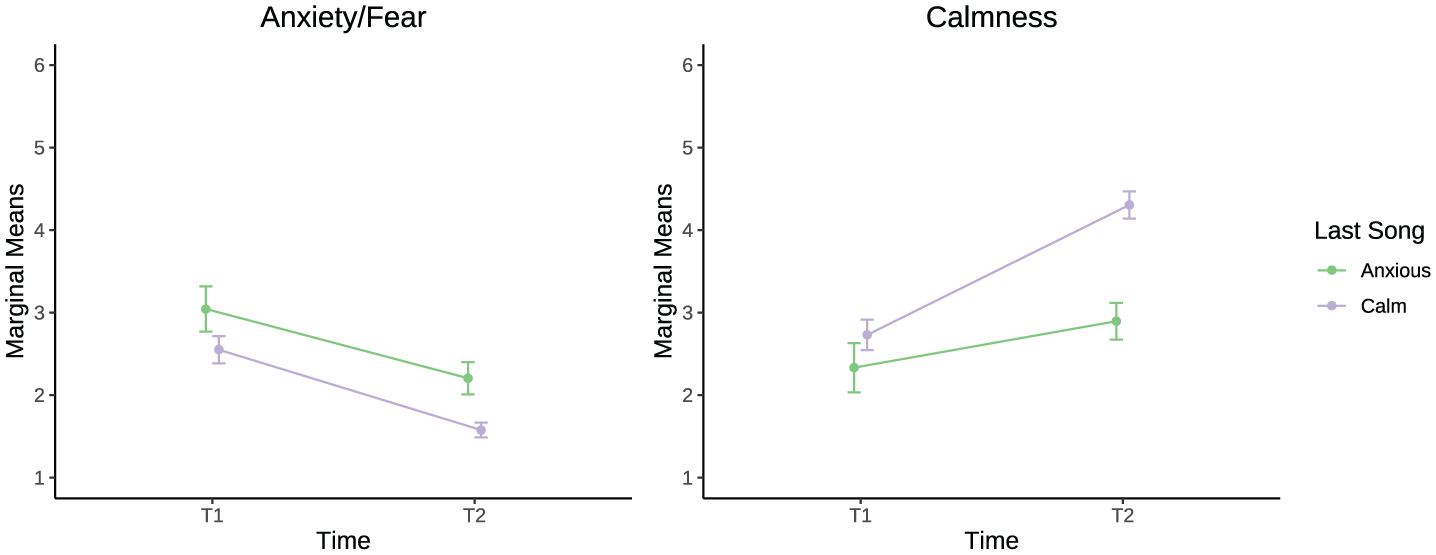
Changes in anxiety/fear (left) and calmness (right) from T1 to T2 for unguided participants who finished their playlist with a calm song vs. an anxious song.
Subjective effectiveness of playlists
To further investigate this difference in affect-regulation outcomes among unguided participants whose spontaneous listening pattern ended with calm vs. anxious songs, we explored participants’ subjective ratings of the effectiveness of music-listening from both guided and unguided groups.
The subset of unguided participants who followed a listening pattern that concluded with a calm song (i.e., the compensatory principle, inverted u-curve, iso principle, and oscillatory patterns) reported visibly higher effectiveness than unguided participants whose spontaneous listening patterns concluded with an anxious song (i.e., the inverse-iso principle, u-curve, and ruminative patterns; see Figure 5). This suggests that the last song in an emotion-regulation playlist may play an important role in inducing the desired affect of listeners. For further analyses on subjective effectiveness, please see Supplemental Materials. 7
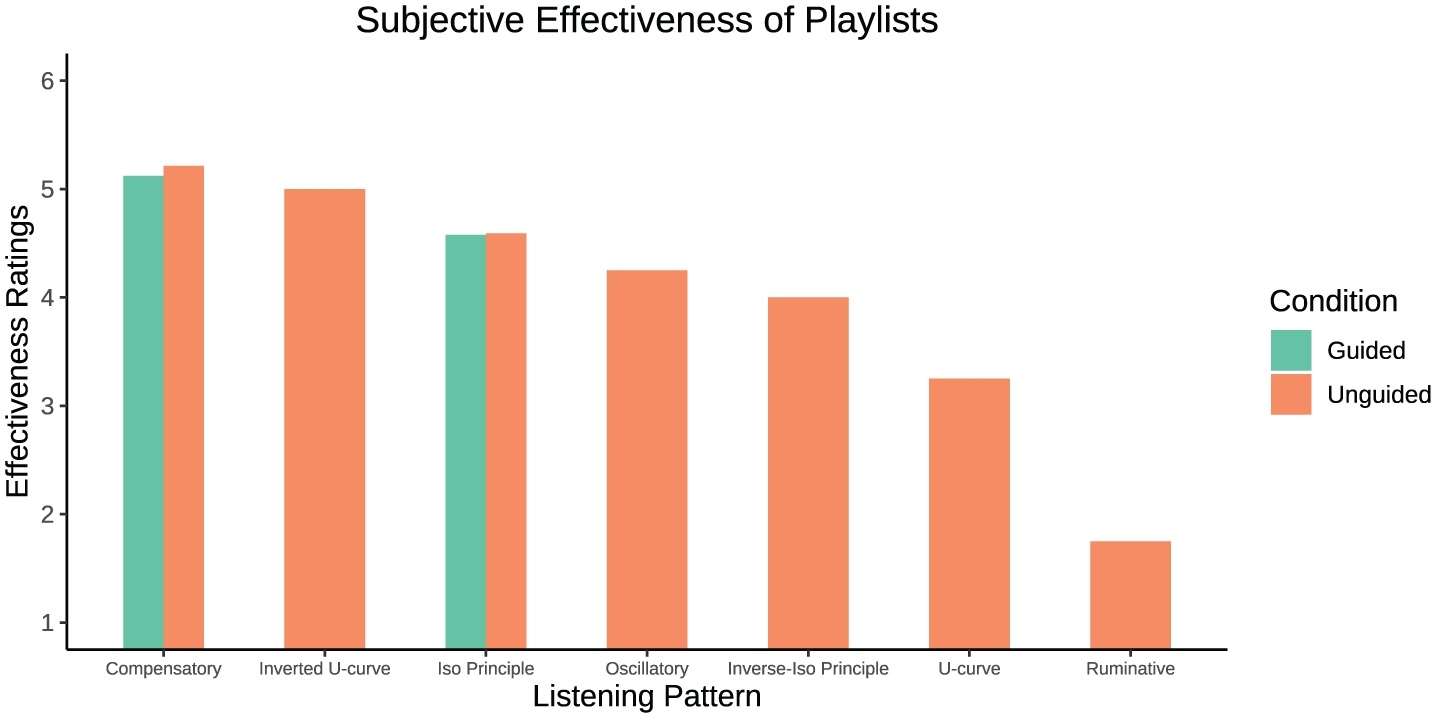
Participants’ perceived effectiveness in either their given playlist (guided conditions) or self-selected songs (unguided condition) helping them feel calm.
Discussion
The iso principle has long been a staple of music therapy and is starting to find its way into large-scale music interventions targeting clinical and non-clinical populations. And yet, evidence for the affect-regulatory benefits of the iso principle is relatively scarce, especially in non-clinical samples. We aimed to fill this important gap by conducting the largest experimental study, to our knowledge, comparing iso-principle music listening versus both compensatory-principle and unguided listening in a sample of healthy (non-clinical) individuals. Contrary to our first pre-registered hypothesis – which was based on Starcke and von Georgi's (2024) results – iso-principle guided listening was not more effective than compensatory-principle listening for affect regulation. Instead, we found that both iso- and compensatory-principle music listening significantly improved participants’ affect following an anxiety induction.
Exploratory follow-up analyses advance our understanding of the effectiveness of guided versus unguided modes of music listening in the general population. We found that guided modes of listening were more effective for up-regulating calmness following an anxiety induction, compared with unguided listening. This suggests that users of music streaming services (e.g., Spotify) could benefit from receiving guidance in the ordering of songs in their playlists to achieve optimal affect-regulation outcomes.
In support of our second pre-registered hypothesis, we found that participants in the unguided listening condition showed more variance in their post-listening affective experience compared with participants randomly allocated to one of the two guided conditions. This higher variability may be understood in the context of our exploratory findings that participants in the unguided condition spontaneously adopted one of seven different music listening patterns, which seemed to vary in self-reported regulatory effectiveness. Finally, our data indicate the potential importance of the final or ‘terminal’ song in an affect-regulation playlist for modulating listeners’ affect.
Why did we not find evidence that iso-principle listening is more effective?
Our failure to replicate Starcke and von Georgi's (2024) findings, which supported the superiority of the iso principle over the compensatory principle, may be driven by several methodological differences.
First, in terms of playlists, we used participant-selected (rather than researcher-selected) songs to increase ecological validity and because of the known important effects of familiarity on participants’ emotional engagement with music (Pereira et al., 2011). We also curated iso and compensatory playlists of five (rather than two) songs to test a more gradual affective shift in line with how the iso principle is described in the music therapy literature (e.g., Jacobsen et al., 2019). Notably, by allowing participants to select songs with specific affective qualities (i.e., calming, anxiety-inducing), we compromised experimental control in exchange for greater personal relevance: whereas all of Starcke and von Georgi’s (2024) participants listened to the same final researcher-selected ‘happy’ song, our participants listened to different songs that they had identified as being calmness-inducing. This may have contributed to the divergence of our findings from Starcke and von Georgi’s (2024) results.
Second, unlike Starcke and von Georgi (2024) who used a movie-clip with a music soundtrack to induce sadness, we used an autobiographical recall task to induce anxiety. Our study therefore tested the effectiveness of music-listening for regulating unpleasant affect induced by real events/experiences in people’s daily lives, rather than film/music-induced affect. Moreover, we investigated how different forms of music listening influenced activated negative affect (anxiety) which is a more common everyday experience than deactivated negative feelings, such as sadness (Trampe et al., 2015).
Third, our study differed slightly from Starcke and von Georgi (2024) in terms of how and which affect was measured: whereas Starcke and von Georgi assessed broader positive affect and negative affect dimensions using a German version of the PANAS, we assessed the narrower affective constructs of anxiety/fear and calmness using items from the PANAS-X, which more specifically mapped onto the affect trajectory of interest. In addition, our analyses quantified to what extent different music-listening interventions influenced change in affect from post-induction (T1) to post-listening (T2), rather than only comparing experimental groups on their post-listening affect. In our view, the analysis strategy we used more directly tests the hypothesis that the iso-principle is more effective in regulating (i.e., causing change in) affect than compensatory listening.
Fourth, we note that our participants completed the affect-induction and music-listening task in the lab, allowing us to ensure that participants followed instructions and were free from other distractions, whereas Starcke and von Georgi’s (2024) study was conducted online.
Finally, our sample size was approximately twice as large (per condition) as Starcke and von Georgi’s (2024). We determined our sample size based on an a priori power analysis to ensure that we had sufficient power to detect an effect of the same magnitude as the difference between iso and compensatory listening reported by Starcke and von Georgi (2024). Thus, our failure to find a difference between these conditions is unlikely to be due to a lack of statistical power. Moreover, our larger sample would have afforded us greater precision to detect a true difference between iso and compensatory listening, if such a difference exists (Lakens, 2022).
Considerations for the design of personalised affect-regulation playlists
Guidance in playlist creation
A key finding of our study was that guided music listening resulted in a significantly greater increase in calmness from post-induction to post-listening compared to unguided music listening. To explore the potential influence of placebo effects (that participants in the guided conditions expected their experimenter-curated playlist to be effective), we compared the subjective effectiveness ratings of guided versus unguided iso-principle listening and guided versus unguided compensatory-principle listening. Effectiveness ratings appeared highly similar for unguided versus guided iso and compensatory playlists (see Figure 5), which suggests that the observed difference between guided and unguided listening is unlikely to be primarily due to placebo or expectation effects. We suggest that guided listening was more effective than unguided listening because participants in the guided conditions received playlists designed to help them shift to their desired affective state, while those in the unguided group followed various self-selected listening patterns, only some of which may be effective. Some spontaneous listening patterns, such as those that maintain anxiety (e.g., the ruminative pattern), may be maladaptive and result in poor regulation outcomes. Thus, our findings suggest that without guidance, not everyone in the general population will make optimal decisions when selecting music for affect regulation, highlighting the importance of guidance in affect-regulation playlist creation.
The last song of an affect-regulation playlist
Overall, our findings suggest that both iso- and compensatory-principle listening were effective in reducing anxiety and increasing calmness. While these listening conditions differed in their starting point and trajectories, both types of listening finished with a calm song, presumably matching listeners’ desired affect. From this observation, we speculate that the last song is important for inducing listeners’ desired affect in a music-listening trajectory for the general population. Further supporting this speculation, our exploratory analyses revealed that participants in the unguided group who ended their listening session with a calm song also showed significantly greater calmness post-listening than participants who finished with an anxious song.
However, we did not measure affect after each song and did not test trajectories beyond the iso- and compensatory-principle. Therefore, further research is needed to explore the potential effect of the last song in a music-listening trajectory, and the optimal number of desired-affect-congruent songs at the end of a playlist to ensure that the induced affect is sustained.
Limitations and future directions
While this study provides important insights into the affect-regulatory potential of music listening, when interpreting the findings, it is crucial to consider several limitations that could be addressed in future research. First, participants in our study listened to affect-regulation playlists comprising five songs, and we measured the immediate impact of music listening on participants’ affect. Future research should test different playlist lengths. For instance, longer periods of music listening may induce longer-lasting affective change, but this remains unknown. Similarly, although we found no significant difference in the affective outcomes of iso- versus compensatory-principle music listening, future studies could investigate how the effects of these and other music interventions may vary as a function of playlist duration. Furthermore, future research should measure affect at multiple times throughout the listening experience, such as after listening to each song and post-study to get further insight into the precise affective trajectory induced by different modes of music listening, and the precise times at which affect change takes place.
A second limitation of our study is that we relied on participants’ subjective rankings of the affective qualities of songs (from most to least calm/anxious). On one hand, this could be seen as a strength of our design, as this ensured that the music presented to each participant was personally relevant and subjectively evoked the relevant feelings. On the other hand, however, we did not verify the validity of participants’ song selections and rankings. Therefore, in future studies, researchers should analyse objective musical features (e.g., tempo/BPM) of participant-selected songs (e.g., Heiderscheit & Madson, 2015; Lázaro-García et al., 2024; Ratcliff et al., 2014) to determine whether these moderate the effectiveness of iso- versus compensatory-based music listening.
Third, although our choice of affect-induction procedure sought to maximise the ecological validity of our findings by having participants recall a real-life event, our study was nevertheless conducted in a lab. Therefore, we cannot be certain that participants’ affective responses to the anxiety induction and music intervention are representative of how these processes unfold in natural settings. Future research should determine whether there is a difference between the iso and compensatory principle for regulating naturally-occurring feelings in everyday life, for example, by using the experience sampling method (Randall & Rickard, 2017). Conducting a similar study in everyday life would also lend itself to investigating the impact of different music interventions on affective trajectories beyond those that were explored in this study (i.e., anxious-to-calm) and previous experiments (e.g., sad-to-happy; Starcke & von Georgi, 2024).
Finally, previous research suggests that individuals differ in their preferences for listening to affect-congruent versus affect-incongruent music when experiencing unpleasant or undesirable feelings. For example, high-Neuroticism individuals prefer to listen to sad music when feeling sad, whereas those high in Agreeableness, Openness, and Extraversion prefer to listen to happy music (Ferwerda et al., 2015). Such individual differences may moderate the impact of different music interventions (e.g., iso versus compensatory) on affective experience – a possibility that awaits future investigation.
Conclusion
The current study represents the largest experimental investigation to our knowledge of the affective consequences of iso- versus compensatory-based music listening among healthy participants. Our findings challenge a common assumption, supported by some previous studies, that listening to music following the iso principle is more effective for down-regulating unpleasant affect than more straightforward compensatory listening. By comparing both iso- and compensatory-based listening to unguided listening, our findings suggest that people may benefit from receiving guidance in the creation of affect-regulation playlists. We suggest that the influence of playlist length, and of the last song in a playlist, could be explored in future studies. These findings may inform ongoing research into (automated) generation of affect-regulation playlists within music streaming services, and thereby help users of these services achieve optimal affective outcomes and improved well-being.
Supplemental Material
sj-docx-1-msx-10.1177_10298649261421187 – Supplemental material for Personalised affect-regulation playlists: A pre-registered experimental test of the iso principle in the general population
Supplemental material, sj-docx-1-msx-10.1177_10298649261421187 for Personalised affect-regulation playlists: A pre-registered experimental test of the iso principle in the general population by Xanthe Lowe-Brown, Solange Glasser, Greg Wadley and Peter Koval in Musicae Scientiae
Footnotes
Acknowledgements
The authors would like to thank the Australian Music & Psychology Society for their feedback on this study.
Author contributorship
All authors contributed to the study design and ethics submission. XLB was responsible for preparing all study materials and data collection. XLB prepared the data for analysis and conducted quantitative analyses supervised by PK. All authors interpreted the results. XLB wrote the first draft of the manuscript and all authors revised the manuscript and approved it for submission.
Ethical considerations
This research was approved by the University of Melbourne’s human ethics committee (ID: 28378).
Consent to participate
Written informed consent to participate was obtained for all participants in this study.
Consent for publication
Yes.
Funding
The authors disclosed receipt of the following financial support for the research, authorship, and/or publication of this article: This research was supported by the Commonwealth through an Australian Government Research Training Program Scholarship [DOI:  ]. Additional funding for this study was provided by a Dame Kate Campbell Fellowship awarded to Peter Koval by the Faculty of Medicine, Dentistry, and Health Sciences, University of Melbourne.
Declaration of conflicting interests
The authors declared no potential conflicts of interest with respect to the research, authorship, and/or publication of this article.
Data availability
We pre-registered the study methodology and hypotheses prior to data collection (https://osf.io/kmu4g), and our raw data and analysis scripts are available at .
Supplemental material
Supplemental material for this article is available online.
Notes
References
Supplementary Material
Please find the following supplemental material available below.
For Open Access articles published under a Creative Commons License, all supplemental material carries the same license as the article it is associated with.
For non-Open Access articles published, all supplemental material carries a non-exclusive license, and permission requests for re-use of supplemental material or any part of supplemental material shall be sent directly to the copyright owner as specified in the copyright notice associated with the article.
