



Abstract
Correspondences between the timing of motor behaviour and that of musical performance are well-established. Motor behaviour, however, is known to degrade across the adult lifespan due to neurobiological decay. In particular, performance on speed-dependent motor tasks deteriorates, spontaneous motor tempo (SMT) slows, and upper motor rate limit falls. Here, we examine whether this slowdown in motor behaviour impacts the tempo of musical performance as a function of age. We analysed 13,180 songs released between 1956 and 2020 by artists with careers spanning at least 20 years. Generalised Additive Mixed Models (GAMMs) and Linear Mixed Models (LMMs) were employed to assess the effects of age, operationalised by subtracting the birth year from the release year of each track, on musical tempo. Results revealed a slight tempo increase from early adulthood to age 30, followed by a marked, linear slowdown with age across the remainder of the lifespan. From artists’ thirties to their eighties, tempo decreased by almost 10 bpm, averaging around 2 bpm per decade. This decrease aligns with the slowing-with-age hypothesis and mirrors rates of decline observed in studies of SMT and gait speed. Our findings highlight a significant gap in the understanding of creative performance across the lifespan, particularly the role of age as a mediating factor in musical tempo. Moreover, that a discernible decrease in the tempo is apparent even in commercial recordings further emphasises the inescapable connection between the dynamics of motor behaviour and the timing of musical performance.
Keywords
Introduction
Tempo is an essential characteristic of music that can be manipulated to express different emotions (Eerola & Vuoskoski, 2013) and musical styles (Li & Chan, 2011) and to build and release tension (Goodchild et al., 2016). Tempo impacts perception of emotion (Webster & Weir, 2005), perception and estimation of time (Droit-Volet et al., 2013; Pereira et al., 2022), and characteristics of music-induced body movement (Burger et al., 2014). Spontaneous performance tempo of simple melodies is subject to individual differences (Wright & Palmer, 2020), and spontaneous motor tempo (SMT), an individual’s natural pace of movement, has been shown to play a key role in this. For instance, SMT has been found to significantly contribute to preferred music tempo, regardless of familiarity with a piece, suggesting that internal motor rhythms play a role in tempo preferences (Hine et al., 2022).
Motor movement and music are, in fact, intimately intertwined, especially in terms of timing-related factors (Luck & Toiviainen, 2012). Body movement is not only induced by music but required to both understand it (Leman & Maes, 2015) and, of course, create it. Typical speed of body movement, frequently indexed via both SMT and gait speed, is known to decrease across the adult lifespan (Bohannon & Andrews, 2011; McAuley et al., 2006). This slowdown, likely a result of decreased muscle activation and slowdown of nerve conduction velocities (Chase et al., 1992), is consistent with the slowing-with-age hypothesis (Baudouin et al., 2004) and is thought to reflect a degradation of motor, neural, and perceptual processes (Hunter et al., 2001; Morgan et al., 1994; Salthouse, 1996), as well as changes in muscle mass, visuo-proprioceptive function, strength, and reaction time (Voelcker-Rehage, 2008).
This general age-related slowing is well documented across a range of physical and cognitive activities. Average gait speed, for instance, decreases by approximately 0.1 m/s per decade after age 60 (Bohannon, 1997; Studenski et al., 2011), while handwriting tends to become slower and more variable with age (Ketcham et al., 2002). In spoken language, articulation rate and speech tempo show measurable declines, with older adults producing fewer syllables per second than younger speakers (Amerman & Parnell, 1992; Jacewicz et al., 2010). These effects are not merely peripheral but reflect systemic age-related changes in motor planning, execution, and sensory integration, and often follow nonlinear trajectories across the lifespan.
Recent work provides tentative evidence for an intrinsic connection between this age-related slowdown and the tempo of music created across the lifespan (Luck, 2024). Examination of almost 2,000 songs released by 10 best-selling solo artists revealed that their mean album tempo has fallen across each of their careers by as much as one and a half standard deviations from their early 20s to their late 50s. This effect holds despite the presence of different songwriters, producers, executives, collaborators, etc. Furthermore, it reveals that commercial recordings can offer profound insights into a fundamental and understudied aspect of human functioning across the lifespan.
Nonetheless, while this work offers support for a connection between age and tempo of artistic output, it remains unclear how generalisable this effect is beyond a small sample of artists. In addition, while Luck (2024) identified a linear relationship between the tempo of commercial recordings and artist age, a curvilinear relationship has been identified in studies of SMT and gait across the lifespan (Bohannon & Andrews, 2011; McAuley et al., 2006). To gain a more comprehensive picture of how the performance tempo changes as a function of the artist’s age, it is essential to study a broader range of musical output. Here, we address these issues by investigating (1) a larger sample of songs from (2) a larger number of artists with (3) greater style and geographic diversity. Specifically, we examine the tempos of over 16,000 tracks released by more than 150 artists while utilising a more sophisticated statistical approach. In light of the curvilinear nature of SMT and gait speed trajectory across the lifespan, we were interested in exploring whether a larger, more diverse sample would reveal a similar trajectory in commercial music recordings. We hypothesised that the tempo of an artist’s commercial output would follow an overall downwards trajectory across their adult lifespan. However, we further hypothesised that this relationship would take a curvilinear form similar to that observed in studies of more basic motor timing, with a small increase in tempo during artists’ early adulthood, followed by a more pronounced decrease in tempo across the remainder of their lifespan. Identifying the age at which this decline became apparent was a key issue of interest.
Method
Sample
We drew our corpus from the Spotify 1.2M+ Songs dataset (Figueroa, 2020). This dataset contains computationally extracted values for a wide range of musical features, including tempo. All features are based on Spotify’s own algorithms, and as such, their precise definition and calculation are unknown. However, Spotify’s tempo feature is widely used in the research community (Al-Beitawi et al., 2020; Duman et al., 2022; Gulmatico et al., 2022) and serves as a standard proxy. The dataset contains 850,944 unique songs from 165,365 artists. We compiled our dataset by downloading the entire catalogue from MusicBrainz and then querying Spotify’s API for each album’s Universal Product Code (UPC). This process enabled the retrieval of album information, which was further complemented by obtaining track details for each album through subsequent queries to the Spotify API (Figueroa, 2020). To ensure accurate data analysis, the data were thoroughly cleaned, and a trimming process was carried out prior to the data modelling phase.
Since our aim was to examine the effect of an artist’s age on the track tempo, we developed a range of exclusion criteria concerning artist’s age and career length, album type, and track type. To ensure artists had sufficiently long careers and enough material to reveal potential age-related tempo effects, we excluded artists with careers spanning less than 20 years and artists with fewer than three albums. For obvious reasons, we also excluded artists whose birth year could not be identified. In order to create a dataset likely to be characterised by a relatively steady and clear tempo, we excluded all music released before 1955 and recordings identified as being in the classical genre. Since our aim was to focus on each artist’s original studio recordings, we excluded tracks identified as being recorded in live performance contexts (i.e., concerts) as well as unreleased tracks and rarities. Posthumous albums were excluded because the artist would not have had any creative control over the tempo of the final track. To avoid duplicates, compilations, greatest hits, collections, and ‘best of’ albums were also excluded. To help limit the impact of multiple artists on a track’s tempo, tracks with featured artists were excluded, and to remove ‘skits’ (spoken tracks without music) typical of rap and hip hop genres, as well as podcasts, and interviews, so too were tracks with speechiness values > 0.33. 1 To further limit extramusical influences on song characteristics, soundtrack albums, Christmas albums, remix albums, and mixtapes were also excluded. All songs appearing on multiple albums were retained only in the album on which they first appeared. In addition, we excluded any track with missing information about the release year or tempo, or any track that was either less than 1 min or greater than 10 min in length.
Our final corpus contained 13,180 tracks released by 161 artists between 1956 and 2020. The average song length was 3.95 min (SD = 1.38). The songs from 1956 to 1969 constituted a minor part of the sample (2.6%), whereas songs from the following decades were respectively 7.3% (1970s), 10.9% (1980s), 24.9% (1990s), 27.8% (2000s), 24.3% (2010s), and 2.3% (2020s) of the sample (see Figure S1 in the Supplemental Material). To operationalise the artist’s age, we subtracted each artist’s birth year from the release year of each track. In cases where the artist was a band, we manually identified the lead singer or lead instrumentalist using Wikipedia and other credible web resources and used their birth year (similarly to Leppänen et al., 2026, in print). The average artist age was 44.47 (SD = 13.65) (see Figure 1), and the 95% Highest Density Interval (HDI) 2 ranged between 22 and 71 years. The final dataset included artists from a diverse range of genres spanning Rock (e.g., Pearl Jam, Green Day, Alice Cooper), Pop (e.g., Kylie Minogue, Usher, Cyndi Lauper, Barbra Streisand), Country & Folk (e.g., Dolly Parton, Willie Nelson), Jazz & Blues (e.g., Luther Allison, Aretha Franklin), Electronic and Dance (e.g., Paul Kalkbrenner), Rap & Hip Hop (e.g., Tech N9ne), Metal (e.g., Judas Priest, Death), Latin (e.g., El Gran Combo De Puerto Rico, Juan Gabriel), and more. The average career length of the included artists was 26.08 years (SD = 8.40), ranging from 20 to 55 years. Further info on the career timelines of the included artists can be found in the Supplemental Materials (Figure 2).
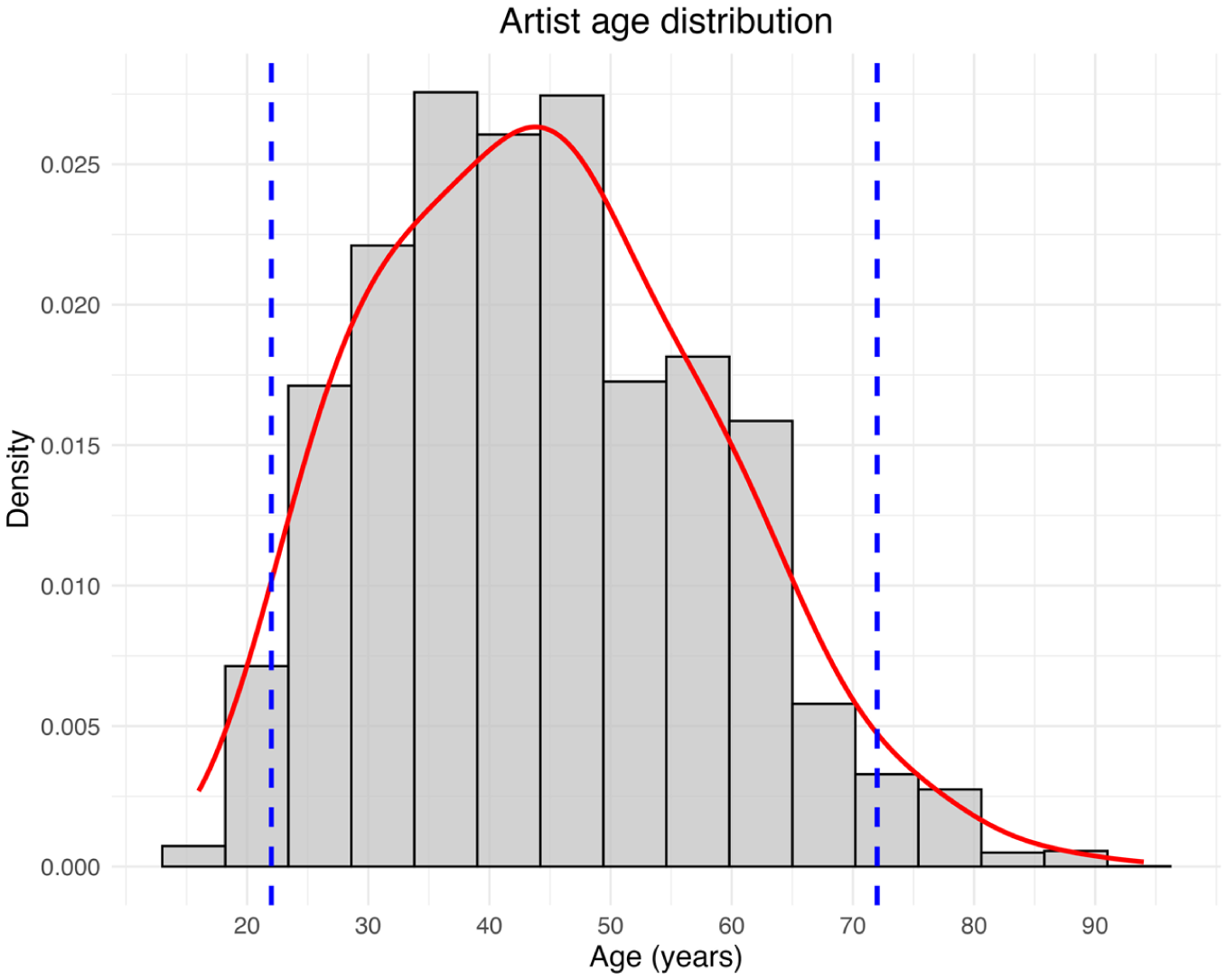
Artist age distribution.
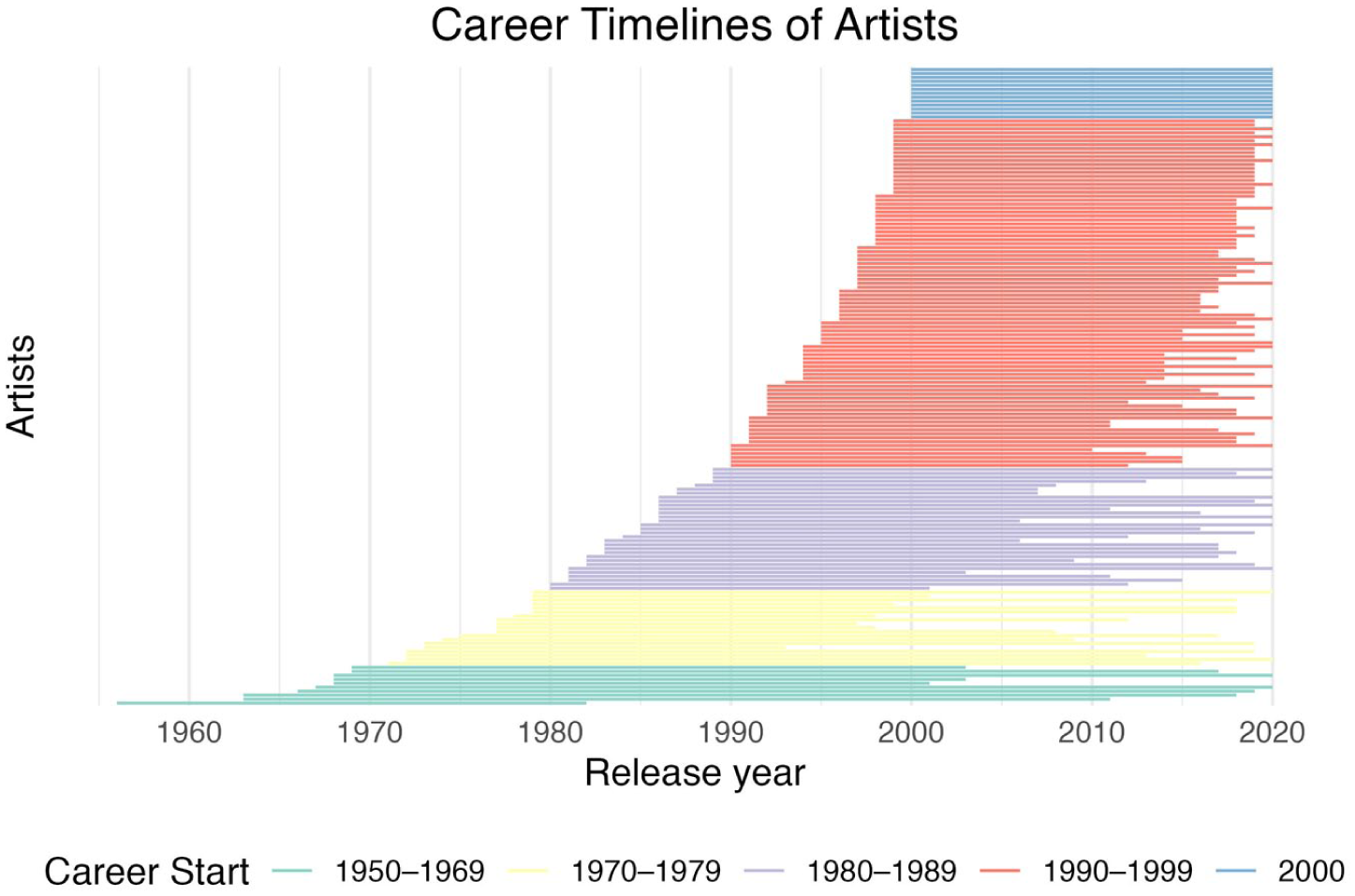
Career timelines of artists.
Statistical analysis
Analyses were carried out in R using the lme4 package (Bates et al., 2015) for the Linear Mixed Models (LMMs) and gamm4 (Wood & Scheipl, 2020) and mgcv (Wood, 2025) for the Generalised Additive Mixed Models (GAMMs). GAMMs can be considered an extension of the Generalised Linear Mixed Models that incorporate smooth, nonlinear functions of predictors that allow for more flexible modelling of complex relationships between variables (Wood, 2017). The 95% Confidence Intervals (CIs) for the estimates were computed using a bootstrap method (N = 10,000 simulations). To investigate the role of our predictors, a model comparison was performed (Rodgers, 2010) by inspecting the Log-Likelihood and Likelihood Ratio Tests, Akaike Information Criterion (AIC) (Pedersen et al., 2019), Bayesian Information Criteria (BIC), and Bayes Factor (BF) (Ward, 2008) 3 (Table 1).
Model comparison.
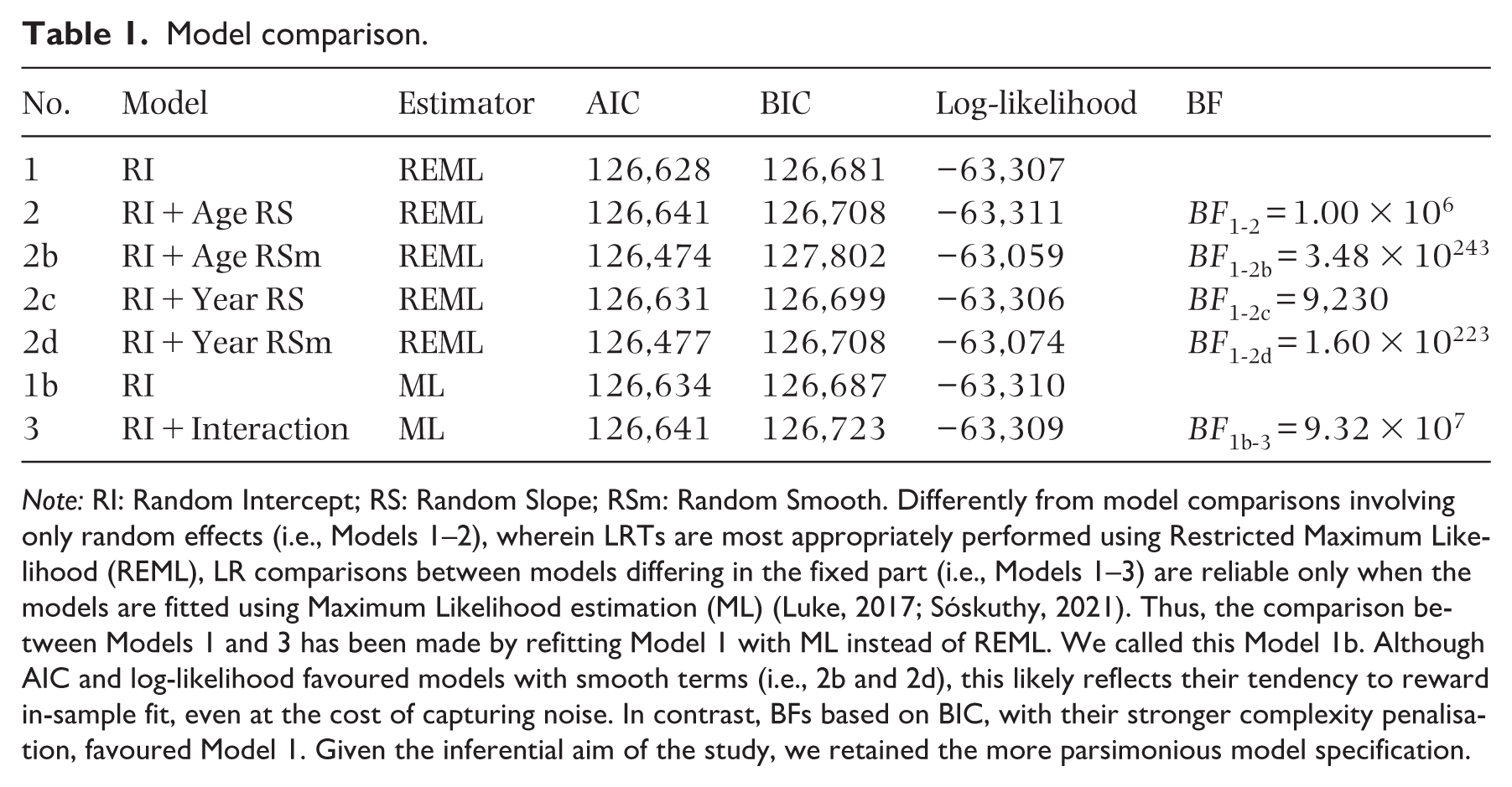
Note: RI: Random Intercept; RS: Random Slope; RSm: Random Smooth. Differently from model comparisons involving only random effects (i.e., Models 1–2), wherein LRTs are most appropriately performed using Restricted Maximum Likelihood (REML), LR comparisons between models differing in the fixed part (i.e., Models 1–3) are reliable only when the models are fitted using Maximum Likelihood estimation (ML) (Luke, 2017; Sóskuthy, 2021). Thus, the comparison between Models 1 and 3 has been made by refitting Model 1 with ML instead of REML. We called this Model 1b. Although AIC and log-likelihood favoured models with smooth terms (i.e., 2b and 2d), this likely reflects their tendency to reward in-sample fit, even at the cost of capturing noise. In contrast, BFs based on BIC, with their stronger complexity penalisation, favoured Model 1. Given the inferential aim of the study, we retained the more parsimonious model specification.
The Minimum Detectable Effect Sizes (MDES: Dong & Maynard, 2013) of the LMMs were computed using a Monte Carlo simulation approach (N = 2,000 simulations) via the simr package (Green & MacLeod, 2016).
Results
Descriptive statistics
The average tempo value was 120.07 bpm (SD = 30.41), and the 95% HDI ranged from 69.42 to 180.67. The skewness of the distribution was 0.41 (SE = 0.020), and the kurtosis was −0.29 (SE = 0.04), indicating slight positive skewness and a slightly platykurtic shape. These values suggest that the distribution approaches normality (Figure 3).
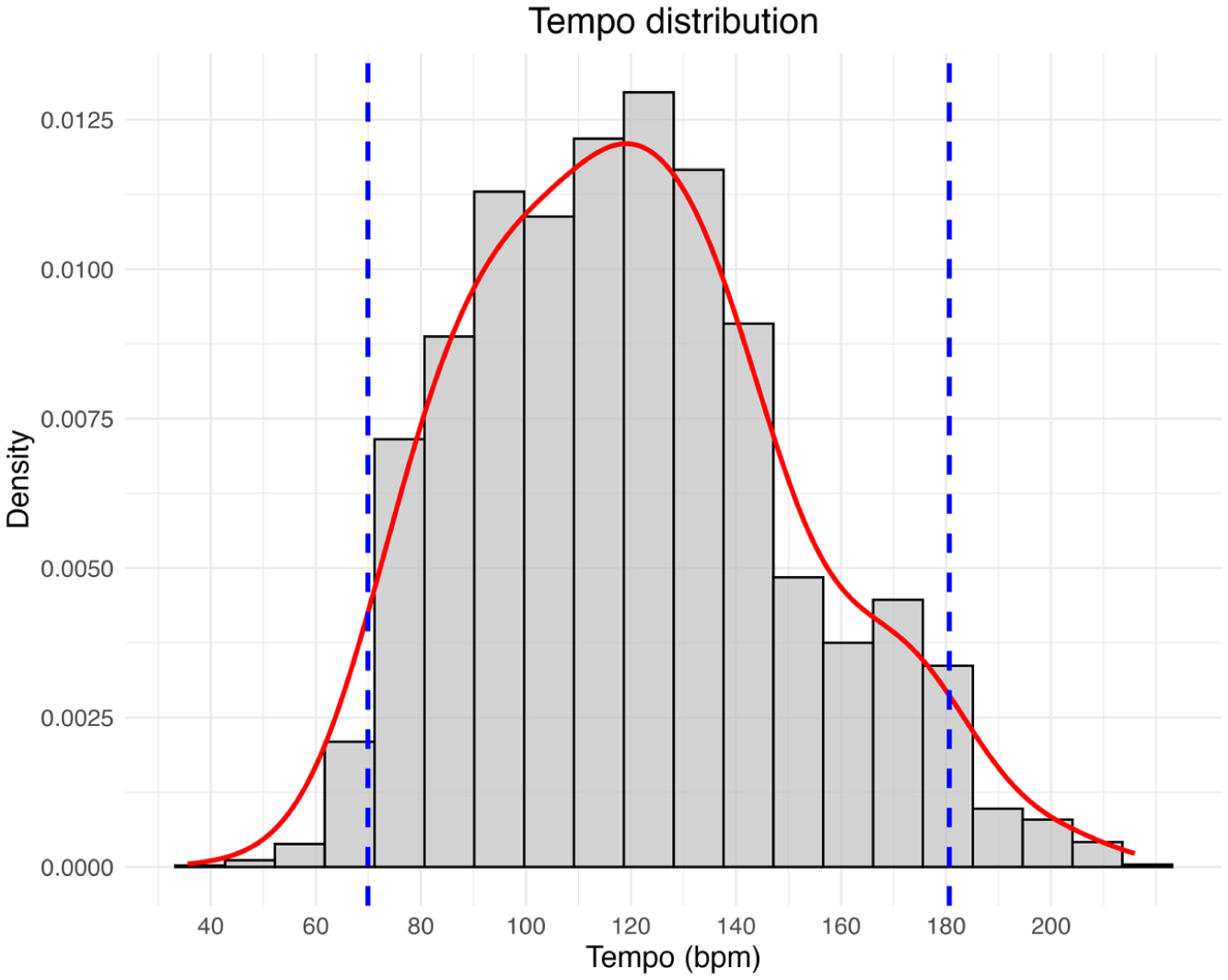
Tempo distribution.
Several sanity checks were performed on Spotify’s tempo values to ascertain their reliability. A random sample of 893 songs was manually annotated by a professional drummer by tapping along to the tracks. A normalisation procedure was put in place to account for metrical-level differences (e.g., half-time or double-time perception). For each song, we computed the ratio between Spotify’s tempo and the tapped tempo, rounded its base-2 logarithm to the nearest integer, and applied the corresponding power of two (e.g., 0.5, 1, 2, 4) as a correcting factor. This adjustment aligns tapping tempos to the same metrical level as Spotify’s estimates. After such a correction, the correlation between the two tempos was ρ = .96, 95% CI = [.94, .97], p < .001. Moreover, an ordinal regression verified that the correction factor was not changing over time (1958–2021), or, in other terms, that Spotify’s bias was relatively constant over time, b = −0.005, 95% CI = [−0.017, 0.006], p = .372. This check was necessary because a significant result would have implied a systematic tendency for Spotify to double/halve the tempi in more/less recent songs, thus jeopardising all longitudinal estimates. Lastly, to assess absolute accuracy, we computed the difference in bpm between the tapped tempo and the closest metrical subdivision of the Spotify tempo. The average gap was very small, i.e., 3.65 bpm, 95% CI = [2.95, 4.45], SD = 10.65, the median and mode being both 0. Overall, such sanity checks demonstrated that Spotify’s tempo estimates are metrically consistent and reliable across time.
GAMM Model 1: Random intercept
We initially predicted the track tempo (in bpm) as a nonlinear function (i.e., smooth term) of artist age. Moreover, as we were aware of a positive correlation between release year and tempo (Léveillé Gauvin, 2018), we also added a nonlinear effect of release year on the tempo to control for this effect. Artists were modelled as random intercepts, thus allowing each artist to retain their baseline tempo level. This approach was crucial because it allowed us to appreciate and account for individual differences between artists. By taking these differences into account, we could make more generalisable comparisons and understand how age might influence changes in the tempo beyond the artist’s natural tendency. Restricted Maximum Likelihood (REML) was used to estimate the smoothing parameter (i.e., λ) 4 (Wood et al., 2016). This parameter determines the smoothness and flexibility of the fitted curve, balancing the model’s fit to the data against its complexity. In sum, the GAMM formula is represented in gamm4 and mgcv (Wood, 2025) notation as follows, where s identifies smooth terms:

This corresponds to:
where
As shown in Table 2, both terms reached statistical significance (pyear = .010; page = .014 5 ).
GAMM model parameters.
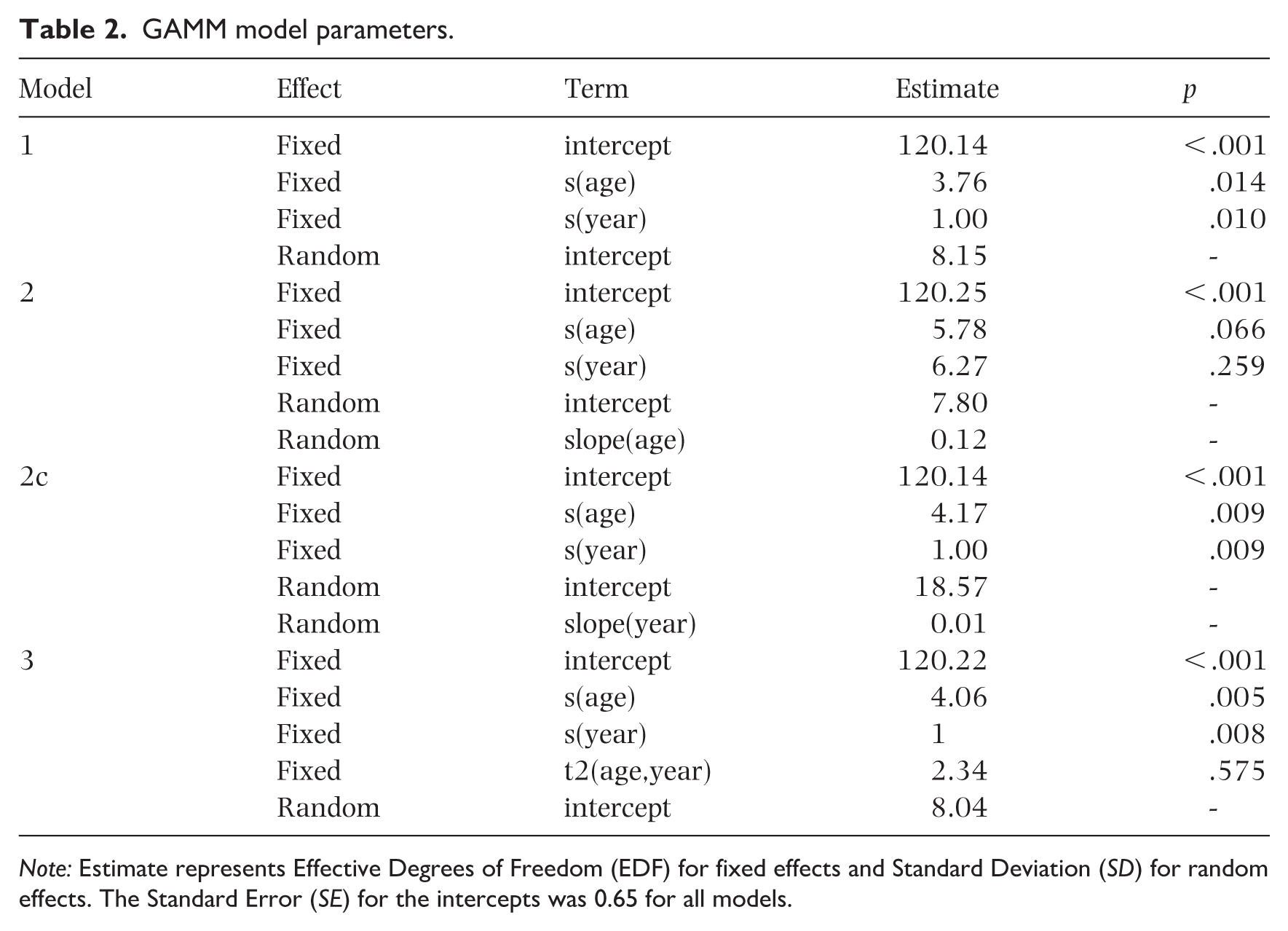
Note: Estimate represents Effective Degrees of Freedom (EDF) for fixed effects and Standard Deviation (SD) for random effects. The Standard Error (SE) for the intercepts was 0.65 for all models.
Inspection of the predicted tempo (shown in Figures 4 and 5) and effective degrees of freedom 6 (EDFage = 3.76) suggests that the relationship between age and tempo might deviate from linearity. The relationship between release year and tempo, however, is indistinguishable from a linear trend (EDFyear = 1.00) 7 (Figure 5). This suggests that the effect of age on the tempo varies in a complex manner across artists’ lifespans, beyond what could be captured by a simple linear model.
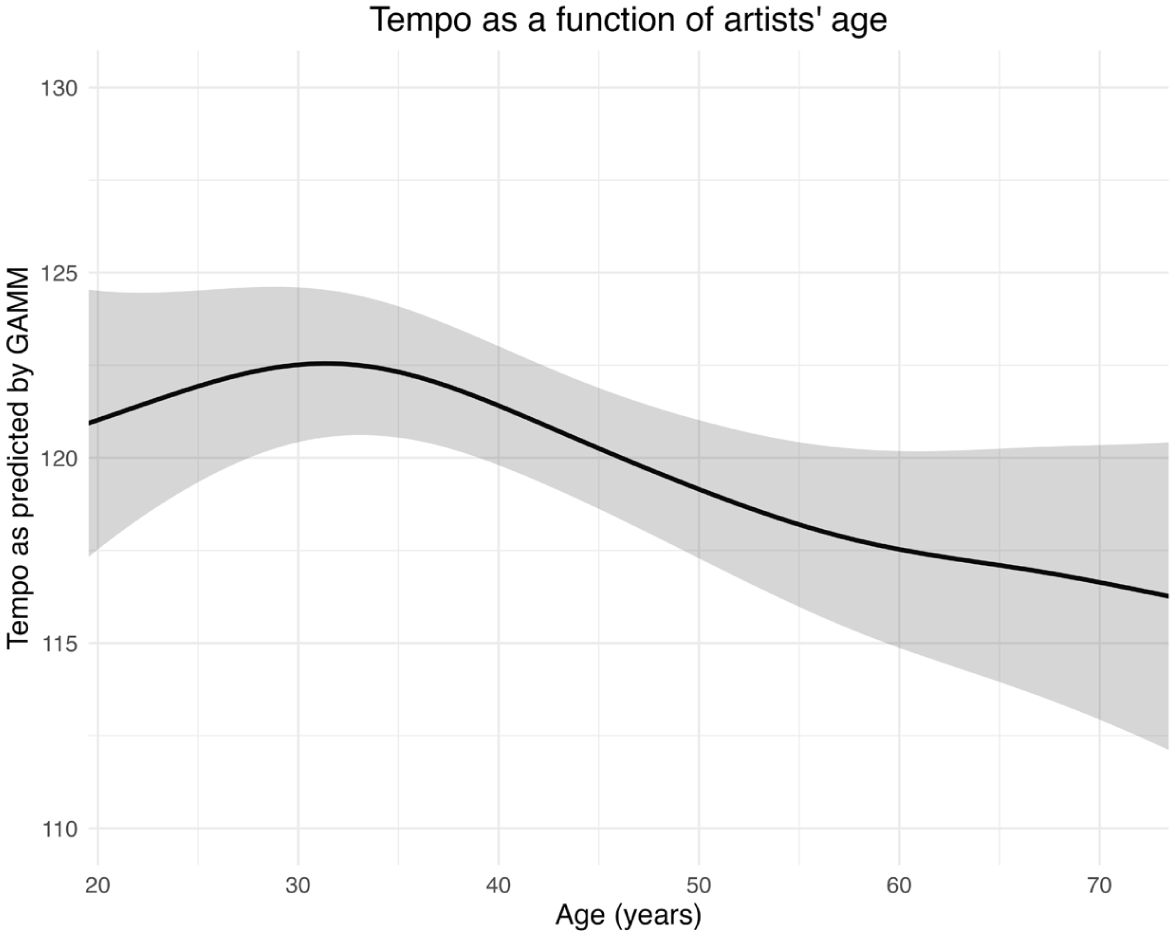
Tempo (bpm) as a function of artists’ age.
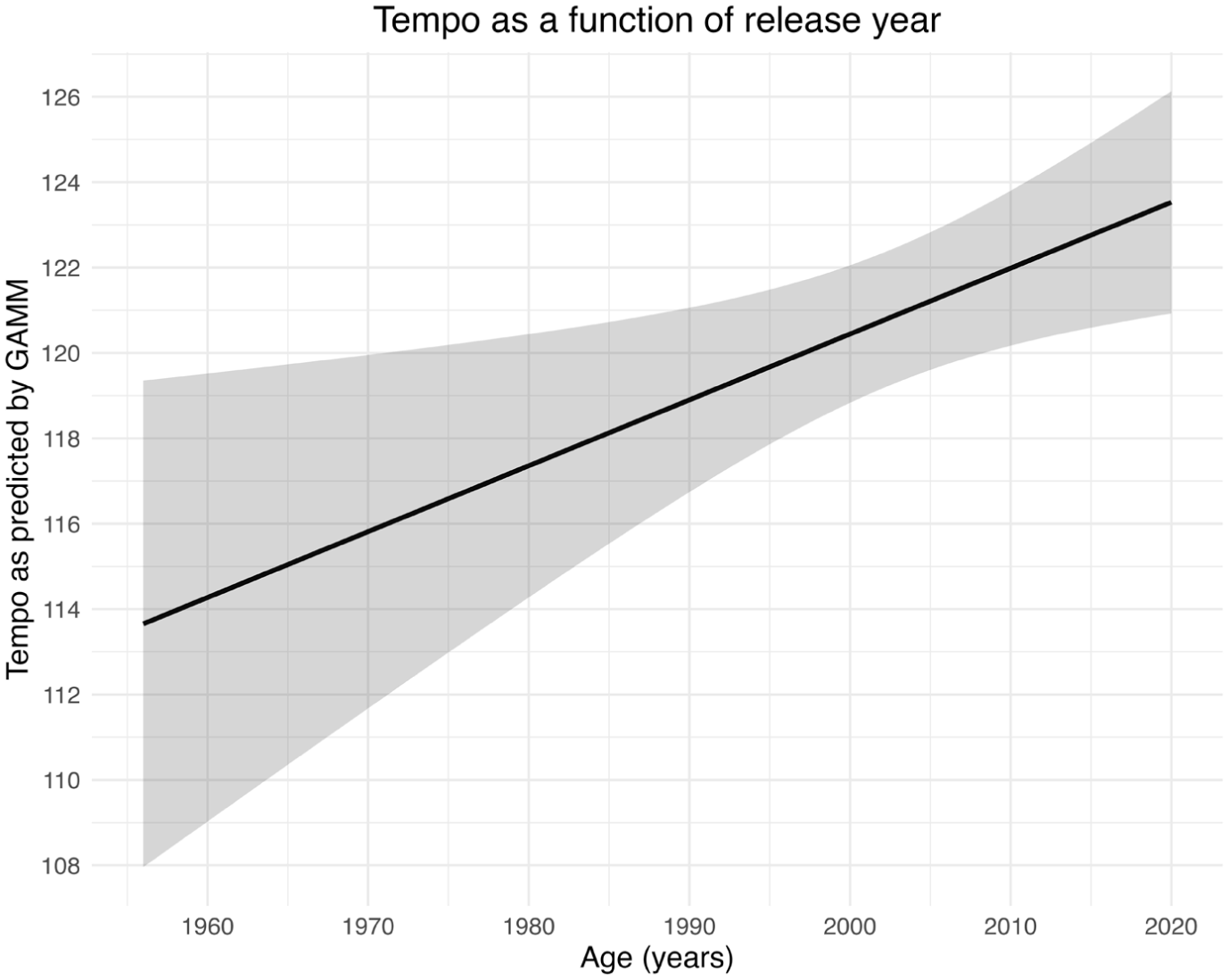
Tempo (bpm) as a function of release year.
GAMM Model 2: Random linear slopes and random smooths
Given the variability in the artists’ age-related tempo profiles identified by Luck (2024), in a second step, we examined whether the effect of age might differ significantly between artists. Consequently, a second, more complex model was constructed in which artists were modelled as both random intercepts and slopes. Unlike Model 1, Model 2 permitted the effect of age on the tempo to vary between artists. Specifically, in Model 2, we included a random linear slope for age for each artist, reflecting how each artist’s tempo changes differently over time. To build this model, we utilised the formula:

which corresponds to:

where the new term represents a random linear slope for age and models how the relationship between the age and tempo varies for the i-th observation, depending on the artist.
When comparing this model with Model 1, all the model comparison metrics indicated a preference for Model 1, which included only random intercepts, demonstrating a better fit to the data (Table 1). Furthermore, the nested models were compared using a Likelihood Ratio Test (LRT), which showed a lack of significance (p = 1). This result suggests that adding complexity to the model did not improve the model’s performance. Indeed, when inspecting the estimated variance of the slope, it was near zero (SD = 0.12), suggesting minimal artist-level variation in the age effect.
This result, the increased values of AIC and BIC for Model 2, coupled with the Bayes Factor clearly favouring Model 1, indicate that the additional complexity introduced by the random slopes in Model 2 did not lead to a model improvement (Table 1). For this reason, we retained the Model 1 configuration for subsequent analyses. Notably, this result implies that the effect of age on the tempo is relatively consistent across artists. That is, the variability between the linear trajectories (i.e., how each artist changes their tempo over time) is relatively small, and the linear trends across artists are reasonably similar to each other when considering the effect of age.
Figure 4 shows the tempo as a function of the artist’s age. It can be seen that the tempo increases slightly from artists’ mid-teens to early thirties, after which it decreases linearly over the rest of their lives. By the age of 45, the tempo has dropped below mid-teen levels. By the age of 70, it has decreased by twice as much. By the age of 90, the tempo has decreased threefold.
At this point, to further investigate individual differences in the age trend among artists, we fitted a different version of Model 2 (i.e., Model 2b) with random smooth effects (Wood, 2017, Chapter 5) instead of random linear slopes, as follows:

Different from the previous version, this one allows each artist to have a fully nonlinear age trajectory and therefore has the possibility of retaining more complex patterns of variation. In fact, this model had a better log-likelihood (–63,059 compared to –63,307), suggesting a better raw fit (Table 1). However, as anticipated, it did have a radically higher number of parameters (around 177 vs. 7), resulting in a very much worse BIC due to overparameterisation. Indeed, when compared with Model 1, despite a significant LRT test (p < .001), the BF supported the simpler model with overwhelming evidence (i.e., BIC = 127,802 compared to 126,681; BF = 3.48 × 10243) (Table 1). This finding strongly suggests that the improved fit resulted from overfitting the data (the parameters of Model 2b can be found in the Supplementary Materials, Table S1).
Two alternative models were fitted by adding a random linear slope (Model 2c, LRT p = .700; Table 2) and a random smooth term (Model 2d, LRT p < .001, similar to Model 2b) for the release year (the parameters of Model 2d can be found in the Supplementary Materials, Table S1). In both cases, the fit failed to improve meaningfully compared to Model 1 (Table 1). Hence, we retained Model 1.
GAMM Model 3: Interaction model
Finally, we wanted to check whether the age effect remains constant over time. For this purpose, we built a third model wherein we added an interaction term (i.e., a tensor smooth) to Model 1. The formula was:

This corresponds to:

The new term, called tensor product smooth or tensor interaction term, allows for a flexible, nonlinear interaction between age and release year, without assuming that they are on the same scale or have similar units (Wood, 2006, 2017).
As Models 1 and 3 varied in the fixed part, we refitted Model 1 with Maximum Likelihood (ML) and called that Model 1b. This was necessary since comparisons between models differing in the fixed effects are reliable only when the models are fitted using such an estimator (Luke, 2017; Sóskuthy, 2021).
All the comparison metrics favoured Model 1b over Model 3 (Table 1). The LRT test did not reach significance (p = .870), thus suggesting that the effect of age has remained consistent across different decades. Figure 6 shows a three-dimensional representation of the relationships between tempo, age, and release year.
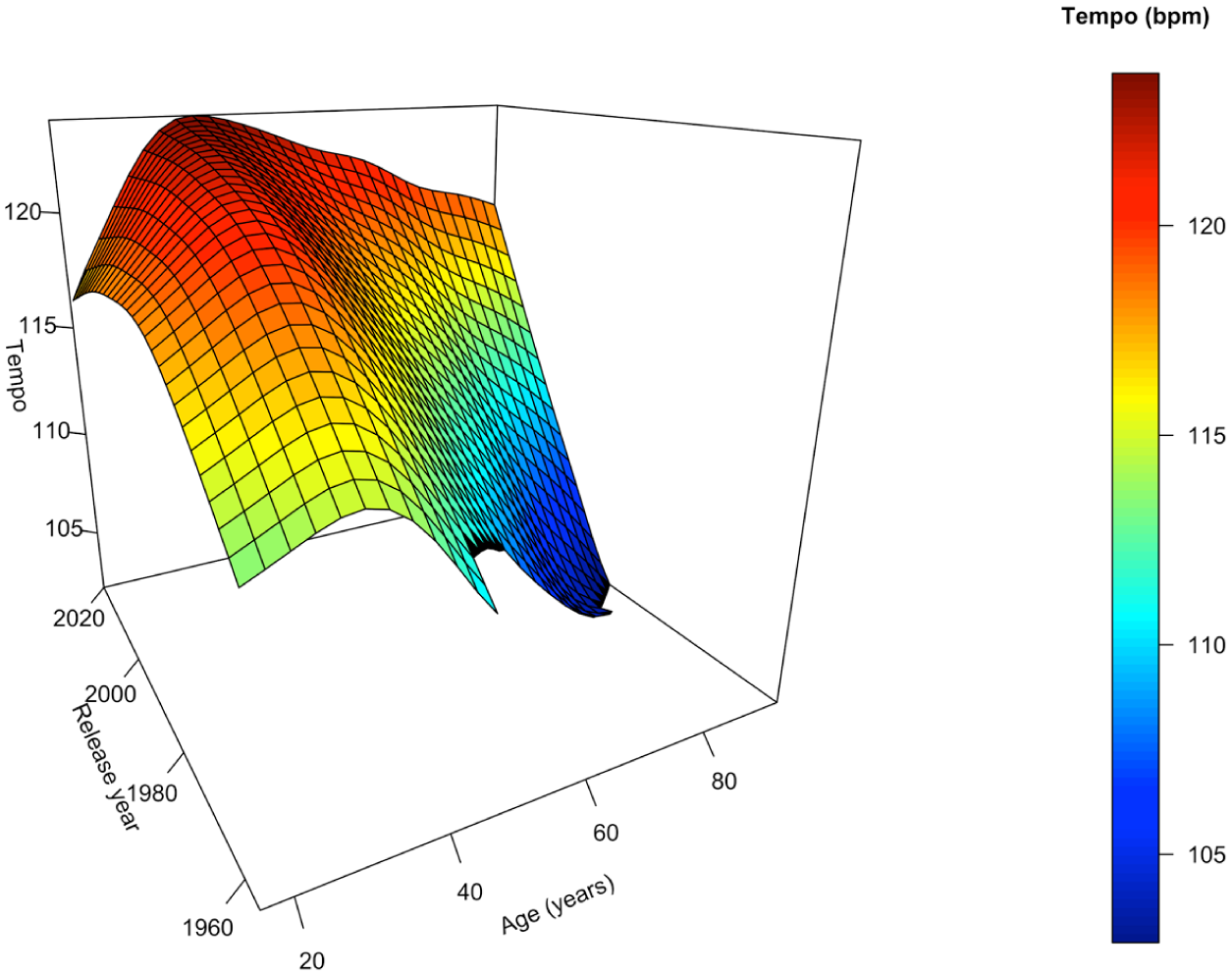
Tempo (bpm) as a function of artists’ age and release year.
Analysis of the linear trends (LMMs)
To better assess the slopes of the increasing and decreasing trends, we took two further steps. First, we ascertained the linearity of the trends (i.e., the EDF values) by rerunning two instances of Model 1: One for the values of age < 30 (EDF = 1.00) and one for the values > 30 (EDF = 1.91). Finally, we ran an LMM for each trend. The formula was identical to that of Model 1. The LMM for the increasing trend (i.e., age < 30; Ntracks = 2,002; Nartists = 81) signalled a positive relationship between age and tempo, b = 0.67, 95% CI = [0.15, 1.19], SE = 0.27, p = .013. The release year effect was not significant, b = 0.02, 95% CI = [−0.17, 0.22], SE = 0.10, p = .782. The LMM for the decreasing trend (i.e., age > 30; Ntracks = 10,885; Nartists = 161) indicated a significant negative relationship, b = −0.19, 95% CI = [−0.32, −0.07], SE = 0.06, p = .002. In this model, the effect of the release year was significant, b = 0.17, 95% CI = [0.04,0.29], SE = 0.06, p = .007 (Table 3). Notably, when fitting a random slope model for the decreasing trend, we found that all artists had a decreasing trend after age 30, with no exception. The artist with the lowest decrease was Willie Nelson (b = −0.12), whereas the artist with the steepest decrease was El Gran Combo De Puerto Rico (b = −0.26). In this model, the correlation between the random intercept and slopes was r = −.43, thus suggesting that artists with faster initial tempi have steeper decreases over time. However, the uncertainty of the estimate was quite large, with 95% bootstrapped CI = [−.91, .30], and a non-significant p-value of .551 (this was computed by comparing the model with an identical model without the correlation at hand).
LMMs Model parameters.
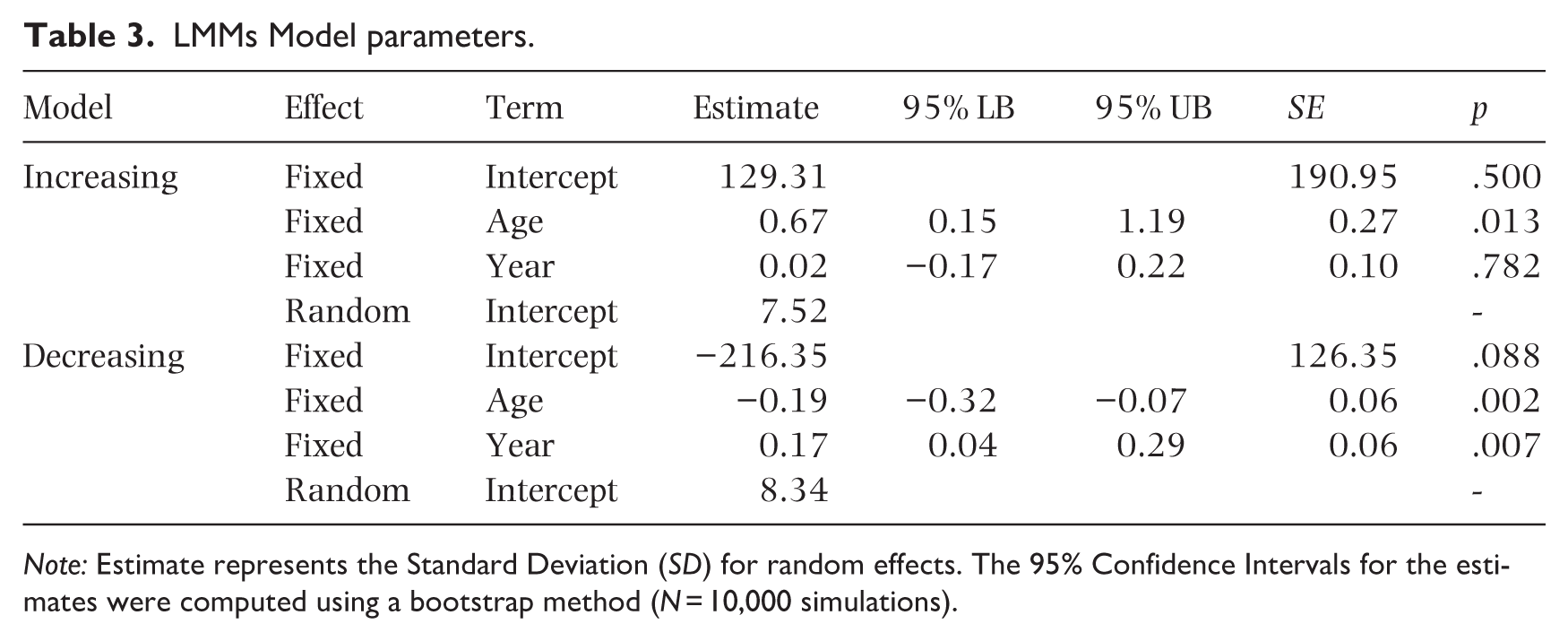
Note: Estimate represents the Standard Deviation (SD) for random effects. The 95% Confidence Intervals for the estimates were computed using a bootstrap method (N = 10,000 simulations).
In Figure 7, we represent the decreasing slopes of a random sample of 10 artists (including the above-mentioned ones, as a reference).
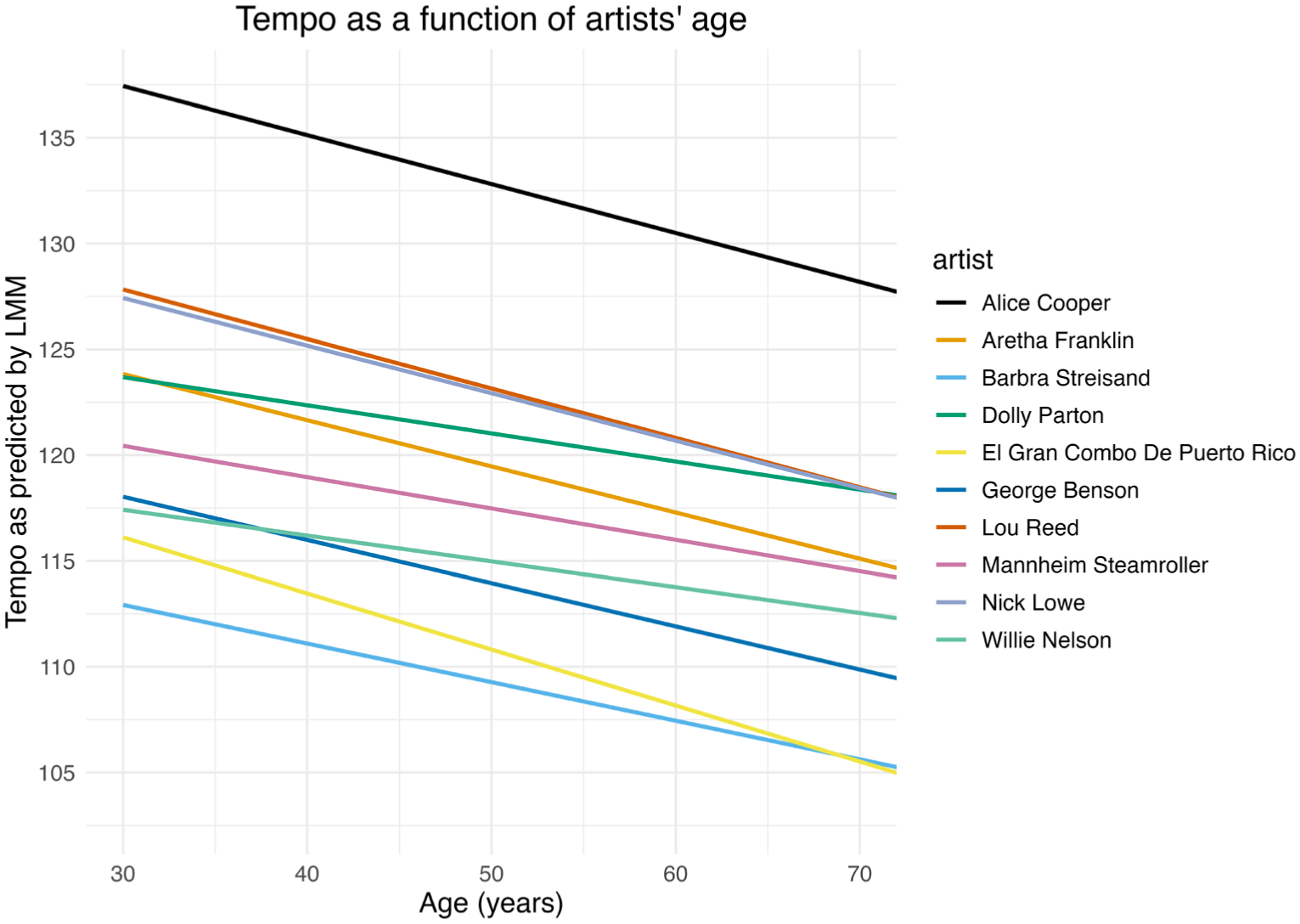
Decreasing slopes (> 30 years) of a random sample of 10 artists.
This finding suggests that, after age 30, musicians’ tempo slows inexorably by approximately two beats per minute for every decade that passes.
Power analysis
A sensitivity analysis was conducted using a Monte Carlo simulation approach (Green & MacLeod, 2016) to evaluate the MDES at a power of 50% for the two models. In the case of the increasing trend model, the analysis determined that an effect size of b = 0.54 could be detected at power = 51.15%, 95% CI = [48.93, 53.36]. The effect we found (b = 0.67) could be detected at power = 68.40%, 95% CI = [65.42, 71.27]. As for the decreasing trend model, an effect size of b = −0.13 could be detected at power 53.20%, 95% CI = [50.05, 56.33], whereas our effect (b = −0.19) has power = 87.88%, 95% CI = [85.41, 90.06]. Such results suggest that the model for the decreasing trend is powered enough and detects a significant effect, whereas the model for the increasing trend shows a significant but marginally powered effect, suggesting a more cautious interpretation.
Discussion
We investigated the effect of the artist’s age on the music performance tempo by examining computationally extracted tempo values from a diverse range of commercial recordings. Using GAMMs and LMMs, we dissociated the effects of artist age from more general temporal trends in musical style and market forces. Our analyses revealed a modest tempo increase from artists’ mid-teens to approximately age 30, followed by a continuous, linear decrease across the remainder of their adult lifespan. From age 30 to 80, the musical output tempo decreased by roughly 10 beats per minute (bpm), averaging about 2 bpm per decade. Importantly, this effect was independent of broader genre-level tempo trends and resembles age-related changes in SMT and gait speed previously reported in cognitive and motor ageing literature (Luck, 2024).
The emergence of a curvilinear age-tempo relationship contributes novel empirical support to the idea that fundamental changes in motor functioning across the lifespan manifest in the temporal structure of musical performance. Unlike the strictly linear decrease observed in earlier work (Luck, 2024), our larger and more stylistically diverse dataset revealed a more nuanced trajectory. The initial increase until age 30 might reflect the maturation of motor control and timing precision or, alternatively, broader developmental trends in artistic exploration and tempo preference. The subsequent decrease, closely mirroring the curvilinear profile of gait speed (Bohannon & Andrews, 2011) and SMT (McAuley et al., 2006), supports the hypothesis that commercial musical output is constrained, consciously or otherwise, by age-related changes in motor capacity, timing stability, and possibly sensorimotor integration.
Nevertheless, several important interpretative caveats should be considered. While the tempo decrease observed here is consistent with a physiological account, it remains unclear whether the observed effect reflects diminished ability to perform at faster tempi or rather a shift in compositional and expressive preferences with age. In other words, the fact that the trajectory we found closely resembles the ones of gait speed and SMT does not unequivocally guarantee that its cause lies in reduced motor capacity. Older artists might simply favour slower tempi due to changing aesthetic priorities, shifting musical genre, emotional tone (see Leppänen et al., 2026, in print), or cultural alignment with ageing audiences. Such preference-based explanations cannot be excluded and likely interact with underlying biological factors. Notably, if motor constraint were the primary driver, one might expect the tempo slowdown to be modulated by artists’ initial working tempo range or to interact with individual differences in the early-career tempo. As the evidence we gathered on this particular point is rather uncertain, future work should examine whether artists who began their careers producing high-tempo music show steeper decreases or whether the rate of decrease is invariant across starting speeds.
Furthermore, comparing our results with rates of motor decrease observed in other behaviours could offer additional insight. Gait speed, for instance, decreases in the order of 0.1 m/s per decade after age 60 (Studenski et al., 2011), while SMT slows by approximately 20–30 ms per beat per decade (i.e., ≈ 3–5 bpm) (McAuley et al., 2006). The decrease observed in the musical tempo, roughly 2 bpm per decade, falls within a similar range of gradual slowing, suggesting that fine motor timing in musical contexts is shaped by constraints similar to those affecting large-scale bodily motion. Whether these decreases are more closely linked to gross motor (e.g., gait, gesture) or fine motor (e.g., finger tapping, articulation) functions remains an open question. Given the complexity of musical performance, which draws on both domains, future work might explore more direct parallels by comparing musical tempo to longitudinal changes in instrument-specific motor capacities (e.g., drumming speed, pianistic finger agility).
It’s also important to note that playing at a slower tempo does not automatically equate to playing fewer notes in a given time period. For instance, one might play more notes at a slower tempo (subdivisions) or fewer notes at a faster tempo. Indeed, this is an issue that impacts the perceived tempo itself. Future work could, for example, examine note onset-density (as opposed to tempo) as a function of age. Identifying a decrease in note onset-density across the lifespan would add weight to our findings reported here.
Our findings also raise broader questions concerning the influence of demographic and individual difference variables on the tempo decrease. For example, gender has been shown to modulate motor timing performance, with some evidence of earlier onset or steeper decrease in men compared to women in activities such as gait and handwriting (Ketcham et al., 2002; Voelcker-Rehage, 2008). If music tempo reflects general motor capacity, one might predict similar moderating effects in recorded output, although such effects were beyond the scope of this study, especially since the dataset is unbalanced towards male artists (40.99%) and bands (41.61%). Likewise, the genre could interact with the tempo trajectory, as stylistic conventions impose differing expressive and technical demands. Rock musicians, for instance, might exhibit steeper decreases if higher baseline tempi impose greater physiological strain in later life.
Beyond theoretical implications, our results carry significant creative and aesthetic relevance. Our findings suggest that the artist’s age might subtly but consistently shape the temporal structure of musical output across a career. Given the well-documented influence of tempo on emotional expression (Webster & Weir, 2005), arousal (Lundqvist et al., 2009), and body movement (Burger et al., 2014), such age-related tempo changes could have downstream consequences for how music is experienced by listeners. In this light, longitudinal analyses of musical performance could serve as a valuable lens through which to study the intersection of lifespan development, creativity, and embodied cognition.
Future research could benefit from more targeted studies that isolate compositional preference from performance capacity, such as experimental work assessing tempo production limits in older versus younger musicians under controlled conditions. In addition, several other methodological limitations might also be addressed in future work.
First, the use of Spotify’s own tempo extraction algorithm resulted in a lack of clarity as to precisely how tempo was computed. Utilising a non-black box approach in the future, if and where feasible, would afford greater transparency and understanding of results.
Second, in cases where the artist was a band or ensemble, operationalising age as that of the lead singer or instrumentalist might not have provided the most accurate estimate of group age. Furthermore, the implicit assumption that the leader’s age shapes musical tempo to a greater extent than that of the other band members is indeed a non-trivial one, suitable for modelling purposes, but somewhat detached from real-world dynamics. More realistically, each member of a band has a weight in the process of choosing the right tempo for each song, and the weights are likely to differ depending on the genre and instrument, with drummers, percussionists, and singers probably being more influential than the other members. In principle, a better, although considerably more time-consuming, approach might be to compute the average age of all group members. However, this strategy would come at the cost of excluding a significant portion of the sampled artists. For instance, the lineup of many bands changes over time. Moreover, a large number of artists rely on session musicians for their recordings. Consequently, it will likely be challenging to identify the exact band composition of each album, even more so for each song. Furthermore, the birth year of many session musicians, who often work behind the scenes and contribute to recordings without being officially associated with a band or social artist, is not always easily available.
Third, our efforts to exclude tracks in order to minimise extramusical influences were not without their difficulties. For instance, some exclusions were based solely on names and nomenclature; a Christmas album title that did not contain the words ‘Christmas’, ‘Xmas’ or similar would have been missed. In the same vein, we excluded classical music via typical related words (sonata, concerto, etc., and many names of classical composers). However, since track genre is not specified in the dataset, some lesser-known classical musicians/composers might have slipped through. Ideally, in subsequent studies, one might build one’s own dataset utilising stricter criteria.
Fourth, we did not examine the effects of musical genre on the tempo slowdown across the lifespan. Future studies might also consider including this as a factor, if possible, in case, for example, rock musicians slow down faster or with a different trajectory than, say, pop artists, and so on (see Leppänen et al., 2026, in print for a similar approach in the longitudinal study of acousticness).
Fifth, it is worth mentioning that the analysed dataset is dominated by Western artists, especially from North America (78.26%) and Europe (e.g., 15.53%), with Africa, Asia, South America, and Oceania accounting for the remaining portion of the sample. Further studies with larger and more representative samples are needed to verify whether such a trend also exists in such underrepresented areas.
Finally, we deliberately excluded live recordings from our sample since live contexts introduce additional confounding factors – click tracks to help set and maintain the tempo and/or effects of heightened physiological arousal, for instance – likely to influence the tempo. It could be valuable to investigate live recordings to see if similar effects of age on performance tempo can be observed.
Conclusion
Our findings demonstrate that the tempo of an artist’s recorded musical output typically follows a curvilinear trajectory, increasing slightly into early adulthood before declining by approximately 2 beats per minute per decade from around age 30 onwards. It seems unlikely that this observed tempo change is perceptually salient to listeners, and most probably goes unnoticed. Nonetheless, this age-related deceleration parallels changes observed in SMT and gait speed (Bohannon & Andrews, 2011; McAuley et al., 2006), suggesting that broader sensorimotor transformations may shape expressive behaviour in professional music-making. However, it would be premature to attribute this trend solely to declining motor capacity. Shifts in aesthetic preference, creative intention, or socio-emotional priorities with age (Carstensen, 2006; Juslin & Laukka, 2004) may also contribute meaningfully to the observed pattern. Rather than indicating artistic limitation, our results illuminate the embodied nature of musical performance and point to age as a subtle but pervasive influence on artistic expression. Future work should aim to disentangle the relative roles of motoric constraint and changing expressive priorities, as well as explore how such lifespan dynamics are modulated by genre, gender, and individual stylistic evolution. Ultimately, recognising the influence of age on tempo contributes to a richer, more embodied understanding of creativity across the human lifespan.
Supplemental Material
sj-pdf-1-msx-10.1177_10298649261419738 – Supplemental material for The ageing musician: Evidence of a downwards trend in song tempo as a function of artist age
Supplemental material, sj-pdf-1-msx-10.1177_10298649261419738 for The ageing musician: Evidence of a downwards trend in song tempo as a function of artist age by Geoff Luck and Alessandro Ansani in Musicae Scientiae
Footnotes

Ethical considerations
This study analysed publicly available data obtained from Spotify, which does not involve personal or sensitive information. Consequently, the need for ethics approval was waived, as the project exclusively utilised data that are publicly accessible and do not infringe on individual privacy.
Funding
The authors disclosed receipt of the following financial support for the research, authorship, and/or publication of this article: This work was supported by the Research Council of Finland (grant numbers 346210 and 356841).
Declaration of conflicting interests
The authors declared no potential conflicts of interest with respect to the research, authorship, and/or publication of this article.
Data availability statement
Supplemental material
Supplemental material for this article is available online.
Notes
References
Supplementary Material
Please find the following supplemental material available below.
For Open Access articles published under a Creative Commons License, all supplemental material carries the same license as the article it is associated with.
For non-Open Access articles published, all supplemental material carries a non-exclusive license, and permission requests for re-use of supplemental material or any part of supplemental material shall be sent directly to the copyright owner as specified in the copyright notice associated with the article.
