



Abstract
This systematic review aimed to provide a comprehensive and up-to-date understanding of the current state of empirical research in self-regulated learning (SRL) and music, investigating learning strategies planned and employed by advanced musicians and evidence to support the benefits of SRL training for this population. Using the Preferred Reporting Items for Systematic Reviews and Meta-Analyses (PRISMA) protocol, we initially identified 3323 records related to our search, spanning the period from 2001 to 2023. Inclusion criteria consisted of peer-reviewed empirical articles reporting studies involving the participation of advanced (i.e., undergraduate and postgraduate student and professional) musicians using Zimmerman’s cyclical model of SRL and published in English, Spanish, Portuguese, or French. Forty-eight articles met all the inclusion criteria and were included in the review. We divided them into three types: reports of observational studies, descriptive-correlational, and intervention studies. We discuss the findings according to the three phases of Zimmerman’s cyclical model: forethought, performance/volitional control, and self-reflection, including the processes of goal setting, selection and adaptation of learning strategies, help seeking, time management, and self-evaluation and adaptation. Our analysis identified trends in the behavior of advanced musicians, particularly regarding practice quantity and musical achievement. Suggestions for future research indicate the need to invest in the training of instrumental and vocal teachers, so that they become familiar with SRL learning strategies that they can pass on to their students.
While time spent practicing is considered an essential component of music practice, research findings suggest additional factors that contribute to the quality and effectiveness of practice sessions (Bonneville-Roussy & Bouffard, 2015; Ericsson et al., 1993; Williamon & Valentine, 2000). These factors have been investigated within the widening domain of research on music practice (How et al., 2022). The PRISMA (Preferred Reporting Items for Systematic Reviews and Meta-Analyses) (Page et al., 2021) review by How et al. (2022) analyzed research on music practice from 1928 to 2020 and found that this field had been influenced by methods used in psychology and that the most common topics and the most cited articles were related to psychological constructs such as deliberate practice, motivation, and self-regulation.
Self-regulation can be defined as the “self-generated thoughts, feelings, and actions that are planned and cyclically adapted to the attainment of personal goals” (Zimmerman, 2000, p. 14). It is a set of processes that can be modeled and internalized throughout the learning process, rather than a single, innate trait (Zimmerman, 1998). Self-regulation has been investigated from various theoretical perspectives, including phenomenological, operant, volitional, Vygotskian, constructivist, and social cognitive approaches (Zimmerman & Schunk, 1989).
According to social cognitive theory, self-regulated learning (SRL) encompasses three interdependent subprocesses: self-observation, self-judgment, and self-reaction, which are all influenced by environmental factors (Bandura, 1986; Schunk, 1989). From this perspective, monitoring one’s own behavior provides valuable information that can inform future choices of strategies to accomplish learning tasks and achieve satisfying outcomes (Schunk, 1989).
The main difference between the socio-cognitive approach to self-regulation, on one hand, and noncognitive behavioral theories, on the other hand, is that the social cognitive approach acknowledges the role of human agency (Bandura, 1991). Different models have been proposed to explain how the processes underlying SRL enable people to accomplish their goals.
Models of SRL were reviewed by Puustinen and Pulkkinen (2001) and updated by Panadero (2017) following specific inclusion criteria: (a) peer-reviewed (specifically in journal citation reports or self-regulation handbooks); (b) published in the English language; and (c) with a minimum of 500 references (if published before 2010) or 20 citations per year (if published after 2010) (Panadero, 2017). Besides the first SRL model proposed by Zimmerman (1989), the models reviewed include those subsequently developed by Pintrich (2004), Boekaerts’ Dual Processing Model (Boekaerts & Cascallar, 2006), Efklides (2011), Winne and Hadwin (Winne, 2011), and the Socially Shared Regulated Learning Model by Hadwin et al. (2011). Although not mentioned in the reviews, Weinstein et al.’s (2000; 1994) model fits Panadero’s (2017) inclusion criteria, and their approach to SRL strategies is widely used in the self-regulation literature, in addition to their Learning Strategies Assessment Instrument (LASSI) (McCombs, 2017; Weinstein et al., 1987).
Zimmerman (1989) initially developed a triadic SRL model that encompassed personal, behavioral, and environmental influences; he subsequently developed a multilevel model (Zimmerman, 2013) in which learning shifts from observation to self-regulation. Zimmerman and Risemberg (1997) also describe SRL as a multidimensional construct in which processes are organized into six psychological dimensions: motive, method, time, behavior, physical environment, and social factors. Finally, Zimmerman (1998, 2002) proposed a cyclical model, in which SRL processes are organized temporally in three phases: forethought (before the task), performance/volitional control (during the task), and self-reflection (after the task) (Zimmerman, 2013; Zimmerman & Campillo, 2003). Both the multidimensional model and the cyclical model have been adapted to music learning and performance by McPherson and Zimmerman (2002, 2011) and have been explored by music education and performance researchers. This review will focus on the phases of the cyclical model, as described below.
Forethought
Before accomplishing a task, learners must analyze its features and use this information to establish goals and plan the strategies to be employed. When aiming to learn and perform music effectively, learners should set goals hierarchically and temporally by taking future events such as recitals and exams into consideration, as well as daily practice, and selecting technical and interpretative objectives to achieve in every practice session. This way, larger goals can be divided into smaller ones, enabling mastery of musical challenges (Hatfield, 2016; Kegelaers et al., 2022; McPherson et al., 2019; McPherson & Zimmerman, 2011; Zimmerman, 2000). Music learners should plan to use specific strategies for each task, achieve their daily practice goals, and then build the experience and necessary beliefs to accomplish future performance goals (Nielsen, 2015; Zimmerman, 2002). Self-efficacy, or the degree to which an individual feels capable of successfully performing a task, is addressed in several studies related to music (Regier, 2021; Ritchie & Williamon, 2012; Zelenak, 2020). Self-efficacy beliefs are also influential in the forethought phase because they affect the way learners set their goals; for example, if hierarchically organized goals are achieved, the learner is likely to experience a sense of mastery. Higher self-efficacy enables learners to choose more challenging goals throughout the learning cycle (Zimmerman, 2000).
Performance/volitional control
Learning strategies selected during the forethought phase are employed during the performance/volitional control phase, supported by self-control and self-observation subprocesses. Learning strategies are defined in this context as “actions taken by the learner to complete a task or obtain information” (Dembo & Seli, 2016, p. 280). Within the SRL framework, these actions require agency, purpose, and self-observation (Zimmerman & Martinez-Pons, 1986). Learners must use the information from personal, behavioral, and environmental influences to select strategies, bearing in mind that no strategy works the same way for all people nor in all situations (Nielsen, 2001, 2012, 2015; Zimmerman, 2000). Strategies are selected and applied not only to accomplish a specific task (e.g., related to repertoire or technical issues) but also to support environment structuring, time management, and help seeking (McPherson, 2022; McPherson & Zimmerman, 2002; Zimmerman & Risemberg, 1997). Self-observation is the action of monitoring elements of our behavior, the conditions in which our learning takes place, and the results we obtain from our performance (Zimmerman, 2000). Keeping a record of goals, strategies employed, feelings, and outcomes generates information that can help people monitor their learning trajectories and regulate their motivation and the emotions associated with accomplishing a task.
Self-reflection
After completing a task, learners evaluate its outcomes and experience reactions to them. By taking into consideration the information they recorded during the performance phase, they can evaluate the way they managed their behavior while carrying out the task, the efficacy of the strategies they planned, and the goals they set during the forethought phase. These self-reflection processes concern the behaviors, strategies, and goals that should be changed to obtain better results in the next practice session. The model is thus cyclical, as self-reactions and self-judgments influence successive learning phases. It is also reciprocal between phases, as each process in each phase involves making a decision that will influence subsequent actions. For example, a strategy consciously planned during the forethought phase, and employed and monitored during the performance phase, will be subjected to causal attributions during the self-reflection phase, affording the opportunity to adapt the chosen strategy in the next forethought phase (Zimmerman, 2000, 2013).
SRL training in the context of learning music
Self-regulation is not an innate characteristic but rather a set of processes that can be learned by individuals (Zimmerman, 1998). The main aim of SRL interventions is to train individuals to use SRL strategies that they can internalize and apply in their daily practice. Varela et al. (2016) highlighted the difference between “general music instruction” and “musical self-regulation instruction” (p. 4), associating the latter with both the musical and self-regulation aspects of learning. This was emphasized in the seminal article by McPherson and Zimmerman (2002) who pointed out the need to research the results of SRL process training as well as general aspects of musical training.
The distinction between SRL process training and musical training in general was examined by Miksza (2015). The study included an intervention and was designed to assess the relative effects on advanced music students of receiving instruction in strategies for music practice alone and instruction in strategies for music practice combined with SRL training. Participants who had received both kinds of instruction were found to show greater improvement in performance.
Since Zimmerman’s SRL cyclical model was adapted by McPherson and Zimmerman (2002, 2011), more research on music learning has been conducted from the perspective of social cognitive theory, according to a systematic review of 25 relevant outputs published in 2011 (Varela et al., 2016). The reviewers applied no specific protocols but specified exclusion criteria as follows: articles reporting nonempirical research and research involving the participation of pre-service music teachers; written in languages other than English; and unrelated to music learning, performance, or the article by McPherson and Zimmerman (2002). The reviewers devised a categorization system and gave each article included in the review a score from which means and correlations could be calculated (How et al., 2022). The results of the calculations indicated that evidence of SRL in participants’ self-reported behaviors is more likely to be associated with SRL instruction than music training in general. The limitations of the review, noted by its authors, include the unweighted scores assigned to studies with different sample sizes. Moreover, the calculation of means was treated as correlations and used different numbers of articles; for example, some questions were answered using all 25 studies included in the review, and others as few as four studies. Another limitation worth noting is that, contrary to the exclusion criteria set out above, not all the articles retrieved refer to SRL as a construct deriving from social cognitive theory.
Purpose of the study
In this systematic review, we aimed to collect information on published research on SRL processes and their impact on advanced musicians’ practice and performance. According to a definition of expertise based on the research of Ericsson et al. (1993), musicians who have sung or played their instrument for at least 10 years can be described as experts. We decided to adopt the term advanced musicians to include students enrolled in higher education institutions, such as universities or conservatories that offer tertiary music education, and who are preparing to become professional musicians or are already working professionally, since it is the term often used in the increasing body of research on music practice (e.g., Araújo, 2016; Papageorgi et al., 2010). Advanced musicians exhibit deliberate practice skills, can maintain focus while practicing during practice, and have enough knowledge to organize their practice on the basis of musical form and harmony (Miksza, 2015; Williamon et al., 2002). They have also been described as expert musicians (De Bruin, 2017; Fasano et al., 2020) (regardless of how long they have been playing), college musicians (Boucher et al., 2020, 2021; Kim, 2010), undergraduate musicians (Clark & Williamon, 2011; McPherson et al., 2019; Zhukov, 2012), professional musicians (Dos Santos & Gerling, 2011; Pike, 2017), and even elite musicians (De Bruin, 2019; Kegelaers & Oudejans, 2020; Mornell et al., 2020). We decided to focus on advanced musicians to (a) understand their self-regulatory processes and the extent to which they use them in their practice and performance and (b) find out if SRL training can benefit musicians who have already completed their basic technical–instrumental training and are in the final years of their formal education or working as professional musicians.
The research questions that guided our search strategy were:
RQ1. How do advanced musicians plan and employ learning strategies?
RQ2. Is there evidence of the benefits of SRL training for advanced musicians?
Method
Information retrieval
The PRISMA statement was established to improve the reporting procedures of systematic reviews and meta-analyses (Page et al., 2021). It was originally developed in 2009 and underwent an update in 2020, which was applied in this review. The statement includes a 27-item checklist, which offers a structured approach for the retrieval of essential information, and a flow diagram that provides guidance on the organization of search results. In this section, we will outline the key steps involved in the search strategy and screening phases of a PRISMA-compliant review.
Inclusion criteria
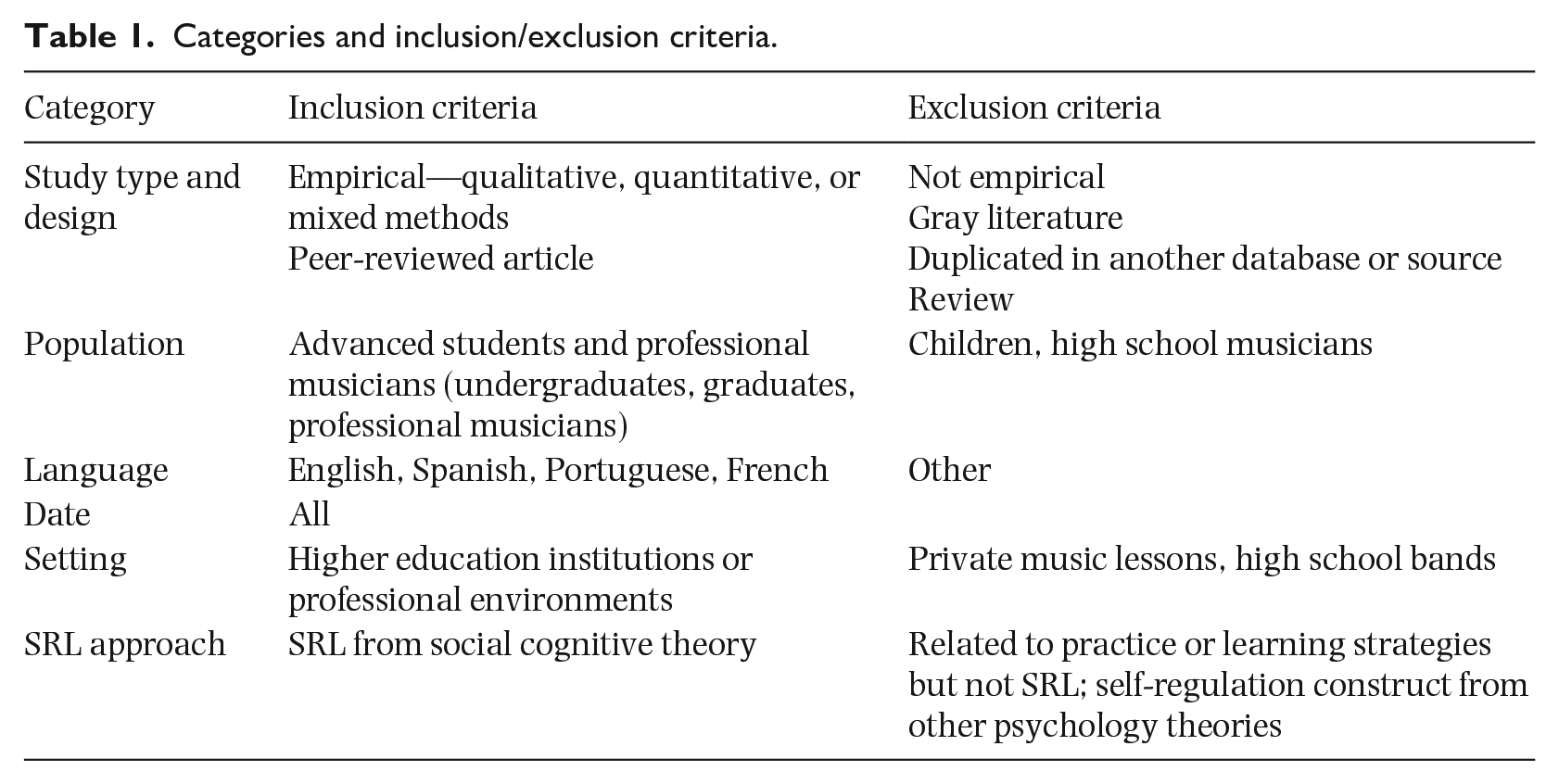
We modified Varela et al.’s (2016) inclusion criteria for the purposes of our review by expanding the selected languages (English, Spanish, Portuguese, and French), excluding results from gray literature, and considering only articles that address SRL in reference to Zimmerman’s (2000) model. The inclusion/exclusion criteria included the following categories: study type and design, population, expertise level, language, setting, and SRL approach (see Table 1). Unlike Varela et al., we decided to include studies involving the participation of pre-service music teachers.
Categories and inclusion/exclusion criteria.
Search strategy
The search strategy was defined according to the research questions. We also adopted the PICOS system , a search strategy tool to list terms related to the Population, Intervention, Comparison, Outcomes and Study design of the literature to be reviewed (Page et al., 2021). Subsequently, we elaborated the following search string: (“Self-regulation” OR “Self-regulatory” OR “Self-regulated” OR “Metacognition” OR “Metacognitive,” OR “Social-cognitive”) AND (“Expert musicians” OR “Elite musicians” OR “Professional musicians” OR “Undergraduate musicians” OR “Postgraduate musicians” OR “College musicians,” OR “Advanced musicians”). After peer reviewing the search string and undertaking several pilot searches on Scopus, PsycINFO, JSTOR, Eric, Web of Science, EBSCO, Science Direct, Google Scholar, and SAGEPUB, we adapted it according to the supported Boolean operators in each source. All the information collected from these bases, the applied search strings, and the results obtained can be found in the Appendix (Table S1 in Supplemental Material).
On 3 July 2023, we conducted the initial search, generating a result of 3323 entries from databases (Scopus: 487; PsycINFO: 198; JSTOR: 147; Eric: 76), search platforms (Web of Science: 864; EBSCO: 287; Science Direct: 101), a web search engine (Google Scholar: 839), and a website containing a large number of music journals (SAGEPUB: 324) (Rethlefsen et al., 2021). All the references were imported to Mendeley Software. From the initial entries, 439 duplicate records and six retracted articles were removed.
The first author carried out the initial screening, analyzing the remaining 2878 records by title and abstract, and removing 664 items unrelated to music and 2055 unrelated to SRL. All the authors analyzed and discussed the remaining full 159 articles with reference to the inclusion criteria. In cases of disagreement as to the theoretical approach used and its relation to social cognitive theory, we consulted an external researcher with extensive experience in the field of SRL. We finally included 48 studies for discussion in the systematic review. Figure 1 shows the search flow diagram (Page et al., 2021).
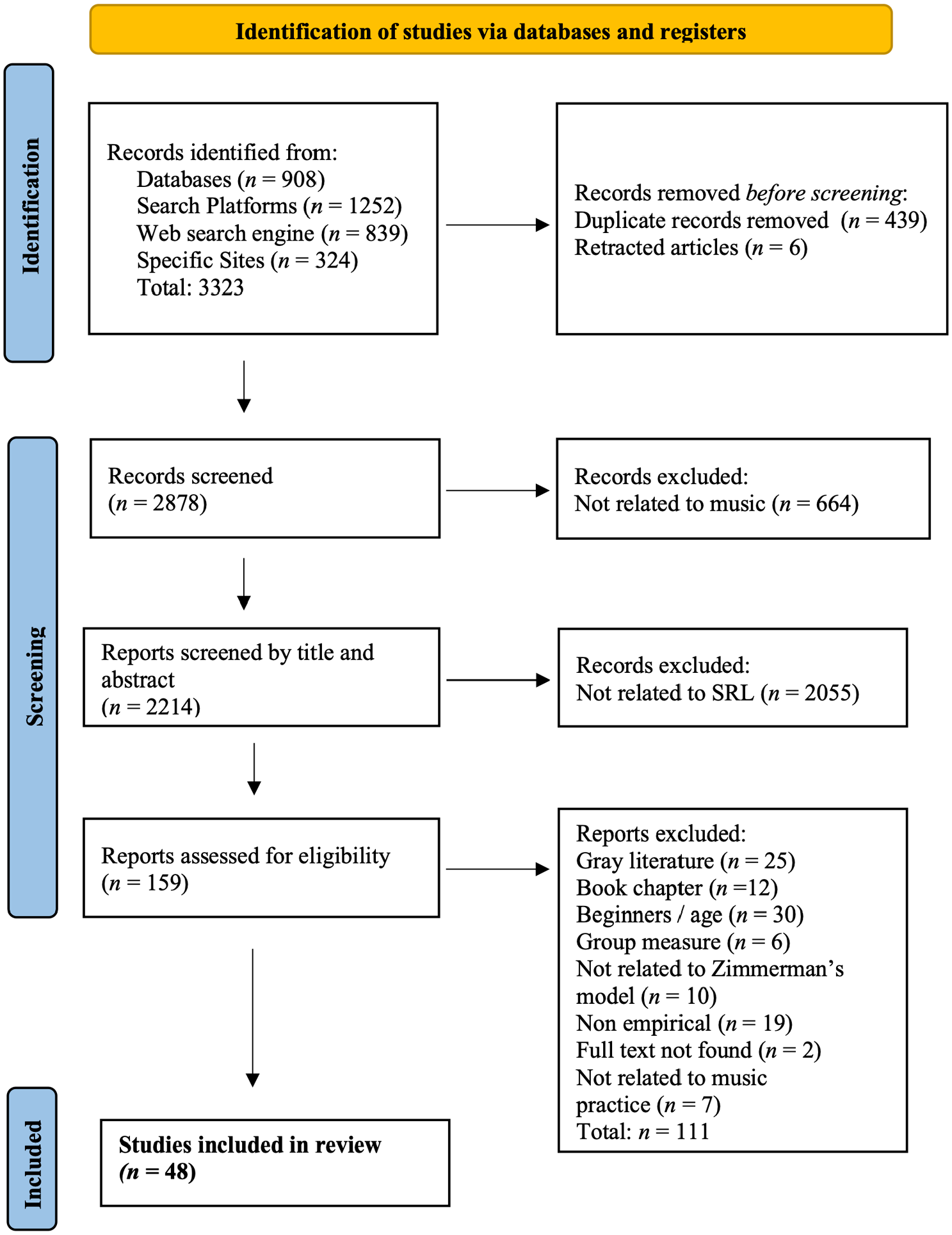
PRISMA flow diagram (Page et al., 2021).
Results
The 48 articles retrieved and selected were published between 2001 and 2023 (Table S2 in Supplemental Material). Most studies were conducted in the United States (nine articles), followed by Norway (six articles) and Turkey (six articles). Sample sizes ranged from 1 to 880 participants, with the majority of the studies involving fewer than 20 participants (26 articles). Forty-one studies investigated self-regulation in classically trained musicians, one focused on jazz musicians, and four included mixed backgrounds in the sample. Two did not supply this information. Participants’ ages ranged from 17 to 69 years. SRL processes were measured during music practice in 36 studies, and 12 addressed both performance and music practice. The complete list of articles and detailed information (authors, date, country, expertise, sample, design, length, instrument, and main findings) can be found in the Appendix (Table S2 in Supplemental Material).
We categorized the studies by their research design as observational studies, interventions, and descriptive-correlational studies. We classified each study according to the information provided in the articles. When information was missing, we examined the main characteristics of the study and the methods described in the retrieved articles (see Tables S3 to S5 in Supplemental Material for information about the studies categorized by their research design).
Eighteen observational studies were carried out to investigate SRL processes. Some of these studies used other noninterventional methods such as interviews, questionnaires, and the analysis of recordings. The advanced musicians whose practice behaviors and strategies were analyzed came from Australia (four articles), Brazil (four articles), China (one article), Finland (two articles), Germany (one article), the Netherlands (one article), Norway (two articles), Spain (one article), and the United States (two articles). The samples ranged from 2 to 38 participants. In 10 studies, data were collected in the form of video recordings of practice or performance either for the purposes of evaluating the participants’ practice behavior or performance or to support interviews in which participants reported the strategies they had used while practicing or performing (video feedback). In 11 studies, interview data were collected; in seven studies, questionnaires were administered, and microanalysis protocols were used to collect data in two studies.
Thirteen intervention studies were conducted to measure the effects of SRL training on self-regulation while practicing and/or performing. The majority included a control group as well as an experimental group. Measures were taken before and after SRL training, and the authors of the articles discuss the changes in self-regulatory processes that can be attributed to the intervention. The studies were conducted in Australia (one article), Canada (two articles), the Netherlands (one article), Norway (one article), Taiwan (one article), Turkey (one article), the United Kingdom (one article), and the United States (five articles). Sample sizes ranged from 1 to 53 participants. Measures included audio recording (one article), interviews (five articles), logs monitored by the researcher (one article), microanalysis protocol (two articles), practice diaries (five articles), video recordings (five articles), and questionnaires/scales (three articles).
In this review, we categorized studies in which SRL behaviors were measured using descriptive statistics (e.g., frequencies and percentages) and/or inferential statistics (e.g., comparisons and correlations between SRL scores) as descriptive-correlational studies. Seventeen such studies were conducted, mostly with large samples, in higher music education institutions in Canada (one article), China (one article), Germany (one article), Norway (three articles), Portugal (one article), Turkey (five articles), the United Kingdom (three articles), and the United States (two articles). Samples ranged from 33 to 880 participants often in several countries. Questionnaires including one or more SRL scales were administered in all the studies, and scales were used in five of them that had not originally been developed for use in the context of music learning and/or performance. The numbers of articles published each year and their distribution in relation to research design are shown in Figure 2.
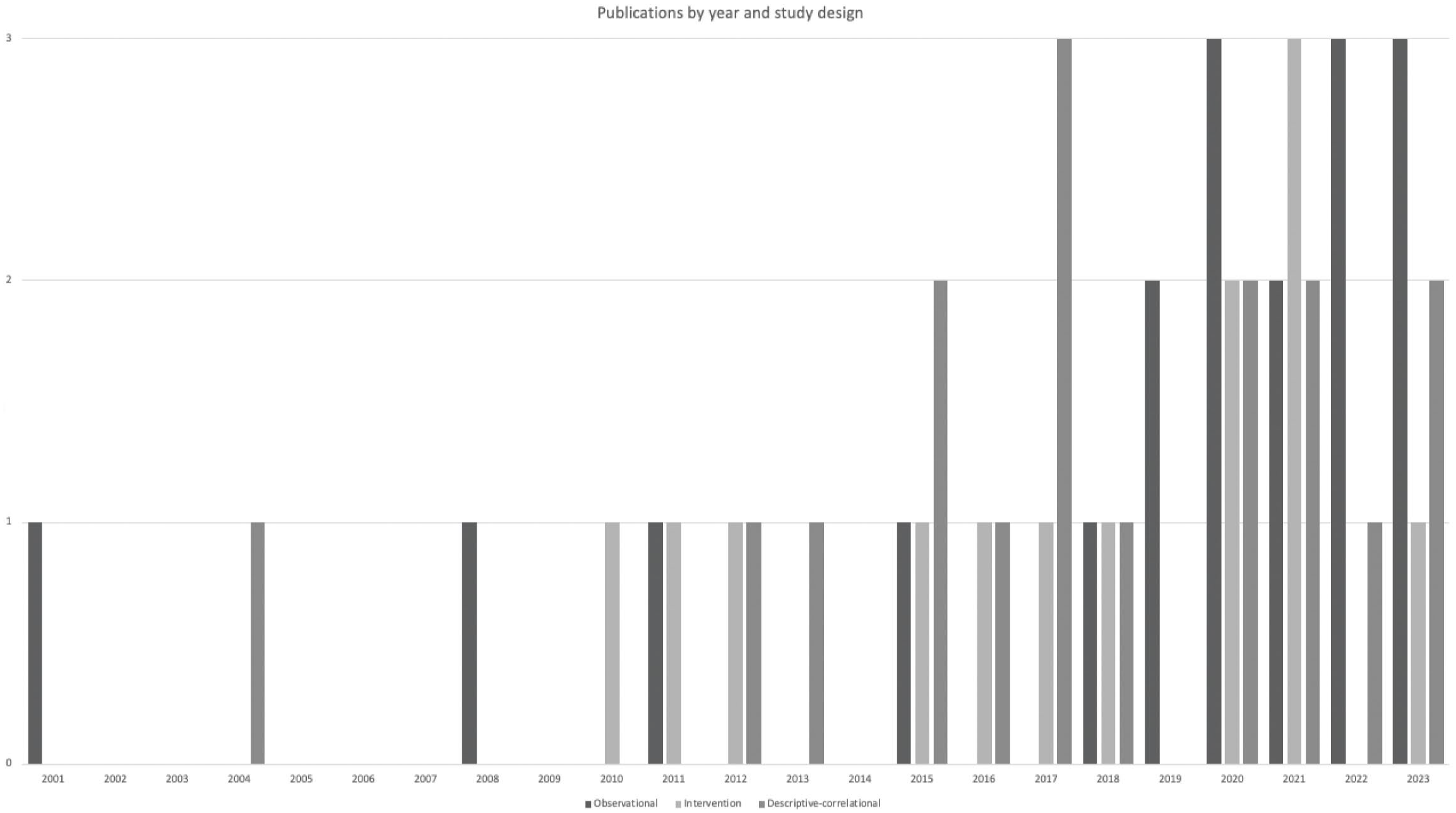
Number and design of articles by year.
An increasing number of articles were published each year, especially between 2017 and 2023. Although they report studies that were almost evenly distributed in terms of their research design, more articles reporting descriptive-correlational studies were published between 2015 and 2018. Since 2020, however, more articles reporting observational studies have been published, perhaps because self-regulation is typically measured using self-reports. Quantitative measures are needed for obtaining data from large samples and generalizing from the results of data analysis. Yet increasingly, researchers prefer to gather data from observational studies, attempting to identify self-regulatory processes as they occur (McPherson et al., 2019; Miksza et al., 2018) or exploring musicians’ reflections on their daily practice (Dos Santos Silva et al., 2023; López-Íñiguez & McPherson, 2020, 2021; Silva & Fiorini, 2021).
Discussion
We use the three phases of the cyclical model (Zimmerman, 2000) as a framework for discussing the SRL processes and strategies identified in the articles selected for review: forethought, performance, and self-reflection.
Forethought
Goal setting
In the articles reporting observational studies, Nielsen (2001), Dos Santos (2018), Kegelaers et al. (2022), Suzuki and Mitchell (2022), and Dos Santos Silva et al. (2023) report the goals set by the participants themselves that influenced the subsequent stages of SRL. Nielsen (2001) observes that participants set specific goals and planned the strategies they were going to use, using personal information to determine the levels of performance that they would be able to achieve. This kind of strategic planning was also observed in the participant in López-Iñiguez and McPherson’s (2020) study and measured using statistical methods in the descriptive-correlational study conducted by Hatfield et al. (2017), in which goal setting was found to correlate positively and significantly with self-efficacy, time management, self-evaluation, and coping.
In one intervention study, however, the results of the pre-test showed that “participants had little experience setting specific goals for their instrumental practice” (Hatfield, 2016, p. 13) and the participant reported by Pike (2017) set unrealistic long-term goals. McPherson et al. (2019) describe their participants’ goals as vague, as did Mornell et al. (2020) and Miksza and Brenner (2023) when referring to the identification of problems to be solved during a practice session; the participants in both of these studies appeared to show little awareness of SRL processes in the forethought phase. Similarly, Silva and Fiorini (2021) report that their focus-group participants had different conceptions of goal setting, and most of the participants in the study by Kegelaers et al. (2022) described generic goals without explaining how they would achieve them.
Antonini Phillippe et al. (2020) could not identify any mention of either planning or goal setting in the data they obtained from their participants, suggesting that they do not plan their practice. Only in one study, by Dos Santos (2018), goals were said to be set by someone other than the participant, in this case their teacher.
Participants in the descriptive-correlational study by Miksza and Tan (2015) did seem to be aware of planning, as several mentioned analyzing the structure of the piece and isolating excerpts to practice. Suzuki and Mitchell (2022) classify this as basic goal setting, while some of the participants in their study set interpretative goals. The contrast between these two types of goals is also highlighted by Mornell et al. (2020) and Kegelaers et al. (2022) because musicians may spend more time trying to meet goals associated with technique than goals associated with sound quality and the interpretation of the music, to the detriment of the latter. It could therefore be useful for musicians to specify the type of goal to be met before identifying a particular goal. Interventions can help them internalize this process. In Hatfield (2016), for example, participants could choose from a range of options including technical, interpretative, and performance-related goals.
The intervention studies highlighted changes in participants’ goal setting from pre- to post-test, such as setting more realistic and hierarchical goals that fostered self-efficacy and practice planning (Clark & Williamon, 2011; Hatfield, 2016; Kegelaers & Oudejans, 2020) and identifying the strategies that could be used to achieve them (Miksza et al., 2018). According to Miksza and Brenner (2023), musicians are likely to set general goals when they start practicing, then more specific goals for solving problems, and finally general goals when they are preparing to give a performance.
Performance
SRL processes in the performance phase include rehearsal and metacognitive strategies, help seeking, and time management. We discuss these in turn.
Rehearsal strategies
According to the observational studies carried out by Byo and Cassidy (2008), Nielsen (2015), McPherson et al. (2019), Suzuki and Mitchell (2022), Silva and Fiorini (2021), and Liu (2023b), participants’ main practice strategy was repetition (see Weinstein et al., 2011 for a discussion of categories of learning strategies). With the exception of Nielsen (2015), researchers divided participants into two groups: (a) those who isolated a difficult excerpt and repeated it until they could play it accurately, varying tempo and rhythm, before playing it in context and (b) so-called nonplanners (Suzuki & Mitchell, 2022), or those who repeated a difficult excerpt a few times and moved on, regardless of whether they could now play it accurately in context. Participants in the descriptive-correlational studies by Miksza and Tan (2015) and Nielsen (2004, 2012) also reported using repetition as a practice strategy.
Metacognitive strategies
In the intervention studies, the methods employed most often by researchers to foster the use of recording and self-monitoring strategies by advanced musicians were practice diaries (Hatfield, 2016; Kim, 2010; Miksza et al., 2018; Osborne et al., 2021; Pike, 2017) and video feedback (Boucher et al., 2020, 2021; Deniz, 2012).
Using a journal to record the learning strategies they had used helped participants to recognize their personal resources and ability to practice (Dos Santos Silva et al., 2023; López-Íñiguez & McPherson, 2020; Osborne et al., 2021) and to evaluate and adapt these strategies to counter episodes of helplessness (Pike, 2017). It could also help them improve their self-perceived concentration and productivity (Miksza, 2015).
In an intervention study by Kim (2010), a practice diary was used for both data collection and analysis. It enabled the researcher to observe participants’ SRL and also improved the SRL of participants who had not previously recorded their daily practice by facilitating a metacognitive approach to practice, promoting self-observation, self-evaluation, and the process of goal setting during the forethought phase (Hatfield, 2016). However, in a descriptive-correlational study by Ritchie and Williamon (2013), “keeping records of events” (p. 106) was the behavior with the third lowest mean scores, and the least-frequently reported behavior in the observational study by Woody (2023).
In her observational study, Nielsen (2001) was the first to describe the contribution made to advanced musicians’ SRL by video feedback. In an intervention study by Deniz (2012), pre-service music teachers reported that video feedback raised their awareness of both their skills and their weaknesses as performers and helped them identify appropriate goals. Following the intervention, post-test results showed improved performance and decreased music performance anxiety.
Nielsen (2015) and Kegelaers et al. (2022) note that their participants often used video feedback, monitored their progress, and evaluated their practice strategies. A top-rated pianist who took part in the study by Suzuki and Mitchell (2022) reported recording and listening to their own performance, but only two of the 11 participants in the study by Silva and Fiorini (2021) reported using this strategy. Mornell et al. (2020) highlight the surprise expressed by participants when they found that video feedback improved their concentration.
The prevalence of repetition in the articles selected for this review suggests that musicians typically employ a limited repertoire of practice strategies. According to Kegelaers et al. (2022), there is a difference between the strategies identified by musicians and those they actually use every day. Some of the reviewed interventions aimed to help musicians develop a metacognitive approach involving self-observation and self-monitoring, monitor their learning as it took place, and adapt strategies for optimizing daily practice so as to achieve goals (Liu, 2023a, 2023b; López-Íñiguez & McPherson, 2020). Furthermore, in a descriptive-correlational study, Ersozlu et al. (2017) found that self-monitoring predicted successful performance in instrumental classes. In a German study, participants’ use of self-monitoring increased significantly during the COVID-19 lockdown period (Nusseck & Spahn, 2021).
Nielsen (2001) observed the metacognitive strategy of self-instruction in the form of questions asked and answered by the participants themselves. Kim (2010) and Huang and Song (2021) observed it in the form of self-guided verbalizations, and Casas-Mas et al. (2019) observed it in the form of private singing. They all report increased metacognitive awareness and performance monitoring among participants, and Casas-Mas et al. (2019) also report an improvement in sound quality.
Help seeking
The help-seeking process in music learning and performance involves a proactive search for external feedback from teachers, family, peers, or audience, and the use of resources such as recordings, methods, and videos, among others. Participants in the study by Nielsen (2004) reported less use of help-seeking strategies than cognitive strategies. Similarly, Dos Santos and Gerling (2011) observe that few of their participants sought external feedback during their practice. The item measuring help seeking scored highest, however, in the descriptive-correlational study by Ritchie and Williamon (2013), and participants in the intervention study involving microanalysis by Miksza et al. (2018) also reported adopting help-seeking behaviors.
Peer interaction enables students to learn vicariously through feedback, knowledge exchange, and positive reinforcement (McPherson & Zimmerman, 2002). This process was explored by Dos Santos Silva et al. (2023) and Liu (2023a).
In a study by Volioti and Williamon (2017), advanced students were found to be more likely than professional musicians to listen to recordings when preparing for a performance. Araújo (2016) also found a significant decrease in the use of external resources with age, although the results of surveys administered to pre-service music teachers (Boon, 2020; Kaleli, 2021) showed that more advanced students relied to a greater extent on external resources such as peer assistance than students in their first and second years. Similarly, in the studies involving microanalysis conducted by McPherson et al. (2019) and Osborne et al. (2021), high-achieving music performance students demonstrated help-seeking behaviors.
The results of the studies reviewed, which used a range of designs, suggest that professional musicians rely less than advanced students on external resources when preparing for performance, but students are well advised to be proactive in seeking help when they are practicing, as it can promote “modeling, listening, and critical appraisal” (Ritchie & Williamon, 2013, p. 113).
Time management
In relation to the role of time management in SRL, Ritchie and Williamon (2013) found the highest positive correlations between SRL and quantity of practice and SRL and efficiency of practice. In the studies by Boon (2020), Topoğlu and Topoğlu (2018), and Zhang et al. (2023), the longer participants practiced, the higher they scored for SRL. Similarly, the highest-achieving participant in the intervention involving microanalysis by Miksza et al. (2018) reported more time practicing than lower-achieving participants.
Bonneville-Roussy and Bouffard (2015) found a positive correlation between the use of SRL strategies and weekly practice time but a negative correlation between weekly practice time and musical achievement. Similarly, Araújo (2016) reports a negative correlation between years of experience playing an instrument and quantity of daily practice, suggesting that SRL in the context of music practice increases as musicians acquire experience and need less practice time to achieve their goals. In support of this suggestion, Dos Santos and Gerling (2011) found in their observational study that the participant who gave the highest-rated performance of a new piece was also the one who spent the least time practicing. Likewise, Vellacott and Ballantyne (2022) report that the professional musicians who took part in their observational study said they now completed practice tasks more quickly than when they were students.
Given the positive correlation between quantity of practice and SRL, on one hand, and the negative correlation between quantity of practice and musical achievement, on the other hand, why is it that more advanced, higher-achieving musicians do less practice? Perhaps students who spend more time in the practice room score higher for SRL because they have more to report about their strategies than professional musicians who spend more time on activities such as rehearsing, performing, and teaching (e.g., those described by Vellacott and Ballantyne, 2022).
In the studies by Silva and Fiorini (2021) and Turhal (2022), participants reported not having enough time to practice, perhaps because of poor time management. According to the intervention studies by Kim (2010), Clark and Williamon (2011), Miksza (2015), and Pike (2017), and the observational studies by López-Iñiguez and McPherson (2020) and dos Santos Silva et al. (2023), SRL can improve time management and thus increase practice efficiency.
Self-reflection: Self-evaluation and adaptation
Nielsen (2001) reports that the students who participated in her observational study evaluated themselves by adopting and subsequently revising and adapting their criteria for performance. In a more recent study, Nielsen (2015) observed improvement in the performances of (different) students who had watched recordings of their previous performances and revised their strategies accordingly. Boucher et al. (2020) identified this process of adaptation in an intervention in which experimental-group participants watched recordings of their performances and modified their practice strategies. The practice diaries kept by participants in intervention studies by Kim (2010) and Hatfield (2016) revealed that they adapted their strategies for use in subsequent learning cycles.
One of the participants reported by Dos Santos (2018) demonstrated an awareness of the elements of his practice that could be adapted; this awareness could be described as incipient self-reflection. Yet no such self-reflection was seen in the study by Antonini Philippe et al. (2020), and self-reflection entries in the practice diaries completed by participants preparing for music performance in the study by Miksza and Brenner (2023) were described as imprecise. Lack of self-reflection can jeopardize musicians’ ability to assess the effectiveness of their practice and thus their subsequent planning.
Goals as well as strategies should be evaluated and adapted, especially if they need to be organized more hierarchically. Only one participant in the study by Dos Santos (2018) evaluated and adapted their goals, and none of the participants in Byo and Cassidy’s (2008) study did so, but rather maintained fixed daily routines. Although goal setting is generally considered part of the forethought phase, according to Zimmerman’s model, its proper management also depends on the evaluation conducted during the self-reflection phase of the previous learning cycle.
The cyclical nature of SRL
McPherson et al. (2019) found their participants to demonstrate little awareness of SRL processes in the forethought and self-reflection phases and suggested that reflective self-assessments may produce more efficient goal setting and, consequently, more efficient practice sessions. The intervention study involving microanalysis by Osborne et al. (2021) required participants to engage regularly in self-evaluation, which helped them plan their subsequent practice sessions and adjust their practice and both short- and long-term performance goals. Both Hatfield et al. (2017) and Miksza and Tan (2015) found that self-reflection significantly predicted SRL processes in the forethought phase. Peistaraite and Clark (2020) found significant positive correlations between reappraisal (a form of self-reflection) and two SRL processes in the forethought phase: goal setting and self-efficacy. It can thus be seen that the self-reflection phase feeds into the next learning cycle (Zimmerman, 1990, 2000). The results of the studies we reviewed also suggest that interventions in which advanced musicians are encouraged to set goals and develop the habit of self-reflection can improve both practice and performance.
Conclusion and suggestions for future research
The aim of our systematic review was to investigate the evidence for advanced and professional musicians’ SRL processes and strategies by reporting both the development of research on this topic and its findings. First, we asked how advanced musicians plan and employ learning strategies. It would appear from the observational and descriptive-correlational studies that participants were most likely to employ passive rehearsal strategies such as repetition, suggesting that even highly advanced musicians still rely on strategies requiring minimal cognitive effort (Weinstein et al., 2000). Moreover, they are limited in terms of setting and adapting goals. Given the cyclical nature of the SRL model (Zimmerman, 2002), this could compromise their selection of learning strategies.
Second, we asked if there was evidence of the benefits of SRL training for advanced musicians. Most of the intervention studies encouraged the use of metacognitive strategies such as self-monitoring and self-recording and found post-intervention improvements in participants’ SRL processes. In short, SRL training helped the participants to set more realistic and hierarchical goals (Clark & Williamon, 2011; Hatfield, 2016; Kegelaers & Oudejans, 2020), improve practice efficiency through better time management (Clark & Williamon, 2011; Kim, 2010; Miksza, 2015; Pike, 2017), and adapt their learning strategies appropriately (Hatfield, 2016; Kim, 2010). Participants could be followed up in future intervention studies to find out if their improved SRL had been maintained. Also, teachers could be asked to model the use of metacognitive strategies for their students.
All the articles we reviewed highlight the role of music teachers in promoting SRL strategies, but only four articles reported research with only pre-service music teachers as participants (Boon, 2020; Deniz, 2012; Kaleli, 2021; Topoğlu & Topoğlu, 2018). While experienced instrumental and vocal teachers and their students might resist invitations to take part in research involving interventions that could interfere with their existing teaching methods, researchers could bridge the gap between theoretical knowledge of SRL and musicians’ use of SRL processes, as reported in the literature, by carrying out intervention studies with music teachers during their training. It would be beneficial for such teachers to learn about and use SRL strategies not only for their teaching but also their own performance.
According to How et al. (2022), the most often-cited article on (deliberate) music practice is the one by Ericsson et al. (1993). This was one of the first studies to argue for the role of quantity of practice in musical achievement, although many researchers (including Ericsson) have since turned their attention to quality of practice. The efficiency of practice, too, could be improved if only self-regulation were to be promoted by teachers from the earliest years of their students’ training, increasing the use of metacognitive strategies, appropriate goal setting, and the evaluation and adaptation of strategies. We recommend that music education institutions make use of the research findings identified in our review to invest in the training of instrumental and vocal teachers and their students by including SRL in the curriculum from the outset.
Supplemental Material
sj-docx-1-msx-10.1177_10298649241275614 – Supplemental material for Self-regulated learning processes of advanced musicians: A PRISMA review
Supplemental material, sj-docx-1-msx-10.1177_10298649241275614 for Self-regulated learning processes of advanced musicians: A PRISMA review by Camilla dos Santos Silva and Helena Marinho in Musicae Scientiae
Footnotes
Funding
The authors disclosed receipt of the following financial support for the research, authorship, and/or publication of this article: This study is part of a larger research project funded by the São Paulo Research Foundation (FAPESP), grant #2018/20809-2 and #2019/21481-3, held by the first author. The second author thanks FCT - Fundação para a Ciência e Tecnologia, I.P., through the project UIDB/00472/2020, with the DOI identifier  .
.
Supplemental material
Supplemental material for this article is available online.
References
Supplementary Material
Please find the following supplemental material available below.
For Open Access articles published under a Creative Commons License, all supplemental material carries the same license as the article it is associated with.
For non-Open Access articles published, all supplemental material carries a non-exclusive license, and permission requests for re-use of supplemental material or any part of supplemental material shall be sent directly to the copyright owner as specified in the copyright notice associated with the article.
