



Abstract
In this study, we examined how mobile music listening can change one’s perception of the environment. Using a mixed-methods approach, we subjected the written statements of 112 individuals to content analysis and association rule mining to identify categorical relationships. Findings revealed two distinct qualities of perception that are related to relevant factors: (1) Altered attentional focus is predominantly characterized by an intentional shift of attention, usually to exclude the external world from perception. Here, we found associations with situational context and affect regulation. (2) Altered perception and experience of the self are characterized by the inclusion and modification of the environment, or by an altered sense of oneself. They are related to musical attributes, affect regulation, situational context, and behavioral change. We also found an association between the two qualities of perception. Based on the patterns identified, we were able to determine temporal relationships between the effects of mobile music listening. For example, participants often reported that they consciously used music to improve or enhance their mood. On the one hand, they achieve this by focusing their attention on the music and thus blocking out the outside world. On the other hand, mood enhancement through music may lead to a more positive experience of the environment and behavioral consequences. We summarize our findings in a model showing patterns of changes in perception with regard to antecedents and consequences. This model exemplifies the plurality of mobile listening strategies and their psychological effects, advancing our understanding of the multifaceted nature of mobile music listening.
Listening to music with headphones connected to a portable device while walking or commuting is a common everyday musical activity for many people. Termed mobile music listening (e.g., Bull, 2000; Simun, 2009), this listening activity differs substantially from others. We define mobile music listening as a self-determined, solitary listening activity through headphones and mobile devices such as MP3 players, iPods, or smartphones in public spaces (see also Kuch & Wöllner, 2021). The communicative functions of listening to music in public spaces through portable loudspeakers are not considered in this study. Mobile music listening allows listeners to move freely with their music, whether they are on a train, riding a bike, walking in a pedestrian mall, relaxing, or jogging in the park. Listeners have various needs in different environments and respond differently to music according to the listening context. This article examines changes in perception that arise while listening to music on the move. The aim is to identify patterns of changes in perception from the description of individuals in order to better understand the relationship between context and perception-related responses.
By putting on headphones, listeners create their own soundscape, an “auditory bubble” (Bull, 2005, p. 344), and thus modify how they perceive the environment by engaging or not engaging with the environment. For instance, “tuning out” with music functions as “a distraction from the aural ecology” (Beer, 2007, p. 858). Not only can music be used to mask unwanted sounds, but it also allows people to distance or detach themselves from other dimensions of their experience, such as places or crowds that are perceived as unpleasant (Bull, 2000; Heye & Lamont, 2010; Prior, 2014; Simun, 2009; Skånland, 2011). Listeners block out the environment by immersing themselves in music while being on the move. This has a calming effect on them and can increase their attention to their feelings and needs (Skånland, 2011).
Conversely, the surroundings can also be shaped by the music, resulting in an audiovisual perception and a potential re-evaluation of the situation. This form of aesthetic experience, or “aestheticization” (Bull, 2000, p. 85), is characterized by intense experiences and typically more positive perceptions of the environment. It may also include filmic experiences, such that music is perceived as the soundtrack for current situations, and mobile listeners become spectators or even actors in an imagined film scene unfolding before their eyes (Bull, 2005; Herbert, 2012a). The connection between one’s movements and the music is essential for these experiences (Bull, 2005; Schönhammer, 1989) and is often accompanied by altered experiences of the self (self-experiences) such that the body appears to lose its weight (Bull, 2000). Like a film score, music increases awareness and may complement or intensify impressions of the environment (Gram, 2013; Schönhammer, 1989; Simun, 2009; Watson & Drakeford-Allen, 2017). Changes in perception during mobile music listening have been investigated in field experiments, confirming that positive music leads to a more positive evaluation of environments (Yamasaki et al., 2015; see also Ehret et al., 2021).
The statements of participants in qualitative studies suggest that changes in perception interact with mood and that both qualities of perception may act together (Bull, 2004; Simun, 2009). For instance, if the immediate acoustic environment (e.g., screaming children) is masked by music, the experience of the surroundings can be intensified at the same time (Bull, 2004). The findings of a quantitative study of the functions of mobile listening and listeners’ experiences suggest that cognitive encapsulation is associated with aestheticization and absorption, and both are related to mood management strategies (Kuch & Wöllner, 2021), although it was not clear how these associations might manifest themselves in practice.
Listeners’ experiences during the course of mobile music listening have some dimensions in common with altered states of consciousness. Bull (2000) noted the transcendental properties of listening experiences, and Herbert (2011) described trance-like processes in everyday music listening situations such as traveling, which can be “characterized by a diminished orientation to consensual reality, a diminished critical faculty, a selective internal or external focus, together with changed sensory awareness and—potentially—a changed sense of self” (p. 297). This includes dissociation (a temporary splitting-off from oneself or the environment) and absorption (a heightened focus on the object of experience), manifested as an intense, multisensory experience, or an altered focus of attention.
Taken together, previous research has shown that mobile music listening affects the listener’s perception in two ways. The music can either create a buffer between the listener and their external experience by shifting attention away from the environment itself; or, alternatively, contribute to a multimodal linking of what is heard and seen, drawing the listener further into their environment and intensifying their engagement with it. These two psychological pathways lead to distinct changes in the experience of either distancing oneself from or approaching the environment. Various strategies underlie the use of mobile music listening, where the interplay among the environments, mood, and music alters the individual’s experience (Bull, 2012; Simun, 2009). Prior (2014) describes the iPod as a “device that is dynamically and skilfully folded into multiple patterns of practice” (p. 36). This also applies to mobile music listening per se and underscores the need to examine the consequences of perception at an individual level by considering the underlying patterns of use in light of situational antecedents. Previous research, mostly including qualitative interviews, offers multi-layered insights into the experiences of mobile music listeners. However, less is known about situations in which they occur and what psychological consequences are associated with them.
The aim of this study was to investigate changes in perception by identifying characteristic patterns of experience. To this end, structures in listening experiences that occur during mobile music listening were sought across different individuals. We asked the following research questions:
How does mobile music listening change listeners’ perception of the environment?
What factors underlie changes in perception?
Is it possible to identify patterns of changes in perception in mobile music listening that provide information about the antecedents and psychological consequences of listening?
We assume that changes in perception are manifest in attentional or genuine perceptual processes, being experienced as distancing oneself from the surroundings or engaging with the environment in a modified way. First, we used a qualitative approach to explore the interactions between the environment, music, and reactions. Participants’ free responses provided insights into experiences that represent subjectively relevant situations and practices (e.g., Herbert, 2012b; Prior, 2014). Second, we used content analysis to highlight the different types of quality of perception and its underlying factors (Research Questions 1 and 2). Based on the participants’ statements, we used association rule mining (ARM; Agrawal et al., 1993) to identify patterns of perception in mobile music listening (Research Question 3), which we summarized in a model.
Method
Participants
A total of 203 individuals took part in the study: 147 female (72.4%), 55 male (27.1%), and one person who did not provide information, with a mean age of 26.98 years (SD = 6.41). The sample included 181 individuals who reported listening to music on the move (89.2%). Among them, 112 individuals (61.9%) described some kind of altered perception during mobile music listening. Analyses were made of data from this subsample, 89 female (79.5%), 22 male (19.6%) male, and one person who did not provide information, with an age range of 19–56 years (M = 26.05 years, SD = 5.45). Of these 112 participants, 75 (67.0%) reported a mean of 8.41 years musical of training (SD = 5.43). Invitations to participate were made via university courses and social media; participation was voluntary, and no additional (monetary) benefit was offered. The study was conducted following the guidelines of the Ethics Committee of the Faculty of Humanities, University of Hamburg, and participants consented to the anonymous use of their data for academic purposes.
Procedure
We administered an online survey (SoSci Survey; Leiner, 2019) on mobile music listening. First, participants provided demographic information (age and gender). Second, they took part in an audiovisual experiment on the effect of music on visual perception (Kuch & Wöllner, 2024). Third, they read the following information:
The following section of the survey is about your personal use of music in public places and your experiences with it. We are particularly interested in situations in which you typically use headphones, for example, because other people are present or you are on the move (e.g., public transport, library, park). For the following questions, please think of all situations to which the requirements apply and always keep them in mind when answering the questions.
Fourth, they answered the following question using a text-box allowing them to write as much as they wanted:
Would you say that in certain situations music changes your perception of your surroundings (environment, people, atmosphere)? Please describe your experiences in as much detail as possible.
Fifth, they responded to a series of items about mobile music listening (the results of this part of the study are reported by Kuch & Wöllner, 2021). In the present article, we report only the analyses of the data gathered in the open-ended questions.
Data analysis
As shown in Figure 1, we used a mixed-methods design to analyze the 112 participants’ responses. We carried out a qualitative content analysis first, then stored the statements derived from the participants’ responses as a transactional dataset (Li et al., 2014) before using ARM to reveal patterns of co-occurring categories.
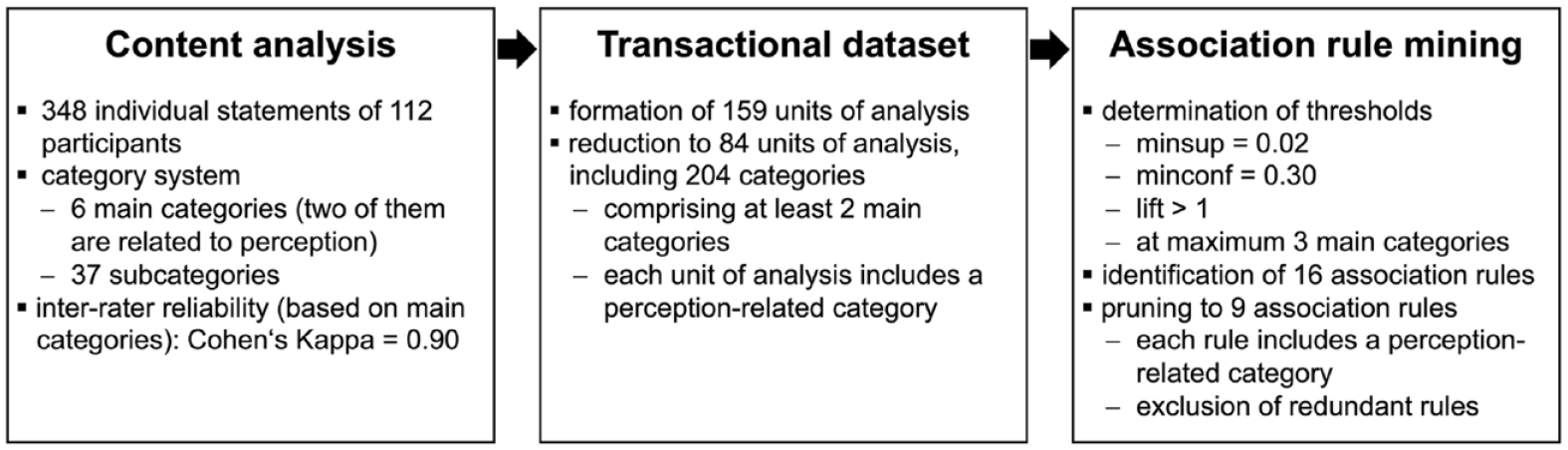
Three stages of analysis.
Qualitative content analysis
We analyzed the participants’ responses and identified 348 statements or coding units, which we categorized inductively (Mayring, 2022, pp. 81–85). An independent rater also categorized the coding units. Categorizations were discussed and agreed by consensus if the raters did not agree initially, but overall the raters’ categorizations were highly consistent (Cohen’s κ = .90).
ARM
ARM is a data mining technique that uses machine learning methodology to identify relevant relationships between objects of interest. It originates from market basket analysis and helps to find patterns in the purchase behaviors of customers by uncovering products that frequently co-occur within a transaction (e.g., Ceglar & Roddick, 2006). The frequent co-occurrence of two products, for example, is represented as an association rule, which is stated in the form X→Y (if X is purchased, then Y is likely to be purchased as well). The application of ARM to qualitative data permits the identification of associations between categories derived from participants’ statements, which can inform theory building (Li et al., 2014). To select, interpret, and compare the association rules, researchers define thresholds of the measures of interestingness in advance in terms of support, confidence, and lift.
Because this technique can be used to reveal categories of qualitative data more likely to be mentioned together than others, across a sample of participants, we employed ARM in this study to investigate patterns of changes in perception described in response to our open-ended questions. We did this by storing the dataset of statements as a transactional dataset. In the context in which ARM was developed, each transaction corresponds to a purchase and provides information about the items it contains. In this study we considered units of analysis (UoAs) as transactions, each one describing a cohesive process, with categories corresponding to the items contained in a transaction (Li et al., 2014). From the 348 statements we derived 159 UoAs. While each UoA was assigned to a single participant, participants could have more than one UoA. We analyzed only the 84 UoAs describing changes in perception during mobile music listening. As is typical in ARM, we did not consider multiple instances of the same category in a UoA. We then calculated the key measures based on the transactional dataset in R (version 3.6.2) using the arules package (Hahsler et al., 2021) and the Apriori algorithm.
Support: relative frequency of co-occurrence of X and Y relative to all UoA (e.g., sup = .2: 20% of UoA include X and Y):

Confidence: relative frequency of co-occurrence of X and Y with respect to the UoA containing X (e.g., conf = 0.5: 50% of the UoA containing X also contain Y):

Lift: direction and strength of association (e.g., > 1: positive association; UoA that include X tend to include Y more often than UoA that do not have X):

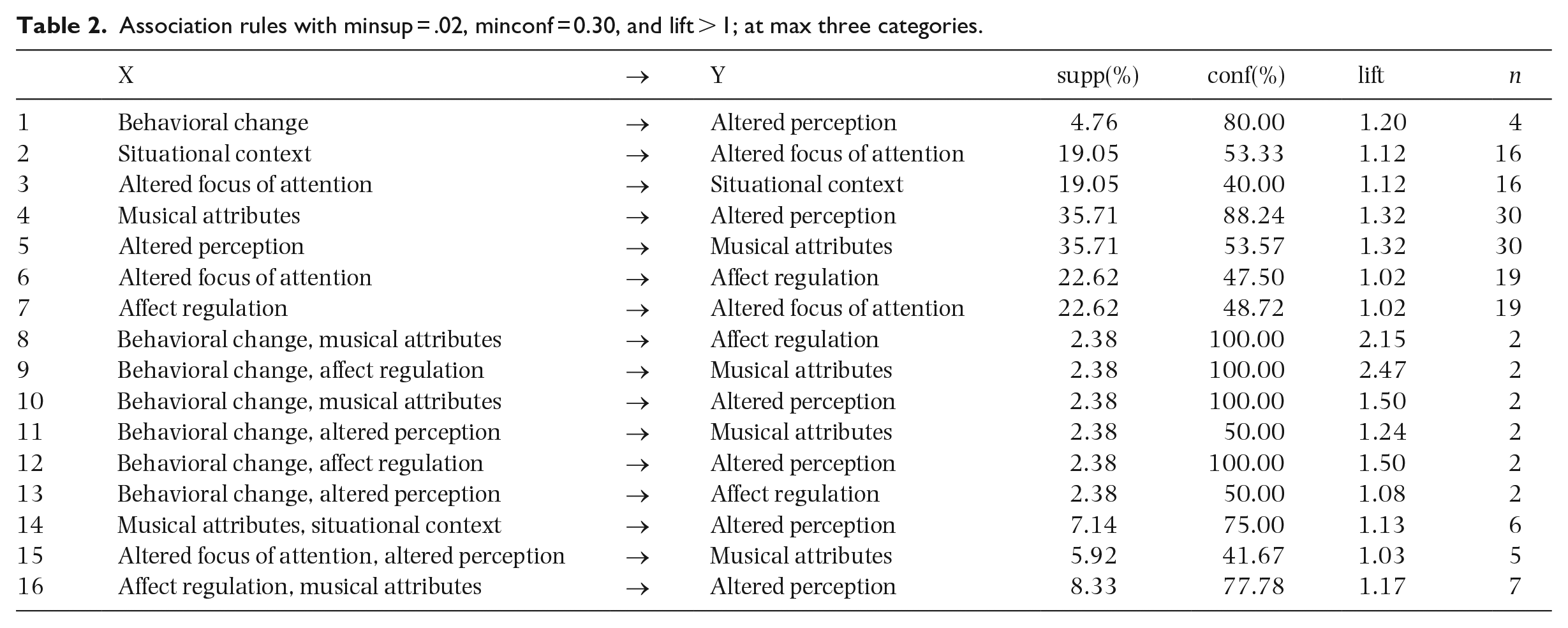
To identify relevant rules, we set the minimum thresholds as follows: minsup = .02, minconf = 0.30, according to which associated categories must be present in at least two UoA to be identified. The values should be considered in context because even rare itemsets (low support) can indicate strong connections due to high confidence, which makes it worth considering them as well. A lift > 1 was obligatory to identify positive associations, and as a further condition, we determined a scope of at most three categories. Consequently, we identified 16 rules of interest across the main categories (see Appendix 1). We further reduced the rules by retaining only those containing at least one category related to changes in perception. Since no causal statements can be made in this context (Li et al., 2014), we considered perception-related categories in both if-then positions. We checked rules containing identical items in a different order manually, and considered only the rule with the highest confidence.
Finally, we analyzed the statements that matched the association rules we had identified and interpreted them at a semantic level, in order to gain insight into the situational antecedents and psychological consequences as well as the temporal relationships of the co-occurring categories.
Results
Content analysis: Characteristics of changes in perception during mobile music listening
We carried out the content analysis by assigning participants’ statements to six main categories. Categories 1 and 2 permitted us to differentiate between qualities of experience in terms of perceptual and attentional processes and thus to address Research Question 1 (how does mobile music listening change listeners’ perception of the environment?), while their subcategories enabled us to consider reported experiences in more detail. An overview of the complete category system can be found in Appendix 2, ordered by the frequency of statements contributing to each category. The categories are summarized here in terms of content, which is why the order is different.
Category 1: Altered focus of attention
Statements in this category describe changes in perception such that attention is deliberately redirected. Reduced environmental attention (1.1) includes descriptions where attention to the music distracts from or blocks out the environment. A similar mechanism can be found in auditory masking (1.3), where noise and sounds such as environmental sounds or conversations are suppressed, but other information from the environment is still perceived:
Listening to music is also a way of separating myself from the people who surround me. I often find myself unpacking my headphones when I hear conversations from other people whose content I consider irrelevant or incorrect—I just don’t want to hear that. (P-001, female, 20 years)
Some participants reported mental encapsulation (1.2), a withdrawal into their own world in which they can turn their focus inwards, concentrating on themselves or switching off entirely. The distance gained from the environment can also be used to increase concentration on specific tasks (1.5) by deliberately blocking out environmental information.
Attentional processes do not exclude the environment in every case. With increased attention (1.4), certain sections of the environment are brought into focus, and, for example, “more attention is paid to the passing landscape or the people sitting opposite” (P-072, female, 21 years). Listening to music may facilitate increased visual attention, for example, as described by one participant:
I sometimes perceive the environment with my eyes a little more accurately because I no longer pay attention to the environment with my sense of hearing. Otherwise, I’m afraid that something important will happen that I won’t notice or that someone will address me, and I won’t notice it. (P-078, female, 26 years)
Category 2: Altered environmental perception and self-experience
Statements assigned to altered perception of the environment and the self (hereafter altered perception) explicitly mentioned changes in perception involving multimodal connections or experiences related to an altered state of consciousness. Serving as an acoustic background, music changes the perception of the environment and atmosphere (2.1) by improving a negative overall appearance or by enhancing pleasant visual impressions. A corresponding effect on social perception (2.5) can also be observed, whereby individuals perceive people around them more positively under the influence of music. An altered sense of self can also be induced by music (2.2), which includes extraordinary sensations and is mainly related to the perception of one’s own body, such that walking feels like “floating” (P-05, female, 25 years). Flow-like states are also included in this category, where the individual is focused on the music or movement, feels detached from their surroundings, and loses self-consciousness. Filmic experiences (2.3) include the merging of music and the environment in terms of an audiovisual imagination or daydreaming, which resembles the aesthetic experience of viewing a film. According to one participant, “Music makes the environment more exciting and beautiful; it feels more like the music is the soundtrack of my life (so a bit like a movie), which makes even boring things exciting” (P-073, female, 24 years):
[The music] strengthens the imagination and stimulates you to see something different in your annoying neighbor . . . You can become someone else through the music and imagine that the situation you are in has a different background. That makes everything different. (P-092, male, 41 years)
Furthermore, when the environment and music appear to be linked together, audiovisual synchronicities may occur (2.7), for example, when a “car blinker lights up to the tempo of the music” (P-098, male, 25 years). Participants also reported an altered perception of time (2.4), according to which listening to music makes time “fly by” when they are on the move (P-089, female, 24 years).
Some participants reported alienation from the environment due to music and a negative influence on self-experience (2.6), whereby the environment is perceived as less intense or duller, and the listener feels crushed by the environment.
Categories 3–6: Affect regulation, situational context, musical characteristics, and behavioral change
With reference to Research Question 2 (what factors underlie changes of perception?), statements referring to the factors underlying changes of perception were assigned to the remaining four categories, and only those in the largest subcategories are presented here (see Appendix 2 for a complete list). Participants reported affecting regulation such that music serves in improving (3.1) or enhancing (3.2) their current mood, as well as distracting from or re-evaluating their thoughts (3.3). Statements in Category 4 described situations, places, and activities that could be thought of as framework conditions for the use of music in public, the listening environment. This includes, for example, location (4.1), such as public transport, as well as the characterization of the mood and atmosphere of the situation (4.2). The listener’s initial mood (4.4) also plays an important role here, as does being involved in a particular activity (4.3). The statements also include information about the attributes of the music, indicating participants’ awareness of the effect of certain types of music on them. For instance, participants refer to musical character (5.1), musical genres or styles (5.2), and tempo (5.3).
Finally, participants referred to the (observable) effects of music on their behavior, which are manifested primarily in the form of motor or physical reactions (6.1) when they adjust their speed to the music (on foot, by bicycle) or consciously turn around to make sure they are aware of traffic when music dampens environmental sounds. In addition, some participants described effects on their social behavior and interaction (6.2), such as more positive feelings toward others and friendlier responses toward others, or changes in facial expressions (6.3), such as smiling.
ARM: Patterns of changes in perception
To address Research Question 3 (is it possible to identify patterns of changes in perception in mobile music listening that provide information about the antecedents and psychological consequences of listening?), we applied ARM to the six main categories, resulting in nine rules (Table 1). By evaluating the statements in detail, we were able to identify the antecedents and consequences of mobile music listening in each of the subcategories and summarize them in the model shown in Figure 2.
Association rules with support, confidence, and lift.
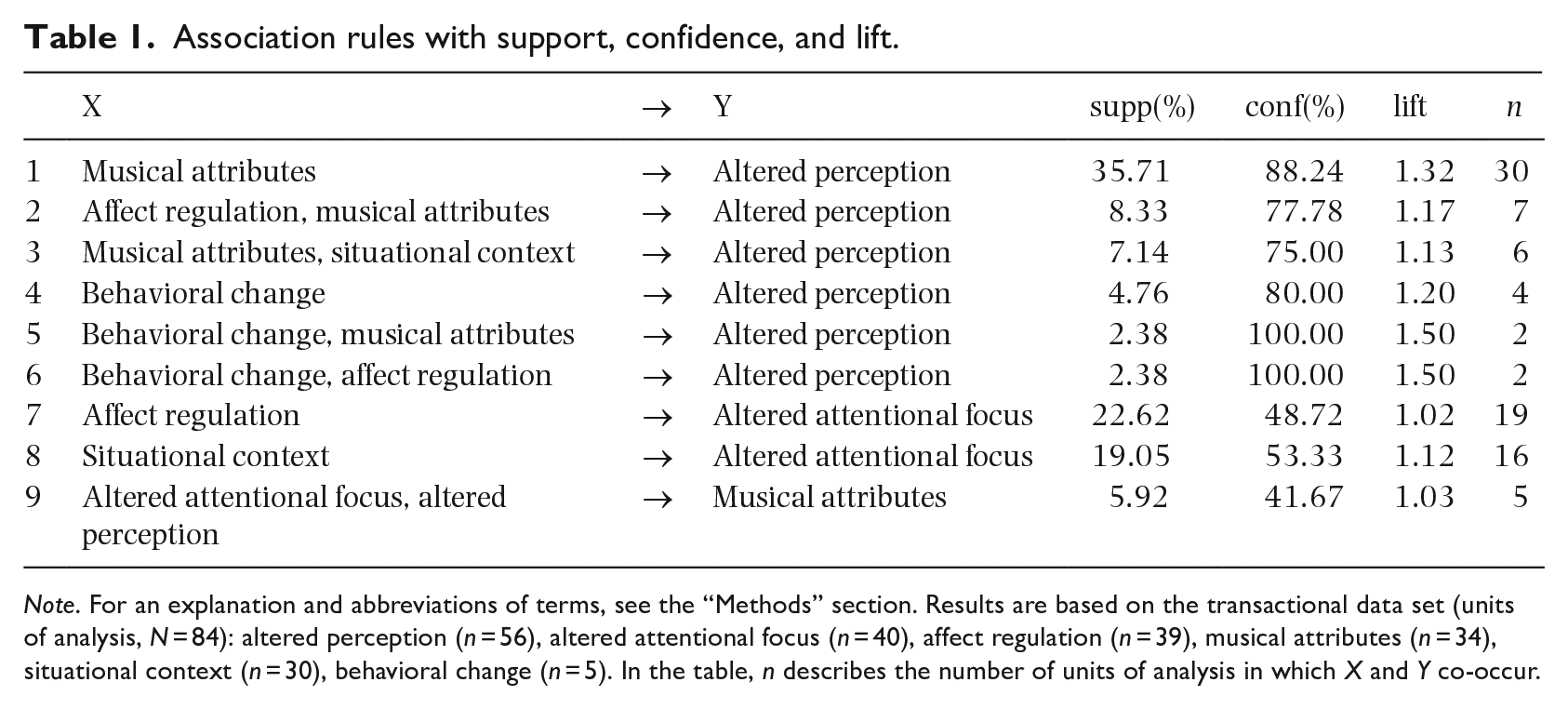
Note. For an explanation and abbreviations of terms, see the “Methods” section. Results are based on the transactional data set (units of analysis, N = 84): altered perception (n = 56), altered attentional focus (n = 40), affect regulation (n = 39), musical attributes (n = 34), situational context (n = 30), behavioral change (n = 5). In the table, n describes the number of units of analysis in which X and Y co-occur.
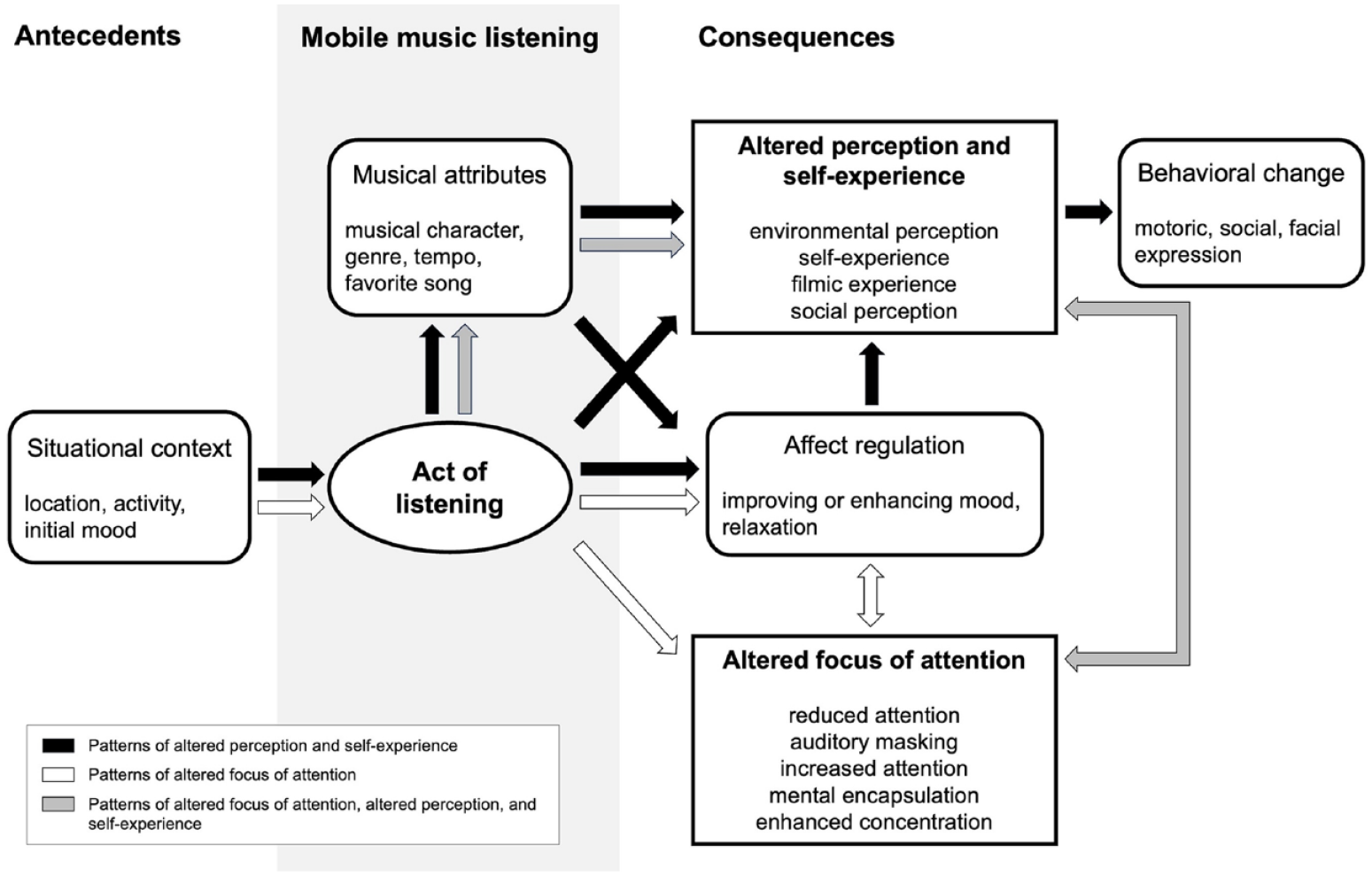
Model of patterns of changes in perception associated with mobile music listening.
Patterns of altered environmental perception and self-experience
Altered perception was associated with the category of musical attributes (rule 1). This association was further related to affect regulation (rule 2) and situational context (rule 3). Most of the statements suggest that participants perceived the environment and other people differently with music (rule 1), for example: “With electronic music . . . the world appears faster and possibly more graphical/distant” (P-080, male, 28 years).
An altered perception of the environment is usually seen as positive; however, individual statements show tendencies contrary to this assumption. Participants mentioned that the “direction” of the influence (P-045, male, 28 years) depends on the characteristics of music (rule 1): “When I listen to happy music, I usually perceive the atmosphere as ‘lighter,’ also friendlier, and warmer. When I hear sad music, I often feel crushed by my surroundings, and I feel alone” (P-084, female, 20 years).
Especially when participants reported improving their mood by listening to happy music, the environment was perceived “much more positively” (P-011, female, 21 years). Improvements in mood seem to be the primary motivation in these cases and may also influence how other people are perceived (rule 2): “I usually listen to happy music that lifts my mood, which makes the surroundings seem less dreary (for example, on a gloomy winter morning)” (P-036, female, 22 years); “Music has a great effect on mood, so people in the environment can be perceived more positively when the music is also positive” (P-097, male, 36 years).
Participants often described specific places or individual circumstances when reporting music-induced changes in perception (rule 3). The situational context resembles an initial setting in which certain needs arise or preconditions for certain ways of experiencing must be fulfilled. Physical sensations due to the weather, for example, can be mitigated by certain music (in one participant’s case, Latin music), such as experiencing a “more pleasant and lighter feeling” (P-110, female, 26 years) when it is hot. Improving situational circumstances also plays a crucial role when using public transport. One participant reported that it is “less awful [to] sit in a crowded train” when she hears happy music and perceives her fellow human beings as “friendlier” (P-015, female, 24 years). Descriptions of filmic experiences were associated with traveling through a changing environment, and often influenced by choice of music: “When traveling by train and looking out the window, the view often seems cinematic to me, especially with slow music” (P-071, female, 26 years).
In addition to specific locations or activities, participants mentioned their initial mood, which could be influenced by music. The combination of a positive mood and music that they liked and that was meaningful to them altered their perception of the environment by increasing their receptivity to positive information and decreasing their receptivity to negative information: “If I feel good and listen to my favorite music, then I perceive the positive things in my environment more strongly” (P-032, female, 28 years).
Altered perception was also associated, crucially, with behavioral change (rule 4), in conjunction with musical attributes (rule 5) or affect regulation (rule 6). While altered perception manifested itself primarily as a more positive perception of the environment, it was also present in reports of altered self-experience. For example, one participant reported experiencing a state of flow that appeared to her to positively affect motor behaviors such as bicycling (rule 4): “I often just let myself drift . . . [I] feel lighter, as if I was carried by the music, quickly get into a steady speed and effortlessly dodge everything” (P-014, female, 27 years).
Behavioral change in mobile music listening associated with altered perception also included an emotional component that could potentially influence interactions with others. Here, musical attributes also play an important role (rule 5), according to which “happy, ‘wilder’ music [puts] a kind of a ‘golden sunshine’ on everything [which makes me] more cheerful . . . in encounters with other people” (P-047, female, 21 years). Another participant described how the music “made her smile” during a filmic experience, even though she was “feeling bad” before (rule 6) (P-005, female, 25 years). It was noticeable that the descriptions of altered perception frequently contained temporal words such as sometimes and often, suggesting that this kind of experience implies certain randomness.
Patterns of altered focus of attention
An association between altered attentional focus and situational context emerged (rule 7). Sealing oneself off from the outside world seems to be particularly important when using public transport: “When riding the bus, my music shields me from the others, I feel more isolated (but this is not a negative feeling in this situation)” (P-066, female, 22 years).
By listening to music, participants create a private space in public and retreat into their “own world” where they are “oblivious to the people” around them (P-069, female, 26 years). Negative impressions, such as “the rush of the surroundings” (P-012, male, 29 years), can be blocked out. This intentional encapsulation leaves mobile listeners untouched by the environment, which at the same time supports their concentration on specific tasks: “When I’m doing sports or on longer trips, I’m more for myself and can switch off better or concentrate on other things” (P-056, female, 28 years).
Altered attentional focus was also positively associated with affect regulation (rule 8). In public spaces, “sounds from the environment (especially conversations from other people)” (P-044, female, 23 years) seem to be major stressors. Masking auditory information helps listeners to distance themselves from it: “Disturbing sounds and people move into the distance, and I can find relaxation” (P-031, female, 31 years).
Conversely, attentional focus can be facilitated by regulating affect. Listening to music may reduce arousal, diverting the listener’s attention away from the environment and toward mental encapsulation, to engage with themself: “I am more relaxed [when listening to music] and can focus on myself” (P-081, female, 25 years). Thus altered attentional focus is predominantly associated with negative situational conditions in which listeners attempt to redirect their attention to improve their mood. Participants’ reported desire to block out their surroundings suggests that the attentional shifts can be understood as a function of mobile music listening.
The association rules also show a connection between altered attentional focus and altered perception, which arises via the category of musical attributes (rule 9):
Especially when I turn on a DJ set that is 30-90 min long and thus covers my entire journey from start to end point, it all feels like a cohesive little journey and gives my movement a bit of a “flow” feeling. It provides me with my own little mental and felt “bubble” in which I move through the hectic and highly varying public. (P-050, male, 27 years)
This quotation illustrates the relationship between altered attentional focus and self-experience. By retreating into his sound world, this participant focuses his attention on the music while blocking out the acoustic stimuli of his surroundings. The continuity of the music, which creates an overarching framework across different locations and impressions, seems to put him into a state of flow that propels him through his environment. Similarly, listeners’ altered experience of their self and increased attention to their surroundings may cause them to lose touch with reality momentarily, and intensify their feelings of pleasure:
With the song [“The Truth” by Handsome Boy Modeling School] I felt lighter somehow. It no longer felt like I was walking down the street, but more like I was floating. I then also paid more attention to the nature I was walking past and suddenly I noticed the sunshine and the very intense green of the trees—the atmosphere was very beautiful. All in all, it felt like I was in a movie. (P-005, female, 25 years)
Modeling the antecedents and consequences of mobile music listening
On the basis of these findings, we developed a model representing the patterns of changes in perception in mobile music listening (Figure 2). It illustrates associations between consequences and their directions determined at the semantic level and highlights the characteristics of two distinct psychological processes: (a) altered perception of the environment and self-experience and (b) altered focus of attention. On the right side (consequences), the structure of their effects becomes apparent. While musical attributes and behavioral change are connected only with altered perception, both processes involve affect regulation. Furthermore, there are differences between the pathways of effect: in the pattern of altered focus of attention, music is mainly used for blocking out sounds and surroundings and for gaining distance to improve one’s mood in a hectic or unpleasant situation; music listening is thus a strategy to reduce the negative impact of the outer world. At the same time, affect regulation may also promote effects on attention (mental encapsulation, enhanced concentration) and perception (environmental and social perception, filmic and self-experience). This has implications for the personal use of music because, especially in the case of altered perception, listeners relate emotionally to and immerse themselves in it, which, in turn, may have the unintended effect of changing their perception of the environment and themselves.
Since listeners first choose to listen to music and then select the music they listen to, it is worth considering the attributes of the music that are associated with the motivation to listen and may promote changes in perception. For example, “ When I listen to rather quiet instrumental music, I immerse myself more deeply in the landscape that rushes past; when I listen to rock music, it’s . . . to block out rather loud people on the train” (P-042, male, 22 years).
The music I listen to is mostly adapted to my mood or the mood I want to put myself in. So, when I walk, I hear rather faster things with rhythm, and when I ride the train after work, rather something relaxed. Thus, the atmosphere is also different, and in quiet moments I notice other people or perceive my surroundings more strongly. When I’m in a bad mood, the music helps me to shut myself off and distract myself from the environment. (P-055, female, 25 years)
Here the selection of different kinds of music is revealed as a function of situational condition, and the motivation to listen is associated with different qualities of experience.
Discussion
In this study, we investigated how mobile music listening modifies the relationship with the outer world by examining changes in perception and identifying patterns of mobile listening experiences. We found that 61.9% of the participants had experienced changes in perception during mobile music listening on at least one occasion, which can be explained by a shift in attentional focus and by multimodal processing, leading not only to changes in perception of the environment but also in experiences of the self. We examined categorical relations by applying ARM (Agrawal et al., 1993; Li et al., 2014), which revealed patterns of variables including situational context, affect regulation, musical attributes, and behavioral change.
Our analysis of written statements provides insights into participants’ situational use and experiences of mobile music listening that confirm and extend previous findings (e.g., Bull, 2000; Kuch & Wöllner, 2021; Simun, 2009; Skånland, 2013). Although we asked specifically about altered environmental perception, participants also described changes in self-experience, which were also observed by Bull (2000) in the context of aesthetic experiences. Our findings from participants’ self-reports reflect Bull’s “auditory bubble” and aestheticization in general (e.g., Bull, 2005, p. 344, 2012) and Herbert’s (2011) descriptions of trance-like processes with both dissociative and absorptive features. A novel finding of this study is that individuals show patterns of changes in perception, which we have integrated into a model.
The patterns of changes in perception we identified hold information about their categories, pathways of effect, and underlying intentionality. Regarding the three most frequent association rules (support between 19.05% and 35.71%), differences between categories become apparent: an altered focus of attention is more likely to be mentioned with affect regulation or situational context, whereas altered perception (i.e., of the environment and self-experience) is more likely to be mentioned with the description of musical attributes. We conclude that different circumstances may contribute to one of the two processes. For example, listeners may decide to use music to gain distance from the environment, especially in unpleasant environments (situational context) to dampen disturbing or unpleasant noises when commuting, and to improve their mood (affect regulation). The statements revealing these associations suggest that shifting attention acoustically and holistically is mostly understood as a conscious strategy for achieving a better mood. On the contrary, the calming effects of music can be used for shutting down the external world and for focusing on oneself by retreating into one’s own world.
In contrast, descriptions of modified perceptions often refer to the character of the music and its personal meaning for the listener. This adds to what is already known about mobile music listening, since previous studies predominantly investigated the use of mobile devices such as the Walkman or the iPod (e.g., Bull, 2000; Prior, 2014; Simun, 2009) while ignoring the music that was played on them. For instance, participants in our sample often mentioned listening to positive music, or their favorite music, when reporting a more positive perception of the environment. The tempo of the music is also relevant to altered perception, such that fast music seemed to promote the perception of an accelerated world, while slow music enhanced participants’ filmic experiences.
As for association rules encompassing affect regulation as a further category, we assume that altered perception may be a side effect of the induction or maintenance of a positive mood through music. Simun (2009) observed that relaxation as the result of listening to music increases willingness to engage with the environment and be more open and receptive to it (see also Skånland, 2013). Since our data show that listening to music can alter perception both positively and negatively, depending on the music selected, we can also infer mood-congruency effects (e.g., Bower, 1981) such that the perception and interpretation of environmental or social information are influenced by the mood of the perceiver induced by listening to music.
We also found that altered perception can both be induced and occur accidentally. For example, music can be used intentionally to improve the listener’s perception of their surroundings, typically in negative environments (situational context). But it is likely that multimodal or filmic experiences, perception of others, and altered self-experiences are side-effects of listening to music. They seem to be strongly dependent on external circumstances, such that they occur when the situation, activity, and music selection match, activating a “perceptual mode” (Gram, 2013, p. 196). The narrative of filmic experiences, for instance, is generated by the interplay of sensory impressions relating to locomotion, visual changes in the environment, and musical parameters. This interplay between music and moving images is well-known from film research (for an overview, see Herget, 2021), but is not limited to this context (e.g., Yamasaki et al., 2015). Moreover, as indicated by the association found between the two processes of altered focus of attention and altered perception, musical framing seems to “‘choreograph’ consciousness” (Herbert, 2012a, Coda section, para. 1) by altering attention and perception of the environment and oneself. This result suggests that music acts on multiple levels simultaneously and that consciousness as well as awareness of the environment can change constantly when an individual is listening to music.
We observed the category of behavioral change in relation to altered perception and also to the attributes of music and affect regulation. Motoric changes such as speed of walking or cycling are common (e.g., Heye & Lamont, 2010), and reactions in facial expressions have been described by Skånland (2013) as a consequence of emotion regulation. Such responses may indicate a state of absorption (Chen, 1998) when listening of which listeners may be unaware. We also showed that mobile music listening may influence, and often improve, people’s attitudes to others (cf. Skånland, 2013). This challenges the prevalent assumption that those who listen to mobile music are engaged in a narcissistic activity instead of attending to social situations (Verhoef, 2022). Mobile music listening may imply turning away from public events, but it may also foster a turning toward the environment with potentially positive effects on social interactions as these are related to the individual’s state of mind (e.g., Forgas, 2002; Forgas et al., 1984); specifically, music may draw the listener’s attention to their fellow human beings and increase their willingness to interact with them (Greitemeyer, 2009; Ruth & Schramm, 2021).
Our categories focused on the cognitive mechanisms of attention and perception implying that music can enable individuals both to distance themselves from and approach the environment. Some participants found the process of distancing to be positive, involving focusing on the music or the self, tuning out sounds and other stimuli from the environment, and entering a state of flow. Others, however, reported negative alterations of their perception of the environment that could be related to negative self-experiences. In some cases participants reported perceiving that the music and environment were blended, or attention to the environment that was heightened or selective. The latter suggests the possibility of a hybrid state in which listeners’ direct their awareness toward positive information within the environment, filtering out negative information. We could not map these phenomenological dimensions of approaching or distancing from the environment in our system of categories since the subcategories of attention and perception include both distancing and approaching.
The study has some limitations attributable to our exploratory approach and use of qualitative methods. First, there may have been other latent correlations between categories that we did not identify because our questions about changes in perception were open-ended, and potential links between categories did not occur to participants when they answered our questions. Because we provided the opportunity for participants to respond freely, some described specific instances of listening (e.g., “recently [I had] a situation where I listened to ‘The Truth’ by Handsome Boy Modeling School”), while others described general listening behavior (e.g., “I mostly listen to happy music”); in this way, habitual and situational actions were inevitably conflated. The sample was also predominantly female (79.5%), young (mean age = 26.05 years), and musically educated (67.0% reported receiving or having received music lessons), which limits the generalizability of the results; additional person-related information such as musical preferences or cognitive styles of music listening (Kreutz et al., 2008) might be beneficial for studying shifts of perception in the future. Second, we applied ARM to a relatively small dataset of 84 UoA, potentially compromising the patterns revealed. Given the defined threshold of support, we may have overestimated the rules we identified. Accordingly, the rules and associations set out in our model should not be generalized beyond our sample, and they should be validated in research addressing hypothesis-driven questions tested using larger datasets. The extent to which comparable effects occur in other listening situations, for example, at home or using other audio formats such as podcasts, should be explored in future research. It would also be possible to include subcategories when applying ARM, and to apply experience-sampling methods (ESM; e.g., Randall & Rickard, 2013) to collect event-related information about participants’ experiences of changing perception and other important variables when listening, such as the situation and the music.
To summarize, in this study, we examined changes in both perception and attention during mobile music listening, revealing different aspects of cognitive processing when regulating the relation to the environment. It provides insights into the personal use and individuals’ experiences of mobile music listening and presents a model illustrating the interrelationships between situational antecedents (location, mood, and activity), the act of listening to music (musical attributes), and psychological consequences (altered perception, altered attention, affect regulation, and behavioral change). In this way, we demonstrate the value of extracting patterns of categories that participants are more likely to mention together than others, which contributes to a better understanding of the plurality of listening strategies and effects. The methodological approach of combining content analysis and ARM allows for the structuring of experiences, their evaluation in terms of impact pathways and intentionality, and the generalization of patterns based on subjective statements.
Footnotes
Appendix 1
Association rules with minsup = .02, minconf = 0.30, and lift > 1; at max three categories.
| X | → | Y | supp(%) | conf(%) | lift | n | |
|---|---|---|---|---|---|---|---|
| 1 | Behavioral change | → | Altered perception | 4.76 | 80.00 | 1.20 | 4 |
| 2 | Situational context | → | Altered focus of attention | 19.05 | 53.33 | 1.12 | 16 |
| 3 | Altered focus of attention | → | Situational context | 19.05 | 40.00 | 1.12 | 16 |
| 4 | Musical attributes | → | Altered perception | 35.71 | 88.24 | 1.32 | 30 |
| 5 | Altered perception | → | Musical attributes | 35.71 | 53.57 | 1.32 | 30 |
| 6 | Altered focus of attention | → | Affect regulation | 22.62 | 47.50 | 1.02 | 19 |
| 7 | Affect regulation | → | Altered focus of attention | 22.62 | 48.72 | 1.02 | 19 |
| 8 | Behavioral change, musical attributes | → | Affect regulation | 2.38 | 100.00 | 2.15 | 2 |
| 9 | Behavioral change, affect regulation | → | Musical attributes | 2.38 | 100.00 | 2.47 | 2 |
| 10 | Behavioral change, musical attributes | → | Altered perception | 2.38 | 100.00 | 1.50 | 2 |
| 11 | Behavioral change, altered perception | → | Musical attributes | 2.38 | 50.00 | 1.24 | 2 |
| 12 | Behavioral change, affect regulation | → | Altered perception | 2.38 | 100.00 | 1.50 | 2 |
| 13 | Behavioral change, altered perception | → | Affect regulation | 2.38 | 50.00 | 1.08 | 2 |
| 14 | Musical attributes, situational context | → | Altered perception | 7.14 | 75.00 | 1.13 | 6 |
| 15 | Altered focus of attention, altered perception | → | Musical attributes | 5.92 | 41.67 | 1.03 | 5 |
| 16 | Affect regulation, musical attributes | → | Altered perception | 8.33 | 77.78 | 1.17 | 7 |
Appendix 2
Category system of content analysis about changes in perception during mobile music listening.
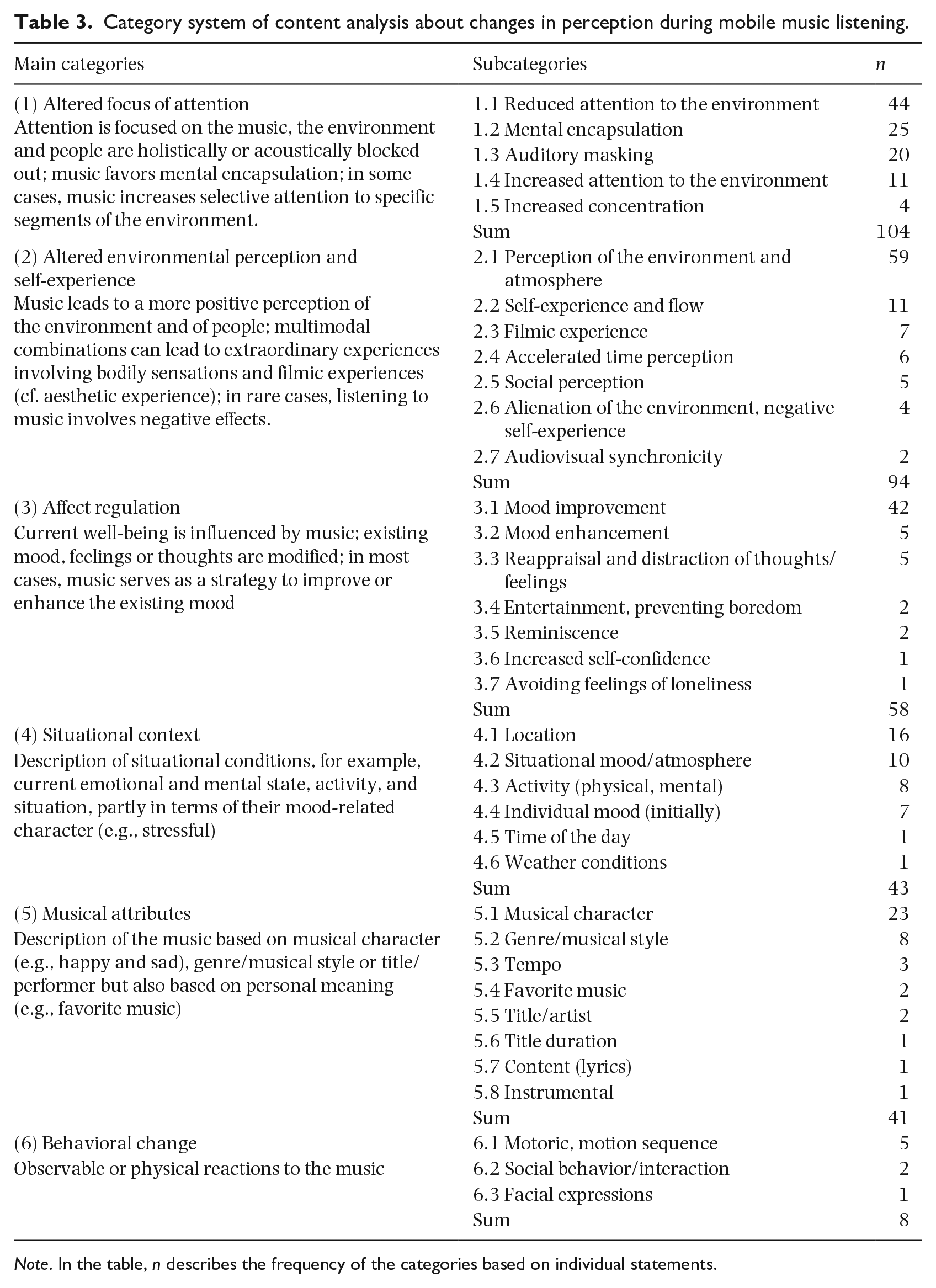
| Main categories | Subcategories | n |
|---|---|---|
| (1) Altered focus of attention Attention is focused on the music, the environment and people are holistically or acoustically blocked out; music favors mental encapsulation; in some cases, music increases selective attention to specific segments of the environment. |
1.1 Reduced attention to the environment | 44 |
| 1.2 Mental encapsulation | 25 | |
| 1.3 Auditory masking | 20 | |
| 1.4 Increased attention to the environment | 11 | |
| 1.5 Increased concentration | 4 | |
| Sum | 104 | |
| (2) Altered environmental perception and self-experience Music leads to a more positive perception of the environment and of people; multimodal combinations can lead to extraordinary experiences involving bodily sensations and filmic experiences (cf. aesthetic experience); in rare cases, listening to music involves negative effects. |
2.1 Perception of the environment and atmosphere | 59 |
| 2.2 Self-experience and flow | 11 | |
| 2.3 Filmic experience | 7 | |
| 2.4 Accelerated time perception | 6 | |
| 2.5 Social perception | 5 | |
| 2.6 Alienation of the environment, negative self-experience | 4 | |
| 2.7 Audiovisual synchronicity | 2 | |
| Sum | 94 | |
| (3) Affect regulation | 3.1 Mood improvement | 42 |
| Current well-being is influenced by music; existing mood, feelings or thoughts are modified; in most cases, music serves as a strategy to improve or enhance the existing mood | 3.2 Mood enhancement | 5 |
| 3.3 Reappraisal and distraction of thoughts/feelings | 5 | |
| 3.4 Entertainment, preventing boredom | 2 | |
| 3.5 Reminiscence | 2 | |
| 3.6 Increased self-confidence | 1 | |
| 3.7 Avoiding feelings of loneliness | 1 | |
| Sum | 58 | |
| (4) Situational context | 4.1 Location | 16 |
| Description of situational conditions, for example, current emotional and mental state, activity, and situation, partly in terms of their mood-related character (e.g., stressful) | 4.2 Situational mood/atmosphere | 10 |
| 4.3 Activity (physical, mental) | 8 | |
| 4.4 Individual mood (initially) | 7 | |
| 4.5 Time of the day | 1 | |
| 4.6 Weather conditions | 1 | |
| Sum | 43 | |
| (5) Musical attributes | 5.1 Musical character | 23 |
| Description of the music based on musical character (e.g., happy and sad), genre/musical style or title/performer but also based on personal meaning (e.g., favorite music) | 5.2 Genre/musical style | 8 |
| 5.3 Tempo | 3 | |
| 5.4 Favorite music | 2 | |
| 5.5 Title/artist | 2 | |
| 5.6 Title duration | 1 | |
| 5.7 Content (lyrics) | 1 | |
| 5.8 Instrumental | 1 | |
| Sum | 41 | |
| (6) Behavioral change | 6.1 Motoric, motion sequence | 5 |
| Observable or physical reactions to the music | 6.2 Social behavior/interaction | 2 |
| 6.3 Facial expressions | 1 | |
| Sum | 8 |
Note. In the table, n describes the frequency of the categories based on individual statements.
Acknowledgements
The authors are grateful for Geoff McDonald’s helpful comments on a previous version of the manuscript.
Funding
The authors received no financial support for the research, authorship, and/or publication of this article.
