



Abstract
This study investigates the experiences of people involved in a virtual intervention involving community music and music therapy for individuals with autism. The intervention blends conventional music therapy and community music approaches. During the COVID-19 pandemic, many community music and music therapy projects shifted to an online format and there is a resultant need to understand more about how virtual music interventions may be of benefit for individuals with autism. We report on the design, implementation, and outcomes of one such intervention. Over an 8-week period, community musicians and music therapists (music facilitators) based in Scotland and America delivered 16 music sessions, which were recorded using the Zoom software. During the sessions the participants wrote, performed, and recorded two songs. Semi-structured interviews were conducted with two of the participants, using video elicitation techniques, and six of the facilitators. Data were analyzed thematically. The intervention was found to (1) enable participants to explore their personal narratives, (2) promote self-perceptions of achievement, and (3) provide evidence of mastery, creativity, and self-expression. An international collaboration made possible by technology enabled facilitators to work remotely and participants to make use of new opportunities for engagement. This article demonstrates how community music practices focusing on participation and music therapy approaches focusing on clinical outcomes can be integrated. We present the online environment as its own social milieu in which creativity and connection can be explored in new ways.
Keywords
In this qualitative study, we investigated the experiences of people involved in the Rock ’n Roll Music Therapy Project, a virtual music intervention for individuals with autism delivered by community musicians and music therapists (music facilitators) based in Scotland and America. The project aimed to harness the separate but related sets of skills of the facilitators as well as the opportunities afforded by the online environment. The current study took the form of practice-based research that emerged from this pre-existing project. The global COVID-19 pandemic that began in 2019–2020 resulted in physical-distancing guidance and policies being implemented around the world as a means of reducing the rate of infection. These measures produced changes such as a reduction in social interaction; reduced educational, community, and individual supports; and interrupted daily routines (MacDonald et al., 2021). For people with autism, these changes are likely to have had a negative impact on their wellbeing (Mencap, 2020). It was therefore particularly important to design an online intervention that could be delivered by facilitators and in which people with autism could take part from their own homes. Moreover, although there is a considerable amount of research exploring the outcomes of participation in music interventions for individuals with autism (Hillier et al., 2012; James et al., 2015; Simpson & Keen, 2011; Thompson et al., 2022; Wilson & MacDonald, 2019), there is currently a lack of research exploring the outcomes of participation in virtual music interventions.
Remote forms of community music and music therapy expanded during the COVID-19 pandemic as a way of adhering to physical-distancing measures while maintaining social opportunities and effective healthcare treatment (Carvajal, 2020). Remote interventions utilize communication-based technologies as a means of providing access to community- and healthcare services for individuals that would otherwise be inaccessible due to the limitations imposed by geography or time as well as social and cultural barriers (Wootton, 1996). These communication-based technologies may include real-time audio and video-conferencing platforms or telephone communication. Given that there is considerable evidence highlighting the ways in which music can enhance health and wellbeing in both clinical and non-clinical contexts (MacDonald et al., 2012), technology can play an important role in the maintenance of musical activity. This article contributes to a growing body of work looking at virtual creative and musical experiences by examining music making via the video-conferencing program called Zoom. While it is beyond the scope of this article to describe the specific technical affordances of the Zoom software, it is particularly accessible when it comes to this type of creative work in that participants do not require sophisticated hardware and software to utilize its functions. Basic phone or computer technology with internet access, a camera, and a microphone are all that is required. Much has been written about issues of latency, sonic fidelity, and the manner in which Zoom selects the sounds that participants hear, although many practitioners have utilized Zoom since its accessibility enables participation by everyone (MacDonald et al., 2021).
Virtual communication poses significant challenges for those engaged in educational, clinical, and/or creative activities. Issues arising from latency (the time taken for events to travel via the internet from one location to another) are often cited as a barrier to virtual music making, particularly when using interventions that seek to achieve synchronous interaction (Fuller & McLeod, 2019). There is considerable debate as to how to overcome this issue (Smith et al., 2020). MacDonald et al. (2021) present improvisation as one method of overcoming the latency problem in the context of virtual music making. Improvisation is a method used in many music therapy approaches. As a universally accessible, social, and collaborative form of musical activity, it provides a framework within which a client–therapist relationship can be established (MacDonald & Wilson, 2014; Wigram, 2004). By providing opportunities for creative interaction and enabling the nonverbal exploration of thoughts and feelings, improvisation may lead to improvements in health and wellbeing (MacDonald & Wilson, 2014). Moreover, as it is a process involving spontaneous, moment-to-moment decisions, improvisation may allow many of the challenges of online music making, such as latency, to be incorporated into ongoing musical interactions (MacDonald et al., 2021). Other reported challenges to working online include its poor audio quality, which affects the sound of music and musical instruments. Barriers to working online include inequities related to the difficulty of learning how to use technology, and its prohibitive costs (Kantorová et al., 2021). By contrast, Baker and Krout (2009) suggest some possibilities for music interventions delivered online. They worked with an adolescent with Asperger’s syndrome in a songwriting intervention both online and face to face, and showed in their study that the adolescent was not only highly engaged in the Skype sessions but more creative and communicated more freely. Baker and Krout (2011) subsequently reported that participants felt more comfortable making personal disclosures online than face to face. Despite the limitations of virtual communication, the opportunities presented by music for maintaining social interaction and support networks may encourage those involved in the arts and healthcare to continue developing remote interventions.
In the present study, the music facilitators were members of two organizations in Austin, Texas (US) and Glasgow, Scotland (UK), respectively. The roles and responsibilities of individual music facilitators were at no point made explicit. However, the community musicians were typically charged with helping to develop the structural elements of music, while the music therapists were more likely to focus on the moment-to-moment psychological wellbeing of the participants. The project took an egalitarian approach insofar as everyone was involved in both creating music and caring for each other in some way.
The Center for Music Therapy (CFMT) offers music therapy services for infants, children, adolescents, and seniors. To meet the needs of a diverse population of people attending music therapy, music therapists working at the CFMT draw on a wide range of methods, techniques, and research into what they describe as their full-spectrum approach to music therapy (centerformusictherapy.com). This approach is holistic in nature, in that music is seen to play a role in making positive changes in the individual’s physical, psychological, social, and/or emotional state. It acknowledges that music therapy may improve the physiological health of individuals and presents opportunities for people attending music therapy to fulfill their creative potential. It draws on psychodynamic approaches in which the focus of therapy is on the therapeutic relationship, especially the dynamics of transference and countertransference between the client and the music therapist (Kim, 2016). This is a largely unstructured approach allowing the creative process to unfold spontaneously as the session progresses (Kim, 2016). Thus therapists may prioritize self-expression through musical improvisation over the aesthetic value of the music created, in contrast with the importance of music in some community music practices (O’Grady & McFerran, 2007).
Limelight Music describes itself as “a Scottish equalities professional music training and production company” specializing in working with people from disadvantaged groups (limelightmusic.org.uk). It aims to promote engagement and access, and provide people with new resources and skills for music making. As such, its objectives reflect those of both community music and music education. It delivers professional development and educational programs for young people and vulnerable adults. Many of its projects take the form of inclusive music workshops in which people who have previously been excluded from participating in any kind of musical activity, whether for social or physical reasons, are given opportunities to explore their creativity through music. Limelight Music takes an inclusive and egalitarian approach to musical participation based on the assumption that everyone is musical (MacDonald & Miell, 2002). Moreover, many of its activities are conducted in such a way that emphasis is placed on socio-musical interactions, involving every member of the group, rather than individual performances (MacDonald & Miell, 2002). The company aims not only to meet its social and educational objectives but also to enhance the employment prospects of musicians with disabilities by involving them in the design, preparation, and delivery of music projects.
A key challenge in promoting music for all is addressing the hierarchal notions surrounding music and the arts, as well as the impact of stereotypes (Daykin, 2012). Elitist constructs of musicians (e.g., only a select few individuals have the potential to be good at music and attain a high degree of technical proficiency) can inhibit participation by those without musical training (MacDonald, 2016). This may have implications for those who assume that musicality and talent are inherent qualities rather than social constructs (Daykin, 2012), and would describe themselves as neither musical nor talented. In addition, there are often inequities in access to the resources and facilities required for musical participation, which may be linked to disability (Stige et al., 2010). According to the social model of disability, environments are disabling if they include barriers such as these. They create perceived impairments leading to the limitation of opportunities and roles (Barnes, 1992). The social model of disability also rejects the notion that underemployment can be viewed in isolation from other factors such as education, access, and culture (Barnes, 2000).
Methodology
The epistemological positioning for this research was informed by social constructivist perspectives that perceive knowledge to be socially produced. As such, the research took a relativist approach, which assumes multiple realities that are perspectival and situated in relationships (Guba & Lincoln, 1994). Consequently, the field in which this research was conducted is perceived to be socially constructed. This epistemological position resonates with the social model of disability, which asserts that it is society that disables those with impairments through environmental factors, both physical and social, resulting in a loss of opportunities to participate in the community (Barnes, 1992). The language used to describe the lived experiences of individuals with disabilities, reinforced through knowledge created within traditional medical models, also inhibits opportunities for personal advancement (MacDonald & Miell, 2002). As such, it is important that qualitative researchers create space for all voices.
Participants
Two adults with autism (Trey and Michael) participated in this study. The two participants had prior musical experience and were receiving individual music therapy sessions at the CFMT at the time of the study. The six music facilitators were four community musicians (Cat, Gordon, Gerry, and Mark), based at Limelight Music in Glasgow, and two music therapists (Hope and Claire), based at the CFMT in Austin. Ethical approval for this research was granted by University of Edinburgh research ethics committee at the start of the study and participants provided their written informed consent to participate. All the facilitators and participants (and in particular the latter) were keen to be acknowledged and credited for their contributions, and the sharing of their experiences, and thus gave permission for their first names to be used. In addition, participants were happy for the term individuals with autism to be used throughout the article.
Project model and data generation
Limelight Music and the CFMT had developed methods for facilitating online sessions before their collaboration on this project commenced. It was therefore possible for them to work together in the same ways that they had been working with their own clients for over a year. The music workshops took place twice a week for a total of 16 sessions, lasted an hour each, and were facilitated and recorded using Zoom. Although all the music facilitators and participants occupied the same creative space in these workshops, no two individuals occupied the same physical space. The participants were both confident users of technology and had already been working together at the CFMT for some time before starting the online workshops. Thus, a significant investment in relationships had already been made, which provided a strong foundation for moving to the online platform. A supporting person at home was not required. The types of musical activities used in the workshops included musical and emotional recall exercises, improvisation, songwriting, and group performance. Participants were also involved in a process of recording two songs and took part in a so-called global release in which the finished tracks were released to the public.
Following the workshops and the global release, all the facilitators and participants were interviewed about their experiences of the process. These semi-structured interviews took place over a period of 3 weeks and lasted 37 min, on average. They all took place on Zoom, because of worldwide COVID-19 pandemic restrictions, and were recorded and transcribed in full. The interviews covered the background to the project; the structure of the sessions, including approaches to online practice, songwriting, and recording; the benefits and limitations of working remotely; and the impact of participation on the interviewee (see Appendices 1 and 2).
Although semi-structured interviews are an established method of data collection in qualitative research, researchers using this method with individuals with disabilities may encounter challenges including limited engagement or depth of response, perhaps because of issues related to self-esteem or the suitability of strategies used by researchers to support the communication preferences of participants (Kaley et al., 2019). Thus, participants with autism were supported by repeating questions, using prompts and visual cues, and by the presence of a trusted person. Sometimes, supporters without a disability threaten to dominate the conversation, with the result that participants’ views are distorted. In the present study, a music therapist took part in the interviews with participants, in their role as a trusted person, and to rephrase the researcher’s questions if they were initially unclear. This helped to create a sense of familiarity and relationship that encouraged predictability and clarity. Every effort was made, however, to ensure that the participant remained the primary interviewee.
The second part of the interviews with each of the two participants used video elicitation techniques (VET: Henry & Fetters, 2012) as the researcher, participant, and a music therapist watched edited video footage of the music sessions together. Video elicitation interviews involve presenting participants with visual mediums, such as photographs or videos, to provide visual cues that may prompt and enhance discussion (Kaley et al., 2019). Few studies using VET with individuals with disabilities have been published (Burford & Jahoda, 2012; Kaley et al., 2019; Rojas & Sanahuja, 2012; Sitter, 2015). Nevertheless, VET enable the observation of nonverbal methods of expression, such as body language, facial expressions, and physical interactions. This can be useful when investigating social and communicative acts and interactions that may occur in the context of a group activity. VET may also help to reveal the perspectives of people with autism who prefer to use nonverbal forms of communication (Kaley et al., 2019). Additionally, as individuals often relive an event through watching it on video, VET may facilitate more accurate recall of experiences, including their associated thoughts and feelings (Jarret & Liu, 2016). Thus VET can be effective ways of engaging participants with autism more fully in the research process, providing access to richer data, without having to rely on other people to articulate their views and experiences.
To ensure that participants had relatively fresh memories of the activities being presented, the interval between the original event and the VET—carried out with participants but not facilitators, due to the timescale of the study—was kept as short as possible, around 3 weeks on average. Selected video clips included those in which participants were perceived by the researcher to be gaining some form of enjoyment or benefit from participation in musical activity; experiencing it negatively; and where technology was perceived to have had an impact on the quality of musical interaction. Participants were asked to describe what was taking place in these clips, in their own words, and how they felt about them.
Data analysis
Analysis of the interview data proceeded through repeated reading and inspection of transcripts. Familiarization led to the generation of initial codes, followed by the gradual emergence of identifiable themes that were then refined and checked against the data following the framework for thematic analysis outlined by Braun and Clarke (2006). Analysis involved a recursive process of data engagement, allowing themes to be discarded or explored further as sophistication and information improved (Terry et al., 2017). The first stage of analysis produced over 80 initial codes. Similar codes were then combined into four more general categories: Social, Technical, Process, and Output. Responses referring to the approach used by facilitators, or the process of songwriting, were categorized as Process, while comments regarding the benefits or wider implications of recording, producing, and releasing the two tracks were categorized as Output. There was also considerable discussion of experiences of working online, categorized as Technical, and their social experiences, categorized as Social category. Thematic maps were developed to help identify relationships between these categories and candidate themes were formed accordingly. Candidate themes were then reviewed and named as follows: Online experiences, Telling our story, and Products as helpful resources, as shown in Figure 1.
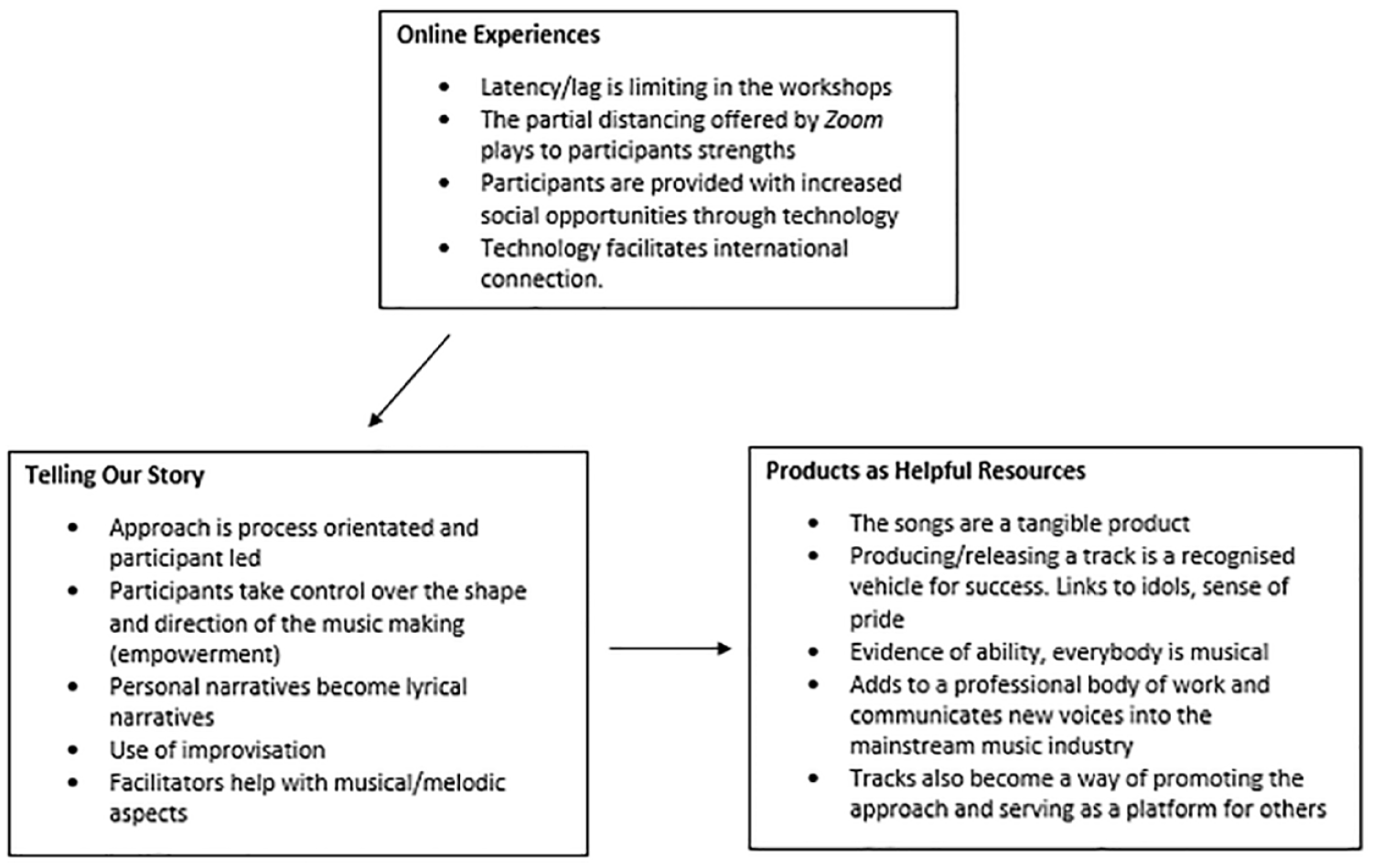
Thematic map.
Findings and discussion
Online experiences
Facilitators and participants frequently discussed their experiences of making music via Zoom. Technological challenges were reported, including audio cutting in and out, audio centring on the loudest player, and computer lagging/latency. Latency was consistently described as a drawback of making music via Zoom as it did not allow facilitators and participants to play together in synchrony. According to one of the community musicians, Cat, “the lag was pretty hard sometimes, because there were times where, maybe if we were in a room, we would have been able to play so much more cohesively together.” Similarly, one of the music therapists, Claire, said, “especially with music, which is so dependent most of the time on people, you know, playing at the same time, and it’s really difficult to do that online.” As highlighted in these quotations, ensemble coordination or synchronization is often viewed as important in achieving successful musical interaction in collaborative music making. However, this was not reported to affect the creation of the two songs, as individual parts were recorded and put together out with the sessions, during the production phase. Conversely, Hope, the other music therapist, noted some benefits for participants when working in a virtual context:
In the band, trying to get near each other spaces, and synching it up in a live time with the pulse, and with the timing and the rest and the breaks. That’s very hard for folks with autism . . . What was interesting, it seems like this process with virtual worked better, to play to their strengths more. That demand and that pressure wasn’t there . . . And what I noticed is their creativity went up. And they were freer in this format.
The partial distancing offered by Zoom was thus seen as an advantage, in that it removed some of the social demands usually associated with playing with others in the same room. It was emphasized, for example, that participants were more creative in generating lyrics in this context. This enhanced sense of creativity may also be linked to the fact that individuals were enabled to participate within their familiar environments. As Hope said:
They were allowed to stay in their familiar and comfortable environment, again, the musicality, and the contributions and the flow from Michael and Trey was so much more natural. But they were always in their own comfort zone, so I think that allowed much more energy to go into the creative process.
Participants may have experienced an enhanced sense of control or agency over the creative process because they felt more at ease in their home environment.
Despite the technical challenges associated with making music via Zoom, interview responses generally focused on the positive aspects of being enabled to connect with others. For instance, Hope suggested that one benefit of working online was “bringing more relationships and opportunities for socialisation, and travelling and getting [to] know people in [an]other part of the world,” and Cat pointed out, likewise, that “in terms of connecting with people in different countries, technology is a fantastic tool because you’re with these people, a part of their lives, even though they’re thousands of miles away.” Similarly, one of the participants, Michael, described one aspect of the workshops that he particularly enjoyed was “seeing friends, hanging out.” One of the affordances of making music via video-conferencing platforms was thus highlighted: it transcends geography. An international collaboration was made possible by technology which allowed facilitators to work remotely. In this way, virtual music workshops may also increase accessibility and provide participants with new opportunities for social interaction and connectedness. This was seen to be useful at a time when it looked as though the effects of the COVID-19 pandemic were likely to continue to persist. According to one of the community musicians, Gordon:
This kind of production might have to happen more often with what’s happening in the world. Because it doesn’t look like the pandemic is gonna go away overnight . . . [I] think we’ve found a model that means we can continue to do things online.
In sum, it was evident in all the interviews that the social benefits of the workshops were believed to outweigh any technical problems experienced by facilitators or participants.
Telling our story
The approach used in the workshops and the process of songwriting, including the techniques used by the facilitators, was also described. Facilitators frequently reported that the musical processes were not bound by predetermined objectives but followed an open approach, allowing participants to exercise control over the shape and direction of the music making. One of the community musicians, Gerry, said, “It was very much client led and not, we weren’t leading the sessions. We tend to go in with quite a wide and very loose plan and the clients take us wherever they want to go.” The musical facilitation process thus became a reflection of the participants’ own interests and abilities. In this way, the music created was more personal to the participants. This was relevant not only to the general approach used but also to the songwriting process, as Mark, another community musician, explained: “We’ve got a technique, we let them tell the story. So, if we say to them, how was your day, how are you doing today, they tell us and then we turn that into a song.”
As reported by Gordon and Cat, respectively, lyrics took the form of personal narratives:
What they did was they talked about what experiences they had, for example, “In the Park” was about how Michael liked going to the park. And it was memories, basically, memories they had of going to the park and what they saw in the park, and also, you know, the kite in the tree, it wasn’t all happy, some sad experiences as well. Like flying a kite that got broken. We did emotional recall exercises, where we spoke about things that meant stuff to us, and in our daily life, stuff that was important for us. And that’s kind of how we went on to then later kind of construct the song, through having these conversations.
These quotations show how the lyrics developed reflected the personal experiences of participants, from everyday encounters to deeply meaningful issues. They also emphasize that songwriting, particularly approaches utilizing narrative techniques, can be seen as an effective medium for telling the participant’s own story. In this case, Telling our story relates specifically to the stories of the participants rather than those of the facilitators. Importantly, this process may have provided opportunities for participants to develop or explore their personal identities.
Contributions from participants to the lyrics of the songs ranged from contributing single words to entire verses. As illustrated above, in many cases, these narratives were promoted through conversational or other creative exercises. However, some of the lyrics were improvised by the participants themselves. As Claire said:
“In the Park” came from Michael just improvising his own lyrics. We were playing, and he just was making up all these kinds of scenarios, something that was happening in a park. And we didn’t know that he was improvising at the time, I thought that he was singing a song that he had already learned before.
Additionally, music improvised by participants influenced the style in which the songs were written. According to Gordon:
If you’re writing in a group situation improvisation is a good way of creating the vibe of the song . . . I mean obviously every song is written in a different way, but the things that we did helped us to find the style that would suit the people in the band.
These quotations illustrate the ways in which improvisation processes promoted the exploration of both musical and narrative ideas. However, facilitators also discussed their use of some composed musical structures. For example, the traditional Scottish Gaelic song “Hurin Da” was used because of its flexibility, and new lyrics were written around parts of its existing melodic and harmonic frame. Music facilitators also helped develop much of the musical and melodic aspects for a second song, “In the Park.” Importantly, they emphasized that the participants made the final decisions on the content of the songs and therefore it was they who had ultimate control and ownership over the final product. The facilitators suggested that this approach provided participants with an empowering learning experience. As Cat pointed out:
You can’t expect somebody to want to, you know, open themselves up in the space, if you don’t give them the chance to express or be themselves and say what they wish and say what they don’t want, you know, all these things that are empowering.
Products as helpful resources
Facilitators and participants also discussed their experiences and the wider implications of recording and releasing “In the Park” and “Hurin Da.” Facilitators frequently described the completed tracks as a tangible product of the experience that can be listened to, and looked back on in the future. As Claire said:
I think it is really important because it kind of allows for us to have this tangible product because most music is, it’s really in the moment, it’s like ephemeral, you can’t look at it, like once you do it, it’s there, it’s done, it’s in the past . . . but having that end product, you know, because memories fade, we’ll have that song for the rest of all of our lives to listen to.
In this way, the tracks would have a life beyond the sessions in which they were created. Facilitators and participants also reported that writing and releasing the two tracks fostered experiences of achievement as well as a sense of pride and ownership through being involved in creating a meaningful and aesthetically pleasing product. According to Gordon:
I think what we all got out of it was the fact that we made something that we’re pretty proud of musically, and it kind of led us to producing something that we probably didn’t think we’d be able to do in the time we had to do it. So, I think we’ve got a sense of achievement and a sense of ownership together as a group of people working on a music project.
In one interview involving Michael and Claire, she said:
I do remember when we saw each other on Friday we sang the feelings song. And you said you felt proud. So, we sang, let’s sing about our feelings today, let’s share some thoughts about our feelings, and you sang, I feel proud. Do you remember why you felt proud?
He responded, “Because I played the drums and wrote the songs.” This theme reveals important aspects of creating the songs, linking participants’ musical engagement to psychological wellbeing. In addition, Trey reported feeling “relieved” to have released the two tracks. Thus, creating the songs and then releasing them to the public was perhaps also associated with a sense of completion.
It was clear from the interviews that, through being involved in the writing, recording, and releasing of a song, participants take part in a process that is culturally idealized. As such, the tracks may be seen as a vehicle for potential success within the music industry. Gerry reflected on this as follows:
I think the main benefit is that the musicians who are involved can understand that that’s what their musical heroes would do, so that’s what they do. You turn on the TV and you see your favourite band playing or your singer singing, you buy a CD, you know, you’ve got this thing, you can play it, you can download it. So that’s like a recognised vehicle for potential success or communicating what you do to the rest of the world. So, I think that it’s about understanding and appreciating that you can do this.
Thus, participants may experience a heightened sense of their own capabilities through creating a product that is socially valued. The songs also act as a bridge between the private space of the workshops and the public space. In hearing individuals do something that is often viewed as an elite musical activity, the perceptions of the wider community may be changed such that they see participants as creative rather than disabled. In this way, the tracks and the global release could be seen as potentially reflexive, in that they are a comment to society about what musicians with disabilities can do. To quote Claire, “[it] shows how people that have different needs are perfectly capable of making creative and musical decisions to create a, you know, an aesthetically pleasing product.” Meanwhile, Cat noted that:
Maybe from an outsider’s perspective, it shows that people who’ve got, you know, neurodivergent people or people on the autistic spectrum, people with disabilities, they are valid. They’re valid musicians. Because once you provide people with a track to listen to, you’ve given them solid evidence that people are capable.
Hope described the tracks as adding to a “professional body of work,” allowing new voices to enter the mainstream music industry and thus be heard. This theme shows how the completed songs provided evidence of the participants’ creativity, while also highlighting the universal accessibility of songwriting and other musical activities. The focus on professionalism and the importance, for individuals with autism, of creating a socially valued product, may also explain why musicians were isolated acoustically in the recording phase, rather than playing together on Zoom with its numerous, unpredictable features that can have unforeseen outcomes. The interview data contributing to this theme also align with ecological thinking, stressing how our full human capability can always be nurtured, provided that the surrounding conditions are supportive. As Gerry said:
It just lets people understand that this is something that anybody with support can do. And everybody who wants to do it should have the opportunity to do it. It’s not about anything to do with commercial success . . . and it puts it on a platform that’s accessible to anybody.
General discussion
In this study, we explored the experiences of people who participated in the Rock ’n Roll Music Therapy project, highlighting both the outcomes of the workshops and outlining some of the methods by which the virtual intervention was undertaken.
The reported benefits of the songwriting process were generally connected to the songs as a narrative and to the expression of feelings and experiences. Even lyrics about seemingly everyday experiences seemed to have important resonances for the participants. For example, “the kite stuck in the tree” was highlighted by one of the community musicians as a particularly sad memory for one of the participants. In this way, the songs perhaps became a way of containing or communicating deeply meaningful emotions. This was particularly significant for individuals who may have difficulty articulating their experiences within the context of everyday social interaction. All the musical decisions were informed by the participants’ own contributions in a process that empowered them by giving them the opportunity to make choices in relation to the content of songs: their lyrics, musical style, and instrumentation. As such, these elements could be seen as being strongly connected to fundamental aspects of participants’ identities (MacDonald & Miell, 2002). The findings of the study also demonstrate that music and lyrics can be created online. Baker (2016) suggests that the aesthetics of a creative space can support or hinder the songwriting process. In this case, the Zoom space seemed to be an environment in which participants flourished creatively.
In the music therapy literature, there are many case studies of clinicians writing songs with their clients to address various therapeutic goals (Baker & Wigram, 2005). In contrast to songs composed by clinicians for specific clients and therapeutic purposes, songs written collaboratively in the course of sessions may serve a different purpose. Here, both the process and product (performance or recording) may be viewed as part of the intervention (Baker & Wigram, 2005). It has been suggested that therapists who set the objective of creating a product may inhibit clients’ participation in the early stages of therapy, particularly if the primary emphasis is on the outcome rather than the process of relating interpersonally (Magee, 2002). These concerns may produce challenges when working across practices. In community music practice, a performance or other output or product may be the driving force behind the process (Powell, 2004). Community music practice thus contrasts with traditional therapeutic approaches in which clients may or may not take the opportunity to engage in additional musical or therapeutic activities outside their sessions with therapists. However, in the case of the current project, the creation of the two songs was not a predetermined objective but developed naturally out of shared musical improvisation. Thus, both the musical process and the product related to participants’ interests. To echo Pavlicevic and Ansdell (2004), the music facilitation process followed the needs of the people and their circumstances. This was frequently demonstrated through the process-orientated and participant-led approach.
The findings of this study also demonstrate how the development of the final product—a recorded song—may become a valuable resource. First, participants’ own self-perceptions of achievement were supported by their successful experiences in having both completed the project and creating something that holds aesthetic value for society. The development and demonstration of musical skills involved in releasing a song may be considered a part of the cultural capital important for an individuals’ sense of self-esteem (Baker & Wigram, 2005). For example, it was often reported by the community musicians that, by releasing a professionally mixed track, participants may find that they can achieve something, contrary to the expectations of society. As such, the songs may reinforce and validate internal changes in the individual (Turry, 1999). The participants’ capacity to create cultural capital may also relate to their participation in the wider community. Through the global release, the participants showcased the songs to friends and family and to the public, providing their community with evidence of their talents and abilities. Here, the audience’s views of disability may have been transformed as their perceptions were subordinated to their experiences of hearing the music (Soshensky, 2011). In this way, the songs may also have helped to remove barriers to other people’s social and cultural participation, for example, by demonstrating that musicians with disabilities are worthy of a place in the mainstream music industry. Responses from music facilitators and participants also reflect what has been termed as health musicking (Ruud, 2012), in that engagement in the project led to enhanced markers of psychological wellbeing. In this case, engagement was linked to interpersonal feelings of mastery, accomplishment, and pride in the creation of two songs that reflected the participants’ identities and capabilities.
The findings also demonstrate that music workshops can be successful in a virtual context. First, music facilitators were able to collaborate more easily via Zoom as they were not required to travel long distances to work together. Consequently, participants were provided with additional social opportunities to which they would not otherwise have had access because of social-distancing guidance and policies implemented at the time of the project. Therefore virtual music workshops may be increasingly vital for facilitating contact and maintaining important social bonds in times of enforced isolation. The opportunities presented by video-conferencing platforms for remote working may also increase accessibility for those who for various reasons may not be able to access music interventions in their respective areas (Lorweth & Knox, 2019). For example, the community musicians involved in this project were able successfully to deliver music workshops for participants based in America while working remotely from their homes in Scotland. Despite changes to delivery, it was clear that the principles of using music to support relationships and quality of life remained an important reason for participating virtually.
Any technical difficulties associated with working on Zoom generally related to the effects of technology on the social aspects of musical collaboration. For example, latency was frequently reported as a limiting factor, making it impossible for musicians to synchronize with one another, in line with previous debates on this issue (Fuller & McLeod, 2019). Thus, playing music in a virtual setting may result in a different experience from that of playing in a room with other musicians, challenging some important principles of music therapy (Kantorová et al., 2021). For instance, if therapists are unable to attune to their clients musically, because latency has disrupted their synchronous interaction, the two individuals may not experience reciprocal communication. This could be seen as potentially hazardous to the therapeutic relationship. Although the interaction between musicians may be supported by existing relationships between them, Lorweth and Knox (2019) suggest that it is necessary for all parties to try to build social relationships in the initial stages of virtual music workshops. In this case, the participants and music therapists already knew each other. However, time was allowed at the beginning of the workshops for informal conversation so that participants and community musicians could learn more about each other, and to ensure that everyone felt comfortable in the space. To compensate for latency during the production process, parts were recorded individually and separately, with the whole piece being assembled later, at the editing stage. Related to this approach to production, MacDonald et al. (2021) call attention to performance versus exploration perspectives. In this case, although there was a need for the unpredictable features of Zoom to be minimized or eradicated during the performance and production phases, spontaneous musical improvisation did allow opportunities for creative, collaborative interaction in the context of the virtual music workshops.
This project involved collaboration between community musicians and music therapists. Although none of the music facilitators referred to the approach they used as a specific practice, they described it in terms resonant of those used in community music therapy discourse, in that participants accessed a variety of musical situations allowing them to move between the workshops and the wider social contexts of music making (Pavlicevic & Ansdell, 2004). Through the recordings and global release, the participants brought to the wider community what they had achieved in private work with the facilitators, in line with Ansdell’s (2002) Individual-Communal Continuum, which suggests that music therapy can work along a continuum from individual to communal possibilities. The global release could be viewed as a communal event, offering opportunities for participants to contribute to musical activities in their community. Thus, the project may be said to include clinical as well as non-clinical aspects. In models influenced by community music therapy, the therapeutic framework may be more porous as facilitators may need to be increasingly flexible in their roles as therapists, musicians, and collaborators. Interprofessional collaboration between music therapists and community musicians may be helpful in this regard, as they have different skills (O’Grady & McFerran, 2007). Participants may receive support in realizing their musical aspirations from professional accompanists (Oosthuizen et al., 2007), while music therapists are trained to provide support in any emotionally challenging situations that may arise (Stige & Aaro, 2011). As noted by Oosthuizen and colleagues, one aspect of working across practices may be the requirement to achieve a balance between focusing on producing outputs and providing the space for participants to reflect on the process of production.
Conclusion
The Rock ’n Roll Music Therapy Project workshops were run in response to the need to provide more therapeutic and creative interventions for disadvantaged groups. This was particularly important during the COVID-19 pandemic when many people did not have access to creative outlets or ways of staying connected, as the delivery of therapies and other creative activities decreased. This may continue to be important given the long-lasting effects of the COVID-19 pandemic on human interaction.
In this study, we explored the experiences of people who facilitated or participated in a virtual music intervention, and, in this article, we have outlined a model whereby such interventions can be undertaken. The findings show that songwriting and improvisation were important parts of the intervention process. The use of improvisational activities, with an emphasis on real-time, collaborative interaction, allowed participants to verbalize and create lyrics and music spontaneously, leading to the development of two original songs that were recorded and released to the public. The data suggest that participants experienced a sense of pride in the creation of these songs because the songs conformed to certain cultural expectations and were, at the same time, authentic expressions of the participant’s personal experiences. In addition, the findings suggest that the meaning of the songs and their affordances were also connected to their use outwith the creative space. As musical artifacts, the recorded songs provide evidence of mastery, creativity, and self- expression; they can be revisited and shared with others; and they are something tangible that may remind participants of their achievement. Therefore, the therapeutic process of songwriting may continue to evolve further once the product has been completed (Baker & Wigram, 2005). The findings also demonstrate that virtual music interventions can increase accessibility because participants are not required to be in the same room. More generally, virtual interventions may offer greater transferability of knowledge by allowing those involved in the arts and in healthcare to collaborate and share their expertise more easily. Overall, the findings show how the integration of music therapy objectives and community music objectives, using video-conferencing technologies, can help facilitate creative, social, and psychological benefits for participants, and highlight opportunities for engagement afforded by the online environment.
Footnotes
Appendix 1
Appendix 2
Declaration of conflicting interests
The authors declared no potential conflicts of interest with respect to the research, authorship, and/or publication of this article.
Funding
The authors received no financial support for the research, authorship, and/or publication of this article.
