



Abstract
Music performance anxiety (MPA) affects health, wellbeing, and performance quality. The characteristics of MPA are multifaceted and mainly caused by psychophysiological factors that generate a sense of loss of control. The aims of the present study were to understand MPA in the context of higher music education in Portugal through the individual and collective thoughts and perceptions reported by teachers and students; identify the strategies employed both by teachers during the teaching-learning process for students to cope with the effects of MPA and by the students themselves; and portray the extent of institutional support for students experiencing MPA. We carried out semistructured interviews with 24 students and 12 teachers from four higher education institutions in Portugal and analyzed the data thematically. We identified four overarching themes (perceptions of MPA, strategies, contextual factors, and institutional support) from which 10 subthemes emerged. In addition to confirming the presence of psychophysiological factors experienced before, during, and after performances, the findings suggest that MPA may decrease with years of experience and that teachers’ strategies to counter MPA are limited. Contextual factors, institutional culture, teaching methodology, and lack of institutional support all contribute to the high levels of MPA that continue to be found in higher education institutions. One implication of the study is that there is a clear need for MPA to be discussed in educational institutions with teachers, students, and psychologists.
Music performance anxiety (MPA) has attracted the attention of researchers for decades, mainly due to its high prevalence and negative impacts not only on performance but also on the occupational health and the physical and psychological wellbeing of professionals and students. Araújo et al. (2017) have pointed out that, in the context of higher education, music students hold perceptions, attitudes, and behaviors that raise potential concerns about their health and wellbeing. This means that music students can be affected by MPA and need support to improve their health and wellbeing during their course of their studies (Barros et al., 2022).
MPA is commonly defined as a feeling of apprehension that compromises performing skills in public (Brodsky, 1996; Ryan & Andrews, 2009; Salmon, 1990). Kenny (2011, 2016) describes physiological, cognitive, and behavioral responses that cause feelings of loss of control (Barlow, 2000) and affect both solo and group performances. Psychophysiological features including these responses are also associated with the etiology of MPA and can occur before, during, and after performances (Papageorgi et al., 2007). Other factors that can influence MPA include performance experience (Kenny et al., 2011), institutional culture (Papageorgi et al., 2010), individual variables such as low self-efficacy (Paliaukiene et al., 2018; Papageorgi et al., 2010; Robson & Kenny, 2017), situational variables such as whether the performance is solo or involves a group (Casanova et al., 2018; Cox & Kenardy, 1993; Orejudo et al., 2017), and social factors such as social phobia and parental perceptions (Cox & Kenardy, 1993; Dobos et al., 2019).
Many musicians, whether professionals, amateurs, or students, experience MPA, regardless of the style of the music, whether it is instrumental or vocal, or performed solo or in a group. The prevalence of MPA among students in higher music education has been estimated to range from 16% (Paliaukiene et al., 2018) to 83.1% (Miller & Chesky, 2004) via 39% (Zarza et al., 2016b) and 75.1% (Bannai et al., 2016), suggesting that this is a significant health issue requiring further study.
Hamann (1982) and Hamann and Sobaje (1983) found that levels of MPA fall with years of experience. Likewise, Paliaukiene et al. (2018) found higher levels of MPA in musicians who play fewer concerts, although Cox & Kenardy (1993) and Kenny et al. (2011) found no association between performance experience or time spent playing an instrument and MPA. Casanova et al. (2018) point to the effect of institutional culture on motivation, general anxiety, MPA, and performance quality. According to Zarza et al. (2016a), teaching curricula determine perceptions of learning and music performance, which can influence the development of MPA. Jääskeläinen et al. (2020) maintain that neoliberal institutional cultures affect students’ quality of life, with increased stress levels triggered by high workloads.
At the individual level, variables affecting music students’ emotional, cognitive, and behavioral state before, during, and after performances include low self-confidence (Abel & Larkin, 1990; Kirchner et al., 2008; Miller & Chesky, 2004), low self-esteem (Liston et al., 2003), low self-efficacy (Paliaukiene et al., 2018; Papageorgi et al., 2010; Robson & Kenny, 2017), perfectionism (Dobos et al., 2019; Liston et al., 2003; Sulun et al., 2017), neuroticism (Liston et al., 2003; Steptoe & Fidler, 1987), and positive and negative self-conceptions (Wiedemann et al., 2020). Other individual-level factors include the musician’s perceived lack of musical progress, preperformance nervousness, and burnout (Dews & Williams, 1989), choice of instrument (Casanova et al., 2018), and low academic grades (Paliaukiene et al., 2018). At the situational level, variables mostly relate to the concert situation, such that MPA is higher when the musician is playing solo rather than in a group (Coşkun-Şentürk & Çırakoğlu, 2018; Cox & Kenardy, 1993; Papageorgi et al., 2010, 2013) and when playing to a critical audience (e.g., colleagues or juries) rather than making a recording (Brotons, 1994; Hamann, 1982; Hamann & Sobaje, 1983). Social factors also play a role in MPA, which has been found to be associated with perceived low social support (Schneider & Chesky, 2011), dysfunctional behavior and need for approval (Yondem, 2007), and social phobia (Cox & Kenardy, 1993; Dobos et al., 2019); musicians may worry about making mistakes and how their parents perceive them, or doubt their own actions (Dobos et al., 2019; Liston et al., 2003).
A great deal of research on MPA has been conducted, but most studies have used quantitative approaches to evaluate interventions using methods such as virtual reality (Aufegger et al., 2017; Williamon et al., 2014), biofeedback (Barros et al., 2019; Wells et al., 2012), cognitive behavioral therapy (Braden et al., 2015; Osborne et al., 2007), and relaxation techniques (Bartos et al., 2021; Sousa et al., 2012). Samples have included professional (Castiglione et al., 2018; Kenny et al., 2014), amateur (Castiglione et al., 2018), and student musicians (Araújo et al., 2017; Barros et al., 2022). Two decades ago Miller and Chesky (2004) pointed out the lack of qualitative studies addressing the experiences of music students.
We carried out a systematic review of 43 relevant publications (Barros et al., 2022), only two of which reported qualitative research; we subsequently identified two doctoral theses (Jordan, 2016; Liu, 2016) and one further article (Tahirbegi, 2021) reporting research in which a qualitative approach was taken. Qualitative research is more likely to provide a holistic understanding of MPA than quantitative research. We therefore chose to take a qualitative approach to the topic, seeking to enter the personal worlds of individuals and discover how they perceive and attribute meaning to the processes surrounding the various personal and social situations they experience (Coutinho, 2018; Latorre et al., 1996). Specifically, we aimed to 1) understand MPA in the context of higher music education in Portugal through the individual and collective thoughts and perceptions reported by teachers and students; 2) identify the strategies employed both by teachers during the teaching-learning process for students to cope with the effects of MPA and by the students themselves; and 3) portray the extent of institutional support identified for students experiencing MPA. We did this by carrying out semistructured one-to-one and focus-group interviews and analyzing the data thematically.
Method
Participants
We recruited teacher and student participants from four higher music education institutions in Portugal, specifically, the Universidade de Aveiro (UA), the Escola Superior de Música e Artes do Espetáculo (ESMAE), the Escola Superior de Música de Lisboa (ESML), and the Escola Superior de Artes Aplicadas (ESART). We chose these institutions not only because they are located in different parts of the country (Aveiro, Porto, Lisbon, and Castelo Branco, respectively) but also because they deliver programs for a range of musical instruments, singing, and teacher training. 1 Together, a total of 1,957 students (507 at UA, 536 at ESMAE, 619 at ESML, and 295 at ESART) were taught at these institutions in the 2021/2022 academic year. Having sought and obtained ethical approval from the Ethics and Deontology Board of the University of Aveiro (Certificate 02-CED/2020), we sent out invitations to participate in the study via email and social media, and by making use of our personal contacts.
At each of the four institutions we held one-to-one interviews with three teacher participants (12 in all) and focus-group interviews with six undergraduate and master’s degree student participants (24 in all). There were 10 male teachers and two female teacher participants with a mean age of 48.3 (SD = 9.53, range 31–63). There were 12 male and 12 female student participants with a mean age of 22.0 (SD = 1.72, range 20–27). Fourteen were undergraduates and 10 were studying for master’s degrees. They were studying bassoon (n = 1), cello (n = 2), clarinet (n = 2), flute (n = 2), piano (n = 2), saxophone (n = 3), singing (n = 3), singing and piano (n = 1), trombone (n = 2), trumpet (n = 1), tuba (n = 1), viola (n = 1), and violin (n = 3).
Materials and apparatus
We developed two interview guides, based on the research questions, for the one-to-one and focus-group interviews, respectively (please see Appendix 1). We asked teacher participants to reflect on their own definitions of MPA and to tell us if they had experienced MPA themselves in their careers and if they had students with MPA. We asked them what strategies they used to counter students’ MPA, and about any institutional support offered to students experiencing MPA. We asked student participants if they had experienced MPA and when it occurred; we asked them about their symptoms and how they cope with them, the importance they attribute to MPA and the nature of their feelings before, during, and after performances.
We used a Sony ICD-PX312 recorder to make audio- and video recordings of face-to-face interviews at UA and the Zoom platform for the remaining interviews, which were conducted online because of the COVID-19 pandemic. MAXQDA software was used to analyze the data.
Thematic analysis
The interviews were transcribed verbatim, and the six-step procedure specified by Braun and Clarke (2006) for conducting thematic analysis was followed: 1) familiarizing ourselves with the data; 2) generating initial codes; 3) searching for themes; 4) reviewing themes; 5) defining and naming subthemes; and (6) producing the report. In Step 2, the researchers generated the initial codes independently and deductively, with reference to the interview guide, then compared and discussed the codes until consensus was reached. Throughout the process, the researchers read and re-read the transcripts to ensure that the themes and subthemes, deriving from participants’ utterances and determined inductively, were valid (Spencer et al., 2003). For the purposes of the report, participants were identified using codes from T1 to T12 (teachers) and S1 to S24 (students).
Results
We identified four themes from the data obtained from the one-to-one interviews with teacher participants (Figure 1) and focus-group interviews with student participants (Figure 2): perceptions of MPA, strategies, contextual factors, and institutional support. We report the subthemes contributing to each theme obtained from the teacher-participant data first, then the subthemes obtained from the student-participant data, which were similar in some respects and different in others. Numbers in brackets indicate the number of participants whose data contributed to the subtheme.
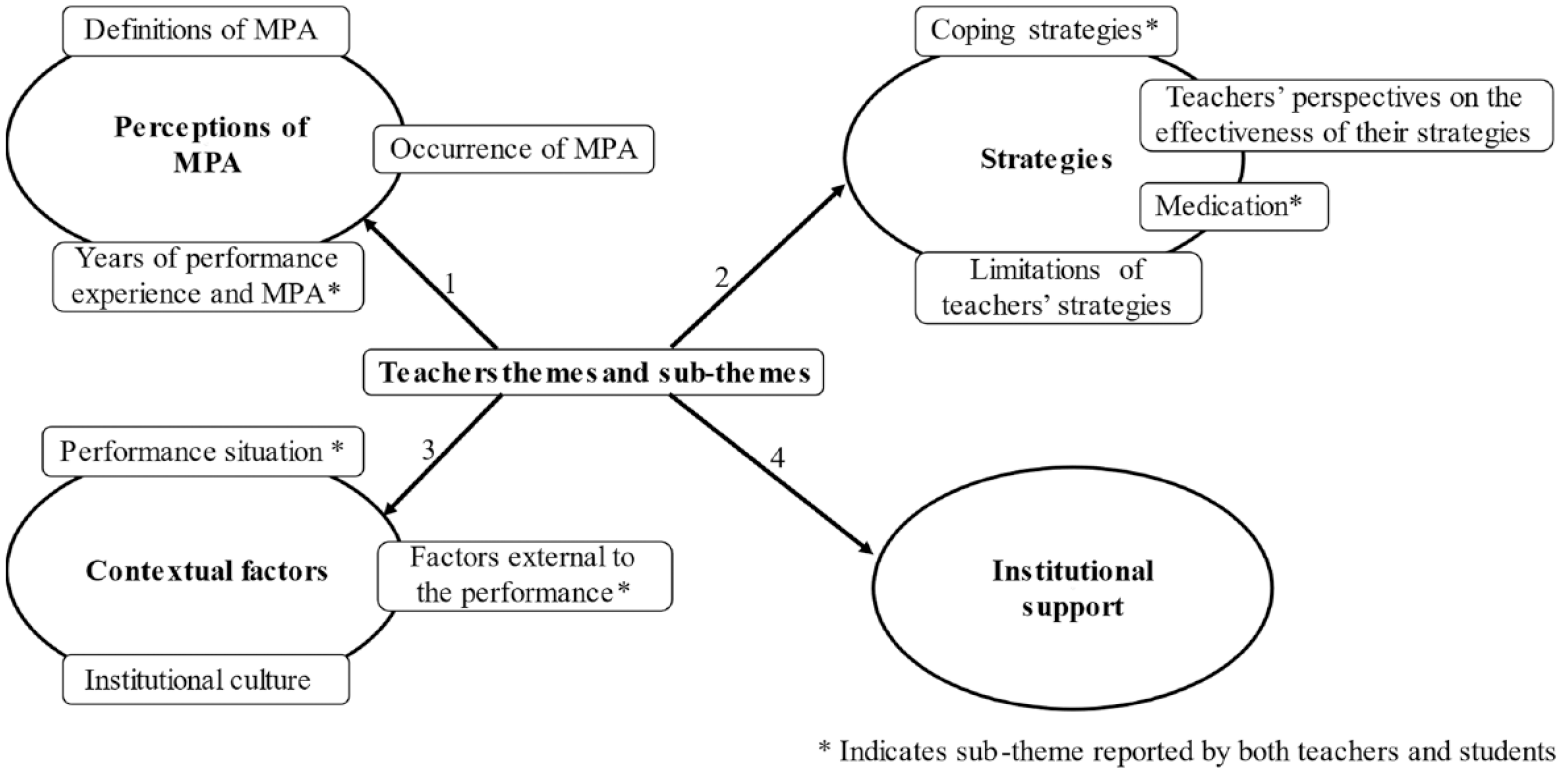
Themes and subthemes emerging from the 12 individual interviews with teacher participants.
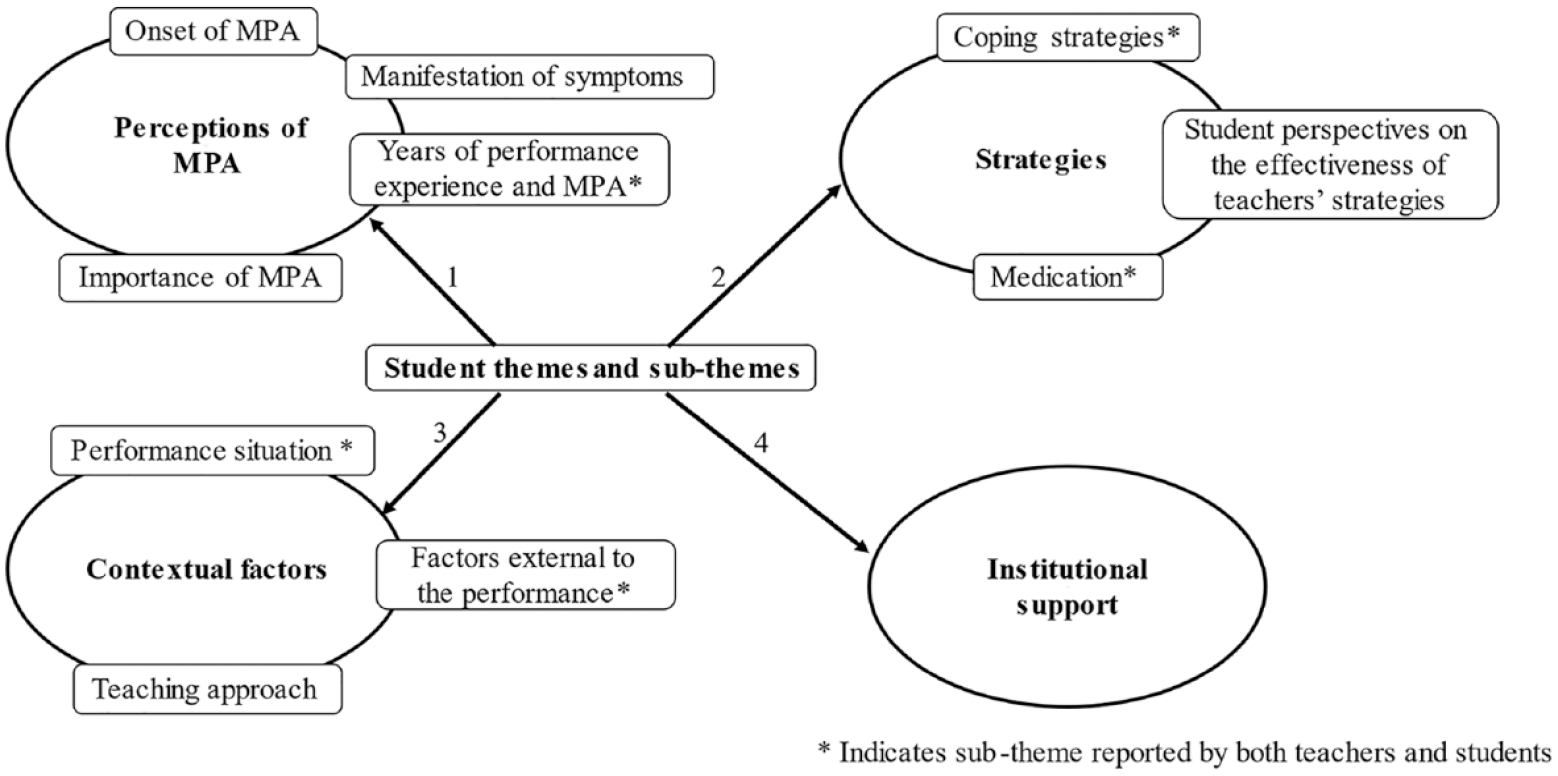
Themes and subthemes emerging from the four focus group interviews with student participants.
Teacher participants
Perceptions of MPA
Definitions of MPA (12)
Participants defined MPA as stage fright, fear of failure, or fear of an unsuccessful performance in front of an audience: “The fear of failing in front of a public . . . And this fear may also be present in the preparation phase of the performance” (T2). They also saw it as a perceived physical and psychological alteration: “It is the combination of the physical and psychological state that alters the perception of what we are doing, of our body and the way we think; so it is a slight modification of the normal” (T5).
Some alluded to the way it can be seen as a common occurrence, and viewed positively:
Anxiety is a feeling, a physiological reaction to an emotionally stressful situation, due to the uncertainty of what will happen to us. But it can be something positive . . . If in excess, it can be harmful and compromise the technical component of the performance. (T8)
Adrenaline can also cause loss of concentration, lack of discernment, and panic.
It is the defence or way of reacting to an external threat . . . [Although not precisely] a threat, it can even be seen as such . . . MPA also has a significant role with adrenaline as this can benefit the energy of the whole performance. (T9)
Occurrence of MPA (12)
All the teachers interviewed reported having to deal with MPA personally: “[I dealt] many times [with MPA]. That MPA happens when we have extremely important concerts and need to relax to overcome the fear. However, it is not something we can do easily. It takes many years” (T1); “MPA depends on the personal context that has nothing to do with the performance of that moment. Many factors, either from the situation itself or external to the situation, can contribute to our general and emotional state” (T9).
MPA throughout my career so far has not always been the same. As a student, it was something that blocked me or could limit me. Then MPA became part of the performance, but not as something that limits or enhances . . . I deal with it and expect it as something normal. (T5)
Years of performance experience and MPA (5)
Coping may improve with time: “People are better at dealing with situations; therefore, they are used to them or have the maturity to deal with it. For example, nothing seems to bother international soloists because they have long careers” (T9);
Some of my students—I’m considering a specific student, but it has also happened with others—who have every reason to be confident, they have a great technical level, [but] they always think they’re going to fail . . . It’s experience, isn’t it? (T2)
Strategies
Coping strategies (12)
Strategies include exercises and talking:
I developed or borrowed from someone some breathing and physical exercises. I also have a conversation [with the students] but not right before the performance. I do it long before, when we must understand why we make music, which is essential. If the breathing or physical exercises do not work, we have to understand intellectually that our fear is irrational. (T1)
Level of preparation can influence MPA:
If we are not adequately prepared or completely sure and confident of what we are doing, it causes anxiety because we perceive the possibility of failure, and this causes negative anxiety and greater stress. But when the preparation is adequate, I think the anxiety levels also go down. (T7)
Similarly, mental rehearsal was described as a complement to technical preparation: “I advise the students to imagine they are playing before an audience” (T2). One participant downplayed the significance of mistakes and suggested individualized strategies:
Relativise mistakes, do not attach too much importance to them, and then deal with that. I try to suggest physiological strategies such as breathing and psychological approaches . . . I would say that you need to understand the student holistically: who is he/she? What is his/her background? Why is he/she nervous? Once you understand that, you can select the best strategies. (T8)
Building self-confidence was crucial: “I talk to the student, saying we must respect ourselves because too much effort causes even more frustration and fear . . . I try to work on self-confidence, always through dialogue” (T9).
Teachers’ perspectives on the effectiveness of their strategies (10)
In general, teachers were positive about their strategies. Two described their impact:
I have students who were very nervous and tense and failed consistently due to anxiety and lack of work. However, they started to work harder and got to know me better, which also boosted their confidence. (T2) The conversation is specific and directed to each student because some individuals, from a musical and human point of view, are in different stages, and I always try to maximise the strategies so that they are effective for each one. (T8)
Medication (3)
Three participants mentioned the use of medication: “I remember a student . . . About three or four years ago, who had a lot of anxiety playing his instrument . . . And he even took that medication, Inderal” (T11). Another (T12) mentioned a specific institution that was aware of many students taking anxiolytics but did nothing to find a solution, while according to the third:
Many musicians take medication and beta-blockers. On of my young students admitted that that she was taking medication and she needed that to be able to perform, to face this stress. And she managed to get off that, but it was hard, because she was under the impression that, without that, she couldn’t do anything. (T3)
Limitations of teachers’ strategies (4)
One participant mentioned that a teacher cannot replace expert support: “We are not psychologists. We may know the students very well but we cannot replace a more structured program” (T2). Another pointed out that teachers often lack the knowledge to deal with specific problems such as anxiety: “Perhaps the teachers do not have the necessary tools, either because they have never experienced it or because they have never looked into it, so that they can eventually advise the student” (T12).
Contextual factors
Performance situation (4)
The audience, the concert hall, and whether playing solo or in a group were thought to cause variations in MPA:
It depends on who we are playing for, right? The public is crucial. The public and the concert room . . . It also depends on whether we are playing a solo piece, a duo or a trio, or as musicians of an orchestra. (T11)
In line with the previous observation, one participant stated that the competitive orchestral environment causes a more intense form of anxiety:
In my case, I’ve always felt more comfortable with the pressures of a soloist competition, where you must play a type of repertoire that, in my opinion, is more challenging . . . But in orchestral competitions, I’ve always felt much more anxious. A jury of 3 or 4 members that will decide your death sentence, it’s the environment itself, isn’t it? (T12)
Factors external to the performance (2)
MPA may be exacerbated by financial concerns and fatigue: “Of course, playing a concert and thinking I still have to pay the rent of the house is bad” (T6);
Being very tired . . . Or when your muscles are sore, or with contractures. For example, last year I had a finger contracture, in this arm, and it prevented me from doing a trill . . . I could hardly do it. That really has an impact on the performance. (T11)
Institutional culture (12)
Participants were critical of conservatories:
I think the traditional teaching model in conservatories is one of exclusion; teaching for a minority of people with a series of conditions predisposing them to be winners from the start. The role of the master who perpetuates tradition, who immediately classifies the student, isn’t it? I think that we effectively need to change our attitude towards this. (T2) I strongly agree [that the performance tradition] still exists in many places and is applied by many teachers . . . It’s a closed and castrating thing, and the student knows that the teacher has high expectations . . . I think these traditions are already a bit obsolete; they cause anxiety on all. They [the students] don’t even understand how they are being conditioned and constrained. (T9) The guilt is neither individual nor collective; it is systemic . . . But it is up to us to create plans and environments where this is not the main factor . . . So, it is hard for me to talk about anxiety, stress, fear, and pressure in the musical world when all the elements that act upon musical performance come from the siege that this jungle of winners and losers exerts upon music. Students are surrounded by competition. They desire glory. Teachers are eager to glorify themselves through their students’ work. Students are eager to glorify themselves through the recognition of their teachers and their juries. (T6)
The jazz context was reported to present different approaches: “Jazz allows for a creative approach and also to assimilate the mistake with some ease, something that, for example, in more crystallised music, in erudite music, is maybe a little more difficult” (T8). The formality of the classical context could trigger MPA:
Classical musicians, because they have to follow that formality, that tradition . . . Maybe, at a certain level of performance, it can cause some tension, some anxiety. And also the formality, the dress code, having to obey all those traditional procedures of going on stage, causes an increase in anxiety. (T12)
Institutional support
This theme was mentioned by all 12 teacher participants and related specifically to the lack of programs specifically aimed at managing MPA in Portuguese higher education institutions:
There is no general program focused on anxiety. I don’t know if there is in other [institutions] because it’s not something that’s talked about or known that much . . . It’s pertinent to raise this issue, and it’s relevant to study this. I’ve had students who dropped out because they couldn’t control their anxiety, which was mainly a psychological issue. (T2)
One participant suggested that schools should have taught the management of MPA:
I think schools should have Pilates, Alexander Technique, yoga, and meditation as optional subjects . . . There may be several ways to deal with this type of situation. In Holland, for example, they already exist, in Germany too, but not here [in Portugal]. (T3) It is not taboo among the students and the teachers because everyone knows how anxiety is. Still, maybe it is an institutional taboo institutionally, isn’t it? If it was not such a taboo issue, eventually, there would be a course directed at dealing with anxiety . . . Here in Portugal, my institution does not have it, and I am not aware of any other institution that does, at least on a regular basis. (T12)
Although the general themes identified were common to both teacher and student participants, there were some differences in the sub-themes, as detailed below.
Student participants
Perceptions of MPA
Onset of MPA (19)
Participants first experienced MPA in a variety of situations: “I began to feel it more while at the university because the responsibility becomes greater, and I think that we feel it more and more” (S1); “I felt it more in high school, but that was because I had a very harsh teacher” (S4); “I think it was from my first audition [in the philharmonic band] when I had to play in front of people” (S8); “I think I started to feel it when I was in the conservatory because I began to play more often and to be called up for more important concerts, which I was not used to at the time” (S21).
Manifestation of symptoms (15)
Several participants described the symptoms: “I talk too fast with people” (S3); “As a singer, there’s impact on my voice; my voice starts trembling” (S12); “[In addition], trembling legs, altered breathing, stomach pains” (S14); “fast heartbeat” (S16). Two described them in detail: “I had a sweaty and numb feeling in my hands, stomach ache and felt sleepy. I felt like I could barely open and close my hands. It’s an anxiety that really hits your limbs. I was trembling and sweating” (S9); “Nervousness, I sweat a lot, I often feel dry mouth, and sometimes I even lose a little strength and muscle control” (S10).
They also described their feelings before, during and after a performance: “I often fall asleep before I go to play. During the performance, as my head is more relaxed, I can concentrate more, but before, it was a total blur. And at the end, I cried because of the pressure” (S4);
I can say that I am very curious before: “how is it going to be?,” “what is going to happen?” During the performance, nowadays, I feel greater and greater freedom. I have been feeling so well performing that sometimes, instead of wishing it was over so there would be some relief, it seems that I could go on longer. I have been working now on the end, because I feel some disorientation. (S9) I pay a lot of attention to the before and after. Before, because I have to feel nervous to be able to enter the scene . . . After, reflecting on everything I did to understand what was right and what was wrong so that next time I can do better. (S7) I feel a bit anxious before the performance but it’s a good anxiety; I don’t see it as something negative. During the performance, I’m enjoying the moment; I’m confident and I feel energy and power. After the performance all my energy is gone, and I just want to rest. (S11) When I feel prepared before the exam, I feel confident and well about the work I’m going to do. During the exam, I’m conscious of my capacities and that I have mastered the music, and I also try to feel pleasure in what I’m doing. At the end, I feel proud of the work I have done. But then, if it goes wrong, I feel angry and upset. (S2) Before I go on stage, I feel very nervous, like I’m dying. Then I go on stage. During the first part, if it goes well, my body relaxes, and I think: “this is going to go well.” And I go on to the end. At the end, I feel relieved. (S19)
Years of performance experience and MPA (10)
Some participants related MPA to experience of performing: “I think that [it] is related to how long we have dealt with the problem. For example, as I started coping with it very young, it was a nightmare for a long time” (S4);
The anxiety has decreased over the years. In a way, the habit of feeling these symptoms makes it possible to find ways of dealing with them; it is necessary to know the triggers that make it feasible for us to control them. (S10)
Importance of MPA (18)
The importance attributed to MPA varies widely. “It is more important now than it used to be; before, I didn’t really have a sense of what anxiety was. Now, the greater the responsibility and demand, the more important it is” (S5); “On the one hand, I feel it is much less important. On the other hand, I attach more importance to the pedagogical side of things, which is very important” (S4); “It is important because I managed to find a way to feel it as a flame that makes me want to perform on stage” (S8); “If I had a concert tomorrow and I didn’t feel that slight anxiety, maybe it could go badly. I need to get used to anxiety and find strategies to deal with it during the performance” (S10). By contrast: “I feel that dealing with anxiety has become more important than it should be . . . I end up suffering a bit” (S19).
Strategies
Coping strategies (24)
Coping strategies included exercises: “I think there are several exercises a person can do to focus and be more aware of what’s going to happen. Breathing exercises to control anxiety before the performance. Also, stretching the muscles” (S1). Some participants reported imagining and giving practice performances, acknowledging that MPA is normal:
When I started studying at the university, I started doing more [mental] audition simulations, which helped me control my anxiety. During a masterclass, the teacher said that at night we have to imagine the score in our head and pretend we are playing to visualise the performance situation. Maybe it sounds stupid, but it helps a lot. (S6) I always try to create uncomfortable situations so that when I have a performance, I’m prepared in a certain way. Besides that, I play for class colleagues or colleagues from the brass section because I know there will be a much more precise and intelligent criticism and evaluation. (S10) One thing that has helped me to improve over the years is to assume: “OK, I’m nervous, and it’s normal.” I adopt strategies that include turning off my phone, withdrawing from the world, and reflecting. I don’t talk to anyone. (S9) My only strategy is to keep things in perspective because it’s just a concert. I’m a jazz musician . . . I’ve also studied classical music, which requires thinking that there’s only one right way of doing things, and you can’t make mistakes because they are bad. Since I started thinking that mistakes are part of the performance, I feel much less anxiety. (S12)
Additional strategies were reported, including playing up to the moment of the performance and stopping half an hour beforehand: “I get more anxious if I wait even two or three minutes . . . I play as much as possible until I enter the exam room or the audition” (S24);
I have a bit more anxiety than usual, but the simple fact of looking at the score before I go in and check the most problematic parts . . . That’s what I do. Maybe controlling my breathing a bit more to feel calmer. [Besides], making recordings helps me a lot. (S21) I used to take natural relaxants because I thought they would help me prevent performance anxiety. But, as time passed, I realised that it’s better to stop half an hour before the concert, go out, think about what I have to do, clear my head, and then the pressure goes away a bit. (S19)
Finally, “If the performance didn’t go well, it was because of anxiety. Still, it has also to do with the preparation and the previous work for that performance” (S10).
Student perspectives on the effectiveness of teachers’ strategies (20)
While the teacher participants were generally satisfied with the effectiveness of their strategies, this was not the case for the student participants:
Strategies always depend a lot on ourselves and how we feel when we wake up. A lot of the teachers’ advice sometimes don’t work; when that happens, it must be done differently. So, we must have a critical spirit and significant autonomy. (S10) My teacher uses a few strategies. Some are a bit hardcore. It depends a lot on his mood. But he can leave the room to make us feel more comfortable, or he can try to bring us down so that we think: “oh, no way. I have to prove I can do it.” (S14)
Some participants reported that their teachers did not suggest any strategies at all: “I don’t think any teachers worked on any strategy with me. Of course, there’s always a positive conversation . . . But in terms of strategy, it was something that I always missed a lot” (S9).
I’ve never had a teacher who worked on specific strategies to control anxiety. It was something I managed by myself. I don’t think that this has been a problem. But I think the teacher’s role is very important because we are different. (S16)
Teachers who built their students’ self-confidence, however, were appreciated:
Every time I take a music test, my teacher calls or sends me a motivational message telling me that I’m well prepared and that have to focus on what I have to do. And honestly, I think that’s very important because we look at our teachers—at least I do—as models. (S20)
Medication (3)
Some participants reported having taken medication: “I took some calming pills once or twice to handle anxiety, but I realised that wasn’t for me. I couldn’t depend on a substance” (S11). Others had not, but knew others did: “Personally, I’ve never taken anything. But I know my colleagues have taken beta-blockers that can help because they control the heartbeat and breathing” (S23).
Contextual factors
Performance situation (24)
Participants commented on the context in which they were performing: “I think I only feel MPA when I play solo. When I play in a group, I feel almost nothing” (S1); “In a symphony orchestra, us wind players for example, if we are playing a leading solo part, there is sometimes a certain nervousness as if it was a solo” (S6); “I don’t feel as much anxiety when I’m playing in the orchestra or even chamber music as when I’m alone with the piano” (S14). They believed the type of audience, as well as level of preparation, can produce different kinds of anxiety: “Sometimes, it has to do with the kind of public, the target audience, or the people in the audience” (S23); “I think the situations that make me most nervous are probably competitions because it’s not entirely natural to play only for a jury, and often we do not feel they are there to enjoy it” (S18);
In orchestra, the nervousness is almost none, but in solo playing, there is more anxiety. [MPA] may differ depending on whether it is a class audition or a concert in a big hall with a larger audience . . . Anxiety is more intense when we do not feel well prepared . . . But if I’m well prepared, I may feel just as nervous. (S17) There is only one circumstance in which, as a pianist, I don’t feel symptoms, which is as an accompanying pianist . . . As a singer, if it is a recital, in which I’m perhaps more focused on myself, I have some symptoms of fast breathing and a bit of dry mouth, which is odd because, as a pianist, anxiety affects the arms. As a singer, it affects breathing, which should be controlled, and I feel my mouth dry. (S9)
Peers can increase MPA: “I’ll give you an example: we were playing in a chamber music group, and I knew that some colleagues didn’t know their parts. So, since I was aware of that, I got nervous and that compromised my work” (S20);
While I was trying to warm up and go over some important passages that I needed to check, some people entered the room and started playing the same passages as me, faster than me, just to sting me. That really affected my psychological and anxiety levels, and it went badly. (S19)
Factors external to the performance (2)
These include instruments:
All my colleagues have professional saxophones from Selmer and Buffet, and I have an intermediate series. When I play very difficult pieces, they are easier to play with my colleagues’ saxophones; my saxophone doesn’t hit specific notes so well, for instance, the harmonics. The tuning is not so stable. So . . . Evaluating the others causes some anxiety before the concert because something can go wrong. (S19)
Teaching approach (4)
Pressure could cause anxiety:
I had several teachers, and some of them would come up to me and say: “look, you have to listen to this. Listen to this.” They wanted me to play like Jean-Marie Londeix, the greatest saxophonist in the world; they told me: “you have to play like him.” At auditions, I felt the pressure of “I have to play like Jean-Marie Londeix, but I can’t . . . It’s impossible.” So, I felt anxious because I couldn’t play like him in the audition. (S19) I had a very aggressive teacher who said: “the less you study, the nicer I am.” And I was the first of his students to finish high school in ten years, so I suffered greatly from his frustration. I was never enough; not that he was doing anything wrong, but I was never enough. (S4)
Institutional support
Participants thought that MPA should be discussed in the context of teaching, and they should be taught how to manage it: “I think we are already in another era and, therefore, I believe it is essential that the students nowadays follow other approaches and talk more about anxiety” (S9); “I think it should be addressed much more in the student community, teachers included, and it should not be put under a rug and ignored” (S15); “Talking can provide people with ideas for different strategies. It would be interesting to get students talking about it. . . Because I think it might help many people feel less anxious” (S12).
Discussion
Participants’ definitions of MPA, describing it as involving psychophysiological changes, echo those provided in the literature (e.g., Kenny, 2011, 2016). According to the responses of student participants contributing to subtheme 1.2, Manifestation of symptoms, these changes are physiological (sweating, stomach pain, numb hands, uncontrolled muscles, tremors, dry mouth, muscle tension, heartbeat acceleration, altered breathing, chills), cognitive (psychological self-sabotage, negative thoughts), and behavioral (lack of concentration, talking fast, sleepiness). Such symptoms have been found to be associated with the etiology and intensity of MPA. Participants also defined MPA as stage fright, and fear of lack of success.
Student participants reported experiencing symptoms of MPA before, during, and after performances. This finding reflects those of Papageorgi et al. (2007) and Tahirbegi (2021). These participants also reported moments of freedom, confidence, and awareness; the need to feel nervous about going on stage; disorientation after performances; and reflections on the quality of the performance.
Participants argued that MPA can be positive, provided it is not excessive, as it can improve performance quality. Positive anxiety occurs when the individual masters both the intensity of their sensations and the environment. Our findings support those of Tahirbegi (2021), who reports that some students are aware of both adaptive anxiety, which can facilitate performance, and its opposite, maladaptive anxiety, which can hinder performance. Adaptive anxiety may be related to flow, experienced when an individual is fully immersed in a particular activity, causing satisfaction and feelings of wellbeing (Nakamura & Csikszentmihalyi, 2002). By contrast, MPA is often experienced as maladaptive, in that it is undesirable and accompanied by negative feelings of insecurity and worry (Facchini, 2014).
Teacher participants reported having experienced MPA themselves particularly when giving important performances, and most acutely when exposed to the public. Fehm and Schmidt (2006) found that 58.1% of their participants related anxiety to status. Similarly, student participants’ responses to the subtheme 1.1, Onset of MPA, support this finding in that it first occurred for them when they began to feel responsible for high-quality performances in high school, university, and conservatoire orchestras and bands. Lupiáñez et al. (2022) identify the presence of an audience as a predictor of anxiety when young musicians give their first performances, and suggest that the later they start performing, the more they experience MPA. Thus, factors triggering MPA include lack of experience, inadequate psychological preparation, the presence of an audience, and the performance environment.
MPA does not remain constant throughout careers, as mentioned in the subtheme 1.3, Years of performance experience and MPA, and by Papageorgi et al. (2013). The habit of coping with MPA over time may help performers to develop their own strategies for decreasing anxiety levels. The results align with previous findings by Fernholz et al. (2019). However, this does not mean that experienced musicians do not feel or do not have to deal with MPA on a regular basis, also depending on their individual characteristics.
Student participants attributed different meanings to the feelings that they associate with MPA. While some found that MPA enhances the liveliness of the performance, others focus on ways of countering its impact. In addition, some mentioned MPA in association with pedagogical aspects or the responsibility for delivering a performance. These findings suggest the need to consider student profiles as levels of anxiety depend on individual characteristics (Papageorgi et al., 2013).
Coping strategies adopted by teacher and student participants include breathing and physical exercises, imagery strategies or mental preparation, conversations aiming to provide positive reinforcement, performance evaluations during practice, studying with the mindset of one giving a real performance or simulating one, isolating oneself, making audio- or video-recordings, focusing on technical and musical preparation, acknowledging anxiety, reviewing the score before playing, playing for others and simulating uncomfortable situations, and receiving motivational messages from the teacher. Both teachers and students highlighted technical and musical preparation as a coping strategy for dealing with the effects of MPA. However, according to research findings, MPA can increase even when one is prepared (Lupiáñez et al., 2022).
Students both criticized and praised their teachers’ strategies for managing MPA, and teachers mentioned their limitations. Some student participants mentioned that their teachers do not recommend the use strategies for handling anxiety, or that this may depend on the teacher’s mood. Tahirbegi (2021) highlights similar cases; while some students found that teachers offered support for dealing with anxiety, others reported that the teachers were only concerned with developing their technical and musical skills. These students often mentioned the need for institutional support.
Concerning the use of medication, both students and teacher participants were aware of the use of beta-blockers to cope with MPA, as mentioned in the literature (Kenny, 2005). However, in many cases, this occurs without medical advice. Nube (1991, 1994) confirms the effectiveness of beta-blockers in relieving the physiological symptoms of anxiety but points out that high doses may have negative effects. Inderal (propranolol hydrochloride) is widely used and known by musicians to address the physiological symptoms associated with MPA (Kenny, 2011). According to Nascimento (2013), pharmacological treatment may compromise fine motor control, an essential aspect of high-level musical performances.
The reported contextual factors include the performance situation, and suggest that MPA is more intense in solo performances when compared to group performances. Participants mentioned that the type of audience (including teachers, for example) may trigger different anxiety levels. Some performance situations, such as competitions, also seem to affect personal experiences of the symptoms of MPA. Other studies report that competitive environments and assessment by a jury, for example, may be factors that increase levels of MPA (Hamann, 1982; Hamann & Sobaje, 1983; Ioannou et al., 2018; Papageorgi et al., 2010; Taborsky, 2007).
Regarding institutional culture, some teacher participants mentioned that teaching strategies associated with the Western performance tradition may lead to exclusion and promote anxiety. According to Leech-Wilkinson (2016), institutional rules can be repressive, cause feelings of guilt, fear of making mistakes, and feeling inappropriate. Other authors have also pointed out the impact of the cultural context (Barros et al., 2022; Perdomo-Guevara, 2014), and the pressure and anxiety it may generate (Papageorgi et al., 2013).
According to participants, the traditional teaching approach is associated with increased levels of MPA since pressure from teachers may generate feelings of inadequacy and negative thoughts. According to Marzano (2007), this type of approach has a negative impact on student learning, increases MPA, and produces self-critical thoughts about musical performance. As the Western classical performance tradition is predominantly reiterated by teachers (Gaunt, 2010), positive student emotions are suppressed as a result of the teacher–student relationship (Peistaraite & Clark, 2020), which provokes higher levels of MPA.
As regards institutional support, several participants stated there are no programs for preventing or mitigating MPA or interventions for higher education students in Portugal and supported their implementation as a way of improving their teaching and learning environment.
Conclusion
The present study confirms that MPA is widely and intensely experienced by music student participants, and that it affects occupational health in this context. The characteristics of MPA in this geographical context are multifaceted, especially its psychophysiological dimensions, and their occurrence is mainly associated with auditions and early-career public performances. The symptoms occur before, during, and after performances, but may lessen with years of experience. Furthermore, the importance attributed to MPA reveals the existence of both adaptive and maladaptive anxiety.
The most commonly mentioned strategy was technical preparation, which suggests that teachers may face difficulties devising ways of countering MPA, and other professionals could assist, introducing other coping strategies to deal with MPA in higher education institutions.
The findings of this research also show how contextual factors (performance situation, the type of audience, competitive environments, and orchestral auditions) interlink with higher levels of MPA. Furthermore, institutional culture, style of teaching, and lack of institutional support converge to maintain high levels of MPA in conservatories and university music departments.
On the basis of these findings, we propose some recommendations. Music students, right at the beginning of their studies, should receive appropriate professional and institutional support for dealing with MPA. Miller and Chesky (2004) propose intervention strategies focused on the type of anxiety experienced, indicating the need for longitudinal and qualitative studies to acquire in-depth knowledge about psychological factors at the individual level.
In accordance with increasing awareness of the need to ensure preventive care in relation to physical and mental issues (sometimes originating from teacher-student relationships), teachers should maintain good relationships with students, identify the MPA-related factors that apply to them, and, in some cases, review their teaching approach (more can be taught than just technical and musical skills), which must align with the individual profiles of students. More empathic teaching approaches may improve teacher–student relationships in the context of higher education.
Furthermore, we would highlight the importance of discussing MPA in educational institutions not only to produce knowledge about this issue but also to promote discussion about its occurrence in this context. We would suggest designing and integrating curricular units that address aspects of MPA and foster coping techniques, such as Alexander Technique, yoga, and meditation. The taboo that still exists around MPA will diminish as it is discussed more widely and addressed in prevention programs, improving the health and wellbeing of music students in higher education in Portugal.
The limitations of this study should be noted, including those raised in and by the current literature. Factors external to performance such as financial concerns, physical fatigue, sore muscles, contractures, and the quality of the instrument played, can accentuate MPA. However, further research is required to study and address these variables.
Another limitation of this study concerns the participation of teachers and students at only four higher education institutions and our interpretation of the data they provided cannot be generalized to music teachers and students more widely. We would therefore suggest that, in future, research should be carried out at other conservatories and university music departments for further comparison and analysis. It would also be worth comparing the experiences of MPA reported by student participants at different stages of their studies. Furthermore, there is also the possibility that participants perceived the interviewer as an outsider and therefore provided cautious accounts of their experiences so as not to compromise teachers, educational institutions or themselves.
Nonetheless, this context also allows for increased empathy during the interviews, as the interviewer may have shared similar ideas and experiences with the interviewees. In qualitative research, sharing and reflecting on the researcher’s place in the context of the research, which occurs inside a particular time and place between two or more people, increase the credibility of the results (Berger, 2015; Dodgson, 2019) and, in this case, deepens the understanding of MPA from an insider’s view.
The implications of the findings are that it is necessary for MPA to be discussed by teachers, students, and psychologists in higher education institutions. It is also necessary for such institutions to incorporate programs designed to improve and maintain musicians’ health and wellbeing in their curricula. This would entail exploring and defining students’ profiles so they can be taught specific coping strategies for each type of MPA. These initiatives would enable the development of more inclusive, constructive, and stress-free environments, in which attention can be paid to the individual needs of students who would, as a result, be better prepared for their professional careers.
Footnotes
Appendix 1
Acknowledgements
Thanks are due to FCT/MCTES for the financial support to INET-md (UIDB/00472/2020), through national funds.
Funding
The authors disclosed receipt of the following financial support for the research, authorship, and/or publication of this article: This work was supported by the [FCT—Fundação para a Ciência e a Tecnologia] under Grant [SFRH/BD/144883/2019].
