



Abstract
Music has the ability to captivate and engage people from all walks of life and in a wide range of situations. Music psychologists seek to understand the various psychological processes that are involved in music listening and making, including perception, cognition, motor skills, and emotion. In recent years, music psychology researchers have begun to collect data in real-life settings, such as concerts of live music. This approach offers a unique opportunity to connect with a wide variety of participants and at the same time gain insights that may not be available in laboratory settings. In this Letter to the Editor, we report on the novel format of an outreach activity called the Golden Ear Challenge that introduces a gamified component and thus unifies concert research and science communication. First organized at the University of Oldenburg in October 2022, the activity uses this format to demonstrate the approaches and methods of music psychology in an accessible and engaging way. By providing accessible and informative content, it aims to inspire people from various backgrounds to learn more about science and, in particular, the fascinating field of music psychology.
Keywords
Music psychology beyond the laboratory
Scientific outreach activities are valuable for promoting public engagement with scientific research and provide an opportunity to communicate complex scientific concepts and methodologies in ways that are accessible and engaging to a wider audience, including those who may not have a background in science. In music research, scholarship and performance can be combined in engaging and illustrative ways using, for example, the lecture-recital format. By contrast, empirical studies in music psychology are traditionally conducted in isolated environments. In recent years, there has been a trend, however, to increase the ecological validity of empirical work in music cognition research. Besides studies of the effects of musical activities on health and well-being using real-life interventions (e.g., Habibi et al., 2022; Jensen & Bonde, 2018; Kreutz, 2015), live concerts and performances have become a source of major interest (McAdams, 2004; Reynolds, 2004; Wald-Fuhrmann et al., 2021). The empirical methods used in such settings range from self-reports, sometimes continuous (Broughton et al., 2019; Egermann et al., 2013; O’Neill & Egermann, 2022), peripheral-physiology data (Czepiel et al., 2021) and motion capture (Swarbrick et al., 2018), to mention but a few. This trend toward the use of naturalistic concert settings in experiments on music perception is part of a wider momentum in the field (e.g., Tervaniemi, 2023) illustrated by the installation of expensive performance or concert halls specialized for research such as the Livelab at McMaster University in Hamilton, Canada (https://livelab.mcmaster.ca) and the ArtLab at the Max Planck Institute for Empirical Aesthetics in Frankfurt, Germany (https://www.ae.mpg.de/artlab/information.html).
In this Letter, we wish to suggest that diverse audiences can be inspired to engage with science through exposure to music psychology. Specifically we present a novel approach to science communication that is likely to produce a particularly high level of engagement among audiences, namely the gamification of an experiment taking place in the context of a live concert. The gamification includes components such as a leaderboard that not only provides feedback contributing to concertgoers’ experience of their own competence, but also encourages competition that can serve as a source of intrinsic motivation (Sailer et al., 2017). Music has a powerful emotional impact on many people’s lives, and as such, music as a field of study can be a motivating and engaging topic for outreach activities. In the following, we describe the use of a format that was presented publicly at a forum held at the University of Oldenburg in October, 2022, on a range of topics related to music, hearing, and health, the Music & Hearing Health Workshop (https://uol.de/music-hearing-health-workshop). We believe that the gamified format could be adopted when addressing a variety of research questions, not necessarily limited to those relating to music psychology.
The Golden Ear Challenge
The Golden Ear Challenge took place in a large auditorium at the University of Oldenburg. Its goal was to illustrate the abilities of human beings to hear errors in the performance of polyphonic music and to demonstrate the detrimental effects of hearing loss on these abilities, for example, by presenting the music through a hearing loss simulator.
Members of a local professional music ensemble, Kammerensemble Konsonanz (https://konsonanz.com) played Antonin Dvorak’s String Quartet No. 12, Op. 96, a work using a range of musical materials and including passages with relatively independent voices. The 32 individuals who took part in the challenge were all participants in the international Music & Hearing Health Workshop, aged approximately 20–65 years. They were instructed to listen to five excerpts from each of the four movements of the quartet, presented in order of appearance (i.e., 20 excerpts in all), each excerpt lasting around 10 to 30 s. One of the four musicians played a pre-arranged error in each excerpt, either melodic (an out-of-scale tone deviating by one or two semitones) or rhythmic. The challenge for participants was to detect which of the musicians had played an error. All the participants were allowed to take part in the experiment until all the excerpts from the first three movements had been played. Each movement was conceived as a round in a competition, with the excerpts from the fourth movement constituting a final round open only to the participants who were most accurate in their judgments, representing one of the top two scorers in the first three rounds (reaction times were used to determine scores when there were ties between participants). Responses were recorded using a web-browser interface (slido.com) on participants’ mobile devices (see Figure 1(a)), with feedback being provided at the end of each excerpt. In the final round, the six participants experienced simulated hearing loss by wearing closed headphones through which they heard a feed from a real-time hearing loss simulator (https://3d-tune-in.eu) based on the signals from a dummy head, captured at the ears, positioned in front of the stage.
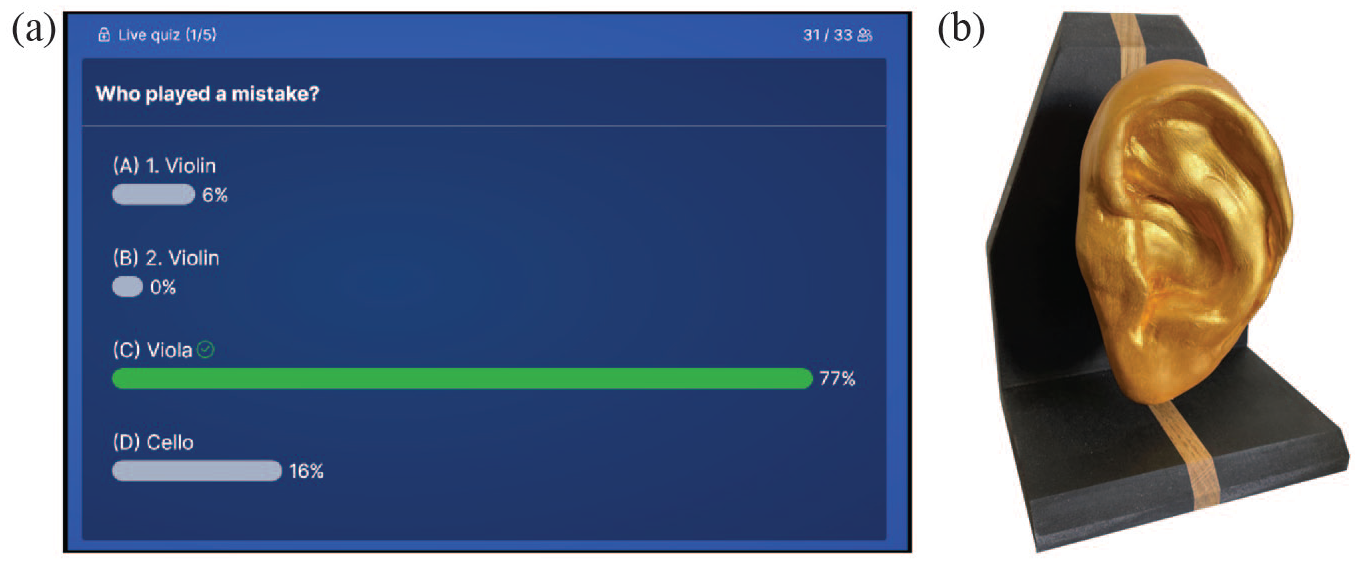
(a) Display of audience responses using the web platform www.slido.com. During each excerpt, participants were asked to decide which member of the quartet had played a pre-arranged error. After the excerpt, the responses were shown and the instrument playing an error was highlighted in green. (b) Picture of the Golden Ear Award.
Figure 2 shows the scores representing individual participants’ accuracy (A) and their performance across trials (B). It can be seen from the wider spread of mean scores in each round that—as intended by the researchers—the errors became harder to detect from one round to the next. Data for the fourth and final round (light blue) were obtained from only the six participants who experienced a simulated hearing loss, making their task even more difficult. The participant with the highest score in the final round was declared the winner of the Golden Ear Challenge and, as a humorous gimmick, presented with the Golden Ear Award (see Figure 1(b)). On the basis of the positive feedback we received on the event, we believe that the gamified nature of our approach motivated participants to engage fully in each trial and reduced the likelihood that their attention would lapse.
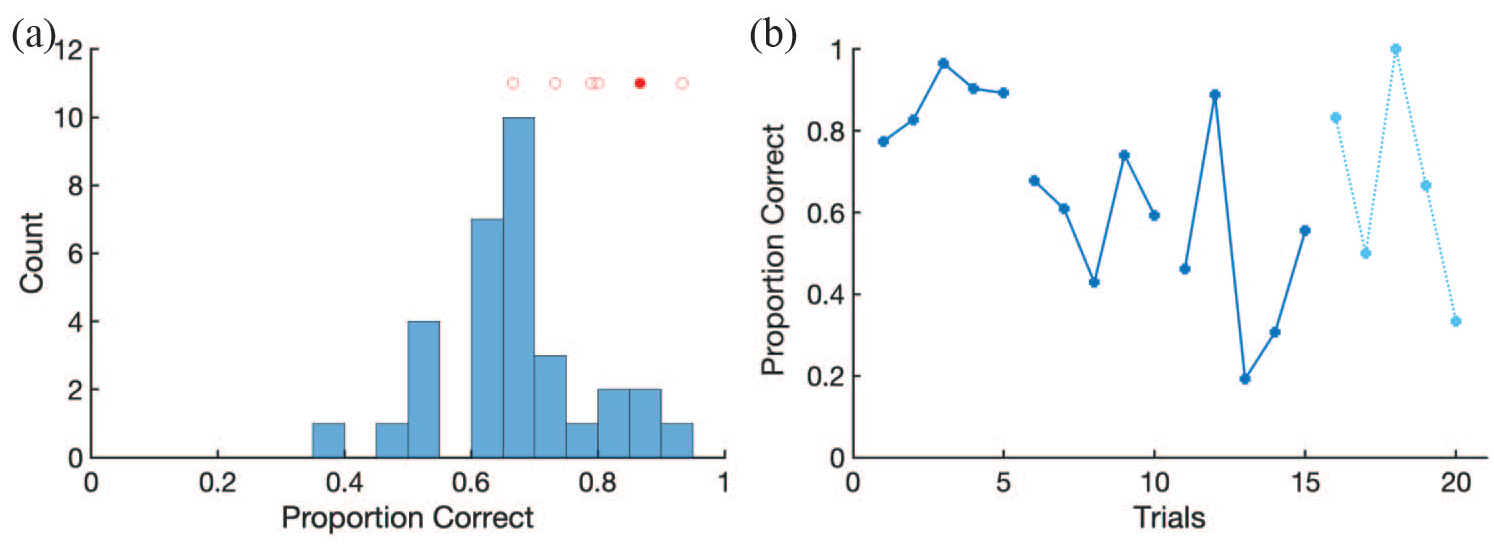
(a) Distribution of the overall proportion of correct scores across participants. Red circles indicate the overall scores of the finalists. The filled red circle indicates the winner. (b) Proportion of correct scores for individual excerpts.
Conclusion
Overall, the gamified nature of this format created a playful atmosphere that encouraged active participation from the audience, setting the activity apart from the often passive experience of attending classical music concerts. Framing the event as a challenge enabled us to unify the goals of concert research and scientific outreach. In principle, such formats permit a wide range of research questions to be addressed outside the laboratory in such a way as to advance both research and the public understanding of music psychology.
Inevitably, as with all naturalistic research, the experiment was carried out in conditions that were less controlled than would have been the case in the laboratory. The location of the four musicians in the performance space could have been an important confounding variable, influencing the sound field and how participants perceived nuances of the sounds to which they were exposed. One way of measuring the effects of this variable would be to record the experimental stimuli at a live concert, for example, at different locations in the performance space, and conduct additional controlled experiments using the recorded stimuli. This would make it possible to validate the results of other concert research experiments and contribute to the establishment of such experiments as a robust source of data complementary to those gathered online and in the laboratory.
