



Abstract
Music listening can modulate affective states. Individuals can choose music that is congruent or incongruent with their current affective state. Music therapy intervention manuals suggest that individuals who suffer from mental disorders should listen to music according to the iso principle. This involves listening to music that initially matches the current affective state, and then gradually shifting to listening to music that represents a desired state. In the current study, 59 healthy participants underwent a sadness induction by being shown a movie clip designed to induce sadness. They were subsequently divided into two experimental groups: the iso group and the compensatory group. The iso group listened to a sad song first, followed by a happy song. The compensatory group listened to two happy songs. All participants rated their current affective state prior to and after the sadness induction, and after listening to each of the songs. In addition, trait affect and personality were assessed. The results indicated that the movie clip induced sadness in both experimental groups. After listening to the two songs, the iso group reported significantly lower negative affect than the compensatory group. Final affective state was related to trait affect and personality. We conclude that listening to music according to the iso principle is effective in modulating affective state. Individuals who listen to music according to the iso principle should experience changes of affect in line with the music’s affective shift.
Numerous studies have demonstrated that music can induce emotions (Altenmüller & Kopiez, 2012; Västfjäll, 2002). Juslin and Västfjäll (2008) have summarized the exact mechanisms whereby music can induce or modulate emotions. They postulate brain stem reflexes (quick and basic auditory sensations mediating arousal, attention, etc.), evaluative conditioning (repeated pairing of pieces of music with other emotional stimuli), emotional contagion (perceiving the emotional expression of the music and mimicking this expression), visual imagery (generating visual images during music listening), episodic memory (evoking the memory of an event through a piece of music), and musical expectancy (the music violates, delays, or confirms expectations as to how the piece of music continues). Several variables predict whether listening to music actually induces an emotion, including the personality and mood of the listeners as well as situational factors (Scherer & Zentner, 2001; Vuoskoski & Eerola, 2011). It has been reported that healthy individuals listen to music to regulate their affective state in everyday life (e.g., von Georgi et al., 2006, 2009). Patients with mental disorders have been observed to profit from music listening in everyday life and in the course of music therapy (e.g., Aalbers et al., 2017; Gebhardt et al., 2014, 2018). Both happy and sad music appear to be applicable to affect regulation through music (Saarikallio, 2008, 2010; Saarikallio & Erkkilä, 2007). The mechanisms include the maintenance of happy mood, psyching up and energizing, revival and relaxation, strong sensation, diversion and distraction, discharge and disclosure, solace, and mental work. According to previous research (e.g., Gembris, 1991; Schaub, 1981; Schramm, 2005), there are two ways to use music for affect regulation: Individuals can listen to music that is congruent with their current affect, or they can listen to music that is opposed to their current affect. This depends on whether individuals aim to maintain or to change their current affective state. For example, a person in a sad state can choose to listen to happy music to overcome the sadness, or can listen to sad music to get solace, or discharge. Listening to music that is congruent with the current affective state has been called the iso principle (from the Greek word isos meaning equal to), while listening to music that is opposed to the current affective state has been called the compensation or compensatory principle (i.e., to compensate for the current and probably undesired affective state). The mechanism underlying the compensatory principle might be emotional contagion, meaning that listeners mimic the emotion that is expressed through the music.
In the context of music therapy, the term iso principle has an additional meaning: patients start listening to music that is congruent with their current (undesired) state, and gradually shift to listening to music that represents a desired state. This strategy can be applied to the regulation of both affect and arousal. For example, a patient who suffers from depression should initially listen to sad music before shifting gradually to listening to happy music. This should help the patient shift to a more positive perspective and experience. This interpretation of the iso principle was first proposed in the 1940s (Altshuler, 1944) and subsequently included in music therapeutic intervention manuals (Wigram et al., 2002). It has been proposed that when patients listen to music that is congruent with their current state, their internal and external experiences match. They may experience solace and feelings of being understood in the present moment. The supportive nature of these experiences helps patients to have new external experiences. Listening to music characteristic of a different state represents such an external experience. Having had a supportive experience previously should facilitate the patient’s shift to experiencing a new affect that is afforded by the state-incongruent music. Although the iso principle has a long history in music therapy, controlled experimental studies are scarce so its underlying psychological mechanisms have not yet been tested empirically. A recent single-case study documented the benefits of listening to music according to the iso principle for a female patient with depression (Heiderscheit & Madson, 2015). Experiments have been conducted with healthy participants to demonstrate the shift from one affective state to another (i.e., affect trajectory), for example, from sad to happy or from restless to serene (Shatin, 1970). In a more recent study (Warmbrodt et al., 2021), participants listened first to happy music and then to sad music, and vice versa. While these experiments demonstrated that it is possible to create affect trajectory, they did not include a compensatory-principle control condition to investigate whether the iso principle is more powerful than the compensatory principle. In one study involving patients recovering from hematopoietic stem cell transplantation, however, the effects of the iso principle on affect and arousal modulation, on the one hand, and unstructured listening to music, on the other, were compared. While both improved mood in the short term, they did not have long-term effects, and no differences between the conditions were identified (Ratcliff et al., 2014). In a more recent study involving healthy participants, the effects on affective state of listening to music according to the iso and compensatory principles were compared (Starcke et al., 2021). Having undergone a sadness induction participants were split into four experimental groups. Each group listened to two pieces of classical music with different emotional valence: sad–sad; happy–sad; happy–happy (compensatory principle); and sad–happy (iso principle). Participants who listened to music according to the iso principle had the highest positive affect and the lowest negative affect but, while differences between the mean affect scores of the iso group and the compensatory group were in the direction predicted, the results were not statistically significant.
In the current study, we focused on affective responses to music listening according to the iso principle (as used in the context of music therapy) versus the compensatory principle. Both have been used to regulate affect (e.g., Gembris, 1991; Heiderscheit & Madson, 2015; Schaub, 1981; Schramm, 2005; Wigram et al., 2002), but we expected to show, based on the findings of previous research, that listening to music according to the iso principle would help to modulate affective state better than listening to music according to the compensatory principle. Although our long-term aim is to promote the use of the iso principle in the treatment of patients with affective disorders, we recruited a non-clinical sample consisting of healthy participants who underwent a sadness induction. If we were able to show that the iso principle has benefits for this sample, we would recommend conducting controlled experimental studies involving groups of patients. There are differences, of course, between the affective states of non-clinical and clinical populations. In the former, for example, sad affective states are probably less pronounced and more transient than in the latter. However, the proposed mechanisms underlying the iso principle should be relevant to patients and healthy individuals alike. Following the sadness induction, our participants listened to music according to either the iso or the compensatory principle. We used pop songs instead of pieces of classical music because a previous study had revealed that more participants preferred pop music (Starcke et al., 2021). Also, pop songs tend to be short, so that participants can listen to complete songs rather than excerpts. For control purposes, they were all selected by the researchers. We predicted that participants in the iso group would score significantly higher for positive and lower for negative affect at the end of the experiment than participants in the compensatory group. Given that previous studies have shown associations between music-induced affect and personality (Juslin et al., 2008; Starcke et al., 2021; Vuoskoski & Eerola, 2011) we also predicted that there would be relationships between affective state (positive and negative) and personality.
Methods
Design
The experiment was conducted online during the COVID-19 pandemic using the SoSciSurvey tool (Leiner, 2019). It had received approval from the local research ethics committee. The design used repeated measures and was between-subjects. The independent variable was the nature of the intervention (iso vs compensatory), and the dependent variables were measures of current affective state.
Participants
Participants were 59 students at three universities (44 female, one non-binary, 14 male) 1 with a mean age of 24.27 years (range = 18–74, SD = 9.57). Their cultural background and fluency in the English language were not assessed, as it was assumed that they would understand the lyrics of the songs they were to hear because they read scientific literature in English as part of their study programs. They were not pre-selected on the basis of their musical knowledge or ability, nor were these tested during the study. Prospective participants were excluded, however, if they were under the age of 18 and if they had affective or anxiety disorders, or any other psychological conditions that might be exacerbated by the sadness induction. They were randomly assigned to either the iso group (5 male, 23 female, with a mean age of 24.39 years, SD = 10.95) or the compensatory group (9 male, 21 female, 1 non-binary, with a mean age of 24.16 years, SD = 8.31).
Materials
Prior to the intervention participants completed measures of trait affect, current affective state, and personality, and they underwent a sadness induction.
Measures of affect and personality
We used the German version of the Positive and Negative Affect Schedule (PANAS; Breyer & Bluemke, 2016), based on Watson et al. (1988), to measure positive and negative affect independently of each other. It consists of 10 adjectives representing positive affect (e.g., interested, strong, inspired, enthusiastic) and 10 adjectives representing negative affect (e.g., distressed, upset, scared, irritable). Responses are made using a 5-point Likert-type scale ranging from 1 (not at all) to 5 (extremely). A high score in the positive subscale represents a high positive affect; a high score in the negative subscale represents a high negative affect. Trait affect was measured at baseline by asking participants to respond according to the way they feel generally; state affect was measured during the experiment by asking participants to respond according to the way they felt “right now.”
To measure personality, we used the Short Eysenck Personality Profiler with NEO-PI-R Openness (SEPPO; von Georgi & Herr, in preparation), which is a modified version of the Eysenck Personality Profiler (EPPD; Eysenck et al., 1998), and the openness-to-experience dimension taken from the NEO Five Factor Inventory (NEO-PI-R; Costa & McCrae, 1992). The questionnaire assesses the four personality dimensions extraversion, neuroticism, psychoticism, and openness to experience. It consists of 21 adjectives representing the four dimensions. Responses are made using a 5-point Likert-type scale from 1 (does not apply) to 5 (applies).
Sadness induction
We used part of the final scene from the movie The Champ (Zeffirelli, 1979) to induce sadness. The clip (2 min 51 s) was embedded in a YouTube video. In this scene, the Champ has won a boxing match but is severely injured; he lies on a couch and dies. His son thinks he is sleeping and tries frantically to wake him up. The clip included the soundtrack, which begins with speaking and crying before instrumental, orchestral music is introduced, Theme from The Champ and Gone (Grusin, 1979). The background music includes major and minor harmonies. The tempo is slow with no substantial variations in tempo or irregular rhythms. It is played legato and with low energy. The clip has been used successfully to induce sadness in previous studies (e.g., Gross & Levenson, 1995).
Songs
There were three songs selected by the researchers: one sad, two happy. The selection criteria were as follows: to minimize the risk of positive or negative associations in memory, and the potential for artists to polarize listeners, the songs were all released in the 1960s and unlikely to be in participants’ current playlists. Like the movie clip, the songs were embedded in a YouTube video. The sad song, played to the iso group, was As tears go by (Faithfull, 1964) (2 min 33 s). The lyrics refer to sadness and crying. The first happy song, played to the compensatory group, was The Loco-motion (Eva, 1962) (2 min 26 s). The lyrics refer to happy dancing. The second happy song, played to both groups, was I’m a believer (The Monkees, 1967) (2 min 49 s). The lyrics refer to falling in love.
Procedure
Participants, who were randomly assigned to either the iso or the compensatory group, were provided with full information as to the nature and content of the study before giving their consent to take part. They were not told the hypotheses at the outset but were debriefed at the end of their participation. They were instructed to carry out the experimental tasks on a laptop in a quiet place minimizing potential distractions. No specific affective state was requested when starting the study. Participants could start the study at any time, no matter which state they were in at that time. Measures of current affective state, trait affect, and personality were administered, followed by the sadness induction, and the playing of the two songs. The iso group listened to a sad song first and then a happy song. The compensatory group listened to two happy songs. In addition to rating their current affective state before the sadness induction took place, they also did so on three further occasions: after the sadness induction, after the first song, and after the second song.
Data analysis
Statistical analyses were conducted using SPSS Statistics v27.0 for Windows (IBM Corp., Armonk, NY). We used independent-samples t tests to check for differences between age, trait affect, personality, and baseline affect in the iso and compensatory groups, and a chi-square test to check for differences between gender in the two groups. We used 2 × 2 repeated-measures analyses of variance (ANOVAs) to test the effects of the sadness induction on the two groups’ affective state before and after the sadness induction. We used 3 × 2 repeated-measures ANOVAs to analyze the effects of music listening on the two groups’ affective state after the sadness induction, the first song, and the second song. We used independent-samples t tests to compare the two groups’ positive and negative affect after the second song. We used Pearson correlations to analyze potential relationships between trait affect, personality, and current affect. The level of significance was determined as .05, and effect sizes were calculated using Cohen’s d and partial eta squared.
Results
As shown in Table 1, there were no differences between the two groups so far as demographic variables (age, gender), trait affect (negative and positive), personality variables (neuroticism, extraversion, psychoticism, and openness to experience), and current affect at baseline (negative and positive) were concerned.
Demographic variables, trait affect, personality, and baseline affect in the two groups.
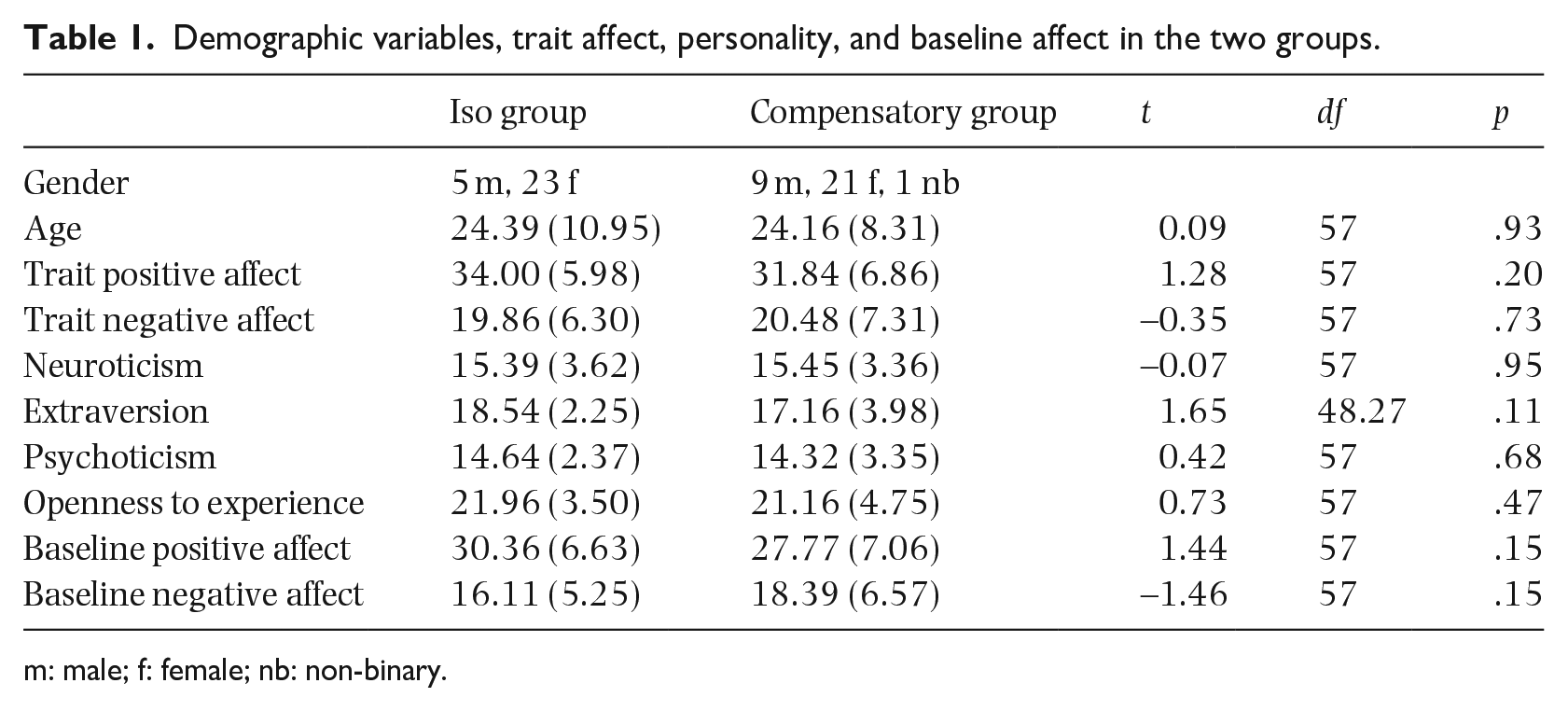
m: male; f: female; nb: non-binary.
Sadness induction
A 2 × 2 repeated-measures ANOVA revealed a significant and large main effect of time such that scores for positive affect decreased from a mean of 29.00 (SD = 6.92) at baseline to 24.03 (SD = 6.31, F1, 57 = 38.71, p < .001,
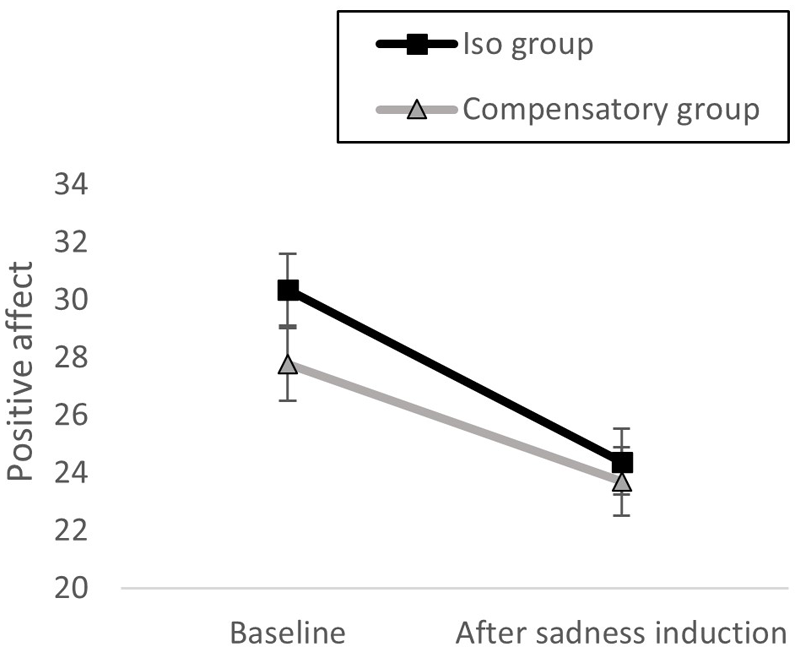
Positive affect before and after the sadness induction (error bars = standard error).
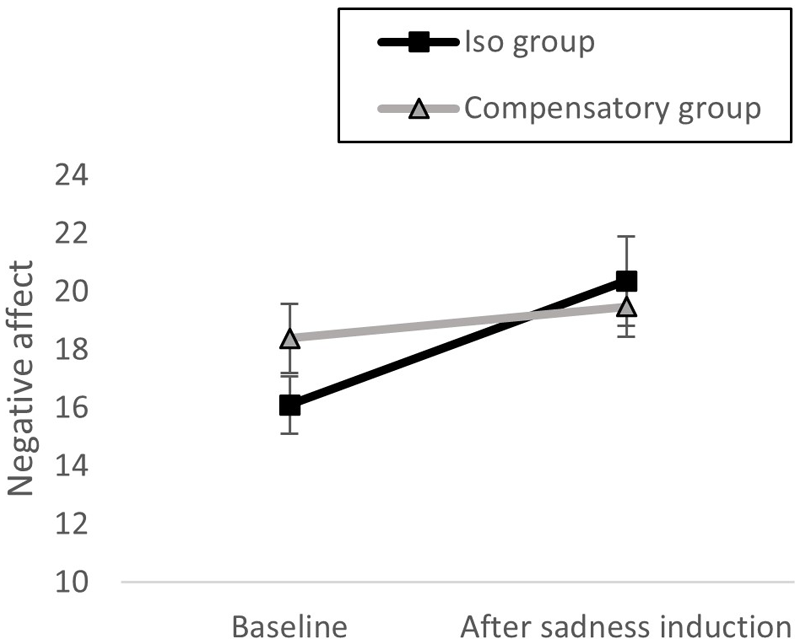
Negative affect before and after the sadness induction (error bars = standard error).
Music listening
A 3 × 2 repeated-measures ANOVA revealed a significant and large main effect of time (F1.59, 90.64 = 23.40, p < .001,
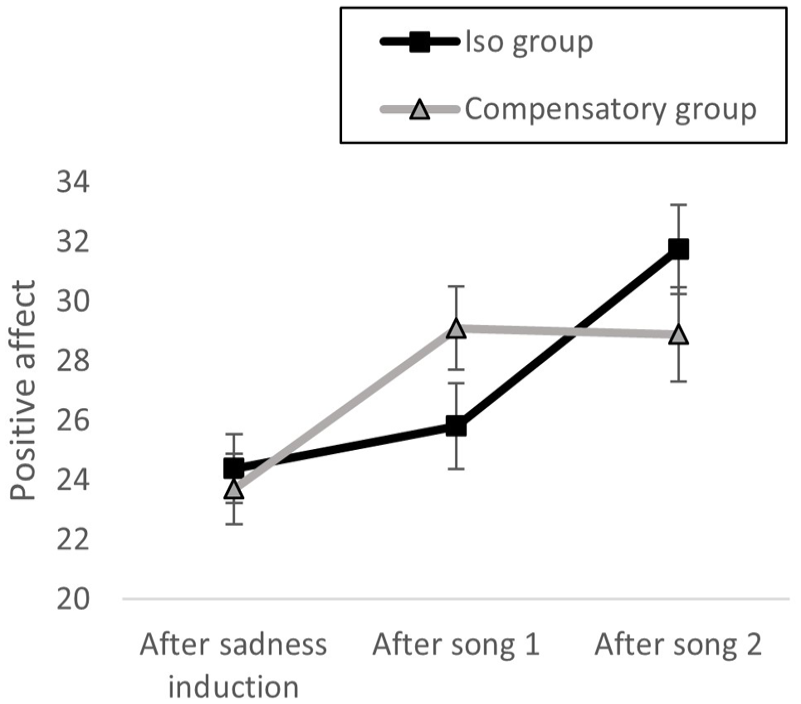
Positive affect after the sadness induction, after the first song, and after the second song (error bars = standard error).
A 3 × 2 repeated-measures ANOVA revealed a significant and large main effect of time (F1.47, 83.51 = 52.45, p < .001,
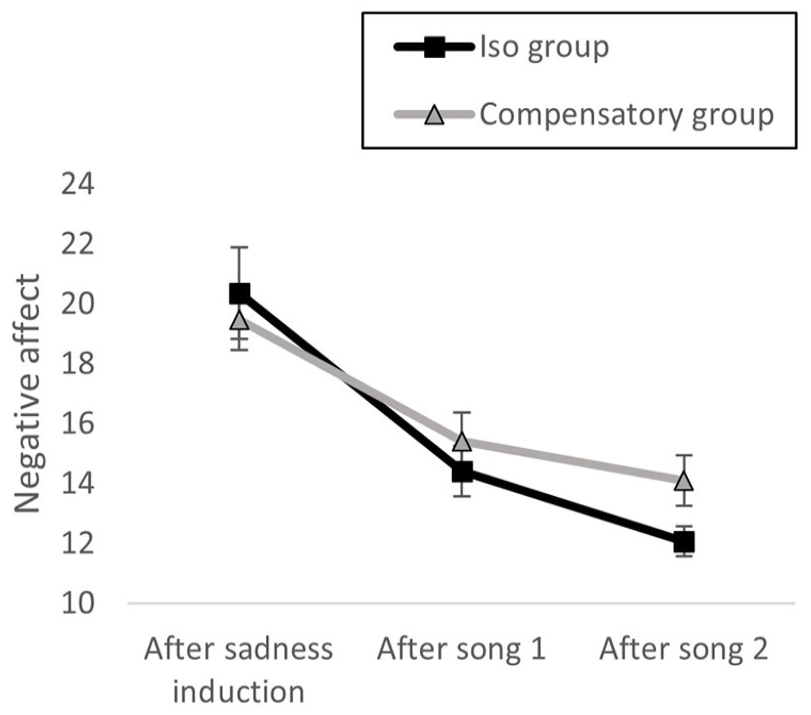
Negative affect after the sadness induction, after the first song, and after the second song (error bars = standard error).
An independent-samples t test revealed a significant difference between the two groups’ scores for negative affect at the end of the experiment (negative final affect), with a medium effect size, t(48.14) = −2.06, p < .05, d = .52, such that the iso group scored lower (M = 12.07, SD = 2.65) than the compensatory group (M = 14.10, SD = 4.71), as shown in Figure 4. Thus, the compensatory group had higher negative affect at the end of the experiment which means their participants felt worse than the participants of the iso group. There was no significant difference between the two groups’ scores for positive affect at the end of the experiment (positive final affect; iso group: M = 31.75, SD = 7.93; compensatory group: M = 28.90, SD = 8.78).
Relationships between final affect, trait affect, and personality
Analysis of Pearson correlations indicated a negative relationship between final positive and negative affect (r = -.33, p < .05), and positive relationships between final positive affect and positive trait affect (r = .49, p < .001), final negative affect and negative trait affect (r = .44, p = .001), final positive affect and extraversion (r = .44, p = .001), and final negative final affect and neuroticism (r = .33, p = .01).
Discussion
We predicted that participants in the iso group would score significantly higher for final positive affect and lower for final negative affect than participants in the compensatory group. Our results support the hypothesis concerning final negative affect. Results for positive and negative affect are overall in line with the iso principle (Altshuler, 1944). The trajectory of positive affect in the iso group represents a decrease after the sadness induction, a minimal increase after listening to the first (sad) song, and a large increase after listening to the second (happy) song. For the compensatory group, there was a decrease in positive affect after the sadness induction, a large increase after the first (happy) song, but no further increase after the second (happy) song. This pattern was reflected by a significant interaction between time and group although the difference between the two groups’ scores for final positive affect failed to reach significance. The trajectory of negative affective state in the iso group represents an increase after the sadness induction, a decrease after the first (sad) song, and a further decrease after the second (happy) song. For the compensatory group, there was a decrease in negative affect after the first (happy) song, and only a minimal further decrease after the second (happy) song. There was a significant difference between the two groups’ scores for final negative affect such that those of the iso group were lower than those of the compensatory group. Thus, after finishing the intervention, the compensatory group felt worse than the iso group. The finding that significant between-group differences were only observed concerning negative affect is in line with evidence that it is easier to induce negative affect than positive affect (e.g., Out et al., 2020).
Our results confirm those of previous studies investigating the effectiveness of the iso principle for modulating affective state. Heiderscheit and Madson (2015) in their single-case study, and Shatin (1970) and Warmbrodt et al. (2021) in their experimental studies, demonstrated similar affect trajectories in listeners exposed to music according to the iso principle but made no direct comparison of the iso and compensatory principles. Somewhat undermining the iso principle, Warmbrodt et al. (2021) showed that listening to a sad song could induce lingering sadness. The design of their study differed from the current study, however, as non-iso conditions were not included. Two previous experiments have been undertaken in which the iso principle is compared with another condition. The first was carried out by Ratcliff et al. (2014), with inconclusive results, but it differed in several respects from the current study. In that study, participants were patients recovering from hematopoietic stem cell transplantation, the other condition was unstructured music listening, and no affective or arousal state was induced prior to music listening. The design of the current study is similar to that of the other previous experiment, carried out by Starcke et al. (2021). We reduced the number of groups to two (iso and compensatory), replaced excerpts from classical music with pop songs (because participants in Starcke et al.’s study preferred them), and exposed both groups to the same happy second song (to rule out the potentially confounding effects of different songs). The differences between the two groups’ mean scores for final negative affect support the iso principle.
Our prediction that there would be relationships between positive and negative affective state and personality, based on the associations between music-induced affect and personality that have been found in other studies (Juslin et al., 2008; Starcke et al., 2021; Vuoskoski & Eerola, 2011), was upheld. Final positive affect was related to trait positive affect, and final negative affect was related to trait negative affect. In addition, final positive affect was related to extraversion, and final negative affect was related to neuroticism. These two findings support those of a detailed investigation of the relationship between music-induced emotions and personality in a laboratory setting (Vuoskoski & Eerola, 2011). Negative relationships were identified between neuroticism and vigor, and between extraversion and tension; a positive relationship was found between neuroticism and confusion, anger, depression, and tension.
Some limitations of the current study should be addressed. First, although the iso principle was initially designed for patients suffering from mental disorders, we recruited healthy participants who underwent a sadness induction. In future, patients with mental disorders should be asked to participate, and no induction procedure should be administered. Second, most of the participants were females. In future studies, a more gender-balanced sample should be recruited. Third, the movie clip used to induce sadness incorporated a soundtrack including music. The music was slow, included minor harmonies, and played legato with low energy. According to Juslin and Laukka (2004), these musical features are associated with sadness. This may have affected participants’ responses to the two songs they heard subsequently. In future, stimuli to induce sadness (if used) should not include any music. Fourth, the songs were selected on the basis of their lyrics and face validity. In future, professional musicians should rate such stimuli a priori according to their musical elements rather than the lyrics. Fifth, we presented only two songs to participants, creating rapid shifts in their affective states. The stimuli used in future studies should include more songs allowing more gradual shifts. Sixth, the songs presented were selected by the researchers. There is an ongoing debate as to whether self-selected or researcher-selected music is optimal for affect and stress regulation (Adiasto et al., 2022). While researcher-selected music ensures a high degree of standardization, self-selected music ensures that the music matches the participants’ preferences and represents their everyday listening behavior for affect and arousal modulation. Future studies should replicate current findings with self-selected songs and make a direct comparison between researcher-selected and self-selected songs to determine which, if either, are optimal for the application of the iso principle. Finally, the study was conducted online, and we cannot exclude the possibility that participants were distracted or non-compliant with the instructions. The current study should therefore be replicated in the laboratory.
Despite these limitations, we have added to what is currently known about the way music listening modulates affect in healthy participants, as shown by von Georgi et al. (2006, 2009), Saarikallio (2008, 2010), and Saarikallio and Erkkilä (2007). Listening to music according to the iso principle (Altshuler, 1944) appears to be more effective than listening to music according to the compensatory principle, perhaps because it addresses the optimal fit between the individual’s current affective state and the stimulus to which they are exposed. People who listen to music according to the iso principle, whether they are healthy participants or patients, should experience changes of affect in line with the music’s affective shift. Final suggestions for inclusion in future studies include the use of standardized instruments in patients with affective disorders; if the results are promising, stimuli could be varied in future experiments by testing, for example, the use of self-selected music according to both iso and compensatory principles, and measuring participants’ affective state at follow-up, when the intervention has ended.
