




Abstract
Functional harmony is an integral part of many repertoires in the Western musical practices, including both diatonic and extended tonality. In the latter context, music-theoretical accounts suggest that the three octatonic equivalence classes (OECs) consisting of pitch-classes related by stacked minor-third intervals may be associated with tonic (
A motivating example
A core feature of tonal harmony is that musicians may realize analogous harmonic contexts with different chords, that is, that different chords may substitute for one another. Figure 1(a), for example, shows the normative cadential resolution of a chord rooted on the fifth scale degree (V) toward the tonic I. This is a common chord progression in tonal music, in which V serves the function of setting up the expectation of resolving toward I (Piston, 1948). Figures 1(b) to (d) show three examples in which chords rooted on different scale degrees other than the fifth (here III, ♭II, and ♭VII, respectively) are used by composers to prepare a resolution toward the local tonal center I; all these chords may be conceived as being mutually substitutable in expressing the same preparatory function toward the I as the V.

Each panel shows the use of a different chord to elicit the expectation of a resolution toward a tonic (I) in extended-tonal repertoires. In panel (a), a standard cadential progression is shown, where the final I is prepared by a dominant V. Instances of this progression are ubiquitous in Western classical music. In panel (b), a harmonic sonority rooted on pitch-class A (locally, III) resolves toward the local tonic F in mm. 174&ff. of Bartók’s Divertimento Sz113 (Lendvai, 1971). Panel (c) shows the tritone substitution of the cadential ii-V progression, which then becomes ♭vi-♭II, from the jazz standard Satin Doll by Duke Ellington (Biamonte, 2008). Finally, the analytical reduction of the final bars of Simon & Garfunkel’s The Sound of Silence in panel (d) (Everett, 2004) highlights the structural resolution of a harmony rooted on the Dorian (♭)VII toward the concluding tonic.
It is within the scope of music-theoretical accounts to identify the chords that are mutually substitutable in a certain musical style. In particular, theories of extended or chromatic tonality focus on characterizing several repertoires in the Western musical tradition that go beyond major/minor diatonicism, for example by exploring the entire chromatic space or by mixing different diatonic modes (Haas, 2004; Rohrmeier & Moss, 2021; Tymoczko, 2011). Such repertoires include subsets of classical, film, jazz, rock, and pop music (Capuzzo, 2004; Heine, 2018; Rohrmeier, 2020). In jazz, for example, substitutions are essential to improvisation, and musicians are explicitly trained to express their creativity by choosing different equivalent harmonizations (Levine, 1995).
These accounts represent music-theoretical insights into the way harmony is deployed in compositional practice. However, in the vein of understanding music cognition as a convergent research program bridging music-theoretical, computational, and psychological approaches (Huron, 2006; Pearce & Rohrmeier, 2012), the extent to which music-theoretical insights also represent a parsimonious and accurate characterization of listeners’ perception of harmonic functions and substitutions in extended tonality remains an open empirical question. In this article, we address this question using an experimental design inspired by the idiomatic use of harmonic substitutions in jazz.
The functional syntax of tonal harmony
Theories of diatonic harmony in common-practice Western tonality typically share the view that harmonic entities, such as the degrees of the scale and the chords built on them, can be assigned some harmonic function (e.g., tonic, dominant, or subdominant) within a tonal context (Agmon, 1995; Lester, 1982; Meeus, 2000; Piston, 1948; Riemann, 1893). The temporal organization of functional harmonic progressions can then be described based on two principles (Agmon, 1995; Rohrmeier, 2011):
On an abstract level, functions stand in some implication–realization relationship to one another; for example, the dominant function elicits expectations toward (or prepares; Rohrmeier, 2020) the tonic function, which in turn can resolve (or discharge; Harrison, 1994; Smith, 2020) expectations from the dominant function (authentically) or the subdominant function (plagally). Such implication–realization relationships can be chained recursively, hierarchically, and cyclically, so that the target of an implication can simultaneously function as the source of a new implication with a different target. For example, the dominant function in a subdominant–dominant–tonic progression resolves an implication set up by the subdominant and, at the same time, establishes a new implication toward the tonic.
On the musical surface, each function can be fulfilled by several different chords that collectively form an equivalence class, whose representatives can substitute for one another in compositional practice.
In other words, harmonic functionality is held here to be characterized by (1) patterns of directed expectations and (2) a classification of reciprocally substitutable chords based on relationships of functional equivalence.
Empirical studies based on musical corpora have shown harmonic functions to be an accurate and parsimonious way of categorizing chords for the purpose of characterizing common-practice repertoires (Anzuoni et al., 2021; Jacoby et al., 2015; Rohrmeier & Cross, 2008; White & Quinn, 2018). Crucially, a functional understanding of harmony also allows for clear predictions to be made as to the patterns of expectations it elicits in listeners, which numerous studies have tested in the context of diatonic tonality (Brown et al., 2021; Janata et al., 2002; Leino et al., 2007; Sears et al., 2019; Wall et al., 2020). However, features proper to extended tonality may also contribute to listeners’ perception (Bisesi, 2017; Krumhansl, 1998; Milne & Holland, 2016). In particular, music-theoretical accounts identify functional uses of harmony that are common across extended-tonal compositional practices to various degrees (Doll, 2017; Everett, 2004; Haas, 2004; Harrison, 1994; Lendvai, 1971; McGowan, 2010; Smith, 2010, 2020). In the present study, we focus on a specific music-theoretical formalization of harmonic functionality in extended-tonal repertoires, presented in the next section, and investigate its perceptual reality in a sample of Western-enculturated listeners.
Octatonic equivalence classes as functional categories in chromatic harmony
Music-theoretical approaches such as the Riemannian theory of diatonic tonality (Riemann, 1893), neo-Riemannian theory (Cohn, 2012), and Tonfeld theory (Haas, 2004; Polth, 2018) of extended tonality in classical music, as well as functional theories for the functional aspects of non-classical repertoires (Doll, 2017; Everett, 2004; McGowan, 2010), identify recurring patterns in the ways that chords are employed to express harmonic functionality. Specifically, some degrees of the scale may be more likely than others to be considered by composers and musicians as expressions of a given function, which then affords predictions in the form “a chord rooted on scale degree X is a viable instantiation of function Y.”
In the case of extended tonality, such predictions can be characterized as geometric regularities over representations of pitch-class space such as the Tonnetz (Rohrmeier & Moss, 2021; Figure 2(a)). In particular, three octatonic equivalence classes (OECs) can be obtained by partitioning the chromatic space into collections of pitch-classes related by minor-third transposition. Converging analytical insights highlight how each OEC constitutes a set whose elements, when interpreted as chord roots or generally as chord tones, tend to express the same function in classical (Haas, 2004; Lendvai, 1971; Polth, 2006, 2011; Smith, 2010), jazz (Rohrmeier, 2020), and possibly other extended-tonal repertoires (Rohrmeier & Moss, 2021). Once a global key is fixed, the 12 chromatic scale degrees, relative to the global tonal center, can then be divided into 3 classes
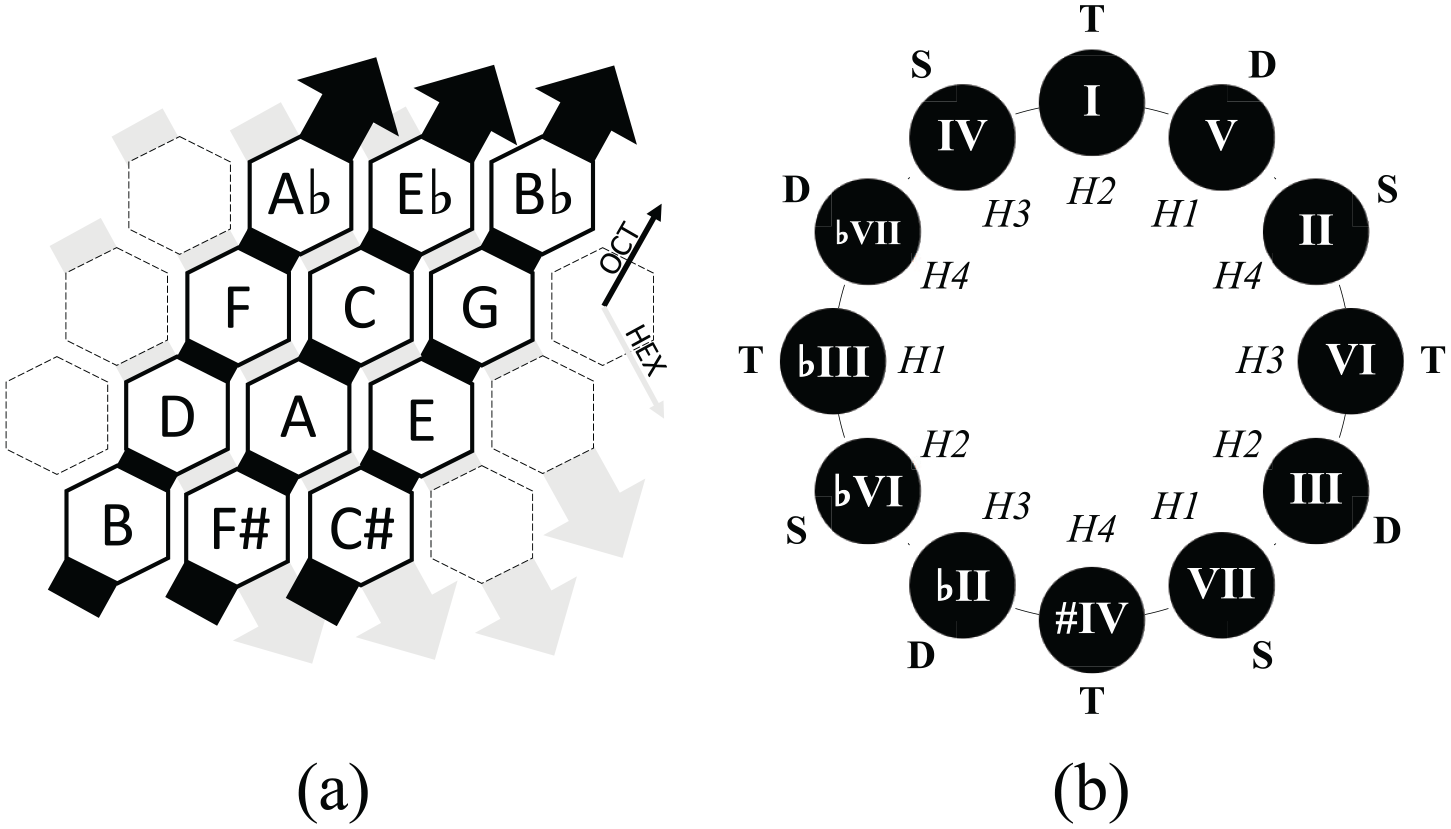
(a) Different dimensions of Euler’s Tonnetz correspond to different relationships of harmonic relatedness: highlighted in the figure are octatonic (dark arrows) and hexatonic (light arrows) relatedness. Motion along one of these dimensions can be interpreted as motion inside a single Octatonic Equivalence Class or Hexatonic Equivalence Class, respectively. (b) The 12 chromatic scale degrees (under enharmonic equivalence) arranged around the circle of fifths. On the outside of the circle, the membership of each scale degree to the
The labeling reflects the fact that, relative to the global key, implication–realization relationships linking the tonic, subdominant, and dominant functions can be generalized in terms of
It should be noted that the functional logic inherited by diatonic tonality is not the only or main structuring principle in extended-tonal idioms. In Tonfeld theory, for example, the above-mentioned OECs generated by stacking minor thirds and imbued with functional meaning coexist with two other types of tonal organization generated by stacking fifths or major thirds (Haas, 2004; Schiltknecht, 2011), the latter broadly related to the hexatonic collections characterized by neo-Riemannian theory (Cohn, 2012). Like OECs, Hexatonic Equivalence Classes (HECs, numbered here as H1–H4 as per Figure 2(b), inner circle) also constitute distinct classes of potentially substitutable chords (Cohn, 2012). However, while hexatonic collections have also been interpreted functionally (Cohn, 1999), movement across hexatonic collections typically conveys a sense of “the uncanny” (Cohn, 2007, p. 230) and contrast rather than the creation and resolution of goal-directed expectancy (Cohn, 2007; Smith, 2020). In other words, with respect to the definition of harmonic functionality given above, HECs are expected to satisfy condition (2), at least to some degree, but not condition (1); that is, substitutability but not the capacity to induce expectancy. While this study specifically targets the perceptual reality of harmonic functionality as modeled by octatonic equivalence, we also test HECs as a plausible and widely investigated alternative characterization of extended-tonal harmony. Our hypothesis is that HEC membership is not a better predictor than OEC membership of listeners’ responses in a task that relies on the perception of harmonic function, such as the one described in the following section.
Aims and hypotheses
For the purpose of our experiment, we intended to target classes of functionally substitutable chords selectively, rather than other types of pitch-space structures. Based on the definition given at the outset, an experimental paradigm aiming to investigate harmonic functionality might exploit goal-directed expectations as proxies for functional hearing and test for similarity in expectancy as a proxy for functional equivalence. In particular, we focused on the defining feature of functionality, which is the syntactic relatedness of functions in terms of their potential to set up patterns of harmonic expectancy (Huron, 2006; Rohrmeier, 2013), or, to put it another way, cadential resolution as captured in condition (1) above. Functions resolve into one another locally and, in particular, cadential resolution into the global tonic is a marker of global harmonic closure (Rohrmeier & Neuwirth, 2015). Thus, representatives of different OECs were hypothesized to differ with respect to the expectations for closure they elicit. For example, chords in
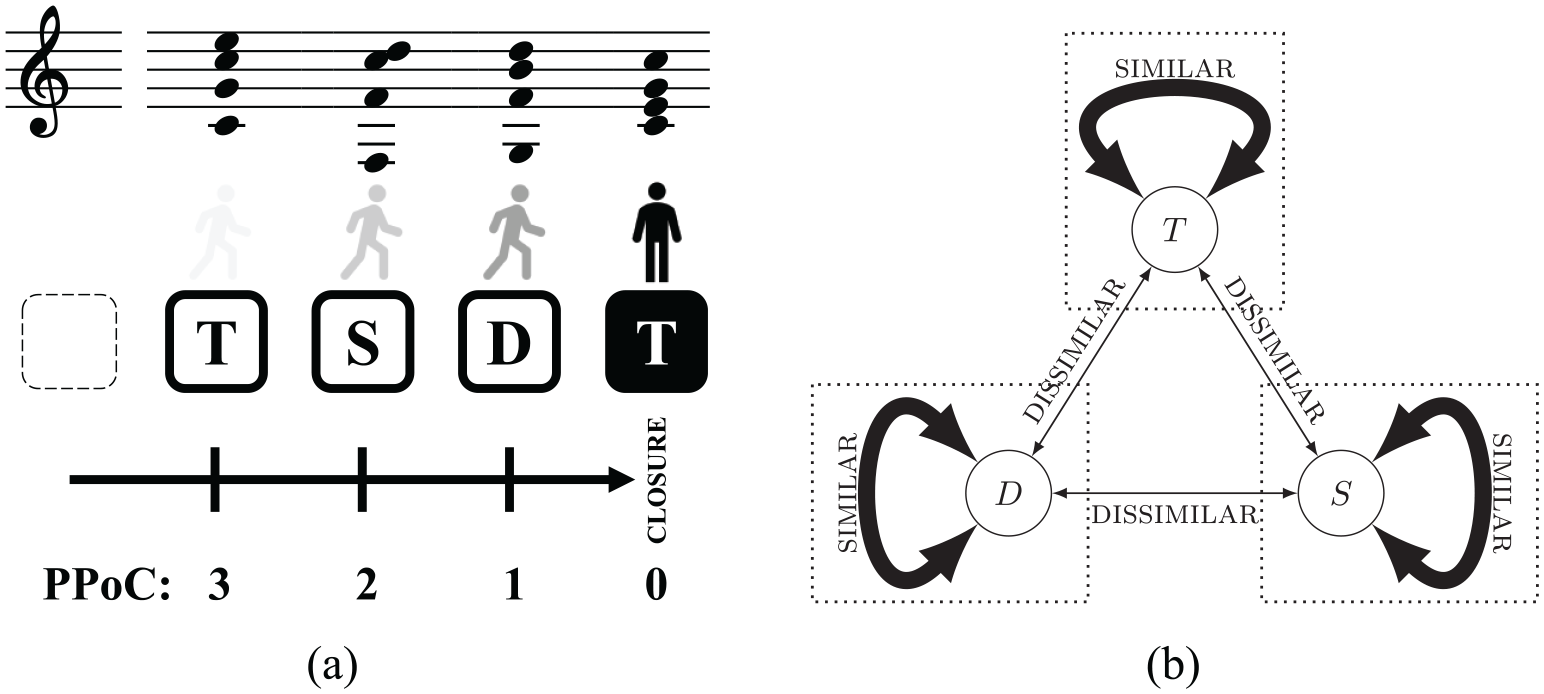
(a) Example of cadential approach to harmonic closure. Each step preceding the achievement of closure instantiates a different function, and listeners may to some extent infer how distant harmonic closure is based on the function of the current harmonic context. The quantitative estimate of such distance, in terms of the number of events missing until closure is achieved, is termed here perceived proximity of closure (PPoC). (b) Schematic visualization of the expected similarity of PPoCs depending on the functional status of the harmonic context. Thick edges connecting a function with itself indicate that contexts expressing the same function are expected to induce mutually similar PPoCs. Thin edges across functions indicate that contexts expressing different functions are expected to elicit different PPoCs. Overall, observing this pattern of similarity and dissimilarity among members of the classes would support the theoretical classification into three mutually distinct classes, as highlighted by the dotted boxes.
Previous research has shown that listeners’ PPoC is predicted by computational models of structural organization (Herff et al., 2021), suggesting that PPoC reflects an implicit knowledge of harmonic relationships (Rohrmeier & Rebuschat, 2012; Tillmann, 2005). In this study, we replicated the experimental paradigm proposed by Herff et al. (2021) and investigated how such implicit knowledge, as reflected by PPoC, relates to a music-theoretical formalization of extended tonality. Specifically, we presented potentially interrupted chord progressions and tested listeners’ predictions as to how imminent harmonic closure would be. We assumed that such predictions reflect the functional status of the harmonic context at the time the prediction is made. Drawing inspiration from the practice of chord substitutions, which are idiomatic in jazz as illustrated in Figure 2(b) (Levine, 1995), we manipulated harmonic context systematically with chromatic transpositions of penultimate and pre-penultimate events in chord progressions (cf. Figure 3(a)). Finally, we tested whether OECs, as music-theoretically motivated markers of functional harmonic status in extended tonality, represent parsimonious and accurate predictors of participants’ expectations compared to other putatively non-functional characterizations of diatonic (i.e., distance on the circle of fifths) and chromatic harmonic relatedness (i.e., chroma distance, HEC membership).
Methods
Participants
One hundred participants (mean age 27.33,
Stimuli
Stimuli for this experiment comprised 24 jazz chord progressions. The jazz style was adopted because explicit chord substitutions are idiomatic in jazz improvisational practice (Levine, 1995), offering a natural template for our experimental manipulation as detailed below. Furthermore, jazz harmony shares characteristics with both classical and rock/pop traditions (McGowan, 2010; Rohrmeier, 2020), potentially resonating with the implicit harmonic familiarity of a variety of Western listeners. In order to clarify the stylistic context, chords were realized in 4-part voicings, as is idiomatic in jazz (Levine, 1989; McGowan, 2011). Accordingly, in the following, the triangle
Each chord progression comprised an initial 8-chord introduction sequence and a 6-chord core, the latter falling into either the Complete or Incomplete category as illustrated in Figure 4 and explained in detail below. The introductory sequence comprised a repeated
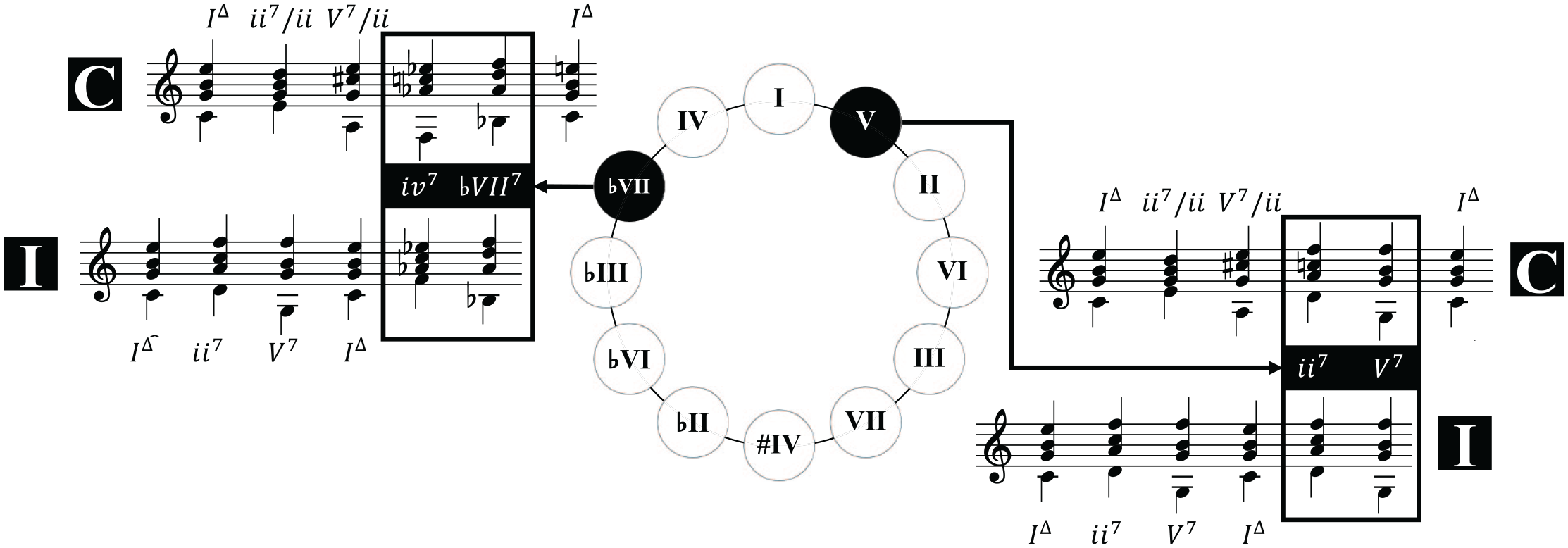
Examples of Complete (C) and Incomplete (I) stimulus cores for two different substitutions. On the right, the original 6-chord core progressions are shown, where the
Complete stimuli
The core of each Complete chord progression was obtained starting with a
Incomplete stimuli
The cores of Incomplete chord progressions were obtained starting with a
The voicing of the transposed block in Complete and Incomplete stimuli was adjusted for better fit to the chords that preceded and followed it. We term the transposed
Experimental task
In each trial of the main experimental task, one of the Complete or Incomplete chord progressions was presented in a random transposition from −4 to +7 semitones relative to C major. In a replication of the task described by Herff et al. (2021), participants were told that each stimulus represented the potentially interrupted concluding section of a song and asked to estimate how many more chords they would have expected to come before the end of the song. We interpreted this estimate as a measure of the PPoC (cf. Figure 3(a)). Participants clicked a mouse to select an integer value between 0 (meaning that they perceived the chord progression to be complete as presented) and 3 (meaning that they expected three chords to be missing for the chord progression to be complete), presented on screen as a horizontal array of labeled buttons. After recording the PPoC, participants were asked to report how confident they were about their estimate by selecting a value between 0 (not confident) and 100 (fully confident) on a quasi-continuous horizontal rating scale.
Procedure
The experiment was administered online. The user interface for the main experimental task was implemented in PsychoPy 3 (Gallant & Libben, 2019; Peirce et al., 2019) and hosted on the online repository Pavlovia.org (Bridges et al., 2020). At the beginning of the experimental session, participants were shown an informed consent form and proceeded to the instructions after confirming consent. Instructions for the main experimental task included a tutorial trial using a stimulus that was not part of the materials described in the “Stimuli” section. Over the course of the session, four presentations of each chord progression were arranged in random order, resulting in a total of 96 trials interleaved by 3s of white noise to mitigate any carry-over effects of key across trials. After completing the main behavioral task (lasting ~40 min), participants filled in the Gold-MSI questionnaire (~8 min).
Analyses
Individual similarity and joint entropy
Since we expected substitutions sharing the same function to elicit similar PPoCs, we quantified their similarity by defining the individual similarity between two stimuli (IND) for each participant as the proportion of identical
1
PPoC values estimated by each participant across the different presentations of the two stimuli. Specifically, if

where
Modeling the effect of substitution classes on IND
Our aim was to investigate whether consistency in PPoC, as quantified by IND, reflects music-theoretically motivated equivalence classes between substitutions. We therefore aimed to define models predicting the values of IND based on features that encode the music-theoretical relatedness of harmonic substitutions. For each pair of stimuli, we characterized the relationship between the substitutions they contain in five different ways as follows:
The SemitoneDistance variable quantifies the shortest distance in semitones, under octave equivalence, between the two substitutions (e.g., the
The OctPair categorical variable encodes the functional status of the dominant-seventh chords contained in the two given substitutions (e.g., the
Similarly, the HexPair categorical variable encodes the substitutions’ membership of hexatonic classes (e.g., the
Finally, the SubstitutionPair categorical variable explicitly encodes the pair of substitutions contained in the two given stimuli (e.g., the pair containing substitutions
Each pair of stimuli is further characterized by its CompletenessStatusPair, a categorical variable encoding whether the two stimuli in the pair are both Complete (CC), both Incomplete (II), or with opposite completeness status (IC).
Bayesian mixed-effects models
After standardizing all non-categorical variables to null mean and unit standard deviation, data were analyzed with Bayesian mixed-effects models provided with weakly informative priors (t(3,0,1); Gelman et al., 2008) and implemented in the R package brms (Bürkner, 2018). For each one of the main predictors

where MusicalTraining is quantified through the corresponding subscale of the Gold-MSI. Each such compound predictor models the main effect of predictor

allowing for a participant-specific random intercept. Such a model predicts the values of IND for pairs of stimuli based on all compound predictors in
Results
Distributions of PPoC
Average PPoC for all Complete and Incomplete stimuli are shown in Figure 5 separately for each substitution. The minimal expected effect was that Complete stimuli (i.e., stimuli ending on the stable global-tonic chord) would have a significantly higher probability of being perceived as requiring no more chords than Incomplete stimuli, which end on a dominant-seventh chord. A paired t-test comparing the proportion of zeros among the PPoC responses to Complete versus Incomplete stimuli (
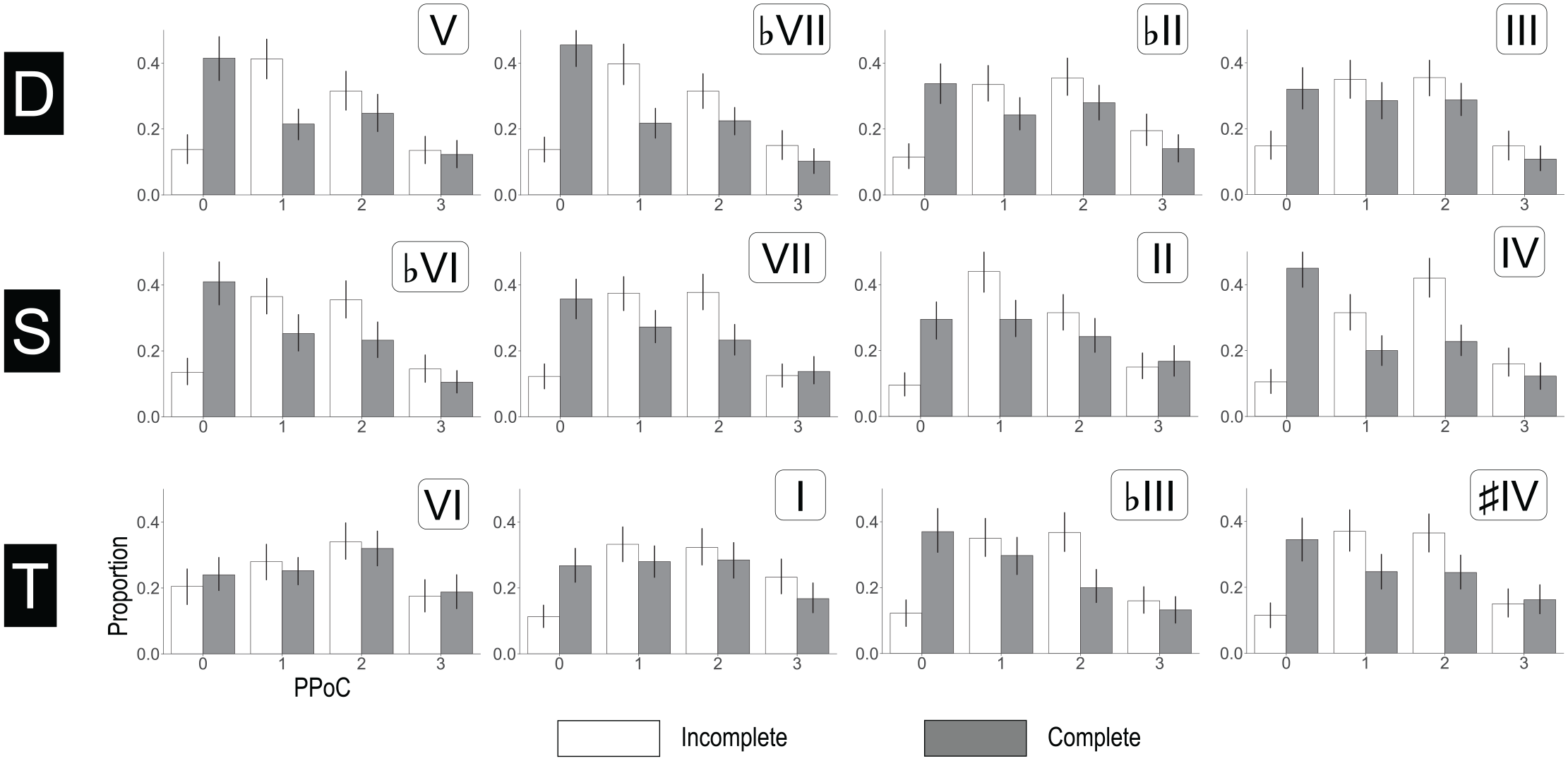
Distributions of PPoC responses across all participants for Complete (dark bars) and Incomplete (light bars) stimuli. Each panel reports data for a given substitution, as indicated by the corresponding label. Panels are arranged so that each row comprises substitutions from the same OEC, indicated by the label on the left. In all stimuli the proportion of PPoC 0 is greater in Complete than in Incomplete stimuli, indicating that ending on a global-tonic chord increased the likelihood of null PPoC irrespective of the substitutions.
Additional exploratory analyses of the response distributions are available as Supplementary Material S3, including a two-dimensional representation of the relative distances between response distributions of different substitutions, obtained through multidimensional scaling, and a statistical evaluation of within-OEC and across-OEC distances. However, note that the analysis of response distributions pooled across participants may fail to capture aspects of the participants’ perception; for example, response distributions for two stimuli may be identical with no single participant reporting the same PPoC in both stimuli. We therefore analyzed the data further by quantifying similarity and uncertainty among stimuli on an individual basis, as discussed above and reported below.
Model comparison
Table 1 shows the results of the comparisons between all the models, each predicting IND based on a different set of predictors. The best performing model had
Comparison among IND(X) models predicting IND values based on different subsets X of compound predictors (see Section Bayesian mixed-effects models).
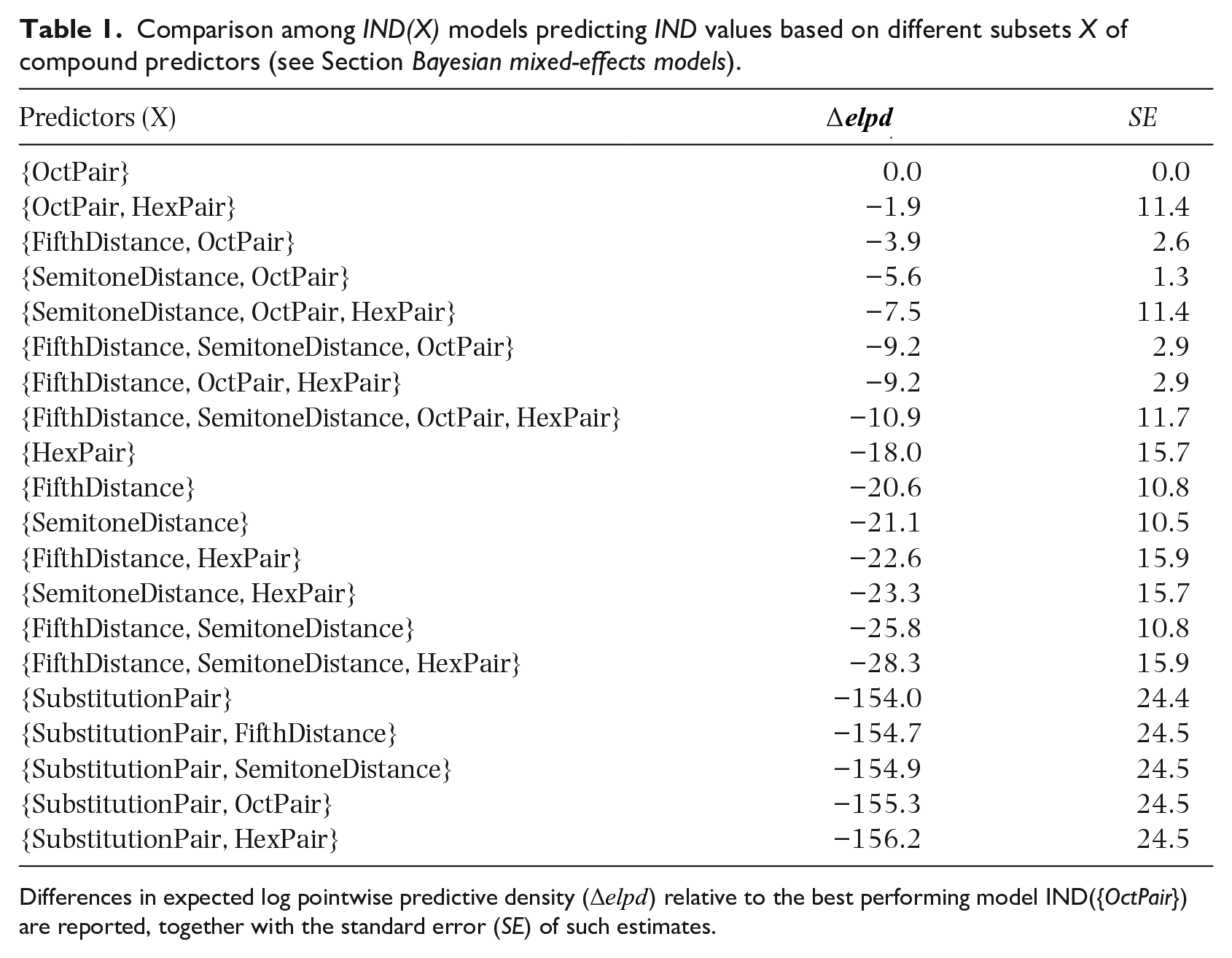
Differences in expected log pointwise predictive density (∆
Effect of music-theoretical relatedness on perceived functional equivalence
The results presented above show that model
Effects of completeness and musical training
As shown in Figure 6, the IND values strongly depended on the CompletenessStatusPair of the pairs of stimuli (i.e., whether the pair comprised two complete stimuli [CC], two incomplete stimuli [II], or a complete and an incomplete stimulus [IC]). Specifically, taking IC as the reference level for factor CompletenessStatusPair, PPoCs for pairs of Complete (
Membership of OECs
To find out if OECs were perceived as correlates of harmonic functionality, we tested whether IND scores among OECs reflected the expected similarity relations illustrated in Figure 3(b). Specifically, we wished to test whether IND scores were higher within than across OECs. We therefore let

This value quantifies the evidence in favor of the hypothesis that the IND scores between two (In)Complete stimuli with substitutions in OECs
Complete stimuli with substitutions in the
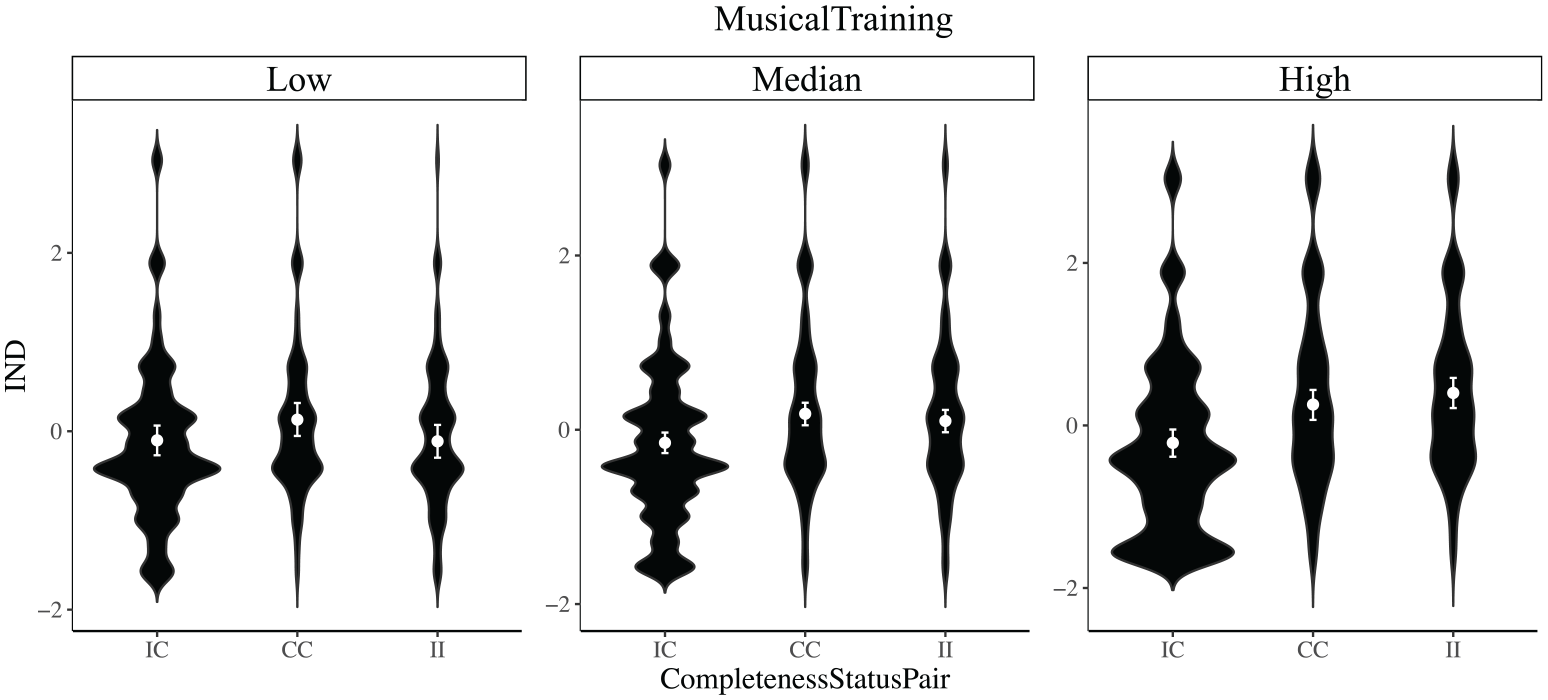
Distribution of IND values by CompletenessStatusPair for three ranges of musical training: bottom quartile (left panel), interquartile range (middle panel), and top quartile (right panel). White marks (with 95% CI) report the completeness status’s conditional effect on IND at the midpoints of each musical-training range. CC and II pairs have higher IND than IC pairs for increasing musical expertise.
In Incomplete stimuli, no evidence was found for any OEC or group of OECs to constitute a separate class in perception. Specifically, for no OEC were IND scores higher among its members than they were across its members and members of a different OEC (for
Post hoc analysis of joint entropy
The results reported above show that, for Complete stimuli, members of
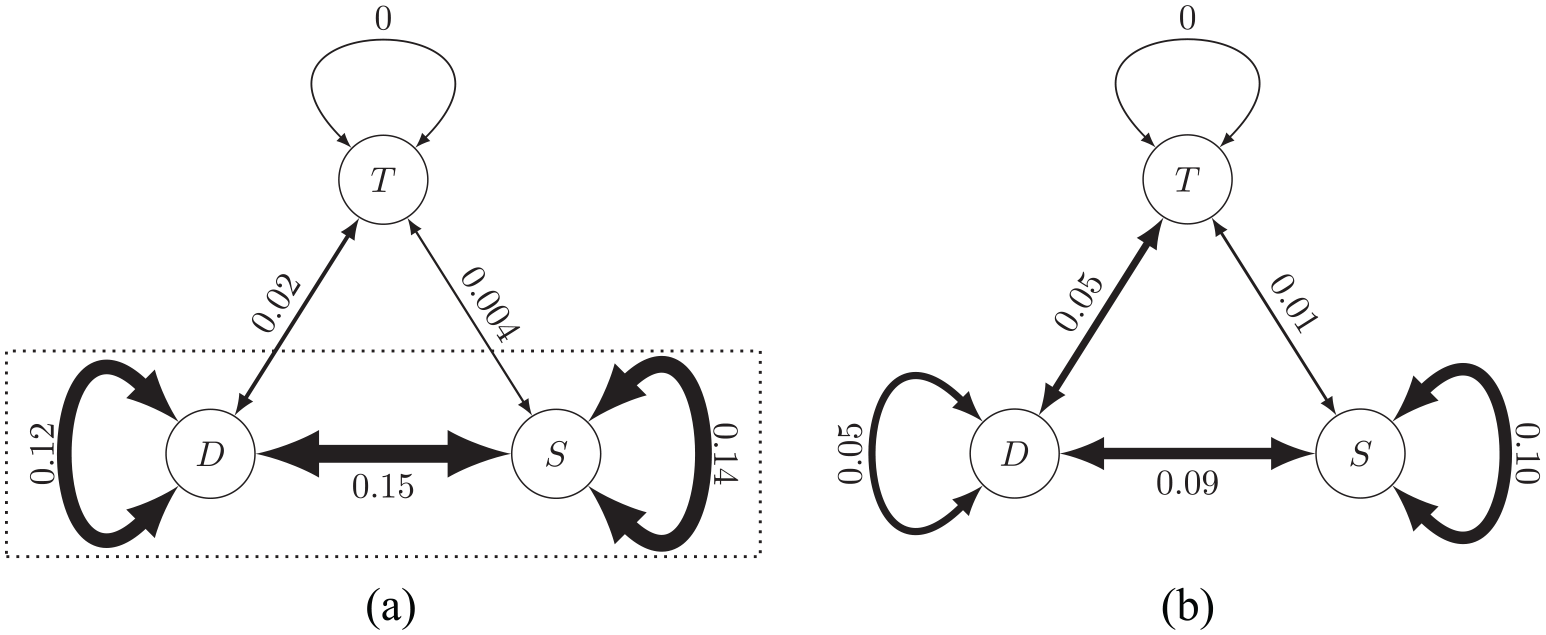
Graphs show the observed relationships of similarity between pairs of OECs for Complete (a) and Incomplete (b) stimuli. The thickness of the edge connecting two nodes
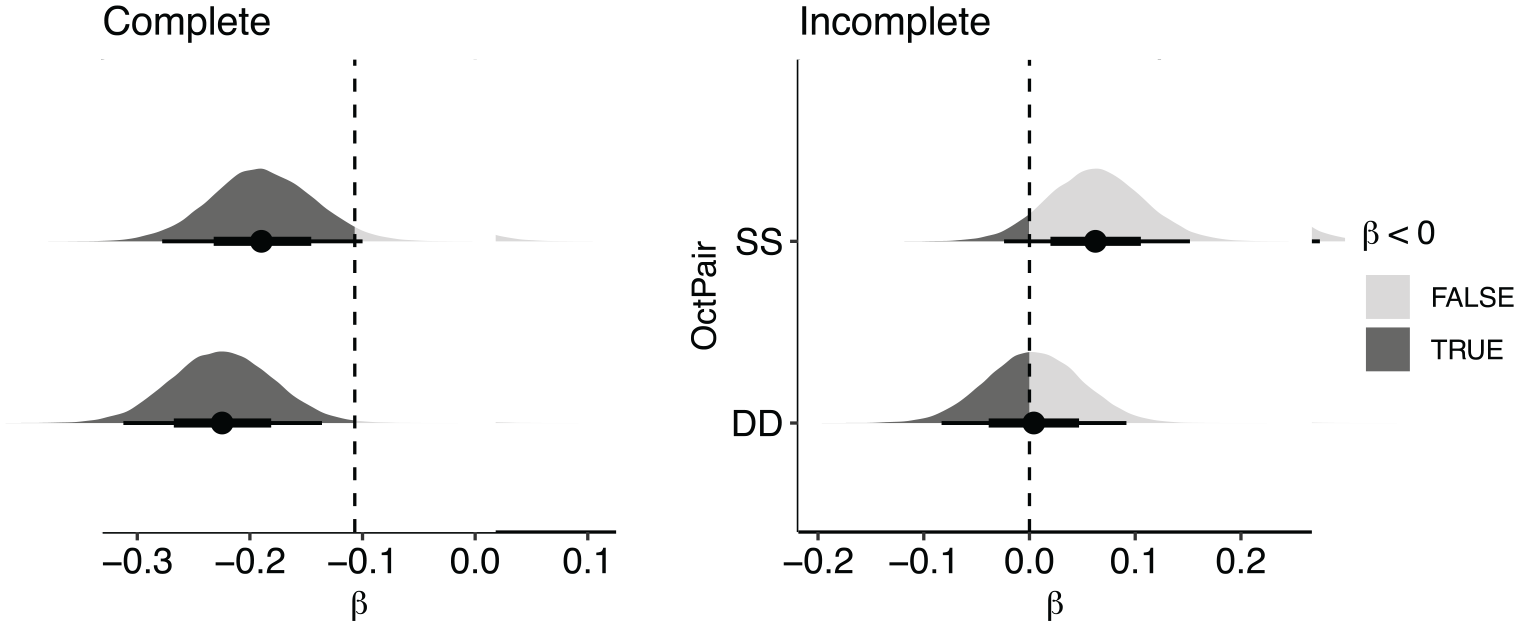
Posterior distribution of the incremental effect on the joint entropy, relative to the reference category
Discussion
In this study, we set out to test the extent to which perceived functional equivalence, as quantified by similarity in the perceived proximity of harmonic closure (PPoC), reflects music-theoretical accounts of harmonic function, as drawn from theories of extended tonality. Our results show that music-theoretical accounts attributing functional meaning to OECs in the extended-tonal harmonic idiom are not only appropriate characterizations of both historical and current compositional practices, but also provide a parsimonious model of perceived functional harmonic relations for a sample of listeners who are familiar with different instantiations of compositional practices in the idiom of extended tonality. We found that OECs differ in terms of the clarity of the expectation for closure their members elicit, as well as in terms of their coherence as equivalence classes. In particular, our results indicate a comparatively lower relatedness among members of
While our results are consistent with the hypothesis that OECs as functional categories may constitute a cognitively relevant representation of pitch-space structure, the present results should not be read as conclusive evidence that listeners’ perception is guided in some sense by representations of such structuring principles. Other classifications of harmonic sonorities may also characterize perception similarly or even more accurately, and more complex models with maximal random-effects structure (Barr et al., 2013) may further identify sources of inter-participant variability potentially underlying the reported effects. Overall, while we cannot fully conclude that listeners’ cognitive representation of pitch space employs OECs or an isomorphic representation, the present results offer empirical evidence that OECs may be adopted as a way of formalizing, modeling, and expressing listeners’ functional hearing. Such parsimonious descriptive adequacy of OECs in perception may have represented a stable equilibrium toward which compositional practices and music-theory have converged, contributing to the feedback loop between the introspections of composers, musicians, and theorists (folk psychology, as described by Cross, 1998), on one hand, and idiomatic musical practices and theoretical formalizations on the other hand.
According to our analysis, Complete and Incomplete stimuli elicited different behavioral responses. Specifically, PPoC between a Complete and an Incomplete stimulus was less similar than PPoC between two Complete or two Incomplete stimuli. Furthermore, increased musical training seemed to favor the likelihood for listeners to report the same PPoC for two Incomplete stimuli to a greater degree than for two Complete stimuli. Recall that the core chord progressions underlying Complete and Incomplete stimuli were different, so that their lengths could be matched. However, it is unclear why musical training would have different effects on the two types of progressions. A possibly more salient common feature of Complete stimuli is that they all ended with a global tonic, whereas each Incomplete stimulus ended with a different chord. Such surface similarities alone may explain the finding that pairs of Complete stimuli elicited similar PPoCs irrespective of listeners’ expertise, while experienced listeners would, in their responses, reflect the less salient structural similarity of Incomplete stimuli to a greater extent.
Complete and Incomplete stimuli also differed in terms of how substitutions produced harmonic functionality. For Incomplete stimuli, substitutions in both
In light of the low average degree of musical sophistication of our participants, and of the scarce evidence for an effect of musical training beyond Complete/Incomplete discriminability, it should be expected that the correspondence between perception and the structural principles guiding composition are a result of musical acquisition processes and implicit learning from exposure to particular musical repertoires (Pearce et al., 2010; Reber, 1989; Rebuschat, 2022; Rohrmeier, 2010; Rohrmeier & Rebuschat, 2012). This leaves open the question as to which aspects of compositional practice are actually acquired by listeners. In particular, substitutability is a core feature of functional harmony, and listeners may learn through exposure to identify chords belonging to the same OEC as substitutes by observing how frequently they occur in analogous contexts (Jacoby et al., 2015; Rohrmeier & Cross, 2008; White & Quinn, 2018). If this were the case, we would expect high similarity of PPoC within OECs, and low similarity across OECs, as illustrated in Figure 3. However, our results do not show that members of the same functional class behave as mutual substitutes by systematically eliciting similar response patterns from our participants, or that the three OECs form three distinct families of substitutes. On the contrary, functional classes can be distinguished based on the degree of similarity among their members, at least insofar as
The commonality of
Overall, we can conclude that representatives of the tonic function elicit incoherent patterns of expectations when employed as preparations for some harmonic goal within a tonal context. This observation may be interpreted as indicating the difficulty of parsing, or interpreting, chord progressions in which members of
The perceptual biases we identified may be thought of as part of a competence (Chomsky, 1965) for harmonic syntax in music, forming the basis of the capacity for processing and interpreting idiomatic extended-tonal music (Cecchetti et al., 2020; Lerdahl & Jackendoff, 1983; Steedman, 1996). Our results may thus inform theoretical and computational models attempting to formalize such implicit knowledge (e.g., Harasim et al., 2020; Rohrmeier, 2020; Steedman, 1984), as well as the human capacity to learn (Harasim, 2020) and process musical harmonic structure (Granroth-Wilding & Steedman, 2014; Harasim et al., 2018; Jackendoff, 1991). In particular, experimental evidence supports the view that listeners construe mental representations of hierarchical musical structure (Cecchetti et al., 2021; Herff et al., 2021; Koelsch et al., 2013; Leino et al., 2007; Serafine et al., 1989). In modeling such representations, the present results offer empirical support for the choice of syntactic dependencies that reflect observed harmonic relationships, as suggested, for example, in syntactic accounts of extended tonality (Rohrmeier & Moss, 2021). Nevertheless, further investigation into the role of stylistic familiarity and musical expertise is necessary, as the present results are only representative of some so-called average listener with generically Western musical enculturation, while the relationship between music-theoretical formalization and perception is likely to be strongly dependent on musical idiom and individuals’ exposure and training.
In this study, stimuli were designed to be particularly evocative of jazz voicings, with the purpose of providing listeners with a deliberately chosen, ecologically valid stylistic context in which extended-tonal harmony and functional substitutions are idiomatic (Levine, 1995; Rohrmeier, 2020). However, while there are global principles of extended tonality that persist over its entire historical span (Haas, 2004; Rohrmeier & Moss, 2021; Tymoczko, 2011), jazz harmony is a specific instantiation of certain stylistic preferences within the possible range of musical relations. For example, tritone substitution is particularly prominent in jazz harmony (Biamonte, 2008; Levine, 1995), while backdoor substitutions and plagal closure are typical in pop and rock (de Clercq & Temperley, 2011; Doll, 2017; Everett, 2004; Moore, 1995; Temperley, 2011). As a consequence, it is likely that prevalent individual familiarity with pop and rock music and its stylistic preferences may have influenced perceived harmonic relatedness as quantified in this study, as suggested by previous evidence for the stylistic priming of harmonic expectancy (Vuvan & Hughes, 2019). Future research may also investigate how patterns of harmonic relatedness are influenced by metricality, which was not manipulated in our experimental design. Specifically, metrical weight may interact with harmonic expectancy, hence with perceived harmonic functionality.
Finally, hexatonic relatedness did not capture any additional variance in our data compared to octatonic relatedness. Considering that our task was based on goal-directed expectancy, a characteristic aspect of functional harmony, this observation suggests that HECs were not perceived by listeners as carrying this type of functional meaning, consistently with music-theoretical literature. It should be noted that previous empirical approaches to tonal relatedness based on probe-tone profiles also failed to find evidence for the perceptual reality of hexatonic relatedness (Krumhansl, 1990). Nevertheless, these results do not exclude the possibility that hexatonic relatedness may constitute a cognitively relevant representation with non-functional meaning, for example, by expressing manipulations and contrasts of harmonic color. While tasks leveraging goal-directed expectancy as a proxy of harmonic relatedness have already offered an accessible gateway into the perception of functional tonal harmony, it will be a challenge for future research to identify appropriate experimental paradigms to investigate notions of harmonic relatedness in non-functional harmony, including transformational and non-functional aspects of extended-tonal musical practices (see, for example, Guichaoua et al., 2021).
Conclusion
This study highlights similarities and differences between music-theoretical accounts of functional harmony in extended tonality, on one hand, and perceptual manifestations of harmonic functionality in the perceived proximity of harmonic closure (PPoC), on the other hand. We found evidence that OECs, as defined music-theoretically, parsimoniously predict similarity in a behavioral response such as PPoC. However, while such theoretical accounts hypothesize three distinct OECs, characterized by similar PPoCs within classes and dissimilar PPoCs across classes, this is not directly reflected in our results. In fact, we rather observed members of class
Supplemental Material
sj-docx-3-msx-10.1177_10298649221122245 – Supplemental material for Hearing functional harmony in jazz: A perceptual study on music-theoretical accounts of extended tonality
Supplemental material, sj-docx-3-msx-10.1177_10298649221122245 for Hearing functional harmony in jazz: A perceptual study on music-theoretical accounts of extended tonality by Gabriele Cecchetti, Steffen A. Herff, Christoph Finkensiep, Daniel Harasim and Martin A. Rohrmeier in Musicae Scientiae
Supplemental Material
sj-docx-4-msx-10.1177_10298649221122245 – Supplemental material for Hearing functional harmony in jazz: A perceptual study on music-theoretical accounts of extended tonality
Supplemental material, sj-docx-4-msx-10.1177_10298649221122245 for Hearing functional harmony in jazz: A perceptual study on music-theoretical accounts of extended tonality by Gabriele Cecchetti, Steffen A. Herff, Christoph Finkensiep, Daniel Harasim and Martin A. Rohrmeier in Musicae Scientiae
Supplemental Material
sj-zip-1-msx-10.1177_10298649221122245 – Supplemental material for Hearing functional harmony in jazz: A perceptual study on music-theoretical accounts of extended tonality
Supplemental material, sj-zip-1-msx-10.1177_10298649221122245 for Hearing functional harmony in jazz: A perceptual study on music-theoretical accounts of extended tonality by Gabriele Cecchetti, Steffen A. Herff, Christoph Finkensiep, Daniel Harasim and Martin A. Rohrmeier in Musicae Scientiae
Supplemental Material
sj-zip-2-msx-10.1177_10298649221122245 – Supplemental material for Hearing functional harmony in jazz: A perceptual study on music-theoretical accounts of extended tonality
Supplemental material, sj-zip-2-msx-10.1177_10298649221122245 for Hearing functional harmony in jazz: A perceptual study on music-theoretical accounts of extended tonality by Gabriele Cecchetti, Steffen A. Herff, Christoph Finkensiep, Daniel Harasim and Martin A. Rohrmeier in Musicae Scientiae
Footnotes
Acknowledgements
The authors thank Claude Latour for supporting this research through the Latour Chair in Digital Musicology at EPFL. The authors would also like to thank Ken Déguernel and the members of the Digital and Cognitive Musicology Lab for fruitful discussions, as well as the Editor, Prof. Jane Ginsborg, and two anonymous reviewers for their thoughtful contributions during the review process. G.C. conceptualized the study, implemented the methodology, collected and analyzed the data, and wrote the original draft. All authors contributed to the conceptualization and reviewed the draft. S.A.H., C.F., and D.H. contributed to the methodology. S.A.H. and M.A.R. provided supervision and acquired funding.
Funding
The authors disclosed receipt of the following financial support for the research, authorship, and/or publication of this article: This project has received funding from the European Research Council (ERC) under the European Union’s Horizon 2020 research and innovation program under grant agreement No. 760081-PMSB.

Supplemental material
Supplemental material for this article is available online.
Notes
References
Supplementary Material
Please find the following supplemental material available below.
For Open Access articles published under a Creative Commons License, all supplemental material carries the same license as the article it is associated with.
For non-Open Access articles published, all supplemental material carries a non-exclusive license, and permission requests for re-use of supplemental material or any part of supplemental material shall be sent directly to the copyright owner as specified in the copyright notice associated with the article.
