




Abstract
As a result of the COVID-19 pandemic, many cultural and artistic programs for older adults have been put on hold, despite the numerous physical, social, and emotional well-being benefits continued participation may bring. This article details a cross-section of participants (n = 13) in the Active Minds Music Ensemble—a longitudinal Australian-based research project that provides 12 months of group music instrument lessons to healthy older adult novices—who transitioned from face-to-face (F2F) to an online format. Research questions include the benefits and challenges for older adults as they cope with the technological demands of “going online,” perceived effects on teaching and older adults’ musical learning, as well as perceived effects on group learning benefits. Qualitative data were collected from three different perspectives: i) a frequently asked questions (FAQ) report from the research team documenting technological issues, ii) individual semi-structured interviews with the participants, and iii) a reflective report from the teacher. The findings confirm that online group music instrument lessons are viable for and valued by older adults, with appreciation of continued technical support. Teaching and learning changed as a result of the online format, primarily in the reduction of individual feedback and less interplay between participants; this was mitigated by use of various functions such as chat, whiteboards, and breakout rooms. Implications for older adult online music instrument lessons include providing continued technical support to learners and helping them maintain confidence with technology. Social opportunities for informal “side-chatter” may also help them to empathize with and encourage each other during music learning activities.
Participation in leisure activities including sports, community groups, cultural, and artistic activities has been linked to better health and well-being through over 600 different mechanisms. Although some of these mechanisms have immediate effects, others can unfold over time (Fancourt et al., 2021). For older adults, continued social and creative engagement in cultural activities is important for maintaining their health and well-being (Tymoszuk et al., 2019), and to an extent may protect individuals from dementia (Fancourt et al., 2019) and frailty (Rogers & Fancourt, 2020).
One effect of the COVID-19 pandemic is that many arts organizations, and community and care services, have been offering more online content and activities for older adults. According to the UK-based Baring Foundation, only 20% of creative aging organizations delivered services via some form of remote methods pre-pandemic, increasing to 87% post-lockdown (Cutler, 2020). Nevertheless, many community cultural and social activities for older adults ceased, with evident impacts on mental and physical health (Age UK, 2020).
Organizations providing educational, social, and creative activities for older adults, such as the University of the Third Age, 1 demonstrated the benefit of online provision in pre-pandemic times (Githens, 2007). Online provision enables a range of barriers to physical access to be overcome, such as lack of transport, distance, and inconvenient scheduling. However, as older adults are subject to an array of digital access inequalities (e.g., lack of a stable Internet connection, unavailability of a personal device), and experience barriers to digital literacy, including confidence and the ability to use various new technological devices and platforms, arts-based programs need to be planned with these audiences in mind (Hebblethwaite et al., 2020).
The view that older adults’ lack of digital engagement is attributable to poor digital literacy reflects the tendency of research in human-computer interaction, and in the wider gerontology literature, to treat older adult users as one homogenous group (Neves et al., 2018; Vines et al., 2015). Despite the persistence of ageist stereotypes suggesting a resistance to the use of technology (Githens, 2007) and the fear of contributing to a negative stereotype of low technological ability (Mariano et al., 2021), most older adults in the United Kingdom (Centre for Ageing Better, 2020) and Australia (Maccora et al., 2019) were using digital technology on a daily basis before the pandemic. During the pandemic, there have been more incentives to use technology, highlighting inherent digital inequality barriers (Centre for Ageing Better, 2020). Although the general use of technology by older adults (e.g., for shopping, banking, information finding, and communicating) is increasing, older adults are less likely than adults in other age groups to adopt communication technologies (e.g., teleconferencing software such as Skype and Zoom), for numerous reasons that cannot solely be classified as age-related, such as attitudes to use, education, and access to technology (Neves et al., 2018). Communication technologies can be a vehicle for maintaining or increasing meaningful social interactions that play an important role in the well-being of older adults (Neves et al., 2019). In order to further understand different contexts in which communication technologies may assist with older adult well-being, the present study provides an opportunity to examine the abrupt transition from face-to-face (F2F) to online participation primarily through the use of teleconferencing software for older adults involved in a creative cultural activity, in this case, learning how to play a musical instrument.
Learning to play a musical instrument for the first time in older adulthood may provide a number of cognitive, social, and emotional benefits (Bugos et al., 2007; Creech et al., 2014; MacRitchie et al., 2020; Schneider et al., 2018). Older adults have several motivations for starting to learn to play a musical instrument. Individuals may wish to fulfill a long-held desire to learn an instrument, re-frame their identity as somebody musical, and/or share music with family members or friends (Creech et al., 2020). Music instrument learning can be accessed through formal education programs (e.g., University of the Third Age), informally (e.g., individually through resources found online) or in non-formal contexts such as bands, orchestras, and choirs (e.g., New Horizons groups, cf. Jutras, 2011, which older adults can join as beginners). A review of 18 empirical studies of older adults’ use of music technology concluded that older adults, including those living with dementia, demonstrated a general capability and interest in devices that allowed them to access favorite music, to move to music, or to play or perform music (Creech, 2019). Favilla and Pedell (2013, 2014) and Taylor et al. (2021) report the successful use of interfaces such as touch-screen tablet devices and custom MIDI controllers with physical buttons by older adults with dementia in the context of group music making in the community, and older adults with varying physical and cognitive abilities in residential care, respectively. These studies showed not only that it is possible to make music using these devices but also that participants enjoyed sessions when the quality of musical interaction was perceived as high. Online communities have for a long time enabled people to learn to play musical instruments using a variety of approaches that can suggest ways of overcoming barriers to participation (for reviews see Bauer & Mito, 2017; Creech et al., 2020), with a recent survey of learners showing high levels of support for technological tools such as digital metronomes, tuners, and recording devices (Waddell & Williamon, 2019). Until recently, only a few studies have investigated how synchronous non-formal contexts for learning can be replicated online, the majority focusing on children or young, rather than older, adult learners. As highlighted by Biasutti et al. (2021), delivering music lessons online involves more than delivering them on camera as though they were F2F, albeit with added technical challenges; this mode of delivery also has an impact on the pedagogical and learning techniques used.
Online distance learning (ODL) is an established method in school-based learning that can involve both synchronous and asynchronous activities. Synchronous music lessons delivered online via teleconferencing platforms, although feasible, are often hampered by issues of latency and sound quality (Dammers, 2009; Kruse et al., 2013). Until recently, this form of ODL has only been used to supplement F2F teaching (Dammers, 2009; Hash, 2021) or for providing more access for remote communities (King et al., 2019a). However, the abrupt move of many education institutions across the world to remote learning as a result of the COVID-19 pandemic has produced opportunities to examine online practice on a wider scale, including non-educational contexts in which online practice, unlike ODL, has not been designed for the specific setting.
Band directors from elementary to high school level were recently surveyed on their priorities and challenges in delivering remote teaching during the pandemic. Maintaining student well-being and motivation to continue music making were their main priorities, while students’ access to technology and their technological skills were rated more often as minor than major or extreme challenges (Hash, 2021). Nevertheless, these are common features in the reports of those considering how to provide music lessons at the collegiate level (Biasutti et al., 2021). A recent study of Italian conservatory students who experienced the sudden transition from F2F to remote learning during COVID-19 noted changes in the nature of communication in lessons between teachers and students attributable to both negative and positive aspects of remote teaching and learning (Schiavio et al., 2021). Participants reported variable Internet connections that were often broken, so they needed to concentrate harder on the more detailed explanations they requested from their teachers. They also reported, to an increasing extent, forming communities of practice where they made connections with other students outside the formal teaching context. In the same project, Biasutti et al. (2021) examined teachers’ experiences of online instruction, identifying seven themes: a) COVID-19 and the music school—how online instruction was managed by the school, rather than through individuals; b) technology—use of platforms and software, and the limitations of connectivity and audio quality; c) curriculum planning—for example, when participants noted making pedagogical transitions such as replacing non-verbal demonstrations with verbal instruction; d) managing instrumental lessons—difficulty seeing what students were actually doing, and providing less frequent and slower feedback online; e) examinations—the conduct of formal examinations; f) strengths—organization, flexibility, time-management, and space; g) limitations—teachers’ work-life balance and time spent away from lessons, offline. Both teachers and students perceived their relationships to be dynamic, changing throughout the course of lockdown (Philippe et al., 2020). Results indicated that when this relationship was adapted during remote instruction to the specific learner, the teacher–student dyad could discover a new, positive form of interaction.
As more and more older adults learn music (Creech et al., 2020) and, because of the pandemic, arts activities are increasingly being provided online (Cutler, 2020), it is vital to understand the experiences of older adults making use of this provision to learn to play a musical instrument. The Active Minds Music Ensemble (AMME) is the training program that was investigated in a longitudinal research project based in Australia; it provides a sample of 68 healthy older adult novices with 12 months of group music lessons. This article reports a case study involving a cross-section of these participants (n = 13) who made the transition from F2F learning to fully online learning during the COVID-19 pandemic. 2 We asked the following research questions: broadly speaking,
What are the benefits and challenges for older adults of learning a musical instrument online?
What are the perceived effects on older adults of learning music online?
What are the perceived effects on older adults of group learning online?
Methods
Design
Qualitative tools and methods were used to draw a picture of the perceived effects on older adults, and the benefits and challenges for them of learning to play a musical instrument online, in a group. First, an FAQ-style document was compiled by the research team to record, in detail, the transition from F2F to online learning. Second, semi-structured one-to-one interviews were conducted with the participants to explore the implications of online delivery of teaching and learning for group integration and group dynamics. Third, the teacher submitted a report on his experience of the transition from F2F to online teaching.
Training program and technology requirements
The first participants in the AMME training program, which is still ongoing, began taking 60-minute lessons once every other week in November 2019. Participants learn by ear, instruction being given via aural prompts rather than using any form of notation. Full details of the program are in the Supplemental Material online.
The last F2F lessons were given on March 18 and 20, 2020. There was then a three-week hiatus until the next lessons could be delivered online on April 8 and 10, 2020. During this hiatus, the research team helped all participants, regardless of whether they were using Windows, Mac OS, or Linux platforms, first, to download, unzip, and install prototype software to enable performances on a piano keyboard connected to a PC or laptop computer to be recorded, and all but one of the cognitive tests to be administered. We chose to develop our own prototype data-collection software to accommodate user feedback, and to continue collecting data online. Second, the research team helped all participants to create an email address using the iPad Mail application (app), or to link an existing email address to the app, to continue collecting data from the iPad app Thumbjam (a musical instrument), and to administer the remaining cognitive test. Third, the research team helped all participants to download and operate Zoom, so that lessons could be delivered online.
A dedicated technical support assistant was hired in May 2020 to provide individual assistance to the participants and teacher for issues including those associated with Zoom. The assistant joined all the scheduled lessons and offered extracurricular one-to-one support for issues that emerged during the project. Subsequently, all the online lessons were recorded, password-protected and made available to participants on a time-limited basis so that they could be reviewed if participants experienced difficulties with their Internet connection.
Participants
In mid-March 2020, when social restrictions were first enforced in Australia, two groups of participants (n = 15) were enrolled on the AMME training program. A total of 13 went on to take online lessons, 3 all of whom had been recruited between September 2019 and January 2020, expecting lessons to be fully F2F. Of these participants, seven (Group 1: 4 women and 3 men, with a mean age of 69.6 years, SD = 4.5) took 10 lessons F2F, and six (Group 2: 5 women and 1 man, with a mean age of 72.2 years, SD = 1.8) took just two lessons F2F before social restrictions were enforced. 4 We selected these participants for the case study so as to be able to compare their experiences of both F2F and online group music lessons. All participants gave informed written consent for the collection and publication of data.
All participants were novices, so far as learning to play a musical instrument was concerned: 12 had never taken lessons, and one had had only a year of formal training. According to their ratings of the statement “I feel very comfortable and capable using a tablet, e.g., iPad” on a scale from 1 (strongly disagree) to 7 (strongly agree) (M = 5.8, SD = 1.4), they were reasonably confident with technology, but their regular use of a smart phone, computer, and/or tablet varied (with 100% representing the waking day, M = 44.8%, SD = 22.8%).
Measures
Technical FAQ and solutions
During the initial three-week period of transition from F2F to online teaching, and until the end of December 2020, the research team and subsequently the technical support assistant kept a record of frequently asked questions (FAQ, i.e., technical challenges) and their solutions, primarily for reference. These included, for example, syncing issues with the file-sharing program Dropbox and antivirus apps blocking the installation of our prototype software. As such, the issues raised by participants were recorded rather than the frequency with which each one was reported.
Interviews
According to the structure of the AMME program, semi-structured one-to-one interviews were conducted after every three months of lessons. The interview data reported and discussed in this article were collected from participants in Group 1 between April 17 and May 1, 2020, and in Group 2 between May 13 and May 27, 2020, that is, within 4–5 weeks of their having made the transition from F2F to online learning.
The interview guide was based on Brookfield’s Critical Incident Questionnaire (Brookfield, 1995) to assess participants’ engagement with the music lessons (e.g., “At what point did you feel most engaged with the lessons?”). Additional questions concerned the participant’s relationship with the group (e.g., “How would you characterize the group you are learning with?”), strategies for practicing at home (e.g., “What do you do when you sit down to practice?”), and the expectations and reality of being involved in the larger program (e.g., “To what extent are you achieving your goals for learning how to play a musical instrument?”). 5 There were also questions on practice strategies at home and in-lesson group dynamics. Five additional questions were included in the interviews carried out in April and May 2020, asking specifically about the transition from F2 to online learning:
Has anything changed about the way you learn in the class from having lessons remotely?
Has anything changed about the way you practice at home from having lessons remotely?
What about the online lessons surprised you most?
At what point in the online lessons do you feel most distanced?
[Is there] anything you want to add?
The interviews were conducted and recorded via Zoom. The audio-only recording was used for transcription.
Teacher’s written report
One teacher was responsible for delivering all the AMME training program lessons. In February 2021, he was asked to write a report in which he focused on the period from March to June 2020 and the first two groups of participants, reflecting on their experience of the transition from F2F to online teaching by responding to prompts in the form of questions taken from the study by Biasutti et al. (2021). 6 These concerned changes to teaching methods, defining goals, the needs and reactions of students, and interesting aspects of teaching online, including challenges. The teacher was not told how much to write but the questions were spaced in such a way on a Word document to indicate that he was expected to provide a long paragraph in response to each one. He was also asked to report any observations he might have on the lessons he gave between June 2020 and the time of writing the report.
Data analysis
Technical FAQs and their solutions were categorized by the first author; the categories were confirmed by all the co-authors.
Semi-structured one-to-one interviews were transcribed verbatim by a member of the research team, and all statements referring to taking music lessons online, online platforms, software, and hardware were extracted. The results of the transcription and extraction process were confirmed by another member of the research team, the first author. The data were then subjected to thematic analysis as described by Braun and Clarke (2006). All statements were segmented into separate meaning units, constructed inductively by the author JM when they had read through the whole dataset. The meaning units were then confirmed by author AC. 7 The meaning units were then coded and categorized independently by two further co-authors (AC and MR), with a high level of agreement (Cohen’s κ = .753, p < .001), and divergences in coding were resolved in subsequent discussion. As the result of an iterative process, themes and sub-themes were agreed and described collaboratively by the first two co-authors, with final refinements agreed by all co-authors.
The questions used as prompts for the teacher’s report were taken from the study of teachers at a conservatory by Biasutti et al. (2021). Meaning units were derived from the report as described above and coded using Biasutti et al.’s themes and sub-themes. 8 There was a substantial level of agreement between the categorizations of two co-authors (Cohen’s κ = .634, p < .001), with divergences resolved in subsequent discussion.
The results of the analysis of each source of data are reported and discussed separately, and synthesized in the general discussion.
Results and discussion
Technical FAQ and solutions
Technical challenges are shown in Table 1 along with their solutions, categorized in four areas as follows: 1) installation, 2) running, 3) connection, and 4) audio/video. Broadly, they concerned using Zoom to join the music lessons, accessing Dropbox and the audio materials associated with the lessons, and operating both prototype and customized software for capturing musical performances remotely from participants’ computers at home. Issues related to installing, opening, and operating our prototype software are included, as they may be generalizable to other situations in which prototype applications are created and distributed, but not issues related to operating the prototype and customized software and commercial apps used in the AMME training program, such as Thumbjam.
Technical issues requiring assistance from the project team during the transition from F2F to online delivery in the Active Minds Music ensemble training program.
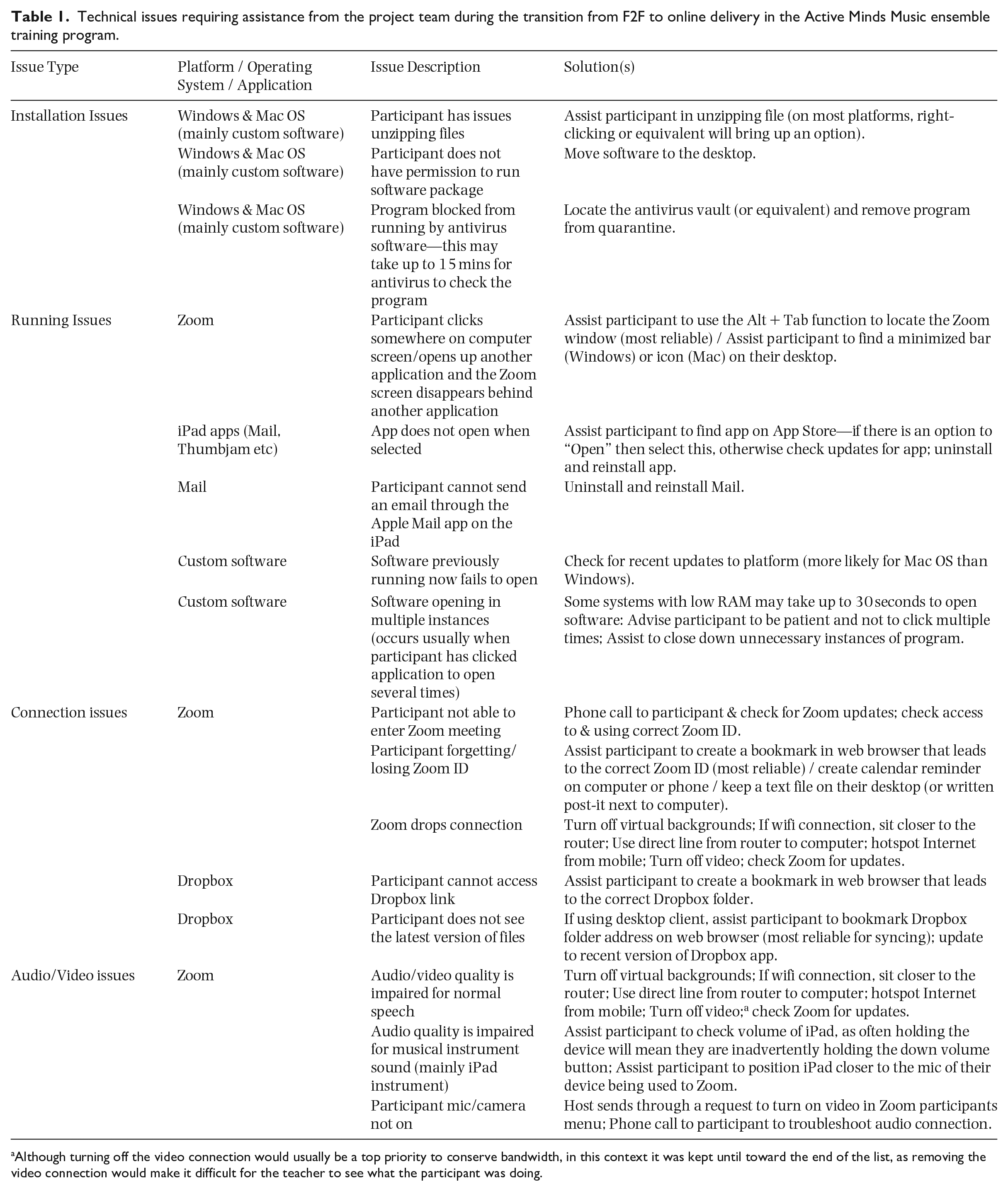
Although turning off the video connection would usually be a top priority to conserve bandwidth, in this context it was kept until toward the end of the list, as removing the video connection would make it difficult for the teacher to see what the participant was doing.
Some participants needed help to install software packages in the correct locations, a security requirement with some operating systems (OSs), and when they were blocked by pre-installed antivirus software. One ongoing issue was the need for participants to make consistent and harmonized software updates across OSs and apps, and for the research team to ensure that participants could use the associated App stores to manage these updates. On several occasions, issues arose with the compatibility of apps and newly updated OSs, and updates to apps that affected the quality and stability of the connection to platforms such as Dropbox and Zoom. Connectivity was also affected by using particular devices and platforms, and the quality of participants’ Internet connections.
Some participants needed help with connection issues, particularly when using Zoom. They sometimes misplaced or forgot the meeting details, and often required assistance to improve intermittent connections. These issues were not confined to the start of the transition from F2F to online delivery but persisted, justifying the need for a dedicated technical support assistant to be present at all the lessons, as well as offering extracurricular one-to-one help as needed.
Interviews
Data from the semi-structured one-to-one interviews with participants provided their perspectives on the transition from F2F to online learning. We identified four themes and 18 sub-themes, shown in Figure 1:
AMME program (6 sub-themes)
Technology (6 sub-themes)
Education/activity (4 sub-themes)
Social interaction (3 sub-themes)
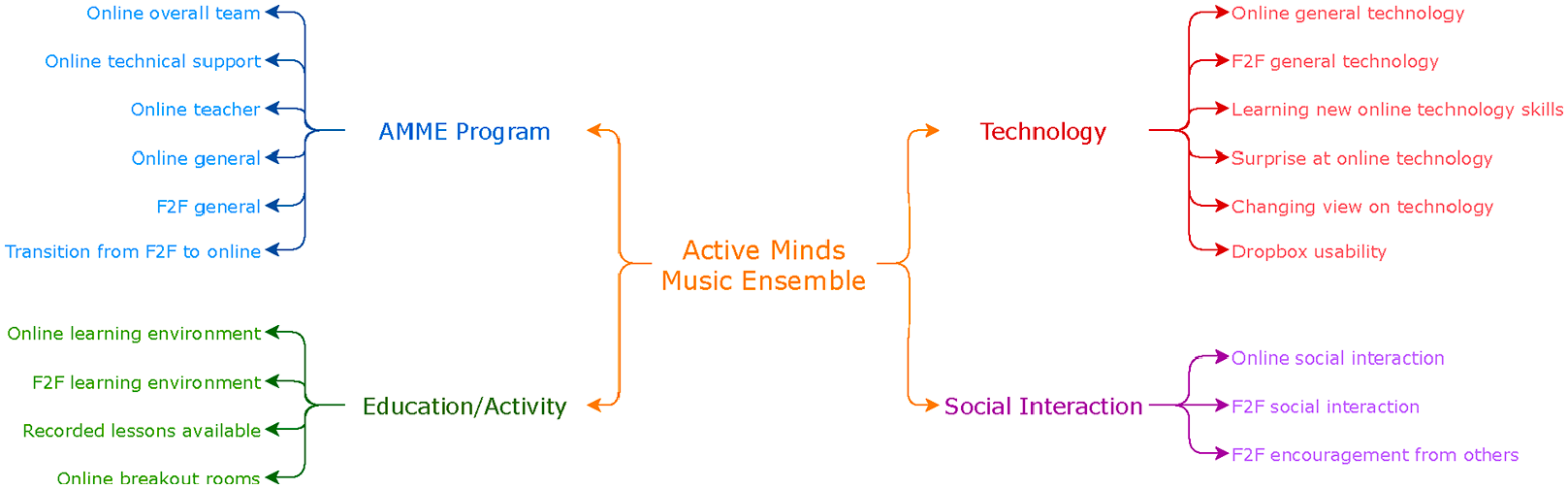
Themes and sub-themes identified from the semi-structured one-to-one interviews.
AMME program
The six sub-themes comprising the AMME program theme were Online overall team; Online technical support; Online teacher; Online general; F2F general; and Transition from F2F to online. Statements were coded as Online overall team if they referred to the whole research team or all its members, such as “everybody was helpful” (P4-2) and “you’ve all got the patience of Job, really” (P1-2); they were only coded as Online teacher or Online technical support if they identified member(s) of the research team in those specific roles. Statements coded as Online overall team and Online technical support were invariably positive. Both sub-themes were characterized by references to the high level of organization in the AMME training program, which reportedly gave many participants confidence in the program overall, as well as the positive attitudes and general availability of the research team. Participants reported being “pleasantly surprised” that the team could consistently work around technical “roadblocks.” Statements coded as Online teacher were very largely positive; participants were pleased with the teacher and felt “lucky” to have him as part of the training program, sometimes referring to specific teaching-related attributes such as his “good ear.” Statements contributing to this sub-theme suggested that, in addition, it is desirable for an online music teacher to give all members of the group appropriate time, make them feel included in all activities, and provide useful advice on peripheral equipment such as headphones. Other statements indicated that participants felt they were less likely to ask the teacher direct questions in online than F2F lessons and received less direct feedback.
Statements about the online delivery format in general, such as participants noting that they were thankful that lessons were continuing during the pandemic, and that they were saving time and money without having to commute every two weeks to the on-site teaching space contributed to the Online general sub-theme. Negative statements indicated that participants could at times feel exhausted after online lessons, particularly when they had other online activities that day. Similarly, statements about the F2F format contributed to the F2F general sub-theme, although there were only two such statements, both positive, made by a single participant who felt (a) that they could plan their day better when taking F2F lessons, and (b) looked forward to them more when they were actually “going out.” Participants described the transition from F2F to online as “quick” and “seamless,” although some found it challenging, specifically in relation to the use of technology, as detailed below. Statements about the transition were often paired with positive references to team members, such as “I can imagine what it was like behind the scenes, but . . . we sailed into the lesson and you were battling away . . . it’s been fantastic” (P3-1).
Technology
The six sub-themes comprising the Technology theme were Online general technology; F2 F general technology; Learning new online technology skills; Surprise at online technology; Changing view on technology; and Dropbox usability. Online general technology contained both positive and negative broad statements. Positive statements about Zoom indicated that the user interface was relatively easy to manage, and the audio and video quality were generally impressive. Negative statements indicated challenges such as disruptions in audio-visual connection, although participants felt this was largely dependent on their individual devices and Internet connection. Some participants were distracted by the noise—picked up by the microphone—of other participants tapping, or moving objects during lessons. They could find the technology side of the program unfamiliar and very challenging: “I feel really stupid at times . . . with software [and other technology]” (P1-2). Participants also noted that when severe technological problems affected an online lesson, as in the case of the first lesson for one group, they did not want to listen back to the recording via the link provided.
Some statements contained a mixture of positive and negative references: “Once I’ve got the technology working properly, it’s fine. But by its very nature technology can be frustrating in itself” (P3-1). Similarly, some participants said that while they wanted to try out new technology they also did not want to “waste a lot of time” learning it: The only thing I’d be cautious about is there’s been a lot of time spent . . . whilst going to the [online] fortnightly sessions have been fine, with all the changes that have happened, each of us has to spend a lot of time outside just learning to play an instrument in just getting us up and running. (P1-1)
In contrast, the sub-theme F2 F general technology contained only positive statements, often describing independence from technology in general. High-quality equipment such as headphones was also supplied in the F2F classes, whereas not all participants had access to good quality headphones for online learning at home.
The sub-theme Learning new online technology skills contained a mixture of positive and negative statements. Participants felt good or “chuffed” when they were able to work out a technical problem and thought positively of the requirement to learn an extra dimension (i.e., technology) in the online format. Participants described this as “enhancing” or “stretching” their learning. Conversely, participants felt that learning new skills using technology could be a lot to “come to grips with.” Statements indicated general difficulties with learning how to download and unzip attached files, locating files and programs. When new technology was proving difficult, some participants experienced self-doubt, being unsure whether the issue lay with their own inexperience and mistakes, or if the problem was caused by an external factor. At times, participants made compound statements balancing the positive and negatives of Learning new online technology skills: “[the setup] wasn’t that hard, but . . . it’s been a real learning curve” (P1-1). Overall participants felt the online format was a positive learning experience, although one that requires some improvization from both the participants and the research team.
Statements coded as Changing view on technology were mainly positive, referring for example to participants’ increasing confidence and comfort with technology over time. Several participants noted that they were now using Zoom for non-music activities such as book clubs, exercise classes, and socializing; one participant stated they were “really hooked on Zoom.” Negative and mixed statements in this theme indicated that while the technology component was well received, its novelty wore off over time; one participant felt overwhelmed by the many different necessary programs: “I started off really well and then I got a bit frustrated with all the software and everything” (P1-2). In the Dropbox usability sub-theme, participants found the Dropbox content useful for making recorded examples and other material easily accessible; one participant reported finding the “repeater” playback function helpful when they were listening to and playing along with the audio materials that had been provided. One participant experienced difficulties with navigating the Dropbox site itself, however, not being able to find the correct audio materials immediately; they felt this experience had a negative impact on their learning.
The sub-theme Surprise at online technology contained statements describing participants’ initial apprehension at the prospect of using the platform and subsequent surprise to find it both functional and easy to use, as many participants had limited prior experience of similar applications such as Skype, FaceTime, and Microsoft Teams: “I guess the biggest surprise is that it works quite well, it works just as well as being there when it comes to trying to learn a tune or picking up the tune” (P2-1); “What we’re doing is incredible. The technology’s gone so far, so quickly. What’s it gonna be like next year?” (P6-1). Participants also indicated that their friends who were not on the AMME training program were surprised, too, at Zoom’s functionality and usefulness when learning a musical instrument.
Education/activity
The four sub-themes comprising the Education/activity theme were Online learning environment; F2 F learning environment; Recorded lessons available; and Online breakout rooms. Statements concerned elements of the program that facilitated or hindered learning, mainly the difficulties associated with online learning, and how these were balanced by benefits such as learning new skills. The Online learning environment sub-theme contained both positive and negative statements. According to one participant, “it’s a completely different way of working that people will maybe come to grips with, and maybe get some benefit from” (P6-2), and according to another, “we could actually be independent . . . that’s something we’re learning [to do]” (P4-1). Participants felt it was easier to concentrate on one person when learning in an online format, that the atmosphere was good, that “no one was put off,” and that the online classes moved faster, meaning that more content was covered. One participant described “having to do more ourselves after the [online] lesson” (P1-1), although they also felt this was the right approach in order to get through the material. Many participants found it more difficult to ask a question in the online learning setting, particularly when other people were talking; participants felt they needed to wait longer for their turn to interact with the teacher, and consequently, much more concentration was required for online classes.
The sub-theme F2F learning environment contained statements regarding increased engagement when learning in a F2F setting; one participant felt the reason for this was “just being able to see everything [while F2F]” (P4-2). Some participants described enjoying interactive play between participants in F2F, which was no longer possible in online lessons. Participants described F2F as allowing more room for individual feedback: “it meant that with [the teacher] going around the room individually and . . . [they] could say ‘yes,’ ‘no’ to each participant instead of me going ‘hey, have I got it right?’” (P5-1). Some participants found the audio-visual recordings of the online lessons helpful (sub-theme Recorded lessons available), because they could revisit lessons when the content was challenging. However, some participants found these recorded lessons redundant as they could not receive live feedback from the teacher. Statements comprising the sub-theme Online breakout rooms described this function as a positive, helpful aspect of the online classes, particularly for cases where a participant required musical or technical assistance, and they could be moved to a separate room until the problem was resolved. Participants felt this was positive because it allowed the lesson to continue unhindered, and “takes off the pressure of the individual [who requires assistance]”(P2-1). The same participant stated that “[it] gave a pause to the meeting that enabled me to think and do the things that I needed to pick up” (P2-1). This participant, as well as another participant in the same group, described feeling most engaged when the teacher took participants aside into separate breakout rooms.
Social interaction
The three sub-themes comprising the Social interaction theme were Online social interaction; F2
F social interaction; and F2
F encouragement from others. Statements coded as Online social interaction or F2
F social interaction were a mixture of positive and negative. Participants described the online setting as detrimental for “side chat” and “banter” throughout and after the lesson; some participants described online lessons as more “serious” and “distanced” in comparison with F2F. Statements comprising these two sub-themes also described the loss of social nuance when talking to people via Zoom, and awkwardness when talking or timing verbal contributions as the result of latency issues. Some participants preferred F2F lessons simply because they enjoyed interacting with “real people rather than people shown on a screen”. However, Online social interaction also contained positive statements; participants felt others in the group had less potential to be distracting during an online lesson, and that interaction was still possible at a high level: “It’s amazing, I’m talking with someone just as if we’re sitting down and talking” (P3-1). Participants felt that despite being harder to meet new people during a pandemic, the AMME program had managed to facilitate this: I enjoy the actual lesson, I think because of . . . the people, yeah because . . . I don’t mix well especially now during this lockdown, I don’t talk to anyone now . . . I don’t have that sort of social bit at the moment. (P4-2)
The sub-theme F2 F social interaction contained statements indicating that participants could feel as though they had been left “outside of the main group” or “out of sight, out of mind,” depending on where they were physically situated in the classroom. Examples of this were described when there were vacant seats in the classroom, such as after participants had dropped out of the class, creating gaps in the spatial layout of the room. Participants described this issue as resolved with the move to online learning; one participant described being online as “equally in front of [the teacher],” and another participant said that “[online] seems to be almost a better, a better classroom situation . . . the setup is better than the classroom situation” (P5-1).
In statements comprising the sub-theme F2
F encouragement from others, participants reported preferring to discuss any problems they experienced with one or two of their classmates rather than the whole group. Participants also received better visual feedback from other participants and the teacher when learning F2F. They described being able to compare themselves with others as a useful way of gauging their own progress: because you can see other people’s reaction to, you know, when you make a mistake or even [the teacher], you know, I can sort of see . . . really if . . . I’m doing something good or bad or . . . you get better feedback from people’s faces. (P4-2)
Teacher’s written report
We analyzed the teacher’s report, which provided his perspective on the transition from F2F to online teaching, using five of the seven themes identified by Biasutti et al. (2021) so as to place our results in a larger framework of approaches to online music instruction during the pandemic. We did not use the COVID-19 and the music school or Examinations themes because the AMME training program was part of a research project, not a music school in its own right. The research team, rather than a music school, offered support to the teacher and participants in the training program, and no formal music examinations were conducted. 9
The teacher, who was initially somewhat apprehensive, reported being surprised at his ability to adapt to the process of delivering classes online and commended the technical support assistant who had been brought into the team to support participants in their Zoom lessons. He noted that this “invaluable” member of staff had a positive impact on the dynamics of the groups and the running of the classes.
The teacher’s thoughts on Technology are in line with those of the teachers at a conservatory who took part in Biasutti et al.’s (2021) study, commenting on Limitations (i.e., bandwidth, audio quality, and interruptions), although he also mentioned some of the useful functions of Zoom (in sub-theme Plugins/software) such as chat, screen-sharing, and whiteboard. Similarly, his thoughts on Curriculum planning echoed those of Biasutti et al.’s teachers in that he described replacing non-verbal demonstrations with spoken or written instructions.
In a statement contributing to the Managing instrumental lessons theme, coded as the sub-theme Synchronous strategies, the teacher raised a potential issue for group lessons with beginners: giving instant feedback to participants. In F2F lessons, he reported, he would walk round the class giving feedback to each participant in turn, but in online lessons every interaction between teacher and participant could be heard by all. This impeded the progress of participants whose work was interrupted by feedback to others but was helpful for participants experiencing the same problem. He felt more able in online lessons than in F2F lessons to monitor participants’ progress visually and anticipate their needs, although he could only give feedback on what he could see.
In another statement contributing to the same theme, coded as the sub-theme Ensemble lessons, the teacher reported that participants needed “great patience and empathy” from all involved in the training program. Successful groups had demonstrated “tolerance, patience and support for each other during lessons . . . Impressively, if a participant is seen to struggle, the other students are encouraging, and this builds the confidence of the individual and also the group.” Statements contributing to the Curriculum planning theme were again in line with the data reported in Biasutti et al.’s study. These statements concerned the greater use of verbal instruction than non-verbal demonstrations, and the need for the teacher to review the amount of content he aimed to teach in each online rather than F2F lesson.
Contributing to the Strengths theme, the teacher reported that managing documents and digitized teaching materials was easier as they were all to hand on his computer. He had had to commit a great deal of time to moving documents and materials online in the initial stages of the transition from F2F teaching but, in addition to the useful features of Zoom mentioned above, he also mentioned the advantage of not having to travel, especially for participants. In conclusion, he commented on how comfortable participants appeared to be with the transition from F2F to online learning, and how they “realised the limitations imposed by the online aspect.” Most of the Limitations he noted related to Technology, other than time spent preparing materials for online teaching (sub-theme: Time consumption).
General discussion
Challenges and benefits of online teaching and learning
The challenges of setting up and maintaining teleconferencing software for the purposes of delivering music lessons online to older adults were highlighted by the research team, participants, and teacher. These challenges, which relate particularly to connection quality, have been well documented both before and since the start of the COVID-19 pandemic (Biasutti et al., 2021; Kruse et al., 2013). Although participants often experienced frustration, they also noted that the technological element of the lessons “stretched” their learning, and said they were “chuffed” when it went well. Our results suggest that it is demanding not only to set older adults up for learning online but also to maintain their online connection. While participants were more-or-less comfortable with technology in general, some experienced recurring difficulties when entering Zoom sessions and configuring their audio settings correctly. The need has been acknowledged for people living with dementia to obtain local, one-to-one technical support to access virtual singing-group rehearsals (Dowson et al., 2021) and group music therapy sessions (Molyneux et al., 2020). In the present study, involving the participation of healthy older adults, the teacher noted the value of the technical support that was offered.
Teaching and learning a musical instrument in online groups
Both participants and the teacher noticed the adaptations that had to be made to teaching online. Most concerned the decrease in individual feedback, interactive playing, and the amount of musical material that could be covered in a single lesson. Although undoubtedly improvements to Internet connections and audio quality would enhance the delivery of lessons online, an improved visual experience for both students and teacher could increase the types of feedback and assessment offered. Remote music education for beginners has been shown to benefit from devices that offer multiple camera angles and increased audio quality, even when delivered through platforms such as Skype (King et al., 2019a, 2019b) although it is not clear whether these types of solution would be appropriate for use in individuals’ homes. The teacher agreed with those who took part in Biasutti et al.’s (2021) study in noting the functions of teleconferencing software that are useful for online music lessons, but if the teacher was able to control who hears what, as in a typical keyboard laboratory setting (Stephens-Himonides & Hilley, 2017), that might allow students to progress faster. Participants also noted that breakout spaces could be used to address individuals’ issues, whether related to technology or music, without hampering the progress of the rest of the group.
The impact of online teaching on the group
Both the participants and the teacher noted the supportive nature of the environment created by the research team and the participants themselves. The teacher commented that participants listened patiently to each other’s attempts to play, one at a time, even if they felt frustrated at not being able to progress faster on their own, and they supported one another. Despite this, participants noted the reduced non-verbal feedback from fellow learners, as some would rely on others’ faces to gauge their progress in F2F. Generally, participants felt that online lessons reduced the social integration of the group, because the teleconferencing software did not permit informal side chats and banter. 10 This finding aligns with those of studies of virtual rehearsals during the pandemic in which group identification and psychological needs satisfaction were diminished in comparison with F2F rehearsals (Draper & Dingle, 2021). Nevertheless, virtual rehearsals can positively affect participants’ moods and are described as “better than nothing” (Zhu & Pitts, 2021, p. 13); they may at the very least satisfy the motivation to continue enjoyable activity in the presence of others (Cohen-Mansfield et al., 2021). In the present study, music lessons were a valued activity for participants and the transition from F2F to online teaching enabled them to continue learning, even in the absence of social connection brought about by the pandemic.
Implications
Our findings have two main implications. First, the online delivery of arts education to older adults requires continuing technical support. Our participants may have been strongly motivated by the desire to take music lessons but, once they had been helped to make use of technology (some for the first time), their confidence to go on doing so was enhanced by the availability of continuing one-to-one assistance. Despite the challenges that arose, the participants’ motivation to go on taking lessons and the support they received from the team and the other participants were important factors in keeping the lessons going.
Second, the types of teacher–student and peer-to-peer interactions afforded by online lessons, and how these might fulfill the needs of older adult learners, should be considered. In the present study, participants reported that there was less time for covering musical material and they received less individual feedback, while the teacher replaced non-verbal demonstrations with verbal instructions. Participants also reported that they received less non-verbal feedback from their peers, feedback that they had used in F2F lessons to gauge their own progress. It might be possible for such cues to be provided if the whole group, participants and teacher, could have a better visual experience online, enhancing teacher–student feedback and peer learning. It would also be worth enabling group members to socialize online before and after lessons to provide opportunities for the more informal exchanges typically valued by older adults in F2F settings.
Limitations
This article reports a case study in which older adults started taking music lessons F2F and made the transition to online learning. Generalizations can only be made, therefore, with caution. Our participants were self-selecting in that they were keen to take part in the arts program in the first place, and if not keen then at least open to using technology. We were fortunate in that the training program had access to funds to provide participants with musical instruments, to pay for the teacher’s time spent preparing as well as teaching, and for a dedicated technical support assistant able to be present at all the online lessons. Had it not been for these resources, other challenges to making the transition from F2F to online teaching might well have arisen. In this case study, we could not, however, include participants without a stable Internet connection, or a device such as a laptop or computer at home. Digital inequalities have been noted as important issues for future arts-based training programs (cf. Dowson et al., 2021).
Methodological limitations include our omission, first, to record how often participants made requests for particular kinds of technological assistance. This would have shed light on how widespread specific issues were and how often they occurred. Second, we interviewed the two groups of participants at different times after the transition from F2F to online lessons in March 2020, and the teacher wrote his report nearly a year later; in all cases recall may have been colored by subsequent events. In future, longitudinal research could be undertaken with older adults to explore the evolution of their attitudes, confidence, and use of technology as they begin to take music lessons, and over time.
Conclusions
The delivery of music lessons online to healthy older adults can be successful, according to the teacher and participants in the present study. This population is often unfairly described as being at odds with technology, so it is pertinent to document that arts learning and engagement online are viable for older adults provided the necessary supports are in place. Online delivery changes the types of interactions made with older adults learning music (notably a decrease in non-verbal feedback and cues from others), but it possesses certain features that may nevertheless provide opportunities for informal social connections to be made.
Supplemental Material
sj-docx-1-msx-10.1177_10298649221097953 – Supplemental material for Going online: Successes and challenges in delivering group music instrument and aural learning for older adult novices during the COVID-19 pandemic
Supplemental material, sj-docx-1-msx-10.1177_10298649221097953 for Going online: Successes and challenges in delivering group music instrument and aural learning for older adult novices during the COVID-19 pandemic by Jennifer MacRitchie, Anthony Chmiel, Madeleine Radnan, John R Taylor and Roger T Dean in Musicae Scientiae
Footnotes
Acknowledgements
The authors would like to thank the participants involved in this study and Siyao Cheng for her assistance with transcribing the participant interviews. We would also like to acknowledge the contributions toward the wider project of Mr Patrick O’Donnell in the design and delivery of the music lessons, Prof. Andrea Creech in advising our qualitative data collection, and Prof. Catherine Stevens in the experimental design and data collection.
Funding
The authors disclosed receipt of the following financial support for the research, authorship, and/or publication of this article: The Active Minds Music Ensemble project is funded by the Australian Research Council (DP190102012).

Supplemental material
Supplemental material for this article is available online.
Notes
References
Supplementary Material
Please find the following supplemental material available below.
For Open Access articles published under a Creative Commons License, all supplemental material carries the same license as the article it is associated with.
For non-Open Access articles published, all supplemental material carries a non-exclusive license, and permission requests for re-use of supplemental material or any part of supplemental material shall be sent directly to the copyright owner as specified in the copyright notice associated with the article.
