



Abstract
Mental imagery plays an important role in various contexts of life, involving cognitive resources such as memory, learning, spatial representation, and reasoning. The vividness of mental images depends on different factors, including personal expertise in a certain field. For instance, musicians have been found to possess better auditory imagery abilities than non-musicians for both musical and non-musical sounds. Only a few studies have tried to find out if this advantage is selective for auditory stimuli, however, with contradictory results so far (i.e., some studies supporting an advantage for mental imagery in general and some supporting an advantage for auditory mental imagery in particular). This study therefore investigated auditory and visual mental imagery in individuals with and without formal musical training. Thirty-six formally trained musicians, 33 self-taught musicians, and 33 non-musicians completed two questionnaires assessing the vividness of their auditory and visual mental imagery. They also completed measures of aptitude for music and general cognitive abilities. Both groups of musicians reported greater vividness of auditory (non-musical) imagery, but not visual imagery, than non-musicians. Thus musical experience, regardless of the type of training undergone by musicians, is linked to superior self-reported auditory mental imagery for everyday sounds, but not mental imagery in general.
Keywords
A mental image is an internally generated representation of an object, event, or sensation. In contrast to perception, it occurs when perceptual information is accessed from memory and is often described as “seeing with the mind’s eye” or “hearing with the mind’s ear” (Kosslyn et al., 2001, p. 635), depending on the sensory modality. Mental images can be internally generated as representations of things, experiences, or scenes (Schifferstein, 2009) allowing people to recreate the past and simulate the future (Moulton & Kosslyn, 2009). Here, the term vividness refers to how clearly and realistically a mental image is experienced (McAvinue & Robertson, 2007).
Mental imagery plays a functional role in various contexts involving cognitive resources such as memory, learning, spatial representation, and reasoning. For instance, imagery is an effective method for promoting adherence to medical advice (Liu & Park, 2004); indeed, people who imagine implementing specific health procedures are more likely to perform them accurately and consistently in real life, even for extended periods of time.
Mental imagery is also related to increased involvement in planned behavior and promotion of task engagement (Renner et al., 2019; Vasquez & Buehler, 2007), more effective learning outcomes (Guarnera et al., 2019), positive mood training (Holmes et al., 2006), improved sports performance (Mizuguchi et al., 2012), and motor control (Isaac & Marks, 1994); it also plays a major role in the domain of music (Aleman et al., 2000; Brochard et al., 2004; Brown & Palmer, 2013).
Although many studies focus on visual mental imagery, which is also the modality in which the highest vividness ratings are obtained (Schifferstein, 2009), it is known from the literature that mental imagery can take all other kinds of sensory forms (e.g., tactile, olfactory, motor, and auditory, see Andrade et al., 2014). The vividness of mental images depends not only on the sensory and affective qualities of the imagined stimulus (Bywaters et al., 2004), or the capacity of short- and long-term memory systems (Baddeley & Andrade, 2000), but also on expertise and indeed personal experience in different areas. For example, Isaac and Marks (1994) showed that specific groups of experts, such as elite athletes, physical education students, air traffic controllers, and pilots, reported more vivid mental imagery than matched controls, especially in certain domains (e.g., physical education students provided higher vividness ratings for motor imagery than students in other academic disciplines; similarly, athletes and air traffic controllers reported more vivid motor and visual imagery than control groups).
Mental imagery in musicians
Musicians are often regarded as a model for studying brain and behavioral changes after prolonged and intense training (e.g., Münte et al., 2002; Schlaug, 2001). Music training makes high cognitive demands, as it requires information from different sources to be integrated, and appropriate motor actions to be planned and executed (Sergent, 1993). For a musician to plan any musical performance, they must be able to create a mental representation and to imagine a desired interpretation (Holmes, 2005). These mental representations are mostly auditory musical images generated in the anticipation of actual auditory feedback. In other words, learning to use imagery is part of a musician’s training, whether auditory, such as imagining a pitch, or not, such as imagining a movement. For example, singers generate auditory images of their performance by imagining the exact notes they will sing (Keller & Koch, 2008), and pianists are able to imagine their dynamics and articulation (e.g., staccato, legato) while they are performing (Bishop et al., 2013b). Musicians can thus use musical mental imagery as part of their typical learning and performing routines, and when reading notated music silently (Bailes, 2006; Bishop et al., 2014; Brodsky et al., 2008; Gregg et al., 2008). Furthermore, musicians can use mental imagery to help them create anticipatory images enabling them to plan actions and execute movements (Keller, 2012). In this way, they can gain an enhanced expressive and interpretive understanding of the music they are to perform (Connolly & Williamon, 2004); they can also improve their creativity in relation to composing music (Wong & Lim, 2017). In ensembles, interpersonal coordination is facilitated by mental imagery, as musicians simulate their own actions and the actions of the other musicians during the performance (Keller & Appel, 2010; Pecenka & Keller, 2009).
It is therefore not surprising that some studies have found that musicians possess better musical and auditory imagery abilities than non-musicians, either at the behavioral level or at the level of brain activity (Aleman et al., 2000; Bishop et al., 2013a; Herholz et al., 2008). This advantage has mostly been observed in objective assessments of mental imagery. Examples of these assessments include tasks in which imagery is needed to obtain the correct solution to a problem (e.g., Aleman et al., 2000; Brochard et al., 2004). For example, musicians were found to perform better than non-musicians when asked to imagine and compare the pitches associated with two different lyrics of a well-known song. They also performed better in another version of the same task using non-musical stimuli. Yet there was no difference between the performance of musicians and non-musicians on a task involving the visualization and mental comparison of objects (Aleman et al., 2000). By contrast, Brochard and colleagues (2004) observed that musicians performed better than non-musicians on an objective visual imagery task (i.e., maintaining a mental representation of a visual cue, after it has disappeared, to facilitate the localization of a target stimulus). Janata and Paroo (2006) found a positive relationship between years of music training and acuity of the auditory image of pitch and tempo, suggesting a possible causal role for music training.
Another common approach to the investigation of mental imagery is the use of self-report questionnaires such as the Vividness of Visual Imagery Questionnaire (VVIQ, Marks, 1973), the Plymouth Sensory Imagery Questionnaire (Andrade et al., 2014), the Movement Imagery Questionnaire (Hall & Martin, 1997), and the Spontaneous Use of Imagery Scale (Nelis et al., 2014). Little research using these questionnaires compares musicians and non-musicians, however. Exceptions include the work of Campos and Fuentes (2016), who found that music students reported greater vividness and clarity of cutaneous, kinesthetic, gustatory, visual, and auditory imagery than students of other subjects. Di Nuovo and Angelica (2016) found that expert musicians reported more vivid motor mental images than their untrained counterparts. In another study investigating musicians only, however, no relationship between musical experience and self-reported vividness of visual imagery was observed (Clark & Williamon, 2012).
These findings raise the question as to whether musicians possess enhanced general mental imagery abilities, or whether these abilities are only for auditory stimuli. The evidence supporting an advantage for musicians in relation to general mental imagery, from studies in which behavioral rather than self-report data were collected, is contradictory (e.g., Aleman et al., 2000; Brochard et al., 2004). Also, the advantage of musicians in auditory imagery tasks, particularly when musical stimuli are presented, might be explained by their use of mental imagery when practicing (Gregg et al., 2008), by the potentially positive effects of musical training on cognitive functions (for a review, see Swaminathan & Schellenberg, 2019), or by their more effective processing of imagery representations in auditory cortical areas (Aleman et al., 2000).
Objectives of the study
Because the results of previous studies were contradictory, we wanted to look more closely at potential differences between musicians and non-musicians in terms of their musical auditory and visual imagery, specifically in relation to its vividness, as reported by participants in the research. Musical imagery was excluded as it is often part of musicians’ training and might also be associated with movement (i.e., playing) and visual imagery (e.g., for music notation). Two self-report questionnaires assessing the vividness of auditory and visual imagery were administered to participants with different levels of musical skill: formally trained musicians, self-taught musicians, and non-musicians. Comparing formally trained and self-taught musicians could help determine whether musicians’ superior self-reported imagery abilities are linked to formal music training or music making more generally. A link to formal music training is suggested by evidence that formally trained musicians have advantages in some aspects of auditory processing (Zendel & Alexander, 2020). Furthermore, trained musicians scored higher than self-taught musicians for creativity in musical and verbal domains (Palmiero et al., 2020), and links have been identified between creativity and mental imagery (Palmiero et al., 2011).
To assess auditory mental imagery, we used a new self-report questionnaire modeled on the VVIQ (Marks, 1973), the Vividness of Auditory Imagery Questionnaire (VAIQ) (see Supplemental Appendix), as our purpose was to use comparable measures of auditory and visual mental imagery for everyday objects and sounds. The VVIQ was chosen as a model because it is a short test with good reliability, already used as a model for other imagery questionnaires such as the Vividness of Movement Imagery Questionnaire (VMIQ, Isaac et al., 1986). Although other scales also assess vividness of auditory imagery, we believed that they were not fully comparable to the VVIQ. The Bucknell Auditory Imagery Scale (BAIS; Halpern, 2015), for example, has a different structure and many of its items refer to music, so it was not suitable for our purposes. Musicians are known to have an advantage in music imagery (Brodsky et al., 2003) and, as we aimed to compare auditory and visual imagery in musicians and non-musicians, we did not want the questionnaire to include items directly linked to imagery for music. Other multisensory scales such as the Plymouth Sensory Imagery Questionnaire (Andrade et al., 2014) and the Questionnaire on Mental Imagery (Sheehan, 1967) include only five items for each sensory modality and, as we aimed to compare only two sensory modalities, we wanted the questionnaire to include more items for each one so as to improve its reliability, especially as our sample of participants was relatively small (Marsh et al., 1998).
We also measured participants’ aptitude for music 1 using the shortest version of the Profile of Music Perception Skills (Mini-PROMS; Zentner & Strauss, 2017), to assess whether auditory imagery can be linked to aptitude regardless of music training and/or musical activity, and their cognitive abilities using two subtests of the Wechsler Adult Intelligence Scale (WAIS-IV; Wechsler, 2008, see “Materials” section for further details).
Method
Participants
One hundred two young adults participated in the study. The mean age was 22.7 years (min = 19, max = 33). There were 35 females and 67 males. Participants were (1) 36 formally trained musicians (conservatory students, music school students, and/or professional musicians); (2) 33 self-taught musicians who, as children, had had fewer than 2 years’ music lessons other than at school, and reported being unable to read music notation; and (3) 33 self-identified non-musicians who, as children, had had fewer than 2 years’ music lessons other than at school. The protocol was approved by the ethics committee of the University of Padua.
Demographic details and scores for the WAIS-IV subtests are presented separately for each group in Table 1. Formally trained musicians had slightly more years of training and/or musical activity than self-taught musicians, and reported practicing for substantially more hours per week than the self-taught musicians.
Age, education, performance (raw scores) on the WAIS-IV Visual Puzzles and Vocabulary subtests, music training and/or musical activity, aptitude for music, and hours of practice per week.
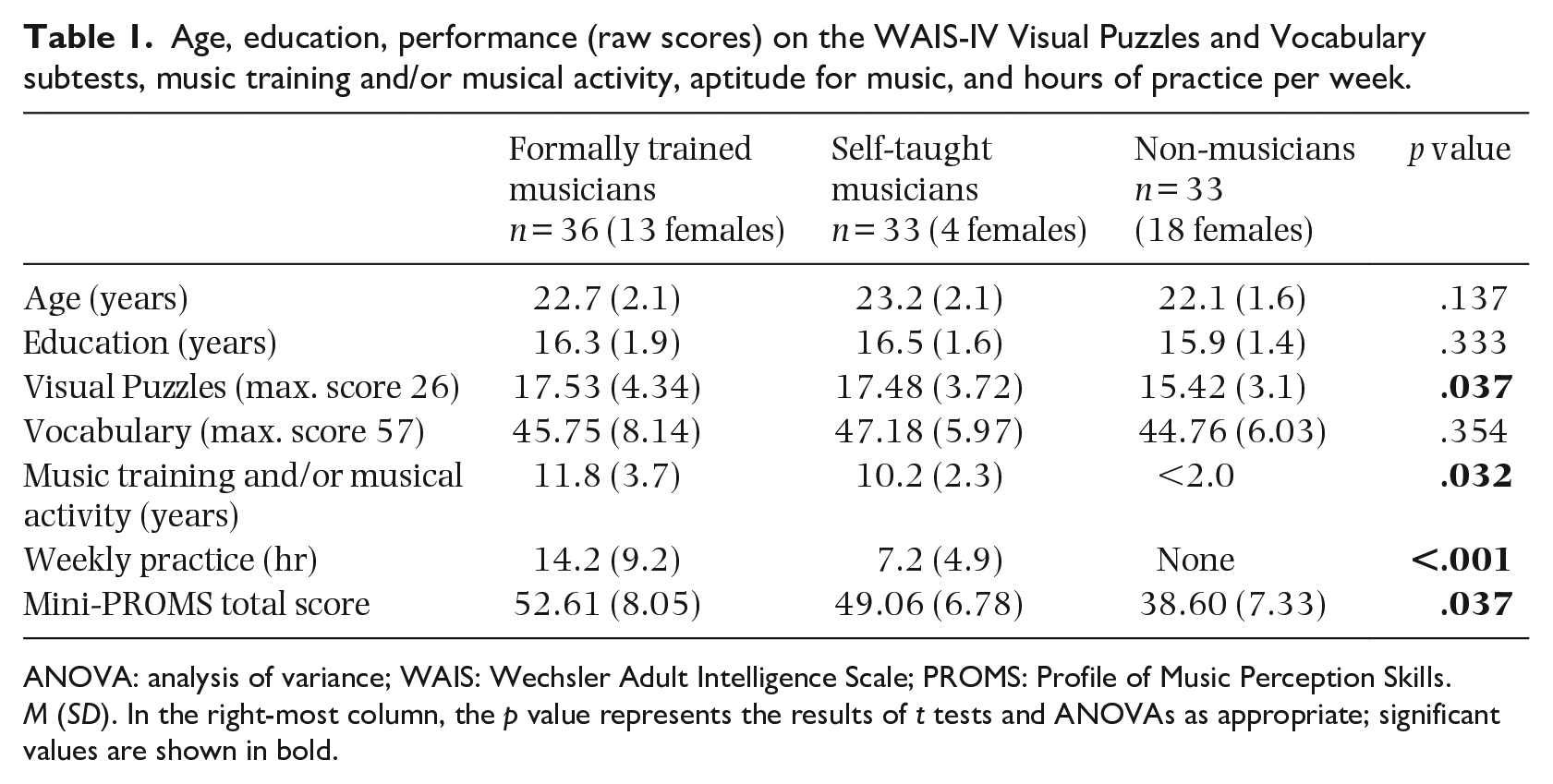
ANOVA: analysis of variance; WAIS: Wechsler Adult Intelligence Scale; PROMS: Profile of Music Perception Skills.
M (SD). In the right-most column, the p value represents the results of t tests and ANOVAs as appropriate; significant values are shown in bold.
Materials
Mental imagery questionnaires
VVIQ
The original scale (Marks, 1973) was used because, unlike a more recent revision, its translation into Italian (Antonietti & Crespi, 1995) has been validated. Minor differences between the psychometric properties of the original and the revision are not of concern (Campos & Pérez-Fabello, 2009 ). It has 16 items in four groups, each group representing an object to be imagined: a familiar person, the rising sun, a familiar storefront, and a countryside. Each of the four items in a group refers to a specific characteristic of the object, for example, the color of the familiar person’s clothes, the contour of their face and the body, their walking pace, and their posture. Participants are asked to rate the vividness of each image using a 5-point scale from 5 (perfectly clear and vivid as normal seeing) to 1 (no image at all, you only “know” that you are thinking of an object). In the original version, the scale ranges from 1 (perfectly clear and vivid as normal seeing) to 5 but the Italian translation uses a reversed scale. Participants must complete the questionnaire twice, once with their eyes open and once with their eyes closed, having re-read each item.
VAIQ
This scale was modeled on the VVIQ, requiring participants to form auditory, non-musical images, and rate their vividness. It also has 16 items in four groups, each group representing an everyday auditory object to be imagined: the sound of a toothbrush when brushing one’s teeth, a child laughing, church bells, a thunderstorm. Again, participants are asked to rate the vividness of each image using a 5-point scale from 5 (Perfectly realistic, as vivid as hearing it) to 1 (no image at all, I only “know” that I am thinking of an object); again, participants must complete the questionnaire twice, once with their eyes open and once with their eyes closed, having re-read each item. Administration of the VAIQ questionnaire to 149 psychology students showed that it has good reliability (Cronbach’s α = .85). Factor analysis with varimax orthogonal rotation yielded one factor explaining 29.53% of the variance, in line with a previous study of the Spanish translation of the VVIQ (Campos et al., 2002). Corrected item total correlations were carried out for the pairs of items to which participants had responded with their eyes open and shut (see Supplemental Appendix, Table S1).
Mini-PROMS
This online test was used to test all participants’ aptitude for music. It has four subtests investigating different aspects of music perception. In each subtest, the participant listens twice to a standard stimulus, followed by a comparison stimulus and is asked to judge whether the comparison stimulus is the same as or different from the standard stimulus. The Melody subtest assesses the participant’s ability to recognize whether or not two short melodies are the same. The Tuning subtest assesses the ability to recognize if one of the notes of a chord in the comparison stimulus is mistuned. The Accent subtest assesses the ability to recognize whether or not two short series of accentuated rhythmic clicks are the same, and the Tempo subtest assesses the ability to recognize whether a synthetic rhythmic structure or a recorded sample of music is being played for the second time faster or slower.
WAIS-IV
Two subtests of this scale were administered to test participants’ general cognitive abilities; specifically, their nonverbal reasoning and semantic skills, as these could help to explain individual differences in mental abilities, including imagery (Shaw & DeMers, 1986). The Visual Puzzles subtest was used to test participants’ nonverbal reasoning. This is a timed test in which the participant must look at a series of reference figures and, for each one, choose three out of five elements of the figure that can be combined to recreate it. A score of 1 is awarded for each correct response. Level of difficulty increases figure by figure, and the test ends when the participant has been awarded three consecutive scores of 0. The Vocabulary subtest was used to test participants’ semantic skills. The researcher reads a list of words aloud, one at a time, and the participant has to provide a short definition of each one. Scores of 2 are awarded for definitions that are complete, 1 for those that are incomplete, and 0 for those that are incorrect. Again, the level of difficulty increases word by word, and the test ends when the participant has been awarded three consecutive scores of 0.
Apparatus and procedure
The Mini-PROMS is administered online 2 and participants took the test inside in a single-walled standard audiology booth (IAC Acoustics) wearing a pair of Sennheiser HD 580 headphones. The sound level at which the test was administered was comfortable and fixed for all participants.
First, participants signed a written consent form, provided demographic information about themselves, and completed a standard questionnaire about musical experience (e.g., training, type of instrument, listening to music). Second, the two subtests of the WAIS-IV were administered. Third, participants completed the mental imagery questionnaires, in counterbalanced order, such that half of the participants completed the VVIQ first followed by the VAIQ and half completed the VAIQ first followed by the VVIQ. Fourth, they took the Mini-PROMS test. Finally, they completed a questionnaire about their musical habits such as listening to music and dancing, and the two groups of musicians responded to additional questions about their music training and/or musical activity (e.g., years of training, hours of weekly practice, type of instrument played).
Analyses
We used one-way analyses of variance (ANOVAs) to test the effects of group (formally trained and self-taught musicians, and non-musicians) on scores for the WAIS-IV subtests and the Mini-PROMS, representing cognitive abilities and aptitude for music respectively. We computed the sum of all the ratings for all the items in the VVIQ and VAIQ for each participant, as there were no missing data, and explored associations between cognitive abilities, aptitude for music, and vividness of auditory and visual imagery using Pearson’s r. We conducted a repeated-measures ANOVA to test the effects of group, modality (auditory vs. visual imagery), and condition (eyes open vs. eyes closed) on auditory and visual imagery. We adjusted p values for false discovery rate (FDR; Benjamini & Hochberg, 1995).
Results
Cognitive abilities
A one-way ANOVA revealed a statistically significant effect of group on scores for the Visual Puzzles subtest of the WAIS-IV, F(2, 99) = 3.39, p = .037, η2 = .06. Post hoc tests showed that formally trained musicians performed better than non-musicians, t(63) = 2.32, p = .035, d = 0.56, and self-taught musicians performed better than non-musicians, t(62) = 2.44, p = .035, d = 0.60, but there was no significant difference between the scores of formally trained musicians and self-taught musicians, t(67) = 0.04, p = .965, d = 0.01 (see Table 1). There was no significant effect of group on scores for the Vocabulary subtest, F(2, 99) = 1.05, p = .354, η2 = .02.
Aptitude for music
A one-way ANOVA revealed a statistically significant effect of group on total scores for the Mini-PROMS test, F(2, 99) = 32.17, p < .001, η2 = .39, such that formally trained musicians (M = 52.61, SD = 8.05) outperformed non-musicians (M = 38.70, SD = 7.33), t(67) = 7.51, p < .001, d = 1.81, self-taught musicians (M = 49.06, SD = 6.78) outperformed non-musicians, t(64) = 5.96, p < .001, d = 1.47, and formally trained musicians outperformed self-taught musicians, t(66) = 1.99, p = .05, d = 0.48.
Associations between years of music training and/or musical activity, hours of weekly practice, cognitive abilities, aptitude for music, and vividness of auditory and visual imagery
As shown in Table 2, significant but weak correlations were found between years of music training and/or musical activity and VAIQ score, hours of weekly practice and VAIQ score, and hours of weekly practice and VVIQ score with eyes open. Weak correlations were also found between scores for the Melody and Tuning subtests of the Mini-PROMS and the VAIQ and the VVIQ. There were no correlations between cognitive abilities and visual or auditory imagery so scores on the Visual Puzzles and Vocabulary subtests of the WAIS-IV were not included as covariates in subsequent analyses.
Pearson Correlations between Years of Music Training and/or Musical Activity, Hours of Weekly Practice, Mini-PROMS Scores, Visual Puzzles, Vocabulary, and VVIQ and VAIQ.
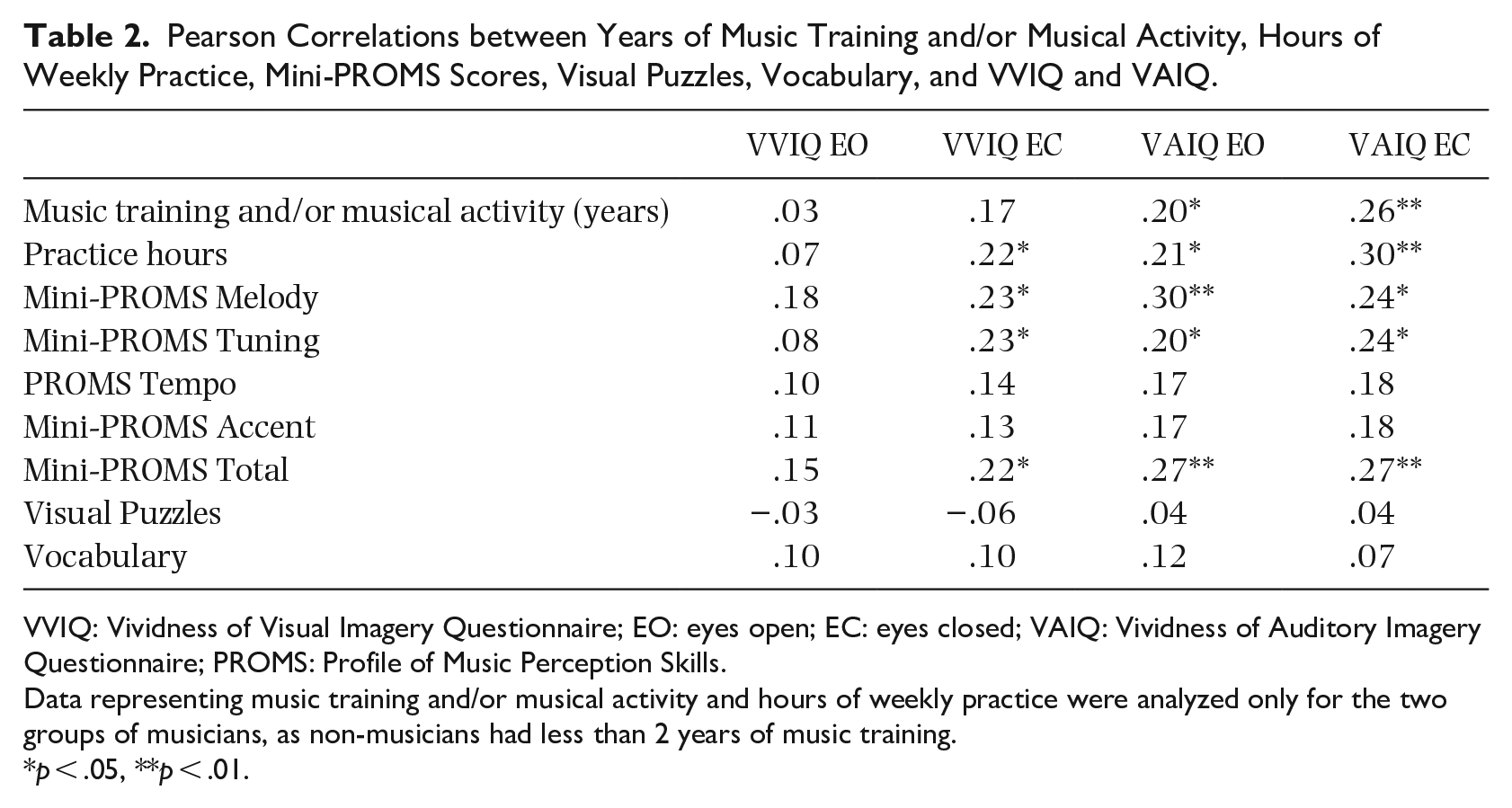
VVIQ: Vividness of Visual Imagery Questionnaire; EO: eyes open; EC: eyes closed; VAIQ: Vividness of Auditory Imagery Questionnaire; PROMS: Profile of Music Perception Skills.
Data representing music training and/or musical activity and hours of weekly practice were analyzed only for the two groups of musicians, as non-musicians had less than 2 years of music training.
p < .05, **p < .01.
Auditory and visual imagery
A repeated-measures ANOVA revealed a significant effect of condition, F(1, 99) = 43.23, p < .001, η2 = .29, such that images were reported to be more vivid when participants’ eyes were closed (M = 123.5, SD = 18.59) than when they were open (M = 114.5, SD = 18.26). There was no significant interaction between modality (visual vs. auditory) and condition, F(1, 99) = 0.80, p = .372, but there was a significant interaction between modality and group, F(2, 99) = 4.20, p = .018, η2 = .08, illustrated in Figure 1. Post hoc tests showed that formally trained musicians scored significantly higher than non-musicians for auditory imagery, t(67) = 2.54, p = .039 3 , d = 0.61, but not visual imagery, t(67) = 1.28, p = .310, d = 0.31. Similarly, self-taught musicians scored significantly higher for auditory imagery, t(64) = 3.55, p = .004, d = 0.87, but not visual imagery, t(59) = 1.58, p = .240, d = 0.39. There were no significant differences between the scores of formally trained and self-taught musicians for auditory imagery, t(67) = −0.9, p = .445, d = 0.22, or visual imagery, t(64) = −0.42, p = .679, d = 0.10.
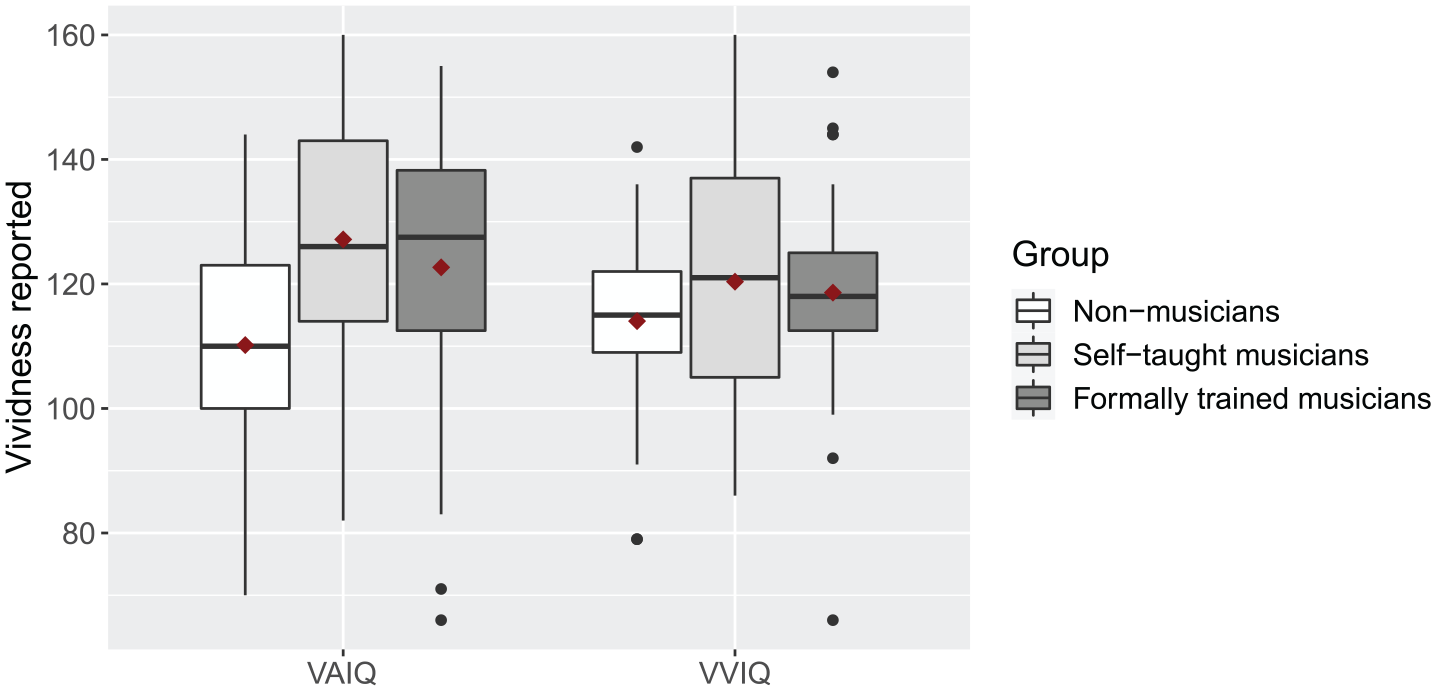
Self-report scores in the mental imagery questionnaires (sum of eyes open and eyes closed conditions): the higher the value, the higher the vividness reported.
Discussion
In this study, we assessed auditory and visual mental imagery in three groups of participants with different levels of musical skill: formally trained musicians, self-taught musicians, and non-musicians. We also assessed aptitude for music objectively using the Mini-PROMS. The results indicate that both formally trained and self-taught musicians reported more vivid mental images than non-musicians, but only for auditory objects. The differences between the scores of musicians and non-musicians representing vividness of auditory imagery were more striking for self-taught than formally trained musicians, as type of correction for multiple comparisons affected the p value of the result of the comparison between formally trained and non-musicians. However, this comparison was likely to have been affected by two outliers in the group of formally trained musicians (see Figure 1); when these observations were removed, the difference between groups remained consistently significant across different types of multi-comparison correction. There were no significant differences between the scores of the three groups representing vividness of visual imagery, a result in line with the previous finding that musicians have better mental imagery abilities than non-musicians, but only when they are asked to create auditory images (Aleman et al., 2000). Note that in the study by Aleman and colleagues (2000), however, a different paradigm was used to test mental imagery, with three conditions: musical (participants were asked to compare pitches), non-musical auditory (participants were asked to imagine the acoustic characteristics of everyday sounds), and visual (participants were asked to visualize the forms of objects). This would seem to strengthen the validity of the self-report questionnaires used in this study as measures of mental imagery ability. Nevertheless, there were no significant differences between the scores of the formally trained and self-taught musicians representing vividness of auditory imagery, suggesting that this ability is not necessarily associated with formal musical training only but, more generally, with musical activity. Moreover, years of musical activity (regardless of whether the individual has undergone formal training) could also play a role in the self-reported ability to imagine auditory stimuli. If so, this role is likely to be small, however, as we found only a weak correlation between years of music training and/or musical activity and scores on the VAIQ. This is in line with the finding in previous research by Pfordresher and Halpern (2013) that music training was correlated only weakly with a measure of auditory imagery. Note that the BAIS, a scale more oriented toward music, was used in this study. A comparison of formally trained and self-taught musicians with this scale could show a different pattern of results. (e.g., different imagery abilities between formally trained and self-taught musicians). Yet we cannot exclude the possibility that factors besides playing a musical instrument are responsible for the higher scores of our two groups of musicians on measures of auditory imagery. We found, for example, that both groups of musicians reported listening to music more often than non-musicians. In future research, the role of listening to music in auditory imagery should be clarified. This could be achieved by asking non-musicians about their listening behaviors. Finally, the vividness of auditory imagery seems also not explained by general cognitive abilities (although formally trained musicians scored better than non-musicians), as the VAIQ and the Visual Puzzles subtest of the WAIS-IV scores were not significantly correlated.
We found significant differences between the scores of the two groups of musicians for the Mini-PROMS, suggesting that formally trained musicians have more aptitude for music than self-taught musicians. If aptitude for music were linked to more vivid auditory imagery, formally trained musicians would have scored higher on the VAIQ than self-taught musicians, but this was not the case. There were, however, weak correlations between scores for the tonal subtests of the Mini-PROMS (Melody and Tuning) and both the VVIQ and VAIQ, while the subtests measuring temporal skills (Accent and Tempo), were not correlated with mental imagery abilities. VAIQ items refer to everyday sounds in relation to their tonal rather than temporal properties, with the exception of two references to “speed.” It may be that the tonal and temporal properties of sounds are represented in different ways, with tonal information being easier to imagine than temporal information (Janata & Paroo, 2006). Another possibility is that participants who are asked to report the “vividness” of an auditory image focus only on its stable aspects. This is supported by Colley et al.’s (2018) finding that temporal synchronization ability, measured objectively, was predicted by the Control subscale of the BAIS, which assesses how easily an individual can change their mental image of a sound. They also found no significant correlation between temporal synchronization ability and the Vividness subscale of the BAIS. Finally, it can be speculated that the weak correlations between participants’ scores for Melody and Tuning subtests of the Mini-PROMS and the VVIQ with eyes closed are attributable to a common, higher order brain mechanism. For example, different brain networks are activated when individuals experience different mental states (e.g., when their eyes are open and when their eyes are closed). Interoceptive awareness, often experienced when individuals’ eyes are closed, is associated with imagination and recall of sensory information such as auditory information (Xu et al., 2014). The same brain networks may therefore have been activated when participants undertook imagery tasks in the eyes closed condition and the tonal subtests of the Mini-PROMS.
Although the VAIQ scores of formally trained and self-taught musicians did not differ significantly, there was a larger effect size for self-taught musicians. It could be that self-taught musicians who do not read music are more reliant than formally trained musicians on mental imagery when they perform; this could in turn be linked to enhanced auditory imagery skills.
Next, we might ask why people who play musical instruments score higher on a measure of vividness of auditory imagery than people who do not play a musical instrument. Perhaps this is why people decide to start learning an instrument. Or perhaps playing music enhances auditory imagery ability, as suggested by the small correlations we found between years of music training and/or musical activity and VAIQ scores.
It may be that musicians have better auditory imagery because they have a better knowledge than non-musicians of the physical rules that govern the relationships between sounds and their sources (see Gaver, 1993a, 1993b; Spence, 2011 for an overview of cross-modal correspondences). For example, small objects are known to produce high-frequency sounds, whereas large objects are known to produce low-frequency sounds (Grassi, 2005; Grassi et al., 2013). The materials of which objects are made have particular sonic characteristics (Giordano & McAdams, 2006), and the shapes of objects determine the sounds they produce (Kunkler-Peck & Turvey, 2000). Differences between musical instruments make these relationships apparent; for example, compare the size and sound of a violin with those of a double bass, or the sound of a metal vibraphone with that of wooden marimba. Musicians who have been exposed to musical instruments, and who have had the opportunity to associate their physical characteristics with the sounds they make, learn the laws of physics that underlie such associations and can exploit them when asked to imagine everyday sounds. This proposition could be tested by developing a training method for boosting associations between the characteristics of objects and the sounds they make, and finding out if such training also improves auditory imagery.
Finally, the VAIQ should be fully validated in future research. Convergent and discriminant validity could be tested, for example, by using the auditory subscales of published questionnaires such as the Plymouth Sensory Imagery Questionnaire (Andrade et al., 2014), and the BAIS; the comparison with the BAIS would also have the advantage of potentially highlighting the differences between auditory imagery for everyday sounds and for musical sounds, as the BAIS is more oriented toward music.
Conclusion
The present research assessed self-reported mental imagery abilities in participants with different levels of musical skill. Specifically, we wanted to compare the auditory and visual mental imagery abilities of formally trained and self-taught musicians and non-musicians, to find out if musical experience is associated with enhanced imagery abilities in general or auditory stimuli in particular. To test this, we compared participants’ scores for the VVIQ with their scores for its auditory counterpart, the VAIQ. The findings confirm that music training and/or musical activity are associated with superior mental imagery for everyday auditory stimuli, but not visual stimuli. Future studies should shed light on the origin of this advantage.
Supplemental Material
sj-docx-1-msx-10.1177_10298649211062724 – Supplemental material for Auditory and visual mental imagery in musicians and non-musicians
Supplemental material, sj-docx-1-msx-10.1177_10298649211062724 for Auditory and visual mental imagery in musicians and non-musicians by Francesca Talamini, Julia Vigl, Elizabeth Doerr, Massimo Grassi and Barbara Carretti in Musicae Scientiae
Supplemental Material
sj-docx-2-msx-10.1177_10298649211062724 – Supplemental material for Auditory and visual mental imagery in musicians and non-musicians
Supplemental material, sj-docx-2-msx-10.1177_10298649211062724 for Auditory and visual mental imagery in musicians and non-musicians by Francesca Talamini, Julia Vigl, Elizabeth Doerr, Massimo Grassi and Barbara Carretti in Musicae Scientiae
Footnotes

References
Supplementary Material
Please find the following supplemental material available below.
For Open Access articles published under a Creative Commons License, all supplemental material carries the same license as the article it is associated with.
For non-Open Access articles published, all supplemental material carries a non-exclusive license, and permission requests for re-use of supplemental material or any part of supplemental material shall be sent directly to the copyright owner as specified in the copyright notice associated with the article.
