



Abstract
Human emotional weeping, or crying, occurs in response to a wide array of antecedents. Although music is often mentioned specifically as a stimulus that may make individuals cry, few studies have systematically explored the characteristics of these crying episodes. The present study examines crying over music. Participants (N = 2778; 1716 women) completed a survey asking about the last time they cried while listening to music, their associated emotions and physical experiences, details of the song they were listening to, time of day, presence of others, and the overall experience of the crying episode itself. Crying over music appears to be relatively common and occurs mainly when the person is alone during the afternoon and evening. Participants cried over a wide variety of songs, and they attributed their crying to sad memories, nostalgia, the music itself, and the lyrics. They often experienced being moved, sadness, powerlessness, and nostalgia while crying over music. These findings are discussed in the context of music listening and how they compare with the findings of research on crying in general.
Shedding emotional tears 1 appears to be a common, pervasive, and uniquely human behavior (Gračanin et al., 2018; Vingerhoets, 2013). Vingerhoets (2013) proposes the following types of emotional tears: (1) physical pain tears, (2) attachment-related pain tears, (3) empathic pain tears, (4) societal pain tears, and (5) sentimental tears. This latter category includes, among others, art-elicited tears (Wassiliwizky et al., 2017), and differs from the other types in that it does not seem to involve any sort of pain and suffering, and an evolutionary function is unclear. Of all art forms, music is specifically mentioned as a stimulus that may often make people cry (e.g., Trimble, 2012), but few studies have systematically investigated this particular connection. The goal of the current study is to explore the experience of crying over music more thoroughly and compare these findings to what is known about shedding tears for other emotional reasons.
Emotional Tears
Recent explorations of the functions of weeping have highlighted the importance of shedding tears as a strong signal to others that one needs instrumental and/or emotional support (see Gračanin et al., 2018 for an overview and in-depth argument). This help-soliciting function is particularly obvious in human infants, who are born extremely helpless. They use vocal weeping primarily to notify their caregivers of their need for warmth and/or food as well as to express pain and discomfort. As humans grow older, weeping evolves as part of their physical and socio-emotional development. In short, as one ages, weeping becomes less vocal and more visual (i.e., with tears), sex differences emerge, and the antecedents of weeping show notable changes (e.g., Gračanin et al., 2018; Vingerhoets, 2013). The reliance on others for the fulfillment of all kinds of physical needs is strongly reduced in adults, while social interaction and the relevance of conveying one’s thoughts and emotions become more important. The mainly vocal weeping of infants thus changes into a more subtle, visual signal that can be specifically directed at those individuals who will most likely provide the needed support, without notifying the wider environment (including predators and possible assailants) of one’s weakness and distress. Vocal weeping in adults may also be suppressed to adhere to social display rules or the social context (see Vingerhoets & Bylsma, 2016 for examples).
When people grow older, their reasons for weeping become more diverse and complex. Adult weeping is most often interpreted as a strong signal of sadness (Zeifman & Brown, 2011), even though it also occurs in response to joyous events (Gračanin et al., 2018). At its core, weeping appears to be a behavior that is particularly associated with helplessness, aimed at social bonding, that can serve some important interpersonal functions such as soliciting emotional support from others, appeasement, and adhering to social norms (see Balsters et al., 2013; Gračanin et al., 2018; Vingerhoets, 2013). The postulated intra-individual functions, including catharsis and self-soothing (Bylsma et al., 2008; Gračanin et al., 2014), may be considered a secondary effect of these functions (Gračanin et al., 2018). The latter intra-individual beneficial effects of weeping appear to depend on individual characteristics, situational circumstances, and the reactions of observers (Gračanin et al., 2015; Rottenberg et al., 2008).
Tears and Emotions in the Context of Music Listening
One of the foremost reasons for listening to music is its ability to evoke strong emotions in listeners (Schäfer et al., 2013). How music does this is still under investigation. It is clear, though, that there may be multiple functions and mechanisms involved, pertaining to the listeners, the properties of the music itself, and the circumstances in which it is heard (e.g., Garrido, 2017; Juslin et al., 2010). People typically report a wide variety of positive, negative, and mixed emotions in response to music (e.g., Hunter et al., 2010; Juslin & Laukka, 2004). Strong experiences of music are often marked by crying or feeling like crying (e.g., Cotter et al., 2018, 2019; Eerola & Peltola, 2016; Gabrielsson & Wik, 2003; Pelowski, 2015; Sloboda, 1991; Trimble, 2012), chills and thrills (Bannister, 2018, 2019; Goldstein 1980; Panksepp, 1995), and complex emotional states such as being moved (Menninghaus et al., 2015). Despite their relatively short-lived nature, crying episodes are often very intense and can be described in some detail years after they have occurred. Emotional tears in response to music can thus be considered a peak emotional state (Mori & Iwanaga, 2017). Music’s ability to evoke strong and diverse emotions has led to the use of music as a mood regulator (e.g., Saarikallio, 2011; Saarikallio & Erkkilä, 2007; Van Goethem & Sloboda, 2011).
Scherer (2005) made a distinction between utilitarian and aesthetic emotions. Whereas utilitarian emotions are regarded as adaptive, by definition, and have some sort of functional relevance to real-world situations, aesthetic emotions do not seem to fulfill direct behavioral needs and, by contrast with utilitarian emotions, refer specifically to the experience and appreciation of art. An important notion is that, while all music-evoked emotions are generally considered as art-elicited emotions, not all of these feelings can be qualified as exclusively aesthetic emotions. This distinction is illustrated by examples of triggers for emotional sensations, including the lyrics, memories associated with the music, and contextual factors, such as hearing a song at a funeral or wedding (Juslin et al., 2010).
Several theories on (feeling like) crying in response to art have been developed (Miceli & Castelfranchi, 2003; Pelowski, 2015; Pelowski & Akiba, 2011). These models and general crying theories all name feelings of helplessness as the basis of these experiences. However, whereas general crying theories focus on perceived helplessness in interpersonal relationships (e.g., Gračanin et al., 2018; Miceli & Castelfranchi, 2003; Vingerhoets, 2013), helplessness in the context of aesthetic crying finds its origin in an inability to understand the “sublime” aesthetic experience. This leads to frustration, perceived feelings of helplessness and people giving up on the effort of making sense of the experience, which ultimately leads to tears (Miceli & Castelfranchi, 2003). In this context, being overwhelmed by the beauty of music, and specifically art, can also be considered as some sort of helplessness. Pelowski and Akiba (2011) and Pelowski (2015) propose similar but more elaborate and more cognitive models that mainly focus on crying over visual art. Cotter and colleagues (2018) suggested that there are several reasons as to why the models of appraisal previously outlined might be less applicable to crying over music, including the dynamic nature of music, for example, as opposed to the static properties of paintings.
Braud (2001), by contrast, proposes “tears of wonder-joy” (p. 100) that are common but not limited to the experience of art. According to this theory, as opposed to the appraisal theories of Pelowski and Akiba (2011) and Pelowski (2015), tears of wonder-joy occur relatively automatically as a response to “encountering and appreciating what is truly important” (Braud, 2001, p. 106). This spontaneous shedding of tears and the profound nature of emotional tears have also been reported in music therapy settings (Albornoz, 2013).
Theories of crying in an aesthetic context focus mainly on positive and pleasant experiences, even though weeping episodes are often accompanied by a wide variety of positive as well as negative emotions (Miceli & Castelfranchi, 2003; Vingerhoets, 2013). Recent work by Cotter and colleagues (2018) addresses a previous lack of insight into the emotions that accompany feeling like crying when listening to music. They used a latent class analysis on ratings made by a large sample of adults of their felt emotions during a crying episode. This resulted in two major clusters (or classes), awe-filled and sad experiences, that fit well with qualitative reports on crying episodes. The awe-inspired class is characterized by feelings of euphoria and happiness, inspiration, amazement, and chills, while the sad class is marked by anger, anxiousness, feeling upset and out of control, depression, and sadness. Personality was found to influence the likelihood of recalling a type of crying episode: individuals who scored high on measures of neuroticism were more likely to recall a sad experience, while those who scored high on measures of openness were more likely to recall an awe-like event.
In a follow-up study, Cotter et al. (2019) replicated their previous finding of a two-class model of aesthetic crying and explored the musical and situational features associated with crying episodes. Differences between episodes characterized by awe and sadness were found for the genre of the music people listened to (awe: classical, gospel, and religious music; sadness: pop, country, and soul or R&B; no difference for rock music), and music that led to an awe-like episode was reported to be more complex and beautiful, while music that led to a sad episode was more likely to be experienced as colder, unpleasant, familiar, personally meaningful, and with an emphasis on lyrics. In addition, awe events were more likely when others were present and when listening to live music. The authors suggest that, in awe-inspired episodes, crying is triggered more often by the music itself, while, in the case of sad events, crying is triggered not so much by the music itself, but by external factors such as memories of someone.
The Present Study
The present study was designed with two goals: (1) to investigate crying episodes specifically associated with listening to music, and (2) to compare these findings to what is known on the basis of the pertinent literature about weeping in general. The current body of work is largely exploratory and we hope that it will lead to more direct hypothesis testing in future research. Specifically, we looked at the recency, frequency, intensity, duration, and timing of the musical crying episode, its associated feelings and physical sensations, and the presence and response of others. Further, we report on several music-related variables. In addition to providing descriptive information on our variables, we looked at potential sex differences. As guidance, we used the published literature on weeping in which these differences play a central role. Female weeping tends to be more recent, more frequent, and more intense than male weeping (Vingerhoets & Scheirs, 2000). Men also tend to cry more than women for positive as opposed to negative reasons, and there are differences between men and women as to how often they report specific emotions such as anger and powerlessness (e.g., Vingerhoets, 2013; Vingerhoets & Bylsma, 2016). We expected to find similar differences between the sexes in relation to crying over music.
Method
Sample
A convenience sample of 2778 people (1716 women) aged 18–66 years (M = 38.9, SD = 10.7 years) took part in the study following a call for participants in a study of music and tears on the website of Dutch National Radio NPO 2 during the annual Top 2000 in 2006. This radio event at the end of the year lets listeners vote on their favorite popular music. The selected songs are subsequently played on national radio between Christmas and New Year’s Eve. Further participant details are provided in Table 1.
Overview of Participant Information.
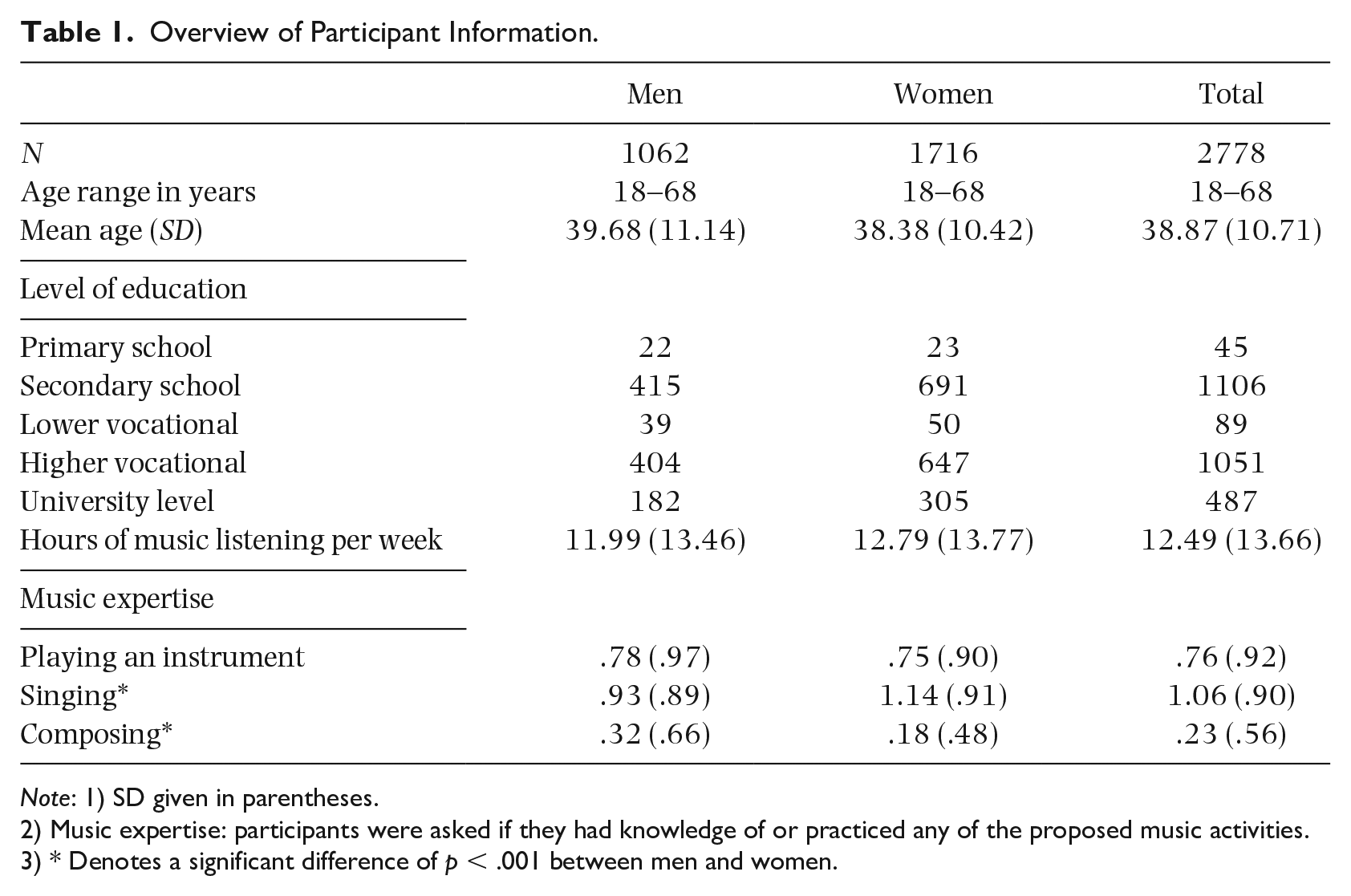
Note: 1) SD given in parentheses.
2) Music expertise: participants were asked if they had knowledge of or practiced any of the proposed music activities.
3) * Denotes a significant difference of p < .001 between men and women.
Measures
Background Information
Participants were asked about their sex, age, highest level of completed education, and music-related activities. These latter activities, rated on a Likert-type scale from 0 (no knowledge) to 3 (expert) included playing an instrument, singing, and composing. Lastly, participants estimated how many hours they listen to music, on average, each week.
The Adult Crying Inventory
We used a questionnaire that was based on the Adult Crying Inventory (ACI; Vingerhoets, 1995; Vingerhoets & Cornelius, 2001). Some questions were reworded in order to ask about crying to music specifically, such as “The following questions refer to the last time you cried when listening to music,” with crying being defined as having moist eyes with an emotional cause. We supplemented the questions on crying with several questions that inquired specifically about the song and its characteristics (see Appendix).
Crying in General
The first two questions were about emotional weeping in general. Participants were asked how often they had cried in the four weeks preceding the questionnaire (“Could you estimate how often you’ve cried during the past four weeks?”), and also on how recent their last emotional weeping episode was in general (Likert-type scale: less than a day ago; 2–5 days; 6–10 days; 11–30 days; 1–6 months; 7–12 months; over a year ago).
Crying Over Music
Participants were then asked to focus on the last time they cried over music (“The following questions refer to the last time you cried when listening to music”).
The Crying-Over-Music Episode
Participants were asked how recently they had cried while listening to music (response alternatives: less than a day ago; 2–5 days; 6–10 days; 11–30 days; 1–6 months; 7–12 months; over a year ago), and to also give the approximate time of day that this episode occurred (00.00–24.00). They further indicated how long this episode lasted (response alternatives: less than 5 minutes; 5–15 minutes; 16–30 minutes; 31–60 minutes; more than 60 minutes; it consisted of multiple recurring, short-lived, episodes). Finally, they provided information on the intensity of crying (moist eyes; moist eyes and sobbing; moist eyes, sobbing, louder crying; moist eyes, sobbing, louder crying, bodily movements or wailing).
Song Characteristics
Participants reported the specific artist and song (free response) that they had heard during their most recent crying over music episode. They then selected the genre of this piece from a list, and were asked if the music was instrumental, vocal, or music that had both vocal and instrumental components. They further indicated if they had chosen to listen to this song, specifically, or if listening to it was coincidental. Lastly, participants selected what made them cry about the song (response options: the beauty of the music itself; lyrics; happy memories; sad memories; nostalgia; something else, labeled “other,” with a free response option).
Presence and Response of Others While Crying
Participants indicated whether they listened to the music in solitude or with (a significant) other(s) present. If applicable, they reported on their relationship with the other(s) present and if these individuals were crying as well. Finally, they provided information on the responses of the other(s) to their crying (response options: ignoring; comfort with words; comfort by putting an arm around me; angry; didn’t know how to react; showed understanding; also cried; or something else/free response). This last question was answered separately for familiar and unfamiliar others who were present.
Associated Feelings and Physical Sensations
Participants rated their mood preceding the episode on a 5-point Likert-type scale ranging from very sad to very happy. They were asked if crying had an effect on their physical and mental wellbeing (“How did you feel mentally/physically after crying in comparison to how you felt before?”: worse than before; the same, better than before), and how they experienced crying (I found it pleasant; I found it uncomfortable; something else). They also indicated the emotions and physical sensations that they experienced while crying (see Tables 7 and 8 for response options).
Procedure
Participants completed the web-based survey on the Top 2000 website in Dutch while the event was aired on radio. The survey was available for two weeks. An introductory text informed participants that this was a study of music and crying, that participation was anonymous and voluntary, and that the data were to be used for scientific purposes only. Participants were also informed that they could discontinue their participation at any time without any negative consequences. Completing the survey in full took approximately 20 minutes. The data were collected in 2006 (see previously) at a time when it was not necessary in the Netherlands to obtain ethical approval to recruit participants to such research, although approval was obtained from the research ethics committee of Tilburg University to analyze the data and publish the results of the study.
Statistical Analyses
Descriptive analyses included means, percentages, and standard deviations of all variables. We compared men and women on various scales with the Chi-squared test for categorical data and ANOVA. Several potential associations were explored through (nonparametric) correlations. We also calculated effect sizes. We report the ϕ and Cramer’s V (ϕ c ) coefficients for the Chi-squared test (ϕ = weak .1, moderate .3, strong .5, and df-adjusted for ϕ c ; Cohen, 1988) and ηp2 (weak .01, medium .06, strong .14; Cohen, 1988) for the ANOVA. To provide some protection against Type I errors, findings were considered significant at an alpha of p ⩽ .001. Analyses were carried out using IBM SPSS 23.0.
Results
The Most Recent General Weeping Episode
Women (M = 3.59, SD = 2.63) had cried almost twice as often as men (M = 2.06, SD = 2.37) during the previous four weeks F(1, 2776) = 241.62, p < .001, ηp2 = .08. As many as 60.49% of women and 53.77% of men reported weeping between one and four times, while 32.11% of men as opposed to only 8.92% of women stated that they had not cried at all. Female weeping episodes were generally also more recent than those of men: 69.29% of women had cried between 0 and 5 days ago as opposed to 42.18% of men (see Table 2). There was a substantial difference between men and women as to how recently they had cried, χ2(6, N = 2778) = 309.66, p < .001, ϕ c = .33.
Overview of the Recency of the Last Weeping in General and Crying-Over-Music Episodes, as well as the Duration and Intensity of the Most Recent Crying-Over-Music Episode.
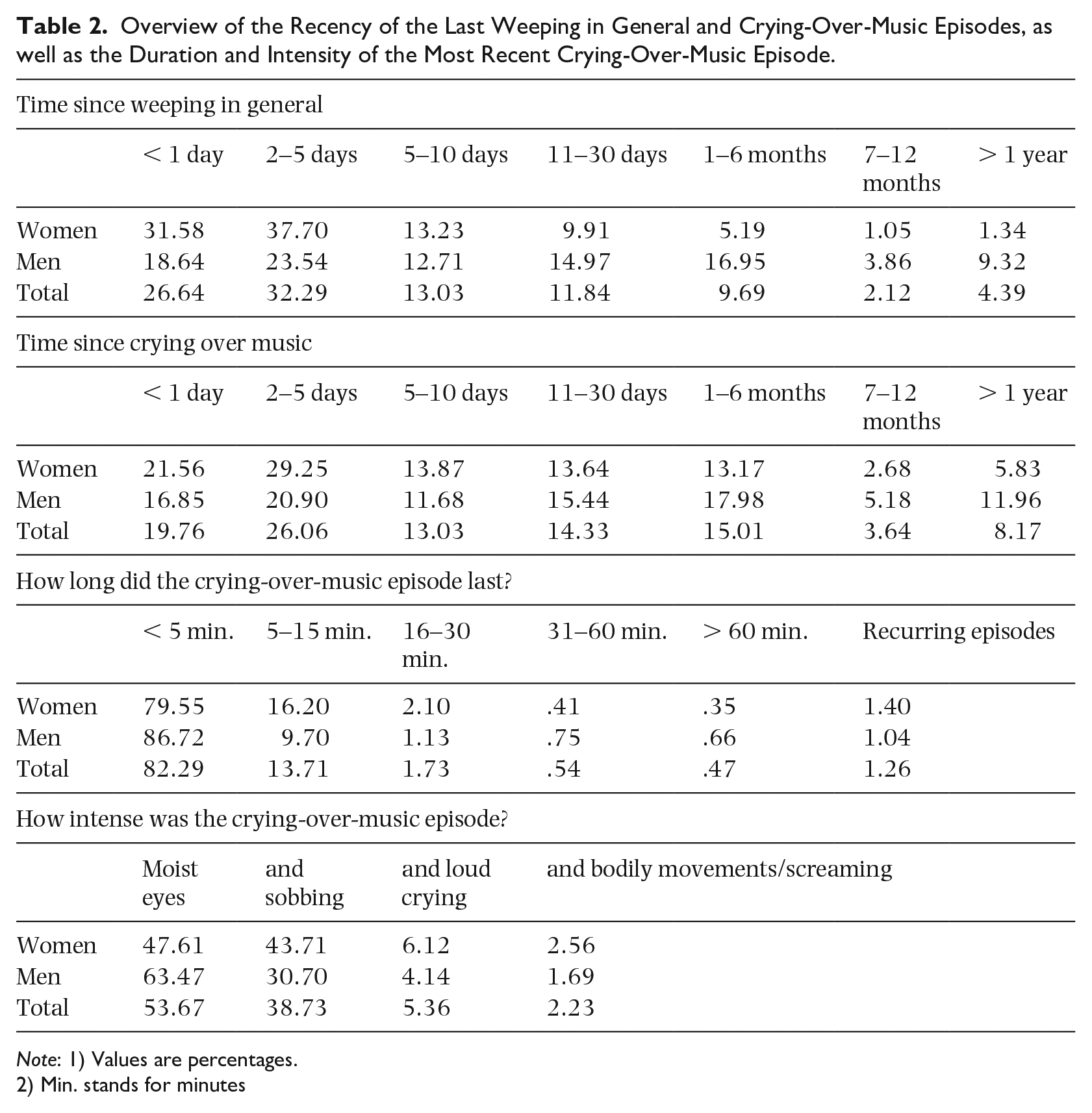
Note: 1) Values are percentages.
2) Min. stands for minutes
The Crying-Over-Music Episode
A similar pattern of women having cried more recently than men was found for crying over music, but the effect size was substantially smaller than we found for weeping in general, χ2(6, N = 2778) = 80.39, p < .001, ϕ c = .17. Data also showed that crying over music was common with 50.82% of women and 37.76% of men having cried while music played during the past 0–5 days (see Table 2). This suggests that some of the crying-over-music episodes overlapped with the most recent general weeping episodes mentioned previously. This was confirmed by a substantial, significant correlation between recency of crying over music and weeping in general, rs(2778) = .66, p < .001.
Crying over music mostly occurred in the evening between 20:00 and 24:00 (37.37%). Crying increased during the day gradually with peaks around 11:00 to 12:00 (6.41%) and between 14:00 and 18:00 (26.28%). Regarding duration, most episodes lasted less than five minutes (see Table 2). There was a small-to-medium effect for sex: women cried somewhat longer than men, χ2(5, N = 2778) = 31.36, p < .001, ϕ c = .11. Episodes that lasted longer than 15 minutes or that recurred over a longer period of time were rare for both sexes. Concerning crying intensity, most of the episodes consisted of having only moist eyes, followed by having moist eyes and some sobbing (see Table 2). There was a medium-sized significant effect for sex: women reported crying more intensely than men, χ2(3, N = 2778) = 66.38, p < .001, ϕ c = .16.
Song Characteristics
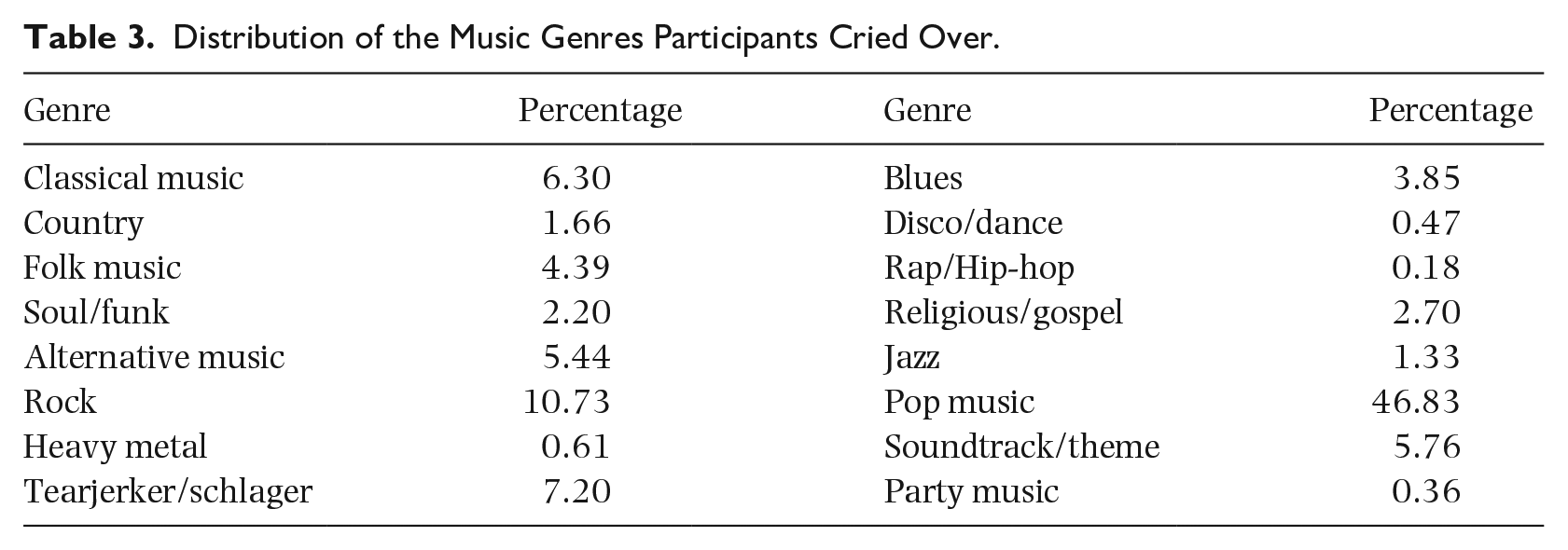
Participants reported crying to nearly 800 different artists, musicians, and composers (exact number unknown due to typographical errors or incomplete information), and an even greater number of different songs and pieces of music. The majority of participants classified the music they cried to as pop (see Table 3 for the genre distribution). They indicated that most of this music consisted of vocal and instrumental components (92.21%), while only a few pieces were a cappella (3.82%) or instrumental (3.97%). The song that was cried over had been chosen specifically by 48.63% of participants, while 51.37% indicated that crying to it was coincidental. Men (56.40%) chose the song they cried over more often than women (43.60%), χ2(1, N = 2778) = 41.56, p < .001, ϕ = .12, but this effect was small.
Distribution of the Music Genres Participants Cried Over.
As to why participants cried over music, they reported it was mostly due to sad memories, the lyrics of the song, nostalgia, and the beauty of the music itself (see Table 4). There was a significant, medium-sized effect for sex, χ2(5, N = 2758) = 54.44, p < .001, ϕ c = .14, such that men reported crying because of the beauty of the music more often than women. On inspection of the free responses, several reactions stood out. A large proportion of participants attributed their crying to a combination of several factors, such as a combination of the lyrics, the music, the situation, and their feelings. In addition, they often mentioned the situation the song was heard in and memories of a specific person.
Overview of What Most Often Makes Participants Cry About Music.
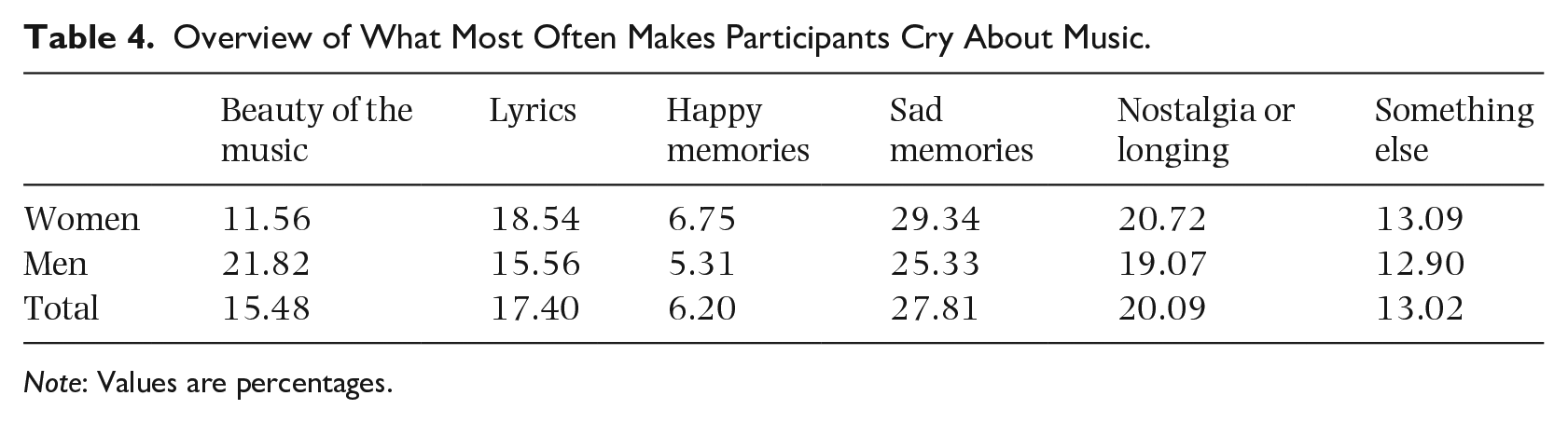
Note: Values are percentages.
The Presence of Others While Crying
Most participants reported crying in solitude (64.25%). When others were present, the company was generally small (1 = 19.98%, 2 = 4.72%, 3 = 2.30% other(s) present). A minority cried in the presence of a group of 10 or more people (6.08%). Their relationship to others present was as follows: in the presence of a partner/significant other 55.77%, in mixed company 14.97%, with their own children 11.45%, friends 6.56%, strangers 5.38%, parents 3.42%, and siblings 2.45%. Participants only noticed others crying too in 7.20% of cases. Observers responded to criers in a variety of ways: familiar others mostly offered understanding and physical comfort, while strangers were more likely to ignore the crying episode, although 20.64% of strangers also showed understanding (see Table 5). The descriptions given in the free-response options of this last question revealed several further interesting reactions. A large proportion of respondents reported that the familiar others present did not notice (as opposed to actively ignore) their tears, or laughed. Sometimes the other present acknowledged their crying, but did not interfere, because that was what the participant preferred. In the case of strangers, a large proportion of participants also said that their crying was apparently unnoticed by bystanders.
Crying in the Presence of Others and their Responses.
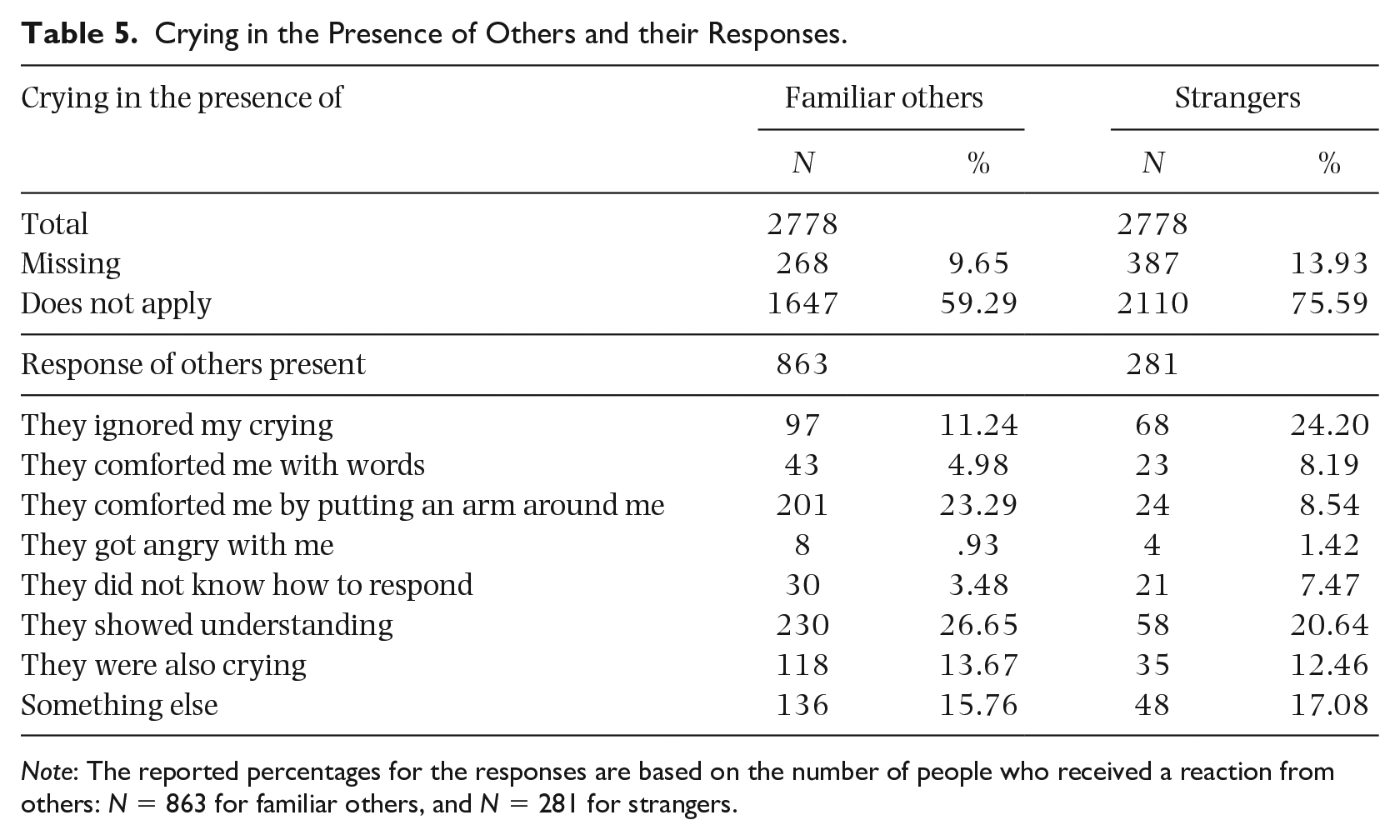
Note: The reported percentages for the responses are based on the number of people who received a reaction from others: N = 863 for familiar others, and N = 281 for strangers.
Emotions and Physical Sensations Experienced During the Crying-Over-Music Episode
Before the onset of crying, a large proportion of participants were in a neutral mood, about a third were (very) sad, while around a quarter were (very) happy (see Table 6). There was no difference between men and women (p = .095). Regarding the question as to whether they experienced any change in their mental wellbeing (see Table 6), around half of the participants reported no change, while a substantial portion said they felt better. A small group felt worse. In terms of physical wellbeing an even larger group reported no change, and the group that reported improvement was only half the size of that which reported a change in mental wellbeing. Again, a small group felt worse. For both mental, χ2(2, N = 2778) = 24.64, p < .001, ϕ c = .09, and physical, χ2(2, N = 2778) = 24.93, p < .001, ϕ c = .09, wellbeing, men said they felt better more often and worse less often than women, but these effects were small. As to how they experienced the crying-over-music episode, the majority of participants said it was pleasant while far fewer felt uncomfortable (see Table 6). On inspection of the free responses, several other sensations stood out; for example, the crying felt unavoidable, necessary, and cathartic. Some people also had no special feelings about their crying, reporting that it was something that just simply happens.
Overview of Several Questions on Pre- and Post-Crying Mood and Feelings.
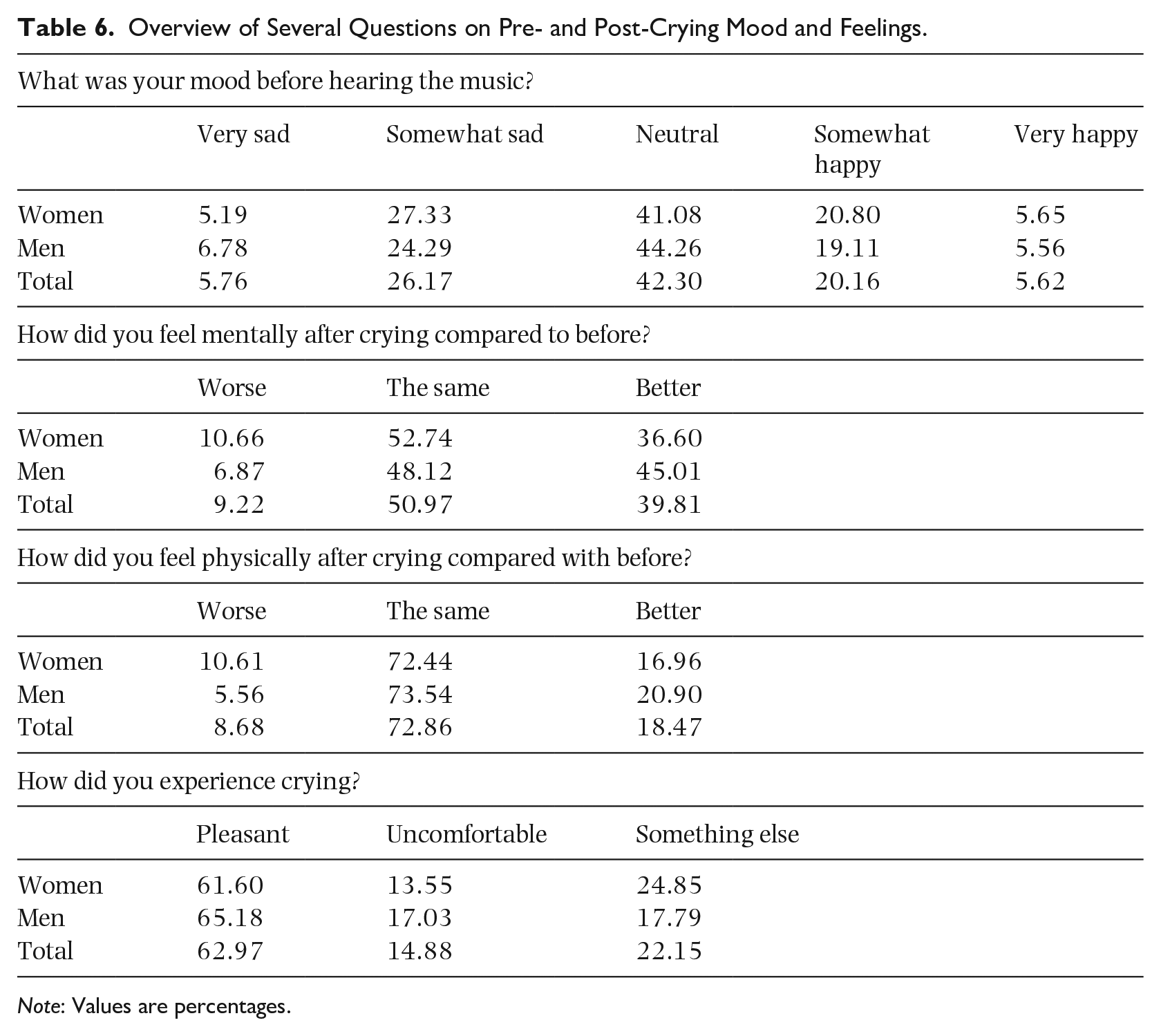
Note: Values are percentages.
In addition, participants indicated the emotions they experienced while crying over music by selecting them from a list provided by the investigators (see Table 7). Being moved, sadness, powerlessness, and nostalgia were the foremost emotions reported when crying over music. Other notable feelings were relief, dismay, and rapture. Reports of highly negative interpersonal emotions (e.g., contempt, humiliation, disgust, guilt) were rare. There were few significant differences between men and women. Males reported significantly less sadness and somewhat more positive emotions than women, but these effects were small.
Reported Frequencies of Experienced Emotions While Crying Over Music.
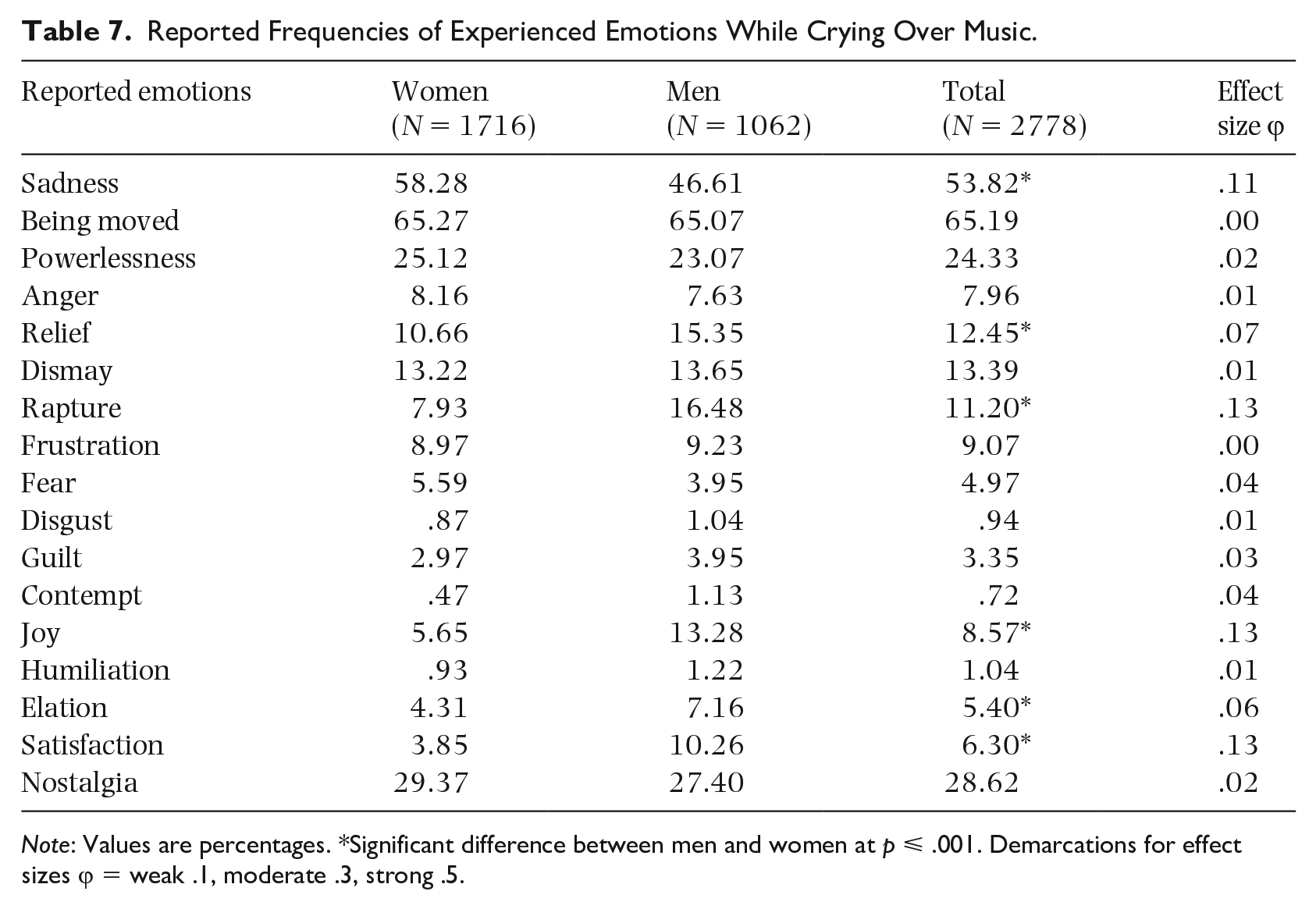
Note: Values are percentages. *Significant difference between men and women at p ⩽ .001. Demarcations for effect sizes ϕ = weak .1, moderate .3, strong .5.
We examined the associations between the four most frequently reported emotions to see if they often occurred simultaneously. Sadness was negatively correlated with being moved r(2778) = -.18, p < .001 and positively correlated with powerlessness r(2778) = .30, p < .001, while being moved was negatively correlated with powerlessness r(2778) = -.18, p < .001 and positively correlated with nostalgia r(2778) = .10, p < .001. Nostalgia and powerlessness were not correlated significantly, r(2778) = -.05, p = .01. There was thus some indication that participants reported less sadness when they experienced more feelings of being moved.
Finally, participants reported their physical sensations (see Table 8). The sensations reported most often were feeling/being quiet, goose bumps, respiratory changes, hair standing on end, and cold shivers. In a result similar to that found for reported emotions, there were few differences between men and women in their reporting of physical sensations. Where differences were statistically significant, effect sizes were minimal.
Reported Frequencies of Experienced Physical Sensations While Crying Over Music.
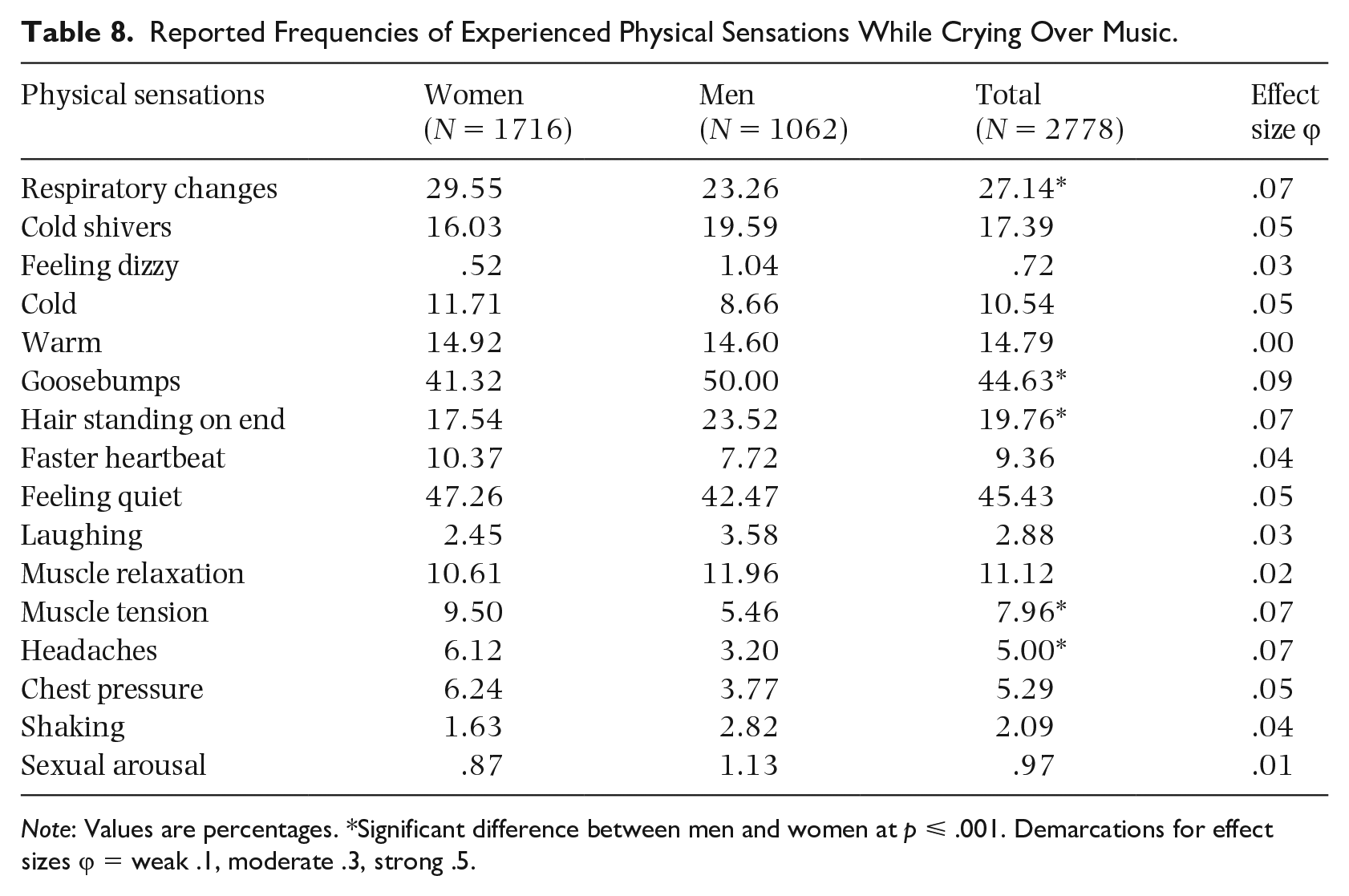
Note: Values are percentages. *Significant difference between men and women at p ⩽ .001. Demarcations for effect sizes ϕ = weak .1, moderate .3, strong .5.
Discussion
This study was designed to obtain a better understanding of episodes of crying over music and to compare these findings to what is known about weeping in general. The current survey was guided by previous research using the ACI, particularly the International Study on Adult Crying (ISAC; Becht & Vingerhoets, 2002; Van Hemert et al., 2011; Vingerhoets, 2013).
In line with recent work by Cotter et al. (2018, 2019), our data suggest that crying is a common and frequent response to music. Episodes are generally short, and mostly limited to moist eyes and occasionally some sobbing. Women cried more, longer, and more intensely over music than men. This corresponds with what is found in the literature on weeping in general (e.g., Vingerhoets, 2013; Vingerhoets & Scheirs, 2000). Smaller effect sizes were found for differences between the sexes in terms of frequency, crying duration, and intensity for crying over music than for weeping in general.
There was a gradual increase in crying over the course of the day, peaking late in the day and particularly in the evening, reflecting the increase and evening peak shown in the ISAC database (Vingerhoets, 2013). People tend to listen to music during the evening, whether they are at a concert or at home. If they are at home, they can choose to listen to music that is relevant to them personally and use it to relax, reflect on the past day, or for other mood-regulatory purposes. Furthermore, fatigue may lower the individual’s weeping threshold (Gračanin et al., 2018; Vingerhoets, 2013). Since we did not specifically ask what people were doing at the time they cried, we do not know the reason for these peaks or whether they were linked to emotionally significant events, for instance, during the day. Understanding the situations in which people cry over music would be an interesting avenue for future research, since the emotional experiences of crying episodes appear to depend on their environmental context (Cotter et al., 2019).
Like general weeping episodes, most crying over music happens in solitude. If others are present at all, they are generally few. Crying over music, as opposed to weeping in general (Vingerhoets, 2013), is less common in the presence of parents, but more so in the company of a partner. Consequently, comfort provided while weeping over music is more physical and less vocal in nature when compared with weeping in general. Tears in general and while listening to music are rarely shed in the presence of strangers. Unfamiliar observers seem to be somewhat more willing to comfort and show understanding, albeit less so than familiar observers, when they witness tears shed while listening to music than when tears are shed without music. This may be the result of being exposed to the same music and experiencing the same feelings as the crier. In addition, the cause of tears may be clearer to the observer in the case of crying over music, and it may be easier and safer for them to engage with the crier since there is no direct risk to the observer. Yet, somewhat paradoxically, tears shed while listening to music are ignored to a greater extent by both familiar and unfamiliar observers than by the observers recorded in the ISAC database (Vingerhoets, 2013). This may be because observers do not consider music a real emotional stressor. This may be because observers do not consider music to be a genuine source of stress evoking the need for comfort and support.
Thus, although weeping is thought to signal a request for help from observers (Gračanin et al., 2018; Vingerhoets, 2013), most crying over music occurs when the individual is alone. Music can, however, be experienced as a nonjudgmental, understanding friend (e.g., Hanser et al., 2016; Van den Tol & Edwards, 2013), and may serve as a substitute for personal contact when others are unavailable or unwanted. Recent work by Aucouturier and Canonne (2017) further demonstrates the ability of listeners to identify social relational intentions in improvised musical interactions, and self-selected music reduces feelings of loneliness in listeners (Schäfer et al., 2020). The prosocial intentions commonly sought by criers may thus also be found in music, probably in particular by those who were already in a low mood before they listened to the music. Another reason for crying in solitude with music may be that there are no interpersonal distractions and listeners can fully focus on their own affective experience (Zhang et al., 2018). This may also help to understand why consolation and other music and mood-regulatory strategies (Hanser et al., 2016, Saarikallio & Erkkilä, 2007) are mostly applied when alone. It may be easier to work through and re-evaluate emotional concerns with the help of music without any distraction from other people. In turn, confronting emotional concerns while listening to an emotionally laden song may evoke tears. Since people strongly believe that weeping serves self-soothing functions (Gračanin et al., 2014) this may be a specific goal of some listeners. However, there is currently no understanding of the nature of the mood-elevating mechanism(s) that may be involved in self-soothing weeping. The findings of both the present study and a recent survey (Cotter et al., 2018) revealed that approximately half of the participants in both studies chose the specific music they cried to. While this does not necessarily imply that they had the intention of crying, it is well documented that people generally have a clear understanding of the music they wish to listen to in certain situations and how their preferred music influences them emotionally (e.g., Schäfer et al., 2013).
Given our method of recruitment, it is unsurprising that most respondents cried over popular music and nearly all the music included a vocal element. The presence of vocals or an instrument that resembles them may be crucial in evoking tears, perhaps because people find it easier to relate to or make social connections with voices. Vocal elements are also important in the experience of other strong experiences with music such as chills (Bannister, 2018). Furthermore, participants attributed some of their crying to specific song lyrics. Future work could focus on which aspects of the lyrics make listeners cry, such as their meaning, the presence of a voice, its timbre, or the performer’s sex. Another intriguing finding that deserves more research attention is that men reported crying over the beauty of the music itself more often than women, while both sexes reported crying equally often because of sad memories, nostalgia, and the lyrics of the song.
A recent study also found that lyrics and memories of people or events played important roles in crying over music, as well as specific music-evoked emotions and personal meaning of the music to the individual (Cotter et al., 2019). These authors also found that awe-inspired crying episodes were more often triggered by factors related to the music, such as the beauty of it, while sad episodes were more often related to extra-musical associations, such as memories. From the general weeping literature, it is known that men cry over positive events more often than women (Vingerhoets, 2013; Vingerhoets & Bylsma, 2016). We do not know if this finding reflects reality adequately or if men are biased in their recall or reports of emotional episodes such that they are more likely to recollect positive experiences than negative experiences.
In the current study, most participants described their crying-over-music episode as a pleasant experience, regardless of whether they were men or women. Even though the experience might have been pleasant, crying over music mostly did not lead to improved mental let alone physical wellbeing. When interpreting this finding, some caution is advised, however, since recent work suggests that the potential positive or negative outcome of a weeping episode relies heavily on the presence and response of others, the psychological condition of the crier (Rottenberg et al., 2008), and the study methodology (Gračanin et al., 2015).
Further support for crying over music as a mostly positive experience comes from the reported emotions associated with the crying episode. Nearly two-thirds of participants reported being moved. There is evidence that art-elicited tears can be viewed as a physiological expression of being moved (e.g., Kuehnast et al., 2014). The study of this complex feeling is relatively new (Menninghaus et al., 2015) and there is an ongoing discussion in the literature as to whether it should be regarded as a mixed state of feelings (Menninghaus et al., 2015), sometimes described as “moving sadness” (Eerola et al., 2016, p. 4) or as a separate, positive emotion (Seibt et al., 2017). Whatever its precise nature, it is clear that being moved plays a major role in the experience of music and peak emotions in particular (Bannister, 2018). Moreover, being moved in daily life is often associated with the direct experience or the observation of prosocial behavior and interpersonal closeness (Menninghaus et al., 2015; Seibt et al., 2017). The present positive association between being moved and nostalgia, and the negative association with sadness and powerlessness suggests that being moved can be seen as a positive emotional construct, even though some crying episodes are characterized by an overlap with a feeling of sadness. The current findings support the view that tears do not signal only sadness (Gračanin et al., 2018; Vingerhoets, 2013; Vingerhoets & Bylsma, 2016).
Sadness played a part, however, in nearly half of the crying episodes that were reported and is thus an important emotion when crying over music (Cotter et al., 2018). Nearly one-fourth of the participants also experienced helplessness. Whether this should be considered as an inability to understand the musical experience, a feeling of being overwhelmed by the beauty of the music (Miceli & Castelfranchi, 2003), or related to extra-musical events should be explored in future research. The latter explanation seems more likely.
Crying over music is most different from weeping in response to other antecedents because of the emotions experienced while crying. In the ISAC database, being moved is reported far less frequently, while powerlessness and other strong negative emotions such as anger and frustration, sometimes combined with powerlessness, are more prevalent when weeping in general (Vingerhoets, 2013). Strongly negative interpersonal sensations such as humiliation, contempt, and disgust are almost absent when crying over music. The literature backs this up: individuals rarely or never experience negative interpersonal emotions while listening to music (see Juslin & Laukka, 2004). Positive emotions such as joy and relief are reported equally often in the ISAC database, with the exception of rapture, which is more common when crying over music. When designing experimental studies of emotional weeping, further consideration should be given to the difference between being moved when crying over music and when weeping in general. Tears evoked by emotional stimuli involving music, but perhaps also other forms of art, may result in entirely different prosocial responses from observers than tears in real-life situations.
While crying over music, goosebumps and feeling quiet are the physical sensations reported most frequently. These bodily feelings are associated with weeping in general (Vingerhoets, 2013) and being moved (Menninghaus et al., 2015; Seibt et al., 2017; Wassiliwizky et al., 2017), and differ from the peak experience of chills, which is marked by warm sensations (Bannister, 2018). This finding supports the idea that tears and chills are separate phenomena (Bannister, 2018; Mori & Iwanaga, 2017) that may occur simultaneously, however, or follow each other in close succession (Bannister, 2019; Wassiliwizky et al., 2017). The overlap between tears, feeling quiet, and goosebumps suggests that the traditional view of the sympathetic and parasympathetic nervous systems as functioning antagonistically might be obsolete and that it is possible for both branches of the autonomic nervous system to be activated at the same time. More physiological research, such as that by Wassiliwizky et al. (2017), is needed to further our understanding of the physiological responses associated with peak emotional experiences. As pointed out by others (e.g., Cotter et al., 2018), the relationships and discrepancies between peak emotional states (chills, crying), and complex emotional constructs (awe, being moved, nostalgia) deserve more research attention, since they seem to occur in a wide variety of both positive and negative situations.
A further point of interest is that we found few significant differences between the reported emotions and physical sensations of men and women while crying over music, with small effect sizes. Differences between men’s and women’s reports of helplessness and fear when weeping in general (Vingerhoets, 2013) disappear when they are crying over music. Taken together with the smaller differences we found between men and women in their reports of recency, duration, and intensity of crying-over-music episodes, these findings suggest that men and women are more similar than dissimilar when crying over music than when weeping in general. How they engage with music and what makes them cry over it may differ, however.
Finally, despite the evident trends described previously, there were substantial differences between the participants in this study in terms of the recency and frequency of crying-over-music episodes, the components of the music that make them cry, the emotions they experienced, and their physical responses. This is further exemplified by the large number of different songs and artists over which the participants cried. Crying over music is therefore not a uniform behavior and seems to depend to a great extent on personal, situational, and musical variables.
Limitations
The current body of work is one of the few studies that investigate crying over music and one of the first to make a comparison between crying over music and weeping in general. Another strength is the large sample size. Several limitations should be considered, however, when interpreting the current findings. First, all responses were self-reports by individuals who were mainly referred to the survey through the website of a popular music radio station. Participants can thus be assumed to have an interest in and preference for specifically popular music and their responses may suffer from self-report bias. Second, data were collected during and immediately after a major radio event at the end of the year. This may have had an effect on the recency and frequency of crying episodes that were reported, and the feelings that were associated with them. Men in particular reported crying more often than expected, according to the general weeping literature (Vingerhoets, 2013). Third, participants included in the ISAC database were not asked if any music was present when they were weeping over general antecedents, although they were given the opportunity to indicate that the direct cause of their weeping was music. Finally, many intra-individual, interpersonal, and intercultural differences exist within general weeping behavior (see Vingerhoets, 2013) so the findings of the present study may not apply to other populations. These issues could be countered by collecting data on multiple crying episodes throughout the year from a sample representative of the general population, rather than just listeners to a specific event on the radio, in several countries, using methods such as diary or panel studies. Such research could provide valuable insight into the question of how listeners engage with music they have cried over in the past. This would also help our understanding of individual differences between weeping in general and crying over music.
Conclusion
The present study furthers our understanding of human emotional crying over music and demonstrates that it is a common, but diverse experience. Crying over music is different from weeping in general in respect of: (1) smaller differences between women and men in frequency, intensity, and experienced emotions, (2) affective experiences, namely the frequent experience of being moved and the absence of strongly negative feelings, and (3) presence (of a partner) and response of observers (more physical for familiar others, and more often understanding, although crying over music is more often ignored by familiar others and strangers alike). Music may help to establish a safe environment in which listeners can give in to or work through their emotions without feeling judged. It may serve as an understanding friend in this context. Crying is not always directly related to feelings of sadness and may have numerous antecedents and consequences that depend to a large extent on the specific situation, the person, and the presence of others. The current findings are particularly relevant to studies in which music is used as a stimulus to induce crying.
Footnotes
Appendix
Music and Crying Questionnaire
Deel 1/ Section 1
De volgende vragen gaan over muziek, emoties en huilen. Met huilen bedoelen wij dat de ogen betraand zijn om emotionele redenen en niet vanwege oogirritatie. Snikken en hardop huilen is dus niet echt noodzakelijk. / The following questions are about music, emotions and crying. By crying we mean having moist eyes for emotional reasons and not because of irritation to the eyes. Sobbing and crying out loud are thus not strictly necessary.
Q1. Wat is uw geslacht? - Man/vrouw / What is your sex? - Male/female
Q2. Wat is uw leeftijd? / What is your age? - (Free response)
Q3. Wat is uw hoogst afgeronde opleiding? - Lagere school /Lager beroepsonderwijs/Middelbaar beroepsonderwijs/Hoger beroepsonderwijs/Universitair / What is your highesst completed level of education? - Primary school/Secondary school/Lower vocational/Higher vocational/University
Q4. In welke mate beheerst u de volgende muzikale vaardigheden? - Bespelen van een muziekinstrument/Zingen/Componeren (Schaal van helemaal niet (0), tot aan expert (3)). To what extent have you mastered the following music skills? - Playing an instrument/Singing/Composing (Scale that ranged from not at all (0), to expert (3)).
Q5. Hoeveel uur luistert u gemiddeld genomen per week naar muziek? / How many hours a week do you on average listen to music? - (Free response)
Q6. Kunt een schatting geven van hoe vaak u de afgelopen 4 weken gehuild hebt? / Could you estimate how often you have cried during the past four weeks? - (Free response)
Q7. Wanneer hebt u voor het laatst gehuild? - Minder dan 1 dag geleden/2-5 dagen geleden/6-10 dagen geleden/11-30 dagen geleden/1-6 maanden geleden/7-12 maanden geleden/meer dan 1 jaar geleden. / When was the last time you cried? - Less than 1 day ago/2-5 days ago/6-10 days ago/11-30 days ago/1-6 months ago/7-12 months ago/over 1 year ago.
Deel 2 / Section 2
De onderstaande vragen hebben betrekking op de laatste keer dat u gehuild hebt toen u naar muziek luisterde. / The following questions refer to the last time you cried when listening to music.
Q8. Welk nummer hoorde u toen u huilde? - (artiest & titel) / What song did you hear when you cried? -(free response - artist & title)
Q9. Wat was het genre? - Klassiek/Blues/Country/Disco, dance/Folk/Rap, hiphop/Soul, funk/Religieuze muziek, gospel/Alternatieve muziek/Jazz/Rock/Pop/Heavy metal/(film)Soundtrack, thema/Smartlap, schlager/Feestmuziek / What was the music’s genre? - Classical/Blues/Country/Disco, dance/Folk/Rap, hiphop/Soul, funk/Religious music, gospel/Alternatieve music/Jazz/Rock/Pop/Heavy metal/(movie) soundtrack, theme/Tearjerker, schlager/Party music.
Q10. Wat voor soort muziek was het? - Alleen zang/instrumentaal/zang en instrumenten / What kind of music was it? - Only vocal/instrumental/both vocals and instrumental
Q11. Wanneer heeft u gehuild? - Minder dan 1 dag geleden/2-5 dagen geleden/6-10 dagen geleden/11-30 dagen geleden/1-6 maanden geleden/7-12 maanden geleden/meer dan 1 jaar geleden. / When was the last time you cried? - Less than 1 day ago/2-5 days ago/6-10 days ago/11-30 days ago/1-6 months ago/7-12 months ago/over 1 year ago.
Q12. Hoe laat was het ongeveer? / What was the approximate time of day? - (00.00-24.00)
Q13. Hoe was uw stemming juist voordat u de muziek hoorde? - Zeer somber/Enigszins somber/Neutraal/Enigszins vrolijk/Zeer vrolijk / What was your mood before hearing the music? - Very sad/Somewhat sad/Neutral/Somewhat happy/Very happy.
Q14. Hoe lang duurde de huilbui? - Minder dan 5 minuten/5-15 minunten/16-30 minuten/31-60 minuten/meer dan 60 minuten/het waren steeds weer terugkerende (korte) huilbuien / How long did your crying episode last? - Less than 5 minutes/5-15 minutes/16-30 minutes/31-60 minutes/more than 60 minutes/It consisted of multiple recurring (short-lived) episodes.
Q15. Hoe intens huilde u? - Alleen vochtige ogen/Vochtige ogen en zacht snikken/Vochtige ogen, snikken en luid huilen/Vochtige ogen, snikken, luid huilen, lichaamsbewegingen en schreeuwen. / How intense was your crying? - Moist eyes/Moist eyes and some soft sobbing/Moist eyes, sobbing, crying out loud/Moist eyes, sobbing, crying out loud, bodily movements and screaming.
Q16. Ik hoorde deze muziek, omdat ik - die bewust had gekozen/heel toevallig. / I heard this music, because I - specifically chose to listen to it/by chance.Q 17. Wat maakte u aan het huilen? - De muziek/De teksten/Herinnering aan een gelukkige gebeurtenis/Herinnering aan een droevige gebeurtenis/Gevoelens van nostalgie/Iets anders (indien iets anders, kun u dan aangeven wat?) / What made you cry? – The beauty of the music itself/The lyrics/Memories of a happy event/Memories of a sad event/Nostalgia/Something else (if something else, could you then specify what? – free response option).
Q18. Hoe ervoer u het huilen? - Ik vond het wel prettig/Ik voelde me opgelaten/Iets anders, namelijk… (indien iets anders, kun u dan aangeven wat? / How did you experience crying? - I found it pleasant/I found it uncomfortable/Something else, namely (Free response option)
Q19. Hoeveel andere mensen waren erbij? / How many other people were present? - (Free response)
Q20. Kunt u aangeven wie erbij aanwezig waren? - Niet van toepassing/partner/ouders/broers, zussen/eigen kinderen/vrienden/collega’s/onbekenden/gemengd gezelschap / Could you indicate who were present? - Not applicable/Partner/Parents/Siblings/Own children/Friends/Colleagues/Unfamiliar others/Mixed company
Q21. Waren er anderen die ook huilden? - Ja/Nee/Weet ik niet / Were the present others crying as well? - Yes/No/I don’t know
Q22. Indien een vertrouwd persoon aanwezig was toen u huilde, hoe reageerde zij/hij? (in het geval dat er meerdere personen aanwezig waren, beperk dan uw antwoord tot degene, die u het meest vertrouwd is) - Niet van toepassing/de persoon negeerde mijn builde/de persoon troostte met woorden/de persoon troostte door een arm om me heen te slaan/de persoon werd kwaad op me/de persoon wist niet hoe te reageren/de persoon voelde zich in verlegenheid gebracht/de persoon toonde begrip/de persoon stopte met vervelend doen/de persoon werd vriendelijker/de persoon huilde ook/de persoon merkte niet dat ik huilde/iets anders, namelijk… / If a familiar person was present at the time of your crying, how did they respond? (If more people were present, please limit your answer to the one dearest to you) – Not applicable/they ignored my crying/they comforted me with words/they comforted me by putting their arm around me/they got angry at me/they did not know how to respond/they felt embarrassed/they showed understanding/they stopped being mean/they became friendlier/they also cried/they didn’t notice me crying/something else, namely… (Free response option)
Q23. Indien een of meer onbekende personen aanwezig waren toen u huilde, hoe reageerden zij? (in het geval dat er meerdere onbekenden aanwezig waren, beperk dan Uw antwoord tot degene, die het dichtst bij U stonden) - Niet van toepassing/de persoon negeerde mijn builde/de persoon troostte met woorden/de persoon troostte door een arm om me heen te slaan/de persoon werd kwaad op me/de persoon wist niet hoe te reageren/de persoon voelde zich in verlegenheid gebracht/de persoon toonde begrip/de persoon stopte met vervelend doen/de persoon werd vriendelijker/de persoon huilde ook/de persoon merkte niet dat ik huilde/iets anders, namelijk… / If unfamiliar others were present at the time of your crying, how did they respond? (If more people were present, please limit your response to the one in closest proximity to you) - Not applicable/they ignored my crying/they comforted me with words/they comforted me by putting their arm around me/they got angry at me/they did not know how to respond/they felt embarrassed/they showed understanding/they stopped being mean/they became friendlier/they also cried/they didn’t notice me crying/something else, namely… (Free response option)
Welke emoties of gevoelens ervoer u tijdens het huilen? / Which of the following emotions or feelings did you experience while crying?
Q24. Opluchting / Relief - Yes/No
Q25. Plezier / Joy - Yes/No
Q26. Minachting / Contempt - Yes/No
Q27. Droefenis / Sadness - Yes/No
Q28. Angst / Fear - Yes/No
Q29. Vernedering / Humiliation - Yes/No
Q30. Machteloosheid / Powerlessness - Yes/No
Q31. Bevrediging / Satisfaction - Yes/No
Q32. Boosheid / Anger - Yes/No
Q33. Walging / Disgust - Yes/No
Q34. Schuld / Guilt - Yes/No
Q35. In de wolken zijn / Elation - Yes/No
Q36. Frustratie / Frustration - Yes/No
Q37. Verslagenheid / Dismay - Yes/No
Q38. Ontroering / Being moved - Yes/No
Q39. Extase, vervoering / Rapture - Yes/No
Q40. Nostalgie – Nostalgia - Yes/No
Welke lichamelijke reacties ervoer u tijdens het luisteren naar deze muziek? / What physical reactions did you experience while listening to the music?
Q41. Verandering van ademhaling / Respiratory changes - Yes/No
Q42. Koude rillingen / Cold shivers - Yes/No
Q43. Duizeligheid /Feeling dizzy - Yes/No
Q44. Het koud krijgen / Cold - Yes/No
Q45. Het warm krijgen / Warm - Yes/No
Q46. Kippenvel / Goosebumps - Yes/No
Q47. Haren die overeind gaan staan / Hair standing on end - Yes/No
Q48. Versnelling van de hartslag / Faster heartbeat - Yes/No
Q49. Helemaal stil worden / Feeling quiet - Yes/No
Q50. Lachen / Laughing - Yes/No
Q51. Ontspanning van de spieren / Muscle relaxation - Yes/No
Q52. Toename van spierspanning / Muscle tension - Yes/No
Q53. Hoofdpijn / Headaches - Yes/No
Q54. Druk op de borst / Chest pressure - Yes/No
Q55. Trillen / Shaking - Yes/No
Q56. Seksuele opwinding / Sexual arousal - Yes/No
Q57. Hoe voelde u zich geestelijk na uw huilbui in vergelijking met de periode daaraan voorafgaand? - Slechter dan daarvoor/Hetzelfde als daarvoor/Beter dan daarvoor / How did you feel mentally after crying in comparison to how you felt before? Worse than before/The same/Better than before
Q58. Hoe voelde u zich lichamelijk na uw huilbui in vergelijking met de periode daaraan voorafgaand? - Slechter dan daarvoor/Hetzelfde als daarvoor/Beter dan daarvoor / How did you feel physically after crying in comparison to how you felt before? Worse than before/The same/Better than before
Acknowledgements
We wish to thank the anonymous reviewers and journal editor for their many useful comments that have helped to improve this manuscript significantly.
Funding
The authors received no financial support for the research, authorship, and/or publication of this article.
