



Abstract
Music is a widely used tool for stress reduction and mood regulation, but its effectiveness may differ depending on individual characteristics and the emotion regulation strategies employed. In the present study, we investigated the association between (un)healthy music use and attachment style, a factor that shapes not only interpersonal behavior but also emotion regulation tendencies. Using a sample of 224 participants, we administered questionnaires assessing attachment styles, general emotion regulation tendencies, attitudes toward emotions, and patterns of healthy and unhealthy music use. Our results showed that insecure attachment styles are associated with unhealthy music use, mediated by general emotion regulation tendencies. Specifically, anxious attachment was linked to ruminative music listening, mediated by a broader tendency to use rumination as an emotion regulation strategy. In contrast, avoidant attachment was linked to avoidant music use, mediated by a general tendency to avoid emotions. In conclusion, attachment style plays an important role in shaping how individuals engage with music, with anxious and avoidant styles being associated with unhealthy patterns of music use. This study makes a significant conceptual contribution by laying the groundwork for a new area of research that focuses on how attachment styles influence music use and related emotional outcomes.
Keywords
A substantial body of research has emphasized the profound emotional impact of music on individuals (e.g., Juslin & Laukka, 2004). Listening to music is one of the most commonly used strategies for mood or emotion regulation (Van Goethem & Sloboda, 2011), which is defined as the effort to maintain, increase, decrease, or change positive or negative affective states (Gross, 2015). It can be used to distract from worries, promote relaxation after periods of stress, energize before undertaking challenging tasks, facilitate the expression of intense emotions, and stimulate positive emotional states (Saarikallio, 2011). Music’s emotion-regulatory potential is already present in infancy. For example, mothers actively use lullabies to regulate their babies attention and emotions, as well as to strengthen mother-infant bonds (Trehub & Gudmundsdottir, 2019). However, while music provides opportunities for a range of generally adaptive emotion regulation strategies, including cognitive reappraisal and distraction from worries (Baltazar & Saarikallio, 2016), it can also be linked to maladaptive strategies such as expressive suppression, which may have negative long-term effects (Chin & Rickard, 2014). Thus, music can be used in both healthy and unhealthy ways (Saarikallio et al., 2015), depending on the listener’s personality and chosen emotion regulation strategies (Baltazar et al., 2019).
One psychological factor that may help explain individual differences in the effectiveness of music-based mood regulation is attachment style, which has been linked not only to general emotion regulation tendencies (e.g., Mikulincer & Shaver, 2019) but also to emotional reactivity to music (e.g., Laan et al., 2012; Lourenço et al., 2023). Building on this literature, the present study aimed to expand our understanding of the factors associated with healthy and unhealthy patterns of music use by examining the role of attachment styles, a factor that has not yet been studied in this context.
Attachment style, affective responses, and mood regulation
Attachment style, introduced by Bowlby (1973), shapes relationship beliefs, expectations, and behaviors. Originally defined as three categories of childhood attachment (Ainsworth et al., 1978), namely, secure, anxious, and avoidant, the concept was later extended to adults and is often conceptualized as a two-dimensional construct comprising attachment-related anxiety and avoidance: Attachment-related anxiety reflects concerns about a partner’s ability to meet one’s needs and maintain the relationship, while attachment-related avoidance reflects a preference for independence and emotional distance. Individuals who score low on both dimensions are considered securely attached (Mikulincer & Shaver, 2010). In romantic relationships, these dimensions shape attachment behavior, especially how individuals respond to challenging situations and the emotions linked to them. Depending on their attachment style, individuals adopt strategies that result in either hyperactivation or deactivation of the attachment system. Hyperactivation, which is primarily linked to an anxious attachment style, involves demanding closeness, reassurance, and love from the partner, alongside frustration when these needs are not met. In contrast, deactivation, associated with avoidant attachment, is characterized by minimizing closeness, suppressing attachment needs, and preventing mutual dependence (e.g., Mikulincer & Shaver, 2005).
Attachment style not only influences behavior within relationships but also affects general emotional responses and regulation strategies. Anxious attachment has been linked to heightened attention to and exaggeration of negative emotions, stronger perceptions of threat, pessimistic beliefs, and reliance on emotion-focused coping strategies. Conversely, avoidant attachment has been associated with diverting attention from emotional stimuli, suppressing emotional experiences, inhibiting or masking emotional expression, and seeking limited social support (Mikulincer & Shaver, 2019; Pascuzzo et al., 2013; Shaver & Mikulincer, 2008).
Emotional dysregulation associated with insecure attachment styles appears to be an important mediator of the relationship between attachment styles and mental health problems or maladaptive behaviors. For example, insecure attachment has been associated with eating disorders via rumination among individuals with high attachment anxiety and via emotional control strategies among individuals with high avoidant attachment (Van Durme et al., 2018). In addition, both anxious and avoidant attachment styles have been associated with depression, social anxiety, and aggression, with dysregulated or suppressed experiences of sadness and anger serving as mediators (Clear et al., 2020). Similarly, the relationship between insecure attachment and addictive behaviors, including substance use (alcohol, marijuana) and behavioral addictions (e.g., texting, Internet gaming, and social networking), has been found to be mediated by difficulties in emotion regulation (Liese et al., 2020; C. Liu & Ma, 2019).
Although research on the relationship between music and attachment styles is limited, some evidence suggests that attachment styles are related to emotional responses to music. For example, one study found an association between attachment style and song lyric preference: individuals high in avoidant attachment preferred lyrics portraying distance, fear of closeness, or avoidance of intimacy, whereas individuals high in neuroticism preferred lyrics reflecting attachment anxiety, such as rejection, jealousy, or hurt (Alaei et al., 2022). Another study showed that anxious attachment was related to more intense emotional memories of songs in video advertisements, whereas avoidant attachment was related to less intense memories, weaker positive emotions, and stronger negative attitudes toward advertisement songs (Lourenço et al., 2023). Individuals with an anxious attachment style further tend to cry more intensely in general and in response to music, while those with an avoidant attachment style tend to inhibit crying (Laan et al., 2012). Attachment style also shapes how music is used in parent-child interactions. For example, it influences how mothers use song to soothe infants (Milligan et al., 2003) and predicts parent-child musical engagement during stressful times such as the COVID-19 pandemic (Steinberg et al., 2021). Taken together, these findings suggest that both the use of music and affective reactions to music correspond with general attachment characteristics. However, no research has yet examined whether attachment styles influence the outcomes of music use. Given the well-established links between attachment, emotion regulation tendencies, and problematic use of food, alcohol, or the Internet, similar associations with adaptive and maladaptive uses of music are plausible.
Healthy and unhealthy uses of music
Specific maladaptive features have sometimes been identified as a part of emotional engagement with music. For example, music may be used to engage with and express negative emotions (Carlson et al., 2015), ruminate on emotional events (Garrido & Schubert, 2015), or disengage from, withdraw from, or deny a stressor as a form of avoidant coping (Miranda & Claes, 2009). The Healthy-Unhealthy Music Scale (HUMS; Saarikallio et al., 2015) was developed to assess musical engagement in adolescents as an indicator of vulnerability to depression. According to the authors, this 13-item scale can be divided into two subscales (healthy and unhealthy) or three subscales (healthy, unhealthy avoidant, and unhealthy ruminative). The HUMS unhealthy subscale has been shown to be related to maladaptive coping, rumination, stress, and depression, whereas the healthy subscale is related to adaptive coping, happiness, and well-being (Saarikallio et al., 2015; Silverman, 2021). For the purposes of the current study, we used the three-factor model to distinguish the ruminative and avoidant aspects of unhealthy music use, as these components are expected to relate to anxious and avoidant attachment styles, respectively.
It has been shown that unhealthy music use, as measured by the HUMS, can be predicted by individual characteristics associated with difficulty regulating emotions. For example, unhealthy music use has been linked to neuroticism, which is associated with emotional dysregulation, rumination, and suppression (Alluri et al., 2022). Unhealthy music use has also been associated with depression and anxiety (e.g., Carlson et al., 2015; Saarikallio et al., 2015), which are often accompanied by difficulties in emotion regulation (Hu et al., 2014). Given these findings, it seems plausible that attachment styles, along with, or via, their associated emotion regulation strategies, may also influence how individuals use music in emotionally healthy and unhealthy ways.
In light of the important social dimension of musical experiences (Schäfer & Eerola, 2020), is particularly compelling to explore whether the established links between attachment styles and various emotion regulation strategies also extend to music. The social aspects of music emerge early on, as seen in musical communication promoting parent-infant bonding and helping caregivers regulate their babies’ emotions (Trehub & Gudmundsdottir, 2019). In this context, difficulties related to attachment styles appear to affect the emotion regulation capacity of mothers. Milligan et al. (2003) showed that autonomous and preoccupied mothers sang less playfully to distressed than to non-distressed infants, while dismissing mothers sang with the same level of playfulness to both distressed and non-distressed infants. Additionaly, listening to music alone has been suggested as an alternative to social interaction, evoking memories of significant others and enabling individuals to identify with the messages in song lyrics (Schäfer et al., 2020). The social aspects of musical experiences make attachment style a particularly relevant predictor of emotional engagement with music. Understanding how individuals with different attachment styles use music to regulate their moods, and how this interacts with their broader emotion regulation tendencies, could offer valuable insights into the social dimensions of music consumption.
The present study: Aims, research questions, and hypotheses
Building on research linking insecure attachment styles to difficulties in emotion regulation and emotional reactivity to music, and on findings that unhealthy music use often occurs alongside traits related to emotion dysregulation, this study examined whether (1) anxious and avoidant attachment styles are associated with unhealthy music use patterns and, if so, (2) whether these associations are mediated by general attitudes toward emotions and specific emotion regulation strategies.
We hypothesized that insecure attachment styles would be associated with different patterns of unhealthy music use via distinct emotional processes. Specifically, individuals with high attachment avoidance tend to suppress emotions (Mikulincer & Shaver, 2019) and prefer song lyrics that express emotional disengagement (Alaei et al., 2022), reflecting a broader tendency to avoid emotions in interpersonal and musical interactions. Therefore, we expected attachment avoidance to be positively associated with avoidant music use (HUMS avoidance), serially mediated by a general tendency to avoid emotions and use emotional suppression as emotion regulation strategy.
Conversely, individuals with high attachment anxiety tend to have heightened emotional sensitivity, use rumination to regulate emotions (Mikulincer & Shaver, 2019), and engage with music in intense and emotionally charged ways (Laan et al., 2012). Therefore, we expected attachment anxiety to be positively associated with ruminative music use (HUMS rumination), with this association being serially mediated by the tendency to approach emotion and the use of rumination as emotion regulation strategy.
Methods
Participants
A total of 224 individuals (124 female, 97 male, and 3 non-binary) with a mean age of 25.5 years (SD = 5.13, range = 18–44) participated in all parts of the study. Most participants were German (n = 125), followed by Austrian (n = 28), Finnish (n = 12), and Italian (n = 12). Other nationalities mentioned more than twice were Turkey (n = 6), Switzerland (n = 3), Tunisia (n = 3), and the United States (n = 3). Most participants indicated that their highest level of education was academic high school (46%), followed by a university degree (44%), vocational school or training (8%), and compulsory school without vocational training (2%).
Regarding musical background, 42% of participants played an instrument or sang. They described themselves as non-musicians or music loving non-musicians (71%), amateur or serious amateur musicians (26%), and (semi) professional musicians (3%). Among instrumentalists and singers, 24% had more than 10 years of formal training, 24% had between 6 and 9 years, 14% had between 2 and 5 years, and 8% had less than 2 years. On a typical day, 56% of the sample listened to music for up to 1 h, 28% for up to 2 h, and 16% for more than 2 h.
Procedure
The study was conducted online using the LimeSurvey software (Limesurvey GmbH, 2022). Participants were recruited through multiple channels, including email invitations sent to all students at the University of Innsbruck and Jyväskylä, flyers and posts on university-affiliated social media platforms, and the crowdsourcing platform Prolific. In Prolific, only German- or Finnish-speaking participants were eligible to participate in order to ensure comparability with the student sample. The study took approximately 25 min to complete. Psychology students (n = 76, 34%) received 1 hr of course credits, while the Prolific participants (n = 122, 55%) received £6.00 in compensation.
After informed consent was obtained, demographic and music-related background information were collected, and the questionnaires were administered in random order. The study was conducted in accordance with the principles of good scientific practice and the guidelines for survey research provided by the University of Innsbruck. It was approved under the university’s general ethics certificate for online survey research (certificate no. 90/2022).
Measures
This study was conducted in English and German. For scales without German versions, fluent bilingual translators provided translations and back-translations.
Attachment styles
We measured anxious and avoidant attachment using a short form of the Experiences in Close Relationships Scale that was validated in German (ECR-10; Neumann et al., 2023), with the English items taken from the long version of the scale (Fraley et al., 2011). This questionnaire assesses both anxious (ω = .79) and avoidant (ω = .85) attachment with five items each on a 7-point scale (1 = strongly disagree, 7 = strongly agree). Anxious attachment was measured by items such as “I need a lot of reassurance that I am loved by my partner” and avoidant attachment by items such as “I try to avoid getting too close to my partner.”
Healthy and unhealthy music use
We assessed healthy/unhealthy patterns of music use with the Healthy-Unhealthy Music Scale (HUMS; Saarikallio et al., 2015) and its German translation by Riedl and Stegemann (2018). This scale assesses music uses with 13 items answered on a 5-point scale (1 = none of the time, 5 = all of the time). We used the 3-factor version of the scale with high internal consistencies, namely, ω = .84, ω = .75, and ω = .85, for healthy, unhealthy avoidant, and unhealthy ruminative, respectively. Example items are: “Music helps me to relax” (HUMS healthy), “Music gives me an excuse not to face up to the real world” (HUMS avoidance), and “When I listen to music I get stuck in bad memories” (HUMS rumination).
General emotion regulation
To measure the general emotion regulation strategy of suppression, we used the suppression subscale (ω = .78) of the Emotion Regulation Questionnaire (ERQ; Gross & John, 2003) and the German translations by Abler and Kessler (2009). Five items, such as “When I’m feeling negative emotions, I make sure not to express them,” were answered on a 7-point scale (1 = strongly disagree, 7 = strongly agree). In addition, we included the rumination subscale (ω = .85) of the Regulation of Emotion Systems Survey (RESS; De France & Hollenstein, 2017), with items such as “At the time I experience a negative emotion, I usually respond to it right away by thinking repeatedly about what was bothering me.” We used a short version with five items answered on a 5-point scale (1 = never, 5 = always), as has already been used in previous publications (Meneghini et al., 2019, 2024).
Attitude toward emotions
Using the Need for Affect Questionnaire (NAQ; Appel et al., 2006) and its German version (Appel, 2008), we assessed the tendency to approach (ω = .81) or avoid (ω = .88) emotional experiences with five items each (e.g., “I think that it is important to explore my feelings” for approach and “I find strong emotions overwhelming and therefore try to avoid them” for avoidance), answered on a 7-point scale (1 = strongly disagree, 7 = strongly agree).
Additional questions
We further asked participants for demographic information (age, gender, highest level of education, and nationality) and musical background. We asked about self-assessed musical status (1 = non-musician, 2 = music loving non-musician, 3 = amateur musician, 4 = ambitious amateur musician, 5 = semi-professional musician, 6 = professional musician), whether participants played an instrument or sang, for how many years they practiced an instrument or sang, how many hours per week they practiced in their most intense practice phase, and how many minutes or hours per day they listen to music on average.
Data analytic strategy
To test the associations between attachment styles and healthy/unhealthy music use, we correlated anxious and avoidant attachment with the HUMS subscales and emotion regulation tendencies and tested whether the correlations were significantly different according to z-tests. As most variables did not meet the assumptions of normal distribution, as confirmed by visual inspection and Shapiro–Wilk tests (see Figure S1 and Table S1 in the supplementary materials), we used Spearman’s nonparametric correlation coefficient. To compare the correlation coefficients between anxious and avoidant attachment styles, we used Fisher’s z-transformation to robustly assess differences in nonparametric correlation coefficients before calculating the z-statistic (Myers & Sirois, 2006).
Subsequently, we conducted two serial mediation analyses with bootstrapping using PROCESS Macro for R (Hayes, 2017), with the attachment dimension as the independent variable, the HUMS subscale as the dependent variable, and general emotion regulation tendencies (NAQ emotional approach and RESS rumination for anxious attachment, NAQ emotional avoidance, and EQR suppression for avoidant attachment) as serial mediators. We chose this method because bootstrapping does not rely on the assumption of asymptotic normality of the parameter estimates and has been shown to provide reliable results even with non-normal data and small sample sizes (Ng & Lin, 2016).
All analyses were performed in R studio, and the analyses scripts as well as the anonymized data are openly available on the Open Science Framework. 1
Statistical power considerations
Using the web-based Monte Carlo Power Analysis for Indirect Effects tool 2 by Schoemann et al. (2017), we determined the necessary sample size for a serial mediation analysis involving two mediators, one predictor, one outcome, and small to moderate pathway correlations. The program specified a minimum of 171 participants to achieve 80% power. We aimed to recruit at least 200 participants to account for potential exclusions or missing data.
Results
Correlational analysis
Our first expectation was that insecure attachment styles would be reflected in music use, specifically predicting associations between anxious attachment and ruminative unhealthy music use, and between avoidant attachment and avoidant unhealthy music use. As shown in Table 1 (upper part), HUMS rumination was correlated with anxious attachment, but not avoidant attachment, with a significant difference in the two correlation coefficients according to the z-test. HUMS avoidance was weakly correlated with both anxious and avoidant attachment styles, with no significant difference in the correlation coefficients. When considering the product of avoidant and anxious attachment scores (i.e., a combined indicator of high insecurity in both dimensions), moderate correlations were found with HUMS unhealthy (r = .34***), HUMS avoidance (r = .32***), and HUMS rumination (r = .28***).
Spearman correlations between insecure attachment styles, outcomes of music use (healthy/unhealthy uses of music), and emotion regulation tendencies.
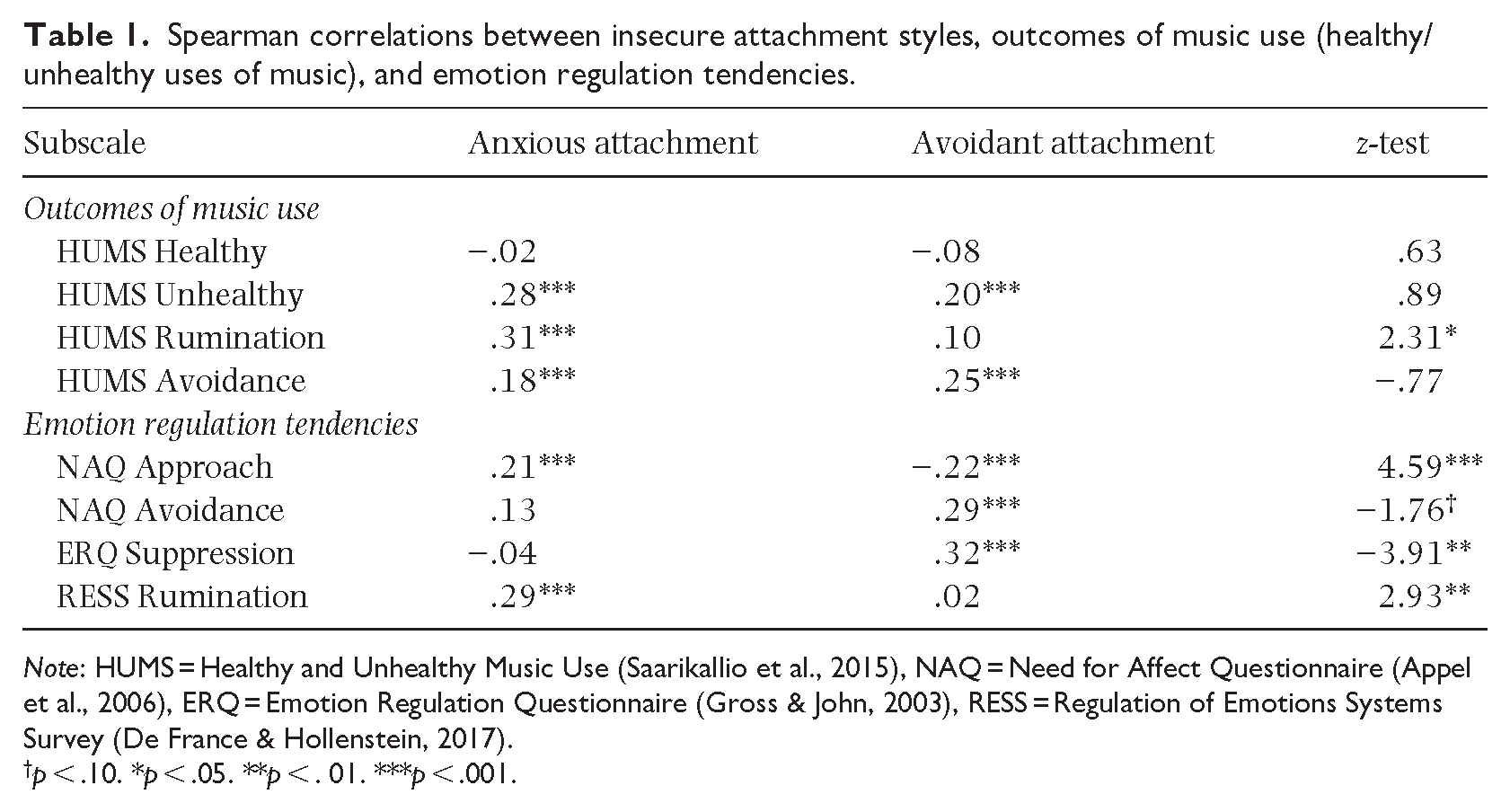
Note: HUMS = Healthy and Unhealthy Music Use (Saarikallio et al., 2015), NAQ = Need for Affect Questionnaire (Appel et al., 2006), ERQ = Emotion Regulation Questionnaire (Gross & John, 2003), RESS = Regulation of Emotions Systems Survey (De France & Hollenstein, 2017).
p < .10. *p < .05. **p < . 01. ***p < .001.
Before moving to the mediation analysis, we also tested whether the expected associations between attachment styles and general tendencies for emotion regulation held in our sample (paths A1 and A2). Table 1 (lower part) shows that, as expected, anxious attachment was more strongly correlated with approaching emotions (NAQ Approach) and RESS rumination than avoidant attachment, as indicated by z-tests. Avoidant attachment showed a significantly stronger correlation with ERQ suppression than did anxious attachment. For NAQ avoidance, the difference in correlational strength was only marginally significant, although there was a trend toward a stronger association with avoidant attachment.
Descriptive statistics and a correlation matrix for all the assessed variables are presented in Supplemental Table S2. Healthy music use was particularly associated with younger age, higher self-reported musical status, and greater tendency to approach emotions. In addition, some correlations between demographic characteristics and attachment styles and emotion regulation tendencies emerged. For example, older age was correlated with lower anxious attachment, higher avoidant attachment, higher use of suppression, and lower emotional approach, whereas female gender was correlated with higher anxious attachment and lower avoidant attachment, lower suppression, and higher emotional approach.
Mediation analyses
To explore whether the associations between insecure attachment styles and unhealthy music uses are mediated by general emotion regulation tendencies, we conducted two serial mediation analyses. We accounted for the observed associations between age, gender, attachment style, and emotion regulation tendencies (Supplemental Table S2) by including age and gender as covariates in the mediation models.
Anxious attachment and ruminative unhealthy music use
The first mediation model, shown in Figure 1 and detailed with all coefficients and confidence intervals in Supplemental Table S3, aimed to predict HUMS rumination from anxious attachment, mediated by the tendency to approach emotions (NAQ Approach) and the use of rumination as an emotion regulation strategy (RESS Rumination).
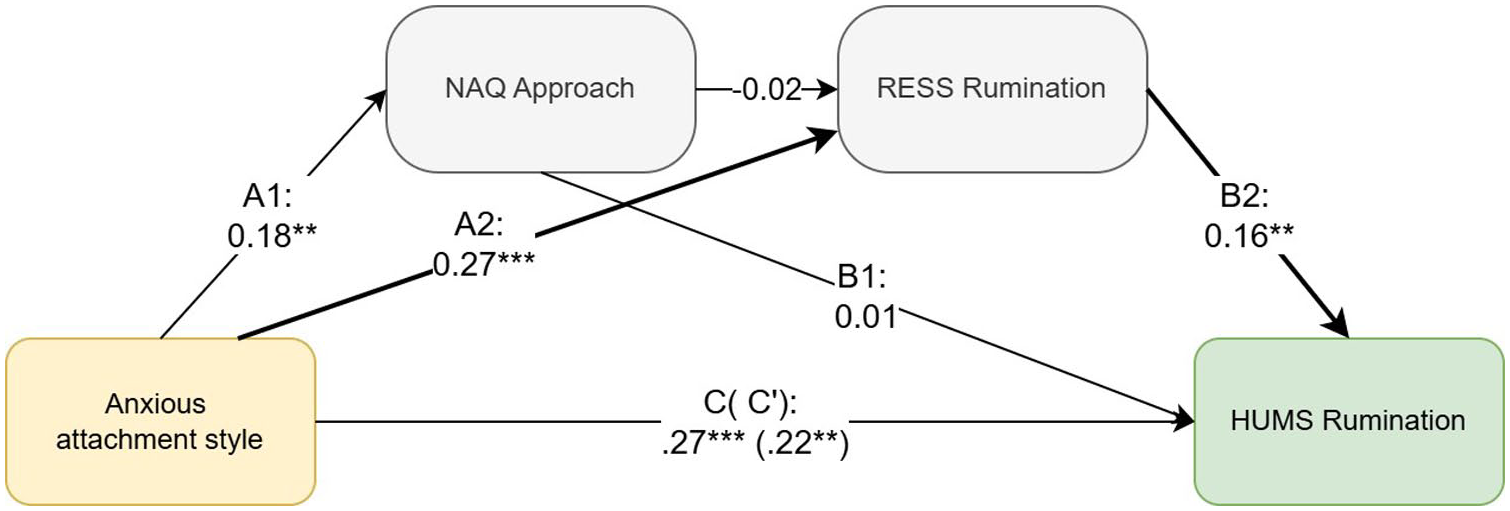
Illustration of the serial mediation model predicting HUMS Rumination by anxious attachment style, NAQ Approach, and RESS Rumination.
As shown in Figure 1, we observed a partial mediation of the association between anxious attachment and HUMS Rumination by RESS Rumination (indirect effect = 0.03, 95% BCa CI [0.001, 0.06]). There was no mediation effect through NAQ Approach (indirect effect < 0.01, 95% BCa CI [−0.01, 0.02]), and no serial mediation through both NAQ Approach and RESS Rumination (indirect effect < 0.01, 95% BCa CI [<−0.01, < 0.01]).
In other words, there was a significant association between anxious attachment style and RESS Rumination (path A2), a significant association between RESS Rumination and HUMS Rumination (path B2), and the total effect of anxious attachment on HUMS Rumination (path C) decreased after including mediators in the model (direct effect C’). Furthermore, we observed a significant association between anxious attachment and NAQ Approach (path A1); however, there was no significant association between NAQ Approach and the outcome (path B1).
In summary, while rumination tendencies mediate the association between anxious attachment and ruminative unhealthy music use, the tendency to approach emotions did not seem to have a significant influence in this context.
Given that anxious attachment was correlated not only with HUMS Rumination but also with HUMS Avoidance, we exploratorily tested the same serial mediation model with NAQ Approach and RESS Rumination as mediators and HUMS Avoidance as the outcome variable. As shown in Supplemental Table S4, the results indicate no significant mediation via NAQ Approach, RESS Rumination, and no serial mediation.
Avoidant attachment and avoidant unhealthy music use
In the second mediation analysis, we predicted avoidant unhealthy music use (HUMS Avoidance) from avoidant attachment, mediated by the tendency to avoid emotions (NAQ Avoidance) and the use of suppression for emotion regulation (ERQ Suppression). The results of this second model, shown in Figure 2 and Supplemental Table S5, revealed a partial mediation in the association between avoidant attachment style and HUMS Avoidance through NAQ Avoidance (indirect effect = 0.05, 95% BCa CI [0.01, 0.09]). There was no mediation effect through ERQ Suppression (indirect effect = 0.01, 95% BCa CI [<−0.01, 0.04]) and no serial mediation through NAQ Avoidance and ERQ Suppression (indirect effect = 0.01, 95% BCa CI [<−0.01, 0.03]).
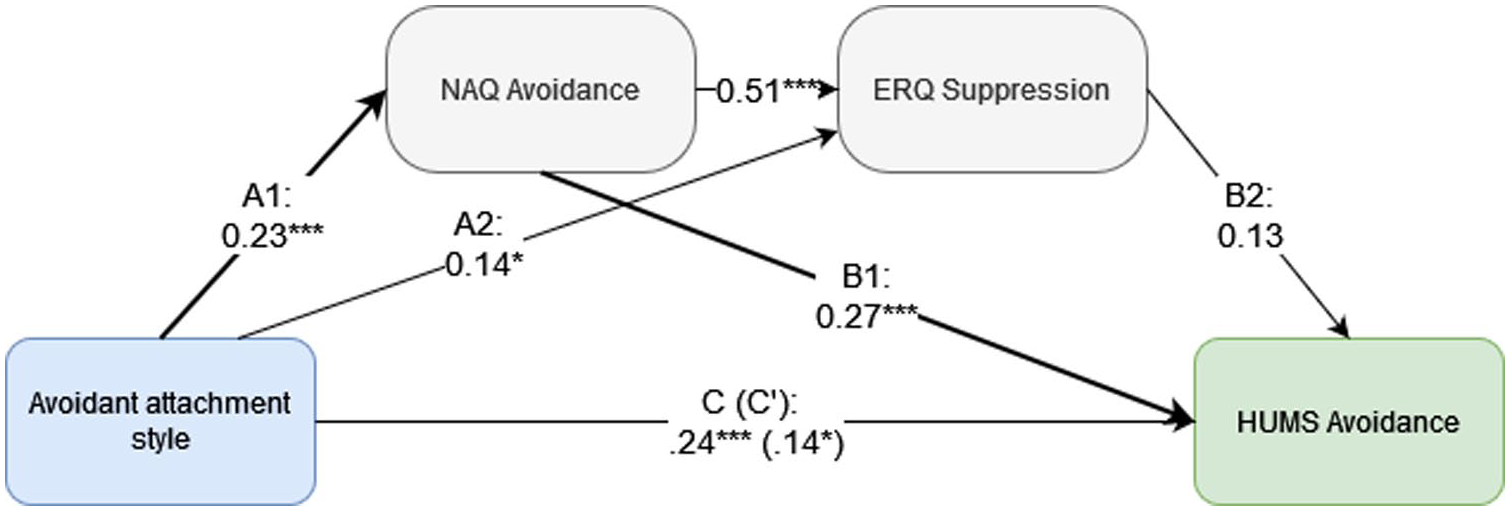
Illustration of the serial mediation model predicting HUMS Avoidance by avoidant attachment style, NAQ Avoidance, and ERQ Suppression.
Specifically, we observed a significant association between avoidant attachment style and NAQ Avoidance (path A1), a significant association between NAQ Avoidance and HUMS Avoidance (path B1), and that the total effect of avoidant attachment on HUMS Avoidance (B = path C) decreased after including mediators in the model (direct effect C’). We also observed an association between avoidant attachment and ERQ Suppression (path A2) but no significant association between ERQ Suppression and the outcome (path B2).
This suggests that, while the tendency to avoid emotions in general mediates the relationship between avoidant attachment and unhealthy avoidant music use, the use of suppression as an emotion regulation strategy does not seem to play an additional significant role in this context.
Exploratory analyses
The results of our serial mediation models suggest that rumination mediates the relationship between anxious attachment and ruminative unhealthy music use, whereas emotional avoidance mediates the relationship between avoidant attachment and avoidant unhealthy music use. To investigate whether the two non-significant mediators (NAQ Approach and ERQ Suppression) would still function as mediators when the effect of the other mediator was removed, we explored two additional mediation models using the same control variables, but including only mediators with non-significant indirect effects in our previous models.
The first analysis again indicated no indirect effect of NAQ approach (indirect effect < 0.01, 95% BCa CI [−0.01, 0.02]) on the association between anxious attachment and HUMS rumination, suggesting that although approaching emotions is associated with anxious attachment, it does not lead to greater ruminative unhealthy music use (see Supplemental Table S6 for details). The second analysis revealed a small indirect effect of ERQ suppression and thus a partial mediation (indirect effect = 0.05, 95% BCa CI [0.02, 0.09]), suggesting that avoidant attachment is associated with a tendency to use suppression as an emotion regulation strategy, which in turn leads to more avoidant unhealthy music use (see Supplemental Table S7). However, according to the serial mediation shown in Figure 2, the mediating role of NAQ avoidance appears to be stronger than that of ERQ suppression.
Discussion
This study was the first to examine the association between attachment styles and self-regulatory music use, particularly whether the two insecure attachment styles (avoidant and anxious) relate to the two different types of unhealthy music use (avoidant and ruminative). Using a sample of 224 participants, we conducted an online survey that included questions on healthy/unhealthy music listening, attachment styles, general attitudes toward emotions, and emotion regulation tendencies. Our results showed that both insecure attachment styles were associated with unhealthy music use outcomes and that these associations were mediated by general attitudes toward emotions and emotion regulation tendencies.
Insecure attachment and unhealthy music use
As hypothesized, both anxious and avoidant attachment styles were associated with a tendency toward unhealthy music use outcomes. This finding suggests that music, which can be a powerful tool for regulating negative emotions (Randall et al., 2023) and enhancing well-being (Weinberg & Joseph, 2017), may also be used in less beneficial ways by individuals with insecure attachment styles.
This general observation aligns with previous research indicating that insecure attachment is linked to less effective coping techniques (Mikulincer & Florian, 2003) and the development of maladaptive behaviors, such as eating disorders or addictions to gaming and social media (Grajewski & Dragan, 2020; C. Liu & Ma, 2019; Tasca & Balfour, 2014). It is also consistent with previous research showing that an insecure attachment style in mothers is associated with a reduced ability to communicate emotions and respond sensitively to their infants through singing (Milligan et al., 2003), as well as with research indicating that neuroticism, a correlate of anxious attachment style (Crawford et al., 2007), is linked with unhealthy music use (Alluri et al., 2022). Previous research has attributed these tendencies in people with avoidant attachment to behavioral and cognitive dissociation from distress cues, suppression of negative thoughts and emotions, and inhibition of distress. Conversely, for individuals with anxious attachment, these behaviors were traced back to hypervigilant attention to distress, inability to suppress negative thoughts and emotions, and being overwhelmed by negative feelings (Mikulincer & Florian, 2003). Consistent with these results, the present study’s findings confirmed that anxious attachment is linked to ruminative patterns of music usage, characterized by experiences such as getting stuck in bad memories with music or continuing to listen to music that makes one feel worse. Avoidant attachment, on the other hand, was associated with avoidant patterns of music engagement, such as listening to music to escape reality, blocking out others, and avoiding facing reality.
It is also worth noting that, while insecure attachment styles were associated with higher reports of unhealthy outcomes of music use, there were no significant associations with healthy outcomes. This suggests that individuals with insecure attachment styles do not necessarily experience fewer benefits from music; rather, they may be more vulnerable to maladaptive patterns of music use under certain conditions. This is consistent with the view that music is a flexible tool whose effects depend on factors such as intention, context, emotional state, and underlying regulatory strategies (Chin & Rickard, 2014; Randall et al., 2023). Future studies could explore the circumstances under which music contributes to adaptive versus maladaptive outcomes for different attachment profiles, for example, by examining music use in interpersonal situations or by using experience sampling methods.
Additionally, an unexpected connection was observed, with anxious attachment being associated not only with HUMS rumination but also with HUMS avoidance. One possible explanation may be that when personal relationships are perceived as insecure or untrustworthy, individuals may use music to either engage ruminatively with negative feelings or distance themselves from relationships by seeking comfort in music and hiding from the world. Indeed, anxious attachment has been found to be associated with an ambivalent coping style in some studies, that includes both active support seeking and withdrawal (e.g., Seiffge-Krenke & Beyers, 2005). In addition, while the HUMS Rumination subscale clearly focuses on rumination, the HUMS Avoidance subscale includes two items (“Music makes me feel bad about who I am” and “Music makes me do things I shouldn’t do”) that may not strictly reflect avoidance, but rather more general maladaptive outcomes of music use (Saarikallio et al., 2015). These items may provide an alternative explanation for the observed correlations between this subscale and anxious attachment.
The mediating role of attitudes toward emotion and emotion regulation
Our mediation analyses suggest that the association between unhealthy music use and insecure attachment styles can be explained by attitudes toward emotion and general emotion regulation tendencies. This finding is consistent with previous research indicating that attachment styles not only shape attitudes and behaviors in close relationships, but are also associated with emotion regulation difficulties (Mikulincer & Shaver, 2019). The mediating role of emotion regulation has also been demonstrated in studies exploring the links between insecure attachment and other unhealthy behaviors, such as addiction or eating disorders (Cortes-Garcia et al., 2019; Liese et al., 2020; Q.-Q. Liu et al., 2021). Furthermore, independent of attachment style, the effects of listening to music have been shown to be strongly influenced by listeners’ emotion regulation strategies and stress reactivity, with negative outcomes particularly associated with distress-enhancing emotion regulation patterns (Thoma et al., 2012).
With regard to anxious attachment style and unhealthy ruminative music use, our study did not support the expected serial mediation but found that the association is mediated only by a general tendency to engage in rumination as an emotion regulation strategy and not by a tendency to approach emotions. This mediation is consistent with previous research showing that individuals with anxious attachment are more likely to rely on emotion-focused strategies such as rumination, self-criticism, and dwelling on negative emotions (Pascuzzo et al., 2013), which can perpetuate or even intensify distress (Shaver & Mikulincer, 2007). As a result, individuals with anxious attachment may extend their ruminative tendencies to music consumption, leading to negative emotional outcomes. Interestingly, the mediation pathway through the tendency to approach emotions was not significant, either in the serial mediation model or when examined as a sole mediator. NAQ Approach, which measures attitudes toward emotions prior to their experience (Appel et al., 2006), reflects openness to emotions and the desire for intense affective experiences. One possible explanation for the lack of the expected indirect effect is that approaching emotions is not inherently maladaptive; it can lead to both negative strategies, such as rumination, and positive ones, such as emotional expression and support seeking (Ben-Zur, 2017). Consistently, approaching emotions was not associated with a general tendency to use rumination for emotion regulation, nor with ruminative music use.
In the case of avoidant attachment and unhealthy avoidant music use, our results suggest that the association is primarily mediated by a general tendency to avoid emotions rather than the specific regulatory strategy of suppression or a serial mediation. Thus, while suppression has been consistently linked to avoidant attachment in the literature (e.g., Pascuzzo et al., 2013; Shaver & Mikulincer, 2007), our findings suggest that general emotional avoidance, rather than suppression, plays a more central role in the context of music use. One explanation may be that music is often used proactively (antecedent-focused), not necessarily to suppress outward emotional expressions, but to manage or even prevent emotional experiences (Randall et al., 2014). The emotion regulation strategy of suppression, as measured by the ERQ, instead focuses mostly on concealing emotional expressions in social contexts (Gross & John, 2003), which may be less relevant in music listening. Thus, while suppression showed a significant indirect effect when tested alone, the stronger mediating effect of emotional avoidance in the serial mediation model highlighted the importance of distinguishing between internal and external emotion regulation strategies in the context of music use.
Theoretical and practical implications
In summary, our findings suggest that individuals with insecure attachment styles, both anxious and avoidant, are more likely to engage in less adaptive forms of music use, namely in rumination or emotional avoidance, mediated by their emotion regulation tendencies and attitudes toward emotions. This study has theoretical and practical implications. Theoretically, the results extend existing models of music use and emotion regulation by providing initial evidence that attachment style is an important factor in music mood regulation and its association with well-being. Practically, these findings may help individuals reflect on and improve their music-related emotion regulation habits. For example, someone prone to rumination might learn to identify and redirect unhelpful listening patterns, whereas others might recognize when they use music to disengage from emotional connections. Our findings are also relevant to clinical contexts, such as music therapy, which is often used to support individuals with attachment difficulties (see Pasiali, 2014, for a review). Understanding how attachment shapes music use could inform therapeutic approaches and help clinicians tailor interventions to promote healthier emotional engagement.
Limitations
This study has several limitations that should be considered when interpreting the results. First, the majority of participants were young females from German-speaking countries, which may limit the generalizability of the results to other demographic groups. In addition, while anxious attachment was well-distributed in our sample, avoidant attachment was less prevalent and showed a positively skewed distribution, potentially limiting our ability to detect associations with avoidant attachment styles. Most importantly, this study used a cross-sectional design, which does not allow for causal inferences. Therefore, observed associations may reflect bidirectional or reciprocal relationships. For example, individuals with insecure attachment styles may be predisposed to unhealthy music use patterns, but it is also possible that unhealthy patterns of music use reinforce or exacerbate attachment-related tendencies. Finally, there are different ways of measuring attachment styles, and it is not a foregone conclusion that the use of other assessment instruments (e.g., Adult Attachment Interview, Relationship questionnaire) would have led to the same conclusions. Future research should replicate and extend these findings using longitudinal or experimental designs to disentangle causal directions and by employing alternative measures of attachment.
Future directions
As a next step in this area of research, we recommend moving beyond the trait-level assessment of healthy and unhealthy music use to explore how music is used for emotion regulation in specific attachment-relevant contexts. For example, individuals with anxious attachment may turn to music following experiences of rejection or loss, whereas individuals with avoidant attachment may use music to cope with the discomfort associated with emotional closeness (Shaver & Mikulincer, 2007). Experimental or ecological momentary assessment approaches could provide valuable insights into real-time interactions between attachment-related experiences, music use, and emotional outcomes.
Attachment style may also help clarify when and for whom certain musical behaviors are adaptive or maladaptive. For example, the use of music as a social surrogate or to reduce loneliness (Ayyildiz et al., 2025; Schäfer & Eerola, 2020; ter Bogt et al., 2017) may reflect healthy emotional coping for some, but less healthy strategies for others. For individuals with insecure attachment styles, such music use may serve as an avoidant substitute for genuine social connection, or be less effective in reducing loneliness due to difficulties in accessing or internalizing emotional support. This possibility aligns with frameworks linking insecure attachment to greater reliance on emotional surrogates in the context of relational mistrust (Flores, 2006; Höfler & Kooyman, 1996). Future research could explore how attachment profiles shape the emotional outcomes of music used to alleviate loneliness, as well as how the social context of listening to music (e.g., alone vs. with a partner or friend) interacts with attachment style to influence emotion regulation and perceived connectedness.
Another potential direction is to investigate gender as a moderator. Although we observed gender differences in attachment, emotion regulation, and music use and included gender as a covariate in our models, the study was not designed or powered to test moderation effects. Prior research suggests that gender may influence how attachment style relates to emotion regulation (e.g., Delgado et al., 2023; Velotti et al., 2016), underscoring the value of exploring these effects in the context of music mood regulation using larger and more balanced samples in future research.
Finally, future research could examine the relative contributions of attachment styles, personality traits, and mental health indicators to music use. The role of personality, which has been emphasized in previous studies, may be overstated if attachment-related processes that are closely linked to emotion regulation are not considered simultaneously.
Conclusion
Overall, this study provides novel insights into how individual differences in attachment style are associated with the use of music as an emotion-regulating resource in everyday life. This study is the first to examine the specific associations between attachment styles and music use outcomes, taking into account the underlying mechanisms. Our findings confirm the expected general association between insecure attachment and unhealthy music use, and further highlight the distinct characteristics associated with anxious and avoidant attachment styles. This pioneering work encourages future research to address attachment style as a relevant factor in investigating the social-emotional aspects and the potential health-relevance of music engagement.
Supplemental Material
sj-docx-1-msx-10.1177_10298649261419777 – Supplemental material for The role of attachment style in unhealthy music use
Supplemental material, sj-docx-1-msx-10.1177_10298649261419777 for The role of attachment style in unhealthy music use by Julia Vigl, Marcel Zentner and Suvi Saarikallio in Musicae Scientiae
Footnotes

Ethical Considerations
This study was conducted in accordance with the principles of good scientific practice and the guidelines for survey research provided by the University of Innsbruck. It was approved under the university’s general ethics certificate for online survey research (certificate no. 90/2022). Before participation, all individuals received comprehensive information about the study and gave their informed consent, following the principles outlined in the Declaration of Helsinki. To maintain anonymity and confidentiality, the data was securely stored on the university’s server.
Funding
The authors disclosed receipt of the following financial support for the research, authorship, and/or publication of this article: This work was partially funded by Österreichische Forschungsgemeinschaft (project 06/16599) and the European Union (ERC, MUSICONNECT, 101045747). Views and opinions expressed are, however, those of the author(s) only and do not necessarily reflect those of the European Union or the European Research Council. Neither the European Union nor the granting authority can be held responsible for them.
Declaration of conflicting interests
The authors declared no potential conflicts of interest with respect to the research, authorship, and/or publication of this article.
Data Availability Statement
Supplemental material
Supplemental material for this article is available online.
Notes
References
Supplementary Material
Please find the following supplemental material available below.
For Open Access articles published under a Creative Commons License, all supplemental material carries the same license as the article it is associated with.
For non-Open Access articles published, all supplemental material carries a non-exclusive license, and permission requests for re-use of supplemental material or any part of supplemental material shall be sent directly to the copyright owner as specified in the copyright notice associated with the article.
