




Abstract
Current geopolitical tensions have impacted higher education relations between China and the West. Bridging a gap in literature, this research compares convergence and divergence of North America (NA) and European Union (EU) policy changes towards higher education relations with China. Drawing on Multiple Streams Framework, this study highlights divergent rationales and outcomes between the NA policies aimed at decoupling (de-Chinaization) and the EU policies focused on derisking in continuing engagement. Both regions strive to enhance research security and diversify students recruitment, yet the NA intensifies visa restrictions and funding scrutiny, whereas the EU maneuvers to balance the risks of such engagement with the benefits. These shifts remind us Brubacher's political philosophy of higher education, underscoring the value-laden nature of higher learning and policy decisions.
Keywords
Introduction and Research Context
With China's rise to be the world's second largest economy, China also comes to the fore in international education, characterizing a top source of international students and a powerhouse for international research collaboration (Lee & Haupt, 2020; Tang & Shapira, 2011; Wang et al., 2012). For most years so far in the twenty-first century, China was enormously immersed in internationalization and globalization of higher education, and apparently benefitting from such processes. However, since 2018, the growing geopolitical tensions between China and the West (in particular the United States) have inevitably permeated the higher education sphere. In this paper, we focus on higher education relations, yet inevitably touch upon research collaboration. Higher education and research do not carry the exact same meaning, though, they overlap to a great extent in contemporary time, as most national research agendas are fulfilled via university-based researchers and facilities. Under the circumstances, more and more Western systems have adopted new policies with respect to higher education relations with China, featuring cautions and vigilance. In this process, both convergence and divergence are observed in association with policy formation and adoption across countries and continents. Against this backdrop, this paper is intended to explore and compare such policy processes in North America (NA) and the European Union (EU), with the following research questions:
How did current and ongoing geopolitical tensions/issues re/shape the policy/change in the NA and the EU with respect to the higher education relations with China? What policy divergence and convergence can be identified between the NA and the EU?
Both the NA and the EU experienced evolving higher education relations with China. The EU-China higher education exchange and cooperation trace back to the 1950s, originating with student exchanges (Cai, 2019). Arguably, the EU-China higher education interactions started much earlier than such relations between the NA and China. Over the time, the EU-China relations have evolved, with notable expansions in degree provisions and research collaboration, and been further boosted by such formal arrangements as the Agreement on Science and Technology Cooperation between the EU and China in 1998, and the EU-China Innovation Cooperation Dialogue in 2012 (Cai and Zheng, 2020). Chinese and European researchers have actively collaborated in both Horizon 2020 and Horizon Europe, which represent two generations of research and innovation program funded by the EU. However, due to concerns over undesirable knowledge transfers and use of collaborative research results for military purposes (see Appendix: Table 3), Chinese researchers are now limited with respect to participation in sensitive high-tech projects. Chinese participation is mostly in the realms of food, agriculture, biotechnology, climate change and biodiversity.
In the NA, there is no uniformed mechanism like the EU, thus we need to look at country by country, and predominantly the United States (US) and Canada. The US has historically held a prominent position in global research sphere as well as impact, but China's higher education and research experienced remarkable growth during the past two decades (Zha, 2023). Now China and the US both stand as the global powerhouse for world scientific development and knowledge production (Lee & Haupt, 2020). As such, China-US higher education relation becomes one of the most speculated bilateral relations. In the recent decade, China has become the top collaborating country with the US in terms of internationally co-authored papers (Wagner et al., 2015). China remained until most recently the top source of international post-secondary students in the US (IIE Open Doors, 2024), and still maintains the status of the largest international student group in the US. However, the rising rivalry between the US and China has led to the notion of safeguarding “research security” that links research activities to national security or securitization (Olson, 2020; see Appendix: Table 3), and the US has launched significant strategies to address security concerns and combat possible intellectual espionage from China.
Canada and China used to have strong university linkages in the 1980s and 1990s, whereby many Chinese universities benefitted from enormous support provided by their Canadian counterparts via international aid programs in developing the programs, curriculum and teaching personnel, which in turn facilitated higher education transformation in China (Hayhoe et al., 2016). Since the 2000s, Canadian universities have been enjoying a reciprocal relationship, in particular an increasing in-bound flow of Chinese students; now China constitutes one of the top sources of international students in Canada. However, as a member of the Five Eyes and a close ally with the US, Canada is certainly caught in current geopolitical tensions towards China, especially in the Canada-China-US trilateral relations, and launched similar strategies as part of the anti-China campaign. The Canadian Security Intelligence Service (CSIS) maneuvered the National Security Guidelines for Research Partnerships that requires a risk assessment process for any research partnership with China. Most recently, the Government of Canada developed and promulgated the New Policy on Sensitive Technology Research and Affiliations of Concern, which names a total of 103 entities in China, Iran and Russia that are identified as posing the highest risk to Canada's national security (see Appendix: Table 1). China stands out to have a bulk (85) of such institutions, which indicates that Canada now sees China as a top source of risk to its national security.
Analytical Framework
This study draws on two major theoretical perspectives to form an analytical lens: Brubacher's (1982) two competing higher education philosophies, and Kingdon's (1984) Multiple Streams Framework (MSF). Brubacher (1982) contrasts the epistemological approach and the political philosophy of higher education. The former tends to “pursue knowledge as an end” (p.13), and the latter renders universities to concentrate on understanding and solving “intricate problems of our complex society” (p.14). Furthermore, “the epistemological approach to the higher learning tries to be value free whereas the political one is anything but value free” (p.17). We use these two philosophies in the sense of Weberian ideal types to contrast principal rationales of perceiving the roles and goals of higher education in different contexts, which fits well with currently shifting rationales increasingly observed with conducting higher education amidst geopolitical changes. Admittedly, being used as ideal types in this study, Brubacher's two higher education philosophies are rather broad and thus lack the structures and nuances needed for addressing multilayered actors involved in international academic exchanges. Such ebb and flow extend beyond students and scholars, the common and conventional actors in higher education business, to also include policy makers, diplomats and other stakeholders in knowledge and science diplomacy as well as the concomitant decision-making process. For this reason, we introduced Kingdon's (1984) Multiple Streams Framework (MSF).
The MSF is not only supplementary to Brubacher's two higher education philosophies in this study, but also operational in terms of analyzing policy processes, specifically the dynamic roles of multilayered actors in shaping policy agendas. Notably, the MSF offers critical insights into agenda-setting, explaining why certain policies gain government attention (Kingdon, 1984; Zahariadis, 2019). This analytical approach operates on three interdependent streams, namely, problem, policy, and politics, each with unique characteristics that collectively shape “windows of opportunity” for policy agenda-setting: the problem stream addresses a situation perceived as a problem whereby there is a noticeable gap between its current state and an ideal state; the policy solution stream focuses on developing solutions for identified or anticipated problems within the political agenda, which usually involves evaluating a range of policy ideas, culminating in the selection of practical solutions; the political stream encompasses the broader socio-political context, integrating factors like public sentiments, political ideologies, and power dynamics, which influence how problems and solutions are defined and interconnected (Béland & Howlett, 2016; Hoefer, 2022; Jones et al., 2016; Koebele, 2021). These streams flow separately and exist in a state of constant change (Hoefer, 2022; Kingdon, 1984). When these streams converge, an issue is more likely to gain agenda prominence (Zahariadis, 2019). The MSF would assist in looking into the actors and their dynamics in policy formation process, and more importantly whether the policy would serve the country's interest effectively—especially with shifting rationales of conducting higher education.
Research Design and Methods
With respect to research design, textual analysis allows for an in-depth exploration of recent relevant publishing to uncover underlying themes and driving dynamics that have to do with the convergence and divergence of the higher education relations investigated. Four major sources are explored and used to obtain data for this study: government working documents, think tank/research institute reports, media articles (from the media outlets such as the Chronicle of Higher Education, Times Higher Education, University World News, Reuters and Science Business), and scholarly literature. Given the substantial volume of texts potentially fitting our criteria, texts were selected based on their direct relevance and coverage of key policy changes related to research security, student mobility and knowledge/science diplomacy. We purposefully focus on the four major sources because they represent governmental directives, policy interpretations, public discourses, and existent research. Our analysis begins with a comprehensive reading of those texts, subsequently interpreting patterns of meanings that emerge across perspectives. Through this process, we aim to reveal recurring policy themes and discourses surrounding the fluctuations in higher education relations. Central to our study is to identify policy divergence and convergence for subsequent extrapolation of the underlying rationales that guide those policies. By further incorporating comparative case studies of the US and Germany, we endeavor to juxtapose a myriad of factors that either support or constrain their evolving higher education relations with China.
While our research examines policy formation and changes in the geographical regions of the NA and the EU, we primarily draw on country-specific policies based on three reasons. First, despite that the EU sometimes operates as an integrated community, there is a lack of published EU higher education policies—especially such a policy in relation to China. As such, we must resort to a combination of policies from the EU and key countries in the region, such as Germany, to inform and complement our analysis. Second, country-specific policies offer a more effective means to decipher national political agendas within their territorial/sovereign contexts. Third, the US and Canada in the NA typically publish their own policies independently. Above all, in the decentralized and fragmented bloc like the NA and the EU, internationalization of higher education is typically a bottom-up process in which universities primarily follow the predefined national strategy (De Wit & Hunter, 2015). Hence, examining policies at the country specific level for both the NA and the EU would allow for a more insightful analysis and thus a more meaningful comparison. The Appendix offers an overview of policy documents published by governmental and think tank/research institute sources analyzed in this study.
Policy Convergence and Divergence Between North America and European Union
In our analysis, we will first broadly provide an overview of the two region's policy convergence and divergence, and then dive into case studies on the US and Germany. Growing differences in ideological and geopolitical pursuits between the West (the NA and the EU in this study) and China have been driving value and risk judgement towards politicize the future of higher education orientation. The ideological differences are primarily rooted in contrasting visions concerning social order and governance as well as the value system behind such sociopolitical arrangements, and tend to be magnified by shifting geopolitical forces and disputes with respect to the ideal norm of world order. Under this circumstance, higher education systems and institutions are likely to lean towards the political philosophy and see their roles as active actors in assisting to resolve sociopolitical problems and advance national interests. As such, amidst the recently rising geopolitical tensions, areas of convergence (Bennett, 1991) have emerged in the shifting higher education policies of the NA and the EU in relation to China. Such convergence features the increasing adoption of research security protocols and strategies to diversify student recruitment and institutional partnerships.
The NA and the EU Policy Convergence
First, standardized research security guidelines and measures become required approximately around the same time to safeguard sensitive information when collaborating on research with China. Previous incidents of alleged espionage, dual military-civilian data usage and political influences on research have prompted the NA and the EU countries to compose China-specific guidelines (Sharma, 2020a). The US has introduced a plethora of regulations and guidelines outlining research cooperation with China, including the National Security Presidential Memorandum 33 (NSPM-33) in 2021, and the Recommended Practices for Strengthening the Security and Integrity of America's Science and Technology Research Enterprise in 2021. In Canada, a similar National Security Guidelines for Research Partnerships was released since 2021 to prompt researchers, organizations and government funders to integrate national security considerations into their decisions and operations. Such guidelines are developed in the EU as well, even in some small member states. For example, Finland published the Recommendations for Academic Cooperation with China in 2021, which focuses on guiding “academic freedom, good scientific practices, security and competitiveness” in academic cooperation (see Appendix: Table 2). As nations adapt to such evolving landscape, the implementation of research security guidelines is expected to foster responsible and secure academic cooperation with targeted countries like China.
Second, rising geopolitical tensions with China propel the NA and the EU governments and higher education institutions to recognize the necessity of diversifying international student recruitment and institutional partnerships. This move is supposed to help mitigate risks associated with overreliance on specific countries during a time of geopolitical strife. In the NA, while Canada is a traditionally significant destination for Chinese students, it initiated rather early the strategy to diversify international student recruitment and so not to “put all eggs in one basket.” Recent data from Immigration, Refugees and Citizenship Canada (IRCC) reveals a steady increase in international students from India, surpassing the number of Chinese students since 2017 (Government of Canada, 2023). This pattern is mirrored in the US, where India has become the leading source of international students, displacing China after a 15-year reign. While the United Kingdom (UK) is no longer part of the EU, its policy shifts could still be referenced for such changes. Between 2021 and 2022, 151,690 Chinese students were studying at the UK higher education institutions, constituting 27% of all non-EU students (Yu, 2023). The British Office for Students responded to this concentration scenario by demanding 23 universities with high proportion of Chinese international students to disclose plans concerning abrupt geopolitical interruption of overseas recruitment (Weale & Quinn, 2023). These proactive approaches and scenarios underscore the importance of preparedness and exercise with respect to diversifying international students and partnerships. As such, in response to current geopolitical tensions with China, the NA and the EU stakeholders deliberately plan for the strategic diversification.
While patterns of convergence have been observed, the NA and the EU policies towards higher education relations with China also indicate some divergences. The NA policies reflect a trend of “decoupling” that emphasizes reducing interdependence and even cutting ties from collaboration with China. The EU policies focus on “de-risking,” which prioritizes risk management through strategic control. In the context of this article, decoupling relates to a holistic severance, whereas de-risking concerns the collaboration under scrutiny.
The NA Policy Leaning Towards Decoupling
The US and Canada's policy changes towards higher education relations with China reflect a deliberately strategic shift that features much enhanced regulatory measures and tightened scrutiny. Notably, both countries have directly involved national security and law enforcement agencies in the policy formation and execution. In the US, the China Initiative was directly launched by the US Department of Justice in November 2018, and executed by the Federal Bureau of Investigation (FBI). In addition, other authority entities in the US such as the White House Office of Science and Technology Policy and the National Science and Technology Committee have also played pivotal roles in this regard. In Canada, the CSIS directly advises the universities and funding agencies with a compulsory risk assessment exercise towards establishing or maintaining a partnership with China, which amplifies the standard of adherence. Similar to the US, Canada openly nailed 85 Chinese institutions and organizations (a list could ever grow) as posing the highest risk to Canada's national security, and thus ushered in the same chilling effect against working with China. Therefore, the NA (the US and Canada) characterize an approach of using state-issued guidelines to maximize adherence and caution potential consequences following non-compliance. Consequently, it is observed in the US and Canada that quite a few university-based researchers prematurely or unexpectedly ended or suspended research collaboration with colleagues in China (Lee & Li, 2021; Zha & Li, 2024).
A looming decoupling has also been indicated by tightening visa-related measures against Chinese students and scholars. The measures are two-fold, both in the form of increasing visa rejection and processing delays. Furthermore, the execution of Proclamation 10043 restricts Chinese graduate students and scholars who are identified as associating with the country's military-civil fusion strategy, especially those from seven military industry-affiliated Chinese universities (commonly referred to as the “seven sons of national defense”), from obtaining F and J visas to study and conduct research in the US. While Canada does not currently have an equivalent to Proclamation 10043, there have been similar operations and cases whereby Chinese student study permits were rejected due to concerns over possible espionage. For example, Yuekang Li, an admitted student to the University of Waterloo's engineering PhD program, had his study permit rejected on the basis that his undergraduate institution was closely connected to China's defense industry, and that his study of microfluidics has the potential to transfer sensitive commercial and military information (Fine, 2024). This case has established a significant precedent in how the Canadian definition of “espionage” is broadening, and such interpretations may be referenced by other universities when admitting students. In addition, now the CSIS alleges that China is sending students barred from the US to Canada as an alternative.
The EU Policy Aiming at De-risking
A tangible illustration of this strategy is evident in Horizon Europe, the EU's key funding program for research and innovation in 2021–2027. Chinese participation is restricted in areas such as artificial intelligence (AI) or sensors (though German policymakers recently envision to expand research collaboration with China into more areas even including AI), and high-risk Chinese firms, such as Huawei and ZTE are not permitted to be part of any projects. However, China's collaboration with Horizon Europe remains robust, with involvement in 45 projects and active cooperation in flagship projects on climate and biodiversity, food agriculture and biotechnology (Matthews & Guerini, 2023). China's sustained involvement in Horizon Europe underscores the resilience of the EU-China collaboration amid geopolitical tensions. The EU-China collaboration extends beyond research, to involvement in China's major geopolitical strategies such as the Belt & Road Initiative (BRI). Seventeen EU countries, mostly being in Eastern Europe, are participating in the BRI. While the BRI primarily emphasizes development of infrastructure and trade, it also provides the space for academic diplomacy through the member state network. By advocating China's scholarship programs and luring students from member countries, the Initiative strengthens Chinese higher education impact on participatory European nations and further embeds China's influence across Europe (Perez-Garcia & Nierga, 2021).
On the EU part, it demonstrates a great interest in knowing China well, and thus has identified a lack of updated knowledge and informed personnel in China-related issues as a significant issue. Moreover, many EU countries did not yet formulate a comprehensive China policy. In a proactive response to anticipated Europe's future competitiveness and security needs, the European stakeholders have launched a project that facilitates collaboration between thinktanks and universities across the member states (Matthews, 2022). This project, namely “Dealing with a Resurgent China,” is dedicated to synergizing and consolidating China-related knowledge, aiming to assist government decision makers in formulating coherent policies and strategic positions in response to China-related situations (MERICS, 2022). This initiative, aligning with Brubacher's political philosophy of higher education and highlighting application of knowledge to solve sociopolitical problems, reflects an orchestrated effort by the EU countries to de-risk while actively consolidating Chinese insights. Importantly, China specific guidelines are typically formulated by European higher education institutions, think tanks and research foundations. For example, the Hague Centre for Strategic Studies published the Checklist for Collaboration with Chinese Universities and Other Research Institutions. Without government official sanctions, these policies serve very much as recommendations and best practices rather than legal regulations. This also underscores the decentralized nature of policy formation in the EU, where diverse stakeholders contribute to shaping the landscape of research engagement with China.
Case Studies with the US and Germany
To further discuss the policy divergence and convergence in the NA and the EU, we will employ the MSF model to construct two case studies concerning higher education policy in relation to China: the US in the NA and Germany in the EU. In each respective case, the problem, policy and political streams are observed and discussed with respect to providing “windows of opportunity” for agenda setting that ultimately shape the policy towards higher education relations with China.
The Case Study of United States
Problem Stream
In recent years, the US and China have adopted a confrontational stance and engaged in a competition for regional and global dominance. Both nations are vying for dominance politically, economically, and technologically. Since Deng's economic reform from the late 1970s, China has been steadily rising as a challenger to the US in terms of economic power and developmental model. Technologically, China is gaining a prominence in critical technologies. The Australian Strategic Policy Institute (ASPI) analyzed 23 critical technologies, and concluded that China led research in 19 (see Appendix: Table 3). Such rankings are based on the 10% most cited academic papers among 2.2 million published between 2018 and 2022. Indeed, China has now surpassed the US in the number of science and engineering publications (see Appendix: Table 1). Politically, the US-China competition spotlights the disparity between Chinese authoritarianism and Western liberal democracy (Střelcová, 2023). While great power competitions occurred in the past (e.g., Japan vs the US in the 1980s), the US-China rivalry highlights a distinct political-ideological dynamic (Dirickson, 2020). This adds complexity as both nations attempt to promote their developmental models on a global scale. Both as leading political and economic powers, the US-China relations have reached a pivotal point of contention, characterized by adversarial antagonism, where each country engages in action that hamstrings their opponent over self-improvement (Shi, 2024).
Policy Stream
In response to the systemic and consequential challenge from China, and to maintain its global dominance, the US has initially implemented economic measures in trade policies towards China. The initiation of trade war by the Trump Administration signifies the employment of tariffs and trade barriers aimed at curbing China's economic growth. Later on, the exchange of research and knowledge becomes subject to guidelines of national security measure aimed to protect domestic technological innovations. The US introduced the Guidance for Scientific Research Security, which outlines rules for “ensuring research security and researcher responsibilities” (see Appendix: Table 1). It specifically addresses national risks associated with international collaboration in high-tech research domains and provides regulations to align with national security imperatives, safeguarding technological innovations. Restrictions on funding application and usage have also started ushering in challenges to academic mobility. Since July 2023, the state of Florida has passed a law (SB 846) that prohibits public institutions from hiring Chinese graduate students and postdocs to work in research labs (Fischer, 2023; Mervis, 2023). As working in research labs is an essential part of graduate training in most STEM fields, all the public universities in Florida had to put a freeze on extending offers to graduate students in China for the Fall of 2024. Such policy initiatives inevitably affect the viability of knowledge exchange and brain circulation across the US and China.
Political Stream
The policy stream dynamics within the US also reflect shifting sentiments among the public. In 2022, a Pew survey of the US public indicated that unfavorable views of China reached a historical high of 80% (Silver et al., 2022). This significant increase in unfavorable views underscores the growing tensions surrounding the US-China relations under the circumstances. The US previously harbored hope that increased exchanges and interactions would eventually lead to China's adoption of Western democracy. Now, as China's STEM research progress gradually poses a threat to American advancement and dominance, research collaboration (as well as higher education interactions) between the two nations ushers in uncertainty and risks, especially when the Chinese ideological stance remains formidable. The Trump Administration's launch of the China Initiative, an investigation that targets the US scientists based on allegations of “Chinese espionage” and concerns about “research integrity” further taints public discourse about the US and China collaboration in higher education and research. Even when the China Initiative ended in February 2022, largely due to heavy criticism for its ethnic profiling tactics, such chilling effect continues, making the US universities active in assisting investigations of potential wrongdoing (especially the cases involving university-based scientists of Chinese origin) and causing academics fearful to work with China. As a matter of fact, such fear has now spread to social science fields, rendering scholars (particularly those of Chinese heritage) reluctant to tackle China-related topics. A media report discloses that in 2018–2023, the National Science Foundation funded over one half less China-related research projects than those in 2012–17, and those related to social sciences and economics were reduced most. These changes would further diminish stock of China expertise in the country
Policy Goal and Outcome
In the US case, the problem, political and policy streams now converge in the current geopolitical circumstances, which in turn results in the policy outcomes that directly impact the US-China higher education relations. From the US perspective, it cannot accept China's challenge to the US dominant position and global monopoly on power. While it would be hard to suppress China's technological developments altogether, the US can alternatively seek to delay China's gaining momentum and advantages in key technological areas through decoupling research collaboration in those areas (adopting the so-called “small yard, high fence” strategy towards China), and widen the R&D gap in the long run via limiting Chinese students’ access to study in critical technology programs in the US universities (Zwetsloot, 2020). For example, the field of AI is now strictly protective against Chinese students and scholars, and the US is quickly regaining competitive advantage over China in AI research, with over 70% of the AI papers cited most since 2020 being authored by researchers from institutions and organizations in the US (Benaich, 2023). Arguably, AI supercharges researchers’ ability to discover ever more innovative technologies, and promises to reshape nearly every field and industry (Schmidt, 2023). A recent report issued by The US Congress Select Committee on the Chinese Communist Party (2024) claims that a significant portion of the research funded by the US Department of Defense or intelligence community leaves back-door access to China's researchers through the US-China university research collaboration, which entails a necessary decoupling with Chinese universities. This report has directly led to Georgia Institute of Technology's termination of its ties with Tianjin University in their bilateral Georgia Tech Shenzhen Institute. Such decoupling took place even earlier with precaution of American universities, and even in non-sensitive areas. For example, Florida International University has ended several partnerships with Chinese universities, including its largest and most successful international initiative: a dual-degree hospitality program run jointly by the university and Tianjin University of Commerce. This ongoing and developing process of ending partnerships with Chinese universities suggests a broader trend of decoupling or de-Chinaization in internationalizing US higher education.
The Case Study of Germany
Problem Stream
Germany does not seek direct competition with China or establish itself as a global superpower. Instead, it prioritizes maintaining its long-term economic strength and sustainability as a leading European country by balancing ties with China and alignment with Western allies. In 2023, Germany investment in China increased by 4.3%, which elevated German investments in China to 10.3% of the country's total overseas investments, recording a decade high, according to German central bank (Bundesbank) statistics. For the eighth consecutive year, China remains Germany's most important trading partner (see Appendix: Table 2). Stronger economic ties would certainly spin collaboration in other spheres, and universities always tend to react to economic incentives arising from a predefined framework (De Wit & Hunter, 2015). Germany's newly published China policy acknowledges the complexity of the relationship, noting China's assertive pursuit of its own interests and its attempts to reshape the current world order. The policy also raises concerns about China's authoritarian model and refers to China as a “systemic rival”. However, unlike the US, which directly engages in economic and technological competition with China, Germany adopts a more measured approach. The difference in strategies reflects Germany's intentions to navigate its ties with China, without compromising its national values and interests. Germany recognizes the importance of maintaining its strategic and ideological alliance with the US and EU, but it is also pragmatic with respect to economic gains from China.
Policy Stream
From a policy perspective, Germany is developing guidance to safeguard its interests in cooperation with China. The updated China strategy published in 2023 emphasizes the need to revise Germany's approach, acknowledging China's deliberate impact on the international order with its single-party political system. While recognizing Germany's dependence on China for trade, which reached 299.6 billion Euros in 2022 (see Appendix: Table 2), the strategy also emphasizes the importance of aligning with other EU nations to form a comprehensive China policy. In the areas of education, science and research, the policy highlights the challenges posted by China's military-civil fusion and unilateral transfer of knowledge in the partnerships. Nevertheless, the strategy encourages continuation of bilateral relationships in these fields under clearly defined guiding principles. In 2024, German Academic Exchange Service (DAAD) published further recommendations for academic cooperation with China (see Appendix: Table 3), advocating sustained collaboration, but with realistic and risk-minimizing approaches. These guidelines suggest that German institutions prioritize their own interests, establish rule-based partnerships and remain mindful of systemic differences that cannot be overlooked. Ultimately, such framework provides grounding for sustainable cooperation, rather than overall decoupling.
Political Stream
A joint 2023 survey by Pew Research Center and Körber-Stiftung polled German participants about their perspectives on China, and compared the results with those of their American peers. While 70% of Americans view China as a security threat, only 13% of Germans embody the same sentiment. Such a perception of China as a much lesser threat aligns with Germany's overall approach of maintaining ties with China, focusing on stability rather than competition. Germany has actively worked to build more Chinese expertise across public, academic and policy sectors, in stark contrast to the US, where expertise on China is waning due to declining knowledge circulation and funding limitations. Rationale wise, Germany emphasizes that navigating political and value-based contradictions with China requires a strong and updated knowledge base. This expansion is being pursued through three key strategies (see Appendix: Table 2): developing a robust knowledge base on China, fostering long-term scientific and research cooperation, and increasing China-related knowledge and language courses in German schools and universities. These efforts reflect the political stream's focus on aligning domestic actions with a balanced foreign policy that accommodates both engagement and risk management.
Policy Goal and Outcome
Germany's shift in its official China approach centers on strategic de-risking in the most sensitive research areas, particularly those aligned with Horizon Europe. However, rather than severing ties, Germany remains interconnected with China, especially in academic and scientific exchanges. Student mobility and higher education collaboration are still facilitated, with Chinese PhD students accounting for 15% of all international PhD students in Germany, which is ahead of India, the second largest country of origin, by nearly 50%. Additionally, the number of Chinese academic staff in German Universities is steadily rising, suggesting that geopolitical tensions have not hindered Chinese participation in Germany's higher education landscape. Collaboration between Chinese and German higher education institutions, such as the Sino-German University (SDH) at Tongji University, has been gradually recovering from pandemic disruptions. Continued student mobility and knowledge exchange are likely to strengthen the bilateral structures like the German-Chinese Alumni Networks (DCHAN), supporting further growth in establishing bilateral research projects. Despite a recalibrated approach, Germany still views China as a viable partner capable of creating mutually positive impacts in higher education collaboration and internationalization. This suggests that, while the focus and nature of collaborations may shift, Germany and China's academic partnerships are expected to endure.
Discussion of Reasons Behind the Divergence
The NA and EU's divergence in higher education policies towards China, as reflected in the case studies of the US and Germany, presents an unexpected finding, given the shared value and belief about a liberal order and democracy in the two regions. While both regions are committed to fostering research security and academic freedom, the differences in policy orientation highlight their distinct regional priorities and contextual considerations.
First, the EU's balanced approach is supposed to serve its member states’ interests better—each of which has varying higher education capacities and R&D priorities. With the emerging US-China great power rivalry, individual EU member countries find themselves navigating a dilemma between of security concerns and need for economic prosperity, depending on their specific national agendas (Grano, 2023). Hence, the EU's approach stands divergent from the US-China dynamics, and underscores a pursuit of higher education relations and knowledge/science diplomacy through the pragmatism of achieving tangible economic benefits and maintaining productive research partnerships despite current geopolitical instability (Amaro de Matos et al., 2022). For example, at a recent meeting of German research committee, policymakers of the coalition government were sending a warning message against reflexively abandoning cooperation with China. Rather, German research policymakers were now advocating for a stronger emphasis on and institutionalization of science diplomacy, including an expansion of research cooperation with China and in areas like aeronautic technology, material science, digitalization and AI. In contrast, the US features an adversarial antagonism with China, focusing on policy and action that hamstring China, with R&D strengths and higher education capacity being a priority. To a large extent, the US policy has produced a chilling effect for its universities and academics to work with China (Lee & Li, 2021). Such a chilling effect has caught the Chinese descent academics in particular, and caused hundreds of such academics to relocate to China or elsewhere in the past few years (Xie et al., 2023). Notably, both the FBI and National Institute of Health have expressed regrets over their actions targeting those Chinese heritage academics. In the meantime, there is an attempt currently in the US legislature to reinstate the China Initiative. Canada is a close neighbor and ally with the US, and always prioritizes aligning its policy and strategy with the US. The similar chilling effect and consequence are thus observed in Canada as well (Zha & Li, 2024).
Second, while the NA and the EU are allies, they are also in competition for global resource and strategic influence. The new “bifurcated governance” and decoupling US-China relations have created new opportunities for European countries. With research collaboration between the US and China experiencing a decline over geopolitical tensions and knowledge-oriented competition, a contrasting pattern has been observed in the research collaboration between the EU and China (see Appendix: Table 3; Wagner & Cai, 2022). It is particularly significant to note that in 2022 the EU-China collaboration in publications has surpassed that of the US-China outputs. The thriving EU-China collaboration suggests a recognition of mutual progress derived from university cooperation and partnership, which could leverage the broader geopolitical tensions.
Although this study focuses on policy changes towards higher education relations with China, it is also important to acknowledge that the evolving objectives and priorities of China's higher education policy will affect how the countries at stakes (such as the NA and the EU countries in our study) may reshape their policy and response. Notably, through initiatives such as the BRI, the Global South (quanqiu nanfang), the China-Indochina Peninsula Corridor and the China-Mongolia-Russia Corridor, international student enrollment from ally countries in Chinese universities has been on rise. This shift could signal a new trend towards higher education regionalization (Ge & Ho, 2022), with China increasingly and strategically concentrating higher education resources, such as student scholarships and research funding, on ally countries while allocating fewer resources to non-member countries (Shih & Cao, 2022). These changes will likely affect and reshape the landscape of higher education internationalization concerning China and other countries. Above all, China's goal and strategy with respect to internationalization are always aligned with its national interest and geopolitical agenda, and likely to evolve and therefore provoke further responses under the circumstances.
Concluding Remarks
This study has provided a comparison of the NA and the EU policies, specifically focusing on the US and Germany, and how they are evolving in regard to higher education relations with China amidst currently rising geopolitical tensions. The theoretical framework adopted in it facilitates an exploration of the underlying policy shifts observed in both regions. The MSF model was used to show how problem, policy and political streams had converged to form the “window of opportunity” for higher education policy setting. Recent policy shifts appeared to have aligned with Brubacher's political philosophy of higher education, revealing that higher learning and policy decisions are inherently value laden.
The policy divergence between the NA and the EU reflects different goals and regional priorities. The NA pursues further decoupling or de-Chinaization, emphasizing increased scrutiny and crushing China's gain in the higher education relations. The US dominates and steers this direction. It appears to be losing confidence (and patience) in differentiating Chinese people, China State and Chinese Communist Party in a Party-State regime, and leaning towards believing every Chinese student and scholar could be used by China towards its rivalry against the US and West. As such, many scholars affiliated to the universities in the US and China may be reluctant to travel in either direction, because they fear losing support and security from their respective governments (Simon, 2024). In contrast, the EU balances opening and safeguarding policy in its relationship with China, making the key R&D programs such as Horizon Europe remain accessible to scholars from China, but emphasizing collaboration with risk-control measures. The policy formation process for the EU countries is relatively decentralized, without a predominant country and thus with mechanisms/avenues for consultation and negotiation, due to divergent national interests and priorities existing among the EU member states.
Footnotes
Declaration of Conflicting Interests
The authors declared no potential conflicts of interest with respect to the research, authorship, and/or publication of this article.
Funding
The authors received no financial support for the research, authorship, and/or publication of this article.

Author Biographies
Appendix: Policy Documents Used in this Study
Policy Documents Published by Think Tanks & Policy Research Institutes.
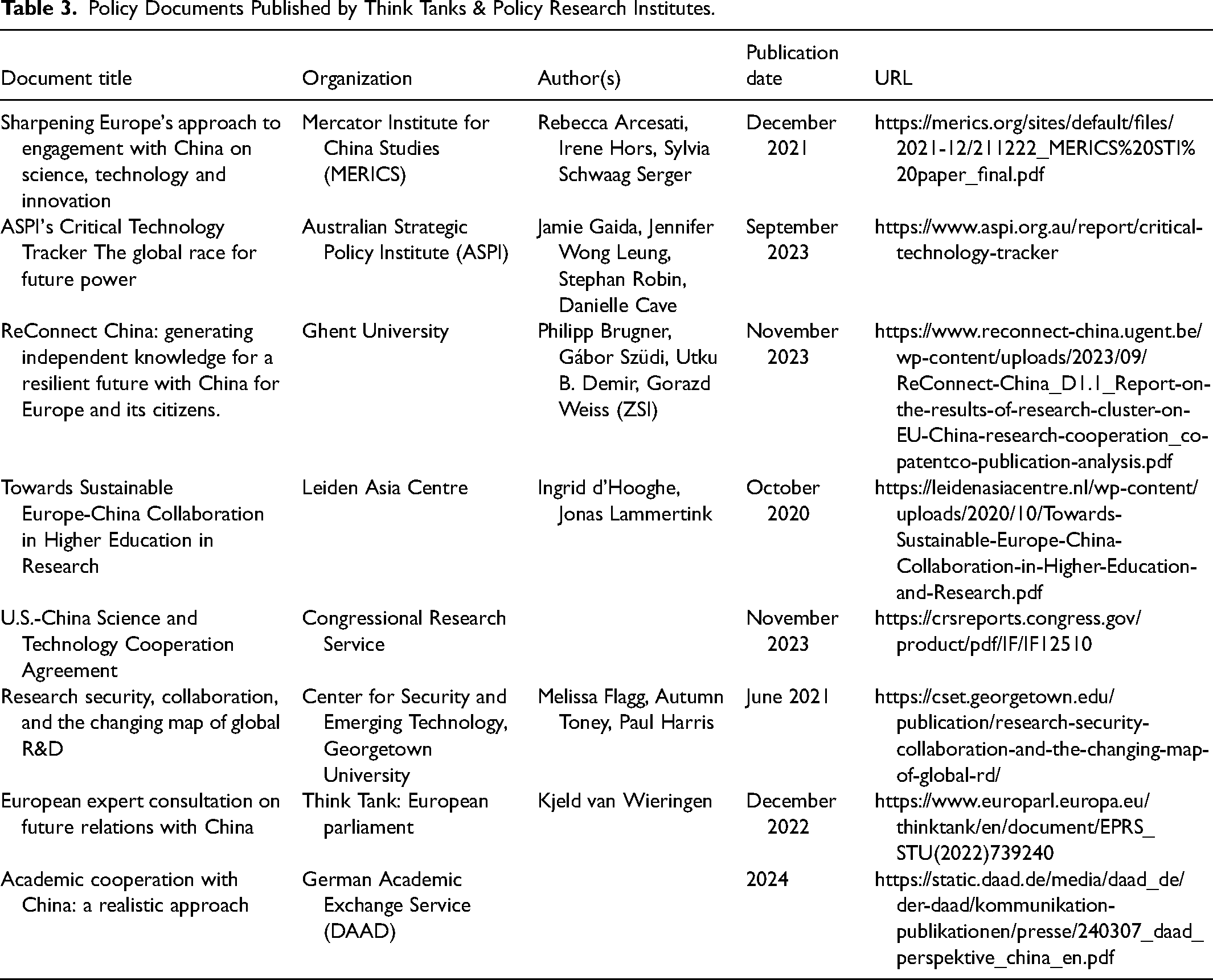
| Document title | Organization | Author(s) | Publication date | URL |
|---|---|---|---|---|
| Sharpening Europe's approach to engagement with China on science, technology and innovation | Mercator Institute for China Studies (MERICS) | Rebecca Arcesati, Irene Hors, Sylvia Schwaag Serger | December 2021 | https://merics.org/sites/default/files/2021-12/211222_MERICS%20STI%20paper_final.pdf |
| ASPI's Critical Technology Tracker The global race for future power | Australian Strategic Policy Institute (ASPI) | Jamie Gaida, Jennifer Wong Leung, Stephan Robin, Danielle Cave | September 2023 | https://www.aspi.org.au/report/critical-technology-tracker |
| ReConnect China: generating independent knowledge for a resilient future with China for Europe and its citizens. | Ghent University | Philipp Brugner, Gábor Szüdi, Utku B. Demir, Gorazd Weiss (ZSI) | November 2023 | https://www.reconnect-china.ugent.be/wp-content/uploads/2023/09/ReConnect-China_D1.1_Report-on-the-results-of-research-cluster-on-EU-China-research-cooperation_co-patentco-publication-analysis.pdf |
| Towards Sustainable Europe-China Collaboration in Higher Education in Research | Leiden Asia Centre | Ingrid d'Hooghe, Jonas Lammertink | October 2020 | https://leidenasiacentre.nl/wp-content/uploads/2020/10/Towards-Sustainable-Europe-China-Collaboration-in-Higher-Education-and-Research.pdf |
| U.S.-China Science and Technology Cooperation Agreement | Congressional Research Service | November 2023 | https://crsreports.congress.gov/product/pdf/IF/IF12510 | |
| Research security, collaboration, and the changing map of global R&D | Center for Security and Emerging Technology, Georgetown University | Melissa Flagg, Autumn Toney, Paul Harris | June 2021 | https://cset.georgetown.edu/publication/research-security-collaboration-and-the-changing-map-of-global-rd/ |
| European expert consultation on future relations with China | Think Tank: European parliament | Kjeld van Wieringen | December 2022 | https://www.europarl.europa.eu/thinktank/en/document/EPRS_STU(2022)739240 |
| Academic cooperation with China: a realistic approach | German Academic Exchange Service (DAAD) | 2024 | https://static.daad.de/media/daad_de/der-daad/kommunikation-publikationen/presse/240307_daad_perspektive_china_en.pdf |