




Abstract
This quantitative research aims to analyze the impact of the WampServer application in Blended learning during the educational process of computing through data science, machine learning, and neural networks. WampServer is a free application that allows the creation of websites considering the use of the database. This research proposes the use of Blended learning in the Development of applications subject in order to facilitate the teaching–learning process in the Database unit. The students discuss and reflect the concepts on the database in the classroom and carry out various school activities on the construction of websites at home through the use of the WampServer application. The sample consists of 28 students who took the Development of applications subject during the 2016 school year. The results of machine learning (linear regression) with 50, 60, and 70% of training indicate that the use of PHP, HTML, and SQL languages in the WampServer application positively influences the assimilation of knowledge and development of skills on web programming. Data science identifies six predictive models about the use of WampServer in the educational process of computing. On the other hand, neural networks determine the factors that influence the assimilation of knowledge and development of skills on web programming. This research recommends the incorporation of the WampServer application in the school activities related to the computer field to create new educational spaces and facilitate the teaching–learning process. Teachers can transform the educational context through the organization and realization of creative activities inside and outside the classroom. Finally, the use of WampServer in Blended learning allows creating new spaces for teaching and learning of computer science because this application favors the assimilation of knowledge and development of skills on web programming.
Keywords
Introduction
Educational institutions are incorporating Information and Communication Technologies (ICTs) in the teaching–learning process because students demand the use of new pedagogical and technological strategies that facilitate the development of competences (Arancibia-Muñoz et al., 2019; Salas-Rueda, 2016; Volk et al., 2017). Consequently, teachers are creating new school activities that include the use of digital technology (e.g. personal computers, blogs, virtual platforms, mobile devices, and web applications) in the classroom and home (Ferreira and Simoes-Santos, 2018).
ICTs are used in the educational field to search for information on the Internet, participate in discussion forums, establish asynchronous and synchronous communication on the web, and access digital resources (Arancibia-Muñoz et al., 2019). In Mexico, the training of teachers in digital skills acquires a fundamental role to achieve the innovation in the educational context (Tinajero-Villavicencio et al., 2019).
In the 21st century, educational institutions acquire a fundamental role in the teaching–learning process as an agent of change (Luckin et al., 2017; Medina-Mayagoitia and Mercado-Varela, 2019; Sena-Rivas et al., 2018). In particular, teachers have the opportunity to transform educational conditions through technological advances (Martínez et al., 2018; Roig-Vila et al., 2019). The role of the teacher includes the incorporation of digital tools in school activities and creation of virtual spaces that favor the acquisition of new knowledge (Marques-Schafer and Silva-Orlando, 2018; Morales-Salas et al., 2019).
In fact, advances in digital technology are causing the emergence of new educational models based on tools, web platforms, and computer applications. For example, Blended learning is a mixed modality where the student performs various activities inside and outside the classroom through ICT. Therefore, teachers can build new educational spaces to facilitate the assimilation of knowledge and develop the skills of students under this hybrid modality. This research proposes the use of Blended learning in the Development of applications subject in order to facilitate the teaching–learning process in the Database unit. The students discuss and reflect the concepts on the database in the classroom and carry out various school activities on the construction of websites at home through the use of the WampServer application.
This quantitative research aims to analyze the impact of the WampServer application in Blended learning during the educational process of computer science through data science, machine learning, and neural networks. WampServer is a free application that allows the creation of websites considering the use of the database.
The research questions are:
What is the impact of the WampServer application in Blended learning during the assimilation of knowledge and development of skills about web programming? What are the predictive models about the use of PHP, HTML, and SQL languages in the WampServer application during Blended learning? What are the factors of the WampServer application that influence the assimilation of knowledge and development of skills about web programming during Blended learning?
ICT in the educational field
In the 21st century, teachers are updating the educational context through the incorporation of ICTs (e.g. learning environments, web simulators, educational games, and technological applications) in the classroom and home (Arancibia-Muñoz et al., 2019; Mendes-Brandao and Soares-Silva, 2018). In Mexico, teachers are trained in topics related to digital technology and development of digital skills in order to use digital tools during teaching–learning process (Medina-Mayagoitia and Mercado-Varela, 2019).
Mobile devices are changing the way of organizing and carrying out school activities in Blended learning because students can access educational applications at any time and place (Camacho-Ríos et al., 2019; Hinojo-Lucena et al., 2018). In particular, the incorporation of tablets in the classroom positively influences the search for information on the Internet, access to web applications, dissemination of information on the network, and active participation of students (Salas-Rueda et al., 2019).
Pedagogical aspects have a fundamental role during the incorporation of digital technology in the educational context (Kim and Smith, 2017; Samperio-Pacheco, 2019). In fact, pedagogical and technological models such as TPACK (Samperio-Pacheco, 2019; Tapia-Silva and Sobrino-Morrás, 2019) and Blended learning (Cerna, 2018; Robles et al., 2016) are modifying the functions of teachers and students during the teaching–learning process.
For example, the TPACK model uses the pedagogical, technological, and disciplinary factors to organize the school activities through the use of digital tools and web applications (Samperio-Pacheco, 2019; Tapia-Silva and Sobrino-Morrás, 2019). Likewise, Blended learning promotes the realization of school activities inside and outside the classroom through ICT (Al-Busaidi, 2013; Hill et al., 2017; Pellas and Kazanidis, 2014).
Blended learning
Educational institutions are designing and carrying out various school activities based on the use of ICT in order to improve the teaching–learning conditions (Flores et al., 2015; Herman et al., 2019). Therefore, teachers are beginning to use new pedagogical and technological models to meet the needs and demands of society in the 21st century (Cobanoglu, 2018; Pellas and Kazanidis, 2014; Simonova, 2018).
Blended learning proposes the incorporation of digital tools, web platforms, technological applications, and educational software during the organization of activities carried out inside and outside the classroom (Cerna, 2018; Hill et al., 2017). In fact, teachers can create new teaching–learning activities under this hybrid modality (Simonova, 2018).
Also, Blended learning relies on the Internet to create new educational spaces that increase the motivation and satisfaction of the students (Cerna, 2018; Robles et al., 2016). Likewise, this hybrid modality favors the autonomy of the students during the learning process (Herman et al., 2019; Lai et al., 2016; Robles et al., 2016).
Some of the benefits related with Blended learning are the organization of activities that promote the collaborative work and active role of students during the teaching–learning process (Herman et al., 2019). In addition, this hybrid modality allows the realization of the student-centered activities (Hill et al., 2017; Samaniego et al., 2015). Even the use of technological tools facilitates communication and interaction between the actors of the educational process in Blended learning (Al-Busaidi, 2013).
Technological applications and web platforms have a fundamental role in Blended learning because students consult the contents and review the information of the courses (Hewitt, 2015; Lai et al., 2016). Likewise, this hybrid modality allows increasing the market segment of the universities because the students carry out their school activities inside and outside the classroom (Flores et al., 2015).
Blended learning has been used in courses related to the English language (Robles et al., 2016), tourism (Simonova, 2018), pedagogy (Cobanoglu, 2018), and law (Hewitt, 2015). At the higher educational level, Blended learning caused that the students are motivated during the educational process on the English language (Robles et al., 2016). Even the students of this course consider that Blended learning allows creating fun and enjoyable virtual spaces for learning (Robles et al., 2016).
The use of Blended learning in the Tourism course improved the quality of education and increased the motivation of the students during the completion of school activities (Simonova, 2018). In the faculty of education, Blended learning was implemented through Edmodo in order to improve the academic performance of the students (Cobanoglu, 2018).
In the field of law, Blended learning allows the construction of virtual educational spaces that facilitate the assimilation of knowledge about laws and the development of skills in students (Hewitt, 2015). Finally, Blended learning is transforming the organization and realization of activities inside and outside the classroom through ICT (Al-Busaidi, 2013; Hill et al., 2017; Pellas and Kazanidis, 2014).
Use of applications in the educational field
Several authors (e.g. Corral-Abad et al., 2018; Ortega-García et al., 2017; Salas-Rueda and Vázquez-Estupiñán, 2017) have incorporated technological applications in the educational field in order to improve the teaching–learning process. In fact, ICTs are modifying the planning and implementation of school activities in various areas such as mechanical engineering (Corral-Abad et al., 2018), computer science (Pereira and Terra, 2018; Singh et al., 2019), and geology (Isik and Cabalar, 2018). In the area of geology, the use of applications in the educational process facilitates the identification of the characteristics and properties of soil (Isik and Cabalar, 2018).
Corral-Abad et al. (2018) propose the use of the MaqTest application in the “Mechanism and Machine Theory” course to facilitate the assimilation of knowledge about mechanical engineering, develop skills, and improve the academic performance of the students. In addition, this technological application can be used at any time and place through mobile devices (Corral-Abad et al., 2018).
Also, several authors (e.g. Camacho-Ríos et al., 2019; Marques-Schafer and Silva-Orlando, 2018; Roig-Vila et al., 2019) have incorporated web applications in the educational field with the purpose of improving the teaching–learning process and develop the competences in the students.
In the field of mathematics, Camacho-Ríos et al. (2019) propose the use of various applications (e.g. Differential Equations, Wolfram, Desmos, and Photomath) in the courses of differential equations in order to facilitate the assimilation of knowledge and develop on skills. In the same way, the GeoGebra cloud service facilitates the identification of the solution region in linear inequalities through the elaboration of the graphs during Blended learning (Salas-Rueda, 2018).
Roig-Vila et al. (2019) propose the use of the Aurasma, Augment, and Blippar applications in the educational field in order to carry out school activities based on Augmented Reality. Also, Blas-Padilla et al. (2019) used various applications of Augmented Reality to facilitate the assimilation of knowledge in the courses related to computer science during Blended learning.
On the other hand, Duolingo is a free and attractive web application that improves the teaching–learning conditions related to the English language (Marques-Schafer and Silva-Orlando, 2018). Likewise, the Logic.ly Simulator allows the use of the theoretical contents of the Computational Mathematics subject in the field of electronics during Blended learning (Salas-Rueda and Salas-Silis, 2018).
Technological advances are causing the emergence of new educational applications and software (Padmo et al., 2019; Wei et al., 2016). Therefore, teachers have the challenge of updating the educational process through the incorporation and use of information and communication tools in the classroom and home (Blas-Padilla et al., 2019; Chen et al., 2017; Wei et al., 2016).
Use of applications in the field of computer science
The construction and use of technological applications in the field of informatics facilitate the assimilation of knowledge and development of digital skills in students (Pereira and Terra, 2018; Singh et al., 2019).
For example, the Inventor application facilitates the design and construction of mobile applications during the educational process of computing through a friendly, fast, and useful environment (Ortega-García et al., 2017). Likewise, the FLApp application improves the educational process on automatons because students analyze the contents of this application to solve the exercises about formal language (Pereira and Terra, 2018).
Singh et al. (2019) developed the Automata Simulator application to improve the teaching–learning process on computational theory. Similarly, the JFLAP application allows the students to understand the topics about automaton theory in a fun and interactive way (Singh et al., 2019).
One of the benefits on the use of technological applications in the field of computer science is the development of technological and digital skills in the students (Fernández et al., 2017; Salas-Rueda and Vázquez-Estupiñán, 2017). For example, Fernández et al. (2017) explain that the incorporation of the applications in school activities allows the creation of new educational spaces that facilitate the development of programming skills.
Also, the ERPAG application facilitates the use of theoretical concepts about computing in the productive context (Salas-Rueda and Vázquez-Estupiñán, 2017). In particular, this application improved the assimilation of knowledge about the architecture and operation of ERP systems in the Application Development for Businesses course (Salas-Rueda and Vázquez-Estupiñán, 2017).
Finally, the use of technological applications in the educational field allows innovating the school activities and transforming the educational process on mechanical engineering (Corral-Abad et al., 2018), programming (Fernández et al., 2017), computing (Salas-Rueda and Vázquez-Estupiñán, 2017), and automaton theory (Pereira and Terra, 2018; Singh et al., 2019).
Method
This quantitative research analyzes the impact of the WampServer application in Blended learning during the educational process of computer science through data science, machine learning, and neural networks. WampServer is a free application that allows the creation of websites considering the use of the database.
The participants are 28 students who studied the Development of applications subject in a Mexican university during the 2016 school year. This subject is located in the sixth semester of the Degree in Business Management and Information Technology.
Procedure
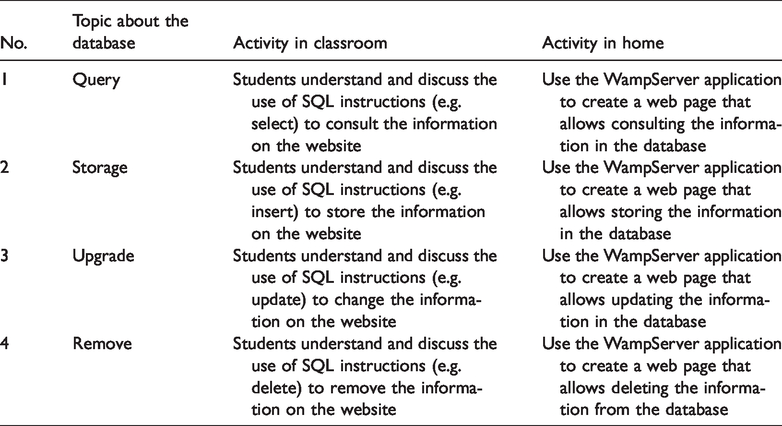
The procedure began with the organization of the school activities for the Database unit considering the Blended learning modality. The students of Development of applications subject discuss and reflect the concepts on the database in the classroom and carry out various school activities on the construction of websites at home through the use of the WampServer application (see Table 1). WampServer is an application that allows the use of the HTML language for the construction of the web pages, PHP language for the connection with the database, and SQL language for the administration of the database.
Activities carried out during Blended learning.
The hypotheses on the use of the WampServer application and the assimilation of knowledge are as follows:
Hypothesis 1 (H1): The use of the HTML language in the WampServer application positively influences the assimilation of knowledge about web programming during Blended learning Hypothesis 2 (H2): The use of the PHP language in the WampServer application positively influences the assimilation of knowledge about web programming during Blended learning Hypothesis 3 (H3): The use of the SQL language in the WampServer application positively influences the assimilation of knowledge about web programming during Blended learning
On the other hand, research hypotheses on the use of the WampServer application and development of skills are as follows:
Hypothesis 4 (H4): The use of the HTML language in the WampServer application positively influences the development of skills about web programming during Blended learning Hypothesis 5 (H5): The use of the PHP language in the WampServer application positively influences the development of skills about web programming during Blended learning Hypothesis 6 (H6): The use of the SQL language in the WampServer application positively influences the development of skills about web programming during Blended learning
Data science allows the construction of the following predictive models by means of the decision tree technique:
Predictive model 1 on the use of the HTML language in the WampServer application and assimilation of knowledge during Blended learning Predictive model 2 on the use of the PHP language in the WampServer application and assimilation of knowledge during Blended learning Predictive model 3 on the use of the SQL language in the WampServer application and assimilation of knowledge during Blended learning Predictive model 4 on the use of the HTML language in the WampServer application and development of skills during Blended learning Predictive model 5 on the use of the PHP language in the WampServer application and development of skills during Blended learning Predictive model 6 on the use of the SQL language in the WampServer application and development of skills during Blended learning
Data analysis
Rapidminer tool allows the analysis of research hypotheses about the impact of the WampServer application in Blended learning during the teaching–learning process through machine learning (linear regression) with 50, 60, and 70% of training.
Also, Rapidminer tool allows the construction of predictive models on the use of HTML, PHP, and SQL languages in the WampServer application through the decision tree technique. Finally, Rapidminer tool establishes the factors on the use of the WampServer application in Blended learning that influence the assimilation of knowledge and development of skills about web programming.
Data collection
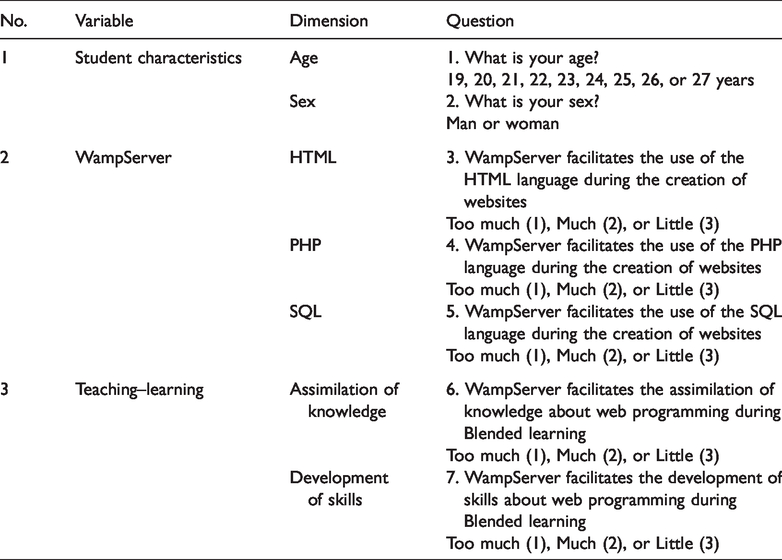
At the end of the Database unit, the measurement instrument (questionnaire) is applied in the Development of applications subject during the 2016 school year (see Table 2).
Measurement instrument.
Results
Below are the results about the impact of the WampServer application in Blended learning during the educational process of computer science through data science, machine learning, and neural networks.
Table 3 shows the results of the WampServer application in Blended learning. For example, WampServer facilitates too much the use of the HTML (n = 20, 71.43%), PHP (n =17, 60.71%), and SQL (n = 18, 64.29%) languages during the creation of websites.
Results of the WampServer application in Blended learning.
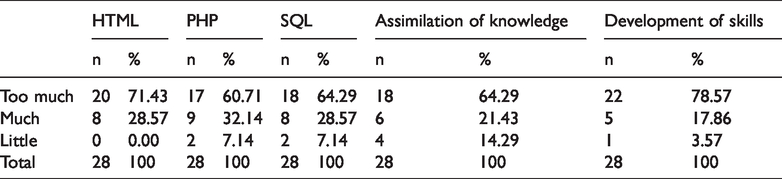
WampServer facilitates too much (n = 18, 64.29%), much (n = 6, 21.43%), and little (n = 4, 14.29%) the assimilation of knowledge about web programming during Blended learning (see Table 3). Also, WampServer facilitates too much (n = 22, 78.57%), much (n = 5, 17.86%), and little (n = 1, 3.57%) the development of skills about web programming during Blended learning.
Assimilation of knowledge
The results of the machine learning (linear regression) with 50, 60, and 70% of training indicate that the use of the HTML, PHP, and SQL languages in the WampServer application positively influences the assimilation of knowledge about web programming during Blended learning (see Table 4).
Results of assimilation of knowledge.
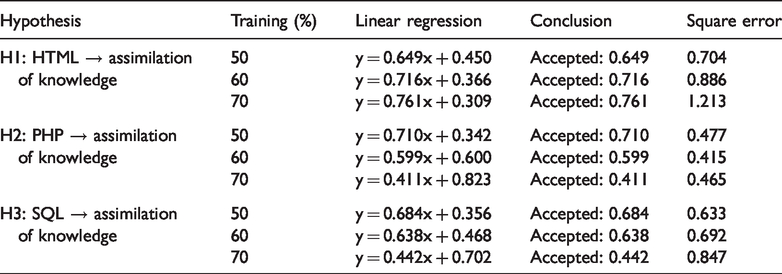
The results of the machine learning with 50% (0.649), 60% (0.716), and 70% (0.761) of training indicate that hypothesis 1 is accepted (see Table 4). Therefore, the use of the HTML language in the WampServer application positively influences the assimilation of knowledge about web programming during Blended learning.
Table 5 shows the predictive model 1 on the use of the WampServer application in the educational process. For example, if the student considers that WampServer facilitates too much the use of the HTML language during the creation of websites, is man, and has an age >20.5 years then WampServer facilitates too much the assimilation of knowledge about web programming during Blended learning.
Conditions in the predictive model 1.
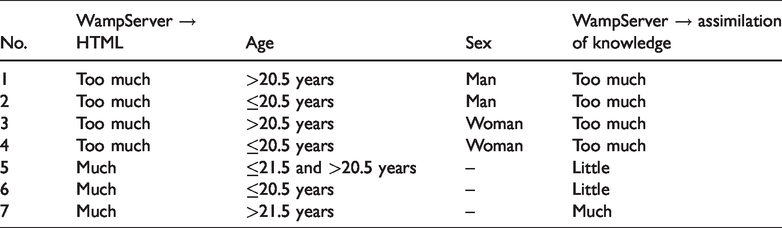
Table 5 shows seven conditions in the predictive model 1 (accuracy of 75.00%). For example, if the student considers that WampServer facilitates much the use of the HTML language during the creation of websites and has an age >21.5 years, then WampServer facilitates much the assimilation of knowledge about web programming during Blended learning.
The results of the machine learning with 50% (0.710), 60% (0.599), and 70% (0.411) of training indicate that hypothesis 2 is accepted (see Table 4). Therefore, the use of the PHP language in the WampServer application positively influences the assimilation of knowledge about web programming during Blended learning.
Table 6 shows the predictive model 2 on the use of the WampServer application in the educational process. For example, if the student considers that WampServer facilitates too much the use of the PHP language during the creation of websites, is man, and has an age >23.5 years, then WampServer facilitates too much the assimilation of knowledge about web programming during Blended learning.
Conditions in the predictive model 2.
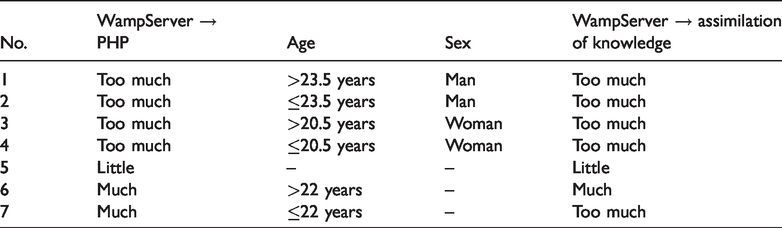
Table 6 shows seven conditions in the predictive model 2 (accuracy of 67.86%). For example, if the student considers that WampServer facilitates much the use of the PHP language during the creation of websites and has an age ≤ 22 years, then WampServer facilitates too much the assimilation of knowledge about web programming during Blended learning.
The results of the machine learning with 50% (0.684), 60% (0.638), and 70% (0.442) of training indicate that hypothesis 3 is accepted (see Table 4). Therefore, the use of the SQL language in the WampServer application positively influences the assimilation of knowledge about web programming during Blended learning.
Table 7 shows the predictive model 3 on the use of the WampServer application in the educational process. For example, if the student considers that WampServer facilitates too much the use of the SQL language during the creation of websites and has an age > 22.5 years, then WampServer facilitates too much the assimilation of knowledge about web programming during Blended learning.
Conditions in the predictive model 3.
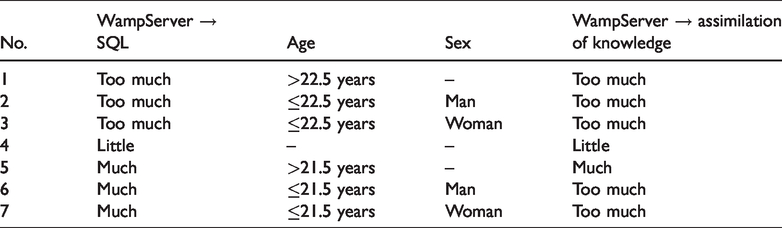
Table 7 shows seven conditions in the predictive model 3 (accuracy of 75.00%). For example, if the student considers that WampServer facilitates much the use of the SQL language during the creation of websites, has an age ≤ 21.5 years, and is a man, then WampServer facilitates too much the assimilation of knowledge about web programming during Blended learning.
Finally, the neural network establishes that the use of the HTML (0.240), PHP (0.401), and SQL (0.188) languages in the WampServer application positively influences the assimilation of knowledge about web programming during Blended learning. In fact, the factor that most influences the teaching–learning process is the PHP language.
Development of skills
The results of the machine learning (linear regression) with 50, 60, and 70% of training indicate that the use of the HTML, PHP, and SQL languages in the WampServer application positively influences the development of skills about web programming during Blended learning (see Table 8).
Results of development of skills.
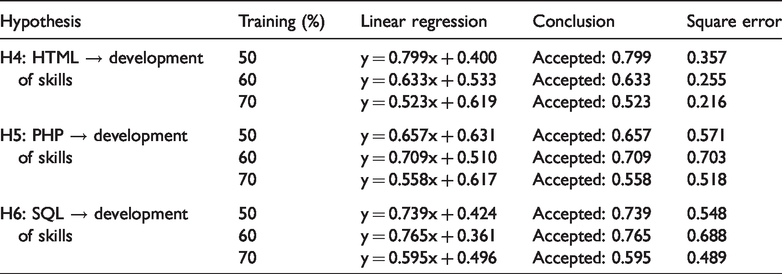
The results of the machine learning with 50% (0.799), 60% (0.633), and 70% (0.523) of training indicate that hypothesis 4 is accepted (see Table 8). Therefore, the use of the HTML language in the WampServer application positively influences the development of skills about web programming during Blended learning.
Table 9 shows the predictive model 4 about the use of the WampServer application in the educational process. For example, if the student considers that WampServer facilitates too much the use of the HTML language during the creation of websites and has an age > 21.5 years, then WampServer facilitates too much the development of skills about web programming during Blended learning.
Conditions in the predictive model 4.
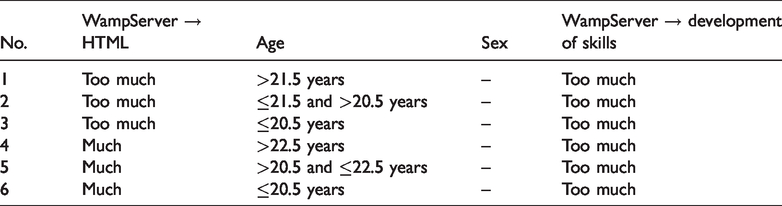
Table 9 shows six conditions in the predictive model 4 (accuracy of 78.57%). For example, if the student considers that WampServer facilitates much the use of the HTML language during the creation of websites and has an age ≤ 20.5 years, then WampServer facilitates too much the development of skills about web programming during Blended learning.
The results of the machine learning with 50% (0.657), 60% (0.709), and 70% (0.558) of training indicate that hypothesis 5 is accepted (see Table 8). Therefore, the use of the PHP language in the WampServer application positively influences the development of skills about web programming during Blended learning.
Table 10 shows the predictive model 5 about the use of the WampServer application in the educational process. For example, if the student considers that WampServer facilitates too much the use of the PHP language during the creation of websites and has an age ≤ 20.5 years, then WampServer facilitates too much the development of skills about web programming during Blended learning.
Conditions in the predictive model 5.
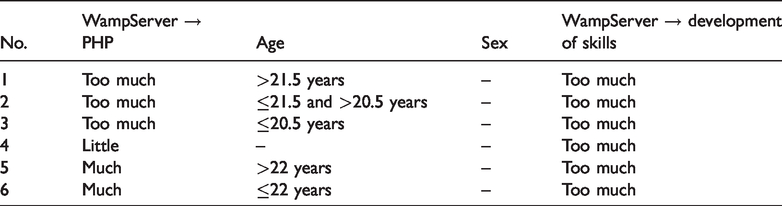
Table 10 shows six conditions in the predictive model 5 (accuracy of 78.57%). For example, if the student considers that WampServer facilitates much the use of the PHP language during the creation of websites and has an age ≤ 22 years, then WampServer facilitates too much the development of skills about web programming during Blended learning.
The results of the machine learning with 50% (0.739), 60% (0.765), and 70% (0.595) of training indicate that hypothesis 6 is accepted (see Table 8). Therefore, the use of the SQL language in the WampServer application positively influences the development of skills about web programming during Blended learning.
Table 11 shows the predictive model 6 about the use of the WampServer application in the educational process. For example, if the student considers that WampServer facilitates too much the use of the SQL language during the creation of websites and has an age > 21.5 years, then WampServer facilitates too much the development of skills about web programming during Blended learning.
Conditions in the predictive model 6.
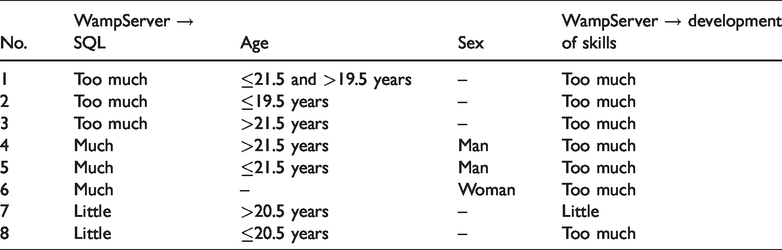
Table 11 shows eight conditions in the predictive model 6 (accuracy of 82.14%). For example, if the student considers that WampServer facilitates little the use of the SQL language during the creation of websites and has an age > 20.5 years, then WampServer facilitates little the development of skills about web programming during Blended learning.
Finally, the neural network establishes that the use of the HTML (0.068), PHP (0.220), and SQL (0.484) languages in the WampServer application positively influences the development of skills about web programming during Blended learning. In fact, the factor that most influences the teaching–learning process is the SQL language.
Discussion
Digital tools and web applications are transforming the organization and realization of school activities in the 21st century because students acquire an active role during the learning process (Ferreira and Simoes-Santos, 2018; Sena-Rivas et al., 2018; Wei et al., 2016).
In particular, this quantitative research analyzes the impact of the WampServer application in Blended learning during the educational process of computer science through data science, machine learning, and neural networks.
Assimilation of knowledge
Most of the students (n = 18, 64.29%) think that WampServer facilitates too much the assimilation of knowledge about web programming during Blended learning. The results of the machine learning (linear regression) with 50% (0.649), 60% (0.716), and 70% (0.761) of training are greater than 0.640; therefore, the use of the HTML language in the WampServer application positively influences the assimilation of knowledge about web programming during Blended learning. Data science establishes seven conditions in predictive model 1 with the accuracy of 75.00%. For example, if the student considers that WampServer facilitates too much the use of the HTML language during the creation of websites, is man, and has an age > 20.5 years, then WampServer facilitates too much the assimilation of knowledge about web programming during Blended learning.
Technological advances such as web applications and mobile devices are causing teachers to develop new school activities (Hinojo-Lucena et al., 2018; Kim and Smith, 2017).
The results of the machine learning with 50% (0.710), 60% (0.599), and 70% (0.411) of training are greater than 0.410; therefore, the use of the PHP language in the WampServer application positively influences the assimilation of knowledge about web programming during Blended learning. Data science identifies seven conditions in the predictive model 2 with the accuracy of 67.86% by means of the decision tree technique. For example, if the student considers that WampServer facilitates too much the use of the PHP language during the creation of websites, is man, and has an age > 23.5 years, then WampServer facilitates too much the assimilation of knowledge about web programming during Blended learning.
ICTs open up the possibility of modifying educational conditions through the creation of new virtual spaces for learning (Chen et al., 2017; Martínez et al., 2018).
The results of machine learning with 50% (0.684), 60% (0.638), and 70% (0.442) of training are greater than 0.440; therefore, the use of the SQL language in the WampServer application positively influences the assimilation of knowledge about web programming during Blended learning. The decision tree technique identifies seven conditions in the predictive model 3 with the accuracy of 75.00%. For example, if the student considers that WampServer facilitates too much the use of the SQL language during the creation of websites and has an age > 22.5 years, then WampServer facilitates too much the assimilation of knowledge about web programming during Blended learning.
The neural network establishes that the use of the HTML (0.240), PHP (0.401), and SQL (0.188) languages in the WampServer application positively influences the assimilation of knowledge about web programming.
Development of skills
This research shares the ideas of various authors (e.g. Ferreira and Simoes-Santos, 2018; Mendes-Brandao and Soares-Silva, 2018) about the fundamental role of digital technology during the development of skills.
Most of the students (n = 22, 78.57%) think that WampServer facilitates too much the development of skills about web programming during Blended learning. The results of the machine learning with 50% (0.799), 60% (0.633), and 70% (0.523) of training are greater than 0.520; therefore, the use of the HTML language in the WampServer application positively influences the development of skills about web programming during Blended learning. The decision tree technique identifies six conditions in the predictive model 4 with the accuracy of 78.57%. For example, if the student considers that WampServer facilitates too much the use of the HTML language during the creation of websites and has an age > 21.5 years, then WampServer facilitates too much the development of skills about web programming during Blended learning.
Teachers have the challenge of updating the educational process through the incorporation of ICT in school activities (Luckin et al., 2017; Marques-Schafer and Silva-Orlando, 2018).
The results of the machine learning with 50% (0.657), 60% (0.709), and 70% (0.558) of training are greater than 0.550; therefore, the use of the PHP language in the WampServer application positively influences the development of skills about web programming during Blended learning. Data science establishes six conditions in the predictive model 5 with the accuracy of 78.57%. For example, if the student considers that WampServer facilitates too much the use of the PHP language during the creation of websites and has an age ≤ 20.5 years, then WampServer facilitates too much the development of skills about web programming during Blended learning.
In fact, ICTs are changing the role of teachers and students during the educational process (Mendes-Brandao and Soares-Silva, 2018; Volk et al., 2017; Wei et al., 2016).
The results of the machine learning with 50% (0.739), 60% (0.765), and 70% (0.595) of training are greater than 0.590; therefore, the use of the SQL language in the WampServer application positively influences the development of skills about web programming during Blended learning. The decision tree technique establishes eight conditions in the predictive model 6 with the accuracy of 82.14%. For example, if the student considers that WampServer facilitates too much the use of the SQL language during the creation of websites and has an age > 21.5 years, then WampServer facilitates too much the development of skills about web programming during Blended learning.
The neural network establishes that the use of the HTML (0.068), PHP (0.220), and SQL (0.484) languages in the WampServer application positively influences the development of skills about web programming during Blended learning.
The results of this research indicate that WampServer facilitates too much (n = 20, 71.43%) and much (n = 8, 28.57%) the use of the HTML language during the creation of websites. Also, WampServer facilitates too much (n = 17, 60.71%), much (n = 9, 32.14%), and little (n = 2, 7.14%) the use of the PHP language during the creation of websites. Likewise, WampServer facilitates too much (n = 18, 64.29%), much (n = 8, 28.57%), and little (n = 2, 7.14%) the use of the SQL language during the creation of websites.
Technological advances are changing the planning and organization of courses in the 21st century (Aljaser, 2019; Altun-Türker et al., 2019; Padmo et al., 2019). In particular, WampServer is a technological tool that allows innovating the school activities in the field of computer science and improving the teaching–learning conditions of web programming through the use of PHP, HTML, and SQL languages during Blended learning.
Conclusion
Teachers can improve the teaching–learning conditions through the incorporation of pedagogical and technological models in school activities. In particular, this research proposes the use of the Blended learning modality in the Development of applications subject through the discussion and reflection of the concepts on the database in the classroom and the realization of various school activities on the construction of websites at home through the use of the WampServer application.
WampServer is an application that modifies the functions of the teachers and students during the educational process related to computer science. The results of machine learning with 50, 60, and 70% of training indicate that the use of PHP, HTML, and SQL languages in the WampServer application positively influences the assimilation of knowledge and development of skills in web programming during Blended learning.
Data science identifies six predictive models about the use of WampServer in school activities. On the other hand, neural networks determine that the PHP language influences the assimilation of knowledge and the SQL language influences the development of skills on web programming during Blended learning.
The limitations of this research are the size of the sample and the use of the WampServer application during the teaching–learning process. Therefore, future research can analyze the use of various ICTs in the Blended learning modality such as social networks, web 2.0 tools, and audiovisual content in the field of computer science. Also, the active role of the student and collaborative work can be analyzed during the use of the WampServer application in the educational field.
This research recommends the incorporation of the WampServer application in the school activities related to the computer field to create new educational spaces and facilitate the teaching–learning process. Teachers can transform the educational context through the organization and realization of creative activities inside and outside the classroom.
In fact, Blended learning is a hybrid modality that allows innovating the school activities and educational practices in the 21st century through the use of ICT. In addition, this quantitative research recommends the use of the Rapidminer tool for the construction of predictive models, calculation of the machine learning, and use of neural networks.
The implications of this research allow that teachers update their activities inside and outside the classroom through Blended learning because this hybrid modality facilitates the creation of new educational experiences that facilitate the development of skills.
Finally, teachers can use digital technology to create new educational virtual spaces. In particular, the use of PHP, HTML, and SQL languages in the WampServer application facilitates the assimilation of knowledge and development of skills in web programming during Blended learning.
Footnotes
Declaration of Conflicting Interests
The author(s) declared no potential conflicts of interest with respect to the research, authorship, and/or publication of this article.
Funding
The author(s) received no financial support for the research, authorship, and/or publication of this article.
