




Abstract
Although increasing attention has been paid to the importance of different forms of capital in graduate employability, few studies have investigated the contribution of capital to the employability of international graduates in the host labor market. This study aimed to explore how six forms of capital (human, social, cultural, psychological, identity, and agentic) contribute to the employability of Chinese international graduates in Australia. This study deploys Bourdieusian theories and a capitals-based approach as complementary theoretical frameworks. A mixed-methods approach was used in this study. Data were first collected via an online survey (N = 203) and then through in-depth interviews (N = 14). The quantitative results showed that cultural capital made the highest self-perceived contribution to employability, whereas social capital made the lowest contribution. The qualitative findings revealed that capital not only helped the participants obtain employment but also enhanced their wellbeing, sustainable employment, and professional growth.
Introduction
Between 1998 and 2019, the number of international students studying abroad increased by 5.5% per year (OECD, 2021). Australia, ranked as the second-most sought-after destination, has captured an 8% share of the global market, following the United States at 15% (OECD, 2021). However, a gap exists between international students’ particular fondness for Australia as a study-abroad location and their employability outcomes. Findings from AUIDF (2017) showed that international graduates from Australian institutions were entering the labor force at rates comparable to those of domestic graduates. However, according to the Australian Census in 2016, less than half of international graduates had full-time jobs (Chew, 2019). Additionally, the recent undergraduate full-time employment outcomes of international graduates in Australia were found less than two-thirds of those of local graduates from 2018 to 2021 (QILT, 2021), although the gap became smaller in 2022 (QIT, 2022).
For the past two decades, the greatest proportion of international students in Australia has historically been Chinese (ATIC, 2021), but their employment outcomes have been found to consistently lower than those of local graduates. The Australian Census of 2016 revealed that graduates from China experienced the lowest employment rates within the Australian labor market (Chew, 2019). Furthermore, recent data from QILT (2021, 2022) demonstrate that the employment rates of Chinese international undergraduate and postgraduate graduates consistently trailed behind the averages for all international graduates. For instance, in 2021 QILT (2021) reported that the employment rate for Chinese international undergraduate and postgraduate graduates stood at 48.5% and 57.4%, compared to the overall average of 64.6%. In 2022, these percentages were 58.5% and 65.7%, compared to 71.5% and 75.9%, respectively (QILT, 2022). The employment outcomes of Chinese international graduates drew the authors’ attention to explore Chinese international graduates’ employability in the Australian labor market.
Employability of International Graduates
Although employability has different definitions based on different perspectives, the most acknowledged definition is that of Yorke (2006, p. 4), who defined employability as “a set of achievements – skills, understandings and personal attributes – that make graduates more likely to gain employment and be successful in their chosen occupations, which benefit themselves, the workforce, the community, and the economy.” However, such definition often leads researchers to equate “employment” to “employability” (Healy et al., 2022). Therefore, an increasing number of studies have argued for a more comprehensive definition of employability that encompasses important components such as sustainable employment (Clarke, 2018), wellbeing (Tang & Jiang, 2023), and professional growth (Ybema et al., 2020). This comprehensive definition has been increasingly advocated in recent studies that explore the employability of different graduate cohorts (Pham, 2021a, 2022; Tang, 2023)
Additionally, research shows that graduate employability is primarily influenced by factors at various levels: macro (government, society), meso (employers, universities, parents), and micro (individuals) (Bronfenbrenner, 1979; Pham & Jackson, 2020). Despite much previous research exploring the macro- and meso-level influences on international graduates’ employability outcomes, limited research has investigated individual resources that determine employability at the micro level. At the micro or individual level, building on Tomlinson’s (2017) Graduate Capital Model, Pham (2021b) initiated a capitals-based approach that categorizes individual resources of employability into six capitals: human (professional knowledge, professional skills), cultural (cultural knowledge, embodied behaviors), social (effective networks), identity (professional identity), psychological (resilience, adaptability), and agentic (the capacity to strategize various resources). However, the significance of these six types of capital in international graduates’ employability remains unclear. This study deployed a capitals-based approach as the primary conceptual framework to explore employability outcomes, including employment outcomes, sustainable employment, wellbeing, and the professional growth of Chinese international graduates in Australia. This research was guided by the following overarching question: How do the six types of employability capital (human, social, cultural, psychological, identity, and agentic) contribute to the employability of Chinese international graduates in Australia?
Theoretical Framework
This study employed a dual theoretical approach, combining Bourdieusian theories (Bourdieu, 1977) and a capitals-based approach (Pham, 2021b), to offer a nuanced perspective on understanding the employability of Chinese international graduates. Drawing from Bourdieusian theories (Bourdieu, 1977), concepts such as capital, habitus, field, and agency are utilized to understand the employability of Chinese international graduates in the Australian labor market. While Bourdieu's four classic forms of capital (i.e., economic, cultural, social, and symbolic capitals) provide a universal lens for understanding human practices in society, the concept of capital has gained significant attention from researchers studying graduate employability (Donald et al., 2024).
Pham (2021b) further developed a capitals-based approach that originated from Bourdieu's notion of capital and was based on the graduate capital model (Tomlinson, 2017). A capitals-based approach expands Bourdieu’s (1986) four capitals to six—human, social, cultural, psychological, identity, and agentic—, which graduates need to build and utilize to navigate the host labor market. Human capital comprises English proficiency, professional knowledge, and skills, which are the essential foundations for international graduates entering specific industries. Social capital encompasses networks, contacts, and relationships that have been proven to bring graduates closer to job opportunities. Cultural capital involves both nationally and organizationally valued knowledge and embodied behaviors that signal cultural compatibility with potential employers. Psychological capital encapsulates character traits and the ability to proactively handle professional challenges. Identity capital includes passion, professional identity, career aspirations, and realistic self-assessments, enabling graduates to navigate the labor market and impress employers. Finally, agentic capital involves graduates’ agentic features (belief and confidence) and actions (active engagement and selective capacity) required to effectively utilize various resources (Pham, 2021a).
Bourdieusian scholars acknowledge individual agency, which, however, does not indicate absolute freedom because individuals can only use capital in a way beneficial to them if they know how to use agency to align capital with the rules of the game (Joy et al., 2020). This means people need to have a “feel for the game” and to align themselves with the “tastes” of the field (Bourdieu, 1990, p. 166). Thus, agency is constrained by the rules in the field. In contrast, a capitals-based approach argues that international graduates are agentic doers. They possess and know how to use their capacities to navigate contextual barriers to obtain employability outcomes that align with their values (Tang, 2023).
Methodology
This study employed an explanatory sequential mixed-methods approach comprising two phases: a quantitative online survey, followed by qualitative in-depth interviews (Creswell, 2014). Depending on the study goals, researchers could prioritize the qualitative data collection and analysis in explanatory sequential mixed-methods research (Morgan, 1998). Therefore, throughout the data collection and analysis process in the study, the qualitative phase was prioritized. This decision was influenced by the purpose of this study, which was to understand how the six capitals contributed to the employability of Chinese international graduates in Australia. The first quantitative phase focused primarily on revealing an overall picture of the contributions of capital to graduates’ employability, and the data analysis employed only descriptive statistics analysis with principal component analysis (PCA) and reliability analysis. The goal of the qualitative phase was to explore and interpret the statistical results to understand how the types of capital contributed to the graduates’ employability.
Participants
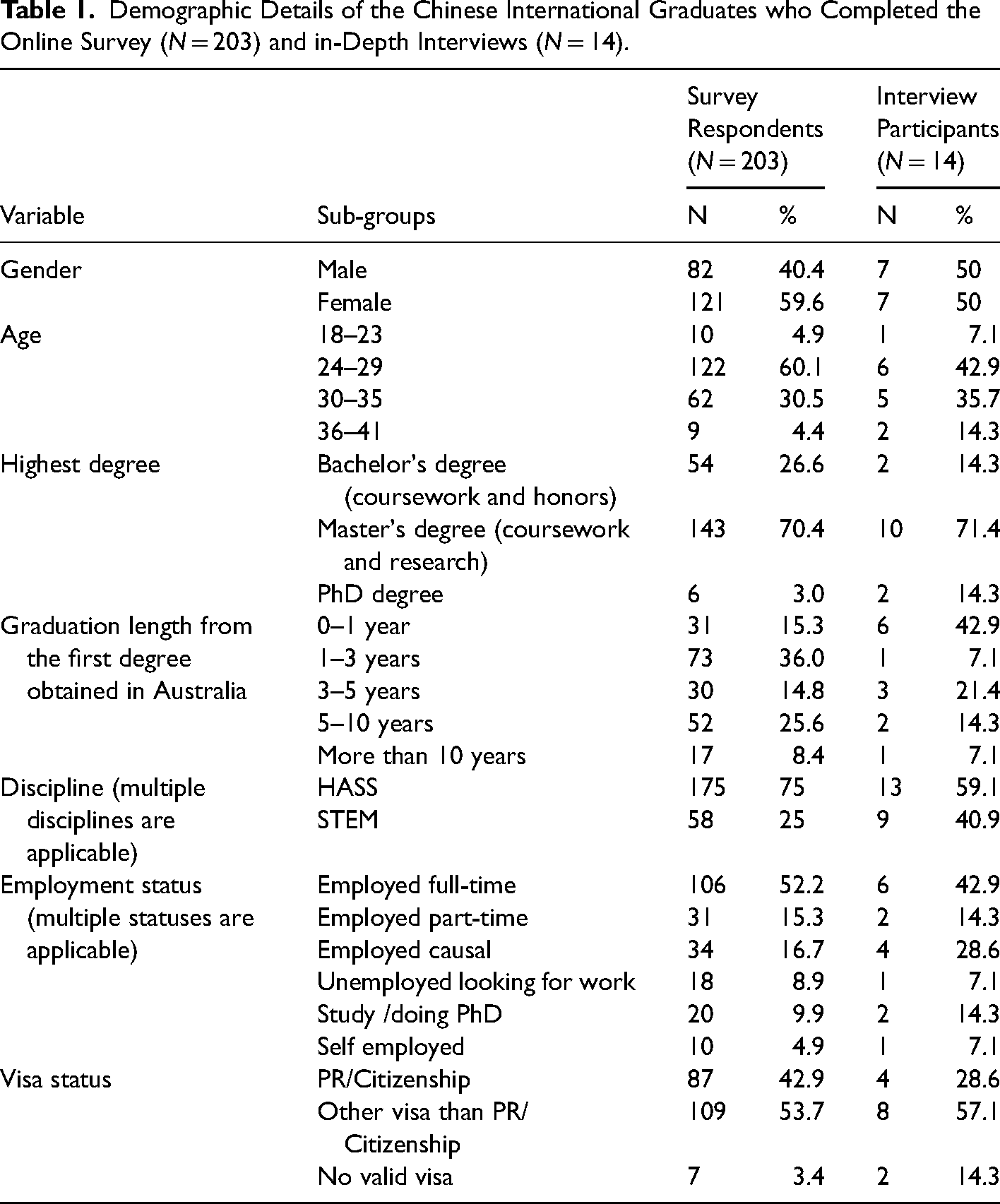
With ethical approval, an online survey was distributed to Chinese international graduates on various social media platforms. The participants signed a consent form prior to the data collection. The recruited respondents met the following criteria: (1) Chinese origin, (2) arrived in Australia as international students, (3) obtained a degree from an Australian university, and (4) engaged in employment in Australia, whether paid or unpaid, casual, part-time, or full-time. A total of 345 responses were collected; however, owing to 142 incomplete responses, 203 valid responses were used for the statistical analysis. Second, based on the survey replies, 14 individuals who submitted complete responses were invited to participate in individual in-depth interviews. The demographic details of the 203 survey respondents and 14 interview participants are presented in Table 1.
Demographic Details of the Chinese International Graduates who Completed the Online Survey (N = 203) and in-Depth Interviews (N = 14).
Instrument Development and Interview Protocol Development
The online survey covered demographic information and comprised 49 items assessing the participants’ perceptions of capital contributions to employability. Utilizing the participants’ perceptions is crucial, as graduates’ evaluations offer insights into their perceived employability (Clarke, 2018). These 49 items were drawn from existing studies on graduate employability and aimed to explore the components of employability outlined in the theoretical framework. Some items were modified to suit the nature of this study, which explored the employability of international graduates. For instance, the item “I believe my degree will improve my career prospects” from the survey of Tomlinson et al. (2022) was adapted to “My degree(s) obtained in Australia improve(s) my career prospects.” Additionally, some items were newly developed based on findings from prior qualitative empirical research (e.g., items about agentic capital, primarily derived from the research by the Pham (2021a, 2021c)). Similarly, other items were developed based on results from previous quantitative empirical research (e.g., some items about psychological capital, drawn from the research by Cassidy et al. (2014) and McIlveen et al. (2021)). Notably, this survey, being used for the first time, carries limitations and has not undergone validation. However, the study's focus was not on validating the scale but on providing an overall understanding of capital contributions to employability. In the qualitative phase, interview questions were developed to obtain deeper insights into the survey results, inviting the participants to explain how these forms of capital contributed to their employability. These questions were developed based on prior research, incorporating interview questions and findings (e.g., Pham, 2021c). Examples of interview questions are as follows: “How were your qualification(s) helpful to your career?”, “How have you used social networks for your career?”, and so on.
Data Collection and Analysis
A Qualtrics-powered online survey was distributed on social media platforms such as WeChat, Facebook, LinkedIn, and Twitter to invite Chinese international graduates to participate. Snowball sampling was employed, encouraging respondents and social networks to repost the survey link. The collected data were analyzed using SPSS v28. Prior to descriptive statistical analysis, all variables were rigorously checked for accuracy. Validity was assessed through PCA, ensuring factor loadings exceeded 0.5 (Hair, 2006).
Inter-item consistency was measured using Cronbach's alpha, with all values surpassing 0.7 (Nunnally, 1978). Six new variables (human, social, cultural, psychological, identity, and agentic capitals) were computed by integrating the items under each capital category. Descriptive statistical analysis was used to calculate means and standard deviations, providing an overall understanding of each capital's contribution to the respondents’ employability.
Fourteen interviews were conducted, with twelve held online and two conducted face-to-face, each lasting between 50 to 60 min. Participants chose between English and Mandarin based on their preferences, and the first author translated four interviews from Mandarin to English. The interview data were primarily utilized to gain deeper insights into survey responses and explore how each capital contributed to employability. Deductive thematic analysis was performed manually and was primarily theory-driven. A predetermined set of codes was derived from graduate employability literature and deployed by the first author. The six types of capital and their subdimensions were chosen as the predetermined codes, which were applied to the participants’ quotes throughout the analysis. When the data did not align with the existing codes, new codes were created. The thematic analysis focused on providing insights and explanations for the survey results guided by the research question: How do the six types of capital contribute to the graduates’ employability?
Findings
Quantitative Results: An Overview Picture of the Contributions of six Types of Capitals to the Respondents’ Employability
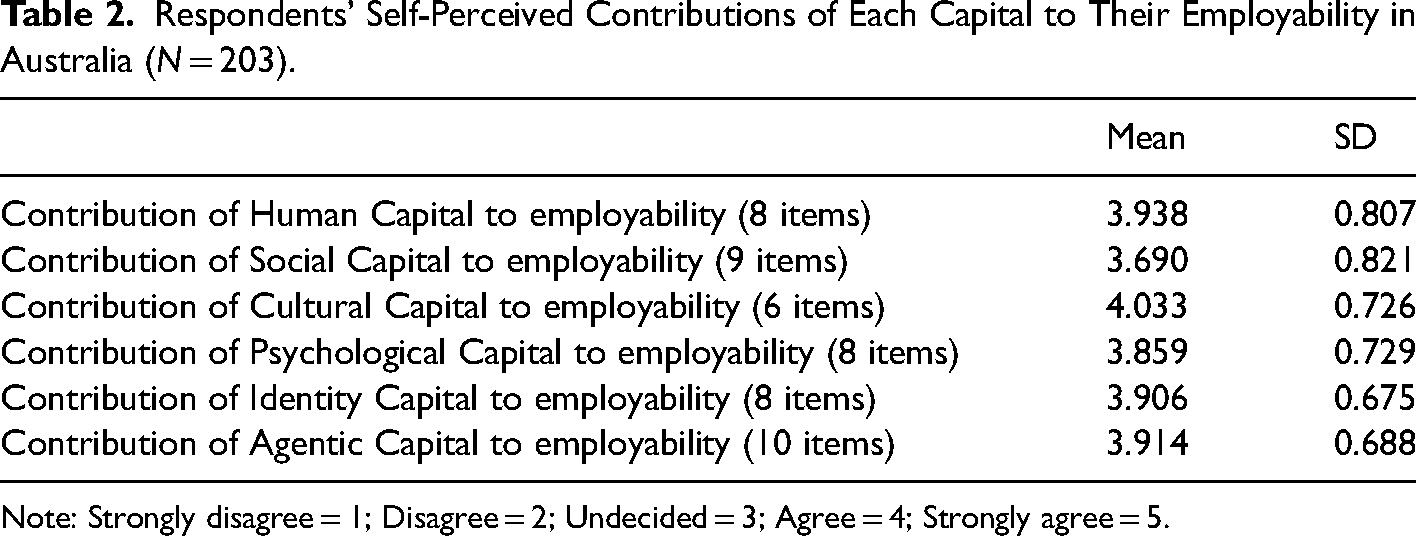
The quantitative phase aimed to offer a comprehensive view of how capital contributes to respondents’ employability. Descriptive quantitative data analysis was performed. Table 2 provides an overview of the self-perceived contributions of the six types of capital to the graduates’ employability, while Table 3 presents the mean and standard deviation, along with the PCA results showing variance explained and factor loadings and the reliability analysis using Cronbach's alpha.
Respondents’ Self-Perceived Contributions of Each Capital to Their Employability in Australia (N = 203).
Note: Strongly disagree = 1; Disagree = 2; Undecided = 3; Agree = 4; Strongly agree = 5.
Self-Perceived Contributions of 49 Items Under Each Capital on Employability.
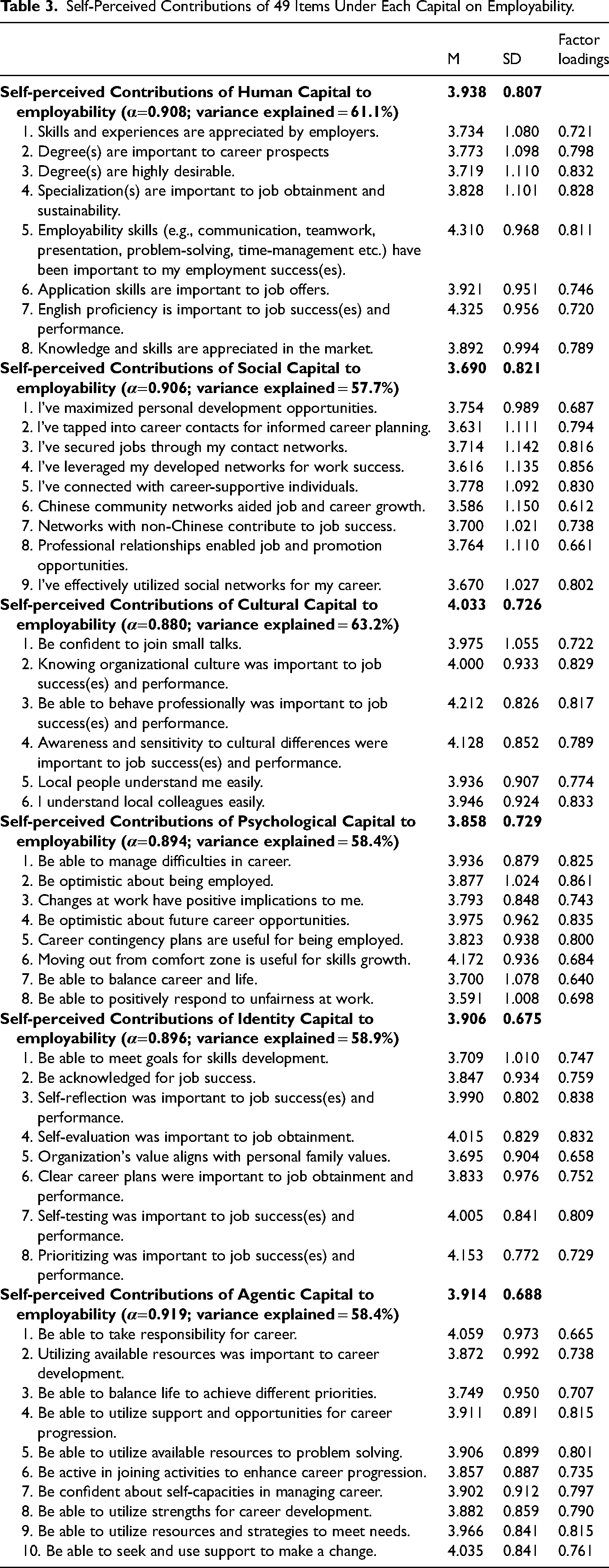
In Table 2, the respondents generally acknowledged the contributions of each type of capital (mean values close to 4). Social capital had the lowest mean (3.690), whereas cultural capital had the highest (4.033). Table 3 further elucidated that the item under social capital (“Chinese community networks aided job and career growth” M = 3.586) scored the lowest among the 49 items. Conversely, under cultural capital, the highest-ranked statement was, “Be able to behave professionally was important to job success(es) and performance” (M = 4.212), ranking 3rd among the 49 items. The top two items, both under human capital, were “English proficiency is important to job success(es) and performance” (M = 4.325) and “Employability skills (e.g., communication, teamwork, presentation, problem-solving, and time management) have been important to my employment success(es)” (M = 4.310).
Qualitative Findings
Contribution of Human Capital: Employment Outcomes
While it is unsurprising that the respondents perceived that a degree was not enough, the survey results indicated that, among various components of human capital, the effect of possessing a degree received the lowest rating (M = 3.719; see Table 3). The qualitative analysis offered insights into this outcome, with respondents explaining that having a qualification alone did not guarantee employment because of the prevalent demand for work experience among employers. Consequently, graduates face challenges in securing full-time employment without prior work experience. Notably, participants in disciplines such as teaching and psychology emphasized the usefulness of mandatory placements for acquiring work experience, whereas some programs and disciplines did not include placements as a mandatory component.
Furthermore, the survey highlighted the importance of professional skills and English competencies in facilitating graduates’ entry into the labor market and their ability to navigate their employability paths. In the interviews, the participants emphasized that satisfactory professional skills and proficiency in English were vital for securing job offers and performing effectively in the workplace. A graduate said: I would not say my English is as perfect as the native speakers, but it is good enough for me to communicate freely with the interviewers and colleagues […]. Soft skills were asked quite often in my job interviews, and I am quite satisfied with these skills, such as time management and problem-solving. These factors are fundamentally important for working effectively. (Spencer, postgraduate in engineering)
The findings emphasize that while a degree serves as a baseline requirement for international graduates in job-seeking endeavors, cultivating additional aspects of human capital, including professional skills, work experience, and English proficiency, is instrumental in enhancing competitiveness and achieving optimal employability outcomes.
Contribution of Social Capital: Employment Outcomes
Social capital received the lowest rating (M = 3.690; see Table 2) compared to the other forms of capital concerning its influence on these graduates’ employability. Insights from interviews unveiled that the participants perceived limited control over how social networks affected their employment outcomes. While job referrals were acknowledged, they were not viewed as equivalent to job offers because candidates still needed to showcase their capabilities during interviews. Participants recognized that building robust social capital required time and effort to establish rapport and trust within social networks. Consequently, they did not rely solely on social support or capital, prioritizing the development of human capital such as English proficiency, professional knowledge, and skills. One participant shared: I really appreciate the support from my social networks, but I am very clear that job referrals are not equal to job offers. Nobody could remain employed forever simply by relying on their social networks […]. Compared to developing or relying on social capital, I found it more useful to develop my knowledge and skills. (Jonas – an undergraduate in business)
Moreover, participants perceived a limited contribution of social networks within the Chinese community to their employability (M = 3.586; see Table 3). The interviews revealed that while participants found it easier to communicate in Mandarin when working for Chinese employers, this did not necessarily translate into positive employability outcomes. Notably, two participants employed by Chinese companies experienced labor exploitation through low wages. They chose to leave these positions after gaining sufficient work experience, prioritizing their wellbeing and professional development over their immediate employment concerns.
Contribution of Cultural Capital: Employment Outcomes and Wellbeing
The survey results revealed that cultural capital had the highest score (M = 4.033; see Table 2), highlighting its significance. An analysis of the interview data further demonstrated that cultural capital made varied contributions to the participants’ employability. The first group of participants emphasized that their cultural understanding and embodied cultural behaviors significantly facilitated their ability to secure job offers. A graduate noted: I have been studying in this faculty for a long time, and I know how the university works, how they deliver courses, the communication style, etc., so I received some benefits applying for the position in the same university I am studying in […]. So, cultural understanding really helped me to get this teaching-associated job. (Jason – A PhD candidate in IT)
The second group of participants highlighted the importance of presenting themselves in a professionally and culturally appropriate manner, which positively influenced their confidence and wellbeing. They emphasized the significance of exhibiting desired embodied cultural behaviors to engage in small conversations, foster deeper relationships, and build trust in the workplace. A graduate stated: I feel much more confident in talking to local colleagues, joining their small talks and building the bonds. It was not easy at the beginning though. However, I have been learning these cultural behaviors and dispositions through observation and being respectful of the vibe. It is all good now. (Meredith – a postgraduate in teaching)
Despite receiving the highest score from respondents, cultural capital did not necessarily indicate that the graduates had fully developed or utilized it effectively. Many participants expressed challenges in acquiring and developing embodied cultural capital, such as desired behaviors and dispositions specific to the Australian workplace and transforming superficial cultural knowledge into cultural capital. Nevertheless, participants strongly recognized the pivotal role of cultural capital in comprehending cultural differences and adhering to expected cultural behaviors, ultimately facilitating professional and appropriate integration into the workplace.
Contribution of Psychological Capital: Wellbeing and Professional Growth
The survey results indicate that the contribution of psychological capital to employability (M = 3.858; see Table 2) was not strongly evident among the respondents. Analysis of the interview data provided insights by revealing that resilience was more valuable for the participants’ wellbeing rather than directly impacting their employment outcomes. For example, being resilient or adaptable did not necessarily result in immediate improvements in employment when participants faced rejection, unemployment, or underemployment. Nevertheless, possessing strong psychological capital empowered participants to swiftly adjust their moods and devise solutions to address challenges, thereby, positively influencing their long-term employability trajectories. One graduate mentioned: It is not like having hope or being resilient gave me fantasy jobs automatically; it is more about how it enabled me to see clearly that failure at work is temporary, and it is not the end of the world. Then, I became less stressed and calmer when thinking about solutions. (Leo – a postgraduate in business)
Participants considered challenging times and inevitable adversities to be normal aspects of their employability journeys, viewing the development of resilience as a customary enhancement of their skill sets. Furthermore, they emphasized the significance of flexibility and adaptability, noting that these attributes increased workplace opportunities and contributed to ongoing skill improvement. One graduate shared: Being more adaptive and flexible gives me more opportunities to say yes instead of saying no […]. I got more opportunities to improve my skills. (Chloe – a postgraduate in Speech Pathology)
Contribution of Identity Capital: Wellbeing and Professional Growth
The survey findings indicated a relatively high consensus among respondents regarding the contribution of identity capital to employability (M = 3.906; see Table 2). The interviews further revealed that identity capital had diverse effects on participants’ employability. First, participants emphasized the significance of having a clear career goal and the willingness to alter their career path if it did not align with their interests and personality. Several participants highlighted that their wellbeing improved after they realized their career goals and made career changes. One graduate noted: I changed my career path and got more reasonable and clearer career goals […]. I know what the steps and milestones are for me […]; so, I am less stressed and more optimistic about my future. (Yolanda – a postgraduate in IT)
Other participants provided evidence that aligning their career goals with their passion resulted in enhanced professional growth and increased job sustainability. These individuals emphasized the importance of pursuing careers with personal significance. Several participants experienced increased motivation after recognizing the importance and meaningfulness of their work. One graduate expressed the following: I cannot say I had the passion initially; it was not until the time when I saw progress in the clients […] I started to see the importance of my job and started to have passion. The more I work, the more passionate I am about becoming a good practitioner. (Chloe, postgraduate in Speech Pathology)
Contribution of Agentic Capital: Professional Growth and Wellbeing
The respondents assigned a relatively high agentic capital score, as evident from the quantitative results (M = 3.914; see Table 2). Analysis of the interviews revealed that the participants enhanced their professional skills through proactive engagement. The participants who initiated their job search months before graduation demonstrated improved interview skills and excelled in official interviews. Moreover, many deliberately pursued the enhancement of their human capital by achieving IELTS band 7 or 8 and acquiring certifications as registered teachers or speech pathologists. Conscious efforts were also directed toward strengthening cultural capital, involving the improvement of cultural knowledge and the exhibition of embodied behaviors during placements.
Beyond professional growth, participants highlighted the positive impact of agentic capital on wellbeing. For instance, Lilian strategically and proactively approached the utilization of available resources. By creating personalized business cards featuring LinkedIn details, she actively participated in conferences as a volunteer, distributing her resumes and business cards to potential employers. While no immediate job offers arrived, Lilian viewed her experience positively. I am proud of my strategic and proactive actions. Although job offers did not come immediately, I am pleased with the outcomes—expanded professional networks and recognition by leading companies. (Lilian, postgraduate in biomedicine)
Similarly, the participants expressed a sense of contentment when employing agentic capital in the selective choice of companies that resonated with their individual values. Additionally, the strategic use of agentic capital was evident in the participants’ deliberate selection of companies that did not mandate Permanent Residency or Australian citizenship. This selective approach allows them to navigate employment opportunities in spaces where visa restrictions are less stringent, aligning with their individual circumstances and aspirations.
Discussion and Conclusion
This study aims to investigate the contributions of six types of capital to the employability of Chinese international graduates in the Australian labor market. It represents the first attempt to employ a mixed-methods approach, encompassing both quantitative and qualitative evidence, to examine how these six forms of capital contribute to international graduates’ employability in the host labor market. The findings reveal several significant empirical themes that augment the existing understanding of international graduates’ employability.
First, this study advocates for a comprehensive definition of employability that encompasses six types of capital (i.e., human, social, cultural, psychological, identity, and agentic capitals) as individual resources for employability. It also considers four aspects (i.e., employment outcomes, sustainable employment, wellbeing, and professional growth) as key employability outcomes. Prior research highlights that employment pertains primarily to job acquisition, whereas employability encompasses a broader concept that includes various aspects beyond mere employment outcomes and refers to long-term employability trajectories (Tang, 2023). This study endorses this distinction and underscores the notion that graduates can only achieve their desired long-term career success if they experience wellbeing, sustained employment, and professional growth.
Second, this study identified the associations between different types of capital and various aspects of employability outcomes. As revealed in findings section, beyond the utilization of human, social and cultural capital for job acquisition, the participants experienced enhanced wellbeing when they possessed healthy and positive social networks (social capital), resilience (psychological capital), or a clear career identity (identity capital). They were also able to sustain their jobs more effectively when their career goals aligned with their passions (identity capital). Additionally, participants improved their professional skills through the presence of reliable mentors (social capital) or by engaging in proactive actions (agentic capital).
Third, this study contributes to the literature by examining the role of social capital in graduate employment. While previous research has emphasized the significance of social capital in facilitating the entry of international graduates into the host labor market, such as Australia (Pham, 2021c), the United States (Son, 2013), and the United Kingdom (Moskal, 2017), this study revealed that social capital was perceived to have the least impact on participants’ employment outcomes. The interviews suggested that social networks primarily facilitated job introductions. To stand out, graduates must strategically leverage other forms of capital.
Furthermore, an interesting aspect revealed in this study, which requires further investigation, was the level of engagement of the participants with the development of social capital and how they used social capital for employability negotiation. Social capital for optimal employability outcomes entails a deeper layer of social networks (Pham, 2022). Participants recognized the need to nurture meaningful connections and mutual interests over time (Pham, 2022; Tang, 2023). However, due to limited time, as international graduates focused on both studying and career development, participants tended to prioritize the development of human capital for employability. This inclination was influenced by their habitus, which further shaped their practices (Bourdieu, 1977). Aligned with the findings of Pham et al. (2019), participants in this study embraced a habitus and mindset that underscored the importance of human capital while acknowledging that a degree alone is insufficient. Consequently, they prioritized investing time in strengthening other aspects of human capital, such as their professional skills and work experiences over extensively cultivating social networks to enhance their employability prospects. Additionally, participants understood that social capital represented a deeper layer of social networks and chose to develop it naturally and gradually rather than prioritizing its immediate cultivation. Consequently, graduates perceived social capital to have minimal contribution to their employability.
Fourth, this study advocates the recognition of international graduates as agentic doers (Marginson, 2014; Pham, 2021a; Tang, 2023). The findings demonstrate the participants’ ability to exert control over their circumstances and engage in the host labor market in diverse ways. For instance, some managed full-time employment without Permanent Residency by leveraging their selective capacity, which is an integral aspect of agentic capital (Pham, 2021a). These graduates selectively participated in fields in which Permanent Residency or Australian citizenship was not mandatory, aligning with their visa permissions. Similarly, others selectively chose fields conducive to freelancing or entrepreneurship, leveraging their self-awareness to navigate spaces with fewer restrictions (Joy et al., 2020). Importantly, the feasibility of such agentic actions largely relied on the existence of specific fields within the Australian job market, where prerequisites such as Permanent Residency or citizenship were not stringently set by employers; consequently, participants managed to pursue their career aspirations as freelancers or entrepreneurs. This observation aligns with the findings of Delva et al. (2021) that the agency in relation to employability is relational and collective, emphasizing that other actors such as employers or policymakers on graduates’ agency to navigate the labor market.
Moreover, a subset of participants successfully transitioned from voluntary roles to full-time employment by leveraging their agency belief, a pivotal aspect of agentic capital that empowers them to instigate action and influence their life trajectories (Hitlin & Elder, 2006; Pham, 2021d). These individuals showed that their habitus, encompassing dispositions and attitudes toward voluntary work, contributed to recognized work performances, ultimately impressing employers and leading to full-time positions. Crucially, these participants viewed voluntary work as a transient phase, prioritizing the accumulation of work experience and professional skill development over immediate financial gain, as recent international graduates. These varied strategies illustrated that the participants actively engaged in the host labor market as agentic individuals. This finding suggests that the habitus of international graduates does not inevitably lead to marginalization. Similar to prior research (Heng, 2018; Tang, 2023), these participants demonstrated agency by creatively applying their habitus to navigate and adapt to diverse social contexts. Importantly, these agentic capabilities were not deployed in isolation as some aspects of their habitus and agency beliefs found suitable spaces in Australia, allowing them to effectively apply their habitus to the host labor market.
In conclusion, this study unpacked the contributions of six types of capital to the employability of Chinese international graduates in the Australian labor market. It emphasizes the need for a comprehensive understanding of employability, encompassing multiple forms of capital as individual resources of employability and various aspects as key employability outcomes. This study also highlights the importance of considering international graduates as agentic doers within the host labor market. Furthermore, this study argues for the shared responsibilities of different stakeholders in supporting the employability of international graduates. Universities should provide international graduates with employability programs that focus not only on the development of human capital but also of various forms of capital. International students and graduates should understand the differences between employment and employability to obtain different aspects of employability outcomes, developing a range of capital. Employers should recognize the contributions of international graduates and support international students in acquiring work experience through internships or placement opportunities. The findings of this study open avenues for future research to investigate the similarities or differences that could shed light on broader patterns in the employability of Chinese graduates in other prominent international educational destinations. Additionally, a validation study of the survey items is necessary for future research.
Supplemental Material
sj-docx-1-jsi-10.1177_10283153241262464 - Supplemental material for Contributions of Employability Capitals to the Employability of Chinese International Graduates in Australia
Supplemental material, sj-docx-1-jsi-10.1177_10283153241262464 for Contributions of Employability Capitals to the Employability of Chinese International Graduates in Australia by Melody Tang, Thanh Pham and Eisuke Saito in Journal of Studies in International Education
Footnotes
Acknowledgements
The authors thank the peer reviewers and the editors for their helpful comments and suggestions.
Declaration of Conflicting Interests
The author(s) declared no potential conflicts of interest with respect to the research, authorship, and/or publication of this article.
Funding
This work was supported by the Australian Government Research Training Program (RTP) Scholarship.

Supplemental Material
Supplemental material for this article is available online.
Author Biographies
References
Supplementary Material
Please find the following supplemental material available below.
For Open Access articles published under a Creative Commons License, all supplemental material carries the same license as the article it is associated with.
For non-Open Access articles published, all supplemental material carries a non-exclusive license, and permission requests for re-use of supplemental material or any part of supplemental material shall be sent directly to the copyright owner as specified in the copyright notice associated with the article.
