




Abstract
This paper focuses on international student mobility and the funding of higher education. We theorize that relying on international students for funding is stronger for institutions in developed English-speaking countries because they more often adopt marketization practices. Compared to Northern and Southern European countries, we find that they had the largest decrease in public funding and largest increase in private funding. The relative number of international students has also increased for English-speaking countries, but not for other country groupings. Furthermore, we found associations between public/private funding and international student enrollments, but these patterns were not uniform. These results show that a decrease in public funding and a reliance on international students as a source of income is not equally important everywhere. This opens new avenues for research on the marketization of higher education, including the role that differences between cultures and types of governments play in shaping international student mobility.
Keywords
Introduction
Over the past decades, governments and higher education institutions (HEIs) increasingly developed policies to attract international students (Levatino et al., 2018; Lomer, 2018; Riaño et al., 2018a). In recent years, an often repeated claim is that international students in highly developed western countries are primarily recruited with the intent of generating income for HEIs (see e.g., Findlay et al., 2017) This has been related to a new neo-liberal institutional narrative on international student recruitment (Choudaha & Van Mol, 2021; Findlay et al., 2017) because HEIs benefit financially from international student mobility (ISM) through tuition fees (Cantwell, 2015; Findlay et al., 2017). However, the narrative of international students as a source of revenue is most prominent in studies about Anglo-Saxon countries (Riaño et al., 2018b) which opens up the question whether HEIs in other countries also primarily recruit international students as a method of generating income.
This paper approaches this question by empirically investigating how levels of public and private spending on higher education have developed in Western European countries and the highly developed English-speaking countries in the years 2008–2018. We link these changes to international student flows, whereby we expect to observe a correlation if international students are used as a source of income. For the European countries we specifically focus on non-EU/EEA international students as these often pay higher fees than domestic and EU/EEA students. Relying on the Varieties of Capitalism (VoC) literature (Hall, 2015), we theorize that while the reliance on international students to fund higher education (HE) is occurring everywhere, it is stronger in the English-speaking countries because HEIs in these countries are more likely to adopt a marketization approach. We specifically chose to focus on highly developed Western countries, because this is where the majority of international students are hosted and claims about the claims about the marketization of HE are most often focused on.
Our paper contributes to debates on the so-called neoliberal turn in HE (Samers & Collyer, 2017). While there have been several qualitative studies and commentaries on the neo-liberal direction of HEIs (e.g., Bamberger et al., 2019; Cannella & Koro-Ljungberg, 2017; Findlay et al., 2017), to the best of our knowledge we are not aware of any large scale comparative quantitative study on the relationship between the funding of HE and ISM. Although using country-level data has the disadvantage that only broad patterns can be discerned and variation within countries is ignored, such an approach nevertheless fits within a recently emerging line of research, which advocates to dedicate more attention to the supply-side of ISM (Findlay et al., 2017), indicating the lack of attention that has been paid to the role of governments and HEIs in how they shape uneven patterns of ISM. Our paper aims to contribute to closing this gap by adopting an international comparative approach. This approach allows us to investigate whether the increasing reliance on international students as a source of income, a claim mostly repeated in studies based on Anglo-Saxon countries, is a homogenous or heterogenous phenomenon.
Theoretical Framework
Neoliberalism and the Marketization of Higher Education
HEIs have become increasingly subject to neoliberal market forces, as they actively compete for students in a global arena (Findlay et al., 2017). One of the effects of neoliberalism is that HEIs receive less funding from the government and become more reliant on income from private sources. To cope with the reduction of governmental funding, HEIs can adopt a marketization strategy where HE is no longer seen as a public good, but as a service that is offered to paying customers. In extension, this means that competition between HEIs is seen as desirable and healthy, as it will increase the quality of education. In such a context, the goal of many institutions becomes to attract as many students as possible because of the additional revenue they bring, compensating for the reduction of governmental financial support (Findlay et al., 2017). Particularly international students have become attractive, as they often pay higher tuition fees.
While the marketization of HE is not a recent phenomenon, it has been argued that it accelerated after the economic crisis of 2008 (Choudaha, 2017). Following the economic crisis, many governments reduced spending on the public sector which meant that HEIs had to look for alternative means of generating income, such as recruiting international students. If HEIs started to implement policies with the aim of attracting international students for financial reasons, it would be expected that this is related to the level of funding received from the government. After all, if a HEI receives enough funding to cover costs, there is no (financial) need to attract more international students. Governments that aim to stimulate marketization do so in part by reducing public funding, which makes public institutions more dependent on generating their own income such as through tuition fees. At the same time, HEIs could use increased international student enrollments as a means to diversify their source of income in order to make them less dependent on the government (Findlay et al., 2017). In turn, this could incentivize governments to reduce their funding of the HE sector even further. Thus, we predict an association between public funding and ISM and formulate the following hypothesis:
Hypothesis 1A: A decrease in public funding of HE is associated with an increase in enrollments of international students.
In a similar vein, we expect a relationship between the amount of private spending on HE and the share of enrollments of international students. It could be the case that if international student enrollments are increasing, HEIs seize the opportunity to increase tuition fees for international students. At the same time, it could also be the case that private spending is increasing, simply because there are more international students who pay higher fees. We thus propose the following hypothesis:
Hypothesis 1B: An increase in private spending on HE is associated with an increase in enrollments of international students.
Even though marketization appears to be increasing in HEIs everywhere, it is not happening at the same pace. For example, France and some states of Germany only charged higher tuition fees for non-EU/EEA students in the last few years and there are still countries, such as Norway, that offer fully free tertiary education (Eurydice, 2020). The response of different governments in funding HE during the recession also varied. Skrbinjek and Lesjak (2014), for example, could not find a uniform pattern in the higher education expenditure of European governments: some governments increased funding on HE, while others decreased it. How to explain such international variation? To answer this question, we will turn to the Varieties of Capitalism literature in the next section.
Varieties of Capitalism and the Marketization of Higher Education
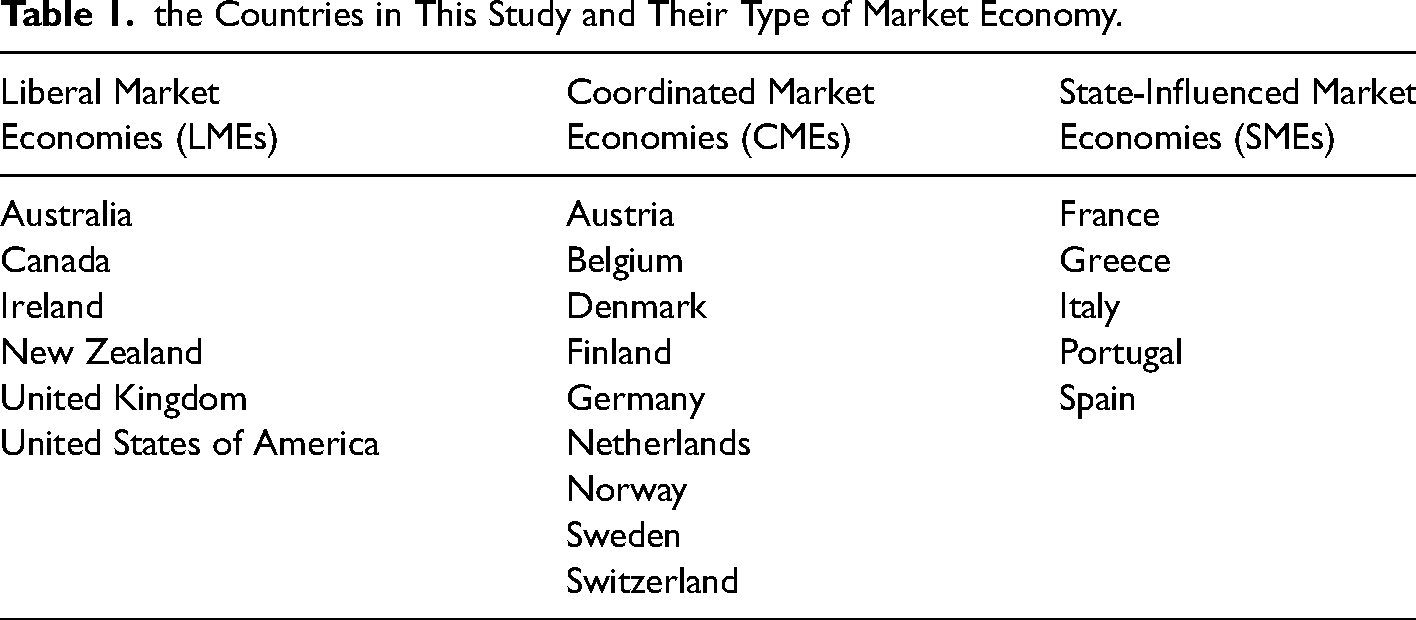
The theory of Varieties of Capitalism (VoC) aims to explain differences between market economies in developed countries (Hall, 2015). It conceptualizes institutions as being embedded in national systems consisting of different actors such as the government, clients, and companies. An important element of this theory is institutional complementarity which explains that institutions complement each other if the existence of one improves the performance of the other (Graf, 2009). The effect of this is that institutions tend to adopt policies that best fit with the institutions in their environment. This connects to the second core concept, comparative institutional advantage, which explains that institutions have different strengths or weaknesses depending on the context. As a result, institutions tend to adopt characteristics that are shared by the national context, because it improves their individual strength, as well as how they coordinate with other actors. Based on the mechanisms of institutional complementarity and comparative institutional advantage, countries form systems with different ways in which institutions coordinate with each other. In this paper, we use the tripartite grouping conceptualized by Schmidt (2009) and further developed by Mariotti and Marzano (2019). They group the developed countries into three types: Liberal Market Economies (LMEs), Coordinated Market Economies (CMEs), and State-influenced Market Economies (SMEs). An overview of the countries per category can be found in Table 1.
the Countries in This Study and Their Type of Market Economy.
While the original VoC theory used firms as their unit of analysis, it can also be extended to HEIs as they too are subject to comparative institutional advantages based on the context (Dobbins & Knill, 2017; Graf, 2009). HEIs do not operate in a vacuum, but are embedded in their country-specific context which spans historical, cultural, and institutional peculiarities (Dobbins & Knill, 2017). Therefore, HEIs tend to adopt strategies that are aligned with the other actors including the governments, students, and other HEIs. Graf (2009) used the VoC approach to compare the internationalization strategies of German and British universities and found that in British universities internationalization was largely guided by market-based principles. In Germany, in contrast, the state played a larger role and internationalization was more based on cooperation between HEIs which are driven by political and cultural links. This shows that there does not have to be a single internationalization strategy, but that the rationales behind internationalization can be shaped by the larger context. Graf (2009) explains this further by pointing out that both the state and HEIs are biased towards adopting strategies that align with the existing organizational framework. Because of this, VoC theory can be used for cross-country comparisons.
LMEs cover the large Anglophone countries where institutions are more reliant on free market mechanisms. Relations between and within institutions are more competitive and hierarchical, and the government takes an arms-length approach to managing institutions (Mariotti & Marzano, 2019). For HEIs this means they have less government involvement, and that standards are often set by market mechanisms (Graf, 2009). Hierarchy and distinction are important for the HEIs in these countries with a few institutions dominating the rest. When comparing European countries in their rationales for internationalization, Seeber et al. (2016) found that English and Irish HEIs were more likely to opt for the revenue rationale compared to other European countries.
CMEs cover countries in Northern and North-Western Europe with Germany often seen as the typical example (Schmidt, 2009). Institutions in these countries are more focused on collaboration instead of competition and the role of the government tends to be one of enabling and cooperating with other institutions (Mariotti & Marzano, 2019). Although many CMEs are becoming more liberal, the degree to which liberalization has taken place, is much slower compared to LMEs (Hall, 2015). Van Donselaar et al. (2022), for example, found that the Netherlands, despite having some of the highest tuition fees of the CMEs, found that there was not a single HEI in the Netherlands that aimed to attract international students solely for financial reasons.
Finally, SMEs cover the Mediterranean countries with France being the central case. In the original formulation of the VoC theory, these countries were considered mixed economies in between LMEs and CMEs. However, Schmidt (2009) argues that these countries are actually a distinct category. The governments in SMEs are more likely to directly influence institutions instead of removing restrictions or cooperating as coequals (Schmidt, 2009). Regarding HEIs, Seeber et al. (2015) state that the influence of New Public Management on HEIs is lowest in SME countries which could be explained by the strong role of the state. In France, for example, there has been a recent adoption of tuition fees for international students, but the state still covers the majority of the costs and its national internationalization strategy is mostly focused on increasing political soft power (Highman & de Gayardon, 2022).
Although the majority of Western countries charge higher tuition fees for international students (Findlay et al., 2017), considerable variation can be observed across countries. All of the LMEs have higher tuition fees for international students (in the European context, we define international as non-EU/EEA). The fees for international students also tend to be much higher. For example, international students pay on average 13,500 USD more per year at the bachelor level at public institutions in Australia, Canada, and the United States (OECD, 2020). In the CMEs and SMEs, the situation is more mixed: not all countries charge higher tuition fees and in the cases that they do the fees are much lower compared to LMEs (OECD, 2020). There have been some changes in national policies concerning fee differentiation for international students during the studied timeframe, but only to Sweden (in 2011), Finland (in 2016) and one federal state in Germany (in 2017) (Eurydice, 2016, 2017; OECD, 2011). Thus, while most countries imposed higher tuition fees, HEIs in LMEs are generally more inclined to demand higher tuition fees compared to CMEs and SMEs. This leads us to theorize that ISM is linked to how HEIs generate income in most if not all developed countries. However, we expect this to be most pronounced in LMEs, because the institutional context in these countries allows neoliberal practices to flourish the most.
Hypothesis 2: In LMEs the associations between public and private spending on HE and enrollments of international students is stronger than in CMEs and SMEs.
A limitation of the VoC approach is that it was originally designed to categorize national economies and not HE systems. As such, there is heterogeneity within the categories (and countries) that is not accounted for. For example, the United States has a much larger private sector than Australia which has a mostly national HE sector. However, the VoC framework is about more than what types of HEIs countries have. It is fundamentally also about how HEIs coordinate with the government and other actors. The Australian government, for example, has increasingly implemented policy reforms with the aim of increasing competition between HEIs since the 1980s, despite the HE sector being largely public (Connell, 2013). In CMEs such policies are far less common. Wahlers (2018), for example, writes that in Germany, because cooperation was the norm and HEIs were roughly equal in quality, marketing and promotion of HE was a rather foreign concept. In such an environment, a more cooperative approach to internationalization could be a wiser strategy than a marketization strategy.
A similar limitation is that within the country groupings there exists heterogeneity – like in all typologies. Within the CMEs, for example, the Netherlands is much more liberal than the other countries (which could also explain why it adopted fee differentiation for non-EEA students earlier than other CME countries). However, it should be kept in mind that the three country types are ideal cases in the Weberian sense and that each country will always have some characteristics of all three (Hay, 2020). While no country perfectly fits in a category, most countries nevertheless have a clear leaning towards one or the other, and the validity of these categories has been empirically supported by a number of studies (see e.g., Hall, 2015; Hall & Gingerich, 2009; Mariotti & Marzano, 2019).
Data and Methods
Dependent Variable
Our dependent variable measures the total number of international students in a country in a given year, as a percentage of the total student population for the years 2008–2018. For the European countries we only include non-EU/EEA students because EU/EEA countries charge the same fees to domestic students and students from other EU/EEA countries. Non-EU/EEA students are therefore only liable to pay higher fees. The data for the non-European countries was taken from OECD (2021a). For the European countries we used data from UNESCO (2021) which has split up the number of international students based on the country of origin thus allowing us to only include non-EU/EEA students.
Independent Variables
Our first independent variable is public spending on HE as a percentage of GDP per country per year (OECD, 2021c). OECD defines this indicator as all direct expenditures to HEIs as well as subsidies given to households which are administered by HEIs, thereby showing the priority given by governments to education compared to other sectors. The second independent variable is private spending on HE as a percentage of GDP. OECD defines it as the expenditure on HE funded by households and other private entities (OECD, 2021b). It includes direct expenditures and does not include subsidies, textbooks, private tutoring, and living costs. Data on private spending was missing for Switzerland which meant that Switzerland had to be excluded in the analyses with private spending.
Analytic Strategy
To estimate the effect of public and private spending on the number of international students, we use a fixed effects (FE) model. This method is useful, because it allows us to estimate the effect of a change in public and private spending on the change in the share of students that is international while ignoring the effects of country differences that do not change over time. To accomplish this, we used an entity-demeaning approach with the help of the plm package in R. Specifically, for every country the average of the variables is calculated over the years. A within estimator is then produced by subtracting an observation from this country-specific mean which produces a measure that shows how much a variable differs at a certain point in time from a country's average. Finally, we estimated the results using robust standard errors that are clustered at the country level in order to account for heteroskedasticity and autocorrelation. 1 Several countries had missing values, especially in the earliest years. In principle, this should not be a problem for a fixed effects model, as it estimates change in the variables in a year-by-year basis.
Finally, we decided to model the effects of public and private spending both separately and in the same model. The reason for this is because they are not clear confounders of each other as the directions potentially go both ways. Consider for example the case where we estimate the effect of public spending on international students. Private spending would be an effective control variable if it influenced public spending and the % international students, but not the other way around. This is possible, but it is also possible that public spending influences private spending, or that the percentage international students influences private spending. If this is the case, then it could lead to mediation or collider bias (Wysocki et al., 2022). Because it is unclear whether public and private spending act as confounders, mediators, or colliders of each other, we follow the recommendation of Wysocki et al. (2022) and run multiple models with different control sets thus presenting the results from each model as competing estimates. The results should therefore be interpreted holistically since there could be omitted variable bias (when they do not control for each other) or there could be mediation/collider bias (when they do control for each other).
Results
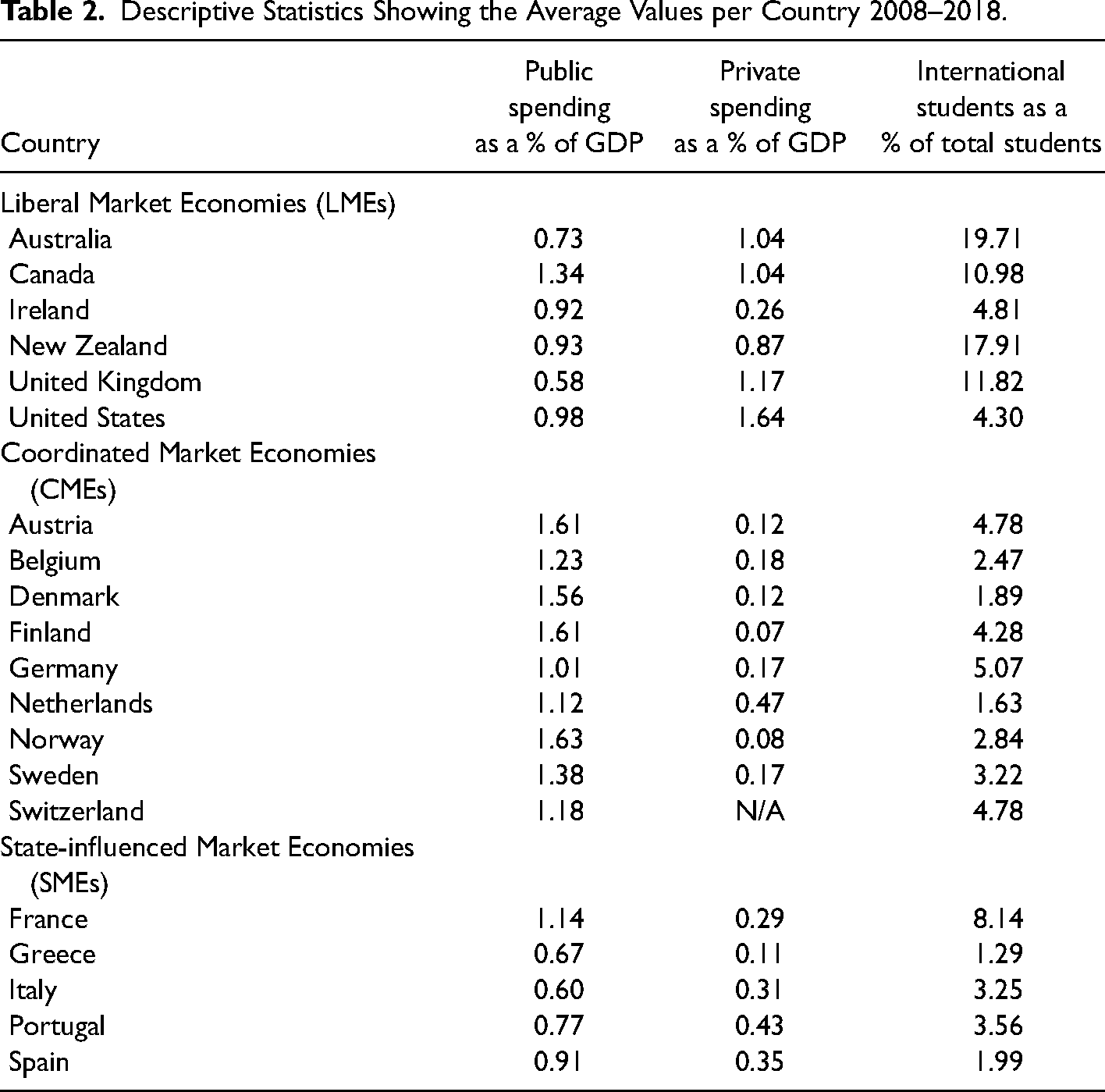
Table 2 shows the descriptive statistics of the three main variables in this study. Regarding public spending on HE, SMEs score the lowest on average (0.82), followed by LMEs (0.91), and CMEs (1.37). This is expected, since following VoC theory, CMEs manage and cooperate with HEIs more directly and would therefore also allocate more funds to HEIs. SMEs and LMEs, in contrast, were expected to give HEIs more autonomy in how they are funded. The difference in private spending is more striking with LMEs having by far the highest average (1.00) followed by SMEs (0.30) and CMEs (0.17). This is interesting, because it shows that low public spending does not necessarily go hand in hand with high private spending. For example, in France and Italy the bulk of the tuition costs are still covered by the state (Eurydice, 2022b, 2022a). Finally, LMEs have the highest average share of international students (12.96) followed by SMEs (3.65) and CMEs (3.44) These results provide some first evidence that low public spending and high private spending on HE is more prevalent in LMEs.
Descriptive Statistics Showing the Average Values per Country 2008–2018.
Trends in Public Funding on HE, Private Spending on HE, and International Student Enrollments
Figures 1–3 show trends in public and private spending, and in the percentage of students that is international. We chose to present the trends using boxplots, because these better show variability within countries while maintaining the overall trend. The line in the middle of the box represents the median, while the box itself contains 50% of the data centered around the median. The lines outside of the box are the “whiskers” which contain most of the rest of the data except for outliers (countries that deviate a lot from the other countries in a given year) which are represented as dots.
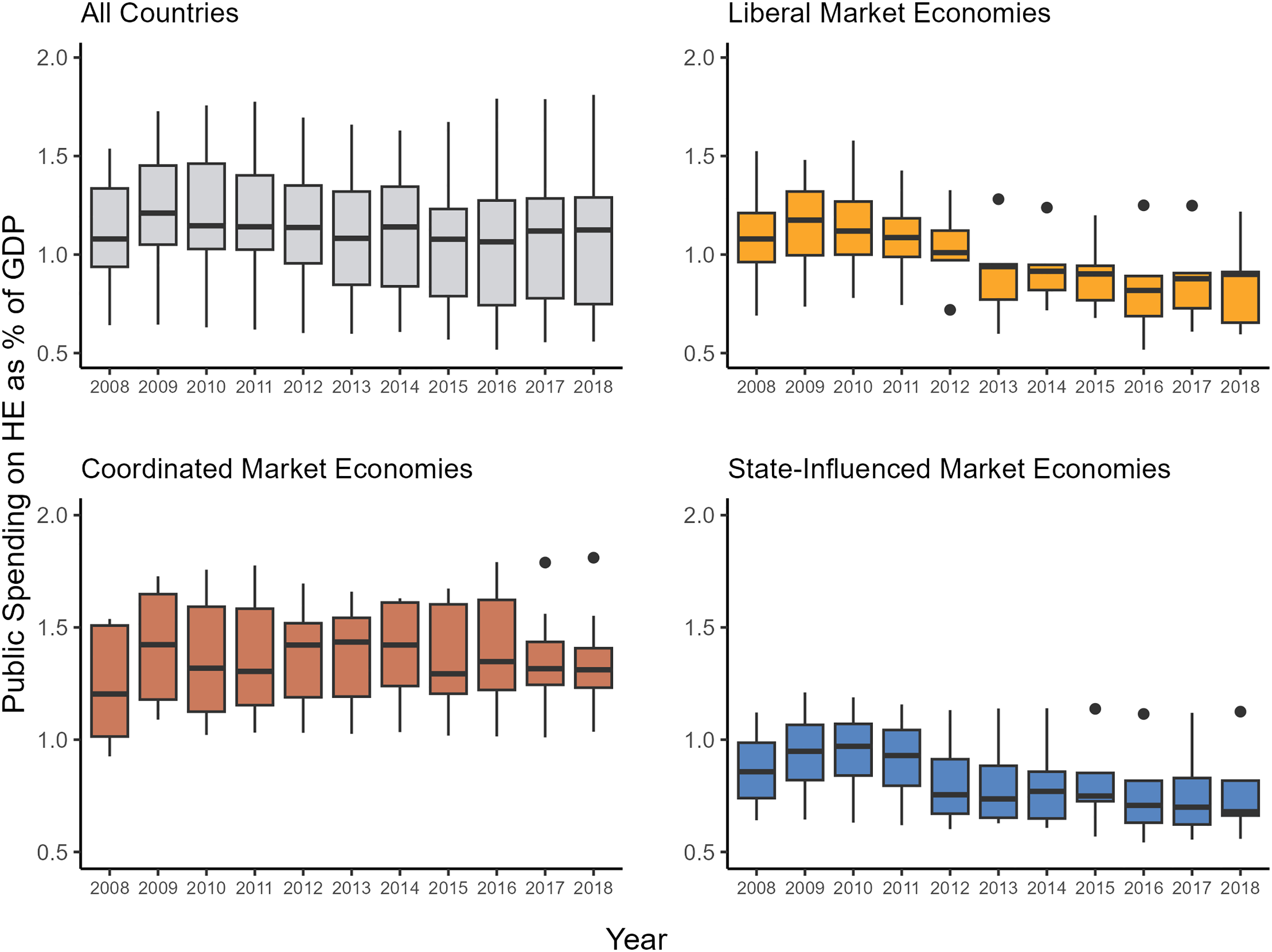
Change in public spending on HE as a % of GDP.
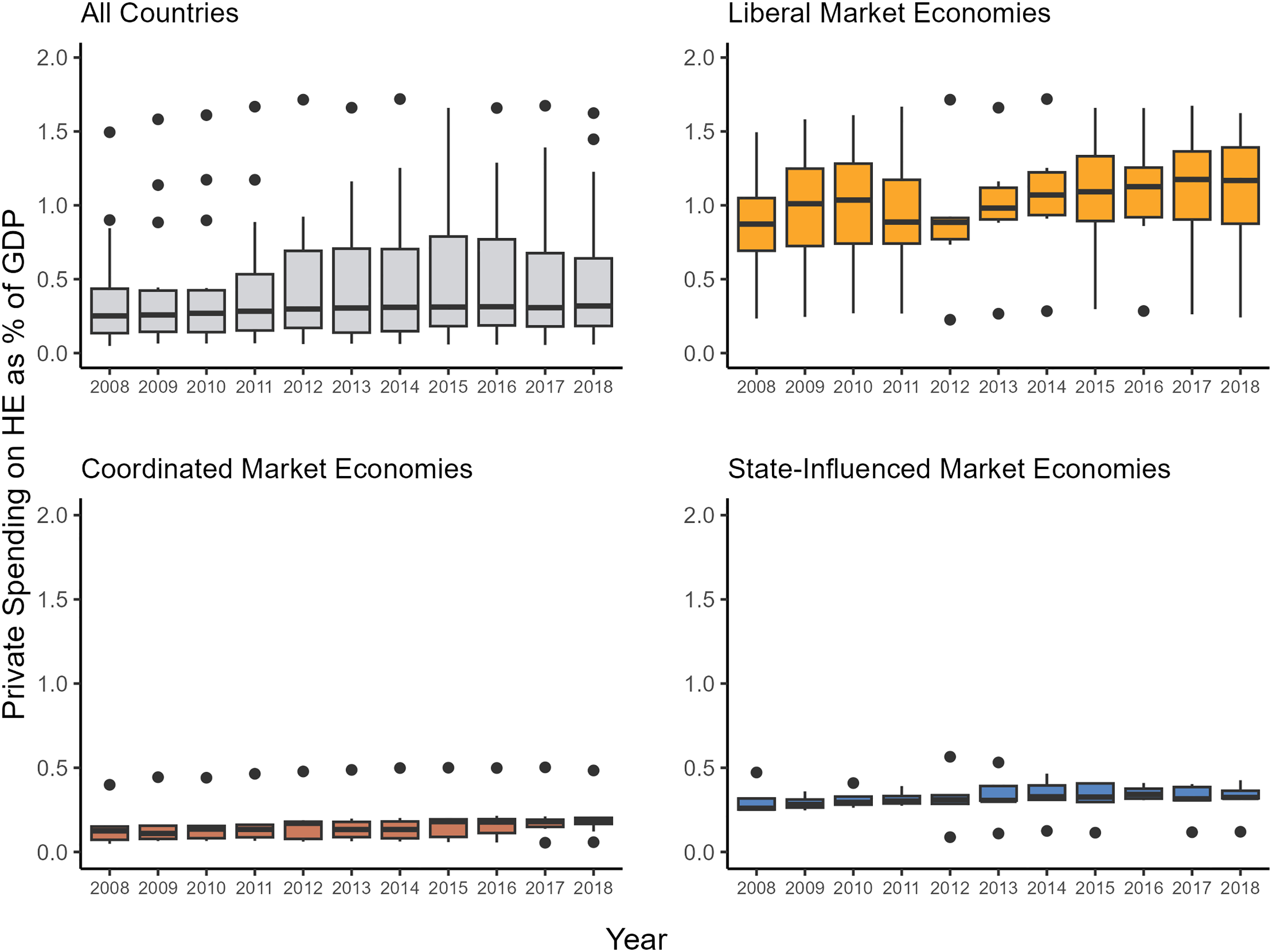
Change in private spending on HE as a % of GDP.
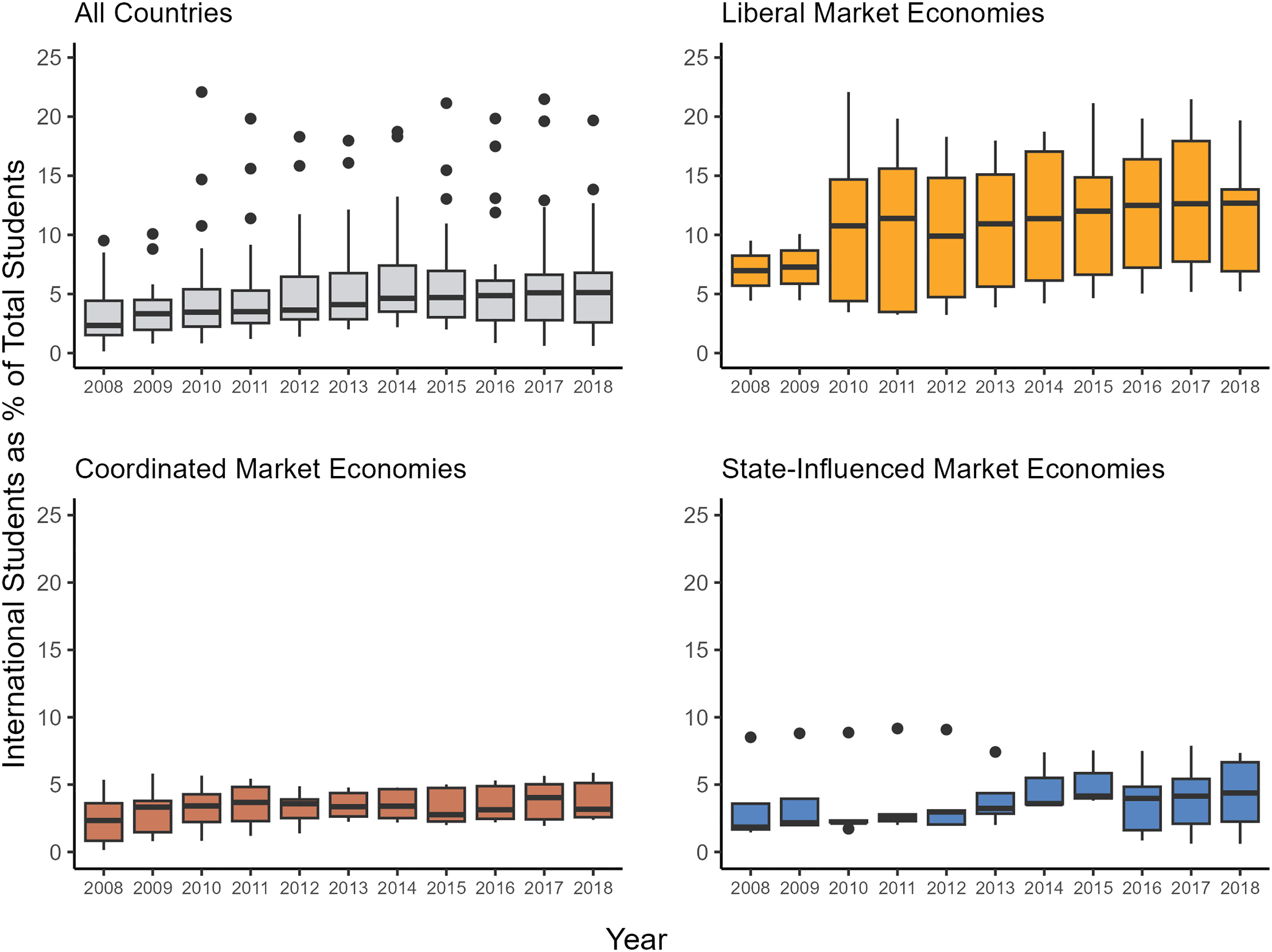
Change in international students as a % of total students.
Figure 1 shows that when considering all countries together, there has been a slight decrease in public spending on HE, but that this decrease is noticeably stronger in LMEs and SMEs. In CMEs, a less clear pattern can be discerned. 2 Some outliers are present in each group (for LMEs this is Canada, for CMEs Norway, and for SMEs France), but overall it is clear that CMEs have higher public funding and have not seen a clear decrease. This is in line with the VoC theory, because LMEs would be more likely to stimulate marketization through decreasing public funding, while in CMEs the government might stimulate competitiveness by working with the HEIs instead of removing restrictions. For SMEs, it is less clear why there would be a decrease, but it is also possible that the governments in these countries have enacted reforms based on the marketization of HE as a response to the economic recession. After all, the government-institution arrangement in these countries, according to Schmidt (2009), is one of state interference only when it is deemed appropriate.
Figure 2 shows that there has been a slight increase in private spending for all groups. 3 For all countries together, the outliers are mostly represented by the largest LMEs and LMEs also show much more variability than CMEs and SMEs. Both CMEs and LMEs have much less private funding of HE and the upper outliers (the Netherlands for CMEs, Portugal for SMEs) are still much lower than the median of the LMEs. These results come as no real surprise, as tuition fees and other costs for students have been steadily rising in most countries, especially for non-EA/EEA international students. This effect would be the strongest in LMEs, because these countries have fewer regulations from the government so they would be freer to charge higher tuition fees. Governments in CMEs would be hesitant about this, though notable exceptions exist such as in the Netherlands, which has loosened regulations when it comes to tuition fees for non-EU/EEA students (Eurydice, 2020). Still, in the period under investigation, many of the countries had very low or no fees at all for students which could indicate low levels of marketization. As with public spending, SMEs are in between LMEs and CMEs, though closer to CMEs.
Figure 3 shows the changes in the percentage of international students. For all countries together, it appears that there was a general increase, but LMEs host overall a larger percentage of international students relative to domestic students. The upper outliers in the SMEs are France. Interestingly, while for LMEs there has been a notable increase, for CMEs and SMEs the percentage (non-EU/EEA) international students does not appear to have changed. 4 This indicates that increases in international students are not always associated with decreases in public spending. There are several ways in which this could be interpreted. There has been a general decrease in enrollments for the biggest destinations in favor of smaller countries such as those in the SMEs or CMEs (Kondakci et al., 2018). It could be that many students consider LMEs as too expensive and choose cheaper SMEs or CMEs instead, such as in the case of Norway (Wiers-Jenssen, 2018).
Testing the Relationship Between Private and Public Spending on HE and Inflows of International Students
We first checked if there was a relationship between public and private spending using a separate FE model (with public spending as the dependent variable and private spending as the independent variable; the results can be found in appendix E). 5 The relationship was negative for LMEs and SMEs, and positive (though non-significant) for CMEs. This indicates that the notion that a decrease in public spending leads to an increase in private spending is applicable in some, but not all countries.
Table 3 shows the effects of changes in public/private spending on HE on changes in international student enrollments. As mentioned earlier, we ran three different models, two with each type of spending separately, and one with both types of spending together. 6 The estimates are unstandardized and should be interpreted as percentage points. For example, in model 1 for all countries, the estimate means that if the public spending increases by 1% of the GDP then this is associated with a 3.71 percentage point decrease in the share of students that is international.
Fixed Effects Models Showing the Effect of Public and Private Spending on HE on the % Students that is International.
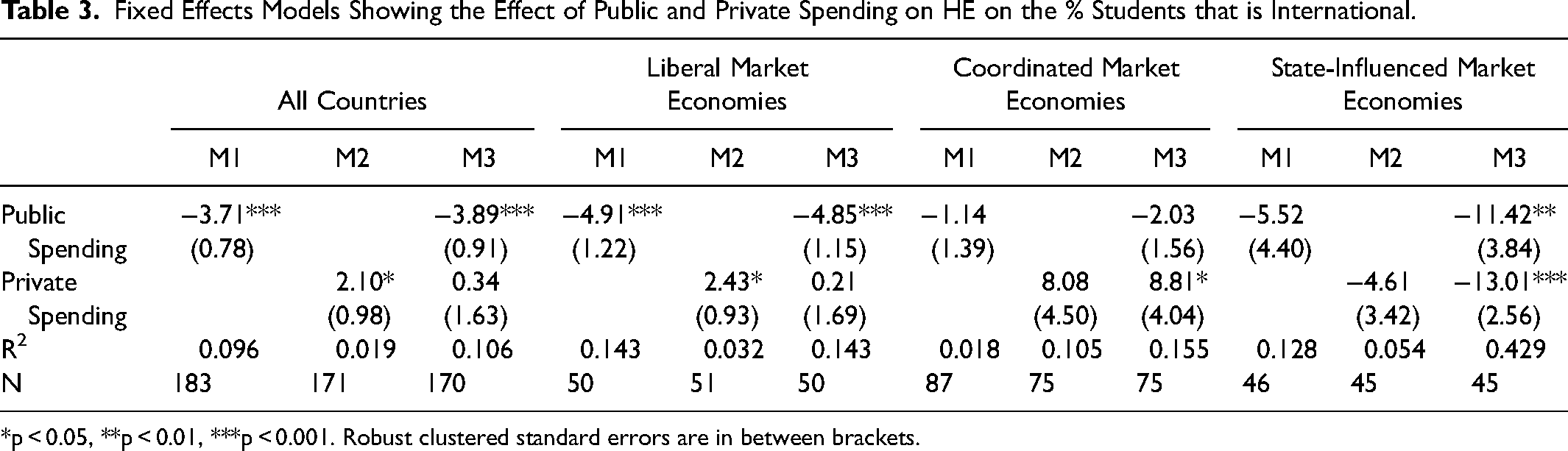
*p < 0.05, **p < 0.01, ***p < 0.001. Robust clustered standard errors are in between brackets.
The results are partially in line with our expectations. For all countries together, and for the LMEs, both model 1 and 3 show that there is a negative association between changes in public spending and changes in the share of international students. For CMEs however no such relationship is observed and for SMEs only in model 3. These results therefore reveal that it is possible that a decrease in public funding stimulated HEIs to look to international students as sources of income, at least for LMEs and SMEs. For the CMEs apparently the amount of public funding they received was independent of the number of non-EU/EEA international students they hosted. This is possible, after all in the CMEs the amount of public funding received by HEIs did not show a change in time so the CMEs might not have had a reason to target non-EU/EEA students specifically, even if they paid higher fees.
Regarding private funding, for the LMEs and CMEs there might a positive relationship between changes in private spending and changes in the share of international students, but for LMEs this was only found in model 2, and for CMEs only in model 3. Interestingly, for the SMEs model 3 actually shows a negative effect of private spending on international students. This could indicate that national governments allowed HEIs to capitalize on enrollments of non-EU/EEA students, as was the case for some CMEs where tuition fee differentiation was introduced. The negative effect for the SMEs seems odd. However, a possible explanation could be that many of these countries have seen a larger amount of outgoing students compared to incoming students. 7 A change in the percentage of international students could therefore also indicate a decrease in the number of domestic students, and therefore less private spending.
The results show that the relationship between ISM and sources of income is heterogeneous and might not be as straightforward as the narrative that HEIs in all developed countries are using international students as cash cows to compensate for lack of funding from the government. Of course, international students themselves also still have agency and it is becoming increasingly clear that they are not merely interested in academics, but evaluate the study abroad experience through a more holistic quality of life perspective (Prazeres et al., 2017). It could be that the increases in tuition fees in LMEs deterred international students who moved to relatively cheaper CMEs instead. In turn, CMEs could have capitalized on this development by allowing HEIs to charge higher fees under certain conditions.
Discussion and Conclusion
In this paper, we investigated heterogeneity in the funding of HEIs by looking at how changes in the funding of HE relate to changes in the international student population in Western European countries and the highly developed English-speaking countries. Starting from the theory of Varieties of Capitalism (VoC), we theorized that the reliance on international students for funding (and for European countries specifically non-EU/EEA students) would be felt strongest in the LMEs (the English-speaking countries), as institutions in these countries tend to follow more market-driven logics. A weaker link between ISM and sources of income was expected for CMEs (Northern Europe), because marketization trends would be less prominent in these countries due to a stronger cooperation between HEIs and the government. Finally, SMEs (Southern Europe) were expected to be more mixed with the state intervening in the economy, but only when necessary. The empirical results were partially in line with our expectations: LMEs and SMEs showed a decrease in public funding over time, and LMEs and CMEs showed an increase in private funding over time. For LMEs there was also an increase in the relative amount of international students, but for CMEs and SMEs this has not changed. For LMEs, and possibly SMEs, a decrease in public funding was associated with an increase in the percentage of students who were international, but for CMEs no such relationship was found. At the same time, an increase in private spending was possibly positively related to increasing international students for LMEs and CMEs, and possibly negatively related for SMEs.
These results show that there exists significant variation in how sources of funding relate to international student enrollments. The narrative that HEIs have increased their recruitment of international students to cover costs might not necessarily apply everywhere. This nuances perspectives found in in the study by Findlay et al. (2017), in which it is claimed that neoliberalism has become the dominant force in how HEIs shape their policy. Instead, the relative importance of the reliance on international students as a source of income could vary significantly between developed countries. Other rationales, such as academic and political rationales, do still play a role in how ISM is being shaped and promoted, and the landscape of internationalization is complex with many variations depending on the context (Unangst et al., 2022). Instead of encouraging internationalization through marketization by decreasing public funding, governments can also stimulate internationalization by increasing funding. It is also important to acknowledge that internationalization is facing resistance in several European countries, on the one hand from academics who argue that it decreases the quality of education, and on the other hand from right-wing politicians who wish to curb migration (de Wit & Altbach, 2020). Furthermore, non-Western countries do not necessarily share these neo-liberal viewpoints. Mulvey (2021), for example, states that while China is investing in the recruitment of international students, this is mainly for political reasons and ISM as a source of income is not the dominant perception. Bamberger et al. (2019) also showed in their study that neoliberalism fails to adequately explain the approaches to internationalization in China, Cuba, and Israel.
If the link between the economic interests and international student recruitment varies so much between countries, then the question remains why the dominant narrative in the literature seems to be that neoliberalism has become the dominant force behind the internationalization of HE. A possible explanation is that there is an Anglo-Saxon bias in the literature, as most of the authors that discuss the rise of neoliberalism in HE are based in Australia (e.g., Desierto & Maio, 2020; Connell, 2013; Hughes, 2017), Canada (e.g., McCartney & Metcalfe, 2018; Yesufu, 2018), the United Kingdom (e.g., Findlay et al., 2017; Jessop, 2018; Nixon et al., 2018)
To conclude, we are not arguing that neoliberalism is not a powerful force, nor that marketization is a uniquely Anglo-Saxon phenomenon. We do argue, however, that statements such as “Neoliberalism is now the dominant ideology of global higher education” (Desierto & Maio, 2020, 148) might be unwarranted, as significant variation exists between countries in how ISM relates to economic circumstances. As Bamberger et al. (2019) point out: “The current tendency in the literature towards a reliance on a progressive neoliberal framing of internationalization limits our understanding on a global scale” (10). Indeed, if we only frame internationalization in terms of neoliberalism, we ignore local variations and the power that HEIs, governments, and students have independent of global capitalism.
This paper has the limitation that it focuses on macro-level correlations. We did not examine the actual policies of HEIs, nor how HEIs view international students. Due to the aggregated nature of the data, we also could also not account for heterogeneity between HEIs. Nevertheless, the findings show that the debate surrounding the marketization of international students should not be focused primarily on English-speaking countries. Rather, rationales for internationalization should be investigated for a variety of HEIs under a variety of circumstances, especially keeping in mind the role of national cultures and the different governments in influencing HE policies. HEIs do not exist in a vacuum and the marketization of ISM might not be inevitable, as there are multiple paths to internationalization. Future research therefore needs to consider the variety of national contexts and how these shape the policies concerning international students.
Supplemental Material
sj-docx-1-jsi-10.1177_10283153231211999 - Supplemental material for International Students as Sources of Income? Moving Beyond the Neoliberal Framing of Internationalization
Supplemental material, sj-docx-1-jsi-10.1177_10283153231211999 for International Students as Sources of Income? Moving Beyond the Neoliberal Framing of Internationalization by Tijmen Weber, Christof van Mol and Maarten H. J. Wolbers in Journal of Studies in International Education
Supplemental Material
sj-docx-2-jsi-10.1177_10283153231211999 - Supplemental material for International Students as Sources of Income? Moving Beyond the Neoliberal Framing of Internationalization
Supplemental material, sj-docx-2-jsi-10.1177_10283153231211999 for International Students as Sources of Income? Moving Beyond the Neoliberal Framing of Internationalization by Tijmen Weber, Christof van Mol and Maarten H. J. Wolbers in Journal of Studies in International Education
Supplemental Material
sj-docx-3-jsi-10.1177_10283153231211999 - Supplemental material for International Students as Sources of Income? Moving Beyond the Neoliberal Framing of Internationalization
Supplemental material, sj-docx-3-jsi-10.1177_10283153231211999 for International Students as Sources of Income? Moving Beyond the Neoliberal Framing of Internationalization by Tijmen Weber, Christof van Mol and Maarten H. J. Wolbers in Journal of Studies in International Education
Supplemental Material
sj-docx-4-jsi-10.1177_10283153231211999 - Supplemental material for International Students as Sources of Income? Moving Beyond the Neoliberal Framing of Internationalization
Supplemental material, sj-docx-4-jsi-10.1177_10283153231211999 for International Students as Sources of Income? Moving Beyond the Neoliberal Framing of Internationalization by Tijmen Weber, Christof van Mol and Maarten H. J. Wolbers in Journal of Studies in International Education
Supplemental Material
sj-docx-5-jsi-10.1177_10283153231211999 - Supplemental material for International Students as Sources of Income? Moving Beyond the Neoliberal Framing of Internationalization
Supplemental material, sj-docx-5-jsi-10.1177_10283153231211999 for International Students as Sources of Income? Moving Beyond the Neoliberal Framing of Internationalization by Tijmen Weber, Christof van Mol and Maarten H. J. Wolbers in Journal of Studies in International Education
Supplemental Material
sj-docx-6-jsi-10.1177_10283153231211999 - Supplemental material for International Students as Sources of Income? Moving Beyond the Neoliberal Framing of Internationalization
Supplemental material, sj-docx-6-jsi-10.1177_10283153231211999 for International Students as Sources of Income? Moving Beyond the Neoliberal Framing of Internationalization by Tijmen Weber, Christof van Mol and Maarten H. J. Wolbers in Journal of Studies in International Education
Footnotes
Funding
The authors disclosed receipt of the following financial support for the research, authorship, and/or publication of this article: This work was supported by the Nederlandse Organisatie voor Wetenschappelijk Onderzoek, (grant number 023.011.004).

Supplemental Material
Supplemental material for this article is available online.
Notes
Author Biographies
References
Supplementary Material
Please find the following supplemental material available below.
For Open Access articles published under a Creative Commons License, all supplemental material carries the same license as the article it is associated with.
For non-Open Access articles published, all supplemental material carries a non-exclusive license, and permission requests for re-use of supplemental material or any part of supplemental material shall be sent directly to the copyright owner as specified in the copyright notice associated with the article.
