




Abstract
International Online Collaboration Competencies (IOCCs) are considered essential for global virtual teams, yet no consensus exists on what experts consider as IOCCs and which competencies are involved. To develop a framework to support higher education in designing learning tasks and evaluation instruments for the acquisition of IOCCs, a three-round consensus study was conducted among a purposive sample of academic and field experts in international online collaboration. The final IOCCs framework includes a definition of IOC and 34 IOCCs within six competency domains: (1) information and communication technology, (2) international and intercultural, (3) communication and language, (4) collaboration, (5) management and organization, and (6) domain-specific. The framework may be a benchmark for program development for Internationalization of the Curriculum (IoC), evaluation, and continuous professional development. Further research is needed to evaluate how this IOCCs framework can be integrated into higher education settings to teach and evaluate IOCCs.
Keywords
Introduction
In our interconnected global workforce, International Online Collaboration Competencies (IOCCs) have become increasingly important (Kolm et al., 2021). Due to the COVID-19 pandemic and climate crisis, employees are progressively working in global virtual teams instead of traveling and meeting personally (Stewart & Menon, 2020). Global virtual teams are a group of people that have a common goal or task to perform while separated by distance or time (Morgan et al., 2014). Between 50 and 70% of white-collar workers in OECD countries work in virtual collaboration, of those, 20 to 35% are involved in International Online Collaboration (IOC), 1 with numbers rising (cited from Kurtzberg, 2014). While a definition of global virtual teams exists (Morgan et al., 2014), this is not the case for IOC or global virtual teamwork. These terms are used interchangeably in this article, since both require shared accountability and interdependence between individuals, clarity of roles and goals (Reeves et al., 2018).
The trend for IOC highlights the urgency to prepare the future workforce for this setting. Young employees might be incorrectly seen as perfectly prepared for IOC since they are often characterized as ‘digital natives’, while their skills are limited to basic office skills, e-mailing, text messaging, social media use and surfing the Internet (Kirschner & van Merriënboer, 2013). Employees are required to work differently in IOC than in face-to-face collaboration (Cleary et al., 2019), since IOC is more complex. It involves individuals and groups from around the world in different time zones, speaking different languages, having different cultural values and different daily experiences (Scott & Wildman, 2015). The differences across cultures can create misunderstandings and negative conflicts (Scott & Wildman, 2015). Gilson et al. (2015) found that culture even seems to influence the preference for ICT, where some cultures prefer richer options such as audio- and videoconferencing, while others prefer e-mail and chat. International and intercultural competencies as well as communication and language competencies seem to be most relevant in differentiating IOC from national online collaboration, since they influence the use of information and communication technology and management strategies. IOC with its diversity of cultures, languages and time zones requires proper management to mitigate its downsides and exploit advantages (Jimenez et al., 2017).
When not equipped with the competencies needed in IOC, the entailed aspects of virtuality, internationality and cultural differences may lead to feelings of isolation and decreased interpersonal contact, increased chances of misunderstanding and conflict escalation, limited availability due to different time zones, and difficulty in understanding different accents and communication styles (Hertel et al., 2005; Solomon, 2016). Technical infrastructure and the level of technical competency (Morrison-Smith & Ruiz, 2020) are, aside from stable internet connection and language skills, prerequisites for IOC. The awareness of colleagues and their context, the motivation to collaborate, a cooperative culture and trust (Morrison-Smith & Ruiz, 2020) are considered as facilitators of IOC.
Internationalization of the Curriculum (IoC) may be a strategy of higher education institutions to prepare the future workforce for IOC, since its ultimate purpose is to improve learning outcomes (Leask, 2013) and the ability of working “… together across national and cultural boundaries as professionals and citizens.” (Leask, 2022). However, scholars in the field of international education often focus on learning outcomes from isolated competency domains such as information and communication technology (Taras et al., 2013), global (OECD, 2018), intercultural (Deardorff, 2006; Leeds-Hurwitz, 2013), cultural (Seeleman et al., 2009), digital (Vuorikari et al., 2016) and virtual competency (Wang & Haggerty, 2011). Respectively, a combined and integrated competency framework of IOCCs seems necessary to allow evaluating international education efforts to prepare students for IOC. This study is structured following the six-step model of Batt et al. (2021) for developing a competency framework, defined as an organized collection of related competency statements (Mills et al., 2020).
Step 1: Identify Purpose, Use and Scope of the Framework
The purpose of developing a framework of IOCCs is threefold: first to determine a definition of IOC, second to inquire about the importance of developing a framework of IOCCs, and third to identify competency domains and competencies which are involved in effective IOC. The framework will be used for designing competency-based education (CBE), student assessment and program evaluation regarding the acquisition of IOCCs. Dillenbourg et al. (1996) define collaboration as “…a social structure in which two or more people interact with each other and, in some circumstances, some types of interactions occur that have a positive effect”. Dolmans et al. (2005) add to this definition, that “…collaboration is not a matter of division of tasks among learners but involves mutual interaction and a shared understanding of a problem”. All definitions lack the international online aspect. Therefore, the authors of this study provide a definition for IOC for this consensus study: “IOC is a social structure in which two or more persons crossing national, ethnical, linguistic and/or cultural borders collaborate interactively to achieve shared goals. Collaboration involves mutual interaction and is not a matter of division of tasks. At least one of the team members works at a different location, organization, or at a different time zone, so that communication and coordination is predominantly based on electronic communication media.” Therefore, our first research question (RQ1) will focus on “How should IOC be defined?”.
Step 2: Identify Contexts of Practice
A framework of IOCCs could support designing CBE, assessment, and evaluation instruments regarding IOCCs for higher education. The second aim of this study is to inquire an expert panel about the importance of such a framework, leading to our second research question (RQ2): “How important is the development of an IOCCs framework?”
Step 3: Explore Practices
This study builds on the preliminary framework of IOCCs developed by Kolm et al. (2021) with six competency domains: (1) information and communication technology, (2) international and intercultural, (3) communication and language, (4) collaboration, (5) management and organization, and (6) domain-specific. Domain titles and descriptions for these six competency domains (Supplementary material, Table A) are evaluated by the expert panel to answer the third research question (RQ3): “What competency domains are important for a framework of IOCCs and how can they be described?” To investigate research question four (RQ4) on “Which competencies should be aligned within the competency domains?”, the 112 IOCCs developed by Kolm et al. (2021) were used as starting point for the survey (Supplementary material, Table B).
Material and Methods
Step 4: Translate and Test
Consensus methods, like Delphi, Nominal Group Technique (NGT) and modified Delphi method, are defined as systematic means to measure and develop consensus when empirical evidence is lacking, limited, or contradictory (Humphrey-Murto et al., 2017). These methods are characterized by foundational principles such as anonymity, iteration, controlled feedback, statistical group response, and structured interaction (Foth et al., 2016). This consensus study follows these principles and aims to obtain and combine expert opinion on the four research questions. New expert members are allowed in each of the three rounds to enable participation based on the experts’ availability. The evaluation of the IOCCs framework should result in an integration of essential competency domains for effective IOC, and the framework itself should be transferable across contexts and professions. To facilitate this transferability, a diverse expert panel coming from different countries and professions will be invited. For each round, an invitation email informed the experts about the aim and the procedures of the specific round (Figure 1), including a link to the survey.
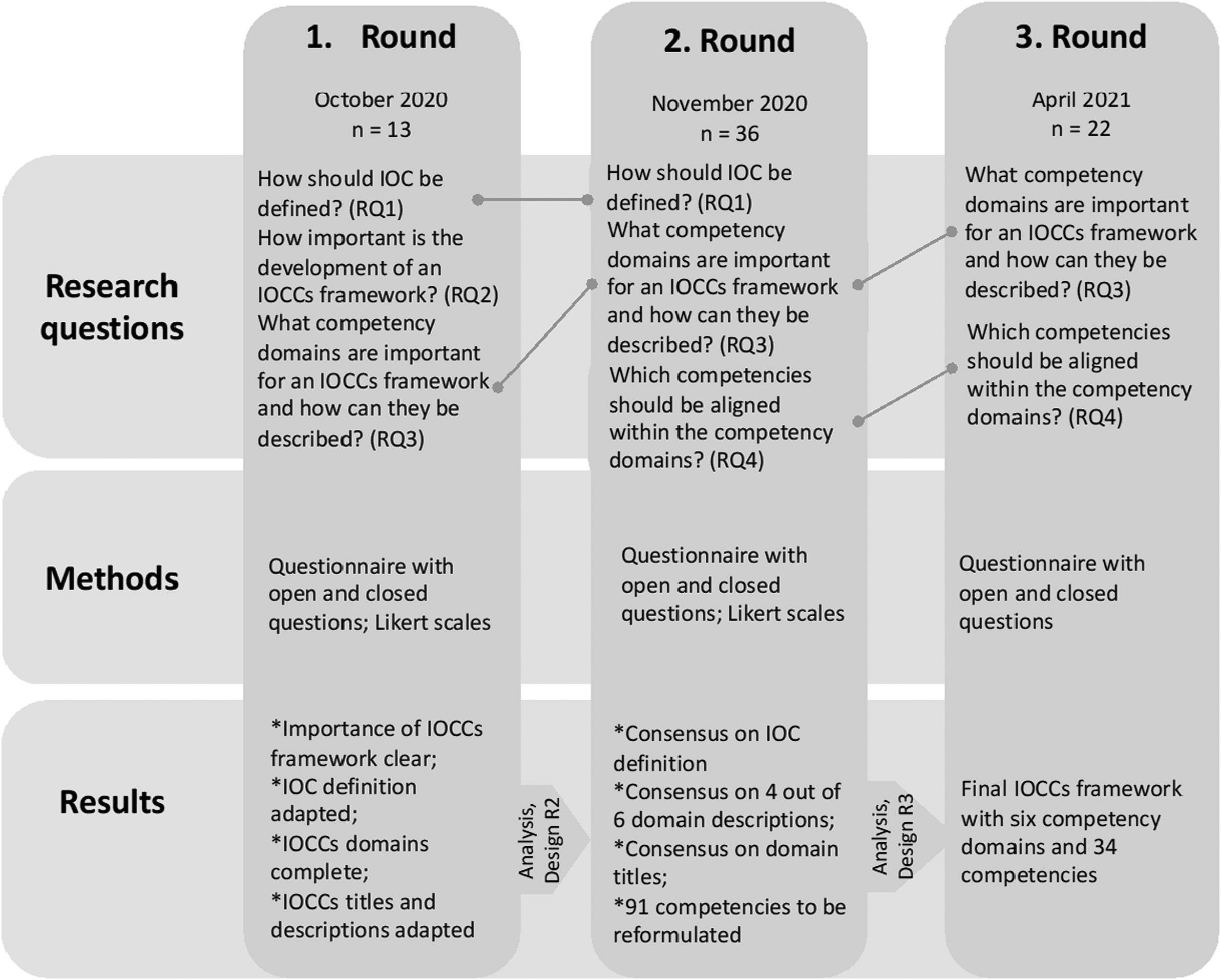
Study process.
Selection of Experts
Purposive sampling was applied to identify researchers (academic experts) and/or field experts in the domain of IOCCs. Academic experts were authors of peer-reviewed papers with reference to IOCCs and global virtual teamwork and identified through a literature search. Field experts were virtual project leaders or virtual team members in global virtual teams, identified by a snowball sampling approach inviting project leaders and their members. Virtual project leaders were identified by searching ResearchGate and Erasmus + project platform, as well as by distributing our study description within the international network of the authors. This study was limited to native and non-native English-speaking experts.
Data Analysis and Definition of Consensus
SPSS software version 24 was used for descriptive data and closed questions. Responses to open-ended questions were coded with numbers using MS Excel: the first number stands for the round, the second for the expert, e.g., statement 1–12 stands for expert 12 in round 1. Following the recommendations on ensuring good quality of research (Elo et al., 2014), the experts’ responses were interpreted and discussed among four authors (AK, JvM, JF, JdN) to ensure internal validity and researcher triangulation. These interpretations and adaptions were subsequently presented in the next round in form of summary statistics to show the majority opinion, which is the most common way of controlled feedback (Meijering & Tobi, 2016). Based on this, experts may choose to revise their opinion in the next round. Reliability was achieved by describing how the study rounds built on each other and carefully documenting every step of the data analysis. Consensus benchmarks in the literature differ between 51–95% (Gracht, 2012), this study defined consensus if ≥70% of the experts reached agreement or disagreement.
Ethical Considerations
Experts had to give informed consent in each survey. Participation was voluntary, anonymous and confidential. Withdrawal was possible at any time without explanation and negative effects. All responses were anonymised and intermediate results were communicated in the feedback reports after each round. Ethical approval for this study was obtained from the Ethics Review Committee of the Faculty of Health, Medicine and Life Sciences (FHML-REC) of Maastricht University, The Netherlands, with the approval number “FHML-REC/2020/078”.
Step 5: Reporting Results
This section is structured by describing the methods, results, and discussion per round, followed by a general discussion, strengths, and limitations.
Round 1
Methods
The first round aimed to answer three research questions: how IOC should be defined (RQ1), how important is the development of an IOCC framework (RQ2), and what competency domains including titles and descriptions are important for an IOCC framework (RQ3), see Figure 1. The expert panel was asked whether they agreed on the definition of IOC (RQ1) (yes/no) and to explain their decision using an open text field. The importance of developing a consensus framework of IOCCs (RQ2) was measured by closed questions using a five-point Likert scale from “extremely important” to “not at all important”. To answer RQ3, experts were asked whether they considered the suggested six competency domains as important for global virtual team workers, and whether the title and the description accurately reflected the domains (yes/maybe/no). The survey allowed narrative elaboration on the domains themselves, their titles, and descriptions.
Results
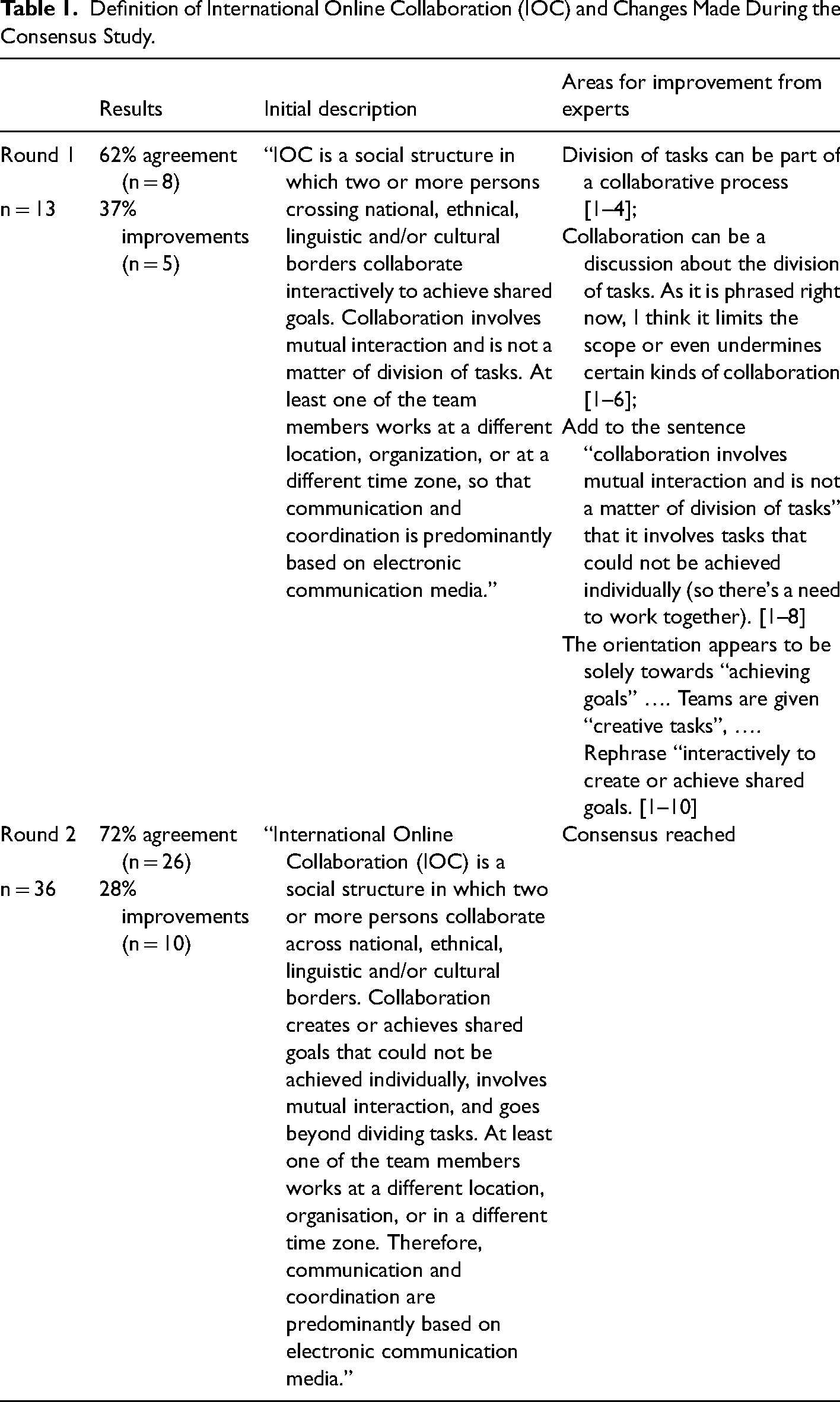
In total, 85 experts were invited, 24 of them responded, and 13 of them generated eligible and complete data sets for analysis (Supplementary Table C). The expert panel did not reach a consensus on the definition of IOC (RQ1), with only 62% agreeing on the proposed definition. Table 1 provides an overview of the suggestions made by the experts and how these were incorporated into round 2. Developing an IOCC framework (RQ2) was clearly considered either important (46%) or extremely important (46%) by 12 experts. One expert stated that “Virtual teamwork provides many opportunities, but also comes with many challenges. I believe current professional networks are insufficiently prepared to work in this context. A good framework of IOCCs will help us to take steps in professional development [1–6].” Another expert highlighted the importance of IOCCs and training for lifelong learning: “Mid-career and some senior career practitioners will be new to online collaboration and be in need of training and development for their professional future [1–10].” One out of 13 experts rated the IOCC framework as not important at all for educational purposes since “… not yet convinced that these competencies need specific attention in education [1–13]”.
Definition of International Online Collaboration (IOC) and Changes Made During the Consensus Study.
Six competency domains (Kolm et al., 2021) were introduced to the experts, including descriptions of the domains. Five domains were important for more than 85% of the experts, see Table 2. The domain of ICT competency was even considered as “…being a condition or requirement” [1–3] for IOC, and “using technology is the only method to connect and make collaboration possible” [1–7]. Since one expert mentioned “…different knowledge of ICT – competency between students” [1–6], this might need special attention before collaborating in international online teams. The second domain on international and intercultural competencies was considered as the “most important competency for global virtual team workers” by one expert [1–1], and “a lot of conflicts are caused by neglecting cultural differences” [1–7]. Regarding the importance of the third domain on communication and language competencies, one expert [1–13] considered this as being included in the domain of international and intercultural competencies. The importance of understanding other people's use of language for fruitful collaboration was mentioned by four experts [1–1, 1–2, 1–7, 1–13]. One expert specifically mentioned the importance of students daring to use their skills in talking in a non-native language [1–6]. The fourth domain for self-management and organization competencies was mentioned as being important for any type of collaboration [1–2, 1–6, 1–9, 1–11]. One expert suggested to “couple this competency with that of teamworking” [1–1]. When it comes to domain five, collaboration competencies, experts considered this as “basic” competency [1–1] and as important in “any collaboration, not specifically in IOC” [1–9]. The importance of the sixth domain on domain-specific competencies was questionable for three out of 13 experts who responded that “formal knowledge” was missing [1–2]. One expert did not understand “why this is explicitly important for global, virtual collaboration” [1–9], and another was “not sure what the added value is to list this in the complete framework” [1–11].
Changes in Importance of Domains, Appropriate Titles, and Descriptions of Competency Domains.
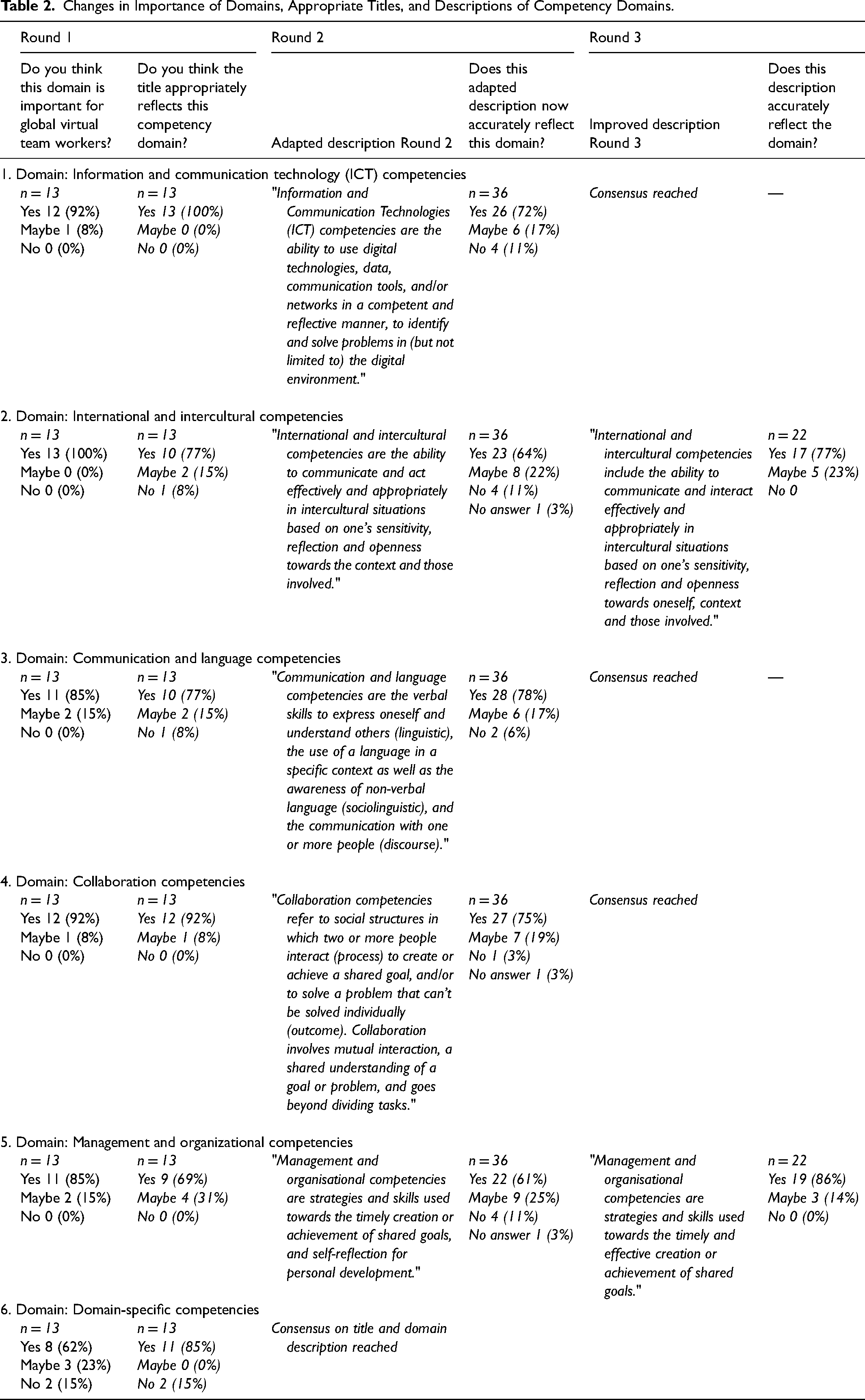
The titles of the domains were rated as appropriately reflecting the competency domains except for “Self-management and organisational competencies” (Table 2). For one expert, it was unclear whether the team or the individual was targeted by this domain [1–12]. Two domain descriptions were rated as accurately reflecting the competency domain: International/intercultural competencies and Domain-specific competencies. For all other domains the experts proposed specific changes for inclusion in round 2.
Discussion
The results and differences in interpretation were discussed among four authors (AK, JvM, JF, JdN). Following revisions were incorporated into round 2: the experts suggested to adapt the definition of IOC (RQ1). The author team agreed on incorporating the aspects of creativity, the achievement of goals surpassing individual goals, and splitting sentences to improve readability, see Table 1. There was consensus on five important domains for an IOCC framework (RQ3), except for domain-specific competencies. Only 62% rated this domain as important. The author team decided to keep this domain, since recent literature stresses the importance of T-shaped professionals with in-depth skills and expertise in a single field (such as domain-specific competencies) in combination with the ability to collaborate across disciplines and apply knowledge to areas beyond their primary field (Barile et al., 2012). Regarding the domain descriptions and the domain titles, the author team incorporated changes in 5 out of 6 domain descriptions and one domain title, changing “Self-Management and organisational competencies” into “Management and organisational competencies”.
Round 2
Methods
The second round focused on three research questions. First, on achieving consensus on the definition of IOC (RQ1) by asking experts whether the adapted definition now completely reflected IOC (yes/no). Second, on achieving consensus on the five descriptions of competency domains by asking whether the changed descriptions now accurately reflected the domains (RQ3), and a text field for narrative elaboration. And third, the alignment of IOCCs (Kolm et al., 2021) (Supplementary material, Table B) within the five domains (RQ4). The experts were asked to include, delete, or move each given competency to another domain. Text fields to identify new competencies were provided.
Results
In total, 120 experts were invited, 55 of them responded, and 36 of them generated eligible and complete data sets for analysis (Supplementary Table C). Consensus on the definition of IOC was achieved (RQ1) by 72% agreement of experts: “International Online Collaboration is a social structure in which two or more persons cross national, ethnical, linguistic and/or cultural borders to create or achieve shared goals surpassing individual goals. IOC involves mutual interaction and goes beyond dividing tasks. At least one of the team members works at a different location, organisation, or in a different time zone. Therefore, communication and coordination are predominantly based on electronic communication media.”
Regarding the competency domains (RQ3), consensus was reached for the description of three competency domains, namely “Information and communication technology”, “Communication and language” and “Collaboration”. Further adaptations were necessary for the domains of “Intercultural and cultural competencies” and “Management and organisational competencies”, see Table 2. The experts included 75 competencies from the initial 112 competencies and added 16 new competencies, in total 91 IOCCs. They recommended formulating all competencies in an active voice for the next round.
Discussion
Because of the revision process, two competency domain descriptions were adapted. “International and intercultural competencies” was changed based on two comments: “I mostly value the awareness of one's self (cultural aspects in own behaviour) so I'd add “towards the self, context and those involved”. Further, I like it very much. I always feel that the most important part is awareness of one self, so I'd add that between context and those involved [2–33]”. Another expert suggested including the aspect of interaction in the description [2–34]. These suggestions are supported by literature. For example, the concept of cultural competency was critiqued for example by Kumagai and Lypson (2009), who highlighted that the traditional notions of competency, i.e., knowledge, skills, and attitudes, are too narrow. Fostering critical awareness or critical consciousness is more relevant, meaning continuous critical refinement and fostering of thinking and knowing of self, others, and the world (Kumagai & Lypson, 2009). The authors have tried to include this in the domain description as “…based on one's sensitivity, reflection and openness towards oneself, context and those involved.” The description of the domain “Management and organisational competencies” was adapted based on the comment “not only timely, also effectively” [2–25], and “self-reflection” was deleted in this domain [2–21, 23]. Based on the experts’ responses, the included and additionally suggested competencies were reformulated in an active voice for the upcoming round, e.g., “managing conflicts” instead of “conflict management”.
Round 3
Methods
The final round focused on finding consensus on two descriptions of competency domains to achieve an IOCC framework (RQ3), and the competencies within each domain to answer RQ4. For this purpose, the experts were asked whether the adapted descriptions now accurately reflected the domain (yes/maybe/no), and to include or exclude competencies for each domain.
Results
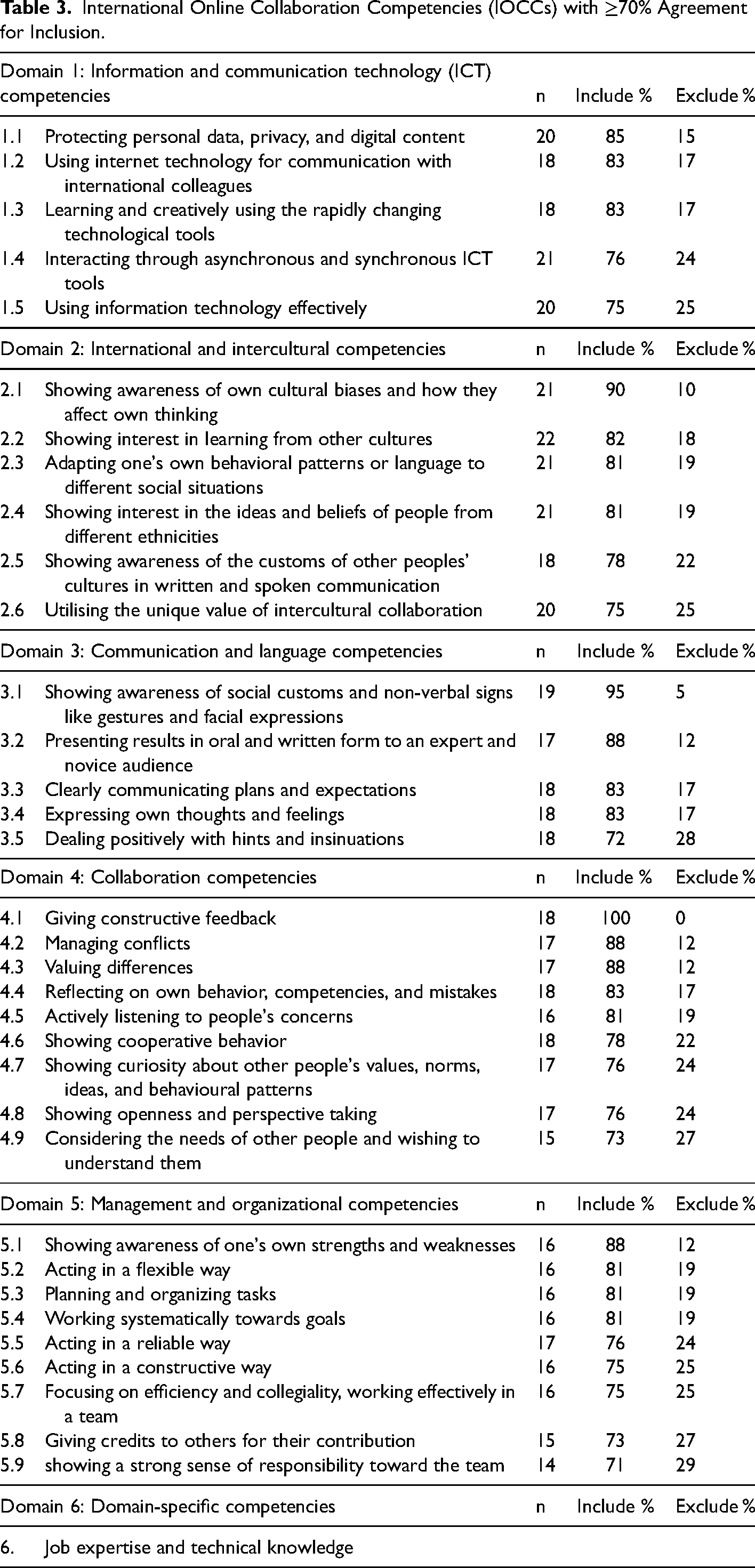
In total, 137 experts were invited, 42 of them responded, and 22 of them completed the questionnaire for analysis (Supplementary Table C). Consensus on the final two domain descriptions was achieved (RQ3), by 77% agreement on the description of “International and intercultural competencies” and 86% agreement on the adapted description of “Management and organisational competencies”. For answering RQ4, competencies agreed on by over 70% of experts were included, finally resulting in 34 IOCCs, see Table 3. The consensus framework of IOCCs is displayed in Figure 2.
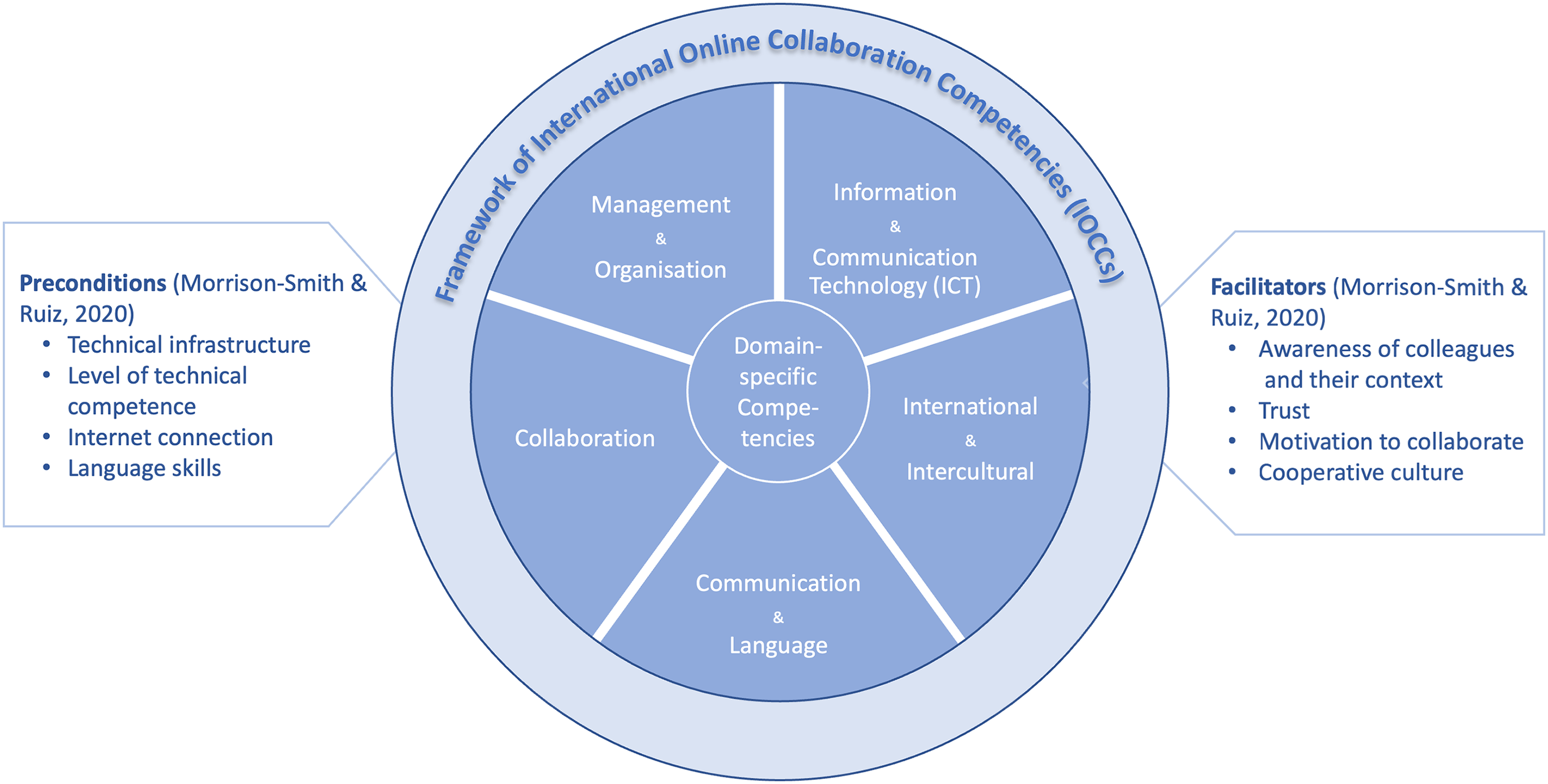
Framework of international online collaboration competencies (IOCCs).
International Online Collaboration Competencies (IOCCs) with ≥70% Agreement for Inclusion.
Discussion
Consensus on the last two domain descriptions and the competencies within the domains could be established in the third round, resulting in a final IOCCs framework with the definition of IOC (RQ1), six competency domains (RQ3) and 34 IOCCs (RQ4). This confirmed that three rounds were sufficient to reach consensus.
General Discussion
This study draws upon the views of experts in IOC to determine how IOC should be defined (RQ1), whether a framework of IOCCs is important (RQ2), and to reach consensus on an IOCCs framework with competency domains (RQ3) and competencies involved (RQ4), as displayed in Figure 1. While working in international online teams gained importance due to the COVID-19 pandemic and climate crisis, available frameworks address only single competency domains such as intercultural competencies or digital competencies, while lacking a comprehensive competency framework to inform education which competencies are involved in IOC. Over 90% of the participating experts, who were either academic experts or had field experience in IOC, agreed that the development of a framework of IOCCs was important to prepare future professionals for the work field, but also for training employees who are not yet prepared for IOC.
Establishing a definition of IOC was possible within two rounds. The initial definition stressed that collaboration was not a matter of dividing tasks, which is considered cooperation rather than collaboration (Baker, 2015). This wording caused misunderstanding, with experts responding that the division of tasks can be part of collaboration, therefore the author team rephrased this as “beyond dividing tasks” to highlight that cooperation and the division of tasks can be a part, but not the aim of collaboration.
This consensus study revealed that experts agreed on five out of six competency domains, that were derived from a systematic review by Kolm et al. (2021). Despite the lack of consensus on the sixth domain of domain-specific competencies, the author team decided to keep it in the final framework for several reasons. First, the authors agreed that the focus within the IOCCs framework should be on the first five domains, but leaving out domain-specific competencies could imply that these are less important, which they are not. Second, depending on the collaborative goal, employees might need to have sound domain-specific competencies that contribute to the achievement of shared goals or creative tasks. Both arguments are supported by literature on instructional design for complex learning (Van Merriënboer & Kirschner, 2012) and T-shaped professionals, where the vertical bar on the letter T represents the depth of skills and expertise in a single field (such as domain-specific competencies), whereas the horizontal bar stands for the ability to collaborate across disciplines and apply knowledge to areas beyond the primary field (Barile et al., 2012). Therefore, domain-specific competencies should stay in the framework. Since the competencies involved in this domain are very context-specific, they cannot be defined on a concrete level in this framework. Overall, the descriptions of the competency domains were finalised in the third round.
Of the initial 112 competencies, 75 reached ≥70% of agreement. Based on the experts’ comments, 16 new competencies were identified, and all 91 competencies were reformulated using an active voice for the third round. Experts reported challenges in choosing the most appropriate competencies as some were very similar and could also have fitted into other domains. For some competencies in the communication and language domain, for example, their integration into the domain of international and intercultural competencies could be argued. The final IOCCs framework consists of a definition of IOC, six competency domains, and 34 competencies, see Figure 2.
Step 6: Evaluate, Update and Maintain
The findings of this study may serve as an important step in reaching a comprehensive picture of the IOCCs needed for virtual teamwork in an international setting, an important set of competencies for the workforce, based on consensus amongst experts. A competency framework based on perspectives from the field can provide a strong foundation for designing international education and assessing students. IoC could provide opportunities for integrating IOC and the evaluation of IOCCs. IoC is defined by Leask (2009) as the “…incorporation of an international and intercultural dimension into the content of the curriculum as well as the teaching and learning arrangements and support services of a program of study.” Virtual mobility is considered one of the most innovative aspects of international education (De Wit et al., 2015), especially during COVID-19. Collaborative Online International Learning (COIL) in global virtual teams could potentially provide a means for designing IOC tasks and the acquisition of IOCCs, as it is “…an approach to teaching and learning that brings together geographically distant instructors and students from different lingua-cultural backgrounds to communicate and collaborate through the use of online communication tools” (Guth, 2013). However, the proof of the pudding is in the eating: this framework should be empirically tested in the future for which task design supports IOCCs acquisition, whether students who develop IOCCs are more successful in IOC, and how IOCCs can be assessed. It might be tailored to specific contexts, and research could reveal how it is used in different learning contexts.
Strengths and Limitations
Several limitations need to be considered. First, the number of participating experts with experience in either researching IOC or field expertise in leading or working in international online teams was low. However, the number of panellists is not as important as their expertise and representativeness (Clayton, 1997). In our panel, all participants were considered experts, with most having an education & training service background and being field experts rather than researchers specializing in virtual global teamwork. Including more experts with a research background or coming from other work fields may have provided different results. Second, a reason why the consensus on competency descriptions took three rounds might be the changing of experts during the three rounds, as it could be more difficult to achieve consensus in a changing expert panel. We chose this study design to allow a greater expert panel to participate in different rounds based on their availability.
Third, consensus was defined if over 70% of experts agreed or disagreed, leaving up to 30% disagreeing without explaining why. There are risks that relevant and unusual judgements have been neglected, despite our rigor in having all authors read the statements and discussing them thoroughly. In addition, it was not possible to reflect and discuss with the experts their reasons for disagreement. Fourth, our results should be validated. Since this study is based on the findings of a systematic review on IOCCs, the study builds on a robust basis. Future research on validity and practical efficiency of the developed framework is needed, as well as a look at the intersections between the competency domains.
Supplemental Material
sj-docx-1-jsi-10.1177_10283153231187140 - Supplemental material for Towards a Framework of International Online Collaboration Competencies – A Consensus Study
Supplemental material, sj-docx-1-jsi-10.1177_10283153231187140 for Towards a Framework of International Online Collaboration Competencies – A Consensus Study by Alexandra Kolm and Jeroen J. G. van Merriënboer, Janneke Frambach, Koen Vanherle, Jascha de Nooijer in Journal of Studies in International Education
Footnotes
List of Abbreviations
Acknowledgements
We thank Andrea Aigner from St. Pölten University of Applied Sciences, International Relations, for the final language proof.
Authors’ Contributions
All authors made substantial contributions to the conception, design of the work, the acquisition, analysis, and interpretation of data. Alexandra Kolm drafted the work, while the other authors substantively revised it. All authors have approved the submitted version and any substantially modified version that involves the author's contribution to the study. All authors have agreed both to be personally accountable for their own contributions and to ensure that questions related to the accuracy or integrity of any part of the work, even ones in which the respective author was not personally involved, are appropriately investigated and resolved, and the resolution documented in the literature.
Availability of Data and Materials
The datasets generated and/or analysed during the current study are not publicly available but are available from the corresponding author on reasonable request.
Declaration of Interest
None. This research did not receive any grant from funding agencies in the public, commercial, or not-for-profit sectors for this study. The authors declare that they have no competing interests.
Funding
The author(s) received no financial support for the research, authorship, and/or publication of this article.

Supplemental material
Supplemental material for this article is available online.
Notes
Author Biographies
References
Supplementary Material
Please find the following supplemental material available below.
For Open Access articles published under a Creative Commons License, all supplemental material carries the same license as the article it is associated with.
For non-Open Access articles published, all supplemental material carries a non-exclusive license, and permission requests for re-use of supplemental material or any part of supplemental material shall be sent directly to the copyright owner as specified in the copyright notice associated with the article.
