




Abstract
In this article, we offer a critical perspective on the interrelationship between internationalisation and sustainability, particularly regarding the contribution higher education internationalisation practices reliant on mobility have made to climate degradation. Specifically, we focus on carbon emissions linked to air travel in the context of in-person internationalisation conferences. Drawing on decolonial approaches and lived realities in the global South, we argue that a return to pre-pandemic practices in the midst of the ongoing COVID-19 pandemic and, more importantly, an existential climate crisis, is highly irresponsible, unjust and exclusionary. We raise issues and propose questions for internationalisation professionals and organisations to consider, unpack and action, both individually and collectively, aiming to move away from exclusionary and harmful internationalisation practices and to bring about change for a new and better ‘normal’ for all.
Climate change is a threat to human well-being and planetary health. Any further delay in concerted anticipatory global action on adaptation and mitigation will miss a brief and rapidly closing window of opportunity to secure a liveable and sustainable future for all (Intergovernmental Panel on Climate Change [IPCC], 2022a, p. 35).
Introduction
What does the IPCC's urgent call for action on climate change, as quoted above, have to do with internationalisation of higher education (HE)? They are intrinsically linked, as many traditional internationalisation activities contribute directly to carbon emissions and the climate crisis. Environmental sustainability is impacted by the most prominent and dominant aspect of HE internationalisation – international mobility of students and staff. Air travel, a key part of international mobility, presents a particular threat to sustainability due to carbon emissions. In the context of short-term mobility for purposes of study abroad, research, guest lectures, and attendance of meetings and conferences, the contribution to climate breakdown is particularly high.
Sustainability and sustainable development are about protecting the planet to ensure that it can support the needs of present and future generations (United Nations [UN], 2015). However, scientific evidence illustrates that our ability to ensure sustainability for future generations has been severely weakened due to centuries of climate destruction by humans. The Sustainable Development Goals (SDGs) highlight that climate change is “one of the greatest challenges of our time” (UN, 2015, p. 5), posing a risk of irreversible negative impact on human existence on earth. To limit climate breakdown, structural and systemic changes, combined with transparency and creative solutions for adaptation and mitigation, are urgently needed in all sectors and all aspects of life (IPCC, 2022a).
In this paper, we take an in-depth look at the literature on academic and staff mobility in HE and specifically focus on in-person internationalisation conferences attended by thousands of people working in and with HE, often on an annual basis. Many of these staff members can be considered hypermobile elites who frequently travel around the world for networking, marketing, recruitment, research and engagement (Baer, 2018; Klöwer et al., 2020; Crumley-Effinger & Torres-Olave, 2021; Climate Action Network for International Educators [CANIE], 2022). Higham and Xavier Font (2020, p. 3) point to the hypocrisy of such elites who tend to be “aware of the climate crisis and the contribution of air travel to the crisis, yet remain largely entrenched in their high-carbon aeromobility practices”. Given the dire predictions by the IPCC, such practices cannot continue unabated. Internationalisation conferences are highly visible, large-scale, regularly occurring events that require major rethinking in order to decrease internationalisation's carbon emissions (CANIE, 2022). While conferences represent a subset of internationalisation activities, they can play an important role in advancing climate action and showcasing greater leadership regarding equity and transition to more just practices in international education towards sustainable development for all, given their strong focus on internationalisation practices reliant on air travel.
The shift to virtual conferencing in the wake of the COVID-19 pandemic has shown the possibilities of using technology to change the methods and approaches to hosting and attending international conferences (Sarabipour, 2020). Because of the pandemic, we were urged to rethink our internationalisation practices, particularly those relying on mobility, and imagine a better ‘normal’ in the post-COVID-19 world. Yet, in late 2022, we note that online and hybrid engagements are being scrapped in favour of international mobility and in-person events. We argue that returning to pre-pandemic practices amid the ongoing pandemic and an existential climate crisis is highly irresponsible, exclusionary and unjust.
While the benefits and approaches to internationalisation have been studied extensively, the environmental impact of international mobility in HE has been largely ignored until now (Shields, 2019). This exploratory paper critically interrogates relevant literature and unpacks available attendance data from the three largest internationalisation conferences held in 2019 to illustrate the need for urgent structural and systemic changes in internationalisation of HE. It also aims to imagine a new ‘normal’ that contributes to the reduction of carbon emissions and sustainable development for all. Apart from considering the environmental impact of internationalisation conferences, we interrogate the lack of equity in global conference mobility patterns. Our paper, and our particular focus on climate justice and more equitable and fair internationalisation practices, are grounded in critical scholarship on internationalisation, decolonisation and climate justice, as well as research published by the IPCC (2022a, 2022b) and CANIE (2022).
As internationalisation practitioners who have participated in numerous internationalisation conferences over the years, we are part of the community this paper focuses on. This allows us to draw on our long-standing experiences in HE internationalisation and to reflect critically on our own practices. Our goal is to engage with the pertinent issues of climate change, sustainability, equity and justice. We emphasise in this regard that inequities in the impact of climate change are mirrored in HE internationaliation in general and in attendance of international conferences in particular. We aim to contribute to critical engagements that seek to bring about practical, systemic and structural changes in internationalisation. We do not intend to present solutions that are relevant for everyone in every context. Rather, we are raising issues and proposing questions for all of us to consider, unpack and action as appropriate in our contexts, both individually and collectively, with the common goal of moving away from harmful and exclusionary internationalisation practices. Focussing on internationalisation conferences, we offer a critical perspective on the interrelationship between internationalisation, climate change and sustainability, informed by decolonial approaches and lived realities in the global South. In light of the ongoing COVID-19 pandemic and climate crisis, we highlight past and present inequities and injustices and the need to bring about a new, better and sustainable ‘normal’ for all.
Inequity, Climate Change and Internationalisation
In a discussion that brings climate change and internationalisation into conversation, we begin by briefly discussing the causes of global inequities and climate destruction. We highlight that the systems and structures responsible for this have also driven global inequalities in HE and internationalisation. Recognising this is key if we are to fully comprehend the social, economic, environmental, educational and other challenges we are facing, and if we are to come up with a plan for a more just world (IPCC, 2022b) and solutions to climate change that “advance justice, equity and human rights” (CANIE, 2022, p. 8) of all.
Global inequities are due to historical and contemporary systems and structures of marginalisation and exploitation of people and the planet (Sultana, 2021a). A decolonial perspective on sustainability highlights that colonialism and capitalism are the primary causes of climate destruction (Crumley-Effinger & Torres-Olave, 2021), as the dominant global economic system relies heavily on the expropriation and exploitation of humans and the ecosystem (Stein & da Silva, 2020). In decolonial terms, those “on the receiving end of the underlying [neo]colonial processes generally experience these crises in more intense ways – as an amplification of existing patterns of violence and unsustainability” (Stein & da Silva, 2020, p. 556).
While climate destruction is a global challenge, it impacts people and communities around the world differently. The world's poorest, both in the global South as well as in poor, immigrant and indigenous communities in the global North, are most vulnerable to climate change (Barnwell & Wood, 2022; IPCC, 2022a; Mattar et al., 2021; Sultana, 2021b), despite being the least responsible for it. A study looking at income and emissions found that, in 2015, the richest 10% of the world's population were responsible for 49% of global emissions, while the poorest 50% were responsible for only 7% (Kartha et al., 2020). As of 2015, the global North has historically been responsible for 92% of world's excess carbon emissions (Hickel, 2020).
Similarly, inequities exist in HE internationalisation, which has not been advanced evenly and equally across the globe. Global knowledge and HE systems are structured around “modern/colonial institutions…that are inherently violent and unsustainable” (Stein & da Silva, 2020, p. 548). Centuries of colonial subjugation and neocolonial impositions have led to the global hegemony of the Eurocentric canon (Stein & Andreotti, 2017). Around the world, Eurocentric knowledges and perspectives continue to be propagated as ‘universal’, contributing to the maintenance of unfair and unequal global socio-economic, political and educational systems and structures. As a result of colonialism, neocolonialism and globalisation, the global HE landscape continues to be characterised by unequal and uneven access to resources (Stein & da Silva, 2020). Unfair practices and inequities find their expression in the often extractive nature of international partnerships between institutions in the global South and their Northern counterparts (Chasi, 2019; Maringe & de Wit, 2016; Stein & da Silva, 2020). Internationalisation has also been a business and tradable commodity for many countries, HE systems and institutions (de Wit, 2020), undermining its potential to contribute to global social justice and equity. In addition, international student mobility, one of the primary internationalisation activities, has been elitist and exclusionary for decades, benefiting only small numbers of students globally (Jones, 2022). CANIE (2022, p. 8) highlights that climate change is further “exacerbating racial and socioeconomic inequalities thus undermining critical diversity, equity, and inclusion efforts at higher education institutions around the world”.
Notwithstanding the challenges, internationalisation remains a key imperative for universities, and international engagements, collaborations and partnerships can play a major role in contributing positively to socio-economic and environmental sustainability. Universities can promote sustainability through teaching and learning, research, community engagement initiatives, strategic and operational management, and campus infrastructures (Bunescu & Estermann, 2021). Numerous institutions have responded to sustainability imperatives by creating sustainability departments, making infrastructural changes and introducing academic courses and programmes on sustainability. However, universities have also been criticised for not engaging with sustainability deeply (Crumley-Effinger & Torres-Olave, 2021), particularly concerning the practices that are premised on exploitation of natural resources, land and people (Stein, 2019) or carbon emissions through flying and international mobility (CANIE, 2022; Shields, 2019).
Student and staff mobility is one of the key internationalisation practices contributing to carbon emissions and destruction of the environment (CANIE, 2022; Shields, 2019). Air travel, in particular, is one of the fastest growing sources of greenhouse gas emissions and is expected to grow in the future (Baer, 2018). Similar to broader global inequities, there are stark inequalities when it comes to global air travel. It is estimated that the majority of people in the world have never travelled on a plane (Baer, 2018; Higham & Xavier Font, 2020). More than half of carbon emissions due to tourist travel are produced by only five countries: the United States (US, 24%), China (12%), Germany (7%), India (6%) and Brazil (4%) (Lenzen et al., 2018). Similar inequalities exist in HE-related air travel. Globally, about 15% of academics, scholars and practitioners are responsible for 70% of air travel for international conferences (Cass et al., 2005), the majority of whom are from the global North (Higham & Xavier Font, 2020).
Higham and Xavier Font (2020) highlight that the expansion of internationalisation practices and activities in HE has directly led to an increase in international travel, thus increasing the contribution of universities to global warming. Highly mobile staff often rely on air travel for their engagement, networking, conferencing and research around the world in the name of internationalisation and competitiveness. They are among the highest emitters in HE, as air travel remains one of the most carbon-intensive activities an individual can undertake. As such, we cannot continue to ignore the impact international education is having on climate destruction (CANIE, 2022; Shields, 2019). To address this dilemma, universities need to align their internationalisation and sustainability agendas (Crumley-Effinger & Torres-Olave, 2021). When engaging both critically and deeply, justice considerations emerge.
A Shared Justice Agenda
The need for justice generally emerges as a concern where equality and equity are found lacking. In the context of climate change, this includes considerations about the impact that colonialism, capitalism and globalisation have had on deepening inequities and climate injustices and how they are intertwined (Sultana, 2021b). Climate change is not only an environmental issue, but also inherently a justice issue, as it concerns questions of “who benefits, who loses out, in what ways, where, and why” (Sultana, 2021b, p. 119). Furthermore, climate justice is about being aware of how climate change disproportionately impacts different communities and parts of the world and acting in ways that address and resolve historical and contemporary injustices (Barnwell & Wood, 2022; Sultana, 2021b). Ignoring historical contributions to climate destruction, and historical and contemporary inequalities and injustices in all spheres of life, will not contribute to a more just world and sustainable development for all.
Justice considerations also permeate HE internationalisation. Parallels can be drawn between how climate change and internationalisation impact people and institutions around the world differently. Both are linked to issues of colonial harm and legacies (Ndlovu-Gatsheni, 2021; Sultana, 2021b). From a decolonial perspective, the skewed nature of internationalisation is evident in the dominance of global North perspectives in internationalisation concepts and practices and in general knowledge production (Ndlovu-Gatsheni, 2021). Climate science research and knowledge production, for example, are overwhelmingly dominated by Northern scholars and institutions. This hegemonic domination is creating “blind spots around the needs of some of the most vulnerable people to climate change, particularly women and communities in the global South” (Tandon, 2021). A justice agenda is key in ensuring that global North domination in all fields of study, including climate science research, ends and that solutions and actions to mitigate climate destruction are based on the lived experiences, needs and interests of affected communities, with meaningful emphasis placed on socio-economic and historical factors causing global inequalities (Sultana, 2021a).
Embedding climate justice principles in our thinking about internationalisation and sustainability is key if we are truly committed to human rights, social and environmental justice and equity in the world (CANIE, 2022). As globally mobile internationalisation scholars and practitioners, we must critically interrogate how our actions, particularly those related to frequent international air travel to attend meetings and conferences, are contributing to climate destruction. We also need to consider how unequal international mobility in HE deepens inequities in knowledge production and dissemination. This includes consideration for greater equity regarding academic mobility and how its benefits are shared among scholars globally (Crumley-Effinger & Torres-Olave, 2021). The change emerging from this process must be based on social, epistemic and climate justice principles, which call for not only ‘green’ initiatives, but a consideration of how these initiatives and changes are addressing root causes of global climate and other socio-economic injustices and underlying vulnerabilities experienced by underprivileged communities across the world (Mattar et al., 2021). According to Sultana (2021a), this is about systemic and structural changes that tackle global, regional and local inequities, inequalities and power imbalances, which, as noted above, is also highly relevant for global HE.
Strategic and developmental plans of all HE stakeholders – from universities, staff, students, governments and funders to HE and internationalisation networks and associations – must be based on the principles of climate justice, social justice and systemic and structural change. They also need to enable climate resilient development which does not damage the environment and which prioritises justice, equality, equity and climate risk mitigation (IPCC, 2022a). Most importantly, we need to ensure that ‘going green’ does not become an empty rhetoric, but that the HE sector follows through with real action (Baer, 2018). For example, we know that travel around the world for in-person conferences does not only directly contribute to carbon emissions but also exacerbates global inequities. How, then, does this practice relate to urgently needed mitigation and adaptation strategies to minimise the negative impact our actions have on the environment? If only a small global academic elite can travel for international conferences (Cass et al., 2005; Higham & Xavier Font, 2020), what does this say about often proclaimed commitments to inclusivity, fairness and equity in international HE engagement and collaboration? Is there anything we can do differently in internationalisation to “secure a liveable and sustainable future for all” (IPCC, 2022a, p. 35) and bridge global socio-economic and geopolitical divides? How can we play an active role in finding solutions to the climate crisis? Reflecting on these questions, we put the spotlight on in-person conferences hosted by the three largest international education associations (IEAs).
In the Spotlight: International Education Associations’ Conferences
There are numerous IEAs around the world, operating at regional and national levels. Our focus is on the three biggest associations in terms of conference attendance numbers. These associations, which regularly attract thousands of delegates, include the Asia Pacific Association for International Education (APAIE), the European Association for International Education (EAIE) and the Association of International Educators (NAFSA). They generally promote their conferences as key annual global events for experts, practitioners, educators, students and others interested in HE internationalisation. Against this backdrop, we apply the notion of hypermobile elites, as described earlier, to professional and administrative staff and scholars working in HE internationalisation who frequently attend conferences hosted by IEAs in different parts of the world. In this context, sustainability issues emerge as a particular concern regarding the environmental footprint of conference hosts and attendees alike.
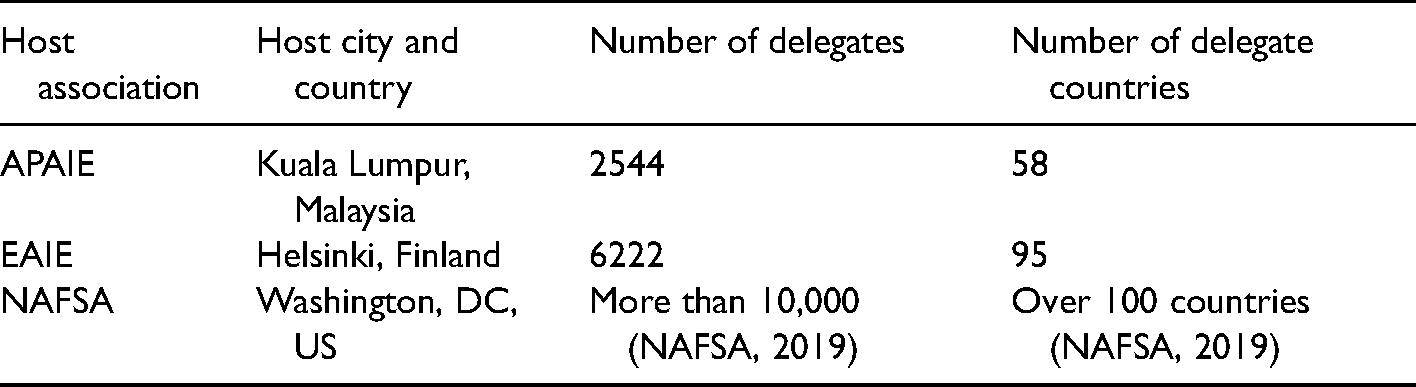
As this is an exploratory paper, we are not concerned with modelling carbon emissions associated with these IEA conferences. It is important to note that, while the above table provides an overview of how many delegates attended and how many countries they represented, it would be impossible to accurately calculate the carbon emissions these conferences have produced without additional information. However, such information is not publicly available. As highlighted by CANIE (2022), transparency and public reporting regarding carbon emissions and decarbonisation plans and strategies in internationalisation are crucial if the field is to contribute constructively to the reduction of emissions.
Research by Klöwer et al. (2020) illustrates the impact large international conferences can have regarding carbon emissions. Using the example of the 2019 American Geophysical Union's conference held in San Francisco, US, they note that 28,000 participants travelled a combined 285 million kilometres, emitting about 80,000 tonnes of carbon dioxide (CO2), which equals the average emissions of a large city such as Edinburgh in the United Kingdom (UK) for an entire week (see Klöwer et al., 2020 for more information about this study and the methodology used to calculate conference-related carbon emissions). To make similar observations about IEA conferences, researchers interested in modelling would need more information than what is publicly available and what the associations were willing to share with us. This includes departure and return location for each delegate, their mode of transport, energy sources used to power the conferences, materials used for furnishing venues and what happens to these materials in the events’ aftermath, and the carbon footprint related to accommodation, catering and other conference activities. To the best of our knowledge, such data is not currently transparently shared by the IEA conference hosts. Nevertheless, the figures from the table above and the example from Klöwer et al. (2020) strongly suggest that in-person internationalisation conferences produce significant amounts of CO2.
Apart from the environmental impact of internationalisation conferences, we are also concerned about equity in global conference mobility patterns. According to the data made available to us, 1 domination of global North countries is evident in the list of top twenty countries in attendance, making up 85% of total delegates at the 2019 APAIE conference and 79% at the 2019 EAIE conference. At APAIE, Indonesia was the only global South representative, in 14th place, and there were no global South countries among the EAIE's top twenty. India was the second highest ranked global South country participating at APAIE, in 24th place, followed by Mexico in 26th place. The top ranked global South representative at the EAIE was India, occupying 25th place, followed by Brazil in 30th place.
As this data suggests, unequal mobility flows, as noted earlier in the context of hypermobility, are mirrored at major internationalisation conferences, where most delegates represent institutions from the global North. Based on the data shared with us, France and the US are among the most mobile countries, as they are in the top ten of both the APAIE and EAIE conferences. The top twenty countries represented at both events include Canada, China, Czech Republic, Germany, Netherlands, South Korea, Spain, Turkey and the UK. This example also supports the points made earlier regarding unequal contributions to climate change, on the one hand, and the unequal distribution of internationalisation benefits, on the other, which are both skewed towards the global North. While we did not receive specific attendance information from NAFSA, we think the overall trends regarding the APAIE and EAIE conferences also apply to the 2019 NAFSA conference.
Internationalisation activities that rely heavily on air travel are environmentally unsustainable. Such practices are also unsustainable from a justice and equity perspective, particularly regarding the underrepresentation of global South delegates, as illustrated above. Notably, costs of international travel, accommodation and subsistence in global North destinations are generally prohibitive for most internationalisation scholars and practitioners from the global South, and financial constraints have only been exaggerated by COVID-19. Furthermore, the pandemic has made it abundantly clear that people, institutions and countries in the global South are subjected to discrimination linked to vaccine inequality and disproportionately unfavourable treatment regarding visas and travel restrictions (Bambra et al., 2021; Benton et al., 2022; Stevano et al., 2021).
Before COVID-19, annual internationalisation conferences were routinely held as physical, in-person events. Due to pandemic-related health and safety concerns and travel restrictions, most IEAs cancelled in-person conferences in 2020 and replaced them with virtual events, a trend that continued in 2021. Even though the pandemic has not yet ended, several associations have returned to hosting in-person annual conferences in 2022. For example, the Association of International Education Administrators (AIEA) held its conference in-person in February (AIEA, 2022), and NAFSA hosted a two-day virtual conference in May, followed by a four-day in-person event in May and June (NAFSA, 2022). The EAIE conference was held as a primarily in-person event in September (EAIE, 2022). This suggests that conference organisers prefer to go back to in-person events at what NAFSA terms a “critical time of reemergence” (NAFSA, 2022). Where virtual events are hosted, as in the case of the 2022 APAIE conference, this is due to pandemic-related concerns and restrictions (APAIE, 2022), not because of concerns about the impact of international travel on climate change and the need to reduce carbon emissions.
After two years of no or limited travel, wanting to go back to the ways things were before the pandemic seems a natural reaction to the disruptions COVID-19 has caused. However, IEAs need to become active players in the climate change movement, leading by example and reducing their conference-related carbon footprint (CANIE, 2022; de Wit & Altbach, 2021). Furthermore, the return to pre-pandemic ‘business-as-usual’ in the form of in-person internationalisation conferences bears the risk of further entrenching existing inequalities and reversing gains made during the pandemic, when virtual conferences allowed for greater access and more diversified participation (Sarabipour, 2020; Wu et al., 2022).
As Stein and da Silva (2020, p. 563) point out, the pandemic “is likely just a preview of what is to come” and current and future crises will “continue to intensify in ways that make it impossible to preserve existing systems and their promises”. Considering this, there is an express need to reimagine HE internationalisation. We must individually and collectively rethink conference-related mobility and come up with practices that are less damaging to the environment and, at the same time, more inclusive and equitable (Crumley-Effinger & Torres-Olave, 2021). Such rethinking and reimagining is required for all internationalisation practices that facilitate or are affected by different forms of harm, discrimination and exclusion. In the next section, we explore what this might mean for HE internationalisation conferences.
Towards a Different Future of Internationalisation
In 2018, Knight and de Wit (2018) asked what core principles and values would make us look back in ten or twenty years and what contributions to the world by international HE would make us proud. For us, a contribution towards a more sustainable and inclusive global society is a worthy cause. We strongly believe that reducing the carbon footprint of internationalisation activities and increasing equity and inclusion in internationalisation practices are urgent priorities for HE institutions, systems and associations. To make meaningful contributions, we must act and “be at the forefront instead of at the back of the climate change movement” (de Wit & Altbach, 2021). Ensuring that our practices do no harm, climate protection for current and future generations and a transition from our current harmful practices towards a genuine focus on sustainability must become core principles underpinning HE internationalisation globally. This does not mean we must put a stop to international education and collaboration. We have to work harder to ensure that internationalisation is comprehensively integrated in everything universities do. We must do more to collaborate fairly and equitably and develop new knowledge based on epistemic plurality (Ndlovu-Gatsheni, 2021).
COVID-19-related disruptions offer a “critical juncture” to HE globally “to reflect and act on humanity's relationship to the environment – particularly as it relates to environmental degradation and the unfettered resource consumption by some, to the (unequal) detriment of all” (Crumley-Effinger & Torres-Olave, 2021, p. 87). As we reflect on dominant approaches and practices, we note that climate justice approaches and decolonial perspectives on HE internationalisation share a concern not only for critical engagement but also for practical, transformative change, linked to Freire's (1970, p. 51) understanding of praxis as a “reflection and action upon the world in order to transform it”. Sultana (2021b) writes that climate justice is inherently about praxis which calls for systemic changes aimed at addressing structural inequities and dismantling unequal and unjust power systems. This involves changing political and socio-economic structures and systems that contribute to global and regional injustices, since our ecosystem is deeply intertwined with political, economic, social and other systems.
This aligns to IPCC's (2022a, p. 6) call for a “focus on transformation and system transitions” in how individuals, communities, societies, businesses and organisations operate. As critical scholars and practitioners concerned with internationalisation conferences, we start from the premise that hosting numerous large international events annually and in-person is not sustainable from environmental, inclusivity and equity perspectives. What kind of positive change can we bring about and what kinds of different futures can we imagine? Tackling these questions, it is important to note that there are no on-size-fits-all approaches, and different scenarios are possible. Given the demands to address both the climate crisis and inequity in internationalisation, it is pertinent that we resist the urge to return to what was considered ‘business-as-usual’ before COVID-19, heeding the lessons we have learnt in the pandemic's wake. This includes a continued commitment to deliver conferences virtually or in a hybrid format to reduce short-term international air travel and to facilitate greater access and inclusion. The response by the HE sector to the pandemic has shown us that change is not only possible but can happen fast. When left with no other choices, institutions and associations found alternative modes for conducting teaching and learning, research, engagement and networking activities, which were designed and implemented in the space of months, if not weeks.
The most drastic response to the challenges we face is to completely do away with in-person conferences and replace them with virtual events. According to CANIE (2022), virtual attendance of internationalisation and other academic and professional conferences in HE must become a standard practice. Virtual conferencing has numerous advantages, as it allows for higher levels of participation by people from underrepresented communities, including people with disabilities or caring responsibilities. Virtual engagements also remove travel times and lowers costs for participants. Most importantly, they significantly reduce carbon emissions (Klöwer et al., 2020; Sarabipour, 2020; Wu et al., 2022). There are also challenges related to virtual events, including the need for high-speed internet, different time zones, ‘screen fatigue’ and limited opportunities for social interaction when compared to in-person events (Wu et al., 2022). However, we believe that the advantages outweigh these challenges, particularly in the long-term. Rather than lamenting the reduction of in-person conferences and insisting that they can never be truly replaced, we must reorient internationalisation away from destructive and exclusionary practices (Stein & da Silva, 2020). This requires continuous innovation to find new ways of meeting, networking and socialising, and to fully explore the potential of technologies such as virtual and augmented realities.
For the short to medium term, less dramatic scenarios are possible. These include capping delegate numbers instead of allowing them to grow continuously and incentivising travel to conference destinations using modes of transport that produce less CO2, such as trains. As data from the 2019 APAIE and EAIE conferences shows, the majority of top ten countries in attendance were from the respective regions in which the conferences were hosted. More specifically, seven out of the top ten countries attending the APAIE conference were from the Asia-Pacific region, complemented by the US, France and Canada. Eight out of top ten countries represented at the EAIE were European. Wherever possible, air travel should be replaced by ground transport. For example, the #TravelWithCANIE initiative aimed to reduce CO2 emissions associated with travel to the EAIE Conference 2022 in Barcelona by 20 metric tonnes and achieved 50.6% of this goal (CANIE, n.d.).
Another option involves reducing the frequency of conferences from annual to biannual events, with fully virtual events in alternate years (Higham & Xavier Font, 2020; Klöwer et al., 2020). We think it should also be possible to introduce a rotational system where IEAs take turns in hosting conferences rather than each association hosting its own event annually. Taking this even further, is it conceivable that associations join forces and host one truly global internationalisation conference annually, instead of several large events in different regions of the globe? What other possibilities can we imagine?
For in-person internationalisation conferences, urgent and serious consideration must be given to environmental sustainability to reduce harm to the planet. In this regard, it is important to make individual changes while also ensuring that HE institutions, associations and governments are working on structural and systemic transformation (Crumley-Effinger & Torres-Olave, 2021). Critical self-reflection is key in this regard, in the general context of HE internationalisation (Stein & da Silva, 2020) and concerning specific internationalisation practices. Regarding the latter, hypermobile elites need to critically reflect on their practices, understand their complicities and identify ways to reduce their individual environmental impact. Crumley-Effinger and Torres-Olave (2021) argue that we need to contemplate alternatives to career progression that are less reliant on mobility, while also facilitating critical engagement with issues of privilege and encouraging solidarity with other, less privileged colleagues.
At the level of universities, a variety of greening initiatives can be aimed at educating for sustainable development and being environmentally friendly and resource efficient (Bunescu & Estermann, 2021; CANIE, 2022). The same is true for IEAs. The EAIE (n.d), for example, is “working towards a more sustainable EAIE ecosystem” and has pledged to support relevant SDGs as part of its broader commitment to social responsibility. The EAIE's efforts to contribute to a greener future include offsetting its carbon footprint by planting more than 13,500 trees annually and choosing sustainable conference venues that aim at reducing food waste, saving water and energy, recycling and using non-plastic materials. Furthermore, the EAIE is committed to choosing fair trade and sustainable conference materials and encouraging conference delegates to make greener choices (Ibid.).
Efforts such as these must be strengthened and expanded. They should become part of an industry standard to be followed by IEAs and universities hosting events around the world, which can be guided by initiatives such as the CANIE Accord (CANIE, 2022). Organisers of in-person conferences have a responsibility to transparently share data and information about the carbon footprint of their conferences (CANIE, 2022; Higham & Xavier Font, 2020). They also need to model participants’ travel to potential conference host cities to decide which city is the best choice for reduction of travel emissions (Klöwer et al., 2020). Most importantly, they must urgently plan to reduce conference-related carbon emissions (CANIE, 2022; de Wit & Altbach, 2021).
It is pertinent to consider ways in which international mobility and air travel for conferences can be considerably reduced by the HE sector (CANIE, 2022), as ‘business-as-usual’ when it comes to air travel “represents a threat to our collective social and environmental wellbeing” (Higham & Xavier Font, 2020, p. 2). Considerations for reducing conference air travel must also take equity concerns into account, which may require deliberate corrective action. In the context of hypermobile elites, such action would be aimed at ensuring that engagement requiring air travel is distributed equitably among all, including among communities in both the global South and North that have been historically sidelined or unable to participate. The reduction of mobility of elites must go hand-in-hand with efforts aimed at increasing access and mobility of those who have been marginalised and excluded (Crumley-Effinger & Torres-Olave, 2021). This is in line with the arguments and proposals put forward by the IPCC (2022b).
Greater justice regarding both internationalisation and climate crisis will not be achieved easily or quickly. It is imperative to configure different pathways for the future rather than seek a universal solution applicable to all (Sultana, 2021b). There are urgent questions and concerns that must be critically unpacked by internationalisation scholars and practitioners. Sacrifices will have to be made for the sake of the future, guided by empathy, solidarity and a commitment to forgo privileges. For global hypermobile elites, the prospect of severely curtailed international mobility will include making painful choices (Crumley-Effinger & Torres-Olave, 2021). However, this moment also presents an opportunity to build alliances and drive collective action to address global historical and contemporary inequities and injustices in all spheres of life (Sultana, 2021b).
Conclusions
HE internationalisation is intrinsically linked to environmental sustainability, as a field that has significantly contributed to climate degradation, particularly in the context of international mobility. We have a responsibility to think critically about mobility as one of the most dominant aspects of internationalisation practices. As illustrated in this paper, internationalisation scholars and practitioners must be concerned with their carbon footprint linked to practices that require short-term international mobility and air travel, as in the case of in-person internationalisation conferences. We must act responsibly, moving towards alternatives that do not damage the environment. As we do so, our actions must also be guided by equity considerations to avoid deepening existing inequalities and inequities (Crumley-Effinger & Torres-Olave, 2021; Klöwer et al., 2020).
As much as we are part of the climate change problem, we can also be part of the solutions. As noted by the IPCC (2022a), the window of opportunity is closing and we must act swiftly and decisively. HE internationalisation must play its role in saving the planet (de Wit & Altbach, 2021). Internationalisation conferences, in particular, must play a key role in showcasing greater leadership regarding climate action, sustainability and equity. As we have illustrated with reference to the conferences hosted by IEAs around the world, virtual and hybrid platforms provide opportunities that not only contribute to saving the ecosystem but also allow for greater access, equity and inclusion in international engagements. If IEAs commit to finding ways to offset the carbon footprint of their conferences, the sector could make a considerable positive impact. Conference organisers can further illustrate their commitment to sustainability and climate change mitigation by tracking and publishing up-to-date travel and emissions data for each event. As Higham and Xavier Font (2020) point out in that regard, provision of such information would contribute to transparent showcasing of the carbon footprint of in-person conferences, which would help highlight the urgency of systemic and structural change.
Finding solutions to problems such as climate change requires collaboration and knowledge generation at the global level, and internationalisation has a key role to play in that regard. The choices made by individuals, universities and IEAs over the next decade will either contribute to limiting climate destruction, or will exacerbate it (IPCC, 2022a). If we make ethical choices, even though they might be difficult, we stand to “win more than we lose as we will not only be more carbon neutral but also more interactive, inclusive, intercultural and international than before” (de Wit & Altbach, 2021), thus playing our part in securing a liveable future for everyone (IPCC, 2022a).
Footnotes
Funding
The author(s) received no financial support for the research, authorship, and/or publication of this article
