




Abstract
Despite the potential for mutual learning, improvement of service provision, and the advancement of policy, research on first-generation migrant students and research on international students have remained stubbornly separate. This paper makes the case that education research would benefit from leveraging data on international students and that internationalization research and practice should more often include first-generation migrant students. To explore the benefits of this proposition, this article explores differences in the experiences of Irish-born domestic students, first-generation migrant students, and international students at Irish higher education institutions, using Eurostudent VI data collected in 2016. These comparisons show that first-generation migrant students report lower levels of preparation for the domestic labor market than both Irish-born domestic students and international students. International students are faring well on other indicators too, as they report higher levels of academic satisfaction and feeling more prepared for the international labor market than both first-generation migrant students and domestic students. Results also suggest that the academic satisfaction of the three groups of students is shaped by both common as well as divergent factors, indicating that interventions aimed to support each group may require additional tailoring. However, limitations of both quantitative and qualitative approaches to documenting the experiences of international students need to be considered as findings from this study and similar studies are used. By comparing the experiences of the three groups of students, this paper highlights the experience of first-generation migrant students, often overlooked in international higher education studies.
Keywords
Introduction
While studies in international and comparative higher education recurrently compare the experiences of international students with those of domestic students (Finn et al., 2021; Ward et al., 2009), the literature does not traditionally compare the experience of international students with first-generation migrant students who have some prior educational experience in a given country. Despite the potential for mutual learning, policy, and practice, research on migrant students broadly and international students have remained stubbornly separate. In part, this separation is the product of disciplinary boundaries and foci, the broadly privileged position that international students have among other mobile, migrant, and refugee populations, and the fact that (administrative) data on migrant students are rarely collected and reported at tertiary education levels. Occasional studies bridge the field of higher education research with migration studies. Studies have been published on the migration industry that supports international students (Beech, 2018), on how international education interacts with labor migration (Liu-Farrer, 2009) and brain circulation (Pellegrino, 2001), and on the experiences of refugee populations in higher education—of interest to both research communities (Unangst & Crea, 2020). Research from the Australian context has previously highlighted similarities between the psychological adaptation of both overseas and migrant students (Leung, 2001). Despite these areas of intersection, direct comparisons between the experiences of international and first-generation migrant students in higher education are scarce.
Yet much can be gained by comparing the experience of international students not only with that of domestic students, but also of first-generation migrant students. This is one of the ways through which research on international students can contribute to serving other vulnerable populations on campus—including students who are the first in their family to attend higher education, migrant students, and refugee students. Both research on and services for international students can increase the relevance of international students and internationalization activities and services to the broader higher education community (Mihut, 2019). The comparison between first-generation migrant and international students is particularly useful in identifying potential gaps in service provision and areas of intervention to better support migrant students—who are often invisible on campuses. In addition, migrant students are an un-tapped resource in the provision of internationalization at home (Beelen & Jones, 2015) and the consolidation of global, international, and intercultural competencies among all students (Soria & Troisi, 2014). Much of the study and practice of internationalization aims to increase global ties, reduce conflict, and foster integration (Mihut et al., 2017). The inclusion of migrant students in international higher education research is also well positioned to support these pro-social aims of internationalization. This paper represents an example on how using international students as a comparison group allows us to see broader trends and challenges faced by other higher education students.
Ireland is one of the national contexts where the comparisons between domestic and first-generation migrant students is particularly relevant, as both migrant and international student populations are increasing. In recent years, Ireland—traditionally a source of emigration—has experienced net positive migration. Both in 2018 and in 2019, over 30,000 more people relocated to Ireland than emigrated (Central Statistics Office, 2019). It is estimated that about 10 percent of students enrolled at Irish schools are not-Irish nationals (Department of Education and Skills, 2017). As migration is a relatively new phenomenon for the country, support structures for migrant populations—including in educational settings—are relatively scarce. However, an increasing number of secondary schools in the country have incorporated cultural integration in their mission (Mihut & McCoy, 2020). The average rate of first-generation migrant students at higher education institutions across Eurostudent VI survey countries was 3 percent. Among these, Ireland registered the highest rate of first-generation migrant students: 11 percent (Hauschildt et al., 2018).
At the same time, Ireland has experienced an increase in the number of international students it hosts. In the academic year 2017/2018, higher education institutions in Ireland (including Northern Ireland) hosted 22,929 full-time (12.5 percent of the full-time student population) and 1,837 part-time international students (4.6 percent of the part-time student population) (Higher Education Authority, n.d.). The growth has been particularly fueled by an increase in the number of students from countries outside the European Economic Area, which has increased by 45 percent between 2013 and 2017 (Groarke & Durst, 2019). In addition to its contribution to debates on migrant and international students in higher education, this paper also addresses gaps in higher education studies on the Irish context. While several studies have been published on the experiences of migrant students in secondary school settings in Ireland, to date, no study has been published on the experience of first-generation migrant students pursuing higher education in the country.
In this context, the present paper aims to answer two research questions using Eurostudent VI data (Eurostudent VI: Ireland, 2016)
1
:
How do self-reported levels of academic satisfaction, satisfaction with accommodation, and perceived preparation for the domestic and international labor markets vary between domestic, international, and first-generation migrant students at Irish higher education institutions? What are the factors associated with the academic satisfaction of domestic, international, and first-generation migrant students at higher education institutions in Ireland?
Background and Previous Studies
Prior studies on the experiences of international students are primality based on qualitative approaches and small-sample surveys and report on the experience of international students at institutions in the US, UK, and Australia. These studies have shown that international students face systematic challenges in their host countries. International students who are visible immigrants were found to face discrimination (Boafo-Arthur, 2014; Udah, 2021). Across groups of international students, academic and social experience at host institutions was previously documented as mixed (Arkoudis et al., 2019). Research also suggests that the experiences of international students may be shaped by social interaction, the quality of interactions at their host institutions (Finn & Darmody, 2017; Rose-Redwood & Rose-Redwood, 2013) and higher education commercialization trends (Arkoudis et al., 2019; Finn et al., 2021). Yet other studies have highlighted successful integration of international students, particularly from Eastern European contexts (Jankowska, 2011). Previous studies have also highlighted that the nationality and destination country of international students matter both for overall satisfaction and the willingness to recommend their experience to other students (Ammigan et al., 2021).
Several studies on the experiences of international students at Irish universities have been conducted. These studies generally illustrate gaps in service provision for and the challenges faced by international students in Ireland. While some of these studies are based on interviews with higher education professionals only (O'Reilly et al., 2013), others include international students exclusively (Dunne, 2009). A small number of studies triangulate the perspectives of international students with that of academic and non-academic staff (Sheridan, 2011). Few surveys have also been conducted with international students at single Irish universities (Idris et al., 2019; O’Reilly et al., 2015) or a subset of institutions (Farrelly & Murphy, 2018; Gilmartin et al., 2020), pointing towards subtle challenges faced by international students compared with domestic students. Previous studies have also used Eurostudent survey data to better understand the experiences of international students in Ireland (Finn & Darmody, 2017; Finn et al., 2021). In addition, since 2013, the StudentSurvey.ie gathers self-reported data on student engagement. This national survey replicates the US-based National Survey for Student Engagement and other national student engagement surveys in the Irish context. StudentSurvey.ie includes data from internationally domiciled students 2 at higher education institutions in Ireland. Overall, internationally domiciled students were found to have higher levels of engagement than domestic students on all indicators of engagement and in multiple iterations of the survey. However, internationally domiciled students reported slightly lower levels of satisfaction with their overall experience (StudentSurvey.ie, 2019). Further research on this data highlighted that the experiences of international students from different regions of origin vary (Darmody et al., 2022).
Prior international studies have documented systematic gaps between domestic and migrant populations. First-generation migrant adolescents were found to face increased risk for bullying and peer aggression (Pottie et al., 2015). First-generation migrants with a tertiary education degree were found to be more likely to work in a job that did not require that level of education than their domestic counterparts (Eurostat, 2016). Few qualitative studies with first-generation migrant students at higher education institutions have been conducted. A study based on the Finnish context found that the success of first-generation migrant students in higher education was facilitated by family, institutional support, and interpersonal relationships (Makrooni, 2019). Using a phenomenological approach, a Canadian-based study has identified similar challenges faced by first-generation immigrant undergraduate students in Quebec (Sinacore & Lerner, 2013). Social relationships were previously found to be more important for the success of both international and migrant students than domestic students at Australian universities (Leung, 2001).
Research has shown that the experience of migrant students at lower levels of education in Ireland is mixed. Migrant students face institutional barriers in primary and secondary education in Ireland (Darmody et al., 2014), in part due to the strong presence of active parental school choice as well as selective school admissions coupled with a relatively high level of stratification among secondary schools (Smyth, 2009). The classroom participation of language minority students has been documented to lag behind that of their native-speaking peers (Lyons, 2010). More recent studies have shown that, while imperfect, school supports for migrant students are becoming more readily available—particularly to ensure English language proficiency and through the extension of services currently in place for other disadvantaged students (Faas et al., 2015). While schools whose explicit mission is to support the integration of students and to celebrate diversity have become more common, they represent a minority of educational institutions in the Irish context (Mihut & McCoy, 2020). Extensive research has also been conducted in the Irish context on the experiences of migrant populations outside educational settings and in the broader society. Recent studies have also shown that migrant populations face housing discrimination (Gusciute et al., 2020) and have poorer housing conditions (Grotti et al., 2018). Migrant populations also have poorer labor market outcomes, despite higher levels of education than the native population (McGinnity et al., 2020). Despite these documented inequalities prior to entering higher education and outside the education arena, the experiences of migrant students at higher education institutions in Ireland remains under-documented.
Data and Methodology
This paper uses Eurostudent VI data, collected in 2016, to compare the experiences of international students with the experiences of non-Irish born first-generation migrant students and Irish-born domestic students. With a response rate of 10 percent, the Eurostudent survey gathered responses from approximately 20,000 students in Ireland. The survey was administered at 26 higher education institutions—the largest subset of Irish institutions involved in a survey including international students (Harmon & Erskine, 2017). The survey gathers data on the profile of students, their current program of study, plans upon graduation, their views on how well they are prepared for the national (Irish) labor market and the international labor market, their satisfaction with accommodation, whether they see themselves as detached consumers or partners in education, and their level of satisfaction with several key aspects of the academic experience. However, the study does not include data on academic outcomes either prior to entering higher education or during their studies. As such, the main outcome variable used in the context of this paper is academic satisfaction. The analysis for this paper was conducted in SPSS Statistics 27.
For the purposes of this paper, academic satisfaction is defined as a composite score of the following Likert scale items included in the Eurostudent VI survey: (1) quality of teaching, (2) organization of studies and timetable (3) study facilities (e.g., library, computers, buildings, classrooms), (4) my lectures inspire me, (5) I would recommend my current (main) study program to other students, and (6) it was clear from the beginning what is expected from me in my current (main) study program. The emerging scale for academic satisfaction based on the items above was tested for reliability (Alpha = 0.787). The variable “I would recommend my current (main) study program to other students” increased the reliability of the academic satisfaction scale, and as such, this item was included in the composite variable, despite previous studies suggesting that academic satisfaction and willingness to recommend a program may be distinct constructs (Ammigan et al., 2021). On these six items, data was missing for between 3.9 percent to 10.1 percent of respondents. After conducting the Little's Missing Completely at Random (MCR) test on the six items [χ2 = 94.799 (76, p = 0.71)], multiple imputations were conducted for each of the six items.
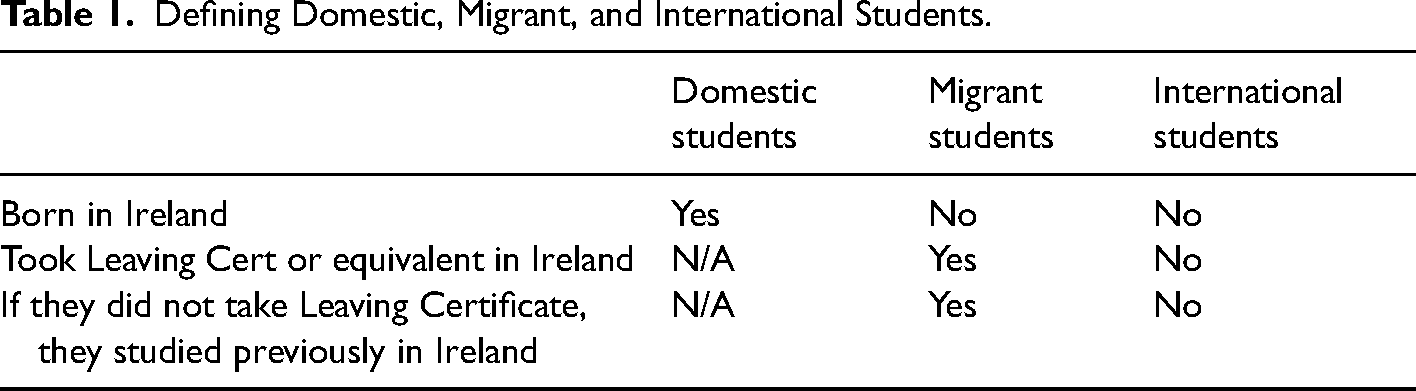
Eurostudent VI does not ask respondents to identify as non-Irish born migrant students or as international students. As such, this study uses the following operationalized definitions for each of the three student categories included in this analysis (see Table 1). Domestic students (or Irish-born students) are all respondents who choose Ireland as their country of birth. This definition categorizes second- and third-generation migrant students as domestic students. International students are defined as students who were not born in Ireland and have not completed their high school leaving examination in Ireland. In Eurostudent VI, only students who do not possess a high school leaving examination are asked to identify the country where they studied previously. An additional group of students who do not possess a high school leaving examination and have not previously studied in Ireland is categorized as international students. First-generation migrant students are all respondents who are non-Irish born and have taken the Leaving Certificate—the Irish high-school leaving exam—or if they do not possess the Leaving Certificate, they chose Ireland as the country where they previously studied (see Hauschildt et al., 2018 for a similar definition).
Defining Domestic, Migrant, and International Students.
Using the definitions above, in the Eurostudent survey VI for Ireland, 72.6 percent of respondents are domestic students, 13.8 percent are first-generation migrant students, and 13.7 percent are international students. These proportions are in relative alignment with various statistics on the student population in Irish schools and higher education institutions. While no statistics on the number of first-generation migrant students are available for higher education institutions in Ireland, it is estimated that in the academic year 2015/2016, 12 percent of students in secondary schools in Ireland were born outside of Ireland (Department of Education and Skills, 2017). Similarly, international students represented 11.2 percent of full-time students at Irish higher education institutions in the academic year 2016-2017 (Higher Education Authority, n.d.). These figures indicate that Eurostudent VI data is broadly representative for the populations of interest in this paper. Data were weighted to reflect the known population parameter for the higher education student population (Irish Social Science Data Archive, n.d.).
The paper uses one-way ANOVA analysis to compare the means between the three sub-populations on the following continuous variables: academic satisfaction, satisfaction with accommodation, how well-prepared respondents feel for the national labor market, and how well-prepared respondents feel for the international labor market. The paper also uses OLS regressions to test how key factors relate with academic satisfaction among the three subpopulations.
No data was missing for the following variables included in the analysis: sex of the respondent, type of institution attended (institute of technology or university), and the degree level (associate, bachelor's, or master's). However, more than 10 percent of the data was missing for the following variables: mother's level of education, financial standing, satisfaction with accommodation, perceived preparation for the national and international labor markets, and being treated as a partner in education. The Little's MCR test was also conducted on the variables included in the ANOVA and the variables considered for inclusion in the OLS analyses. The hypothesis that the data was not missing at random was not rejected [(χ2 = 1239.269 (695), p < 0.001)]. Additional descriptive analysis revealed some variation in missing data between Irish-born domestic students, first generation migrant students, and international students. Irish born domestic students (6%) were as likely as international students (6%) to not provide data regarding their satisfaction levels with accommodation. In contrast, data on satisfaction with accommodation was missing for only 2% of first-generation migrant students. Similar levels of data missingness were reported across the three groups of students (9–12%) regarding their perceived preparation for the national labor market. Irish born domestic students (17%) and first-generation migrant students (16%) were slightly more likely to not provide information about their perceived preparation for the international labor market than international students (11%). Across groups, there were high levels of data missingness for being treated as a partner in education, but first-generation migrant students had the highest level of data missingness (26%). The largest variation in missing data between the three groups of students was on the variable measuring the educational level of the participant's mother. This variable also registered the highest degree of data missingness. As a result, this variable was excluded from further analysis. To minimize the effect of missing data on the analysis results, multiple imputations were conducted on these variables. The results of the pooled OLS analyses across imputation iterations are reported. SPSS does not report pooled results for ANOVA. The results of the first data imputation iteration are reported for all ANOVA analyses. Variations in findings between data imputation iterations are reported, if applicable. The fact that the data is not missing at random in the survey and the degree of data missingness represents a challenge for the ability of the findings of this paper to be generalized to the study population.
Results
International students, first-generation migrant students, and domestic students report relatively high levels of academic satisfaction on the Eurostudent VI survey, with a mean of 3.7 out of 5 across respondents. High levels of academic satisfaction among all respondents were also found by StudentSurvey.ie (2019). Yet differences between the experiences of the three groups of students are also noted. On two key indicators (academic satisfaction and preparation for the international labor market), international students fare better than both domestic students and first-generation migrant students. Despite the relatively high levels of academic satisfaction across the three groups, international students (M = 3.80, SD = 0.77) have statistically significantly higher levels of academic satisfaction compared with both first-generation migrant students (M = 3.74, SD = 0.74) and domestic students (M = 3.68, SD = 0.76). Results are based on a one-way ANOVA analysis [F(2, 15,715) = 24.432, p < .001].
Separate analyses were conducted to test if international students were less likely to recommend their course of study than their domestic and migrant peers. This was not the case. Irish-born students (M = 3.93, SD = 1.07) were statistically significantly less likely to recommend their current program than migrant students (M = 4.0; SD 1.03). The differences in likelihood of recommending their current program between international students and domestic students were not statistically significant (p = .863). These results are based on an ANOVA analysis [F(2, 15,715) = 4.265, p < .014]. This finding suggests that the distinction between academic satisfaction and willingness to recommend a course of study as constructs (Ammigan et al., 2021) may be stronger among international students. However, further analysis is required to test this hypothesis. This further analysis is beyond the scope of this paper.
International students (M = 3.92, SD = 1.03) were also statistically significantly more likely to report feeling that their program of study better prepared them for the international labor market than both first-generation migrant students (M = 3.67, SD = 1.12) and domestic students (M = 3.65, SD = 1.12) 3 . No statistically significant differences were reported between domestic and first-generation migrant students. Meanwhile, Irish-born domestic students (M = 3.86, SD = 1.10) were statistically significantly more likely to feel satisfied with the condition of their accommodation than both first-generation migrant students (M = 3.65, SD = 1.11) and international students (M = 3.39, SD = 1.06) 4 . Lower levels of satisfaction among international students with the condition of their accommodation have been previously reported in the Irish context (Clarke et al., 2018). Irish-born domestic students (M = 4, SD = 1.04) were also statistically significantly more likely to feel that their program of study prepared them well for the domestic (Irish) labor market than first-generation migrant students (M = 3.91, SD = 1.06). No statistically significantly differences were noted between domestic students and international students (M = 3.98, SD = 1.05). International students also reported statistically significant higher levels of preparation for the national labor market than migrant students, but this result was less robust across different data imputation iterations 5 . Figure 1 includes an overview of the differences between the three groups of students regarding levels of perceived preparation for the international and domestic labor markets, as well as academic satisfaction and satisfaction with accommodation.
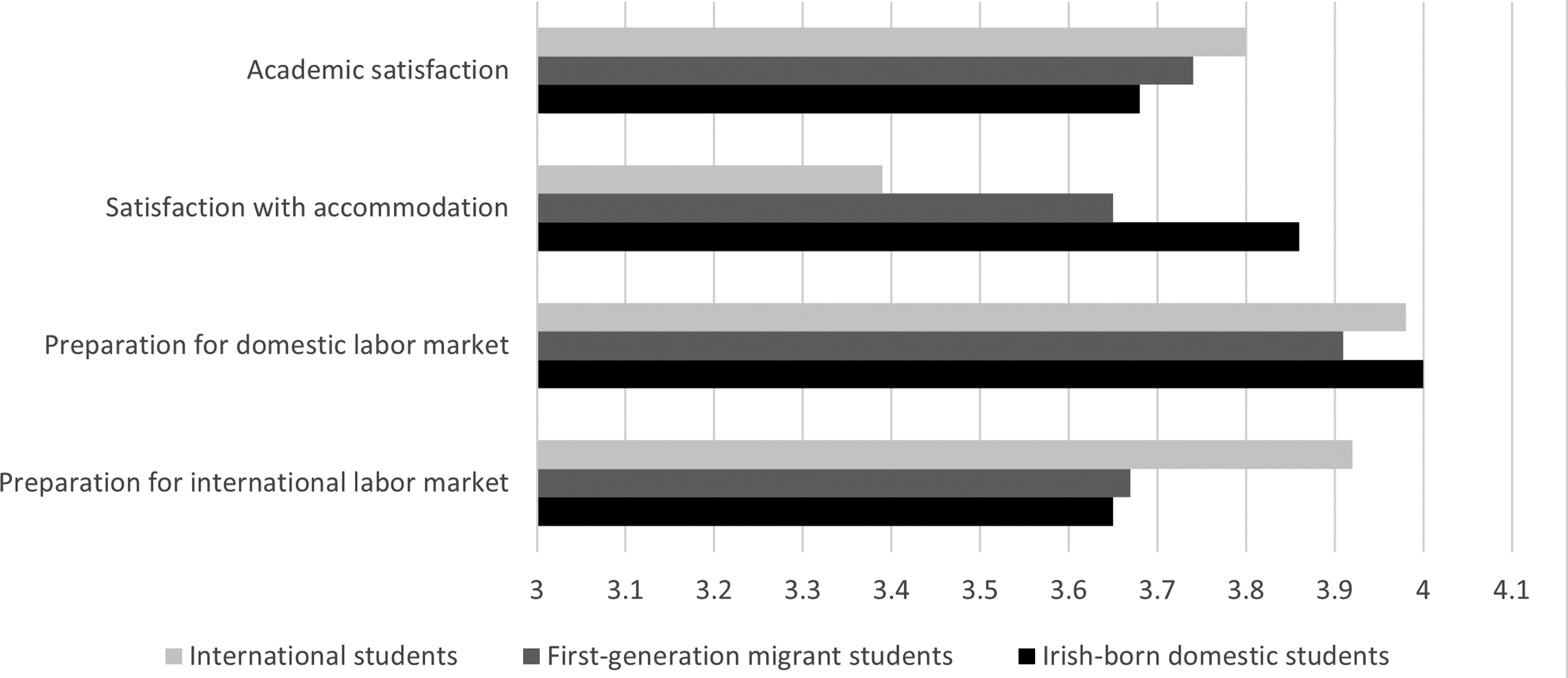
Satisfaction of international, first-generation migrant students, and Irish-born domestic students across key indicators. Source: Eurostudent VI survey.
Three OLS regressions were conducted to better understand the factors associated with academic satisfaction among international students, first-generation migrant students, and domestic students (see Table 2). Personal, institutional, and experiential factors were included in these models. Personal factors include the sex of the respondent as well as a self-reported measure of financial standing. Institutional factors considered were type of higher education institution attended (institute of technology or university) and level of higher education attended (associate degree, bachelor's degree, or master's degree). Experiential factors include satisfaction with accommodation, perceived preparation for the domestic and for the international labor market, and a self-reported measure on being treated as a partner in education or a detached consumer. Being treated as a partner or consumer in education was previously found to be strongly associated with academic satisfaction in the Irish context (Finn et al., 2021).
While some factors were associated with academic satisfaction for all groups, some differences can also be noted. Female domestic students were more likely to be satisfied with their experience at higher education institutions in Ireland, yet no sex effects were noted for first-generation migrant and international students. The perceived financial wellbeing of students” families related to the academic satisfaction of domestic and international students—with students who come from financially well-off families feeling less academically satisfied 6 . Across the three groups, students attending institutes of technology experienced statistically significantly lower levels of academic satisfaction than those attending universities. Only domestic students who were pursuing associate degrees reported statistically significantly higher levels of academic satisfaction than those pursuing bachelor's degrees. The difference in satisfaction between associate degree and bachelor's degree did not persist among first-generation migrant and international students. Academic satisfaction levels were constant between bachelor's and master's programs, across international, domestic, and first-generation migrant students. Across the three groups of students, levels of academic satisfaction were higher for students who were more satisfied with the condition of their accommodation and students who felt more prepared for the national and international labor markets. Across the three groups of students, those who reported being treated as partners in the education process were more likely to indicate higher levels of academic satisfaction than students who reported being treated as detached consumers. This predictor held the highest level of association with academic satisfaction. As discussed later, these findings point toward potential needs to tailor supports that serve these groups of students.
Effect of key Student and Institutional Characteristics on the Academic Satisfaction of Domestic, First-Generation Migrant, and International Students.
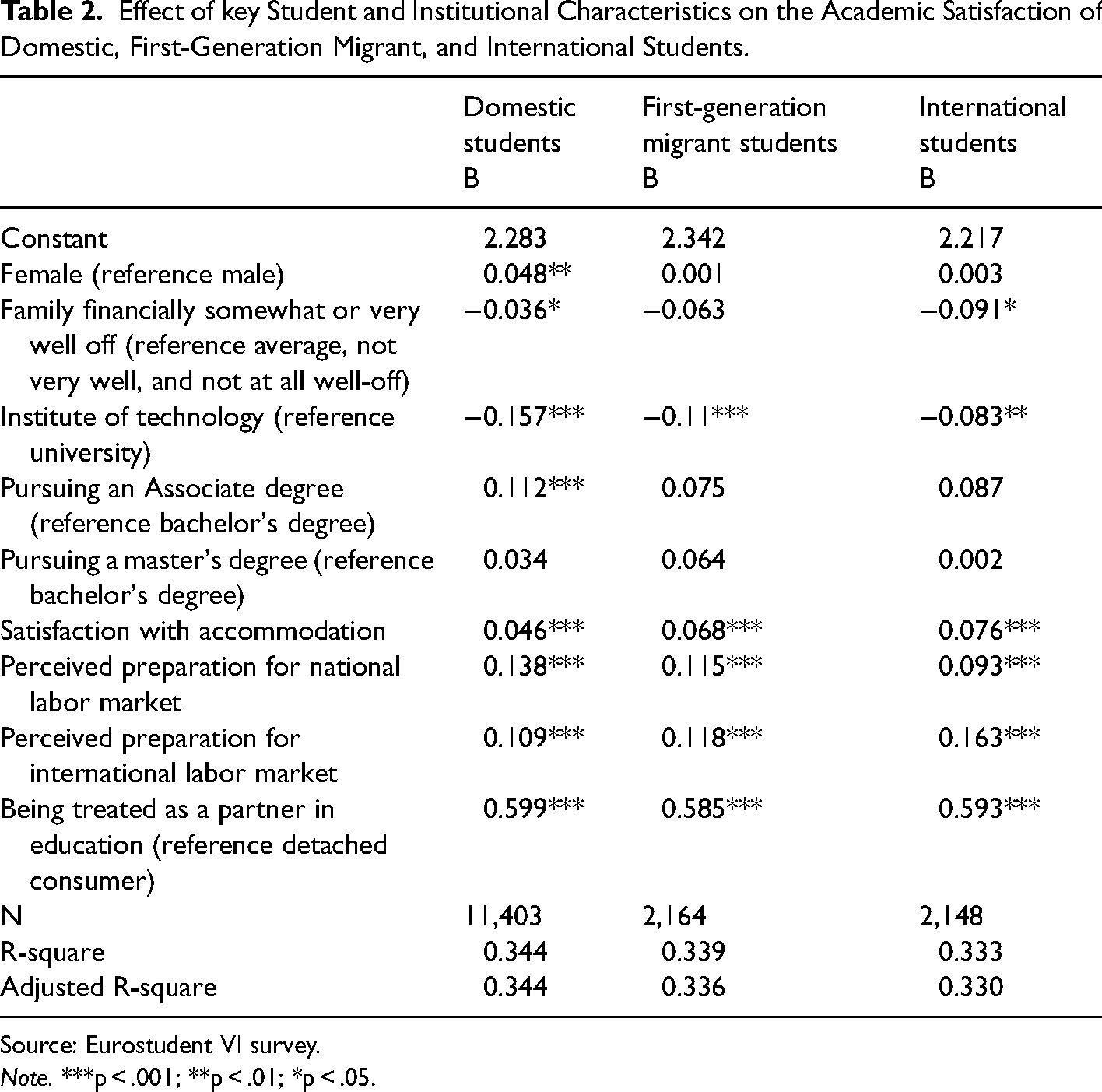
Source: Eurostudent VI survey.
Note. ***p < .001; **p < .01; *p < .05.
Discussion and Conclusion
This article was inspired by two ideas. First, that research on international students can be used as a reference datapoint to identify areas of growth and support for other student populations on campus. I hope that this study is an illustration of the relevance of this idea. Second, that first-generation migrant students at higher education institutions in Ireland, and likely elsewhere, represent an untapped resource for internationalization.
Two main findings emerge from this study. First-generation migrant students might benefit from additional support and engagement at higher education institutions, particularly to increase (perceived) preparation for the domestic labor market. Second, as supported by the results of the OLS regression, looking at differences between and within groups allows for a better understanding of common and divergent factors that may affect the experiences of different student groups. This has implications for how interventions and support services are tailored.
First-generation migrant students did not register the highest levels of satisfaction on any of the four indicators discussed in this paper: accommodation, preparation for national labor market, preparation for international labor market, and academic satisfaction. First-generation migrant students reported lower levels of preparation for the national labor market than both international students and domestic students, despite registering higher levels of academic satisfaction than domestic students. Considering prior evidence that first-generation migrant tertiary education degree holders are less likely to hold jobs where such qualifications are needed than domestic peers (Eurostat, 2016), this finding illustrates the need for stronger domestic labor market support at higher education institutions for first-generation migrant students.
Consistent with prior large-scale studies (Espinosa et al., 2019; Finn et al., 2021) this paper suggests that international students have higher levels of academic satisfaction than their domestic peers. However, findings of this paper also suggest that various supports (e.g., accommodation, preparation for domestic and international labor market) and institutional characteristics shape academic satisfaction for international students. Beyond the specific findings on the experiences of international students, one of the aims of this paper is to illustrate that international students can be used as a reference datapoint to better understand the experiences of other student populations. In this research, international students act as another reference that allows for the identification of challenges faced by first-generation migrant students. The fact that migrant students feel less prepared for the national labor market than domestic students is noteworthy, but juxtaposing this finding with the perceived level of preparation of international students offers a stronger case that further supports are needed for first-generation migrant students.
At the same time, this study shows that the experiences of domestic, migrant, and international students are shaped by shared factors, such as satisfaction with accommodation, and divergent factors, such as gender. One factor was particularly influential in shaping the academic satisfaction of all groups: the perception of being treated as a detached consumer or a partner in the education act. Consistent with prior research using the Irish Eurostudent VI survey data (Finn et al., 2021), this factor was the strongest correlate for academic satisfaction, after accounting for personal, institutional, and other experiential characteristics. This illustrates that marketization trends are as likely to affect domestic, international, and first-generation migrant students and that practices that foster belonging and partnership in the education act may facilitate stronger integration across all groups.
This study has some important limitations. The cross-sectional data used in this paper does not allow observing how the views and experiences of students change over time. The views reported may be influenced by specific events in the year the data was collected or characteristics of the responding cohort. Eurostudent relies on self-reported data, which may be shaped by personal biases (Maxwell & Lopus, 1994), including social desirability bias, or the tendency of participants to overreport desirable aspects and underreport undesirable ones (Krumpal, 2013). These biases may particularly affect how international students discuss their experiences in survey research (Arkoudis et al., 2019). Self-reported biases are further accentuated in this study due to missing data. The data used for this paper does not allow disaggregation of results at the institutional level. Institutional effects were previously found to be significant in shaping the student experience (Mayhew et al., 2016). Other factors, not accounted for in this paper, including country of origin (Ammigan et al., 2021) and cultural distance (Finn et al., 2021), may also affect academic satisfaction. As such, this study does not offer a comprehensive picture on the factors that shape academic satisfaction.
Discursively, international students are often viewed as a group that requires additional support. This view is prompted by multiple studies that show the varied challenges that international students face. Yet academic research is split on the question of how international students experience their study abroad. One of the splits observed in the literature is between small-scale qualitative and large-scale quantitative studies. These two lines of inquiry often offer a diverging picture on what the experiences of international students are, both in the international and in the Irish context. While most qualitative studies offer substantive evidence that the experience of international students is mixed, large scale quantitative studies have generally shown international students to be more engaged with their studies (StudentSurvey.ie, 2019) and to have higher levels of academic satisfaction, as supported by the evidence in this paper. Evidence from the United States also suggests that international students have broadly more positive academic outcomes that domestic students (Espinosa et al., 2019; Mihut, 2019). The tension between the findings of the two lines of research may be explained through multiple mechanisms. First, epistemic differences likely lead the two methods to focus on different aspects of the student experience. This can in turn point to limitations intrinsic to the two approaches and ways through which they can complement each-other. Mixed methods studies with international students have previously highlighted this tension, with international students being more likely to evaluate their experiences in positive terms on surveys and more likely to highlight challenges in qualitative settings (Arkoudis et al., 2019). This preponderance for positive reporting in surveys among international students may represent an area of limitation for this study. Second, the overall high levels of academic readiness of international students may distort other aspects relevant to their experience in large scale studies. However, by engaging in more comparisons between groups and diversifying the breath of factors and outcomes captured, both methodological approaches can better capture the student experience. Student surveys could be improved by allowing better and easier identification of key subpopulations and including additional variables of interest, such as experience with discrimination and academic progress. Similarly, allowing administrative data (e.g., census data, national education databases, tax records etc.) to be linked to other large-scale surveys could increase the impact and relevance of these datasets for research, policy, and practice.
By comparing the experiences of the three groups—domestic, first-generation migrant, and international students—this paper highlights the experience of first-generation migrant students, often overlooked in international higher education studies. However, the study is limited by data availability to further investigate how first-generation migrant students can be better supported by policy and higher education institutions. Further research should focus on investigating the experiences of first-generation migrant students and international students at higher education institutions longitudinally and across a wider range of factors, with a particular emphasis on how relationships with peers, faculty, and institutions may facilitate academic and post-tertiary success. This paper is also an illustration of a broader idea: disciplinary fragmentation within and between internationalization and education studies, and between methodological approaches should be overcome to enable learning from each other.
Footnotes
Declaration of Conflicting Interests
The author(s) declared no potential conflicts of interest with respect to the research, authorship, and/or publication of this article.
Funding
The author(s) received no financial support for the research, authorship, and/or publication of this article.
