




Abstract
Following a rapidly changing external environment, internationalization has become an institutional phenomenon with strategic relevance for universities worldwide. However, the frequently reported gap between theory and practice remains. Engaging staff and achieving successful organizational implementation appears increasingly problematic with more stakeholders and disciplines involved. This study explores the long-time gap between strategy and implementation with Pettigrew's organizational change framework (1987). We conducted a systematic scoping literature review of articles about curriculum internationalization (N = 325) published in English in peer-reviewed journals between 2000 and 2022. Our study demonstrates that the organizational change perspective provides guidelines to improve and facilitate the process. Based on an organizational change perspective we developed a comprehensive framework that may contribute to more effective strategies for staff engagement and meaningful implementation outcomes for curriculum internationalization in higher education.
Keywords
Introduction
The long-time, frequently reported gap between “rhetoric and practice” with internationalization in higher education, already observed by Leask in 2001 (p. 100), does not only remain to exist but has become increasingly problematic, due to a rapidly changing external environment, the increased prominence of internationalization in higher education, and the uneven prioritization of this across multiple disciplines and stakeholders.
Firstly, in the past fifty years, our world has evolved so fast and profoundly that several scholars (e.g., van der Zwaan, 2017) have warned that the current higher education system is no longer sustainable. Van der Zwaan explains how speedy developments with globalization and online and mass education technology have created a highly competitive, interconnected environment. Consequently, higher education institutions worldwide risk a global war for talent, a growing social divide, too high a cost, nationalism and protectionism, and a loss of credibility. Therefore, van der Zwaan urges universities to reinvent themselves, cooperate and make transformative changes to innovate and survive. Equally, Rouse (2016) argues that universities need to respond with organizational agility and influence behaviours rather than focus on efficiency and control. Rouse analyzes universities as “complex, adaptive systems” without a single point of control, inhabited by intelligent, independent stakeholders. As a result, Rouse (2016, p. 19) claims, “university organizations can only influence these dynamic processes through self-organization with personal commitments, incentives and inhibitions, appropriate leadership and collegial power”. Overall, this fast-changing external context has forced university organizations to become more agile and respond with transformative changes.
Secondly, one of these responses concerns the evolvement of internationalization from an initial focus on mobility as the responsibility of the international office towards “comprehensive internationalization” (Hudzik, 2015, p. 7). Hudzik explains how internationalization now affects all staff and students, and impacts all key missions of higher education. Consequently, Hudzik argues, “comprehensive internationalization” implies infusing international and comparative perspectives across teaching, research and service and engaging all stakeholders with their multiple values. Unfortunately, the maturing of internationalization into an institutional phenomenon with many new dimensions and stakeholders has made the existing gap between strategies and practices more difficult to bridge.
In teaching and learning, one of the core missions of higher education, “internationalization of the curriculum” (IoC) has emerged as an increasingly relevant phenomenon and has also been described as “curriculum internationalization”. In a study from the European Parliament, de Wit et al. (2015, p. 50) observe curriculum internationalization implies “significant changes which require long-term institutional commitment and resources and, most importantly, academic engagement”. Leask (2015, p. 9) defines IoC as “the incorporation of international, intercultural and/or global dimensions into the content of the curriculum as well as the learning outcomes, assessment tasks, teaching methods, and support services of a program of study”. As such, Leask approaches “curriculum internationalization” as a staged, purposeful development process, contextual and multi-layered, requiring engagement and resources, broad in scope and potential impact, with formal, informal, and hidden curriculum dimensions. Like Hudzik (2015), Leask signals the process's multi-level, comprehensive, and value-related, partly hidden character. Additionally, from an educational innovation perspective, Riezebos (2017) recognizes curriculum internationalization as one of the essential dimensions to innovate and improve teaching and learning. However, Riezebos stresses that this process competes with other critical operations and educational concepts. Moreover, he observes that these processes towards innovation involve significant changes and require commitment and an investigative attitude from all staff and students involved. Although curriculum internationalization has become an institutional imperative for universities, engagement and implementation are still full of challenges.
Thirdly, the many stakeholders, including academic staff as “key owners” of the curriculum, bring different beliefs, agendas and priorities to the process. For example, several scholars (e.g., Agnew, 2013; Clifford, 2009) explored the impact of curriculum internationalization for disciplines. They found that academic staff often think and work with dominant paradigms based on specific traditions and beliefs. Additionally, individual, and professional identities or the “academic Self” (Sanderson, 2008) are highly relevant, together with institutional culture and structures (Haigh, 2014; Renfors, 2021). Further, the needs and values of staff and students in diverse roles can be somewhat different. Overall, the diversity of stakeholders and disciplines has created a “priority battle” between disciplines and individuals.
Altogether, the broad, contextual scope of curriculum internationalization with multiple levels, disciplines, stakeholders and beliefs involved makes it a highly dynamic process with numerous tensions that require alignment. As such, it is a process with many features of change. That being the case, we wonder whether an organizational change perspective can help bridge the gap between the words in strategies and implementation in practices. Through a systematic scoping literature review, we explore how curriculum internationalization has been conceptualized and investigated as an organizational change process in the IoC literature between 2000 and 2022. We applied Pettigrew's framework Pettigrew (1987) to analyze the critical dimensions of organizational change. To deduce our research question, we first explain how we appropriate this perspective. Next, we elaborate the research methods and then present the findings and discussion.
An Organizational Change Perspective
We chose Pettigrew's framework (1987) of organizational change because of its ease of understanding and relatively general critical dimensions, allowing a broad range of findings as demonstrated by Boonstra et al. (2014). Pettigrew (p. 657–658) views organizational change as a “multi-level, continuous process in context” and explains that it is “too narrow to see change just as a rational and linear problem-solving process”. Instead, he stresses, we must regard the process of change in its broader context to appreciate its interconnected, messy, and political nature. According to Pettigrew, “formulating the content of any new strategy inevitably entails managing its context and process”.
First, the process (the how) refers to “the plans, actions, reactions, and interactions from the various stakeholders seeking to implement the change and move the institution from its present to future state” (Pettigrew, 1987, p. 657–658). To better understand the complexity of the process, we added multiple perspectives with different management foci based on Smith & Graetz, (2011, p. 16 − 17). They distinguish between rational/planned and biological/organic change, with management foci on institutional pressures, resources, systems, psychological, cultural, and power dimensions, and dualities. Second, Pettigrew defines the context as the “outer and inner” context, which we rephrased as “external and internal”. The external context includes the economic, social-cultural, political, and competitive environment in which the organization operates. The internal context concerns the institution's structure, culture, and political context through which ideas for change must proceed. Third, the content addresses the areas of transformation under examination, or simply put the what (Pettigrew, 1987, p. 657–658). Our systematic scoping review of the literature examined these critical, interconnected dimensions of strategic change, process, context, and content.
Research Question
Specifically, our review addresses three questions:
How has curriculum internationalization been conceptualized and investigated as an organizational change process? How can the critical dimensions of organizational change (process, context, content) be identified in these conceptualizations and investigations? What does this mean for future research, policymaking, and practice?
Method
We conducted a scoping review to investigate where gaps and innovative approaches may lie in the IoC literature with curriculum internationalization as an organizational change process (Levac et al., 2010). Necessarily, we made some argued choices in our search and selection process due to limited time and resources, following the meta-analysis protocol for systematic reviews developed by Moher et al. (2015). Firstly, we chose between 2000 and 2022 because curriculum internationalization emerged around 2000. Secondly, we selected only articles in English as the most widely available and accessible language. Thirdly, we focussed on peer-reviewed journal articles in the higher education context, identified through the citation databases of SCOPUS, Web of Science, and PROQUEST. Despite these limitations, our choices align with the scoping review's character and ensure a representative synthesis of findings in line with our research question. Finally, we controlled the rigour in our research with two independent reviewers in each stage of the iterative process. See our search and selection process in Figure 1 below.
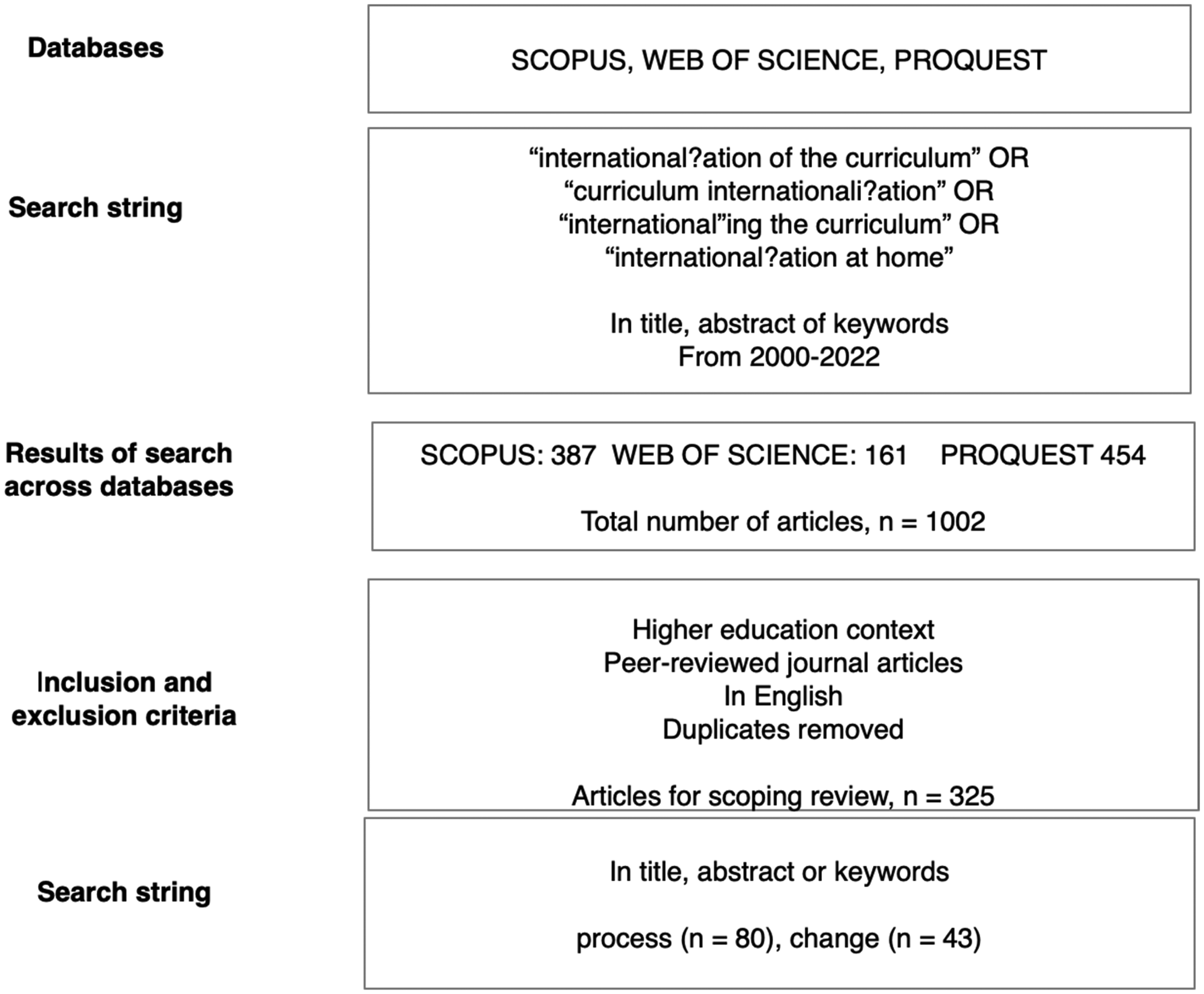
Search and selection process.
Findings and Discussion
Data Characteristics
Our data show less than ten articles per year until 2009 and a steady increase since then, particularly in the last six years, confirming the gained relevance of curriculum internationalization. While most articles appeared in educational research journals, the Journal of Studies in International Education was the leading publisher, with 70 papers on a total of 325 (22%). Only a few papers (n = 16) were publications in management-related journals, suggesting a limited investigation of IoC as an organizational change process. Our identified articles mainly applied a qualitative research approach, with predominantly single case studies and data generated through interviews, questionnaires, or surveys. Comparative case studies and longitudinal designs, standard in organizational change research, were primarily missing.
Process Conceptualizations
Across these 325 papers, we identified 80 with the search string “process”. Overall, these articles mainly described the process in rather general terms, referring to multiple characteristics, activities, stakeholders and issues, with a primary focus on the institutional level. For example, these studies denoted the process as complex, dynamic, contextual, strategic, purposeful, iterative, reciprocal, reflective, imaginative, ongoing, cyclical, or disruptive. The conceptualizations reported planned processes versus more experiential ones, short-term versus longer-term, proactive versus reactive, and cognitive versus affective processes. Many scholars referred to the process more abstractly, such as making meaning, dealing with diversity, or constructing knowledge. Overall, we identified “infusing”, “embedding”, “incorporating”, and “integrating” as the main suggested approaches for the process. We distinguished the “add-on” method of infusing versus broader implementation approaches described as embedding, incorporating, or integrating.
Firstly, some papers (e.g., Clark, 2002; Manuel et al., 2002) discussed the infusing approach, referring to the insertion of international aspects, content, material, or dimensions into existing courses. Particularly programs in business studies widely advocated this approach as “the most cost and resource-efficient method of internationalizing the curriculum” (Jin et al., 2011, p. 173). Some scholars, like LeBlanc (2007, p. 35), however, criticized the infusing method for being “an inadequate approach, not affecting the core curriculum, and not aligning with a department-wide strategy and financial priorities”. Secondly, other papers described the process as embedding, incorporating, or integrating, referring to a more comprehensive approach.
Notably, the main definitions developed since 2000 reflect the interchangeable use of these terms for not necessarily different approaches. For example, whereas Knight (2004, p. 11) used the expression integrating, Leask (2015, p. 9) talked about incorporating, and Hudzik (2015c, p. 7) referred to infusing. Additionally, several scholars talked about embedding (Whitsed & Green, 2016; Fragouli, 2020; Killick, 2020; Ryan et al., 2021). As Green & Whitsed (2015, p.5) stressed, it is more important to look beyond these ambiguous terms and investigate in more detail how to achieve the intended changes. Overall, we detected a development in the conceptualizations towards broader approaches that claim to be inclusive and sustainable and aim “to integrate and align strategies and activities into the institution and engage all relevant stakeholders in the process” (Ainsworth, 2013, p. 46). For example, only recently Fragouli (2020) pointed out the need for a more comprehensive framework towards internationalization. In summary, these more comprehensive approaches all address processes that are, to some extent, strategic and coordinated.
Process Investigations
Next, we identified 43 articles with the search string “change” (e.g., Breit et al. 2013; Killick 2020). Additionally, some publications, like Schuerholz-Lehr et al. (2007), Robson (2011) and Green & Mertova (2016), referred to “transformative processes” to stress the deep level of change involving significant reforms with high impact. However, only a few studies went beyond using change-related terms and acknowledged explicitly that curriculum internationalization involves organizational change. For example, Crosling et al. (2008) approached curriculum internationalization as a strategic change process and revealed “academic autonomy” and “continued resources” as crucial issues. Likewise, Cotton et al. (2019) argued that “agency, ownership, and the ability to act” impact the scope of transformation and innovation. Equally, Jones and Killick (2013) explored a “constructive alignment process” while designing and implementing learning outcomes across disciplines. Finally, Kirk et al. (2018) discovered how “autonomy” and “hidden powers”, expressed as “headspace” and “authority”, are relevant organizational characteristics influencing the implementation process. These and a few other studies (Trondal, 2010; Barnett, 2011; Bradford et al., 2017) reveal some first guidelines for a more effective organizational change process with curriculum internationalization. In short, these guidelines concern the careful consideration of academic autonomy, ownership, and hidden powers and the recommendations to enable stakeholders to act, and to constructively align the process.
Further, some of the rare studies published in management-related journals used other terminology, reflecting a different focus and approach. For example, Jaklič and Karageorgu (2015) talked about “organizational learning” and “improvement processes” aiming for innovation and a positive impact on organizational performance. Overall, however, any empirical investigation of the process of organizational change was mainly incidental. Although some papers addressed change or organizational characteristics, these studies did not research how these features work in the implementation process in a specific context. Across all 325 articles, we identified only one paper (Barnett, 2011) with change as a keyword or reference to theories from organizational change, such as Pettigrew's framework (1987). As such, our review discloses a gap in the IoC literature where it concerns investigations of curriculum internationalization as an organizational change process.
Critical Dimensions of Organizational Change
Process
Next, with Pettigrew’s (1987) perspective, we analysed the process as a sequence of plans, actions, reactions and interactions to implement changes. For example, this could be a new policy on curriculum internationalization followed by specific activities, responses from the stakeholders involved, interactions between them and adjustments to their systems and practices. Our findings revealed references to plans and actions primarily while the reactions and interactions were mostly missing.
Considering this limited display of the process, we added Smith & Graetz's multiple process perspectives Smith & Graetz (2011, p. 16–17, see page 3) for a completer picture. Subsequently, we identified two overarching, sometimes contradictory processes. Primarily, we found a rational, planned approach with top-down processes, interchangeably described as cognitive, strategic, directed, controllable, purposeful, or deliberate (e.g., Agnew, 2013). Some studies (e.g., Crosling et al., 2008; Trondal, 2010; Barnett, 2011; and Takagi, 2015) complemented this top-down approach with bottom-up processes, described as emerging, organic, or evolutionary change. Others, for example Leask (2015), captured bottom-up, more affective change with “reflection and imagination” stages in a planned, rational process design. Likewise, Kirk et al. (2018) signalled that ownership of curriculum internationalization at the disciplinary level needs alignment with university strategy in a mix of planned and organic processes. Moreover, other studies added specific foci. For example, Zhou (2016) used a dynamic systems approach to explore the relationships between organizational variables, levels, and stages of the internationalization process. Agnew (2013) and Bradford et al. (2017) advocated departing from specific qualities and strengths as resources, while others (Haigh, 2014; Green & Mertova, 2016) focused on psychological, cultural, power and duality dimensions with “empowerment” and “disruptive” processes. Overall, the papers we reviewed did not explain how the process could be enabled or facilitated precisely.
Context
Secondly, following Pettigrew (1987), we reviewed the context. We identified multiple rationales (why) related to external and internal dimensions and levels (where) and various stakeholders (who). All papers described context somehow, often situated in a specific geographic area, mainly in general, sometimes ideological words, like “peaceful”, or “unfamiliar”, referring to value-laden descriptions (Leask, 2015). Accordingly, Stier (2004) argues that divergent or even contradictory ideologies, such as idealism, instrumentalism, and educationalism create multiple rationales which complicate implementation. Many scholars confirm the impact of rationales as a relevant contextual factor influencing success or failure with the implementation of curriculum internationalization. However, only a few studies (e.g. Seeber et al., 2016) examined how these rationales interact with other contextual factors and impact implementation.
Further, scholars distinguished between rationales in the external and internal context. We identified a pronounced emphasis on “globalization” as the primary external catalyst and international accreditations such as AACSB and EQUIS as specific external drivers (LeBlanc, 2007; Crosling et al., 2008). Overall, our review revealed a focus on economic and academic drivers, such as global employability and citizenship, revenues, diversity, quality, and reputation. Articles paid less attention to historical, political, societal, technological, or ecological motivations. At the same time, several studies (e.g., Jones et al., 2015) signalled the interconnectedness and tensions between the global and the local context. For example, Agnew (2013) used the term “glocalization” to signal the challenges of linking a historically local focus in the US context with external globalizing developments. Situated in the European context, Šiška et al. (2013) explained the difficulties for programs funded by the European Union to align institutional and national practices with regulations for quality assurance because of multiple values and mechanisms.
In the internal context, rationales appear to be related to multiple levels and stakeholders. Most articles focused on the institutional level and to a lesser degree on the national and disciplinary levels. Fewer publications examined internal levels defined as faculty or school, program, course, or individual. Ten per cent of the documents did not connect to a specific level. At the institutional level, the focus was on the need for more systematic internationalization efforts and particular capabilities and human resource capital (LeBlanc, 2007). The papers addressing the other internal levels stressed educational and socio-cultural rationales.
Finally, with many highly diverse groups of staff, students and other stakeholders in a university, these context-bound rationales often result in unclear, divergent, or even contradictory understandings. As Stier (2004) explains, the underlying, often implicit ideologies and taken-for-granted assumptions create ambiguity and vagueness and complicate a shared understanding and effective and meaningful implementation of curriculum internationalization. Likewise, Barnett (2011) and Trondal (2010) maintain how a shared vision of curriculum internationalization is insufficient to balance universities’ multiple, competing, inconsistent demands and concerns. Instead, Barnett (p. 138) argues to “embrace the diversity of meanings inherent to change and strive to conjoin divergent perspectives”.
In summary, this literature suggests that multiple rationales with curriculum internationalization relate to the interconnected external and internal context, with different levels and stakeholders and complicate shared understandings and successful implementation. The IoC literature mainly described the context, sometimes with change-related vocabulary, but generally, scholars did not use organizational change perspectives to examine the context. Consequently, the literature about curriculum internationalization has not investigated how the specific context involving organizational change influences the process and content with curriculum internationalization.
Content
Thirdly, we examined Pettigrew’s (1987) content dimension. All papers addressed content, mainly with generic, sometimes ideological descriptions and a primary focus on the curriculum. In line with Leask (2015), we found multiple levels and many different topics. Firstly, the curriculum included design, mobility, the formal and informal, student and staff development, teaching and learning, and internationalization activities in the wider sense. Some of these studies focussed on technical, online, or ideological content. Secondly, articles about disciplinary content concerned primarily business and health studies, while fewer papers addressed institutional strategies, policies, priorities, culture, or individual transitions. Yet, what is mostly missing are the managerial or organizational dimensions to be changed as argued by Kondakci et al. (2006) in Qureshi et al. (2014, p. 2299): “Perceiving internationalization as a managerial issue, which touches structural-functional domains of the organization, and conceptualizing it as an organizational change process is a necessary first step towards successfully developing an international dimension into core functions of higher education”.
Overall, the content lacks an organizational dimension and an empirical investigation through the conceptual lens of organizational change research and perspectives. As a result, the papers reviewed did not explain how content relates to the context and process.
Recurring Issues
Lastly, we identified resources and staff engagement as recurring issues. Firstly, many scholars demonstrated the necessity of resources for effective, meaningful implementation. For example, Leask (2015, p. 105–117) pointed out how resources are essential to deal with personal, cultural, and institutional “blockers” and instead encourage and enable the stakeholders and the process. Generally, the resources described distinguish between financial (budget, time, support) and human resources, including knowledge, skills, attitude, and leadership (Bradford et al., 2017). Further, some studies (e.g., Crosling et al., 2008) signalled that the mere availability of resources is not sufficient. They argue that resources also need to be appropriate and continuous, and require adequate management. However, the existing literature does not tell us how to position resources in strategy and policies and enact these resources successfully in practice.
Secondly, we found academic staff engagement as a frequently reported issue hindering implementation (e.g., Friesen, 2012; Green & Whitsed, 2016; Green & Mertova, 2016; Whitsed & Green, 2016). However, overall, the IoC literature did not investigate much how the academic staff perceive and experience curriculum internationalization and how the organizational context impacts their engagement. Scholars examining curriculum internationalization (e.g., Leask et al., 2020; Ryan et al., 2020; Whitsed et al., 2021) have only recently started investigating staff engagement as a contextual, dynamic phenomenon linked to the university organization. These studies argue for a more nuanced understanding of the organizational dynamics that impact staff engagement with curriculum internationalization. Altogether, the recurring issues of financial and human resources and staff engagement appear intertwined and related to organizational dynamics.
Interestingly, other public or professional service organizations reveal similar tensions with resources, staff engagement and organizational characteristics influencing implementation. For example, Kuipers et al. (2014) explain how public sector values in a combined political, juridical, and administrative context strongly impact engagement and implementation in public organizations. In addition, Von Nordenflycht (2010) argues how academic autonomy, informality, shared ownership, and opaque quality impact implementation in professional service organizations such as universities. In a systematic literature review about implementing information technology in hospitals, Boonstra et al. (2014), applied Pettigrew's framework of change (1987) and demonstrate how expertise, hierarchy and autonomy are highly relevant in the implementation process. Boonstra et al. argue that sufficient, adequate financial and human resources and staff engagement are essential but not sufficient. They explain that resources and staff engagement need to be managed, developed, and aligned, for example with multidisciplinary workgroups, role models, communication platforms and continuous training and professional development, as appropriate in a specific context. Likewise, Suseno & Pinnington (2017) point out that professional service organizations, for example, law firms, face enormous management challenges with human resources. They signal how internationalization creates additional complexity but can also be used by organizations to manage these issues effectively. Similarly, Hoover & Harder (2015, p. 175) show that human resources and tensions in complex processes involving change play an essential role in successfully implementing sustainability in higher education and requires “reflexive practice, genuine dialogue and developing flexible structures”.
To summarize, these studies signal similar recurring issues and connect these with organizational dynamics characteristic for public service organizations. For universities, these insights about tensions with engagement and implementation in other public service organizations with different complex phenomena add to what we know from the IoC literature. It may be useful to further investigate this additional literature to develop a more comprehensive, situational perspective of curriculum internationalization.
The Organizational Change Framework
In conclusion, the key findings of this review as to how the IoC literature conceptualized and investigated these critical dimensions of organizational change (process, context, and content) heretofore has developed our organizational change framework for implementing curriculum internationalization. Overall, the 325 papers examined in this study frequently conceptualized yet did not investigate curriculum internationalization much as a process involving change. Our review revealed that the ambiguous, value-laden conceptualizations of the curriculum with many different descriptions hinder shared understandings and consequently complicate effective and meaningful implementation. Despite the many features of change denoted across the 325 articles, the IoC literature has to date only researched the critical dimensions of organizational change in a limited way.
First, the reactions and interactions were missing with the process (how), as well as multiple perspectives based on different foci. The few studies exploring how to balance top-down and bottom-up approaches provide a point of departure. Next, the context reveals multiple rationales (why) related to specific levels associated with the internal and external context (where) and stakeholders (who). Further, the content showed a limited scope, with changes mostly limited to the curriculum and the educational domain. An organizational change perspective adds the organizational dimensions required for a broader reach. Finally, the interconnected, recurring issues of resources and staff engagement show the most significant influencing factors on the process, context and content with curriculum internationalization and the need for appropriate alignment. See Figure 2 below.
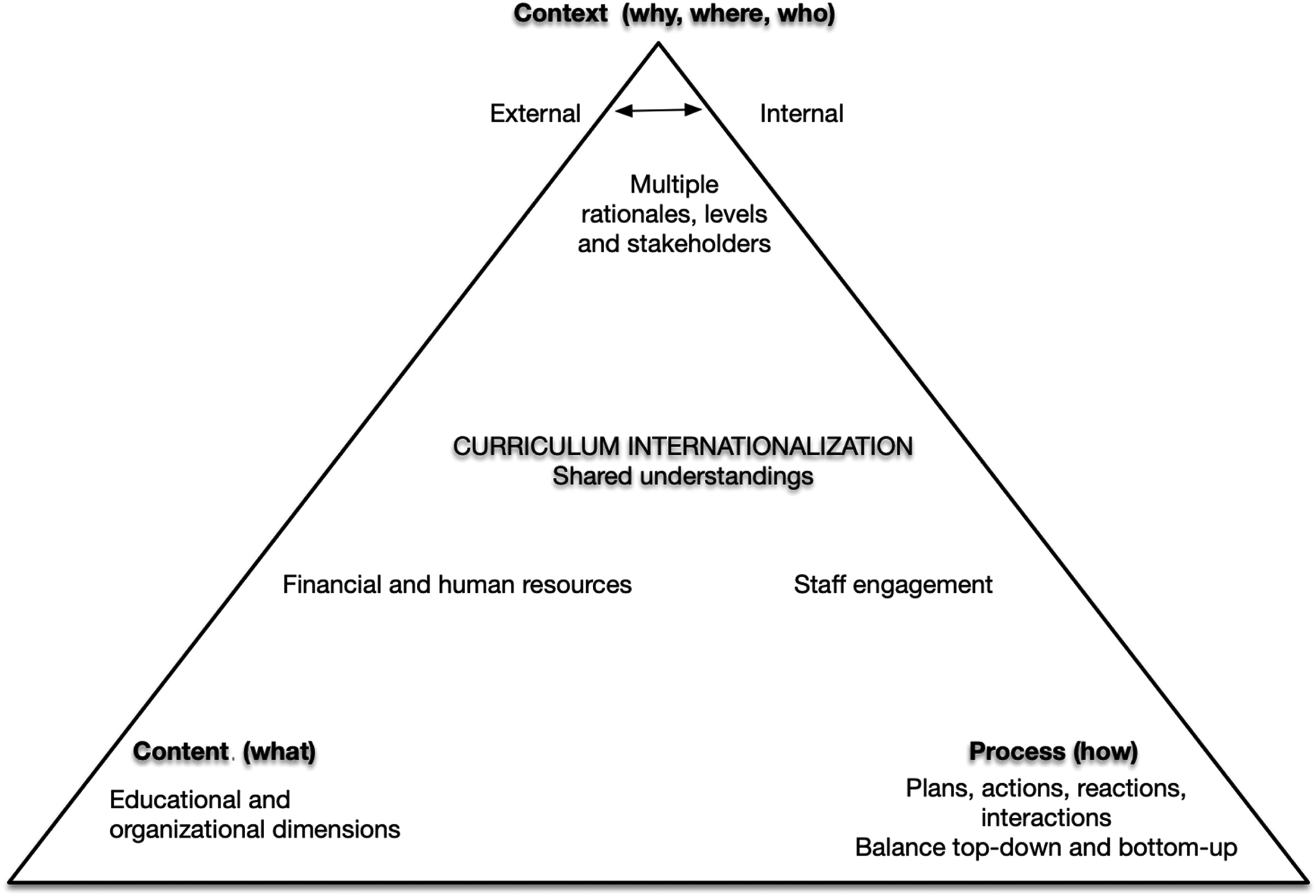
The framework of organizational change based on Pettigrew (1987) for implementing curriculum internationalization in higher education institutions.
Implications for Future Research, Policymaking, and Practice
We assert that this framework can guide future research, policymaking, and practice with curriculum internationalization. This literature review provides greater conceptual clarity of curriculum internationalization as an organizational change process. Further, this study signals a bias in applied methods and perspectives and reveals a gap in research using organizational change theories. We advocate expanding our understanding of curriculum internationalization's contextual organizational dynamics with insights from other public service organizations (Von Nordenflycht, 2010; Kuipers et al., 2014; Rouse, 2016, van der Zwaan, 2017). We also argue to explore multiple organizational change perspectives as explained by Smith & Graetz (2011). For example, Dynamic Resource-Based Theory (Eisenhardt & Martin, 2000) describes how the allocation, development, and alignment of financial and human resources can enable staff engagement and implementation, contribute to meaningful outcomes, and create a strategic advantage. Such a different perspective could reveal mediating interactions and tensions that influence how staff (academic and professional) engage with change at all levels, scales, and types. We should hear the academics’ voices more and explore cognitive and affective perceptions and experiences from staff in various disciplines, beyond the business and health studies. The literature about employee engagement in other organizations (e.g., Albrecht, 2010) can offer more insights into organizational and psychological dynamics with staff engagement in higher education. Overall, we need more comparative, longitudinal empirical studies, and an integrated approach with insights from organizational change studies.
Moreover, this review signals the need to explicitly explain curriculum internationalization in strategies, mission statements, and policies, requiring clearly defined rationales, intended outcomes, and parameters to design, monitor, and evaluate the positioning and enacting of curriculum internationalization in all dimensions. Otherwise, curriculum internationalization will become an empty term, and we will continue to speak a different language. Importantly, internationalization strategies and policies must be aligned with other relevant processes within universities and depart from the core institutional values. An example is the currently popular theme of diversity and inclusiveness. Finally, this study demonstrates that curriculum internationalization requires a consistent institutional approach with appropriate allocation and management of financial and human resources and adequate staff engagement. Our developed organizational change framework provides directions for the future planning and implementation of curriculum internationalization by viewing this as involving change and, as such, an organizational change process. This framework may enable the development of more nuanced strategies to drive curriculum internationalization. It could also allow more effective and meaningful implementation of internationalization in educational and organizational practices.
Suggestions for Effective Strategies
Following the framework, we suggest the following strategies for policy and practice.
With context: identify the critical stakeholders, their position and level in the organization and their main rationales. Then, enable purposeful conversations and create shared understandings of curriculum internationalization. With content: decide (together) what to change in educational and organizational dimensions, the scope of change and the intended outcomes/impact. With process: decide the approach and design, monitor, and evaluate the process. Resources: ensure adequate financial and human resources and development and alignment where needed. Engagement: facilitate cognitive and affective engagement from all relevant stakeholders with adequate connections through appropriate communication and platforms.
Conclusions
In conclusion, our review has demonstrated that the IoC literature has not yet provided a comprehensive, contextual approach to staff engagement and curriculum internationalisation implementation in university organizations. Furthermore, with theories and perspectives primarily from the educational domain, the IoC literature does not elaborate on the organizational dimensions and dynamics necessary to implement more comprehensive transformative changes. This limited perspective is problematic because broader change initiatives involve collaboration from multiple stakeholders at different levels. Therefore, a more detailed understanding of the influencing factors, mechanisms, and patterns for larger-scale changes with curriculum internationalization is required to achieve sufficient staff engagement and successful implementation.
This review across 20 years of IoC literature has highlighted the usability of Pettigrew’s (1987) framework, complemented with more recent insights (Smith & Graetz, 2011), to investigate curriculum internationalization as a process of organizational change in higher education institutions. The curriculum internationalization process involves numerous tensions and should be implemented with great care and with attention given to context, content, process issues, and interactions between these. This paper's academic contribution is in providing an overview of the literature about curriculum internationalization as a process and suggestions for complementary research building on insights about organizational change and research from other public service organizations. The contribution to future policymaking and practice lies in the general findings and the framework to apply as a guideline, with specific points that deserve attention when implementing curriculum internationalization. Recognizing and addressing these dimensions and issues can increase the likelihood of successfully implementing curriculum internationalization and, as such, bridge this long-time gap between theory and practice.
Footnotes
Acknowledgements
Professor Jan Riezebos and Professor Albert Boonstra from the Faculty of Economics and Business at the University of Groningen, the Netherlands contributed to this article as supervisors of this PhD project.
Funding
The authors received no financial support for the research, authorship, and/or publication of this article.
Declaration of Conflicting Interests
The author(s) declared no potential conflicts of interest with respect to the research, authorship, and/or publication of this article.
