




Abstract
This paper examines digital inclusion and equity in international higher education with particular focus on Global South-North Collaborative Online International Learning (COIL). Practice examples, bringing together students and academics in Brazil, South Africa, and the UK, are used to consider how COIL is being integrated into higher education curricula to interrupt western hegemony and open up spaces in which “otherwise” ways of knowing, being, relating and expressing can thrive. We consider COIL as a Third Space within which academics can help facilitate the different intellectual, emotional, and socio-cultural positionings of Global South-North students and reflect on how meaning-making and engagement can be transformed as a result of this dialogue. We also recognize how the digital environment as a Third Space can be experienced as inaccessible and troublesome and make suggestions on how South-North digitalization practices can be designed to address access and inclusion needs of students and academics.
Keywords
Introduction
In 2011 Brandenburg and de Wit predicted that universities would need to embrace ideals of sustainability and equity in internationalization of higher education. More recently, de Wit (2019), advocated for more diverse and inclusive internationalization practices to replace the western paradigm of competition and reliance on internationalization abroad at the cost of internationalization at home (IaH) practices. De Wit (2019) continued by questioning if a more comprehensive, inclusive, and critical approach to internationalization was even possible.
Societies and education systems all over the world have become interconnected as a result of migration, globalization, and digitalization (EAIE, 2020), and the internet, especially in the Global North, has been viewed as a relatively borderless space where “netizens” can easily cross over into new websites and apps (Chang & Gomes, 2017). Yet, research on the realities of netizens in the Global South remains scant and skeptical about ease of access (Finardi & Guimarães, 2020). Furthermore, knowledge remains mainly western. In response, Montgomery (2019) appeals for the co-production of new “Southern” knowledge, not least through a collective intellectual process involving the whole academy. Such a process could be carried out through collaborative online internationalization actions involving both South-South and South-North collaborations.
An example of such action is Collaborative Online International Learning (COIL), a collaborative teaching and learning approach with international partners, through the use of digital technologies (Rubin, 2016). The focus of COIL is on developing a series of attributes, qualities and capabilities that enable students to address and reflect upon the challenges of living and working in contemporary societies as global citizens and professionals (Beelen et al., 2021). Whilst COIL initiatives between geographically distant classrooms are not new, particularly in the field of language learning (more typically referred to as teletandem, telecollaboration and/or online intercultural exchange) (see Lewis & O’Dowd, 2016), COIL represents an emerging pedagogy for many higher education institutions (HEIs), and is becoming associated with the ‘umbrella’ “Virtual Exchange”, as discussions on terminology are debated (O’Dowd, 2021).
In this article, and as four academics in HE from Brazil, South Africa (SA) and the UK, we foreground our perspectives with particular focus on Global South-North COIL experiences. We argue that COIL offers opportunity to interrupt a western hegemony (cf. Baumvol, 2019) and open up learning spaces for alternative ways of knowing, being, relating and expressing, which we examine as Third Space learning (Jørgensen et al., 2020; Soja, 1996). As a Third Space, we discuss how COIL can offer a productive, dialogic, and reflective space that engenders new possibility to redress past inequalities and injustices, to challenge the dominance of western knowledge and pedagogy, and to question the colonial roots of university practices and curricula (du Preez, 2018). As a fertile in-between space, an interruptive and interrogative space (Bhabha, 1994), we suggest COIL offers a Third Space where multiple discourses may be woven together without sacrificing or dismissing the importance of their speakers’ experiences and ways of knowing the world. We share examples of our Global South-North project work and discuss how digital inclusion and equity in international HE can be advanced through COIL as an in-between generative Third Space, representing an ecology of knowledges that includes knowledges from the Global South (Guzmán-Valenzuela & Gómez, 2019). Further, building on Leask and Bridge’s (2013) conceptual framework for curriculum internationalization, we propose an extended framing of Third Space COIL exchange, before moving to conclusions.
Informing Literature
The radical change in the global scenario due to the Covid-19 pandemic has put pressure on HEIs in terms of local and strategic solutions to global problems, reinforcing de Wit’s (2019) concerns mentioned earlier, and supporting more inclusive internationalization strategies into curricula including IaH.
IaH is part of internationalization of the curriculum (IoC) and is similar in its intentions to focus on the careful construction of learning environments and the incorporation of international and intercultural and/or global dimensions into the content of the informal and formal curriculum, as reflected in preparation, delivery, study outcomes and support services (Leask, 2015, p. 9). IoC presents as a wider, embracing institutional approach to internationalize curricula reflected in strategy, training and institutional values and culture (Leask, 2015). IoC can include activities related to strategic transnational education partnerships, student and staff exchanges, summer schools, international student recruitment campaigns, etc. A key difference between IoC and IaH is however, that the latter always occurs ‘at home’ and is focused on all students (Beelen & Jones, 2015, p. 68). Additionally, emphasis in IaH is on “purposeful integration” of international learning within domestic learning environments (ibid, p. 69) (italics added by the authors for emphasis), which assumes students will not study abroad, but learning may extend beyond the home campus into local communities and can include collaborative online interactions such as COIL.
Although protocols, failures and good practices have been documented about COIL (van Hove, 2019), how COIL might be considered as a Third Space (“a symbolic in-between space, enabled through cultural difference and offering generative potential beyond the ‘either/or’ limits of dualities” (Zhou & Pilcher, 2018, p. 2), remains worthy of examination.
COIL as a Third Space has been discussed somewhat: Wimpenny and Orsini-Jones (2020) consider it as a relational pedagogy, as fertile space that offers opportunity for fostering diversity and inclusive participation, promoting openness to knowledge pluralization through diverse students interacting and sharing knowledge perspectives. Moje et al. (2004, p. 44) write about Third Space COIL as “navigational space where diverse stakeholder perspectives and discourses can meet”, where “cultural, social, and epistemological change” can take place as competing knowledges and discourses of different spaces are brought into conversation to challenge and reshape the way participants think and act. Further, Gutiérrez et al. (1999) approach Third Space from a hybridity perspective, both as a theoretical lens to understand diversity as a relational pedagogy, and as a method to organize and mediate learning. Essentially such perspectives recognize the potential of the Third Space COIL environment to be transformative, inclusive, and equitable.
At the same time, one has to be aware that for those in the Global South, some challenges might exist, making it unequal, unhospitable, or even inaccessible. For instance, Stallivieri (2020) argues that for Brazilians to make full use of COIL they would have to overcome three gaps: the linguistic gap (most Brazilians speak only Portuguese); the digitalization gap (in terms of access to ICTs); and the structural gap, in the form of less institutional and curricular flexibility and support for such initiatives. Fataar (2018) similarly identifies within the South African context the need for change in terms of structural arrangements, material dimensions, and inclusive institutional cultures. He argues for a focus on non-domineering curriculum knowledge which addresses “students epistemic becoming” (p. 598) evolving as an acknowledgement of past, present and future; as an interplay between experience, learning and relatedness with others, which again resonates with the potential of COIL as a Third Space—when carefully and purposefully considered.
Towards inclusivity and equity, we see COIL as having the potential to g/localize and contribute to IaH for all students, using the relational and mediation potential of hybrid digitalization spaces to confront global and local values made explicit (Patel & Lynch, 2013). By inclusion we do not mean the incorporation of other cultures based on a relation in a single direction that neglects history and identity. Rather, we refer to inclusive Third Space COIL as a learning experience to encourage the enhancement of students’ glocal experience through a critical academic and cultural exchange of global and local socio-economic and political issues. As such, we view Third Space COIL as promoting decolonized learning, in the sense that all players are mutually recognized, incorporated, and affected in the Third Space through alternative or “otherwise” forms of knowing, being, relating and expressing to people and knowledges on both sides of the abyssal lines in an ecology of knowledges (Santos, 2007).
Le Grange (2016) frames decolonization as uncentering, displacing, deconstructing; a critical engagement with knowledge to offer a renewed understanding of history, culture, and language. Aligning with Le Grange, we suggest what unites a decolonized, internationalized, inclusive curriculum is critical engagement in the learning exchange with entangled constructions and openness to self and others with “respect of difference” valued for its intrinsic worth (ibid). At the heart of addressing this multi-conceptual practice is the curriculum—a complicated concept in itself, relating to the coming together of pedagogies, practices and learning communities as an active force of human educational experiences (Wimpenny et al., 2021).
Building on du Preez (2018) and Le Grange (2016) our contention is that decolonization and internationalization enable faculty to rethink ways of conceptualizing curriculum which decenters dominant knowledge systems to construct Third Spaces, wherein “seemingly disparate knowledges can be equitably compared and function to work together” (Le Grange, 2016, p. 10). We consider COIL as offering such a transformative Third Space, which can use digitalization as a complementary strategy to foster understandings between and amongst disciplines and cultures, working collectively to address societal challenges. Such transformation includes promoting a conceptualization of global citizenship (e.g., Guimarães & Finardi, 2021) that acknowledges complicity in colonial violence (see Stein, 2017), thus fostering understanding between and amongst different cultures working collectively to address societal challenges.
Leask and Bridge (2013) presented a framework explaining alternative constructions of an internationalized curriculum, highlighting the complexity of internationalization with prompts for considering alternate paradigms in legitimizing different perspectives. Further, Lorde (2012), relates how critical, dialogic encounters need to take place amongst students and staff and wider communities, confined not by national contexts, but with international perspectives, and in the interest of ethical spaces for learning, which encourage creativity and do not distance students. With such perspectives in mind, and drawing on three illustrative examples using data captured and analyzed from focus groups, interviews, and COIL exchange observations, we consider two key questions in our use of South-North COIL as digitalized Third Space learning:
How can COIL address the de-centering of hegemonic western attitudes, behaviors, and practices amongst South-North academics and students to encourage awareness and respect for pluralistic ways of knowing, being, relating and expressing? How can South-North digitalization practices in COIL be designed and developed to address access and inclusion needs of students?
Illustrative Perspectives
Blending Massive Open Online Courses (MOOCs) into English Language Teacher Education with Telecollaboration (BMELTET)
At Coventry University in the UK, COIL offered the opportunity to critically evaluate the theorization of English Language Teaching (ELT), an applied linguistics field that, until very recently, has been dominated by WASP (White Anglo-Saxon and Protestant) experts. The South-North dialogue between British and international students based in the UK and studying on an MA in English Language Teaching and Applied Linguistics and their counterparts based in other countries overseas (China and Spain in academic year 2020–2021 for example), highlighted interesting intercultural ELT aspects and fostered a discussion regarding what ELT curriculum should include and stress. The critique of the current content of traditional ELT curricula, was underpinned by the shared use of an existing FutureLearn MOOC (Massive Open Online Course): Understanding Language: Learning and Teaching (by the University of Southampton and the British Council), in a unique COIL-MOOC blend—BMELTET- pioneered at Coventry University (Orsini-Jones et al., 2017; Orsini-Jones & Cerveró Carrascisa, 2019). The aim of BMELTET has been to research how a holistic approach to the integration of technology into ELT education can impact on students’ ways of thinking and relating by providing them with the opportunity to engage with a global ELT community of practice both via COIL and linked to a MOOC that has over 200,000 participants from all over the world, and, in so doing, rethink ELT in an autonomous way to find ways in which English can be best taught in their respective contexts.
The MOOC syllabus coincides thematically with the topics covered by the COIL partners’ ELT curricula. The provision of different knowledge perspectives on ELT, was a strong focus in the MOOC, illustrated by the contributions of its participants to the online forums and by the inclusion of topics like “Global Englishes”, which aims to decentralize the subject of ELT and debunk the myth of the “native speaker” (normally British or American) as the ideal teacher of English—a decolonization debate ongoing in ELT in the world (e.g., Rubdy, 2015). BMELTET aims to raise students’ awareness of this problematic issue to counter being intimidated by the widespread “hear-say” narrative about the alleged superiority of teachers whose first language (L1) is English (the “native speakers”). This distortion is perpetuated by recruiters in the field of ELT in many countries who advertise jobs for “native speakers only” (Kiczkowiak, 2020).
56 students of diverse nationalities were involved across three different HEIs in the September 2020–December 2020 run of BMELTET (28 in Spain, eight in China and 20 in the UK) with students in the UK representing eight different nationalities alone—Chinese, British, Polish, French, Pakistani, SA, Cypriot and Romanian. The four academics who facilitated the sessions were from the UK, China, Spain, and Brazil. The opportunity to debate ELT issues synchronously online across continents facilitated by the immediacy (and intimacy in the break-out rooms) of the digital tool available (Zoom) and through the use of English as a Lingua Franca, appeared to support the realization of non-L1 English speakers that their voice could be heard. Indeed, as identified by Finardi and Guimarães (2020) the opportunities for inclusion of actors and voices from the Global South has shifted perceptions of online international learning and presents a positive challenge to South-North imbalances.
In the 2020–2021 BMELTET cycle, as a consequence of the global pandemic, students had become more familiar with the online dimension (Mishra et al., 2020). Although some students commented positively on their transformational learning journey on BMELTET, regarding their sense of “becoming an interculturally aware and digitally literate English language teacher”, troublesome aspects emerged again. Of most significance, was the challenge both the Global South and North students reported in navigating the openness of collaboration opportunities presented. Many Global South students stated they felt out of their “comfort zone” and that, having experienced very traditional and teacher-centered “in-class instruction” in their own countries of origin, they felt “a bit lost”. Some students from the Global North (mainly from the UK) who arguably have greater exposure to more problem-based, online, and blended learning, also shared their discomfort in participation, and for reasons that need further investigation, not least in understanding students’ willingness to engage with “the other”. What is reinforced by such learner feedback is that whilst COIL as a Third Space invites perspectival transformation and a learning space for critical exchange (Soja, 1996), such openness to knowledge plurality arguably adds to the cognitive load of students who may already be struggling to adapt to modes of online learning. The digital journey and discomfort is a necessary part of the learning. That said, digital learning spaces, like physical spaces, are culturally diverse and navigated with previous digital experiences and personal preferences (Chang & Gomes, 2017; Gomes & Chang, 2021). BMELTET is challenging for students not only related to their digital literacy and starting positions as virtual sojourners but also from an ontological (their “being”, their core beliefs) and an epistemological point of view (their existing knowledge). The next cycle of BMELTET will further explore student's previous connection, or not, to the country partners they are interacting with, and the digital channels they typically navigate within, and how such “digital learning ecologies”, (Gomes & Chang, 2021, p. xxv) influence students’ engagement, sense of voice and agency.
Brazil-Sri Lanka-UK (BSU) COIL Exchange
With the spread of the pandemic, many academic activities at the University of Espirito Santo (UFES), Brazil, at the National Institute of Management and Business (NIBM), Sri Lanka and Coventry University (CU), UK had to be carried out online and in the case of UFES and NIBM, by an academic community that is not necessarily equipped with the necessary infrastructure and digital/linguistic skills to act in this new environment, which is gradually becoming more virtual. To address this gap and inspired by the collaboration in BMELTET, a South-North COIL exchange was initiated between UFES, NIBM and CUUFES, NIBM and CU in 2021 to foster the development of a de-centered view of the western paradigm in terms of the role of English, English teachers and non-native speakers of English in the Global South-North. With that aim, BSU analyzed factors that affect and are affected by the process of IaH in relation to the role of English language education and the use of technologies in this process and the affordances of COIL exchanges in a cross-continental scholarly conversation involving participants (CU, 14 students; NIBM, 13 students; and UFES, 26 students).
The BSU COIL exchange was based on the assumption that globalization and internationalization have positive and negative effects that affect countries and regions differently, yielding more benefits to countries in the Global North than to countries in the South (Patel & Lynch, 2013). Another assumption was that the universities involved could benefit from a decolonial perspective using English and technologies for construction of inclusive and intercultural spaces to facilitate the different intellectual, emotional and socio-cultural positionings of Global South-North students—not least by fostering meaning-making and engagement as a result of this dialogue. In sharing the design and responsibility of the BSU COIL exchange, the academic community was involved in intercultural encounters incorporating plurality and using open access content consciously representing g/local perspectives regarding the role of English and of the “ideal teacher and/or speaker”. A welcome outcome of this project was a robust critique of the MOOC content by its participants, content perceived to be too “North”-oriented in terms of theorization of ELT, and as such contributing to decolonization critiques within the BSU COIL exchange.
Transforming Curricula Through Internationalization and Virtual Exchange (iKudu)
iKudu is a large-scale project involving collaboration between five SA and five European universities. The project is pioneering in that a SA partner (the University of the Free State) coordinates it. The project aims to contribute to developing a contextualized and comprehensive practice of internationalization, embedded in the broader context of curriculum transformation. At the heart of addressing this multi-conceptual practice is the curriculum with a focus on inclusive decolonized internationalized curricula. iKudu is examining how decolonization promotes the need to revisit curricula to redress injustices done to the colonized and oppressed. iKudu is thus focused on how South-North institutional review and responses are required to move beyond the rhetoric of openness, pluralism, tolerance, flexibility, and transparency, towards ways in which decolonization and internationalization are reflected in transformed educational practice.
Whilst focused on the learner experience, iKudu seeks to build capacity and infrastructure to implement COIL at HEIs with diverse histories and contexts. Indeed, staff capacity development is at the heart of iKudu and the ways in which academics can be equipped as proficient teaching staff who themselves have access to an international and local pool of knowledge, skills, and expertise (Jacobs et al., 2021). Further, iKudu aims at improving the management and operational strategies of the partner universities by addressing the process of internationalization and ways of supporting equity and democratization of HE inter alia through teaching and learning practices.
COIL is being used as a means to enhance students’ skills and attributes not only relating to their future profession but also to their role as responsible global citizens. Moreover, the home curriculum is viewed as the key vehicle for internationalization across student backgrounds and identities, not only between South and North, but also within the regions, where the vast majority of the population still struggle to make ends meet. Equally, it is important that the COIL exchanges are integrated into students’ wider programs of study and are not viewed as standalone activities (Beelen et al., 2021).
What has been key to the project progress to date is the value of the collaboration helping to foster inclusivity of all partner universities. The spirit of Ubuntu (I am because we are) was infused from the early days of project writing and has carried through the project where the need for critical cultural awareness, the subtleties and etiquette required in effective online intercultural communication, and the need to be respectful of one another's various cultural differences, digital infrastructure and educational contexts, power dynamics, agency, and voice, has been recognized by all. Beyond that, strong trust capital (Algan, 2018) (recognizing interpersonal trust and people's well-being) has developed, where trust among consortium members developed and spread within the group and has served to strengthen the project work (Jacobs et al., 2021). Through the pandemic, consortium partners have continued to progress the project aims in the online space and have been adopting the principles of Third Space COIL in how colleagues have come to learn together, to be challenged and to challenge one another. The consortium recognize how activities cannot be achieved by a sole person, or a one-sided team, but require the diversity of the combined interdisciplinary experiences and perspectives.
Self-narrative reports based on Appreciative Inquiry (AI) (Cooperrider & Whitney, 2005) from each HEI were shared online in a coming together phase across the partners identifying existing university policy and practice strategy as well as change each institution wants to achieve. The AI approach taken to identify good practices at the different institutions, validates uniqueness, and celebrates diversity, as it is not focused on a deficit model, nor in pitching universities practices against one another. Further, the partners' respective current practices, ambitions, dreams, and visions have been mapped out, discussed, and prioritized for the betterment of decolonized internationalized education for all. Such online AI narratives have been complemented by visual artefacts such as images, which strongly relates to the African way of knowing and expressing.
In terms of student engagement in the first sets of COIL exchanges, pluralistic ways of knowing, being, relating and expressing came to the fore as students worked together and shared stories in and outside formal class times using Zoom and Microsoft Teams. In direct collaborative exchanges, students are present together on screen, and make use of chat functions and break out rooms. When Wi-Fi connectivity has interrupted synchronous flow, recordings of meetings and the discussion threads, have enabled asynchronous follow-up.
While students realized that on the one hand certain aspects of culture were “very similar”, they also reported that they enjoyed the “robust engagement” on differences, and that they felt “very proud” of their culture. Preliminary analysis suggests that COIL has not left students feeling divided and incompatible but rather revealed insightful values bringing together local and cross-border perspectives. That said, challenges are recognized. Expensive and inconsistent access to the internet poses significant hurdles for SA students and colleagues, with occasional power outages disrupting connectivity. Access to digital devices, particularly for students who, due to the pandemic are not able to use on-campus devices provided by the institution, also remains a challenge. Additionally, the complexity of language diversity with 11 official languages in SA combined with the different EU languages have required due consideration when considering verbal and written English language proficiency in online learning creating diverse and very fluid “langscapes” [language/landscapes] (Isikolo, 2013). The point here is that COIL should not necessitate sacrificing one language in favor of another, but rather open up creative opportunities to adopt alternative models of language development and practice, including the use of digital translation tools where possible and when needed. What remains important is respect for multilingualism and language diversity, and not a focus on accent defaming or privileging linguistic capital.
Discussion
The Global South-North examples described here have considered COIL as a Third Space within which both academics and students can explore their different intellectual, emotional, and socio-cultural positionings and develop competences “to recognize [themselves] in the narrative of the interconnected world as well as local realities” (Niemczyk, 2019, p. 3). With this we have also highlighted due regard for human capacity and technological requirements necessary for the complexity of equitable networked learning (Jacobs et al., 2021).
Leask and Bridge’s (2013) conceptual framework for curriculum internationalization recognizes how any transformative learning approach which fundamentally challenges staff and students’ ways of thinking and relating must be understood and delivered within a broader framework of scale. Their framework appreciates the relationship between disciplinary knowledge, and the dominant/emerging paradigms linked to institutional/local/national/global contexts.
In Figure 1 we present an adaptation of Leask and Bridge's (2013) framework (additions indicated in bright green) to consider a conceptualization of Third Space COIL as part of IaH. Drawing on Leask and Bridge's (2013) view on the need for considering alternate paradigms in legitimizing different perspectives when considering curriculum internationalization, we identify an interconnected set of student, staff and institutional capitals, within a particular set of values, which give rise to how ways of knowing, being, relating and expressing might be questioned, contested and transformed in Third Space COIL exchange. Borrowing from Bourdieu (cf. Pham, 2013) we suggest how such capitals and values for South-North COIL exchange need to be recognized to address access and inclusion needs of students.
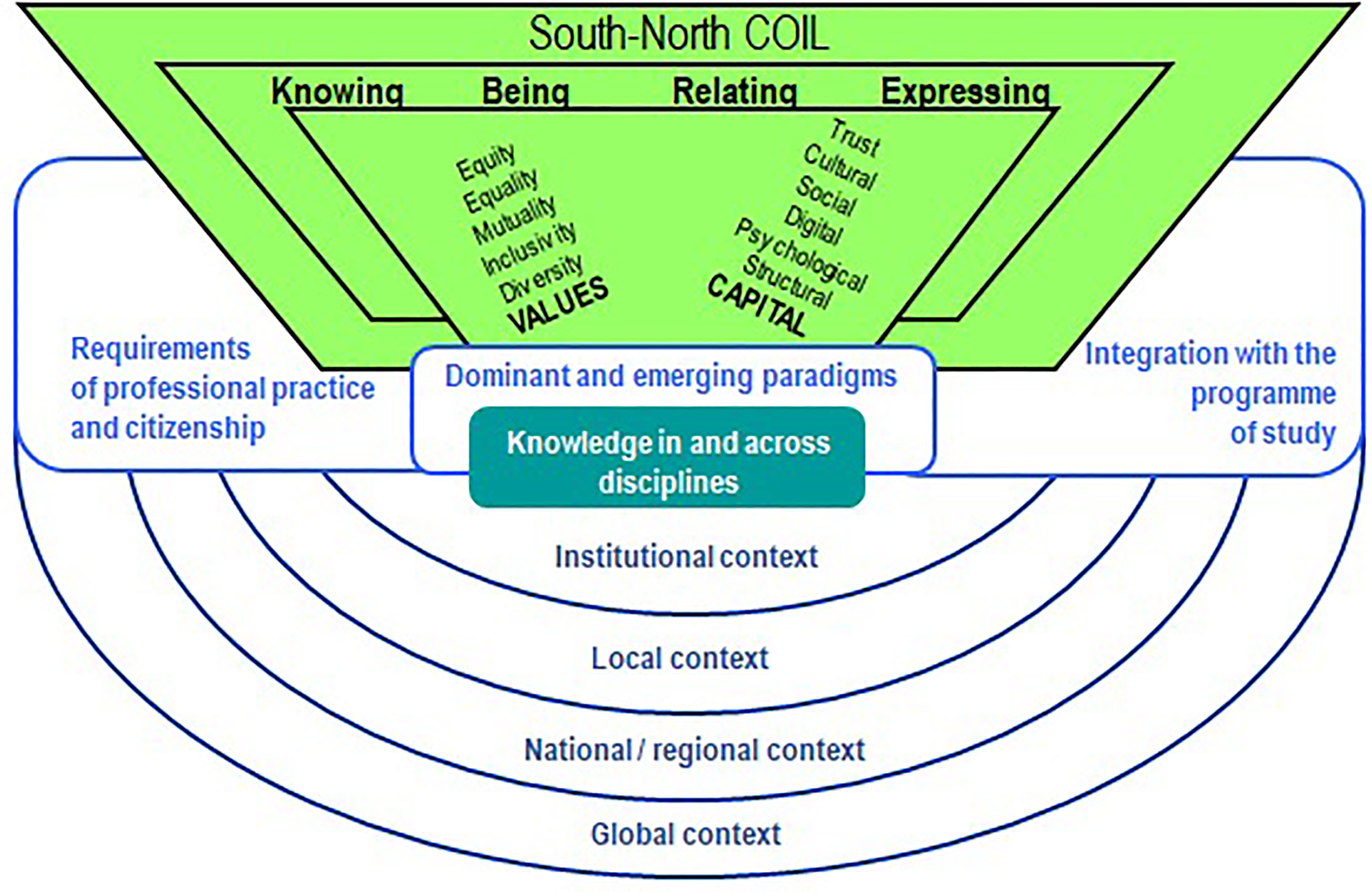
A conceptual framework of Third Space COIL exchange
Capitals of resonance in our framing between those engaging in COIL are social capital (c.f., Warschauer, 2003), digital capital (e.g., Ragnedda & Ruiu, 2020), cultural and psychological capital (e.g., Yang et al., 2021) and trust capital (e.g., Algan, 2018). Also, structural capital, such as flexibility and regulatory accommodation, to build the capacity and infrastructure to implement COIL within HEIs with diverse histories, contexts, and infrastructures. These capitals will be discussed further in what follows. Furthermore, values such as mutuality, inclusivity, equity (redress) and equality (equally valued) should guide all interactions in this space towards open and authentic interactions, promoting not only tolerance, but hospitality (Potgieter, 2015) and appreciation (Jacobs et al., 2021). Developing staff and students’ understandings of these connections, and not least their ability to be critical and reflexively engaged citizens, alongside the influence of disciplinary perspectives and diverse contexts, enables the Third Space COIL dialogue.
Core learning with our South-North COIL examples relates to how COIL as a Third Space needs to be cognizant of the ways that enable students to recognize, value and co-construct pluralized ways of being, knowing, expressing, and relating. But within that, how students’ cultural capital, based on their cultural and social foundation in learning, including their linguistic learning experiences, shape their ease in engaging with online material (McPhee, 2021).
Considering the disruptions caused by the pandemic with the migration of many social activities to virtual environments, forcing what could be viewed as a digitalization/virtualization turn, the practice examples in this paper illustrate ways in which COIL can serve to promote Third Space learning whilst being attentive to the challenges of digital inclusion and equity in international HE, fostering dialogue for curricula transformation and decolonization. Whilst such COIL approaches can potentially contest hegemonic, gate-keeping pedagogies, such learning still risks re-introducing privilege in other ways because of the tendency to replicate cultural practices in online student groups, in similar ways as inequities found in society as a whole. As such, addressing digital inclusion requires faculty to take note of students’ digital capital not only with regard to students’ tangible assets regarding connectivity and hard/software, but also students’ behaviors and digital learning ecologies (Gomes & Chang, 2021), as access to computers and the internet does not guarantee access to digital capital. Rather, paying attention to how the use of technologies can enhance social capital (understood as capacity to accrue benefits from relationships and memberships, in particular social networks, and structures) is required to ensure students’ physical access translates into digital capital (Warschauer, 2003). Furthermore, emphasis should not be on digital capital only, but on the variety of attributes that can be enhanced in this space (cf. Figure 1). Whilst further research is required to examine disengagement in the context of learner's digital capital, due consideration is required to build students’ resilience and [digital] psychological capital, building on Luthans et al. (2007), particularly at the time of the global pandemic and its aftermath in the digital turn. Such [digital]-psychological capital includes the characteristics of self-efficacy (e.g., having confidence to take on and put in the necessary effort to succeed at challenging tasks as part of Third Space learning) and in having optimism (e.g., in making a positive attribution about succeeding now and in the future). Hope, as in persevering towards goals, and as necessary, redirecting paths to goals, and resilience (e.g., in that when beset by problems and adversity, one is able to persevere even beyond the attainment of success) are also important related characteristics.
We posit that Third Space COIL might be troublesome (Meyer & Land, 2003) but has the potential to affect a positive shift for students, not least in exposing the previously hidden interrelatedness of (disciplinary) concepts or cross-cultural attitudes that were not seen as linked, thus helping to recenter knowledges, beliefs, and assumptions. In the construction of more ecologic and pluralistic ways of knowing, being, relating and expressing (e.g., through languages and visual artefacts) in and between the Global South-North, COIL can have a positive transformational effect on the learner. In particular, the discussion facilitated by the COIL encounters amongst both novice and experienced teachers of English on BMELTET and BSU COIL generated Third Space debates, where the awareness of local contexts versus global ones gradually emerged. This intercultural dialogue, which both projects continue to address, offers a critical take on the Global North and on the WASP (White Anglo-Saxon and Protestant) hegemonic models of ELT that are often applied to Global South contexts without consideration given to local needs. At the same time BMELTET highlights the need to be sensitive to learner's trust capital as part of resistance to COIL that needs further investigation. For example, in students’ sense of vulnerability in the online space, and with this students’ sense of being and core beliefs, and how these can be challenged. Drawing on Moscardini et al. (2020) and notions of trust capital, what has been evidenced in iKudu is how partners are engaging in dialogue in a continued attempt to show willingness to be open and engage in collaborative peer work to replace hierarchical models, thus sharing knowledge with less territorial approaches, adopting a more holistic and interdisciplinary lens.
Importantly, iKudu colleagues are not assuming that COIL can be a quick-fix, one-size-fits all solution. What will be required is a continued critical questioning of what curriculum transformation means, not least in building structural capital, in reviewing diversity and inclusion agendas, and in challenging mindsets which serve to create further divides and hierarchies.
Fundamental questions about being human and how humans relate to the world are clearly part of discourse taking place in global HE communities. Our motivation in this paper, and for faculty colleagues wishing to consider similar approaches, or pursue further research along these lines, is on curricular approaches which facilitate critical, dialogic encounters amongst students, academics, and wider communities, not confined by national contexts, but with g/local perspectives. In particular, we have focused on COIL as a Third Space within which academics can help facilitate the different intellectual, emotional, and socio-cultural positionings of Global South-North students. Further studies examining approaches to overcome challenges and to value opportunities towards equity and inclusion in the online space through COIL as a Third Space are encouraged. Our interest remains in how meaning-making can be transformed as a result of this engagement, and in the interest of ethical, and inclusive digital spaces for learning, which encourages creativity and does not distance students.
Conclusion
In this paper, and as academics situated in Brazil, SA, and the UK, our contribution to the field has focused on how COIL can support a new ecology of learning in the Third Space to de-center hegemonic western attitudes and encourage awareness and respect for pluralistic ways of knowing, being, relating and expressing. Extending Leask and Bridge's (2013) conceptual framework for curriculum internationalization we have identified an interconnected set of student, staff and institutional capitals, within a particular set of values, which give rise to alternative ways of knowing, being, relating and expressing for Third Space COIL. Conceptualizing COIL in this way requires careful construction of the learning space including recognition of the importance of non-hierarchical relationships amongst academic-academic and student-student relationships, and in the value of collective development as starting points in creating an inclusive and equitable online learning space—building on mutual values, rather than fostering binaries. We suggest the educational opportunities of COIL as a Third Space represents a pedagogical innovation for Global South-North IaH worth considering to recenter behaviors and practices amongst faculty and students, increasing cultural and linguistic diversity, and knowledge pluralism, with reciprocal benefits for all.
Footnotes
Acknowledgements
All staff and students involved in BMELTET.
The Federal University of Espirito Santo, Brazil (UFES), National Institute of Business Management, Sri Lanka (NIBM) & Coventry University, UK (CU) (UFES-NIBM-CU COIL exchange) is supported by research funding from Cnpq Scholarship (Research Productivity Level 2 Cnpq).
The iKudu project is supported by the European Commission Erasmus + : Higher Education – International Capacity Building Programme [Grant Agreement Number – 2019–2050/001-001] (October 2019–October 2022). The European Commission's support for the production of this publication does not constitute endorsement of the contents, which reflects the views only of the authors, and the Commission cannot be held responsible for any use that may be made of the information contained therein.
Declaration of Conflicting Interests
The author(s) declared no potential conflicts of interest with respect to the research, authorship, and/or publication of this article.
Funding
The author(s) received no financial support for the research, authorship, and/or publication of this article.
