



Abstract
About ten years ago, an innovative instrument was developed to promote internationalization in European higher education institutions—a Certificate for Quality in Internationalization (Cequint). The initiative fits well the contemporary governance philosophy that promotes voluntary instruments, an individualized approach, and an orientation towards transparency instead of control. While labels and certificates are becoming popular, their effectiveness is often questioned. In this paper we examine critically the value of Cequint and its potential for enhancing internationalization. The empirical results confirm that certified study programs outperform their uncertified peers. Partly the effect is explained by self-selection as internationally inclined programs are more likely to apply for the certificate, but there seems to be also a significant independent effect of the certification process. The paper suggests that a voluntary certification scheme can support organizational improvement by three mechanisms: by enhancing motivation, self-awareness, and expertize.
Introduction
Internationalization has become a widely accepted goal in higher education. Many countries have developed internationalization policies (de Wit et al., 2019) and an overwhelming majority of universities include internationalization in their strategic planning (Marinoni, 2019). The focus of internationalization varies across countries and types of institutions, but it also evolves over time. It can be seen as a contribution to international cooperation and collaboration, but also as an asset for international competitiveness in knowledge economy (van der Wende, 1999). The new millennium, furthermore, brought attention to global public goods and it showed the importance of global interdependencies and intercultural skills (IAU, 2012).
As goals of internationalization shift, policy instruments for promoting it evolve as well. Student and staff mobility is the most prominent part of internationalization and mobility numbers show an impressive success over the last few decades. Yet it is clear that physical mobility alone cannot fulfill internationalization needs in a mass higher education system (de Wit et al., 2019). In the context of global challenges, international competencies are important to all students, not only to a small selected group participating in mobility programs. “Internationalization at home” has therefore become an appealing concept and an important objective, promoting the idea that international and intercultural dimensions should be integrated into the formal and informal curriculum for all students within domestic learning environments (Beelen & Jones, 2015). A recent global survey by the International Association of Universities confirms that most institutions identify internationalization of the curriculum as an important aspect of internationalization in their institution (Marinoni, 2019, p. 33). Success of internationalization therefore cannot be measured only in its quantity but particularly in its quality, and as an integral part of all core missions of the university.
Policy instruments to promote quality of internationalization are still quite limited though (de Wit & Altbach, 2021). Existing policies tend to focus on physical mobility, such as visa regulations, funding arrangements, or on various excellence programs (Crăciun, 2018). While mobility numbers are quite straightforward to monitor, internationalization of curriculum and learning competencies goes deep into the core processes of higher education and is more difficult to measure and steer. Incorporating internationalization into regular quality assessment activities is one possible solution. Several national and discipline-specific professional accreditation agencies include internationalization as one dimension of quality in their regular procedures (de Wit & Altbach, 2021). Yet there are limitations for using such a standard approach for a major improvement. The level and nature of internationalization varies substantially across programs, dependent on the level of ambition of each program and a profile of the subject field. A standard assessment tool would necessarily settle on a lower end of the ambition.
Several prominent initiatives have emerged in recent years to measure and assess the quality of internationalization (Beerkens et al., 2010). The Internationalization Quality Review Process (IQRP) of the OECD and the Academic Cooperation Association (ACA) was among the first of such initiatives in the end of 1990s, developing a framework for self-assessment and offering an external review by an international review team. There are examples of rigorous evaluation of internationalization, such as one conducted by the American Council of Education in the US (Green et al., 2008). Several organizations have proposed thorough guidelines and toolboxes for assessing and benchmarking the quality of internationalization (Beerkens et al., 2010).
An interesting experiment to promote explicitly the quality of internationalization is the Certificate for Quality in Internationalization (Cequint), which was launched in 2012. It is an initiative that is run by The European Consortium for Accreditation in Higher Education (ECA). Bachelor and Master programs that want to profile themselves as excellent in terms of internationalization can apply for this European-level quality mark. Also higher education institutions as a whole can apply for the certificate. Although the initiative has been running for ten years, there is very little research about its contribution to internationalization. There is no independent assessment whether the certificate actually reflects a higher level of quality in internationalization. Are certified programs indeed more international, and is public trust in such a certificate warranted? And if so, what does the certification process contribute to quality, and how? We hope to offer some answers to these questions in this paper.
We hope to make two contributions with this paper. Ten years after the start of the Cequint initiative is a good moment to evaluate critically its contribution. The initiative asks considerable resources from participating programs and it relies on the energy and commitment of participating experts. Furthermore, certificates are often used in the promotion material to prospective students and other stakeholders as a valid signal of quality. It is therefore worthwhile to evaluate critically whether the investments and trust are justified from an institutional and societal perspective. The second purpose concerns certification as a policy instrument. Labels and certificates have become an influential policy instrument to promote various societal goals, such as environmental sustainability or social well-being. With this study we hope to understand better how such innovative, information-based steering instruments work and what is their potential not only for internationalization but in higher education more broadly.
What is the Cequint Initiative?
The Cequint is an independent European-level initiative that issues a quality mark to higher education study programs that demonstrate excellence in internationalization. The process is similar to a regular program accreditation and it is often conducted simultaneously with a standard quality assurance process. The process starts with a self-study report, which is then discussed with an evaluation panel during a site-visit, and thereafter the evaluation panel produces an assessment report. The certificate takes a comprehensive look at internationalization. It assesses programs on five standards: intended internationalization, international and intercultural learning (i.e. outcomes), teaching and learning (i.e. curriculum), staff, and students (ECA, 2015).
The evaluation panel makes a recommendation to either issue, not issue, or issue conditionally the certificate. A formal decision is made by the national quality assurance agency who runs the evaluation exercise. The European Association for Quality Assurance in Higher Education (ECA) is in charge of the process by supervising its methodology, checking whether the assessment was conducted according to the agreed procedures, and issuing the Certificate on its name. The ECA publishes the list of all certified programs on its website.
The Cequint initiative emerged out of the challenge to monitor and promote quality of internationalization in this new, more mature phase of internationalization. It started as a pilot project of the Accreditation Organization of the Netherlands and Flanders (NVAO), that responded to interest in this topic within the higher education sector (de Wit, 2012). Internationalization was becoming a recognized dimension of educational quality and programs were interested in demonstrating and being recognized for their level of internationalization. The NVAO system of quality assurance offered a flexible framework to respond to this interest. Namely, a standard NVAO accreditation process included an option for programs to apply for a “distinctive quality feature” of their own choosing without a prescribed list of possibilities. It was seen as an opportunity for institutions to profile themselves and thereby create more variety among higher education institutions. For example excellence in entrepreneurship or sustainability were commonly requested features, but also excellence in internationalization became increasingly popular (Aerden et al., 2013).
As more programs were interested in claiming a distinctive feature of internationalization, there was a need for a clear framework for a comparable evaluation and for advising programs about expectations. In 2009, NVAO gathered a group of experts from higher education institutions, ministries and relevant public organizations to discuss what NVAO could do in this area (Dittrich & Frederiks, 2013). Two important conclusions came out of the discussions. First, the experts agreed that NVAO should be focusing on actual learning outcomes and learning environment at a program level, not on institutional level proxies that describe internationalization activities. Secondly, it was felt strongly that it should remain a voluntary instrument with a focus on development and rewards, not a mandatory instrument based on sanctions. A recognition of excellence was believed to be enough of an incentive and reputation of a quality mark could be used for branding, promotion activities and alliance formation (Dittrich & Frederiks, 2013). These principles were worked into a scheme of internationalization certificates.
With help from several international experts, NVAO conceptualized the meaning of internationalization, and developed a framework for operationalizing the quality of internationalization (Aerden et al., 2013). While originally a Dutch-Flemish initiative, the exercise had from the start a European ambition. NVAO collaborated closely with its partners in ECA, and invited international experts from other agencies to take part as panel members (de Wit, 2012). The institutions themselves also indicated that a European dimension would add value to such a certificate (Dittrich & Frederiks, 2013). In 2018 the operation of Cequint moved from NVAO to ECA and thereby it became officially a European-level Initiative. The core principles have remained the same from the start. The scheme is based on a developmental approach and its primary mission is in enhancing and recognizing internationalization (ECA, 2015), but also in spreading good practices via its platform. Furthermore, the Cequint has a mission that exceeds merely internationalization: “The program's internationalization must have a significant impact on the overall quality of the program and its graduates” (ECA, 2015, p. 10). It also emphasizes the voluntary nature of the instruments: it is not necessarily an instrument for all but an opportunity to recognize programs that make a deliberative choice to go deeper in internationalization.
Stimulating internationalization by a voluntary certification scheme is an innovative approach, but it is an approach that fits very well modern ideas of regulation and governance. At the same time, certificates have been also criticized as misleading and ineffective in many occasions. In the next section we will conceptualize Cequint as a policy instrument, and develop an argument for its potential contribution to internationalization in higher education.
Labels and Certificates as a Policy Instrument
In recent years, dominant views about effective policy instruments have been changing considerably. Traditional state-centered, mandatory and uniform instruments often prove inefficient in a contemporary dynamic environment. They tend to be too slow to change, too rigid to respect diversity of missions and profiles, too weak to address cross-border effects and global supply chains, and they tend to be expensive to monitor and implement. Various voluntary and self-regulatory instruments are emerging as a response, including various labeling and certification schemes. Such schemes are set up to promote some societal value; for example, decent labor conditions in case of the well-known Fairtrade certificate, or environmental and regional wellbeing in case of the Sustainable Forestry certificate. The certification schemes are based on the idea of voluntarism. It is a voluntary choice of users to prefer a certified product over an uncertified one; and it is a voluntary choice of providers to join a certification program. The Cequint scheme falls also under this category of instruments. It is endorsing a societal goal, yet it is run by a non-governmental entity, and it is not mandatory for universities to join the initiative. Yet it can be qualified as a regulatory instrument: it attempts to reach better quality of internationalization by defining higher standards, by raising awareness and providing expertize, and by creating a tangible incentive in the form of reputational benefits that the certificate creates.
The effect of certificates can be conceptualized from three different viewpoints (Rickenbach & Overdevest, 2006): as a market mechanism, as a learning mechanism, or as a signaling mechanism. In a market logic, certificates are a way to create a market that might otherwise not exist. Especially for qualities that are not easily observable, a certificate is a tool that allows the provider to set higher but costly standards that would otherwise be suppressed by market competition for efficiency (Bartley, 2007). Certification gives a financial or reputational premium to high-performing institutions which allows them to distinguish them from others. Nevertheless, providers join certification schemes also on other reasons. Certification schemes are also an instrument for learning. Such schemes expose providers to new methods and practices, and the process makes providers to critically review and adapt their own processes. Thirdly, certification scheme can be a signaling tool to demonstrate commitment to certain values to external stakeholders. Sometimes providers or a sector as a whole turn towards a new certification scheme to avoid or overcome criticism from external stakeholders about their practices.
Advantages of certification and labeling schemes over traditional mandatory government instruments are manyfold (Büthe & Mattli, 2011; Vogel, 2010). They are particularly effective in encouraging new norms that are not yet well established in practice and which therefore cannot be imposed on all without creating substantial resistance and unreasonable costs. A certification scheme recognizes forerunners and thereby helps to push for higher standards, but it also increases awareness and expertize among other providers and users. A mandatory-to-all set of rules must accept standards that are realistic to achieve also by low-performers. A certification scheme can help to spread the norm further, develop expertize in the field, and thereby aim at higher standards in the long run. Secondly, certificates are responsive to issues that are important to certain societal and interest groups but not necessarily accepted by all yet (Baldwin et al., 2011). This allows an earlier reaction than developing an official government policy. Initiatives that fail to create support, dye out naturally as obsolete. Governmental initiatives cannot afford failures easily, neither can they represent strong interests of a small advocacy group. Thirdly, private initiatives help to save public money as the costs of developing standards and monitoring the compliance are carried out by a private actor and/or providers themselves. Furthermore, actors devoted to a certain topic have often more expertize and also more motivation to guard the norms, to specify standards and spread their expertize. Finally, governmental regulation is often criticized by administrative burden and compliance mentality. Joining a certification scheme is a voluntary instrument, which means that organizations must make a rational choice about their own relative costs and benefits of joining such a scheme.
The voluntary and flexible nature of certificates is also their weakness. A positive effect of certificates depends on a number of factors and often certificates also fail (Lytton, 2014). A lot depends on the ability of the certifying agency to define good standards and monitor them rigorously before issuing a certificate. A certificate may fail to achieve the societal value as hoped because specified standards may be misinterpreted or they do not contribute sufficiently to the end goal. Furthermore, both for-profit and not-for-profit certifiers can end up in a conflict of interests as the success of the certification schemes is dependent on providers’ willingness to participate in the scheme, which may be negatively affected by too demanding standards.
Considering inconclusive evidence about certificates as a successful policy instrument, we wish to examine critically the success of Cequint certificates. The key question is whether certified programs indeed outperform other programs, and whether the certification scheme has contributed to higher performance. The next section will elaborate on the data and method used for the empirical analysis.
Data and Method
For the empirical study we compare the quality of internationalization between certified and uncertified programs in the Netherlands. The Cequint is a European-level initiative, but for the methodological rigor of this paper we must zoom in to one country. There is no program-level performance data that is comparable across countries. The Netherlands makes an excellent case for this study. It has been the most active Cequint country, which can be explained by the active role of the Dutch quality assurance agency in launching the initiative. Furthermore, the Netherlands has good program-level data on students satisfaction with many aspects of their studies, including internationalization.
An independent measurement of the quality of internationalization is not easy. As an indication we will use the student satisfaction with internationalization, obtained from the national student survey NSE (Nationale Studenten Enquête). The NSE evaluates students’ satisfaction with various aspects of their education, including “attention to internationalization”. The satisfaction is presented on a 5-point scale with 0 as not at all satisfied and 5 as very satisfied. The NSE survey is executed by the foundation Studiekeuze 123 and it is funded and supervised by the Ministry of Education, Science and Culture.
Student satisfaction gives only one perspective of quality. An evaluation of a program's mission, learning objectives and curriculum might give a different perspective about the quality. Yet the satisfaction measure has too advantages for this study. First, it addresses well the externally oriented signaling goal of the certificate. The certificates can be used as a marketing tool to attract students who value internationalization. It is therefore relevant to study whether students of certified programs perceive the quality of internationalization differently than students in uncertified programs. While a close examination of the program might give a better picture what certified programs do differently, the information would not tell whether the activities translate into a better student experience. Second advantage of the measure relates to the tradeoff between the scale and precision. The student satisfaction measure exists on all programs in the Netherlands and therefore it does not suffer from a response bias, a sampling bias or a bias from a qualitative coding. Nevertheless, the measure has obvious limitations. Student satisfaction does not necessarily mean that students indeed achieve higher international competencies and intercultural skills. It probably shows primarily the extent to which internationalization goals and activities are visible in the program. Secondly, satisfaction may be influenced by the certificate itself. As programs use the certificate often for marketing purposes, it is conceivable that students who value internationalization are more likely to choose a certified program. It is difficult to predict what bias this would create in our results. Knowledge about the certificate may lead to higher satisfaction as students have external assurance that their program is international. On the other hand, students who choose a program for its internationalization have also higher expectations and therefore they are more difficult to satisfy. Despite of the limitations and nuances, the student satisfaction measure can give valuable insights to examine quality differences between certified and uncertified programs.
In the sample we will use all accredited, publicly funded Bachelor and Master level programs in the Netherlands. The NSE dataset excludes programs that deliver less than 5 responses and those are excluded from this study. We will use the data from the year 2018, which is the most recent year the NSE data is available for both academic universities and the universities of applied sciences. The data has been obtained from the foundation Studiekeuze 123 in its original raw format. All individual values are merged by program into a program-level mean value. Our total sample is thereby 2,366 programs, divided almost equally between Bachelor (45%) and Master (47%) programs, and between academic universities (36%) and universities of applied science (56%) (UAS) (see Table 1). The category “other” includes programs like advanced masters for executive-level professionals.
Description of the Sample.
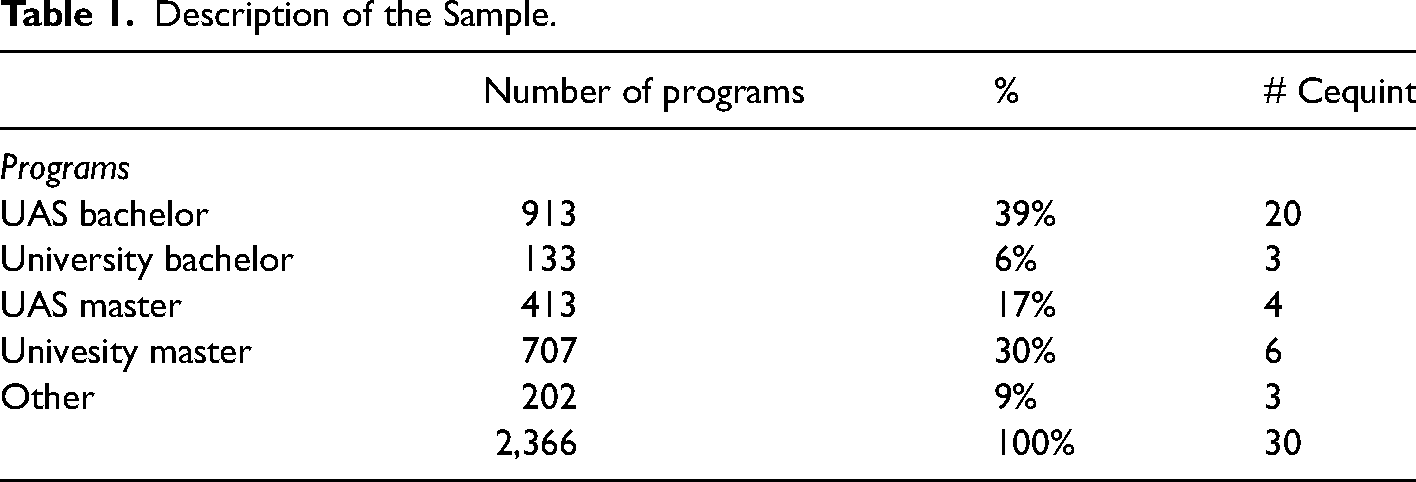
For this study we code a program “certified” in case it has gone through the certification scheme in the year 2019 or before. We thereby assume that the potential positive effects should be observed already during the certification process, not only after issuing the certificate. Within the ten years from the start of the program (2010–2020), 50 certificates have been issued to Dutch programs. The data has been extracted from the ECA register of certificates, and for earlier years, from the NVAO. 20 certificates out of the 50 had to be dropped because the programs had been stopped by the year 2018, the certificates were expired in 2018 (but often they were re-certified), they were issued in 2020 or later, or were issued to institutions not programs. In sum, the total sample is 2,866 study programs from which 30 programs are certified. We can see in Table 1 that the certificates are divided across master and bachelor programs, and that Universities of Applied Sciences are more active participants in the certification scheme than academic universities.
The analysis is built up in three steps. First, we start the analysis with the question of whether certified programs demonstrate higher satisfaction with internationalization than non-certified programs. This is an attempt to answer the question of whether such a certificate conveys any substantial information about the programs, i.e. could an incoming student assume a more international context in a certified program compared to another, uncertified program. However, even if there is a positive correlation between the certificate and internationalization, the causal link between the two may still be challenged. A potential self-selection effect might explain a positive effect: more performance-oriented, pro-active programs are more likely to participate in such a scheme to start with. Therefore, in the second step we examine whether certified program demonstrate in general higher satisfaction with the overall quality of the program, not only with internationalization. A self-selection issue can express itself also in another way. It is likely that programs that have a strong international character (e.g. International Economics, International Relations) are more likely to apply for such a certificate in order to demonstrate their international profile. They would show higher level of internationalization than locally oriented programs regardless of the certificate. As a third step, therefore, we control for the type of the program. In the Netherlands all accredited programs are registered in the national registry, so called CROHO registry. The CROHO registers programs based on their field codes, and the same programs receive the same code. Based on the field code we can thus group together the same programs in different institutions (e.g. Bachelor in Occupational Therapy or Master in International Economics) and thereby compare certified programs not only with all programs, but other programs in the very same field of study.
We will first present differences between mean values across the various program groups and then present the results of a multi-variate, multi-level model that takes into account also other potential variables such as a type of a program and level of the degree. This is set up as a quantitative study, aiming to establish the effect of certificates independently, not relying on perception of participating institutions. In order to explain and contextualize the statistical results, though, eight programs were interviewed. The purpose of the interviews was twofold: to understand why programs apply for the certificate, and what changes if any they had to make for the certificate. This information helps to understand better the causality between higher satisfaction scores and having a certificate, and not to satisfice only with a statistical correlation. Semi-structured interviews were conducted with a program director or coordinator of eight certified programs. The interview data should not be seen as a systematic qualitative analysis, but as a source for further insights to better interpret and understand the observed statistical results.
Analysis and Results
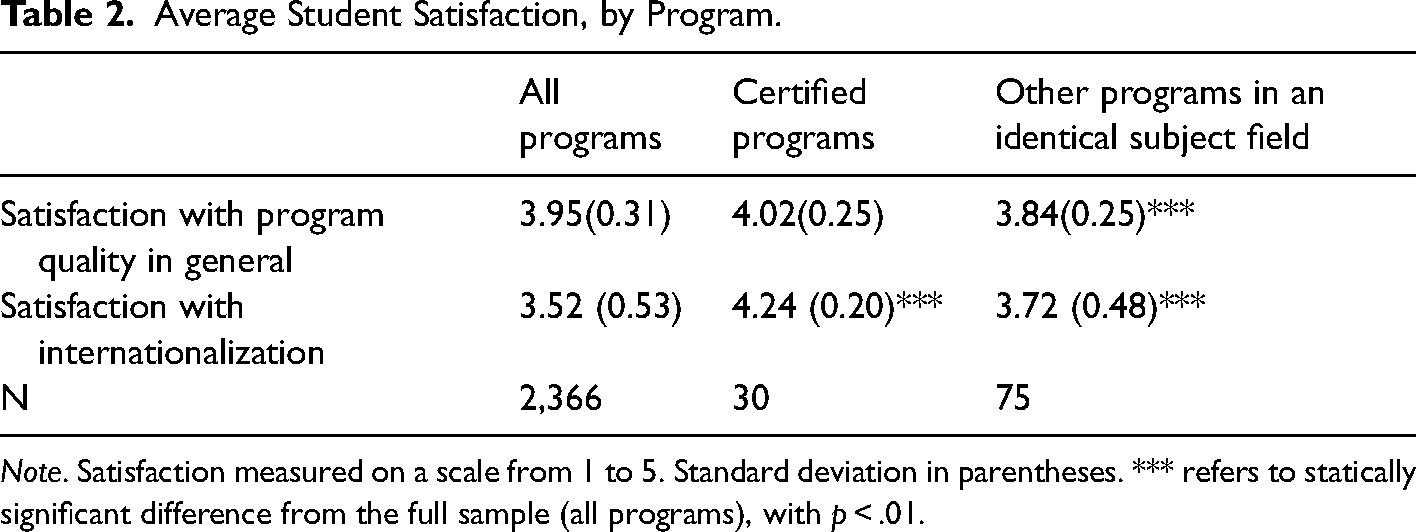
According to the results in Table 2, Dutch students seem to be quite satisfied with the quality of their program. General satisfaction with the program is on average 3.95 on a five-point scale. Satisfaction with internationalization, however, is considerably lower: on average 3.52 on a five-point scale, which is almost half a point lower than general satisfaction.
Average Student Satisfaction, by Program.
Note. Satisfaction measured on a scale from 1 to 5. Standard deviation in parentheses. *** refers to statically significant difference from the full sample (all programs), with p < .01.
Students in certified programs are clearly more satisfied with internationalization (Table 2). Certified programs show a remarkable score of 4.24, exceeding the average by 0.72 points. The difference exceeds a full standard deviation (0.53) and provides thus a solid evidence that certified programs are indeed more internationalized, at least in the experience of students.
It is conceivable that the certificate tells more about the type of programs that apply for the program than about the effect of the certification. Perhaps the certified programs are in general more ambitious in terms of their quality and eager to demonstrate their quality and their internationalization. While certified programs show a slightly higher average satisfaction score by students (4.02 compared to 3.95), the small 0.07 point difference is not statistically significant at the 5% confidence level. We can thus conclude that while certified programs are not different in overall satisfaction, they clearly stand out in terms of their internationalization.
The biggest issue in the results is still the self-selection problem. It is conceivable that programs that are more international in their subject matter are better evaluated on internationalization, and also more likely to apply for the certificate. It is indeed the case that the list of certified programs is dominated by programs that have an international nature, such as International Business or International Hotel Management. In the next step it is therefore important to take into account the nature of the program, and to compare programs that are comparable. The last column of Table 2 shows the programs that that are in the same field as certified programs (e.g. all programs of International Business, International Hotel Management etc. in the Netherlands), but excluding the certified programs. It is indeed true that programs from the same program groups score higher on internationalization that all programs in the Netherlands (3.72 vs 3.52), which is a statistically significant difference of 0.2 points. Nevertheless, the certified programs clearly outperform their colleagues in the same field (4.23 vs 3.72).
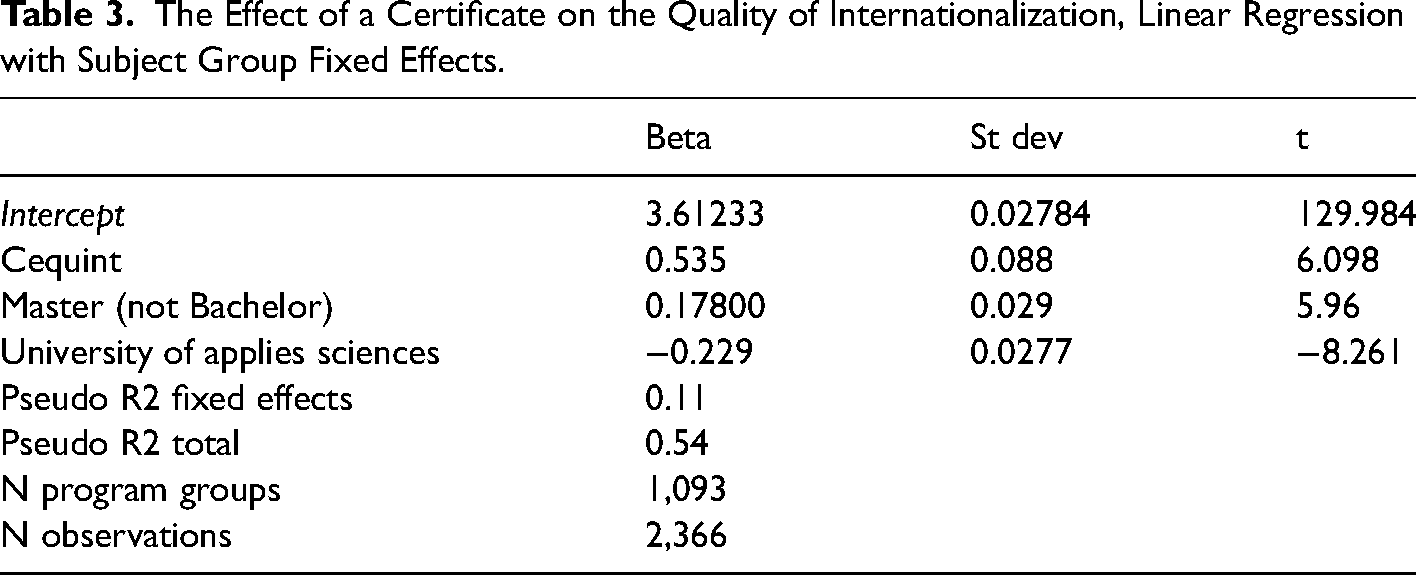
We will conclude the statistical analysis with a formal multi-variate and multi-level model. The quality of internationalization is explained by a program level variable such as the certificate, but possible also by other variables. It may be expected that universities of applied sciences are less internationalized than academic universities due to their close links to local labor market. Master programs as more advanced programs, on the other hand, are likely to be more internationalized both in academic universities as well as in universities of applied sciences. Additionally, the multi-level model controls the potential self-selection effect we have derived empirically from belonging to a specific program group. The results in Table 3 confirm that certified programs demonstrate a significantly higher level of internationalization (by 0.53 points). Furthermore, expectedly, university programs are somewhat more international (by 0.2 points) than programs in universities of applied sciences, and master programs tend to be more international (by 0.18) than Bachelor programs. There is a significant effect of programs groups, explaining 11% of the variance (ICC).
The Effect of a Certificate on the Quality of Internationalization, Linear Regression with Subject Group Fixed Effects.
Qualitative Insights
Statistical evidence shows clearly that certified programs are more international, at least in perception of students. To understand why this is the case, we draw insights from eight semi-structured interviews with the representatives of certified programs. The interviewees were asked about their motivation to apply for the certificate and about the effect of certification on their program. It appears that programs predominantly joined the initiative in order to be able to profile themselves with this quality mark—either directly towards prospective students as a competitive advantage or more abstractly for a reputational effect: “to stand out”, “to be visible to international students”, “kind of a marketing instrument, to have it on my website”. However, the learning element is clearly recognizable in the answers of about half of the respondents: “to encourage the internationalization of the full curriculum”, “it forces you to rethink everything”, “we wish to train a truly European [specialist of the field]”.
It is surprising that most programs report that they had to make only a few changes to meet the requirements of the Cequint: some were changing their final thesis project more international, some adjusted somewhat their learning outcomes, and only two programs recognized that they had to fully rethink their learning outcomes and the curriculum. Even if actual changes in the program are not major, it seems from the interviews that certification is primarily a cognitive process within the organization. It seems to be raising awareness within the organization about what they do and why, and it brings visibility to certain goals and activities. The discrepancy between a major effect on students’ perception and relatively small changes in programs is a curious result. It is not evident from the interviews that the certified programs saw themselves particularly international compared to their colleagues elsewhere, so it is unlikely that the programs were so much more international to start with. The certification process seems to lead to an international awareness and profile that is visible to students, without requiring necessarily major changes.
Conclusions and Discussion
The Cequint certification scheme has been in place for ten years. It was an innovative experiment to refocus attention from quantity to quality of internationalization, and to promote internationalization via voluntary mechanisms. It makes use of the ambition and knowledge of the forerunners in this area. Whether such an approach works for internationalization and for higher education in general is an intriguing question. There are both successful and unsuccessful examples of certificates in various policy sectors, so a critical empirical look into the certification scheme is clearly needed.
The results of this study show that that a Cequint certificate is a valid signaling tool. Prospective students and other stakeholder can be assured that a certified program is probably more internationalized than its counterparts. Whether higher quality of internationalization in these programs is a positive contribution of the certification scheme or a result of self-selection of applicants, is a more difficult question to answer within the limitations of this study. It is reasonable to assume that already well-performing programs are more likely to apply for such a certificate. Their compliance costs are lower and probably they are also more committed to internationalization to start with. However, such a self-selection mechanism behind certificates is not always the case. There are certification schemes that, on the contrary, attract more low-performers because these organizations need to build trust in the eyes of stakeholders that well-performing organizations do not need to worry about, or want to learn from the process for improvement (Overdevest & Rickenbach, 2006).
One ambition of the Cequint, however, remains unfulfilled according to the results of this study. The Cequint's mission is to contribute not only to internationalization but also to the overall quality of the program. Based on student satisfaction data, a certificate has a considerable effect on the quality of internationalization but there is no effect on overall quality of the program. The result seems to suggest that quality of a program can be achieved in different ways. Internationalization may be one way towards quality, but it is not a necessary or a sufficient condition for a high quality program. The relationship between the two dimensions may depend on the type of the program though. If we compare certified and uncertified programs within the same subject area, then we can see that certification indeed coincides with better overall quality. This indicates that internationalization can be an important part of overall quality of the program, but it is not necessarily the case for all types of programs but only for programs where international nature is part of the subject matter and expected competencies.
Voluntary, self-regulatory tools seem to be thus a promising steering instrument in higher education. Reputation is an important asset in the higher education sector and recognition alone may create a necessary effect even without economic benefits. The most interesting question is about the mechanism how a certification scheme leads to higher quality. Making quality differences transparent is one task of a certification scheme, but the ultimate goal is usually about change and improvement. Qualitative interviews give some insights about a change in organizations as a response to the certification process. Most programs in their own perception did not have to adjust a lot in their core processes. However, they were forced to think through what exactly internationalization means in their context, and thereby built awareness and a shared understanding within the program. It is often shown that a clear narrative and vision is an important element in organizational change, and a certification procedure may offer a necessary anchor point for difficult organizational changes. Furthermore, the importance of self-reflection and collaborative approach to curriculum review is widely recognized. In regular quality assessments, self-study is often seen as the most useful element in the entire exercise, encouraging a critical reflection and discussion within the organization. Collaboration between teaching staff is vital for building up a coherent curriculum and links between modules, but it is also vital for having a shared understanding of the mission of the program and intended learning outcomes of students. The certification scheme seems to offer a focus for such a collaborative exercise to streamline activities and define learning outcomes jointly. Apparently this translates into a noticeable difference for student experience and satisfaction.
This paper suggests that the Cequint scheme works via three mechanisms. It offers a tangible incentive for programs to review their processes. It means an organizational commitment that is essential for carrying out difficult organizational change processes. Secondly, the certification process encourages collaboration among teachers and promotes awareness about the goals of the program. A shared understanding of the mission is an important cornerstone for a good program. Thirdly, the certification scheme defines standards and thereby offers expertize to guide programs for higher quality. Relative importance of these three mechanisms can vary considerably across programs.
Several certification and labeling schemes have appeared in recent years. Next to higher education specific certificates, universities increasingly join also other certification schemes. As large corporations with major regional impact they must respond to various external expectations, as reflected for example in a certificate of sustainable management or of inclusive employer. The variety of certification schemes reflects the variety of goals that different stakeholders value. This means a choice for every institution and program to define its own priorities, and respond to expectations of these stakeholders that are most relevant to them.
Footnotes
Acknowledgements
I would like to thank Genesis Alberto and Rosina Nzambi for contributing to the interview material and Mark Frederiks for his help with identifying certified programs.
Declaration of Conflicting Interests
The author(s) declared no potential conflicts of interest with respect to the research, authorship, and/or publication of this article. She has not been involved in any activities related to Cequint, neither received funding for executing the study.
Funding
The author(s) received no financial support for the research, authorship, and/or publication of this article.
