




Abstract
Although many studies on international student mobility have examined the impact of individual factors (e.g., gender, age, family background) on students’ decisions to study abroad, much less attention has been devoted to the role played by the institutional climate and characteristics of their home university. Using data from an Italian survey containing information on a large number of university students, this research investigated the extent to which a more international academic environment incentivizes students to participate in study abroad programs. A logit model was developed to estimate the effect that the degree of internationalization of one’s home university has on the probability that its students will study abroad, while controlling for several student-level factors. The empirical estimates indicate that this effect is significant, suggesting that being part of an international academic environment, where domestic students can interact more frequently with international students, helps motivate them to undertake study abroad. This result stresses the importance of engaging domestic students in the internationalization process of their universities.
Introduction
There is a strong consensus among academics and policymakers that spending some time abroad during university studies is highly beneficial to students. Not only does studying abroad contribute to their personal development (Zimmermann & Neyer, 2013), but, following graduation, it may enhance their employability (Di Pietro, 2015) and earnings (Kratz & Netz, 2018). This has sparked a debate on what can be done to encourage more students to study abroad (Perna et al., 2015). Relevant measures may include an increase in the amount of resources available to support study abroad program development and implementation. For instance, the new Erasmus (European Region Action Scheme for the Mobility of University Students) program 1 (Erasmus+) has a budget of €14.7 billion for the period 2014 to 2020, representing a 40% increase compared with the previous planning period (European Commission, 2016). At the same time, universities and governments have intensified their efforts to increase students’ awareness of the advantages of studying abroad.
This study contributes to the debate by investigating the extent to which an international academic environment (defined later) makes university students more likely to decide to undertake a study abroad experience. Although there is a considerable literature on the determinants of study abroad program participation, most studies (see, among others, Di Pietro & Page, 2008; Messer & Wolter, 2007; Souto-Otero, 2008) look at the effects of student characteristics such as gender, academic ability, and family background. Although institutional climate and characteristics may also influence students’ decision to study abroad (Anderson, 2007), their role has been largely neglected. In addition, although several works (see, for example, Parsons, 2010; Soria & Troisi, 2014) show that internationalization at home, comprising all the activities implemented by higher education institutions to improve their international outlook and intercultural capabilities (Robson, 2017), is important to ensure that non-mobile students receive a global education, much less is known about its impact on participation in study abroad programs.
This study focuses its attention on Italian universities in light of their recent increased internationalization. This is evidenced by several indicators. First, the proportion of non-Italian citizens who are enrolled at Italian universities has been steadily increasing, from 2.55% in the academic year 2005–2006 to 4.61% in the academic year 2016–2017 (Rugge, 2018). Second, there has been an increase in the number of English-taught degree programs in recent years, from 143 in the academic year 2013–2014 to 245 in the academic year 2015–2016 (Rugge, 2018). Third, the last decade has been characterized by increased inward and outward student mobility: the number of both incoming and outgoing Erasmus students 2 has risen remarkably during this period (European Commission, 2017). Finally, in the academic year 2015–2016, Italian universities offered 140 international double- or multiple-degree programs, in which 171 foreign higher education institutions were involved (Rugge, 2018).
One problem with estimating the extent to which an international academic environment is associated with students being motivated to study abroad is the bias introduced by unobserved institutional characteristics. For example, students attending certain universities and studying certain disciplines may tend to have a greater exposure to study abroad programs relative to others. This problem was addressed by developing a logit model predicting study abroad program participation where both university and discipline fixed effects are included. University fixed effects controlled for differences across universities; a more prestigious university may consistently provide its students with more study abroad opportunities across a range of disciplines. Similarly, discipline fixed effects controlled for the possibility that the availability of study abroad places may differ systematically for students of different disciplines.
Before we turn our attention to the logit model we used to estimate the impact of internationalization of one’s home university on the choice to study abroad, we first conceptually consider why an international academic environment may promote study abroad.
Why Would an International Academic Environment Affect Study Abroad Participation?
The most important channel through which an international academic environment may increase study abroad program participation lies in the interaction between domestic and international students. 3 Studies on intergroup contact theory (Allport, 1954; Pettigrew & Tropp, 2006) suggest that, after interacting with international students, domestic students may be more willing to undertake an international study experience. The presence of international students on campus may promote domestic students’ intercultural development (Volet & Ang, 1998). Greater exposure to different cultures may enhance empathy for them and generate an interest and a curiosity to have a better understanding of those cultures (Deardorff, 2009). In addition, increased contact with international students may help domestic students overcome prejudices and stereotypes which can prevent them from participating in study abroad programs (Pettigrew, 1998). A recent study conducted by the Erasmus+ Student and Alumni Association (ESAA, 2018) finds that the proportion of domestic students who interact with their international counterparts on a regular basis is substantial, and also indicates that these interactions increase domestic students’ motivation to study abroad. More specifically, 47% of current and former study abroad participants report that their choice to study abroad has been influenced “at least considerably” (ESAA, 2018, p. 35) by encounters they have had with international students while studying at their home university.
These conclusions are, however, questioned by several studies indicating that many domestic students are reluctant to interact with international students or only have superficial contacts (Brown & Daly, 2004; Ward, 2001). Nevertheless, it is important to note that the majority of these studies are based on Anglophone countries where students frequently cite international students’ lack of English language competence as the most important reason for not initiating an interaction with an international student (Sawir, 2013). In Italy, this is arguably less of a problem as there is likely to be a smaller gap in English language skills between domestic and international students. Another reason often put forward to explain the lack of integration between international and domestic students is that home students fear that the international students may compromise their marks if they work together on academic tasks. If allowed to do so, domestic students prefer to work in groups with co-nationals or existing friends (Peacock & Harrison, 2009) as they lack confidence in international students’ ability to complete assessed tasks to the appropriate standard (Stephan & Stephan, 2000). However, such a problem is again more likely to occur in Anglophone countries where assessment is frequently based on group work: in Italy, almost all academic assessments are individual.
In academic environments where many students have already had an international experience one should expect increased interest in study abroad, given that one of the most effective ways to promote study abroad programs is by word of mouth. Former study abroad participants can play an important role in motivating and providing information to their fellow students who have not yet had an international experience. A survey conducted in Australia finds that 43% of university students willing to participate in study abroad programs cite the experience of other students as one of the main factors encouraging them to apply (Universities Australia, 2016). Similarly, Massey and Burrow (2012) show that in Canada study abroad participants relied significantly on past exchange students to gain information about both how to apply for studying abroad and suitable host institutions. Anderson (2007), using data on a small number of study abroad participants from a large public U.S. university, analyzes the reasons behind their decision to study abroad and comes to the same conclusion. Doyle et al. (2010) find that word of mouth is considered by New Zealand students to be the most effective source of information about student exchanges. Haddad (1997) examines how the size of the study abroad program offered to the engineering students of a U.S. university changed over time and argues that students’ word of mouth accounts for most of the growth experienced by this program.
This study investigates the extent to which universities’ degree of openness to international experiences—which captures, among other things, the exposure of domestic students to their international peers as well as the size of the study abroad community on campus—incentivizes students to participate in study abroad programs. We also test whether this relationship is robust even when we include controls for student and institutional characteristics.
Data and Methods
University Student Demographics and Study Abroad Participation
The primary data source used in this research was a nationally representative survey conducted in 2011 by the Italian National Statistical Institute (ISTAT) on individuals who successfully completed upper secondary school in 2007 (Percorsi di studio e di lavoro diplomati—Indagine 2011). 4 Although this survey was not specifically addressed to university students, it includes information on a large number of them because in Italy, as in many other countries, a significant proportion of recent high school leavers choose to continue their studies at university. This makes it possible to track students who entered the first cycle of university studies 5 immediately after completing upper secondary education and were still enrolled 4 years later. 6 An important aspect of this survey is the possibility of observing whether university students have participated in “official” international student mobility programs (including Erasmus and other student exchange agreements) during their studies. The survey also reports information on the discipline studied at university, the type of upper secondary school (vocational or academic, private or public) attended, and the final grades obtained at the end of upper and lower secondary education. There are also data about such personal characteristics as gender, age, and parental education. 7
Although the survey does not provide information on the university attended, it does report the province in which it is located. Given that in the majority of Italian provinces there is only one university or there is only one university where it is possible to study a given discipline, it is feasible to identify the university attended by most students included in the sample. Where this was not possible, the students were removed from the sample used. This unfortunately meant that we were unable to include in the analysis those students enrolled at universities located in large cities.
University Internationalization
Data on university internationalization were taken from the newspaper La Repubblica. They are based on the analysis by the Centre for Social Studies and Policies (CENSIS), one of the most prestigious Italian national research institutes in social sciences and economics. CENSIS assesses the degree of internationalization of each university at the discipline level. 8 A score between 0 and 110 was awarded on the basis of the following five parameters: 9
The proportion of enrolled students who are not Italian citizens;
The proportion of students who participated in training or study abroad programs in the previous year;
The number of study abroad students as a proportion of all students;
Institutional expenditure on international student mobility;
International double-degree programs as a proportion of all degree programs.
Data on the above parameters come from various sources including, for instance, the Italian Ministry of Education and Research (MIUR). The awarded score was matched to the ISTAT dataset by attributing to each student the internationalization score obtained in the relevant discipline by the university attended. The internationalization score data used refer to the academic year 2007–2008, that is, when students were in their first year of university study. The rationale behind this is that students typically study abroad in the second or third year, but they probably develop their plans in the first year. Using internationalization score data referring to later academic years would also lead to a simultaneity problem: the proportion of students studying abroad in the second and the third year in the ISTAT dataset is likely to have contributed to the internationalization scores for the academic years 2008–2009 and 2009–2010.
Data Analysis Strategy
The empirical analysis proceeded in four stages. It began by looking at the relationships between participation in study abroad programs, on one hand, and student characteristics and internationalization score on the other. A t test was used to compare differences in means between participants and non-participants in study abroad programs. This was followed by a logistic regression where a student’s decision whether or not to study abroad is assumed to be determined by the internationalization score obtained in the relevant discipline by the university he or she is enrolled in, as well as by a number of individual-level characteristics (i.e., control variables). These included gender, age, parental education, discipline studied at university, vocational or academic upper secondary school, public or private upper secondary school, upper secondary school final grade, and lower secondary school final grade. Logistic regression is an appropriate technique for the analysis of dichotomous outcomes in an educational context (Agresti, 1996). Results for various specifications of the logit model (i.e., different combinations of predictors of study abroad program participation) are presented. In addition, as noted earlier, in an attempt to account for unobserved discipline and university characteristics affecting participation in study abroad programs, university and discipline fixed effects are included in the regression model (see Appendix for details about the logit model used in this article). Next, several robustness tests were carried out to support the reliability of the results obtained in the second stage. Finally, possible heterogeneous effects were investigated by analyzing whether the effect of internationalization on study abroad program participation varies by gender, parental education, or academic ability.
Results
The final sample used consisted of 3,263 university students, and the study abroad participation rate was approximately 7.42%. Unless otherwise indicated, survey weights 10 were used in all analyses. The first question was the extent to which participating and non-participating students possess similar observed characteristics. To check for this, Table 1 presents means for participating students (Column 1), non-participating students (Column 3), and the difference in means between these two groups (Column 5). The results of a t test showed that participating students differ from non-participating students along several characteristics. Having completed an upper secondary academic school (liceo) increases the probability of participating in study abroad programs. This type of school provides a curriculum that is more conducive to studying abroad as it offers, for instance, better opportunities to learn foreign languages, whereas lack of foreign languages is often considered to be an important barrier to international student mobility. Studying foreign languages is also associated with a higher likelihood of participating in study abroad programs. Such result could reflect differences in exposure to these programs across students of different disciplines (Böttcher et al., 2016). Female students are found to be more likely to study abroad than their male peers. This could be explained by women being more open-minded and having more positive attitudes toward international experience (Pope et al., 2013). Considering the internationalization score, the raw mean score indicated a statistically significant difference between students who studied abroad (M = 82.94) and those who did not (M = 79.76).
Mean Characteristics of Participants and Non-participants in Study Abroad Programs.
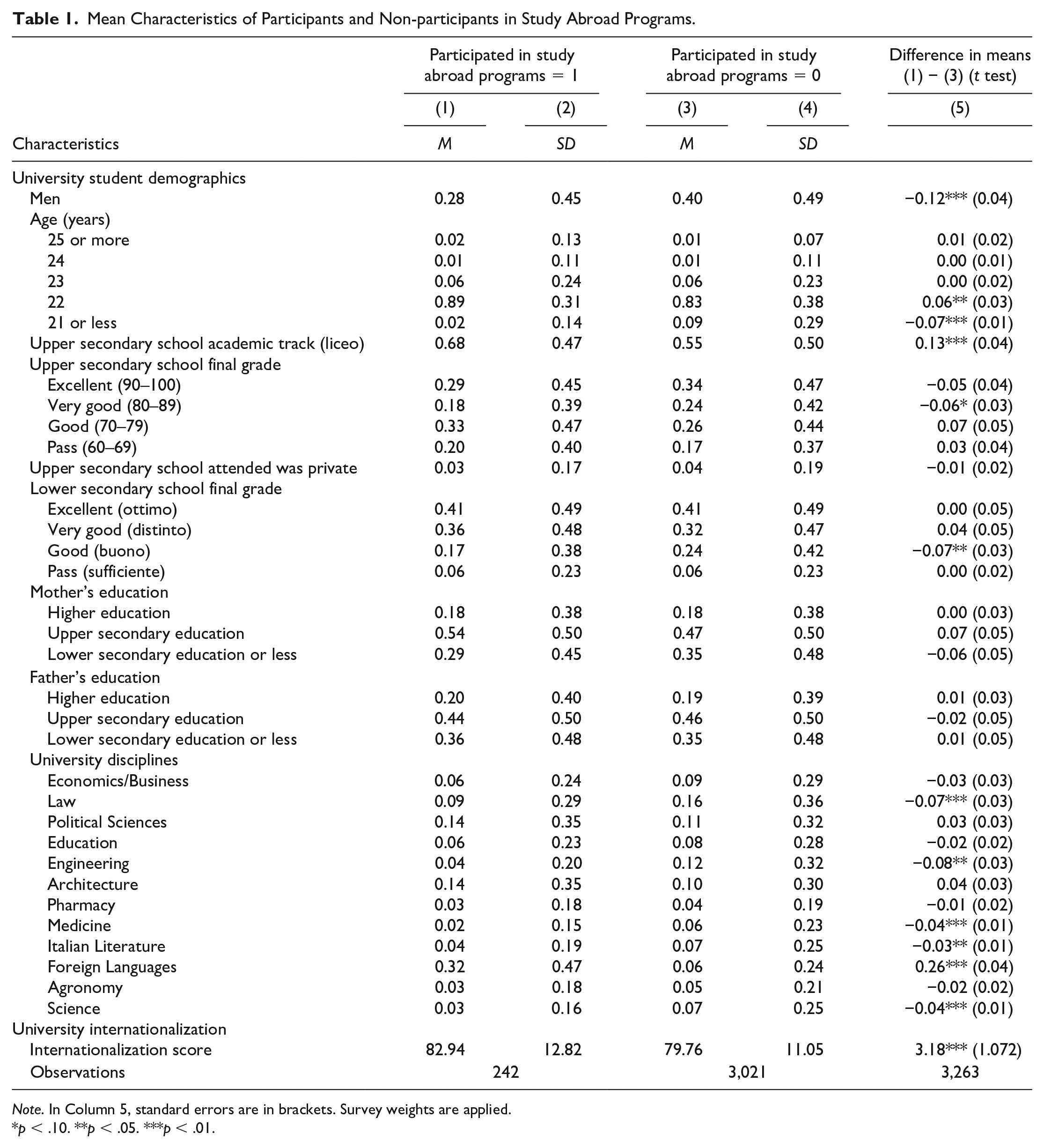
Note. In Column 5, standard errors are in brackets. Survey weights are applied.
p < .10. **p < .05. ***p < .01.
The next step in the analysis was to examine the results from the logit model. These allow testing whether the observed significant difference in internationalization score between participating and non-participating students still holds after controlling for the effects that several observable student traits and unobservable institutional characteristics have on study abroad program participation. Table 2 presents the logistic odds ratio estimates of the association between the internationalization score and participation in study abroad programs. Odds ratio values greater than 1 indicate that an increase in the internationalization score translates into a greater probability of studying abroad. Columns 1 to 4 of Table 2 report the estimates of different specifications of the logit model where predictors of study abroad program participation were progressively added. 11 In Column 1, which shows the results from a regression with no control variables and no fixed effects, the odds ratio associated with the internationalization score is 1.023 and is statistically significant at the 1% level—indicating that a one-point increase in the internationalization score is associated with a 2.3% increase in the odds of participation in study abroad programs. This odds ratio slightly decreases when control variables are included in the model in Column 2. Once university fixed effects are added to the model in Column 3, the odds ratio is practically identical to that shown in Column 1. It is also interesting to note that university fixed effects are highly statistically significant (at the 1% level), meaning that time-invariant university characteristics (e.g., location, unique institutional history) affect students’ probability of studying abroad. Finally, Column 4 presents estimates from a regression that includes control variables and both university and disciplines fixed effects. The full model predicts that each additional point in the internationalization score increases the odds of participation in study abroad programs by 3.5%. Although at first glance this might appear to be a very small effect, the following example shows that the influence exerted by the internationalization score can be quite significant. Consider two students equal in all the characteristics displayed in Table 1 apart from the internationalization score. One studies a discipline at a university with a high internationalization score (say, in the 75th percentile, i.e., 90), whereas the other studies the same discipline but at a university with a low internationalization score (say, in the 25th percentile, i.e., 73). Based on the difference in internationalization score (90 − 73), our model predicts that the first student has a 79.5% increase in the odds of participating in study abroad programs than the second student (the corresponding odds ratio is 1.795, i.e., [1.035]17; Ranganathan et al., 2017). Discipline fixed effects also turn out to be highly statistically significant (at the 1% level), implying that the probability of studying abroad varies across students of different disciplines (Salisbury et al., 2009). In line with expectations, the value of the pseudo R2 increases as the analysis moves from Column 1 to Column 4.
Logistic Regression, Odds Ratio for Participation in Study Abroad Programs—Main Results.
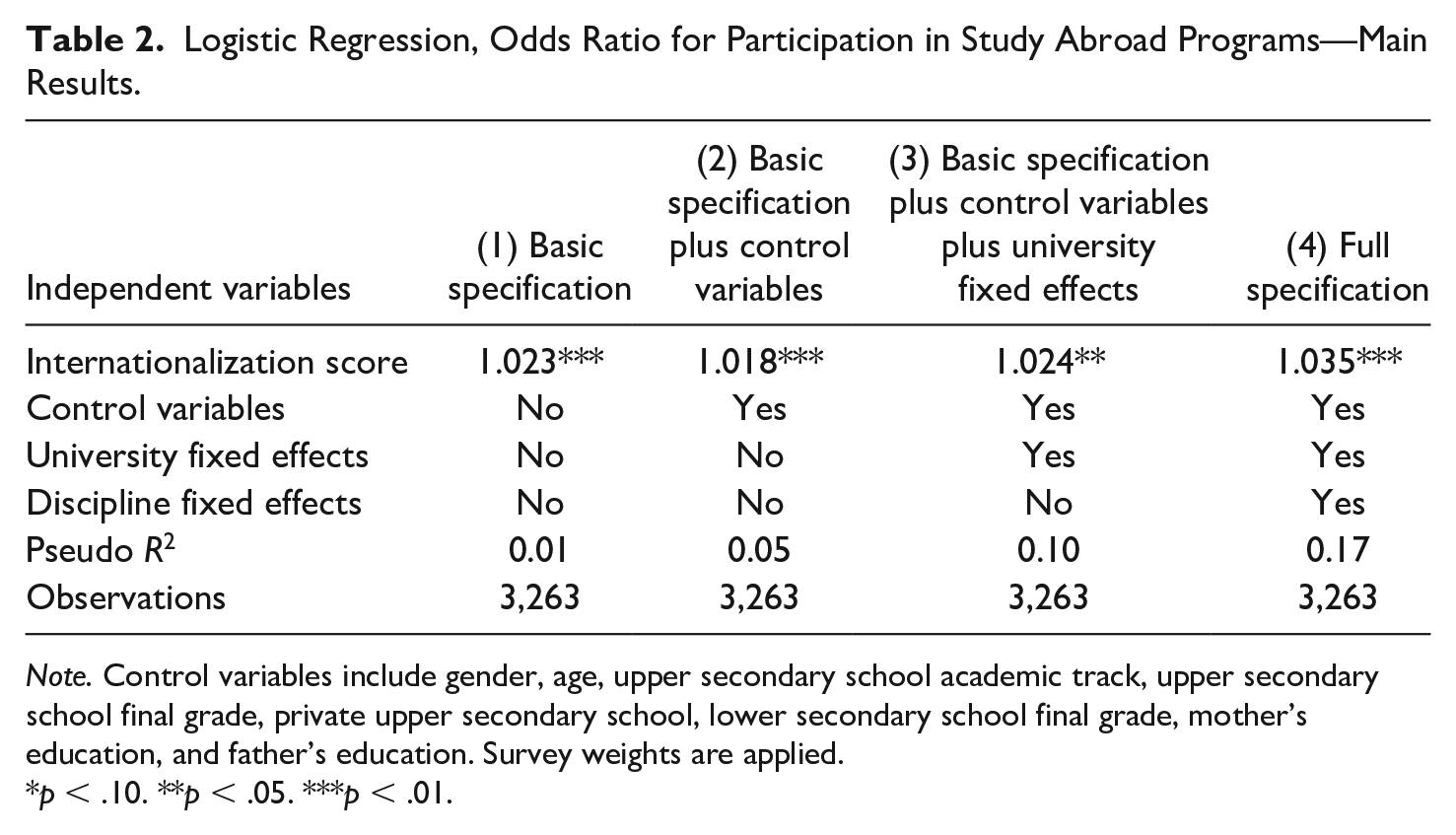
Note. Control variables include gender, age, upper secondary school academic track, upper secondary school final grade, private upper secondary school, lower secondary school final grade, mother’s education, and father’s education. Survey weights are applied.
p < .10. **p < .05. ***p < .01.
Several robustness tests were run to enhance the credibility of the estimates shown in Table 2. The results of these tests are depicted in Table 3. The tests were performed using the full model, that is, the one whose results are displayed in Column 4 of Table 2. First, a linear probability model was used instead of a logit model. As indicated by Angrist (2001), the issue of causal inference does not significantly vary between limited dependent variables and continuous outcomes. This implies that if there are no covariates or the covariates are sparse and discrete, then linear models can be employed to estimate models with limited dependent variables as well as models with other types of dependent variables. According to the results shown in Column 1 of Table 3, a one-point increase in the internationalization score increases the probability of participating in studying abroad programs by about 0.16%. 12 Second, in Column 2 of Table 3 the estimates of Column 4 of Table 2 were replicated without survey weights. Results did not significantly change as the relevant odds ratio turns out to be 1.038. Third, those students with missing information on mother’s and father’s education were included in the sample and two separate dummy variables were created to represent these categories. As shown in Column 3 of Table 3, the inclusion of this group of students did not significantly affect the results. Fourth, all the previous models were estimated with clustered standard errors at university level, but the statistical significance of the results did not change. 13
Robustness Tests.
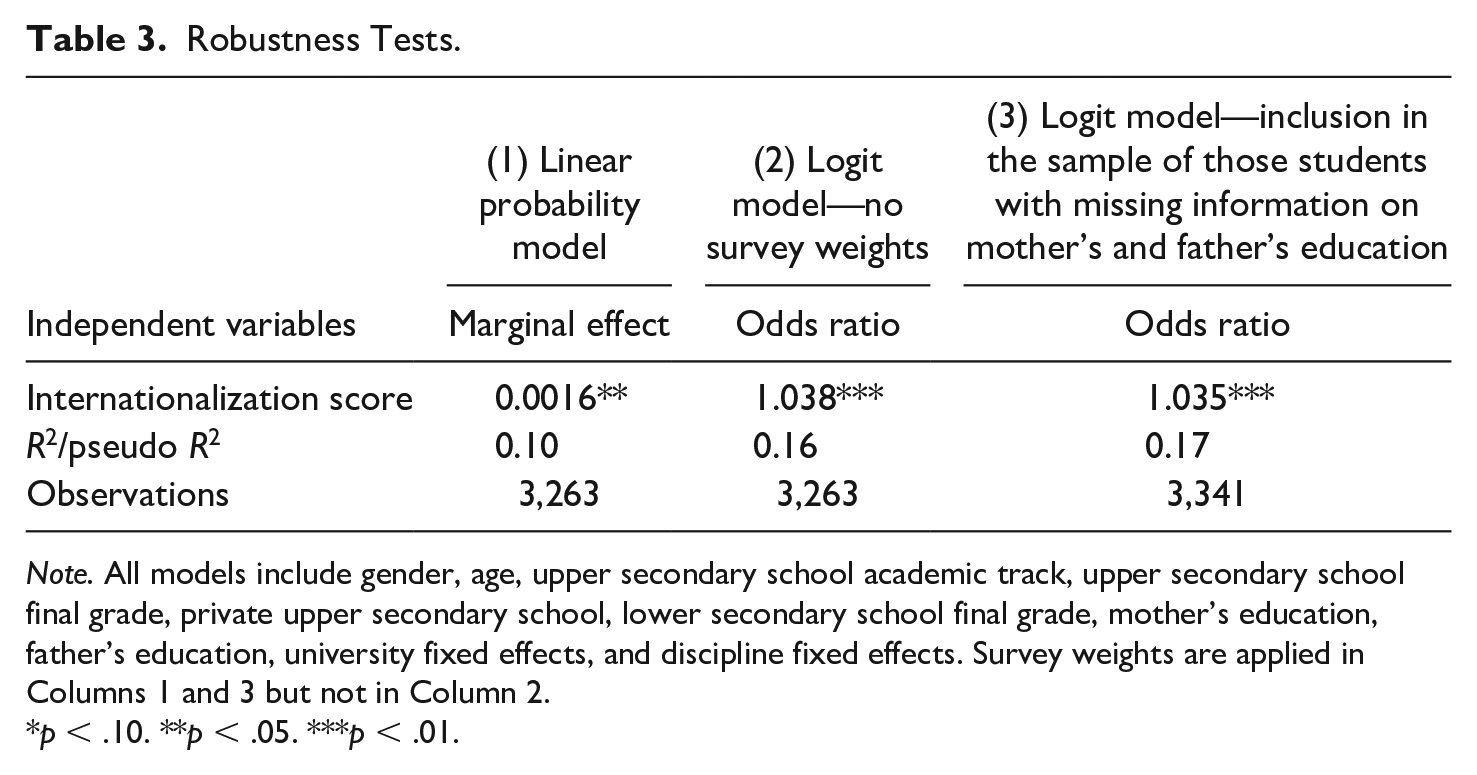
Note. All models include gender, age, upper secondary school academic track, upper secondary school final grade, private upper secondary school, lower secondary school final grade, mother’s education, father’s education, university fixed effects, and discipline fixed effects. Survey weights are applied in Columns 1 and 3 but not in Column 2.
p < .10. **p < .05. ***p < .01.
Separate regressions were run in an attempt to examine whether the effect of the internationalization score on the probability of studying abroad varies by gender, parental education, and academic ability. The results are presented in Table 4. Although these results indicate that there were virtually no differences between genders (Panel A), they suggest possible differences by parental education and academic ability (Panels B and C). The odds ratio associated with the internationalization score is larger for students from more advantaged backgrounds and those who performed better in upper secondary school. Nevertheless, the confidence intervals are wide, and overlapping between the two parental education categories as well as the two academic ability categories. Supplementary analyses (available from the author upon request), where relevant interaction terms were added to the model, showed that there is no statistically significant difference in the effect of internationalization on the probability of studying abroad across students with different academic performances and those from different socioeconomic backgrounds.
Logistic Regression, Odds Ratio for Participation in Study Abroad Programs—Heterogeneous Effects.
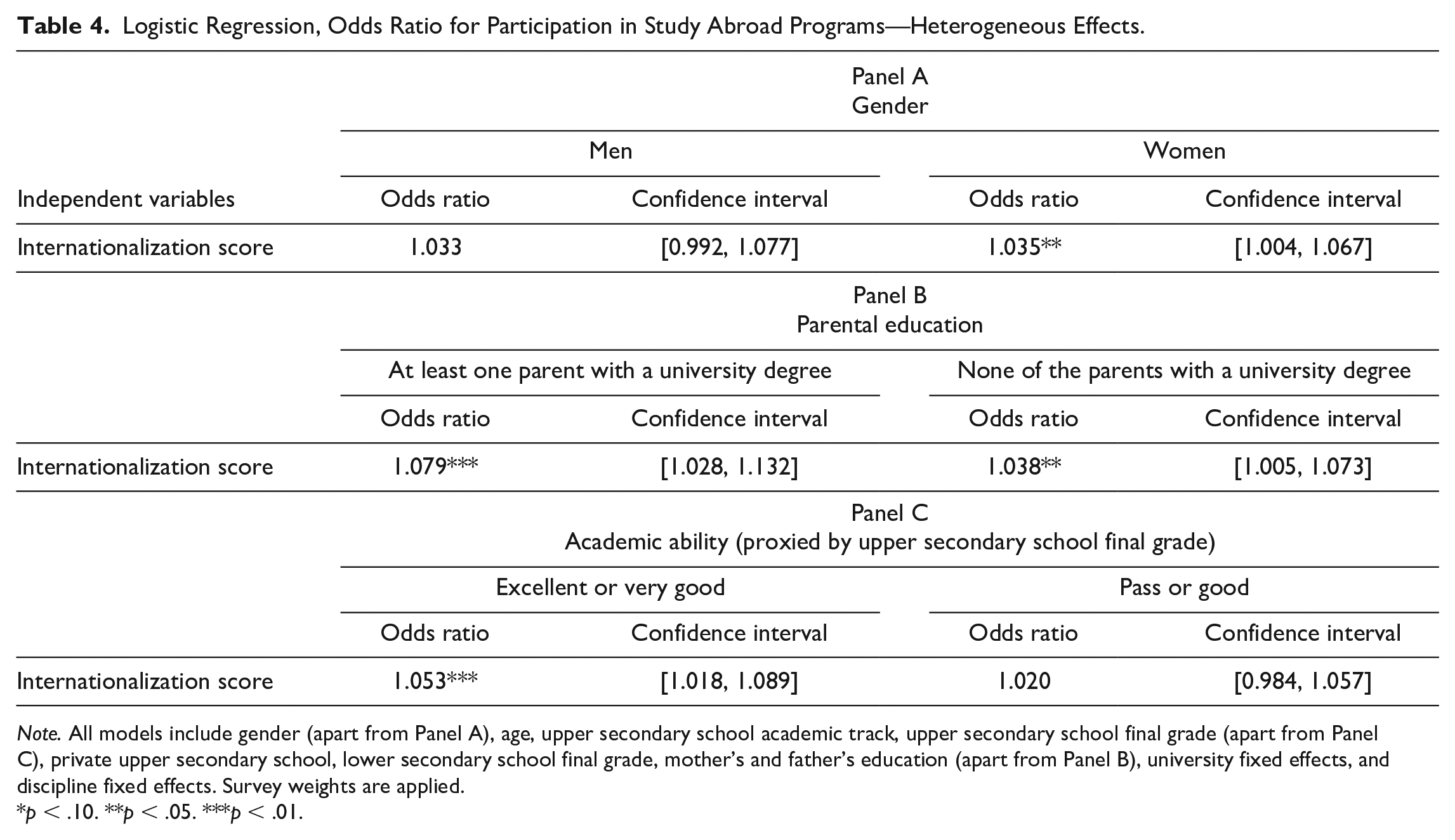
Note. All models include gender (apart from Panel A), age, upper secondary school academic track, upper secondary school final grade (apart from Panel C), private upper secondary school, lower secondary school final grade, mother’s and father’s education (apart from Panel B), university fixed effects, and discipline fixed effects. Survey weights are applied.
p < .10. **p < .05. ***p < .01.
Discussion
There is strong agreement among policymakers and academic researchers that it is important to increase the number of university students participating in study abroad programs (EHEA, 2009). A study abroad experience is likely to have a positive impact on an individual’s life in terms of both personal growth and professional development. Although several factors have previously been identified as affecting students’ decision to study abroad, these mainly relate to such individual traits as gender, age, and family background rather than institutional climate and characteristics.
This study has provided empirical evidence offering support to the hypothesis that those students studying in a more international academic environment are likely to be more strongly motivated to spend time abroad during their university studies. Students joining an internationally oriented academic environment in their first year of study are found to have higher chances of participating in study abroad programs in later academic years. Interactions with international students and with former study abroad participants are two channels through which an international academic environment may increase domestic students’ willingness to study abroad. This result, which has been obtained using a logit model that includes both university and discipline fixed effects, is robust to several specifications and a large number of checks.
Although this analysis has used relatively old data, its conclusions are likely to be of continuing relevance, given that Italian universities have become more international. The growing popularity of study abroad programs among Italian university students combined with an increased number of incoming international students has further promoted the creation of an education environment conducive to study abroad. Student associations aimed at welcoming students doing an exchange program in Italy have developed (e.g., ESN Italia). Among the activities organized by these associations, there are events promoting interaction between domestic and international students. Similarly, it has become easier for Italian students who are considering the possibility of studying abroad to get in contact with former participants in international exchange programs. AskErasmus Italy is a platform enabling prospective participants to obtain information from students who have had a study abroad experience in the same city/university they would like to go to.
The findings of this study shed light on the importance of cultural barriers to studying abroad. Improving understanding of other cultures and countries may be a key factor in promoting the decision to study abroad (Luo & Jamieson-Drake, 2015; Stroud, 2010). An academic environment characterized by a large number of students who have already had the opportunity to study abroad may help address the barriers associated with lack of information about study abroad programs.
Limitations
This study, like every study, has its limitations. Here we focus on two: first, students for whom it has not been possible to identify the university attended were dropped from the sample. Although they constituted a relatively small proportion of the total student population, the omitted students were more likely to have studied at universities located in large cities such as Rome, Milan, and Naples. 14 This may affect the generalizability of the findings. Second, the analysis did not account for possible selection bias arising from the possibility that university choices could have been influenced by study abroad opportunities, that is, students planning to study abroad during their university career could have chosen to attend universities with a high internationalization score.
Footnotes
Appendix
Acknowledgements
The author would like to thank two anonymous referees for their helpful comments and suggestions. The usual disclaimer applies.
Author’s Note
The views expressed are purely those of the author and may not in any circumstances be regarded as stating an official position of the European Commission.
Declaration of Conflicting Interests
The author(s) declared no potential conflicts of interest with respect to the research, authorship, and/or publication of this article.
Funding
The author(s) received no financial support for the research, authorship, and/or publication of this article.
