




Abstract
Internationalization of the curriculum has become a prevalent pattern around the world. Using the data of 115,655 domestic students and 7,165 international students from 16 U.S. universities, this study examined the association between the two types of internationalization of the curriculum (on-campus international academic experiences and study abroad from a U.S. host institution to another country) and intercultural dispositions among international students. This study also compared the potential effects of internationalization of the curriculum on international students with domestic students, who have been a primary target of internationalization of the U.S. universities’ curriculum. While on-campus international experiences were positively associated with several intercultural dispositions among international students, study abroad was not. In addition, the association between on-campus international experiences and intercultural dispositions showed little variation between domestic and international students. This result implies that international students are also beneficiaries, rather than mere resources, of internationalization of the U.S. university’ curriculum.
Introduction
While international students are often considered resources for internationalization of U.S higher education (Brennan & Dellow, 2013; Urban & Palmer, 2014), they are not likely to be viewed as participants who benefit from international experiences offered by their U.S. host institutions. Internationalization of the curriculum, which emphasizes the integration of international and intercultural elements into the higher education curriculum, has been employed to enhance university students’ intercultural disposition, which is becoming vital in the era of globalization (de Wit, 2019; Leask 2013, 2016). However, scholars have barely examined whether international students in the U.S. benefit from internationalization of the curriculum at U.S. universities as do their domestic peers, who are the traditional target of internationalization of the curriculum. This study therefore examines the associations between internationalization of the curriculum - specifically, study abroad and on-campus international academic experiences - and intercultural dispositions among international students and then compares the potential effect of internationalization of the curriculum between international students and domestic students. Of note for this study, the term ‘study abroad’ indicates a temporary departure from a U.S. institution to another country; thus, some but not all international students engaged in study abroad programs sponsored by their U.S host institution.
The significance of this study is to center on international students who are studying at U.S. universities and position them as full participants in internationalization of the curriculum rather than a peripheral resource. Buckner and Stein (2020) claimed that subjects of internationalization of universities in Western countries are likely to be domestic students, and international students are not more than means of internationalization. Corresponding to this claim, this study focuses on international students who engage in internationalization of the curriculum offered by U.S. universities. That is, the aims of this study are to reveal 1) whether international students benefit from internationalization of the curriculum at U.S. universities, and 2) if so, whether the potential benefits of internationalization of the curriculum for international students are similar to their domestic peers who are the traditional targets of internationalization.
Literature Review
In this section, following the importance of intercultural disposition, previous studies’ findings of study abroad and internationalization at home are explained. Also, this literature review section reveals a limited number of studies that focus on international students, relative to their domestic counterparts, as participants in international academic experiences offered by their host institutions. Theoretical frameworks for university student experiences and success are then provided after this summary of previous studies.
Internationalization of Curriculum and the Importance of Intercultural Disposition
Leask (2015) defined internationalization of curriculum (IoC) as “the process of incorporating international, intercultural and global dimensions into the content of the curriculum as well as the learning outcomes, assessment tasks, teaching methods and support services of a program of study” (p. 9). One of the expected learning outcomes of IoC is to cultivate an intercultural disposition (Leask, 2015), which means developing positive perceptions and attitudes toward other cultures (Bush et al., 2001). Globalization has accelerated the need for international communication, which means that it is vital to understand and respect new, sometimes disagreeable perspectives for effective communication with people with different backgrounds (Steinfatt & Millette, 2019). Intercultural/international collaborative research and business have become more prevalent and important (Knight & de Wit, 2018), and higher education must therefore teach students how to work with others from different cultures or nations (de Wit, 2019; Leask, 2013).
According to Knight (2012), internationalization of higher education takes two different approaches: internationalization at home and cross-border internationalization. The former includes internationalized learning at a home institution, and the latter indicates the global mobility of people. It should be emphasized that international students and study abroad (SA) are defined as distinct phenomena in this study. International students mean those pursuing a degree at an institution outside of their home country, while SA is a temporary departure from their home institution (e.g., short-term or semester-long exchange programs) but does not indicate a degree-seeking student staying in a foreign country.
Study Abroad
One of the most common forms of IoC in higher education is the international mobility of students (de Wit, 2020). According to UNESCO (2019), more than five million students were pursuing higher education in a foreign country across the world in 2017. Students with SA experience were inclined to achieve higher academic achievement and career outcomes, such as aspiration for working abroad or professional competencies (Witkowsky & Mendez, 2018; Whatley & Canché, 2021). Another major benefit of SA is intercultural disposition. Universities and policymakers over the world expect students to acquire intercultural dispositions through SA (e.g., Erasmus + in Europe) (European Commission; 2021; Take & Shoraku, 2018). Scholars have found that SA can have positive outcomes relevant to intercultural dispositions, such as intercultural competency, interest in and knowledge about other countries, and openness to diversity (Engberg et al., 2016; Lomicka & Ducate, 2021; Ruth et al., 2019).
At the same time, other studies have shown that SA is not without flaws. According to Mayhew et al.'s (2016) intensive literature review, SA may not be as effective as other diversity experiences in promoting diversity outcomes. Furthermore, SA programs often failed to improve global competency or even decreased the students’ overall perception of campus climate at home institutions (Hutson & Williford, 2018; Soria & Troisi, 2014). Although the reasons for the non-significant or negative findings were not clearly explained in previous studies, Hutson and Williford (2018) attributed these findings to the high proportion of students from marginalized backgrounds holding more negative perceptions of campus climate in their study. Also, SA programs differ in terms of destination, language, and academic content, which can affect their impact on students (Engberg & Jourian, 2015; Ruth et al., 2019), and is not available to all students due to financial constraints (Whatley, 2017). That is, previous studies showed mixed results for the effectiveness of SA on the enhancement of intercultural dispositions.
Internationalization at Home
According to Beelen and Jones (2015), internationalization at home (IaH) indicates “the purposeful integration of international and intercultural dimensions into the formal and informal curriculum for all students within domestic learning environments” (p. 69). While SA is available to a limited number of students, especially socioeconomically privileged ones, IaH aims to provide international experiences to all students and has attracted the attention of researchers and policymakers (Beelen & Jones, 2015; de Wit, 2020).
Empirical studies have examined the various forms of IaH and found their potential positive effects on students. These forms include attendance at academic events with a global focus, interactions between international and domestic students, enrollment in international-focused majors, or research about international students; those IaH practices are associated with knowledge of and interests in other countries, global citizenship, application of knowledge to solve a problem, and employability (Lehtomäki et al., 2016; Lindsey Parsons, 2010; Renfors, 2021; Soria & Troisi, 2014; Watkins & Smith, 2018). Moreover, Soria and Troisi (2014) even found that on-campus international experiences had a stronger relationship with global, international, and intercultural competencies than SA did. In other words, despite the variation of its forms, IaH has been likely to be positively associated with various outcomes.
International Students in International Education
While both SA from U.S. universities and IaH have been examined intensively as explained above, the target beneficiaries of those practices have been predominantly domestic students. Some scholars have examined the potential benefits of general experiences on international students (e.g., high impact practices, Katsumoto & Bowman, 2021), studied international students’ unique barriers to engaging in learning (e.g., linguistic barriers, Yao, 2016), or compared psychosocial outcomes of international students with domestic students (e.g., mental health, Liu et al. 2019). However, in contrast to the growing attention paid to such general experiences of international students, scholars have barely examined whether international education offered by a host country can be meaningful for international students. Studies that examine the potential effect of IaH in a host country on international students are rare. For example, Guo and Chase (2011) found that international students who participated in the on-campus program of global citizen mind expressed a better understanding of other cultures and better intercultural communication skills. However, Guo and Chase (2011) conducted their study in Canada, not the U.S., and their study's sample was international graduate students from one institution. This means that very little is known about how the IoC in U.S. higher education contexts might enhance the development of international undergraduate students in U.S. higher education beyond a single institution.
The IoC's emphasis on only domestic students but not international students may be derived from how international students are viewed in the discussion of internationalization of U.S. higher education. While scholas have examined international students’ participation in general educational practices, such as high impact practices, those students are often resources of international experiences for domestic students (Buckner & Stein, 2020; Brennan & Dellow, 2013; Urban & Palmer, 2014). Thus, little attention has been paid to whether and what international students learn through IoC at host institutions. Moreover, scholars have barely considered (if at all) whether international students’ development from IoC at a host campus is similar to the development of domestic students. If the same international experiences may positively influence both domestic students and international students, universities may be interested in encouraging both groups to join such IoC programs. Thus, this study contributes to a greater understanding of internationalization of higher education by exploring the association between international experiences and outcomes for international students, who have not previously been viewed as potential beneficiaries of international experiences in the context of U.S. higher education. Moreover, this study also examines whether the association between international experiences and outcomes can be consistent or inconsistent between international students and domestic students, who are traditional targets of international education offered by U.S. universities.
Theoretical Framework
Multiple conceptual frameworks guided this study. According to Astin's I-E-O assessment model (Astin & Antonio, 2012), the influence of higher education on students is understood based on three components: Inputs (students’ pre-university characteristics), Environment (the characteristics of the academic institution), and Outputs (learning outcomes and success). Pascarella (1985) and Pascarella and Terenzini (1991, 2005) expand the I-E-O model to include the organizational characteristics of institutions, student pre-university characteristics, socialization, institutional environment, and student effort. According to those frameworks, the elements that should be considered to investigate intercultural disposition are student characteristics (e.g., attitudes in university or pre-university characteristics), student experiences in university, student effort, and institutional structure and environment.
The literature review process suggested that previous studies of SA and IaH focused on only domestic students but not international students (Note: SA and international students are different concepts as explained above). Also, institutional characteristics (e.g., institutional types) and student characteristics (e.g., demography or academic attitudes) may be influential to student experiences and learning, and need to be controlled for to examine the relationship between a certain experience and outcomes. Based on what has been discussed above, the current study examines the following two research questions:
To what extent are study abroad and internationalization-at-home experiences associated with intercultural disposition among international students? To what extent does the relationship that is examined in the first research question differ from the same relationship among domestic students?
Data and Method
Data
This study is a secondary data analysis of the Student Experience in the Research University (SERU) in 2016–2018, a web-based questionnaire that collected data concerning student backgrounds, experiences, and outcomes at doctoral research-intensive universities. The SERU dataset in particular is chosen for this study because of its large number of both domestic and international students: 115,655 domestic students and 7,165 international students from 16 U.S. universities (15 public universities and one private university). The nationality status of participants was derived from the administrative data of each university. Although the sample of SERU was collected only from research-intensive universities, more than 70% of U.S. international students belong to universities with very high research activities or high research activities (IIE, 2021). The findings from this study can be pertinent to many other international students in the U.S.
Descriptive statistics of all variables by domestic and international students are presented in Table 1. In the analytical sample, fewer than 2.5% of all values were missing, and the dependent variables and the key independent variables had fewer than 5% of missing values. For this missing pattern, Little's MCAR (Missing Completely At Random) test was conducted, and the result rejected the hypothesis that the missing pattern is MCAR. However, this finding may not be surprising because MCAR is not common, especially in human subjects (Myers, 2011; Lall, 2016). Although it is not possible to test whether the dataset is MAR (Missing At Random) and MNAR (Missing not at Random) (e.g., Enders, 2010), the values of our dependent variables may not decide their missingness. Asking about the ability to understand international perspectives, the perception of the climate, and diversity engagement may not strongly influence whether students respond to those questions. Thus, the probability that the missing values of the key variables result from the value itself (MNAR) should be low. For missing values, multiple imputation by chained equation was conducted. This process included 20 iterations, pooled the analysis results, and adjusted for standard error between imputed complete datasets. The results from this multiple imputation process are less biased compared to listwise deletion or alternative approaches (for more information, see Carpenter & Kenward, 2013; van Buuren, 2018). Also, due to the low percentages of missing values, and the effect of the missing values should be limited.
Descriptive Statistics for Variables.
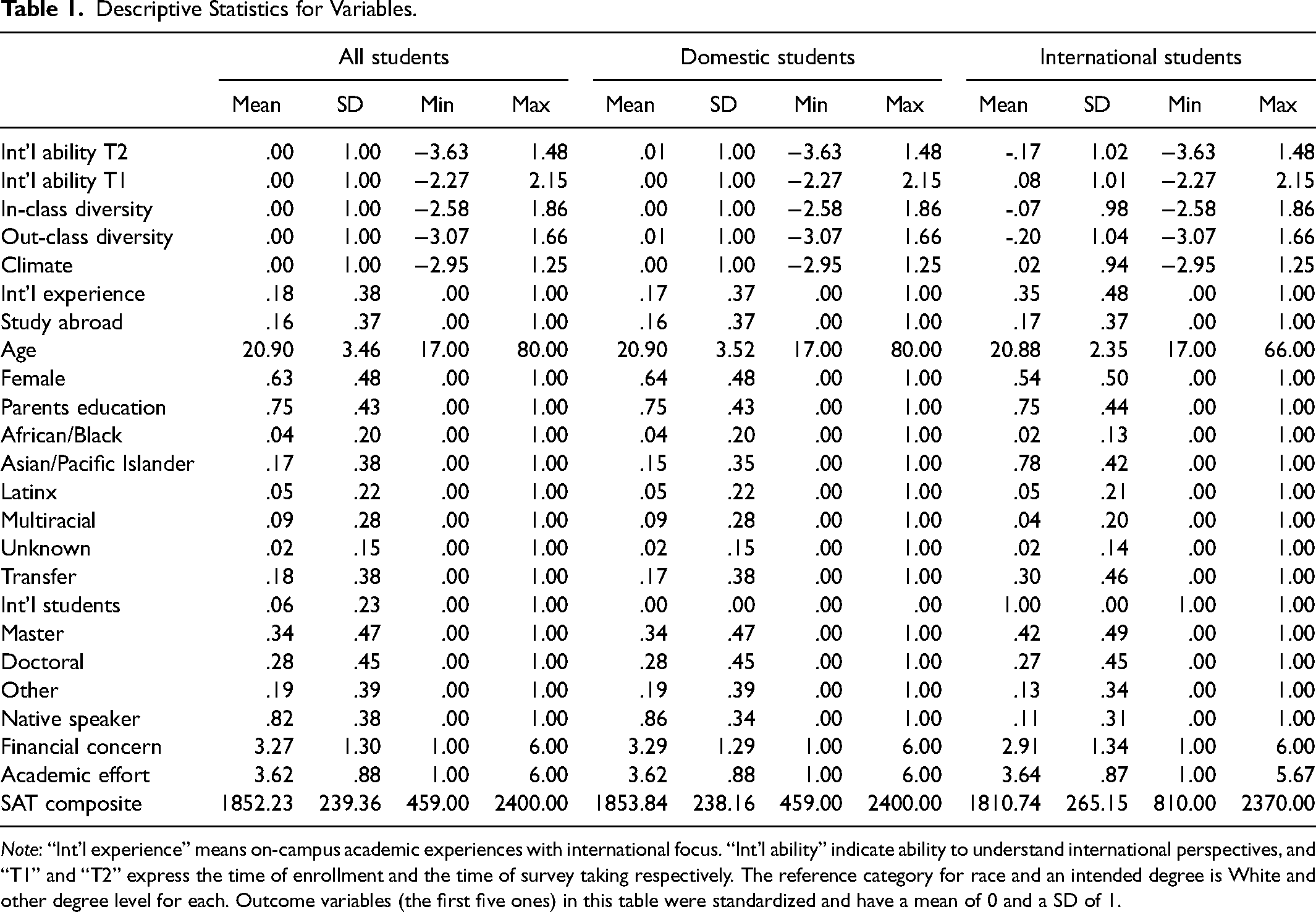
Note: “Int’l experience” means on-campus academic experiences with international focus. “Int’l ability” indicate ability to understand international perspectives, and “T1” and “T2” express the time of enrollment and the time of survey taking respectively. The reference category for race and an intended degree is White and other degree level for each. Outcome variables (the first five ones) in this table were standardized and have a mean of 0 and a SD of 1.
Measures
Dependent Variables
This study focuses on four variables: 1) ability to understand international perspectives, 2) perception of the climate for diversity and inclusiveness at a student's institution, 3) in-class diversity engagement, and 4) out-of-class diversity engagement. Because intercultural dispositions are perceptions of and attitudes towards other cultures (Bush et al., 2001), those four variables are the best proxies to represent intercultural dispositions. All dependent variables are standardized to capture the effect size.
The SERU questionnaire asks students’ perception of their current ability to understand international perspectives (“Please rate your level of proficiency in… ability to understand international perspectives”; 1 = very poor, to 6 = excellent). The mean for this variable is lower with international students (-.17) than domestic students (.01). Perception of climate was the respondent's degree of agreement about being comfortable with the climate for diversity and inclusiveness at each institution (“Overall, I feel comfortable with the campus climate for diversity and inclusion at [University name]”; 1 = strongly disagree, to 6 = strongly agree). Domestic students and international students have similar standardized means.
In-class diversity and out-of-class diversity are factor variables (α = .80 and α = .78) made from three items about the frequency of appreciation for others’ perspectives, interaction with people with different views, and discussion of controversial issues (1 = never, to 6 = very often) in class or out of class. Those two variables of diversity engagement are separated rather than combined due to their qualitative differences. In-class activities may be offered by an instructor, and thus engagement may not be fully voluntary. In contrast, out-of-class diversity engagement may largely stem from students’ own willingness to participate in those activities.
Independent Variables
The key independent variables are on-campus international academic experiences and SA from U.S. institutions to a foreign country. Both variables are dummy (0 = no, 1 = yes). Students were asked about their participation in “on-campus academic experiences with an international/global focus,” which is one of the major IaH activities (Knight, 2012). While 17% of domestic students participated in this activity, 35% of international students did so. A measurement item of SA inquired about “study abroad—academically-focused time outside of the U.S. in which at least 1 academic credit is accrued.” Thus, international students chose yes to this question only when they engage in SA from their U.S. host institution. For example, if a degree-seeking international student at a U.S. institution did not participate in SA from the U.S. institution to another country, that student is considered as an international student without SA experiences. The participation rates of SA are similar between domestic students (16%) and international students (17%).
Also, this study includes control variables. Those control variables were chosen following the theoretical framework developed by Pascarella (1985) and Pascarella and Terenzini (1991, 2005), which emphasizes the potential effects of student characteristics, student experiences in university, student effort, and institutional structure and environment on students. Sex (0 = male, 1 = female), parental education (0 = others, 1 = at least one parent has a bachelor's degree), transfer students (0 = non-transferred, 1 = transferred), and native language (0 = non-English, 1 = English) are dichotomized variables. Race and highest intended degrees, which are categorical, are also dummy-coded (race: Asian/Pacific Islander, Black/African, Hispanic/Latinx, multiracial, and other/unknown with White as a reference; and highest intended degrees: bachelor's degree, master's degree, and doctoral degree with other/certificate/not sure as the referent group). Furthermore, continuous control variables are age, financial concern, academic effort, and SAT/ACT composite score. Financial concern is a factor variable of three items concerning basic needs, personal spending, and debt (1 = never to 6 = very often; α = .80). Student academic effort characteristics are also measured through six items: the frequency of taking challenging courses, increasing academic efforts, revising a paper substantially, seeking academic help from instructors or tutors, having study groups outside of class, and helping other students (for the first item: 1 = never to 4 = three or more times; for the other five items: 1 = never to 6 = very often; α = .74). SAT/ACT composite scores are a sum of math and verbal scores of SAT scores or converted ACT scores. Furthermore, to predict the student's current ability to understand international perspectives, the same ability at enrollment was included as a control variable. The adjustment for the ability at enrollment helps detect the relationship between international academic experiences and skill development since enrollment.
Analysis
Because this study is exploratory of the associations between IoC and intercultural dispositions, a multiple regression was employed. Each model considered one of the four dependent variables. All control variables were included in each model, and regression models examined the net association between independent and dependent variables. Institutional characteristics are critical for student development (Pascarella & Terenzini, 1991, 2005); hence, the institution-level differences were adjusted by institutional fixed-effect analysis by adding dummy variables for all but one institution (see Allison, 2009). In the basic model, the sample was limited to international students.
Furthermore, interaction models examined whether the relationships between IoC and intercultural disposition varied between international and domestic students. Two interaction variables (international students x on-campus international academic or SA) were added to a model of each dependent variable. That is, this study has eight models in total: four basic models, which target only international students, and four interaction models, which seek to measure the possible effect of IoC for international students in comparison with domestic students. The basic models correspond to the first research question, and the interaction models correspond to the second research question. Multicollinearity, normality, and heteroscedasticity were checked and raised no concerns.
Results
Table 2 shows the result from the regression model based on the sample of only international students. On-campus international academic experiences were positively associated with the ability to understand international perspectives (β = .22, p < .001), in-class diversity engagement (β = .21, p < .001), and out-of-class diversity engagement (β = .23, p < .001) among international students. These associations showed small to medium effect size (medium effect size is .30, according to Mayhew et al., 2016). However, the same experience was not significantly associated with their perception of campus climate of diversity and inclusiveness.
Regression Coefficients for the Relationship Between International Experiences and Each Dependent Variable.
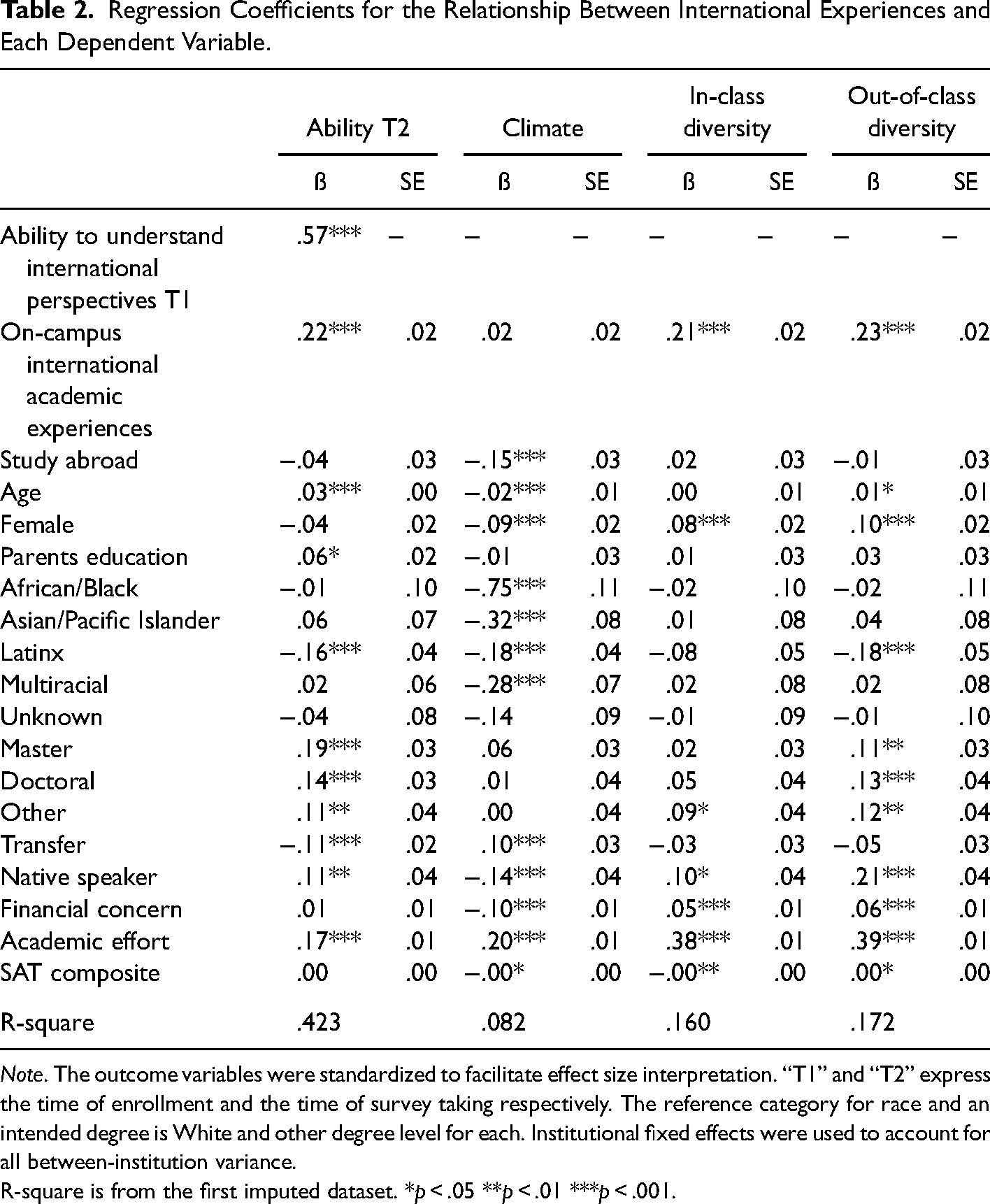
Note. The outcome variables were standardized to facilitate effect size interpretation. “T1” and “T2” express the time of enrollment and the time of survey taking respectively. The reference category for race and an intended degree is White and other degree level for each. Institutional fixed effects were used to account for all between-institution variance.
R-square is from the first imputed dataset. *p < .05 **p < .01 ***p < .001.
In contrast, SA from U.S. institutions to a foreign country was not related to intercultural dispositions among international students. There appeared to be no statistical evidence to claim the relationship between SA and the development of the ability to understand international perspectives, in-class diversity engagement, or out-of-class diversity engagement. However, SA was negatively associated with the campus climate (β = -.15, p < .001). In terms of the first research question, while on-campus international academic experiences tended to be positively associated with various intercultural dispositions, SA from U.S. institutions did not have the same tendency.
In addition, other characteristics were associated with intercultural dispositions. As shown in Table 2, international students of color were less comfortable with the campus climate of inclusion and diversity compared to White international students. Also, native English speakers tended to perceive the campus climate negatively. Additionally, students planning to attain higher degrees underwent higher development in the ability to understand international perspectives and out-class diversity engagement.
The results of the interaction models, which are developed to answer the second research question, are displayed in Table 3. Overall, the findings indicate mixed results. The association between on-campus international academic experiences and the ability to understand international perspectives (β = -.05, p < .05) or in-class diversity engagement (β = -.07, p < .01) was slightly stronger among domestic students than international students. However, there was no statistical evidence for the variation between domestic and international students in terms of the association between on-campus international academic experiences and out-of-class diversity. On the other hand, domestic students with on-campus international academic experiences perceived campus climate more negatively than international students (β = .15, p < .001).
Regression Coefficients for International Experiences and Interactions.
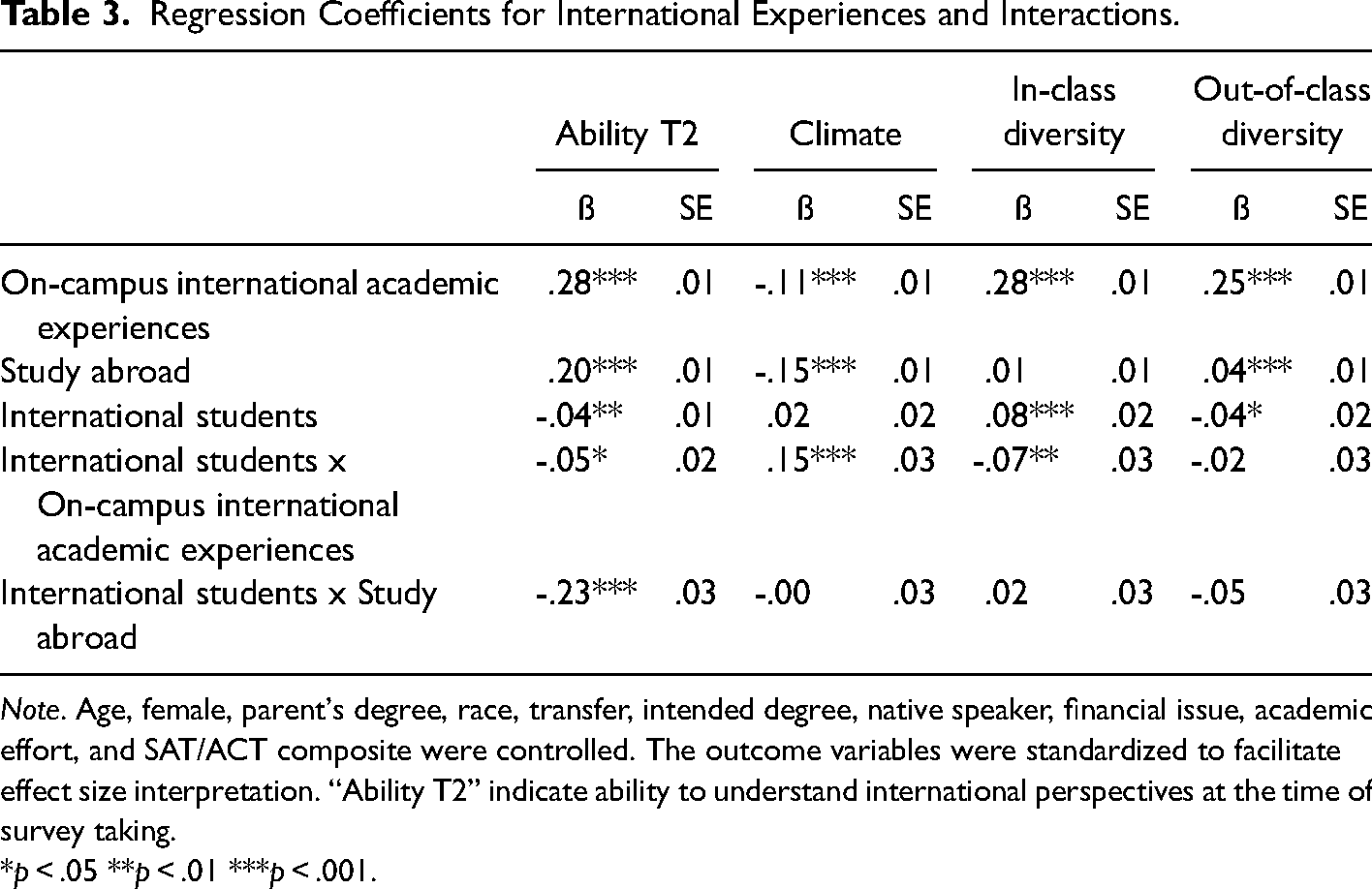
Note. Age, female, parent's degree, race, transfer, intended degree, native speaker, financial issue, academic effort, and SAT/ACT composite were controlled. The outcome variables were standardized to facilitate effect size interpretation. “Ability T2” indicate ability to understand international perspectives at the time of survey taking. *p < .05 **p < .01 ***p < .001.
The relationships between SA and intercultural dispositions were not significantly different between domestic and international students, except for their ability to understand international perspectives. The association between SA and the development in the ability to understand international perspectives was stronger among domestic students than international ones (β = -.23, p < .001). However, there was no statistical evidence to support the variation between international and domestic students in terms of the relationship between SA and other dependent variables.
Discussion
International Students
As shown by basic models, for international students, on-campus international academic experiences were associated with the development of the ability to understand international perspectives, in-class diversity engagement, and out-of-class diversity engagement. Such positive associations between on-campus international experiences and intercultural disposition were already found in Canadian samples (Guo & Chase, 2011), and this study also supports that international students at U.S. universities can be beneficiaries rather than resources of on-campus international experiences, since these programs are one of the major IaH practices.
On the other hand, no statistical evidence was found to claim the positive associations between SA from the U.S. and intercultural dispositions among international students. The potential explanation is that SA from a U.S. institution is the second foreign academic experiences for international students because they already were immersed in an unfamiliar culture by pursuing a degree at U.S. institution. Such second-time foreign experiences through SA from U.S. institutions to another country may not necessarily improve intercultural dispositions. At the same time, previous studies about the effect of such multiple overseas academic experiences among university students (e.g., being a degree-seeking international student and participating in SA in a third country) were not found; further research about the topic would be worthwhile.
Comparison with Domestic Students
Interaction models suggest that the potential benefit of on-campus international academic experiences for international students could be similar to domestic students, who are traditional targets of IoC. Both domestic and international students with on-campus international academic experiences had a greater ability than their peers to understand international perspectives and take in-class and out-of-class diversity engagements. Although previous studies tended to focus solely on domestic or international students (e.g., Guo & Chase, 2011; Soria & Troisi, 2014), the results from this study indicate that potential positive effects of on-campus international academic experiences are not limited to domestic students, but also include international students.
The tendency of the small or null variation between domestic and international students may deserve further attention. Often, cultural and/or linguistic barriers prevent international students from fully engaging in academic opportunities and outcomes (Sherry et al., 2010; Yao, 2016). However, in this study, such clear barriers against international students’ outcomes were not detected. One of the reasons may be that the topic of on-campus international academic experiences facilitates international students’ engagement in learning activities. According to Mori and Takeuchi (2016), international students actively interacted with domestic students in a foreign language course because of their shared interest in that language. In an international-topic class, international students may not hesitate to interact with others and bring their unique international perspectives into class activities because they know their classmates appreciate international knowledge and perspectives. If so, international students can engage in these learning processes and develop intercultural dispositions alongside their domestic peers.
Also, domestic students with on-campus international academic experiences perceived a less positive campus climate for diversity and inclusiveness than international students with similar academic experiences. One possible explanation is that exposure to diverse perspectives may change the students’ perceptions of campus climate. For example, racially minoritized students, who used to perceive the campus climate positively, may learn the dominance of a Eurocentric culture on the U.S. campus by living in another non-Western country. These perceptions may guide students to realize the prevalence of White culture and ideology across the campus and alter their perception of the campus climate. In contrast, reflecting upon their social identities is not rare for international students living in an unfamiliar culture (Barton & Ryan, 2020; Yao & Mwangi, 2022). Thus, on-campus academic experiences may not become an additional occasion to think of their social identities, which subsequently does not change their perceptions of campus climate.
In contrast, SA from the U.S. to other countries was not significantly associated with most intercultural dispositions among international students but only among domestic students. This finding is probably because the SA experience from U.S. institutions to other countries is the second-time foreign sojourn for international students and the first time for domestic students. International students already have the experience of living in a foreign country, and SA would not enhance outcomes considerably, if at all, when compared to domestic students.
In addition, international students with SA experiences are likely to perceive the campus climate for diversity and inclusiveness negatively, and this tendency seems not significantly different from domestic students. In other words, SA experiences and campus climate were negatively associated among both domestic and international students. There are multiple potential explanations for this. For example, similar to the relationship between on-campus international academic experiences and campus climate, exposure to different cultures may result in students’ reconsidering their own social identities and realizing the unwelcoming campus climate to specific groups. The other possibility is that the direction of the two variables is actually reversed. That is, students who are not comfortable with their current campus climate may choose to go SA.
In sum, practitioners and faculty who are supporting international students may be interested in using on-campus international programs as a bridge between international and domestic students. For example, it may be effective to introduce an international-oriented class as a degree requirement. An international learning environment could include the intentional creation of a setting where both international and domestic students can learn together by sharing interests, which could also lower the barriers that international students may experience in other courses. Taking such steps at the institutional level would indicate that international students can be full participants and active learners of international education, which is a paradigm shift away from being viewed as a means of internationalization in U.S. higher education. At the same time, it is necessary to conduct further research to investigate how particular pedagogical elements, such as discussing an international topic with domestic students or learning specific international content, can directly enhance learning outcomes.
This study has several limitations. The first is that the SERU could not capture more precise degrees and manifestations of engagement in international activities. Because the variables of IoC experiences in the SERU dataset were binary (participated or not), the frequency and depth with which students engaged in these activities (e.g., the length and curriculum of SA) were not known. In addition, IoC is not limited to only SA and on-campus international academic experiences, but the SERU inquires only about those two types of international experiences. Thus, a future large-scale study may need to cover a wider range of IoC experiences. Second, due to its self-reported design, students’ responses may not be an accurate reflection of their participation. For example, some students may forget their participation in on-campus international academic experiences. Third, because of the observational characteristics of the dataset, self-selection bias may exist in the dataset. Fourth, the ability to understand international perspectives at enrollment, which was a control variable to predict the same ability at the time of taking the survey, was based on student reflection. Although recalling the actual ability at the time of enrollment is difficult, it is the best proxy for students’ pre-college ability to understand international perspectives in order to examine the development during university.
Conclusion
This study contributes to the knowledge of internationalization of higher education by focusing on the outcomes of international students as beneficiaries of internationalization of the curriculum at a U.S. host institution. Because international students tend to be treated as resources of internationalization of higher education (Buckner & Stein, 2020; Urban & Palmer, 2014), scholars often have overlooked how internationalization of the curriculum at U.S. universities is valuable for international students as well as domestic students, who have been primary targets of the practices. This study found that international students are more than resources of internationalization because they also benefit as participants from internationalization of the curriculum, especially through participation in on-campus international academic experiences. In addition, one implication of this study is that on-campus international academic experiences may be effective in enhancing intercultural dispositions for not only international students but domestic students as well. International students are not merely resources of internationalization but learners who participate in and benefit from the internationalization of the curriculum with domestic peers. Institutions should take into consideration and better understand what kinds of internationalization of the curriculum are most meaningful for international students, in addition to domestic students as the traditional targets, and encourage those students from foreign countries to engage in valuable international experiences at U.S. institutions.
Footnotes
Acknowledgements
The author is thankful for the valuable feedback provided by Dr. Nicholas A. Bowman and Dr. Christina W. Yao to the early versions of this manuscript.
Availability of Data and Material
This original dataset of Student Experience in the Research University (SERU) was administered under the direction of the Center for Studies in Higher Education at the University of California – Berkeley (CSHE). We attained access to the dataset through the support from the office of assessment at the University of Iowa under SERU Data Sharing Agreement.
Declaration of Conflicting Interests
The author(s) declared the following potential conflicts of interest with respect to the research, authorship, and/or publication of this article: This research is developed solely from our academic interest in exploring educational practices. I have never attained or will never attain financial or personal profit from the publication of this paper.
Funding
The author(s) received no financial support for the research, authorship, and/or publication of this article.
