




Abstract
Introduction:
The study aimed to assess the level of standard first aid knowledge among Hong Kong undergraduates and identify the associated factors, and to examine their attitudes, training preferences and obstacles in first aid training.
Methods:
This cross-sectional study employed a structured online questionnaire covering demographic data, first aid knowledge assessment and attitude evaluation. Participants were recruited by convenience sampling from August to October 2020. Inclusion criteria included full-time undergraduates studying for the first degree in Hong Kong and receiving primary and secondary education in Hong Kong. To contrast undergraduates studying medical and non-medical degrees, a set ratio of 1:1 was employed, and estimated proportions were weighted according to the ratio of medical and non-medical undergraduates in the population. Unweighted data were used in logistic regressions.
Results:
Among 385 respondents, the weighted proportion of good knowledge of standard first aid was 15.2% (95% confidence interval (CI): 11.6%–18.8%) and that of good attitudes towards standard first aid was 71.3% (95% CI: 66.8%–75.8%). Holding valid or expired standard first aid certificates (valid: odds ratio (OR) = 9.897, p < 0.001; expired: OR = 4.816, p < 0.001) and studying medical-related degrees (OR = 3.693, p < 0.001) were shown by multiple logistic regression to be associated with good knowledge of standard first aid. Only being a current or past member of first aid cadet teams was associated with a greater likelihood of having good attitudes towards first aid (OR = 2.336, p = 0.047). Respondents proposed standard first aid training should take form of credit-bearing or non-credit-bearing courses in university curriculum, and academic workload should be taken into account when designing training schemes.
Conclusion:
The proportion of undergraduates in Hong Kong with good first aid knowledge was unsatisfactory, but the counterpart with a good attitude was encouraging. Standard first aid training should be proactively provided to all the local undergraduates, regardless of their enrollment in medical- or non-medical-related degrees.
Introduction
First aid is defined as the steps taken towards an injured or acutely ill person. 1 In Hong Kong (HK), standard first aid (SFA) is one of the first aid training courses offered by one of the four recognized organizations to individuals aged 12 or above, transferring basic first aid knowledge and skills,2–5 including patient assessment, bandaging and cardiopulmonary resuscitation (CPR), to trainees so that they are capable of delivering first aid whenever necessary. A SFA certificate is valid for 3 years, after which holders have to get recertification by passing the refresher course examinations.3–5
There are training programs like advanced cardiovascular life support (ACLS) and basic life support (BLS) offered by medical institutions in Hong Kong. These courses, designed primarily for healthcare professionals, mainly focus on advanced and specific life-saving skills targeting cardiopulmonary events, 6 such as CPR, while SFA covers a wider range of topics, including burn and bleeding, that might be more frequently encountered by our target population. Since ACLS and BLS would be distant to the majority of the population of our study, they were not considered as SFA.
In fact, first aid training should not be confined to CPR as suggested by a recent review. 7 The Injury Survey 2008 showed that domestic injuries including falls, sprain, cutting/piercing, hit/struck, burn and animal bite were typical in HK.8,9 Undergraduates are also vulnerable to health conditions that can be relieved by first aid. A behavioural risk factor survey found that those aged 18–24 had the second highest proportion of population (3.6%) to have experienced heat stroke in 2015. 10 Since heat stroke can be life-threatening, it is important to perform timely first aid. Also, the Population Health Survey 2014/2015 found 19.0% of those aged 15–24 had sustained unintentional injury episode(s) in the past 12 months. 11 Therefore, the younger generations should gain first aid knowledge to deal with emergencies promptly in order to reduce risks of mortality and complications of injuries.
Moreover, the younger generations can apply first aid skills to people around them, such as siblings. 12 Considered as future leaders, university graduates can also pioneer in spreading first aid knowledge to a broader audience within society after graduation. Thus, actively advocating first aid among undergraduates can yield multiple benefits.
A study on the knowledge level of SFA among the general local population was conducted in 2011. 13 However, there was a lack of similar data as well as that of training preference, attitude and factors associated with SFA knowledge focusing on local undergraduates. Hence, this study aimed at investigating the SFA knowledge level among HK undergraduates, exploring its associated factors, and examining their training preference, attitudes and obstacles in first aid training. Our findings will inform stakeholders to strengthen SFA promotion and training for the local young generations.
Methods
A cross-sectional study was conducted from August to October 2020 targeting undergraduates of the 11 universities in HK by convenience sampling via an open call on social media and at the campuses of the universities, with the use of an online structured questionnaire. Inclusion criteria were being full-time local undergraduates studying for their first degree in local universities and having received primary and secondary education in HK. At the beginning of the questionnaire, four questions, one for each of the inclusion criteria, were used to screen respondents for their eligibility. To ensure enough participants represent the medical and non-medical undergraduates for comparison, a set ratio of medical and non-medical students of 1:1 was employed. In this study, medical students were defined as those participating in undergraduate degrees that are relevant to the healthcare professions such as ‘Medical & Dentistry’, ‘Nursing’ and ‘Allied Health’. These included students who were studying medicine, general or mental nursing, dentistry, Chinese medicine, pharmacy, biomedical sciences, nutritional sciences, speech and hearing, public health, physiotherapy, occupational therapy, radiotherapy and optometry. Sample size calculation was based on the primary outcome of the proportion of having good SFA knowledge. Using the most conservative scenario by assuming the proportion of having good knowledge being 50%, a sample size of 385 was required to estimate the proportion with a 5% margin of error and a 95% confidence level.
A questionnaire was developed by the team based on SFA textbooks by the Hong Kong Red Cross (HKRC), Hong Kong St. John Ambulance and Auxiliary Medical Services, together with the questionnaire of a study ‘Report on Survey on Public Knowledge and Attitude on First aid’ authorized by HKRC.13–16 Demographic information including age, sex, attending university, current degree programme, experience as a first aider, membership of first aid cadet teams and possession of a SFA certificate was collected in Part I. SFA knowledge was assessed and scored with 25 multiple-choice questions in Part II. A 5-point scale was adopted in identifying respondents’ attitudes (6 items); perceptions of obstacles (13 items), stakeholders’ role (3 items) and optimal age of receiving SFA training (3 items); and training preferences (8 items) and an open-ended question on SFA in Part III. The knowledge section of the questionnaire was reviewed by an expert, who is a first aid training manager of the Health and Care Service Department of HKRC. After a pilot study, the online questionnaire, with its first page designed to obtain informed consent, was distributed via social media. All responses were complete, as secured by the online platform which required full responses to all relevant fields before allowing submission.
The knowledge score was obtained from the number of correct answers to the 25 questions related to knowledge, giving a possible range from 0 to 25, and higher scores indicated better knowledge. The attitude score was calculated by the sum of the six responses using a 5-point Likert-type scale, reversed for items 4 and 6 as described by the HKRC survey. The attitude score ranged from 5 to 30, and higher scores indicated better attitude. Those who scored 70% or higher were categorized as possessing good knowledge of or good attitude towards SFA. 17 Scores of each of the options regarding obstacles and training preferences ranged from 1 to 5. Those with higher scores indicated that respondents recognized them as more prominent obstacles or preferred training measures.
Descriptive statistics were used for demographic information, first aid background and the scores regarding each obstacle and training option. The weighted proportions of respondents with good knowledge of and good attitude towards SFA were calculated with a 95% confidence interval (CI). Weighted proportions were used to adjust for an over-representation of the medical undergraduates as a result of our sampling strategy. The weights were generated according to the ratio of medical and non-medical degree undergraduates estimated from admission information of various degrees, which was estimated to be 1:5.3. Multiple logistic regressions were performed to evaluate the association of demographic variables with knowledge level and attitude level, using the stepwise procedure. Unweighted data were used in the logistic regression analyses. The absence of multicollinearity was checked by variance inflation factor (VIF) less than 2. 18 Missing data were excluded from the analysis. All tests were two-sided and p < 0.05 was considered statistically significant. Data analysis was conducted by IBM SPSS version 25.
Results
A total of 411 responses were collected, 22 of them were ineligible and 4 did not provide information about the degree programme. Hence, 385 valid responses were included in the analysis, with 177 medical students. Table 1 summarizes the demographic characteristics and first aid background of the respondents.
Characteristics of respondents.
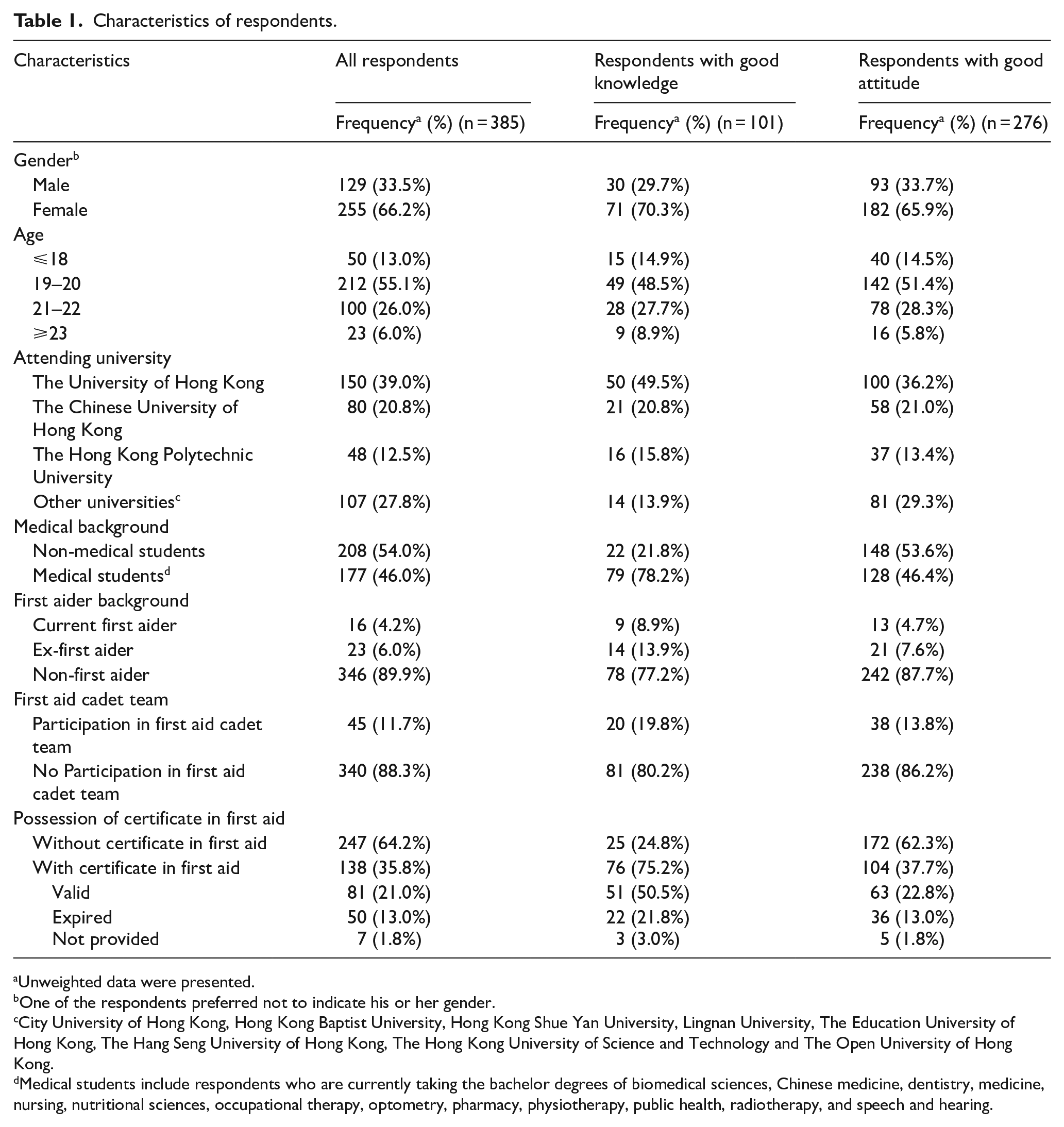
Unweighted data were presented.
One of the respondents preferred not to indicate his or her gender.
City University of Hong Kong, Hong Kong Baptist University, Hong Kong Shue Yan University, Lingnan University, The Education University of Hong Kong, The Hang Seng University of Hong Kong, The Hong Kong University of Science and Technology and The Open University of Hong Kong.
Medical students include respondents who are currently taking the bachelor degrees of biomedical sciences, Chinese medicine, dentistry, medicine, nursing, nutritional sciences, occupational therapy, optometry, pharmacy, physiotherapy, public health, radiotherapy, and speech and hearing.
Only 101 respondents had good SFA knowledge. While 44.6% (95% CI: 37.2%–52.0%) of medical students had good SFA knowledge, only 10.6% (95% CI: 6.4%–14.8%) of non-medical students did so, giving a weighted proportion of 15.2% (95% CI: 11.6%–18.8%). Multiple logistic regression showed that holding valid or expired SFA certificates (valid: odds ratio (OR) = 9.897, 95% CI: 5.213–18.788, p < 0.001; expired: OR = 4.816, 95% CI: 2.326–9.973, p < 0.001) and medical-related degrees (OR: 3.693, 95% CI: 2.051–6.649, p < 0.001) were associated with greater likelihood of having good knowledge of SFA. The VIF were all < 2, reflecting unlikely collinearity among them. There was also no statistically significant difference in the OR of having good first aid knowledge for those holding valid certificates when compared to those holding expired certificates.
Meanwhile, 276 respondents had good attitudes towards SFA. About 72.3% (95% CI: 65.7%–79.0%) of medical students and 71.2% (95% CI: 64.9%–77.4%) of non-medical students had good attitudes towards SFA, giving a weighted proportion of 71.3% (95% CI: 66.8%–75.8%). Multiple logistic regression revealed that only being a current or past member of first aid cadet teams was associated with a greater likelihood of having good attitudes towards first aid (OR: 2.336, 95% CI: 1.010–5.406, p = 0.047).
The most prominent obstacles influencing the acquisition of first aid knowledge were heavy academic workload (mean (SD) score: 3.74 (0.90)), personal time occupation (3.72 (0.90)), being already occupied by various extra-curricular activities (3.66 (0.88)) and lack of training opportunities offered by educational institutions (3.66 (0.97)) (Figure 1).
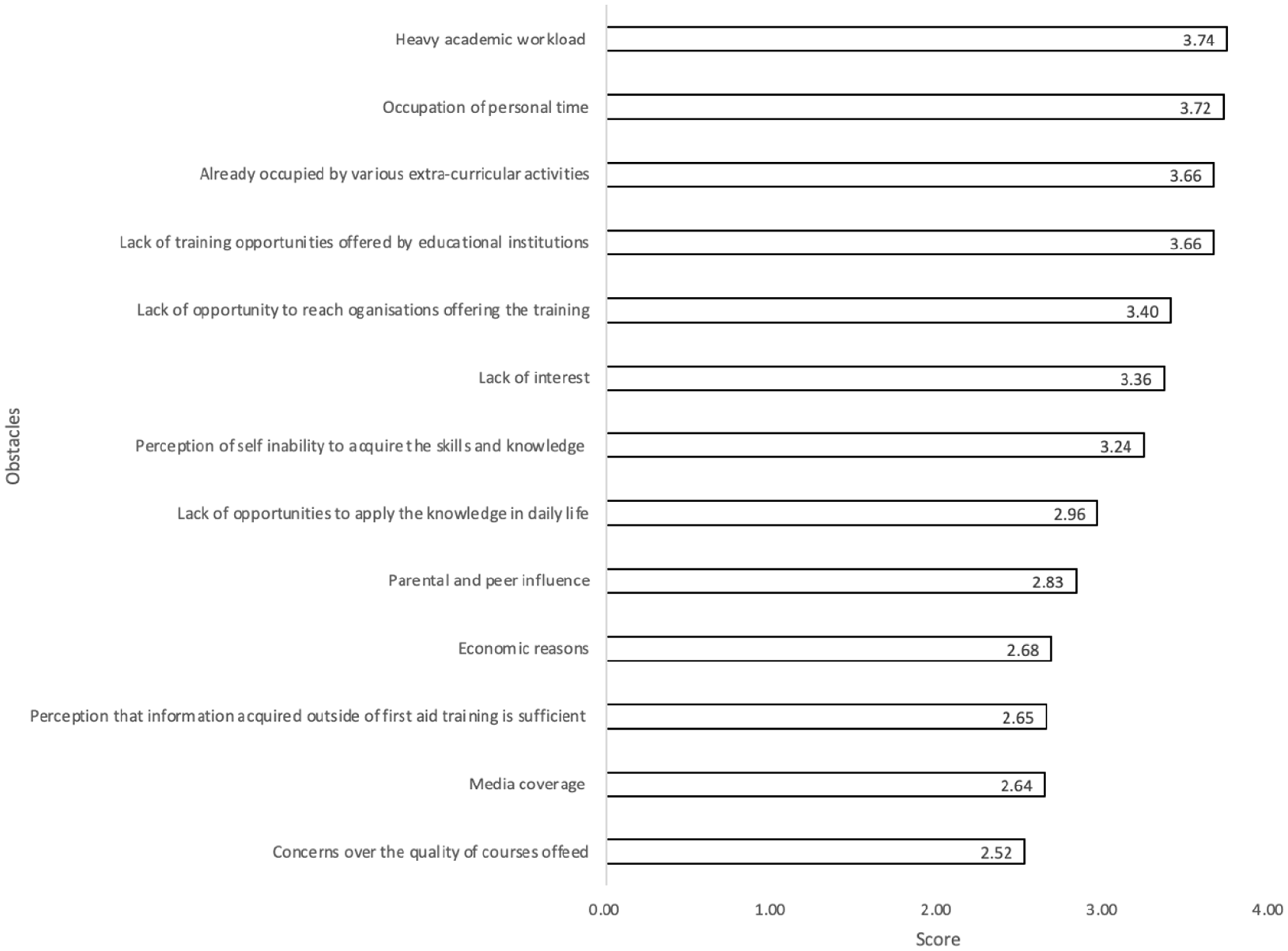
Obstacles influencing students’ acquisition of SFA knowledge, shown in mean score.
Regarding first aid promotion, non-governmental organizations (NGOs) (4.28 (0.65)) were considered most to be the pioneer, followed by the government (4.12 (0.86)) and universities (4.02 (0.76)), and their mean scores were above 4, reflecting that respondents generally agreed these bodies should take a pioneering role. Half of the respondents (49.3%) agreed first aid concepts should be first introduced at the age of 16–18. Age group 12–15 was chosen by the second largest proportion (33.6%), 8.6% considered age above 18 and 8.5% opted for age under 12. Furthermore, 85.8% and 71.3% agreed that first aid training can be implemented as an optional course or a compulsory course, respectively, in the curriculum for their agreed age group.
The top three measures considered as effective in promoting first aid within universities were credit-bearing courses in the university curriculum (mean (SD) score: 3.96 (1.03)), public recruitment of first aiders by uniform groups on university campuses (3.95 (0.88)) and non-credit-bearing courses in university curriculum (3.68 (1.01)) (Figure 2). Furthermore, participants suggested other possible methods, addressing aspects related to advertisement and promotion (15.6%) and fees (12.7%).
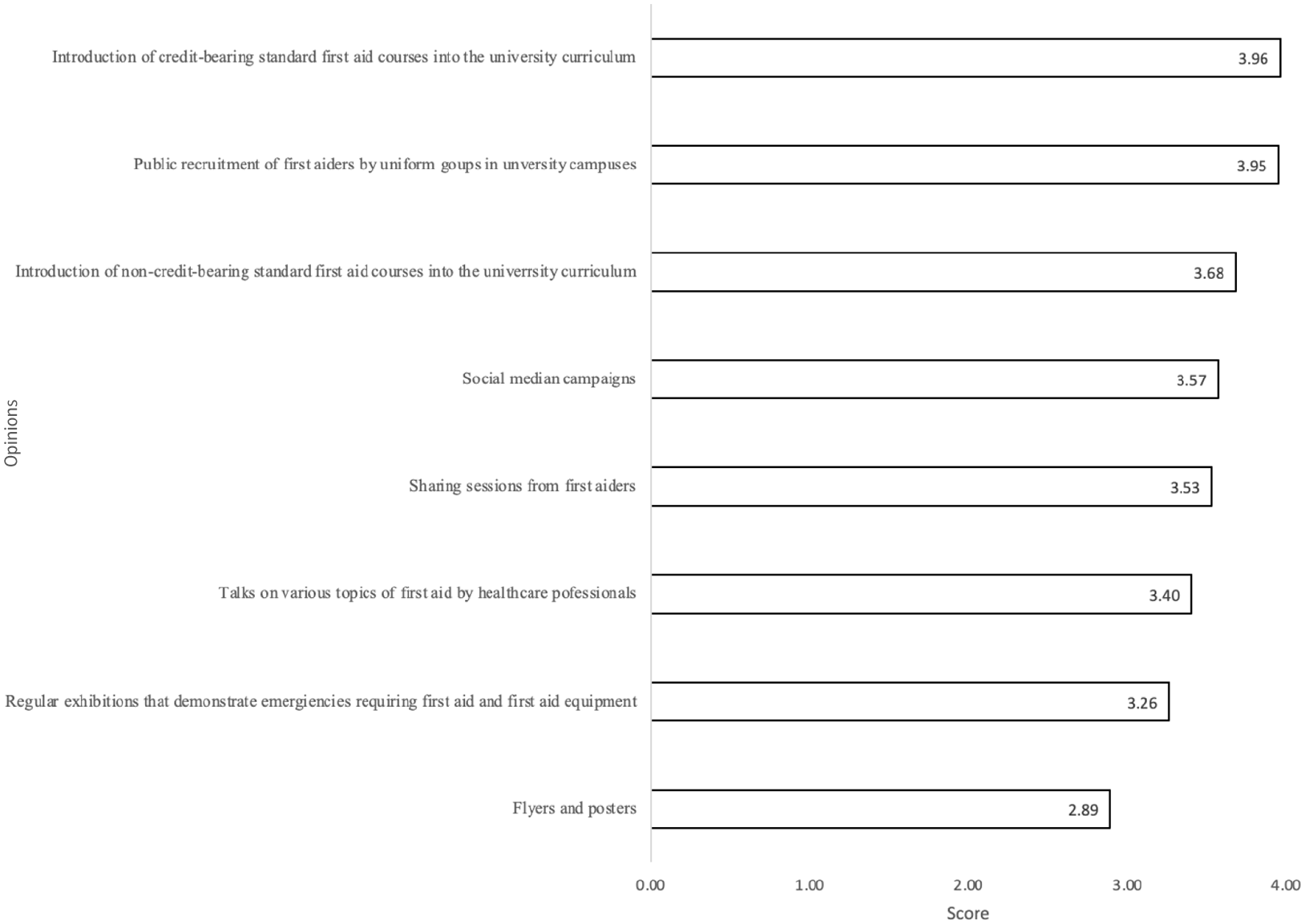
Opinions on the effectiveness of the promotional measures, shown in mean score.
Discussion
Our study showed that only 15.2% of the local undergraduates had good SFA knowledge, indicating the insufficiency of knowledge despite current promotion. Having held SFA certificates, either currently valid or expired, was the most dominant factor associated with good knowledge. Results showed only 35.8% of our respondents have ever received SFA certificates. The percentage of undergraduates being trained was far behind expectations compared to other countries. For example, 90% of Norwegian, aged 15 or above, were trained with first aid knowledge. 19 Proactive training approaches could be a possible reason for the larger percentage in Western countries. According to the International Federation of Red Cross and Red Crescent Societies, first aid is a compulsory course in Denmark, France, Germany, Italy and Norway, 20 implying that more proactive promotion is necessary in HK.
A significant association between studying medical-related degrees and having good knowledge was observed. It implied training for students from non-medical academic backgrounds is essential since they have less exposure to this field than medical students. Nonetheless, only 44.6% of medical students had good knowledge, with a mean score of 16.55 out of 25, which was unsatisfactory. Therefore, SFA education should be promoted in both medical and non-medical undergraduates.
In addition, our study found medical students generally had good attitudes. It was consistent with another study on the attitude of first aid among health science university students in Malaysia, which administered the five attitude-related questions from HKRC as we did.13,17 To our knowledge, this was the only existing study that adopted the same questions on attitudes as we included in our survey, and was conducted in a demographic group similar to a subset of our participants, so that our results would be comparable. It found 90.8% of health science university students had a good attitude to first aid. 17 For fair comparison, we adopted their analysis method. The scores assigned to the 5-point scale were reversed for all questions such that a lower overall score indicated a better attitude. Using this analysis method, we found 86.4% of HK medical students had good attitudes. This suggested both medical students in HK and Malaysia have similar attitudes towards first aid. It is encouraging to see HK non-medical students generally have good attitudes towards first aid as medical students do.
Respondents perceived the most suitable target age group for the first introduction to first aid as 16- to 18-year olds who are senior secondary school students. One possible reason for this suggested range is that it is difficult for junior secondary school students to understand the information and master necessary skills. Also, young students may not be able to retain the information after a number of years. Based on our findings, we suggest the government or relevant organizations consider introducing first aid courses to students above 16 via the school curriculum. This was consistent with a pilot scheme ‘First Aid in Schools Program’ conducted by the Hong Kong St. John Ambulance. The scheme has already provided basic first aid knowledge training for students in around 80 selected primary schools in 2018 during its first stage, 21 and would introduce advanced first aid knowledge to secondary school students in its second stage.
Our study showed it was difficult for undergraduates to spend extra time to participate in time-fixed classes and join first aid courses outside campuses during school time, citing heavy academic workload as a major factor. Therefore, we suggest local universities co-organize courses on campus during the holidays and semester breaks with related organizations. In addition, universities could consider implementing first aid courses as credit-bearing or non-credit-bearing courses that could be considered alternatives to certain components of the undergraduate curriculum. However, the results also showed that while students’ attitudes towards first aid were generally positive, they were not willing to prioritize it over personal time or other extra-curricular activities. More emphasis on the importance and necessity of first aid knowledge via promotion is crucial to encourage students to spend time on receiving first aid training.
Hence, we urge the government, NGOs and universities to work together in first aid promotion. Possible measures suggested by respondents include providing more funding to subsidize course fees or promoting courses to local university students via both face-to-face and online approaches, such as social media, leaflets, talks and celebrity advocacy.
As this study adopted convenience sampling, the results may have limited generalizability to the target population due to insufficient representativeness. The recruitment process resulted in a tilt towards female respondents gender-wise, and students of the University of Hong Kong in terms of the institutions attended, which might also bring bias towards the results. Although the logistic regression models revealed that neither gender nor the university attended was significantly associated with having good knowledge or attitudes of SFA, this imbalance was still suboptimal, and it would be worth recommending that future studies should aim to obtain a more balanced sample in this regard. With an open call for participation through social media, it was impossible to record the number of individuals who were invited but were not recruited successfully, and therefore the response rate could not be calculated. Future studies should consider random sampling to yield a more representative group of participants. Meanwhile, an estimated ratio of medical undergraduates to those from non-medical backgrounds was used to calculate the weighted proportions of respondents with good knowledge of and good attitude towards SFA. Since the exact admission statistics were not available to the authors to calculate such ratios, these weighted proportions could only be approximations. While this survey was targeted at undergraduates, further research on other demographic groups was recommended to aid in formulating comprehensive first aid promotion strategies among HK’s younger population. Finally, the cross-sectional nature of the survey could only reveal association instead of causation.
Conclusion
The proportion of HK undergraduates having good SFA knowledge was unsatisfactory, but the counterpart for having good attitudes was encouraging. Results demonstrated SFA training for all students was necessary to improve the overall knowledge level, and factors including age and academic workload should be considered when devising such schemes. The government, NGOs and universities can be pioneers of first aid promotion.
Footnotes
Acknowledgements
We would like to express our gratitude to HKU Li Ka Shing Faculty of Medicine, and School of Public Health, for supporting and guiding this research. Besides, we would like to thank the Hong Kong Red Cross for authorizing the use of the survey of ‘Report on Survey on Public Knowledge and Attitude on First aid’ as a reference. We also express our thanks to all participants and our team members. Without all the support, the research study would not be completed.
Author contributions
S.N.N., L.K.T., C.K.L., C.Y.C., M.S.C., Y.Y.L., L.C.Y. and Y.T.T. conceived and conducted the study, designed the questionnaire and performed data collection. W.H.T. reviewed and provided advice on the first aid knowledge assessment in the questionnaire. S.N.N., L.K.T., C.K.L. and P.H.C. managed and analysed the data. S.N.N. and L.K.T. drafted the manuscript, and C.K.L., C.Y.C., M.S.C., Y.Y.L., L.C.Y., Y.T.T. and P.H.C. contributed substantially to its revision. All authors approved the version to be published and take public responsibility for appropriate portions of the content.
Declaration of conflicting interests
The author(s) declared no potential conflicts of interest with respect to the research, authorship and/or publication of this article.
Funding
The author(s) received no financial support for the research, authorship and/or publication of this article.
Availability of data and materials
The data that support the findings of this study are available from the authors upon reasonable request.
Informed consent
Informed consent on the first page of the online questionnaire was obtained from all participants.
Ethical approval
Ethical approval was obtained from the Institutional Review Board of the University of Hong Kong/hospital Authority Hong Kong West Cluster (UW 19-730).
