




Abstract
Background:
Terrorist incidents are on the rise in the world, and many countries have been involved so far. Unfortunately, many innocent people fall victim to such incidents every year. The pre-hospital emergency, as one of the most important organs in the management and service of the victims, plays a vital role in these events.
Objectives:
This scoping review aimed to evaluate the performance and preparedness of the pre-hospital emergency in the world for such Terrorist incidents.
Methods:
In order to access the documents and scientific evidence relevant to the purpose of our research, selected keywords were searched in PubMed, Scopus, and Web of Science databases. Finally, we collected the required information through a pre-designed data extraction form that designed based on the purpose of this study.
Results:
The initial search, with the specified search strategies, resulted into 794 documents (263, 488, and 43 documents from PubMed, Scopus, and Web of Science databases, respectively). Finally, eight papers were selected through the full text of the selected articles, three of which were qualitative and three were quantitative, and two were mix-methods (qualitative/quantitative). Our findings show that published papers have so far emphasized four main axes, namely, preparation, training and practice, effective communication, and the proper triage and transmission of these four axes.
Conclusion:
A few studies have been done in this area and more studies should be done in different areas and sectors, and given that terrorist incidents are on rise and the pre-hospital emergency organization as one of the most important organizations is not well prepared to respond these events although it has a vital role to play, they need to be more prepared to effectively manage these incidents.
Keywords
Introduction
Terrorist attacks are on the rise, and so far many countries have been affected by such incidents, with many people victimized and injured. 1 The recent and ongoing threats of terrorist attacks have prompted national and international agencies to reassess their capacity and readiness to respond to such incidents. While it is difficult to identify the likelihood of a terrorist attack (whether common, biological, chemical, or radiological) in any given location, medical emergency agencies, hospitals, and other health care system agencies are currently planning to increase their readiness. 2
Terrorist incidents are one of the most important and dangerous incidents that take place every year in our world and take the lives of many people and also terrify the society. Terrorism has various definitions and is used for a variety of purposes, including the use of force, violence, or threats to achieve political ends through the creation of terror and intimidation.3,4 The US Department of Justice and the Federal Bureau of Investigation defines terrorism as the illegal use of force or violence against persons or property to intimidate or coerce the government, civilians, or any part of it, to advance political or social ends. 4
Terrorism is a threat which has been around for centuries. Some countries—such as Israel, Britain, Turkey, Colombia, Spain, the United States, and Iran—are preparing to fight terrorism.5,6 The pre-hospital emergency, as one of the most important organizations in such incidents that immediately comes on the scene and serves the injured, plays a very important role during such incidents. A pre-hospital emergency is an important part of the public safety net, a support network that ensures the safety and health of citizens. Therefore, the evolution and progress of this organization will not only provide better services in emergency medical care but will also increase the preparedness for terrorist incidents. 4
The awareness and proper functioning of pre-hospital emergency staff and managers are important in order to save lives and serve the victims of these incidents. Given that there are various terrorist incidents in the world right now and there is no specific model for the pre-hospital emergency response to such incidents and the pre-hospital emergency is still not prepared enough, we aimed to conduct a scoping review of pre-hospital emergency response teams against terrorist attacks to identify what actions have been taken, what actions and issues need to be considered, and what issues still need further consideration.
Methods
This study was a scoping review based on the PRISMA checklist according to the following steps.
Initially, in order to access the documents and scientific evidence relevant to the purpose of our research, an electronic search was conducted using MeSH terms, and consulting experienced researchers. Selected keywords included “terrorist incidents, terrorist accidents, terrorist attacks, terrorism attacks, terror, terrorism, terrorists (violence, political, conflict, criminality, war), emergency medical services (EMS), emergency medicine service, emergency medical care, medical preparedness, pre-hospital emergency, pre-hospital emergency care, pre-hospital emergency medical services, pre-hospital care, emergency health service, emergency medical response, and first medical responder”, which were searched in PubMed, Scopus, and Web of Science databases.
Inclusion criteria
Studies which met the following criteria were included:
Studies which were published in English language.
Studies which studied the performance of pre-hospital emergency medical services (EMSs) during a terrorist attack.
Studies which considered use of force, violence, or threats to achieve political ends.
Studies which were published as original or review.
Exclusion criteria
Studies which met the following criteria were excluded:
Studies whose full text was not accessible.
Studies which described other areas of aiding during terrorist attack including anti-terrorist medical service rendered by military personnel, post-terrorist attack medical care rendered by the fire service, police, boy scout, or responses taking place in field hospitals.
Studies which considered events including hacking into a government computer or cyber attacks to the governmental websites.
Studies which focused on other kind of emergency responses including Internet security, sanitation, and transportation.
Studies which were published as letter to editor, commentary, case report, case series, expert consensus, published national guideline, or editorials.
The first preliminary search was performed by two authors (S.M. and A.T.) separately. In the next step, duplicate papers were deleted, and then more narrow searches were performed to remove unrelated items. After reviewing the title and abstract of each of the retrieved studies and checking against inclusion criteria, the potential studies were identified and the full text of the articles was reviewed and discussed until a consensus was achieved (all steps are performed by the two authors S.M. and A.T.) (Figure 1).
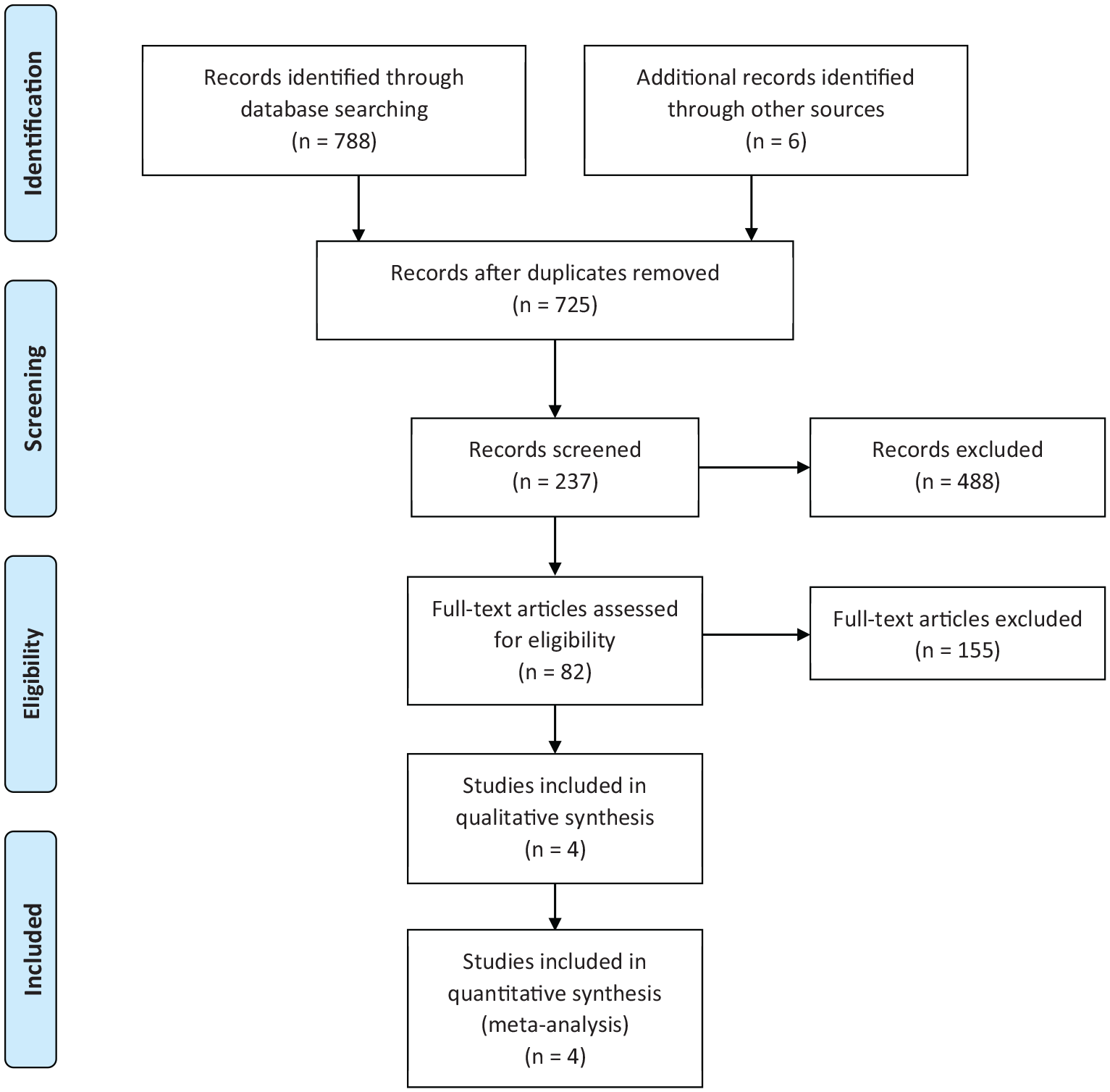
Levels of search and selection of articles (flow diagram).
The data extraction form was designed based on the purpose of the study. This form included sections of study methodology, title, first author, year of publication, type of research, sampling method, sample size, research location, and data collection instrument, results and information related to pre-hospital emergency. We meta-synthesized qualitative studies using content analysis using an inductive approach.
Findings
The initial search, with the specified search strategies, resulted in 794 documents (263, 488, and 43 documents from PubMed, Scopus, and Web of Science databases, respectively) of which 69 were duplicated. After reviewing titles, 119, 101, and 17 papers from PubMed, Scopus, and Web of Science were selected for abstract check.
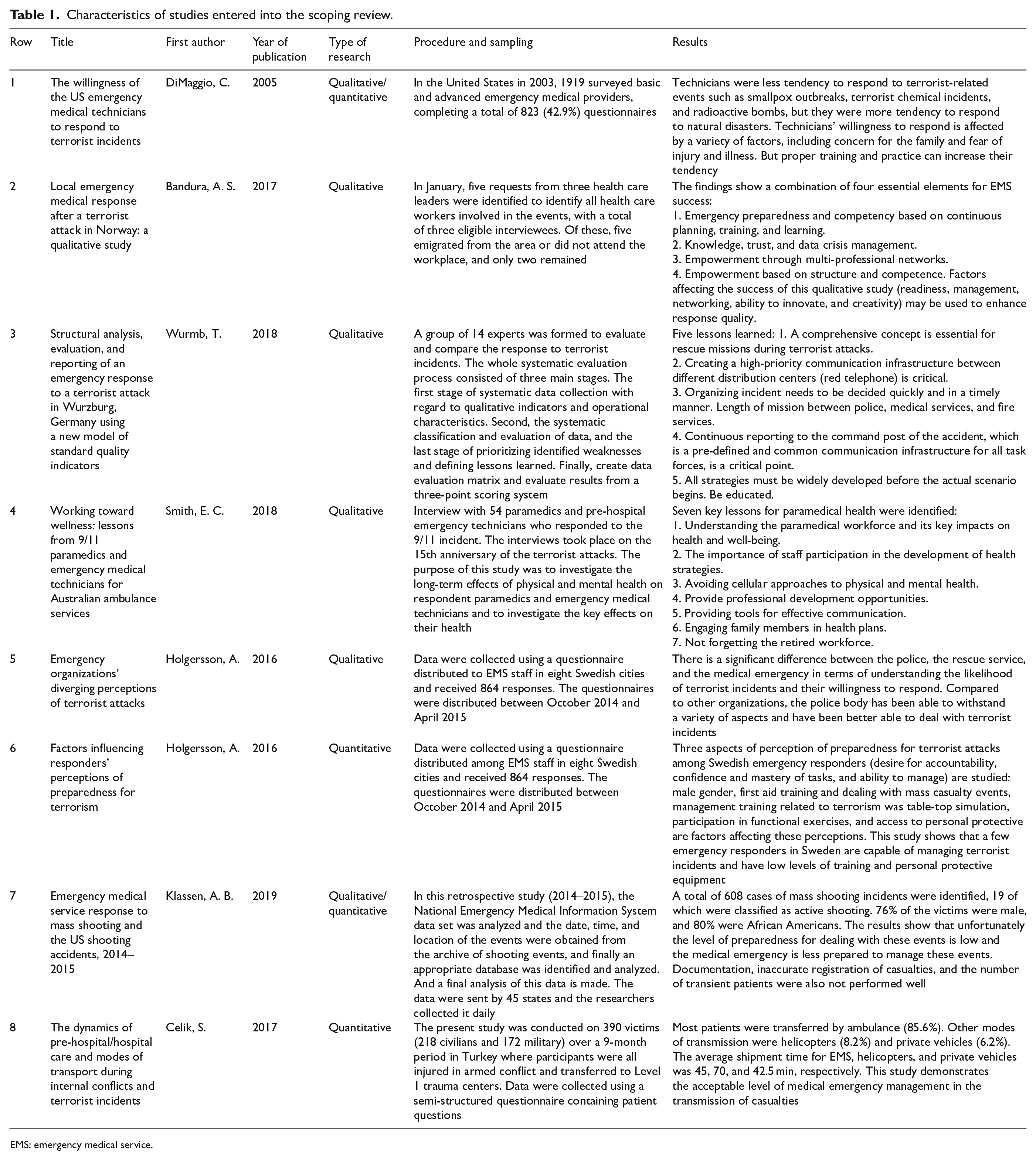
Then after reviewing abstracts, 82 papers were selected. Finally, eight papers were selected through the full text of the selected articles, three of which were qualitative, three were quantitative, and two were mix-methods (qualitative/quantitative) (Table 1).
Characteristics of studies entered into the scoping review.
EMS: emergency medical service.
Discussion
Unfortunately, many terrorist incidents happen in different countries every year, with many innocent victims. Terrorist attacks are done with different intentions and the agent is seeking to obtain special privileges. 7
Evaluation and review of published studies showed that different countries, including developed and developing countries, have a new and special approach at these events and try to improve their preparedness and capabilities in various fields for management and confrontation of these incidents.1,8,9 Published papers have so far emphasized four main axes, namely, preparation, training and practice, effective communication, and the proper triage and transmission of these four axes. Although different levels of preparedness in different countries have been specifically studied and stated, these studies suggest low levels of preparedness in different countries and communities. In this regard, DiMaggio et al. 9 stated that health providers have little tendency to respond to terrorist-related events such as smallpox outbreaks, terrorist chemical incidents, and radioactive bombs, but they are eagerly prepared for natural disasters such as snow avalanches. They were not also inclined to respond to terrorist events, which is in line with their earlier readiness, indicating that pre-hospital emergency technicians are not yet well prepared to deal with such events. Brandrud et al. 10 whose findings suggest a combination of four elements essential to EMS successful that emergency preparedness is one of the elements in this study. It indicates that successful emergency response requires continuous emergency preparedness planning, organizing, regular training, and empowerment through networking and training. It is not possible in local areas without available resources and thus efforts should be done to increase the level of readiness. In the study carried out by Smith and Burkle,11 seven key lessons for paramedic wellness were identified. These included the following: the need to understand the paramedic workforce and the key influences on their health and well-being, the importance of engaging staff in the development phase of wellness strategies, avoiding silo approaches to physical and mental health, providing ongoing professional development opportunities, providing tools for effective peer-to-peer communication, including family members in wellness initiatives, and not forgetting the retiring workforce. They stated that Australian paramedics are currently experiencing a mental health crisis. Suicide rates are up to four times higher than the general population, with high levels of post-traumatic stress disorder (PTSD) and anxiety, and it is suggested that these lessons will be used as key lessons to improve health and increase preparedness.
Much of the preparedness and ability to respond to disasters depends on having a regular training plan which allows people involved in emergencies to practice their roles and responsibilities before actual disasters occur. Practice not only prepares individuals for their roles and tasks but also identifies planning flaws. 4 It is also stated in DiMaggio et al. 9 that training and exercises which increase willingness of providers to respond could have profound effects on enhancing their capacity and planning readiness. Timely and appropriate training, addressing interpersonal concerns, and instilling a sense of responsibility can increase the responsiveness of pre-hospital emergency providers. Smith and Burkle 11 have emphasized the continued training and engagement of pre-hospital emergency medical staff and practical training and maneuvering.
Effective communication was also one of the main focuses of the reviewed studies that still needs further effort and investigation for the management of terrorist incidents. In this regard, Brandrud et al. 10 acknowledged that effective communication and the creation of strong and integrated communication networks play a significant role in managing and serving terrorist events more effectively. But Wurmb et al. 12 have pointed to the rapid launch of the incident command post at the scene of the incident and have stated that a successful mission tactic requires continuous flux of reports to the on-site command post. Creating a high-priority communication infrastructure among organizations such as the police, emergency medical services, and fire services is also critical. Smith and Burkle 11 while pointing the importance of communication at the scene stated that providing the appropriate tools and equipment to communicate should be considered in advance and that all staff should be properly trained.
Quantitative studies which were entered in this review have also addressed the issue of preparedness, although the level of preparedness and its sufficiency have not been clearly stated in two studies published by Holgersson and colleagues,13,14 the level of preparedness and the perception of the risk of terrorist incidents vary among the various organizations involved, among which the police is better prepared than pre-hospital emergency services. There are three aspects of understanding terrorist attack preparedness (willingness to respond, a level of confidence in the tasks, and estimating management ability) among emergency responders in Sweden. It was acknowledged that these three aspects were influenced by gender the man, first aid training and dealing with mass casualty events, management training related to terrorism, simulation table-top, participation in functional training, and access to personal protective equipment. Their study also showed that a few emergency responders in Sweden have the ability to specifically manage terrorism and that the level of training and the use of personal protective equipment are insufficient. 13
Another major focus discussed in the published papers is the triage principles and transfer of patients and victims of terrorist incidents. Many academics and disaster management experts have stated that triage plays an important role in responding to emergencies and terrorist incidents. 15 Klassen et al. 16 believed that all casualties should be triaged immediately according to the correct protocol and that all pre-hospital emergency staff involved in these events must be trained according to the correct triage principles. In addition, Celik et al. 17 reported that most patients were transported by ambulance (85.6%) and the other modes were helicopters (8.2%) and private vehicles (6.2%). The average patient transfer time for EMS, helicopters, and private vehicles was 45, 70, and 42.5 min, respectively, and triage at the scene would save the lives of the injured and make it easier to transfer to medical centers and reduce transmission time but they have not reported whether the pre-hospital emergency function was acceptable or not.
Conclusion
The results of this study showed that a few studies have been done in this area and more studies should be done in different areas and sectors. Overall, studies have examined the performance of pre-hospital emergency managers and staff in four areas and axes, and given that terrorist incidents are on the rise and the pre-hospital emergency organization as one of the most important organizations being not well prepared to respond these events, they need to be more prepared to effectively manage these incidents. Therefore, it is important to be careful in the comprehensive planning of the pre-hospital emergency department and to increase the preparedness of managers and staff, strived to effectively manage and better serve the injured and the victims of such incidents.
Footnotes
Acknowledgements
This study is part of a doctoral thesis by Sadegh Miraki under the guidance of Dr Mohammad Reza Amiresmaili. It is necessary to acknowledge the guidance of dear professors as well as the officials and experts of the Kerman University of Medical Sciences Central Library who provided the search and accessibility of the original articles.
Declaration of conflicting interests
The author(s) declared no potential conflicts of interest with respect to the research, authorship, and/or publication of this article.
Funding
The author(s) received no financial support for the research, authorship, and/or publication of this article.
Availability of data and materials
All data and materials of this study are available upon request from corresponding author.
