




Abstract
African fashion reveals intersections between upgrading, manufacturing and internationalization alongside expanding cultural, political and social influence. Yet global value chain analyses of the industry reinforce a core-periphery dynamic with the location of lead firms in the Global North (GN) and actors lower down the value chain in the Global South (GS). This disappears GS actors in the creative economy, including fashion designers, who innovate, design and cultivate the brand followership associated with lead firms. This paper analyzes fashion designers in Lagos and Nairobi as economic, cultural and social value creators and therein lead firms from below (LFfB). It conceptualizes this dynamic, with a focus on lead firms within the global value chain framework that combines elements of conceptual interventions on state capitalism to offer the LFfB framework. The framework is deployed to analyse primary data from fashion design firms in two key hubs, Lagos and Nairobi. Findings demonstrate the significance of synergies between key areas of LFfB operation (research and development, inputs, distribution, sales and product design) and state capitalism’s support for production, trade and finance, as well as positive returns through international cultural recognition and national profile building. Nevertheless, the paper contends that challenges of state (in)action can undermine sustainable practices, competitiveness as well as multi-scalar internationalization.
Introduction
African fashion offers critical insights into new narratives on innovation, production and internationalization which can challenge the dominance of Global North (GN) firms in conceptualizations of lead firms. This paper examines the significance of this reframing in relation to state capitalism and internationalization by analysing the work of African fashion designers in Lagos and Nairobi.
The Economist acknowledges the African fashion industry as one of the five biggest stories to watch in 2022 (Economist, 2020), highlighting local manufacturing, locally sourced inputs and digitization alongside existing and expanding cultural, political and social influence globally. Moreno-Gavara and Jiménez-Zarco (2019) discuss the potential of the fashion industry for accelerating economic growth and industrialization, building new trade and export options and global value chains and enhancing regional and global integration. The rising interest in the cultural leadership and work of African creatives (England et al., 2021), and fashion designers specifically, offers a basis for reconsidering their potential for higher value addition (Hivos, 2016; Kawamura, 2005) which goes beyond previous emphasis on lower value-added activities (Khan, 2019).
Although the development of global fashion industries and markets has emphasized neoliberal values and entrepreneurialism (Khan, 2019; Langevang, 2017), there remain key connections with state resources (direct and indirect) that facilitate the emergence and viability of national fashion industries. This includes investment in education (fashion and textiles), grants, subsidies, tax cuts or incentives, support via trade missions and other marketing and promotional interventions (Jeong et al., 2021). While acknowledging challenges faced by African fashion entrepreneurs (Langevang, 2017), the extant literature has given little consideration to the potential role and impact of state support in this space. In this paper, we address this gap and argue this impact can stretch from targeted industrial policy to embracing fashion within broader policy agendas (Moreno-Gavara and Jiménez-Zarco, 2019).
State capitalism in Africa has its post-colonial foundations in attempting to redress the imbalance in the global political economy through industrial policy, finance and infrastructure for industrial development and structural transformation (Mkandawire, 2001). This paper contributes to Alami and Dixon’s call (2020) to elevate perspectives from non-Western contexts by centring the relationship between state capitalism and the creative economy in Africa. It builds on debates on state support for specific sectors of cultural production – for example, the film and media industries (Igwe, 2018) – that acknowledges how recent investment in cultural production has repositioned contexts sometimes considered peripheral at the top of global value chains (Kwon and Kim, 2014).
Growing critique of the consolidation of economic power in (GN) ‘global fashion cities’ such as London, Paris, Milan and New York (Jeong et al., 2021) calls for fashion markets and newer fashion cities outside of these urban centres to innovate and forge their own path (Brydges et al., 2018). This includes a number of growing fashion cities in Africa (Oberhofer, 2012). There is particular recognition of the extant significance and growing influence of two of the continent’s key fashion hubs, Lagos and Nairobi, in the progress of the African fashion industry. The paper takes the perspectives of fashion designers as producers and creators of economic, social and cultural value in these cities as its starting point. It centres and interrogates their readings of state capital’s interactions with internationalization trajectories in one of the most vibrant economic sectors in Africa (African Development Bank, 2019). We deploy a case study analysis of fashion design firms, with primary qualitative data collated through semi-structured interviews with fashion designers in Lagos and in Nairobi.
The paper makes three specific contributions. First, it maps fashion designers as value creators at the highest levels and their potential as lead firms from below. This subverts the conceptualization of lead firms as located in the GN, as is pursued predominantly within GVC analyses (World Development Report, 2020). Second, the paper contributes an analytical framework, the ‘Lead Firms from Below’ (LFfB) Framework. Here ‘below’ is used to signify firms that are governed outside of Global North (GN) networks, emphasizing firms operating at the micro-level and independent of international brands who contribute to local development while acting as cultural agents (England et al., 2021: 7) within domestic, regional and global markets. Finally, the paper analyzes the higher-value activities of fashion designers in Lagos and Nairobi and potential as LFfB and examines the synergies between their key priorities and state capitalism in the context of internationalization and globalization (Bowles, 2020; England et al., 2021; Gereffi and Fernandez-Stark, 2016).
Findings demonstrate the significance of synergies between key areas of LFfB operation (such as research and development, inputs, distribution, sales and product design) and state capitalism’s support for production, trade and finance. In doing so, the article responds to the calls to centre GS contexts in conceptual advancements in GVCs and Global Production Networks (GPNs) as well as the significance of state capitalism (Neilson et al., 2014). The paper reflects that while there are benefits from state capitalism, challenges of state (in)action must be addressed to enable global competitiveness, sustainable practices and meeting global standards, as well as enhancing interactions with regional and continental markets towards greater internationalization for the fashion industry. Finally, it contributes to a better understanding of the role that state capitalism can play in the development of the creative economy but also the range of positive returns that state capitalism in this sector can bring in relation to international cultural recognition and national profile building.
Exploring state capitalism, internationalization and fashion
State capitalism and internationalization
The enduring role of the state in development and transition is energizing new debates on concept-building and interventions across geographies, while recognizing extensive gaps in this process (Alami and Dixon, 2020). The notion of state capitalism continues to mutate from the ownership and control of capital to the state’s supervision of capital accumulation (Alami et al., 2022). Others reflect on categorizations from state-owned enterprises to industrial policy (Musacchio et al., 2015). There is broad recognition of the malleability of state capitalism as a concept given the range of foci from policy to institutions and networks with varied engagements with the state (Alami and Dixon, 2020). Also acknowledged is the ontological tension of the state-market dichotomy and the fatalism associated with states (Alami and Dixon, 2020) which Musacchio et al. (2015) refer to as the liability of stateness. This tendency is rooted in the analytical dominance of the state-market dichotomy across the ideological sphere within the social sciences, including critical traditions (Bruff, 2011; Ikpe, 2021). As such it can challenge the understanding of dynamics that are internally consistent and thus entrench contradictory interpretations of empirical realities.
Despite these challenges, thinking about state capitalism as a conceptual category is significant given its complex and multifaceted role across various periods of globalization and the implications for socio-economic transformation. In African contexts, the state has long been essential to socio-economic change, including influencing the construct of domestic private capital vis-à-vis foreign private capital and historically colonial capital as well as its interactions with resource-focused transnational corporations (Ikpe, 2022; Mkandawire, 2001).
Concern with state capitalism endures despite dominant analyses of global dynamics (Bowles, 2020; Mayer and Phillips, 2017; Werner, 2020). Babic et al. (2020) highlight the significance of International Political Economy (IPE)-centred (including GVC and GPN) analysis on state capitalism. In examining contemporary interactions across international contexts, one must consider diverse GS and GN spaces and their positionings within the global economy. Within international political economy, state capitalism is conceptualized as negotiating international dynamics and associated core-periphery structures through supporting domestic firms to internationalize (Alami and Dixon, 2020; World Bank, 2020).
Bowles (2020) conceptualizes interactions between state capitalism, globalization and internationalization through centring key factors connecting these: production, finance and trade. Production, finance and trade are also notable as key aspects of interactions between the state and creative economies (Lee, 2020). This paper extends debates on how state initiatives and investments (and lack thereof) (Werner, 2020) may (or not) support production, trade and finance to enable firms to thrive as leaders through innovation (design), distinct markets, value (economic, social and cultural) and international and global linkages through both imports and exports. In doing so, we contribute to Alami and Dixon’s (2020) call for deepened conceptual engagement with state capitalism by empirically grounding the conceptual development of interaction between developmentalism and energizing lead firms from below.
State capitalism, the creative economy and fashion
There is a growing but limited literature looking at the connection between state capitalism and the development of the creative economy. Yet forms of cultural protectionism and subsidy and intervention, particularly in film and media, are widely acknowledged as political economy and cultural economy instruments (de Jesus, 2020) and remain connected to the importance of cultural representation, national image and cultural recognition (Jeong et al., 2021; Larner et al., 2007). Direct and indirect support by the state – both via cultural policy and industrial policies – is pivotal to the creative economy. It has also been used strategically by many countries to re-position themselves in the global economy in the last decades, such as South Korea’s creative economy and the famous Korean New Wave (Kwon and Kim, 2014). Here, particular interventions include not only industrial infrastructure and skills development but also copyright legislation to facilitate trade and exporters in growing their global cultural market share (ibid). Looking at the success of Nollywood (Nigeria), Igwe (2018) highlights how various mechanisms, including not only a film fund but also professional training and help with distribution, were introduced (2010–2015) to maximize the economic potential of Nollywood’s success for the broader economy.
While media has typically been the focus of these cases of new state capitalism, countries have also supported their own fashion designers to engage more directly with global value chains. Larner et al. (2007) address the role played by state policy in promoting New Zealand fashion designers’ work, contributing to international perceptions and national identity. Meanwhile, Jeong et al. (2021) unpack the range of investment and national policies connected with the emergence and maintenance of global fashion cities like New York and London, ranging from finance (funds or tax breaks) to promoting initiatives for specialized education or linking the fashion industry and academia to facilitate networking within the sector.
Fashion, value chains and creative economies in Africa
Fashion is a key site for the representation of different forms of value. The African-sited fashion industry has an estimated value of $1.3 trillion (AfDB, 2019), but fashion also offers cultural representation and communication of African cultural heritage and new African values and images through visual culture (Rovine, 2015). There are also calls to reject fast fashion production models in favour of more creative, socially and environmentally beneficial approaches that can offer a competitive advantage (Hivos, 2016). Significant investment in sourcing and production (materials, facilities, processes and labour) and in marketing (to communicate narrative) is, however, needed in order to capitalize on this market premium, taking into account higher production costs (ibid: 48).
Textiles, apparel and footwear GDP a figures in Nigeria 2011 and 2020.
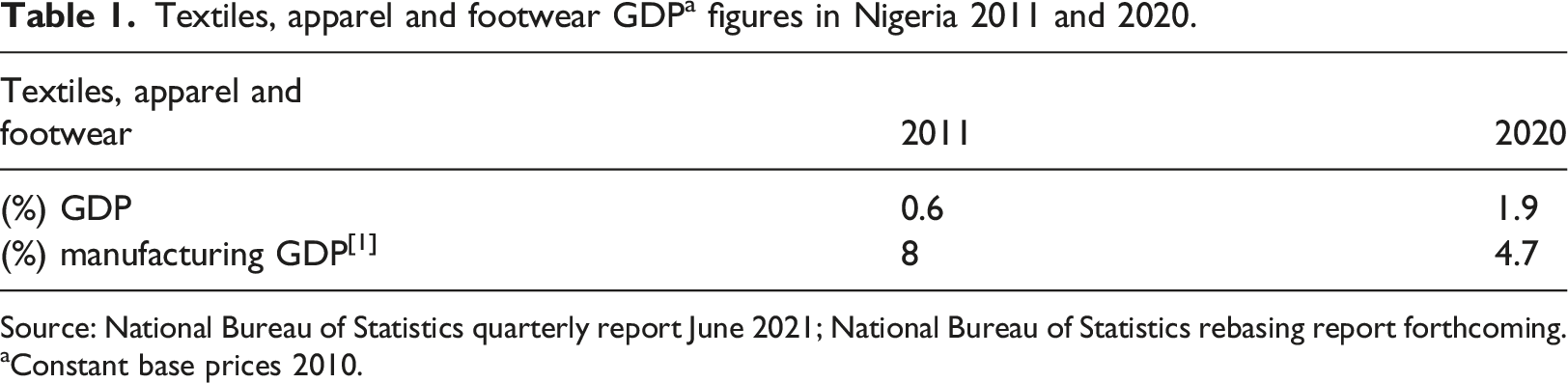
Source: National Bureau of Statistics quarterly report June 2021; National Bureau of Statistics rebasing report forthcoming.
aConstant base prices 2010.
Textiles and apparel manufacturing in Kenya 2011 and 2020.

Source: World Bank World Development Indicators.
On the one hand, growth in contribution to GDP in Nigeria and in value-added manufacturing in Kenya points to the sector’s progress. On the other hand, the decline in manufacturing GDP in Nigeria highlights its challenges, including low productivity. Kenya’s textile and apparel sector is also plagued by low productivity concerns (Konishi et al., 2015).
Examples of emerging public policy directions intended to support domestic textile production and growth in the fashion industry include limiting foreign exchange resources for textile imports (Nigeria), or in some instances banning imports of fashion and textiles (Nigeria), or taxing them heavily (Jennings, 2011), and investing in GM crops for cotton farming and textile production facilities (Kenya and Nigeria) (Nkechi, 2019). These interventions are also intended to address the negative impacts of second-hand clothing imports (Jennings, 2011), a point also raised by our interviewees.
However, there is potential for import restrictions to negatively impact domestic creative production. Jennings (2011) notes the outlawing of textile imports in Nigeria in 2003 resulted in a rise in black-market imports and a persistent lack of choice in fabrics and factories domestically. This highlights the challenges associated with import substitution and the need for adequate industry linkages to support domestic production in such instances, as this paper’s analysis shows. Ongoing reliance on international markets to provide sufficient demand towards economic transformation also remains a challenge.
The AfDB (2019: 2) states that ‘targeting the fashion industry means targeting the whole value chain, from the smallholder farmers to the fashion designers’. We argue there is a need to extend this view to encompass both backward and forward linkages, taking fashion designers as a vantage point from which to consider the position of African actors in production and distribution networks and the relationships between them.
Discussions about African firms in GVC and GPN analyses recognize that supplier firms turn away from global markets for a range of reasons to gain market share and upgrade within regional economies (Barrientos et al., 2016; England et al., 2021). Within the garment sector, lead firm characteristics of higher value fashion content, alongside smaller runs, emerge in local, regional and global markets in Madagascar, Lesotho, Eswatini, Kenya and Mauritius (Morris and Staritz, 2017). State capital is significant in supporting progress in Mauritius but is limited in strengthening progress in Madagascar. Pasquali et al. (2021) point to lead firms in South African retail, focused on regional value chains with sourcing from suppliers in neighbouring Lesotho and Eswatini as well as from US-based firms in a reversal of the GN/GS hierarchies in service to continental markets. They problematize the superficial firm centricism of GVC framings by unpacking the influence of state capital on leadership, notably through investment policies to enable internationalization, export processing zones for strengthening domestic capacities, 2 state finance, trade policy such as import tariffs and protectionism, supporting global market access. In reverse, Morris et al. (2016) note how the dearth of state capitalism, including industrial policy, undermines the possibilities of upgrading and advances to leadership for local firms.
Conceptualizing lead firms from below and the significance of state capitalism
Conceptualizing lead firms in African fashion
Fashion designers and lead firm activities.
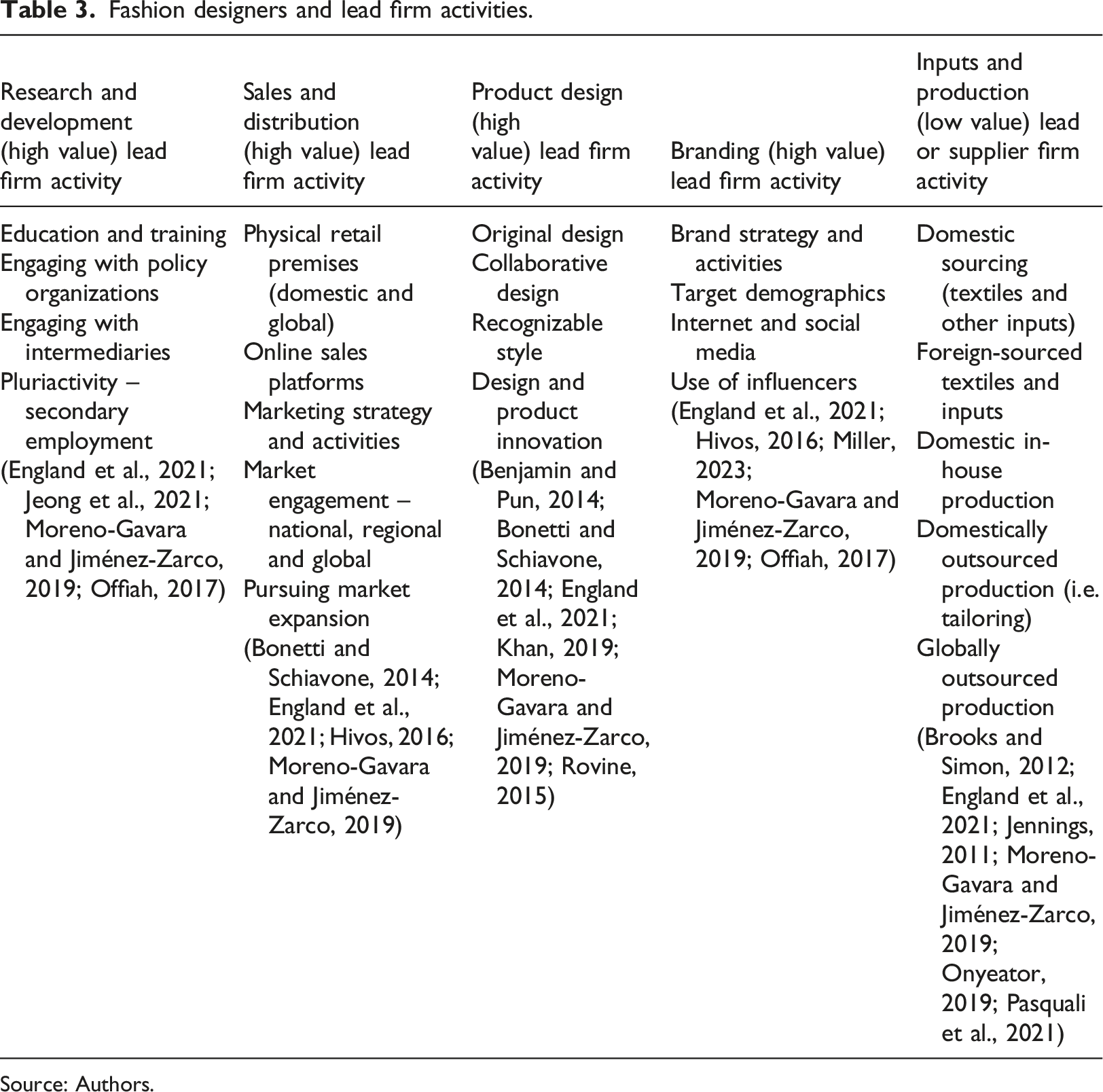
Source: Authors.
Fashion designers (Nairobi and Lagos) and lead firm activities.
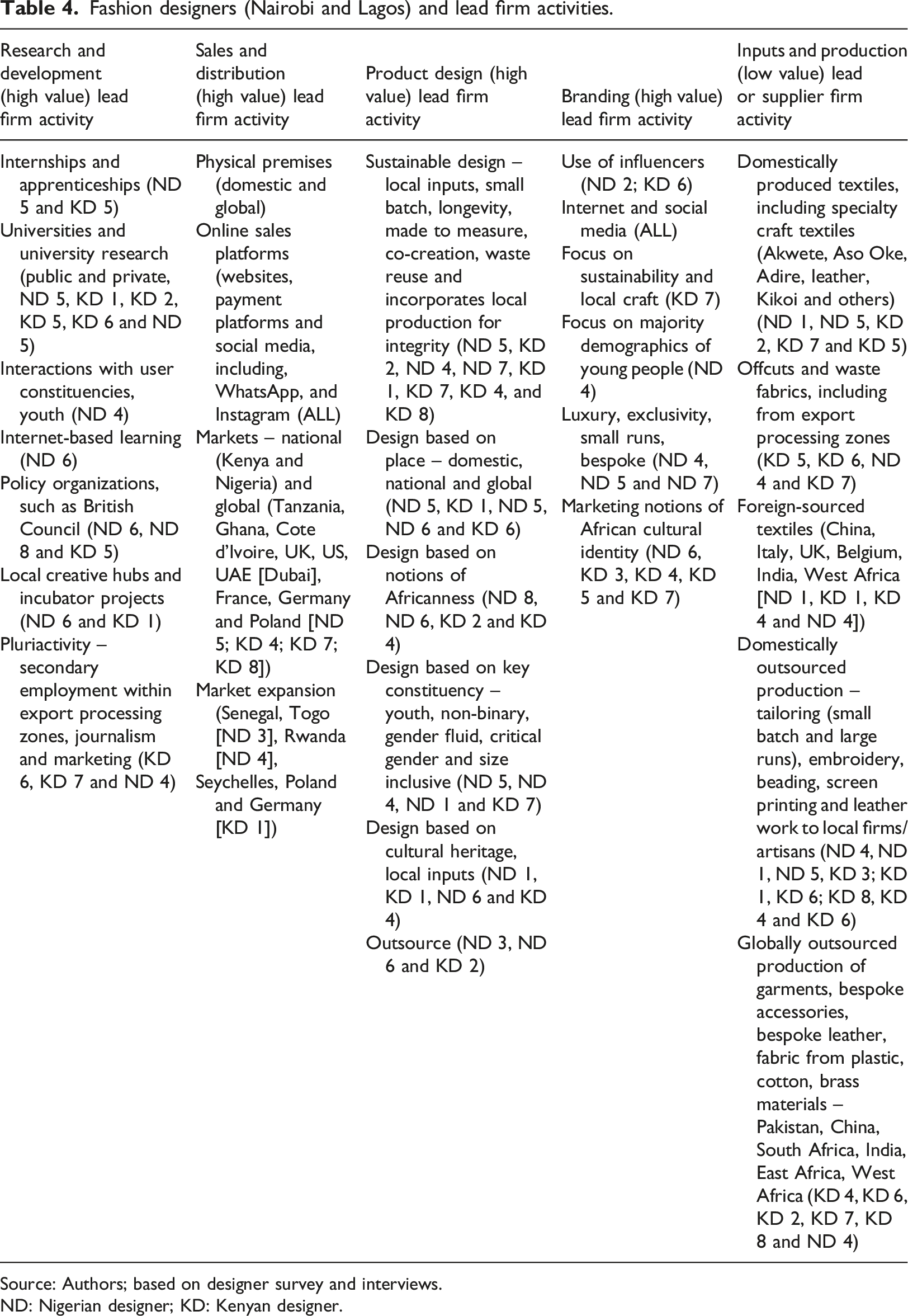
Source: Authors; based on designer survey and interviews.
ND: Nigerian designer; KD: Kenyan designer.
Our mapping builds on Bonetti and Schiavone (2014) who recognize that fashion producers participate in value chain activities such as controlling design (as well as having weak or no control over design); producing domestically or buying; maintaining brand and buying brand access (or having no brand); and distributing directly, using third-party distribution or partner on distribution. It also connects to Benjamin and Pun’s (2014) examination of fashion producers’ interactions with value chain activities as follows, design as couture, fast fashion or niche; raw materials as sourcing intermediate goods as well as natural/synthetic textiles; production as domestic, US/European and Asia-based; marketing as product-based, celebrity-based, new media-based and intermediary-based; and sales and distribution through specialty stores, department stores and chain stores.
Tables 3 and 4 connect to Offiah’s (2017) recognition of African lead firms in fashion alongside European counterparts, focussing on Nigeria as a pivotal space with access to domestic and global markets, intermediaries such as Lagos Fashion Week and numerous traditional and new media and with control over retail and distribution in-country with some scope to connect to global retailers. On a similar note, the UK’s prominent fashion retailer Selfridges as well as Browns and online Farfetch retail African fashion producers (in collaboration with Lagos-based intermediary Style House Files) that own and control design, branding and distribution (Miller, 2023).
Barrientos et al. (2016) note not only the significance of interfirm relations in value chains and production networks but also the need for greater nuance in understanding this over time. We find that among fashion producers such interfirm interactions exist between designers, tailors, embroiders, input suppliers among others, as noted in Table 3 and explored empirically in our analysis. Onyeator (2019) highlights the contributions of embroiders, craftspeople, stoners and contracted tailors and input suppliers to fashion production firms. Staritz et al. (2017) and Morris and Staritz (2017) note lead firms in clothing value chains control value-adding activities such as design and branding, while also carrying out some outsourcing with detailed specifications. Indeed, looking at garment-related value chains, the actions of lead firms (see Table 3) can be recognized in the work of fashion designers.
A key element that drives conceptualization of lead firms is their market share and associated economic value, but value can include economic, social and cultural dimensions. In the case of fashion goods, it is their aesthetic or symbolic qualities that typically determine their value (Kawamura, 2005). The structure of the fashion industry and the position of creators within the market are impacted by both autonomous (non-economic, aesthetic and cultural considerations) and heteronomous (economic, market-related) forces (Brydges et al., 2018). Place (i.e. autonomous and heteronomous value of African production and inputs) also remains a significant factor in discussions about firm leadership in GVCs and GPNs for cultural goods/service, value addition pathways and the way the industry and its complex array of global actors and institutions interact (Bonetti and Schiavone, 2014).
Gereffi and Fernandez-Stark (2016: 7) distinguish between the ‘global’ and ‘local’ categories with lead firms situated in the ‘global’ and others including suppliers situated in the ‘local’. Conceptualizing the global and local is refracted both through spatial geographies of the GN and GS or the so-called developed and developing categories as well as the IPE structural dynamics of the core and periphery. Gereffi and Fernandez-Stark (2016: 10) note that ‘Usually developing countries offer low labor costs and raw materials, while rich nations, with highly educated talent, are behind R&D and product design’. Yet the components of the value chain activities, that is, research, design, inputs, production, distribution and marketing and sales (Gereffi and Fernandez-Startk, 2016: 8), do not necessitate distinction along these lines, as seen in Table 3 and expanded upon in our analysis. Coe and Yeung (2019) offer greater nuance in considering GPNs as distinct due to the particularities of individual lead firms. They also consider complexity in the multi-directionality of interactions between lead firms’ networks of distributors and suppliers and markets. This retreat to the lead firm recentres attention on the particular geographies that have tended to dominate, that is, GN contexts, with limited attention on dynamism from GS contexts (Lim, 2018).
Conceptualizing lead firms, state capital and internationalizing across production, finance and trade
The LFfB framework (Figure 1) draws on existing literature, namely, England et al.’s (2021) characterization of lead firms (in the fashion industry), Bowles’s (2020) representation of state capital and internationalization and globalization with focus on production, trade and finance and Gereffi and Fernandez-Stark’s (2016) characterization of lead firms by research and development, product design, inputs, distribution and sales. Furthermore, the LFfB framework considers that an economic, social and cultural return on state capitalism can also be generated in the form of national profile building, through fashion, and international cultural recognition (de Jesus, 2020; Jeong et al., 2021) and valuing of fashion designs and designers from the GS. The state’s role across these spheres is understood through (industrial) policy to support domestic capital through trade, finance and production, particularly in GS contexts. Lead firms from below (LFfB) framework. Source: Authors.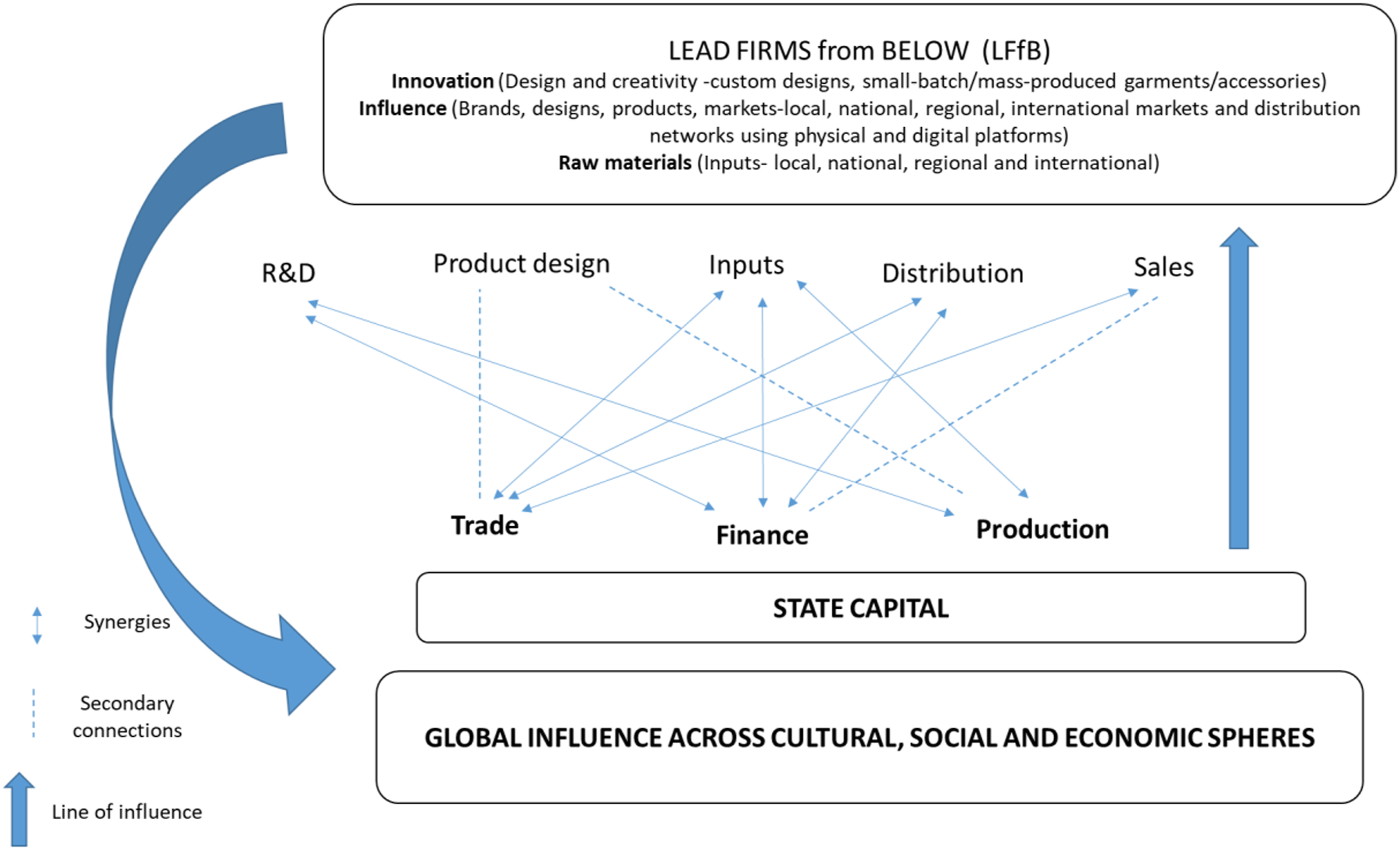
Critical political economist Ake (1981) has long proposed centring African realities as bases for theorizing and conceptualizing across economic, social and cultural spheres to enable such de-disciplining that portrays the ‘dynamic character of reality’ and ‘relatedness of different elements of society’ realities that are dynamic. This framework is attentive to interactions between leads and the state in its synergies and multi-directional lines of influence (state capital → leads; and leads → state capital) across economic as well as social, cultural and political spheres. Like Ake, Polanyi (2001) is interested in theory building rooted in a broader range of empirical knowledge beyond GN contexts as well as across time. He also references the significance of cultural innovation as a tool for negotiating global political economy hierarchies connected to imperialism with the examples of Egypt, Persia, India and China (Polanyi, 2001). These lenses speak to interdisciplinarity as an aspect of decoloniality (Ndlovu Gatsheni, 2018) and its importance for recentring African realities as knowledge epistemes.
Production, finance and trade are useful categories for comprehending the interactions between state capitalism and fashion designers as internationalizing lead firms (from below). Bowles (2020) highlights the significance of production (including access to raw materials), finance and trade in the interaction between state capital and internationalizing and globalizing spaces. Production, finance and trade are also notable as key aspects of interactions between the state and creative economies (Lee, 2020).
Production has been a vibrant space for debate on internationalization and globalization. World Bank’s, 2020 WDR report on GVCs acknowledges the importance of state capital for intersectoral linkages and developing lead firms from below in the apparel sector and also through increased participation in designing and brand building (World Bank, 2020). Within the context of hegemonic finance, understanding how state financial capital might support the emergence and development of lead firms is important. For example, Igwe (2018) describes, in the case of Nollywood, how the Nigerian state intervened to support the sector following its surprising independent success. Alami and Dixon (2020) point to the integration of state capital into global circuits of capital and its significance in supporting emerging international firms. State capitalism has been linked with developmentalism most directly in its interactions with international trade networks (Alami and Dixon, 2020; Nölke et al., 2015). Indeed, international trade has been pivotal to comprehending developmental states’ interdependencies within the global economy (Bowles, 2020; Ikpe, 2022). In contemporary literature, attention on international trade and its intersections with capitalism, including state capitalism, is focused on the negotiated gradual opening up of domestic economies through some use of industrial and trade policy (Nölke et al., 2015). This paper’s LFfB framework relies on the examination of the intersections between state capitalism, trade, finance and production and the characterizing activities of lead firms from below.
The LFfB framework enables the examination of intellectual and policy directions on African industrial development with attention to domestic value creation, internal, continental and global trade and markets (AfDB, 2019; England et al., 2021). This is furthered by attention to cultural and creative goods that hinge on creation and production across economic and cultural spheres and builds on a Polanyian reading of interactions between state capital and economic and cultural value in two ways. First in the steadfast significance of the state for determining and shaping critical spheres of land, labour and finance (fictitious commodities), even and especially within the global economy (Block 2003). Lee (2020) extends the Polanyian lens to consider culture itself as a fictitious commodity, depending on the context. Second, Polanyi’s (2001) notion of embeddedness emphasizes how economic dynamics are rooted in and subject to social, cultural and political processes.
This motivates a move beyond the characterization of lead firms solely as the product of GVCs and GPNs to consider their interactions with state capital with attention to cultural and economic goods that unite economic, social and cultural spheres. Dismissing the significance of states within GVC analyses has been challenged as flattening the complex national, regional and international dynamics as well as the influence and agency of GS actors and contexts (Hauge, 2020). There has been recognition of the incompleteness of analysis wrought by such firm centricism through contributions of analysis of the interdependencies between the state and GVC and GPN dynamics (Alami and Dixon, 2020; Horner, 2017; Ikpe, 2022; Pasquali et al., 2021).
In the following section, we offer a step-by-step deployment of the LFfB framework (see Figure 1) to analyse data across synergies between state capitalism and internationalizing (trade, finance, and production) and lead firm high-value activities (research and development, design, distribution and sales) as well as inputs.
The qualitative data shows evidence of the key GVC/GPN characterizations of lead firms (from below) and their interactions with state capitalism as well as internationalization following theoretical thematic analysis. In reflections on Africa, lead firms (within GVC and GPN analyses) are generally assumed to be from outside the continent (AfDB et al., 2014). Yet, there are important interventions on lead firms from GS contexts that are highlighting Southern economies and the importance of non-chain actors, such as the state.
We deploy the LFfB framework to show core synergies, trade: inputs and sales and distribution; finance: R&D, inputs and sales; and production: inputs and R&D, with attention to state (in)action, as highlighted by infrastructure gaps, coordination, trade policy and fiscal responses.
Distilling the synergies reveals the implications of state capitalism for internationalizing, at regional, continental and global levels, through investments, infrastructure, education and training, monetary and fiscal policy and trade policy. Horner and Nadvi (2018) and Barrientos et al. (2016) have argued for a broader reading of VCs and PNs beyond the dominant multiscalar approach of serving GN economies and markets due to the increasing significance and prominence of various interconnected markets that are domestic or regional as well as global (South–South and North–South).
Crucially, the LFfB framework interrogates interactions between LFfB and the state across economic as well as social, cultural and political spheres. This occurs through analysing how fashion producers proceed to use design to shape and define global image as well as representation and create cultural and value recognition. The framework thus showcases Polanyi’s (2001) and Ake’s (1981) ideas on the interdependencies between economic dynamics and social, cultural and political contexts.
Methodological approaches
Deciphering evidence from Lagos and Nairobi
This is an initial case study which interrogates and potentially strengthens the analytical value of the LFfB framework (Eckstein, 1992). This intervention focuses on the underpinnings of growing and dynamic creative economies with connections to domestic, continental and global markets across diverse GS contexts, including cases such as Nigeria, South Korea, South Africa and India. It offers a foundation for comprehending interactions between state capitalism, internationalizing and LFfB through its deployment in relation to creative economies. It constitutes a ‘building block’ exercise in this concept-building endeavour, which relies on the generation of further cases to incrementally strengthen this framework.
The paper undertakes case study analysis based on empirical evidence from two significant fashion hubs in Africa, Lagos and Nairobi. Both cities are home to key fashion weeks on the Continent and have prime economic functions in their respective nations – Nairobi as the capital of Kenya and Lagos as the commercial capital of Nigeria. Furthermore, they provide interesting perspectives in relation to both East and West African development. Nigeria is noted as a key fashion market (Business of Fashion and McKinsey, 2022), and Lagos is a key site for fashion business development from which new trends emerge and are disseminated across Nigeria and beyond (Oberhofer, 2012). Meanwhile Kenya is of growing interest among global fashion brands for its potential for outsourcing (Business of Fashion and McKinsey, 2022), with Nairobi having a high concentration of fashion designers and tailors (Hivos, 2016). The city is also home to a number of key sector organizations such as the Association of Fashion Designers of Kenya (Hivos, 2016), creating capacity for domestic creative production.
The paper utilizes qualitative approaches to examine primary data collected over 2019 and 2020; this included 18 semi-structured interviews, 6 focus groups and 68 survey responses. Surveys were conducted online; interviews were conducted online and in-person with designers in Lagos and Nairobi in 2019–2020. The forum was held in-person in Nairobi in 2019 as part of wider research fieldwork. Building on this broader fieldwork, the paper uses, more specifically, data from interviews and focus groups. All research was undertaken following ethical approval at authors’ academic institution. The paper relies primarily on the interviews, drawing on primary research approaches used in the contemporary study of fashion and economic development, including in Africa (Moreno-Gavara and Jiménez-Zarco, 2019; Wale-Oshinowo et al., 2019).
The study’s survey participants were identified through online listing, web search and a widely promoted call on social media. Snowballing was also used, including directly inviting forum attendees, an open call to fashion design networks in Kenya and Nigeria as well as inquiries to academics and researchers and policy actors. The survey and focus groups reached a large group of participants. From the survey responses, we used purposive sampling to establish LFfB based on demonstrated innovation, influence and raw materials (from LFfb framework) and interviewees were selectively invited. Interviewees included fashion designers and entrepreneurs, fashion design collectives, academics and educators. This approach was suitable for accessing and drawing on ideas and experiences of specific actors on this subject as it recognizes the fluidity of knowledge in this space. Interviewees were granted anonymity and identified only by the interview number and the letter K for Kenya and N for Nigeria.
Research questions and objectives were developed by the research team. Questions covered the key themes of fashion and cultural heritage; entrepreneurship; networks, markets and supply chains and geographies of work; (in)significance of state policies and capital and; fashion futures. The data was analysed using thematic analysis (Braun and Clarke, 2006). All interviews were conducted in English and recorded and transcribed for a verbatim account. Transcribed data was read several times prior to analysis to familiarize researchers with the data and generate an initial sense of the contours of the data set. The qualitative data was organized through a manual process of coding as outlined by Braun and Clarke (2006). Analysis of the data was conceptually guided by the LfFB framework. Six themes were generated. They included international actors (importers, exporters and production abroad); global (and regional) standards and markets; agency (networks, innovators and technology); industrial policy particularities for fashion designers; role of the state (policies, expectations, finance and local development); and domestic value creation (import substitution, local markets, digitization and connections to the regional/global). In connection with the LfFB framework, discussion of analysed data interrogates themes’ interactions with trade, finance and production synergies. This allows for in-depth analysis in an interdisciplinary inquiry on the subject.
Findings and discussion
Fashion designers as lead firms
Our interviewees show evidence of engagement with the key GVC/GPN characterizations of lead firms (from below) (see Table 4) and interactions with state capitalism. These are research and development linked to education and training (not only higher education and apprenticeship but also business development programmes); original and innovative design; input supplies domestically (with some attention to heritage and local input production) and internationally; distribution and sales as well as brand leadership in domestic/regional and international markets; and domestic and international market and brand development through physical and online spaces as well as networks.
Synergies between fashion designers, state capitalism and internationalization
State capitalism and lead firm synergies for internationalizing fashion designers.
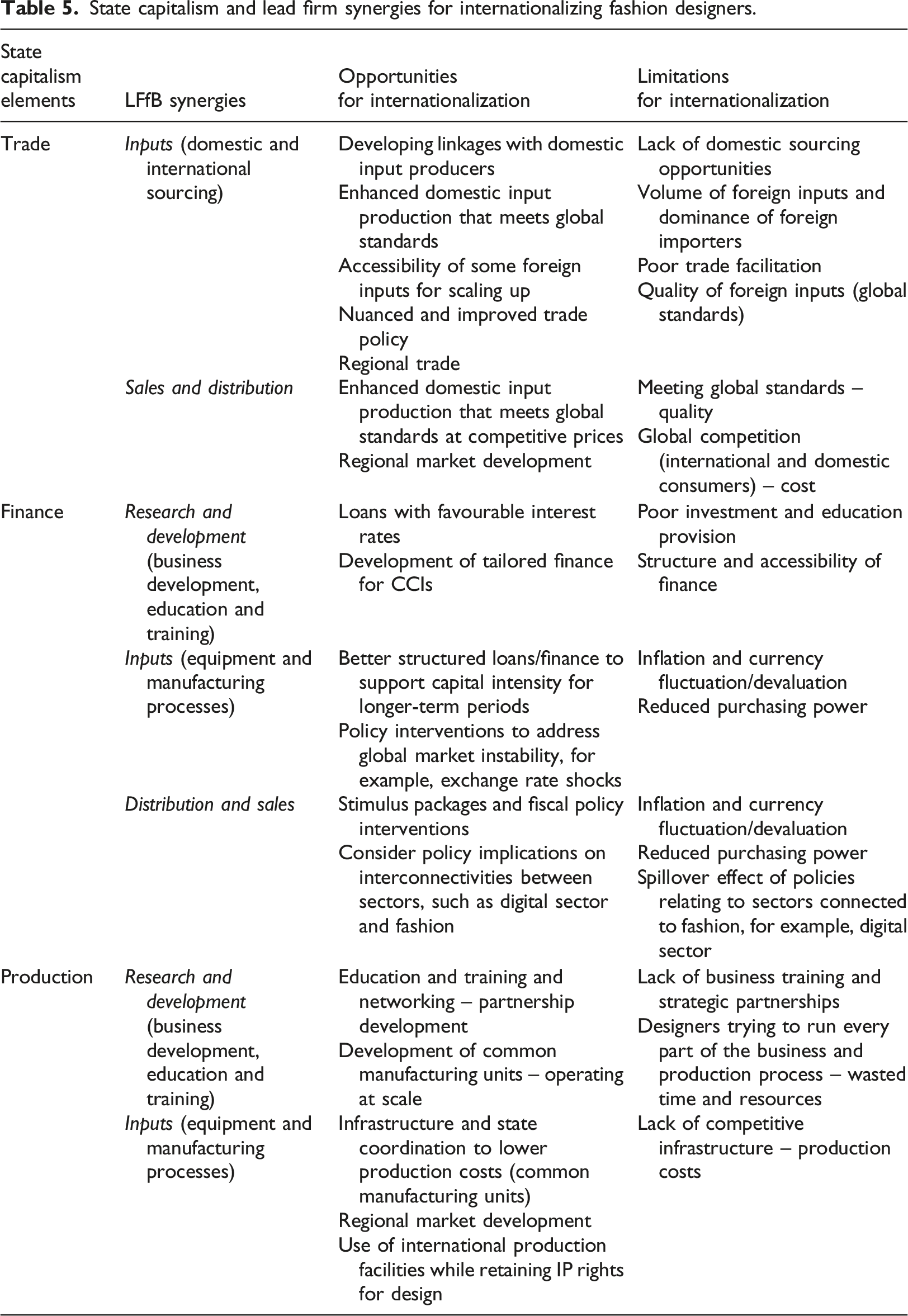
Core synergies are delineable in three key groups – trade: inputs and sales and distribution; finance: R&D, inputs and sales; and production: inputs and R&D. We also acknowledge secondary connections where a second-order synergy between production, trade or finance with a lead firm characteristic is built first on an initial synergy. We include reflection on how these are impacted by infrastructure gaps, coordination, trade policy and fiscal responses that are linked to state (in)action. Across these synergies we highlight the implications of state capitalism for internationalizing through investments, infrastructure, education and training, monetary and fiscal policy and trade policy. We also use the LFfB framework to examine how lead firms from below can use design to reshape and redefine international image, cultural representation and establish patterns of cultural and value recognition.
Trade: primary synergies with inputs, distribution and sales and secondary connection with product design
For the fashion designers in Lagos and Nairobi, inputs emerged as a critical concern with reference to state capitalism and internationalizing. Designers noted synergies between trade and inputs (see Figure 1) through capacity to either source inputs domestically or through imports, particularly when based on lower scales of production: ‘I have no problem travelling and bringing in my own fabric …with sourcing locally, I haven’t struggled in finding numbers…because I’m in the beginning where I’m not looking for 50 rolls…of fabric’ (K3).
Synergies between trade and inputs are notably undermined by poor trade facilitation, linked intrinsically to trade policy (Hoekman and Nicita, 2011) and the role of the state. Poor trade facilitation, associated with (foreign) inputs, was seen as undermining capacity: ‘it’s been a nightmare to…ship goods in and…customs keep on changing the parameters’ (K1). There was a belief that enhanced domestic production and market for fashion inputs would not only aid designers (financially and logistically) but also contribute to local and national economic growth: ‘we stop importation of …materials from other countries…start… producing our own made materials here, it’s going to aid economical value…’ (N3).
State capitalism in trade policy intended to enhance local sourcing (and production) by restricting foreign inputs could also be considered as limiting synergies between inputs and trade. A Lagos designer reflected that ‘policies have been also created where people or designers have to work in their own countries independently, not depending on exportation or importation … for their own materials…’ (N3). In Nigeria, this assertion can be linked to the 2015 directive by the Central Bank of Nigeria (CBN) to restrict foreign exchange availability for importation of woven fabrics and textiles in order to conserve foreign exchange and support domestic input production (CBN, 2015). The policy is connected to the negative implications for global competitiveness and internationalizing, as another Lagos designer articulated: ‘importation of fabrics ban is actually not a great one…I know the government is trying to build the economy, but it doesn’t help the local creatives who compete globally’ (N4). This connects with the challenges of previous import restriction initiatives covered by Jennings (2011) – particularly a rise in black-market imports and a lack of choice of fabrics and factories. There was further reflection from designers on the need for nuancing trade policy to encourage the use of domestic textiles, but with some flexibility vis-à-vis textiles that are not locally available, with arguments for ‘some tax reduction on the fabrics that we need which is not available in the mills’ (N4).
Regarding synergies between trade, sales and distribution (see Figure 1) in international trade contexts, designers also showed commitments to notions of global standards. This arose specifically in consideration of foreign consumers, global competition and competitiveness: ‘Foreign consumers will require global standards and will compare to larger [GN based] fashion houses … no excuse not to compete on global standards…foreign consumers… compare …with Louis Vuitton … Topshop … Zara… ’ (N4).
However, importantly, designers recognized the hierarchies that accompany integration into global networks and highlighted some merits in prioritizing regional and continental markets for inputs and trade resource generation: ‘think about trade with other countries, we tend to think about… Western countries…we don’t think of other African countries…but I think that it’s really important… to be able to communicate … exchange stuff’ (N10). This reflected pan-African commitments and the opportunities to showcase innovation. For some designers, the international as regional is informed by commitments to value creation and consumption that is needs-based and supportive of articulated economies: ‘I have no interest in selling things outside of East Africa, because this is where we need… a lot of the clothes, which are being worn locally, are being imported, because we’re not doing any… production …my ultimate goal…that I’ll be able to provide … for people within Eastern Central Africa’ (N1).
This speaks to arguments for a focus on internal markets as critical to development agendas. It also follows the aims of the AfCFTA. Reliance on foreign inputs was, however, connected with trade as part of an internationalizing stance, particularly when working at larger scales (although not exclusively). This, in turn, was seen to have implications for both quality and costs of production, as noted by an interviewee in Lagos: ‘if we had them [fabrics] produced here in Nigeria it would have been top-notch… but due to setbacks… foreign producers…actually sell materials [fabrics] also here in Nigeria’ (N3). They went on to say, ‘When it comes to the production of garments …if our fabrics or materials here could [be] produce[d]… it would… ease the price’ (ibid). This was then also reflected in the price of garments at the retail stage, from which we identified a further trade synergy with sales and distribution (see Figure 1).
We also note secondary connections between trade and product design as designers alluded to the merits of trade synergies with inputs via domestic input producers (connecting with design and production): ‘we are beneficiaries of that…we’re saying … we want you to make fabrics … they’re saying okay, bring your prints, bring the texture of the fabric that you want… we have two mills …say bring me prints, I’ll make the prints that you want…They are making such good prints…’ (K2).
This highlights additional secondary connections between trade and product design (see Figure 1) as it relates to the trade and supply of inputs that bring African designs to life through original fabric design and subsequently to domestic and international markets.
Finance: synergies with research and development, inputs and sales and secondary connection with distribution
For fashion designers in Lagos and Nairobi, financial resources emerged as a critical concern in relation to state capitalism and internationalizing. We focus our interrogation on synergies between finance and research and development (R&D), inputs and sales (see Figure 1).
On synergies between finance and R&D, designers lauded loans with favourable interest rates as being useful. Chang and Andreoni (2020) are clear on the significance of interest rates for encouraging capital accumulation as part of an industrial policy regime. An example of such loans is one from Nigeria’s Bank of Industry that offers 9% interest rate to entrepreneurs in the fashion industry, including designers (Bank of Industry Nigeria, 2022). An interviewee notes: ‘Even though the government has not been able to give us grants but they’ve been able to help with some SME loans, which they disperse through the banks at the low interest rates…, so that’s actually good’ (N4).
However, state-provided finance is at times undermined by the structure and accessibility of said finance. Designers reflected on how synergies between finance and research and development are undermined by poor investment in early-stage ventures and in education and training: ‘we have fashion designers or fashion brands, supposedly springing up every day … there’s a large part of the market that we could take over, if only there were like sufficient investments and education in them…it’s capital intensive to do things like that… they don’t have the funding’ (N2).
Finance is important for procuring inputs and capital reflecting synergies between finance and inputs (see Figure 1). The size of the loans and the required payment periods were also denoted as undermining their relevance to the sector. One Lagos designer stated that: ‘During this COVID-19 pandemic… I was going to apply for say, a million-naira,
3
I would have to use 70% of the loan to procure equipment …to buy machines… and I would only have 30% as working capital. So it wasn’t something that was feasible’ (N4).
They went on to say, ‘[the state] tend to give out loans… it’s [fashion] really capital intensive …sometimes a long-term investment… doesn’t yield money immediately’ (ibid). This highlights the need for more industry-tailored, viable and sustainable solution forms of finance and investment tools, such as those offered by HEVA (primarily in East Africa) (Njuguna et al., 2021). It is, however, acknowledged that the development of a range of finance for cultural and creative industries (CCIs) across the continent is still in the initial stages of development (ibid).
(In)accessibility to loan schemes was also raised with regard to difficult and complicated processes. A Lagos designer discussed how it was ‘so difficult to go through all these processes…Like I wanted to apply for the one CBN was advertising … It was too too long. It was too too complicated’ (N7). Concerns arose also in the utility of the loan facilities in relation to accessibility and transparency of processes. A Nigerian designer stated, ‘a few loan schemes that were set up by some of the ministries… corruption is a huge problem… these initiatives did not …reach the people that they are targeted for’ (N5). They went on to say: ‘assume there are three layers. It doesn’t even get to the first layer before we hear that the money’s gone…. corruption is a huge problem’ (ibid).
Monetary policy (including in response to the pandemic) – most strongly associated with finance (but also with implications for production) – was also linked to challenging synergies between finance and inputs. Higher costs due to infrastructural shortfalls and high-priced inputs are linked to poor price competitiveness. This was compounded by the pandemic: ‘this is the COVID-19 pandemic issue…The Naira has fallen so badly against you know, other currencies, especially the dollars and you know, in the pound or euro, so this has really affected the fashion business because I’m sourcing fabrics [internationally]’ (N5).
This refers to currency depreciation and eventual devaluation in Nigeria (World Bank, 2020). Chang and Andreoni (2020) highlight the management of exchange rate values as part of industrial policy especially for significant inputs.
Designers expected interventions in (fiscal and monetary) policy to alleviate inflationary pressures – affecting inputs, sales and distribution – that have accompanied the COVID-19 pandemic. Average annual inflation rates (using the consumer price indices) have increased from 11.35% in 2019 to 16. 98% in 2021 in Nigeria and from 5.19% in 2019 to 6.10% in 2021 in Kenya. 4 An interviewee notes, ‘the buying power has reduced…products have increased because there is now an increased inflation rate… I think the government can help alleviate these challenges…releasing stimulus… for businesses’ (N5). While highlighting the impact this has on fashion designers, we also acknowledge that rising inflation and decreased purchasing power is a significant challenge for governments globally.
There are limitations to synergies between finance and distribution and sales, via spillovers between policies targeting different sectors connected to fashion. Fiscal policies for the generation of savings from lucrative digital markets were reported as inimical to the fashion industry: ‘I can think of government initiatives that are not going to help, like the new digital tax that they…proposed or that they’ve implemented where they want online businesses to start a tax’ (K9). Kenya’s digital services tax of 1.5% effective from 2021 is on income accruing to a digital marketplace (Muendo, 2021). This is also significant given the fashion industry’s particular reliance on digitization for internationalization in sales and distribution.
Production: synergies with inputs, research and development and secondary connections with product design
Synergies between lead firm dimensions and production have much in common with trade, particularly in relation to inputs. However, designers also highlighted specific synergies between production and R&D (see Figure 1) in relation to education and training and networking for developing, deepening and broadening expertise. It was suggested that if fashion designers received more business education, this could lead to stronger strategic partnership development: ‘Beyond investment… they need to be educated on how to run businesses… then they would actually be more inclined to look to…synergy and partnerships’ (N2). Interviewees highlighted the importance of such fashion design firm knowledge and expertise partnerships (but also the development of shared infrastructure such as common manufacturing units) as important and cost saving: ‘to have like 10 fashion brands in one building…every one of them has their own separate indoor manufacturing, which they obviously don’t use all the time, which is … a waste of resources and time’ (N4). The absence of such partnerships was noted as limiting synergies between production and research and development and the overall efficiency of design firms: ‘the reason why designers…remain very small is…they are trying to do everything…designing the clothes… making them…selling them and that is not…efficient’ (K9).
Production is synergized with inputs (see Figure 1) in a similar way to trade, as noted above, although with some distinctions. In relation to internationalization there was again an emphasis on supporting more competitive production, but here the emphasis was on (non-cost-effective) production processes and imported equipment rather than raw materials: ‘you ship all the machines and the work…then you cost up, it’s not competitive’ (K1). In response, there were some indications of international production and distribution networks being used to support larger scale and more cost-effective production and distribution internationally: ‘Patent copyrights that let the Chinese [producers] produce for you…you’ve been in the US in the UK, there are made in China… designed in Nairobi, made in China’ (ibid). This creates a secondary connection with product design, built on synergies between production and inputs (see Figure 1). However, discussion of production and input synergies also connected with the potential for regional market development (see earlier discussion in Trade synergies): ‘we have a lot of raw materials outside of Nigeria…with other African countries who are into this…the African cultural matter more than Nigeria’ (N8). As with trade, this also has potential to influence product design in that designers may adapt to or be inspired by available materials.
Designers had expectations of public investment in infrastructure and state coordination to lower production costs: ‘Lower costs of production in Nigeria…I think government can like help this if they try to organise … in terms of infrastructure’ (N1). It was however noted by one Nairobi interviewee that the Kenyan Fashion Council was working towards the development of a common manufacturing unit to support Kenyan designers and increase their production and competitiveness.
State capital and internationalization of fashion designers as lead firms
Using the LFfB Framework, we examine designers’ reflections on the developmental return on state intervention with regards to higher value-added economic activities including the use of supplier firms, branding, distribution and sales and product design for advancing global influence. This is important given the particularities of state capitalism in creative economies (de Jesus, 2020): ‘By telling our African stories […] it's not just in garments, it’s in post-production, it's in the shoots, it’s in the model selections. […] creating employment, we’re really doing something for the economic state of the country, […] We’re working with weavers […] like craftsmen’ (K5).
The discussion on high value addition extended to discourses on sustainability in design and branding, including opportunities for designers to position their work globally as antithetical to fast fashion. A designer reflected that if designers ‘produce for exports…let it not be like aiming for fast fashion, low-cost market’ (K1).
Environmental sustainability and ethical production are acknowledged for their interconnectivity and their value-adding narrative in the wider academic and industry literature (Hivos, 2016). Fashion designers’ control of brands and product design including interactions with cultural heritage are presented as transformational in global fashion: ‘I think designers are defining what African means… especially more from our local context… Every country, every village, you know, has its own rich heritage that is authentic and genuine. … as long as we remain true to ourselves…that’s the only way that it will be a lasting impression on the world’ (K3).
Conclusion
The African fashion industry provides scholars with a critical basis for examining the notion of ‘Lead Firms from Below’. Attention to this sector of the creative economy in the key cities of Lagos and Nairobi offers the opportunity to think more broadly about value as simultaneously economic and cultural. This moves us into interdisciplinary and more complex understandings of cultural goods that embody both cultural and economic value and raise the conundrum about hierarchies as well as methodological advancements in understanding economic value that is not replicated in cultural value (Angelini and Castellani, 2019). This is relevant both to enable conceptual progress in interdisciplinary understandings of value and empirically given the importance of cultural goods in contemporary African socioeconomic transformation. This paper has utilized the perspectives of fashion designers in these cities to offer a reframing of lead firms as governed outside of GN networks, operating at various strata and independent of international brands. It shows they contribute to local, regional and continental development as well as global markets. State capitalism is significant in this reframing exercise in supporting internationalization and signalling the potential to negotiate the imbalance in global hierarchies that position economies in the GS as peripheral.
This article thus makes an important conceptual and empirical contribution to contemporary discourses on state capitalism in GS, and in particular African contexts, influencing the development and emergence of fashion design firms as local, national, regional, continental and global actors. Centring the creative economy makes a particular intervention in considering economic as well as cultural value. Yet the size of the creative economy in African contexts is modest at 2.9% of global creative goods exports (UNDP 2023). It is nonetheless notable that this is a rapidly growing sector with outputs outpacing other industries, steered also by digitization, urbanization, youth and South–South trade, and could reach 10% of GDP globally by 2030 (Buckholz, 2021; UNDP, 2023). In Africa, it is also prioritized as an important context for examining contemporary and future socioeconomic transformation (World Bank, 2020; Afrexim Bank, 2021). This paper presents a case study of fashion designers as a starting point and part of a building block exercise with potential for future research in other creative economy and broader sectors.
The LFfB framework (Figure 1) contributes to addressing a conceptual gap by showing how firms governed outside of GN networks fulfil higher value-added elements of the GVC/GPN activities of lead firms alongside working with other suppliers that are domestic and global (Tables 3 and 4). These activities are analysed in concert with trade, finance and production as components of internationalization and the place of state capitalism therein (Table 5). The paper demonstrates the significance of a range of synergies between research and development, inputs, distribution, sales and product design and state capitalism’s support through trade, finance and production. From the perspectives of fashion designers, the significance of state capitalism for internationalization stands out. Emphasis is on physical and social infrastructure, coordination, industrial, trade, fiscal and monetary policy and the implications for continental and regional integration, as part of internationalization.
There are benefits from state capitalism for fashion design firms in aspects of state finance provision including low interest loans, spillovers from EPZs and domestic input provision. Yet these are challenged by state (in)action of commission and omission as with fiscal extraction from the digital subsector, narrowing of input options through poor trade facilitation, import restrictions and bans and financing structures that are inattentive to the capital intensity of the fashion industry, poor infrastructure and training provision in the sector (see Table 5). The paper shows state capitalism must address these challenges to enable global competitiveness, supporting a proclivity to sustainable practices and meeting global standards as well as enhancing interactions with regional and continental markets for accessing inputs as well as markets, towards greater internationalization for the fashion industry.
The LFfB offers another key set of findings in the influence of fashion in projecting these sites on global planes through generating economic, social and cultural value with prospects for repositioning these contexts within core-periphery characterizations. This occurs in two ways: through redefining African representation and generating new social and cultural narratives that have global influence as well as building more resilient economies, intersectoral linkages and responding to local, national and continental (as well as global) consumption.
On a final note, the LFfB framework provides scope for further studies that analyse the promise of the creative economy in GS contexts, and Africa in particular, in terms of economic, social and cultural value. These have shown steady promise and resilience vis-à-vis the stilted and shaky progress of narratives on Africa rising. However, the role of policy, networks and education has also been connected to the need for the state to be an active player in this agenda. The creative economy is a fertile ground for conceptual and empirical interventions that challenge tendencies to posit Africa as a recipient of ideas and creativity as opposed to setting global standards and driving innovation and originality. This paper’s analysis has shown the promise of African fashion industry’s lead firms from below in its wide-ranging complexity.
Footnotes
Acknowledgements
The authors are grateful to all partners of the African Fashion Futures project and to the King’s Together Research Fund for supporting this work. We are grateful to all survey respondents, interviewees and forum participants that took their valuable time to interact with and provide us with material and critical insights for our research. We are grateful to participants at the Royal Geographical Society Conference 2021 and Global Conference on Economic Geography that provided valuable feedback to earlier versions of this paper.
Declaration of conflicting interests
The author(s) declared no potential conflicts of interest with respect to the research, authorship, and/or publication of this article.
Funding
The author(s) disclosed receipt of the following financial support for the research, authorship, and/or publication of this article: This work was supported by the King’s Together Fund grant to the African Fashion Future Project and the Carnegie Corporation on New York grant, G-18-56408.
