




Abstract
This paper proposes a decentralized planning constructed as a cyber-physical system to jointly manage supply and demand, including aspects related to production and circulation, without the mediation of money. Our aim is to provide a concrete technical solution for a future society based on communizing and commons-based resource allocation as an attempt to move in-against-and-beyond the value-form, which is the social “force-field” that characterizes the capitalist mode of production. This contribution is divided into three articulated parts: (i) a review of the elementary forms that jointly determine the capitalist social organization, (ii) a defense of the proposition that the money-form must be destroyed to enable a new mode of production based on communizing, and (iii) a proposal of a cyber-physical implementation of a jointly decentralized production planning and resource allocation over large infrastructures that enable a multilevel polycentric governance as a variation of the Interactive Economic Planning and Optimized Selections (I-EPOS) algorithm when coordination is needed.
Introduction
Centralized planning and distributed markets are usually posed as extreme ways of solving resource allocation problems (Ostrom, 1990; Nardelli, 2022). In the first case, optimal or sub-optimal solutions are explicitly found, while in the second case, effective solutions emerge in a trial-and-error fashion through monetary mediation. In the capitalist mode of production, Farjoun and Machover (2020) indicate that the first is usually associated with industrial production, which is associated with hierarchically organized and thoroughly controlled industrial plants, and the second with circulation and distribution of commodities, creating the image of chaotic market interactions.
Outside the direct sphere of capitalist relations, it is possible to find a series of other ways of relating, managing, and organizing without the mediation of money, as indicated by Nelson (2022). Ostrom (1990), through extensive studies of the commons, provides remarkable examples of a feasible way to govern shared resources that follows certain rules. It is worth noting that Ostrom received the Nobel prize in Economics for her work, which is a concrete answer to the speculative, while highly influential, The tragedy of the commons by Hardin (1968), where only two forms of governing the usage of common goods exist: either centralized State interventions through planned use or market-based, with a private property regime.
Despite certain naivety of this “either-or” argument, it seems that the majority of the debates is still posed as a struggle between (authoritarian or supportive) centralized State versus (free or regulated) distributed markets. Following a Marxist standpoint, in particular, the Value-form Theory presented in Heinrich (2012), whose focus is on the social forms, this article displaces this type of question by arguing that this debate assumes the capitalist forms of relations as fixed points. At this level of abstraction, the value-form serves as the logical articulation of the specifically capitalist social forms, such as commodity, money, labor, capital, State, and Law.
We will then not engage with the mainstream economic discussion, with its positivist approach, because we aim to supersede capitalism. In consonance with the convincing arguments by Holloway (2022) and partly with the Critique of Value scholars like Jappe (2014), we defend the position that the transition beyond capitalism requires the destruction of the aforementioned social forms. We do not follow Ostrom in taking commons as the third way. We also go beyond the methods (but not the idea!) of the socialist commons in Yugoslav self-management as discussed by Horvat (2020).
To approach the decentralized planning conundrum, we turn our attention to the negative categories that open up the rigidity of the logic of capitalism, moving from nouns to verbs, as indicated in the preface of (Holloway, 2019). Specifically, this article defends the acts of communizing as the basis of a new mode of production, where social coordination is enabled by some of the recent advances in information and communication technologies (ICTs), in many ways aligned with (Groos, 2021; Bernes, 2020; Sutterlütti and Meretz, 2023). Our focus will be on a specific decentralized planning method called Interactive Economic Planning and Optimized Selections (I-EPOS) developed by Pournaras et al. (2018); Pournaras (2020).
All in all, we try to merge the communizing ideas that emerged in France during the seventies and value-form theory, in a path already indicated by Endnotes (2010), but also moving ahead to face the challenges to bring hope in a hopeless time—as the title of John Holloway’s latest book tells us. This text is another attempt to think and act within the conjuncture, in-against-and-beyond capitalism, overflowing its logical form-coercion and real material power.
As Althusser (1999) indicates in his reading of Machiavelli, the revolutionary needs to think and act in the conjuncture, acknowledging its relative openness so as to create the conditions that would enable social change. In contrast to the static thinking of the accomplished fact of the modern philosophers, Machiavelli thinks in the fact to be accomplished, considering the path dependence of the social processes and the conforming power of the existing social forms. The Prince must have both virtù and fortuna, or, roughly speaking, courage to act when the conjuncture allows, and luck when an action takes place; here we find our motivation.
The rest of this paper is organized as follows. We first present the elementary social forms of capitalism as a purified scientific (ideal) object defined by a totalizing social force-field determined by the value-form, from where intrinsic vulnerabilities shall be found. Then, we present a new conceptualization of cyber-physical systems introduced by Nardelli (2022) that is helpful to both reject solutions that resemble capitalist forms and support the communizing-based political economy. As a step further, we present our vision of a fully demonetized future based on decentralized planning following polycentric governance for communizing, similar to the decentralized solution for energy systems first presented by Giotitsas et al. (2022); Nardelli et al. (2021).
Value-form as a social force-field
Background
Since his own time, Karl Marx’s writings have been a fertile ground for heated debates, both between persons or groups identified as Marxist against non-Marxist and among Marxists themselves. In this section, we follow the approach taken by scholars like Elbe (2013), who classify different Marxisms. Until the seventies, there were two principal readings: Orthodox Marxism, supported by the Soviet Union, and Western Marxism, associated with young Marx. The first one is usually associated with “economicism” and the second with “humanism.” Although these strains are still relevant within different groups both in academic circles and communist parties, a New Reading of Marx dealing with rigid patterns of social relation, or simply social forms, emerged in Germany motivated by then-forgotten Soviet writers from 1920s; they are Evgeny Pashukanis and Isaak Rubin, both victims of the purges during the late 1930s. Roughly speaking, the key to understanding Capital is the recurrent (almost naturalized) forms of social relations like the market exchange of equivalents mediated by money and wage labor. The Value-form Theory, associated with the first chapters of Capital, becomes the cornerstone of this approach, which is pedagogically exposed by Heinrich (2021).
A specific line of research affiliated with this reinterpretation of Marx is the State derivation debate, where the State and the Legal Subject are also derived from the commodity-form. The logical formulation follows a chain where the elementary form of wealth in the capitalist mode of production—the commodity—is the basis to derive other necessary forms that constitute the capitalist mode of production as such. It is worth highlighting that the capitalist mode of production, as indicated here, is a purified scientific object, which is constituted historically, and, thus, is not eternal. The specific difference between capitalism, on the one side, and the other past and possibly future ways to organize societies and social practices, on the other side, can be then explicitly characterized through social forms.
Holloway (2022) schematically presents the derivation of the capitalist social forms (or the form-determination chain), constituting then the links in the chain of destruction [that] are difficult to break. The derivation sequence, as presented in Chapter 19, goes as follows: (a) if commodity, then value; (b) if commodity-value, then labor; (c) if commodity–value–labour, then money; (d) if commodity–value–labour–money, then identity; (e) if money, then capital and exploitation; (f) if capital, then state; and finally (f) if commodity–value–labour–money–identity–capital–state, then destruction of nature–pandemics–global warming–extinction. In this sense, the logical core of capitalist sociality is constituted with money being the universal social binding, or as the title of Chapter 28 puts Money rules. Money is the serial killer destroying us all.
Holloway’s argument is constructed based on the hope-against the capitalist forms that restrain the overflowing of social practices (or doing, or concrete-labor, or productive human activity), which are always more than the logically imposed constraints byproduct of the social form. By focusing on the immanent antagonisms and on the fact, shown in detail by Paraná (2018), that capital is mostly fictitious (credit money), with a huge gap of what can be actually materially produced, hope can emerge. In summary, the negative of capitalist forms, especially the demonetization of the social relations, is the hope-against capitalism, the concrete utopia against wishful thinking; the struggle is then to be located at social forms and their immanent overflowing, not in the logical links that indicate the chain of destruction.
To go further on this, we provide two supplementary paths to that characterization, one indicating the logical strength of the social forms through structural causality and the other the economic power of Capital. The first is associated with the conceptualization of Althusser (2014), where the capitalist mode of production is a complex whole articulated in dominance. In the text called On the genesis, Althusser (2020) clarifies how his concept of articulation in dominance by economy could be understood via structural causality, which only exists in its effects, similar to the concept of field in physical sciences. The usual interpretation of Althusser’s main theoretical contribution in this respect focuses on the materiality of ideology and its role in the reproduction of the capitalist relations of production, as his comment about Pascal’s faith indicates: (…) the existence of the ideas of his belief is material in that
Beyond this reading, we turn our attention to the systematic text Philosophy for non-philosophers (unpublished during lifetime) where Althusser (2017) provides a clearer perspective of his thinking through the concept of social practices and necessary abstractions associated with them. The usually referred to determination in the last instance by the economy can be understood as the organizing power of the core economic forms of capitalism, especially money.
Our reading of Althusser approximates his conceptualization of the form-determination as the collective Endnotes (2010) put in their explanation: The critical import of value-form theory is that it calls into question any political conception based on the affirmation of the proletariat as producer of value. It recognises Marx’s work as an essentially negative critique of capitalist society. In reconstructing the Marxian dialectic of the value-form, it demonstrates how the social life process is subsumed under—or “form-determined” by—the value-form. What characterises such “form-determination” is a perverse priority of the form over its content. Labour does not simply pre-exist its objectification in the capitalist commodity as a positive ground to be liberated in socialism or communism through the alteration of its formal expression. Rather, in a fundamental sense value—as the primary social mediation—pre-exists and thus has a priority over labour.
We can read this as the indication of logical coercion of the pervasive value-form, acting as a force-field organizing the capitalist mode of production.
In recent work, Mau (2023) goes into the (often neglected) theme of the economic power of Capital, in contrast to the most usual ones found in Marxist literature, namely, coercive power and ideological power. As precisely posed: Violence is thus replaced with another form of power: one not immediately visible or audible as such, but just as brutal, unremitting, and ruthless as violence; an impersonal, abstract, and anonymous form of power immediately embedded
The key message here is that the economic power takes place indirectly, as an emergent property, through interventions in the material conditions of the social reproduction, which in turn is always (directly or indirectly) determined by and through money as the universal measure of value.
Capitalist mode of production and money-form
Nardelli (2022) proposes a way to demarcate systems based on their ability to function, considering internal and external articulations. We can then conceptualize the capitalist mode of production as a system whose peculiar function is the self-valorization of value, which necessarily leads to the accumulation of capital, measured by money and materialized as commodities; remind that this is a never-ending process that needs to be constantly reproduced as monetizing and commodifying. Logically speaking, the existence of this system is necessarily associated with the physical possibility of performing its peculiar function; Marx (1887) in Capital has demonstrated its condition of production, summarized by the logical chains in (Holloway, 2022). To sustain the dynamics of self-valorizing value and its further accumulation, it is logically necessary to have other instances that ensure the reproduction of the system, including vital aspects that enable its peculiar function; they include the specific social forms of capitalism like the state-form, identity-form, legal-form, and technoscience-form. Other aspects and social practices (e.g., religion, racism, and family) can be also articulated into the logical core of the system as either internal or external necessary conditions for the production and reproduction of its peculiar function. There is an explicit openness in external conditions and reproduction conditions, allowing for the integration of all aspects deemed necessary or relevant.
Note that this approach is a way of demarcating what is specific about the capitalist mode of production as a system; we associate it with its peculiar function and, thereby, define it as such. Two paths can be taken from here: (i) further and further specification of the dynamic of capital (following Marx in Capital and Marxian economics—usually called exoteric Marx) or (ii) focus on the necessary social forms to find the systemic vulnerabilities to eliminate the system (the esoteric Marx). As our aim is a new mode of production, the path to be followed by this contribution is (ii), and thus, this apparent simplicity of the abstract, general, proposed theorization in contrast to other empirical approaches is justified. Quoting Holloway (2022): Desperately, urgently, we need a different way of coming together socially, a cohering that is based on the conscious coordination of people’s activities and an acknowledgement of the way in which all our thoughts and activities overflow into one another:
But, why the focus on money (and money-form)? Simple answer: money is one of the most visible appearances of the social relations in capitalism, the (possibly) most perceived face of the abstract, impersonal power of the capitalist force-field: the social binding that is the driving force pushing humanity towards destruction, in many ways making us accept the unacceptable, as in the recent paper by Kemp et al. (2022) where catastrophic scenarios are analyzed but no mention to capitalism. Sadly, this seems to be another step towards the often-quoted motto of the Capitalist Realism (Fisher 2009): it is easier to imagine an end to the world than an end to capitalism.
Money and value-form social force-field
The value-form is a symbolic (abstract) way to shape (concrete) social relations through the exchange of different objects of use, which are then commodified and necessarily monetized. In very simple terms, the basis of social relations in the capitalist mode of production is the value, whose form of appearance is the exchange value, whose substance is the abstract labor, and whose magnitude is the socially necessary (abstract) labor time. A particular commodified object is needed to constitute the Capital as self-valorizing value: a commodity whose essence is to create a surplus value. When used up within the production process, this commodity (living object) transfers a surplus of value to a new commodity. The peculiarity of creating surplus value is obtained by performing labor, a characteristic inherent to the human labor-power.
Aligned with (Holloway, 2022), labor is a specific way of socially organizing human doing to produce commodities. The value of the labor power is equalized to the value of the commodities needed to sustain the laborers’ own laboring capabilities. When the surplus value produced in the labor process is reinvested to maintain or increase the value production, capital relation is established as the capitalization process. As indicated earlier on, we prefer to displace the controversies and debates about Marxian economics including the transformation problem as posed by Farjoun and Machover (2020); Farjoun et al. (2022), and focus on what is widely accepted: money and money-form with all its functions are necessary to the capitalist mode of production. The relation between value and money, surplus-value and profit is not direct, but it is hard to argue that capital can be reproduced without money. When Marx (2008) discards Proudhon’s moneyless vision of socialism, that’s because it removes money while leaving the commodity relations in place. A vision of abolishing capitalist mediations, alongside capitalist social forms, has to move beyond the first steps of the socialist society posed in the Critique of the Gotha Programme.
Returning to the cyber-physical conceptualization, the physical/material production in the capitalist mode of production is necessarily value-producing, and thus, the key attribute of this system is labor-time. The self-developing dynamic of the system is then determined by competition in different sectors, material constraints, tendencies, counter-tendencies, and, of course, class struggles (and other struggles) that, in the last instance, depend on money and its distribution. The “invisible” abstraction of value and its most “visible” face—money—are the universal force-field that organizes our lives nowadays, similar to the Earth gravity field that we are all subject to, which we somehow learn/evolve to handle. The difference is that while the scientific understanding of the gravity field equips us, for instance, to build devices to fly, the scientific knowledge of the capitalist mode of production allows us to see its intrinsic unsustainability.
Holloway (2022) presents a clear summary of the self-developing dynamics of capitalism, which carries crises and subsequent restructuring, which is usually driven by the fear that this mode of production is incapable of being reproduced through the unbinding of the capitalist social binding, which is the value-form. As the title of the compilation of (Holloway, 2019) says: We are the crises of capital. There is an extremely large gap between (i) what is and can be produced in terms of value and (ii) what is measured and predicted by money (especially in the form of fictitious capital); furthermore, this gap is still increasing due to the crises of 2008 and the pandemics. The snowball of easy credit as a way to maintain the dynamism of the self-valorizing value may be ending with the current increase of national interest rates from the USA and Eurozone, which shall cause human suffering with economic recession and/or austerity measures and/or inflation. These effects of credit easiness may lead to further austerity, social convulsion, wars, hunger, and immigration flows in addition to uncertain dynamics of climate change and the possibility of nuclear war.
The argument here points to the need to destroy the fundamental forms of the capitalist mode of production. The emergency stop of this train (a nod to both Walter Benjamin and Holloway) that no one controls is the elimination of money and all other possible substitutes that would play the functions of money in capitalism. This negative way of approaching the current state of affairs also poses the question of how to organize a new society on a different ground where the mutual recognition of human dignity becomes constitutive.
Cyber-physical systems for communizing
From the critique of the capitalist social forms, we can identify what needs to be eliminated: not only our main target money, but also the State, commodity, and labor as forms of social relations. In other words, the value-form social force field. Planning as the basis of socialism/communism—following the USSR experience and other unrealized experiences like the Chilean Cybersyn project—has been claimed to be one of the main pillars of a new society. Despite the actual capabilities to plan of the already existing ICTs using input-output tables, we follow the critique done by Bernes (2020), especially when one looks at the question of controlling labor, arguing that labor-power still appears in the calculations as any other commodity, and thus, subordinated to the constraints posed by the force field of the value-form. In other words, the peculiar social forms of capitalism are present, although they can appear and/or be named differently. Pedagogically, Bernes tells us: In capitalism, this process occurs through the automatic mediations of money and capital, steered somewhat by the interventions of the state and very powerful capitalist actors. In the dreams of cybernetic socialists, it seems, one would encounter a similar state of affairs, but with much greater equality, an automatic system acting, via algorithm,
In an earlier contribution focused on logistics, Bernes (2013) has pointed out that: The totality of the logistics system belongs to capital. It is a view from everywhere (or nowhere), a view from space, that only capital as totalising, distributed process can inhabit. Only capital can fight us in every place at once, because capital is not in any sense a force with which we contend, but the very territory on which that contention takes place. Or rather, it
This line-of-thought is close to the positions by Holloway (2019, 2022) briefly presented in the previous section.
The critical points taken by Bernes (and in many senses by Holloway) offer an opening for consequent interventions in the question of planning. First and foremost, our hope is grounded in existing social practices and possibilities. In this sense, our aim is neither wishful thinking nor baseless futurology; as precisely put by Holloway (2022): we want to win. A necessary path for the communist mode of production is communizing/communization in-against-and-beyond the value-form field. Once again, Bernes (2018) indicates key issues for this, especially in how to reorganize society and agriculture for food production, which is necessary for any future mode of production, considering that key social relations and production should be stable enough without market and other monetary-like mediations, as well as without any other type of direct or indirect pattern of power. Sutterlütti and Meretz (2023) also present a similar approach in their critique of capitalism and different visions of socialism/communism, and thus, supporting commonism as a new mode of production based on the commons.
Our proposition is to enable A World Without Money: Communism, as beautifully posed by the series of pamphlets with the same title written in the early seventies in France by The Friends of 4 Million Young Workers (2020). In particular, our approach is an attempt to think about the social function of the recently advanced ICTs in our struggles in-against-and-beyond the capitalist mode of production to enable social relations of communization. The idea is “replacing” capitalist social forms by liberating the richness of social production to fulfill human needs, opening the realm of freedom to all. As it should be clear at this point, our aim is to think of a way to jointly eliminate money and offer an immanent alternative to enable a non-exploitative social form without universal mediators or third-parties (like commodity, money, State, and Law).
Robert Kurz, in a short text also called A world without money∗ (written in 2004) poses the main challenge in the struggle against money: The utopian thought always toyed with the idea of abolishing money. In general, however, such reasoning fell short of its object because money is just the surface phenomenon of a determinate social form. Money, according to Marx, is the appearance of a social essence, that is “abstract labour”, and of value (the valorisation of value). Any attempt only to do away with the superficial phenomenon without touching the fundamental deep structure will cause havoc rather than liberation. If in a commodity producing society money is divested of its co-ordinating capacity, let alone money is abolished as such, its regulative function has to be replaced by a totalitarian bureaucracy.
While his concern is correct, we aim at the money-form as the heartless heart of capitalism, following (Holloway, 2022) and the many indications by The Friends of 4 Million Young Workers (2020). In this sense, the cyber-physical system for communizing must consider the already cited concerns by Bernes (2020); we need to build a way to enable a type of planned anarchy, or simply planarchy, that would enable to produce and reproduce this new, communist (or commonist), society in a relatively stable manner.
Our proposed approach to tackle this aspect is to offer a general guiding framework—in contrast to universal solutions—that would offer socio-technical tools to design and govern actual deployments, capturing the relevant attributes of both physical processes and social impact. This general guiding framework would be especially worthwhile for situations and infrastructures that require coordination and potentially conflicting resource allocation. It is important to indicate that our approach tries to focus on the specific of each different case, avoiding having universal mediations, being them market-based incentives (or any kind of abstract nudging or reward scheme) or central planning with compulsory execution (including the obligation to perform labor in order to access the produced goods). In summary: unlock the access, create new commons, and let’s communize.
In many senses, this differs from the socialist planning literature, which is well summarized by Groos (2021). Our approach for the cyber-physical system for communizing is closer to Ostrom’s commons than types of central planning as in, for instance, (Cockshott and Cottrell, 1993) or (Saros, 2014), because we explicitly attempt to construct a pattern of social relations where the political and economical instances are not particularized. This process of particularization (or nucleation) is a cornerstone of the State derivation debate that defends the position that a clear-cut distinction of (i) the political instances that define rules for society around the State power and (ii) the economical instances that refer to the access and allocation of resources and produced goods are phenomena of the capitalist mode of production, where those social forms are derived from the commodity-form. As explained by Holloway (2022), the particularization of those relatively autonomous instances is a necessary condition for the existence of the value-form as such. At the same time, we are not proposing a regress to other exploitative relations from the past based on direct power or metaphysical hierarchies. An interesting comparison is presented by Sorg (2022) when showing two tables that describe the foreground and background transformation required to move away from capitalism social forms while establishing new communising forms.
Moneyless decentralized allocation
Vision of the communist mode of production
There will not be a mixed or an intermediate mode of production between capitalism and communism. The period of transition and, before that, the period of rupture, are characterized by the contradiction between absolutely communist methods on the one side and, on the other, a reality that is still completely imbued with mercantile ways. It is in this phase that a society of abundance and freedom must confront the problems of poverty and power. … Communization does not mean, therefore, only the demonetization, but also the rapid transformation of production.
These two quotations by The Friends of 4 Million Young Workers (2020) set the task that a resource allocation that is both demonetized and decentralized must fulfill as a necessary (but not sufficient) condition for communization. Bernes (2021) proposes in his essay The Test of Communism two logical tests following his reading of Marx political interventions that reveal whether a given political intervention leads to the destruction of the value-form while pointing to communist relations. Against teleological positions in history (still very frequent among Marxists), the logical tests are based on scientifically grounded speculative development of the social processes, moving from the science of value as in Capital towards the a critical science of fiction of value. He claims that the following tasks of communism can be derived from those logical tests: • Immediate abolition of the parliamentary, bureaucratic, repressive state, and all legal subjects. • Expropriation of means of production by self-organized bodies producing directly for social use. • Break the link between right and responsibility, labor contribution and receipt of social wealth. Ration, if necessary, based on need not contribution. • Communize consumption, distribution, and production according to common, freely devised plan.
The points, although simple to state, set the core interventions necessary to move beyond capitalist forms. Nonetheless, they tell little about how such society would be reproduced in more operational terms.
In the following, we will try to produce such a vision of the future when communism is already established; this means that we are not considering the transition towards communism whose agenda is set above. Also, it is important to tell that such a social scientific fiction is to be taken as feasible possibility without ideological prejudices and constraints that are typical from capitalism, especially when dealing with scarcity of resources. An important, more articulated, discussion about what would be a mode of production based on commons, as well as possible ways for a transition, is systematized by Sutterlütti and Meretz (2023) in the already cited Make Capitalism History, a book very recently translated from German to English. In many ways, the vision provided there and ours are very well aligned and open a space for further elaboration, which shall be taken in the future.
Consider different production units that are self-organized whose participation is voluntary. Member of this type of productive club can determine the activities of each member based on their own set of abilities and availability. Different units directly indicate their possible plans for production forecasts, as well as what is needed for them to be accomplished. Production forecasts are defined as a function of predicted demand (to be described later) and level of storage. Production is to be planned in a distributed manner, but higher level coordination and adaptability are necessary.
Computationally speaking, this type of allocation problem is combinatorial at the higher levels, while the generation of feasible plans for the smaller units might be of different types. Therefore, no specific optimization method is to be excluded beforehand, including the ones employed for centralized planning, as in (Cockshott and Cottrell, 1993). As a matter of fact, the type of linear programming defended in the New Socialism can be certainly useful for different type of in-kind exchanges; however, the definition of the problem and the role of the computational tools, in our understanding, needs to be clarified. This is especially important for two reasons: (i) in communist society, productive activity is not compulsory to access the social wealth and (ii) the actual demand is expected to be different from the capitalist one where “economic growth” is mandatory for social reproduction. In our vision, the communist mode of production would lead to a much lower level of energy and raw material consumption while the productive activities would be more direct and pleasurable.
Let us now turn our attention to the mode of producing and distributing dominated by communizing practices. At a personal level, one can have abilities to offer, which might be prioritized. Let’s consider a period of one week. For example, a person called Socrates may be willing to teach philosophy and discuss about life for nine hours every day. His colleague called Plato is also willing to teach philosophy and would be available five hours per day to do it; but he also likes sports and would like to teach wrestling for four hours per day. Other member of this society only called Hefasto likes to build and to do handwork, and he is willing to do any kind of such an activity for four hours per day; but he is also willing to learn philosophy. A woman called Athena is willing to offer at most three hours per day of her activities to work with the ICT system that is employed to match the in-kind offers and demands, and that also produces suggested schedules for activities. Other colleagues called Dionisio and Harmonia are not willing to perform any productive activity; but they nevertheless access whatever society has to offer. Apolo and Aphrodite want only to do cross-fit exercises like carrying stones, and can do it for six hours per day, while they request special meals for muscle building. And this could go on and on.
Those persons interested in doing similar things usually self-organize themselves to perform their activities and offer them to all (i.e., to social use). Tools, from books to complex machines, are used in common but their utilization is managed like libraries. Requests of use are taken place, as well as their maintenance is handled by persons interested in doing so. It is also possible that some activities like cleaning or traveling to support agricultural activities are needed and there will be a call of volunteers. It is also possible that the individually preferable plans are unfeasible but the planning procedure needs to do both: (i) offer a socially acceptable solution and that are also good for the individuals and (ii) use the knowledge of the limitations to flag the social need so that the necessary productive activity could be “open” for persons to add in their plans. For instance, Socrates will teach philosophy for the referred week with the maximum time proposed by him, while Hefasto will participate in his class. Plato will not teach philosophy but will teach wrestling to Apolo and Aphrodite for two hours every second day. All have access to basic needs like food and shelter, as well as to available spaces designated to free and cultural activities.
This microscopic thought experiment could go on, also pointing aspects related to more complex activities or tasks that are highly undesirable. Nevertheless, they need to be accomplished and it is expected that volunteers would emerge because of the communizing constitution of the mode of production, and its reproduction. Although those points are fundamental to solve in reality, our aim here is simply to provide an intuitive vision of how “supply” and “demand” in general could be handled without the value form and other surrogates like vouchers of working time. One could of course point to pitfalls of this vision, also judging it as unfeasible, at least considering the modern way of living and our constitution as atomized subjects. We also acknowledge that our proposal offers a contrast to many strands of the planning literature, because we are not focused here in the minute details in the operation but rather in the structuring form that organizes the mode of production. In these senses, our proposal might appear utopian or too abstract, but so is the capitalist mode of production if we consider it in the vision of a utopian liberal writing in the seventeen century. In summary, if the communism is to emerge and take place, similar dynamics that we just presented shall probably need to be solved in practice, and thus, the communist mode of production can be identified as such, i.e., it can be actually produced and reproduced.
Next, we will present a brief review of a promising method that, in our understanding, is capable of being a tool for communizing against the value-form.
Decentralized allocation and cyber-physical systems
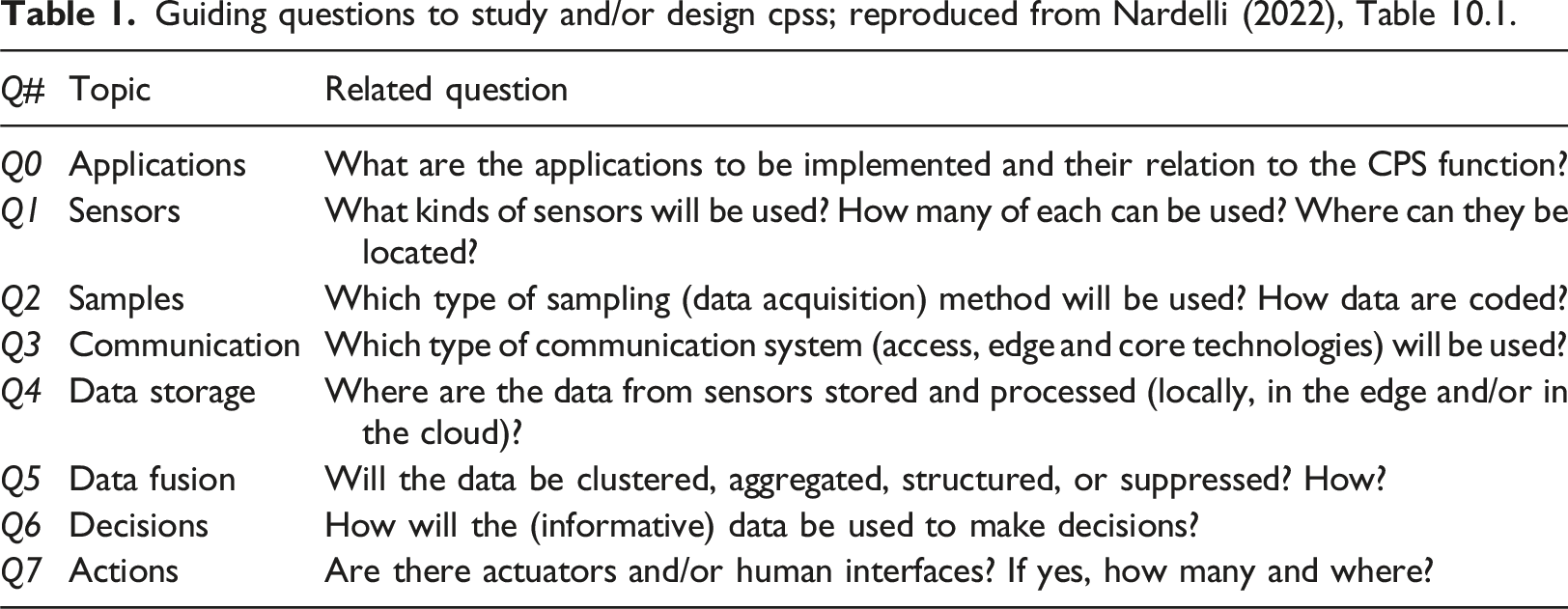
Guiding questions to study and/or design cpss; reproduced from Nardelli (2022), Table 10.1.
One example that follows this cyber-physical system design is the distributed energy resource allocation through virtual microgrids, as presented by Nardelli et al. (2021); Giotitsas et al. (2022). The socio-technical proposal in those articles is to communize an electrified energy system, indicating ways to both repair existing hardware and operate the grid considering the necessary balance of supply and demand of electricity (also including storage and flexible loads). In more concrete terms, Mashlakov et al. (2021) develop a simulation-based example of how peer-produced energy could be communized and distributed across different users using the I-EPOS algorithm at the decision layer based on the information obtained from physical attributes at the data layer, while evaluating the impacts on the physical layer. Although those works are not boldly claiming for a new mode of production based on communizing, they provide a clear illustration of the ambivalence of ICTs to govern large-scale shared infrastructures like this electrified energy system as a commons that will be presented in more detail later. Note that the term “ambivalence” here is borrowed from Feenberg (1990) who argues that technologies, despite being produced in favor of capitalist existing relations, also offer a place for struggle. Following our argument, some ICTs could be appropriated as a tool in-against-and-beyond the value-form, and this is so because it is ambivalent.
In this subsection, we will describe how to use the proposed framework to guide the deployment of CPSs for decentralized multi-agent scheduling, which characterizes a broad range of shared infrastructures, goods, and services. It is clear from Table 1 that different functions would require a different set of hardware and software elements to be deployed to enable the cyber-operation of the system in addition to the actual physical elements that need to be coordinated and/or organized. Moreover, the decision-making process (the “intelligence” of the system) also depends on what needs to be accomplished. An important remark is that not all—and probably only a minority—of socio-technical processes and practices do require coordination through CPSs; nevertheless, many key interrelated sectors for supplying basic human needs such as energy, logistics, industrial production, and agriculture would benefit from it. At this point, it is worth providing more details of the I-EPOS algorithm and how it is capable of allocate resources in the previously described vision of the communist mode of production, capable of enabling a polycentric commons-based governance system..
I-EPOS was proposed by Pournaras et al. (2018) as a general-purpose decentralized collective learning algorithm. In I-EPOS, distributed elements called agents in a network self-determine a set of viable options for themselves, for example, resource consumption and production schedules. Each of these options, or “plans,” has an associated “local” numerical quantification referred to as cost following the literature in the field that represents the agent’s preference for that plan. Moreover, these plans collectively have a system-wide impact that is modeled in terms of a “global cost.” Note that cost here is a mathematical function that might represent money (as monetary expenses or profits), but they can also represent other parameters of interest as well, for example, fairness, environmental impacts, emissions, and deviation from desired states. These latter ones are what interest us most. The I-EPOS algorithm is capable of optimizing the global cost alone, implying full cooperation and thereby selflessness; the local costs alone, implying no coordination and thereby selfishness; or their mixture, implying a tradeoff between selflessness and selfishness.
A rigorous mathematical analysis of I-EPOS can be found in articles by Pournaras et al. (2018); Pournaras (2020); here, we only give a brief non-technical explanation. Consider a network of distributed agents; all the agents have a finite set of feasible plans that represent the resource allocation. For example, consider a network of machines in a modern manufacturing industry that can communicate with each other via an Internet of Things network. These machines have to perform certain processes to manufacture a product, and they can do this independently or by coordinating with each other. For such a machine, a plan could be “2.145: 1.339,2.132,1.534,3.685,1.876,4.81,” where 2.145 represents the local cost, that is, the energy consumed by the machine over a 6-h process schedule (given by the energy consumed per hour, kWh). The machine proposes several such plans, each with different preferences (or costs). Every such machine, or agent, is connected to each other in the network, and all of them have their own plans corresponding to their individual schedules and energy consumption. I-EPOS determines an aggregated response by summing up (element-wise) the selected plans and their costs. Thus, the selected plans of all the agents form a global response vector with an associated global cost. The overall objective is to cooperatively select plans that minimize the global cost. Note that this kind of cooperation is particularly useful when the agents’ choices depend on each other. Moreover, in I-EPOS, agents’ and system’s preferences, that is, local and global costs, can be balanced.
I-EPOS has been shown to work well in scenarios involving collective sharing and usage of resources. For example, consider the case of bike sharing that was studied by Pournaras (2020). Here, users visit a nearby bike station to pick up a bike and then deposit the bike in a station close to their destination. For bike sharing scheme to work well, it should always be possible for the users to pick up a bike in a station and return to another, without the station exceeding the capacity of parked bikes, or having stations without bikes when users need them. By using I-EPOS, Pournaras (2020) showed that I-EPOS can reduce the number of manual bike relocations that are materially needed to avoid the problems mentioned above. In addition, the I-EPOS collective learning algorithm has been shown to obtain near-optimal solutions to other scheduling and resource allocation problems such as load balancing in energy demand-response as in the work by Pournaras et al. (2018), uncertainty-based grid planning and operations by Mashlakov et al. (2021), and tasks involving drone swarms by Qin et al. (2022).
In what follows, we will provide one example of moneyless decentralized allocation for communized energy resources against the commodity form.
Case study: Electrified energy system
In most places, energy is traded as a commodity that needs to be paid for, which must be profitable for producers on the supply side, as well as retailers (when they exist) and energy service providers (when they exist). Besides, depending on the energy market structure, the transmission and distribution network operators also require to be profitable, mainly if they are privatized. As reported by Pirani (2018) among others, fossil fuels are the basis of the socio-technical system we live in, and no resolution by international institutions like United Nations and its high-level meetings could not up to now change this trend (and probably will not do so). The most recent 27th session of the Conference of the Parties of the UNFCCC (COP27) seems to be another step in the greenwashing of capitalism†.
To offer a solution that works in-against-and-beyond the social force field of the value-form, we revisit the technical specification described by Nardelli et al. (2021) that offers a clear design for a decommoditization of an electrified energy system through its communization. This means that energy production is not subordinated to monetization, and access to energy is open to all. In our view, this would be an intentional path-breaking in the commodification tendency taken in electricity markets, as studied by Apajalahti and Kungl (2022). The communization of the electrified energy system is to be deployed in such a way that it can at the same time (i) weaken the self-reinforcing mechanisms that sustain markets and for-profit energy generation-transmission-distribution and (ii) enable other stronger self-reinforcing mechanisms that are necessarily capable of supplying the energy demand.
It is possible to foresee different paths toward this being implemented, but the communizing structure desired would benefit from organizing the physical grid as networked microgrids. For non-industrial demand, many actions could be taken: retrofit targeting energy conservation in buildings, flexible demand management when needed, use of heat pumps, increase of small-scale renewable sources at the distribution side (closer to the end-user), and integration of storage units. All these should lead to lower overall energy demand.
However, for technical reasons, the supply and demand of electricity in the grid must match closely to real-time. To match supply by the intermittent (but in many ways predictable) renewable sources and demand by controlling storage units, heat pumps, and other flexible loads like saunas and dishwashers, a cyber-physical packetized energy management is proposed by De Castro Tomé et al. (2020); Nardelli et al. (2019) and further extended in (Nardelli et al., 2021), from where the technical details can be found. Although these solutions could, in principle, be integrated into the existing market structure (at least many parts of Europe, as illustrated by the idea of energy communities as reviewed by Gjorgievski et al. (2021) or peer-to-peer sharing reported by Klein et al. (2020)), the proposed idea explicitly aims at treating energy as a commons, or in the terms used here communizing energy. The proposed governance approach is mainly highlighted by Giotitsas et al. (2022), as well as by Giotitsas et al. (2015, 2020). The key idea is that open access to energy based on needs without payments and organize the operation of the cyber-physical energy system based towards managing scarcity moments via a rule-based scheme open for community deliberation. Therefore, the planning is decentralized in many senses: community deliberation of operational constraints of how to handle scarcity of supply, multi-agent BitTorrent-type of energy multiplexing through virtual packetization, and the possibility of coordination of individual, regional and global elements towards a shared goal. The iterative stages of bottom-up and top-down of the multi-agent approach of I-EPOS offers one scalable possibility to perform decentralized planning to enable a widespread of communization in-against-and-beyond the value-form.
We present a case that illustrates this approach. In an electricity grid network, for example, every household has its own preferences for the consumption schedules but these preferences have a collective impact on the performance on the grid as a connected network where supply and demand must match in very low time scales for operational reasons. This affects, for example, the electricity that can be shared, the peak load, and the transmission line capacity. I-EPOS can be used to balance those local (individual, agent’s) usage preferences and the overall grid (global) quality requirements by optimizing the tradeoff between the global cost and the local cost. I-EPOS also performs this optimization in an unsupervised and decentralized manner by collectively learning and combining the agents’ plans, while maintaining privacy and autonomy (agents’ schedules do not need to be shared).
In specific terms, let us consider that every household has: (i) solar generation capabilities, (ii) battery as a storage unit, (iii) electric bike with small battery, (iv) electrified thermal loads like heat pumps, heaters, fridges, and freezers, as well as sauna, (v) appliances that can operate flexibly to accomplish their functions like washing dishes and clothes, and (vi) baseload that does not offer flexibility. Following Nardelli et al. (2021), each household can be virtualized as part of a software-defined energy network that determines a cyber-physical system to operate the energy system as a virtual microgrid based on the operational needs of matching energy supply and demand, as well as managing the batteries. This problem can be posed as an inventory management problem not mediated by money. Every agent defines their own priority plans for usage considering the appliances types (iii)-(v); (vi) is given, but predictable. The distributed generation by solar and the battery are managed as a virtual power plant, where the distributed generation and storage units are virtually aggregated to operate the system. We could call every household as an Energy Client in the software-defined energy network, while the I-EPOS would be the algorithm that runs in the Energy Server; batteries and thermal loads are the Energy Buffers. I-EPOS goal is to build up schedules of use based on explicit request and politically-determined prioritization (e.g., what is more important as a load, an electric bike or a heater or a sauna) that are both acceptable by the agents self-determination and operational for the physical grid. This sort of solution already exists in some places, being compatible with the strict electricity market regulations but, most usually, money mediation takes place. Our vision is that this approach can displace the market if it could be scaled up, creating a self-reinforcing mechanism based on commons (virtually aggregate common pool of resources), following paths of the energy transition posed by Apajalahti and Kungl (2022).
The main limitation of this case study is that it focuses on residential and small commercial building demand, and thus, it should be adapted to be employed for large industrial facilities, transportation, and logistics. As a matter of fact, the proposed communization of energy can only be thought of considering as part of the communization process of the mode of production as a whole. Here, we are (in spirit, but not in practice) reminded of Horvat (2020) and the self-managed socialist enterprise and association of associations. The Yugoslav self-management, shaped by the material and geopolitical conditions, is not a monolithic body of theory. Going back to (Todorovic 1965), we see that the intention to do away with the value-form immediately (or any time soon) is referred to as “socialist romanticism” and dismissed from consideration. The acceptance of the value-form and associated market mechanisms by Kardelj and others was challenged continuously. Echoing Bavcar et al. (1985) via (Kirn 2010), the paradoxical position of workers taking the structural position of a capitalist in the production is not an abolition of capital in any meaningful way. The bureaucracy form that is shaped in this relation to manage the economy allows for the value form to keep existing, as (Hamza, 2016) notes, between the state and the party. In brief, we do not believe that the Yugoslav self-management had abolished value form in any way, and we are skeptical of the potential to do so in the direction it took; where we declare ourselves related in spirit is merely the insisting on the distributed approach, but through the roads not taken–some of which Todorovic would have listed in the romanticist treatise.
In this sense, we claim that by organizing the existing large-infrastructures in a similar manner following the guidelines presented by Nardelli (2022) and indicated by the “clinical” question presented in Table 1. Scaling and passing the critical thresholds of communes has been an oft-cited issue with commons; at the same time, degrowth advocates have issues with large power production systems “because an energy-intensive society based on increasingly sophisticated technological systems managed by bureaucrats and technocrats will grow less democratic and egalitarian over time” even in the case of “green megastructures like high-speed trains or industrial-scale wind farms” (Kallis, 2017). In this sense, there are also issues related to raw materials like copper, iron, and other metals needed to produce electronic appliances, solar panels, and batteries as necessary components of the power grid material infrastructure that need necessarily to be solved in a sustainable non-exploitative manner, both socially and environmentally. Those points are of utmost importance, but require studies that go beyond our aim in this section, which is to show that communizing energy is operationally feasible and, in our view, a necessary (but not sufficient) step for the emergence of a mode of production based on commons as a social form, against value.
Conclusions
This article argued for demonetizing and decommodifying social practices and processes by communizing. This radical proposal considers that this is the hope in the hopeless times we are living, but it is far from wishful thinking because we are based on the concrete possibilities that are present in society. Our approach is based on the value-form theory to indicate what must be destroyed to destitute the value-form as the social field through communizing. We foresee that different cases like the energy system, spectrum allocation for wireless connectivity, logistics, transportation, and matching offers and requests (including services related to the ability to perform industrial activities) can benefit from cyber-physical systems to enable the production and reproduction of a new society, creating a reinforcement mechanism that acts, at the same time, as a path-breaking of capitalist reinforcing mechanisms that is monetized through and through. However, our approach is not based on centralized planning—which may have undesirable social implications as its main limitation, not the technical feasibility as such. We rather choose to follow the decentralized planning that the I-EPOS design enables as a multi-agent algorithm that can be implemented to find globally and locally suitable outcomes in terms of community-determined and/or meaningful attributes.
We would like to close this article by quoting (Endnotes, 2010): This is why value-form theory points, in terms of the notion of revolution that follows from it, in the same direction as communisation. The overcoming of capitalist social relations cannot involve a simple “liberation of labour”; rather, the only “way out” is the suppression of value itself—of the value-form which posits abstract labour as the measure of wealth. Communisation is the destruction of the commodity-form and the simultaneous establishment of immediate social relations between individuals. Value, understood as a total form of social mediation, cannot be got rid of by halves.
This text is an attempt to point a way that decentralized planning enabled by the recent ICTs could be employed to eliminate the money-form, and thus, the value-form social force field.
Footnotes
Declaration of conflicting interests
The author(s) declared no potential conflicts of interest with respect to the research, authorship, and/or publication of this article.
Funding
The author(s) disclosed receipt of the following financial support for the research, authorship, and/or publication of this article: This paper is partly supported by the Research Council of Finland (former Academy of Finland) via: (a) EnergyNet Fellowship n.321265/n.328869/n.352654, and (b) X-SDEN project n.349965,
