




Abstract
Studies on the drivers of public sector wage setting (PSWS) within the broader political and economic conditions in Central and Eastern Europe are scarce. To fill this gap, the paper questions to what extent the export-led growth model, based on foreign direct investment as driver of economic growth, influenced PSWS in Czechia and Slovakia after the 2008–2009 crisis. The paper provides new evidence of the appropriateness of the growth model literature, integrated by consideration of global production chains integration, for understanding PSWS in CEE conditions. The analysis shows that PSWS followed institutional traditions and established practices that only indirectly related to the countries’ export orientation and integration into global production chains. The indirect growth model impact on PSWS in CEE conditions is channeled through a strong role of the statutory minimum wage, which serves as a wage benchmark both for the export sector and PSWS.
Keywords
Introduction
While public sector wage bargaining is a key component to the quality and scope of public service provision and has received significant attention in the Western literature (Bach and Bordogna 2016), studies of Central and Eastern Europe (CEE) are scarce (ILO 2015; Kahancová and Martišková 2016; Kahancová and Szabó 2015). The interaction of public sector wage setting (PSWS) with broader political economic settings in CEE countries has attracted even less scientific attention, despite rising public wage bills after union pressures and changing government priorities to invest in the public sector after years of wage moderation in the post-2008 crisis years (Bach and Bordogna 2016).
To fill these gaps, this paper reviews PSWS in two CEE countries—Czechia and Slovakia—in relations to their broader export-oriented political economies. The paper attempts to start the currently missing debate in the region on how the priorities in public sector development may relate to the drivers of economic growth and the preferences of actors responsible for growth in both countries. Building on the growth model approach in comparative political economy (Avlijaš et al. 2021; Baccaro et al. 2022, Baccaro and Pontusson 2021; Hope and Soskice, 2016), the paper seeks to understand whether and how the growth model in Czechia and Slovakia, with strict emphasis on foreign direct investment (FDI) in manufacturing exports (Ban and Adascalitei 2022), influences the processes and outcomes in PSWS after the 2008–2009 crisis. In addition, the paper is innovative in uncovering, both conceptually and empirically, how two types of export-led growth models (high-value and low-value) may have differing impacts on PSWS.
Czechia and Slovakia are considered embedded neoliberal market economies (Bohle and Greskovits 2012). Their economies resemble a dependent export-led growth model where economic growth is largely fueled by these countries’ export orientation while being dependent on the decisions and capabilities of multinational corporations that own most of the industrial core of the CEE region (Ban and Adascalitei 2022). Their public sector employment as a percentage of the labor force is also similar (OECD 2021). Yet they differ in their PSWS institutions (Kahancová and Martišková 2016). Czechia was a latecomer in introducing dedicated legislation on public sector employment and wage regulation and failed to develop coordinated PSWS to the same extent as Slovakia.
The paper adopts an actor-oriented perspective in a two-dimensional comparison. First, it studies how actors in similar structures of political economy interact with and shape diverse PSWS mechanisms. Second, according to the growth model perspective, both countries resemble an export-led growth model; however, the countries’ role in global production chains (GPC) differs (Pula, 2018). This may lead to differences in power relations between key actors in the export sector, the state decision-making bodies and the workforce. Hence, the paper studies how actors’ preferences affect PSWS in a more nuanced perspective than typically employed in the growth model literature.
To capture the internal diversity within the public sector, the empirical analysis covers wage setting in three public sector subsectors: (a) top public administration (workers referred to as civil servants), (b) education (workers referred to as public servants), and (c) the hospital sector (with marketized wage setting following the Labour Code in Czechia and wage setting based on dedicated legislation in Slovakia).
Three arguments are developed. First, in conditions of lacking legal transparency for PSWS (Czechia) and an overtly complex occupational regulation of public sector professions (Slovakia), institutional inertia and complexity of relationships, interests, and bargaining practices within the public sector itself play a more important role for PSWS procedures and outcomes than the export sector’s interests. Second, despite PSWS following its established trajectories that seem independent from export sector developments, there is nonetheless an indirect impact of export business actors on PSWS. This relationship is mediated by the institution of minimum wage, which is relevant for both the export and the public sectors. In the public sector, the statutory minimum wage serves as a direct pegging mechanism for wages in both countries. Finally, the expectation that in a growth model where integration into GCN occurs at a higher value added would yield more direct preference of business actors for social investments in the public sector is not confirmed. Instead, in the growth model based on a low-road GCN integration, the paper shows more willingness of business actors to accept wage growth in the public sector.
The paper’s first section presents the key features of PSWS in Czechia and Slovakia, followed by a conceptual and analytical framework seeking to understand the link these PSWS systems to the growth model perspective. After a brief methodological section, we discuss the impact of the export sector, derived from its role within global production chains, on PSWS. Section five summarizes the findings and arguments.
Key features of public sector wage setting in Czechia and Slovakia
In Czechia and Slovakia, which used to be part of Czechoslovakia before separation in 1993, the existing approach to wage setting developed in the context of historical legacies and interaction of relevant stakeholders, that is, labor and finance ministries, trade unions, and employers/public service providers. After the fall of state socialism, communism, a need emerged in both Slovakia and Czechia to replace the previous unified soviet system of public administration and unified wage setting.
Prior to 1990s the presence of the private sector was marginal. Thus, almost all employment used to be in the public sector and wages were determined centrally by the government. Still, the countries were (and still are) characterized by rather autonomous ministries and agencies despite of a formally centralized wage setting system (Staronova and Rybar, 2024). The economic transition after 1989, which introduced the private sector in early 1990s, resulted in sharp differences in the wage structure, namely, higher private sector wages and a general increase in wage inequality. In addition, to maintain discretion over who stayed in the public sector during privatization of certain state functions, employment relations within the public sector became more stratified and accompanied by a significantly narrower understanding of civil service within the overall public sector (Demmke, 2005). Together with delays in legislative reforms, this produced a situation in the first decade of transformation where public organizations in CEE were often over-staffed with low salaried workers. In turn, attracting of professionals into the service remained challenging, due to rigid pay structures determined by central regulations.
The second decade of transformation was designed to increase public sector attractiveness to high quality candidates and improving remuneration by removing the seniority principle and introducing more flexible and performance-related pay (Staroňová and Láštic, 2012). The most important change was the introduction of flexibility and discretion regarding the variable components of salaries, which constitute a huge proportion of the overall wage. Thus, the system gives ministers and public managers significant discretionary power to conduct institutional reform in their own organizations (Verheijen 2006) and at the same time establishes informal ways for wage setting (Gajduschek and Staroňová 2021; Staroňová and Láštic 2012), with low levels of transparency and predictability of the overall pay.
In Slovakia, the government change of 1998 to a more democratic and pro-EU coalition did not immediately bring the needed reforms. Dedicated legislation on civil service and public service passed only in 2001, upon EU warning that Slovakia’s entry chances could be contested if the reform was not passed. In result, Slovakia introduced a broader public administration reform, aiming to professionalize the public sector, by introducing two separate pieces of legislation in 2001: the Public Service Act, which defines the public service and covers services such as municipalities, health, and education; and the Civil Service Act, which regulates the civil service in central state administration bodies.
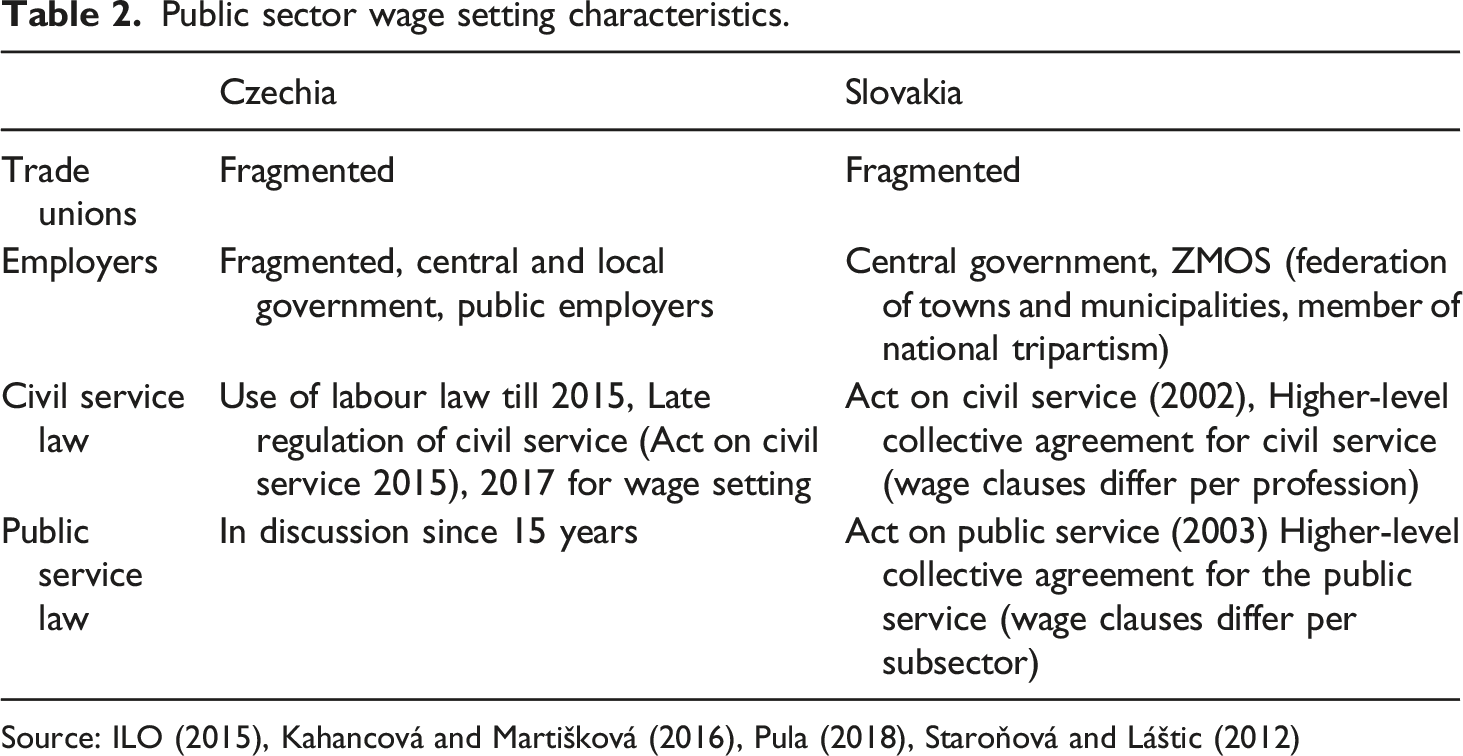
In Czechia, similar efforts emerged, but the Act on Civil Service was adopted only in 2014 and entered force in 2015; and legislation unifying the regulation of public services is still to be adopted. Czechia thus implemented its commitment upon the EU entry to adopt dedicated legislation only after 10 years (Kolev 2014). Still, the Czech public sector is marked by fragmentation, lack of transparency, and absence of collective bargaining across the majority of its sub-sectors, while PSWS mechanisms often derive from unilateral government decisions. Social partners attempt to influence working conditions and employment levels through tripartite consultations, establishment-level negotiations, and employee mobilization strategies (Martišková 2021). Although not strictly focusing on wages, their cooperation does stipulate convergence in interests and approaches to public sector working conditions.
To summarize, PSWS in Czechia and Slovakia differs in country-specific wage setting practices resulting from national public sector reforms and actors’ structures therein. Wage setting in the Czech public sector occurs via unilateral government regulation, leaving room for individual discretionary bargaining at the individual level. Slovakia resembles a regulated and legislatively underpinned structure of wage setting, distinct for civil services and for public services, but also shares elements of individual marketization of wages. While collective wage bargaining at the sector level remained important in Slovakia, with the exception of healthcare professionals, Czechia failed to establish these wage setting mechanisms in the last decade; and maintains a mixed system with both unilateral government decisions and decentralized bargaining.
These general characteristics of PSWS evolution are embedded in broader context of political economies. Both countries are characterized as FDI-financed and export-led growth models (Avlijaš et al. 2021; Bohle and Regan, 2021). In line with the analytical lens of the growth model literature, the next section develops a framework to understand the interactions between these countries’ growth models and the above PSWS procedures and outcomes.
Growth models and their impact on PSWS—a conceptual and analytical framework
A growth model refers to a centrally deployed set of techniques, encompassing policies and the institutions they support, used by the core actors in the economy—governments, firms, and organized producer groups—to secure higher rates of economic growth (Hall 2021). Particular welfare targets derive from export-led growth model (Avlijaš et al. 2021). A high-quality manufacturing-based export-led model relies on wage moderation and protection of labor market insiders to maintain international competitiveness, resulting in labor market and social protection dualization (see Figure 1). At the same time, social investments and expansion of higher education may become policy priorities. The FDI-financed export-led growth model may follow fiscal and social attractiveness for foreign investors through low corporate tax, low labor costs, and minimizing the costs of public welfare. Welfare targets in export-led growth model. Source: Avlijaš et al. (2021).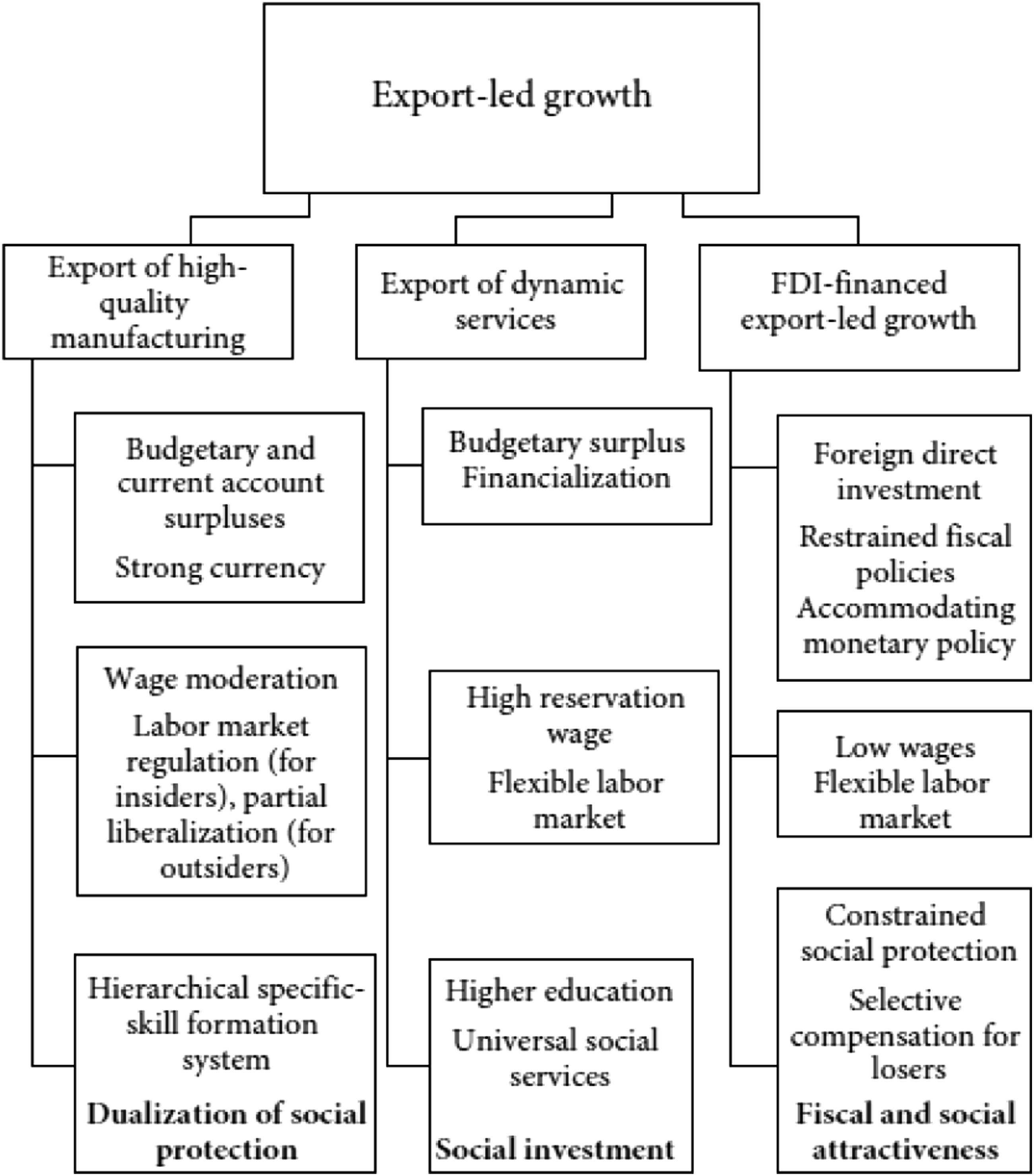
In the FDI-financed export model, fiscal policies are restrained and monetary policies accommodated to ensure a steady flow of FDI. Labor market regulation is designed to produce comparatively low wages (to ensure labor cost competitiveness and FDI attractivness), and job protection is low to ensure numerical flexibility for companies in fluctuating markets. For welfare state provisions, this policy mix leads to constrained social protection and can produce insider-outside cleavages between well-protected manufacturing jobs in high-productivty foreign plants, and precarious jobs in services and supplier companies. The state may decide on selective compensation for certain outsider groups, especially if these policies ensure political legitimacy of the FDI-financed growth model.
Already in the early 1990s the share of Czechoslovakia’s exports on GDP approximated Germany; in 2000 both countries’ export share approximated 50% of GDP (Ban and Adascalitei 2022: 196–197). This trend diverged in the latter years and in 2018 Slovakia’s export share on GDP reached over 90%, while Czechia’s share stood just below 80% (ibid). The exported goods are almost entirely produced within FDI-based corporate infrastructures channeled into low- and medium-skill sectors (ibid.).
Bohle and Reagan (2021) argue that the stability of FDI-led growth regimes can be explained by the quiet politics of informal business-state interaction. While governments change, growth regimes remain stable. This is a relevant consideration for the studied countries, which, despite several government changes and related ideological shifts, remained committed to state-led industrial and enterprise policies and deals between business and the state, targeting mostly investments of multinational firms (ibid.). In turn, the growth model literature suggests that an export-led model in low- and medium-skill sectors will prioritize flexible labor markets and cheap labor, without a particular interest in social investments. This type of politics means that growth models, if at all, set the trends for PSWS, not the other way around.
Seeking for influences of an export-led growth model on PSWS, the closest example to look at is Germany (Keller 2023). Germany is characterized by long-term wage moderation, including the public sector, where unions remained strong, and bargaining coverage is high (Baccaro and Höpner 2022: 254). Wage restraint in the German public sector was first explained by pattern bargaining where a collective agreement in the manufacturing sector sets expectations for wage bargaining outcomes in the public sector (c.f., Soskice 1990). In line with this argument, the export sector would show genuine interest in keeping domestic prices and wages low. However, the German situation is more complex, because public sector wage restraint is a fiscal policy, and the local government (federal units and municipalities), with most public sector workers, are committed to sharp fiscal consolidation and wage cuts despite a joint wage bargaining framework (Di Carlo 2023; Baccaro and Höpner 2022).
The German experience fuels two expectations. First, that the export sector actors’ are likely to be interested in wage moderation in the rest of the economy, including the public sector. Second, that institutional inertia in the public sector and related bargaining structures may facilitate different interests of the public sector actors towards wage bargaining, especially if unionization rate and bargaining coverage is high (Di Carlo 2020).
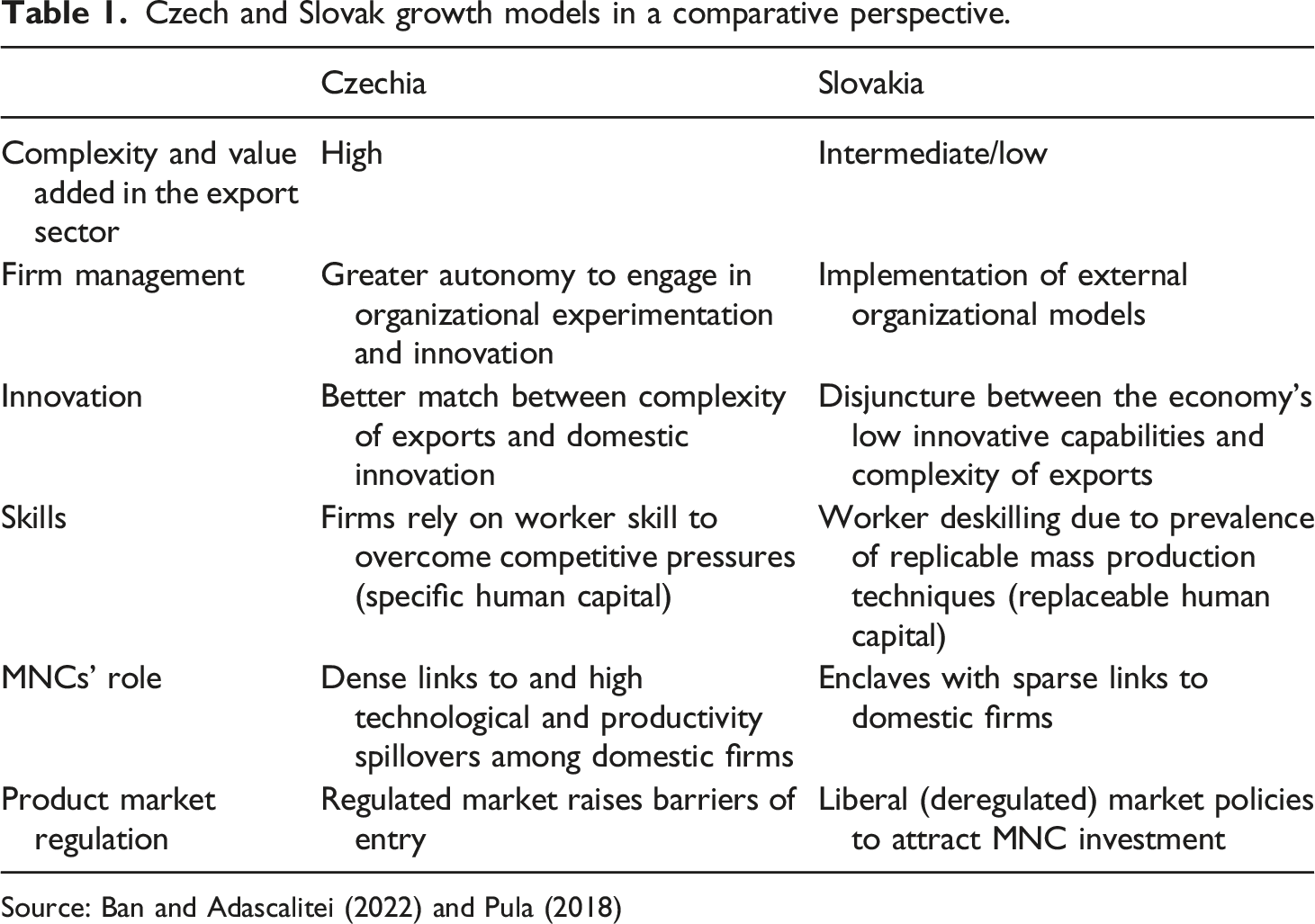
However, and with relevance for Czechia and Slovakia, a more nuanced insight into the subtypes of an export-led growth regime’s wage setting priorities suggests differing ways of export sector actors’ influence on PSWS. The growth model impact on PSWS may differ depending on the structure of exports and the countries’ roles in global production chains (Pula, 2018). Here, the export orientations of Czechia and Slovakia have taken slightly diverging paths. In turn, different positions in global production chains may yield diverse priorities of the export sector’s actors, and thus different bargaining dynamics impacting PSWS.
Czech and Slovak growth models in a comparative perspective.
Source: Ban and Adascalitei (2022) and Pula (2018)
The above conceptualization of FDI-led export growth regime, acknowledging its nuances related to the GPC integration, leads to two hypotheses.
The first hypothesis draws expectations regarding the overall influence of the export sector on PSWS.
The export sector’s pressure on PSWS, namely wage moderation, is conditioned by the country’s GPC integration.
There is no direct pressure on wage moderation in the PSWS in Czechia because of the export’s higher value added compared to Slovakia and therefore an expected interest in social investment, including higher wages, in the public sector.
Due to a higher value added of export manufacturing and higher human capital needed, in Czechia we expect an interest in the export sector’s actors in some high-quality public services including working conditions and wages therein. We expect this especially in those PS subsectors that resemble social investments and skill creation, such as education. Export actors may also perceive healthcare as a social investment important for long-term commitment of skilled workforce, which are at the core of a high value-added role in the GPC. In turn, there is less pressure on wage moderation, because the high value-added export sector is not price sensitive (Ban and Adascalitei 2022).
Direct pressure from the export sector on wage moderation in the PSWS, if found, is more likely in Slovakia than in Czechia.
In Slovakia, the export sector depends more extensively on cheap labor, which leads to an expectation that compared to Czechia, the export sector actors will be less interested in social investments, better public services, and working conditions and wages therein. Therefore, we expect the key actors in the export sector to strive for an overall wage moderation to contain potential inflationary pressures from the public sector that could escalate wage demands in the export sector.
The second hypothesis draws expectations regarding the mechanism of expected influence of the export sector on PSWS.
If a direct or indirect influence of the export sector on PSWS is established (H1), the expected mechanism of this influence occurs either via political lobbying, or pattern bargaining.
H1 establishes that export actors may not have a direct influence on PSWS, namely its wage moderation. However, if an effect of indirect influence is established, it materializes via political connections rather than via pattern bargaining.
Given the lacking bargaining structures for PSWS in Czechia, if Czech export actors wish to influence wage developments and wage bargaining in the public sector, this would be through political connections rather than via direct pattern setting. Large investors may develop direct access to policy makers via informal deals and industrial lobbying, recognizing the importance of the export sector for the economy, and support austerity in government spending, or in case of the social interest argument, support government spending in the public sector. Austerity may translate into lower government willingness to raise public sector wages, while interest in social investments, if matching other government spending priorities, can result in raising public sector wages.
In conditions of developed PSWS structures in Slovakia, we expect the impact of the export sector to occur via pattern bargaining. This depends on particular actor constellations and their interest in wage moderation to keep wages generally low in the economy.
In contrast to Czechia, pattern bargaining as a form of wage coordination is likely in Slovakia where PSWS structures as well as bargaining structures in the export sector are well developed. Emerging from the low-wage preference based on the GSC argument above, export actors will rather support wage moderation than wage growth in the public sector. However, due to the high power of the export actors in the economy, they might also seek direct political connections to shape government policies towards wage moderation in addition to pattern bargaining. At the same time, the high unionization and bargaining power of public sector workers, for example, in the education and healthcare sectors, may place the government into a dilemma. Thus, the actual PSWS can depend on empirical actor constellations.
The remainder of this paper examines whether there is empirical support to these hypotheses.
Design and methods
We investigate the hypothesized influences using descriptive statistics (e.g., ratio of wages in the public and private sectors) as well as qualitative data covering the period of the post-2008 crisis, seeking to show long-term influence patterns rather than explain sudden changes thereto. The empirical analysis is based on the authors’ long-term research of PSWS in both countries. Qualitative evidence is based on approximately 30 interviews in both countries with experts, social partners, government representatives familiar with wage bargaining procedures, and top civil servants with knowledge on discretionary wage setting practices in the public sector. Interviews were conducted by a research team within six research projects on PSWS between 2013 and 2022. 1 The authors also engaged in desk research of media statements and press releases of export actors on developments in PSWS and minimum wage setting.
The comparison is made between Czechia and Slovakia, appearing as most similar cases at first glance. Both studied countries share a common legacy of state socialism legacy and public administration tradition; and both received a high share of FDI in manufacturing/industry since early 1990s. Their economies are strongly export oriented, therefore classified in the literature as export-led growth models (Bohle and Reagan 2021). In terms of broader political economy structures, CEE Bohle and Greskovits (2012) refer to both countries as embedded neoliberal political economies, characterized by a trade–off between policy involvement of social actors on the one hand, and labor quiescence in the course of developing the FDI-oriented economy on the other hand.
Public sector wage setting characteristics.
Source: ILO (2015), Kahancová and Martišková (2016), Pula (2018), Staroňová and Láštic (2012)
Findings
In both Czechia and Slovakia, the export sector is dominated by the automotive industry (Martišková et al. 2021). The extended share of the industry on GDP amounts to 13% in Slovakia (Luptáčik et al. 2013) and between 10 and 13% in Czechia (Gallistl 2018). Average wages in the automotive sector exceeded the national average wage in 2018 by 34% in Czechia and 40% in Slovakia (Martišková et al. 2021). The average wage in the automotive industry grew faster than in the overall manufacturing sector. Interestingly, the Czech and Slovak economies, despite being small export-oriented economies, were not struck as extensively as many other EU member states by the 2008 economic crisis. This fact is relevant in the context of overall public sector austerity and no wage rises for several years after 2008 (Kahancová and Martišková 2016).
The institutionalized involvement of key export sector actors into tripartite decision making is similar in both countries. In Czechia, large foreign companies are organized in the Federation of Industry and Transport of the Czech Republic (Svaz průmyslu a dopravy České Republiky, SPD), while in Slovakia it is the Association of Industry Federations and Transport (Asociácia priemyselných zväzov a dopravy, APZD). SPD is a member of tripartite committee in Czechia and APZD is a member of tripartism in Slovakia.
While it is there, structures where the interests of private and public sectors meet in national-level social dialogue, the actual PSWS occurs between workers’ representatives and the government. Other formalized structures, where export actors participate, for example, the Slovak industrial bipartism and the Alliance of Sectoral Committees (a tripartite platform of the Ministry of Labour, Ministry of Education and representatives of employers and workers) do not have a bargaining mandate to influence public sector developments.
The analysis of press releases, media articles and activities of these bipartite and tripartite structures show that their predominant agenda is creating conditions for a sustainable and competitive export sector. In the last 5 years, however, the discourse on competitiveness has shifted increasingly towards the quality of education and human capital investments for industry. This may have implications for a growth model adjustment, especially in Slovakia where competitiveness typically rested on cheap labor. In the light of new public management (NPM) reforms in the 2000s, public sectors in Czechia and Slovakia faced increasing demands to produce more and better results and to deliver services with higher efficiency and effectiveness (Staroňová 2017). After the 2008–2009 crisis, which only marginally affected both countries, wage freezes were more common in PSWS than wage cuts (Kahancová and Martišková 2016, Martišková 2021).
Although this increasing pressure on education quality only indirectly relates to working conditions in the public sector, it can potentially stimulate debates on export actors’ influence on PSWS. Below we examine the actual PSWS developments and explore whether these were indeed influenced by the export sector.
The growth model impact on the public sector (H1)
The countries’ ratios between public and private sector wages differ (see Figure 2). In Slovakia, public sector wages remained systematically below those of the private sector; while in Czechia they are systematically on the rise vis-à-vis average private sector wages. The period between 2010 and 2014 can be analyzed via the lens of the economic crisis—albeit not extensive—when wage moderation was practiced in the public sector in both countries. During this period, average public sector wages in Czechia dropped from 105% (2010) to 100% (2014) of the average private sector wages. In Slovakia, the drop occurred from 98% to 96% in the same period. After 2014, the trend in both countries diverged: in Slovakia wage moderation in the public sector continued despite economic recovery; while in Czechia public sector wages grew and reached 104% of the private sector wages in 2018. Public and private sector wage ratio in Czechia and Slovakia, 2002–2018. Notes: Public sector is estimated using NACE Rev 2.0 including Education; human health and social work activities; arts, entertainment and recreation; other service activities. Data exclude public administration, defense, compulsory social security (data not available in Eurostat). Private sector is estimated based on NACE Rev 2.0, including Industry, construction and services (except public administration, defense, compulsory social security). All values in Euro in the original source. Source: Eurostat Structure of Earnings Survey, latest reference year 2018.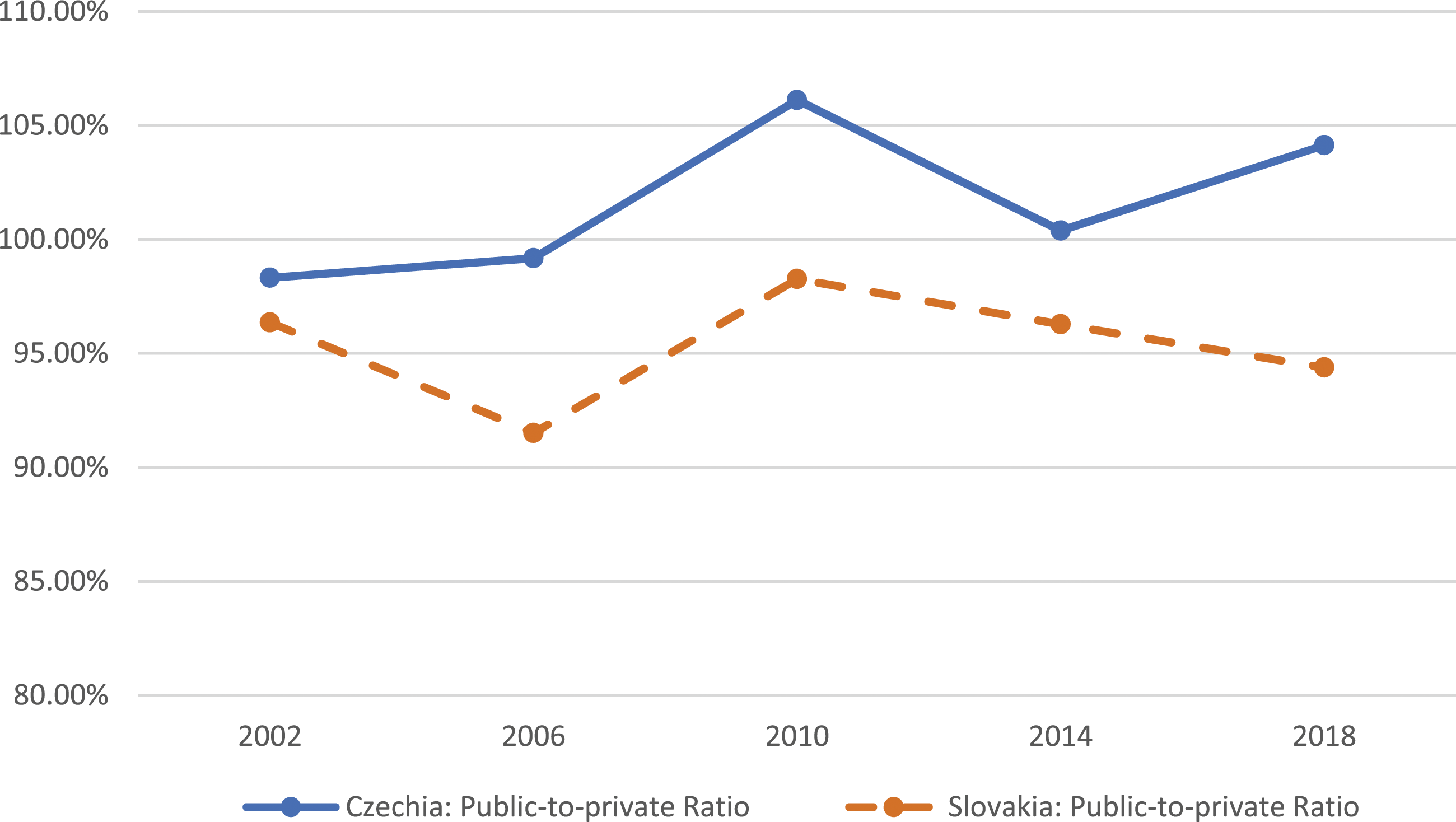
When accessing wage developments in particular PS subsectors (to assess the hypothesized social investment interest of export actors), Figure 3 shows that wages in all three studied subsectors (education, health, and public administration) increased more in Slovakia than in Czechia, benchmarked to 2008 as a baseline year. Average nominal wage increases in three subsectors of the public sector, benchmarked to 2008 (2008 = 100%).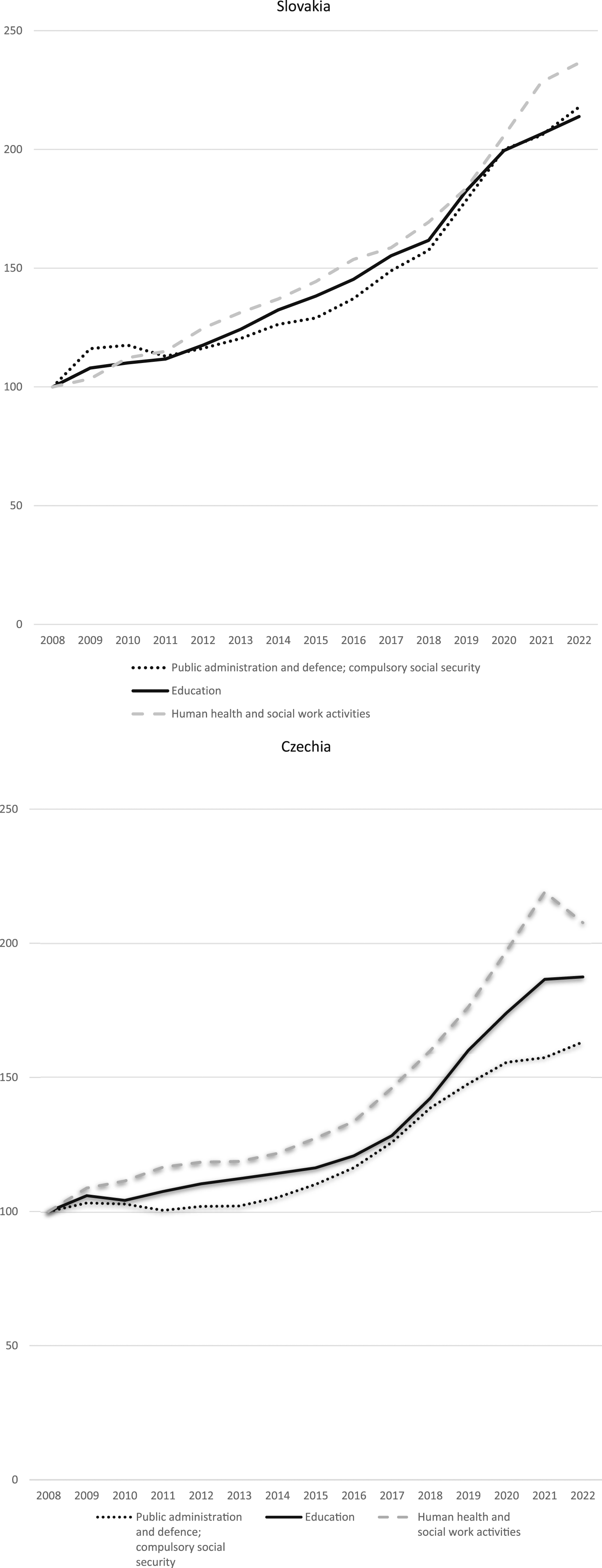
A more detailed insight shows how PSWS operated in several public sector subsectors. For workers in education, wages in Slovakia were determined by the higher-level collective agreement for public service, while in Czechia these are set by a government decree. Bargaining in the Slovak education is regularly accompanied by tensions between the government and trade unions, but other actors from the national tripartism, including employers’ associations representing the large manufacturers and exporters, are left out from this process. In Slovakia, extensive wage increases were reached by bargaining for the education sector: a 3% wage increase from 2022, 7 or 10% increase from January 2023, depending on the occupation, and another 12% increase from September 2023 (Trade Union Confederation of the Slovak Republic “KOZ SR”, 2022). These increases reflected the 2022 inflation. While APZD expressed concerns regarding these inflationary pressures for export sector wages, we did not find evidence of APZD trying to influence the actual public sector wages. In Czechia, in 2022, the government adopted a legislative commitment to peg wages in education to the average wage in the economy. The discourse preceding this decision merged from the governmental planning of the state budget; and we did not find evidence of export actors trying to influence this. Teachers’ wages should reach 130% of the average wage from 2024, increasing the overall budget expenditure by 30.5 bil of CZK (Eurozprávy 2022). This target has also been one of the long-term priorities of the education trade unions (Dobšík 2022).
In the healthcare sector, hospital reforms in both countries have included decentralization of service provision and material privatization (Kaminska 2013). 2 In Czechia, for some healthcare workers wage setting occurs by legislation; while for others wage setting is fully decentralized at the hospital level (Kaminska and Kahancová 2017). In Slovakia, a mid-2000s hospital reform excluded healthcare workers from public servant status and enabled independent multi-employer bargaining complementing decentralized hospital-level bargaining (Kahancová and Szabo 2015). While wages were determined via collective bargaining, pressures increased for legal regulation of wages (ibid.). This signaled a weakening role of wage bargaining and a shift in social partners’ priorities to legal solutions as an alternative wage setting procedure (Kahancová and Martišková 2023). Still, a small part of healthcare workers, mostly in healthcare authorities, are remunerated by the higher-level collective agreement for public service. The export sector’s actors were involved in these reforms only to the extent that the tripartite committee where they participate is an advisory body to the government, without binding impact on legislative changes.
Finally, in civil service (higher public administration) in both countries, wage setting shows discretionary, decentralized and non-transparent elements (Staroňová 2016; Gajduschek and Staroňová 2021). The aim of this decentralized wage setting is to allow for discretionary decision making for political appointees, who have tools to attract highly qualified civil servants from outside of the closed structured system where wages/tariffs are significantly lower, without any link to private sector wages. This drives the introduction of non-systematic wage setting procedures despite existing collective bargaining for public administration in Slovakia. In Czechia, the discretionary flexibility in PSWS changed with the adoption of new legislation in 2017, and civil servant wages are now determined by tariffs, pay scales and grades strictly stipulated by law with no room for discretion and with high transparency. However, in practice, the fixed proportion of the wage is as low as 30% of overall pay. In contrast to the Slovak system, in which variable components are unpredictable, the performance-based pay and bonuses in the Czech civil service are stipulated in detail in a governmental decree without further flexibility or arbitration.
The qualitative analysis based on interviews and desk research confirmed that PSWS lives its own life, distant from the export sector’s direct interference in both countries. What matters for PSWS is the established wage setting mechanism, the power of PS social partners to bargain for wage changes, and the government’s political will to adjust PSWS. The only important indirect mechanism that connects the export sector with PSWS is the existence of the statutory minimum wage. Export actors organized in peak-level employers’ associations, engage in bargaining about changes to the statutory minimum wage. PSWS also sees the minimum wage as a benchmark; wages in some PS occupations are directly pegged onto the minimum wage.
In sum, we found no evidence of direct influence onto PSWS, in form of bargaining or lobbying by export sector actors. In Czechia, we expected interest by export actors in public sector social investments and thus no reason for wage moderation. In Slovakia, we expected export actors’ interest in overall wage moderation due to the growth model’s competitive advantage resting on low wages. The analysis shows two relevant findings. First, wage increases were systematically achieved in all three subsectors (higher in Slovakia than in Czechia, see Figure 3). Thus, wage increases do not apply only to social investments and not only in Czechia; and there is no evidence that export actors tried to moderate wages in PSWS. This contrasts our H1a. Second, PS wages grew faster in Slovakia, albeit still below the private sector average. There is no qualitative evidence for export sectors’ actors attempting to moderate wages in the PS. This contrasts our H1b. Instead, in both countries, export sector’s actors are concerned with public sector developments indirectly when talking about the education policy and reform, not wages therein. The link via wages is only indirect via concerns for the statutory minimum wage, which is also an important benchmark for PSWS.
The role of political connections (H2)
In Hypothesis 2, we expected that large investors may develop direct access to policy makers via informal deals and industrial lobbying, recognizing their importance for the economy, and support austerity in government spending. Despite improvements in PSWS regulation especially in Czechia, persistence of informal, discretionary decision-making makes PSWS in some of its subsectors more arbitrary, less predictable and with high differences in pay in same position. In 2022, a PS collective agreement established binding stipulations regarding working conditions and trade union rights. However, this agreement lacked wage regulations, leaving large government discretion over public sector wages. Wage increases were introduced later in 2022, but without systematized bargaining with social partners. In contrast, in Slovakia, wage setting for public servants is more structured and rigid, given regularly exercised collective bargaining, but cases of multiple quiet bargains still exist especially in public administration. It is this window of opportunity for non-transparent wage setting, plus efforts to politicize wage setting, that leads to wage setting automatization (Brans and Peters 2012).
In both countries, debates on automatized minimum wage setting are documented. In Slovakia, since 2019, the legislation establishes that the minimum wage is negotiated between tripartite social partners, yet if they fail to reach an agreement, an automated mechanism determines the minimum wage level as 57% of the average wage in the economy from 2 years prior to the year in which the minimum wage negotiation occurs (Kahancová and Kirov 2021). In Czechia, the minimum wage is set by governmental decree, without prior opportunity for social partner bargaining. Despite this difference in the role of social partners, the industry associations in both countries, organizing the key export players, are very active in the statutory minimum wage (SMW) debate. SMW is then crucial for PSWS because some wages in the public sector, as well as surcharges for nightwork, shiftwork, etc., are pegged onto the SMW. Moreover, in both countries, the lowest tariffs of public sector jobs systematically remain below the statutory minimum wage. This creates pressures to renegotiate collective agreements, or to pay the difference in form of a variable component and personal bonuses, mostly at government discretion (Sedlacko and Staronova, 2018). Each adjustment in the SMW thus activates bargaining in Slovakia, or additional government decisions for covering the difference in Czechia.
The influence of the export sector’s actors onto SMW is formalized via their membership in national tripartism in both countries and they use official statements, press releases, and argumentation in the respective tripartite negotiations to voice their claims regarding the SMW. The authors’ analysis of statements from SPD and APZD shows that both organizations have been active in voicing their criticisms towards minimum wage increases. In Slovakia, these included requests to freeze minimum wage rises after the 2008–2009 crisis and during the COVID-19 pandemic 1 ; changes to the minimum wage setting procedures and respecting the automatic minimum wage setting mechanism should the tripartite negotiations not yield an agreement on minimum wage rise 2 ; or claims to adopt changes to the minimum wage to facilitate a larger net wage from the gross amount. Finally, the 2023 tripartite negotiations brought a minimum wage increase for 2004 by agreement of social partners; and the activation of the automated minimum wage setting mechanism was not necessary.
In Czechia, the Federation of Industry and Transport of the Czech Republic (Svazu průmyslu a dopravy ČR, SPD) supported moderation of minimum wage; followed by a request of the minimum wage rise not exceeding the rise of the average wage. The 2023 ministerial proposal of a minimum wage rise by 6,4% faced criticism by SPD that requested an increase of max. 5,8%, aligned with the rise of the average wage. SPD seeks to institutionalize the SMW setting, namely, moving away from the governmental discretionary setting to a similar system as in Slovakia, where the SMW is pegged onto the average wage in the economy. The genuine interest of export sector employers in containing minimum wage rises has yet another reason. Pícl (2019) explained that due to low wages, it is still reasonable to use human labor in the export sector, even in Czechia, and this halts a quicker move of the export industry to technological advancement and industry automatization.
The above evidence suggests that although the export sector actors remained active in the SMW setting, they were not concerned by the SMW as a potential threat to export sector wages via coordination or leapfrogging, regardless of the country’s GPC involvement. Figure 4 shows that the average wages in the export (automotive) industry were growing even in years when minimum wage increases slowed down or even dropped (in 2010–2011, 2015–2016 and 2018–2019 in Slovakia, and in 2015–2015 and 2018–2019 in Czechia). Trends in the average wage in the automotive sector (in EUR) and in the minimum wage increases (in %) in Czechia and Slovakia, 2009–2019 (latest available data). Source: AutoSAP (Czech automotive wages), Inštitút zamestnanosti (Slovak automotive wages), national minimum wage statistics, Martišková et al. (2021).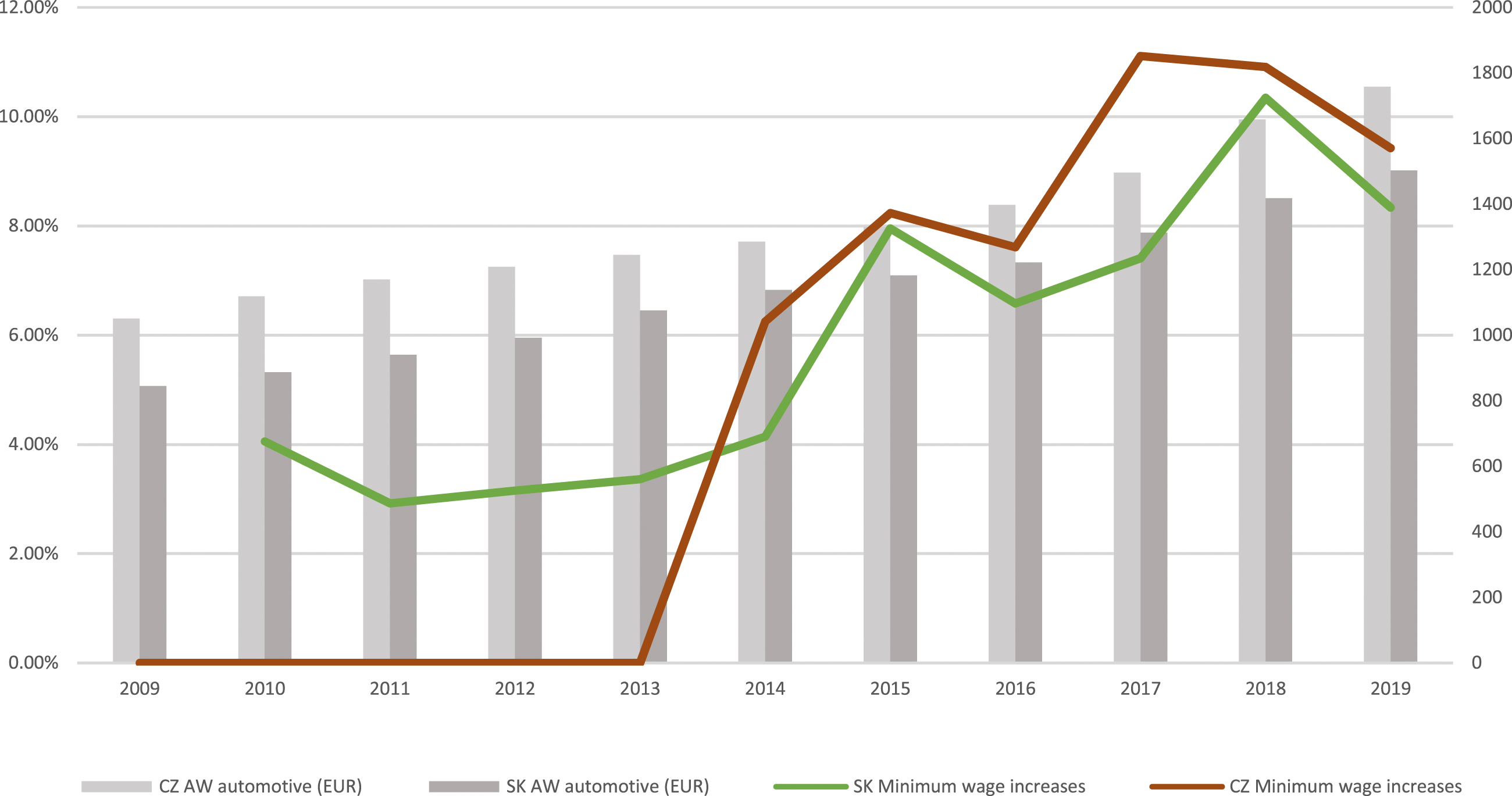
The finding on export actors’ influence on SMW is consistent also after acknowledging the impact of currency developments that might have influenced wage trends in the export sector. Slovakia is part of the Eurozone, while Czechia is not. Despite exposure to currency devaluations between 2011 and 2015 before revaluation vis-à-vis the Euro, the wage trends in the Czech automotive export sector shown in Figure 3 show a consistent development over the entire studied period without visible shifts that could be explained by changes to currency value. Therefore, the monetary regime is not treated as a relevant explanatory factor in the relationship between wage setting in the export sector and PSWS.
In sum, H2 expected a mechanism for PSWS influence in Czechia to occur via political connections, while in Slovakia via pattern bargaining. Since formal structures to shape PSWS or even the minimum wage in a binding matter did not emerge, the Czech analysis provides support to this hypothesis only to the extent that export actors have political opportunities to shape the statutory minimum wage, which in turn becomes relevant for (often discretionary) PSWS. In Slovakia, despite established PSWS structures, wage coordination with the export sector in form of pattern bargaining is not found. Hypothesis 2 is not supported. Instead, PSWS follows political preferences and power relations between the involved social partners. Trends in wages show greater social investment than in Czechia, despite Slovakia’ GPC role expecting wage moderation by export actors. In Slovakia, PSWS also uses the SMW for benchmarking, which is under direct influence of export actors. However, the expected wage moderation and pattern bargaining is not found.
Discussion on other factors relevant for PSWS
The export sector’s impact on PSWS is rather indirect in both countries, channeled via the institution of minimum wages. The remaining question is what other factors influence PSWS. Recalling from the conceptual framework, institutional inertia, high unionization, and bargaining power of public sector workers, as well as actors’ constellation in the public sector itself may be important. In Czechia and Slovakia, electoral cycles seemed important for setting government priorities. In the growth periods since the 2010s, social-democratic government coalitions were more open to public spending than right-wing coalitions in both countries. In Czechia, the center-right government of Prime Minister Nečas proposed budget cuts in 2010 as a response to decreasing state revenues, producing a 10% wage cut for public servants. However, this proposal raised a wave of resistance from stakeholders especially in healthcare and education, which contributed to the fact that wage moderation remained modest and some wage growth persisted (Martišková 2021). Since the 2020 government change in Slovakia, and in the context of the COVID-19 pandemic, even right-wing parties in the government coalition, often supported by extreme right wing and conservative parliament members, felt the pressure to concede wage rises and additional benefits for public service employees. It is difficult to assess to what extent this is an outcome of systematic political preferences, or, more likely, the momentum of time and bargaining power of trade unions (public workers classified as essential, labor shortages in many sectors, high inflation).
Second, structural labor market factors, for example, pressures of business for re-skilling, up-skilling and development of workers’ digital competences, recently emerged in the export industry regardless of being an assembly platform or a more intermediate producer. To preserve current jobs (more likely to disappear in the assembly platform’s cheap labor than in higher value-added jobs), governments may prioritize wage rises across the whole economy. It is an empirical question to what extent wage rises driven by these structural factors would also increase public sector wages.
Finally, trends in bargaining power of public sector workers suggest that these played an important role in wage increases. Their bargaining power is based on the homogeneity of the public servants’ interests. In the past 10 years, in both countries very successful resignation campaigns (healthcare, e.g., the 2011 doctors’ campaign Thank you, we are leaving! in Czechia, followed by union-organized job resignations in Slovakia) and strikes (education, judiciary) occurred, fueling wage increases. In result, PS wage increases were politicized (the last one applicable to education workers in Czechia in 2022 Slovakia for 2023) and independent from developments in the export sector. What has shifted, however, is that wage increases are better achieved by legislation than by collective bargaining even in a coordinated bargaining system (Kahancová and Martišková 2023).
Conclusions
The paper seeks to understand, both conceptually and empirically, the interaction between the FDI-financed export-led growth model in two CEE countries, and PSWS. As argued in the Introduction to the Special issue, in the FDI-financed export-led growth model, the engine of growth is a lean public sector and PSWS restraint that keeps such countries attractive for the manufacturing MNCs. This premise can be confirmed when public sector wages remain below private sector wages despite sporadic increases.
Beyond the export-led growth perspective, the paper calls for acknowledging the actual mode of the countries’ integration into global production chains. While integration into global production chains with higher value added of export goods could yield a higher bargaining power for workers in general and focus on social investments, the paper does not confirm this. Instead, PSWS is strongly influenced by institutional traditions within the public sector itself, and reforms to bargaining on statutory minimum wages, which are a relevant benchmark for PSWS. Key export actors are active in minimum wage setting, but other, direct, mechanisms of their influence on PSWS are not found in the studied countries.
To summarize the paper’s empirical findings, PSWS in Czechia and Slovakia differs to the extent that it allows more scope for bargaining in Slovakia and more government discretion in Czechia. The only demonstrated influence of the export sector’s actors on PSWS is via their active say in shaping the SMW, which serves as a benchmark for pattern bargaining and for pegging selected PS wages. Contrary to our expectations in Hypothesis 1, the Czech export actors are not directly engaged in demanding improvements in the public sector including wages therein. Rather, it was Slovakia, regardless of its cheap labor export strategy, that saw significant wage across the public sector, that is, education. Export actors have, via membership in various advisory platforms and committees, direct impact on shaping the education system which is likely to have further positive impact on wages therein in the long run. In Hypothesis 2, we expected that the mechanism for PSWS influence in Czechia will be via political connections, while in Slovakia via pattern bargaining. The Czech analysis supported this expectation, since platforms to directly shape PSWS or even the minimum wage in a binding matter did not emerge. In Slovakia, despite established wage bargaining in the public sector, a pattern bargaining vis-à-vis the industry did not emerge. Instead, pattern bargaining refers to the SMW, which is closely connected to PSWS and under direct influence of export actors that are one of the negotiating parties to SMW changes.
The remaining question is whether changes in the relationship between PSWS and the growth model are expected in the future and under what conditions they are likely to materialize. Our analysis suggests that with the erosion of bargaining and more legislative regulation of public sector wages that at the same time leaves room for discretionary bargaining of individual wage supplements (in Czechia and in some sub-sectors in Slovakia), a closer relationship with the export sector may emerge because power is centralized with the legislators eager to please foreign investors.
Footnotes
Authors’ note
Material privatization refers to a change from public to private ownership, while formal privatization refers to corporatization and marketization of hospitals that remain in public ownership (Schulten, et al. 2009).
Declaration of conflicting interests
The author(s) declared no potential conflicts of interest with respect to the research, authorship, and/or publication of this article.
Funding
The author(s) disclosed receipt of the following financial support for the research, authorship, and/or publication of this article: This work was supported by the projects providing empirical evidence for this paper include New challenges for public services social dialogue: Integrating service user and workforce involvement to support the adaptation of social dialogue (Project No. VS/2013/0362), Bargaining for Social Rights at the Sectoral Level (BARSORIS, Project No. VS/2013/0403), Bargaining for social rights in the public sector (BARSOP, Project No. VS/2016/0107), Strengthening Social Dialogue in the hospital sector in the East, South and Central Europe (project subcontracted by EU-level social partners EPSU and HOSPEEM, Project No. VS/2019/0008), and Social dialogue in welfare services: Employment relations, labor market and social actors in the care services (SOWELL, Project No. VS/2020/0242).
