



Abstract
Literature on entrepreneurial ecosystems (EEs) has grown rapidly over the past 5 years, using the concept as a framework to understand regional clusters of entrepreneurship. This article reviews, critiques, and extends the concept of the EE, arguing for its relevance in studying the political economy of urban space. To make this argument, we distinguish between niche EEs (NEEs) and growth EEs (GEEs). This distinction is based on the overlapping but distinct networks of actors and institutions forming each type of EE and also reflects broadly different relationships to growth and productivity, the entrepreneurial subject, global and local scales, and financial ecologies. We argue that EE research has largely focused on GEEs to the neglect of NEEs; by broadening the EE concept, we address shortcomings in the treatment of small businesses, financial relations, social difference, as well as urban politics within the EE literature. Drawing on the EE literature and interviews from a case study of Boston, we show that the infrastructure of GEEs and NEEs are not only “for” fast- and slow-growing businesses, respectively, but reinforce social and economic differences. While NEEs do redistribute resources to marginalized entrepreneurs, these resources are focused on building businesses and only indirectly related to the needs of marginalized communities and equitable development more generally.
Keywords
Introduction
A student has a bright idea for a business. At least they think it is: an app for pet sharing—why not? People have dogs, but don’t always want to walk them. People enjoy walking dogs, but don’t always want to own them. Stick a platform between them, and you’ve got a business. So they enter a pitch contest hosted by their university. It doesn’t go well. The judges are not convinced: are people really interested in walking dogs? Will owners entrust their dogs to strangers on an app? What about privacy concerns? Without good answers to such questions, the student does not stand a chance.
That could be the end of the student’s foray into entrepreneurship, but it does not have to be. The local entrepreneurial ecosystem (EE) offers other paths forward. A mentoring service staffed by MBA students can help answer tough business questions, do market research, and refine their pitch. An on-campus incubator facilitates team building and functions as a co-working space. Local accelerators can provide funding to build prototypes, connections to venture capitalists (VCs), and learning opportunities about the entrepreneurship process. With hard work, and good luck, the student may raise several rounds of VC funding to rapidly scale.
In the same city-region, a second-generation immigrant opens a food truck. They get a loan from a Community Development Finance Institution (CDFI), using their small business program for technical assistance and to formulate a business plan. They start their business at a shared kitchen facility, which helps secure a food permit. Later, they join a “retail accelerator,” where they have a chance to run their business out of a local university’s food court before committing the capital required to open a full restaurant.
Is this chef also part of an EE? This question should not be hard to answer: obviously, yes. But according to many EE frameworks the answer is less obvious. It depends on the scale of the entrepreneur’s aspirations. Do they just want to support themselves or produce a line of snack foods that might end up on the shelves of stores across the continent? While the latter is clearly “growth entrepreneurship,” the former is not, and therefore falls outside the traditional bounds of EE scholarship. But regardless of intention, the chef relied on an infrastructure of foundations, community development organizations, and entrepreneurship boosters to open and nurture their business. In this paper, we argue that this infrastructure also constitutes an EE.
In other words, the range of actually-existing EEs exceeds what has been the focus of EE scholarship, which has largely excluded from analysis small-scale businesses, the often marginalized people who start them, and the institutions that support them. To address this lacuna, we differentiate between two types of EE: growth and niche EEs (i.e., GEEs and NEEs). While the defining characteristic of the GEE is firm growth, the category of the NEE is broader, incorporating values and actors given less attention in this rapidly-growing subfield at the confluence of business strategy, and urban and regional development (Acs et al., 2017).
Between 2010 and 2015, 71 articles on EEs were published (Malecki, 2018). In 2022 alone, there were 444. The speed with which the EE concept has spread has even elicited concern among some EE scholars (e.g., Wurth et al., 2021), who worry the concept could become another development fad like the “creative class.” Yet, critical political economists have been largely silent about EE scholarship, which has tended to position itself as apolitical and technocratic. In this paper, we address this silence, by critiquing the concept, politicizing it, and deploying it to better understand the role of entrepreneurship promotion in contemporary urban politics, drawing empirical insights from the Boston region, as a well-studied center of innovation and entrepreneurial networks (Adler et al., 2019; Buderi, 2022; Loh and Agyeman J, 2019; Özkazanç-Pan and Muntean, 2021).
We argue that in ignoring NEEs to focus on more “productive” entrepreneurship, scholars risk playing into the faddish potential of the EE concept, and reinforcing real-life class, race and gender hierarchies in business creation, rather than understanding the (re)production of these inequalities. To make this argument, we draw on the EE literature as well as scholarship related to NEEs (e.g., diverse economies, solidarity economy, and community development), and accounts from professionals in Boston-area entrepreneurship supporting organizations. We (i) argue that productivity is not technically neutral but always freighted with value judgments; (ii) illustrate the various ways that socio-spatial difference shapes EEs; and (iii) connect EEs to the production and politics of urban space.
In the first section, we critique the notion of productivity in the EE literature, arguing that the term is irreducibly more-than-economic. We then elaborate our distinction between NEEs and GEEs by comparing their orientation toward entrepreneurial knowledge, global and local scales, and financial ecologies. We argue that various categorical distinctions—such as necessity and ambition, person of color and white, and feminine and masculine—play performative roles in distinguishing between NEEs and GEEs. But EEs must also be understood in their socio-spatial contexts, rather than with these contexts abstracted away. Therefore, before concluding, we describe EEs as socio-spatial phenomena, situating them in the context of “urban entrepreneurialism” and urban politics.
Throughout the article, we draw on empirical material based on 40 interviews conducted between 2020 and 2022 (see Appendix Table A1), 1 participant observation at various entrepreneurship-related events in the region, textual analysis of gray literature on entrepreneurship, innovation and urban development in the Boston region, as well as scholarly writing on EEs. Interview participants are predominantly Boston-area professionals in entrepreneurship supporting organizations that work with a wide variety of business types and groups. Interviewees were split evenly between GEE and NEE organizations.
Productive entrepreneurial ecosystems
EEs are assemblages of entrepreneurs, financiers, governments, firms, and supporting organizations (e.g., universities) oriented toward promoting entrepreneurship (Özkazanç-Pan and Munean, 2021; Malecki, 2018). EE research distinguishes between “small business” entrepreneurship, and “ambitious” or “productive” entrepreneurship (Acs et al., 2017; Mason and Brown, 2014), and largely focuses on the latter (see Neumeyer et al., 2019 for an exception). In this section, we trouble this distinction by critiquing the conceptualization of productivity within EE literature. We show that entrepreneurship commonly associated with EEs has “productive” and “nonproductive” components which cannot be disentangled. Rather than excluding firms that are not oriented toward a growth-based notion of productivity, a wider variety of firms—and the niche ecosystems they belong to—should also be foci of inquiry in EE research.
Writing on EEs consistently identifies growth as a necessary feature of an EE (Acs et al., 2017; Mason and Brown, 2014, kazanç-Pan and Muntean, 2021; Stam, 2015). Isenberg (2016) goes so far as to posit that the essence of the EE is growth, vaguely defined as “extraordinary value creation and capture.” “Ambitious” and “productive” entrepreneurship are nearly synonymous with growth. “Ambition” is about intent, that is, an entrepreneur is “ambitious” if they intend their firm to “add as much value as possible” (Stam, 2015: 1759–1760). “Productive” entrepreneurship, too, is often narrowly associated with “high-growth startups” (ibid.) or growth orientation (Audretsch et al., 2021). But value creation and startups are not necessarily synonymous (Isenberg, 2016), especially when defining value in social rather than monetary terms (Stam, 2015: 1761; Wurth et al., 2021: 7).
Productive entrepreneurship is often imagined as “Schumpeterian.” However, “productive” and Schumpeterian entrepreneurship are not strictly equivalent. For Schumpeter, one critical function of the entrepreneur is the “creative destruction” of existing capital formations. This lays bare the contradictions of “productive” entrepreneurship: in a Schumpeterian sense, the most productive entrepreneurs are also the most destructive. Many definitions of entrepreneurial productivity refer to Baumol’s classic “Entrepreneurship: Productive, Unproductive, and Destructive” (Acs et al., 2017; Brown and Mason, 2017; Brush et al., 2019; Wurth et al., 2021). Baumol argues for a sort of conservation of entrepreneurial energy, where the “supply of entrepreneurs” varies much less than institutional incentive structures channeling that energy. Here, figures from marauding knights to scholar-officials are entrepreneurs insofar as they attempt to maximize their own wealth and prestige; it is the institutional “rules of the game” which change to incentivize (un)productive entrepreneurship. What (un)productive entrepreneurship actually is, is not discussed beyond references to “activities of…questionable value to society” (Baumol, 1990: 897) like competition over the distribution of existing wealth (Audretsch et al., 2021: 3), and the idea of “productive activity” is fuzzy at best in Baumol’s account.
The most straightforward definition of productivity—producing more widgets in less time or cost—does not align with industries that are most often the focus of EE research. Biotech and software companies, for example, rely on investments in intellectual property to generate rents (Birch, 2019; Tretter, 2016; Rikap, 2022). Does this make these companies unproductive rent-seekers? Just as efforts to measure the economy have grappled with determining the “productiveness” of various activities (Christophers, 2013), there is no a priori method for demarcating the boundaries of productive versus unproductive entrepreneurship. Nevertheless, the EE literature has largely taken the difference for granted.
One possible defense of the definitional role of productivity in EEs is that the social productivity of entrepreneurship is only discernible over long periods of time. Scholars have thought about periodic technological change in terms of “long waves” or “techno-economic paradigms” (Perez, 2010). “Productive” entrepreneurship could be seen as entrepreneurship which spreads the technology of an advancing paradigm. Indeed, one account sees EEs as a special type of cluster driven by the global scope of digital business opportunities and local diffusion of knowledge about the entrepreneurship process (Autio et al., 2018). Here, EEs become instrumental to the propagation of “long waves” through business sectors. However, the current wave models of EEs (Cantner et al., 2021; Mack and Mayer, 2016) do little to clarify how EE lifecycles plug into other economic waves or the time period over which the productivity of an EE should be assessed. If the productivity of an EE can only be appraised retrospectively, or over a long time horizon, then “productivity” is a rather unhelpful criterion for determining the boundaries of today’s EEs.
Yet another move to rescue productivity as essential to EEs is to focus on the productivity of the ecosystem rather than individual firms. One way of plugging EEs into the process of technological diffusion is through the observation that large firms, for example, digital platforms, can act as “keystone species” rather than “value dominators” (Iansiti and Levien, 2004). “Keystone” firms cultivate “business ecosystems”—or even EEs (Autio et al., 2018)—dependent on their products instead of using their monopoly position to maximize short-term profit. While this layering explains the path-dependent evolution of a technological paradigm, it just shifts the challenge of defining the boundaries of productivity to the scale of the EE rather than the firm. If the firms that make up an EE do not themselves have to be “productive,” how does one decide which firms to include and which ones to exclude on the basis of productivity?
The nebulousness of productivity in EE scholarship, despite efforts to redeem it temporally and spatially, makes the exclusion of “unambitious” small business entrepreneurship from analysis untenable. In the next section, we consider some of the many forms of entrepreneurship that have been elided by EE research by focusing on what we call NEEs.
GEEs vs NEEs
Rather than productivity, the crucial distinction, for us, between EEs and other types of entrepreneurship is that EEs facilitate entrepreneurship through intermediary organizations that teach people how to be entrepreneurs and connect them to financial resources. In this section, we elaborate the concept of the NEE by comparing it with the GEE, arguing that both are diverse and internally differentiated. While they are both composed of institutional and organizational networks, the institutions associated with each tend to be different.
NEEs are composed of a number of different entities: CDFIs and other funds which lend to entrepreneurs, sometimes at discounted rates (i.e., “social investment”); technical assistance providers; entrepreneurship centers that hold pitch contests, connect prospective entrepreneurs with mentors, and organize entrepreneurship courses; foundations which support entrepreneurship organizations as part of their philanthropy; universities which may provide co-working spaces or places like food courts to run a business; urban developers that sometimes rent space to local entrepreneurs at below-market rates; and large institutions—universities, hospitals, city governments, and even casinos—which often support NEEs through their procurement practices. While GEEs feature many of the same organizations, GEEs and NEEs operate in different social and economic contexts, which we explore below.
While business knowledge is important in both types of EE, the distinction between “ambitious” and “necessity” entrepreneurship leads to divergent expectations of firms that emerge from GEEs and NEEs: high-growth firms to compete in the world market, versus small-scale operations more oriented toward meeting the needs of specific neighborhoods. These expectations themselves moderate the growth orientation of NEE-based firms. Put differently, while both NEEs and GEEs are “glocal,” constituted at both a global and local level, they are glocal in different ways. They also have distinct financial ecologies. These differences add up to a distinction between NEEs and GEEs that tendentially, although not necessarily, lies along racial and gender divisions, as we explain in more detail below.
Entrepreneurial knowledge and subjects
In this section, we broadly characterize the EE relationship to entrepreneurial knowledge and entrepreneurial subjectivity. We argue that GEEs interpellate “subjects of ambition” whereas NEEs interpellate “subjects of necessity.” The distinction between GEE and NEE is, in this sense, performative, reinforcing tendential differences between GEEs and NEEs.
Both NEEs and GEEs prize generic entrepreneurial knowledge. Entrepreneurial knowledge, and the role of veteran entrepreneurs in leading and maintaining the ecosystem, occupies a special place in EEs (Feld, 2012: 21–25). The idea is that, despite working in a variety of industries, entrepreneurs are united in their difference: they can commiserate about common problems and trouble-shoot each other’s business issues. Since GEEs are tied together by business know-how, rather than industry-specific knowledge, entrepreneurs are imagined to complement each other rather than compete over scarce opportunities (Autio et al., 2018).
Organizations in NEEs also emphasize the importance of generic entrepreneurial knowledge. They bring in entrepreneurs to judge pitch contests and to serve as mentors, and teach common entrepreneurship frameworks. But NEEs organizations often have social goals, such as alleviating poverty in specific neighborhoods, and have their own standards of support. As one financial analyst relates, traditional finance thinks of investing in related businesses as a “conflict of interest” where “a failure of one hurts both.” Their social impact fund, on the other hand, thinks of it as a “confluence of interest” which can “lift both [businesses] at the same time” to “make the little micro economy…twice as strong” (interview). Opportunities are more localized, but not necessarily understood to be more competitive. Complementary businesses are seen as facilitating local economic circulation, a major goal of NEEs. Rather than regarding circulation of money and resources as an equilibrium which the entrepreneur disturbs, in an NEE keeping money circulating in the local economy is a major goal.
At one extreme, the imagined protagonist of the GEE is a genius who can change the world if their potential is brought to market. At the other, the subject of the NEE is someone who becomes an entrepreneur to survive, or, more commonly, to uplift their family or community. The subject of necessity is impelled into entrepreneurship through financial pressure and seeks stability, while the subject of ambition sees an innovative opportunity and is equilibrium-breaking. GEEs attempt to harness, but also manage, this creative destruction. These differences between NEE and GEE ideal-typical subjects have implications for their negotiating power. For example, subjects of necessity may be impelled to accept a worse deal from investors, lenders, and other business partners because entrepreneurship is their only option, whereas subjects of ambition do not face the same constraints.
The distinction between “need-based” and “opportunity-based” entrepreneurship is well established in the literature and maps onto the problematic survival/innovative, non/ambitious, and un/productive distinctions already described. These distinctions play a performative role, disadvantaging NEE entrepreneurs on at least two levels. First, investors and others interested in ambitious entrepreneurship will not look for the next unicorn within NEEs. Interviews with organizers attest to this. As the leader of an NEE organization specializing in entrepreneurship education and business sees it, this as a widely accepted fact: “Everyone says that, ‘Women don’t get the money, entrepreneurs of color don’t get the money’. I’m like, ok good, tell me something I don’t know” (interview). Second, organizations within the NEE who understand their clients as “subjects of necessity” claim the authority to impose conditions ostensibly for the benefit of the entrepreneur, such as requiring entrepreneurship classes or certain business practices as conditions for a loan. This distinction between necessity and ambition in entrepreneurship is observed consistently among academics and practitioners. This is unsurprising as practitioners are generally college-educated, oftentimes with masters’ degrees in fields like business management, entrepreneurship, and regional development, where they would learn to distinguish between necessity and ambition in entrepreneurship.
While, on the one hand, the distinction between subjects of ambition and necessity has performative effects, on the other, volunteerism is not enough to overcome the gap between NEE and GEE. The founder of a now-defunct incubator found that out the hard way, when he attempted to create a tech accelerator in Boston’s historically Black enclave of Roxbury based on the idea that “let’s not say people here can’t do what people in [Kendall Square or the Seaport] do, right? Let’s be equal.” But he discovered: It’s not enough to just create an accelerator, and hope that people come there and support them with curriculum, and a bit of money, and contacts. Some people need more support because they don’t have the financial…opportunity to take risks, they don’t have parents who might [say], ‘Okay, I’ll bail you out.’ So it’s not an equal playing field.
In other words, entrepreneurs in NEE’s could be “subjects of ambition” given the right support and institutional context (e.g., family support and/or “safety nets”), but these are generally absent among entrepreneurs in NEEs and are expensive to implement institutionally.
One entrepreneur and employee of an NEE entrepreneurship center expresses frustration at the resulting difficulty of performing ambitious entrepreneurship in an NEE context. People have been making things that work. And I think that’s what is probably the frustrating thing about it for people is you’ve built a business from nothing and its sustaining you and you go to someone and say, “Hey can I have help scaling this?” and they sometimes are trying to send you through all these classes and courses where it’s like, okay, this is useful information, I need that information, but the urgency of my situation also asks for some practical, useful—here’s x number of dollars so that you can scale like we’re talking about in the classroom, but you’re talking about amounts that I don’t actually have access to get.
In the face of resource scarcity, generic entrepreneurial knowledge (i.e., business lessons) may be unhelpful or even a waste of time.
Although NEEs lack the resources of GEEs, they are not simply lacking GEEs, but distinct constellations of organizations and institutions. Insisting that NEEs and GEEs must be understood in their socio-spatial context opens the way for more detailed typologies of EEs based on industry domains, regulatory structures, legal codes, and socio-natural metabolisms. These factors should be foregrounded rather than abstracted away. While the idea of necessity and opportunity play a performative role in creating a real distinction between NEEs and GEEs, the two types of ecosystem are further distinguished by how the different organizations and populations that comprise them are embedded in the global economy.
Glocal entrepreneurship
EE literature often tries to determine the optimal level at which to analyze EEs (Alvedalen and Boschma, 2017; Cavallo et al., 2019). Some view this question as unanswered (Cavallo et al., 2019), while others assert that the local scale is most appropriate (Malecki, 2018). Still others emphasize the multi-scalar nature of entrepreneurial ecosystems (Brown and Mason, 2017; Roundy et al., 2018). In this section, we discuss how both GEEs and NEEs are profoundly “glocal” (Swyngedouw, 1997), constituted on a social terrain that is simultaneously global and local. GEEs and NEEs are globally embedded in different ways with regards to both the flow of entrepreneurs and ideas. By showing how global and local factors intertwine in EEs, we demonstrate the importance of a multi-scalar analysis.
The most obvious ways in which NEEs are both global and local is through immigrant and ethnic entrepreneurship. The case of Boston is instructive. Nearly 30% of Boston’s population is foreign born (Johnson, 2015). More traditional studies of ethnic entrepreneurship focus on so-called “survival ventures” with low levels of capital, which exhibit their own spatial dynamics of incubation, agglomeration, linkage, and spatially concentrated consumption (Kaplan, 1998). Johnson (2015) finds that entrepreneurs from different places of origin have taken on specific niches in Boston’s economy (e.g., Brazilian house cleaning, Korean dry cleaning, and Vietnamese nail salons). Yet clusters of ethnic businesses can be disconnected from NEEs. According to the director of an entrepreneurship center in a Massachusetts city with a large Cambodian refugee population, the rate of business ownership among Cambodians is high, but there are challenges in integrating them into the existing NEE infrastructure. First, the entrepreneurship support system of the area has been largely white. Second, entrepreneurship resources are usually in English or Spanish. Third, their potential clients are often skeptical of organizations offering to give business services away for free. As the entrepreneurship center director put it, “If you’re not accustomed to that, you’re questioning: how is it free, why is it free, are you sure it’s free, there are no strings attached, right?” (interview). As NEE-supporting institutions aspire to broadly promote entrepreneurship among marginalized groups, the separation of ethnic enclave economies becomes a barrier to overcome.
Institutions supporting NEEs take inspiration and methods from around the world, especially from practices like microlending first promoted in the Global South (see Roy, 2010). The CEO of one NEE organization observed that the social impact of lending was better documented in the Global South than the United States. More domestic research was needed because if you can “show a city or a government that [from] X amount of dollars invested … here’s the social payback and here’s the financial payback…you can imagine much better cash flow and resource flow into these kinds of activities.” While funding organizations view this as a matter of maximizing impact, it could also be viewed as a method of managing populations.
Echoing recent critiques of microlending and payments platforms in Africa as neo-colonial (Langley and Leyshon, 2022), NEEs could be characterized as a project of neo-colonial management internal to the United States. A dramatic increase of Boston’s immigrant population from the Global South over the past 50 years (Johnson, 2015), the spread of entrepreneurship-promotion techniques pioneered in the Global South, and a focus on nonwhite populations are all consistent with this characterization. Indeed, Black and Chicano activists have long analyzed their status in the US as that of an “internal colony” (Gutiérrez, 2004).
The issue of coloniality is evident in the Solidarity Economy (SE) movement, at the more radical edge of NEEs, which holds a community-focused view of the economy in which firm growth is not paramount. The movement itself originates in Latin American responses to neoliberal austerity (Loh and Shear, 2015). One democratically managed fund in Boston, Ujima, makes explicit the postcolonial dimensions of entrepreneurship support by naming itself after the Tanzanian concept of Ujamaa, a 1960s-era social and economic ideology of self-reliance. Ujima’s commitment to democratic self-management of its investment fund may contrast with more technocratic NEE support organizations, but as of yet, it is unclear how much of a democratizing influence this type of model will have on NEEs overall.
Privileged immigrants from countries with highly developed technology sectors and GEEs of their own have an easier time entering GEEs in the United States, a dynamic that intertwines with the geopolitics of international development as much as the neo-coloniality of NEEs does. Saxenian’s (2007) research has documented how Silicon Valley was bolstered by ethnic associations that supported immigrant entrepreneurship in high technology for workers frustrated by a lack of career advancement opportunities in a predominantly white male industry. High-technology ethnic associations facilitated the spread of Silicon Valley–style entrepreneurship to Israel, Taiwan, China, and India. Connections to establish EEs in other countries can be a competitive advantage for entrepreneurs in the United States: recent EE research has portrayed “transnational immigrant entrepreneurs” as deriving competitive advantage through their engagement with “dual entrepreneurial ecosystems” in both home and host countries (Duan et al., 2022).
While Özkazanç-Pan and Muntean (2021) argue that GEEs primarily support the entrepreneurship of dominant groups, namely, white men, our analysis suggests that minority status does not, in itself, define the dividing line between NEEs and GEEs. Considerations like immigration status also play a role that intersects with socioeconomic status and educational attainment in shaping relative access to GEEs and NEEs. Place of origin, educational attainment, and income are often correlated, causing internal differentiation in other categories, like race. For example, as depicted in The Color of the Capital Gap report from Boston Indicators (2021: 2) “some Asian entrepreneurs are highly educated with strong social networks to tap while growing a business, while others…face language barriers, have fewer resources at their disposal, and experience direct discrimination.” The relationship between ethnicity and NEE or GEE membership varies substantially within and between minoritized groups. The distinction between GEEs and NEEs, then, is entangled with race, ethnicity, and immigration status, but in complex, non-binary ways.
In analyzing EEs, a multi-scalar analysis that is sensitive to specific socio-spatial configurations is needed. GEEs and NEEs are both global and local but are broadly embedded in the global and local economies in different ways. While both types of EE may include migrant entrepreneurs, the type of migration flow that fuels each type of EE is very different. NEE organizations model themselves on poverty reduction strategies used around the world, but GEEs are more directly embedded in international networks of entrepreneurs, global production networks—and military-industrial complexes. Indeed, the US military increasingly acts like a VC, cultivating a portfolio of technologies and financially supporting GEEs (Modigliani et al., 2021), providing a base of support that is not present in NEEs. The VC industry comprises another support base that exists in GEEs but not NEEs; indeed, the financial ecologies of NEEs and GEEs are quite different.
Financial ecologies of entrepreneurial ecosystems
In this section, we apply insights from the literature on financial ecologies to EEs. What emerges is a better sense of how financial relations mark and reproduce the boundaries between NEEs and GEEs. Financial ecologies research has its origins in literature on financial inclusion, exclusion, and citizenship (Leyshon, 2020). Scholarship on financial exclusion/inclusion often starts from the premise that some financial actors are “inside the financial system,” whereas others are “outside” of it, excluded from “mainstream” financial institutions. However, those excluded from mainstream finance still conduct financial activities, just in different ways, and in connection with different actors. They are seen to inhabit “fringe” or “alternative” financial ecologies, featuring an array of institutions, relationships, and spaces distinct from “mainstream” ecologies (Leyshon et al., 2004, 2006). Analogously, entrepreneurs that do not fit the mold of ambitious, growth entrepreneurship are still engaged in entrepreneurship and often embedded in distinct ecologies of supportive institutions and networks. Beyond this simple analogy, EEs are directly embedded in financial ecologies, such as networks of VCs, or CDFIs and philanthropic foundations. In other words, financial ecologies shape EEs, and play a vital role in determining whether they more closely resemble GEEs or NEEs.
Entrepreneurs can finance a new business in at least five ways: taking on formal debt, selling equity, investing retained earnings, inheritance, and borrowing money from friends and family. While the financing mix varies across firms and geographies, there is a core distinction between GEEs and NEEs based on whether selling equity, especially through VC financing, is an option. While VC financing does not account for a large portion of overall funding for new businesses, it is a prized option in GEEs that does not exist in NEEs.
VCs and their networks perform particular functions in a GEE, selecting firms and imparting them with a strong growth imperative (Cohen, 2017). According to Ferrary and Granovetter (2009), VCs perform at least five functions: financing, selection, collective learning, embedding, and signaling. This means that VC networks collectively filter aspirant start-ups, selecting the “right” firms to fund and determining what firms get the chance to scale up rapidly. In short, the form of financing and the financier have an outsized role in determining who can become an entrepreneur within a GEE.
VC funding is predicated on a few very successful high-growth firms and accepts a large number of firm failures. In order to maximize investors’ chance at returns, firms funded by VCs are impelled to become blockbusters. Cohen argues that this all-or-nothing ethos crowds out the pursuit of values other than growth, making it hard for VC-funded startups to become embedded in communities (Cohen, 2017: 96–97). One angel investor observed a difference between East and West Coast VC culture. While the “Silicon Valley mindset is like, raise as much as you can early on and then just grow quickly before competitors come in,” on the East Coast entrepreneurs don’t like to “give away too much of the company. But give away enough that makes sense to get you to the next round of investment” (interview). As a lawyer familiar with both the GEE and NEE worlds observed, “venture capital is rocket fuel money,” intended to accelerate growth as much as possible (interview). Although there are variations in the growth models, VCs are primarily interested in rockets.
Arbitrage opportunities provide the only protection against the exclusion of particular social groups from VC financing. However, the extreme whiteness of the VC industry and VC-funded startups, while not surprising (Pardes, 2020), raises the obvious concern that arbitrage provides insufficient insurance against the VC industry missing genuine opportunities that lie outside of their white male-dominated social networks. Indeed, arbitrage opportunities have been shown to persist in the private equity market, despite higher returns investing in minority-owned businesses than white-owned businesses (Bates et al., 2018). An analysis finding that women entrepreneurs produce more revenue with less investment (Abouzahr et al., 2018) has similar implications. If successful entrepreneurs become VCs and leaders of EEs, this can create a self-reinforcing exclusionary loop, disadvantaging entrepreneurs outside of GEEs and extant, largely white VC networks.
While there are increasing efforts to set up various types of funds to invest in entrepreneurs of color, fund founders face similar challenges to entrepreneurs they aim to support: raising large amounts of initial assets, the need to establish a track record, and issues of unconscious bias and systemic discrimination. As one angel investor noted, “access to capital for a fund [is] a whole other animal, but it comes with very similar challenges…as much as there’s … this, push … to get more diversification in the sector, you constantly run into these roadblocks” (interview). According to this investor, most of the efforts to change the VC industry are coming from the outside, and despite some rhetoric to the contrary, VC funds remain largely white and male dominated.
Entrepreneurs outside of GEEs still need financing, but without access to VCs, aspirant entrepreneurs must often rely on debt. While conventional financial theory suggests that firms should prefer debt over equity because interest payments are tax write-offs, that matters little if there is no profit to tax. Equity investors like VCs forego quick payment, and will even wait for their share of profits. VC-backed entrepreneurs are encouraged to plow everything back into the business in order to achieve rapid growth. Debt, on the contrary, acts as a drain on a new firm’s cash flow as they typically must begin loan repayment immediately. This can be difficult for new businesses without stable revenue streams, even if the loan is branded as “social finance,” intended to help prospective entrepreneurs lift themselves out of poverty.
NEE institutions try hard to provide access to capital to entrepreneurs at a low cost, but they also protect investors in order to make their own debt products safe if low-yielding. Loans to NEE entrepreneurs often come through CDFIs, which are able to provide relatively low interest loans because they are nonprofits, so they only need to cover the cost of capital and operating costs. According to one fund manager, the nonprofit status also helps mitigate credit risk because “as nonprofits [CDFIs] can receive grants, both from the state … and also from foundations, so that helps with the flexibility” of the business model, allowing grants to defray operating costs. But dependence on debt and access to credit through non-market channels can pose unexpected challenges. For example, during 2020, community investment funds could not always pass on record-low interest rates to their borrowers. One financial analyst recounted that their fund had already raised notes at a fixed rate, putting a floor on the rate at which they could lend: “Now everything we’re offering is basically at 5% interest. So our spread”—the difference between the interest rates at which it borrows and lends—“is down.” This not only pressures the fund, but prevents NEE entrepreneurs from benefiting from low interest rate environments.
Social missions can also place differential costs on NEE compared to GEE entrepreneurs. In the SE movement in Boston’s urban food system, Loh and Agyeman (2019) describe a dynamic where while “anchor institutions” like universities and hospitals are pressured to buy from SE enterprises, SE enterprises also face pressures to become more market-conscious and loosen their commitments to social values (e.g., high wages and local suppliers). But the pressure can also run in the other direction. Social impact lenders like the Boston Impact Initiative and Ujima select borrowers that are committed to ethical business practices, whereas GEE entrepreneurs whose perceived social value lies in their product rather than their business practices (e.g., medicine and clean energy) have more latitude to be market-conscious without being penalized by their financiers.
While the most obvious distinction within the financial ecologies of EEs is the availability of VC funding, EEs’ financial ecologies are more complex than that. Financial ecologies in general have come to be understood as “variegated” (Appleyard et al., 2016; Lai, 2016)—varying along multiple dimensions, rather than through a binary of in/excluded or even along a spectrum. From the beginning, the financial ecology literature exhibited sensitivity to variegation. While Leyshon et al. (2004) distinguish between inner-city and suburban financial ecologies, they also see variety within these ecologies. Each ecology is occupied by different types of firms using different techniques with different relationships to their customers, or as the authors put it, “ecologies within ecologies” (ibid., 639). EEs should be thought of in the same way. While the distinction between venture capital and debt financing is real and significant, mechanisms like friends-and-family financing also vary between GEEs and NEEs, depending heavily on who the entrepreneur’s friends and family are, and what resources they can mobilize to support a new enterprise.
The variegation within financial ecologies and entrepreneurial ecosystems is not neutral, contributing to extant economic and social hierarchies that determine the relative growth potential of different businesses. These hierarchies in financial and social networks are intersectional and cut across many axes of social difference.
Entrepreneurship and social difference
In the prior sections, we have shown how the discourses of entrepreneurial knowledge, global flows of people and ideas, and financial ecologies all reinforce distinctions between GEEs and NEES. In the United States, while growth enterprises are most associated with white men, “survival” or “lifestyle” businesses are more often associated with women and people of color (Neumeyer et al., 2019). These are not logically necessary associations, but results emerging through ideological and material factors that reinforce a path dependency separating NEEs and GEEs along social and geographical lines. While some EE frameworks already acknowledge the importance of social differences, these frameworks have not been adequately developed. We call for a methodology of historical and geographical specificity, rather than abstract individualism, in the study of EEs.
Abstract individualism has often been criticized by feminist scholars of entrepreneurship, who have long understood the dominant conception of the entrepreneur to be masculine (Hamilton, 2013), often a white, male settler taming a recalcitrant nature (Ogbor, 2000). EE scholars drawing on feminist traditions argue that participants in an EE are imagined as abstract individuals—unmarked by gender, race, or class—with “equal access to resources, participation, and support” (Brush et al., 2019: 394; Özkazanç-Pan and Muntean, 2021). But the imagined universal individual against which difference is defined is actually particular, namely, a white man. Masculine entrepreneurship is widely depicted as generic, and women’s entrepreneurship as a special case, a binary distinction with one pole elevated over the other (Bruni et al., 2004; Hamilton, 2013; Marlow and Swail, 2014; Ogbor, 2000). This distinction between masculine and feminine entrepreneurship is disavowed by EE research, which confines itself to the analysis of high-growth entrepreneurship while denying a gendered dimension to this distinction. The fact that GEEs are formally inclusive, in the sense that theoretically any profitable idea is welcome regardless of who comes up with it, allows researchers to ignore how EEs are informally exclusive: structured by, and reproducing, social hierarchies.
EE scholarship’s existing analytical frameworks allow for more detailed accounts of gender and race than have been produced. For example, some of the propositions in Spigel and Harrison’s (2018) process theory of EEs have implications for the racialization and gendering of entrepreneurship, although their propositions are not couched in those terms. The idea that entrepreneurs’ access to resources within the ecosystem depends on their perceived legitimacy as high-growth entrepreneurs, and that access to those resources will affect entrepreneurial competitiveness, illustrate the way in which an uneven playing field can be part of an EE, and determine who get funneled into NEE and GEE networks.
Roundy et al. (2018: 3) characterize the distinction between the “inside” and the “outside” of an EE as more than geographical, including “certain socio-cultural characteristics.” Analysis emphasizing such socio-cultural boundaries point to the importance of explicitly accounting for social differences like race and gender in EEs, even if it does not actually do so. As Özkazanç-Pan (2022) recently argues, a critical understanding of “social capital” impels one to a more structural analysis of the place of EEs in society. A “network of trust” can be both horizontal and relatively egalitarian within the network, and exclusive to those outside (Neumeyer et al., 2019; Özkazanç-Pan and Muntean, 2021: 187–188).
The previous sections have shown how shaping of entrepreneurial subjects, global and local connectivity, and financial ecologies all profoundly shape NEEs and GEEs in ways that go beyond abstract individuality. But we have maintained that ultimately, NEEs and GEEs are distinguished by socio-spatial differences, rather than abstract categorical ones. In the next section, we paint a broad picture of the historical geographical emergence of GEEs and NEEs, relating them to the dynamics of urban and suburban development in the United States. In so doing, we further concretize the distinction between NEEs and GEEs and highlight their roles in urban political economy.
Entrepreneurial ecosystems, cities, and suburbs
Placing the EE phenomenon in its historical and geographical context connects EEs to urban entrepreneurialism, as well as the spatial politics that have attended efforts to produce urban space for financial- and service-sector professionals in the face of post-Fordist economic restructuring. We argue that GEEs have their origins in technological growth poles that flourished during the economic turbulence of the 1970s and 1980s, while NEEs can be traced to public-private urban development efforts that emerged in the aftermath of urban renewal and in the context of the community reinvestment movement and legislation of the 1970s. Together, GEEs and NEEs have helped remake the urban fabric of American cities to become environments for entrepreneurship.
Amidst rapid suburbanization after World War II, cities and the federal government attempted a program of “urban renewal” intended to alleviate issues of urban poverty and increase the local tax base. Some early developments, like Cambridge’s Technology Square, were explicitly modeled after the suburban technology parks developing at the time (interview; Buderi, 2022). In the late 1950s, planners already intended to attempt to lure emerging high-tech businesses back to the urban core. A shift from “municipal managerialism” to “urban entrepreneurialism,” spurred on by the decline of US federal support for cities in the 1980s, intensified competition between cities to become centers of consumption and spectacle, command-and-control centers of the global economy, or leaders in technological development (Harvey, 1989). This created the conditions of possibility for the emergence of NEEs and GEEs oriented toward neighborhood economic development and technological innovation, respectively.
As federal support for cities declined, community development became “privatized,” dependent on foundations, CDCs, and other nonprofits. In Boston, early CDCs oftentimes supported economic development alongside housing and some, like Roxbury’s CIRCLE Associates (1969), had Black business development as their primary goal (Dunning, 2022: 108). Massachusetts’ Community Development Finance Corporation (CDFC), founded in 1975, invested in “business ventures sponsored by local CDCs for the purpose of creating or maintaining jobs for area residents” (Nye, 1984: 11). In the following decades, CDCs increasingly operated as proponents of market-oriented neighborhood development (Newman and Lake, 2006). But while in the 1980s, CDC programs focused on property development saw more success than business development programs (Dunning, 2022), and more recently business support organizations have proliferated, often using the language and pedagogy of Silicon Valley-style entrepreneurship.
Cities with archetypical GEEs typically started out more as “cities of knowledge” (O’Mara, 2004) than financial centers. State subsidized growth of the “new economy” enabled “isolated urban sites” and “suburban technopoles” to become technological agglomerations, including cities like Austin and Boulder (Scott, 1988), later known for their EEs. If the suburban office park was the high-tech fantasy of the 1980s and 1990s (Massey et al., 1992; Castells and Hall, 1994), then today that fantasy is the innovation district. A successor to industrial districts (Harrison, 1992), the innovation district is essentially the urban (versus suburban) form of a GEE. Ideally, innovation districts are dense, multi-functional neighborhoods that maximize “collisions” or “buzz,” providing the ideal habitat for the “creative class” (Florida, 2014; Katz and Wagner, 2014). A similar logic extends to the city in general, which is seen as the natural habitat of the entrepreneur (Florida et al., 2017) or a source of “problems” for entrepreneurs to “solve” (Cohen, 2017), that is, entrepreneurial opportunity, as well as home to a critical “collision density” that sparks those solutions (McFarlane et al., 2021: 7; Cabrera Pereyra, 2019).
As the overaccumulation crisis starting in the 1970s spurred investors to look for “new sources of value” (Bassens and Van Meeteren, 2015), they found these in both the development of new technology and new urban space. “Third generation science cities” use technoscience for urban boosterism (Charles, 2015), enrolling GEEs in growth coalitions to produce high-rent districts. The entrepreneurial production of space has converged with the production of entrepreneurial space in what Levanda and Tretter call a shift from the “entrepreneurial city to cities for entrepreneurs” (Levenda and Tretter, 2020; McNeill, 2017; Rossi and Di Bella, 2017).
In this way, EEs grew entangled with the world city network as centers of wealth and power. Cities written off as centers of innovation by Castells and Hall in the early 1990s (e.g., New York and Berlin) have reemerged as homes to GEEs (Audretsch, 2015; Adler et al., 2019; Langley et al., 2020). Today, even financial centers are becoming home to “fintech” EEs (Hendrikse et al., 2020; Sohns and Wójcik, 2020). Zukin (2021) names this post-Great Recession conjunction of density, digital tech, and property development “planetary Silicon Valley.” But while Silicon Valley is iconic, it is largely suburban, and, as McNeill notes, today there are more unicorns in San Francisco than Silicon Valley itself (McNeill, 2017). 2
In the Boston region, this dynamic encompasses the ongoing rise of urban innovation districts such as Kendall Square, the Seaport, and North Allston which are challenging the Route 128 suburbs for the center of the VC economy. But the establishment of high-rent “innovation districts” associated with successful EEs has posed problems for the very growth coalitions that promote them. Insofar as high rents reduce a new startup’s “runway,” they are inimical to GEEs. High rents are certainly a concern in Kendall Square, where an in-migration of pharmaceutical and tech giants is understood to pose a potential challenge to the entrepreneurial dynamism of the district (Buderi, 2022: 147–150). Not only has this led to a spatial evolution of the GEE as some small firms migrate to cheaper neighborhoods, but it has also led to the creation of subsidized entrepreneurial spaces, like shared lab facilities, in order to keep innovation in Kendall Square. Such spaces may be subsidized by universities or corporations, or even mandated by the city as a condition for commercial development, as is the case with the city of Cambridge (ibid.).
Productions of urban entrepreneurial space to support GEEs and fuel “unicorn” dreams create tensions with urban populations. Rising rents have led to financial pressure on startups as well as local businesses and residents. NEEs can cope with this pressure if businesses within them become more oriented toward serving wealthy customers. In this way, GEE success also incentivizes the development of NEEs in the direction of serving more affluent classes. Further, the language of entrepreneurship is malleable and can be appropriated by communities adversely affected by GEEs and associated urban investments. Concessions to communities can take the form of support for local entrepreneurs, leading to the emergence of NEEs that are both subsidized by and that serve GEEs and anchor institutions.
In 2008, Harvey wrote that the “right to the city” is the “right to change ourselves by changing the city”, which is a “common rather than an individual right”. But rather than transforming the city to transform ourselves, the right to entrepreneurship asserts the right of individuals to transform themselves in order to transform the city. Symptomatic is the Boston Foundation-sponsored The Color of the Capital Gap report (2021), which analyzes the funding differential between white entrepreneurs and entrepreneurs of color in Massachusetts, framing entrepreneurship as an economic right of Commonwealth residents, which is often denied to people of color. Closing this gap is not only seen as the “right thing to do,” but as effective in creating broad-based economic growth, jobs, and spurring innovation (ibid., p 2). This translates urban politics into a depoliticized, entrepreneurial idiom that substitutes the “right to the city” with the right to the entrepreneurship center, the business incubator, or the pitch contest. 3
While traditionally, EE scholarship has focused on GEEs alone, we argue that distinguishing between NEEs and GEEs and studying both improves the EE concept’s analytic value. The EE has been a technocratic concept, focusing on growth alone, even though technology capital associated with GEEs has increasingly entered the urban political scene (McNeill, 2016). Recognizing that networks of entrepreneurship promotion extend beyond startup firms further opens the EE concept to the politics of urban space. Amidst rising rents, NEEs have appropriated the market-oriented ideology of entrepreneurship to make claims to their “right to the (entrepreneurial) city,” in demanding space and resources for other types of enterprise. At the same time, access to the city becomes contingent upon the ability to make claims within the idiom of capital accumulation.
Conclusion
This article analyzes and critiques existing scholarship on EEs, a framework that has emerged in the past decade to explain and promote high-growth entrepreneurship. We argue that two types of EEs, GEEs and NEEs, can be distinguished by their histories and the different constellations of institutions that form them, but also by their broadly distinct relationships to growth, understandings of the entrepreneur, global embeddedness, and financial ecologies—especially the presence or absence of venture capital. We argue that centering GEEs at the expense of NEEs is unjustifiable through the logic of “productive” entrepreneurship, which reproduces a masculine notion of entrepreneurship in academic discourse that is already perniciously present in practice.
Existing efforts to make entrepreneurship inclusive have often reproduced social hierarchies of race and gender both by tracking different people into different ecosystems, or special tracks in the GEE, rather than making the ecosystem more inclusive as a whole (Özkazanç-Pan and Muntean, 2021). We make these dynamics explicit by differentiating between GEEs and NEEs, and enumerating various ways in which social differences reinforce this distinction. Finally, we situate EEs in the context of the neoliberal city. The distinction between GEEs and NEEs allows us to better understand how the urbanization of entrepreneurship is creating a new politics of entrepreneurial urban development. In response to rising real estate prices and gentrification, a politically safe response is to promote entrepreneurship, both growth and niche. By introducing the NEE, we have sought to particularize the GEE and expand the horizons of what EEs are, who and what constitute them, and where they are located.
The considerations raised in this paper lend themselves to several lines of future research. The first is to quantify the distinction between NEEs and GEEs through social network analysis of various EE organizations and their strategic partners, as well as the social effects of both NEE and GEE entrepreneurship. A more in-depth investigation into the history of NEEs is also warranted. In the case of Boston, several works have recently come out that discuss the importance of neighborhood nonprofits and their links to business supporting organizations (Levine, 2021; Dunning, 2022), but a more specific treatment of NEEs is needed, both in Boston and other cities, drawing out connections between EEs and urban development. Drawing out the links between EEs and the military-industrial complex is another worthwhile research project, especially in cities where entrepreneurship and defense contracting have a long history (e.g., Boston, the Bay Area, and many others). Finally, our analysis of glocality points to the need for translocal accounts of EEs. Both NEE and GEE organizations, like EforAll and MassChallenge, respectively, are spreading around the United States and around the world. Understanding whether and how connections between places are built and maintained will help us understand how EEs are not just globally embedded, but global. All these lines of research take seriously the idea that EEs are productive, not of widgets, but of social relations—productivity not measured in dollars alone. Research on the co-constitution of EEs and society in various forms is a step toward growing broadly prosperous economic ecosystems rather than hunting for unicorns.
Footnotes
Declaration of conflicting interests
The author(s) declared no potential conflicts of interest with respect to the research, authorship, and/or publication of this article.
Funding
The author(s) received no financial support for the research, authorship, and/or publication of this article.

Notes
Appendix
Composition of interviews.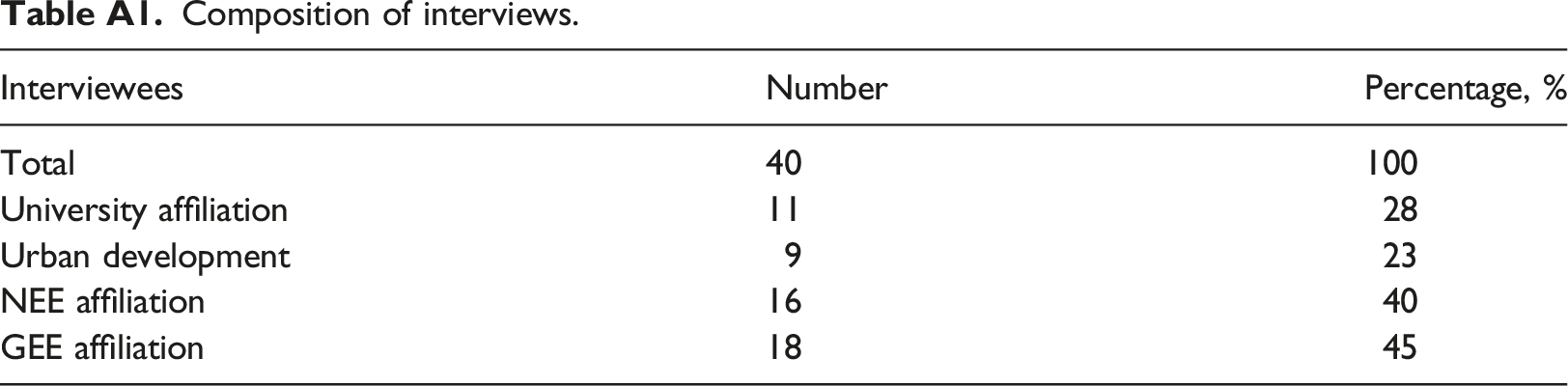
Interviewees
Number
Percentage, %
Total
40
100
University affiliation
11
28
Urban development
9
23
NEE affiliation
16
40
GEE affiliation
18
45