




Abstract
Accounts of neoliberalism have noted, but not fully explored, the neoliberal empowerment of corporations. The corporate power literature, similarly, rarely makes the connection between corporate agents and neoliberalism as a power structure. This article fills the gap between these literatures with a dual contribution. It develops these contributions by first reviewing the neoliberalism literature and in so doing, developing the idea of neoliberalism as a bricolage of practice and ideas. It then discusses the mischaracterization of the corporation within neoliberalism before deconstructing four core policy areas of neoliberalism – deregulation, non-intervention, free markets and free trade. In each policy area it is shown how the practice of these policies has enhanced the social and economic power of major corporations – thereby deepening practice-based accounts of neoliberalism – and how the discourse of these policies has empowered corporations in the political arena – thereby deepening the corporate power literature’s account of how corporations operate powerfully. More generally this article offers a much fuller account of how 40 years of ‘free market’ policies have resulted in the creation of oligopolistic corporate economies.
Introduction
There is a vast literature on neoliberalism concerning what it is, where it started, if it exists, its uneven geographic implementation, and the contradictions inherent in it, among many other concerns. As Dean (2014: 150) writes, neoliberalism has been used to ‘characterize everything from a particular brand of free-market political philosophy and a wide variety of innovations in public management to patterns and processes found in and across diverse political spaces and territories around the globe.’ The breadth and scope of the literature, and the differential understandings contained within it, is unsurprising given the term is used to broadly refer to both a group of closely-related ideas about how the state should act, and to fundamental changes in local, national and the global political economy/ies over the past 40 years.
In contrast, while a ‘hardy perennial of political science’ (Hindmoor and McGeechan, 2013: 834), business power has a much smaller body of recent literature, with Culpepper (2011: 185) arguing that ‘the study of business power is currently more neglected than it has been for the last half century’. As Bell (2012: 661) explains, debates about business power ‘did not wholly end but were deflected into wider debates about “globalisation” and related arguments about how the structures of global capitalism shape the capacities, resources and even the ideologies of actors.’ That said, the literature on business power has been growing in the aftermath of the global financial crisis, and several different approaches have started to become established. 1
However, while neoliberalism and corporate power are two of the most dominant politico-economic themes of the last 40 years, there is a gap between the literature on neoliberalism and the literature on corporate power. Within the literature on business power, neoliberalism is a backdrop that is often not considered worth mentioning; the focus is instead on what corporations do as individual actors, not the wider socio-economic system they find themselves in, or how these socio-economic circumstances empower/dis-empower individual corporations. The focus of this literature, then, is often too narrow to capture the impact of neoliberalism on corporate power. 2
With the literature on neoliberalism, as Cahill and Konings (2017: 98) note ‘corporations have at times somewhat faded from view’, often only making a brief appearance. When corporate power is considered, a thin account of instrumental power is offered as to how corporations have prospered in the neoliberal era. Crouch (2011: 47), for instance, writes that ‘political power and economic wealth are mutually convertible currencies.’ Harvey (2005: 77–78) similarly argues that ‘the boundary between the state and corporate power has become more and more porous. What remains of representative democracy is overwhelmed, if not totally though legally corrupted by money power.’ Such accounts not only ignore the long-standing literatures covering interest groups and business power, but also present an unsophisticated and monolithic take on corporate influence that renders lobbying and campaign contributions a black box process – where corporations put money in and get good results out – and that fails both to account for the diversity of corporate political action, and the policy losses that corporations do suffer (Dür et al., 2015).
Closing the gap between these literatures will be beneficial for both, and as such this article has a dual contribution built from an institutional political economy perspective. The first contribution is to the practice-based accounts of neoliberalism (or ‘actually-existing neoliberalism’) that, while offering a much richer understanding of neoliberalism still needs a deeper understanding of the interaction between corporations and neoliberalism. As this article charts, the realization of corporate interests through the neoliberal period has seen corporations given much greater scope for their actions, has facilitated (further) risk-shifting from corporations to society, has seen the roll back on restrictions on corporate size (which has facilitated oligopoly), and has provided a legal framework that has allowed the global expansion of sales of corporations, the establishment of a corporate-dominated digital economy, and the arms-length exploitation of foreign workers. The second contribution is to the corporate power literature. This article explains how neoliberal ideas can both be used by corporations (and paid-for allies such as thinktanks and astroturf groups), and can work for the benefit of corporations without their active involvement. In the former case, corporations would be deploying agential discursive power, in the latter corporations would be relying on structural discursive power (Hathaway, 2016).
To substantiate these contributions, this article begins with a discussion of the literature on neoliberalism, showing neoliberalism to be a bricolage of ideas and practices rather than a coherent whole. It then briefly lays out what a corporation is, and how it is misunderstood within (neo)liberalism. The bulk of the article then considers key elements of neoliberalism – deregulation, non-intervention, the free market, and free trade – and outlines how the practice of neoliberalism in these areas has created a politico-economic reality of corporate dominance and how the discourse around these areas offers corporations ready-made reality-distorting ideas that they can actively deploy to realize their interests. 3
It is worth noting at this point, however, that the argument presented here should not be read as saying that corporations have always and totally realized their interests in the neoliberal period when it comes to policy fights. This point is contradicted by a good body of evidence provided by interest group studies and business power literature (Bell and Hindmoor, 2014; Dür et al., 2015), which shows corporations losing policy battles – tobacco being an obvious example. Instead, the argument made here is that neoliberal practice has increased the power of corporations to directly influence society outside of the political arena, and that neoliberal ideas have put corporations in a privileged discursive position so that they realize their interests more than they would have otherwise inside the political arena.
Neoliberalism
Due to the breadth of the literature, neoliberalism as a term has somewhat become ‘an oft-invoked but ill-defined concept in the social sciences’ (Mudge, 2008: 703). Venugopal (2015: 165) goes as far to say that neoliberalism is ‘a deeply problematic and incoherent term that has multiple and contradictory meanings’. There is a degree of truth to these criticisms, and in many ways ‘neoliberalism’ as a critical term is a victim of its own success – the broad adoption of the term across disciplines has led to much looser definitions being used. However, while its definition is difficult, ‘neoliberalism’ still retains meaning. The difficulty in defining neoliberalism lies in part with the uneven geographic roll out of neoliberalism, in part with the differing ways in which political elites have sought to reconcile neoliberal ideas with prevailing electoral sentiments and with inherited political structures, but primarily due to the inherent contradictions of the neoliberal project.
The slipperiness and contradictions of neoliberalism has been reflected in the practice-informed accounts of ‘actually-existing neoliberalism’ (Hardin, 2014: 210). Foundational to this practice-based literature is a critique of what has been termed the idealist, or ideational, view of neoliberalism. In its ideational form, neoliberalism can be summed as a faith in market provision and a lack of faith in state provision. Intellectually, it relies on a (odd) mixture of neoclassical and Austrian economic thought, and the widely-promoted view of economics as a scientific, technical and value-free discipline (Chang, 2010: 32). Rhetorically, it is advanced through claims to freedom and liberty – that the freer the market, the freer the society. In the hands of its most skilled rhetoricians, neoliberalism becomes synonymous with freedom of the individual, cosmopolitan globalism, and a dynamic meritocratic society. These ideas have successfully been advanced around the world, and now neoliberal concepts represent ‘the ruling ideas of the time’ (Harvey, 2005: 36).
In terms of stated policy goals on a national level, neoliberalism has advanced deregulation, non-intervention, privatization, lower taxes, and a reduction in the size of the state. These policies have been implemented around the world, starting first in Chile under Pinochet and garnering more attention when they were applied to the UK and USA under Thatcher and Reagan respectively – with these two latter countries often considered as being the most neoliberalized states around the world (Connell and Dados, 2014: 122). In addition, on an international level the neoliberal agenda has been forwarded through the promotion of greater interconnectedness through trade facilitated by a reduction of barriers to trade. It is these policy areas – deregulation, non-intervention, privatization, lower taxes, smaller states, and free trade – that can be seen as a definitive core of neoliberalism.
However, the ideational view of neoliberalism has, and the discourse around these core polices have, been deeply misleading for both proponents and critics alike, as Cahill (2014: viii) writes Many commentators mistakenly believed the capitalist world economy had come to resemble the free market, small government laissez-faire vision of such neoliberal thinkers and think tanks … . Such an understanding reflects an idealist, or ideas-centred, conception of reality … [that offers] an unhelpful portrayal of the dynamics of neoliberalism in practice.
Even when ideas-centred scholars have not been seduced by the rhetoric of neoliberalism, their accounts have paid insufficient attention to the translation and implementation of neoliberal ideas. For example, in the work of Mirowski (2013) – the foremost historian of neoliberal thought – ideas were generated in the ‘neoliberal thought collective’ (which had the Mont Pelerin Society at its core) and then transmitted down into society. The relationship presented is hierarchical and works with an implicit assumption that the author of an idea maintains some control over the idea as it spreads out into society. Such an account underplays the significance, or even possibility, of interest-based transformation of ideas during the process of translation of ideas into practice, and the subsequent capability of this transformation of practice to inform later understandings of an idea: that is to say, that while ideas influence practice, practice also influences ideas, and powerful interests within society will work to influence both.
Neoliberalism in practice, then, is an entirely different beast to how it is portrayed. This point is not new, and there have been various responses to neoliberalism’s contradictory character. Gill (1995: 405) uses the term ‘oligopolistic neoliberalism’, which for him involves ‘oligopoly and protection for the strong and a socialisation of their risks, market discipline for the weak.’ Similarly, more recently Bruff (2017) has termed it ‘authoritarian neoliberalism’, which is about the ‘about the coercive, non-democratic and unequal reorganization of societies’.
These understandings of the contradictory character of neoliberalism are grappling with the central problem of neoliberalism, which is that between its discourse and its practice, as Peck (2010: 65) notes, ‘it can live neither with, nor without, the state.’ The core contradiction of neoliberalism is that its project of removing the state from the economic sphere is simply impossible, because the economic sphere is created by the state. The state creates the market through, for example, the provision of private property rights, of company law, and of contract law, and through using the coercive power of the state to enforce such rights and laws.
This point is generally societally obscured due to the dominance of neoclassical economic thought, which operates with an idea that the market is natural and eternal (Chang, 2002). Neoliberal practitioners have echoed this naturalist view of the market, holding to ‘the idea that the market has a nature of its own, has its own laws and mechanisms, and constitutes an autonomous reality which left to its own has the capability to provide for the wellbeing of its people’ (Zuidhof, 2014: 161). Yet, at the same time, neoliberalism has been about the construction of markets; alongside market naturalistic rhetoric, there is competing practical logic of market constructivism. Neoliberal market constructivism is about the extension of the economic sphere and the imposition of a ‘market logic’ to a greater range of activities. As Zuidhof (2014: 162–163) notes, neoliberalism ‘turns the market into a norm for government action, dictating market-like forms of government … [whereby] social problems are best governed by creating markets or market-like institutions.’ Hence, traditionally non-economic institutions – such as prisons, schools, and even the military – have faced privatization, outsourcing, and the attempted creation of quasi-market structures during the neoliberal period (Schnyder and Siems, 2013).
There is thus a dual approach to markets whereby intellectually and rhetorically a naturalist view prevails, while practically markets are being constructed. The power of this layered thinking between rhetoric and practice is that it shuts down debate within society about political economy, about market institutional arrangements, and about a whole range of basic yet important questions such as ‘what is a market?’, ‘what is competition?’ ‘where does the economic sphere end?’, while society is transformed. If it was recognized that a market can take a variety of institutional forms, then the market constructivist logic is revealed and ‘there is no alternative’ collapses. In such a situation the neoliberal project of ‘depoliticization through economization’ (Madra and Adaman, 2014) would fail.
Neoliberalism, then, is at first glance easily-recognizable, with a clear set of core policies. However, the central contradiction of neoliberalism’s relationship to the state, the impossibility of a free market, and its dual constructivist-naturalist understanding of the market reveals neoliberalism more as a bricolage of ideas and practices (Ferguson, 2010: 183), rather than a unified, coherent and consistent political ideology that informs a uniform set of practices which can be rolled out across the world to produce cookie-cutter neoliberal states. As is demonstrated below within this bricolage of practices and ideas the general construction of neoliberal regimes, and the practice of neoliberal global governance, has empowered corporations.
The corporation in capitalism
As with neoliberal thought failing to give a detailed account of markets and competition, it too fails to give an account of the corporation that has any depth. In fairness, the corporation has been misunderstood by liberal theorists for a long time. As Ciepley (2013: 139–140) argues One of the signal projects of nineteenth-century American liberalism was to sharpen the distinction between public and private and divide the social world between them. Business corporations were placed on the private side of this divide, assimilated to liberalism as private partnerships and, in some contexts, even as private persons. Corporate power that was once unaccountable because of state regulatory weakness now became unaccountable as a point of legal doctrine, as corporations came to be viewed ever more thoroughly through the lens of private contract. At the terminus of this development stands the neoliberal theory of the corporation, which, as a prophylactic against the possibility that corporate power might invite ‘totalitarian’ intervention in the economy, presented the corporation as nothing more than a ‘nexus of contracts’ among private individuals. The corporation became a pure creature of the market rather than a creature of government, exempting it from any duty to the public, or accountability to the public, or even publicity to the public, and rendering it eligible for a raft of constitutional rights, including electioneering rights.
Unavoidably, the modern business corporation owes permanent debts to the legal framework from which it is birthed. Many elements of the framework go back thousands of years, but the final elements that defined and have allowed the modern business corporation can be dated to around 150–200 years ago. In particular, in British law the Companies Acts 1844–62 granted corporations limited liability, made the process of creating a corporation an act of simple registration, and worked to further establish the corporation as an entity that is fundamentally separate from its members (for a detailed account of this process see Ireland, 1996).
The long process of creating the modern business corporation resulted in an economic institution that offers a collective form of ownership of the means of production, a socialization of debt in the case of bankruptcy, and the mass pooling of capital, and to which rentiers are attached through shareholding. The implicit social purpose of the business corporation was to undertake large scale and high-risk ventures, hence the historical coincidence of the business corporation’s legal form and the mass expansion of railways, with railway company shares being foundational to the development of stock markets.
The fundamental change that the corporation wrought on capitalism was recognized early on by Marx(1991 [1894]: 567) who wrote that the corporation could represent the abolition of the capitalist mode of production within the capitalist mode of production itself … It establishes a monopoly in certain spheres and thereby requires state interference. It reproduces a new financial aristocracy, a new variety of parasites in the shape of promoters, speculators and simply nominal directors; a whole system of swindling and cheating by means of corporation promotion, stock issuance, and stock speculation. It is private production without the control of private property. The modern multidivisional corporation is thus a far cry from the Marshallian firm in both its vision and its strength. The Marshallian capitalist ruled his factory from an office on the second floor. At the turn of the century, the president of a large national corporation was lodged in a higher building, say on the seventh floor, with wider perspectives and greater power. In the giant corporation of today, managers rule from the top of skyscrapers; on a clear day, they can almost see the world.
What this means is that individual corporations cannot take it for granted that their particular interests will be realized, even while their fundamental interests (and very existence) are rarely subject to challenge. As such, as groups and on their own, corporations have worked extensively to influence the political arena. In the US since the 1970s the money spent on lobbying and campaign contributions by corporations has ballooned, making it now a multi-billion-dollar industry. Brussels, too, is the location of a multi-billion-euro lobbying industry. Corporations have also funded thinktanks to forward pro-corporate ideas, founded fake grassroots ‘astroturf’ groups, funded their own research to combat public scientific research, ghostwritten scientific papers (McHenry, 2018), encouraged their own employees to go through the revolving door between business and government, hired people coming through the revolving door, and used a variety of means to disseminate favourable messages in the news media.
While corporations were powerful before neoliberalism, neoliberalism has undoubtedly expanded their power from the pre-neoliberal period – the largest corporations have been more able to realize their interests (be that continuing to sell a carcinogenic chemical, to create risky financial derivatives, to chop down the rainforest, or to sell personal data) at the expense of other societal actors than previously. As the following sections on deregulation, free markets, non-intervention, and free trade show, the practice of neoliberalism has been to create the conditions for corporations to grow larger and have a greater global reach – thereby increasing their social and economic power – alongside easing corporate policy fights through placing corporations in a privileged discursive position whereby they have greater political power.
Deregulation
Deregulation has been a central plank of neoliberal discourse. Around the world, deregulation has been promoted domestically by political elites and internationally through conditionalities attached to IMF and World Bank loans. It has been applied to a diverse array of markets, with the general focus being on the industries considered most infrastructurally important, such as energy, finance, and transportation. The reasoning underlying the push for deregulation is, as Anderson (1999: 5) writes, the ‘efficient use of resources, human freedom in open competitive markets, consumer benefit and expanded choice’ – deregulation is intended to give the market mechanism the necessary space to operate and so to allow it to reach its natural equilibrium point.
However, the central problem of ‘deregulation’ is that it is impossible as a government cannot judge itself to have no judgement on an issue it has considered – a rewriting of the rules is not the same as an erasure of rules. As Samuels and Shaffer (1982: 464) argue if by deregulation it is meant the elimination of regulation per se, then, because deregulation means the substitution of a new regulatory arrangement for the old one, ‘deregulation’ is impossible … [hence] the question is not ‘to regulate or not to regulate (deregulate)’, but ‘which regulation? markets need rules not only to protect people and the environment from collateral damage, but also to function effectively in the first place. Our real-world choices therefore hinge not on whether markets should be governed, but on how they should be governed.
So, neoliberalism has involved reregulating while claiming deregulation. However, the nature of the reregulation has been to support corporate interests generally. Environmental, health, and consumer protection laws that impose costs on corporations have been opposed by politicians who seek to ‘free the wealth creators’, while other regulations that support corporate profitability concerning, for example, bankruptcy law, data trading or corporate confidentiality are left alone or even expanded.
A significant example of the extension of pro-corporate law in the neoliberal period is the Digital Millennium Copyright Act (DMCA) of 1998, which has been copied around the world and laid the groundwork for many features of the contemporary (corporate-dominated) digital economy. Created and lobbied for by the software, music and film industries (see Chipman, 2018; Imfeld and Ekstrand, 2005 for lobbying histories of the DMCA) the DMCA facilitated the internet moving from being a ‘lost cause’ for the music industry (according to a music industry executive, as quoted in Imfeld and Ekstrand, 2005: 292) to the music industry’s main source of revenue. In part, it did this by beefing up penalties for copyright violations (which moved to fines of up to $1m and jail time of up to 10 years), but it also extended the rights of copyright holders through Section 1201. Section 1201 criminalized the act of bypassing digital restrictions and prohibited the sale or transmission of digital or physical tools that are capable of bypassing digital restrictions (even if the protected content is not subject to copyright).
The principles of Section 1201 effectively meant an owner of device with digital restrictions is not legally allowed to modify the device and/or look at the underlying copyrighted source code. 7 Over time, this has meant, for example, that modifying an iPod to play legally-purchased (i.e. copyright-compliant) non-iTunes songs is illegal, that selling, buying or installing a modchip that allows a games console to play (legally-purchased) games from other countries are all illegal, and that examining, or undertaking research on, software code behind a digital lock (such as software installed on a car, a refrigerator or an air-conditioner) would be illegal unless specifically exempted (Benon, 2019; Lipton, 2005).
Furthermore, the DMCA modified the law so that internet service providers and content hosters were not liable for copyright-violating material on their servers. So long as they took down material and passed on information as to the copyright-violating user when requested by the copyright holder, the DMCA made them non-liable for user content stored on, and distributed from, their servers. Without this ‘safe harbour’ provision, the business model that developed of the now major online corporations (Facebook, Twitter, YouTube, Google, etc.) would be non-viable as they would be liable for the mass violation of copyrighted material uploaded by their users.
Such pro-corporate regulations have the possibility of winning through in the political arena because there is a fundamental unevenness in the neoliberal idea of regulation. Implicitly, ‘regulation’ is understood as restrictions on (major, established) business activity, but regulatory restrictions on other elements of society (as with the DMCA) are not included. So, for instance, labour unions have been targets of neoliberal regulation, with increasingly draconian restrictions on the rights of workers to collectively organize and negotiate the terms of their employment. Similarly, regulation of the activities of the unemployed has increased through programs such as workfare, which has replaced a right-based system of welfare with a welfare system contingent on work (Peck, 2001). The benefit sanction regime in the UK, which requires unemployed people to look for work 35 hours a week or face a withdrawal of benefits for up to 3 years (Watts et al., 2014), is a prime example of how neoliberalism has actually extended regulation in areas that do not fit with the neoliberal definition of regulation.
Neoliberal regulation in the form of the weakening of unions, the promotion of labour market ‘flexibility’, and the movement to an increasingly punitive welfare system has allowed the proliferation of insecure, poorly-remunerated work (Zwick, 2018). As a consequence of new technology combined with the neoliberal regime for industrial relations, the ‘gig economy’ has grown substantially in recent years – between 2005 and 2015 the share of the US workforce in the gig economy rose from 10.1 per cent to 15.8 per cent (Istrate and Harris, 2017). The profitability/viability of companies such as Uber, Amazon and Deliveroo is reliant upon hugely exploitative contractual arrangements with their workers that requires few commitments from the companies and which would not have been possible prior to neoliberal regulation and reregulation.
Beyond this structural reorganization of society in favour of corporations, deregulation as a wider idea has given corporations a discursive weapon that they can deploy. In the neoliberal discursive environment ‘cutting red tape’ is a panacea and can work in this manner because it avoids the actual details of what rules society wants. Instead, the discourse casts all rules as inefficient restrictions on dynamic market forces that, if unleashed, could drive down costs. The construction of this discourse allows the argument that regulations hurt consumers, by seeing them face costs they would not in a deregulated environment.
Likewise, the extension of regulations that corporations disapprove of can be readily opposed with a rallying cry of ‘regulatory overreach’ (possibly by a tyrannical government, if you go do the more extreme end of the discourse (see Rugy, 2018, for example)). For example, Uber and Lyft are currently lobbying around the world for the ‘deregulation’ of local taxi markets (Borkholder et al., 2018). This push has been given broader intellectual weight by the normal low-transparency pro-corporate thinktanks adding their support – the Institute for Economic Affairs (Niemietz, 2016), the Heritage Foundation (Snead, 2015) and the Adam Smith Institute (2014), for example. In fact, these thinktanks are essentially recycling the standard deregulatory discourse from 40 years ago; Feeney (2015), working for the Cato Foundation, writes that: Sharing economy competitors deserve the chance to compete, and regulators can help them do this by deregulating the industries the sharing economy is disrupting. The forces of a free market, not regulatory bodies, should decide which providers survive and which ones fail.
Non-intervention
Linked to the notion of deregulation is the more general idea of non-intervention by the state into the market. In Milton Friedman’s (1955) words, states should work to remove the ‘dead hand of government and to give maximum scope to the invisible hand of self-interest’, or as Ronald Reagan said ‘government isn’t the solution to the problem, government is the problem’. Deregulation is clearly part of non-intervention, but non-intervention has also been extended much more widely. It has been promoted on the grounds that a free market, ‘invisible hand’ system naturally moves toward/never departs from equilibrium – that, absent government interference creating perverse incentives, welfare-maximizing individuals will, through their impersonal market relations, balance supply and demand and cause markets to clear.
8
Hence, in the neoliberal imagination, the Great Depression was not evidence of market malfunction or contradictions in capitalism but was caused by government, with Ben Bernanke (2002) while speaking at Milton Friedman’s ninetieth birthday, apologizing on behalf of the Federal Reserve by saying I would like to say to Milton and Anna [Schwartz]: Regarding the Great Depression. You’re right, we did it. We’re very sorry. But thanks to you, we won’t do it again. A self-regulating market demands nothing less than the institutional separation of society into an economic and a political sphere. Such a dichotomy is, in effect, merely the restatement, from the point of view of society as a whole, of the existence of a self-regulating market.
Not only is non-intervention impossible, but neoliberal governments have also not retreated from the market, and instead continued and expanded various means of supporting corporations. Neoliberal states have supported corporate profitability through various schemes involving subsidies, tax discounts, and other support for business. For instance, Mazzucato (2015) demonstrates the importance of state support, state funding, and state action for many recent technological innovations in the US, including the iPhone, the internet, and green technology. Similarly, Farnsworth (2015: 9) argues that in the UK government support of corporations totals £93 billion a year. Within this context, Farnsworth (2015: 4) writes Running counter to the dominant neoliberal rhetoric from the 1980s onwards that suggested that private businesses could be more competitive, more entrepreneurial, and more profitable if governments got out of the way (to paraphrase Ronald Reagan), the reality is that, throughout this period, every Western government intervened heavily to support private businesses just as they have throughout the period of modern capitalism. No major economy has ever left their businesses to truly ‘go it alone.’
In addition to the practical benefits of ‘non-intervention’ for corporate profitability, the discourse of non-intervention has been beneficial for corporations. Non-intervention works as corporate structural discursive power because, while they may preach non-intervention, states are not only unable, but are also unwilling, to fully release the tiller; non-intervention is often only a fair-weather purported principle. Even with a strict non-interventionist policy, a government still views itself (and voters in democratic states reinforce this view) as ultimately responsible for the state of the economy. When the economy does poorly, or faces a crisis, a ‘non-interventionist’ government will likely intervene.
This point was seen in the Global Financial Crisis. After letting Lehman Brothers fail, US politicians realized the threat of financial contagion and ‘nationalized some of the largest financial institutions in the world, socialized financial market risks and pumped huge amounts of public money into the economy’ (Saad-Filho, 2011: 242). This situation led to President Bush’s wonderfully tortured logic of bailing out the banks when he said ‘I have abandoned free market principles to save the free market system’ (CNN, 2008).
So, while the state has never practised non-intervention, the non-intervention that has been preached has been hugely beneficial for corporations – privatizing profits and socializes losses in the case of the banking industry. The discourse has also masked governments’ continued economic involvement in the form of the provision of corporate welfare, and has obscured the inequities that stem from the fair-weather application of the principle of non-intervention.
Free markets
While deregulation and non-intervention are negative values, in that they involve undoing and not doing, free markets represent a positive value – something that society should strive towards and protect. Hayek (1945) argued that free markets, unlike centrally controlled ones, were more efficient because through the pricing mechanism they can utilize a much greater amount of knowledge. A more popular reason given for desiring a free market is that a free market is one where, unlike with monopolies, constant competition leaves businesses at the mercy of consumers, thereby meaning businesses treat the consumer as king. Friedman (1962: 15) further gilds the idea by tying it to democracy, saying that a free market ‘is, in political terms, a system of proportional representation. Each man can vote, as it were, for the color of the tie he wants and get it.’
While the rhetorical presentation of neoliberalism in political arenas has been pro-competition, it is a form of competition that has departed radically from previous conceptions of competition, in that neoliberal competition theory (as developed by Mont Pelerin Society members) allows monopoly. The required intellectual shift within liberal thought, and the squaring of the argument, relied heavily on an exhortation as to the power of competition to undermine monopoly. As Van Horn (2009: 220) writes ‘Classical liberals had suggested … that monopoly suppressed competition. [Aaron] Director and [Milton] Friedman turned this distinction on its head, asserting that competition eventually suppressed monopoly.’
These ideas would later be developed further and then worked into the legal arena through the Chicago School of Law and Economics, and through the work of Bork and Posner. The influence of neoliberal competition theory led to anti-trust law being reinterpreted in the US, which then has had influence around the world. Previously, high-profits and large market share were seen as legally problematic from an anti-trust perspective. However, Chicagoans worked to remould the legal understanding of ‘competition’ through using arguments based on neoclassical economics. Instead of competition being a situation of low barriers to market entry and a large number of firms actively contesting a market, the Chicagoans argued that ‘“competition” for purposes of anti-trust analysis, must be understood as a term of art signifying any state of affairs in which consumer welfare cannot be increased by judicial decree’ (Bork, 1978: 51). Market size, profits, or actual evidence that ‘proved an intention to distort competition, reduce choice, crowd out competitors or interfere with the price-setting function of the market’ (Davies, 2014b: 95) would no longer be the main gauges of anticompetitive behaviour, instead neoclassical economic analysis of consumer welfare became the sole arbiter.
Consumer welfare, the argument was advanced, could be maximized through efficiency (which was assumed to lead to lower prices), and efficient businesses could well be monopolies or oligopolies (Davies, 2014: 95–99). Thus, an oligopoly can be competitive because it is efficient in maximizing consumer welfare. In this manner, the circle was squared and, as the popularity of Chicagoan work and the seniority of Chicagoan students increased, the effectiveness of anti-trust law as a check on oligopoly was eroded (Lynn, 2010).
So, while in 1962 the US Supreme Court rejected a merger between two companies that would have seen the merged company control ‘7.2 percent of the nation’s retail shoe stores and 2.3 percent of the nation’s total retail shoe outlets’ (Skitol and Vorrasi, 2011), now in the US the two largest brewers have a 65.9% market share (America’s Beer Distributors, 2018) and Walmart ‘delivers at least 30 percent, and sometimes more than 50 percent, of the entire U.S. consumption of products ranging from soaps and detergents to compact discs and pet food’ (Lynn, 2010: 6), while globally ‘all the world’s major industrialized sectors are controlled by five corporations at most, and 28 per cent have one corporation accounting for more than 40 per cent of global sales’ (Elbra and Mikler, 2017: 183). The increased degree of market concentration has even been recognized by Goldman Sachs (Jarsulic et al., 2016: 4), which advised clients to invest in the major players in oligopolistic markets.
Greater market concentration facilitates ever more aggressive practices that undermine competitive markets. Amazon is a particularly egregious example. It now controls ‘46% of all e-commerce in the United States. Not only is it the fastest-growing major retailer, but it is also growing faster than e-commerce as a whole’ (Khan, 2017: 755). As Figure 1 shows, Amazon has achieved its growth primarily by not making a profit. Instead, through sucking up investor finance, Amazon could keep product prices low while creating its own distribution networks and market platforms. The quick and cheap distribution and low prices attracted consumers, which then attracted businesses to Amazon as a market platform, thereby co-opting competitors and further cementing Amazon’s place.
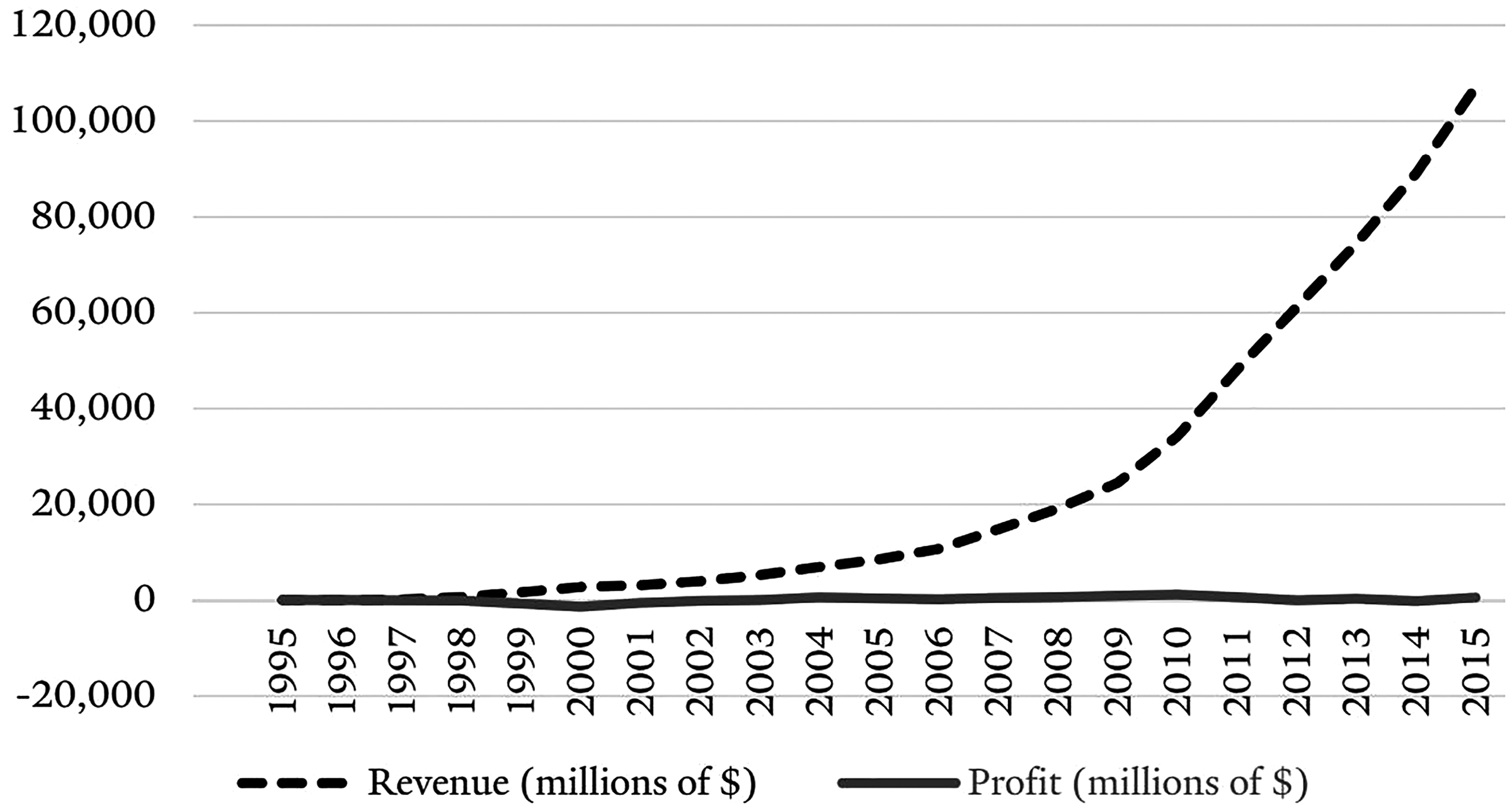
Amazon’s profit and revenue. Adapted from Khan (2017: 748).
At the same time as the practice of neoliberalism was eroding choice through allowing the growth of oligopolistic corporations, rhetorically the discourse of free markets and consumer choice was performing two important functions for corporations. First, by discussing the ‘market’ as an abstract, disembodied and geographically-diffuse place of economic exchange, a vision of the economic system is advanced that clashes with, and overwrites, the supermarket, chain store, clone town reality of everyday economic exchange. The supply-and-demand-sets-prices neoclassical ‘perfectly competitive’ market that neoliberalism invokes is based on having many small suppliers and so leaves little space for the major oligopolistic corporation or the global industrial system. As such, the discourse actively denies an understanding of economics based on real world experience of the corporate economy, effectively erasing the role of transnational corporate behemoths in the global economy through a structural discursive concealment.
This concealment of the corporation by the discourse of the market is so effective that neoliberal politicians have been able to institutionalize corporate managerial practice in public services under a banner of ‘market competition’. That is to say, the power of the discourse is such that the practices of industrial-scale corporate bureaucracies have been able to be seen as one and the same as ‘market practice’, despite the major corporation being a replacement for the market as a method of economic co-ordination. 9 This point is under-recognized societally and generally in the academic literature, with Knafo et al. (2019: 237) recently noting, whilst arguing against this reading, that ‘the political economy literature has often read managerialism as a means to pursue neoliberal goals, namely to promote and consolidate markets.’
Second, by presenting a vision of consumer-as-king, neoliberal discourse removes agency – and moral accountability – from corporations. If consumer demands are what drives the market, then corporate decisions are consumer decisions – if the market system is democratic, then the results of the market system are due to voter preference. Politics is unnecessary in this situation, for if consumers want clean air, ethically-produced food, independent shops, good conditions for manufacturing workers, etc. then they simply have to purchase goods that reflect these values and the market will adapt. Equally, if they don’t purchase these things, it is evidence that they do not care about these values (even if they are unable to purchase such things). This discourse has been used in various lobbying pushes by corporations. Recently, for example, a purportedly grassroots organization called the ‘Consumer Choice Center’ 10 sought to ‘mobilize millennials against what its founders argue is the overburdensome regulation that limits choice’ (Corporate Europe Observatory, 2017) and went lobbying in the US, Canada, Brazil and the EU on a range of issues such as for diesel cars, against advertising restrictions, and for the continued use of glyphosate.
The fight against neoliberalism in practice, then, is not the fight against free markets but against oligopoly and corporate power in the economy. However, the characterization of the economy as a ‘free market’ limits the extent to which oligopoly is seen, presents a barrier to understanding the nature of the global industrial system, and provides corporations with a very effective (and increasingly internalized by citizens) narrative about consumer, rather than corporate, power.
Free trade
As neoliberalism has transformed domestic political economies, so too has it sought to transform the international. The central discourse on the international level has been free trade, whereby domestic barriers to trade should be removed so that companies and individuals are able to operate across borders without restriction so that international economic efficiency can be improved. As with the other areas there is again a hollow ring of truth to the discourse that has been deployed. Tariffs around the world have substantially decreased, global trade has massively increased and trade interlinkages continue to multiply.
Yet, tariffs and protection remain parts of the world economy. For example, the US, a lead exporter of free trade rhetoric, collects $33 billion annually from tariffs and spends $25 billion annually providing subsidies to its agricultural sector to help protect it from competition. Trade negotiations are ultimately situations of horse-trading, unequal power relations and national interest, rather than about countries pursuing an even and fair global trade structure. Reflecting this point, Lowi (2001: 137) wrote ‘if free trade were the only goal, the policy would be the easiest thing in the world to draft and implement … establishing free trade … could have been written on one page – a simple treaty to eliminate tariffs.’
As time has progressed, not only have national interests resulted in an uneven global trade structure but the trade agenda has been significantly expanded beyond tariffs and now often encroaches on areas most consider outside the remit of trade rules. As such, and in opposition to what Lowi suggests, trade agreements are long, complex and complicated. The North American Free Trade Agreement, for instance, was 1700 pages long. More recently, in 2016, the Trans-Pacific Partnership (TPP) agreement was reportedly 5600 pages long (Busch and Pelc, 2016). Instead of free trade constituting a simple system of no tariffs or the removal of the state from the international economy, an increasingly complex and uneven regime of global economic governance has been instituted.
The complexity of this regime has increased as the idea of barriers to trade has been extended from tariffs to include regulations, with the goal being that business can trade in different markets without having to alter their products or packaging for local regulatory standards – so-called regulatory harmonization. Within this understanding of free trade, differences in regulations are cast as a form of non-tariff barrier, rather than as a national variance in the democratic expression of societal values. These regulatory issues have become increasingly prominent in trade deals; as in the abortive Transatlantic Trade and Investment Partnership (TTIP) where regulatory harmonization was meant to account for two thirds of economic gains (De Ville and Siles-Brügge, 2017: 3). In this manner, free trade has increasingly become an international re-regulatory discourse used to shape the global governance regime against non-business/non-economic values as expressed in national regulations, to the benefit of economic actors.
In addition, trade agreements have often worked to legally secure new rights for corporations. For example, the establishment of the World Trade Organisation saw the institution of intellectual property rights on the international stage through the agreement on Trade-Related Aspects on Intellectual Property Rights (TRIPS), which was a hugely profitable move for (Western) corporations. In fact, the inclusion of intellectual property rights in the WTO was itself a product of lobbying by a small group of pharmaceutical, software and entertainment corporations (Sell, 2003). As the disquiet of developing countries with the WTO regime has grown, and negotiations over the further extension of WTO rules has stalled, intellectual property rights have been further extended through the EU and US pushing for the inclusion of ‘TRIPS-plus’ provisions in bilateral trade agreements, which include the institution of DMCA-style anti-circumvention provisions (May, 2015).
Similarly, there have repeated (but often failed) attempts through new trade agreements (in the form of the Multilateral Agreement on Investment, TTIP and TPP) to extend corporate rights. In particular, these treaties have sought to introduce investor-state dispute settlement mechanisms, which could allow corporations to sue governments for regulatory changes that effect their current and future profitability, thereby have a chilling effect on national efforts to tame corporate control or promote public values. Stiglitz (2019: 79) notes how trade provisions have increased rights, writing that An American investor putting his money into Mexico or some other country covered by similar provisions is more protected [than in the US]: not only can’t the foreign government take away his property without compensating him, but it also can’t even change a regulation.
More recently, ‘free trade’ has facilitated the ‘disintegration’ of many corporations. In developed countries, reversing a previous trend in the manner by which corporations worked, corporations have shed as many stable and well-remunerated jobs as they could, both through offshoring and through outsourcing (Weil, 2014). What corporations have kept is design and marketing, reflecting their focus on (and newly extended legal right to) controlling intellectual property. 11 In developing countries, corporations have built extensive, and disposable, outsourced supply chains. So, for example, while Apple itself owns no factories, the iPhone 6’s components were made by ‘785 suppliers in 31 countries’ (Ruggie, 2017: 3). As well as being cheaper than using domestic labour, the removed nature of these supply chains gives the corporations using them plausible deniability for poor labour standards, pollution and low wages at their suppliers’ factories.
Finally, corporations have also benefitted from the uneven construction of free trade – they benefit not just from the rules adopted, but also where rules have not been adopted. So, while there is a solid framework of global intellectual property rules there are not equivalents on tax collection, labour rights, or environmental protections. With tax, for instance, the lack of central regulatory authority has allowed corporations to create stateless profits through creative accounting. For example, Google’s creative accounting saw it engage in a ‘double Irish Dutch sandwich’ where profits were moved first to Ireland, then to the Netherlands, and then back to Ireland in order to reduce their tax liabilities (Zucman, 2014: 124). In fact, Ireland has actively courted corporate tax avoidance, with the Irish government even fighting against the European Commission’s ruling that Apple owed it €13bn (Associated Press, 2016).
This issue has particularly been exacerbated by the active collusion of powerful states. The UK is one of the worst offenders, reflected in the fact that 14% of the total money that ends up in tax havens being routed through it, and reflected in tax havens such as the Cayman Islands, Bermuda and the British Virgin Islands being British Overseas territories (Garcia-Bernardo et al., 2017). This situation of powerful countries creating non-regulated space has resulted in vast sums of capital being able to escape taxation, with global annual revenues lost to corporate tax avoidance being estimated at $240 billion (Elbra and Mikler, 2017: 181).
Free trade, then, works powerfully as a discourse to provide a story of a simple and fair international trade system, rather than a complex and corporate-dominated one, again working as structural discursive power for corporations. Moreover, working as a narrative that denies the need for rules, free trade smothers substantive debate about the rules that have been adopted and the distributional consequences of those rules – allowing the enhancement of the legal and material position of corporations to the extent of facilitating a new form of corporate organization.
This discourse is even more effective, deceptive and subtle when presented as globalization, rather than specifically free trade (although the terms are often elided). Globalization has painted the deliberate construction of a corporate-dominated global order as an unavoidable phenomenon, which prevents a deeper reflection on the values that the global economic order should/could espouse and the policies that can realize those values. Indeed, in 2000 Bill Clinton sought to depoliticize changes at the global level to the extent of calling them natural, saying that ‘globalization is not something we can hold off or turn off … it is the economic equivalent of a force of nature – like wind or water’ (as quoted in Ziai, 2015: 113).
Conclusion
Neoliberalism is a contested concept, primarily due to the fact that neoliberalism has necessarily worked as a bricolage of assorted ideas and practices in different countries with varied political traditions. Despite variation and uncertainty with what counts as neoliberalism, there are a core of closely-related general policies that are fundamental to what neoliberalism is. But these policies are based on a reading of the world – and of corporations – that is not supported by reality. This results in a fundamental fracture between the practice of neoliberalism and the ideas of neoliberalism. All too often, critics of neoliberalism have been distracted by neoliberal ideas, and failed to reflect actually-existing neoliberalism.
Yet, even within the practice-based literature on neoliberalism corporations are insufficiently focused on. As such, the above account shows how corporations have: been given an expanded scope for their activities (even crossing the boundaries of what is traditionally considered the domain of the state), benefitted from tighter regulations on labour, continued to receive corporate welfare, profited from fair weather non-intervention, been allowed to grow to sizes previously considered anti-competitive, utilized new global trade rules to spread into new countries and new markets, have received enhanced rights domestically and in trade treaties, and more generally have benefitted from an uneven system of global rules.
Yet, the ideas of neoliberalism are still important, and insufficiently reflected upon in the literature on corporate power. With neoliberal ideas the political power of corporations has been increased as neoliberal discourse has provided a mask for reality – or, structural discursive power. This mask has been useful in attracting political actors to the corporate cause. Those that have accepted an oppositional binary between free market capitalism and government control have, thinking they are supporting the former, been strong advocates of corporate control. Because of the pervasiveness of the discourse neoliberalism works to promote corporate interests without corporations necessarily having to act through the crafting of a discursive terrain that benefits corporate interests.
When corporations do act, they are in an enhanced position in that they (and the various corporate-funded front groups) can cite red tape, consumer choice, free markets, and other well-worn discursive paths in seeking to agentially promote their interests as the general interest. With broad structural discursive empowerment, the traditionally-identified mechanisms of corporate power (lobbying, campaign contributions, etc.) that the business power literature focuses on are enhanced and the traditional mechanisms may not even need to be employed for major corporations to realize their interests.
Overall, then, neoliberalism has contributed in its practice and its ideas to the societal, economic and political power of corporations. Corporations were powerful prior to the neoliberal period, but the particular institutional constructions of neoliberalism around the world have again and again favoured increasing the size of corporations, increasing the scope of their activity, granting them new rights, allowing new forms of corporate organization and diminishing their responsibilities, all the while talking of freedom, consumer choice and a cosmopolitan global system. In this manner, neoliberalism has fundamentally worked in the interest of corporate power.
Footnotes
Acknowledgements
I would like to thank Stelios Moshonas, Egle Cesnulyte and Ingrid Harvold Kvangraven for their comments on earlier versions of this article. I also would like to thank the editor and anonymous reviewers of this article.
Declaration of Conflicting Interests
The author(s) declared no potential conflicts of interest with respect to the research, authorship, and/or publication of this article.
Funding
The author(s) received no financial support for the research, authorship, and/or publication of this article.
