



Abstract
Climate policy measures and the energy transition present challenges for unions beyond the traditional scope of collective bargaining and social dialogue. Union responses to policies to phase out internal combustion engines must simultaneously address climate, environmental and industrial policy issues, and influence decision-making within multinational corporations and the web of supply chain firms that participate in production. Studies point to the need for capacity building to enable unions to respond to these complex challenges. Nevertheless, the nature of the union ‘capacity’ to be mobilised in climate responses, and how this is developing in diverse institutional contexts, remains unclear. Building on Richard Hyman’s concept of ‘strategic capacity’, the article explores how different dimensions of union capacity are mobilised to respond to challenges posed by internal combustion engine phase-out policies. This article draws on a study that maps trade unions’ responses to such policies in the United Kingdom and two EU countries.
Introduction
Climate policy and the energy transition present challenges for unions that go beyond the traditional scope of collective bargaining and social dialogue. These challenges are particularly acute in internationally competitive sectors that are undergoing deep technological transformation, such as the automotive sector. Policies to phase out and ultimately ban the sale of new internal combustion engine vehicles (ICEVs) and to promote the uptake of electric vehicles (EVs) 1 have emerged as a key element of European governments’ approach to decarbonising the transport sector. In 2020, the European Commission introduced proposals to phase out petrol and diesel engine cars as part of the ‘Fit for 55’ legislative package, through a requirement that all cars sold in the EU be zero emission ‘at the tailpipe’ by 2035 (EU Regulation 2023/851). Prior to this, several European countries, including the United Kingdom and Spain, had unilaterally imposed internal combustion engine bans. Internal combustion engine phase-out policies entail the certain obsolescence of job roles, the transformation of work processes and skills requirements, and extensive supply chain restructuring. They may also present new opportunities for employment. The outcomes of the process for workers, regions and national industries are highly uncertain. The EV transition will also create new environmental and social pressures in areas such as resource extraction and access to affordable transport. Union responses must therefore simultaneously address environmental, industrial and transport policy and challenge decision-making authority within multinational corporations (MNCs) and the vast web of supply chain firms involved in production.
The growing complexity of industrial relations reflects long-term structural trends. In response to pressures from mobile capital and domestic neoliberal economic policies, unions in many countries have been driven to ‘relaunch themselves as “political subjects” [. . .] engaged not just in collective bargaining and workplace regulation, but also in the broader aggregation of political and social interests’ (Baccaro et al., 2003: 119). In the context of neoliberal globalisation, union power is increasingly reliant on institutional support, even in countries with traditions of grass-roots trade unionism (Baccaro et al., 2003). This political dynamic may be recognised in the burgeoning literature on workers and unions as actors in environmental and climate policy-making (Galgóczi, 2020; Kalt, 2022; Mildenberger, 2020; Snell and Fairbrother, 2010; Thomas and Doerflinger, 2020). Studies point to the need for organisational and institutional ‘capacity building’ to enable unions to respond to the complex challenge of decarbonisation (ETUC, 2019; Metta et al., 2022).
The kinds of union ‘capacity’ that are being mobilised in union climate responses, and the ways in which these capacities develop in concrete institutional contexts, however, remain underspecified and under-theorised. This article responds to this gap by building on Richard Hyman’s concept of union ‘strategic capacity’ to develop a richer conception of the kinds of capacities unions are deploying – and arguably need to deploy – if they are to be active agents in unfolding low-carbon transitions. We do so by exploring how unions in three European countries are mobilising in response to the strategic challenges posed by national and EU-level internal combustion engine phase-out policies.
The article contributes to the understanding of unions’ role as policy actors in climate and green industrial policy; to the theory and practice of union capacity building; and to the literature on union renewal. We show that, in responding to automotive climate policy, unions are seeking to expand their capabilities to anticipate and address decarbonisation risks, manage employment and industrial restructuring, and influence industrial and transport policy outcomes. Strategic action depends on forward-looking, holistic analysis of pathways and options; democratic processes that support the redefinition of collective interests and commitment; mechanisms for vertical coordination within unions and for multi-actor horizontal coordination; and network development and coalition-building. Internal tensions persist, linked to severe short-term employment effects at many sites, challenges faced by internal combustion engine firms in transitioning to EV production, and, increasingly, the threat of far-right anti-climate mobilisation. Section 2 draws on the existing literature to distil four such strategic challenges and then synthesises the state of knowledge concerning unions’ power resources and strategic capacities. The subsequent sections set out our methodology, describe the policy context, present the results of our country case studies, and provide a concluding discussion.
Union strategic capacity and the EV transition
Strategic challenges in the context of technology bans
The internal combustion engine vehicle phase-out presents new challenges for unions across environmental, industrial and transport policies, as well as industrial relations.
First, unions and workers within the automotive manufacturing sector face a divergent set of opportunities and risks during the transition (Hancké and Mathei, 2024). Internal combustion engine bans differ from other climate policies in that they are geared not towards the closure of entire sectors (such as coal) but towards extensive transformation in industries within the large ‘decarbonisable sector’ (Kupzok and Nahm, 2024). Workers at large ‘original equipment manufacturers’ (OEMs) face employment restructuring within and across sites, along with demands for training and reskilling for new products and processes. Powertrain electrification is less labour-intensive than internal combustion engine production, because EVs have fewer components, which could reduce overall employment (International Energy Agency [IEA], 2020). At the same time, many firms producing internal combustion engine-specific components face closure if they cannot reorient production to alternative technologies. Unions must mediate divergent worker preferences, responding to immediate employment impacts while pursuing strategies to secure the long-term development of the EV value chain (Hancké and Mathei, 2024).
Secondly, future employment in decarbonisation and digital transitions is shaped by the technological transformation of both products and production processes within companies. This puts pressure on workers and unions to position themselves as innovation actors, actively involved in decisions on products and production planning (Gnisa and Frey, 2024).
Thirdly, credible commitment to technological and industrial policy pathways is needed. Internal combustion engine phase-out policies are motivated by green industrial policy competition among existing and aspiring automotive exporters seeking to (re)orient their sectors towards the production of alternative transport technologies (Meckling and Nahm, 2019). For advanced industrialised states, ICEV bans are a form of political signalling in green industrial policy competition intended to attract investment in emerging technologies (Meckling and Nahm, 2019). The success of state announcements depends on the ‘signal credibility’ of policies: the capacity to commit unambiguously to a long-term programme that drives the roll-out of electromobility through climate and industrial policy, infrastructure expenditure, and workforce transitions (Meckling and Nahm, 2019). The state’s ability to ‘credibly commit’ to the technological pathway over time is crucial for driving investment (Brunner et al., 2012). The actions of unions and firms thus continue to matter throughout the long and challenging implementation period.
Fourthly, green industrial policy approaches may prioritise narrow industrial agendas over broad and balanced ‘eco-social’ policies (Mandelli, 2022). The scope of union responses matters because the distributional and environmental impacts of the automotive transition extend to the affordability, accessibility and environmental impact of transport systems. Do unions act narrowly in pursuit of sectoral interests or seek to secure broad class-based, social and environmental objectives?
Finally, the political character of the EV transition shapes unions’ strategic options. Fossil fuel phase-out policies are associated with elite politics and civil society mobilisation (Green, 2018). As elite-driven projects, internal combustion engine phase-out policies may lack a civil society coalition promoting the change. While many groups promote sustainable transport, the adoption of EVs as a technological solution to decarbonise transport has not been a focus of these campaigns, suggesting that ICEV bans are a climate policy without a broad social base. This has implications for union political and civil society coalition-building strategies regarding climate, employment and industrial policy objectives.
Theorising union capacity
Debates about union capacity and renewal have emerged in response to the need for unions to adapt internally to changing circumstances and to the shifting foundations of union power (Lévesque and Murray, 2010: 334). In response to the increasingly complex challenges facing unions, Hyman (2007) proposed the study of union ‘strategic capacity’, in other words ‘the ability to assess opportunities for intervention; to anticipate, rather than merely react to, changing circumstances; to frame coherent policies; and to implement these effectively’ (p. 197).
Hyman explains that organisational capacities underpin strategic capacity. Intelligence concerns the extent to which unions and confederations possess specialist expertise in research, education and information-gathering, and the means to disseminate knowledge throughout the organisation. Structure and strategy concern the degree of an organisation’s unity and its ability to aggregate diverse perspectives into common priorities. This includes the internal structures and processes of organisation that link knowledge to action through the analysis of options, and the planning of objectives and forms of intervention. Efficacy concerns the attainability of objectives within the given context, the capacity to realise them through the mobilisation of power resources (Hyman, 2007: 198). This implies a set of knowledge, decision-making and influencing capacities. We describe these below, drawing on the literature on union climate responses and power resources.
Intelligence: union knowledge capacities
Union intelligence is generated by knowledge regimes within unions. They determine the scope for forward-looking, informed analysis of industrial futures under decarbonisation scenarios (Pulignano et al., 2023). A knowledge regime refers to a set of organisations and structures within unions that develop new knowledge, ideas and policies, including union research departments, research institutes and foundations (Pulignano et al., 2023). Knowledge regimes also shape the range of issues that unions are equipped to address. Well-resourced knowledge regimes provide the capacity to engage with a broader range of issues and societal debates, for example, on climate change, as well as on more immediate workplace and employment issues (Pulignano et al., 2023: 124).
Strategy: decision-making processes and structures
Union decision-making capacity is rooted in democratic processes and structures that translate knowledge of options into a set of supported objectives. This requires that union policy processes both identify and redefine the plurality of competing interests and units into a broad consensus and common goals (Hyman, 2007: 201). The capability to ‘frame’ policy agendas in recognisable and accepted terms, while drawing on existing narratives of union action and identity, provides scope for expanding repertoires of union action. Where workers’ interests are in conflict, framing capabilities support the identification of common interests and trade-offs (Lévesque and Murray, 2010: 343).
Efficacy: implementation and influence
Union-influencing capacities or strategic efficacy require that objectives align with and cultivate available power resources. A key insight of power resource theory is that strategic action must address contradictions and trade-offs between different types of power resources (Korpi, 1985). A key goal therefore is to mobilise power resources in ways that are mutually reinforcing, building union power in multiple domains.
While traditionally power resources are conceptualised as sources of influence for organised workers at the workplace level, more recently scholars have identified them at the organisational level of trade unions (Lévesque and Murray, 2010). These include unions’ infrastructural resources: material and human resources and their allocation through processes, policies and programmes (Lévesque and Murray, 2010: 340). The network embeddedness of unions (and actors within unions) is also a source of power. Network embeddedness refers to the horizontal and vertical links within and between unions, community groups and social movements. Diverse and strong vertical and horizontal networks provide sources of external solidarity and opportunities for the exchange of information, expertise and policy experience (Lévesque and Murray, 2010: 339). We may expect that sufficient infrastructural resources and high network embeddedness support proactive planning and decision-making, mediating broadly defined and diverse interests.
Access to information on company and government decarbonisation plans, as well as capacity for influence within firms and the state are shaped by institutional power resources, the set of rights and institutional mechanisms that underpin union action in workplace and policy contexts (Kalt, 2022: 501). The exercise of influence within institutional forums depends not only on formal rights but also on the ‘problem-solving capacity’ within policy processes, which helps in the design and implementation of acceptable reforms (Culpepper and Regan, 2014). The capacity to design realisable transition plans and policies may enhance influence, especially when reforms expand or deepen a union’s institutional power resources, such as new rights in restructuring processes or mechanisms for policy input.
However, good ideas alone do not guarantee success. The capacity to mobilise workers ‘in both the workplace and in the street’ has been fundamental to unions’ political power (Culpepper and Regan, 2014: 728). This relies on workers’ structural power – the latent or realised disruptive impact of industrial action – and their associational power to translate latent power into action by attracting and retaining members sufficiently bound by solidarity and willing to act (Kalt, 2022: 501). Decisions that prioritise broad common interests at the expense of groups of workers in particular firms or industries are likely to harm associational power at those levels. Conversely, limiting the losses of workers most exposed to decarbonisation enhances solidarity and associational power, potentially translating into greater acceptance of concentrated or short-term losses for broad or long-term gains. Unions that can convert latent structural power into effective action can reproduce associational power and potentially consolidate gains into new institutional supports (Korpi, 1985).
The outcomes of political conflict are also shaped by unions’ social or discursive power, which comes from gaining broad political support for union demands, including through coalition and social movement building (Kalt, 2022: 502). This movement-building facet of union power is closely linked to network embeddedness, which provides a means for building external solidarity. The capacity to mobilise social power resources depends on the identification of broad political issues that can underpin coalitions. Historical tensions between workers’ interests in industries subject to fossil fuel phase-out and the objectives of environmental NGOs are indicative of the latent challenge for broad-based mobilisations here.
Considering these challenges and trade-offs, we expect that a union’s strategic capacity and power resources may develop in mutually beneficial ways as collective goals are realised or, conversely, decline as strategies fail and organisations fragment.
Methodology
Findings are drawn from a multi-country comparative study that collected documentary evidence and interview data on unions’ responses to internal combustion engine phase-out policies (see Appendix 1), including announcements on the prohibition of such engines, and related sectoral decarbonisation policies (industrial, labour market and social policy instruments) at national and EU levels. Documents were coded for union support for internal combustion engine phase-out policies (oppose, conditional support, support, see Table 1.). The range of union policy responses was mapped, identifying the scope of transition objectives (narrow/conservative or broad/adaptive) and the main governance mechanisms unions used to pursue these objectives (collective bargaining, industrial policy and so on). Coding for the scope of union policy objectives was grouped into four areas of adaptive ambition: defending employment through firm adaptation, managing employment transitions between firms and sectors, green industrial policy measures, and shaping the transition to sustainable transport. We also conducted interviews with 18 union officials. Interviews were used to triangulate and supplement information on unions’ positions and to generate insights into how union strategies were shaped by union-level, economic, institutional and political contexts. Drawing on this analysis, we provide a short summary of union strategies for each case, based on the core elements of union responses to internal combustion engine phase-out policies.
Union responses to internal combustion engine phase-out announcements: UK, Spain, Germany.

Building on this, we describe the core elements of union responses to internal combustion engine phase-out policies and how unions develop and deploy those responses, across three aspects of ‘strategic capacity’ set out above: intelligence (union knowledge capacities); strategy (policy positions, decision-making processes and structures); and efficacy (implementation and influence, as well as fit and impact on available power resources). The case studies examine how unions are navigating the complex strategic challenges of the automotive transition, the types of power resources they develop, and indicators of progress. We then compare union approaches and identify the implications for how unions develop strategic capacity.
Case studies
Germany
Summary of union responses
IG Metall’s response to the European Commission’s 2020 proposal and the 2023 implementation of an internal combustion engine phase-out policy shows continuous development. The union’s stance shifted from ‘delayed’ to decisive support for electromobility, accompanied by a wide-ranging, adaptable set of policy proposals. Key goals in their policy documents focus on managing employment shifts across firms and sectors, enhancing cooperation in sectoral and regional industrial policies, and guiding the transition to sustainable transportation. IG Metall has pursued these aims through efforts to increase co-determination via ‘future collective agreements’ within companies and through the ‘Transformation Networks’ initiative at the regional level. Additionally, IG Metall has formed coalitions with environmental NGOs regarding the internal combustion engine ban and the broader transport transition.
Intelligence
German unions generally benefit from a well-developed knowledge regime that supports forward-looking analysis and proactive approaches to decarbonisation (Pulignano et al., 2023). This knowledge regime evolved to enable the effective exercise of co-determination rights, which enable worker representatives to participate in firm decision-making. Worker representatives possess extensive information rights under the Works Constitution Act (Betriebsverfassungsgesetz, BetrVG), covering employment, social, technical and financial matters, as well as company planning, including mergers and production changes. Formal consultation rights on the supervisory board, with veto rights in select areas around the introduction of new technology and processes, require that labour representatives have adequate knowledge and expertise to engage with complex technological change and business strategies (Pulignano et al., 2023: 132).
The development of union expertise in these areas is supported by the research institutes of the Hans-Böckler-Stiftung, which develop a labour perspective on diverse issues, including employment, corporate governance, macroeconomic and social policy, and how these domains intersect with climate and sustainability issues (Appendix 1, IMK 1). These research institutes also support knowledge dissemination across the union and provide policy advice, and they are networked with works councils (Appendix 1, IFTP 1). The Fraunhofer Institute – Europe’s largest applied research organisation – is also a key actor in the German knowledge regime, providing publicly funded analysis and (co-)commissioned work for unions and industry. These arrangements provide a strong basis for anticipating and responding to risks. For example, IG Metall has developed a granular ‘Heatmap’ analytics tool that shows employment losses, investments and job creation across thousands of sites and regional ‘hotspots’. This forward-looking perspective has underpinned the formation of long-term collective bargaining agreements aimed at securing employment and the future of sites within firm EV transition planning (Strötzel and Brunkhorst, 2019).
Strategy
Forward-looking capabilities do not necessarily indicate pro-decarbonisation stances. Because of the negative employment impacts forecast by the Fraunhofer study (Bauer et al., 2018), IG Metall opposed internal combustion engine phase-out policies until at least 2017, partnering with the German Association of the Automotive Industry (VDA) in press releases that emphasised ‘technological neutrality’ and supported the continued use of so-called ‘clean’ diesel, while also promoting synthetic fuels (IG Metall, 2017). Interviews reveal a significant policy shift from 2018 onward towards electric vehicle (EV) production (Appendix 1, IG Metall 2). The 2019 and 2023 policy conferences concentrated mainly on the energy transition. The 2019 event did not explicitly address the ICEV phase-out, but resolved not to oppose decarbonisation related technological shifts but rather to get them ‘right’ (IG Metall, 2019).
However, the 2021 union response to the EU’s ‘Fit for 55’ package and the 2023 announcement of the 2035 phase-out goal constituted clear moves towards supporting electromobility and advocating a combination of industrial, infrastructure, employment and skills policies to facilitate this shift (IG Metall, 2023). The 2023 conference also formalised the stance on the complete phase-out of combustion engines, explicitly opposing synthetic ‘e-fuels’ for cars because of concerns about energy efficiency, costs and environmental impact. In 2024, in response to calls for policy reform, the union supported delaying fines but maintaining fleet limits, emphasising that reforms should not hinder the speed or direction of change (IG Metall, 2023; Appendix 1, IG Metall 1, 3). By mid-2025, however, amid significant employment cuts in the German automotive sector, IG Metall issued a joint statement with VDA acknowledging that the 2035 target was ‘no longer achievable without short-term adjustments’. These would include regulatory changes to allow more PHEVs and EREVs, as well as proposals to utilise e-fuels in these vehicles.
Analysis of decision-making at the policy conference indicates that the opportunity to set the agenda through Executive Committee framework motions (Leitantrag) allowed for a comprehensive and integrated framing of the union’s policy priorities and strategic outlook. The Congress policy documents showcase a flexible vision of the transition, acknowledging employment losses while highlighting strategies to mitigate them via proactive site conversions, job transfers and new roles in green technology (IG Metall, 2019). Conference framework motions placed the automotive transition within a network of interdependent shifts in energy and mobility, connecting employment, transport accessibility and affordability, along with industrial and environmental objectives.
This perspective was embedded within the broader concept of ‘Transformation [. . .] of work, society and the environment’, encompassing digitalisation, automation, energy, mobility, demographic and democratic changes (IG Metall, 2019, 2023). Union officials portrayed this framing as part of a long-term view that accepts the automotive transition as an inevitable aspect of wider technological and systemic changes connected to digitalisation and decarbonisation (Appendix 1, IG Metall 2, 3, 4). This approach facilitates a focus on managing change processes (Appendix 1, IG Metall 4). Support for the internal combustion engine ban is also tied to the need for a clear policy framework to guide investments within companies’ long-term innovation and investment cycles (Appendix 1, IG Metall 1).
The stance on e-fuels reflects an integrated, cross-sector perspective on viable decarbonisation routes. It aligns with the union’s hydrogen strategy and Fraunhofer Institute findings showing that large-scale use of e-fuels for vehicles is not feasible economically because of conversion losses and particulate emissions (Fraunhofer, 2023). Additionally, it would divert green hydrogen essential for decarbonising industrial production (Appendix 1, IG Metall 1, 4). Interviews reveal that environmental NGO engagement also influenced this position (Appendix 1, IG Metall 2, 5). Notably, this stance diverges from the VDA’s lobbying approach, which has supported ‘modest’ EV policies, pushed for an ‘exemption’ for e-fuels within the EU phase-out policy, and aimed to weaken the 2035 target (Hancké and Mathei, 2024; Lobbymap, n.d.). There are signs of internal disagreement within the union over the shift to electromobility, the issue of e-fuels and the pace of the transition. Hancké and Mathei (2024) report that members differ in their economic stakes: OEMs and supply chain workers reliant on internal combustion engine skills oppose a decisive shift to electromobility, while workers in non-drivetrain sectors with portable skills tend to support it. Interviews suggest these tensions persist, but there is a shifting trend towards acceptance of the transition and recognition of the importance of keeping pace with technological change among ICEV-dependent works councils (Appendix 1, IG Metall 3). Nevertheless, amid a prevailing sense of ongoing crisis in the European and German automotive sectors, these tensions are becoming more evident.
Efficacy
IG Metall’s approach relies on leveraging the institutional position of worker representatives within firms to expand their capacity to shape the transition at both the firm and regional levels. German unions have a high institutional capacity to influence the employment effects of industrial restructuring within firms. Works councillors have the right to negotiate a social plan addressing redeployment, pay, retraining and compensation measures (Dupuis et al., 2024: 13). IG Metall has sought to expand this scope through collective bargaining. In the 2021 round of sectoral bargaining, unions secured the right to request negotiations on investments and future products through provisions for the development of ‘future-oriented’ collective agreements (Dupuis et al., 2024: 13). Future collective agreements feature prominently in the unions’ policy programme to secure the principle of ‘conversion before new construction’, grounded in the development of future-oriented concepts and product strategies (IG Metall, 2023). However, there are signs that the strategy of mitigating employment impacts through company-level agreements is running into trouble. Notably, an agreement with VW to secure the conversion of the Zwickau plant to EV production (2021) unravelled in 2023–2024, when the company announced the plant would be closed. This led to a series of strikes that, while ultimately securing the site’s future, entailed extensive job reductions across the company. Agreements with other OEMs have also included substantial concessions (Krzywdzinski et al., 2023: 14–15).
Reflecting these limitations, another strand of the unions’ approach focuses on strengthening coordination among representatives in industrial firms and with multiple stakeholders at the regional level through the state-backed ‘transformation networks’ policy initiative. The union used its position on the Expert Committee of the Future Fund for the Automotive Industry to secure funding for the establishment of 27 regional ‘transformation networks’ from 2022 onwards, 25 of which were initiated by the regional IG Metall branches (Bosch, 2024). The networks link research organisations, trade unions, works councils and regional public bodies to jointly identify opportunities, risks and challenges of the transition and to raise the political profile of these issues at the regional level. There is an ambition for the networks to facilitate cross-company cooperation on new product lines and ‘mobility concepts’ (IG Metall, 2023). Interviews indicate that the programme is in its early stages, focused primarily on convening and network building. The initiative has been extended by the 2025 CDU-SPD coalition government.
The union has also engaged in coalition-building with environmental NGOs. One key forum is the ‘Alliance for a Socially Responsible Mobility Transition’, formed in 2021 (IG Metall, 2021). The union views coordination with environmental groups as important for policy influence, including through expanded information networks focused on climate-friendly industrial models and pathways (Appendix 1, IG Metall 5). Positioning within broad social coalitions is framed as key to achieving core employment objectives (IG Metall, 2023). One participant suggested that the economic, social and environmental policy domains are increasingly overlapping, requiring coordination with environmental groups to enhance expertise. Networked and integrated approaches to developing policy inputs underpin influence, enabling pooled expertise on matters such as extractive industry, resource use and human rights in the metals industry and supply chain (Appendix 1, IG Metall 4). However, this type of joint working and coalition-building was seen as relatively ad hoc, under-resourced and reliant on individual networks and informal interactions (Appendix 1, IG Metall 4).
Spain
Summary of union response
In Spain, before the European Commission announced the EU 2035 phase-out policy, the PSOE-led government of Pedro Sánchez set a 2040 phase-out date in the 2021 Law on Climate Change and Energy Transition (Law 7/2021). We discuss the responses of the two largest union confederations, Confederacion Sindical de Obreras (CCOO) and Unión General de Trabajadores (UGT), and their affiliated industrial unions, CCOO Industria and UGT-FICA. FICA provided early conditional support for the policy. CCOO Industria opposed the policy but later shifted to support it. Policy responses were broad and adaptive. Core objectives focused on managing employment transitions within and between firms and sectors, coordinating industrial policy and shaping the transition to sustainable transport. These objectives were pursued through measures aimed at enhancing rights during restructuring, proposals for a new industrial law and a state pact, and provisions for green collective bargaining to secure access to sustainable transport.
Intelligence
In Spain, works councils are entitled to information and consultation rights on a wide range of issues (Real Decreto Legislativo, 2/2015). However, unlike in Germany, these councils are less integrated into company planning and decision-making processes. Consequently, their engagement is often reactive, triggered by specific restructuring events. Representatives note that union reactions to employment risks at automotive plants have typically been reactive, occurring after job cuts or closures are proposed (Appendix 1, CCOO 1, UGT 1). The closure of Nissan’s Barcelona plant in 2021, however, is viewed as a catalyst for more proactive engagement, exemplified by a cross-sector working group focused on anticipating the effects of transitioning to electric vehicle (EV) production (Appendix 1, CCOO 4). After Nissan’s closure, the CCOO identified excess capacity in internal combustion engine (ICEV) production and proposed a transition to EV component manufacturing, achieving notable results, including a worker-led reconversion programme at SEAT Martorell (Appendix 1, CCOO 4).
The confederal structure of Spanish unions is distinctive and shapes affiliates’ knowledge regimes and policy processes. Union confederations play a key role in developing and disseminating information and analysis on decarbonisation and employment. Confederal bodies provide a cross-sectoral and social perspective on the challenges and contradictions workers face in the context of decarbonisation (CCOO, 2025). Within CCOO (2023), the 1st of May Foundation, a confederal research institute, has provided a cross-sectoral analysis of employment prospects and pathways within the ‘sustainable mobility sector’. Within UGT, the 2021 establishment of the ‘Area of Climate Action and Just Ecological Transition’ has strengthened the capacity to develop technical information on decarbonisation, provide policy advice, and deliver worker education. UGT (2020) also collaborates with environmental organisations on sustainable transport policy.
Strategy
UGT and its industrial affiliate FICA did not oppose either the Spanish government’s 2040 phase-out target or the 2035 EU date, but adopted a position of ‘conditional support’ from the outset. This included a set of ‘23 proposals’ for the automotive transition, developed in 2018 and covering industrial policy, EV infrastructure, short-time working, retraining and measures for negotiated plant transitions (UGT, 2024a). Up until 2023, CCOO Industria took an oppositional stance, but then shifted to support for planned EV transitions after the EU 2035 phase-out proposal was adopted. FICA does not directly endorse e-fuels, but congress policy documents indicate that the union remains open to ‘any alternative’ that supports the decarbonisation of automobility, while in other documents CCOO Industria promotes synthetics for light vehicles. CCOO and UGT confederal responses do not address the phase-out policy directly but promote industrial, employment and transport policy proposals for electromobility and sustainable transport. UGT-FICA’s position developed through a process of internal debate on decarbonisation in 2017, which identified ‘common ground’ and policy proposals to manage the transition across all sectors (including the ‘23 proposals’ for automotive) (Appendix 1, UGT 1). Spanish unions’ policy processes provide a framing opportunity for union leadership. UGT-FICA congress Executive Committee documents develop a broad framing of the automotive transition: ‘Union action must be based on the intersection of decarbonisation, the right to effective mobility, quality employment, and industrialisation’ (UGT, 2024b).
It is notable that UGT-FICA, despite not covering transport sectors outside automotive manufacturing, has developed an integrated perspective and policy demands for the sustainable transport transition. This reflects both the political influence of confederal bodies, which can frame issues and promote alignment among affiliates (Appendix 1, ILO 1), and a workplace-level perspective focused on worker access to sustainable transport (UGT, 2024b). Officials who support the internal combustion engine phase-out policy argue that a clear trajectory is needed to ensure that firms invest in the transition, that the net balance of jobs will be positive, and that political reversals in EV policy threaten employment (Appendix 1, CCOO 1, 2, 4; UGT 1, 5). Interviews indicate internal opposition to the policy and support for synthetics among representatives in the oil refinery sector (Appendix 1, UGT 2). Firm-level automotive representatives expressed concern about ongoing job losses (Appendix 1, UGT 3), and some participants indicated a preference for softening the deadline (Appendix 1, CCOO 4).
Efficacy
There are clear indications from PSOE-affiliated UGT that the union has influence within the Sánchez government. Social dialogue has deepened through the just transition strategy, although at this stage the framework has focused largely on the energy sector. Officials suggest that political trust and policy cooperation have been enhanced by the formation of just transition agreements for coal regions, which are seen as a potential template for extension to other areas over time (Appendix 1, UGT 5; CCOO 1). FICA’s early conditional support for the policy was linked to demands for firm restructuring, several of which have been realised. These include the demand to activate short-time working measures during downturns (the RED mechanism), linked to retraining and upskilling for affected workers (UGT, 2018). The administration agreed to activate the automotive mechanism in December 2024, in recognition of the challenges facing the sector (MITES, 2025).
The 2023 labour reform enhanced union rights in firm restructuring, requiring companies to open negotiations six months in advance of lay-offs, providing more time for unions to prepare responses (Royal Decree 608/223). These measures complement existing rights to negotiate relocation plans under provisions on collective redundancies (Expediente de Regulación de Empleo), including retraining and job-search assistance. There are indications of a developing capability to negotiate plant conversions and worker transfers. One standout case is SEAT Martorell, part of the VW group located in Catalonia, where union-led proposals for component recycling have been adopted, and plans for battery repurposing and a broader programme to convert the local supply chain are under negotiation (Appendix 1, CCOO 3). Negotiated workforce transfers from the Nissan site to the train manufacturer Alstom are another partial success, although they represent only a small proportion of the jobs lost at Nissan (Appendix 1, CCOO 3).
Both unions have promoted new industrial policy measures, most successfully through the draft Law on Industry and Strategic Autonomy, which provides a new regulatory framework for green reindustrialisation, strategic investment and domestic supply chain development. UGT suggests these proposals originated internally and views the Law’s adoption by the Spanish government as an indicator of the union’s influence and an example of proactive ‘prevention’ measures aimed at securing investment through a modernised industrial policy framework (Appendix 1, UGT 1). The Law is intended as a template for EU-level industrial regulation to secure investment in the EV value chain and ‘strategic autonomy’ across the EU. CCOO and UGT have also mobilised protests to push for a ‘State Pact for Industry’, which is seen as essential to securing a long-term political basis for green industrial policy in an increasingly fragmented political context marked by anti-climate policy mobilisation by the populist Vox party (CCOO, 2024; UGT, 2024b).
Another key policy success is the adoption of the Sustainable Mobility Act 2025. The Act recognises access to mobility as a right, promotes a modal shift away from private vehicles, and provides investment in transport systems. The Law requires companies to develop sustainable mobility plans, which must be negotiated, implemented and monitored with trade unions (where recognised) or a committee composed of the most representative trade unions in the sector. This establishes ‘green collective bargaining’ in Spanish law for the first time and strengthens unions’ role in non-union workplaces (CCOO, 2018). Coalition-building with environmental groups was key to designing and realising the proposals, including through collaborative research (UGT, 2020), protests and legislative participation. CCOO officials indicate an extensive cross-union and NGO coordination effort to advance the ratification process across Spain’s 17 autonomous communities (Appendix 1, CCOO 2).
The United Kingdom
Summary of union responses
In 2017, the UK government announced a 2040 phase-out date, which was later moved forward to 2030 under the zero emissions vehicle (ZEV) mandate, which became law in 2020. The mandate requires manufacturers to meet annual targets for increasing zero-emission vehicle sales to 100 per cent by 2030 (later amended to 2035). Unite’s response has been characterised by early support for the shift to EVs, opposition to the internal combustion engine ban policies, and a shift to conditional support by 2022. Union automotive policy responses are primarily sector-focused and defensive. Core objectives centre on defending employment through firm-level adaptation and developing mechanisms for industrial policy coordination. Unite has pursued these goals by identifying at-risk firms, developing worker-led transition plans and coordinating industrial action to protect employment across the supply chain.
Intelligence
UK unions lack institutionalised access to company planning beyond the basic provisions of the legislation on information and consultation of employees. In practice, the extent of access to company information is determined by the status and characteristics of firm-level collective bargaining, which is highly uneven (Appendix 1, Unite 1). In some major OEMs, such as Jaguar Land Rover, embedded cooperative industrial relations support forward-looking appraisal of employment risks. In many other firms, outside formal consultation proceedings, bargaining representatives face more onerous barriers to obtaining information (Appendix 1, Unite 1, 4). Officials indicate that awareness of the employment risks of the automotive transition crystallised only after the high-profile closure of GKN Birmingham in 2021, a site that manufactured drivetrain components for internal combustion engine vehicles.
Following this closure, Unite tasked automotive sector bodies, including a new dedicated automotive supply chain forum, with collating information on at-risk sites by creating a ‘risk register’. Unite now conducts annual risk assessments for large OEMs and has sought to expand this initiative to Tier 1, 2 and 3 suppliers. In each sector, a dedicated research officer now develops analysis of employment trends, issues and forecasts, and produces sectoral strategy documents, most notably the 2018 Electric Vehicles, Autonomous Technology and Future Mobility Automotive sector report and the 2019 Transport Matters report by the Unite Transport sector. Unite has also recently developed several sectoral combines, including the Unite Manufacturing Combine, which brings together shop stewards across different employers and manufacturing sectors. This facilitates a more cross-cutting perspective on the transition within manufacturing industry (Unite the Union, 2020).
Strategy
Documentary sources indicate early support for electromobility but opposition to the ICEV ban, with support shifting by 2022. Opposition to the policy was linked to the withdrawal of EV purchase subsidies and to the need for an impact assessment of employment, supply chain and regional impacts as part of a just transition strategy (Unite the Union, 2018). In 2023, Unite criticised the Sunak government’s extension of the deadline to 2035 as merely delaying action and instead advocated a clear industrial strategy to guide the transition (Unite the Union, 2023). In 2024–2025, Unite’s reform proposals emphasised incentives for UK-made vehicles and improved departmental oversight, rather than focusing on the target date. In developing these proposals, Unite’s policy process was member-driven, with motions from branches and regional and national industrial sectoral committees (RISCs and NISCs). However, the union’s policy documents tended to be more targeted and lacked the comprehensive, integrated perspective seen in Germany and Spain. Additionally, they paid little attention to broader issues of sustainable mobility and modal shifts within automotive sector policies.
For example, Unite’s sectoral strategies were often siloed: automotive sector documents focused on industrial, technological and employment issues, while sustainable transport issues were addressed in transport sector strategy and policy documents (Unite the Union, 2019). Unite documents focus largely on defending existing employment, with limited references to employment transfers between firms and sectors, although the need for alternative work is acknowledged (Unite the Union, 2025). Officials indicate that the internal combustion engine ban position is informed by major employers’ positions and reflects the union’s attempt to balance the divergent preferences and strategies of different firms to minimise overall employment risk (Appendix 1, Unite 1). Officials and documents link the early oppositional approach to competitiveness concerns, the risk of offshoring and a weak government commitment to industrial strategy (Appendix 1, Unite 1, 2). There are no indications of internal contestation over the union’s policy position. Membership engagement on the issue reportedly increased following the announcement of the ban, with the 2030 date ‘galvanising’ a previously abstract discussion. However, the delay to 2035 was also seen to undermine this focus, as workers felt that the issue was less immediate (Appendix 1, Unite 2).
Efficacy
The more defensive framing of the transition adopted by Unite reflects the limited scope of UK union rights to manage industrial restructuring. These rights consist of statutory entitlements to information and consultation (triggered when 20 or more redundancies are planned), with no employer obligations for retraining or outplacement for workers made redundant. Beyond these provisions, union involvement in restructuring negotiations depends on prevailing industrial relations arrangements, voluntary agreements and the capacity to take advantage of industrial action. Officials indicate greater access to information and a strong capacity to negotiate restructuring in well-organised, high-union-density OEMs with partnership-style industrial relations, such as Jaguar Land Rover (JLR) (Appendix 1, Unite 1). Influence within JLR is also associated with its UK ties and head office, contrasting with other MNCs, in which decision-making authority is considered to lie outside the United Kingdom (Appendix 1, Unite 1, 4).
Alongside the risk register, Unite has continued to build capacity for early interventions to secure new product lines and reconversion plans for at-risk sites. Plant conveners in OEMs have long engaged in ‘bids’ within MNCs to attract production of new lines. However, success in this area has been uneven during the EV transition, with initiatives at the Vauxhall Ellesmere Port and Nissan Sunderland sites, but also notable failures, such as the unravelling of an agreement with Stellantis on electric van production, which led to the closure of the Vauxhall Luton site in 2024 (Unite the Union, 2024). Moreover, developing alternative future sites and product line proposals is seen as far more challenging than the traditional approach of bidding for new models (Appendix 1, Unite 1, 2). The early-intervention approach is backed by the TUC Worker-led Transition project, which helps unions and representatives in decarbonising sectors anticipate transition impacts and develop plans.
Officials have identified a significant capacity gap in the union knowledge regime. Support is needed to develop alternative business cases. This includes expertise in evaluating product diversification options, product markets, competitors, supply chain risks and sustainability considerations, as well as financial analysis of investment requirements and revenue forecasts (Appendix 1, Unite 3). Union efforts to increase industrial policy coordination have focused on promoting the ‘risk register’ concept to employer associations and policy-makers at regional (West Midlands) and national levels. To date this has been unsuccessful, however. According to officials, there is agreement between the government and employers that such a register would be desirable, but there is no willingness to cooperate jointly on the proposals (Unite 1). Interviewees suggest that government reluctance is linked to a limited capacity to map the industry and labour market implications, given the scale and complexity of supply chains (2500 UK employers) (Appendix 1, Unite 1).
Unite has also developed a supply chain organising strategy in response to negative employment and pay pressures faced by supply chain workers, which they link to OEM cost-cutting pressures driven by EV transition costs (Appendix 1, Unite 2, 3). Organisers report steady attrition in employment and attacks on pay and conditions in recent rounds of contract renegotiations with OEMs. The strategy involves coordination within the supply chains of specific OEMs to counter fragmentation and downward pressure on pay by sharing information and coordinating bargaining, in an effort to promote a ‘race to the top’ (Appendix 1, Unite 2). Preventing employment attrition is also seen as a prerequisite for developing plant transition plans. The supply chain-focused approach originates in a Brexit-era analysis of exposures to shifting trade patterns (Waterman and Norman, 2022). This analysis developed insights into the extent to which OEMs are ‘anchored’ in local clusters and supply chains, and are vulnerable to industrial action in the supply chain because of the structure of ‘just-in-time’ production. This perspective was reinforced by the semiconductor crisis in 2021 (Appendix 1, Unite 2).
Discussion and conclusions
The case studies point to distinct capacities that unions need to support decarbonisation, while highlighting significant cross-national differences in their ability to build such capacities, reflecting variation in organisational resources and institutional environments.
First, union knowledge capacities are crucial for proactive approaches to climate policy challenges. The automotive transition presents new knowledge challenges. Across the unions we studied, the ability to anticipate the impacts of the internal combustion engine phase-out across the complex value chain and within automotive-dependent regions is a pressing concern. Moving from anticipation to action through worker-led efforts to identify site conversion options and develop future product concepts requires building expertise in areas far beyond traditional industrial relations practices.
Second, the extent to which union knowledge regimes, structures and policy processes enable the development of cross-sectoral, integrated strategies shapes unions’ ability to identify and advocate feasible technological, environmental and employment options. The scope of this issue is crucial not only for understanding constraints – such as the limited availability of green hydrogen for industrial decarbonisation and large-scale e-fuel use in vehicles – but also for formulating comprehensive policy positions that consider workers’ broader social interests, including rights to accessible, affordable and sustainable transportation.
Third, mobilising structural and associational power is necessary but not sufficient for effective workplace responses. Rapid transformation across entire industrial sectors requires unions to develop the capabilities to act as industrial policy actors. Across our cases, unions responded to a perceived lack of industrial policy coordination by drawing on sectoral and regional networks and political relationships to identify risks and secure support for managed firm transitions.
Despite these common imperatives, the institutional and organisational foundations of union strategic capacity vary substantially across our cases. The exemplary knowledge capabilities of the German labour movement are evident in IG Metall’s strategy. Notably, despite Germany’s corporatist model of industrial relations, IG Metall diverges from the employer association on the key issue of e-fuels, indicating a relatively autonomous approach. At the same time, the union’s traditional capacity for managing employment restructuring appears to be reaching its limits.
As Greer and Lechowski (in press) argue, Germany’s cooperative labour governance is facing new challenges, as seen in the VW strike. They suggest that the recent concessions made by IG Metall in the Zwickau dispute stem from workers’ weakened structural power amid the EV transition, especially as low demand may reduce bargaining strength at sites shifting to EV production. The union’s fragile position is also influenced by the German government’s decision to cut EV purchase subsidies, highlighting the connection between plant-level actions and industrial policy. This is particularly evident in the union’s declining support for the phase-out policy. In a time of crisis, the slow development of regional coordination through ‘transformation networks’ might be too late for many workers. However, this multi-stakeholder regional transition model, similar to approaches used in sectors such as coal, could serve as a foundation for broader, long-term industrial policy efforts.
In Spain, UGT’s early conditional support and its strategy of using political influence to secure legislative gains appear to have paid off across labour, environmental and industrial policy domains. The SEAT Martorell conversion example demonstrates the workforce’s knowledge-based capacity to develop and negotiate technically and socially viable plans. This shows the latent capacities of workers and unions as actors in industrial policy. We also see efforts to forge a pro-transition coalition across politics, industry and labour through a state pact. This reflects unions’ recognition of looming political risk and the negative employment effects of policy reversals. At the same time, political fragmentation may make this goal unattainable. More optimistically, the adoption of the Sustainable Mobility Act (and the Industrial Law) is a testament to the problem-solving and mobilising capacities of Spanish unions. The origins of this in workplace-level environmental organising have come full circle, via the collaborative work of union confederal bodies and NGOs, establishing union rights to green collective bargaining for the first time.
Given unions’ institutional positioning within processes of economic restructuring, the approach adopted by Unite and the TUC is arguably the most ambitious, although it also faces the greatest challenges. Despite limited institutional and government support, Unite has built on existing sectoral bodies to develop the information base for an early-intervention model. The substantial gap between representatives’ knowledge capacities and the demands of worker-led transition planning highlights a critical area for capacity building. Given this challenge and the need for political commitments to support the sector, the lack of coalition-building around the automotive transition limits the capacity to mobilise the public support needed for this purpose. The siloing of climate policy responses by sector may be a key weakness. Conversely, coordinating industrial action along the supply chain – as a direct response to trade pressures and instability – is a crucial foundation for plant transitions, underpinning associational power by combating workforce attrition and downward pay pressures.
This article has shown that, regardless of industrial relations institutions and traditions, successfully navigating the automotive transition – and its intertwined economic, political and environmental dimensions – requires unions to possess strong strategic capacity: to look ahead, mediate disparate interests, formulate credible strategies and act effectively in broader political and policy arenas. We venture that, where unions can do these things effectively, they may contribute substantially to the prospects of success for decarbonisation and a just transition. Policy-makers promoting decarbonisation should act quickly to support the capacity of union knowledge regimes, including through rights to anticipate change and funding for union-led applied research capacity.
The role of unions as active drivers of transition policy formation and implementation warrants greater scholarly attention. The transnational dimension of union strategies likewise remains underexplored. Future research should address the tension between conceptions of unions as industrial policy actors, operating within state competition for comparative advantage, and the labour movement’s solidaristic foundations and need to build global solidarities for environmental action.
Footnotes
Appendix 1
Interviews.
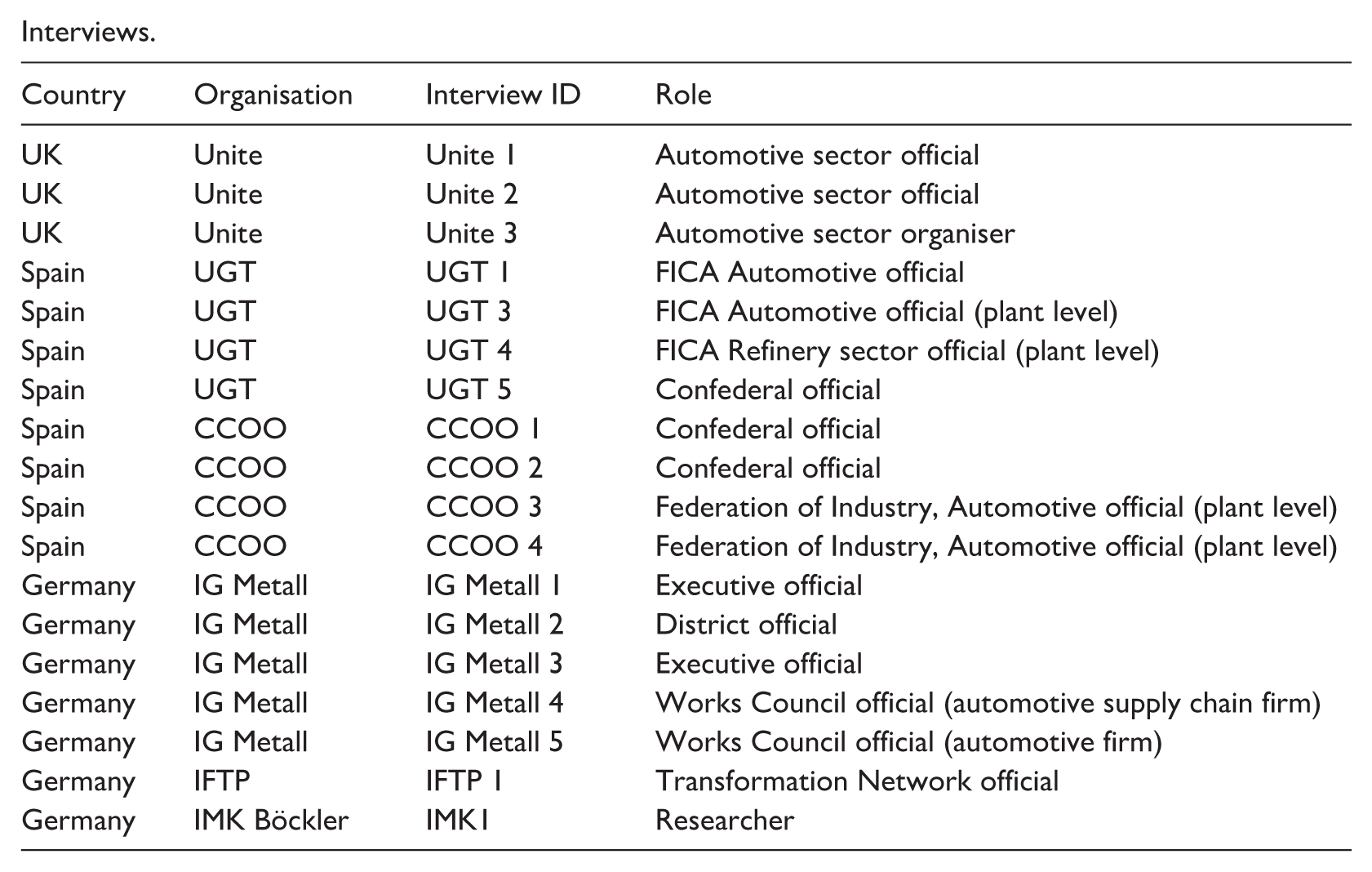
| Country | Organisation | Interview ID | Role |
|---|---|---|---|
| UK | Unite | Unite 1 | Automotive sector official |
| UK | Unite | Unite 2 | Automotive sector official |
| UK | Unite | Unite 3 | Automotive sector organiser |
| Spain | UGT | UGT 1 | FICA Automotive official |
| Spain | UGT | UGT 3 | FICA Automotive official (plant level) |
| Spain | UGT | UGT 4 | FICA Refinery sector official (plant level) |
| Spain | UGT | UGT 5 | Confederal official |
| Spain | CCOO | CCOO 1 | Confederal official |
| Spain | CCOO | CCOO 2 | Confederal official |
| Spain | CCOO | CCOO 3 | Federation of Industry, Automotive official (plant level) |
| Spain | CCOO | CCOO 4 | Federation of Industry, Automotive official (plant level) |
| Germany | IG Metall | IG Metall 1 | Executive official |
| Germany | IG Metall | IG Metall 2 | District official |
| Germany | IG Metall | IG Metall 3 | Executive official |
| Germany | IG Metall | IG Metall 4 | Works Council official (automotive supply chain firm) |
| Germany | IG Metall | IG Metall 5 | Works Council official (automotive firm) |
| Germany | IFTP | IFTP 1 | Transformation Network official |
| Germany | IMK Böckler | IMK1 | Researcher |
Funding
The authors disclosed receipt of the following financial support for the research, authorship, and/or publication of this article: This research was supported by the European Commission as part of the project ‘Advancing the understanding of the challenges, policy options and measures for a just EU energy transition’ [HORIZON-CL5-2021-D2-01-12]. The views and opinions expressed here are those of the author(s) only and do not necessarily reflect those of the European Union or the European Research Executive Agency. Neither the European Union nor the granting authority can be held responsible for them.
Declaration of conflicting interests
The authors declared no potential conflicts of interest with respect to the research, authorship, and/or publication of this article.