




Abstract
This article is a contribution to debates on the role of trade unions and industrial relations institutions in boosting popular support for a greener economy. Building on prior work that demonstrates a positive association between collective bargaining coverage and pro-environmental attitudes among workers, the article adds a more robust country-comparative focus. Matching data from the European Social Survey with the new European Participation Index (EPI), it examines whether cross-national variation in the strength of unions and industrial relations institutions is related to country differences in public support for carbon taxation and considers a range of explanatory factors. Results of multi-level regression models support the core argument by revealing a positive association between the EPI and public support for carbon taxation, which is robust to several control variables, including the domestic weight of the fossil fuel industry. The article thus highlights the importance of trade unions and industrial relations institutions in the successful navigation of green transitions.
Introduction
Despite the alarming intensification of climate change (IPCC, 2022) it has proven challenging to sustain broad popular pressure for extensive environmental protection policies, particularly among workers in sectors most affected by such policies (Lu, 2025). A potentially decisive but hitherto empirically underexamined factor in this respect pertains to the role of trade unions and industrial relations institutions: do such institutions play a role in fostering public support for environmental policies?
Although the issue has been the subject of extensive debate, often framed in terms of a ‘just transition’ (Galgóczi, 2022; Stevis, 2023), systematic empirical research based on wider representative data remains limited, with some exceptions (Bolet et al., 2024; Ringqvist, 2022). Building on insights from prior work, this article advances the hypothesis that strong unions and industrial relations institutions are conducive to improving public support for environmental policies and tests the hypothesis in a country-comparative analysis looking at support for carbon taxation.
The article draws on data from the 2016 European Social Survey (ESS) and the novel European Participation Index (EPI), utilising multi-level regression analysis to examine differences between 23 European countries in the level of public support for carbon taxation. To arrive at a comprehensive measure of workers’ influence, the EPI combines a number of factors (ranging from union density to workplace representation) into a single encompassing index (De Spiegelaere and Vitols, 2024). This provides an opportunity to advance insights from studies based on discrete indicators, such as bargaining coverage, criticised in terms of issues of cross-national (in)comparability (Refslund and Arnholtz, 2022; Visser, 2024).
Thus, this article asks whether a country’s characteristics in terms of workers’ influence through unions and industrial relations institutions – measured by the EPI – helps explain why public support for carbon taxation is higher in some countries than in others. In addition, the article considers several factors that may contribute to such a positive effect, namely: social protection (specifically, higher unemployment insurance coverage), income equality, social and political trust, and perceived political voice.
The analyses support the overarching argument by revealing a significant positive association between the EPI and support for carbon taxation: such support tends to be noticeably higher in countries with stronger unions and industrial relations institutions. Although data are cross-sectional and causal inferences should be drawn with caution, the positive ‘EPI effect’ is robust to several control variables related to the composition of the labour market and economy, including the domestic weight of the fossil fuel industry. In turn, while acknowledging causal uncertainties and data limitations that preclude formal mediation analysis, further analyses suggest that the positive EPI effect could be attributed partly to higher unemployment protection coverage and lower income inequality. Both of them (although particularly the latter) are correlated positively with the EPI and public support for carbon taxation. On this basis the article suggests the utility of considering industrial relations actors and institutions in comparative debates on public support for environmental protection. Indeed, in light of the results it seems plausible to hypothesise that the widely observed decline in workers’ voice (De Spiegelaere and Vitols, 2024) exacerbates the challenge of mitigating the climate crisis.
Public support for environmental policies in comparative perspective
A growing comparative literature examines attitudes and policy preferences around environmental protection, highlighting the impact of such factors as trust, macroeconomic conditions and social protection (Fairbrother, 2016; Nordbrandt et al., 2025; Pickett et al., 2024; Ringqvist, 2024a). Of particular relevance is the body of research into the role of social protection, whose primary focus has been welfare state characteristics (García-García et al., 2022; Koch and Fritz, 2014; Nelson et al., 2023; Nordbrandt et al., 2025; Parth and Vlandas, 2022). In alignment with what is labelled the ‘synergy hypothesis’ (Koch and Fritz, 2014) a key finding from this literature is that more encompassing welfare states tend to see higher public support for environmental protection (notwithstanding certain tensions, Jakobsson et al., 2018). This is attributed to the fact that social protection policies reduce economic risk through de-commodification (decoupling life-chances from pure market mechanisms) and economic redistribution, and possibly also feedback loops around norms, trust and public favourability towards government intervention (Koch and Fritz, 2014: 693; Nordbrandt et al., 2025; Parth and Vlandas, 2022).
It would seem to make sense to look more closely at the role of industrial relations actors and institutions in these comparative debates, not least considering that environmental policies, including carbon taxation, tend to have an impact on the world of work and employment. Such impacts notably include lay-offs and industrial restructuring, which in turn fuel economic and job-related anxieties (for example, Damiani et al., 2025; Galgóczi, 2022; Lu, 2025). Arguably, trade unions in particular are important in this context, both as key actors in a coalition promoting pro-worker policies (Engler and Voigt, 2023; Pérez Ahumada, 2023; Pineda-Hernández et al., 2022) and in the more micro-level regulation of work (MacKenzie and Martínez Lucio, 2005). Besides the fact that a range of general conditions (including social protection) tend to be more favourable in countries with strong unions and industrial relations institutions, such institutions can articulate concerns about the design, implementation and management of work-related impacts of environmental policies.
Located thus between the state and the individual, representing workers’ interests across a range of levels and governing bodies (Ahlquist, 2017; Pineda-Hernández et al., 2022: 897), unions offer significant actor capacity when navigating the employment impacts of environmental policies. Such capacity ranges from ‘substantive’ to ‘procedural’ (Bolet et al., 2024), both of which are key to a just transition (Galgóczi, 2022). The question is whether this implies that in countries with stronger unions and industrial relations institutions more people support environmental policies.
In empirical terms, quantitative research is scarce on the impact of industrial relations institutions in this respect, with some exceptions (Bolet et al., 2024; Ringqvist, 2022). Recent work across a sample of European countries offers a preliminary examination of the effects of collective bargaining coverage on workers’ willingness to prioritise environmental protection (Ringqvist, 2022). Although it uses few country-level control variables and focuses primarily on the individual-level effects of union membership, the study finds stronger prioritisation of environmental protection in countries with higher collective bargaining coverage. This effect appears not to be attributable to the level of employment security and skills development, measured by an index combining several factors. The study concludes by calling for further comparative research on the relationship between industrial relations institutions and workers’ support for environmental protection, including more concrete policy proposals and fuller consideration of specific explanatory mechanisms. This article builds on these conclusions by looking at support for specific environmental policies and examining a number of potential explanatory factors.
There is also reason to look more closely at the measurement of workers’ power and influence through collective organisation. Indeed, discrete indicators of such influence – most commonly, union density or bargaining coverage – have long been subject to criticism (De Spiegelaere and Vitols, 2024; Refslund and Arnholtz, 2022; Visser, 2024). De Spiegelaere and Vitols (2024) note that such measures are liable to omit both ‘functional equivalents’, whereby different institutions perform similar functions, and ‘synergistic interactions’, where combinations of factors (such as workplace representation and high unionisation rates) interact to generate specific outcomes. Accounting partly for such issues, their European Participation Index (EPI) is an attempt at a more encompassing measure by combining into a country-level index indicators of collective bargaining coverage and union density, workers’ workplace representation and board-level representation (De Spiegelaere and Vitols, 2024). This approach to operationalising workers’ influence through collective organisation fits the overarching argument of the present article, which emphasises the multiple levels at which such organisation brings actor capacity in navigating the employment impacts of environmental policy, notably embedded in previously established conditions ranging from wages and work environment to the broader policy infrastructure. The contention is thus that the risks that might accompany a carbon tax – including labour market restructuring and economic uncertainty – would be mitigated by strong industrial relations institutions, reducing workers’ exposure to adjustment costs and enhancing their sense of security, lowering the salience of competing priorities and the perceived risks of ambitious environmental policy. The following overarching hypothesis is offered:
What, then, are the specific mechanisms through which strong unions and industrial relations institutions may garner support for environmental policies? While some of the mechanisms covered above operate in ways that are difficult to observe empirically in the present analysis, an overview of prior studies (for example, Fairbrother, 2016; Nordbrandt et al., 2025; Pickett et al., 2024; Ringqvist, 2024b) suggests that such factors may include: unemployment insurance, income equality, social and political trust, and legitimacy related to a sense of political voice.
Given its centrality to union debates it is worth beginning by considering what is often presented as a key factor in a just transition, namely social protection, notably in the form of unemployment insurance. Through such general policies, strong unions are consistently linked with more extensive efforts to cushion against various labour market and life course-related risks (Crouch, 2017; Engler and Voigt, 2023; Gordon, 2015; Jensen, 2012; Korpi, 2006; Ringqvist, 2022). This in turn is likely to have implications in terms of public support for carbon taxation, as adequate social safety nets can mitigate anxieties around its economic and labour market repercussions. As Madsen et al. (2023: 4) observe, ‘a fine-grained safety net offering compensation and re-qualification’ can limit ‘the resistance from prospective losers and arguably increases the social acceptability of the transition’.
Empirically, comparative research does substantiate the notion of a positive impact of unemployment benefits on environmental policy support. Noting that the ‘long-term acceptance of carbon taxes likely hinges on a host of policy measures’, Nordbrandt et al. (2025: 97) conclude a comparative European analysis as follows: ‘Our results suggest that encompassing social protection should be part of such a climate policy mix’. Their study shows stronger support for carbon taxation in countries with broad unemployment insurance coverage, which is interpreted as reflecting reduced perceptions of risk and unfairness, mechanisms often identified as key to public acceptance of environmental policy. While their findings point to the importance of unemployment insurance coverage, they do not examine the political or institutional drivers that expand such coverage in the first place. The present study takes up this issue by highlighting the role of unions. Because of data limitations (a low number of countries), these arguments are not tested formally in mediation analysis, but through more descriptive analyses, thus:
Next, as a widely recognised outcome of strong unions and industrial relations institutions (Ahlquist, 2017; Pineda-Hernández et al., 2022), including when operationalised through the EPI (De Spiegelaere and Vitols, 2024), income equality constitutes a further reason why such institutions may augment public support for environmental protection. Although the empirical evidence is mixed (Franzen and Meyer, 2009; Roberts and Mangold, 2023), research has corroborated a link between income equality and support for such protection (Pickett et al., 2024). Part of this is attributed to issue salience, such that people under conditions of high inequality are more prone to ‘prioritise increasing social spending to address their immediate economic risks, even if this is at the expense of allocating more funds and resources to address environmental risks in the future’ (Parth and Vlandas, 2022: 534). Relatedly, all else being equal, a larger share of households in countries with lower income inequality should be able to bear the costs of, and thus be more likely to support, carbon taxes. Indeed, looking at the economic impacts of environmental policies, Nelson et al. (2023) demonstrate that income redistribution reduces the risk of households being pushed into poverty as a result of rising fuel prices or energy costs resulting from environmental taxes. Thus income equality may boost support for carbon taxation as more households can absorb the additional costs, reducing affordability concerns that may drive opposition, and lower the salience of more immediate concerns and distributional conflict. This would allow climate benefits to become a more prominent consideration. Hence:
Next, although it is an issue fraught with causal ambiguities, unions and industrial relations institutions may also boost support for environmental protection through an interrelated set of norms and perceptions (Ringqvist, 2022, 2024b). In part by reducing inequality, such institutions can help to promulgate or sustain social cohesion and norms conducive to trust, collective action solving and support for environmental policies (Crouch, 2017: 59–60; Fairbrother, 2016; Ringqvist, 2022; Rothstein, 2001). For example, research shows that social trust partly enhances public support for environmental protection (Fairbrother, 2016), and trust tends to be lower in unequal societies (Pickett et al., 2024). As Pickett et al. (2024: 14) suggest, high inequality ‘leads to reduced social cohesion, decreasing the sense of public responsibility and collective will required to support environmental efforts’. This is also connected to a related set of issues around trust in political institutions and the public sense of procedural justice, namely the extent to which people are perceived to have influence on politics (Bolet et al., 2024; Galgóczi, 2022: 356). In this regard, strong workers’ organisation – again operationalised through the EPI – may contribute to both social and political trust, as well as to a stronger perception of political voice (Elsässer and Schäfer, 2022; Refslund and Arnholtz, 2025: 17; Rothstein, 2001). In turn, this may enhance support for carbon taxation by reducing concerns about policy misuse and unfair burden-sharing. Social trust reduces concerns that others will free-ride or fail to comply (Fairbrother, 2016), while political trust and perceived political voice may strengthen people’s belief that their interests are being represented in the policy-making process. Together, these factors could increase acceptance of policies that impose short-term costs in pursuit of collective long-term benefits. In contrast to the hypotheses around unemployment protection and income inequality measured at the country level, trust and perceived political voice are measured at the individual level in the current analysis. This allows for a formal causal mediation analysis. Therefore:
Data and methods
The analyses utilise the 2016 European Social Survey (ESS ERIC, 2023), a nationally representative dataset based on probabilistic sampling. After removing missing data, which vary between models, the sample ranges between 20,972 and 22,542 individuals across 19–23 European countries (Table 1 lists the participating countries). As explained below, this article employs multi-level modelling, a statistical technique accounting for variables at several levels of analysis. In this case, variables are included at the individual and country levels. To reflect this structure, the following section presents the variables in two parts, beginning with those measured at the individual level.
Descriptive country statistics.
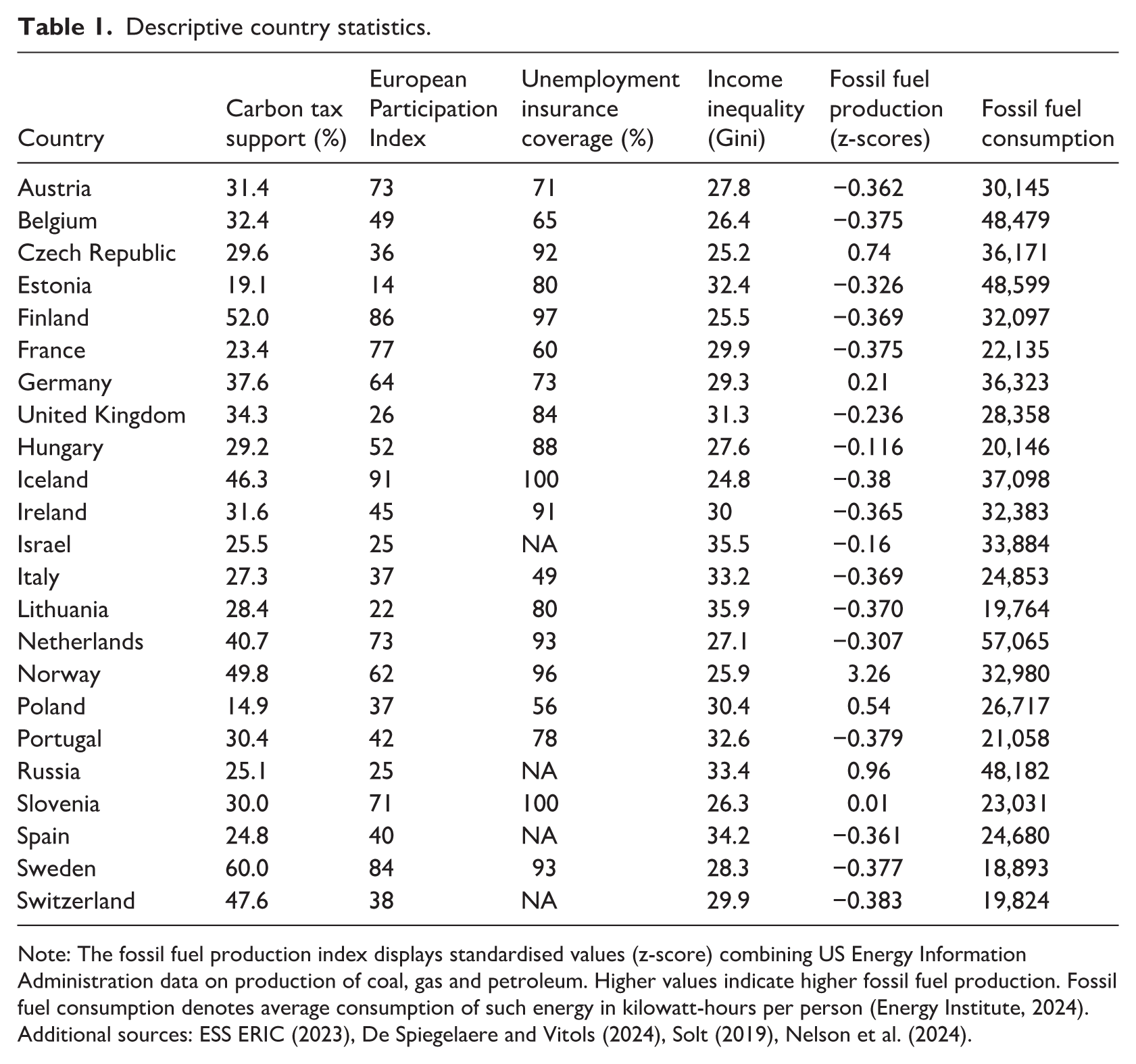
Note: The fossil fuel production index displays standardised values (z-score) combining US Energy Information Administration data on production of coal, gas and petroleum. Higher values indicate higher fossil fuel production. Fossil fuel consumption denotes average consumption of such energy in kilowatt-hours per person (Energy Institute, 2024). Additional sources: ESS ERIC (2023), De Spiegelaere and Vitols (2024), Solt (2019), Nelson et al. (2024).
Individual-level variables
To capture support for environmental protection, the dependent variable is based on a question on the extent to which respondents favour or oppose ‘increasing taxes on fossil fuels such as oil, gas, and coal in order to reduce climate change’. Responses are dichotomised, distinguishing between those who are ‘strongly in favour’ or ‘in favour’ (1) and those who are ‘neither in favour nor against’, ‘somewhat against’ or ‘strongly against’ (0).
Also measured at the individual level, to test H4a social trust is operationalised via the question: ‘Generally speaking, would you say that most people can be trusted, or that you can’t be too careful in dealing with people?’ Responses are ranked on a scale from 0 (‘you can’t be too careful’) to 10 (‘most people can be trusted’). Political trust (H4b) is measured through a question regarding trust in the country’s parliament, from 0 (‘no trust at all’) to 10 (‘complete trust’). H4c concerns perceived political voice, measured by combining answers to two questions on whether the ‘political system allows people to have influence on politics’ and ‘have a say in what government does’.
Following previous research (for example, Nordbrandt et al., 2025; Ringqvist, 2022) the following control variables are included: occupational group (based on the eight-class scheme of Oesch, 2006); household income (deciles); education; place of residence (rural/urban); gender; age; sector (public/private); union membership; employment contract (unlimited/limited/no contract).
Country-level variables
To capture variation in workers’ influence through collective organisation, the key country-level independent variable is the European Participation Index (EPI) (De Spiegelaere and Vitols, 2024). Constructed to facilitate cross-national comparison, the EPI weighs together the following factors (attributed equal weight) into an index ranging from 0 to 100:
The average between union density and collective bargaining coverage.
Workplace representation, based on estimates of the proportion of the workforce covered by formal workplace representation (a union, works council or shop steward/stewards committee).
Board-level representation, based on expert ratings of the strength of legal rights pertaining to board-level employee representation, distinguishing between a wide-ranging system, limited experience of board-level representation, and no regulations on board-level representation.
Besides accounting for functional equivalents and synergies, as discussed above, the EPI offers an advantage by enabling the inclusion of multiple relevant contextual factors regarding workers’ influence without overburdening the statistical models, a frequent limitation in comparative research (Nelson et al., 2023).
To examine Hypotheses 2 and 3, the following variables are used, measured at the country level. Following Nordbrandt et al. (2025), Hypothesis 2 is tested with data on unemployment insurance coverage from the Social Insurance Entitlements dataset (SIED, Nelson et al., 2024). The variable measures the coverage of unemployment insurance as a proportion of the total labour force. For Hypothesis 3, income inequality is measured through the Gini-index (Pickett et al., 2024), utilising post-transfer data from Solt (2019), ranging between 0 (perfect income equality) and 100 (perfect income inequality). Post-transfer means that the index measures income inequality after state redistribution (taxes and transfers).
In terms of country-level controls, it is pertinent to consider some issues related to the structure of the domestic labour market and economy. One potentially important element is the economic importance of the fossil fuel production industry (Madsen et al., 2023). This is measured through an index weighing together country-level data from the US Energy Information Administration concerning production of petroleum, coal and gas, relative to the country’s population. The analyses also consider the consumption of fossil fuels, measured as the average consumption of energy from coal, oil and gas, in kilowatt-hours per person, using data from the Energy Institute, with major processing by Our World of Data (Energy Institute, 2024). Analyses also control for GDP/capita (Ringqvist, 2024a). Country-level data refer to 2015 or the closest available year.
Supplementary analyses (not shown) also control for the size of the manufacturing sector (share of employment). Nahm (2022: 448) argues that the sector, when sizeable, has often been ‘a central impediment to climate policy’. However, supplementary analyses reveal that the share of manufacturing is not associated with support for carbon taxation.
Methods
This article asks whether the characteristics of a country – specifically, workers’ influence through unions and industrial relations institutions – may help to explain why some people are more supportive of environmental protection than others. The idea is that policy preferences may be shaped not only by individual attributes but also by the national context. To investigate this, a technique called multi-level analysis (MLA) is used (Hox et al., 2017). Whereas traditional methods assume that each person is independent of every other, this tends not to hold where individuals are grouped in countries. Ignoring this can lead to misleading conclusions. MLA allows variation to be separated into individual- and country-level characteristics, making it possible to study both levels simultaneously.
Results are interpreted much like regular regressions, with the output signifying how each factor is linked to the outcome, holding others constant. In the present case, analyses use logistic regression models, which are suitable when the outcome is binary. Effects are reported in the form of odds ratios, which show how the likelihood of supporting carbon taxation changes with a one-unit increase in a particular variable. For example, an odds ratio of 1.5 for political trust would mean that, all else being equal, a one-unit increase in political trust makes people 1.5 times more likely to support environmental protection. If the odds ratio is below 1, the factor is linked to lower odds of support.
The study also explores how workers’ collective influence might affect support for environmental protection. Hypotheses 2 and 3 look at other country factors that could explain the effect: unemployment insurance coverage and income equality. These can be seen as steps in the process between EPI and environmental policy support. However, because the data contain a limited set of countries, it is not advisable to test this process in a full model (for example, Leyland and Groenewegen, 2020: 121). Instead, the analysis proceeds in two steps, first using correlation analysis to check whether EPI is linked to unemployment insurance coverage and income equality and then testing the respective factor in a multi-level analysis to see if it relates to carbon tax support. Hypotheses 2 and 3 are thus not evaluated through formal mediation analyses, which precludes strong conclusions regarding mediation.
Hypothesis 4 suggests that the EPI effect operates through specific individual-level factors (Diez-Roux, 1998): social trust, political trust and perceived political influence. These are measured at the individual level, enabling formal assessment of whether the EPI effect might be explained by each respective factor (‘mediator’). To this end, a step-by-step modelling approach is used. First, the relationship between EPI and carbon tax support is examined on its own. Next, the mediator is added to see whether the EPI effect is reduced. If so, this suggests that the mediator explains part of the relationship. Because such a model comparison does not strictly translate into logistic regression analysis, complementary step-wise linear probability and causal mediation analyses are reported (not shown).
Results
Table 1 shows descriptive statistics on the key country-level indicators and the proportion within each country favouring an increase in carbon taxation. Figure 1 offers a visual overview of the bivariate association between the EPI and the share favouring such taxation. There is considerable country variation in support for carbon taxation. Poland scores lowest among the countries in the sample, with only around 15 per cent supporting increased carbon taxation. This is consistent with the substantial weight of the coal sector in the Polish economy, reflected in its high score on the fossil production index. Together with Estonia and Russia, Poland is located near the bottom left corner of the figure, low on both environmental policy support and the EPI. Conversely, among those with the highest carbon tax support are a group of Scandinavian countries, all of which also display high EPI and unemployment insurance coverage numbers and comparatively low income inequality. Other countries relatively high on both indicators include the Netherlands and Germany.
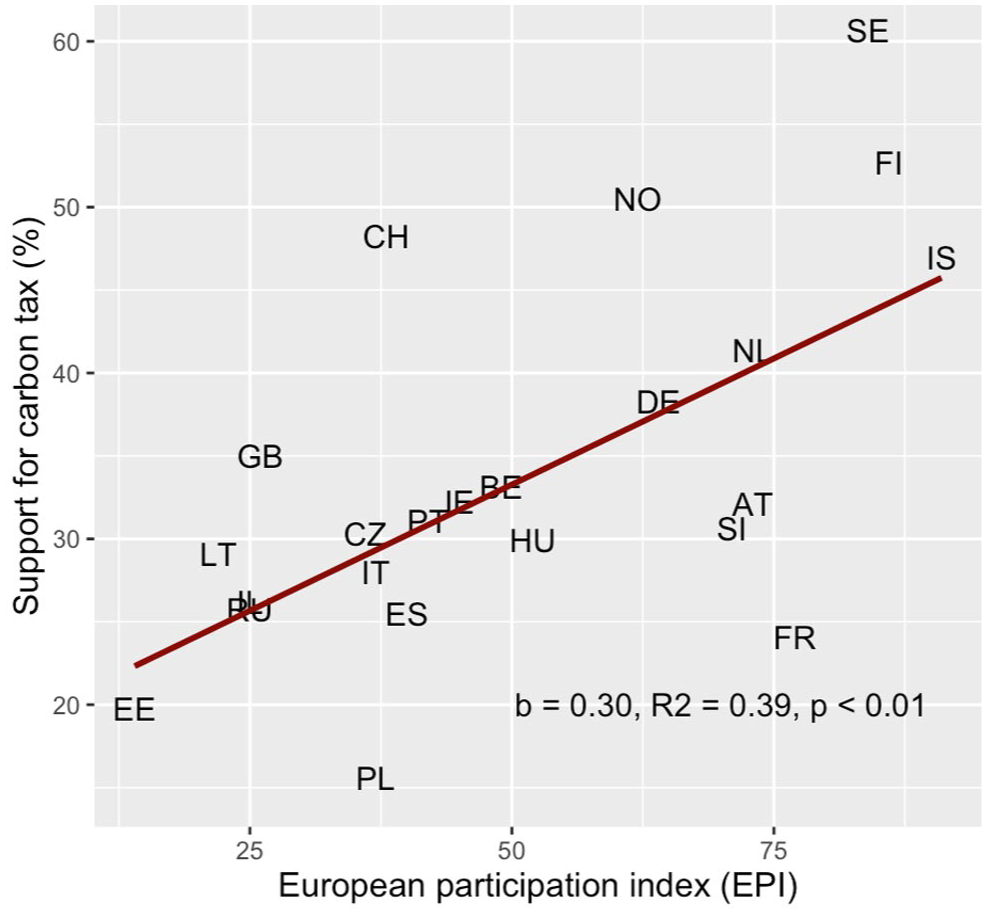
Bivariate association between EPI and carbon tax support.
Overall, as seen in Figure 1, there is a clear tendency for countries with a higher EPI to display higher carbon tax support, which provides initial support for Hypothesis 1. France is a partial outlier, with a high EPI but relatively low support for carbon taxation. In this respect the EPI arguably overrates workers’ influence in France, ranking the country third highest across Europe (using the 2013 French EPI score, in which board-level representation was ranked lower, yields an improved model fit). Switzerland also departs from the pattern, having comparatively high carbon tax support relative to its mid-to-low EPI ranking (while scoring very low on the fossil production index).
For systematic treatment of the relationship between the country variables, Table 2 shows their correlation coefficients. These serve as indicators in the analysis of Hypotheses 2 and 3 concerning the association between the EPI, on the one hand, and unemployment insurance (H2a) and income inequality (H3b) on the other. Notably, there is a modest (r = 0.42) positive association (not highly significant (p < 0.1)) between the EPI and unemployment insurance coverage, which provides fairly weak support for H2a. Consistent with previous findings (De Spiegelaere and Vitols, 2024), there is a strong negative correlation (r = −0.75) between EPI and income inequality, providing support for H3a: a higher EPI is associated with lower income inequality.
Correlation analysis, country variables.
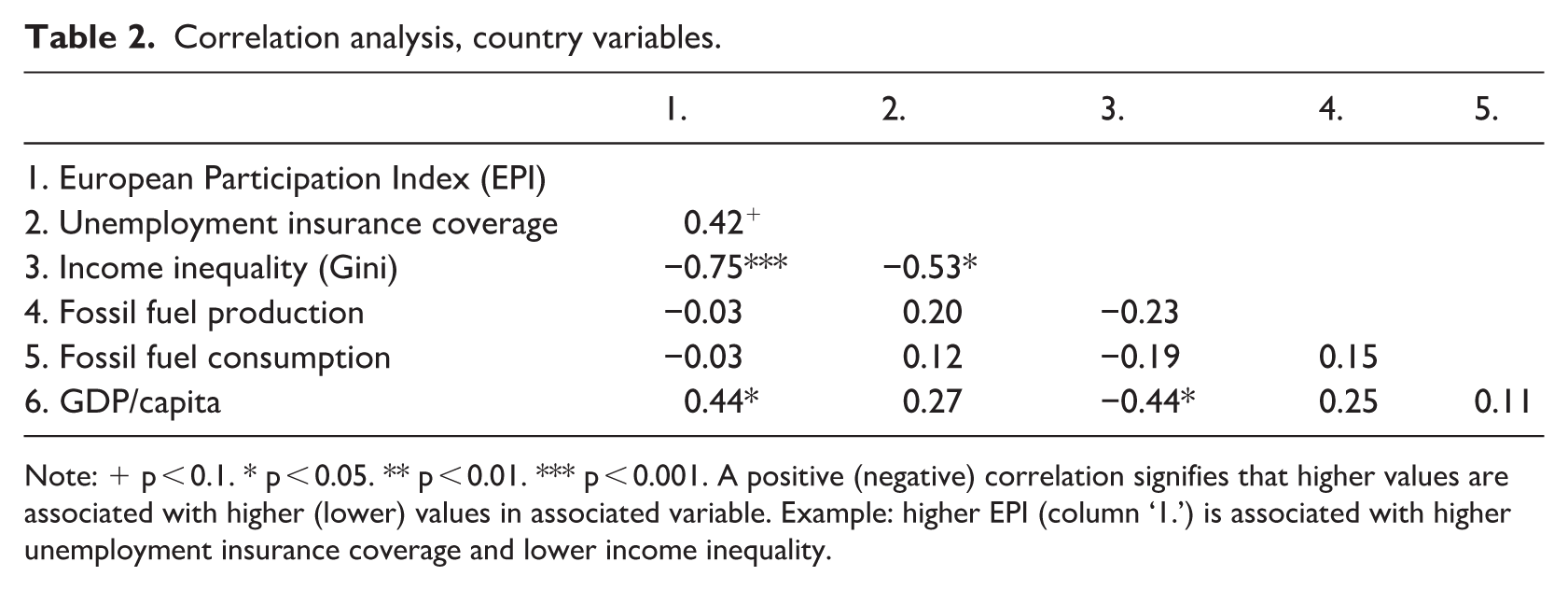
Note: + p < 0.1. * p < 0.05. ** p < 0.01. *** p < 0.001. A positive (negative) correlation signifies that higher values are associated with higher (lower) values in associated variable. Example: higher EPI (column ‘1.’) is associated with higher unemployment insurance coverage and lower income inequality.
The next step is to turn to the regression models. Unlike the bivariate analysis in Figure 1, regression models make it possible partly to isolate the ‘effect’ of the EPI by holding other variables constant, moving from observing patterns to testing whether they hold when accounting for competing explanations. It is important to note, however, that these models do not establish cause and effect. While they can strengthen the case for an independent association, they cannot rule out unobserved variables that might be driving the results. What the models offer is a clearer picture of conditional (and probabilistic) associations, not definitive causal claims.
As shown in Table 3, the association between the EPI and support for carbon taxation holds when including a substantial range of control variables. 1 There is a strong and significant positive association between the EPI and carbon taxation support also when taking into account, among other things, occupational and sectoral composition, as well as country-level indicators of fossil fuel production and consumption (the latter being negatively associated with carbon tax support). The EPI is standardised using a z-transformation (as are the other continuous country variables). This is common practice as it places variables on a common scale, centred on the mean with a standard deviation of 1. Based on this standardisation, for every increase in the EPI by one average deviation, the odds of supporting carbon taxation increase by approximately 26 per cent. In simpler terms, where the EPI rises by a noticeable amount, the chances of supporting carbon taxation are substantially higher. These results thus support Hypothesis 1.
Multi-level logistic regression models, support for carbon taxation.
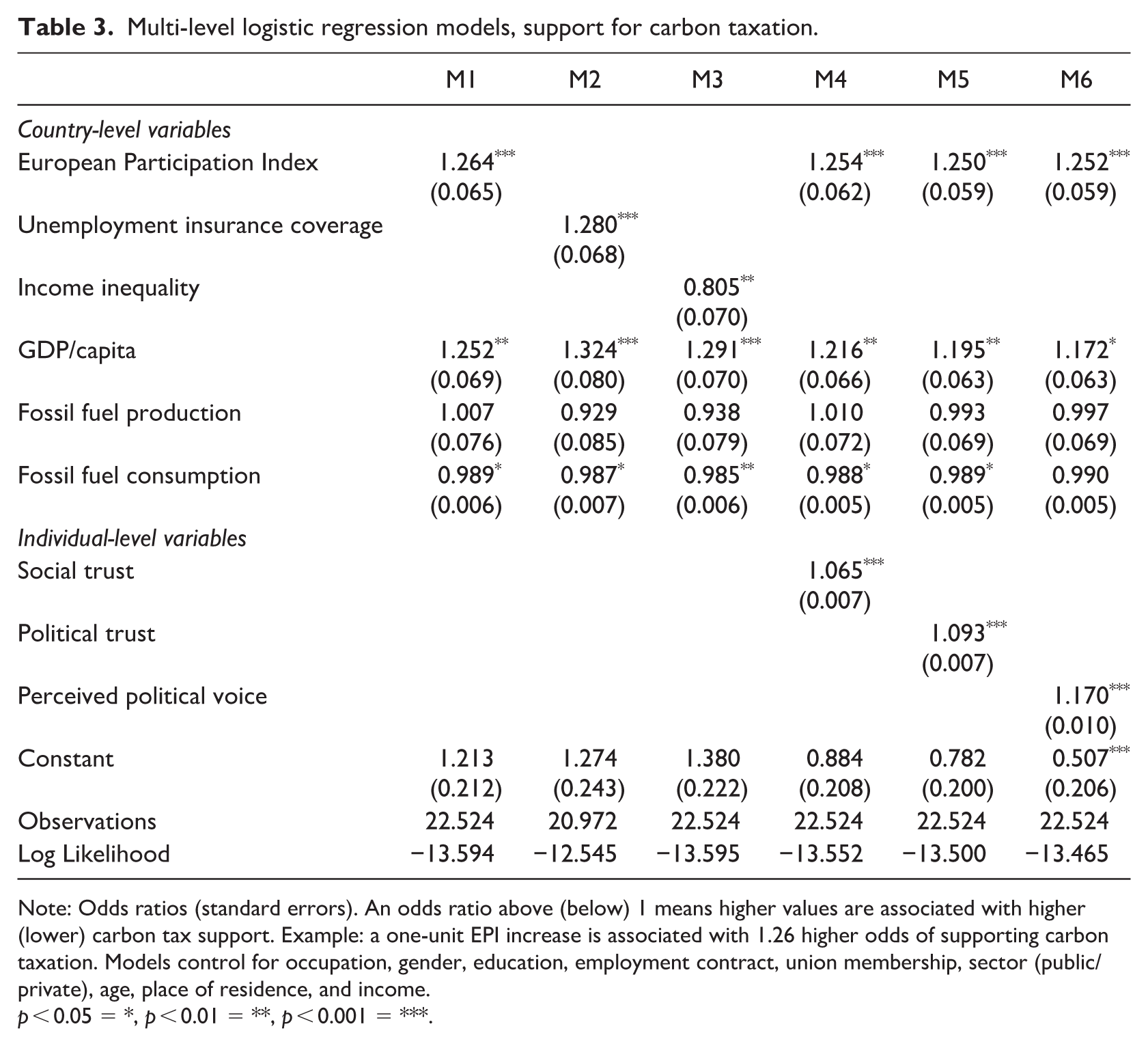
Note: Odds ratios (standard errors). An odds ratio above (below) 1 means higher values are associated with higher (lower) carbon tax support. Example: a one-unit EPI increase is associated with 1.26 higher odds of supporting carbon taxation. Models control for occupation, gender, education, employment contract, union membership, sector (public/private), age, place of residence, and income.
p < 0.05 = *, p < 0.01 = **, p < 0.001 = ***.
Hypothesis 2 suggests that part of the positive ‘effect’ of the EPI may be related to higher unemployment insurance coverage. As noted, Table 2 demonstrated a positive, albeit not highly significant, correlation between the EPI and unemployment insurance coverage. Table 3 (M2) shows that unemployment protection is associated positively with support for carbon taxes, thereby supporting Hypothesis 2b. As was the case with the EPI, unemployment insurance coverage is z-transformed: one standard deviation increase in such coverage amounts to a 28 per cent increase in the odds of carbon tax support. Supplementary step-wise linear probability analyses (not shown) indicate that when controlling for unemployment insurance coverage, the estimated EPI effect declines from 0.058 to 0.042 (−28 per cent). This suggests that while only modestly correlated with EPI, such coverage may explain a meaningful share of the ‘EPI effect’, although this conclusion remains uncertain given the small number of countries.
Hypothesis 3 proposes a similar argument around the role of income equality, which was shown in Table 2 to be associated strongly with the EPI. The regression results (Table 3, M3) reveal that income inequality is associated negatively with carbon tax support, meaning that such support tends to be significantly lower in countries with higher income inequality. Hypothesis 3b thus receives support. For one standard deviation increase in income inequality, the odds of supporting carbon taxation decrease by around 20 per cent. In other words, where income inequality is higher, support for environmental policy tends to be lower. In a full supplementary linear probability model (not shown), neither the EPI nor the Gini effect remain significant, indicating multicollinearity. Because the EPI and the Gini are highly correlated, their shared variance makes it difficult to assess their unique contributions in the same model. A modest EPI coefficient shift (from 0.058 to 0.056) therefore probably reflects statistical overlap rather than substantive irrelevance.
Hypothesis 4 proposes that part of the EPI effect may run through perceptions around social trust (4a), political trust (4b) and political voice (4c). This is assessed through step-wise logistic models (Table 3, M4–6), as well as step-wise linear probability models underpinning formal causal mediation analysis (reported but not shown). If the respective factor constitutes part of the mechanism linking EPI to carbon tax support, the EPI effect should decrease when included in the model. However, the EPI remains largely unaffected by their respective inclusion. These factors hence do not explain the positive EPI effect, a conclusion supported by the supplementary mediation analyses, which indicate no significant mediating effect. 2 This is somewhat surprising given that higher social trust, political trust and perceived political voice are each associated with higher odds of supporting carbon taxation. However, the premise that these are linked significantly to the EPI does not hold: it is not possible to say with statistical certainty that trust or perceived political voice tend to be higher in countries scoring higher on the EPI. Hypothesis 4 is thus not supported.
Concluding discussion
Building on previous research (Bolet et al., 2024; Ringqvist, 2022), this article contributes to debates on the role of trade unions and industrial relations institutions in shaping public support for environmental protection. While prior research identifies an association between collective bargaining coverage and pro-environmental attitudes (Ringqvist, 2022), the article advances the discussion by looking at support for a specific policy proposal, incorporating a more comprehensive measure of workers’ influence, namely the European Participation Index (EPI) (De Spiegelaere and Vitols, 2024), and controlling for a broader set of contextual factors. Results of multi-level regression analyses support the central argument: in a relatively uniform manner, countries scoring higher on the EPI tend to see higher public support for carbon taxation. This points to industrial relations actors and institutions as meaningful factors when considering environmental policy preferences across diverse European national contexts.
The article aligns with previous studies regarding the importance of income equality and social protection, notably unemployment insurance, for pro-environmental attitudes (Koch and Fritz, 2014; Nordbrandt et al., 2025; Pickett et al., 2024). However, although strong causal conclusions should be avoided, the article adds an important element of agency underpinning such conditions by emphasising workers’ participation and influence through unions and industrial relations institutions. This perspective enriches the theoretical understanding of how industrial relations dynamics intersect with broader social and environmental agendas, echoing Galgóczi’s (2022: 355) argument that ‘a just transition does not happen in a vacuum’, but rather ‘concrete transitions take place in work environments that are determined by the capital-labour relationship’ (Galgóczi, 2022: 361).
Arguably, the findings thus highlight some challenges to managing a just transition towards a greener economy in the context of declining worker voice across Europe and beyond (De Spiegelaere and Vitols, 2024). Indeed, by representing workers’ interests across a range of levels and governing bodies, articulating concerns around the design and implementation of environmental policies, strong unions are likely to be a mitigating factor tempering popular backlash against such policies, especially in contexts in which political parties pursuing such agendas have experienced declining policy-making leverage.
In other words, the more people who are unionised, covered by a collective agreement and represented at the workplace and board levels, the more favourable a range of conditions conducive to environmental policy support are likely to be, including the level of unemployment protection and income equality. In addition, albeit more speculatively, the strength of unions and industrial relations institutions may also lead to a more widely held perception that environmental policies are designed and implemented, and the consequences of such policies managed, in ways that are more attentive to workers’ concerns.
In relation to the latter argument, research demonstrates that the design of environmental policies matters greatly when it comes to gaining support for them (Bergquist, 2025). Mares et al. (2025: 4) conclude that ‘compensation policies that target benefits to low-income consumers and workers are likely to bring about the largest increase in support for environmental policies’. These findings point to some concrete mechanisms through which unions and industrial relations institutions may help to build support for such policies.
However, the underlying mechanisms – that is, the specific reasons why support for carbon taxation tends to be higher in countries with stronger unions and industrial relations institutions – remain to be determined systematically and at a more granular level, notably through in-depth case-based research. Specific just transition policies, for example, appear not to be extensive subjects in current bargaining (Galgóczi, 2022: 358; Mandelli, 2025), suggesting that the EPI effect rather reflects pre-existing conditions secured by strong workers’ voice, ranging from working conditions to the broader policy infrastructure. From a union and broader policy perspective, specific and targeted measures through concrete just transition agreements could thereby be considered a latent potential inherent in strong industrial relations institutions for enhancing legitimacy and ‘easing potential conflicts’ (Mandelli, 2025: 4). Among the mechanisms underpinning such effects may be included employment support through retraining and job-matching (MacKenzie and McLachlan, 2023) and various non-material aspects related to recognition and status. This resonates with the growing policy reappraisal of industrial relations institutions, exemplified by the OECD’s (2019) increasingly positive framing of collective bargaining as a source of economic resilience and democratic legitimacy.
In terms of explaining the positive EPI effect, the evidence presented here suggests that material conditions around social protection and income inequality matter more than trust and perceptions of political voice, although it is important to emphasise that the former are not explored through formal mediation analysis, and the results should therefore be interpreted as only indicative. While trust and perceived voice tend to be associated positively with carbon tax support, they are not significantly higher in countries with a higher EPI. This is arguably a surprising finding which merits further research. It should be stressed in this respect that while the EPI constitutes an advance in terms of measuring workers’ influence, it remains a fairly blunt instrument (omitting, for example, variation in membership composition, as well as structural and ideational power; Lévesque and Murray, 2010; Refslund and Arnholtz, 2025). Measuring influence and power remains a complex task and the EPI captures only a partial aspect.
Some further limitations of the study must be acknowledged. The analyses are cross-sectional and do not establish a causal link between the EPI and carbon tax support. Formal mediation analysis of Hypotheses 2 and 3 was precluded by the limited number of countries. Thus, while arguably supported by theoretical reasoning, these mechanisms remain to be examined more systematically in future research. While utilisation of the EPI is an attempt at a more comprehensive measure, caution is warranted when comparing countries in this manner: results may not be easily transferable. Additionally, the data are somewhat dated (2016); more recent indicators will help determine whether these relationships hold under current conditions, and longitudinal analyses would be a particularly promising direction for future research.
Ultimately, nevertheless, this article provides empirical evidence highlighting the positive relationship between workers’ collective influence through unions and industrial relations and public support for environmental protection policies. The fact that many nuances remain to be examined simply underscores the importance of considering these dynamics in future comparative debates. From a strategic union perspective, the findings suggest that strong institutional foundations render ambitious environmental agendas more achievable. A central implication is thus that environmental policies should not be detached from core union concerns, including workers’ economic and labour market security. Where unions are in a stronger position to mitigate risks associated with environmental policies, conditions are more favourable for workers to engage with climate policy. In this sense, broad and durable support for environmental reforms and green transitions is likely to depend on the forms of social and economic protection that strong unions help secure, enabling workers to participate in climate action from a position of stability rather than vulnerability.
Footnotes
Acknowledgements
The author would like to thank Robert MacKenzie, Tomas Berglund, the editors and the two anonymous reviewers.
Funding
The author received no financial support for the research, authorship, and/or publication of this article.
Declaration of conflicting interests
The author declared no potential conflicts of interest with respect to the research, authorship, and/or publication of this article.
1.
Supplementary analyses (not shown) reveal no significant cross-level interaction between EPI and occupation, indicating that the EPI effect is not specific to certain occupational groups.
2.
Mediation analysis based on linear probability models. The EPI effect remains significant and largely unaltered in supplementary analyses (not shown) separating each mediator into within- (standardising by country mean) and between-country effects (assigning each country its mean).