




Abstract
This article seeks to advance our thinking about better and worse work by developing a novel framework for assessing the quality of work and its implications. It does so in terms of the wider literature on job quality, while addressing the need to embrace a broader agenda and a more dynamic understanding of how to make worse work better. To this end it presents a three-dimensional framework: risk, autonomy and expressiveness. The framework assesses better and worse work and the ways in which workers navigate between these different dimensions of their lives at work. We explore implications for actor strategies and for researchers to take a better-work agenda forward.
Multiple disruptions are reshaping the regulation of work. Globalisation, financialisation and outsourcing have forced workers to make concessions on wages and job security. There has been a shift in the balance of power, with a deepening asymmetry between workers and their representatives and firms and other employers, often themselves locked in destructive competition. With the erosion of social models supporting the employment relationship, the state has often exchanged its protective role for that of neoliberal enabler. Work environments are fractured by the commodification and dematerialisation of work, invasions of privacy, the individualisation of risks, and increasing disparities in income and employment status. Disquiet at abusive labour market practices is widespread as flexibilisation and fissuring strategies shift the burden of organisational adjustments onto individuals. This is exacerbated for vulnerable workers such as migrants and those at the far reaches of supply chains, often at the peril of their own health and well-being. Many communities are torn between economic nationalism and xenophobia, between job protection and sustainable development.
Faced with this disruption of traditional forms of regulation, actors in the world of work are experimenting with re-regulation, sometimes resulting in better, sometimes in worse working conditions (Murray et al., 2020). This background of disruption, adjustment and experimentation has led to growing concerns about job quality in strategic and policy agendas. Better work offers the promise of a better life, or at least of helping to connect the fragmented dots of work and personal lives in the pursuit of well-being. For some employers desperate to fill vacancies, better work might attract the skilled workers they need to increase productivity, agility and quality. For other employers, better work sends a more favourable message about their brand and their role in the community. For unions and professional associations, it is a way of broadening bargaining and policy agendas and connecting with the concerns of those they represent or seek to represent. For policy-makers preoccupied by labour shortages and the impact of bad work on populism and democracy, it offers an opportunity to embrace well-being as more than just an economic trickle-down effect. For the academic community, it offers a window into the transformations of the world of work.
In this article we aim to expand current thinking about better and worse work. Drawing on the literature about job quality, the article highlights the need to embrace a broader agenda and a more dynamic understanding of how to make worse work better. It presents a three-dimensional framework for assessing better work, encompassing risk, autonomy and expressiveness. It explores how workers navigate between these different dimensions of their lives at work and examines implications for world-of-work actors.
Job quality initiatives
The growing literature on job quality has prompted multiple efforts to understand the nature of work, the conditions under which it is performed and its links to well-being and social performance.
The International Labour Organization’s (ILO) Decent Work Agenda was launched in 1999 and formally adopted in 2008. Its four pillars include the promotion of jobs and enterprises, guarantees for rights at work, and the extension of social protections and social dialogue, with gender equality as a crosscutting concern. Based on comparable statistical indicators, the aim is to promote decent work in the policies and programmes of UN agencies, governments and social partners at different levels of development (Anker et al., 2003). For some, the concept has remained ‘extremely vague and all-encompassing’ (Burchell et al., 2014). Despite real achievements, the ‘Better Work’ programmes that spawned the Decent Work Agenda have often been criticised for embracing modest, even cosmetic, ‘best practice’ arguments, as opposed to transformative change requiring genuine worker voice and agency (Pike, 2020).
Following the 2008–2009 financial crisis, the ETUI (European Trade Union Institute) sought to push European employment policy beyond the narrow framework of ‘more jobs’ and ask whether it came at the cost of ‘better jobs’. Its innovative European Job Quality Index covers a range of job quality attributes, including wages, atypical employment, working conditions, working time and work-life balance, training and interest representation (Piasna, 2023). It is used mainly for aggregate comparisons of country performance, providing less insight into the quality of jobs for specific groups of workers (Muñoz de Bustillo et al., 2011: 472).
In the face of criticisms of the inequalities generated by neoliberal policies and technological change (Grimshaw, 2020), and stemming from efforts to stimulate a broader international policy narrative focused on well-being rather than economic growth (Stiglitz et al., 2009), the OECD introduced its Job Quality Framework in 2015 (Cazes et al., 2015). It covers three dimensions: earnings (pay and degree of inequality), labour market security (risk of unemployment and social protection coverage in case of unemployment), and work environment (time pressure, physical health risks, autonomy and learning opportunities, workplace relationships). Labour market institutions, such as collective voice and trade union representation, which are present in the ILO and ETUI initiatives, are not considered. Despite increasing attention to the importance of intrinsic job quality (Mira, 2021), workers’ subjective experiences are also discounted because individual preferences, attitudes and values ‘are not easily amenable to policy’ (Cazes et al., 2015: 14).
The COVID-19 pandemic prompted further efforts to capture job quality. The Aspen Institute’s ‘building back better’ proposals emphasise that job quality should also include ‘characteristics related to business culture, job design, supportive work environments, skills development, and career advancement’ (Conway et al., 2021: 6). The US Department of Labor’s 2022 Good Jobs Initiative seeks to improve job quality and create access to good jobs free from discrimination and harassment by providing critical information to workers, employers and government agencies. 1 Its Good Jobs Principles establish a series of criteria: recruitment and hiring; benefits; diversity, equity, inclusion and accessibility; empowerment and representation; job security and working conditions; organisational culture; pay; and skills and career advancement.
Other recent initiatives also seek to integrate objective and subjective attributes. To chart the quality of employment in Canada, Chen and Mehdi (2019) include measures for employment security (job security, career prospects), job demands in the work environment (work intensity, working time quality, risks to physical health), job resources in the work environment (skills and discretion with regard to autonomy and training opportunities, the social environment including adverse social behaviour, management support and collective representation), and the quality of compensation (hourly wage, benefits). Their analysis includes one voice mechanism, union representation, in a somewhat unwieldy composite measure of the social environment. Drawing on European sources, Mira (2021) emphasises the need to include key intrinsic aspects of job quality, in particular autonomy, interaction or support from colleagues, intensity and, importantly, meaningfulness (usefulness of work and sense of accomplishment). Steffgen et al. (2020) argue for ‘a worker-oriented, individually constructed and theoretically grounded job quality index’; they include job attributes but not outcomes (although surely these are an aspect of better work) and informal participation but not formal representation.
This plethora of job quality initiatives points to a range of operational, conceptual and strategic challenges. Operationally, there is no consensus on how to measure job quality. It seems difficult to integrate objective attributes, such as pay and employment status, with subjective experiences, such as the meaning of work and discrimination. With a few notable exceptions, the voice of workers and their experiences with collective representation are either absent or receive little expression. Conceptually, there is a need to move beyond the quality of particular jobs to embrace a broader conception of better work. Jobs are captured on the basis of operational metrics, leaving little room for aspirational and future-facing indicators on how work might change. Strategically, organisations and firms, workers and union representatives, civil society and public policy analysts need some sort of compass to conceptualise the trajectories of specific groups of workers and how to make them better. While work is dynamic, job quality indexes are often static. Workers make trade-offs – sometimes voluntarily, often under constraint – to adapt their working lives to their circumstances.
From job quality to better work
In the introduction to a thematic issue of Human Relations on job quality, Findlay et al. (2013: 448) identify four important criteria: multi-dimensionality; multiple levels; multidisciplinarity; and the importance of and variations in context.
Regarding multidimensionality, there is significant consensus that good quality jobs allow people to develop and use their skills in challenging ways, thereby matching work to personal skills, exercising discretion and control over their own work and having their voices heard and participating in decision-making (Findlay et al., 2013: 444).
Multi-level analysis is also required. For example, the provision of accessible and affordable child care for parents with young children (most often a feature of public policy) is as likely to influence the quality of work as other job characteristics.
Multidisciplinarity combines multiple dimensions, factors and levels, with legal, sociological, managerial, psychological, geographical, political and industrial relations ‘lenses’ – to name just a few – contributing to the analysis.
Lastly, context is essential to a dynamic understanding of better and worse work in order to take account of variations among individuals, occupations, labour market segments, societies and historical periods. Cooke et al. (2013) highlight the importance of grasping the alignment between individual needs and aspirations and the embeddedness of these individuals in a variety of contexts, be it family, community, labour market or economic circumstances. They explore how these needs vary based on spatial location or life cycle. In their analysis of gig jobs, Goods et al. (2019: 506–508) underline the importance of ‘fit’ for workers: how jobs align with individuals, how individuals fit into the labour market and how jobs meet societal expectations. The newly recognised importance of low-paid frontline jobs during the COVID-19 pandemic is one illustration of such context (Hodder and Martinez Lucio, 2021; Méda, 2022), but, for example, jobs’ carbon footprint are likely to assume increasing prominence in how individuals evaluate them (Bosch, 2023).
These observations give rise to an additional consideration: a framework for achieving better work must embrace overarching normative objectives. Better work entails a view of the ‘work experience’ as fundamentally social (Ferreras, 2007). Infused with democratic ideals, better work is not simply a set of procedural rules, but rather a process bringing together conditions enabling participation in the give and take of everyday life in a given community (Macready, 2018) and intertwining democratic ideals and equal access to opportunities (White, 2007).
Our goal is to develop a framework to capture these multiple dimensions and levels of better and worse work, locate them in relation to particular life circumstances and contexts, connect them with overarching normative goals, and thereby inform individual and group strategies about how their work might become better. We draw on the rich literature on job quality (Green, 2006; Kalleberg, 2011) and our ongoing efforts to develop a template for the analysis of cases of experimentation in the re-regulation of work and employment. This work is part of an international collaborative project focused on promoting better work (Ferreras et al., 2020; Gesualdi-Fecteau et al., 2023; Lévesque et al., 2022; Murray et al., 2020). Our conception of better work aims to ensure workers’ physical and psychosocial integrity, their ability to engage democratically, and to build their life trajectories through their work and sustain themselves and their families. We believe that workers and their representatives, managers and their organisations, public policy and civil society actors and other stakeholders need strategic tools for this purpose.
What is better and worse work?
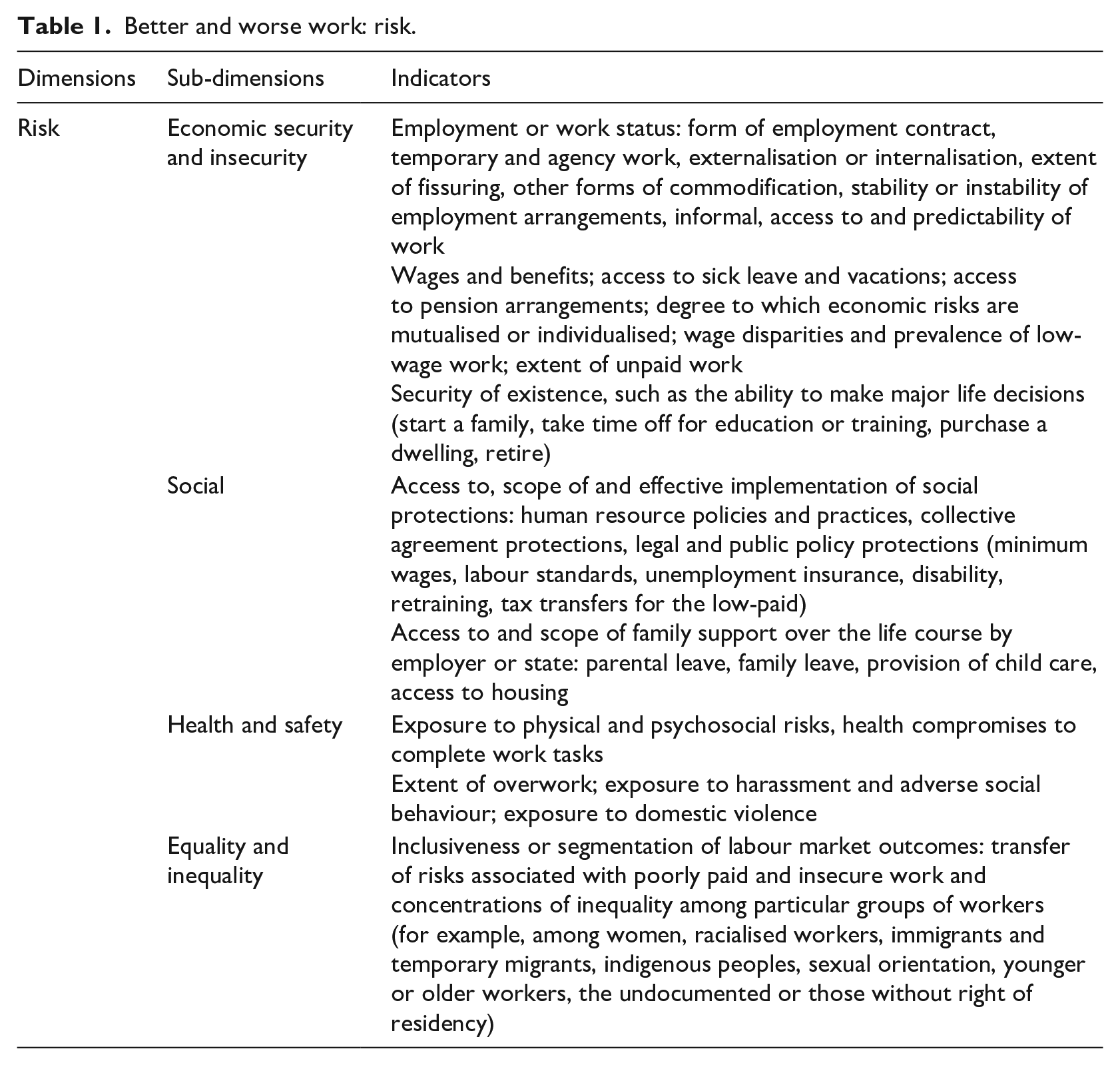
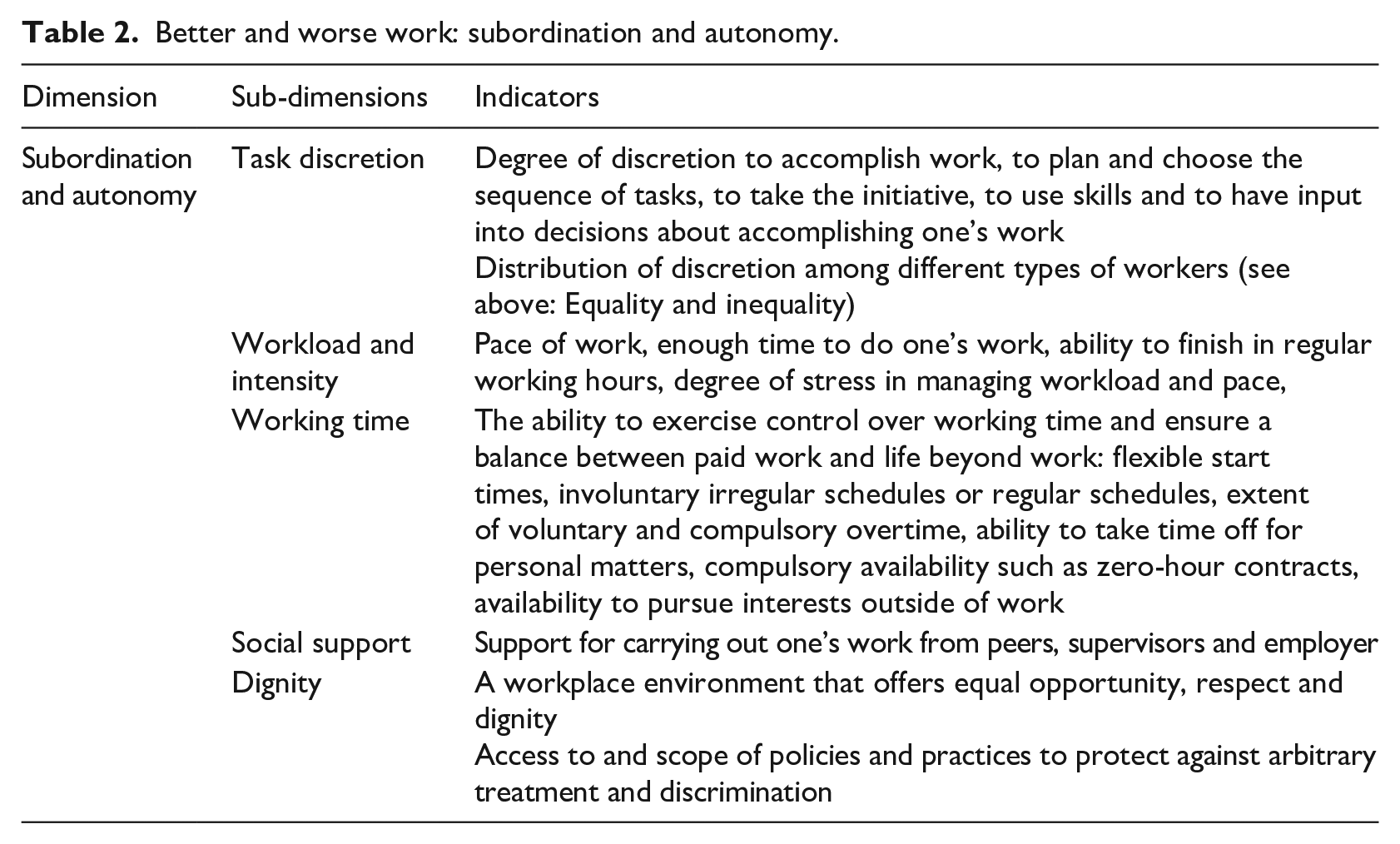
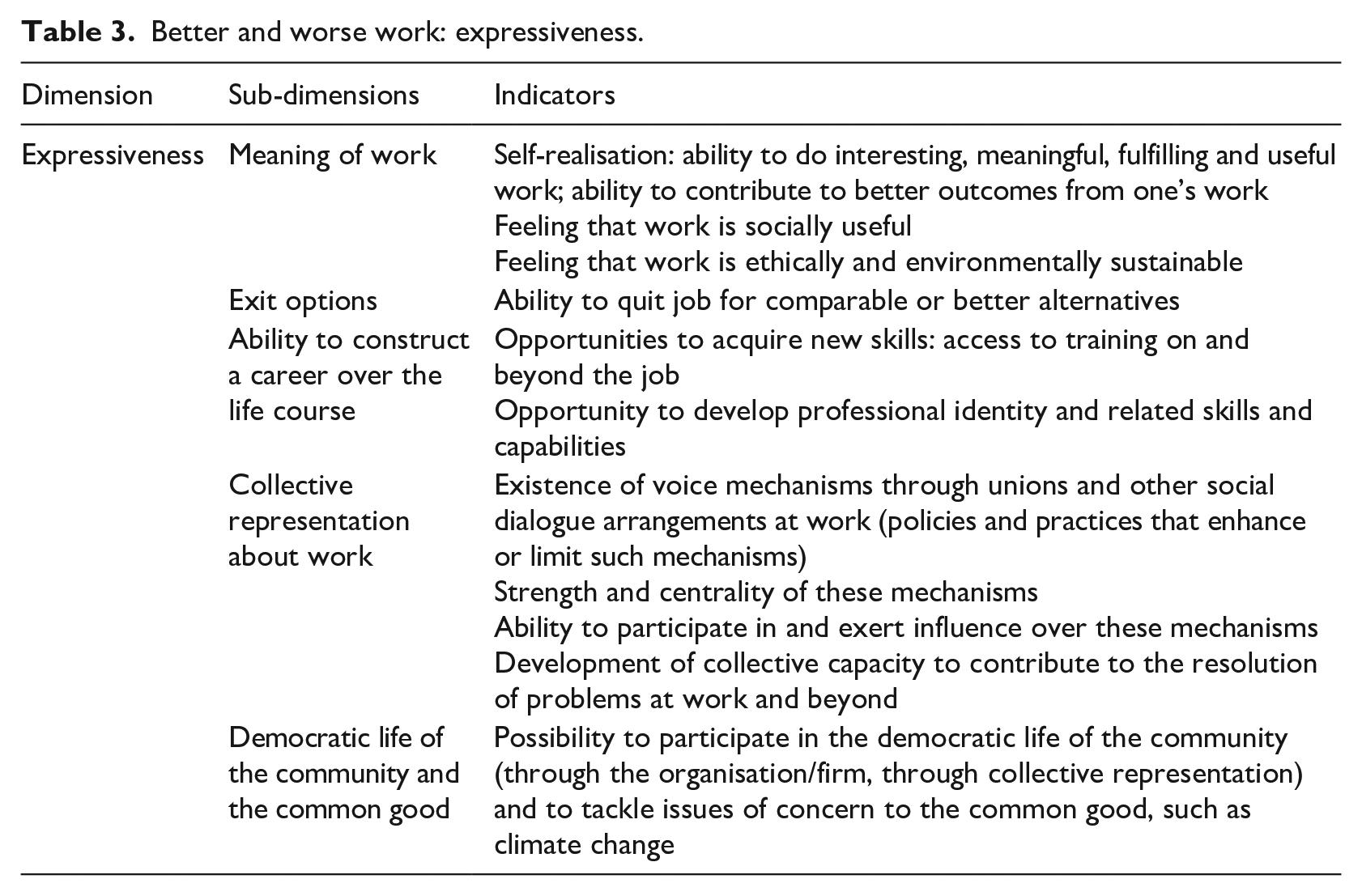
We explore three dimensions of work: risk (Table 1), subordination and autonomy (Table 2), and expressiveness (Table 3). A holistic approach to how these three dimensions come together will help us to understand better work and provide a path towards the collective capabilities needed to achieve broader goals for work in our societies.
Better and worse work: risk.
Better and worse work: subordination and autonomy.
Better and worse work: expressiveness.
Risk
The first dimension concerns the allocation of risk, that is, the nature and extent of the risks workers face. We identify four sub-dimensions: economic security and insecurity, social protection, health and safety, and equality and inequality. For workers, what matters here is how they ensure their physical and psychosocial integrity at work, construct their life trajectories through their work and support themselves and their families. What matter for organisations are the ways in which they fragment or integrate the work experience. For societies, what are important are the ways they individualise or mutualise economic and social risk, leading to greater or lesser degrees of well-being, equality and opportunity.
The contemporary labour market is characterised by rising worker economic insecurity, as experienced through a growing contingent workforce and temporary and low-paid jobs, including unpaid work. Non-standard work arrangements shift various burdens onto individual workers, from zero-hour contracts (under which they must guarantee their own availability with no guarantee of being given any work) to the growth of gig and temporary work, with increasing barriers for those in temporary jobs and widening differences in job quality between social classes (Gallie, 2022). Non-standard employment is characterised by poorer job quality in terms of employment prospects, physical working environment, skills and discretion, and quality of working time (Gevaert et al., 2023). The fissurisation of the firm and the diminished capacities of countervailing actors appear unable to halt or reverse the erosion of traditional work protections (Strauss and Fudge, 2013). The degree of risk is linked to labour market regulation, labour law protections, and social and fiscal policies (Pulignano, 2017). The deregulation of labour markets, the rise of more distended work arrangements through platform intermediation and global value chains, the implosion of archetypal salaried work and the weakening of publicly mandated labour standards, whether on health and safety or employment, have resulted in greater insecurity and wage inequality (Bosch, 2023; Bourguignon, 2015). These trends affect intergenerational opportunities and family well-being (Putnam, 2015), as well as social stability (Streeck, 2014), especially in the absence of collective intermediaries (Freeman et al., 2015).
Social risk concerns access to and the effectiveness of social protection. Social risk might be alleviated or exacerbated by the nature of organisational protections (firm- and industry-levels) through HR policies and collective agreements. It may also be affected by public policy and legal institutional protections through employment and unemployment insurance, disability, access to training and tax transfers, availability of parental and family leave, provision of child care and access to housing (Hacker, 2019; Luce et al., 2014). It is important to assess how social risks and social protection evolve over time and whether they become more individualised or mutualised.
Health risks are at the core of better and worse work. Occupational safety and health focuses on the prevention of harm and injuries related to work and the work environment. Sources of harm include material and environmental hazards, overwork, exposure to harassment, as well as adverse social behaviour or any other form of psychosocial, physical or psychosocial risks. Strong evidence indicates that ‘long-lasting exposure to job strain shortens a healthy life’ (Albin et al., 2022: 236). Hazardous work can be ‘exported’ or transferred to less regulated territories, notably to the Global South (Hudson, 2009). Gendered emotional labour under public sector cutbacks and pandemic-related pressures on service provision take a toll on the well-being of frontline service workers (MacDonald, 2021). Various health and safety risks were further exacerbated by the COVID-19 pandemic (Rosemberg et al., 2021).
It is important to understand how forms of worse and better work are distributed and concentrated among specific groups – to the detriment or benefit of specific groups of workers and types of social relations. The uneven distribution of risks leads to greater inequality (Bourguignon, 2015). Inequalities constellate, as in the case of women workers, young workers in precarious jobs (MacDonald, 2016), migrants in unfree labour (Strauss and Fudge, 2013), and racialised workers (Lee and Tapia, 2021). The intersectional weaving of gender, race and migration status in the most subordinated forms of labour, such as domestic work, provides a telling illustration of such concentrations (Blackett, 2019). Despite the persistence of significant pay gaps, the case for women workers shows that improvements can be achieved (Gallie, 2022). The challenge for firms and markets is to tap into larger, more diverse pools of talent.
Subordination and autonomy
The second dimension of better work concerns the degree of subordination and autonomy experienced by individuals, but also by their families and communities. Sub-dimensions include task discretion, workload and intensity, working time, social support, and dignity. For individual workers, it concerns their ability to exercise control over their lives at work. For organisations, subordination and autonomy are at the heart of their ability to organise work productively and ensure their employees’ adhesion to organisational goals. For societies, it is a question of relative prosperity through the creation of value, but also about ensuring dignity for all through their work.
Task discretion is at the core of work design and the employment contract. Given the indeterminacy of labour contracts (the need to coordinate the ability to work to achieve some sort of outcome), there is a continuous need to activate workers’ physical, mental and emotional efforts (Bélanger and Edwards, 2007). The enduring paradox is that most work cannot be done without a high degree of cooperation, but it is contractually subordinated to managerial control. The effort bargain – the frontier of control – between employers and workers can be formal or informal as regards work organisation, allocation and rewards (Edwards and Hodder, 2022). Studies of job quality rightly focus on key features of job design, including task variety, identity and significance, as well as autonomy and feedback (Hackman and Oldham, 1980). Many digitised work systems now collect huge amounts of data in real time, which is then used to measure employee performance and make decisions, thus reducing the discretion of both workers and frontline supervisors, who are effectively being replaced by algorithms (Gautié et al., 2018; Levy, 2023). But new high-performance work systems and active participation of workers in the organisation of their work also point to the possibility of increased autonomy for many workers (Osterman, 2013; Vidal, 2022).
Workload and intensity refer to the pace of and time spent at work. Contemporary work arrangements often lead to an increase in the number of tasks that must be performed simultaneously, leaving workers with little leeway in the face of tighter deadlines and 24/7 availability (Hassard and Morris, 2022). Technological platforms and the changing organisation of markets and firms have transformed many employees into contractors who remain largely subordinated to those who purchase their services (Weil, 2014). As work becomes increasingly intense, it leads to unhealthy and unsustainable feelings of chronic overload (Kelly and Moen, 2020: 147). Kellogg et al. (2020) highlight how, under algorithmic control, power asymmetries increase and autonomy decreases.
Autonomy also concerns the ability to exercise control over working time and the frontier between paid work and other parts of workers’ lives. The Universal Declaration of Human Rights (Article 24) emphasises ‘the right to rest and leisure, including a reasonable limitation of working hours and periodic holidays with pay’ (McCann, 2010). Abusive working time affects workers’ health and well-being. Employers’ ability to impose involuntary overtime, for example on so-called ‘essential’ health-care workers, is an obvious source of tension. Zero-hour contracts, split shifts, unpaid overtime and wage theft are just some of the abuses that are imposed on the poorest and most vulnerable workers (Hallett, 2018). New technologies such as telework blur the boundaries between work and non-work, with often conflicting implications for women (Hilbrecht et al., 2008).
Social support for one’s work involves the availability of support from a variety of sources (supervisors, co-workers, family members, the community). It can be emotional (empathy and caring), instrumental (provision of resources), informational (availability of information), evaluative (through appraisal, feedback and self-assessment) (Jolly et al., 2021). French et al. (2018) point to the importance of a broad perception of support in the workplace to mitigate conflicts between work and family. The trajectories of many people, especially women taking on care work beyond the workplace, are strongly determined by the availability of social support (Pocock and Charlesworth, 2015).
Dignity is intrinsic to human labour. It is not a commodity and cannot be separated from the person performing the work. Dignity is manifested by respect, the absence of arbitrary treatment and discrimination, and equal opportunities (Davis, 2021), as well as by a living wage, the ability to resist abuse, pride in one’s own work, and democracy and justice (Hodson, 2001: 3). It also implies a sense of self-worth and self-respect and a duty of care towards others in a position of inequality (Martin, 2015: 268–269). Lucas et al. (2017: 1507) distinguish between innate dignity (all individuals are valuable in their own right) and earned dignity (the recognition of the value of individual competencies to an organisation). Dignity is often gendered, in the sense that women tend to experience less earned dignity than men. Workers who experience abuse and discrimination report lower levels of respect and fairness in their jobs (Roscigno et al., 2021: 592–593). The #Metoo and Black and Indigenous Lives Matter movements have highlighted the profound impacts of bullying and harassment on the well-being of racialised and LGBTQIA+ workers (Areguin and Stewart, 2022; Wang and Brewster, 2020).
Expressiveness
The third dimension of better work, expressiveness, concerns the meaning of work, exit options, the possibility of constructing a career over the life course, worker voice and collective representation in relation to work, and the contribution of work to the democratic life of the community and the common good.
The meaning of work is a rich, multidisciplinary area of study concerning how employees find meaning in their work and the roles it plays (whether providing merely a paycheck, a higher calling or just something to do) (Rosso et al., 2010). For Ferreras (2017: 84), even the most unfulfilling and exhausting jobs may have an ethos: ‘being included, being useful, being independent, doing interesting work’. While individuals express a range of attitudes towards work (Osty et al., 2013), aspirations to meaningful work potentially inhabit a wider emancipatory space, mobilising intelligence, capacity, creativity and pride. This is what Budd (2004) labels the ‘human face’ of work. Citing Dejours (1993), Coutrot and Perez (2022: 20) identify three key aspects: achieving goals, expressing values in the social world, and self-fulfilment. The importance of low-wage frontline jobs during the COVID-19 pandemic and the carbon footprint of jobs are indicative of changing assessments of the meaning of work.
Exit options refer to the ability to quit a job for comparable or better alternatives, but also the extent to which workers are invested in their current jobs. This notion helps to explain why, to draw on Hirschman (1970), voice is as important as exit. Studies of why people leave their jobs is often limited to their desire to move (dissatisfaction versus satisfaction) and the perceived ease of movement (Judge et al., 2017). But exit options are also grounded in workers’ embeddedness or self-investment in their work. Swider et al. (2011: 433–434) identify three aspects of this embeddedness: links (formal or informal ties to institutions, issues or other people), fit (compatibility with an organisation or community), and sacrifice (benefits forfeited by leaving). In a study of low-skilled service work, for example, Ellingson et al. (2016: 130–131) refer to the importance of social ties in improving the work environment and predicting people’s intention to quit.
The ability to build a career over the life course is related to the acquisition and expression of skills through access to training on and off the job. The development of talents and skills is linked to greater self-realisation and professional identity. The collective recognition of skills can create a common identity. Lifelong learning refers to the ability to learn and develop a range of adaptable skills and competences over the life cycle (Schmid, 2017). Skills have multiple meanings, ranging from requirements for the job to more transversal skills, such as numeracy, literacy and a capacity to solve problems and intervene in democratic spaces. Høyrup (2010) illustrates how organisational learning generates employee-driven innovation. Skill acquisition helps workers to construct their life trajectories; so that access to new skills through their occupation, status within a firm, or institutional arrangements, contribute to better work.
Collective representation refers to voice mechanisms, through trade unions and other social dialogue arrangements that enable effective worker participation and influence in decision-making. The strength of these mechanisms is important, as is the development of a collective capacity to contribute to problem solving at work and beyond. Work is more likely to be expressive when workers can assert their basic rights and participate in decisions that affect them. The weakening of publicly mandated voice and representation highlights the democratic deficit and power imbalances characteristic of workplaces and the challenge for collective actors to develop new capabilities (Ferreras et al., 2020) and assume new roles in the re-regulation of work (Kristensen and So Rocha, 2012). Knudsen et al. (2011) emphasise the importance of moving beyond pseudo forms of participation, because genuine worker participation and democratic voice exert such a positive impact on the psychosocial well-being and the work environment (Bellego et al., 2023). Behrens and Pekarek (2023) emphasise how, in the context of the COVID-19 pandemic, works councils in Germany were able to expand their protective repertoires to address key questions about job loss, work-life balance, and training and professional development. In the context of technological and climate change, effective participation in tackling power imbalances and achieving democratic change appears to be an essential aspect of better work (Bosch, 2023; Bosch and Schmitz-Kießler, 2020; Simms, 2022).
The expressive dimension of work also concerns workers’ possibility to participate in the democratic life of the community and address issues for the common good. This is a question of ethics and social responsibility at the individual, organisational, occupational and societal levels. The relevance of work might be expressed in terms of the welfare of others, as in care work and those undervalued workers whose indispensability and social usefulness were so starkly revealed by the COVID-19 pandemic (Méda, 2022). It could refer to new forms of transformative organisational democracy (Battilana et al., 2022), epistemic communities through occupational identities that transcend the workplace (Dukes and Streeck, 2022), community prosperity and new union roles to achieve that prosperity (Kristensen and So Rocha, 2012), or planetary sustainability for which the organisation of work is likely to be so important (Éloi and Pochet, 2016). At the societal level, this expressive dimension of work also refers to the extent to which citizens and stakeholders are democratically engaged (Fung and Wright, 2003), can access collective representation (notably through trade unions, themselves subject to democratic transformation (Hyman, 2016), and can contribute to the democratic life of the community and its common good. This is grounded in the ‘face-to-face’ relations of deliberative democracy (Estlund, 2000). Also central is what Wright (2013) identifies as real-world experiments to deepen democracy through new forms of social empowerment and visions of transformative emancipatory alternatives to existing organisations and institutions.
Worker strategies and experimentation for better work
The framework advanced here aims to facilitate our understanding of how workers (and actors) navigate constraints and opportunities by making trade-offs. While workers experience varying degrees of economic and social risk, better work is likely to involve some collectivisation of that risk. Workers make trade-offs between types of risk (a higher wage but weaker provision for old-age security) or between risk and expressiveness (less security but more meaningful work). When state policies and actor strategies collectivise risk through collective bargaining and organisational policies, precarious jobs might be less of an issue. The absence of protections exacerbates the individualisation of risk, resulting in worse work. Different types of risk are as likely to cluster together on all sub-dimensions; the notion of choice then appears nonsensical, giving way to clusters of bad work through sheer constraint.
Autonomy is essential for better work. Changes in work organisation that limit task discretion, increase workload and intensity, reduce control over working time, decentre social support and result in less dignity tend to foster worse work. Virtuous circles of greater task discretion, manageable workloads, ability to manage working time, evidence of social support, and a work environment that encourages dignity are associated with better work.
More expressive work is better work, although many current forms of disruption clearly operate in the opposite direction. Better work entails a combination of different facets of expressiveness: more meaningful work; the ability to enhance skills and develop a career over the life course; effective voice at work; and democratic commitment to the common good of their employing and representative organisations, their communities and their societies. Variegated trade-offs may include simply getting by (on instrumental attachments to work, see Méda, 2015), or building an identity at work on the basis of self-fulfilment and self-expression, whether through skills, influence on work organisation, or contributions to social and environmental sustainability. Institutions and collective labour actors are essential ingredients in better work, as institutional legacies can enhance or diminish the meaning of work, skills development, collective voice, and democratic contribution to the common good. As workers and their communities navigate change, the expressive dimension of work offers an opening to transformative opportunities.
The impact of technological change in the form of algorithmic control and robotics on semi-skilled manufacturing jobs provides a good example of the growing importance of the expressive dimension of better work. By increasing routine tasks and reducing opportunities for workers to develop and mobilise their skills, it is questionable whether such jobs can generate meaningful and skill-enhancing work any longer. But although standardisation may reduce the proportion of meaningful jobs, subjective knowledge and experience of the work process are still important (Bellandi et al., 2020). Key means of achieving better work include the acquisition of new skills and access to training, so that, as jobs are recrafted, workers can regain control and expand their voice over emerging technologies (Yudken and Jacobs, 2021).
This highlights the interconnectedness of the different dimensions of better work. The implementation of technological change in a way that leads to greater worker autonomy and skills is more likely if strong unions are involved in negotiating high-performance work systems (Gautié et al., 2018; Rutherford, 2021). Through the creation of industrial clusters, research organisations, training centres and other institutions, public policy can also create new spaces and opportunities for actors, particularly trade unions and firms, in coalition with other actors, to embrace deliberative processes and collective decisions about their trajectories and how to make work better (Bosch and Schmitz-Kießler, 2020; Garneau et al., 2023; Pulignano et al., 2023). Garneau et al. (2023) emphasise that whether trade unions view the trade-off between employment, skills and autonomy as a threat or an opportunity depends on their experience and trust in their institutions.
The emergence of telework also exhibits potential trade-offs. While new job opportunities arise in working remotely (Gallardo and Whitacre, 2018), the infrastructural costs of remote work are often borne by the workers themselves (Jaakson and Kallaste, 2010), who must also contend with new ergonomic risks (Buomprisco et al., 2021). These workers may enjoy greater autonomy, but the boundaries between work and leisure time are blurring (Lambert et al., 2020) and workers are increasingly subject to forms of digital monitoring previously beyond managerial control (Sewell and Taskin, 2015). The reduction in face-to-face social contact is also changing the way work is done and may reduce its meaningfulness (Maillot et al., 2022), but there are also new opportunities for solidarity, collective action and representation (Öngün and Yon, 2021), notably through organisational creativity and the emergence of new grass-roots organisations (Vandaele, 2021).
Unions face new bargaining challenges due to the blurring of boundaries between work and non-work time and digital surveillance. They face representational challenges when trying to connect with dispersed workforces. While traditional union activism relied on physical presence for meetings at times and in spaces often incompatible with caring responsibilities (Greene and Kirton, 2003), new technologies offer the potential to reach underrepresented groups and experiment with self-regulation strategies. Public policy is also variegated. Some states avoid intervention altogether or adopt the barest of protections for a grey zone of worse work located somewhere between employment and self-employment (Stewart and Stanford, 2017). Others espouse new forms of standard-setting: recalibrating occupational health and safety legislation for new physical and psychosocial risks, and adapting social and fiscal policies to accommodate new working arrangements.
Conclusions
Disruptive change is leading to the re-regulation of work and employment. These dynamics are often at odds with aspirations to better work. We have argued that it is possible to identify key features of better work: productive, innovative, healthy and inclusive work, in which workers are free from excessive insecurity, from unaccountable control over their working lives, and from conflicts between personal and professional lives, and in which they can find meaning in their work and express their voice individually and collectively, at the workplace and beyond.
As modes of governance of work are reordered, the challenge is to better understand how these different dimensions of work interact and their consequences for better and worse work. A more holistic view is needed of what might make worse work better. The framework advanced in this article allows for a transformative, yet normative understanding of some of these possibilities.
While the job quality literature provides invaluable insights, it can be static, overly aggregated and often conservative in its aspirations. Reflecting the complexity of work itself, our understanding of better work must be multi-dimensional, multi-level and interconnected.
It is imperative to examine how workers navigate and recombine the different dimensions of better and worse work, sometimes as an opportunity, often as the result of constraints. Some may accept a higher degree of risk in order to better manage their working time, engage in more meaningful work, acquire new skills or construct a work-life trajectory over the longer term.
The objective of this text is not to develop specific measures but rather to explore how we might approach the integration of objective, subjective and normative understandings of work. This points to the importance of a practical strategic agenda. If disruption leads to experimentation, then workers and unions, employers and the state need to explore these possible combinations and their implications for work. The focus must be on what initiatives make work better, how and why.
It also entails a definitive shift from jobs to work, and from job quality to better work. Better work then becomes more aspirational, more forward-facing, more connected to the expectations embedded in society itself.
Ultimately, the pursuit of better work extends to building a better society. Better work paves the way to more just, peaceful, sustainable, open and democratic societies. Hyman (2016: 22) issued a call in this journal for an imaginative, even utopian, counteroffensive involving a persuasive vision of a different, better society and economy based on a set of values that connect with everyday experiences in the workplace. The core normative challenge is to make work better. The analytical framework presented here aims to respond to this challenge by providing a practical way of analysing key dimensions of better and worse work and sketching out some of the possibilities for moving from worse to better.
Footnotes
Acknowledgements
We would like to thank the many researchers for their contributions to ongoing discussions around experimentation for better work, as well as the anonymous referees, Transfer editors for their insightful comments.
Funding
The CRIMT Partnership on Institutional Experimentation for Better Work is supported by grants from the partnership program of the Social Sciences and Humanities Research Council of Canada (SSHRC) and the Regroupements stratégiques program of the Fonds de recherche du Québec – Société et Culture (FRQ-SC) and contributions from participating partner centres and researchers.
