




Abstract
Ways of strengthening workers’ voice within multinational companies, especially with regard to cross-border restructuring, have been much discussed in recent years. Research shows that European Works Councils (EWCs) are not always informed and consulted in a timely or comprehensive manner, limiting and sometimes entirely preventing employee representatives from exercising early and coordinated influence at transnational level. Against this backdrop, one might ask whether access to bodies such as supervisory and administrative boards, in which economic and strategic decisions are taken, can make a difference to transnational employee representation. Little is known, however, about how institutions for transnational information and consultation are linked to board-level employee representation. This article aims to fill this research gap by analysing the different modes of horizontal articulation between SE Works Councils and board-level employee representation within European Companies (Societas Europaea). Building on evidence from case studies, we identify a number of different modes of articulation and highlight how articulation rests mainly on and is sustained by the overlapping roles of the individuals involved and the holding of multiple mandates.
Introduction
This article deals with the articulation between two EU-level spheres of employee representation and participation: transnational information and consultation, on the one hand, and, on the other, board-level employee representation in European Companies (Societas Europaea or SE), a supranational legal company form based on EU law. The legal framework for SEs consists of two intertwined parts, the European Company Statute Regulation and the supplementary Directive on employee involvement. As with the EWC Directive, the SE Directive is based on a procedural mode of regulation that gives primacy to negotiations between management and a ‘representative body’ of employees, the Special Negotiation Body (SNB), at company level (see Gold and Schwimbersky, 2008 for an overview of this instrument’s long and contested history).
A unique feature of the SE Directive is that it contains provisions not only on transnational information and consultation but also on board-level employee representation, thus generating two transnational action fields for employee representation at European Companies. This means that employee representatives from different Member States are not only informed and consulted on cross-border matters – as also provided for by the Directive on European Works Councils (EWC) – but, if present on the SE’s supervisory or administrative board, can also participate in corporate decision-making and the exercise of control over management that is characteristic of two-tier corporate structures. Overall, this raises the question of whether and how the information and consultation rights of SE Works Councils are articulated with board-level employee representation in these settings and how this affects employee representation at transnational level.
It has long been debated how workers’ voice can be strengthened within multinational companies, especially with regard to cross-border restructuring like the relocation of company sites or investment and divestment decisions. This question is of the utmost importance for trade unions within the context of an increasingly internationalised economy with a growing number of multinational companies. Existing EWC rights, however, are limited to information and consultation and the relevant bodies often show a fairly limited capacity to influence managerial decision-making (De Spiegelaere et al., 2022). Thus, board-level employee representation could be regarded as an institutional power resource, enabling early access to strategic information and possibly offsetting the limitations of transnational information and consultation (see also Hoffmann et al., 2015). Analysing the linkages between board-level employee representation and transnational information and consultation is therefore crucial for identifying the potential for transnational employee representation within multinational companies.
While interaction and coordination between the various institutions and actors of employee representation at local, national and European level have been the subject of extensive research (see, for example, Haipeter et al., 2019; Müller et al., 2004; Pulignano, 2017; Waddington, 2011) much less is known about how linkages function between board-level employee representation and other institutions and actors (Rosenbohm and Haipeter, 2019; Waddington and Conchon, 2016). Although previous research has highlighted linkages between board-level employee representation and other actors and institutions both within and outside companies, such as works councils and trade unions (Carley, 2005; Gold, 2011; Waddington and Conchon, 2016), as yet there has been no systematic analysis of the underlying processes – for example, how these links emerge and how they are configured in practice – especially with regard to transnational information and consultation.
We aim to fill this gap by investigating the articulation of transnational information and consultation and board-level employee representation in SEs. Moreover, we will explore whether this opens up new opportunities for employee representatives at transnational level. We concentrate on SEs as these offer a unique institutional structure involving two transnational action fields, with board-level employee representation no longer based on national law but, like SE Works Councils, resting on a transnational company agreement. The analysis is informed by the following research questions. First, what articulation patterns can be identified between SE Works Councils and board-level employee representation and how are these action fields of employee representation interlinked? In short, what will opening up the ‘black box’ of this interaction reveal in terms of possible modes of horizontal articulation? Secondly, how are the resources of the two action fields – SE Works Councils and board-level employee representation – combined and rendered usable for transnational employee representation? Overall, the study aims to complement existing research on the vertical articulation between the local, national and European levels (Haipeter et al., 2019; Müller et al., 2004) and, consequently, to contribute to a better understanding of the multi-level system of European industrial relations (Marginson and Sisson, 2006).
The article proceeds as follows. We begin by reviewing some findings from the literature, highlighting the fact that links between board-level employee representation and transnational information and consultation bodies such as EWCs or SE Works Councils remain largely unexplored (Section 2). Next, we outline the theoretical considerations framing our analysis (Section 3), followed by our methodology (Section 4), before presenting our findings from case study research (Section 5). We conclude with a discussion of the results and pinpoint some key implications for further research.
Literature review
In recent decades, research on transnational employee representation has generated a wide range of insights into the structures and operation of actors and institutions. Much of this work has been devoted to EWCs and has been aimed at understanding this first European institution for cross-border employee representation. A core question for scholarly debate on EWCs has been how effective they are and whether they are able to influence managerial decision-making (for an overview see Hann et al., 2017). The evidence points to substantial variations on this issue. While some EWCs have advanced well beyond the rights stipulated in the EWC Directive and, for example, act as negotiating partners for management, others are little more than ‘symbolic’ (see Hauser-Ditz et al., 2016; Kotthoff and Whittall, 2014; Lecher et al., 2001). Moreover, quantitative studies indicate that while EWCs are frequently informed, they are rarely consulted (De Spiegelaere, 2021; De Spiegelaere et al., 2022; Waddington, 2011), suggesting that EWCs have acquired only a rather limited capacity to influence managerial decision-making. This is also linked to the fact that EWCs are not always informed and consulted in a timely or comprehensive manner, limiting and sometimes entirely preventing employee representatives from exercising early and coordinated influence at transnational level (Carley and Hall, 2006; Voss, 2016; Waddington, 2011). This finding was emphasised by a recent survey of EWC members, according to which only a minority indicated they were generally informed and/or consulted before final managerial decisions are taken and only a minority saw EWC plenary meetings as an effective means of influencing such decisions (De Spiegelaere et al., 2022: 99–100; 105–107).
The effectiveness of EWCs as representative bodies has been ascribed to a wide range of factors, including their interactions or relationships with other actors (management, unions, national-level employee representation) (Lecher et al., 2001); structural factors, such as management structures (Marginson et al., 2004); and the degree of alignment between company and EWC structures (Hauser-Ditz et al., 2016). Other studies have stressed the significance of management attitudes towards EWCs in determining their effectiveness (De Spiegelaere, 2021; Pulignano and Waddington, 2020). Although links to national arrangements for employee interest representation have been noted as relevant, as yet there has been no explicit reference to the role of board-level employee representation. Whether access to bodies such as supervisory and administrative boards, where economic and strategic decisions are taken, can make a difference to transnational employee representation, and whether this is linked to the activities of transnational information and consultation bodies such as EWCs or SE Works Councils thus remains largely unexplored. And while Waddington and Conchon (2016) showed that articulation between board-level employee representation and other actors and institutions of employee representation can play a positive role in articulating employee interests within the board, the fact that they focus specifically on the board level, asking how other actors or institutions might support board-level employee representatives, leaves a gap in our understanding of how a presence in board-level employee representation might, in turn, support information and consultation at transnational level. First results of the EWC survey, however, point towards such mechanisms, as EWC members who communicate with board-level employee representatives reported more effective EWC functioning (Lafuente et al., 2022).
Existing research on employee representation in SEs has focused mainly on negotiation processes and outcomes (for example, Keller and Werner, 2012; Rehfeldt et al., 2011; Rosenbohm, 2014). For the German context, previous research has shown that in some cases this supranational corporate legal form was adopted shortly before the company reached the employee threshold for German co-determination (Rosenbohm, 2014). In effect, this has allowed for a pre-emptive escape from co-determination, in which the existing level of co-determination is either ‘frozen’ in its current form or avoided entirely (Keller and Rosenbohm, 2020; Keller and Werner, 2012).
Nonetheless, recent research has also provided some first impressions of how SE Works Councils and board-level employee representation operate. Based on case study findings, Fiedler et al. (2021) concluded that the dual role of SE Works Council members, who are also simultaneously works council and board-level representatives, promotes and sustains mutual trust and cooperation between managers and employees. Other insights are provided by Waddington and Conchon (2016), who, based on a survey of board-level employee representatives including SE representatives, examined the form and functions of employee representation at board level in Europe. With regard to SEs, two results are worth mentioning. First, Waddington and Conchon (2016: 129) found that employee representatives in SEs – more than 80 per cent of their respondents of SEs sit on the board of an SE headquartered in Germany – assessed their scope for exerting influence on corporate restructuring decisions in similar terms to representatives of companies incorporated under German or Austrian law. On the one hand, around 34 per cent of the SE representatives reported that they were ‘not very influential’ or ‘not at all influential’ compared to 35 per cent from other companies of the ‘Germanic cluster’. On the other hand, around 33 per cent of SE representatives regarded themselves as either ‘very influential’ or ‘influential’. This resembles the proportion mentioned by representatives of companies incorporated under German or Austrian law. Secondly, their findings highlighted the close individual connections between SE Works Councils and board-level employee representation in SEs. For example, some two-thirds of employee representatives on SE supervisory or administrative boards stated that they were also members of an SE Works Council, compared with just 8 per cent of board-level representatives in other companies who indicated they were also members of an EWC. The survey did not include any further information on the specific interactions between SE Works Councils and board-level employee representation, however. In this respect, we still do not know precisely why such personal connections exist within SEs and whether they contribute to a continuous cooperation between both action fields.
Horizontal articulation of action fields: linking transnational information and consultation with board-level employee representation
Employee representation in multinational companies is embedded in a highly complex multi-level system embracing a wide range of representation levels and actors. Drawing on Giddens’ theory of ‘structuration’ (Giddens, 1984) and the theory of strategic action fields (Fligstein and McAdam, 2012), we view the different levels of interest representation in multinational companies as action fields (see also Haipeter et al., 2019). While studies so far have focused mainly on the vertical interaction of employee representation at local, national and transnational level (Haipeter et al., 2019; Pulignano, 2017), in this article we concentrate on a specific aspect of this multi-level system, namely the links between SE Works Councils, on one the hand, and board-level employee representation on the other. We refer to this as articulation, a term that has been used in a variety of contexts in industrial relations research.
Following Crouch (1993), the term is used for the analysis of collective bargaining. In this context, Heery and Noon (2008) note: ‘[Articulation] is a term used in academic industrial relations to refer to the integration of trade union activity or collective bargaining at industry and local levels of the industrial relations system. For example, bargaining could be described as articulated if framework agreements negotiated at industry level contain opening clauses that allow further negotiations on specific topics at enterprise level’ (see also Marginson, 2015). The term has also been used for the analysis of transnational employee representation in multinational companies, with a particular focus on links between EWCs and other actors and institutions of employee representation (Eurofound, 2015; Waddington, 2011). In this context, articulation refers to the links between different actors and institutions of employee representation at different levels, both within and outside companies (see also Haipeter et al., 2019; Waddington and Conchon, 2016). And with regard to European and national levels of social dialogue, articulation is defined as ‘the establishment of cohesive interrelationships both vertically (between European, national, sectoral and company levels) and horizontally (between different countries and/or sectors and/or subsidiaries of the same multinational)’ (Eurofound, 2018: 4). Hoffmann et al. (2015: 63) also distinguish between these two forms of articulation, defining vertical articulation as the links between information and consultation at national and European level, and horizontal articulation as the links between transnational information and consultation and board-level employee representation. Based on these considerations, we refer to the linkages between SE Works Councils and board-level employee representation in European Companies as horizontal articulation.
Analytically, we distinguish three aspects of horizontal articulation: (i) individual overlaps across the two action fields: actors may be members of both the SE Works Council and the supervisory board, and we analyse the nature and significance of these overlaps. (ii) Communication and information exchange: how do actors in the two action fields interact with each other and what kind of information exchange can be observed? Focusing on this aspect is relevant because information can be seen as a prerequisite for developing a common strategy towards management. Finally (iii), we analyse the extent to which the actors combine the resources from both action fields. In particular, we investigate whether board-level employee representation is used as an institutional power resource for employee representation at transnational level.
Methods
The study builds on company case studies that offer in-depth insights into the horizontal articulation between SE Works Councils and board-level employee representation. Such a focus inevitably means restricting the research to a limited group of SEs with comparatively developed structures of transnational employee representation. The spectrum of employee involvement in European Companies is much more diverse, however (ETUI, 2021; Rehfeldt et al., 2011; Rosenbohm, 2014). Many SEs have not yet implemented transnational information and consultation procedures and others have set up only an SE Works Council. In quantitative terms, SEs with SE Works Councils and board-level employee representation are still in the minority (ETUI, 2021).
According to the European Company Database (ECDB) of the European Trade Union Institute (ETUI), there were 3392 SEs in the EEA in November 2021 (ETUI, 2021). Of these, around one-fifth (642 SEs) have so far been identified as so-called ‘normal SEs’: that is, they conduct business operations and employ more than five employees. The other group contains so-called ‘shelf SEs’, which were set up without any operations or employees, but also SEs with very few employees and SEs where precise information is lacking (see for more details Stollt and Kelemen, 2013). Currently, SEs are registered in 28 of the 30 EEA countries, but with a highly uneven distribution (see also Keller and Rosenbohm, 2020): more than 80 per cent of all existing SEs are registered in Czechia and Germany. This skewed distribution becomes even more apparent when considering only ‘normal SEs’, 56 per cent of which (395 SEs) are registered in Germany.
Of the 642 normal SEs identified, 171 currently have a body or procedure for information and consultation on cross-border matters (ETUI, 2021). There are 77 SEs with both an SE Works Council and board-level employee representation (ETUI, 2021). If board-level employee representation has been agreed on during the negotiations between management and employee representatives, the concluded agreements always contain provisions on transnational information and consultation as our analysis of SE agreements shows. The discrepancy between the number of SEs in which the employees have only information and consultation rights at European level and the number of SEs in which there is also board-level employee representation can be explained by the fact that such representation is not mandatory for all SEs. The ‘before-and-after-principle’ of the SE Directive protects only rights that existed before the establishment of the SE, not for all such companies (see for details Gold and Schwimbersky, 2008; Keller, 2002). In the remaining cases, no form of transnational employee representation has been agreed on because the negotiations were either not commenced or terminated by the special negotiating body or not initiated at all. The latter option is particularly evident for the activation of so-called ‘shelf SEs’ (Keller and Rosenbohm, 2020).
Of these 77 European Companies, 66 (86 per cent) are currently headquartered in Germany (ETUI, 2021). One-third of these German-based SEs provide for board-level representation on a parity basis (that is, equal numbers of employee and shareholder representatives), while in the other cases a non-parity form exists, mainly one-third employee participation.
The SE offers scope for employee board-level representatives to be drawn from countries in which the company operates. Depending on the provisions stipulated in the SE agreement, such an international composition may be guaranteed, be possible or be excluded. Apart from a few cases in which it is stipulated simply that the SE Works Council itself decide, seat allocation is often based on proportionality (Lafuente, 2019). Other allocation rules exist, however. Sometimes an SE agreement will stipulate that the seats be allocated to certain countries or that employee representatives must represent a certain number of countries. The SE agreements foresee a diverse set of rules on how board-level employee representatives are nominated, appointed or elected. Quite often, multi-level procedures are mentioned, in which different actors – the workforce, national representative bodies, the SE works council or the annual general meeting of shareholders 1 – are involved (Lafuente, 2019). Following national transposition laws, some SE agreements reserve certain seats for full-time trade union officials of unions represented in the company. For instance, this is the case for German-based SEs with parity co-determination. These representatives are usually nominated by German trade unions, in some cases explicitly based on a European mandate from the European Trade Union Federations.
Our sample comprises seven SEs with headquarters in Germany. Case selection was based on the following criteria. First, the sample was restricted to SEs headquartered in Germany. This appears reasonable because the vast majority of companies with SE Works Councils and board-level employee representation have their registered office in Germany (see above; ETUI, 2021). Moreover, this also holds the legal and institutional framework constant as all SEs with a registered office in Germany are subject to the same national transposition law. Secondly, only companies operating as an SE for several years were included because we can assume that articulation practices will develop only after a certain period of time. Thirdly, the sample included companies with different types of board-level employee representation (parity and non-parity) and differing degrees of internationalisation in terms of the national origins of employee representatives on the supervisory board in order to take account of any resulting differences in articulation patterns. Our sample cannot be considered as statistically representative, however, rather, the aim is to gain exploratory insights into the horizontal articulation between SE Works Councils and board-level employee representation. Finally, the sample included firms in both manufacturing and private services. Table 1 provides an overview of the case study sample.
Case study sample.
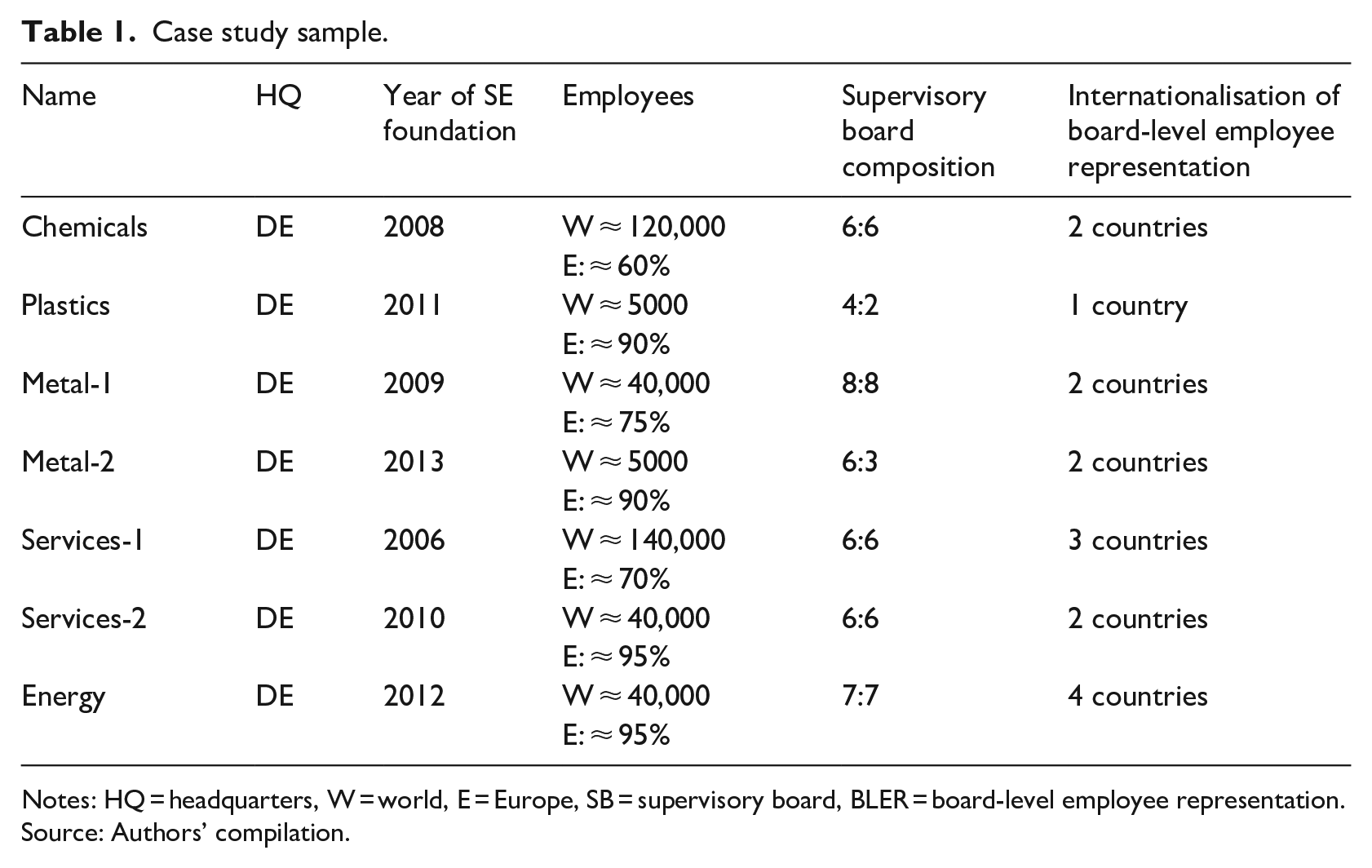
Notes: HQ = headquarters, W = world, E = Europe, SB = supervisory board, BLER = board-level employee representation.
Source: Authors’ compilation.
All the sample companies had been operating as an SE for at least six years; in four cases, experience with this legal form extended back over 10 or more years. In five cases (Chemicals, Plastic, Services-1, Metal-1, and Energy) the SE Works Council had replaced a previous EWC, while the other two companies had not set up an EWC before, although they fell within the scope of the EWC Directive.
Our data were derived from 35 semi-structured interviews with employee representatives on supervisory boards, including external trade union representatives, members of SE Works Councils who were not board-level representatives, trade union experts and, in some cases, management. Supervisory board members are bound by an obligation of confidentiality, however. The interview situation is therefore always influenced by what such members are permitted to report to an external person about their activities. The sample included home country representatives from Germany, as well as representatives from other European countries. All interviews were transcribed and analysed using thematic coding (Schmidt, 2013).
Empirical findings: horizontal articulation in practice
Individual overlaps
Individuals had roles in both action fields in all the sample companies. Neither the SE Directive nor SE agreements require employee representatives on the supervisory board also to be members of the SE Works Council. The individual overlaps between the action fields do not therefore result from any formal requirements but have developed in practice. Our analysis reveals considerable differences in the extent of those overlaps (see Figure 1).
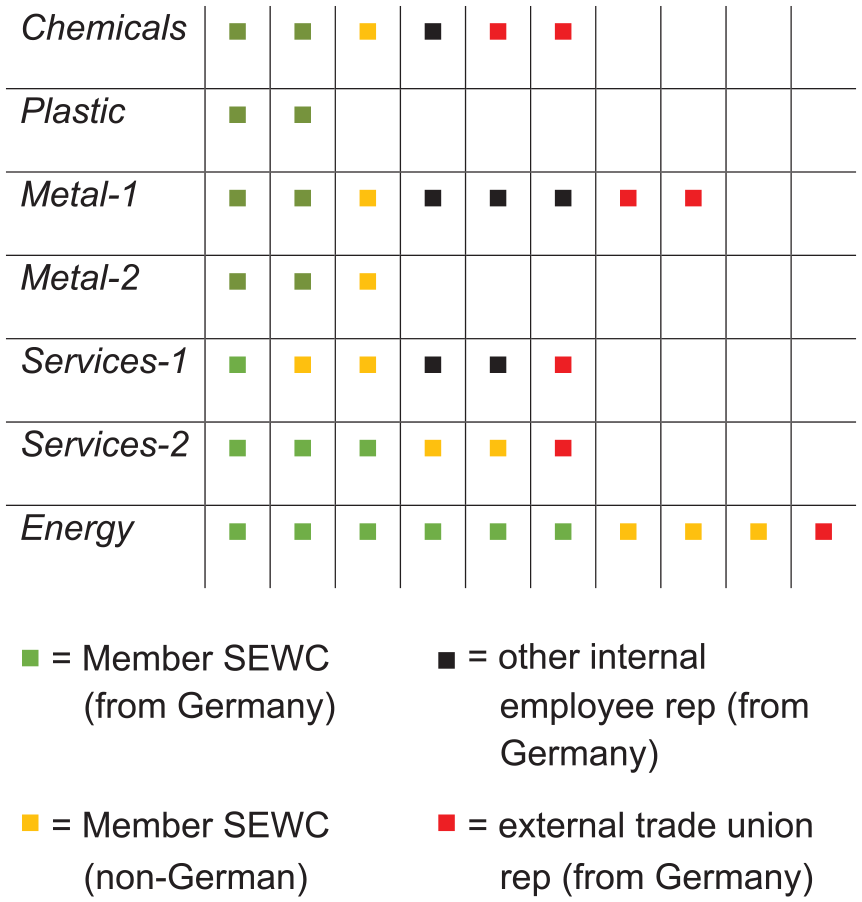
Composition of board-level employee representatives.
In case of Plastic and Metal-2, the two companies in our sample with one-third employee board-level participation, all the board-level employee representatives were also members of the SE Works Council, resulting in a 100 per cent overlap. In the other cases, where parity co-determination operated, the situation was somewhat different, as external trade union representatives, who are not employees of the company, cannot become regular SE Works Council members because this is confined to employees.
In four out of the seven firms in our sample, an international composition was always guaranteed. In the case of Chemicals and Services-1, seat allocation was based on the D’Hondt method, under which it was guaranteed that the final seat will be allocated to any country not yet represented. The SE agreement at Services-2 provided for an allocation to certain countries – in this case the two with the highest number of employees – and at Energy it was agreed that at least three different countries had to be represented, to be determined by the SE Works Council. An international composition was also provided for at Metal-1 and Metal-2, although not guaranteed unconditionally. Only at Plastic did the agreement not provide formally for any form of international representation for the employee side of the board.
One consistent pattern among the non-German board-level representatives was that they were all recruited from within the SE Works Council (see Figure 1). This seems to be linked to the role of the SE Works Council in the election or appointment of board-level employee representatives. In all the companies in our sample, the SE Works Council was actively involved in this process and played a key role in these appointments – either by directly appointing or electing board-level employee representatives or by confirming national proposals – which means that the election or appointment of board-level representatives becomes an issue that the SE Works Council has to engage with. One consequence is that for board-level representatives the right to vote is no longer the exclusive prerogative of German-based employees but extends, through the SE Works Council’s involvement, to representatives from other European countries. Overall, this marks a key difference from EWCs, which have no equivalent competences, and which are not usually concerned with the nomination or election of board-level representatives in German-based companies (Rosenbohm and Haipeter, 2019). According to our interviewees, the SE Works Council’s competencies on this issue constitute a marked ‘upgrade’ compared with the competencies of conventional EWCs.
People who are members of both the supervisory board and the SE Works Council hold central positions within the latter. They act as chairs, deputy chairs or members of the executive committee. In every company in our sample, the chair of the SE Works Council was also a member of the supervisory board; in two cases this individual also served as a deputy chair of the SE supervisory board. These personal ties serve as a proven method for linking the two action fields to ensure a good flow of information.
Senior people in the works council bodies are also members of the supervisory board. This is simply to improve the flow of information. That’s the most important thing from my point of view, that the information flows better. (Services-1_DE-1)
2
We [the group of board-level employee representatives] have two non-German colleagues who belong to the steering committee of the [SE Works Council], so we actually have a very close link between the employee bench in the SE supervisory board and the SE Works Council. [. . .] They are both deputy chairs of the SE Works Council and in that sense we have, so to speak, a very close connection. And the topics that are exchanged in the SE Works Council are then transported by us to the supervisory board. (Services-1_DE-2)
At Plastic the link to the executive committee of the SE Works Council was expressly emphasised as a means of guaranteeing access to the supervisory board in the event of contentious issues.
Then it’s important that someone from the executive committee [of the SE Works Council] is on the supervisory board. Of the four of us, I’m the one. They are quite satisfied that they have a direct contact if something happens. (Plastic_DE-1)
Such overlaps are not SE-specific but can be observed in other companies incorporated under German law, where industrial relations arrangements are characterised by dense interlinkages between works councils and board-level representatives (see also Rosenbohm and Haipeter, 2019; Waddington and Conchon, 2016). In the case of the SE, these linkages tend to be more pronounced, however, as the inclusion of non-German representatives increases the number of overlapping memberships of the SE Works Council and the supervisory board.
Information exchange
While the existence of people with overlapping roles could be seen as a way of linking the two action fields of employee representation, this is no guarantee of whether and how much information will be exchanged. For this reason, we examined how the exchange of information between the SE Works Council and board-level representatives was organised in practice, and indeed whether it took place at all. Because the SE Works Council elects or appoints the employee representatives to the supervisory board, and thus legitimises them, it seems relevant to analyse to what extent the SE Works Council is informed about what these representatives do.
Our case study findings indicate, however, that there is little or no formal reporting to the SE Works Council about the topics discussed and decided by the supervisory board. In none of the companies in our sample was a formal report from the supervisory board a regular agenda item at SE Works Council meetings. The German transposition law (SEBG) 3 stipulates that the duty of confidentiality incumbent on the members of an SE Works Council does not apply vis-à-vis board-level employee representatives (Article 41(3) SEBG), rendering it legally unproblematic for information to be passed from the SE Works Council to board-level representatives. More restrictive conditions apply to members of the supervisory board, however. The SE Regulation 4 stipulates that members of SE bodies may not disclose any information about the SE that might be prejudicial to the company’s interests (Article 49). In this regard, the SE regulation is, however, not more restrictive than the national regulation in Germany. In our case studies, respondents emphasised that communication between board-level representatives and the SE Works Council was significantly affected by these confidentiality obligations.
Confidentiality is a thing. I just try not to say anything. It is always better not to say anything, then you don’t cause problems. (Services-1_NDE-1)
An exchange of information is possible only if the information in question is not regarded as confidential. Given that what issues are subject to confidentiality constraints is not necessarily expressly discussed in detail within the supervisory board, however, employee representatives must exercise particular vigilance to ensure that they do not breach their obligations.
Because there is actually no clear communication about what can be communicated to everyone outside the supervisory board meeting. And before you say something wrong, you’d rather say nothing. (Services-2_DE-1)
This can mean that those SE Works Council members who are not themselves members of the supervisory board have no or only a vague notion of what has been discussed and decided within the supervisory board.
We have no information about the supervisory board meetings. The [employee representatives on the supervisory board] are very strict and very professional, and they stick to it. They do it quite well, of course they have to keep it tight [. . .] So we don’t get to hear anything. (Chemicals_NDE-1) But I don’t know what information is discussed there, because that’s always confidential. I don’t really know what kind of information they get there or not. [. . .] It’s not talked about much. (Plastics_NDE-1)
Against this backdrop, we observed how board-level representatives were left to resolve the tension between their duty of confidentiality and the communication necessary for employee representation. SE Works Council members who do not sit on the board only rarely asked questions about the topics discussed within the supervisory board, if at all. This was not necessarily the result of a lack of interest, but rather reflected a process of adjustment. In several instances, we were told that SE Works Council members or new members did ask questions about supervisory board discussions during the first phase after the SE was established. These subsequently decreased, however, as board-level representatives repeatedly explained that they were unable to provide any of the detailed information requested.
A special structure was, however, observed in the case of Services-1, which stands out from the sample in this respect. They set up a so-called social dialogue group, which is made up of management and employee representatives and which serves to discuss topics with a European scope and also negotiates European company agreements. On the employee side, not only the members of the executive committee of the SE Works Council are represented but also all board-level employee representatives, including the external trade union official. The social dialogue group thus fosters the articulation between both action fields because it creates an opportunity for regular communication and exchange of information.
Nevertheless, we found that confidentiality requirements barred or severely limited the formal transfer of information from the supervisory board to the SE Works Council. Even if there was no formal reporting, however, not all information flows between the two action fields were blocked. Rather, individuals with mandates in both played a crucial role in establishing a connection. In this context, creating such individual overlaps offers a way of dealing with restrictive confidentiality obligations.
Combination of resources
In this section we focus on the question of whether there was any combination of resources between the two action fields and, if so, what impact this had on employee representation at transnational level. In particular, we consider the ways in which board-level employee representation is used as an institutional power resource, enabling early access to strategic information and participation in corporate decision-making. Based on our case studies, we identified a number of different forms in which resources from the two action fields were combined and made usable for transnational employee representation (Figure 2).
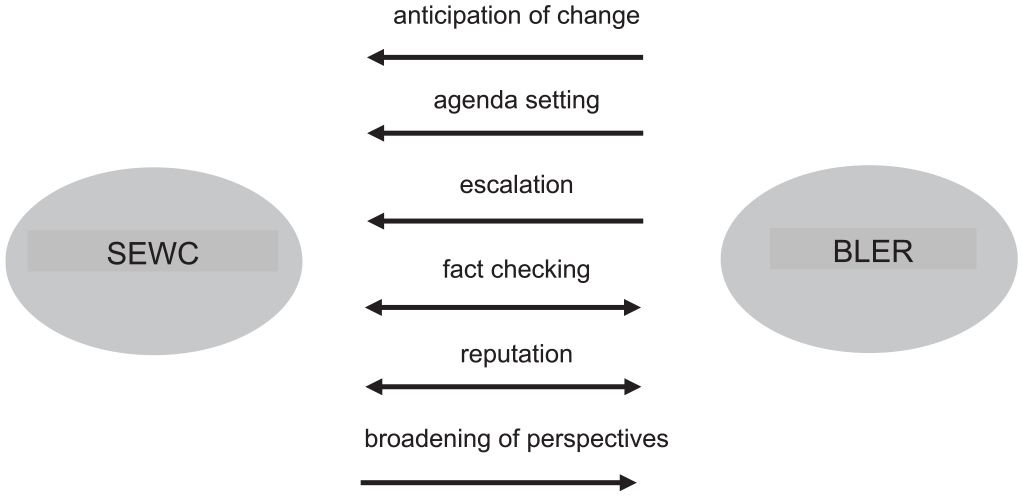
Combination of resources.
As already mentioned, these practices are not based on formalised information exchanges between the two action fields, but build primarily on overlapping individual memberships. A great deal therefore depends on such multiple office-holders, their social skills and their willingness to link resources from both action fields.
Information obtained via the supervisory board is especially useful for employee representatives because it can forewarn them at an early stage about impending developments, giving them greater tactical scope to frame a response ahead of implementation (‘anticipation of change’). Depending on the topics dealt with in the supervisory board, employee representatives are alerted about what might happen in the near future and can make use of this information, both in the SE Works Council and at national or local level.
You can’t always act because it is confidential, but you can prepare. So, when it does happen, you are more prepared in your own country or the organisation where you work, you wouldn't be so surprised if it is just dropped on you, so you can prepare better. (Services-1_NDE-1)
A further connection between the two fields exists when information from the supervisory board is used to raise issues for the SE Works Council (‘agenda setting’). In our case studies, this occurred in two ways. First, when board-level employee representatives asked ‘informed questions’ during SE Works Council meetings with management representatives, leaving it up to management representatives to deal with any confidentiality aspects. In this way, knowledge acquired by board-level employee representatives can facilitate the information and consultation process within the SE Works Council. And second, when board-level representatives explicitly requested that management inform the SE Works Council as soon as possible about issues they had become aware of through their presence on the supervisory board.
By discussing things with the relevant board members and saying, 'From my point of view, this is an issue for the SE Works Council, please show up there and report.' [. . .] Because they may then come and spread things around. That’s one aspect that you have to use, to win the board members or managers for such meetings, in order to promote precisely this kind of thing, so that they then make the information a bit more open. (Services-1_DE-1)
In addition, the connection between the two action fields can be used to bring concerns and problems that are discussed within the SE Works Council to the attention of the supervisory board and escalate them if needed (‘escalation’).
In the case of plant closures or any relocation of activities from one site to another, we have already used this possibility to transpose this to the supervisory board. We already do that, we use that. (Metal-1_NDE-1) We had a situation where colleagues in the SE Works Council meeting said: 'Ok, we have a problem, but we can’t get anyone to listen'. And we did indeed take that to the supervisory board. (Services-2_DE-1)
In this sense, the supervisory board serves as an important institutional pillar of co-determination. If management refuses to provide information or reach a consensus, the SE Works Council can shift the discussion to the supervisory board. Achieving such an effect does not necessarily require topics to be raised at plenary meetings of the supervisory board; it can be sufficient simply to announce that they will be brought up or to address them directly to the CEO, who usually attends the preparatory meetings of board-level employee representatives.
Sometimes things get resolved before the formal meeting. Because the employee reps meet with the CEO. And the CEO brings in the board members relevant to that topic. [. . .] And you do get a chance and influence the decision a bit more because you are talking more. (Services-1_NDE-1)
Furthermore, we found that the information obtained from the supervisory board served to verify the information presented by the management at SE Works Council meetings (‘fact checking’). Information available in the supervisory board enabled employee representatives to assess whether the information presented to the SE Works Council was accurate and comprehensive. This may be less relevant for people who are themselves members of the supervisory board but can be important for other SE Works Council members who do not have access to the same level of information. Often, as reported in our interviews, the mere presence of board-level employee representatives at SE Works Council meetings was helpful because in that case management did not withhold relevant information.
I think the advantage, if there are a few persons in a decisive position, like me as chairman, who at the same time has a mandate on the supervisory board of the SE, is that those with whom you negotiate there [in the SEWC] [. . .] are aware of that and have to behave in a decent manner. (Services-1_DE-1)
In turn, the SE Works Council also provides resources for the employee representatives on the supervisory board. Information from the SE Works Council can be helpful in assessing the status and relevance of information obtained from the supervisory board, for example in order to anticipate future developments. This helps employee representatives on the supervisory board to question management decisions and consequently supports the board’s overall decision-making process. In this respect, fact-checking works in both directions.
The fact that different countries and company operations are represented on the SE Works Council also means that board-level employee representatives have a greater awareness of developments and problems across the company (‘broadening of perspectives’). According to the employee representatives in our sample, this was helpful in advancing employee interests within the supervisory board, in terms not only of allowing employee representatives to ask more targeted questions but also of ensuring that they were not dependent solely on the management’s view.
Simply to sharpen the view, to hear what is going on in the national companies. And not just from management, but also from the standpoint of employees in these local operations. I think that is a gain per se [. . .] So, of course it gives us a completely different awareness when we have the input from [other] European countries, so that we can raise more targeted questions in the supervisory board. (Chemicals_DE-4) We know what is happening on the shop floor. It is not filtered. I get better information than I get through the management chain. Because each manager would put [their] interpretation on it. It does help, yes. (Services-1_NDE-1)
In this regard, the SE Works Council serves as a Europe-wide network that can provide additional and alternative information, and through this can guide and support decision-making by employee supervisory board representatives.
You simply have a swarm with whom you can exchange information. So that you can assess the whole thing a little better. And so perhaps also be able to influence accordingly, in a direction that is desirable for us employee representatives. (Services-1_DE-1)
Finally, we identified a resource that we term ‘reputation’. This has a couple of elements. On the one hand, the SE Works Council not only serves as an information resource but can also help ensure that employee representatives are seen as serious negotiating partners by management, as SE Works Council members represent key actors on the employee side. And for its part, board-level membership influences the role and status of employee representatives at transnational, as well as at national level. In particular, non-German representatives consider that their membership of the supervisory board strengthens their position vis-à-vis local management.
In some ways, yes, because occasionally I have learned a lot of things before the [country manager] knew about them. Which is quite good, quite interesting. It can help. (Services-1_NDE-1) Yes, of course it strengthens your position. Of course, because first of all you have a very big information advantage that strengthens your position at the site. (Metal-1_NDE-1)
Conclusion
A unique feature of the SE is that it is the locus of two transnational action fields for employee representation: SE Works Councils and SE supervisory boards. This institutional constellation was the starting point for us to explore the horizontal articulation between these two fields. Given that previous EWC research has drawn attention to the limitations of transnational information and consultation, investigating the linkages between these two fields, and in particular the potential for employees to intervene more effectively in corporate decision-making, was seen as a worthwhile exercise. Against this backdrop, the aim of this article has been to assess in which ways SE Works Councils and board-level employee representation are articulated and whether this might enhance the scope for employee representatives at transnational level.
Evidence from the sample company case studies indicates that, because of the restrictive confidentiality obligations imposed on board-level representatives, there was hardly any formal information exchange between the two fields of action, such as reporting back to the SE Works Council about supervisory board discussions and decisions. Overall, the confidentiality rules covering the supervisory board had a major impact on horizontal articulation. This led to a situation in which those SE Works Council members who did not hold supervisory board mandates had only a very vague idea of what was discussed and decided at the supervisory board, despite the fact that board-level representatives will have been elected or appointed by the SE Works Council.
Our findings demonstrate that overlapping memberships of these bodies are key in establishing linkages between them. Articulation mainly rests on and is sustained through individual involvement and the holding of multiple mandates. Those individuals who hold multiple mandates can be regarded as central actors in horizontal articulation. The evidence from this study underlines that these overlaps are deliberately created by the actors as means of dealing with the constraints imposed by confidentiality obligations. In this respect, horizontal articulation is created and sustained by those key employee actors with multiple mandates who, through their membership of both SE Works Council and supervisory boards, can define the issues and problems and anchor them in the action fields. In this regard, they can be understood as ‘brokers’ (Svensson and Öberg, 2005), able to use their positions of influence to build bridges and enhance coordination between the two fields.
Despite the fact that formal information exchange was found to be limited, our analysis shows that resources from the two action fields are, nevertheless, combined and made usable for transnational employee representation. Applying our typology (Figure 2), the effect of this combination ranges from ‘anticipation of change’, ‘agenda setting’ and ‘fact checking’ to ‘broadening perspectives’, ‘reputation’ or an ‘escalation of controversial issues’. In this regard, board-level employee representation serves as an institutional power resource for transnational employee representation. The existence of this combination rests, however, mainly on overlapping memberships of the two institutions. Although these overlaps offer a means of dealing with the confidentiality obligations that apply to board members and linking resources from the two action fields to render them usable for representative purposes, they also concentrate power in the hands of a few key actors. In this respect, horizontal articulation depends to a great extent on their competences, social skills and willingness to be engaged.
The existence of such individual-based ties is not unique to SEs. In companies incorporated under German law, similar overlaps also exist between board-level employee representation and works councils (Waddington and Conchon, 2016). In this sense, German-based SEs, on which this study focuses, appear to have perpetuated the pattern already established at national level. Nonetheless, there are also SE-specific developments. The internationalisation of board-level employee representation has clearly facilitated multiple office-holding across both action fields as all the non-German board-level representatives in our case studies were recruited from the SE Works Council. In addition, SE Works Councils and board-level employee representation are more interrelated than EWCs and board-level employee representation because SE Works Councils are often actively involved in the election and appointment of board-level representatives.
These findings also point to some practical implications, for both employee representatives and policy-makers: because the bodies can draw on different resources, coherence between both action fields is mutually beneficial. Especially when it comes to anticipating changes that have a potential impact on employees’ interests, coherence between the two bodies seems to be crucial for effective participation because the combination of resources helps to circumnavigate SE Works Councils’ limited information and consultation rights. In this regard, practical measures for the articulation of the two bodies could be regarded as an important issue for SE negotiations. For instance, the lack of exchange and communication could be counteracted by setting up a liaison group or joint meetings that connect SE Works Council and board-level employee representation members, irrespective of overlapping memberships. The most significant policy implication also relates to this aspect: because confidentiality obligations hinder information exchange between board-level employee representation and SE Works Councils, little or no formal reporting is possible. Therefore, it should be clarified what is subject to confidentiality and how SE Works Council members can be integrated into confidential information loops (see also for the cooperation between EWCs and board-level employee representation, Lafuente et al., 2022).
Our study, nevertheless, has several limitations. First, given the limited sample it is not possible to assess how widespread those articulation patterns are across the wider population of SEs. In addition, more comparative data would be needed to analyse the differences between companies with parity and non-parity co-determination in more detail. Additional research would also be useful to investigate how horizontal articulation works in other institutional contexts, where such individual overlaps are less likely. A comparison with French-based companies would be especially interesting as French law does not allow employee representatives on administrative or supervisory boards to simultaneously be members of works councils (Waddington and Conchon, 2016: 156). Such a perspective is of utter importance to better understand how those articulation patterns are shaped by existing national contexts or can be fostered by EU regulation. Further research should thus be undertaken to investigate how horizontal articulation might look when overlapping memberships are absent.
Finally, this article has focused on a specific group of SEs with comparatively developed transnational labour relations. This sheds a critical light on the current situation in which only a minority of all SEs have both SE Works Councils and board-level employee representation (ETUI, 2021). Where no BLER exists, no horizontal articulation occurs, which means that no additional resources can be mobilised for employee representation at transnational level. Above all, this underlines the importance of strengthening workers’ involvement and introducing minimum standards of board-level employee representation in cross-border constellations, as demanded by the ETUC (ETUC, 2020) and the European Parliament (European Parliament, 2021).
Footnotes
1
If the annual general meeting of shareholders is mentioned, it is usually bound by proposals from the employees.
2
While ‘NDE’ refers to foreign representatives outside Germany, ‘DE’ refers to home country representatives from Germany. For foreign representatives the country is not further specified for reasons of anonymity.
3
Gesetz über die Beteiligung der Arbeitnehmer in einer Europäischen Gesellschaft (SE-Beteiligungsgesetz – SEBG), 2004, amended 2021.
4
Council Regulation (EC) No 2157/2001 of 8 October 2001 on the Statute for a European company (SE).
Funding
The empirical study presented in the article was funded by the Hans Boeckler Foundation [grant number 2017-215-2]. The authors would like to thank the Hans Boeckler Foundation for their generous support of the empirical research.