




Abstract
The paper deals with the European Company (SE), the first supranational company form. The focal question is its impact on the development of transnational employment relations. We show that only a minority of SEs has set up SE Works Councils and we discuss the reasons for this non-compliance. Board-level employee representation (BLER), the other form of voice, is even less common. We compare both concepts and reveal that the SE’s contribution to the development of transnational employment relations remains limited. By placing the SE in a broader perspective, we conclude that it fits the general pattern of limited progress towards ‘Europeanization’.
Keywords
Introduction
The long-term and still unfinished project of the European Union (EU) includes not only economic but also social integration. Not only social policy issues but also the establishment of transnational employment relations represents an important pillar of its ‘social dimension’, the minimum floor of employment rights. Within this frame of reference institutions of transnational employee voice constitute a fundamental ingredient. However, to date, only two such institutions exist: the 1994 Directive ‘On the establishment of a European Works Council or a Procedure in Community-scale groups of undertakings for the purposes of informing and consulting employees’ (94/45/EC), amended 2009 (2009/38/EC) and the 2001 ‘Directive supplementing the Statute for a European Company with regard to the involvement of employees’ (2001/86/EC).
For decades, lots of research projects have been conducted on issues of the older European Works Councils (see for overviews De Spiegelaere et al., 2022; Hann et al., 2017) and it has been frequently debated whether the EWC Directive promotes the Europeanization of industrial relations or fails to contribute to such a development (Lecher et al., 2001; Marginson and Sisson, 2006; Streeck, 1997). In inexplicable contrast, hitherto little attention has been paid to the more recent European Company (Societas Europaea, or SE). We therefore focus our analysis on this specific institutional form and ask for its empirical impact on the slowly progressing development of transnational employment relations. In this context, we ask whether the SE framework constitutes a milestone or only a small step forward towards EU social integration. Thus, we contribute a new strand to the ongoing research agenda on internationalization.
The SE, the first and still most prominent supranational company form, constitutes the new option to launch a public limited-liability company on a European-wide base instead of keeping restrictions of purely national legal forms. The SE was incorporated in European company law in order to provide a unified management structure and reporting system as well as to lower the barriers for transferring the registered office to another EU country without dissolving the existing company. In economic terms, major savings of ex ante as well as ex post transaction costs (Williamson, 1996) – for example, not only in case of registering but, later on in transnational restructuring – were expected.
The SE consists of two intertwined parts, the Council Regulation ((EC) No. 2157/2001) and the supplementary Council Directive on Employee Involvement (2001/86/EC). To avoid the risk of ‘regime shopping’ the latter demands obligatory negotiations on cross-border company-level employee involvement before an SE can be registered. These negotiations may cover two channels of transnational ‘collective voice’: Information and consultation procedures on transnational matters and employee representation in supervisory or administrative company boards. For the purpose of our paper the Directive is of more importance and interest because it determines the development of transnational employment relations at company level.
Literature review and research questions
The long and protracted history of the SE dates back as far as the late 1960s. We mention only some ‘stylized facts’ because they have been documented elsewhere in great detail and are of minor importance for our empirical analysis (Gold and Schwimbersky, 2008; Keller, 2002; Sorge, 2006). It took more than three decades before the European Council managed to conclude a political compromise in the early 2000s. This arrangement was rather complicated because all Member States wanted to preserve their national standards and established forms and/or to prevent any restrictions of their national employment relations to be possibly caused by dissenting EU regulation. Furthermore, in political decision-making unanimous decisions of Member States were required, a legal-institutional prerequisite that is always difficult to reach.
The original objective was to establish a unified European ‘regulatory space’ instead of exclusively preserving various national ones. At the beginning of the political process in the early/mid-1970s strict ‘harmonization’ of widely differing national company laws constituted the ambitious goal. However, it could finally not be realized because of continued reluctance at national level. In particular, principles and extent of employee involvement were highly controversial among Member States. Their frequent fears were that nationally embedded frameworks and their established ‘customs and practice’ would be damaged or even abolished.
After several draft statutes and lengthy periods of stagnation, the introduction of far-reaching ‘neo-voluntarism’ turned out to be the only realistic alternative, given the enormous heterogeneity of national employment relations systems. This more recent paradigm shift from ‘hard’ (or binding) to ‘soft’ (or non-binding) forms of regulation meant, in our case of the SE Directive, as in others, the primacy of freely negotiated agreements instead of a statutory framework, the introduction of only procedural instead of substantive rules and purely optional instead of mandatory and, therefore binding forms. The complex result that was finally reached at the level of the smallest common denominator allows at the level of individual SEs for considerable leeway, enormous diversity and substantial degrees of ‘flexibility’ of corporate governance.
The impact of EU institutions is limited to the early stages of the policy cycle. Transposition and implementation procedures of EU statutory measures at national, sectoral and company level in the Member States are decisive for all subsequent issues of corporate governance. They differ, among others, according to the forms of measures, legislation and/or collective bargaining. In the EU ‘multi-level governance’ with its complicated structures, actors and processes (Pulignano et al., 2016) transposition means the transfer from the European to the national level, whereas implementation denotes the subsequent transfer from the national to the sectoral or, in our case, the company level. These specific procedures are necessary in order to bridge the existing diversity of employment relations between Member States. At national level, however, they allow for ample opportunities of strategic maneuvering and lobbying activities, first of all of political parties and social partners’ federations but also other groups of stakeholders. Therefore, these procedures are important because they frequently lead, despite their uniform legal framework to incoherence and major differences in outcomes of national adaptation, such as employee information and consultation in our case.
Existing studies have discussed the long and highly contested political history of the SE legislation (Gold and Schwimbersky, 2008; Sorge, 2006) or have provided initial insights into the features and functions of employee involvement in SEs (Casey et al., 2016; Fiedler et al., 2021; Keller and Werner, 2012; Rehfeldt et al., 2011). Most studies focused on specific aspects such as the analysis of the provisions of SE agreements (Lafuente, 2019), the SE’s impact on BLER (Keller and Werner, 2012; Lafuente, 2019; Rosenbohm, 2014), or aimed at understanding how SEWCs work in practice in specific company settings (Casey et al., 2016; Rehfeldt et al., 2011; Rosenbohm, 2013).
Still missing is a synthesis and more general assessment of the underlying developments and a broader discussion of the SE’s significance 20 years after the legislation was adopted. To fill this gap, we focus our analysis on the SE and ask for its overall contribution to the development of transnational employment relations in the EU, with particular consideration of its impact on procedures and practices of employee involvement. Unlike previous studies, this paper does not focus on the early stages (agenda setting, formulation and adoption) but on the later ones (implementation, monitoring and evaluation). What are the results? Is the early overall pessimistic assessment of European Works Councils for the development of a European industrial relations system (Streeck, 1997) still valid? Or should it even be generalized to the new forms?
Methodology
In order to analyze the SE’s outcomes and contributions we combine two approaches. In a first step, we analyze by using secondary data the quantitative distribution of SEs and focus on the question of how widespread transnational information and consultation procedures and board-level employee representation are. The empirical base of our quantitative analysis is the European Company Database (ECDB) made available by the European Trade Union Institute (ETUI), the research institute of the European Trade Union Confederation (ETUC). 1 The comprehensive ECDB offers extensive key data on all registered SEs and, thus, provides necessary information on the implementation of the SE Directive. We include all available data until end-2020. Thus, we add the so far missing longitudinal analysis of SE developments. Furthermore, the ECDB source is complemented by data from the European Works Council Database (ewcdb) of the ETUI, which contains not only information on European Works Councils (EWCs) but also on SE Works Councils (SEWCs) and by available national register data on SEs headquartered in Germany. Moreover, we have analyzed all publicly available official documents.
Number of interviews.
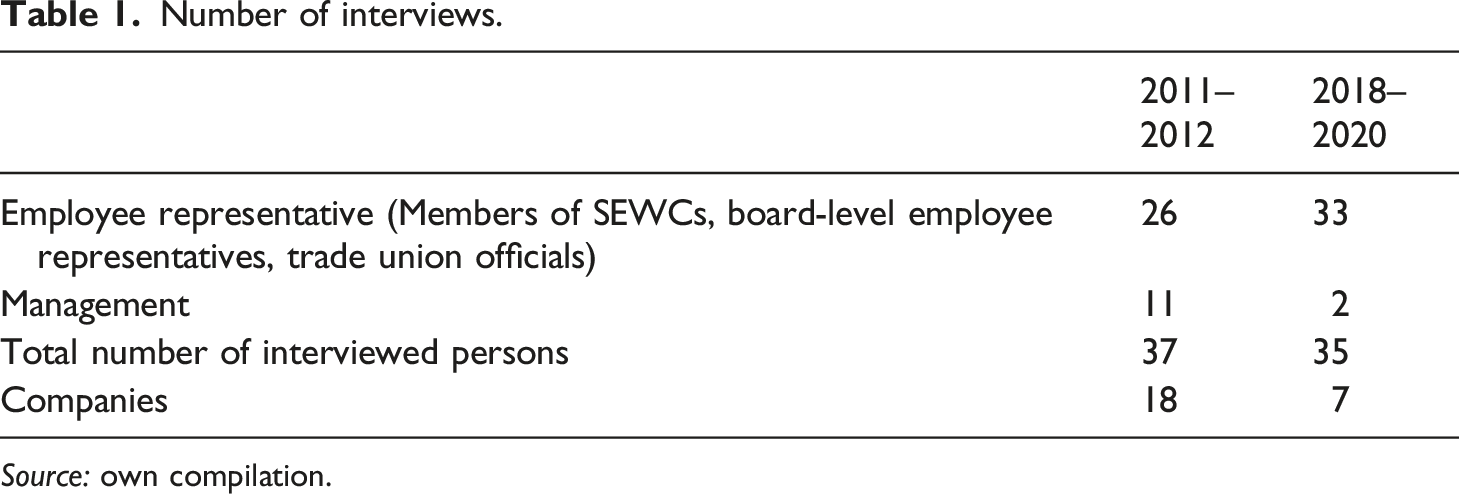
Source: own compilation.
Semi-structured interviews were conducted with employee representatives – including members of SEWCs, board-level employee representatives as well as trade union officials – and management representatives at central level. The interviewees can be considered as key actors because they conducted the SE negotiations, were members of the SEWCs steering committees or were board-level representatives. Interviews lasted between one and 2 hours. Most interviews were recorded and transcribed and were analyzed using content analysis (Schreier, 2012).
In the first phase (2011 and 2012), we conducted interviews in 18 German-based SE, in the second phase (2018 and 2020) in 7 German-based SEs. Overlaps existed in two instances where we revisited the companies. We have put special emphasize on SEs with headquarters in Germany because it is home of most operational SEs (ECDB; see below).
European Company (SE): Long-term development and present state
Country-specific transpositions of the SE Directive had to take place between 2002 and 2004. The beginning was slow, due to missing information about the new opportunities, unresolved legal issues and delayed transposition in some Member States. Since then, the overall number of SEs has more or less permanently increased to about 3,357 at the end of 2020. This is, at least at first glance, a surprisingly high and impressive number (Figure 1). Total number of all registered SE and registered ‘normal’ SE, 2004–2020. Source: own compilation, ECDB 12/2020.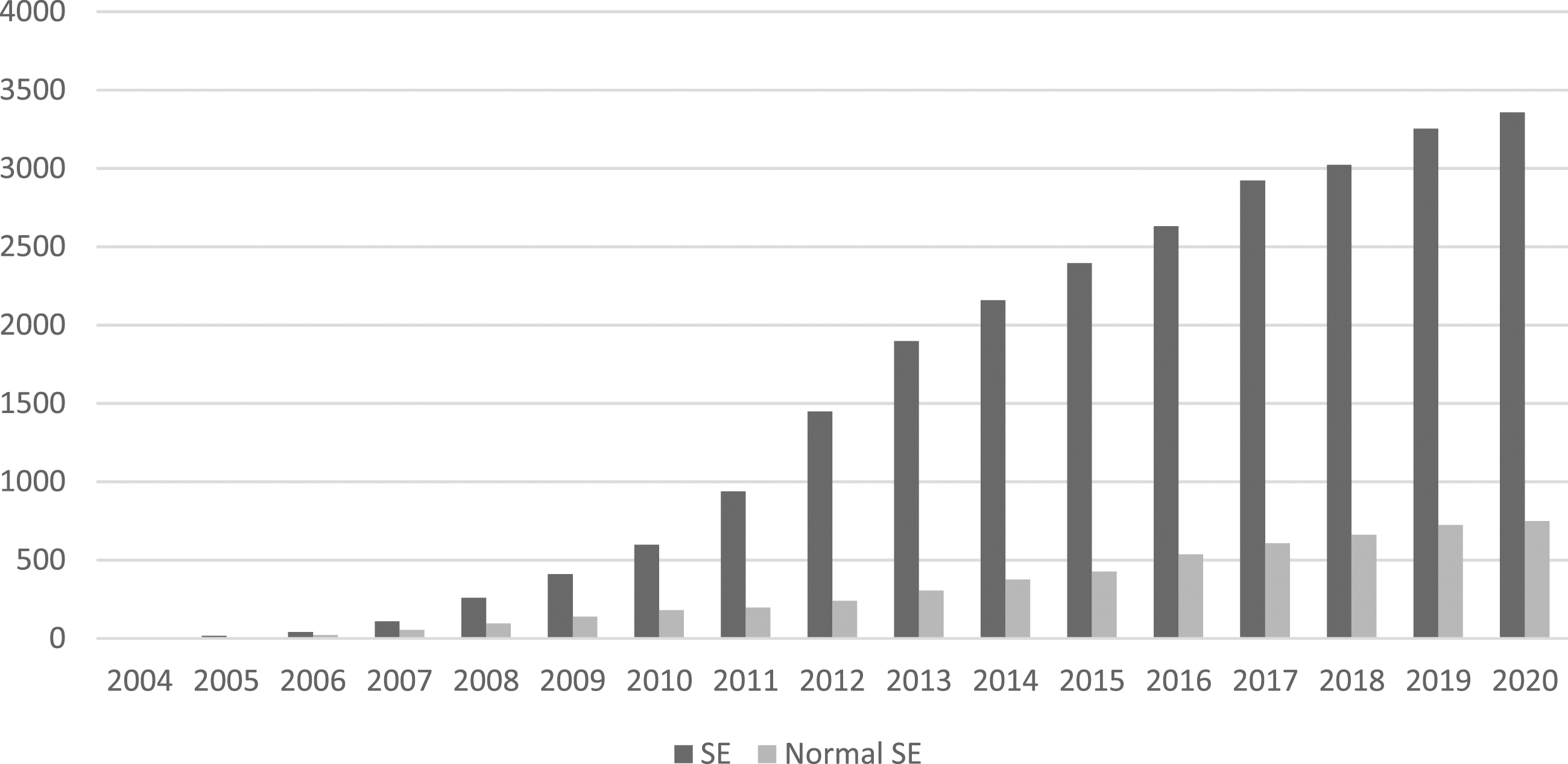
The establishment of an SE is a purely voluntary decision of the owners without any opportunity for employee involvement. According to the SE Regulation four forms of formation are to be distinguished: (1) conversion of an existing single company, (2) merger of two or more companies, (3) formation of a holding company by two or more companies, and (4) formation of a SE subsidiary. For all forms, a cross-border character is a necessary prerequisite, which means that at least two of the involved companies have to be subject to the legislation of different Member States.
The vast majority of SEs (2,606) has been set up as a subsidiary. This originally unexpected uneven distribution of forms is to be explained by the fact that the above-mentioned SE Regulation also allows that an SE itself can be used to create another subsidiary SE. Thus, in recent years SEs were used as legal tools to establish several other SEs.
The choice of forms dominated the political discussion before the SE Directive was passed and in the following early stages of transposition but lost its importance. For our empirical question on different forms of employee involvement another distinction or, to be more precise, a further fragmentation of forms proves to be more important. There are not only normal SEs, that is, with actual operations and more than five employees, but – as originally unintended outcomes – also other forms: ‘empty (or micro) SEs’ with operations but no or very few (five or fewer) employees, ‘UFO SEs’ with insufficient information for categorization and ‘shelf SEs’ with neither operations nor employees. 2
So far only 749 SEs have been identified as ‘normal SEs’. Their share (of about 20%) remains stable in the long run and is much less impressive than the overall number that includes all forms (Figure 1). In the following we focus on these ‘normal SEs’ because they constitute the only form that could have an impact on the development of transnational employment relations. There is, however, one important restriction. Later on, ‘shelf SEs’ can be activated by acquiring employees and operations and can be transformed into ‘normal SEs’ (Hans Boeckler Foundation, 2018). This legal opportunity creates certain threats to employment relations because all procedures for securing employee rights only take effect at the date of establishment of ‘shelf SEs’ without legal obligation to launch negotiations when they are transformed. Overall, the observed dominance of subsidiary SEs is mainly linked to the activation of non-operational ‘shelf SEs’. Later on, we come back to this important problem.
Geographical coverage of all registered and ‘normal’ SEs.
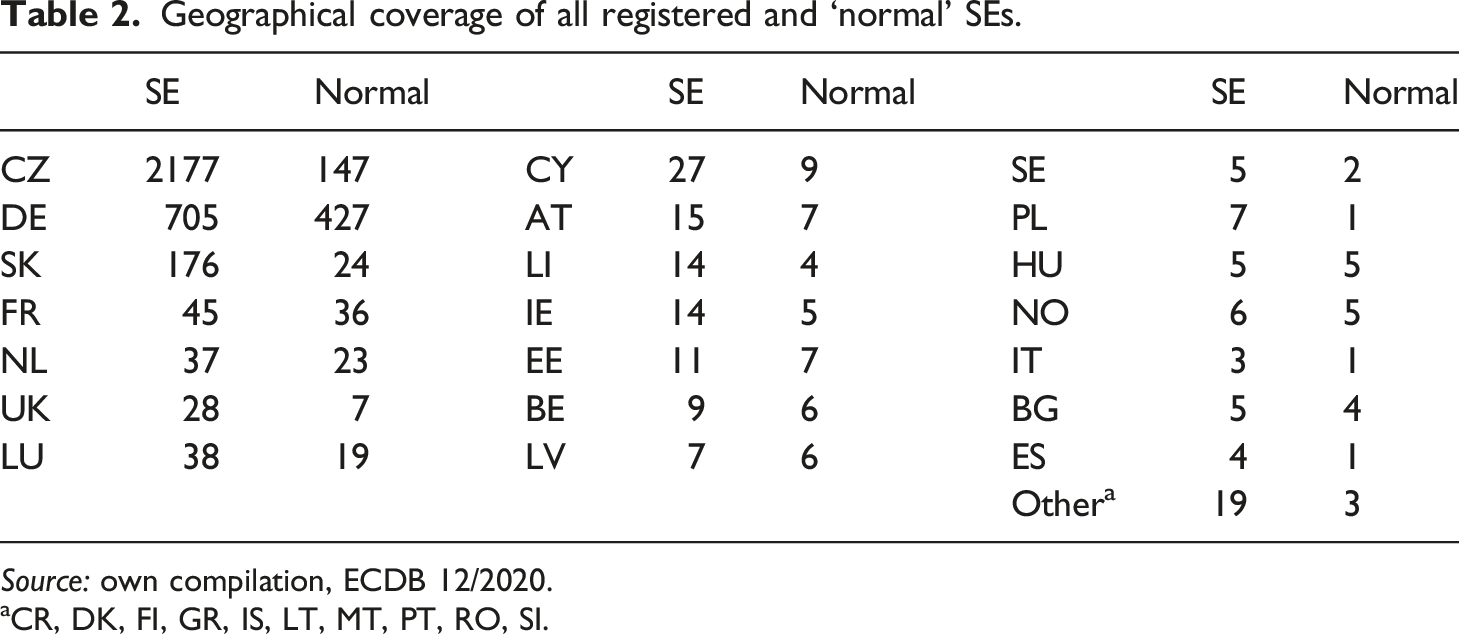
Source: own compilation, ECDB 12/2020.
aCR, DK, FI, GR, IS, LT, MT, PT, RO, SI.
SE outcomes and contributions to transnational employment relations
The SE Directive provides two possible channels of transnational ‘collective voice’ in (normal) SEs. Information and consultation procedures (in most cases SEWCs) are well known, whereas board-level employee representation (BLER) is so far unknown and completely new for regulation at EU level – not to mention other world regions. These forms are not temporary but permanent ones of formal nature; they institutionalize distinctive corporate actors and provide additional resources at both levels. First, we elaborate on SEWCs, the more frequent and, according to our analysis, the more important form.
Information and consultation procedures
An important peculiarity of the SE Directive is that it defines exclusively procedural rules on provisions of employee involvement. All substantive issues for governance are freely negotiated at the level of the individual SE between central management and a set up ‘representative body’ of employees, the Special Negotiation Body (SNB). These negotiations about all substantive issues are mandatory and, in order to avoid ‘wait and see’-strategies by management, have to take place before the foundation (Article 4 of the Directive). Thus, the SE Directive is in line with the fundamental ‘principle of subsidiarity’ (Art 5(3) TFEU). However, the basic decision about the SE establishment is the ‘management prerogative’ and takes place without any employee involvement.
If no agreement can be reached so-called ‘standard rules’ (or ‘statutory fall-back positions’) that are formulated in an annex to the Directive apply. In the majority of SE agreements, the negotiated rights and interests closely resemble those of the standard rules that constitute ‘salient points’ or benchmarks for representatives of both sides. In addition, the SNB can decide not to negotiate or to terminate launched negotiations. In this case, the SE remains without employee involvement at transnational level. 3
The empirical consequences of this institutionalized ‘mandatory voluntarism’ are two-fold. On one side, despite legal requirements, only a minority of normal SEs (182 of 738) has set up SEWCs at all (ECDB). Other voluntary forms, such as consultative committees, are legally possible but rare in practice. In the remaining cases, no agreement has been concluded, either because bipartite negotiations were terminated or not initiated at all. The latter option is particularly evident for the above-mentioned activation of ‘shelf SEs’. As a result, employees of these SEs have no rights of ‘collective voice’, even though they work in multinational companies that are incorporated under European law. In other words, forms of non-compliance with existing legal norms exist not only in ‘shelf SEs’ but also in normal SEs; there is ample room for strategic attempts to (successfully) evade existing mandatory constraints.
This situation is already known from the case of EWCs (Whittall et al., 2015). The difference is that in the case of an SE, negotiations have not to be initiated but are mandatory during the establishment process. As in well-known cases at sectoral and company level in different Member States, ‘coverage rates’ tend to be low and major ‘representation gaps’ frequently exist. As documented for other cases of EU regulation on social affairs (Falkner et al., 2005; Whittall et al., 2015) monitoring and other enforcement mechanisms of existing legislation are underdeveloped and therefore unsatisfactory.
On the other side, empirical analyses show that, as a result of the daily routine in SEs, transnational information and consultation has extended to companies that were either not covered by the EWC Directive or had not set up an EWC before the SE status was adopted (ECDB, ewcdb). Although the number of EWCs has grown steadily since the EWC Directive was first adopted in 1994, the annual rate of increase has slowed considerably in recent years (ewcdb). It can therefore be argued that the SE facilitates the spread of transnational information and consultation bodies across European multinationals. This is also reflected in our interview data, where an employee representative from a company where no EWC had previously existed emphasized the added value of such a body: ‘The most positive outcome of the SE, and it’s precisely for this reason that I wouldn’t want to miss it, is the network that has been created on the employee side, the flow of information, this mutual exchange that is worth its weight in gold’. (Interview_I25)
According to the SE Directive, SEWCs must be informed and consulted by central management on transnational issues and the overall situation as well as significant developments within the company. These rights include the economic and financial situation, the trend of employment, investment decisions or the introduction of new working methods as well as in the event of relocations, closures of establishments or collective redundancies. However, the exact definition of these information and consultation procedures as well as the frequency of meetings is left to the agreement of the negotiating parties at company level.
This arrangement points to clear similarities with the EWC Directive, which is based on similar procedural principles (Waddington, 2011). At the same time, however, key distinctions exist. A first difference concerns the negotiation procedure. As mentioned above, SE negotiations must always be initiated by central management, which means that there is no need for a request from the employee side, as is usually the case with EWCs. In addition, the timeframe is much shorter, as SE negotiations may only last 6 months, and management usually has an interest in quick negotiations, as an SE cannot be legally registered without having tried to reach an agreement. Finally, when the SE Directive was adopted, it contained some significant improvements over the original EWC Directive of 1994. For example, the definition of information and consultation rights was more precise and the SE Directive included a broader definition of transnationality than the original EWC Directive. In addition, the already mentioned statutory fallback provisions are more advanced and detailed compared to the original EWC Directive.
Therefore, in some respects, the SE Directive contains better provisions and provides a stronger legal basis (Waddington, 2011). Against this backdrop, some authors argue that SE negotiations lead to qualitatively better outcomes in terms of transnational information and consultation compared to EWCs (Casey et al., 2016; Rehfeldt et al., 2011). Comparative analysis of SE agreements supports this view. Overall, SEWCs are more likely to have competences that go beyond mere information and consultation rights. Some SEWCs even have the right to initiate projects or to engage in negotiations with management. SEWCs also meet more frequently than EWCs and their members are more likely to have access to training and an explicit right of access to company premises (for details in quantitative regard De Spiegelaere and Jagodzinski, 2015).
While the analysis of agreements yields important insights into the formal basis of SEWCs, it does not state much about how information and consultation procedures actually function. As EWC research highlights, such agreements are only an approximate guideline, since actual practice may deviate from the codified rules in the agreements (Hauser-Ditz et al., 2015; Lecher et al., 2001). Thus, it can be assumed that the terms of the agreements influence SEWC practices and shape interactions but never determine them completely.
Our empirical research underlines that SEWCs do not per se function better than EWCs. Rather, they seem to mirror the already known diverse practice of EWCs (De Spiegelaere et al., 2022; Lecher et al., 2001). Thus, there is an enormous variety and heterogeneity of transnational forms and rights, and a wide range from inactive or ‘symbolic bodies’ with insufficient capacities to ‘representative bodies’ with more extensive rights to determine procedures in certain areas, such as health and safety at work or equal opportunities that come close to negotiation rights. Tailor-made, freely negotiated arrangements clearly dominate at individual SE level, and the original principle of ‘one-size-fits-all’ legislation has for a long time been superseded by more ‘flexible’ ones.
Employee representation at board-level
In contrast to the EU level where BLER did not exist before the introduction of the SE this form of employee voice is by no means new at national level (for overviews ETUI, 2014; Deakin, 2021). Especially since the 1970s, the majority of Member States has institutionalized considerably varied forms (Waddington and Conchon, 2016) offering opportunities to influence not only day-to-day affairs but also corporate decision-making. These national requirements differ considerably, according to forms, coverage rates, extent and impact, thresholds of necessary workforce size, statutory or voluntary introduction by labour legislation or basic agreements.
As its unique feature the SE Directive contains provisions not only on transnational information and consultation but also on BLER. This means that employee representatives from different Member States will not only to be informed and consulted on operational ‘bread-and butter’ matters, but will also, through their presence on the SE’s supervisory or administrative board, be involved in strategic decision-making at company level and in monitoring long-term management strategies. They have the same rights and obligations as the shareholders’ representatives.
Regulations at national level are frequently of legal and therefore general nature. In contrast both SE forms constitute outcomes of negotiations at decentralized level of the individual company. Consequences of this pattern are more heterogeneity and fragmentation than in the opposite case of centralized statutory regulation.
Our empirical analysis shows that the experiment of BLER remains limited to only 88 SEs. Therefore, one should not, implicitly or explicitly, generalize from this small number or even a ‘convenience sample’ of this group on all SEs (Casey et al., 2016). By definition its impact on employment relations, especially on power relations within SEs is uneven and restricted to these few cases (for details Waddington and Conchon, 2017; Lafuente, 2019). BLER is mainly limited to SEs from Member States whose national companies had to guarantee these rights already before the SE establishment. The reason is a legal specificity. According to the SE Directive ‘the establishment of an SE does not entail the disappearance or reduction of practices of employee involvement existing within the companies participating in the establishment of an SE’ (SE Directive Recital 3).
In order to prevent attempts of ‘regime shopping’ the so-called ‘before and after principle’ was implemented in the SE Directive. According to this principle, BLER continues to apply in the SE when it had already existed before. This, however, also means that a national company without BLER is not obliged to introduce it when it transforms into an SE. In other words, the existence and intensity of this form of employee involvement depend to a great extent on national provisions and the SE follows the ‘country of origin’ or ‘home country’ principle. This specificity is, as we explain later, underlined by the fact that currently more than 80% of all normal SEs with BLER have their headquarters in Germany. Germany is the Member State with a long tradition and comparatively far-reaching rights of employee involvement at board level (Keller and Kirsch, 2021). Therefore, national experience of ‘co-determination’ exerts major influence on the SE board level. Other SEs with BLER (but only a good dozen) are located in France and two have their headquarters in Austria (ECDB). These two countries also have national legislation on BLER.
In empirical regard, there exists a rather strict mutual dependence: At national level there are enormous differences in the extent and quality of employee involvement that are caused by divergent national regulations and their specific ‘customs and practice’. They exert a major impact on the choice of form: If the SE is registered in a Member State with institutionalized BLER, it is more likely that the SE will also introduce this form of corporate governance. The established German model of ‘co-determination’ constitutes the prototypical example for this constellation of national interests.
However, with regard to the ‘German model’ also negative repercussions exist. This is the case when the adoption of the SE status takes place shortly before the threshold of 2,000 employees, which normally triggers the right to parity board-level employee representation according to the 1976 German co-determination law (Keller and Kirsch, 2021). Estimates indicate that around 80% of German-based SEs with more than 2,000 employees in Germany did not introduce parity BLER. In these instances, the companies used the SE status to preventive escape from parity co-determination in the supervisory board (Sick, 2020). This get around is legally possible because the ‘before and after principle’ of the SE Directive only protects acquired rights exclusively at the date of the SE foundation but does not foresee any dynamic changes.
We also find evidence for these developments in our qualitative interview data; especially in those companies where the majority of shares are held by the founding family. ‘When we started this process, we had 1,700, 1,750 employees in Germany, a total of about 2,100 employees in Europe, and no employee representation at board-level. As a typical family business, we wanted to maintain that situation’. (Interview-I-17)
Moreover, our analysis also reveals management strategies to limit the number of board-level employee representatives in order to reduce outside interference and to externalize unions. This happens by reducing the overall board size. Even if the proportionality between shareholder and employee representatives remains unchanged, it often happens at the expense of external union officials, who are not employed by the company. This refers to a peculiarity of the 1976 German co-determination law that reserves a certain number of seats for external union officials who are nominated by trade unions represented in the company. One could call these activities strategic avoidance at transnational level, or a subtle and so far widely unnoticed German form of ‘union busting’ (Rügemer and Wigand, 2014).
The SE also offers the possibility of an international composition of board-level employee representatives since these conditions are freely negotiable during the founding phase. However, in quantitative terms such ‘Europeanization’ remains far from being widespread. Our analysis shows that in Germany – the country where most SEs with BLER are headquartered – currently in only 38% of SEs with BLER employee representatives from different European countries are members of company boards. Although the total number remains limited, it should, however, not be underestimated that through this internationalization BLER is indirectly spreading to countries where such representation does not exist in the national corporate governance system, by granting employee representatives from these countries access to company boards (ETUI, 2014; Tschirbs and Milert, 2021 for a detailed case study on the German Allianz group).
From a strictly legal point of view both forms – SEWCs and BLER – are to be distinguished. In empirical regard however, recent analysis of practices indicates that linkages and their interplay are important for employee representation; among others, overlaps of membership, exchange of information and knowledge by means of personal contacts, and combination of formal as well as informal resources can enhance transnational employee representation (Lafuente et al., 2022; Rosenbohm and Kuebart, 2022).
Overall, this combination opens up room for strategic maneuver. Rather than being informed about a measure after its introduction, employee representatives have the opportunity to anticipate changes and prepare themselves accordingly. In addition, the BLER channel can also be used to escalate concerns and issues that are raised in the SEWC but cannot be resolved at that level. On the other hand, the SEWC is a valuable source for board-level employee representatives because it provides insights into the company’s operations in different countries, thus, ensuring that employee representatives do not have to rely solely on management’s assessments when strategic decisions within the board are made.
However, one caveat must be mentioned. Given that only a limited number of SEs have BLER, these specific effects are limited to this small group – mainly German-based SEs. In the majority of SEs without BLER, such resources cannot be mobilized for transnational employee involvement (for a more optimistic view ETUI, 2014).
Moreover, as we know from experience at national level, ‘collective voice’ neither precludes nor necessarily means or includes union voice (Terry, 2010). Following this national tradition, the SE Directive primarily provides for information and consultation procedures for employees, not for unions. Depending on the results of negotiations between management and employee representatives, union representatives may be members of the administrative or supervisory board, thus contributing their specific external knowledge and sectoral experience. Due to existing legal and practical differences in national regulations, external trade union representation is, however, by no means a reality in all SEs with BLER.
The SE in broader perspective of concepts of employee voice
The specific case of SEs has to be put in the broader context. Our conclusion is that it fits fairly well with the general trend of only gradual and slow progress of transnational employment relations. We mention one prominent example – collective bargaining – to illustrate the absence of a vertically integrated employment relations system.
By definition, the SE Directive and its subsequent ‘customs and practice’ is limited to employee involvement at company level; its outcomes constitute only limited forms of specific ‘upward convergence’ and, by definition are restricted to this level. Collective bargaining (CB), the complementary form of institutionalized collective employee voice has to be taken into consideration, in normative perspective especially in the pluralist – instead of egoist, unitarist or critical – form of employment relations (Budd and Zagelmeyer, 2010). It has more distributive than integrative functions. The SE Directive has no consequences for access to CB as the important countervailing collective power in contrast to unilateral decision-making by management. At national level of Member States CB, the standard procedure to jointly negotiate all terms and conditions of employment, takes place at company level as well as sectoral or industry-wide level. There are different ‘monistic’ as well as ‘dualistic’ systems of employment relations with varied forms of ‘single-employer’ as well as ‘multi-employer bargaining’ (Müller et al., 2019). They have no functional equivalent at EU level.
Throughout EU history social integration has always been less advanced than economic and business integration. Both processes have moved forward, but at different speeds on their long journey to an ‘ever closer union’. The completion of the ‘single European market’ (SEM) in the early 1990s as well as the introduction of the ‘Economic and Monetary Union’ (EMU) and the single currency in the late 1990s happened some time ago; both political decisions constituted milestones towards (macro-)economic integration. Equivalent milestones in the ‘social dimension’ of the internal market and the ‘social acquis’ hardly exist. Multi-level governance of employment relations is still ‘in the making’ (Marginson and Sisson, 2006). Thus, the establishment of transnational employment relations constitutes an emerging, definitely long-lasting and still unfinished project.
Our specific case of the SE fits well with these long-term trends of persisting lags between speeds of processes of economic and social integration. As mentioned in the introduction the SE project was already launched in the 1970s but finalized as a latecomer only in the early 20002. All original expectations and hopes of more or less automatic ‘spillover’ effects from economic to social integration proved to be unrealistic. SEWCs, and not to mention BLER still constitute the exception. Their slow development matches the diagnosis of ‘transnational industrial relations institution in the making’ (Waddington, 2011).
How do we explain these lasting deficits? At first glance they are surprising because the legislative framework is in place and the new corporate form of SE is available. There are different reasons for this prevailing stalemate in the non-hierarchical ‘multi-level’ EU polity. They have been caused by public (state) as well as private (non-state) corporate actors at European as well as national level.
One reason is the increasing inactivity of the more recent European Commissions (especially Santer, Barroso I and II but also Juncker and most likely also von der Leyen) in the development age of liberalization of employment relations and dominating neo-liberalism. The formerly well-known ambitious objective of the ‘social dimension of the internal market’ was coined by the Delors Commission in the mid-1980s and incorporated in the social chapter of the Maastricht Treaty in the early 1990s. Later on, the comprehensive model of ‘Social Europe’ and its integral component of elaborated ‘social partnership’ took over. Such concepts are of less importance on the current agenda of the political leadership than they used to be (Pulignano et al., 2016). We explicate in the outlook why the legally possible, if not required recast of the SE Directive did not take place but faded away from the political agenda in the early 2010s.
A further reason is associated with one of the social partners. Employers’ federations at national as well as supranational level, especially BusinessEurope as the greatest and most important one, are obviously not interested in more social integration, especially not in strengthening and institutionalizing European employment relations. Most managerial attitudes prefer unilateral and unconstraint action or, if this not possible, purely ‘voluntarist’ solutions of EU regulation at the level of the smallest common denominator (De Spiegelaere et al., 2022: 266).
If EU regulation cannot be circumvented, they try to avoid ‘hard’ and binding forms and favour ‘soft’ and non-binding ones. These federations constitute not only ‘reluctant social partners’ in all social dialogues (Aranea et al., 2021) but even veto players in other protracted processes of EU decision-making. At national level a very similar attitude exists. A study on German employers ‘finds considerable support for board-level codetermination among individual firms but continued opposition from the federations’ (Paster, 2012: 471).
Another reason is that quite a few Member States, not only central and eastern European ones, are not overtly attracted by more integration of their national employment systems. The above-mentioned skewed national distribution of SEs constitutes a typical example of this lasting constellation of differing preferences or even lack of interest. Without the critical mass of proponents unanimous decisions in the Council of Ministers, a necessary prerequisite for a recast of the SE Directive, would be impossible to reach. Moreover, with regard to the specific case of the SE a general uncertainty about processes and outcomes of a potential negotiated revision of the SE Directive constitutes another reason for ‘both sides of industry’ and their diverse stakeholders. The consequences of trade-offs and concessions that would be necessary during protracted negotiations on compromises cannot be calculated in advance in the diverse European polity and are, therefore avoided right from the start.
In public policy (or political science) terms two modes of governance are to be distinguished (Scharpf, 1999). Measures of market making (or economic integration by removing obstacles to integration) turned out to be more important than those of market correcting (or social integration by establishing new transnational institutions). The SE definitely belongs to the latter category and demonstrates its difficulties. This traditional asymmetry of the European ‘regulatory space’ has not only lasted. It has even deepened in the slowdown of EU social activity especially but not exclusively in recent times of liberalization and deregulation of product markets as well as labour markets.
SE’s impact on the development of transnational employment relations
Our fundamental research question is the SE’s impact on the development of transnational employment relations. We indicate that in purely quantitative regard the SE’s impact on cross-border corporate governance and ‘Europeanization’ of employment relations remains restricted to a limited number of cases. First, the number of normal SEs is, at about 750, much smaller than the, at first glance, fairly impressive overall number of more than 3,500 SEs (for details Figure 1). In other words, normal SEs constitute only a minority of all existing SEs.
Second, there are only about 180 normal SEs with transnational procedures of information and consultation. Furthermore, the number of SEs with BLER is, at only about 90, even much smaller in contrast to former as well as lasting optimistic expectations to the contrary in some, especially union quarters (ETUI, 2014).
The question of an SE contribution to the development of transnational employment relations needs differentiated answers for both forms of new corporate actors of SEWCs and BLER. At least for the time being they still constitute the exception. Their specific coverage rates remain rather low and, therefore disappointing. Despite the fact that legal opportunities have now existed for two decades, major ‘representation gaps’ persist; therefore, the SE utility ‘is severely underdeveloped’ (Casey et al., 2016: 15). Even if the SE could facilitate the spread of transnational information and consultation bodies across European companies, especially MNCs, it still provides – in contrast to original hopes and expectations only limited ‘value added’. Therefore, the mentioned early reservations about the potential impact of EWCs (Streeck, 1997) are also valid for the SE.
The existing uneven acceptance of both forms by management is to be explained by differing legal preconditions: Because of the mandatory requirement of their institutionalization SEWCs are more frequent and, therefore, in quantitative regard more important. BLER is not mandatory and, therefore remains comparatively rare and limited to those SE cases where existing national participation rights have to be safeguarded because of the ‘before-and-after-principle’. Therefore, SEs based in Germany, the Member State with comparatively advanced rights, constitute the vast majority. In other words, because BLER is introduced on a purely voluntary basis it constitutes a rarely used opportunity. As we elaborate, BLER establishes another, comparatively new and advanced form of employee participation but its contribution to the internationalization or ‘Europeanization’ of interest representation constitutes the exception and the development of a genuine transnational and collective European identity among members remains rare (Waddington and Conchon, 2017). The underlying reason is that not all EU Member States have an extensive tradition of BLER at national level (for the specific case of the UK see Hyman, 2010). Furthermore, the existing option of both forms offers opportunities for barters in negotiations about their introduction when employee representatives could favour more rights for SEWCs and, therefore, have to compromise on BLER.
Moreover, the surprisingly high number of ‘shelf SEs’ constitutes a specific problem for the establishment of transnational employment relations. According to the SE Regulation normal SEs are only allowed to be registered after the conclusion of an agreement on employee involvement. This statutory provision is supposed to protect existing national employees’ rights and interests from being either eroded or even neglected in an SE. The decisive problem is a major deficiency of the SE Directive: It lacks exact and unambiguous procedural rules for the introduction of employee involvement rights in cases of a delayed SE establishment. Therefore, it is legally possible to activate empty SEs without initiating these negotiations (von der Höh, 2017).
The prevalence of ‘shelf SEs’ constitutes an attractive legal vehicle for management but represents a considerable threat of employees’ rights. Empirical analyses estimate that around 40% of all normal SEs with headquarters in Germany constitute activated ‘shelf SEs’ (Hans Boeckler Foundation, 2018). Their overall number as well as the high number of SEs without any kind of transnational rights of employee involvement indicates significant implementation problems and deficits of the SE Directive. The original intention has been turned around (for further details Keller and Rosenbohm, 2020).
For these various reasons, the SE contribution to the development of transnational employment relations remains limited. In empirical regard, SEs constitute neither the (feared by some) ‘race to the bottom’ of existing labour standards – albeit major deficiencies of transposition into national legislation and implementation at SE level – nor the (hoped for by others) ‘race to the top’. A new ‘dynamism’ towards stronger information and consultation procedures than at national level occurs only rarely. ‘Upward convergence’ of the economic and social dimension is an important objective of EU policies not only for employment relations. In our case where it has to be defined as an improvement of already existing national rights of information and consultation in SEs this political concept constitutes an unstable exception. It is, in the limited number of indicated cases, dominated by a pure extension to the supranational level of rights that already exist in some Member States. Coming back to the question in our headline it constitutes more a small step than a milestone towards transnational employment relations.
In empirical perspective, it has to be concluded that a more or less established system of transnational employment relations does not, or at least not yet, exist. It would constitute a specific form of EU wide horizontal coordination, that is, a supplement and an addition but definitely not a substitute for national employment relations. SEs could develop an important, more or less integrated building block in such a construct.
However, even if such a system existed it would still be different from a less traditional and less national oriented, but genuine EU wide system of employment relations, as a form of vertical integration or outreaching ‘harmonization’ of national labour market institutions and processes and, thus, more and far-reaching interdependencies of corporate actors at different levels. The former option still constitutes an ambitious political project whereas the latter is unrealistic for empirical reasons.
The geographical distribution of SEs is rather unequal (Table 2). Therefore, processes of ‘Europeanization’ do not include all Member States or at least not to the same extent. All in all, national companies’ interest in establishing SEs has remained limited to a small number of Member States. Quite a few with little or no national tradition of highly institutionalized forms of employee participation, among others central and eastern European ones, have no SEs at all, whereas others, especially Germany, are of major importance. This is even more obvious in the case of BLER. SEs with BLER are mainly German ones, with only few cases in France and Austria. Overall, the SE’s impact on national institutions remains very limited in other countries and has not been subject of debates. In France changes have been made to national legislation, but these have not been linked to the SE (Rehfeldt, 2019). This skewed distribution leads to uneven national interests and impacts on the development in the EU.
Such an unequal distribution of consequences is by no means unusual for EU framework regulation on social policy issues in general and employment relations in particular (e.g. Falkner et al., 2005). The reason is that major national institutional differences of arrangements and their ‘customs and practice’ frequently persist in vertically oriented processes of transposition as well as implementation of EU regulation. In our case, the overall contribution to the development of transnational employment relations still remains limited. The SE constitutes neither the pure export of national models nor does it indicate some form of ‘Europeanization’.
Conclusion: What could and should be done
As we have shown, there obviously exist major deficiencies of implementation and monitoring at company level, among others, the activation of non-operational SEs and their conversion into normal SEs without negotiations, the lack of negotiations on employee involvement in a large number of normal SEs, and the failure to deal with ‘structural changes’ and their (non-)consequences.
How could the current situation of originally unexpected and unintended outcomes be improved? The idea that comes to mind first is, of course a major revision of the SE Directive. The Directive stipulates (Article 15) a revision of its application after 5 years with the option of amendments and improvements if necessary. This review was initiated by the Commission (European Commission, 2008), whose task is to monitor the Treaties, but both social partners were not interested in amendments and clarifications. A contracted report on the application by external experts, and an online consultation on its results followed.
Later on, the Commission initiated the first-phase consultation of the social partners on the possible review of the SE Directive. Their responses differed widely and even contradicted each other on (almost all) issues of employee involvement. The Commission later decided not to take the political initiative, arguing that the expected benefits would not outweigh the potential challenges of a revision (European Commission, 2012). As a result, the revision faded completely away from the political agenda (for details Keller and Rosenbohm, 2020).
Nowadays, a recast of the SE Directive is highly unlikely given the described lasting constellation of conflicting interests between the European social partners and lack of interest of (at least a major number of) Member States in the fragmented multi-level European polity. However, the longer the political stalemate lasts, the more difficult it will be to make necessary amendments to improve the situation.
Therefore, the only realistic solution lies not, as one could expect, at the European but at the national level. As mentioned, the EU impact is limited to the early stages of the policy cycle (agenda setting, formulation and adoption), whereas the Member States are in charge of the later stages (transposition and monitoring). This institutionalized constellation puts them in the foreground of any improvement of the unsatisfactory present situation. There is only one pragmatic option to better leverage the potentials of transnational ‘collective voice’ in SEs. Specific measures of re-regulation, not of the SE Directive but of its country-specific transposition laws could remove shortcomings of transposition laws by closure of obviously existing loopholes and improvement of the point of departure for normal SEs (for details Keller and Rosenbohm, 2020). For the time being the only option are revisions in national transposition laws that provide ample room for adapting the broad EU statutory framework. In legal terms, such necessary amendments are possible without modifications of the SE Directive.
Two countries stand out in geographical distribution and location of headquarters of SEs (see Table 2): Germany where more than half of all normal SEs have their registered office and the Czech Republic. 4 The latter constitutes a specific case because the increase in recent years has primarily been driven by the high number of newly registered SEs, mainly due to small companies that used the SE regulation to avoid national obligations (Cremers and Carlson, 2013; Lasák, 2018). Because of the skewed geographic distribution of SEs the German transposition law would be the most relevant case for changes and amendments. Later on, other Member States could follow.
This is even truer as there is clear evidence that German companies frequently use the SE status to avoid more stringent national rules on BLER. Although there exists a commitment in the coalition agreement of the current coalition government to take action against the avoidance of BLER through the SE (by use of the freeze effect), there is currently no indication that the issue is high on the list of priorities (Koalitionsvertrag, 2021: 72). However, at national level it would need a political majority in parliament as well as an agreement of the social partners. For the time being, both preconditions are not fulfilled. In other words, the reasons for non-decisions are known but not coped with.
A recent legal opinion from Germany confirms these suggestions (Krause, 2023). It argues that the activities of national legislators to change the transposition laws are in line with the existing framework of supranational SE regulation. Its crucial starting point is the above-mentioned strategic avoidance or conservation of employee rights on BLER with the support of freezing strategies and the ‘before and after principle’. The study recommends that the use of such freezing strategies should be understood as an abuse of rights. Accordingly, an abuse would be presumed if at least one of the main motives for establishing an SE is to avoid or freeze BLER. According to this study, such an abuse exists if the number of employees exceeds the relevant national legal thresholds for BLER (500 and 2,000 in German co-determination laws) within four years of the SE’s establishment. In such cases, new negotiations on employee participation rights with a fallback solution based on the current size of the workforce should be strictly binding. This arrangement would ensure that the level of BLER could increase with the size of the company. Later changes could also indicate a specific misuse of existing employee rights. Indicators, such as value creation essentially in only one country (‘domestic-SEs’), could also be specified in further developed transposition laws.
Finally, one could argue that other directives on European company laws and especially their (non-)impact on employee involvement need to be taken into consideration in a review of potential developments of transnational employment relations. More recent company forms such as the European Cooperative Society (SCE) are, however, not widespread and, thus, only of marginal importance (ECDB). Furthermore, the provided opportunities for employee participation are even below the standards of SE legislation (ETUI, 2014). The proposals for a European Private Company (Societas Privata Europaea) or a single-member private limited liability company (Societas Unius Personae) faded away from the political agenda due to unresolved issues revolving around employee involvement and the separation of the registered seat and headquarters between different countries. Finally, the Cross-border Conversions, Mergers and Divisions Directive, which entered into force in 2020 modifies the existing Cross-border Mergers Directive as part of the so-called EU Company Law Package. It contains provisions on BLER – albeit with different rules and standards than for the SE leading to new loopholes and even more diversity in the legal framework for European company forms. However, it does not provide for negotiations on transnational information and consultation arrangements. Against this background, the ETUC (ETUC, 2020) and the European Parliament (European Parliament, 2021) call for harmonized minimum standards for information, consultation and board-level participation for all European company forms. It remains to be seen whether such initiatives will lay the foundation stone for a new dynamic in transnational employment relations.
Supplemental Material
Supplemental Material - The European Company: Milestone or small step towards transnational employment relations in the European Union?
Supplemental Material for The European Company: Milestone or small step towards transnational employment relations in the European Union? by Berndt Keller and Sophie Rosenbohm in European Journal of Industrial Relations
Footnotes
Acknowledgements
The authors would like to thank the Hans Boeckler Foundation and the German Academic Scholarship Foundation for their generous support of the empirical research.
Declaration of conflicting interests
The author(s) declared no potential conflicts of interest with respect to the research, authorship, and/or publication of this article.
Funding
The author(s) disclosed receipt of the following financial support for the research, authorship, and/or publication of this article: The empirical study presented in the article was funded by the Hans Boeckler Foundation [grant number 2017-215-2] and the German Academic Scholarship Foundation.

Supplemental Material
Supplemental material for this article is available online.
Notes
Author biographies
References
Supplementary Material
Please find the following supplemental material available below.
For Open Access articles published under a Creative Commons License, all supplemental material carries the same license as the article it is associated with.
For non-Open Access articles published, all supplemental material carries a non-exclusive license, and permission requests for re-use of supplemental material or any part of supplemental material shall be sent directly to the copyright owner as specified in the copyright notice associated with the article.
