




Abstract
An advocacy coalition of trade unions, churches and NGOs had been trying for a long time to mobilise domestic media and politicians in order to re-regulate the German meat industry. The meat industry’s low-cost business model, using employee posting and subcontracting on a massive scale, has led to extreme forms of unsafe working and poor living conditions for large numbers of Central and Eastern European workers. But it is only in the wake of the COVID-19 pandemic that the German government decided to ban subcontracting, posting and temporary work in this industry. Why did COVID-19 make a difference? In an industry in which the livelihoods of local communities in Germany’s pig belt and in deprived rural parts of Romania have become structurally dependent on subcontracting, institutional change would not have happened without the pre-existing mobilisation of the above-mentioned advocacy coalition. But COVID-19 created a ‘perfect storm’ that empowered this coalition by helping reframe the meat industry issue away from a ‘narrow’ employment regulation problem into a ‘broader’ public health threat. Indeed, after becoming a virus hotspot, the meat industry was no longer just a threat to the livelihoods of its own workers, but to those of the wider local community.
Introduction
In his seminal Politics in Hard Times, Peter Gourevitch reminds us that, in difficult economic periods, the patterns and institutions on which societies are built may unravel, long simmering conflicts come into the open and competing policy prescriptions emerge. Policies, however, require politics. ‘Ideas for solving economic problems are plentiful, but if an idea is to prevail as the actual policy of a particular government, it must obtain support from those who have political power’ (Gourevitch, 1986: 17).
This article explores the COVID-19 crisis through the prism of Gourevitch’s insights. The crisis has been a ‘big reveal’ (McNamara and Newman, 2020), shedding a bright light on many weaknesses of contemporary (European) capitalism, and unravelling some of the patterns and institutions on which it was built. For example, ‘essential workers’ who have kept the economy and society afloat in these testing times have been revealed to be ‘at the bottom of the contemporary economic hierarchy’, working under precarious and often exploitative conditions, and facing ‘the lethal consequences of the sharp rise in economic inequality’ (Sell, 2020: 152). In Europe, massive outbreaks of the disease in farms and slaughterhouses have revealed the inequalities and human costs generated by one of the most widely cherished achievements of the single market: the free movement of labour (Cosma et al., 2020).
But does the fact that societies have been forced to look in the mirror and to see their shortcomings revealed in sharp relief lead to policy change? Can actors who have to date been marginalised garner sufficient power and support to implement policy alternatives? Our article seeks to answer these questions by analysing the case of German-controlled transnational meat production. This sector presents an extreme case of agribusiness that relies on cheap and non-unionised labour from low-wage Central and Eastern European countries.
For the past two decades, the German meat industry has been controlled by a few powerful ‘meat barons’ with close ties to the major political parties. Exploiting the opportunities of the transnational liberalisation of European labour markets and the erosion of organised labour, Germany’s meat barons have made ample use of posted workers and subcontracting. To this end, they have aligned with powerful middlemen, often located in Europe’s east, who have provided them with a seemingly endless stream of workers. To top it off, the German meat barons have also benefited from the lax enforcement of health, safety and labour regulations (Wagner and Hassel, 2016).
The pandemic has proved to be a source of regulatory regime change for this system. Although meat workers’ dire working and living conditions had been well known and attempts at regulating the sector had been made in the past (Mense-Petermann, 2020; Wagner, 2015), they had proved ineffective. After massive outbreaks of the pandemic in Germany’s slaughterhouses in the spring and summer of 2020, the government decided to ban subcontracting and posted work from 1 January 2021, and temporary work from 1 April 2021 (Deutscher Bundestag, 2020). While the article attributes an important causal role to the pandemic, it is nevertheless wary of generalising from this single case.
Previous research already highlighted the crucial role played by an advocacy coalition of trade unions, churches and NGOs in trying to get the German meat industry to move away from its low-cost business model (Mense-Petermann, 2018, 2020; Wagner, 2015). In this article, we similarly highlight this coalition’s political importance. But we also go beyond this, in two ways. First, we ask why Germany’s low-cost model was so resilient until COVID-19, despite the coalition’s long-run efforts to put it on the political agenda. Specifically, we show that subcontracting institutionalised a conflictual, but also mutually beneficial relationship between the relevant communities and core firms with structural power in local and national politics. Subcontracting achieved this by creating seemingly better paid jobs for poor – often jobless – rural communities in Central and Eastern European countries, such as Romania, and by creating new economic activity for local communities in Germany where the meat industry has been a dominant sector. We also show how in contrast, the power resources of German trade unions had been far from a match for the meat industry, while Romanian organised labour remained entirely disengaged from the topic despite extensive media coverage.
Secondly, we argue that what has been decisive in enabling the advocacy coalition to break these barons’ structural power during the COVID-19 pandemic is an unplanned increase in the salience of subcontracting and a new framing of the problems affecting the meat industry. As the industry became a COVID-19 hotspot, this created a ‘perfect storm’ that helped turn a public spotlight on its abysmal practices and reframe its problems away from a ‘narrow’ employment regulation issue affecting the livelihoods of immigrant communities into a ‘broader’ public health issue, where the barons became ‘villains’ threatening the lives of whole – immigrant and native – communities. This reframing was built on native communities’ fear of being stigmatised for the occurrence of the virus in their region and empowered the advocacy coalition to successfully pressure politicians for change.
Our article generates insights hitherto unconsidered in the relevant scholarship, such as the importance of the public health frame. This frame, we suggest, can be explored alongside the ‘anti-discrimination’ or ‘social dumping’ frames unearthed by existing work on equal pay and working conditions for disadvantaged workers (Erne and Imboden, 2015; Mense-Petermann, 2018). In a broader sense, the article speaks to an underexplored facet of the multi-disciplinary literature on global value chains (GVC): the meat processing industry and its labour supply from inside the ‘core’ countries. While the German case is extreme in many respects, principally with regard to the structural power of the lead firms in the chain, it opens up new terrain for global value chain scholarship by focusing on a low-tech industry. In it, the suppliers deliver mostly raw meat and labour, not intermediate products and are in a much more subordinate position to the lead firm than the manufacturing-based global value chains of the standard literature (see Gibbon et al., 2008 for an overview). The characteristic nature of the processed meat global value chains poses different chain governance issues than a standard manufacturing sector setting.
In the next section, we further develop our argument and present our empirical strategy. Section 3 presents the German meat industry’s low-cost model and the mutual dependence between German and Romanian local communities it entrenched. Section 4 shows how that model gave outsized political power to German core firms and their Romanian intermediaries before COVID-19, and how COVID-19 has changed the salience and policy narrative around the industry. Section 5 concludes.
Research question, argument and empirical strategy
The European Union (EU) enlargements of the 2000s have allowed millions of citizens of the former Communist Bloc to see their living standards rise and to enjoy unprecedented freedom of movement. Yet massive emigration has exacerbated the depopulation of many peripheral cities and rural areas in Europe’s east (Dzenovska, 2020) while significant wage differentials between old and new Member States and the lesser overall generosity of social protection systems in the latter have instilled fears of social dumping in Europe’s west (Bernaciak, 2015).
In this context, no institutional arrangement has been more controversial than that of allowing firms to ‘post’ their employees on a temporary basis to carry out a service in another EU Member State. Germany’s meat industry made massive use of posting following EU enlargement in order to build a comparative advantage in low-cost meat production (Wagner and Hassel, 2016). While the relevant directive stipulated that posted workers have access to a set of core rights – including regarding wages and working conditions – in force in the host Member State, home-country rules apply to many social services, including social security and health care. Germany made the most of this (Stan et al., 2020). In this regard, research shows that ‘European liberalization opens exit options for capital but constrains the rights of unions, works councils and mobile workers; it has allowed the importation of informal work practices, placing these into “regime competition” side by side with the German employment relations system’ (Wagner and Lillie, 2014: 404).
Furthermore, the principle of equal pay between domestic and posted workers was not adopted until July 2020, allowing a great deal of room for pushing down wages for posted workers in Germany. 1 The same was true of the situation of agency workers: the EU Temporary Agency Work Directive of 2008 stipulates that agency workers have the right to equal treatment with permanent workers, yet its actual implementation was left to the discretion of local courts. Given low unionisation, the transnational organisation of labour supply chains in the meat industry and the fact that the German government allowed the German social partners to opt out of equal treatment by collective agreement, 2 the principle was not really brought to bear on the situation of the workers in question.
Posting has imposed poor working conditions on mobile workers in low-paid jobs. It has also put trade unions in host countries in a very difficult position because of their legal incapacity to represent posted workers whose defence should fall under the jurisdiction of home-country unions. Some have argued that, in Germany’s meat industry, unions have given up on the protection of these labour market ‘outsiders’, and that independent media has played a key role in pushing the German government to address abusive practices (Wagner and Hassel, 2016). Others, however, have highlighted organised labour’s active efforts to defend posted workers’ rights and, ultimately, to block the use of posting (Afonso, 2020; Mense-Petermann, 2020; Wagner, 2015, 2018). The unions have not only drawn media attention to the issue on their own initiative, but have also used innovative strategies, such as building broader advocacy coalitions with humanitarian NGOs and church organisations. Unions have also set up help desks for migrant workers and campaigned for sectoral and statutory minimum wages that would become binding for posted workers, thereby making recourse to posting much more impractical.
Growing union activism notwithstanding, changes in working conditions in the German meat industry were incremental at best before the COVID-19 pandemic. The NGG union’s successful campaign for a minimum wage in the sector was the most notable feature. Indeed, even if posting became less widespread in the industry from the mid-2010s, the continued use of subcontracting meant that ‘fraud and exploitation [were] still prevalent in this labour market’ (Mense-Petermann, 2020: 197). Why was the industry’s low-cost model so resilient and why has it been challenged more decisively in the wake of COVID-19?
We argue that its resilience can be traced to the German meat industry’s structural and instrumental power in the regions where it is dominant – the so-called ‘pig belt’ – and to big subcontractors building structural power in the regions where they recruit. 3 This power was disrupted, however, by a spectacular increase in issue salience and a different framing of the issue with the outbreak of COVID-19 in Germany’s slaughterhouses. Specifically, by emphasising the detrimental impact of the industry’s work organisation on the health and potentially even the lives of everyone in the pig belt’s local communities, the COVID-19 pandemic has helped the same activists to reframe this case as a public health issue with far-reaching consequences for public perceptions, particularly by native inhabitants of the pig belt. The end game was the empowerment of the coalition for regulatory change.
To substantiate our argument, we focus on the labour-intensive parts of the German-controlled meat chain: meat slaughtering and processing. Work in these has become highly transnationalised, as slaughterhouses and meat processors rely heavily on subcontracting migrant workforce. We further narrow down the focus to one crucial case – that of the Tönnies Group and its most powerful subcontractor, MGM, which operates in Romania to supply Tönnies (and other companies) with thousands of Romanian workers.
Tönnies-MGM is an unlikely case. Given the high structural power of the major players in the industry, the limited power resources of trade unions, and strong reliance on unorganised migrant labour (for details, see Section 3), successful re-regulation of the industry is not the most likely outcome. If our argument that salience and the reframing of exploitative working conditions under the public health shock of COVID-19 have led to substantive policy change is valid, it should be more generalisable.
To substantiate our framing argument, we apply a narrative policy framework (Shanahan et al., 2013, 2018; Stone, 1989). 4 This framework was developed to do justice to the constitutive role of policy ideas and framing in explaining policy change. Policy narratives are ‘frame bundles’ (Leifeld and Haunss, 2012: 384) woven together along an overarching story arc and populated by villains, victims and heroes (Seidl, 2020: 5). Key to these narratives is problem definition, or the process of image making, whereby political actors ‘compose stories that describe harms and difficulties, attribute them to actions of other individuals or organizations, and thereby claim the right to invoke government power to stop the harm’ (Stone, 1989: 282). On the empirical level, these stories identify ‘the mechanism by which one set of people brings about harms to another set’, while on the normative level they ‘blame one set of people for causing the suffering of others’. Jointly, these causal stories ‘move situations intellectually from the realm of fate to the realm of human agency’ (Stone, 1989: 283).
Our data sources for reconstructing the main actors for the case study and the policy narrative analysis are newspaper articles, social media materials, job post websites and interviews. We selected newspaper and television material using keywords (‘COVID-19’, ‘subcontractors’, ‘MGM’ and so on) and focusing on quality press sources in Germany and Romania. To tease out the structure and functions of the Romanian subcontractors, one of us analysed media coverage of the Romanian barons, monitored job posts for meat work and conducted nine interviews with on-the-ground recruiters in the meat packing industry. The interviews were carried out by phone in Romania between October 2020 and April 2021, and between November 2020 and January 2021 we had electronic correspondence – and carried out interviews – with Fair Mobility (Faire Mobilität) labour organisers active in Germany. We also monitored workers’ discussion fora on two diaspora Facebook groups, with 70,000 members, 5 and called small labour recruitment firms who posted ads on high-traffic sites such as Facebook, OLX.ro and https://ro.jooble.org/.
The emergence and resilience of Germany’s exploitative low-cost production model
Growing competition between European meat producers, the rise of discount grocery retail chains and the privatisation of publicly owned slaughterhouses have all put pressure on Germany’s meat processing industry to move towards a low-cost production model since the 1960s (Niehuss, 2019; Wagner and Hassel, 2016). By exporting about 20 per cent of its meat production (Erol and Schulten, 2021: 7) and by achieving a share of 7–9 per cent of the global meat trade, 6 Germany has become one of the biggest global players in this sector. In this section, we show, firstly, how the industry’s low-cost model has relied on two crucial characteristics, namely the growing concentration of meat processing among a few major players and the systematic exploitation of cheap, mostly rural Romanian, labour by the industry and by its foreign subcontracting intermediaries. Secondly, we show how the industry’s structural power both in Germany’s pig belt and in Romania’s rural communities allowed it to escape radical re-regulation for two decades.
Key features of the business model
From the 1990s, a major concentration process took place, as a result of which the bulk of the industry came to be controlled by integrated players who deal with ‘slaughter[ing], cutting and boning, packaging and logistics under one roof’ (Erol and Schulten, 2021: 4). As shown by Erol and Schulten (2021: 5), three major players dominate the industry: Tönnies, Vion and Westfleisch, who account for about 50 per cent of meat processing and almost 60 per cent of pig slaughtering. Tönnies transformed from a small family butcher into an industrial giant. Vion Food Germany is a subsidiary of the Dutch Vion group which expanded to Germany to take advantage of the German low-cost model of meat production. Westfleisch, finally, is a cooperative of animal breeders and farmers (Erol and Schulten, 2021: 6).
Since its restructuring, the industry has heavily relied on cheap foreign labour. From the late 1980s onwards, ‘a series of bilateral agreements was concluded between Germany and 12 Central and Eastern European countries, [as well as] Turkey, that allowed workers to be posted to Germany under service contracts’ (Czommer and Worthmann, 2005: 2, quoted in Erol and Schulten, 2021: 9). Since the eastern enlargement of the EU, Germany’s meat industry has made ample use of posting and subcontracting; around half of all workers in the industry were contract workers and some plants employed 90 per cent of their staff that way (Erol and Schulten, 2021: 9). These workers are not covered by collective agreements, and, until a statutory minimum wage was introduced in 2014 following pressure from the NGG union, they had not been subject to any wage floor (Erol and Schulten, 2021: 10). Even so, labour costs in the meat sector in Germany have remained far below Europe’s major meat producers. Annual labour costs per employee in the sector have been more than a third lower than in France, Belgium and the Netherlands and more than half the level of Denmark (Erol and Schulten, 2021: 8).
Furthermore, although workers should have been paid statutory minimum wages since 2014, this was often not the case before the COVID-19 pandemic. Trade unions, labour inspectors and investigative journalists have collected ample evidence of systematic abuse of contract workers by subcontracting firms. These firms routinely deducted ‘fees’ for items or ‘services’, such as transport, protective equipment, rent or even ‘misconduct’. Workers were also forced to work overtime, and safety and health standards were not being observed in the workplace. The same firms often provided substandard and overly expensive housing (Mense-Petermann, 2018: 27).
The ‘success’ of Germany’s meat industry was thus based on criminal abuse and exploitation of its workforce, enabled by a system of ‘institutionalized non-compliance’ with existing rules and regulations (Erol and Schulten, 2021). While responsibility for this abuse clearly lay with the major German players, above all Tönnies, and politicians who looked the other way, none of this could have happened without the vast ‘hinterland’ of cheap and unorganised labour that powerful Central and Eastern European subcontractors preyed upon.
This business model is of relatively recent vintage and has been spurred by the Hartz labour market deregulation reforms and bolstered by the particular way in which posted work is structured in Germany. Specifically, Germany has a practice of enforcing minimum standards for posted workers in courts and law enforcement (which posted workers avoid) rather than, as in Switzerland, by the social partners taking up anonymous complaints in trade union and bipartite and tripartite commissions (Afonso, 2016; Erne and Imboden, 2015). This means that the subpar working conditions for posted workers in Germany are not simply a consequence of agency work or posted work as such (Hassel, 2018) but of the particular way posted work is regulated in Germany (Pedrina and Rieger, 2019).
Rural Romania has supplied the largest reserve army of labour to Germany’s Big Meat firms. Romania’s rural population is not only eastern Europe’s largest, but also its poorest. While in 2020 large Romanian cities had a very low share of population at risk of poverty (5.8 per cent compared with the 17 per cent EU average), 38.1 per cent of the Romanian population living in the countryside were at risk of poverty (as opposed to an 18.5 per cent EU average). The post-1989 transformations devastated farm incomes and Romania turned from a net food exporter to a net food importer. The relative size of the rural middle class in terms of land (owners of 10–50 hectares) is practically the same as it was a hundred years ago, 4.7 per cent (Cosma et al., 2020). Safety nets have been threadbare and using them is widely stigmatised and even racialised. Our interviewees have been unanimous in highlighting that living off the land in a decent way is virtually impossible for the overwhelming majority. For the rural poor, a net income of €1000, which could be earned through seasonal work in western Europe, is between four and five times higher than what they can eke out in Romania’s rural economy unless they live within commuting distance to an industrial town (Voivozeanu, 2019). As a result, around a million and a half young and middle-aged rural residents have had a rational motivation for engaging in seasonal migratory work abroad (Cosma et al., 2020).
But income differentials do not, by themselves, explain the massive outflow, which increased in intensity during the 2000s and 2010, a period of remarkable reduction in income differentials. As several scholars have shown, the disembedded neoliberal characteristics of Romania’s political economy – including increased social and economic inequalities, racial stigmatisation for the Roma, the development of migration networks and the elimination of visas for entry into the EU – were additional powerful engines of out-migration (Cosma et al., 2020; Stan and Erne, 2014; Stan et al., 2020; Troc, 2012).
The intermediation function between this large reserve army of labour and the demand for cheap and seasonal work in Germany’s meat processing industry has been the terrain of competition between subcontracting conglomerates enmeshed in local politics (the so-called ‘barons’) and small-scale subcontracting intermediaries (‘caporali’) operating in a similar fashion to the gangmaster operators that have been studied for decades in Italian agriculture (see Howard and Forin, 2019 for overviews). Because the caporali tend to intermediate labour for small meat processing plants, however, the focus of our article is on subcontracting barons that have ensured a constant flow of labour for German meat barons. Critically, as clearly explained by Ursula Mense-Petermann, the relationship between such subcontractors and the meatpackers has been highly asymmetrical, with the meat producer prescribing the conditions and prices for service contracts, and drafting the contracts to put ‘enormous pressure on subcontractors’ (Mense-Petermann, 2018: 28).
The largest subcontracting ‘baron’ is MGM Handels, a company owned by Romanian businessman Dumitru Miculescu, a media-shy man whose large Romanian pig and poultry farms and slaughterhouses grew out of the entanglements of post-communist asset stripping and southern Romanian politics. MGM is based in Dâmboviţa county, a poor and heavily deindustrialised southern Romanian region of 500,000 inhabitants. Found guilty of forgery and tax evasion, Miculescu nevertheless has managed to entrench himself in public life and steer local politics towards providing him with rents and protection. He and his extended family have cultivated and shifted between virtually all parliamentary parties with a local foothold in Dâmboviţa county, from conservatives to social democrats, using his local media outlets to besmirch foes, while luring thousands of locals living in desperate poverty to pack up their knives and jump on the weekly buses that MGM ran to Tönnies like a conveyor belt (Mogoş, 2020). In 2020, MGM subcontracted 1700 workers to Tönnies alone (Zoltan, 2020).
Escaping radical re-regulation
From the early 2000s, the German meat industry got increasingly bad press because of its exploitative labour relations, the mistreatment of animal stock, and its environmental consequences. By way of example, in 2005, the periodical Der Stern deplored Wild West methods in the sector. In 2013, the Belgian government issued a formal complaint against unfair competition from the German meat industry to the EU. This was to no avail, as the European Commission responded that it had no competence to monitor and enforce employment conditions (Wagner and Hassel, 2016: 2). In 2014, German TV devoted a whole episode of its long-running weekly crime series Tatort (‘Scene of the Crime’) to the north German meat industry (Mensing, 2014).
Despite the bad image and the increasing pressure from domestic and international actors, employers in the industry have resisted any attempts at improving wages and working conditions. In 2007, the federal government undertook a first attempt at introducing a minimum wage in the industry via the posted worker legislation, but it was simply ignored (Bosch et al., 2020: 8). It was only in 2014, in anticipation of the nationwide introduction of the statutory minimum wage, that employers and trade unions agreed on a branch-specific minimum wage. Many subcontractors failed to implement it, however. In 2015, threatened by a proposal to limit subcontracting, the six largest firms committed to a voluntary scheme ‘to improve working conditions [. . .] and only take on contract workers who had been hired in Germany and were subject to German labour law and social security provisions’ (Erol and Schulten, 2021: 10). This voluntary scheme was eventually signed by 52 firms, but it failed to reduce the share of the workforce employed by subcontractors, nor did it reign in the widespread system of illegal and abusive employment practices (Bosch et al., 2020: 10).
The fact that the industry’s low-cost and exploitative business model was so resilient before the COVID-19 crisis can be traced to the power resources that the industry has at its disposal both in Germany and Romania, and labour’s lack of them.
First, the industry’s growing market concentration and its geographical concentration in Germany’s ‘pig belt’ have given firms both structural and instrumental power in the German political system (for these concepts see Culpepper, 2015). Thus, a set of ‘mutual dependencies between business and the state’ (Culpepper, 2015: 392) that constitute structural power emerged in the ‘pig belt’, with an important share of investment and employment in it depending on this industry. North Rhine-Westphalia produces around 30 per cent of all meat products in Germany, and meat production has backward linkages to the machine tool industry in the state (Landesbetrieb IT.NRW, 2018). In Lower Saxony, the food industry is the second most important sector after the car industry (Volkswagen), and meat production plays a central role in this (Niedersachsen, 2021). Some of the districts and towns of the pig belt are even entirely dependent on the industry. For instance, in the districts of Vechta and Cloppenburg in Lower Saxony alone, there are around six times as many pigs as people, and every third job depends on animal husbandry (Preker, 2020). A similar phenomenon is also observable in some parts of East Germany, where after the fall of the Berlin Wall, abattoir combines were taken over by West German companies.
The industry has supplemented this structural power with significant instrumental power resources, such as the capacity to lobby (Culpepper, 2015). Besides having several associations 7 (and Clemens Tönnies is also president of football club Schalke 04), the industry has developed very close ties with the German political class. These ties are forged via revolving doors, and lubricated via consultancy and other fees. According to an FT investigative report, ‘several CDU MPs sitting on parliamentary agricultural or economic committees have received tens of thousands of euros in recent years from positions with agricultural associations’ (Solomon et al., 2021). These are also the MPs who usually vote against stronger state control of the sector. But close ties are not restricted to the conservative party. German website Abgeordnetenwatch has documented the fact that former SPD leader Sigmar Gabriel acted as a consultant for Tönnies for three months in 2019, earning €30,000. It also reported a meeting between Sigmar Gabriel and the head of the chancellery’s office in May 2020 on the topic of health and safety law (Reyer, 2020), which has been a crucial issue for the meat industry.
Romania’s subcontracting ‘barons’ have also had significant structural and instrumental power, thereby preventing any public outcry in Romania about their exploitative practices in Germany. Their economic importance to – and structural power in – Romania’s poor rural communities has already been described. Equally important is their instrumental power, which manifests itself in a fusion between MGM’s public (municipality) and private interests. As already indicated, Dumitru Miculescu, the owner of MGM, has entrenched himself deeply in public life. Suggestively, several spin-off firms that MGM has established right next to Tönnies’s abattoirs have had local Romanian politicians friendly to MGM as shareholders (Mogos, and S,tefănescu, 2020). Furthermore, the director of the county Sanitary and Veterinary Agency was a shareholder in one of Miculescu’s pig farm–owning companies (Zoltan, 2020).
Miculescu’s TV station also protected controversial conservative local politicians who eventually left the scene after being sentenced for electoral fraud. After Miculescu left politics, he nevertheless left behind in the corridors of local political and administrative power a network of cronies and extended family members who helped protect his business model to the point where he felt emboldened to let community leaders of the Roma community (from which MGM recruited aggressively) know that he informally controlled the local police, tax offices and labour inspectorates. One of MGM’s protegees, a 22-year old, experienced rapid promotion in the management of the Romanian agency in charge of food safety standards (Constantinescu, 2020).
While the meat industry has accumulated significant power resources because of its economic concentration and transnationalisation, labour has lost its own resources. This concerns first and foremost its associational power. In Germany, union density in the industry has declined significantly to around 10 per cent (Erol and Schulten, 2021: 14). Outsourcing has made it difficult for unions to recruit ‘given the high level of labour turnover, language barriers and the lack of access to subcontractors, few of which have shown any inclination to cooperate with trade unions’ (Erol and Schulten, 2021: 12). To counterbalance these difficulties, in 2011 the German Trade Union Association (Deutscher Gewerkschaftsbund, DGB) in collaboration with other NGOs and the Federal Government started the Fair Mobility (Faire Mobilität) initiative, which aims at providing information, consultation and legal advice on social and labour law for migrant workers in their native languages. There are currently 11 Fair Mobility centres, and, in 2020, the DGB received additional federal funding to expand them. 8 Despite its importance, the initiative cannot compensate for the loss of associational power in the industry. This is also visible in the decline of collective bargaining coverage, which is a result of lower union density and companies withdrawing from employers’ associations.
A second labour power resource is parliamentary representation (Korpi, 1983). Here, labour is being squeezed from two sides. On the one hand, labour migration leads to workers’ de facto disenfranchisement. While up to 30–50 per cent of the industry’s workforce is made up of migrant workers, they lack a voice in elections and parliament. On the other hand, workers’ traditional ally in parliament, the Social Democratic Party, increasingly has to navigate between the demands of two core constituencies: the traditional working class and the cosmopolitan middle class (for example, Kitschelt and Häusermann, 2021). While the latter are not blind to the plight of workers in the meat industry, this is not their first priority. Rather they are more concerned about issues of environmental degradation, biodiversity and animal welfare.
As for Romanian labour unions, suffice to say that union membership and collective bargaining there have been devastated by waves of anti-union legislation. As a result, by the 2010s, union action was relegated largely to the public sector. But even in their heyday, apart from a few isolated episodes in manufacturing during the 2000s, Romanian unions showed no capacity to do the transnational work that protecting meat processing workers entails (Adăscălit,ei and Muntean, 2019). Indeed, on the matter of Romanian employment in Germany’s meat industry, the union confederation of Romanian meat workers (Sindicatul Sindalimenta) remained silent.
Responding to the big reveal
All in all, then, because of the restructuring of Germany’s meat industry and the transnationalisation of its labour markets, sectoral politics has moved from the sphere of associational politics to the realm of quiet politics behind closed doors (Culpepper, 2011). It is only at times when major scandals erupt that the dealings of the industry become publicly salient. These situations provide openings for actors other than business and state elites to push through their demands. The outbreak of COVID-19 in Germany’s abattoirs provided exactly such an opening, and led to the Federal government taking more decisive action. The Occupational Safety and Health Inspection Act (Arbeitsschutzkontrollgesetz) was submitted to the Parliament in summer 2020 and adopted in December 2020 (Deutscher Bundestag, 2020). Most importantly, contract work in the core areas of slaughtering, cutting and boning in establishments with more than 50 employees has been banned from January 2021, and temporary agency employment from April 2021. Employees’ hours of work are recorded electronically, and the law also stipulates that workplace inspections will be stepped up (Deutscher Bundestag, 2020).
We trace this renewed attempt at tighter regulation of the meat industry in Germany to its prominence and particularly to the sudden public interest in working conditions in this sector, and the policy narrative that centred on the wrongdoings of the most powerful German meat baron, Tönnies. Figure 1 illustrates the sudden public interest in the meat industry that the outbreak has generated. Based on internet searches since 2013 it shows there was very little interest in the industry even during earlier periods of politicisation of the sector. This only changed in June 2020, which witnessed a sudden peak in searches both for ‘Tönnies’ and the term ‘meat industry’. The Figure also shows the decline of public interest soon afterwards, however. 9
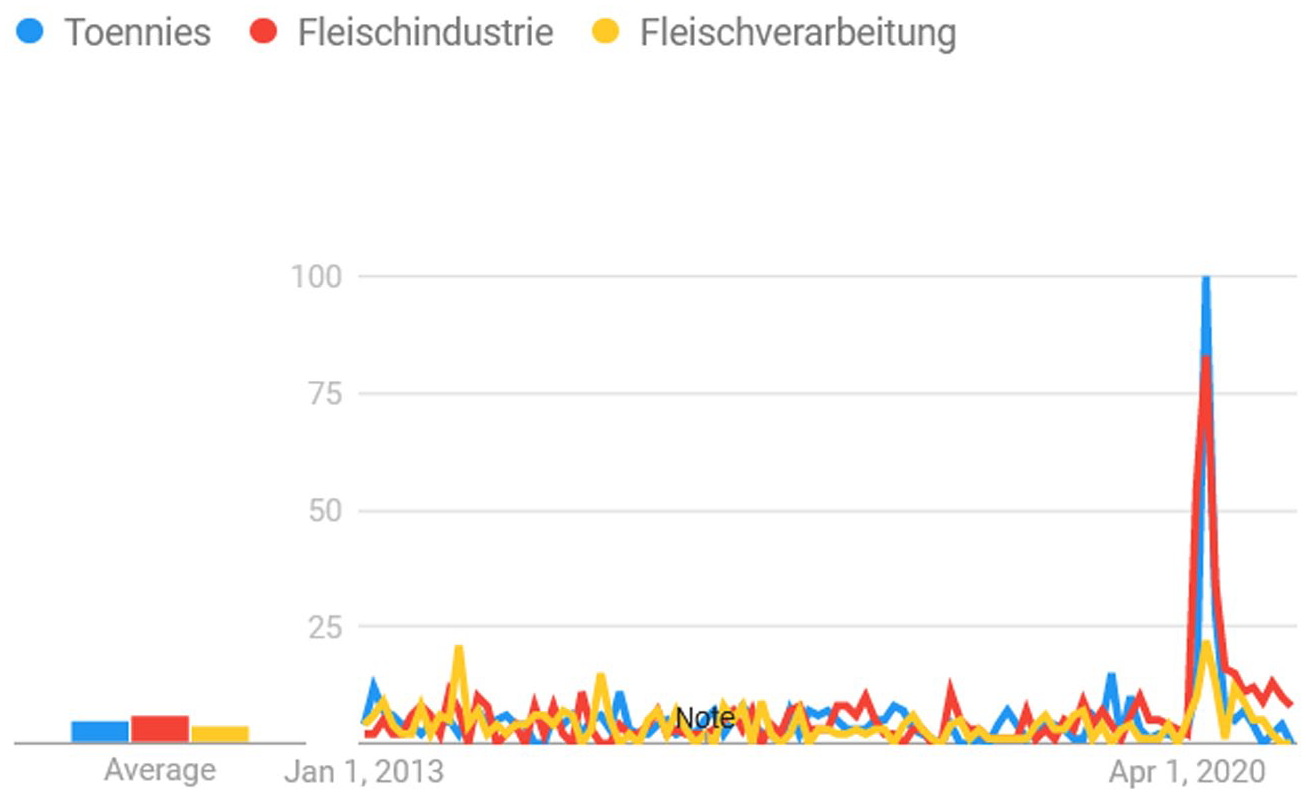
Public interest in the meat industry.
The background to this massive public interest was provided by two waves of coronavirus outbreaks in Germany’s largest slaughterhouse, the Tönnies factory in Rheda-Wiedenbrück, a district of the city of Gütersloh in North Rhine-Westphalia. While the first outbreak was relatively mild, a massive second wave had its peak in the second half of June and caused the closure of the plant for over a month. More than 1500 employees had tested positive, and more than 7000 people had to be quarantined. Because of the spread of the virus to the local communities, the district of Gütersloh and two neighbouring districts had to go into lockdown for two weeks. Meanwhile neighbouring states issued a travel ban on people coming from Gütersloh (Horst, 2020).
The public health disaster in Germany’s biggest slaughterhouse empowered all those who had been fighting for decent living and working conditions in the industry. As shown by Wagner (2015) and Mense-Petermann (2020), during earlier scandals, an advocacy coalition had formed which fought for re-regulation of the industry. This coalition included the trade union federation DGB and the food industry organisation NGG, the Fair Mobility offices and other NGOs, as well as church activists, most famously Peter Kossen, a Catholic priest who grew up in Germany’s pig belt and who had a long track record of campaigning for better working conditions and a minimum wage for the meat industry (Kossen, 2020). This coalition also had close contacts with politicians in Lower Saxony and North Rhine-Westphalia, who called on their expertise, and found a political ally in the Social Democratic Minister of Labour, Hubertus Heil.
The advocacy coalition converged on a policy narrative with a clear villain 10 : Germany’s pig baron no. 1, Clemens Tönnies. Tönnies was an easy target, as he was a well-known colourful personality in Germany’s public life, with a net worth of about €1bn, and close contacts with local, national and international politicians. While in 2015 he could still present himself as the one who would singlehandedly end the exploitative model in the meat industry (Kunze and Willeke, 2015), his public exposure backfired in the COVID-19 crisis. The new policy narrative identified Tönnies’ use of opaque subcontracting as the mechanism by which he inflicted harm on migrant workers and local communities, while at the normative level, it blamed Tönnies for causing their suffering. The advocacy coalition also converged on the policy solution, namely the banning of subcontracting. Some members of the coalition had more far-reaching policy solutions. Most notably, the NGG and Fair Mobility offices also demanded the banning of temporary and agency work, the re-regulation of housing, and an increase in inspections. At the time this article was submitted in May 2021, Fair Mobility was optimistic about the campaign. 11
What made this coalition more powerful than in previous attempts at re-regulating was that it could broaden its scope by drawing in local politicians, the local community and even the conservative state minister of North Rhine-Westphalia, Armin Laschet. What triggered this broad coalition and enabled it to break the structural power of the Tönnies group, at least temporarily, was that the entire population of Gütersloh and the neighbouring districts was taken hostage. Not only had they to endure a two-week lockdown, but in addition, the population felt stigmatised because some parts of Germany issued a travel ban for people from the region just before the summer holidays. In addition, people living close to immigrant communities expressed fears of contagion.
Consequently, the policy narrative of the local mayor focused less on the fate of migrant workers, and rather saw the broader community as a victim of Tönnies’ deceptive business practices. As Stone (1989) put it, jointly, these causal stories attributing blame to villains and demanding remedies for the victims shifted the conception of the situation from the realm of fate/accident (the exploitation of Central and Eastern Europeans as ‘destiny’) to the realm of human agency/intent (the exploitation was caused by identifiable villains who had an interest in doing so).
Finally, the powerful policy narrative was also widespread in the centre-left media and local media. In fact, the media helped a lot in bringing some of the heroes in the fight against the scandalous meat production process to the attention of Germany’s public. Faire Mobilität labour counsellors such as Daniela Reim (a Romanian speaker), Manuela Szabó or Piotr Mazurek, and the above-mentioned priest Peter Kossen became household names for a short period, at least for that part of the German public that consumed centre-left or left-wing media. This was an important enabling factor for the reform coalition because ‘causal beliefs are quite sensitive to the way news coverage portrays problems’ (Stone, 1989: 292).
While the advocacy coalition for regulating the industry broadened, the policy coalition of the opponents shrank. The broad pro-reform policy coalition started to disintegrate shortly after the draft law was submitted to Parliament, however. Conservative politicians, who in summer had still backed the Labour Ministry draft, started to backpedal. Together with representatives of the meat industry, they attacked the planned banning of temporary workers, arguing that this was needed during seasonal peaks, for instance in barbecue season (Keuchel and Verfürden, 2020). The ‘barbecue sausage’ policy narrative caught on, and the common front of the meat industry and conservative MPs against the Occupational Safety and Health Inspection Act delayed its passing in parliament and watered it down. While the law that was finally passed at the end of December 2020 still postulates a banning of temporary workers in the industry, the use of temporary workers remains possible for a transitional period of three years, albeit only under certain conditions. 12
Back in Romania, the government’s reaction was limited to the Ministry of Foreign Affairs informing the public about the growing number of infected workers. In the European Parliament, however, the Social Democrat delegation issued passionate pleas that a regulatory regime change should take place in Germany and that the European Commission adopt a pan-EU framework that could bolster the rights of workers in this sector. Moreover, the Romanian Social Democrats reported that within the S&D group debates they won the commitment of SPD co-chair Norbert Walter-Borjans that the SPD would act at the federal level to curb labour abuses in the meat industry. These activities at the European Parliament level never reached the Romanian public arena beyond vague statements by the far right. But on this occasion, the Romanian media amply reported on the case of Romanian workers (including by interviewing Daniela Reim), and carried out investigations into MGM, whom it painted as a villain exploiting his own people. The Romanian media also revealed that Tönnies was a regular at hunting events organised by a Romanian multimillionaire – who took time out to defend Tönnies in the media (Crăit,oiu, 2020) – and was a shareholder in a large agribusiness (Orgapic) farming 7000 hectares of land, which was investigated for tax evasion precisely in areas from which some Tönnies workers originated (Mazilu, 2020).
MGM’s German operations had a sophisticated defensive strategy when activists and the media put the spotlight on it, climaxing in an in-depth report in the Financial Times (Solomon et al., 2021). Thus, when Daniela Reim, a labour counsellor for Romanian workers in Lower Saxony, revealed MGM’s business model, Miculescu’s social media crew orchestrated a professional social media campaign against her, while MGM lawyers attempted to bully her into not publishing the results of her research in the media and dragged her into court. Yet MGM’s counter-narratives did not find sympathetic ears in the media and German courts even ruled in favour of Reim (Kühnel, 2021).
Conclusions: is this time really different?
The banning of subcontractors is the most decisive action taken by the German legislature to improve working conditions to date. To understand this outcome, the article proposes an analytical framework that highlights the importance of material incentives, critical junctures and public health frames in labour struggles for the rights of transnationally mobile labour. Specifically, if exploitative labour practices are inherent in business models in the host country that nevertheless deliver comparatively better economic opportunities for the local population and migrant communities, regulatory coalitions face an uphill battle. Forms of corporate structural and instrumental power can, however, be destabilised by externalities – in this case, a pandemic – that stigmatise the local and migrant populations alike, opening up the opportunity structure for reform by couching labour regulation in more encompassing and more resonant health frames. As expected, the eventual success of the advocacy coalition was conditional on the fact that it had been built before the critical juncture of the pandemic and could be easily mobilised and called upon when the latter broke.
We also observed that this initial success has emboldened further union action in Germany. In February 2021, the food processing union NGG organised a campaign for a €12.50 an hour wage, a pay level considered more adequate for the punishing conditions of meat industry work. To date, employers have offered only €10.50. As our monitoring of the Faire Mobilität social media posts reveals, this campaign found support among Romanian workers, particularly in the meat packing plants that had labour representatives.
At the same time, the article issues a note of caution. First, many of the subcontractors responsible for the dire conditions in the meat industry also supply other industries with contract labour. As long as the ban is only for a specific industry, there is little reason to believe that contract workers will not be deployed elsewhere. Second, enforcement of the law has always been a major issue. The number of inspections is notoriously low, and while the law stipulates a higher number, it still does not amount to a major threat. In a similar vein, while the law foresees sanctions in case of violations, the fines are far from impressive. Third, the industry has already found ways around the law, by simply relocating elsewhere in Europe, to Spain and Poland. One would hope that the EU legal framework may prevent excessive regulatory arbitrage, with the European Court of Justice ruling in June 2021 that setting up temporary work agencies and posting cheap labour to other Member States is illegal. This ruling makes forum shopping impossible for work agencies that could hitherto establish themselves in the Member States with social security legislation that is most favourable to them. 13 As this article shows, however, the instruments of exploitation are often subtler than the arm of the law.
Finally, the impact of the ban on MGM is hard to gauge. After the ban, subcontractors began recruiting for the Netherlands, France and the United Kingdom. The number of posts on social media and other sites about work in German meatpacking plants has dwindled to insignificant numbers, with most of the recruitment work being done on a smaller scale and on a face to face basis. Our monitoring of the relevant sites revealed that the British wage deals were 20–40 per cent better than in Germany.
What implications follow from all this regarding the strategies of trade unionists active in this labour-intensive sector? First, one needs to be prepared for regulatory arbitrage and/or technological change. One can conjecture that, under these conditions, meat firms from the German pig belt can move to jurisdictions with more flexible frameworks for subcontractors. Alternatively, they can automate more and observe labour standards better (as Danish meat packers did) but also use their power to dilute the ban over time, once the pandemic passes and the issue fades from public and political attention. Ultimately, then, what trade unions need is to link up with issue-based civic networks and make the most of openings in the opportunity structure when they frame their message aimed at re-regulating this exploitative low-cost sector at the EU level. Students of labour issues and trade unionists active in the context of such a massive power asymmetry between labour and capital could benefit from recent research highlighting the importance of bottom-up organising (broadening engagement among people never previously involved in such a movement) in contrast to classical mobilisation and more professional forms of struggle, such as advocacy (McAlevey, 2016). The fact that German labour activists understood that all three strategies are needed may constitute grounds for more optimism about the future of work in Europe’s meat industry.
Footnotes
Funding
Dorothee Bohle acknowledges funding for the research from the Research Council of the European University Institute.
3
For the concept of ‘structural power’ of business, see Culpepper (2011,  ), and Section 3 below.
4
We thank Timo Seidl and Andrea Terlizzi for pointing us to policy narratives.
5
https://www.facebook.com/groups/184028005850391; (accessed 22 November 2021).
6
7
For example, the Association of the Meat Industry (Verband der Fleischwirtschaft), or the Federal Federation of the German Meat Products Industry (Bundesverband der Deutschen Fleischwarenindustry).
8
https://www.faire-mobilitaet.de/ueber-uns/++co++aad7ecc8-efae-11e1-8a24-00188b4dc422 (accessed 22 November 2021); see also .
9
We also performed a search in the Factiva database for coverage of the meat industry and working conditions in mainstream print media and one major tabloid, where a very similar picture emerged.
10
The findings presented below are based on the analysis of about 100 articles that appeared in Germany’s major print media in 2020.
11
Author correspondence with Fair Mobility agent.
12
The company must be covered by collective agreements, temporary workers will have to receive the same wages as the permanent workforce, the maximum period of temporary employment shall be four months, and the share of temporary workers may not be higher than 8 per cent of the annual workforce.
13
https://curia.europa.eu/juris/liste.jsf?lgrec=fr&td=%3BALL&language=en&num=C-784/19&jur=C (accessed 22 November 2021).