




Abstract
This article aims to take stock of the various manifestations of on-call work in Germany. It is shown that formal on-call work is, by international standards, relatively strictly regulated in Germany, not least as the result of a 2019 reform of the law. Similar to other countries, however, other informal variants are used that lie outside the scope of the re-regulation or ‘normalisation’ of formal on-call work. Differentiated analyses based on survey data show that both formal and informal variants of on-call work are associated with disproportionately high levels of short part-time work, low pay and consequently with considerable risks of poverty. As a consequence, the ongoing debate on the erosion of the status of employee should not be too narrowly restricted to self-employed workers in the gig economy (Deliveroo, Uber) but should be extended to include the ‘grey zones’ in the area of dependent employment.
Cet article vise à faire le point sur les différentes manifestations du travail à la demande en Allemagne. Il montre que le travail à la demande formel est, selon les normes internationales, réglementé assez strictement en Allemagne, grâce notamment à la réforme de la loi en 2019. Toutefois, comme dans d’autres pays, d’autres variantes informelles sont présentes et échappent au champ d’application de la re-réglementation ou de la “normalisation” du travail à la demande formel. Des analyses différenciées, basées sur des données d’enquête, montrent que les variantes formelles et informelles du travail à la demande sont associées à des niveaux proportionnellement trop importants de travail à temps partiel de courte durée, de faibles rémunérations et, par conséquent, à des risques considérables de pauvreté. Dès lors, le débat en cours sur l’érosion du statut de salarié ne devrait pas être strictement limité aux travailleurs indépendants de la gig economy - ou économie des petits boulots (Deliveroo, Uber), mais devrait être étendu aux “zones grises” présentes dans le domaine de l’emploi dépendant.
Der vorliegende Artikel zielt auf eine Bestandsaufnahme der verschiedenen Erscheinungsformen von Abrufarbeit in Deutschland und zeigt, dass die formale Variante von Abrufarbeit hier im internationalen Vergleich relativ strikt reguliert ist, nicht zuletzt durch eine Gesetzesreform, die 2019 in Kraft trat. Ähnlich wie in anderen Ländern kommen jedoch andere informelle Varianten zum Einsatz, die außerhalb des Geltungsbereichs der Re-Regulierung oder ‘‘Normalisierung’’ der formellen Abrufarbeit liegen. Differenzierte Analysen auf der Grundlage von Umfragedaten zeigen, dass sowohl formelle als auch informelle Varianten von Abrufarbeit mit einem unverhältnismäßig hohen Anteil an kurzer Teilzeit, Niedriglöhnen und damit einem hohen Armutsrisiko assoziiert sind. Die gegenwärtige Debatte über die Erosion des Arbeitnehmerstatus sollte sich deshalb nicht zu eng auf die Solo-Selbständigen in der Gig-Ökonomie beschränken (Deliveroo, Uber), sondern auch die ‘‘Grauzonen’’ im Bereich der abhängigen Beschäftigung in den Blick nehmen.
On-call work as a ‘hybrid’ form of work on either side of the platform economy
The casualisation of employment in recent years has often been associated with the platform economy, with workers treated as self-employed rather than employees and only called in and paid for their work if and when needed. Frequently the subject of court proceedings, corporate practices such as these fuel the debate on how ‘employee’ and ‘employer’ statuses are to be defined and to what extent the new technologies and business models make it necessary to adjust existing labour law (Prassl, 2018; Todolí-Signes, 2017). It is increasingly acknowledged, however, that platform-mediated work is merely one of many ‘new forms of work’ (Eurofound, 2015), of emerging ‘grey zones’ of employment (Bureau and Dieuaide, 2018) or ‘hybrid’ forms of work (Cherry and Aloisi, 2017; De Stefano, 2015), in which characteristics of self-employment and employment are legally combined. These hybrid forms also include on-call work beyond the platform economy, most prominently the so-called ‘zero-hours contracts’ in the UK. Often assigned to the hybrid category of ‘worker’ created by New Labour in the 1990s, employees on such ‘zero-hours contracts’ enjoy only limited protection under labour law (Adams and Deakin, 2014; Kenner, 2017). In other European countries, on-call work tends to be conceived as a dependent employment relationship (Eurofound, 2015). Yet even then, it can be characterised as a de facto hybrid form of work, since one characteristic it shares with self-employment, is that on-call workers run the risk that the labour they offer remains unused and therefore goes unremunerated.
According to the study by Eurofound (2015), on-call work has become more widespread not only in the UK but also in other European countries such as Ireland, Italy, the Netherlands and even Sweden. Due to different national regulations and definitions of on-call work, internationally comparable data are not yet available, and even national datasets often lack precise information on its prevalence and characteristics. Estimates for individual countries range between 1 per cent and 8 per cent of the workforce (see Broughton et al., 2016: 122–123). A recurrent finding across countries is that on-call work is concentrated in service sectors such as retail, hotel and catering (‘horeca’), health and social care (Broughton et al., 2016). One possible factor for the persistent or even increasing use of on-call work is the re-regulation of labour markets. The introduction of and increases in minimum wages in many European countries have restricted the opportunities available to employers to reduce labour costs by paying low hourly rates. One possible alternative strategy is thus to reduce ‘unproductive’ paid working time through the use of on-call work (Datta et al., 2019). There is also some evidence that the re-regulation of more expensive ways of reducing unproductive working time, such as temp agency work, has led employers to rely more on on-call work (Pennycook et al., 2013: 15). Furthermore, various studies point to the role played by new digital technologies and new practices based on them. Besides the above-mentioned algorithm-based platforms, the increasing diffusion of smartphones makes it easier for companies – even beyond the platform economy – to call on workers at short notice when required, as studies of the cleaning industry or domiciliary care services show (among others Sardadvar and Holtgrewe, 2017; Moore and Hayes, 2017).
Recent legal reforms in EU Member States and at EU level have responded to calls to re-regulate variable hours contracts, and have banned zero-hours employment, as in Ireland (as of 2019), or increased minimum standards for on-call work, as in Germany (as of 2019, see below) or in the Netherlands (as of 2020). The EU Directive on transparent and predictable working conditions (COM (EU) 2019/1152) also lays down minimum requirements for on-demand contracts, seeking to prevent their abuse. Critical assessments of the EU Directive (Piasna, 2019) and of national reforms have however highlighted persisting protection gaps, pointing to contractual arrangements for variable working hours that still escape the regulatory efforts – such as zero-hours workers in Ireland without employee status (so-called ‘if-and-when’ contracts) (MacMahon and Dundon, 2019). As MacMahon and Dundon (2019) conclude, the Irish ban on zero-hours employment may even backfire through inciting employers to resort more to these less regulated forms of on-call work.
This split development – the re-regulation or ‘normalisation’ (Rubery et al., 2018) of certain types of precarious work (such as on-call work recognised as employment) on the one hand, and the continued or even growing use of more informal variants of on-call work on the other hand – is an issue the present analysis seeks to explore in greater detail. Taking Germany as an example, we analyse how the recent legal reform that came into force in 2019 has contributed to diminishing protection gaps for formal on-call work (Section 2), while at the same time a number of informal variants of on-call work have eluded re-regulation (Section 3). In the second part of the article (Section 4) we analyse the prevalence and degree of precariousness of on-call work in Germany. Our findings show that both the formal and informal variants are to a considerable degree associated with low wages, short part-time work and the risk of poverty. Overall, our findings emphasise that the current debate on the erosion of the ‘employee’ status should not be confined to gig economy workers (Deliveroo, Uber) but should also encompass the ‘grey zones’ (Bureau and Dieuaide, 2018) existing in formally dependent employment and in other hybrid forms of work outside the platform economy
Dual trends in legislation and jurisdiction: re-regulation and the persistence of informal forms of on-call work
Formal on-call work – gaps in protection despite re-regulation
Following the definition used in the Eurofound (2015) study, on-call work ‘involves a continuous employment relationship maintained between an employer and an employee, but the employer does not continuously provide work for the employee. Rather, the employer has the option of calling the employee in as and when needed.’ In Germany, this definition equates in essence to the form of employment contract covered in § 12 of the Part-Time and Fixed-Term Employment Act (Teilzeit- und Befristungsgesetz or TzBfG) by the term ‘Arbeit auf Abruf’ (on-call work). There are two further forms of on-call work in Germany, known respectively as ‘Rufbereitschaft’ (‘on-call at home’) and ‘Bereitschaftsdienst’ (‘on-call duty’). In the former, employees can be contacted at home and called in to work at short notice (e.g. firefighters). In the latter, employees remain at their place of work (e.g. a hospital) and are available to be deployed as and when required. However, availability for work at short notice applies to only part of their working time. In addition to their regular working time, they are rostered to work additional on-call shifts (typically outside normal operating hours, e.g. at night or at weekends) that are usually planned well in advance. Moreover, stand-by times are paid for in the case of ‘on-call duty’ shifts, and partly also in the case of ‘on-call at home’ shifts, reflecting important re-regulations from the European level since the beginning of the 2000s (see e.g. the CJEU judgment ‘Matzak’ of 21.02.2018, C-518/15). Both types will therefore be excluded from the following analysis due to the more limited flexibility requirements and income risks associated with them.
Even ‘Arbeit auf Abruf’, which corresponds more closely to the notion of casual work, can be classified as relatively strictly regulated by international standards (O’Sullivan et al., 2015: 112–116). Indeed, it was further tightened by the ‘Gesetz zur Weiterentwicklung des Teilzeitrechts - Einführung einer Brückenteilzeit (BrTzEG)’, a revised version of the above-mentioned TzBfG which came into force in January 2019. The revision was opposed by employer organisations in sectors making strong use of on-call work, such as the hotel and restaurant industry (see DEHOGA, 2018), whereas the German Trade Union Confederation (DGB) had called for a complete ban of ‘Arbeit auf Abruf’ (DGB, 2016). Compared with the UK regulations on zero-hours contracts, four restrictions on employers’ margin of flexibility can be highlighted.
Unlike zero-hours contracts in the UK, ‘Arbeit auf Abruf’ has always been classified as
To prevent on-call employees having to be available at short notice round the clock, employees have to be given at least four days’ notification of the starting date and time. In the UK, by contrast, there is no obligation for employers to observe a
Zero-hours contracts in the literal sense of the term, in which employers provide no guaranteed hours at all, are not permitted in Germany. In the absence of a contractually fixed number of working hours, a
The use of ‘bandwidth’ contracts was ultimately prohibited by regulations on
The revision of the TzBfG has thus eliminated some of the grey areas, and will presumably help improve knowledge of existing rights and obligations. However, given the complex legal situation and the difficulty in establishing where the boundary lies between formal on-call work and other forms of flexible work (e.g. on-call at home), it is by no means certain whether employees actually know their rights (Absenger et al., 2014: 38).
Besides gaps in knowledge, the effectiveness of the protections is probably primarily constrained by employees’ unwillingness to claim their rights. The pivotal point here is ‘voluntariness’: in practice, employees are not forbidden from voluntarily working more than the upper limit of 25 per cent additional hours. However, given the low pay levels, this ‘voluntariness’ is in reality often tempered by material constraints and fear of dismissal or future discrimination in the allocation of work (Frisse, 2017; Friedrichs, 2017). This is graphically described by an employee of the H&M fashion chain which, according to press reports, offers most of its employees so-called ‘flexi-contracts’: Sales staff at our place only get 20-hour contracts. At the same time, they’re expected to be able to work at least 30 hours on a flexible schedule, to be contactable at any time and to be ready to fill in at a moment’s notice. Anyone unable to guarantee that won’t get 20 hours either and anyone who doesn’t pitch in won’t be given a single hour’s overtime on the next rota. But what you earn for 20 hours per week is just enough to keep you alive but not enough to really live. (H&M employee, 2017, quoted in Frisse, 2017, authors’ translation)
Informal variants of on-call work
In the following section, ‘informal’ variants include those arrangements and practices that open up wide-ranging possibilities for employers to unilaterally vary the scheduling and, to some extent, the volume of paid working time and where the workers are at the same time so closely integrated into the company’s work processes that they cannot be defined as self-employed. Since the boundary between on-call work and self-employment is far from clear-cut, these informal variants have in the past frequently been the subject of legal proceedings. On the basis of court judgments and other literature, three variants of informal on-call work can be identified.
The same applies to the second variant, namely
Finally, as working time has become more flexible, forms of working time organisation have emerged even in standard employment relationships that have certain similarities with formal on-call work. This is particularly the case with
On closer inspection, working time accounts also entail economic risks for employees. Unlike formal on-call work, there is no legal obligation to define upper and lower limits for weekly or monthly working hours. This is an open invitation to employers to fix the contractually agreed average working time significantly lower than that of a full-time position, since by doing so they give themselves greater scope to adjust to fluctuations in workloads through the use of working time accounts. Court judgments (e.g. BAG judgment of 26.04.2017, Az. 10 AZR 589/15) illustrate the ways in which employers exploit the considerable latitude they enjoy, only offering their employees part-time jobs but when necessary deploying them as full-timers. This practice has been made even easier by the mass diffusion of smartphones and their systematic incorporation into companies’ working time planning. This is illustrated, for example, by digital tools developed by the Fraunhofer Institute to support a modern system of flexible, capacity-oriented working time management. Their ‘KapaFlexcy’ app and KapaStar software help employers identify those employees who can be discharged at short notice in the event of a staff surplus or conversely who can be asked to work additional shifts. However, when this app was trialled, doubts were expressed by works councillors about the voluntariness and the generally increased expectations on workers to make themselves permanently available (Böwe and Schulten, 2014). Similar practices of calling in staff at short notice by smartphone have long been used in service industries such as commercial cleaning and catering, supported in some cases by specialist shift planning apps (e.g. www.gastromatics.de; shyftplan.com) and in others simply by the use of the usual messaging services, such as WhatsApp and text messages (Sardadvar and Holtgrewe, 2017).
In sum, while a trend towards re-regulation (albeit with continuing gaps in protection) can be observed in respect of formal on-call work, contrary tendencies are at work as a result of the widespread use of informal variants.
Empirical findings: precariousness of on-call work
In both variants of on-call work, flexibility requirements and the risks of precariousness can be particularly high when combined with low volumes of guaranteed hours and with low hourly rates of pay. Previous investigations have already revealed that formal on-call work occurs frequently in combination with so-called mini-jobs 4 ; that it is particularly widespread among employees not working in the occupation for which they have been trained; and that it is very common in the hospitality and retail sectors (see e.g. Fietze et al., 2014; Hank and Stegmaier, 2018; Schult and Tobsch, 2012). These findings suggest that on-call work combines various structural characteristics responsible for the precariousness of this form of employment: the risk of low hourly pay is particularly high in mini-jobs, in low-skilled jobs, and in certain sectors like retail or the hotel and restaurant industry (see Kalina and Weinkopf, 2018).
Detailed below, our own analyses both confirm and shed further light on these findings. For both variants of on-call work (formal and informal), we studied a) the share and occupational composition of on-call workers with short part-time contracts 5 , and b) their risks of precariousness. Our core aim here was not to assess the impact of the contractual form (on-call work) on pay and poverty, and thus to isolate the effect of on-call work from other factors such as low skill levels. Instead, we sought to identify to what extent an inherently precarious contractual arrangement (variable, non-guaranteed pay) goes hand in hand with other factors, such as a low volume of weekly working hours and low hourly pay, thereby effectively translating into material precariousness – as measured in low pay rates and at-risk-of-poverty rates.
The data used in the following analyses are taken from the Socio-Economic Panel (SOEP), a representative panel survey carried out since 1984 among households in Germany (Wagner et al., 2007). While other surveys ask only about on-call work, the SOEP questionnaire distinguishes between on-call work, on-call at home and on-call duty (see Section 2 above). This ensures that on-call work as defined in §12 of the Part-Time and Fixed-Term Employment Act (TzBfG), to which the following analyses refer, can be identified relatively precisely, although misallocations can certainly not be ruled out. Moreover, the analyses also aim to capture those variants
Formal on-call work
In 2017, around 1.7 million dependent employees stated that they did on-call work as their main job, a share of around 4.9 per cent of all dependent employees. 6 While the share of formal on-call work has increased slightly over time, from 4.5 per cent in 2011 to 4.9 per cent in 2017, it has also fluctuated, meaning that no clear trend can be discerned (2014: 5.0 per cent; 2015: 5.5 per cent; 2016: 4.25).
Structural analysis: share and occupational composition of on-call workers in short part-time jobs
It is worth noting that, unlike in other countries where young workers account for a high share of on-call workers (UK: more than 30 per cent aged below 25, see Adams and Prassl, 2018; Netherlands: more than 65 per cent aged 15–25, see Burri et al., 2018), this is not the case in Germany. Here only 8 per cent of formal on-call workers are aged below 25, while some 6 per cent are aged 65 and older according to our calculations. Hence, more than 80 per cent are in core working age, and have this job as their main job. The share of short part-time contracts is nevertheless high: In 2017, almost 25 per cent of the employees engaged in on-call work had no contractually agreed working time (Figure 1). For this group, therefore, according to the legislation then in force, a weekly working time of 10 hours would have been regarded as the agreed working time (see Section 2 above). A further 18 per cent had a contractually agreed working time of fewer than 20 hours per week. A greater share of on-call workers thus have a low guaranteed volume of hours per week and correspondingly a lower guaranteed income than the employed population as a whole. And even when their actual working time is taken into account, on-call employees work considerably fewer hours. A good 28 per cent of the employees doing on-call work actually work up to 20 hours per week, compared with 16 per cent of all dependent employees.
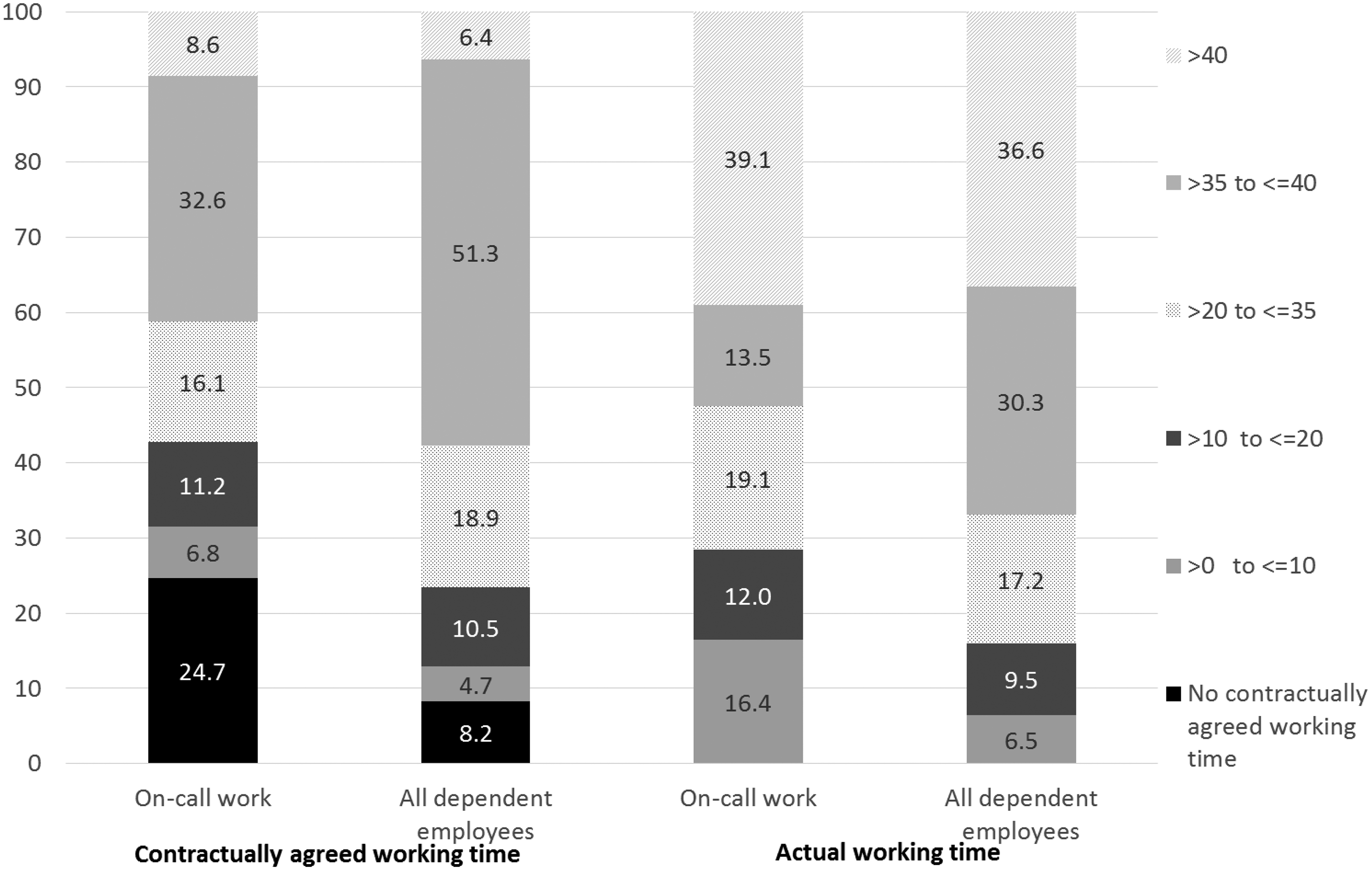
Distribution of on-call work by contractual and actual working time (dependent employees, 2017, %).
According to our analysis, almost 50 per cent of employees doing on-call work are in the health sector (17.6 per cent), distributive trades (11.7 per cent), the hospitality sector (10.2 per cent) and transport and communication (7.3 per cent). In order to ascertain which activities are hidden behind these aggregated economic sectors, we analysed the occupations in which on-call work is most commonly used. The results show that certain jobs found mainly in private sector services, such as waiters and bartenders, sales assistants and cleaners, dominate on-call work with low and intermediate volumes of hours. However, care workers in institutions, e.g. auxiliary nurses in health and elderly care or doctors’ assistants are also among the occupations that do on-call work and are also in the short part-time segment (Table 1).
The 5 occupations with the highest rates of on-call work by actual working time (2015–2017).*
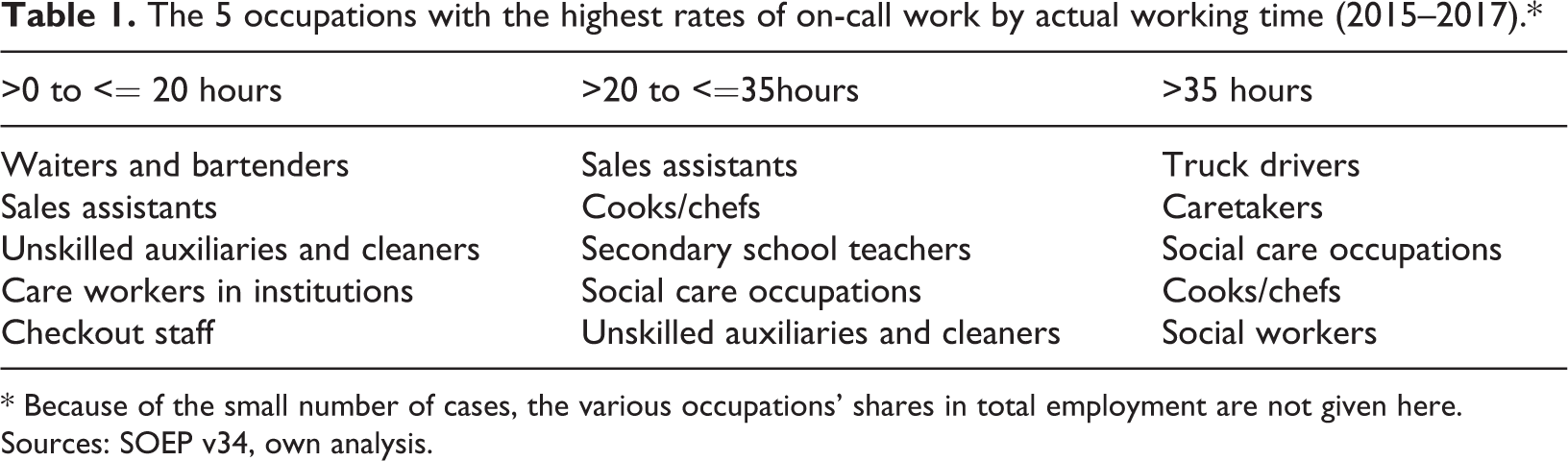
* Because of the small number of cases, the various occupations’ shares in total employment are not given here.
Sources: SOEP v34, own analysis.
Risks of precariousness
Except for those working more or less full-time, employees who do on-call work have a higher risk of being low-paid (between 40.9 and 64.9 per cent) than among all dependent employees (22.6 per cent; Figure 2).
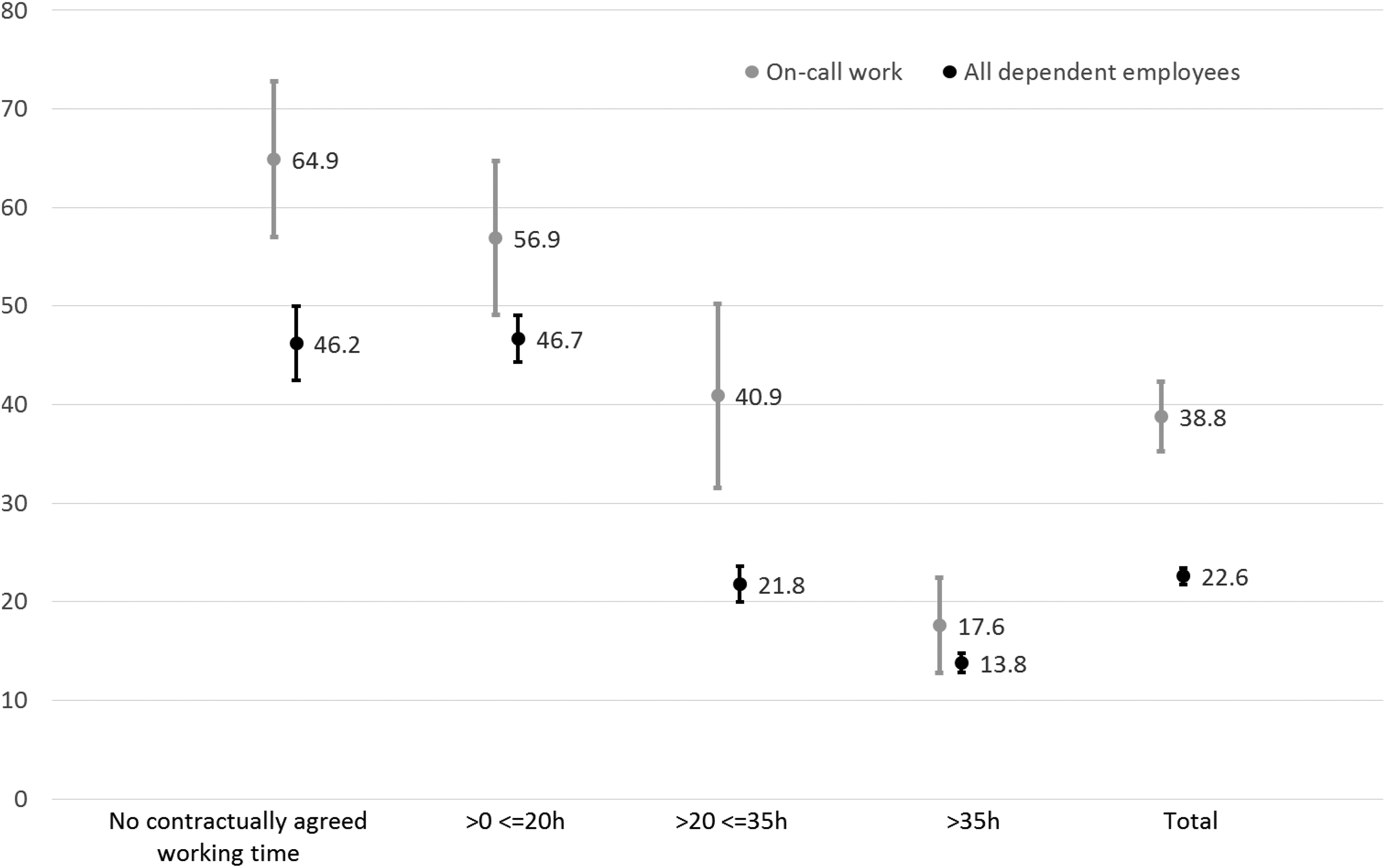
Low-pay risk* in on-call work (2015–2017 pooled with 95% confidence interval, %).
Generally speaking, the risk of low pay is significantly higher for short part-time employees (with up to 20 hours per week) and for those without contractually agreed working hours than it is for those with longer working hours. When combined with on-call work, this risk increases still further. Employees who do on-call work and have either no contractually agreed or short working hours have the highest risk of low pay (64.9 per cent and 56.9 per cent respectively), percentages twice as high as that of all dependent employees (22.6 per cent).
Unsurprisingly, the combination of working on-call and having short working hours is also reflected in high at-risk-of-poverty rates at household level (Figure 3). For on-call workers in general the poverty risk (14.8 per cent) is higher than for dependent employees (8.0 per cent), while it is highest for on-call workers with either no contractually agreed working hours (21.2 per cent) or short working hours of up to 20 hours (25.9 per cent).
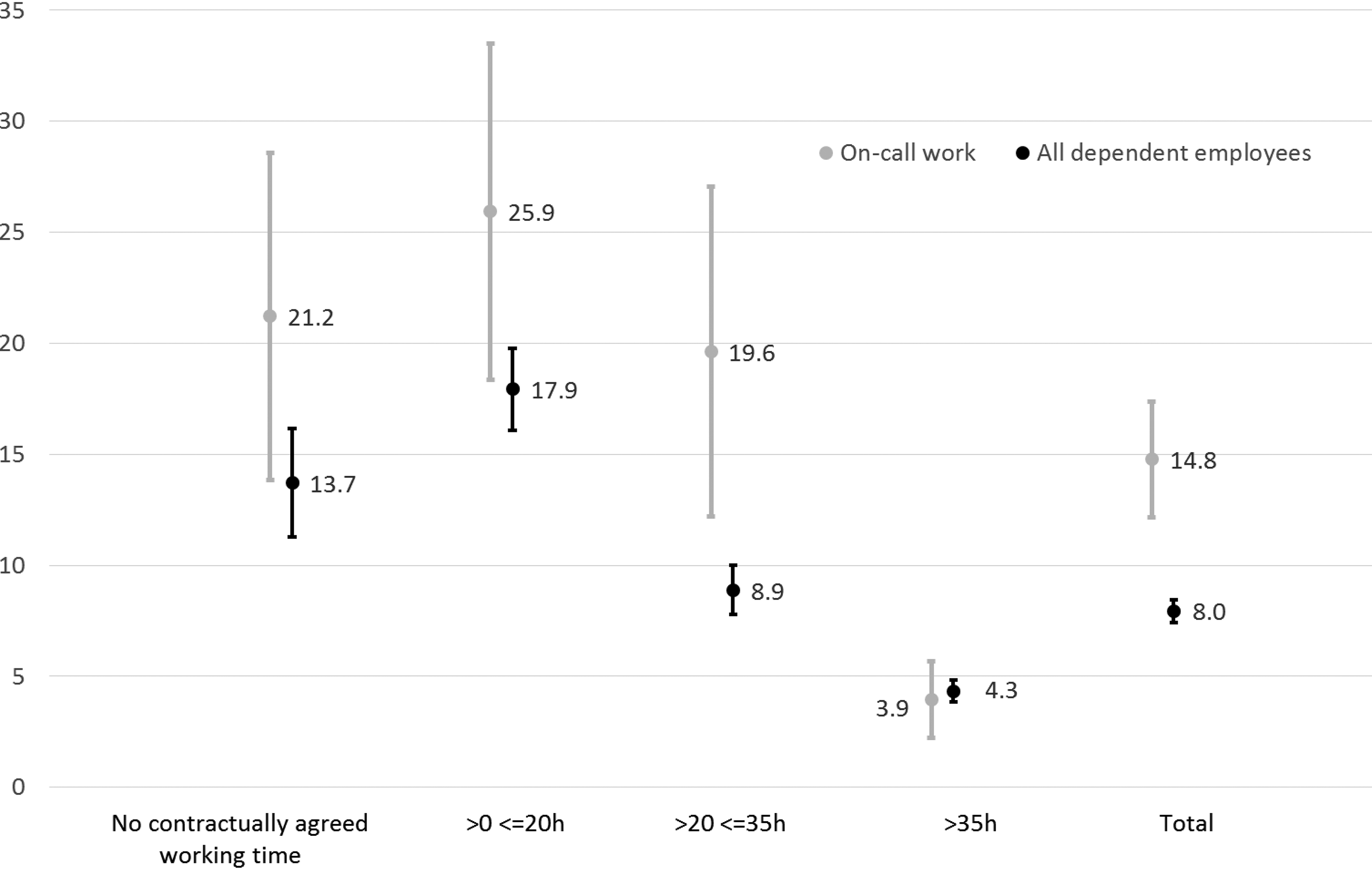
On-call work and poverty rate* (2015–2017 pooled with 95% confidence interval, %).
Summing up the results so far, more than 40 per cent of on-call workers are contractually or legally entitled to up to 20 hours of paid work per week. Their low-pay risk is more than twice as high as that for the employed population as a whole, while their at-risk-of-poverty rate is almost three times as high. Higher rates of low pay and poverty risks also affect those with longer part-time contracts (>20–35 hours). The difference between on-call workers and the employed population as a whole is not statistically significant at the 95 per cent level for all working time categories, pointing to important other factors explaining low pay and poverty risks among on-call workers. However, as explained above, our core aim here is not to explain but to ascertain the degree of precariousness of on-call work. The findings reveal that, due not least to the heterogeneous job profiles, on-call contracts do not equate to precarious employment for all on-call workers, but for a considerable share thereof.
Employees without fixed working time: an approximation to informal variants of on-call work
In 2017, around 8.2 per cent or some 2.9 million of the total 35.3 million employees in Germany stated that they had no contractually agreed weekly working time. The majority of them – some 2.1 million employees – did not assign themselves to either on-call work, on-call at home or on-call duty. Our further analyses relate to this group in order to avoid overlaps with the above-mentioned analyses. 7 Their share of all dependent employees rose slightly from 5 per cent in 2011 to around 6 per cent in 2017.
Structural analysis: share and occupational composition of ‘informal’ on-call workers in short part-time jobs
Employees without contractually agreed working times are significantly more likely than the dependent employee population as a whole to work 20 or fewer hours per week and are less likely to be employed in substantial part-time or close to full-time jobs with 35–40 actual weekly working hours (10.8 per cent compared with 29.7 per cent, see Figure 4). While the actual working times of the dependent employee population as a whole are concentrated in the full-time and excessively long hours zones, those of employees without contractually agreed working times are polarised between excessively long hours and the short-hours part-time zone.
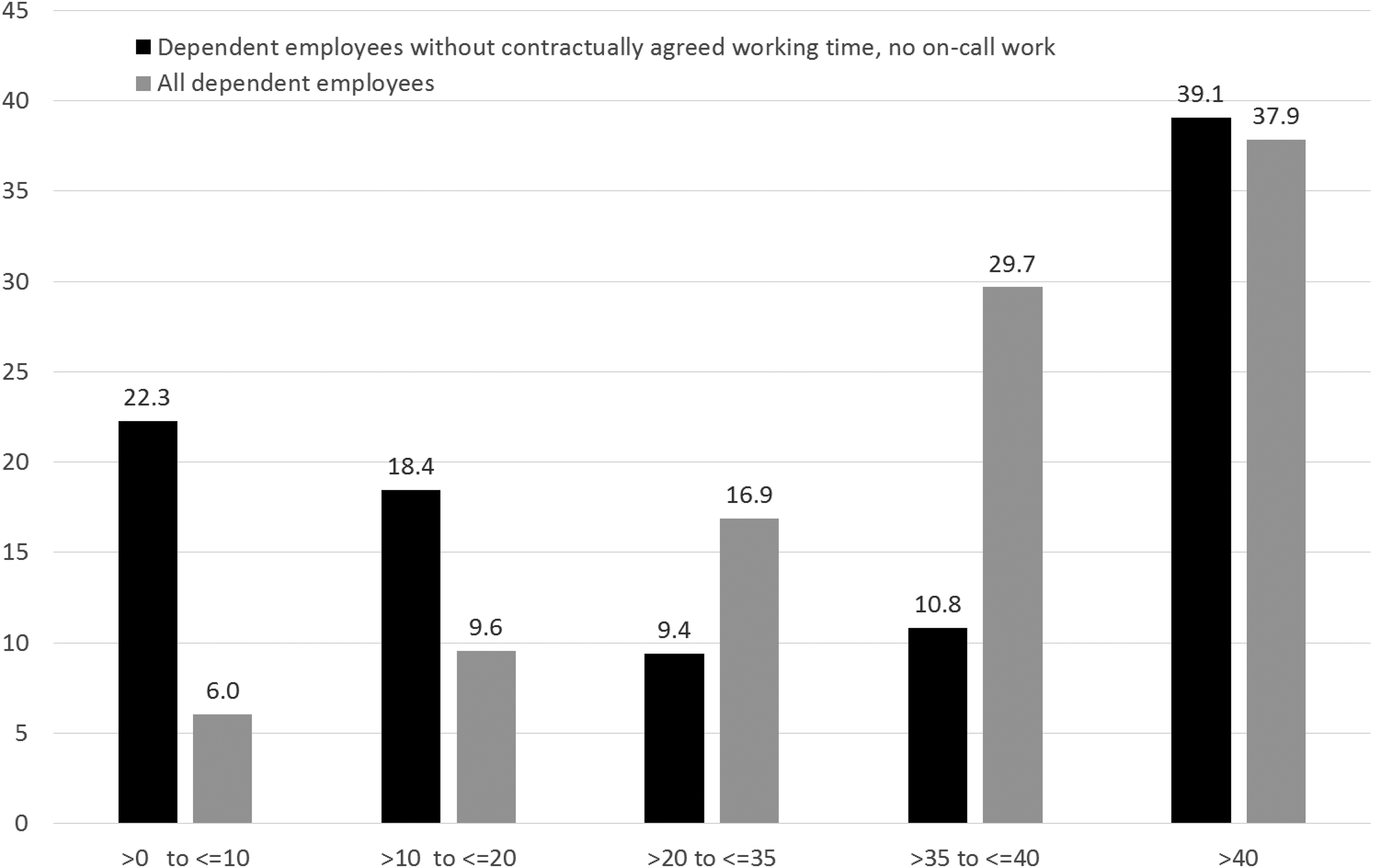
Distribution of dependent employees among actual working time categories (2015–2017, share in category, %).
Such polarisation can also be observed with regard to the skill levels of occupational groups particularly frequently represented in this group. Employees without contractually agreed working times 8 account for an above-average share not only of employees in graduate occupations (accounting for over a quarter (26.2 per cent) of this group), but also of unskilled auxiliary workers (12.4 per cent). As Table 2 shows, longer working hours (>35 hours) are dominated by employees with a university education or management responsibilities, such as architects, business consultants and university lecturers. It seems reasonable to assume that the absence in these groups of a contractually agreed working time reflects a certain degree of influence on when they do the work they have to do and how much time they spend on each of their allotted tasks. Thus ‘informal on-call work’ seems a less appropriate label for these occupations, despite high flexibility requirements for some of them.
The five occupations that appear most frequently in each working time category, (2015–2017 pooled), dependent employees without fixed working times only (no on-call work).*
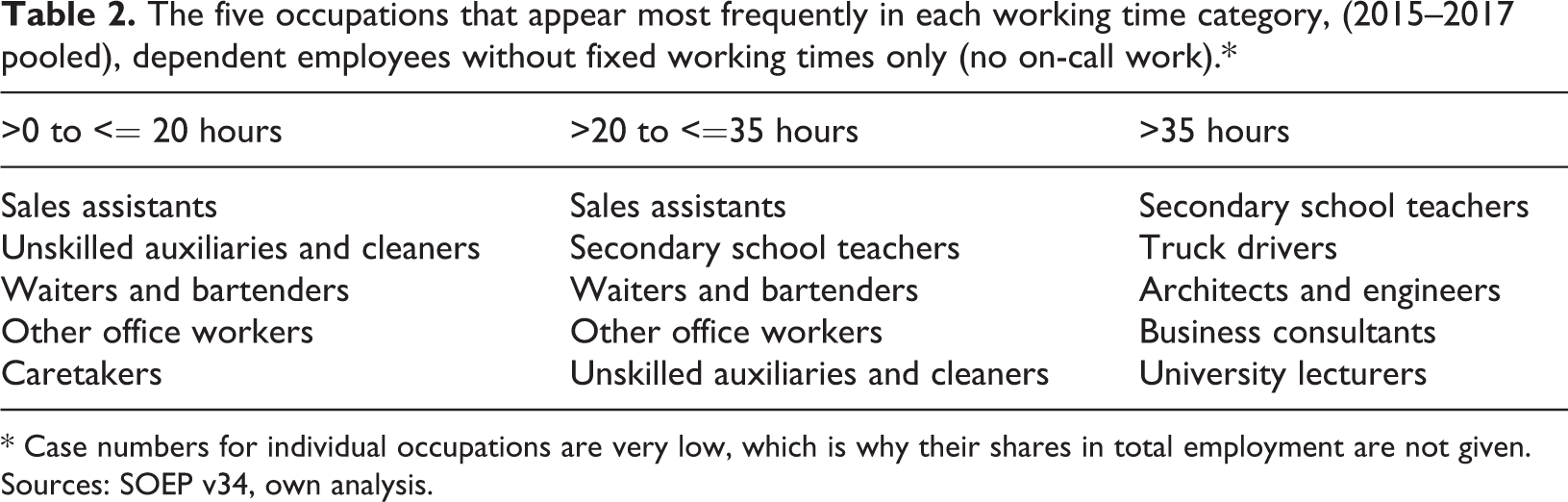
* Case numbers for individual occupations are very low, which is why their shares in total employment are not given.
Sources: SOEP v34, own analysis.
The situation in the short part-time category is quite different. Here there are clear overlaps with the occupational groups particularly heavily involved in formal on-call work (e.g. sales assistants, unskilled auxiliaries and cleaners and waiters) (Table 1). However, the SOEP contains no further information that would enable us to investigate the extent to which the scheduling and duration of working time vary in the course of the weeks and months and how far this is determined by employers or employees. Consequently, these cases can be designated ‘informal on-call work’ only with reservations. Efforts precisely to quantify such informal forms are still very much in their infancy.
Risks of precariousness
Employees without contractually fixed working times had a 48.5 per cent risk of low pay in 2017, more than twice as high as that for all dependent employees (22.7 per cent). This applies in particular to those who work part-time. If the analysis is restricted to those whose actual weekly working time is up to 35 hours, more than 72 per cent – i.e. almost three in four of this group – were paid an hourly rate in 2017 below the low-wage threshold of €10.37 (Figure 5). This also translates into high poverty risks at household level. Dependent employees without contractually fixed working times who work 35 hours per week or less are, at 21 per cent, at considerably greater risk of poverty than dependent employees as a whole (8.6 per cent) (Jaehrling and Kalina, 2019).
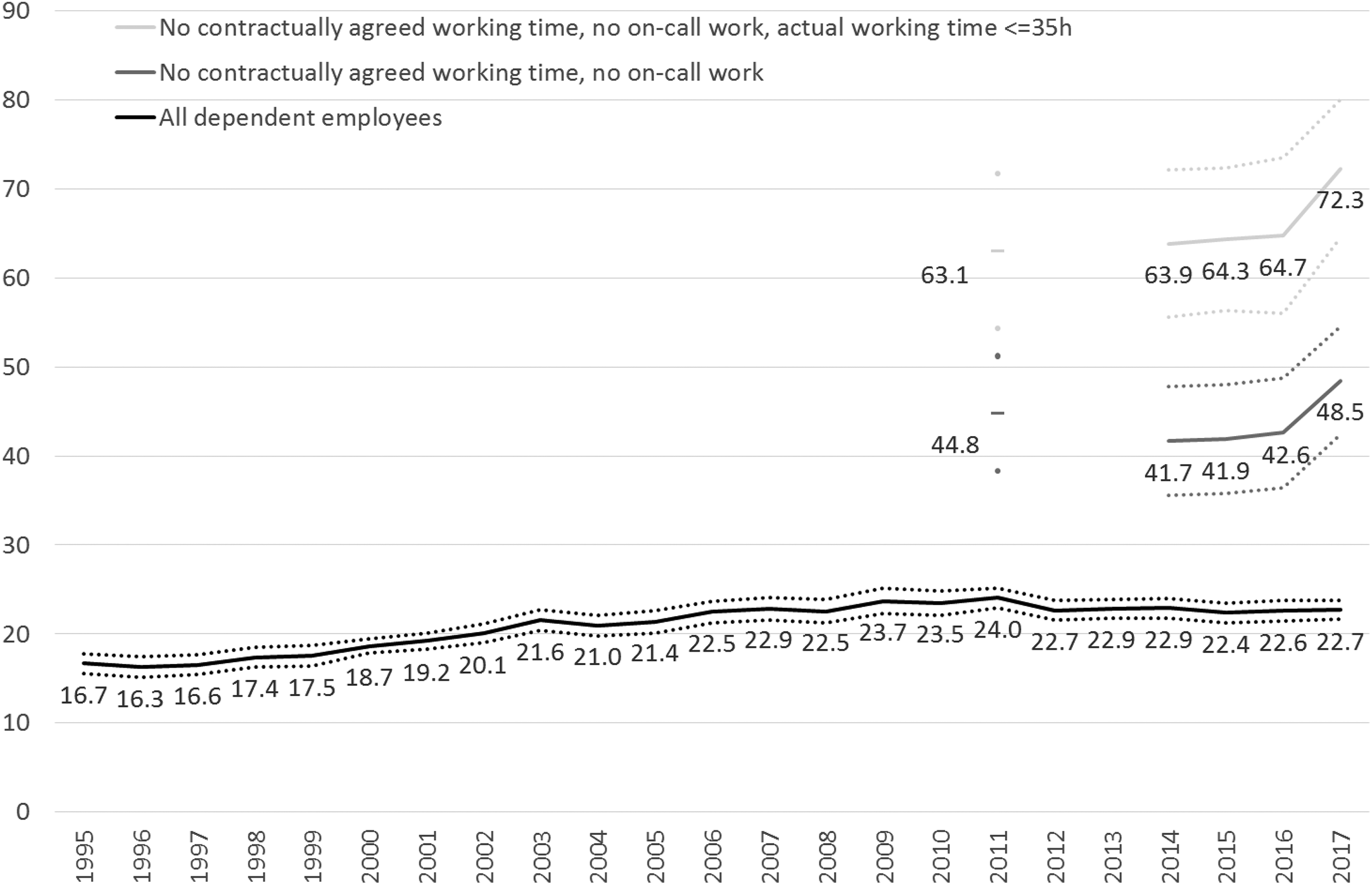
Evolution over time of the low-wage risk for dependent employees without contractually fixed working times (%, with 95% confidence interval).
Conclusion
As our analyses have shown, on-call work is fairly widely used in Germany and extends well beyond the platform economy. It is true that, by international standards, formal on-call work is relatively strictly regulated in Germany, not least as a result of the recent 2019 reform which eliminated some of the legal grey areas leading time and time again to broad interpretations and legal disputes. In practice, nevertheless, gaps in protection still exist, even in formal on-call work. Particularly when combined with part-time employment, many workers will arguably be under increasing material pressure to accept, on a formally voluntary basis, employers’ demands for flexibility going well beyond the protective framework provided by the law. Our empirical findings confirm that formal on-call work does not equate to precarious employment for the whole group of on-call workers, due not least to the heterogeneous occupational profiles. The argument is sometimes put forward that the limited number of those effectively at risk of poverty does not justify legal reforms restricting the use of on-call work (e.g. Schäfer, 2017). Yet, as we have shown, those with short part-time contracts are faced with the risk of variable hours and with a much higher risk of low pay and, consequently, face a poverty risk roughly three times higher than for the employed population as a whole. This certainly calls for reforms targeting at least the situation for this particular group of on-call workers.
Besides formal on-call work, a number of informal variants of on-call work can be identified which are being used by German employers to shift at least part of the financial risk of workload fluctuations onto their employees. While a trend towards re-regulation or ‘normalisation’ (Rubery et al., 2018) can be observed in respect of formal on-call work (albeit with continuing gaps in protection), this trend has so far left these informal variants untouched. Those with the highest protection gaps are the ones not classified as employees (zero-hours framework agreements and informal pools of temporary workers). They are quite similar to ‘if-and-when’ contracts in Ireland (O’Sullivan et al., 2015) or ‘preliminary agreements’ in the Netherlands (Burri et al., 2018: 5–6), in that these contractual forms are likewise not classified as employment, and, consequently, are less regulated or not covered at all by the legislation applying to formal on-call work. They thus contribute to a blurring of boundaries between on-call employment and solo self-employment. On the other side, the more protected informal variant – employment contracts with working time accounts with no or very broadly defined upper and lower limits – contributes to a blurring of boundaries between on-call work and standard employment.
Efforts to capture empirically these informal variants are still in their infancy. Our analyses of employees who have no contractually fixed working times (but do not assign themselves to any variant of formal on-call work) can be regarded as an initial approximation to informal variants of on-call work. Our analyses of this group of 2.1 million employees show that it is sharply polarised in respect of working times and occupational profiles. On the one hand, it includes service occupations and unskilled auxiliary jobs with short working times and, on the other, graduate occupations and managerial positions with long working times. It is the unskilled auxiliary and service occupations that we deem most relevant to our research question. Detailed analyses show that the same occupations as in the formal variants of on-call work (e.g. sales assistants, unskilled auxiliary workers, cleaners and waiters) commonly feature in this group as well. We interpret this as an indication that similar forms of working time flexibilisation are being used here too. However, this is merely a conjecture.
In our view, there is a considerable need for research in this area in order to adequately capture the ‘grey zones’ (Bureau and Dieuaide, 2018) and the presumed increase in the diversity of modes of working and patterns of flexibility, even within ‘standard’ forms of employment. According to Bureau and Dieuaide’s proposed understanding of the grey zones, this would shed light not only on the ‘the legal protection void to which some people are exposed’ but also on ‘the existence of resources and space for manoeuvre which these same individuals may have to experiment with, to bring about new regulations’ (Bureau and Dieuaide, 2018: 267). In fact, it may well be that the break-up of rigid shift schedules actually creates opportunities to take better account of employees’ preferences for flexible working that could be realised through formal and informal negotiations. However, the opportunities and resources for individuals to negotiate compromises matching their preferences are probably very unevenly distributed over the various sectors and occupational groups and therefore require support from legislation and collective agreements.
Footnotes
Funding
We acknowledge support from the Open Access Publication Fund of the University of Duisburg-Essen.