



Abstract
This article intends to show the added value of an interdisciplinary approach to researching the protection of on-location platform workers in producing a more fruitful understanding of the current socio-legal problems regarding the classification of these platform workers and their possible solutions. It explores how food delivery platform workers in Amsterdam experience their social rights, the conditions under which they would wish to change their situation, and the legal reforms needed to realise the changes. The empirical findings suggest that not only solo self-employed but also employed riders appreciate the ability to decide when and whether to accept an assignment. In addition, both types of food delivery riders express the desire to be protected under labour and social security law. The legal analysis highlights various obstacles to meeting the demands of the platform workers. It concludes that it is worthwhile rethinking the dichotomy of the employed and self-employed, both at the EU and national levels, and to offer platform workers (some) employment and social security protection.
Keywords
Introduction
On 9 December 2021, the European Commission published a draft proposal for a Directive to regulate platform work and promote its sustainable development within the EU. 1 After more than two years of intensive negotiation, on 24 April 2024, a compromise version of the Directive was approved by the European Parliament. 2 Based on national law and collective agreements as well as consideration of EU case law, the new Directive introduces a presumption of the existence of an employment relationship, which is triggered upon the presence of facts illustrating control and direction. 3 Platforms are obliged to assume the burden of proof on the non-existence of an employment relationship. However, compared with the original European Commission version, the final version of the Directive has been watered down. The provisions regarding the presumption, in particular, have been diminished, while the European Parliament's proposition to further enhance the protection of platform workers has hardly been incorporated. 4 Member States are required to establish a rebuttable legal presumption of employment at the national level, but have autonomy to decide the criteria. Although the presumption will not lead to an automatic reclassification of platform workers as employees, it will help grant platform workers the correct employment status and address bogus self-employment. On the other hand, however, Member States are not explicitly required to apply a rebuttable legal presumption in the field of social security law. 5
In this context, it should be noted that the reclassification of self-employed platform workers as employees is not necessarily compatible with platform workers’ preferences. For example, various empirical studies have shown that on-location platform workers, such as food delivery riders, want to freely decide when and where to work and, therefore, choose to be classified as self-employed workers. 6 Indeed, although Court decisions in various jurisdictions have shown that workers’ freedom to decide when and where to work does not necessarily preclude the existence of an employment contract, 7 the particular national legal context may present important legal barriers to facilitating employment contracts of platform workers which grant them this freedom to some extent.
This article intends to show the added value of an interdisciplinary approach to researching the protection of on-location platform workers in producing a more fruitful understanding of the current socio-legal problems regarding the classification of these platform workers and their possible solutions. It explores how food delivery platform workers experience their social rights, the conditions under which they would wish to change their situation, and the legal reforms needed to realise these changes. To this end, we have analysed the experiences and motivations of 20 employed and solo self-employed food delivery platform workers in Amsterdam and, subsequently, assessed the legal implications of these empirical findings.
This article is structured as follows. Section 2 describes the current classification of food delivery riders working for platforms in the Netherlands, while section 3 explains the methods used for the empirical research. Section 4 presents and discusses the findings, and concludes that some of the platform workers interviewed deliberately choose to be protected under social security and labour law yet, at the same time, these and other respondents express the desire for a certain degree of freedom to decide where and when to work. Section 5 then discusses how Dutch labour law can meet the respondents’ desire to combine security with flexibility. This section argues that the recent Dutch Supreme Court judgment on the classification of Deliveroo workers theoretically enables platform workers to conclude an on-call employment contract with a platform, which allows them some freedom to decline a call. However, current legal provisions, such as the employer's obligation to pay platform workers for a minimum of three hours’ work each time they are called upon to work, will prevent parties from entering such employment contracts. Section 6 provides a brief conclusion and some proposals for future empirical-legal research.
Employment status of food delivery riders in the Netherlands
The European Commission estimates that nine out of ten platforms active in the EU classify their workers as self-employed. 8 Food delivery platforms in Europe often emphasise the flexibility of working as a rider and the advantages of doing so as a self-employed rider. Uber, the parent company of Uber Eats, claims, for example, that its relationship with riders is a partnership, with riders thus being defined as self-employed. Uber Eats and companies such as Deliveroo offer their riders a supplier agreement rather than an employment contract. In November 2022, Deliveroo left the Dutch market because of the ‘disproportionate investment required to maintain its market position in the Netherlands and uncertain returns’, 9 just a few months before the Dutch Supreme Court ruled that riders working for Deliveroo were employed rather than self-employed. 10 So far, however, this decision has not affected the strategies deployed by Uber Eats.
In contrast, Just Eat Takeaway, which operates in 15 European countries under various brand names, mainly offers its riders employment contracts, with the only exceptions being Ireland, Slovakia and the United Kingdom, where riders are self-employed. 11 Thuisbezorgd, the Dutch subsidiary of Just Eat Takeaway, employs riders and offers them either: (1) a permanent contract (40 hours per week); or (2) a weekly optional fixed-term contract, with either a minimum of six hours per week, or a minimum of 16, 24 or 32 hours per week with pre-arranged shifts. 12 The first type of contract is clearly a standard employment contract, while the second is a fixed-term employment contract. The combination of these contractual arrangements means that employed riders can enjoy some degree of flexibility by opting to work part-time and choosing from several options for their working hours. To some extent, they can also consider their personal schedule when arranging shifts. Thuisbezorgd collaborates with Randstad, a multinational human resource service company, in recruiting and managing food delivery riders. 13 Randstad employs riders under a payroll contract, whereby the payroll company (in this case, Randstad) is the riders’ employer. Under Dutch law, the payroll company has to provide payroll workers with the same employment conditions, including remuneration, as it provides to workers directly employed by the user company (Thuisbezorgd). 14 This means that, in contrast to the self-employed riders, these riders are protected against dismissal, while also being entitled to continue being paid during sickness and pregnancy, and having co-determination rights and social security protection.
Methods and data (empirical study)
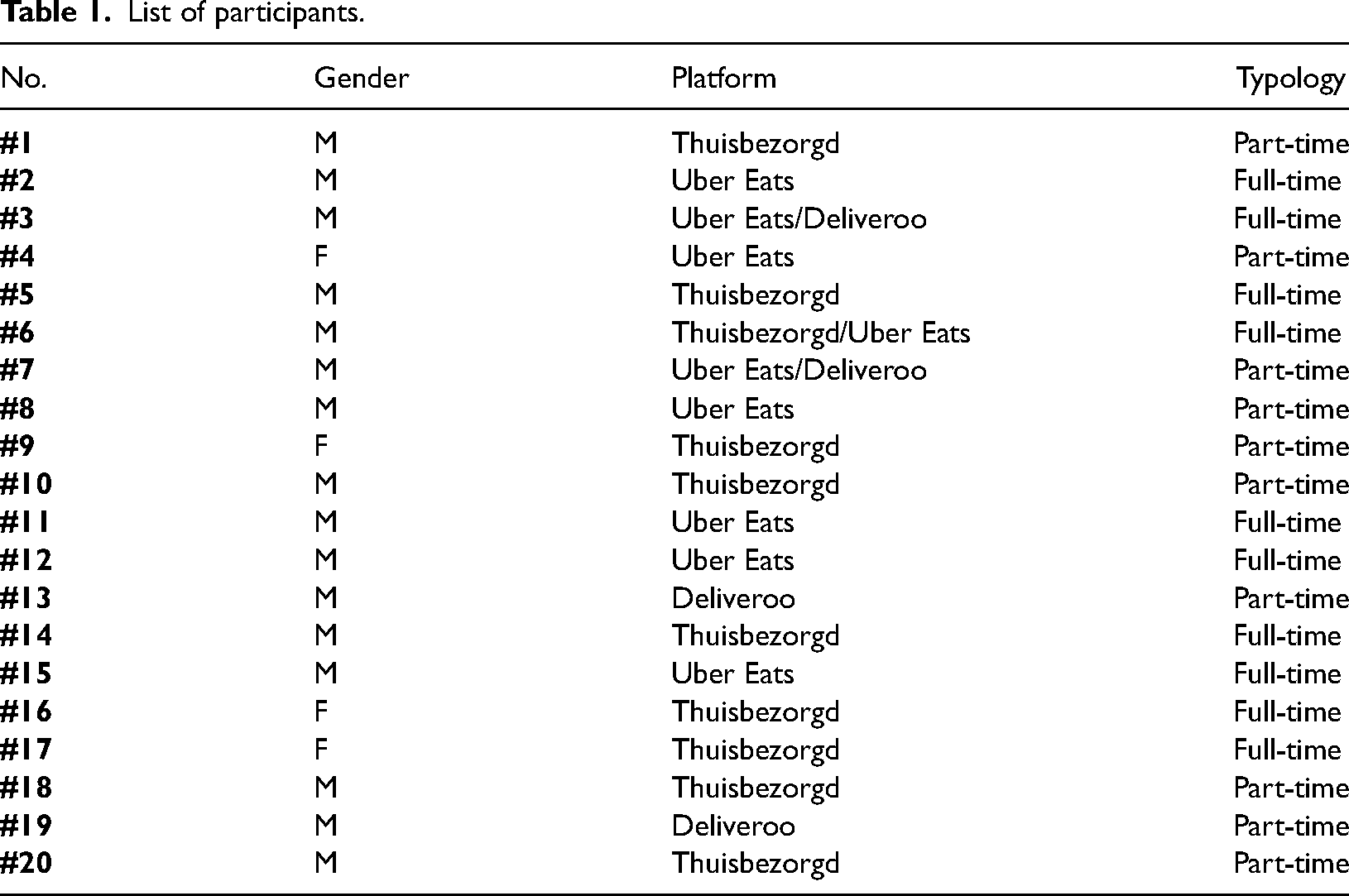
Using a typical instance sampling technique, 15 20 food delivery riders working for Thuisbezorgd, Uber Eats and Deliveroo were interviewed by Law in Society students at the Vrije Universiteit Amsterdam. They conducted qualitative interviews to explore the experiences and motivations for doing platform work. While we did not intend to establish a representative sample of all food delivery riders in Amsterdam, we sought to make the sample as diverse as possible (see table 1). The participants were recruited through posters, online networking promotions, rider organisations, Dutch trade unions and riders’ connections. Since the riders’ employment status and the social rights attached to this status was the main focus of our research, the riders’ employment status was the most important criterion when selecting the participants. Therefore, we selected ten employed and ten self-employed workers. As explained above, riders working for Thuisbezorgd are hired as employees, while riders working for Uber Eats and Deliveroo are self-employed, thus creating a contrast in legal status. Ten of the participants were working for Thuisbezorgd, while the other ten worked for Uber Eats or Deliveroo, with some crossovers in between. It should be noted, in this respect, that empirical studies on on-location platform workers usually limit their sample to only one type of worker (usually self-employed workers). 16 By selecting both employed and self-employed food delivery workers in our sample, we also intended to explore how platform workers with various employment statuses experienced their work.
List of participants.
List of participants.
In addition, given that the gendered and racialised exploitation of low-income service work is regarded as extending to the platform economy, 17 we also sought to include participants of different genders and nationalities. However, given the low number of female food delivery riders working in Amsterdam, it was very difficult to find female riders who were willing to participate in this research. Only four participants were female, while 16 of the participants were male. In addition, little less than half of the participants were native Dutch. The remaining participants were migrant workers or international students. Other factors that were taken into account included the numbers of hours worked per week for the platform and the age of the workers. Ten of the participants were working part-time and regarded the food delivery work as a side job, while the other ten were full-time riders and relied mainly on this job to make a living, and some of them transitioned between the two employment statuses. It was also difficult to find participants over the age of 30. Most of the participants were aged between 20 and 30, with a minority being under 20 or over 30.
The interviews were conducted in public areas, such as parks, cafes and fast-food restaurants in Amsterdam, suggested by the participants, during March to May 2022. The qualitative semi-structured interviews enabled the researcher to get an in-depth understanding of the riders’ views. The interview topics used included: the riders’ motivation for becoming a food delivery rider, the reason for choosing a specific platform, their opinion on working as a self-employed person or as an employee, the way they experienced their working environment, their thoughts about future jobs, and their views of the EU proposal on classifying platform workers. These topics prompted participants to share their opinions proactively and facilitated the interviewer to ask follow-up questions, based on the content of the conversations. Most interviews were face-to-face, with Zoom being used in five exceptional cases, and the length of the interviews ranged from 30 to 90 minutes. All interviews were voice recorded so as to effectively capture the interviewee's explanations in the process. Each interview transcript included a field report describing the interview setting, as well as other details of the process. The interviewees gave written consent to participate in the research. Transcriptions were shared with other researchers only after names and other crucial personal information had been removed. All the interviewees participated voluntarily and were informed in advance of their rights, including the option to stop participating at any stage and to have their data removed.
Once the data collection was complete, they were transcribed, supplemented by field notes, and coded through ATLAS.ti. The coding procedure was designed to be multi-staged, consisting of several phases: the first round (open coding) involved coding as many categories of data as possible, based on the researcher's inherent insights into the problem, while the second round (centralised coding) adapted the codes to the categories that emerged from the records, and the third round identified the core analytical categories, based on the research question, and divided them into themes. 18
Our research explored individuals’ experiences and feelings about working for a food delivery platform as either an employed or a self-employed rider. By analysing the interviews, we were able to classify the findings into four main themes: (1) riders’ unawareness of their employment status; (2) riders’ concerns for security and stability; (3) riders’ demands for freedom and flexibility; and (4) riders’ comments on the EU proposal, as explained in more detail below.
Riders’ unawareness of their employment status
A few riders did not clearly understand the difference between self-employed and employee status, or their corresponding rights and obligations. Moreover, several riders had not consciously chosen to be self-employed or an employee at a specific platform company, but were referred by others or attracted by advertisements. While some riders had not read their contracts carefully, riders in higher education were generally more aware of their rights at work. The data also suggested that these riders were more likely to conclude an employment contract. However, a larger-n study is needed to test the hypothesis that more educated riders are more likely to conclude an employment contract.
Riders’ concerns for security and stability
Compared with self-employed riders, most riders employed by Thuisbezorgd emphasised that they enjoyed the security and stability of their status as employees. They had often deliberately chosen to become an employee; participant #9, for example, said: I found that at some places you didn’t get paid by the hour and I did not like that. That is why I wanted to work at Thuisbezorgd because I did want that steady hourly wage. If I am spending an hour in the sun waiting for an order, I will still get paid for that order. If you are a freelancer, then you don’t get paid for that hour that you don’t have any orders.
Employed workers also valued being part of an organisation and their relationships with fellow employees. These riders saw each other at, for example, the Thuisbezorgd hub, where they were given a bike and other equipment. However, the nature of the work meant that their contact with colleagues and the Thuisbezorgd organisation were also very casual. This may explain why Thuisbezorgd employees frequently mentioned that they did not know where to go to if they had a question or a problem. One Thuisbezorgd rider said, for example, that she felt uncomfortable with a restaurant employee who was flirting with her, but that she did not know how to deal with this problem or what support Thuisbezorgd could offer her in this respect.
Most labour and social security law protections do not apply to self-employed riders, and some of the self-employed riders interviewed expressed their dissatisfaction with the lack of security and stability in their work. They acknowledged that being paid per order was ‘very market-dependent’ and meant that there was ‘no certainty’ around whether you were going to earn what you needed, or what you wanted to earn in order to do the things you were planning to do that month. The fact that the platforms used algorithms to work as efficiently as possible meant that they would ‘not be interested in the human picture’. Some self-employed riders realised that the lack of social protection could make them very vulnerable, especially if they were working full-time. Participant #4 said, in this regard: I think, as a full-time job, it's too precarious if you get sick, if you know something happened…you’re so responsible for yourself but you can get yourself in trouble if suddenly you’re incapacitated or something.
Other self-employed riders said that they would like the platform to set up some break reminders to prevent them from working too many hours in succession. In other words, they wanted the platform to take some responsibility for protecting their health and safety. Notably, participant #19, who left Deliveroo to work for Gorilla as an employee, felt that being able to decide whether to work and getting paid per order made him less motivated. As he said: Sometimes I just forget about riding for Deliveroo, so I just don’t do it. And when [I’m] working for Gorilla I am required to work. Yes, I actually enjoy Gorilla more because I am required to work. Otherwise, I just won’t work or just work like twice a month. For me, it's more useful to work as an employee instead of a flex worker.
Riders’ demands for freedom and flexibility
While self-employed riders sometimes mentioned that they experienced a lack of security, most of those choosing to work for Uber Eats or Deliveroo generally valued their freedom and flexibility. In their opinion, the downside of not being protected was outweighed by the freedom offered by being self-employed. What was important to them, first of all, was the ability to arrange when and for how long they worked. In addition, despite some complaints about excessively long working days and the lack of reminders to take breaks, self-employed riders were also happy not to have to comply with working time regulations and thus to be able to work long days of up to 16 hours’ duration. Some self-employed riders said that they tried to complete deliveries as fast as possible or to work more than the maximum of 48 hours a week prescribed by the EU Working Time Directive, especially in order to earn more money. Sometimes this meant working between 50 and 80 hours a week.
The ability to make decisions for themselves was another aspect that attracted workers to become self-employed riders. They felt that they could be their ‘own boss’ and enjoy a certain degree of independence. Self-employed riders thought, for example, that the phrase ‘deciding for yourself when to work’ contained in the Deliveroo job advertisement was very appealing, and viewed the obligation to work a certain number of hours, or according to pre-set schedules, as a significant downside of being an employee. As participant #11 said: Whenever I want to work, I can work. I have no pressure in my mind that someone is pushing me.
Nonetheless, self-employed riders were usually also aware that they did not operate as independent self-employed workers in all respects. They mentioned, for example, that their freedom was limited in that the orders they could choose from were automatically presented to them by the system.
Interestingly, while employed riders had deliberately chosen to work as employees, some of them also expressed a desire to have more freedom and flexibility in their work, like self-employed workers. For example, they wanted to be allowed to decline a call or a shift in the event of bad weather. As participant #16 said, I’ve had moments when it's cold and I think, I'm going to quit tonight, but I don’t. Or when you’re completely soaked and you just have to keep working, sometimes it's really hard … I just accept it, but sometimes it's really irritating. I was harassed more in Amsterdam during my free time than in Haarlem. It also kind of depends on the environment you are in. But in Haarlem, it didn’t matter where I went. I feel safe in Haarlem all the time actually. On the one hand I thought, is it really that hard to just make sure I don’t get any orders from a specific place? But, on the other hand, I also understand that it's hopeless to do that for every girl or boy.
Riders’ comments on the EU proposal
As many riders were not aware of the EU proposal, the interviewers often had to explain its main contents and objectives to them, especially the legal presumption about determining employment status. Admittedly, and despite our best efforts to remain neutral, the explanations by the interviewer may have had some impact on the riders’ views on the proposal.
Most riders agreed that the Directive was necessary in order to restrict the platform's behaviour and reduce exploitation. Nevertheless, some self-employed riders expressed concerns about the potential impact of the Directive and were afraid that it could force platform companies to close their business, with the result that riders would lose their jobs. Some self-employed riders emphasised that they preferred to keep open the option to choose to be self-employed, as this status would ensure they were free to work when they wanted.
Interestingly, participants noted that the departure of self-employed food delivery riders from the labour market (as a result of the implementation of the EU proposal) was expected to improve the road safety of all food delivery riders, given that self-employed riders were paid per delivery and so tended to behave more aggressively on the road than employed riders. Participant #17, for example, said: So maybe when they become employees, they are less stressed when they are waiting in the restaurant. It would also make them a little safer on the road if they were less rushed. They would wait at red lights and ride a little slower. Just like I do.
Analysis: mix of stability and security
Our findings are in line with previous empirical research that showed that self-employed food delivery riders enjoyed their status as self-employed workers because of the freedom and flexibility that this gave them. However, our research additionally indicates that the freedom and flexibility the workers desire are, to a great extent, shaped by the alternative presented by Thuisbezorgd, whereby riders have to sign up for work schedules in advance. Indeed, the interview data show only one main freedom and flexibility-related attraction in working for platforms such as Deliveroo and Uber Eats, namely, the ability to decide when to work and whether to accept an assignment. The other argument that came up in the interviews – that being classified as self-employed enabled workers to work more hours than would be allowed under an employment contract – is not related, in our opinion, to a desire for freedom and flexibility, but is first and foremost attributable to the low pay associated with such work.
With the exception of Dubal, 19 previous studies have paid little attention to the desire of vulnerable self-employed riders to enjoy social security and labour law protections like employed riders. The findings of our research indicate that self-employed riders are aware that their market dependency (indirectly) forces them to work long hours. As pointed out by employed riders, self-employed riders’ dependence on payment per delivery means they may also be more likely to behave aggressively in restaurants and on the road. This is not only detrimental to their own health and safety, but also to that of other riders, both self-employed and employed alike.
It can be questioned why those self-employed riders preferring to fall within the scope of social security and labour law protection do not opt to become employees at Thuisbezorgd. The findings suggest that while self-employed riders do not want to lose the freedom to work when they want to, they are not always aware of the differences in rights and obligations associated with being self-employed or employed. Our findings also indicate, however, that once riders become aware of these differences, they may consider moving to Thuisbezorgd (to work as an employee) or to look for a position as an employee with a different employer.
At the other end of the spectrum are the riders working for Thuisbezorgd as employees. While these riders generally reported to be happy with their employee status, including their right to social security protection, their responses also showed that it is not always easy to enforce these rights. This could be because, in contrast to many other employees, food delivery riders perform their work individually and have little contact with supervisors or other people working for Thuisbezorgd, except perhaps with colleagues they meet at the hub. As a result, they often do not know where to go to enforce rights, such as claiming sickness payments. It should also be noted that according to participants, Thuisbezorgd riders using their own bikes do not usually go to the hub, as briefly discussed in the final section of this article.
Some of the employed riders interviewed would have preferred more freedom and flexibility in their work as this would enable them to decline work in the event of bad weather or to avoid unsafe neighbourhoods. In other words, just like the self-employed riders, the freedom and flexibility that the employed riders desired amounted to being able to decide where and when to work. Our explorative empirical research thus suggests that while part of the self-employed platform workers want to work as employees, this is true only where the entitlement to protection under social security and labour law is combined with a certain degree of freedom to decide where and when to work.
Combining this entitlement to protection with such freedom may, however, be contradictory to the definition of the employment contract. Under Dutch (and EU) law, an employee is defined as someone who performs work under the authority of another party (the employer) during a certain period. The next section of this article therefore explores the extent to which access to protection under labour and social security law (security) and the possibility to turn down orders (flexibility and freedom) can be combined under Dutch national labour law. To this end, we will specifically consider the extent to which the provisions for on-call employment meet the demands of platform workers.
Combining flexibility and security: legal challenges
Courts in various countries have ruled that work relationships between platform workers and platforms such as Deliveroo and Uber should be classified as employment contracts, despite the option available to platform workers to reject a work assignment. 20 Even in countries such as the UK and Germany, which stress the mutuality of obligations in employment contracts (i.e., the continuing obligations to offer and perform work), 21 courts have ruled that the freedom of platform workers to reject a call does not preclude the existence of an employment contract. 22 In some countries, the legal definition of the employment contract already assumes the freedom to decide whether to respond to calls. In Finland, for example, the legislator has clarified that an employment contract does not require the employee to accept all tasks; 23 alternatively, as in the case of zero-hours employment contracts, a separate agreement to accept work may be required. 24 Meanwhile, the Belgian legislator has created a new kind of employment contract, the flexi-job, which allows employees to decline any call. 25 This special form of zero-hours contract was initially introduced into the hospitality industry by the 2015 Flexi-job Act and then gradually extended to other industries, such as the chocolate-making sector in 2023. 26 However, this contract can be used only in sectors stipulated by law and is strictly limited to work constituting a side job. 27
In the Netherlands, the Deliveroo judgment of March 2023 seems to have opened up the possibility to establish employment contracts with food delivery workers working through a platform. According to the Supreme Court: Freedom to appear at work or not and to accept or not accept orders does not in itself preclude the existence of an employment contract. Whether the requirements for an employment contract are met depends on the further circumstances of the case, in particular what applies if the person concerned appears and accepts an assignment to work, and the frequency with which and the duration for which this usually occurs.
28
Options in the Netherlands prior to the Deliveroo judgment of 2023
Before the Deliveroo judgment it was generally assumed in the legal doctrine that employees on an on-call contract were not allowed to reject a call. 30 According to this doctrine, workers allowed to reject a call to work had, instead, entered into a preliminary contract, and an employment contract would exist only after the worker had accepted a call. For employers, however, these arrangements were not attractive, because after three temporary employment contracts (each lasting for the length of the call), a permanent employment contract was deemed to come into existence. 31
A second option offering work flexibility, which was available before the Deliveroo ruling, was the employment agency contract. Under Article 3(1)(b) of Directive 2008/104/EC (Temporary agency work), which has been transposed into Dutch law, a ‘temporary-work agency’ means ‘any natural or legal person who, in compliance with national law, concludes contracts of employment or employment relationships with temporary agency workers in order to assign them to user undertakings to work there temporarily under their supervision and direction.’ In the context of platform food delivery work, two constructions are theoretically possible:
An employment agency concludes an employment contract with the worker and a contract for services with the platform. The employee (platform worker) works under the supervision and direction of the platform. The platform is considered an employment agency (or cooperates to that end with an employment agency) and concludes an employment contract with the worker and a contract for services with various restaurants. The employee (platform worker) works under the supervision and direction of these restaurants.
In the case of platform food delivery riders in the Netherlands, Option (ii) can immediately be dismissed because the organisational structure of food delivery platforms such as Deliveroo does not usually involve platform workers working under the supervision and direction of restaurants. Under Option (i), by contrast, the platform is assumed to exercise authority over the worker, and this will often accord with the factual circumstances. As such, therefore, each food delivery assignment could qualify as a new contract with the employment agency.
32
However, this option has some limitations. Firstly, as explained in more detail in section 5.2, in the case of each assignment the employer will have to pay the employment agency employee for at least three hours, even if the assignment to deliver food takes only 30 minutes. 33 Secondly, the duration of such employment agency contracts is limited, given that Dutch law allows employment agencies to conclude an unlimited number of employment contracts only during the first 26 weeks of an employment agency contract (or for a maximum of 78 weeks, if agreed upon in a collective agreement). 34 This therefore limits the period during which contractual parties can use these arrangements. Thirdly, the employment agency worker's position is less secure than that of an employee, given that the employment agency is not obliged to offer any work during this period. A final possible limitation of the employment agency contract is that it would not seem to be in accordance with Article 5 (5) of Directive 2008/104/EC (Temporary agency work), which prevents successive assignments (in this case, successive assignments to deliver food). This is because the ECJ has clarified that successively assigning the same temporary agency worker to the same user undertaking circumvents the very essence of the provisions of Directive 2008/104 and amounts to a misuse of that form of employment relationship, given that, by undermining worker security, it upsets the balance struck in that Directive between flexibility for employers and security for workers. 35 Indeed, in the event of successive assignments, the worker might as well be offered a more secure employment contract by the user undertaking.
Options after the Deliveroo judgment of 2023
Contracts fulfilling the requirements of the Deliveroo judgment provide food delivery riders with security (by classifying them as employees) and flexibility (by allowing them to reject calls). Under current law, however, as mentioned before, there is also an important caveat for employers: if the employment contract is classified as an on-call contract, 36 employers will have to pay the worker for at least three hours for each call (i.e., each assignment). Therefore, even if workers deliver the food within 30 minutes, they will still be entitled to three hours’ wages. Only one form of on-demand work is exempt from this obligation: workers with variable working hours who are working 15 hours or more per week and do not fall under the legal definition of on-call workers, 37 such as workers with guaranteed annual working hours whose pay is spread evenly over the year. This means that the platform (as an employment agency or employer) and the food delivery rider should either enter into an on-call contract and agree on shifts of at least three hours (these workers are referred to here as ‘Group A workers’) or enter into a contract with guaranteed but variable working hours (for a maximum of one year and for an average of more than 15 hours per week), with pay spread evenly over this period (these workers are referred to here as ‘Group B workers’). Group A workers will normally have to accept each call during their shift, unless they and their employer have agreed some specific arrangements (e.g., workers get three offers during their shift and have to pick one of these within two minutes). Group B workers, by contrast, will be allowed to reject all calls. It should be noted that workers should not be punished for rejecting calls, for example, by receiving less favourable calls, as this would be contrary to the objective of providing workers the freedom to reject a call.
This brings us to the question of the extent to which Group A workers and Group B workers have to be paid for the time they are logged into the app but are waiting for an offer or a call. According to the ECJ, the question of whether time spent waiting should be regarded as working time as defined in the Working Time Directive (2003/88/EC) must always be assessed on the basis of all the circumstances of the case. The decisive factor in this assessment is the extent to which the employee is constrained by the obligations arising from the employer's instructions and, in particular, the time within which the employee has to respond to the call. 38 The Working Time Directive does not, however, regulate the right to pay. 39 This implies that national regulations and collective agreements could regulate the lower level of pay for periods during which a rider is logged in, but not delivering food. Katsabian and Davidov propose, for instance, that 50% of the person's normal wage should be paid under these circumstances. 40 If we now turn to our Group A and Group B workers, we can establish that the employer would have to pay Group A the normal level of pay for each shift (of at least three hours), but that Group B workers could be paid less during waiting times. However, as long as Group B workers are allowed to reject all shifts, the obligation to pay, for example, 50% of the normal wage for the time that Group B workers are logged in to the app is not very attractive to employers unless workers are only allowed to log in to the app during limited periods (schedules) amounting to no more, for example, than twice the number of hours they are required to work (with an average maximum of 15 hours per week). Employers are more likely to agree that Group B workers can log in whenever they want, providing that the employers are not obliged to pay for time spent waiting. In addition, given that these workers can be presumed not to be constrained in their private lives (as they can reject all calls), time during which they are logged in will not count as working time under EU (or Dutch) law. Under Dutch labour law, however, the employer will still be obliged – in accordance with the principle of good employment practices 41 – to offer these Group B workers sufficient work so as to meet the agreed number of hours and, conversely, these workers will be contractually obliged to accept a sufficient number of calls to meet this threshold.
In our opinion, the Group B arrangement is the only option under current Dutch law that would meet platform workers’ desire to combine flexibility and freedom with security. Employers and workers could, for example, agree on 80 working hours per month. Workers would then be allowed to log in whenever they wanted, with their only obligation being that they would have to accept work offers for 80 hours each month. An important downside of this legal construction for Group B workers is that the parties would still have to check whether the criteria specified in the Deliveroo judgment have been met. While this could be particularly hard in the case of on-demand work outside the food delivery sector, this problem could be resolved by introducing a legal regulation comparable to the Belgian flexi-job regulation, which stipulates variable working hours with the option to reject a work assignment or call. It should be noted, however, that the Belgian flexi-job has clearly been designed as a side job.
Discussion and conclusion
Unlike previous studies on platform work, which usually focused on either empirical or legal research, we have translated our empirical findings into legal terms and subsequently analysed the options available. In doing so our study has illuminated some legal obstacles to meeting workers’ desire to combine security with the freedom to decline work assignments. While the findings suggest that self-employed platform workers do not wish to be classified as employees in all circumstances, it should be noted that part of the food delivery workers were not aware of their employment status and the rights and obligations related to their employment status. The study furthermore indicated obstacles to re-enforce employment rights because of the opaque nature of platform work (e.g., it is not clear where you can lodge your complaint).
The legal analysis revealed that Dutch labour law has not yet adapted sufficiently effectively to the rapid changes in the labour market, among which, the rise of the platform economy. Indeed, while the current national definitions of employment contracts, including the continuing obligation to offer and perform work, were devised in the previous century and characterised by Fordist (hierarchical) work organisations, the results from our study indicate that the rights and obligations related to the employee status will have to be substantially reconstructed if they are to meet the needs of today's platform workers. 42 As such this study also indicates that it is worthwhile to re-think the dichotomy of employee and self-employed both on the EU level and the national level and to consider the idea of personal work to expand the concept of employment relation so as to cover all people performing personal work activities against remuneration under (EU) labour law, with the exception of people who are genuinely operating a business of their own, as proposed by Freedland and Countouris and other legal scholars. 43 Building on these ideas and drawing on the ILO report ‘work for a brighter future’, 44 Eva Kocher recently proposed to introduce universal rights for workers which are based on fundamental or human rights, or on respective norms, goals and values, which differ from universal contractual guarantees, such as guarantees for personal work. Universal rights, then, consider the worker as a citizen and not as a contractual partner or a market player. Kocher distinguished between three types of rights. First, universal social rights which encompass in addition to human rights and anti-discrimination rights, also social security rights, which are relevant for all workers, regardless of their employment status. 45 Second, she introduced the principle of the ‘lifetime contract’. This contract assumes that legal protection is needed in long-term, sustainable contractual relationships since power imbalances as the result of organization can occur in the process. 46 Therefore, the protection against unfair termination of contracts, minimum wage, the safeguarding of the collective aspect of interests and access to justice shall be applied to platform workers as they provide labour in long-term relations. Third, Kocher points at the labour rights for non-employees that follow from the 2019 ILO report ‘Work for a brighter future’. These include health and safety at work and working time regulations. We believe that Kocher provides some very valuable proposals guaranteeing the social protection of platform workers, while acknowledging (some) riders’ desire for flexible working hours.
As for the empirical part of our study, we have a few more comments. While the low number of participants in our study is clearly insufficient to draw ‘hard’ conclusions, as mentioned before, this study aimed to explore the experiences and motivations of employed and self-employed food delivery riders. Future quantitative research could test the hypothesis that, regardless of their current employment status, platform workers desire both the option to decline calls and the right to be protected under labour and social security law. In addition, since national courts in other countries have also judged that a platform workers’ freedom to decline a call does not preclude an employment relation, it is worthwhile to analyse how in these countries, the employment protection is ensured for workers who are free to decide where and when to work. More in general, future qualitative empirical-legal research could explore what other legal regulations would be needed to adapt to the social changes we are seeing. Such research could also study how the rise of the platform economy, and the accompanied emergence of workers behaving as competitive (sometimes aggressive) entrepreneurs, impacts on the health and safety of all workers (i.e., both self-employed workers and employees) and what regulations are needed to prevent these negative health and safety consequences.
The empirical findings indicated that the experiences of female platform workers may differ considerably from those of their male counterparts. Yet, research on food delivery riders has largely ignored gendered aspects of platform work. We therefore recommend that future research into food delivery platform workers should investigate these aspects in more depth and also, more generally, explore the interaction between experiences of platform workers and employment status in less male-dominated sectors, such as care work.
Finally, adapting to labour market changes also means devoting attention to the enforcing of labour and social security law. As the empirical findings showed, even food delivery platform workers with the status of employees can find it difficult to enforce the rights that come along with this status. This means that the social partners and the government (e.g., the Labour Inspection Service) should seek new ways to effectively supervise the enforcement of the social rights of employees whose contacts with their employer or a wider organisation are limited to a relationship with a machine.
Footnotes
Acknowledgements
The authors would like to thank Bente Heilig, Homa Golestani, Luna Leenaers, Natalia Robledo Contreras and Nienke Heijne Makkreel for conducting the interviews.
Declaration of conflicting interests
The authors declared no potential conflicts of interest with respect to the research, authorship, and/or publication of this article.
Funding
The authors received no financial support for the research, authorship, and/or publication of this article.
