



Abstract
Dispersive double reflections realized by means of two bent perfect crystal (BPC) slabs of different cuts used as a sandwich can provide a monochromatic beam of excellent resolution parameters. The dispersive sandwich monochromator/analyzer provides the freedom to combine crystal slabs of different cuts, that is, different crystal reflections for the double diffraction process. For some combination of the individual crystal slab, it is possible to achieve the back-scattering resolution for a rather low monochromator take-off angle. Therefore, by using a suitable combination of two slabs, one can practically obtain a monochromatic neutron beam of any wavelength in the thermal region. Depending on the bending radius of the sandwich the resolution Δλ/λ and the Δ
Keywords
Introduction
Together with the construction of new powerful neutron sources, new scattering instruments with improved resolution properties have been designed. One of the candidates of monochromators for very high-resolution neutron diffractometers and spectrometers appears to be so-called dispersive monochromators based on a dispersive double diffraction process. It can be realized by means of exciting a strong multiple-reflection effect inside one elastically deformed perfect crystal or by two independent crystals. Dispersive double-crystal thermal-neutron monochromators/analyzers are usually not used in practice because the luminosity of the scattering instruments where they are employed is rather low because of the much smaller Δλ × Δθ phase space element of the monochromatic beam. Nevertheless, in some cases of the scattering instruments requiring a very high angular or Δλ resolution, a dispersive type of monochromator setting can be quite useful. Therefore, much attention has been paid to designing and testing different dispersive double-reflection geometries in the last two decades. Interest in the dispersive double-reflection processes emerged during studies of positive multiple reflections (MRs) in cylindrically bent perfect crystals (BPCs) as summarized in Mikula et al. 1 (where many related references can be found) when strong MR-effects (often called Umweganregung or Renninger effect) consisting of one or more dispersive double-reflection processes inside the bent crystals were observed. In this case, several applications of high-resolution monochromatic beams obtained from the MR process were demonstrated as well. Many experiments have also been carried out related to the exhaustive studies of high-resolution dispersive double-bent-crystal monochromator settings with strongly asymmetric, fully asymmetric, or symmetric analyzer diffraction geometry inside the second crystal. The results obtained and references have been summarized in references,2–7 respectively. The possibility of employing two independent bent crystals in (n,-m) setting provides some freedom in the choice of individual crystal slabs as well as the neutron wavelength, however, it requires one more axis for a neutron scattering instrument which was not the case of an MR-monochromator.
Thanks to the first promising experimental tests,8,9 this review paper summarizes the obtained experimental results of other dispersive double-crystal neutron scattering geometry in the form of a sandwich. These results demonstrate that especially in the case of elastically deformed perfect single crystals (in our case cylindrically bent perfect crystals), the suggested sandwich monochromator can provide a sufficiently strong neutron signal which can similarly be exploited for very high-resolution scattering studies.
Figure 1 shows a schematic diagram of a bent sandwich monochromator as tested for practical use. The choice of the crystal cut provides some freedom in combination with slabs in the sandwich as well as the reflections involved. Thus, the choice of the reflections and the corresponding cut angles Ψ1 and Ψ2 determine the neutron wavelength and the final monochromator take-off angle Ψ3. In this contribution, we present the results of test experiments with several such dispersive monochromators.
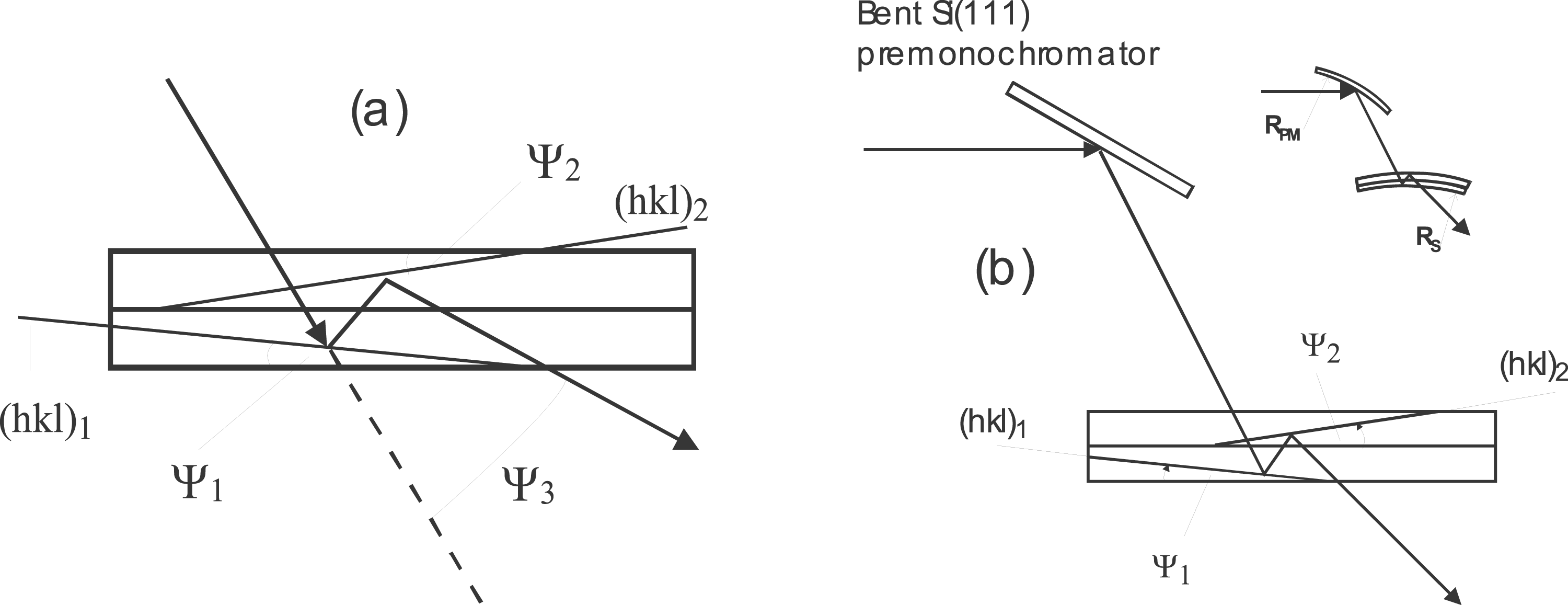
(a) Schematic diagram of a two-step double reflection process realized by two independent slabs put in the form of a sandwich and (b) the experimental arrangement used for testing (the insert shows the bending orientations).
Figure 1(a) and (b) can be combined into one figure.
Depending on the cut of the crystal slabs used, we can find many combinations of the two reflections taking place in the sandwich. For example, the sandwich using the first slab having the main face parallel to the planes (110) and the longest edge parallel to the vector [1 Si(331) (Ψ313 = −22.00o) + Si(220) (Ψ220 = 0o) θ313 = 53.39o θ220 = 31.39o λ = 0.200 nm Si(220) (Ψ220 = 0o) + Si(313) (Ψ313 = −22.00o) A θ313 = 53.39o θ220 = 31.39o λ = 0.200 nm Si(3 Si(220) (Ψ220 = 0o) + Si(3
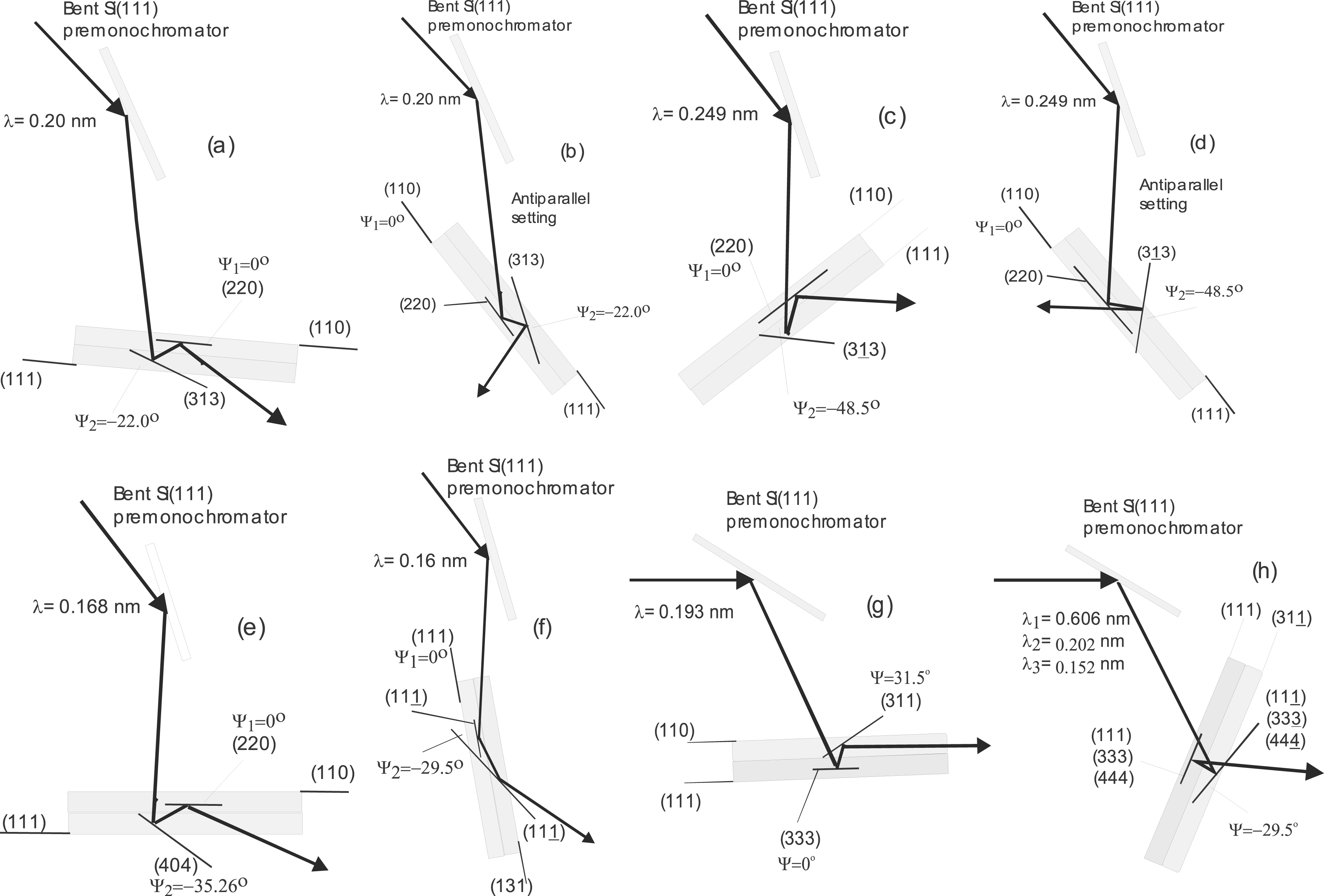
Schematic diagrams of the tested sandwich geometries related to the combinations described in Section 2.
Similarly, when using crystals with different cuts we had at our disposal, additional reflection combinations and sandwich alternatives could be tested (see the schematic diagrams in Section 3):
Si(404) (Ψ404 = −35.26o)+Si(220) (Ψ220 = 0o) θ404 = 61.22o θ220 = 25.99o λ = 0.168 nm Si(111) (Ψ111 = 0o) + Si(11 Si(333) (Ψ333 = 0o) + Si(311) (Ψ311 = 31.48o) θ333= 67.67o θ311 = 36.19o λ = 0.193 nm Si(11 Si(33 Si(44
These presented combinations document possibilities of preparing sandwich monochromator crystal cuts for operation at any neutron wavelength λ chosen in advance.
* The symbol A designs the reverse antiparallel setting with respect to the premonochromator.
Experimental studies were carried out on the double-axis diffractometer installed at the medium power research reactor LVR-15 in Řež equipped with the 1-d position sensitive detector (1-d PSD). When using the premonochromator permitting us to set the calculated neutron wavelengths in advance, double diffraction beam profiles from the prepared cylindrically bent sandwiches were recorded by a 1-d PSD with a spatial resolution of 2 mm. The experimental results obtained for different combinations described in Section 2 are documented in Figures 3–6. The width of the incident beam from the premonochromator was about 20 mm.
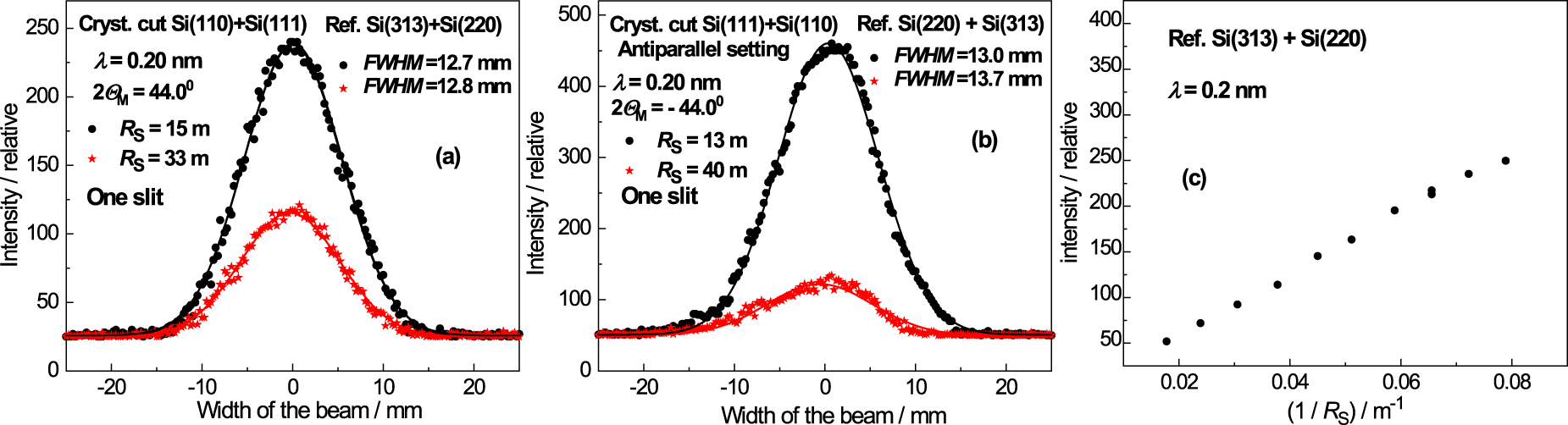
(a, b) Double reflected neutron beams as recorded by 1-d position sensitive detector (1-d PSD) for two different radii of curvature RS related to Figure 2(a) and (b); and (c) the peak intensity dependence on the sandwich curvature related to Figure 2(a).
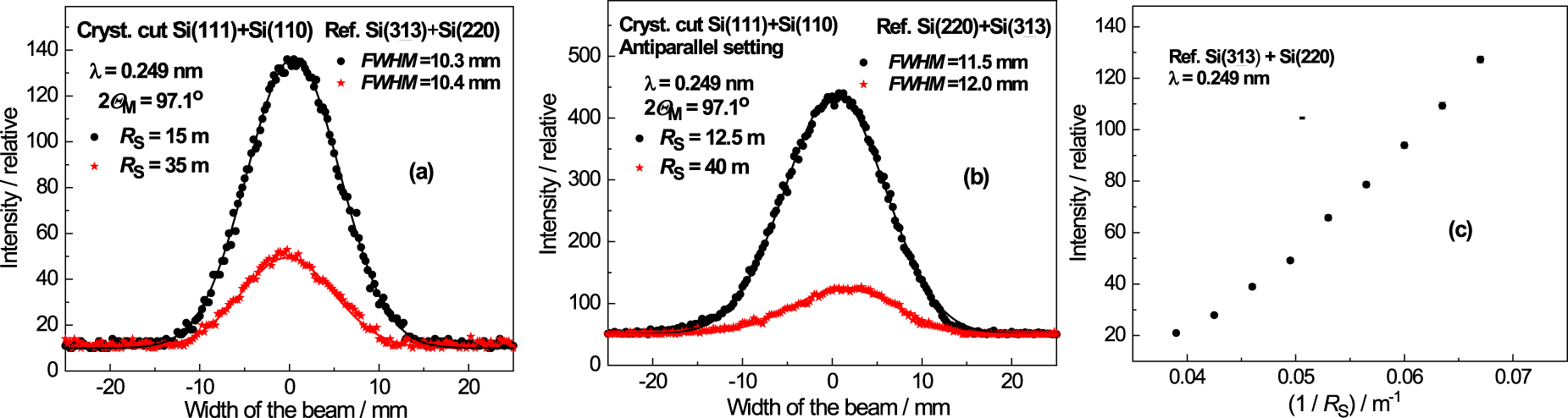
(a, b) Double reflected neutron beams as recorded by 1-d PSD for two different radii of curvature RS related to Figure 2(c) and (d); and (c) the peak intensity dependence on the sandwich curvature related to Figure 2(c).
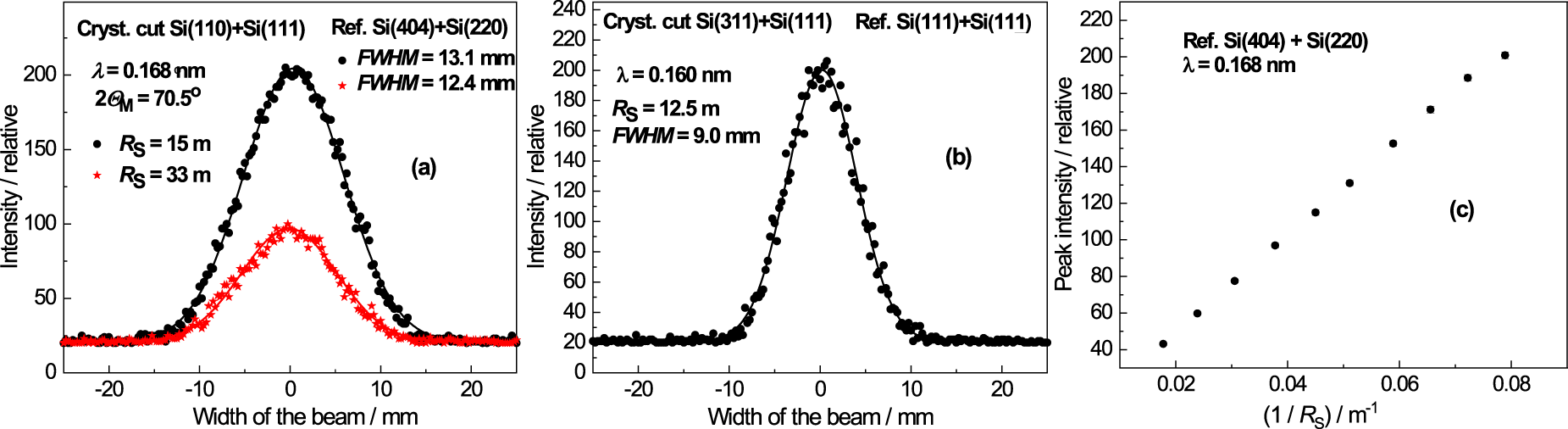
(a, b) Double reflected neutron beams as recorded by 1-d PSD for chosen radii of curvature RS related to Figures 2(e) and (f), and (c) the peak intensity dependence on the sandwich curvature related to Figure 2(e).
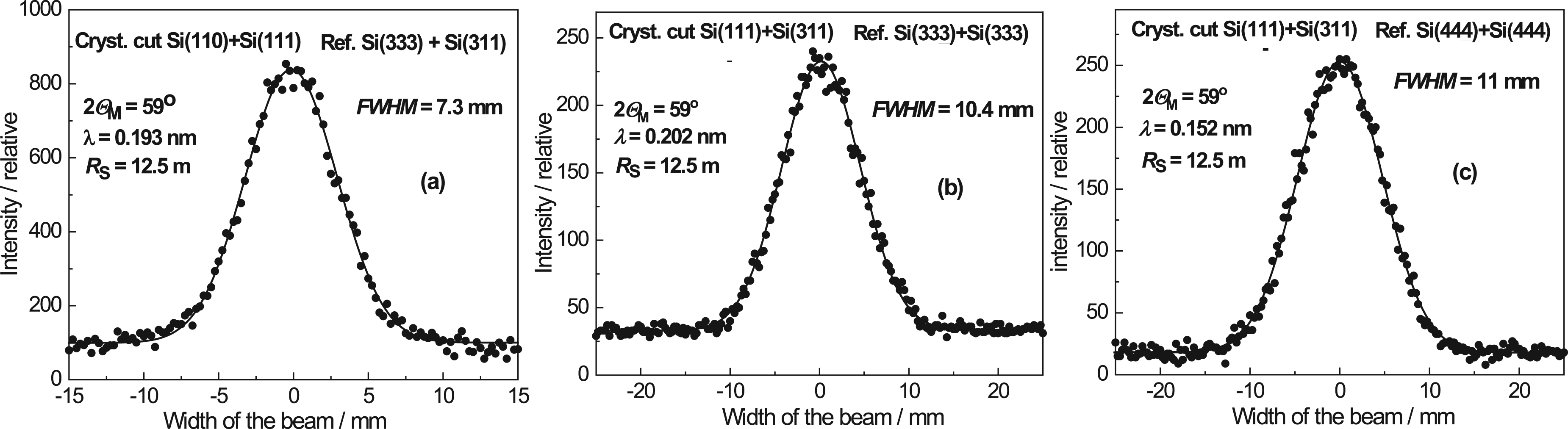
Double reflected neutron beams recorded by a 1-d position sensitive detector (1-d PSD) for three different crystal combinations in the sandwich as shown in Figure 2(g)—(a) and Figure 2(h)—(b, c).
Experimental tests of the sandwich-type dispersive monochromator were carried out in two steps. First, by using a bent Si(111) premonochromator of the dimensions of 200 × 40 × 4 mm3 (length × width × thickness) and with the fixed radius of curvature RPM of 12 m, and the double-reflection process was verified with different cylindrically bent sandwiches situated at the sample position of the diffractometer (see Figure 1(b)). Though we were limited by a maximum take-off angle of 60° at our diffractometer, using Si(111) premonochromator provided us with quite a large range of monochromator neutron wavelengths. The obtained double-diffracted beam from the sandwich was registered and its profile was imaged by a linear position-sensitive detector.
Figure 2 shows diagrams of the sandwiches bent to radii of curvatures RS that we prepared for the first step of testing using the Si-BPC slabs in our possession. The possible alternative of the premonochromator permitted us to choose the necessary wavelength provided by the calculations (see Section 2) except for the case h with Si(11
3.2 Experimental diffraction profiles
According to the schematic diagrams shown in Figure 2, in the first step, the diffraction from individual sandwiches was studied in a monochromatic beam of the appropriate wavelength. The results are shown in Figures 3–6. The accessible range of the curvatures 1/RS was (0.01 ÷ 0.1) m−1.
Inspection of Figures 3–6 reveals that the intensity of the monochromatic beam depends on the curvature of the sandwich because the individual crystal deformations increase linearly with curvature.9,10 Then the full width at half maximum (FWHM) of the diffraction profiles is approximately 10 mm. There is almost no difference between the parallel and antiparallel settings with respect to the premonochromator. Further inspection of Figure 2(c), (d) and (h) reveals an excellent property of the related sandwich monochromators, namely, that in all cases a so-called back scattering diffraction takes place on one of the bent slabs with a relatively small final take-off angle. This can be useful for applications to high-resolution neutron scattering experiments.
3.3 Some neutron diffraction applications
In this second step study, the sandwich was situated at the monochromator position and the monochromatic beam was used for diffraction from a high-quality
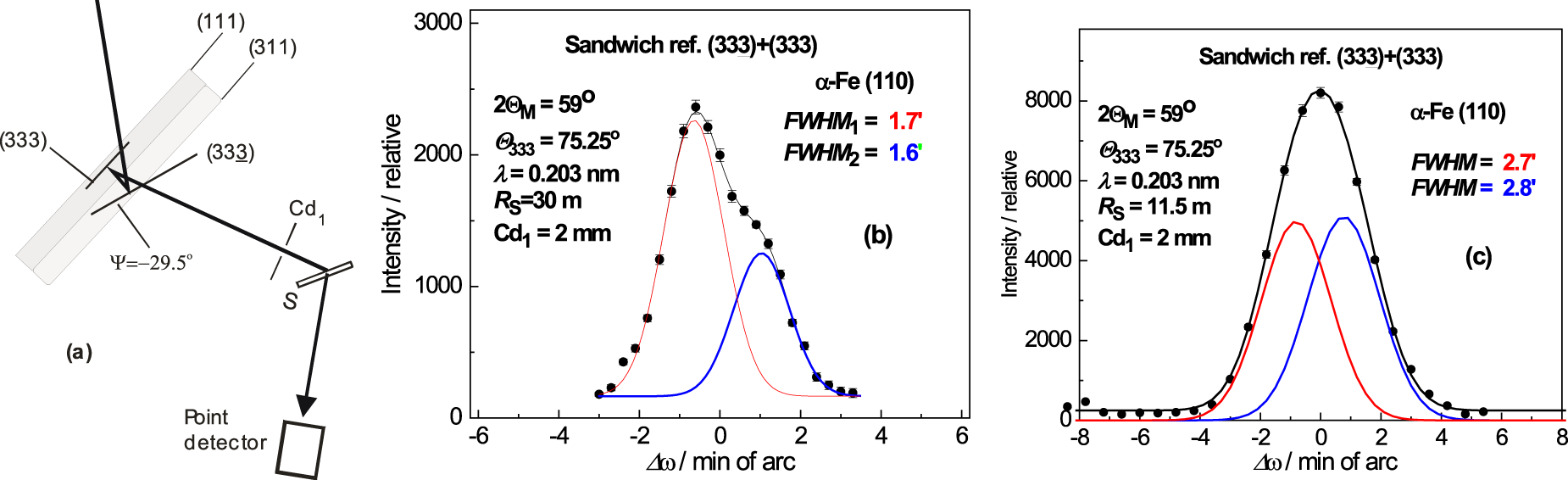
(a) An example of the feasibility of using a sandwich monochromator; and (b, c) with one of the crystals in the back-scattering mode for two different radii of curvature Rs.
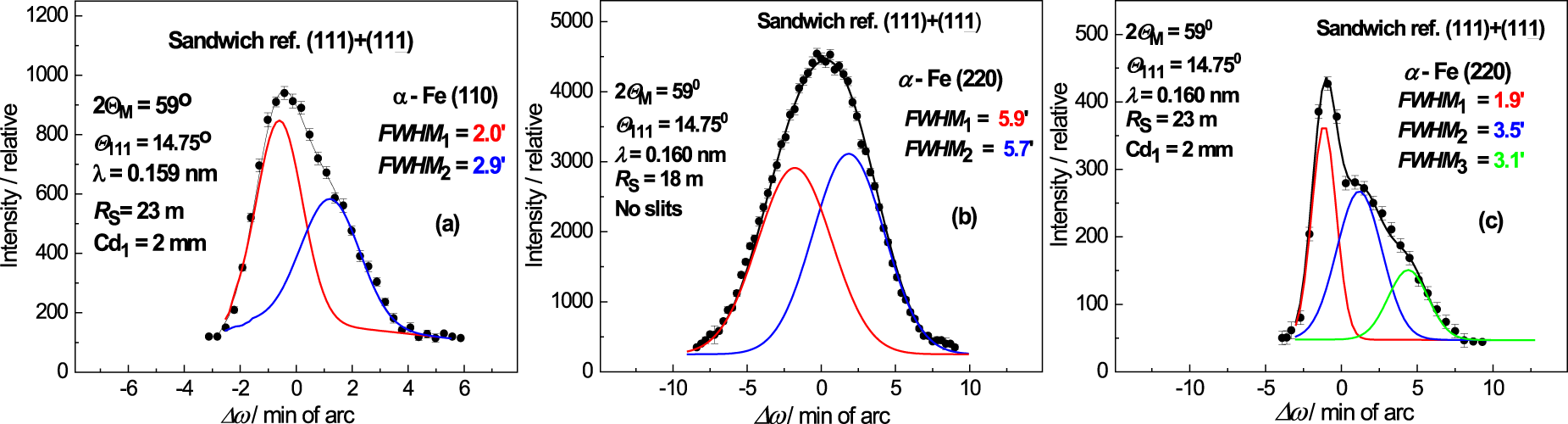
Three examples of the rocking curves of the
In the next step, the sandwich combination Si(220) + Si(313) (see Figure 2(b)) was placed in the monochromator position of the diffractometer. The monochromatic beam was used for studying the collimation of the monochromatic beam for different radii of the curvature of the sandwich. Two slits of 1 mm in width and separated by 9 mm were put into the obtained monochromatic beam. The intensity profile of the neutron beam was registered by the 1-d PSD with a rather poor spatial resolution of 4 mm that we had at our disposal (see Figure 9). The dependence of the FWHM on the sandwich curvature is quite small. The difference in the FWHMs related to the two peaks is probably due to a slight inhomogeneity in the divergence of the neutron flux within the cross-section of the incident monochromatic beam and the inhomogeneous efficiency of the PSD. Nevertheless, a high collimation of the monochromatic beam could be shown.
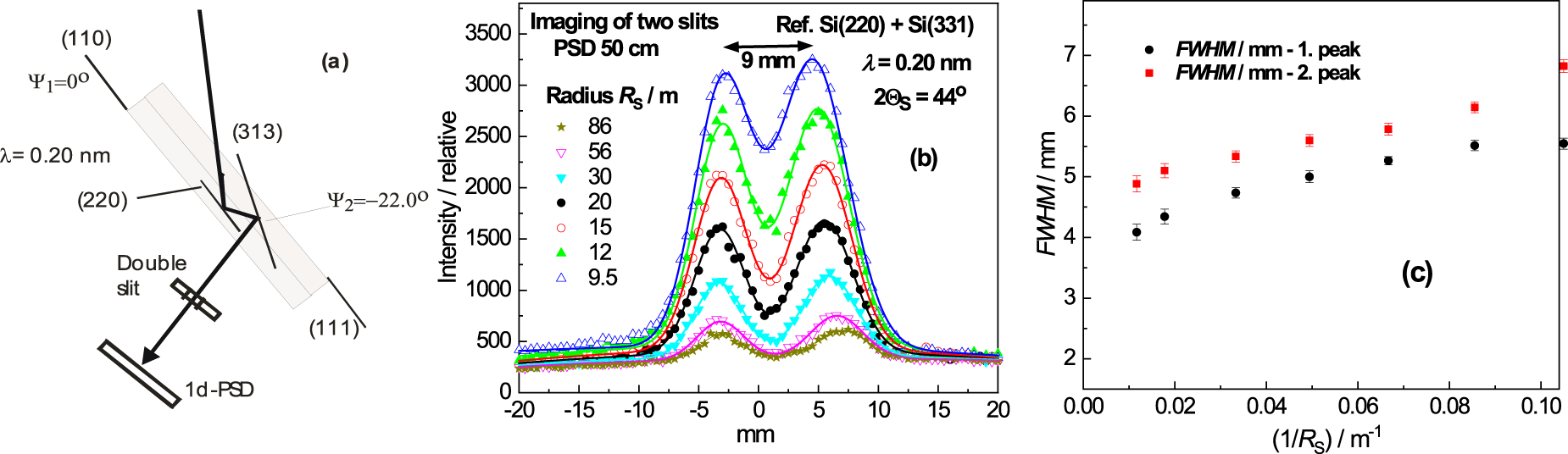
(a) Two 1 mm slits separated by 9 mm and situated behind the sandwich; (b) imaged by 1d-PSD for different radii of curvature RS of the sandwich at the distance of 70 cm; and (c) and the FWHM dependence of the individual peaks on the sandwich curvature.
The presented results clearly demonstrate the feasibility of using double-reflection effects realized by two-crystal sandwiches for high-resolution monochromatization (or analysis) of neutron beams. Several combinations of double reflection processes inside two BPC slabs put together were examined. We had at our disposal 4 mm thick Si-crystals of different cuts. Besides high resolution, the advantage of such sandwich monochromators, in comparison with the double-crystal settings of two separated slabs used earlier, is to save one diffractometer axis, that is, to reduce the space required for the instrument.
Furthermore, when using a large diffraction angle at least of one of the crystals (in the extreme case, the backscattering mode), the resulting monochromator take-off angle could be rather small, which possibly could also provide a decrease in the background. As has been shown, the thermal neutron flux depends on the curvature of the sandwich. This affects the dimension of the resulting Δλ × Δθ phase-space element of the monochromatic neutron beam that corresponds to the intersection of two phase-space elements of the individual crystal reflections. Due to the mutual dispersive setting of the BPC slabs, the doubly diffracted beam has a narrow Δλ/λ as well as Δθ spread, of the order 10−3 or less as documented by the FWHMs in Figure 7(a). The reflection probability, often called peak reflectivity, r, of the individual crystal slabs can be quite high when the curvature is small. According to our earlier studies, for example, of the Si(111) and the Si(220) crystals, calculations based on the formulae published earlier10,11 provide values of r > 0.5 and >0.8, respectively, for the curvatures used. In this way, it could be pointed out that when using Ge crystals, the peak reflectivity of the sandwich can be slightly higher in comparison to that of Si slabs, see, for example, Figure 10 reprinted from references.6,12 On the other hand, the beam attenuation is smaller for Si crystals that can be obtained more easily on the market and are less brittle. It is clear that by using a proper crystal cut, a corresponding sandwich can practically be prepared for any wavelength of thermal neutrons. As for other parameters, namely an asymmetry of the diffraction geometry, both of the individual crystals and of the whole sandwich, it is important to determine the neutron wavelengths and the lattice planes that are favorable for getting sufficiently strong double-reflection effects. To find the optimum design of the scattering device Monte Carlo simulations would be helpful.
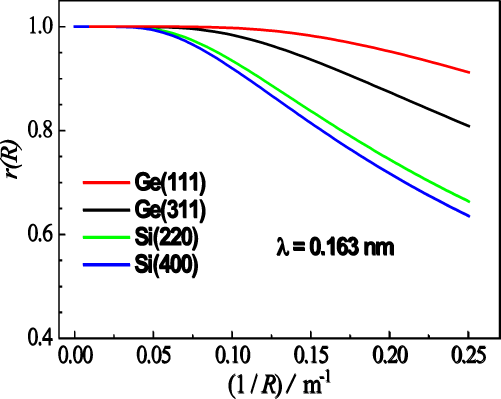
Peak reflectivity versus crystal curvature for several slabs as calculated for symmetric diffraction geometry.
Footnotes
Acknowledgements
The authors thank B. Michalcová from NPI CAS for significant help with measurements and data processing.

Funding
The authors disclosed receipt of the following financial support for the research, authorship, and/or publication of this article: The measurements were carried out at the CANAM instrument of NPI CAS Řež installed the CICRR infrastructure, which is financially supported by the Ministry of Education and Culture—project LM2023041. The authors received financial support from the project ESS Scandinavia-CZ II (LM2023057), respectively. Furthermore, P. Strunz and V. Ryukhtin were supported by the Fermion OP JAK project of MEYS No. CZ.02.01.01/00/22_008/0004591.
Declaration of conflicting interests
The authors declared no potential conflicts of interest with respect to the research, authorship, and/or publication of this article.