




Abstract
Occupations in the Lower Bengal Delta have been disrupted for various reasons, such as natural disasters, social degradation, economic crisis, and political revenge. It results in changing their traditional occupations. This study discusses how traditional occupations can be made sustainable in the future. An empirical study has been conducted in two villages in the Shyamnagor subdistrict of Satkhira district in southwestern coastal Bangladesh. The empirical methods included 310 household surveys, focus group discussions, and key informant interviews. Results show that 15 professions have been recorded and grouped into four categories: zero-capital instant wage occupations, minimum capital-end rewarding occupations, intellectual occupations, and capital-based occupations, depending on the type of capital. These categories accommodate mainly hand-based occupations—a trend most experienced in stressed environmental conditions. The intellectual occupations desire more institutional support for their sustainability. However, the sustainability of current occupational strides can be achieved by healthy external subsidies for applying knowledge and tangible inputs with information, communication, and technology support, as suggested by households (HH) involved in capital-based occupations. These HH suggested an integrated approach for occupational stride; however, such occupations are primarily land-based. The current climate-induced hazards to land and water’s physicochemical attributes suggest an uncertain return from such capital-based, land-oriented occupations. Thus, this study suggests that hand-based occupations have a better chance for sustainability than subsidised capital-based land-oriented occupations.
Keywords
Introduction
Coastal Bangladesh covers 32% of the country’s total area and is the habitat of 44 million people (Huq & Rabbani, 2011; Mallick et al., 2017). Approximately 97.10 % of this coastal area and over 35 million of its population are exposed to multiple climate change-induced hazards such as tropical cyclones and storm surges (Huq et al., 2015) due to its locational actuality (Charabi et al., 2010), and thus it is globally regarded as a climate hotspot location. Dependence on climatic variability, natural resources, and poor resilience to environmental stress render livelihood support systems vulnerable to climatic hegemony, as exemplified on many occasions in coastal Bangladesh (Biswas & Mallick, 2020; Gain et al., 2012; Karim et al., 2012).
Occupation provides means of living that enhance materials and social resources. An unhindered occupation against socio-climatic stresses maintains and intensifies net economic gain using scopes and wealth, maybe enlisted as the sustainable one (Chambers & Conway 1992; Priodarshini et al. 2021). Thus, the criteria that determine an occupation to be sustainable are social and environmental: environmental sustainability reviews all external impacts by local and global actors that lead to stewardship of natural resources, and social sustainability reviews the internal capacity of livelihood patterns to withstand shock and stresses that lead to resilience (United Nations Development Programme, 2017). Here, the sustainable livelihood approach (SLA) comes into the application, and it deals with the livelihood strategies that allow resilience and empowerment of the community to strive and adapt to adversities and mutate hardship into opportunities. SLA advocates opportunities for future generations (Mallick et al. 2020), for instance, farmers’ enhancement (Huq et al., 2015), aquaculture diversity (Ahmed et al., 2010; Islam et al., 2014), cost-effective resource modelling (Alam et al., 2013a, b), and conflicts over resource utilisation (Swarnokar et al., 2020). Such SLAs focus either on aquaculture or agriculture that advocates land-based support depending on High Yielding Varieties, and such support encourages uncontrolled access to natural resources and accreted lands (Brammer, 1996; Paul, 2009).
However, the coastal land and water in the Lower Bengal Delta are already degrading due to salinity and land immaturity (Datta et al., 2018). Approach to hand-based (skill-based) occupational alternatives generally only require a few natural resources (land and water) but need to be more focused in the literature. However, the multiplication of cropping patterns at current ambient conditions is not environmentally supportive because of salinity contamination in groundwater irrigation and occasional drought conditions (Haque, 2006). Perception from the community also does not suggest aqua-based efforts with periodicity between shrimp (Penaeus monodon) and prawn (Macrobrachium rosenbergii) because of their conflicting requirements for survival (Humphreys et al., 2015). However, expanding market facilities for artisanal handicrafts and tailing would be a plausible option. Certainly, an agrarian community’s productive land or asset endowment can directly raise household income. However, in a landlessness context, such reliance is problematic, and certain off-farm activities can be promoted to absorb the promising labour power (Quasem, 2001). Thus, these occupations may be clustered into four major categories based on the Mode of Capital following Ali (2005) and Islam et al. (2011), as presented below:
Considering these four categories of occupation and relevant strategies, this study identifies the occupational pattern in two villages, Bara Kupat and Henchi, located in southwest coastal Bangladesh, and assesses how these occupations can be sustainable and the possible alternatives for sustainable occupation in the study villages. In the following, section 2 describes the empirical study settings and methodology. Section 3 presents the results, followed by a discussion in section 4, and section 5 concludes.
Methods and Materials
Study Area
This coastal region is experiencing—during the last 50 years—an overall increase in maximum and minimum annual temperature with excessive precipitation during monsoon and post-monsoon (Rimi et al., 2009). The alteration of the geophysical environment of this region during the 1960s by constructing enclosures (called polders)—initially meant for protecting crop-agriculture in the tidal floodplain from saline invasion—soon become waterlogged saline wetlands because of congestion of the natural drainage system (Gain et al., 2012; Seijger et al., 2019) that leads to changes in the geochemical environment as well. Such changes in physicochemical conditions of the environment have driven households (HH) to shift from agro-based to non-agro-based occupations (such as aquaculture supported by saline/brackish water) (Pouliotte et al., 2009). Salinity-tolerant occupations such as shellfish farming (shrimp and crab) then started replacing the crop-agro-based occupations pursued by HH. However, such practices enhanced salinity more to soil and contamination of shallow aquifers by salinity and agrochemicals (Datta et al., 2010; Islam et al., 2019; Paul & Vogl, 2011; Primavera, 1997). Because of constructed physical barriers for water management, the migration of aquatic faunal species was delimited, and many indigenous fish varieties initiated experiencing stress in breeding and sufferings from diseases (Cochrane et al., 2009). With time, many also disappeared (Gain et al., 2008). This compelled the peasants to succumb to pisciculture with exotic species such as Clarias gariepinus, Pangasius giganticus, Tilapia mossambica and so on. Although the yield from such pisciculture is quite lucrative, many regard such dominance of exotic species in the natural system as a biological explosive (Barua, 1990) that may risk both humans and the environment (Sapkota et al., 2008).
The study region lies in the Ganges Tidal Floodplain (Brammer, 1996) as a broad bend of shallow land—barely a meter above the sea level and may be termed an immature delta (Rashid, 1991). The immature delta is included in the country’s Sundarbans and the Sundarbans Reserve Forest agroecological zone. Geochemically, the soils are primarily noncalcareous grey floodplain and acid sulphate soils (saline). Both of the villages (Bara Kupat and Henchi) were devastated by Category IV tropical cyclCycloneR (November 15, 2007), Category I Cyclone AILA (May 25, 2009) (Paul, 2009; Roy et al., 2009) and Category IV tropical cyclone AMPHAN (May 16, 2020) (WMO, 2020) and were left defenceless. However, being experienced in extreme climatic events, the community is aware of coastal hazards with their peers.
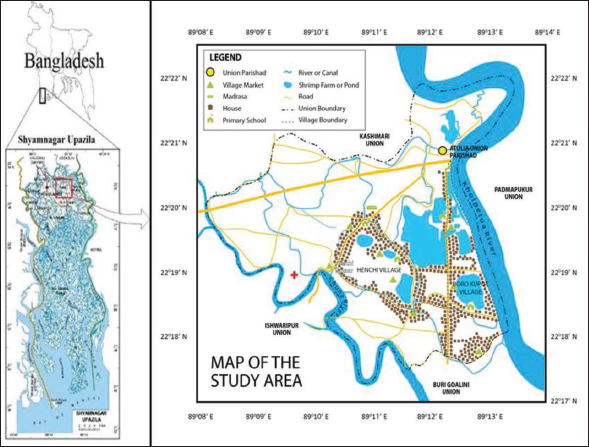
The study villages Bara Kupat and Henchi are located on the bank of Khalpetua River in Atulia Union of Shyamnagar Upazila (subdistrict), Satkhira, and are peripheral to the Sundarbans of the Lower Bengal Delta (Figure 1). They are geographically situated around latitude 22°18´ N to 22°22´ N and longitude 89°08´ E to 89°14´ E and included in Polder 15 (Polders are enclosures with earthen embankments meant for protecting tidal floodplains from saline invasion). The Henchi is separated from Bara Kupat by a small distributary of Khalpetua named Arpangashia-Henchi Khal (canal). The region experiences a humid subtropical climate; the maximum temperature reaches up to 35.5°C during summer, and the minimum temperature is 12.5°C during winter (Bangladesh Meteorological Department, 2016). The average annual rainfall is around 1,710 mm (BMD 2016). Extreme climatic events such as storm surges, salinity invasion, and waterlogging are frequent in this region (Mallick et al., 2017).
Location of the Villages Bara Kupat and Henchi, Union Atulia, Shyamnagar, Satkhira.
Data Collection
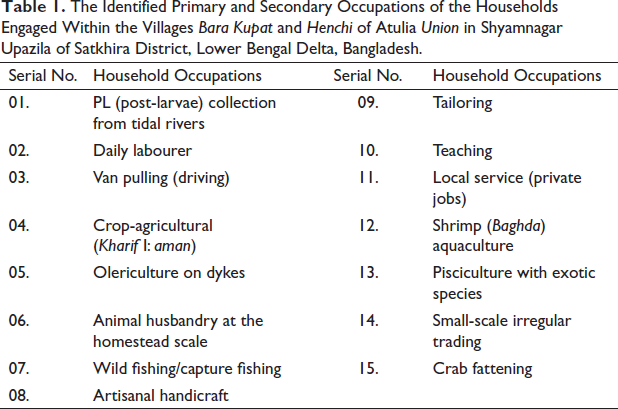
Procedures for Participatory Action Research (Pretty et al., 1995) were followed to capture data for this research. Preceded with a reconnaissance survey, the primary field attributes were collected through a semi-structured questionnaire survey, Focus Group Discussion (FGD), Key Informant Interview (KII), and expert consultation. The questionnaire was pretested, and the surveyors were trained before field activities. The recorded total number of 948 HH in Bara Kupat and 158 in Henchi reported 15 different primary and secondary occupations, as shown in Table 1. The primary occupation is where the household devotes the highest period in a year. All occupations supplementary to the primary occupations are regarded as secondary occupations.
The Identified Primary and Secondary Occupations of the Households Engaged Within the Villages Bara Kupat and Henchi of Atulia Union in Shyamnagar Upazila of Satkhira District, Lower Bengal Delta, Bangladesh.
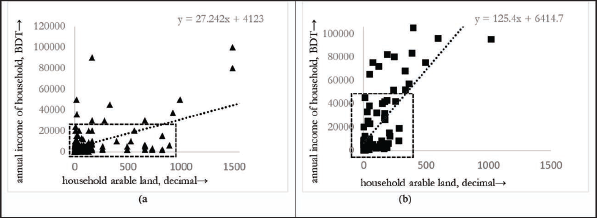
Land provides the primary livelihood support system for an agrarian community in coastal Bangladesh, and its degradation causes major financial losses (BCAS, 2001). A statistically significant positive relationship is observed between household arable land area and household income (at 95% confidence level) both in Bara Kupat (r = 0.559, Figure 2a) and Henchi (r = 0.73, Figure 2b). Considering such a relationship, we have stratified the total population (HH), and after determining the sample size (n) following Kothari (2004), they were selected randomly from each stratum according to weightage. We have observed that 12 HH in Bara Kupat and 22 in Henchi lie outside the cluster (Figure 2a and 2b) and are sampled separately. Following such estimation, the sample size (n) for Bara Kupat is (190 + 12) = 202 HH, and that for Henchi is (86 + 22) = 108.
Correlation Coefficient Between Arable Land Area and Total Income of Households in Villages: (a) Bara Kupat and (b) Henchi of Atulia Union, Shyamnagar, Satkhira, Lower Bengal Delta, Bangladesh.
Semi-structured questionnaire—focusing on demography, resource availability-vulnerability, occupation-income, land-use, cropping pattern-intensity, livelihood demand-requirements, health and sanitation, food and nutrition, culture, infrastructure, transportation and so on—was constructed for all 310 HH (202 in Bara Kupat and 108 in Henchi) and was surveyed given equal importance and time to all HH.
Four FGDs were held at Henchi Govt. Primary School premises (Henchi), Bangabandhu High School premises (Henchi), Bara Kupat Krishna Temple (Bara Kupat), and Bara Kupat Primary School premises (Bara Kupat). Each FGD has been participated by around 18–22 members maintaining gender balance, generating a composite perception of issues on sustainable occupation (Figure 3).
A Flash of Four FGDs Performed in Four Locations of Bara Kupat and Henchi, Outlining Major Steps and Focuses That Have Been Performed.
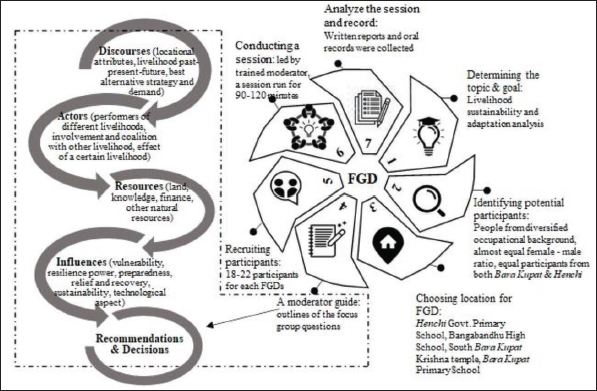
The FGD sessions of 90–120 minutes concentrate primarily on occupational sustainability concerning the past-present-future status and options about locational attributes (discourses), actors’ involvement in particular options, and its effect on society, environment, economy (actors), variety of knowledge and resources that is required for executing an occupational option (resources), the vulnerability, resilience, and sustainability of occupational choice (influences) and perception on the potential of sustainability of the opportunity.
Five KIIs and expert consultations were also performed with an agro-farm owner, a shrimp farmer, a full-time wage labourer, a local government official, and a forest and fisheries department executive.
Results and Discussions
Demographic Profile
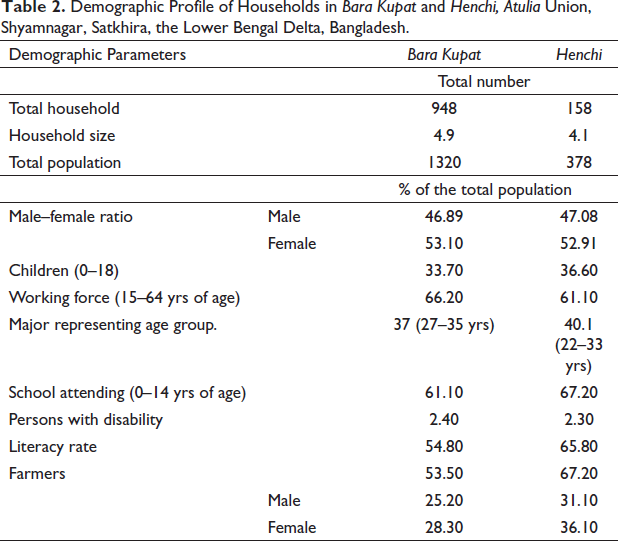
We have recorded a total population of 1,698 in Bara Kupat and Henchi with a male-female ratio of 47:53 (Table 2). The number of HH in Bara Kupat is 948, with an average size of 5 (~4.9), while the Henchi accommodates 158 HH and average size is 4. The age group between 27 and 35 years is quite significant (around 37% and 40%, respectively, in Bara Kupat and Henchi). A promising share of the workforce population (between 15 and 64 years old) was identified (66% in Bara Kupat and 61% in Henchi) who financially support their HH. Around 61% of children in Bara Kupat and 67% of children in Henchi (of age < 14 years) attend primary and junior educational levels, and the overall literacy rate is 54% in Bara Kupat and 65% in Henchi. A significant proportion of the population (around 53% in Bara Kupat and 67% in Henchi) is directly involved in farming activities such as agro-based, aqua-based, and livestock farming.
Demographic Profile of Households in Bara Kupat and Henchi, Atulia Union, Shyamnagar, Satkhira, the Lower Bengal Delta, Bangladesh.
Occupational Profile
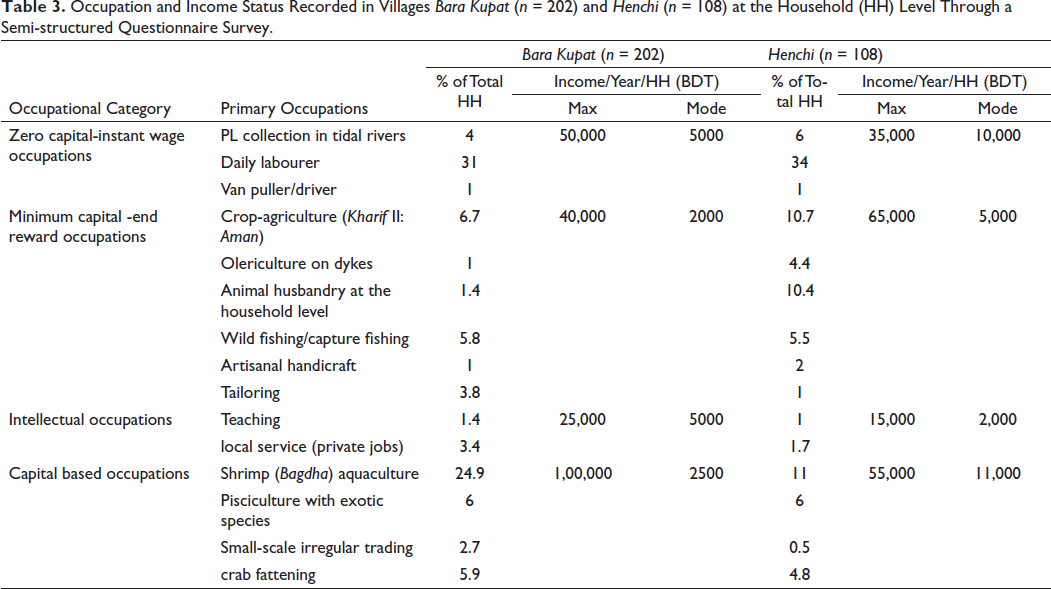
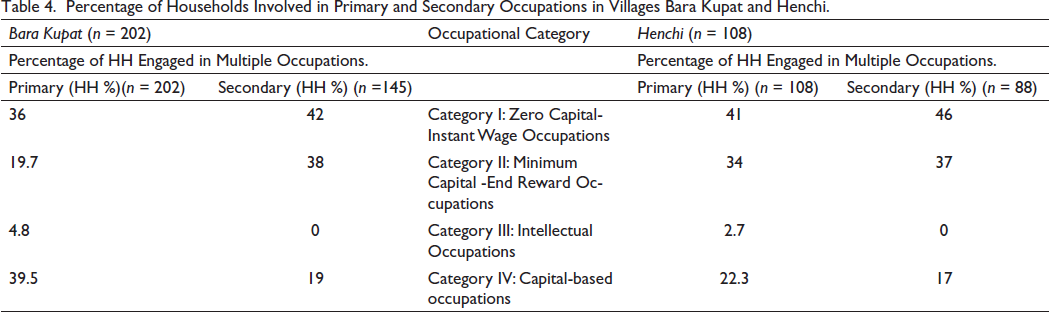
The primary occupation and income status in different occupational categories are presented in Table 3. The percentage of HH involved in other secondary occupations and the primary ones belonging to different categories are shown in Table 4.
Occupation and Income Status Recorded in Villages Bara Kupat (n = 202) and Henchi (n = 108) at the Household (HH) Level Through a Semi-structured Questionnaire Survey.
Percentage of Households Involved in Primary and Secondary Occupations in Villages Bara Kupat and Henchi.
The usual Zero Capital-Instant Wage (Category I) occupations in villages Bara Kupat and Henchi are day labouring (31% HH in Bara Kupat and 34% HH in Henchi) and post-larvae (PL) collection from the wild. However, a range of activities is observed in Minimum capital -End reward occupations (Category II). Among them are mono-crop (mainly aman) agriculture, livestock farming, and wild fishing (prominent in villages Bara Kupat and Henchi). Other activities of Category II encompass olericulture, crafting, and tailoring. Professional engagement with Intellectual Occupation (Category III) is scarce in the villages; however, few are engaged with traditional teaching and services. The seductive pull for tempting financial profit draws a group of community members to Capital Based Occupation (Category IV), where the commanding practices are year-round shrimp (Penaeus monodon, called Baghda in Bangla) farming (24.9% HH in Bara Kupat and 11% HH in Henchi), pisciculture with exotic species (6% of HH in both Bara Kupat and Henchi) and crab (Scylla olivacea) nursing/fattening (5.9 % HH in Bara Kupat and 4.8% HH in Henchi).
The secondary occupations where the community is involved mainly fall into the Zero capital-Instant wage and Minimum Capital -End Reward categories (Category I and Category II, respectively) (Table 4). The HH in Henchi are more involved in secondary occupations than Bara Kupat’s. It is observed that a significant number of HH are involved with more than one occupation, as observed in Tables 3 and 4.
The financial outcome from the four occupational categories suggests that the highest share in Bara Kupat (BDT 1.00 Lac per HH per year) is achieved from Capital Based Occupations (Category IV); however, in Henchy, the dominant income share (BDT 65,000 per HH per year) is acquired from Minimum Capital -End Reward (Category II) occupation. The second highest income comes in Bara Kupat from Zero capital-Instant Wage (Category I) and in Henchi from Capital Based Occupation (Category IV) (Table 3).
Occupational Shift: Facts and Preference
Perception regarding frequent changes and barriers in maintaining a livelihood support system is presented in Figure 4. A sizeable number of HH diagnosed salinity invasion (92%) and cyclonic events (95%) as the most instinctive driver responsible for changes in land use patterns. Reduced soil fertility—as perceived by 82% HH—is a significant cause for the decrease in productivity of rice crops. The HH perceived that such hazardous events were not an everyday experience two decades ago. About 80% of the HH perceived that the region is experiencing prolonged drought periods, which was not a poor freshwater region even two decades ago.
Hindrances in Maintaining the Sustainability of Current Occupations as Perceived by the Households of Bara Kupat and Henchi.
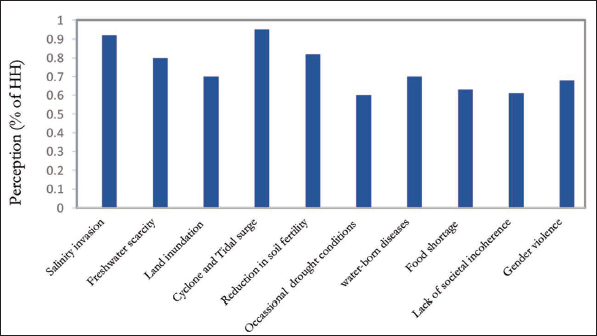
Such barriers in maintaining occupational sustainability are responsible for the current food crisis for 63% of HH. Occupational instability was also reported as accountable for declination in social coherence; for example, 61% of HH referred to social violence, and 68% of HH claimed that women insecurity either at the household or community level.
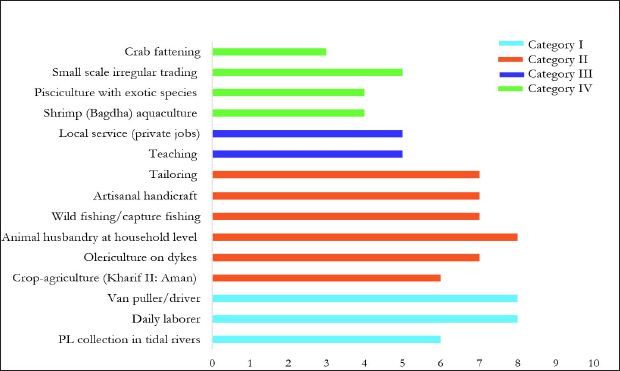
The perceived environmental stressors contributing to occupational uncertainties are sorted through expert consultations and transect walking and semi-quantified in a Likert scale following Joshi et al. (2015). The occupational preferences are classified and charted in Figure 5. The exercise suggests poor choices (score ≤ 4 out of 10) for several currently practiced capital-based occupational options such as shrimp aquaculture and crab nursing, requiring saline water, pisciculture with exotic species and so on (Category IV). Instead, the community is more inclined toward (score ≥ 5 out of 10) nonfarming activities such as daily labouring, van pulling, PL collection, tailoring, crafting and so on. (Category I and Category II).
Perceived Household Preferences for Occupational Options on a 1–10 Scale.
However, it is essential to note that almost all HH demand migration from their current settlement to a place perceived as free from antagonistic environmental attributes.
The community people desire an economical and environment-friendly change in current occupational practices. This urge is mainly pronounced with women folk in kitchen assemblies. A strategy for integrated agriculture or aquaculture, pisciculture with major and minor indigenous carp species, and indigenous catfish (preference score 9.5 out of 10, Figure 5) is suggested instead of existing mono-crop rice by intense irrigation. Economic migration to sort-of occupations that are not vulnerable to environmental stresses is highly prioritised (score 10 out of 10). However, many community members also favour self-owned van driving, boatmen, labouring, recycle-reuse-based SMEs, self-motivated tailor-trainers, and dry food (fish, fruit, and spices) processing, as revealed by FDGs and HH survey.
Occupational Sustainability Analysis
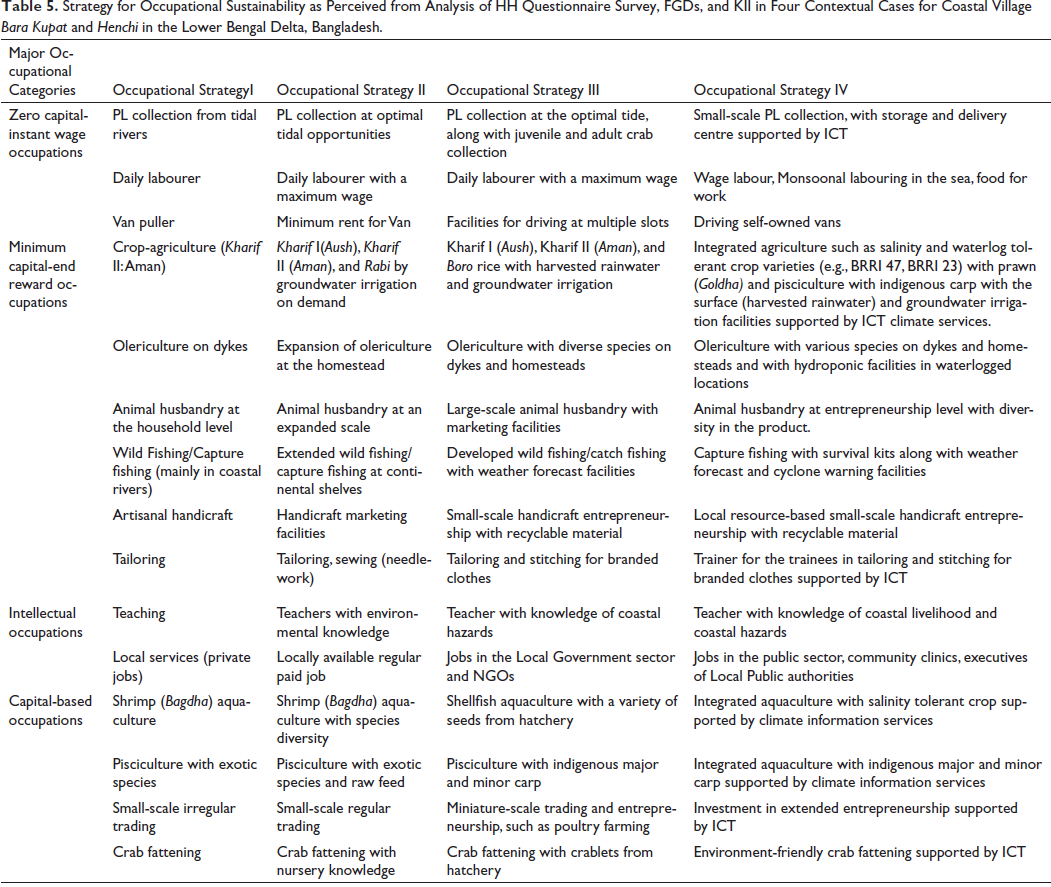
Analysis from FGDs, semi-structured HH questionnaire surveys, and expert opinions are consulted to filter options for better alternative occupational strategy and thus sustainability analysis of livelihood. Table 5 represents the current occupational strategy along with three alternatives following Edjossan-Sossou et al. (2014) and designated as follows:
Strategy for Occupational Sustainability as Perceived from Analysis of HH Questionnaire Survey, FGDs, and KII in Four Contextual Cases for Coastal Village Bara Kupat and Henchi in the Lower Bengal Delta, Bangladesh.
Toward Occupational Sustainability
Occupational Strategy I
The current occupational strategy pursued by Baro Kupat and Henchi HH reflects a compromise with the ambient processes governing the physical environment that support the livelihood system. The physical actuality of the Atulia union currently favours a saline ambient condition (Datta et al., 2018; Ullah & Rahman, 2015). Persisting occupations with such an ambient environment require an adequate capital base, and a sizeable number of Baro Kupat (39.5%) and Henchi (22.3%) HH are currently involved with such Capital Based Occupations (Tables 03ab & 04) who own a good size of arable land as well. Table 4 suggests that the stressed environmental conditions compelled a significant number of HH to be involved with Zero Capital-Instant Wage and Minimum Capital-End Reward Occupations (36% and 19.7%, respectively, in Bara Kupat and 41% and 34% in Henchi, respectively). However, such occupations are mostly hand-based, and our intuitive perception is that these HH own a meagre size of arable land and depend on secondary occupations to maintain their livelihood support (Table 3). Thus, the occupational strategy that the HH follow is not subsidised by the environmental contributors and therefore needs to be sustained by seeking alternative and improved options.
Occupational Strategy II
Our observation from contextual analysis of the household survey, FGD, and expert consultation suggested a range of reallocations of internal resources and energy optimisation to sustain the current occupational strategy. The occupations categorised as Zero Capital-Instant Wage prioritise hand-based activities where environmental subsidies such as benefit from optimal tide for PL collection from coastal tidal rivers and minimum van rent and maximum wage are deserving. The HH involved with Minimum Capital-End Reward occupations also urge to optimise the occupational benefit by multiplication, expansion, and extending their current occupation at least spatially (Table 4). Households involved in Intellectual Occupations perceive that acquiring current knowledge of the environment and consistency in engagement may guarantee sustainability in their occupation. Boosting occupational support for households engaged in Capital Based occupations perceives their sustainability through innovation and extension of their efforts through compromise with saline ambient conditions such as selecting Baghda and practicing exotic fish species for pisciculture with small-scale trading, thus abandoning crop-agriculture (Table 4).
Occupational Strategy III
The community desires external contribution and support to internal resource and energy optimisation efforts to sustain the current occupational support system as a third strategy. The major hand-based Zero Capital-Instant Wage occupations desire to expand the diversity of PL collection, crablets, and relaxed time slots for performing additional occupational activities with tools (such as vans) from the owners. This would provide the space for involvement with secondary occupations at convenient time slots. HH involved with mostly hand-based Minimum Capital-End Reward occupations expect external contribution in expanding crop-agriculture by harvested rainwater and groundwater irrigation with quality assurance, an extension of olericulture both in dykes and homesteads, and capture fishing at continental shelves with weather forecast facilities. This group is also inclined to scale their efforts in animal husbandry and artisanal handicraft with entrepreneurship. The HH involved in Intellectual occupations desire sustainability of their current occupation by fortification when rendered to public authority. Much innovation for the sustenance of current occupation may be observed from the perception of HH involved in Capital Based occupations.
However, such perceived sustainability effort for current capital-based occupations is mostly land-based and meant for community members who own large arable land. The land is dedicated to aquaculture diversity in hatchery-based shellfish (such as shrimp and crab) culture, pisciculture with indigenous carp, and entrepreneurship (Table 4). Success in pisciculture with indigenous species without eliminating the exotic species is doubtful, as many experts perceive, because the latter have a predatory habit (Barua 1990). Similar is the situation that may hinder success in the diversity of prawn (Macrobrachium rosenbergii) as favoured by many HH in place of shrimp (Penaeus monodon), but their survival conditions are environmentally conflicting (Sarwar, 2005).
Occupational Strategy IV
Including defence mechanisms against climate-induced environmental hazards is the main focus for the perceived sustainability of the current occupational strategy, which is important in Occupational Strategy IV. This strategy also upholds the need to optimise resource and information, communication, and technology (ICT) tools input from external and internal sources that enhance the inherent ability of quest for sustainability of the current occupational pattern. HH involved with Zero Capital-Instant Wage occupations suggest a hazard-proof storage and delivery system for their collections, support from the social safety net promulgated by the public authority, and ownership of paraphernalia required to keep their occupational strive. These HH seem to be less worried about climate-induced perceived environmental hazards. The HH involved in Minimum Capital-End Reward occupations perceive sustainability of their current occupational efforts through integrated agriculture and integrated aquaculture, olericulture through hydrophonic assemblages, small-scale animal husbandry, and product diversity secured capture fishing and also local resource base artisanal handicraft and tailoring - all with an urge for developing entrepreneurship. The HH engaged in intellectual occupations perceive their current occupational sustainability by striving to enhance knowledge and incorporation in the public sector. The HH of capital-based occupations perceive their current occupational sustainability through external input by expertise and reliance on tangibility with the ambient environmental biophysical attributes (Table 4).
It is worth mentioning that various social, cultural, and economic factors influence the gender dynamics of all sorts of occupation in our study villages, which, like many other places in the coastal region, often exhibits distinct patterns in the types of jobs and employment opportunities available to men and women. The traditional gender roles were prevalent, where men were often associated with tasks such as fishing, agriculture (including shrimp farming), and other physically demanding activities, but women were often involved in household chores, small-scale agriculture, and working in the informal sector. For instance, men were more commonly engaged in commercial fishing, while women were more involved in smaller-scale, subsistence fishing and aquaculture. Besides, limited resource access restricts women’s participation in certain economic activities, which is increasingly recognised for its importance in building resilience, poverty reduction, and sustainable development in the region. Promoting gender equality and empowering women economically can lead to more inclusive and prosperous coastal communities.
Conclusion
The current attributes of villages Bara Kupat and Henchi are perceived as an ecological backlash—the consequence of human interference with the natural system. Thus, the sustainability of the current occupation—with innovation and subsistence—is complicated when it is considered antagonistic environmental support. Land-based occupations—where investment facilities are perceived as hazardous—should be replaced with hand-based occupations supported by ICT tools.
As a compromise to the current antagonistic environmental attributes, the land-based occupations may strive with integrated agriculture/aquaculture fortified with saline and waterlog tolerant rice varieties such as BRRI 47, BINA 8, BRRI 23, 41, 53, and 54, along with fish species such as Harpadon nehereus, Liza parsia, Mugil cephalus, Chanos chanos and so on. Macrobrachium rosenbergii and rice varieties may also be a practical occupational option with harvested rainwater for irrigation where possible. The introduction of crab fattening also is suggested by many. Olericulture may be considered as occupational fortification against climate change-induced hazardous conditions. HH engaged in nonfarm occupation—primarily those in Zero Capital Instant Wage and Minimum Capital End Reward occupations—have no or less access to arable land and perceived hand-based occupations as a practical option for sustainability for their current engagement. Thus, Occupational Strategy IV could be the most viable option for sustaining the current occupational engagement.
While these findings are based on two villages may not provide an exhaustive picture of the entire region, it can still offer valuable insights into the specific context and circumstances of those villages.
The results are not just unique to those particular villages but may have broader implications. It’s important to note that replicability does not necessarily guarantee the accuracy or truthfulness of the findings. The results of a replicated study could still be subject to variation due to differences in contextual factors, variations in data collection, or the inherent complexity of the subject being studied. However, if multiple researchers can independently replicate the study and achieve consistent results, it enhances the robustness and credibility of the findings, and later can be generalised. Researchers should be cautious about making sweeping generalisations and should instead focus on contributing to the understanding of the specific areas under study. The more robust the research design and the more carefully the study villages represent the larger population; the more confident one can be in the relevance of the findings to that part of Bangladesh.
Footnotes
Acknowledgments
This study results from a service contract granted to DKD by Oxfam-Monash Action Research Project PROTIC (Participatory Research and Ownership with Technology, Information, and Change). IR acknowledges receipt of Research Assistantship under this service contract. She also believes the Ministry of Science and Technology for granting her a lump sum research fellowship. BM acknowledges receipt of post-doctoral fellowship of European Union’s Horizon 2020 research and innovation programme under the Marie Skłodowska-Curie (Grant ID–846129). The authors acknowledge logistic support received from NGOs Ganochetona Foundation and Shusilan. During field visits, constructive discussion and field assistance from Professor Md Zahangir Hossain, Professor Abdullah Harun Chowdhury, and Professor Md. Mujibor Rahman and Sadhon Chandra Swarnokar of Environmental Science Discipline, Khulna University, and Professor Md Muhyminul Islam from Department of Environmental Science and Disaster Management, Bangabandhu Sheikh Mujibur Rahman Science & Technology University, Gopalganj 8100, Bangladesh, and Mr Tapash Ranjan Chakraborty from Oxfam GB is gratefully appreciated.
Declaration of Conflicting Interests
The authors declared no potential conflicts of interest with respect to the research, authorship and/or publication of this article.
Funding
The authors received no financial support for the research, authorship and/or publication of this article.