




Abstract
Little research has examined how football rivalries shape civic identity in Asian megacities characterised by rapid urbanisation and high internal mobility. Drawing on 30 semi-structured interviews and online non-participant observation, this study examines how the football fans of Shanghai Shenhua F.C. and Shanghai Port F.C. shape and reflect civic identity in Shanghai through their derby rivalry. The findings reveal that Shenhua fans assert local authenticity via the 310 ID prefix and Shanghainese dialect, reinforcing boundaries between natives and migrants. In contrast, Port supporters, mostly new elite socioeconomically privileged migrants, embrace global symbols to construct a cosmopolitan counter-identity. A further group of neutral fans, ‘Purple Skins’, express city-first attachment to Shanghai that sits uneasily with club-centred tribalism. These competing repertoires co-produce a distinctive Shanghai-style derby culture, while state-led stadium relocations further reshape the spatial visibility of fandom and the contours of authenticity claims. The article develops an analytical framework linking structural conditions, fan practices and differentiated civic identities in urban derby contexts, offering a transferable approach for future studies of football fan rivalries across diverse international contexts.
Introduction
As one of China's largest and most economically influential cities, Shanghai has long served as a key hub for Chinese football, earning the titles ‘Football Stronghold of the Far East’ (远东足球重镇) and the ‘Cradle of Chinese Football’ (中国足球摇篮) (Shen et al., 1995). Studies by Chinese scholars have illustrated how the city's football culture has been shaped by both Western colonial influences and domestic sports policies (He, 1989; Wang and Ni, 2016). Historical records from Chinese sources trace the origins of the Shanghai football derbies back to the early twentieth century, notably to matches between St John's University and Nanyang Public School. 1 Since the professional reform of Chinese football in 1994, Shanghai has experienced a proliferation of football clubs, with Shanghai Shenhua (founded in 1993) and Shanghai Port (established in 2005) 2 emerging and remaining the city's two dominant forces in the Chinese Super League (CSL). Despite their shared metropolitan base, the two clubs have followed sharply divergent institutional trajectories. Shenhua entered the professional Jia-A (甲A联赛) 3 era through strong institutional continuity and early municipal backing, rooted in its origins as a former state-affiliated team, and became a founding member of the CSL in 2004, long embedded in Shanghai's footballing memory. By contrast, Shanghai Port (then Shanghai East Asia), originating from a youth-development venture, emerged later through a commercially driven pathway aligned with market expansion and municipal sporting strategies, progressing rapidly from the China League Two (中乙联赛) to the China League One (中甲联赛) and ultimately to the CSL, 4 securing multiple league and cup titles along the way and positioning itself as a rising force in Shanghai football. Shifts in league performance and public visibility have progressively reconfigured their relative status, intensifying rivalry between the clubs and laying the foundations for the modern Shanghai-style derby, through which competing claims to civic representation are increasingly articulated (Qi et al., 2021).
It has long been understood that football is ‘more than a game’; instead, it can be seen as a sociocultural phenomenon that fosters strong individual identities and collective belonging for fans and, even, the broader community (Russell, 1999: 15). This is relevant to understanding the rivalry between Shenhua and Port fans, which extends beyond the pitch, reflecting deeper social tensions within the city. This conflict culminated in the infamous ‘3·11 Incident’ of 11 March 2016, a violent clash between Shanghai Shenhua and Shanghai Port (then Shanghai SIPG) supporters that resulted in multiple injuries and police intervention. The divide between the two fan groups mirrors broader sociocultural fault lines: Shenhua fans, predominantly long-term local residents, position themselves as custodians of a distinct traditional Shanghainese identity, whereas Port fans, largely first-generation internal migrants from other Chinese provinces, articulate a more cosmopolitan and aspirational imaginary of the city.
Drawing on urban sociology and the sociology of football fandom, this paper examines how the Shenhua-Port rivalry negotiates competing claims to civic belonging within the city of Shanghai. In doing so, it develops an analytical framework of civic-based football rivalries which may be utilised to examine fan cultures and identities in other locations. As such, the study repositions debates beyond Western paradigms and demonstrates how football can mediate migration, modernity and civic identity in state-led Asian cities, using Shanghai as an illustrative case.
Football fandom, ‘derby’ rivalry and civic identity
It has long been acknowledged that football fandom, characterised by emotional attachment, loyalty and engagement with clubs, national teams, as well as local communities, plays a pivotal role in shaping civic identity (Dunning et al., 2014; Giulianotti, 1995; Guschwan, 2011). Civic identity refers to an individual's sense of belonging and participation within a community, shaped by shared values, traditions, social interactions and political-moral awareness (Youniss et al., 1997). At the same time, civic identity not only reflects but also actively constructs contemporary debates concerning immigration mobility and cultural diversity, making it a crucial site for examining the intersection of football and society (Sullivan et al., 2019).
Existing research highlights that football fandom contributes to civic engagement in multiple ways. It fosters local and national patriotism (Armstrong and Hognestad, 2003; Brentin, 2013), encourages political participation and social solidarity (Fitzpatrick and Hoey, 2022; Kasimoğlu, 2025) and reinforces civic rights within consumer culture (Numerato and Giulianotti, 2018). Indeed, football fandom serves as a mechanism for enhancing social cohesion and civic awareness, while also determining the symbolic status of cities and influencing cultural discourses (Jiang and Bairner, 2020).
Furthermore, studies indicate that football fan cultures can mediate civic identity formation through inclusionary and exclusionary practices, depending on the socio-political context (Cleland and Cashmore, 2016). Armstrong (1998: 306) uses the term ‘post-modern tribe’ to describe parochial football fans. Nowadays, football fans actively construct and reinforce their civic identity through stadium rituals, engagement in fan communities and participation in digital discourse in their tribes (Armstrong and Young, 2000; Bromberger, 1995). As a territorial form of football fandom, derby rivalry can reinforce civic identity through longstanding local allegiances and competitive tension. As such, the phenomenon of the football derby, characterised by intense rivalry between local teams, has long been intertwined with processes of urbanisation. Since the late nineteenth century, as cities grew and social identities became more complex, football clubs emerged at different junctures as symbols of regional pride, often reflecting deeper socio-economic and cultural divisions within urban spaces (Tyler and Cobbs, 2015).
The origins of derby rivalries are deeply rooted in processes of industrial and urban expansion (Collins, 2015). As cities expanded, football clubs often formed along neighbourhood, class or occupational lines, creating natural rivalries. In England, the Merseyside Derby (Liverpool vs. Everton) exemplifies how urban growth fostered football rivalries. Bale (2001) argues that Everton's split from Anfield in 1892 was not just a sporting divergence but also a reflection of Liverpool's urban and economic stratification. Similarly, the Manchester Derby has been framed as a contest between the historically working-class United and the more commercially successful City, mirroring Manchester's industrial and post-industrial transformations (Brown, 2008).
Urbanisation not only creates football derbies, but it also reinforces social identities and senses of belonging through football. Derby matches serve as ‘theatres of identity’, where local pride and animosities are performed. In Glasgow, the Old Firm rivalry (Celtic vs. Rangers) transcends sport, embodying religious and political divisions that were entrenched during the city's industrialisation (Bradley, 1995). Contemporary urbanisation has further transformed derby dynamics. Stadium relocations, gentrification, and globalised fandom have altered traditional local rivalries. Millward (2011) examines how West Ham United's move to the London Stadium disrupted long-standing rivalries with clubs like Millwall, illustrating how urban redevelopment can reshape football's geographical and emotional landscapes. Meanwhile, in Madrid, the Atlético-Real rivalry has evolved with the city's shifting demographics, as noted by Duke and Crolley (2014), who highlight how Real Madrid's association with Spanish centralism contrasts with Atlético's working-class roots. These football rivalries, therefore, operate within and are responsive to the deeper fractures in a rapidly urbanising society, where questions of who belongs, who represents and whose voices matter are negotiated through everyday cultural practices like football fandom.
Despite increasing academic interest in the intersection of football fandom, rivalry and civic identity, significant gaps remain in understanding how fan culture shapes civic identity across diverse societal and geographical contexts. While scholars have explored the role of globalisation and social media in shaping transnational fan identities (Doidge, 2015), there has been comparatively less focus on how football fandom, especially derby rivalry, influences civic identity at local levels, particularly in societies undergoing rapid social transformation due to migration and multiculturalism. Much of the existing literature has been predominantly centred on the United Kingdom and broader European context (Brown, 1998; King, 2000; Redhead, 1997), as well as Latin America (Archetti, 1992; Lopes, 1999), with most studies conducted in the late 1990s and early 2000s. In contrast, research on East Asia, particularly China, remains relatively neglected. As Brick (2001: 9) has noted, ‘cultures of fandom seek to understand, negotiate and relocate themselves within increasingly complex glocal contexts’. Given that cities and nations have become increasingly socially intricate and often characterised by ‘super-diversity’ (Vertovec, 2007: 1025), there is a pressing need to reassess these themes within the contemporary framework.
One critical area that remains unexplored is the interplay between local and migrant football fans, despite its significance for understanding social integration, collective identity negotiation and community cohesion (Burdsey, 2006; Giulianotti, 1999). Particularly in contemporary China, where urbanisation, demographic shifts and the increasing internationalisation of football culture are rapidly reshaping fan communities, further research is essential to explore how football fandom intersects with evolving civic identities.
The Chinese context: football fan culture, urbanisation and the distinctive Shanghai Derby
The emergence of football fan culture in China is closely tied to the country's distinctive trajectory of social change. Modern football was introduced into coastal port cities such as Hong Kong and Shanghai through Western colonial and commercial channels in the late 19th and early 20th centuries (Twydell, 1994). However, football fandom as a self-conscious, collective organised cultural formation began to take recognisable public forms from the 1980s, shaped by the accelerated urbanisation that followed the Reform and Opening-up (改革开放), and expanded rapidly with the professionalisation of the domestic league in the mid-1990s (Fan and Lu, 2013; Zhe and Guan, 1999). During this period, large-scale domestic migration reshaped urban social structures and intensified demands to express local belonging (Jiang and Bairner, 2024; Xiong et al., 2020). In response, some urban residents drew on European repertoires of fan organisation and match-day support, turning the football stadium into a symbolic space for expressing local attachment (Lee, 2022; Sullivan et al., 2022).
Unlike European and Latin American football fandom, which has often been historically anchored in class, religious or territorially entrenched antagonisms, sometimes intersecting with racism and far-right extremism, Chinese football fan culture displays a marked ‘glocalisation’ character (Buarque De Hollanda and Busset, 2023; Fontes and Hollanda, 2014; Giulianotti and Robertson, 2012). It is rooted in a traditional moral-cultural horizon structured by a ‘family–city–nation’ isomorphism, while continuously negotiating between, on the one hand, a state discourse oriented towards order and, on the other, a market logic driven by transnational consumption (Li et al., 2024; Wang, 2025). This dual anchoring reflects both the influence of longer cultural resources, such as the collective ritual participation associated with cuju (蹴鞠) in imperial China and the ethical sensibilities shaped by Confucian notions of moderation, and the outcomes of Reform-era development, in which local cultural inheritance has repeatedly encountered and reworked imported cultural forms (Yan et al., 2025).
Understanding this cultural formation requires close attention to urbanisation as a core societal process. As both academic and media sources have noted, drawing on an observation by Joseph E. Stiglitz, the Nobel laureate in economics, technological development in the United States and urbanisation in China represent two key forces shaping global development in the twenty-first century (Ye and Wu, 2014; The Economist, 2014). In the Chinese context, however, urbanisation has functioned not only as an engine of economic growth, but also as a driver of profound transformations in population structure, socio-spatial reorganisation and the reconfiguration of civic identity (Joppke, 1999; Li, 2004; Wen and Liu, 2019). Against this macro backdrop, professional sport, and football in particular, has increasingly become an instrument of urban development and city marketing (Bale, 2001; Yu et al., 2019). Football clubs, in this sense, operate as mobile ‘performances’ of their host city's image, carrying policy intentions and development narratives into public view. As a result, Chinese professional football clubs are typically tightly bound to both corporate capital and municipal agendas. Rivalries among fan groups, therefore, tend to be less about deep social cleavages and more about symbolic struggles over ‘urban representativeness’, cultural superiority and access to development resources – struggles that ultimately centre on inter-urban image competition and the branding of place (Liang, 2017; Wang, 2025).
This competitive logic has direct implications for how urban fans construct ‘civic identity’. In China, civic identity is closely entangled with state-led urbanisation, the hukou 5 (户口, household registration) system and the enduring urban–rural dual structure. It takes shape as an ongoing negotiation between institutionalised belonging and mobile, contingent social positioning: it includes affective attachment to the city, yet is simultaneously constrained by unequal rights differentiated through hukou status (Guo, 2019). Accordingly, the notion of civic identity used in this study is not reducible to a city-level sense of belonging. Rather, it denotes a hierarchical and mobile form of identity formation that is produced through the interaction between national urbanisation policies and local cultural processes, and that carries implicit meanings of social rights and entitlement.
From this perspective, the Shanghai Derby offers a particularly valuable micro-level case. As a leading frontier of China's urbanisation, Shanghai's hukou reforms and talent-attraction policies have produced a highly diverse population structure; within fan communities, negotiations between ‘new migrants’ and ‘old-stock locals’ become increasingly salient. Meanwhile, Shanghai's distinctive Haipai Culture (海派文化) took shape through the interaction of the local Wu cultural milieu with treaty-port cosmopolitanism, periods of Western imperialism and Japanese occupation and socialist state-building. It is commonly associated with openness, hybridity, cosmopolitan outlook and a pragmatic, commercially oriented modernity (Balfour and Zheng, 2002; Lee, 1999). These features furnish the cultural frames through which supporters’ debate ‘who can legitimately represent Shanghai’ in the football arena. Therefore, taking the Shanghai Derby as an entry point, this article asks how, under demographic transformations generated by state-led urbanisation, the professional football derby becomes a key symbolic stage. On this stage, rival fan publics mobilise competing interpretations of club history, cultural symbols and urban ethos to contest the very meaning of ‘Shanghainess’ and the legitimacy of representing the city. The article argues that such rivalry is far from a simple sporting antagonism; it constitutes a form of practice-based identity work through which a new mode of civic identity is produced and negotiated. Through this micro-level lens, the study seeks to offer a more dynamic and conflict-sensitive account of how the interaction between China's urbanisation and sports culture reshapes social identification. In doing so, the article contributes significantly to wider scholarship in sport on team rivalries and on civic identities, by conceptualising civic identity as an outcome of practice-based boundary work, rather than a fixed attribute of place. Accordingly, the study provides an empirically based analytical framework that can be tested or applied in relation to other sport rivalries in the international context.
Methodology
The study examines these themes and issues through the research question: How do the fan cultures and identities of Shanghai Shenhua F.C. and Shanghai Port F.C. reflect and influence the construction of civic identity in Shanghai through their derby rivalry? To address this, a qualitative research design was employed to reveal football fans’ perspectives on civic identity in Shanghai. Individual semi-structured interviews were conducted to prioritise the voices and insights of football fans (Bryman, 2016). Additionally, non-participant observation was carried out using materials gathered from news reports and social media platforms (including fan WeChat groups, RedNote 6 and Dongqiudi 7 ). In this study, these materials serve as a supplementary data source, used to contextualise interview accounts, sensitise the researcher and track shifts in online fan narratives before and after derby fixtures (Natow, 2020). This approach was designed to uncover how fans construct, interpret and embody the cultural symbols, identities and practices associated with football fandom, offering insight into how Shanghai-style football fan cultures reflect civic identity.
Fan recruitment and participants
Given the study's exploratory qualitative design, we used purposive, criterion-based sampling (Sparkes and Smith, 2014; Patton, 2015). Thirty fans of Shanghai Shenhua F.C. and Shanghai Port F.C., recruited via RedNote posters, were interviewed by the lead investigator on Microsoft Teams between August 2024 and January 2025. During this period, two derby matches took place between Shanghai Shenhua F.C. and Shanghai Port F.C.: a CSL Round 23 fixture on 17 August 2024 (Shenhua 3–1 Port) and a Chinese Football Association (CFA) Cup match on 25 September 2024 (Port 3–2 Shenhua). Conducting interviews in this window meant that participants were sensitive to the rivalry; however, given that neither game resulted in particularly strong controversies, it can be assumed that the perspectives offered were relatively typical. The primary inclusion criteria were: (1) participants had to be dedicated fans of Shanghai Shenhua F.C. or Shanghai Port F.C., with substantial experience watching matches involving the club they supported, either live or on television; and (2) participants were required to be at least 18 years old. The cohort included 16 Shenhua fans (four women and twelve men), and 14 Port fans (five women and nine men), with participants’ ages ranging from 19 to 43 years. The length of the interviews varied from 70 to 160 min. To preserve anonymity, real names were replaced with codes (e.g., Shenhua 01, Port 01). Additionally, to support rapport in the online setting and partially compensate for reduced access to non-verbal cues, participants were encouraged to keep their cameras on and were invited to share any club-related items (e.g., jerseys, scarves, memorabilia) during the interview. As part of a brief pre-interview icebreaker, participants were asked to provide information regarding their educational background, place of origin and current residence. A summary of key participant characteristics is provided in Appendix Table A1.
Data analysis and themes
Following Braun and Clarke's (2006, 2019) procedural framework, the thematic analysis (TA) progressed through familiarisation, iterative reading, systematic coding and the generation, development, and refinement of themes. Analysis began with the verbatim transcription of recorded interviews. Given the volume of the dataset and the presence of culturally specific terms derived from Mandarin or Shanghainese dialects, the lead investigator, a native Mandarin speaker, conducted initial coding in Chinese to preserve meaning and improve efficiency. Although not native to Shanghai, the investigator had studied and worked there for four years and was unaffiliated with either club's organised supporter groups, enabling linguistic and contextual access while maintaining neutrality. Reflexive memos were maintained throughout to consider how this positionality might shape data generation and interpretation. Once preliminary themes were identified, they were translated into English, after which all subsequent analyses and interpretations were conducted in English. To minimise semantic loss in translation, key terms and candidate theme labels were discussed with two native English-speaking co-investigators; where dialectal or culturally laden expressions occurred, the original pinyin (拼音, the Romanisation of Chinese pronunciation) and Chinese characters were retained alongside succinct glosses. Three overarching themes were developed to address the research question: (a) social structural conditions, (b) fan cultural practices and (c) ideal-typical civic identities. Appendix Figure A1 was refined collaboratively and summarises the analytical framework derived from TA, which guides the discussion that follows.
Performing belonging: civic identity construction through Shanghai-style derby fan practices
ID numbers and civic of belonging
As MacClancy (1996) argues, sport functions as a potent medium through which individuals distinguish themselves and construct identities in relation to others. In the Shanghai Derby, this becomes particularly salient as fans of Shanghai Shenhua F.C. seek to distinguish themselves from their rivals as more ‘authentic’ locals by invoking civic and cultural identifiers, chief among them, the prefix of their Chinese national ID number: 310.
The 310 reference is rooted in the People's Republic of China (PRC)'s hukou and national Resident Identity Card systems. Chinese national ID numbers comprise 18 digits, of which the first six designate the administrative region of initial registration – typically the place of birth or original hukou. While individuals may relocate and acquire different hukou through residence or employment, their ID numbers remain fixed, preserving a permanent marker of geographical origin.
Although the 310 prefix is an administrative registration code, it functions as a practical interactional resource rather than a natural marker of origin in Shanghai Derby contexts. In interviews conducted with Shenhua supporters, many emphasised that their ID numbers beginning with 310 signify a deeper connection to the city, not merely residency, but native belonging. For example, Shenhua 13, who grew up across the street from the club's historic stadium in Hongkou District, proudly described themselves as a ‘very prototypical 310’. This sentiment was echoed by Port 11, who observed, ‘Shenhua fans are very proud of their 310 identity and often use it to question the authenticity of Port fans, saying their IDs don’t begin with 310’.
This symbolic exclusivity simultaneously demarcates boundaries with Port supporters, many of whom are new migrants to the city, despite the club being associated with a more cosmopolitan and success-oriented ethos, which also attracts a substantial base of local followers. Unlike Shenhua fans, whose cultural practices ‘emphasise local heritage and take pride in maintaining the perceived purity of Shanghai identity among supporters’ (Port 13), Port supporters do not make claims to a local identity. As Port 03, a locally born Port fan, stated: I don’t need a football club to validate my connection to Shanghai – I’ve always lived here. But for new Shanghainese, supporting Port may help strengthen their emotional ties to the city. Still, Port fans don’t really claim to represent Shanghai in the same way Shenhua fans do.
Dialect and derision
Language constitutes a key semiotic resource through which boundaries of inclusion and exclusion are negotiated. Comparable to the use of Scots and Catalan by football supporters to articulate regional autonomy and cultural difference (Bairner, 2001; Duke and Crolley, 2014), Shanghainese
8
(沪语) operates not merely as an inherited competence but as a performed, publicly legible practice that distinguishes ‘locals’ from ‘outsiders’, reinforcing symbolic hierarchies within the city's football fan cultures. This phenomenon is particularly prominent in fieldwork conducted at Shenhua home games. For instance, Shenhua 05 noted, ‘Almost all the Shenhua fans I know are locals [from Shanghai], so we usually talk to each other in Shanghainese’. Similarly, Shenhua 04 remarked, ‘Once you’re in the Shenhua's stadium, even the swearing happens in Shanghainese’. Beyond casual interactions, Shenhua fans incorporate Shanghainese into chants and songs to assert their distinctive, place-based fan culture. As Shenhua 06 explained: We sing in Shanghainese – it just makes you feel like a true local, backing a real Shanghai team, pushing it forward … Tell me, is there any place in this city more ‘Shanghai’ than that moment in the Shanghai Stadium (Shenhua's current home ground)? I don’t think so! It 's where the most Shanghainese people cheer in their own language for their own team. There's nowhere else like it … In that moment, your sense of belonging to the city reaches its peak.
This connection between language, civic belonging and team identity goes beyond the stadium. According to Shenhua 10, Shanghai people have become inseparable from the identity of Shenhua as a football club: ‘Whenever we see anything Shenhua-related, our first instinct is to speak in Shanghainese. It's like, in that moment, we all just click, like we’re part of the same group, completely connected to this city. You can’t separate us from it’.
Online observation indicates that even on platforms such as RedNote or Dongqiudi, Shenhua fans frequently employ Hupu (沪普), a Mandarin transliteration of Shanghainese phonology, employing forms such as Nong (侬) in place of ‘You’ (你) and Ala (阿拉) instead of ‘We’ (我们) to articulate local identity. Furthermore, Shenhua fans frequently mock Port fans for not being able to speak Shanghainese. Igarashi and Saito (2014) assert that language is not merely a mode of communication but a marker of cultural capital and social distinction, which is highly relevant in the context of Shanghai as a rapidly globalising metropolis. As Shenhua 07 pointedly stated: ‘Whether someone's willing to speak Shanghainese – well, that says a lot about whether they really want to integrate into this city’.
Accordingly, language operates as a boundary-making tool through which Shenhua fans consolidate collective identity, while simultaneously erecting symbolic barriers that hinder newcomers’ identification with the club. As Port 03 explained: For newcomers to Shanghai, learning Shanghainese, so different from Mandarin, is really tough and takes years. Imagine joining a fan group that's proud of being super local, chanting in a language you don’t even get. It's hard to feel like you truly belong. But with Port, it's a lot easier – lots of fans are new to the city, chants are in Mandarin, and the atmosphere feels more open and welcoming. That's why it's easier for newcomers to go with Port over Shenhua. Almost all our chants include English. Our most famous one is ‘For Shanghai Always Win’ (‘为了上海Always Win’). Using English is common – we even have full English chants for players like Vargas and Oscar, and for our coach, Muscat. I don’t think any other CSL club has a whole stand singing fluent English like we do. This reflects Port's international feel. Also, our fans are more educated and globally minded.
Performing fandom in everyday life
Football is an indispensable part of fans’ daily lives, with the constant presence of the team symbols and routines reflecting the intensity of this attachment (Knijnik, 2018). Through these routine engagements, fans articulate their civic identity, drawing symbolic boundaries and reinforcing a sense of belonging within the urban community. These practices reaffirm their belonging both to the club and to the city. Shenhua 15 shared: ‘Most of the time, I go to work wearing my Shenhua jersey or scarf … I even have a plush keychain of Blue (布鲁, Shenhua's mascot) on my bag’. Shenhua 13 added: ‘I have a Shenhua sticker on my car. And when I see another car on the road with the same sticker, we’ll usually honk and wave. There's this instant sense of kinship’.
Shenhua 12, a middle-school Chinese teacher who began attending Shenhua matches with her father as a child, uses a still image from the 2023 Shanghai Derby as her laptop wallpaper – the moment when midfielder Wang Haijian (汪海健) celebrated a stunning long-range goal by tearing off his shirt and sprinting across the pitch. She explained: I often project my screen during class, so my students can see the wallpaper. That's one way they get exposed to Shenhua … I’m not deliberately trying to use my job to promote Shenhua or ignore Port, but Shenhua is simply part of my life. Unlike Shenhua fans who wear their jerseys to all kinds of places, even unrelated to football, I never wear my Port jersey in public … Honestly, it's because Shenhua fans outnumber us in Shanghai – that's just the reality. And I live in Hongkou [district], near their former stadium, so I’m surrounded by them. I don’t want to get into arguments or even fights.
Port 08, currently studying in the USA and an avid traveller, described: Wherever I go, I bring my Port scarf. I’ve written ‘Port is the champion’(海港是冠军) in the US, the UK, and even in the Sahara. I wear the jersey on campus, have nine Port stickers on my laptop, and use the club logo as my phone wallpaper. As a hometown fan, I feel proud, especially with world-class players like Oscar and Vargas. When people in the US ask which team I support, I say ‘Shanghai Port’ – maybe they don’t know the name [of the club], but when I say ‘Oscar's team’, they get it right away.
Inheriting and reconfiguring belonging: the influence of derby culture on fans’ civic identity of Shanghai
‘Old-stock’ Shanghainese, ‘New-Migrant’ and ‘Purple Skins’’
Children's embryonic identification with a sports team is often shaped by parental influence, particularly that of fathers and male role models (Spaaij and Anderson, 2010). Among Shanghai Shenhua supporters, fandom functions as an inherited identity, sustaining familial continuity across generations. Shenhua 13, a third-generation fan born in the late 1990s, recalled: My grandpa and dad were both Shenhua fans, and that definitely influenced me … The club recently released a ‘match day’ video asking, ‘Did you first love Shenhua on your dad's shoulders or in front of a small TV?’ – that hit me deeply. Honestly, I’ve watched games since I was little – it feels like Shenhua is in my blood. My dad and I might support different teams in other international leagues, but Shenhua is what we share.
In contrast, Port F.C.'s fanbase has largely emerged in tandem with the club's professionalisation and success. As Rowe and Gilmour (2009) argue, globalisation and commercial sports media often reshape fan identities, especially in emerging megacities. Port's fanbase is more demographically diverse and marked by the presence of ‘New Shanghainese’ – migrants from other provinces drawn to the city's dynamic economy, especially its post-1990s development of Pudong New Area (浦东新区). As Port 05 noted: ‘Our fans include workers from state-owned enterprises like SIPG and SAIC, 9 as well as university students and professionals from across China’. These fans tend to embody an ethos of ambition, educational attainment, and professional mobility – an elite class often associated with the ‘new middle class’ in Chinese urban sociology (Anagnost, 2008).
Their support is often less rooted in family tradition and more contingent, driven by the club's performance, branding, and star players. This is particularly true among local younger fans or second-generation migrants whose families do not have an entrenched football tradition. Port 03, a fan born in 2000 in Shanghai, explained: No one in my family watched football, but I got into it through English clubs like Chelsea. Port was still in League One back then, but after they got promoted and signed foreign players, I became a fan. Watching them grow, winning titles, seeing Wu Lei (武磊) rise, go abroad, then return … For me, Port's rise is deeply tied to my personal and the city's growth – that's why the bond feels so strong.
However, support for Shanghai's football clubs reveals complex and diverse patterns beyond the mainstream local-migrant divide, which are equally worth attention. A segment of Port F.C.'s fan base still includes native Shanghainese who trace their loyalty back to Port's predecessor, Shanghai East Asia F.C. Many of these fans are followers of Xu Genbao (徐根宝, the club's founder and former Shenhua manager) and come from areas like Chongming Island, where East Asia F.C. was originally established. Among migrants, especially first-generation newcomers from provinces with strong football traditions, allegiances to hometown teams often remain. For example, Shenhua 11 noted: ‘Many of my colleagues from Shandong still support Taishan F.C., even after moving to Shanghai. Port is definitely more open to new Shanghainese, but that doesn’t mean all migrants support them’. Those from prominent football regions often hold hybrid allegiances, supporting both Port and their regional teams. This fluidity of affiliation reflects broader shifts in urban belonging, mediated by sports fandom.
Interestingly, despite the deep divisions and tensions between Shenhua and Port supporters, so-called ‘neutral fans’, those who support both teams, appear to form a sizeable segment of Shanghai's football fan base. These supporters are often referred to as ‘Purple Skins’ (紫皮), a nickname derived from the team colours: blue for Shenhua and red for Port. Mixing blue and red yields purple, symbolising their dual allegiance. As Port 11 explained, Shanghai isn’t like some cities in the UK, where historical rivalries run deep, like the War of the Roses Derby between Manchester United and Leeds United. Here, the two teams don’t have that kind of entrenched animosity. I know many people who genuinely support both teams and just hope they both do well.
Conceptually, ‘Purple Skins’ reflect a city-oriented identification that complicates the club-centred tribalism often assumed in derby studies. Rather than grounding belonging in in-group/out-group opposition, they frame football as a vehicle for affirming attachment to Shanghai itself. This stance resonates with discussions of ‘post-tribal fandom’ and ‘urban citizenship’, and with work on the ‘citizen-consumer’ in sport (Numerato and Giulianotti, 2018; Redhead, 1997). As Shenhua 04 put it: Even if their understanding of football is quite basic, you can’t deny that their sense of identification with the city is the strongest. In a way, it's their love for Shanghai that draws them to football in the first place.
Stadiums, space and shifting geographies
Geographically, the fanbase of Shenhua is primarily composed of ‘old-stock Shanghainese’, those residing in older districts such as Hongkou and Yangpu, whose cultural identity is deeply rooted in local tradition, civic pride and a strong emotional attachment to the city. Their support for Shenhua functions as a symbolic extension of historical memory and urban nostalgia, although this identity is sometimes expressed in boundary-drawing terms (Giulianotti and Robertson, 2009).
This deep-seated connection is exemplified in the collective attachment to Hongkou Football Stadium, a venue often described by Shenhua fans as a ‘spiritual home’. As Ahlfeldt and Maennig (2010) suggest, stadiums are more than architectural structures; they serve as cultural mirrors and spatial anchors of urban identity. Although Shenhua's home ground was recently relocated to Shanghai Stadium (Port F.C.'s former home stadium) under municipal planning, many fans continue to express a profound sense of loss regarding their ‘Hongkou memories’. Shenhua 14 remarked, ‘Hongkou Stadium was our Devil's Home Ground (魔鬼主场) – not just because the team was strong back then, but because of the intense atmosphere and pressure our fans created for the opponents’.
Living in the Xuhui district, Shenhua 10 further explained: Even though it's easier for me now to watch games in Xuhui [District] than to go to Hongkou [District], I really dislike the change. Hongkou was Shenhua's home for over 25 years. For us, it wasn’t just a stadium, it was a part of our lives … Hongkou is to us what Highbury was to Arsenal fans … Every time I ride Metro Line 3 and see the Hongkou Stadium, I’m taken back to my high school days – match ticket in hand, scarf on, getting on the train, feeling excited as the stadium came into view. For us, the real ‘blue-blood’ (蓝血人), Hongkou means everything. In the eyes of many old Shanghainese, districts like Hongkou and Yangpu have long carried a rough reputation, working-class districts with a long grassroots reputation dating back to the 1930s. Shenhua fans have deep emotional ties to Hongkou, which they see as sacred ground. The club's move away from there felt like a loss of identity and disconnection from its working-class roots. In contrast, Port F.C. never had such ties to areas Xuhui or the former French Concession (a historically foreign-administered district in Shanghai) – those links simply didn’t exist. The stadium move turned a lot of people living in Puxi into ‘TV fans’ who now just watch from home. But at the same time, it helped bring in a lot of new fans from Pudong. If things stay this way for another ten years or so, I definitely think Port's fan base will increasingly be made up of people from Pudong. The new stadium strengthens Port F.C.'s image as a symbol of reform, innovation, and Shanghai's post-socialist transformation. It's no coincidence that the club moved its training base and home ground to Pudong. Port is trying to brand itself as the face of a new Shanghai.
Reshaping ‘Haipai Football’
The hybridised cultural heritage known as Haipai Culture, once associated mainly with art, fashion, and literature, has also long shaped football discourse in Shanghai. The term ‘Haipai Football’ (海派足球), popular in the last century, described a technical, elegant, and cosmopolitan playing style linked to the refined identity of old Shanghai (Fei, 2014). Promoted by local media as a symbol of civic pride and distinctiveness, it also influenced national perceptions of Shanghai football and urban identity. However, in the contemporary era, this stylistic notion has largely vanished from public discourse. The disappearance of Haipai Football has been closely tied to the national and international diversity of player backgrounds in football's more commercialised era, and to the growing emphasis on tactical hybridity.
This sense of loss is accompanied by symbolic markers that fans use to delineate historical identity. For instance, banners on Shenhua's North Stand read ‘Shanghai Authentic’ (上海正统) and ‘Shencheng Authentic’ (申城正统, ‘申’ [Shen] is the official abbreviation for Shanghai, while ‘城’ [cheng] means ‘city’ in Chinese), but never ‘Haipai Authentic’ (海派正统) – an absence that is as telling as any claim.
Although the tactical notion of Haipai Football has faded, both Shenhua and Port fans still view themselves as heirs to the Haipai cultural legacy. In interviews prompted by the question, ‘What does Haipai Culture mean to you?’, both groups emphasised Shanghai's cosmopolitan ethos, which they often summarised through slogans promoted by official municipal publicity channels, such as ‘be inclusive as the sea, pursue excellence, think openly and wisely, and act with generosity and humility’ (海纳百川, 追求卓越, 开明睿智, 大气谦和).
For Shenhua fans, this identity is steeped in tradition, historical legitimacy and civic sensibility. They frame their fandom as rooted in a traditional version of Shanghai, represented by local dialects, civic rationality and a refined sense of social conduct often captured in the Shanghainese word Qiangdiao (腔调), a term that denotes style, self-discipline and subtle superiority. For example, Shenhua 03 described: We respect social norms and do not rely on external authority. During the derby [game] when Port hosted and didn’t release tickets openly, the main reason was the large gap between the two fan bases, and they feared a sea of Shenhua blue. Our club leader said ‘Shenhua fans are dignified citizens of Greater Shanghai’, We should carry ourselves with Qiangdiao, no need to argue or make a scene over such things.
In contrast, Port fans emphasise inclusivity, progress, and internationalism, traits they see as representative of the ‘new Shanghai’. The club, they argue, embodies Shanghai's future-facing character. Port 10, who had lived briefly in Shanghai, put it this way: ‘Shenhua puts up banners showing “The City is Blue”, but Port never says “The City is Red”. If I ran Port, I’d say “The City is Diversity”, which is the real spirit of Shanghai’.
A central tenet of identity theory holds that individuals derive a positive self-concept through favourable social comparison, by perceiving their own group as distinctively superior to others (Abrams and Hogg, 1988; Cleland et al., 2018). This pursuit of positive distinctiveness often reinforces group pride and self-esteem. Port fans often describe themselves as more ‘open’ and ‘inclusive’. Port 01 explained: ‘Port's fanbase doesn’t practice regional discrimination, and that's what makes us truly Haipai’. Also, supporters point to the club's inclusive practices, from hosting international fans to having chants in English.
This ‘openness’ is also reflected in club operations. When domestic coaches struggled, Port actively recruited managers with top-level European experience and invested heavily in internationally renowned players from major foreign leagues. Their high-profile acquisitions were widely interpreted as expressions of the club's ambition to internationalise and position itself as a rising powerhouse in Chinese football. As Port 06 put it: ‘That willingness to embrace change and seek excellence is the essence of Shanghai's enterprising spirit’.
Both Shenhua and Port fans align themselves with different temporalities and textures of civic identity in Shanghai, the former with historical continuity and urban heritage, the latter with global integration and institutional innovation. These competing interpretations of Haipai Culture provide a wider symbolic vocabulary that lends meaning and legitimacy to everyday fan practices, from linguistic choices and authenticity claims to norms of conduct, and illustrate how urban football culture in Shanghai becomes a stage for rival articulations of civic identity.
Conclusion
The sociology of football has long highlighted that fandom extends beyond sport, in being deeply entwined with identity, belonging, and civic pride (Taylor, 1972). This study examined how supporters of Shanghai Shenhua F.C. and Shanghai Port F.C. use derby rivalry as a symbolic arena to express and negotiate civic identity within a rapidly urbanising Chinese metropolis. It contributes to global sports scholarship in three respects: (1) it proposes an empirically grounded, initial analytical framework for examining the nexus between football fandom and civic identity in state-led urbanisation and internal migration in East Asian megacities, (2) conceptually, it demonstrates how derbies function as opportunities for negotiating modernity, mobility, and legitimacy, and (3) practically, it underscores football's role in mediating migrant integration, identity formation and symbolic exclusion in contemporary urban China.
These findings generate several new insights and, more broadly, advance analytically transferable propositions that may guide future comparative research in other urban derby contexts. Shenhua supporters mobilise the 310 ID prefix and Shanghainese dialect as semiotic resources to authenticate local belonging and police boundaries against migrants, while Port supporters more often draw on the demographic advantage of higher educational attainment, embracing international symbols such as English to construct a cosmopolitan counter-identity. Together, these administrative and linguistic markers can be repoliticised as interactional resources through which civic belonging is authenticated, contested, and policed in contexts of internal migration.
Spatially, state-led stadium relocation reconfigures not only patterns of attendance but also the geography of fandom, exacerbating socio-spatial divides and redefining the physical and symbolic contours of football in the city. However, the rigid local/migrant boundary between the two football clubs may soften over time, as second-generation migrants adopt 310 IDs and increasingly integrate into the urban fabric, potentially transforming the narrative that frames Shenhua fans as the ‘old-stock’ Shanghainese contra Port immigrants as the symbol of a new urban class. In turn, such shifts could ultimately transform narratives of authenticity and reshape how fan cultures are enacted in everyday life.
Additionally, the emergence of neutral ‘purple skins’, fans expressing loyalty to the city of Shanghai itself, highlights the evolving nature of urban belonging which deviates significantly from rivalry narratives that dominate European football fan cultures. In Shanghai, derby rivalry is structured less by religion or historically entrenched class antagonism and more by hukou-mediated local/migrant distinctions, state-led spatial restructuring, and competing visions of Haipai modernity. The prominence of city-first ‘neutral fans’ further challenges assumptions that urban derbies are necessarily organised around bipolar club tribalism. More broadly, this suggests that football fandom should not be understood as a uniform social form rooted in the same identity cleavages across different contexts. Rather, the social foundations of fandom are historically and culturally contingent, shaped by the particular institutional arrangements, spatial dynamics, and symbolic boundaries of each society. In this sense, the Shanghai Derby highlights how globally recognisable forms of football rivalry are locally reconfigured through distinctive patterns of identity and belonging, pointing to a context-specific and potentially glocalised mode of fan formation.
Despite the value of this case, several limitations point to priorities for future research. First, the recruitment strategy may have shaped the composition of the sample. Participants were recruited via social media, and interviews were conducted online, an approach that has become increasingly common in post-pandemic qualitative research and is effective for reaching active supporter communities (Archibald et al., 2019; Torrentira, 2020). At the same time, it may over-represent younger, digitally engaged, and relatively educated supporters – an issue that is particularly relevant given the article's discussion of Port fandom. While the characterisations presented here are grounded in interview material and were cross-checked through non-participant observation of online materials to mitigate interpretive bias, the sample is not intended to be statistically representative. Rather, it offers an account of a particular segment of highly engaged supporters. Future studies could broaden recruitment channels by combining online and in-person fieldwork and by seeking greater diversity across age, gender, education, and occupational backgrounds.
Second, the timing of data collection may have influenced how supporters narrated civic identity. Interviews were conducted during a period in which recent sporting trajectories differed across the two clubs, which may have foregrounded heritage and authenticity claims among Shenhua supporters and success-oriented narratives among Port supporters, particularly in the context of Port's recent championship successes (2023–2025). Longitudinal qualitative research across different competitive and institutional cycles would be well placed to examine how these narratives and boundary-making practices evolve over time, and to distinguish more clearly between everyday, practice-based visibility and media-driven or symbolic visibility as Shanghai's football landscape continues to change.
Footnotes
Acknowledgements
The author would like to thank all participants in this study for generously sharing their experiences, insights and reflections on Shanghai football. The author also appreciates the constructive comments and feedback provided by the anonymous reviewers and the editor, which have significantly improved this manuscript.

Declaration of conflicting interests
The authors declared no potential conflicts of interest with respect to the research, authorship and/or publication of this article.
Funding
The authors disclosed receipt of the following financial support for the research, authorship and/or publication of this article: This work was supported by the China Scholarship Council.
Notes
Appendix
Demographic characteristics of interviewees.
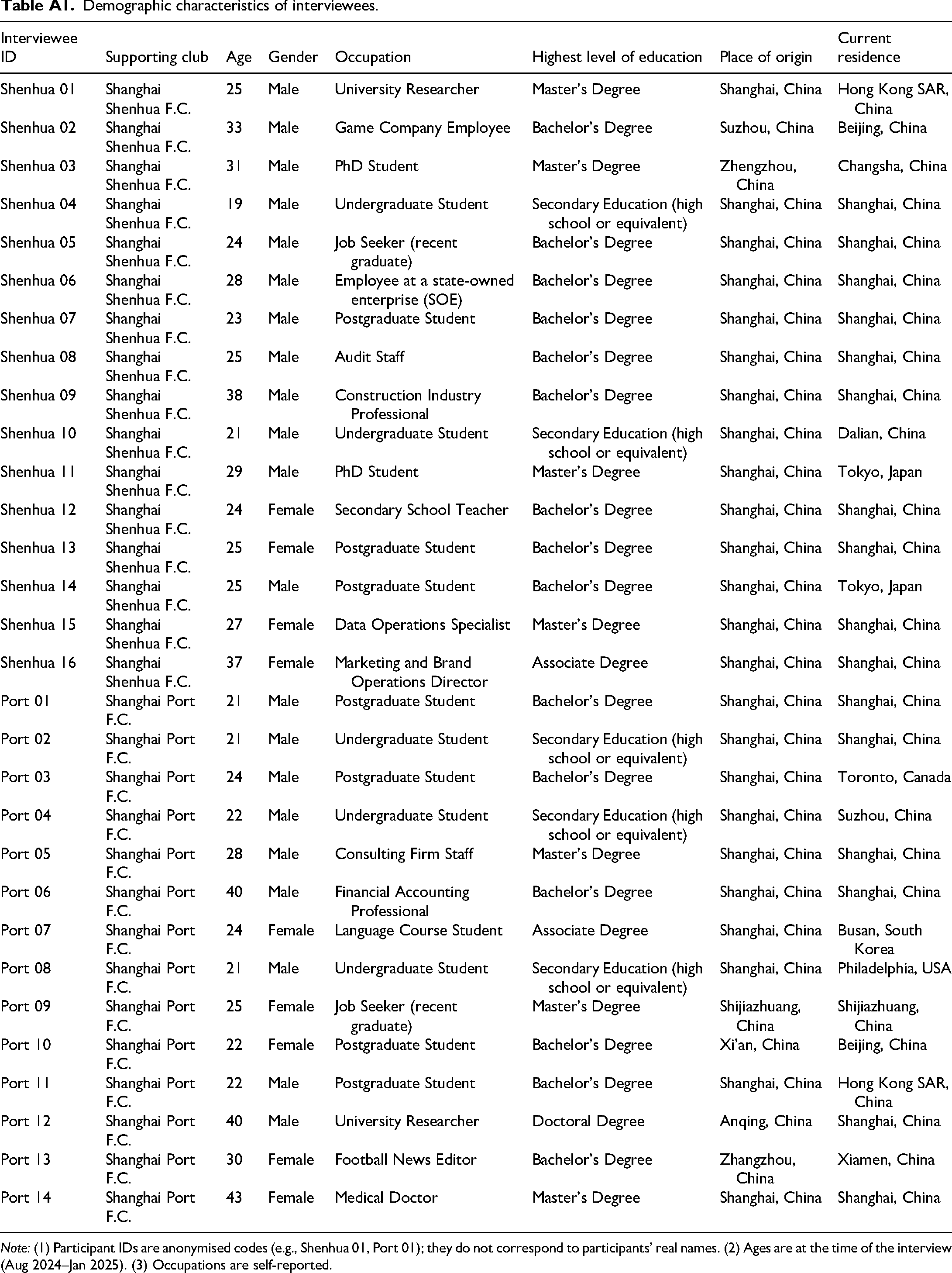
| Interviewee ID | Supporting club | Age | Gender | Occupation | Highest level of education | Place of origin | Current residence |
|---|---|---|---|---|---|---|---|
| Shenhua 01 | Shanghai Shenhua F.C. |
25 | Male | University Researcher | Master's Degree | Shanghai, China | Hong Kong SAR, China |
| Shenhua 02 | Shanghai Shenhua F.C. | 33 | Male | Game Company Employee | Bachelor's Degree | Suzhou, China | Beijing, China |
| Shenhua 03 | Shanghai Shenhua F.C. | 31 | Male | PhD Student | Master's Degree | Zhengzhou, China | Changsha, China |
| Shenhua 04 | Shanghai Shenhua F.C. | 19 | Male | Undergraduate Student | Secondary Education (high school or equivalent) | Shanghai, China | Shanghai, China |
| Shenhua 05 | Shanghai Shenhua F.C. | 24 | Male | Job Seeker (recent graduate) | Bachelor's Degree | Shanghai, China | Shanghai, China |
| Shenhua 06 | Shanghai Shenhua F.C. | 28 | Male | Employee at a state-owned enterprise (SOE) | Bachelor's Degree | Shanghai, China | Shanghai, China |
| Shenhua 07 | Shanghai Shenhua F.C. | 23 | Male | Postgraduate Student | Bachelor's Degree | Shanghai, China | Shanghai, China |
| Shenhua 08 | Shanghai Shenhua F.C. | 25 | Male | Audit Staff | Bachelor's Degree | Shanghai, China | Shanghai, China |
| Shenhua 09 | Shanghai Shenhua F.C. | 38 | Male | Construction Industry Professional | Bachelor's Degree | Shanghai, China | Shanghai, China |
| Shenhua 10 | Shanghai Shenhua F.C. | 21 | Male | Undergraduate Student | Secondary Education (high school or equivalent) | Shanghai, China | Dalian, China |
| Shenhua 11 | Shanghai Shenhua F.C. | 29 | Male | PhD Student | Master's Degree | Shanghai, China | Tokyo, Japan |
| Shenhua 12 | Shanghai Shenhua F.C. | 24 | Female | Secondary School Teacher | Bachelor's Degree | Shanghai, China | Shanghai, China |
| Shenhua 13 | Shanghai Shenhua F.C. | 25 | Female | Postgraduate Student | Bachelor's Degree | Shanghai, China | Shanghai, China |
| Shenhua 14 | Shanghai Shenhua F.C. | 25 | Male | Postgraduate Student | Bachelor's Degree | Shanghai, China | Tokyo, Japan |
| Shenhua 15 | Shanghai Shenhua F.C. | 27 | Female | Data Operations Specialist | Master's Degree | Shanghai, China | Shanghai, China |
| Shenhua 16 | Shanghai Shenhua F.C. | 37 | Female | Marketing and Brand Operations Director | Associate Degree | Shanghai, China | Shanghai, China |
| Port 01 | Shanghai Port F.C. | 21 | Male | Postgraduate Student | Bachelor's Degree | Shanghai, China | Shanghai, China |
| Port 02 | Shanghai Port F.C. | 21 | Male | Undergraduate Student | Secondary Education (high school or equivalent) | Shanghai, China | Shanghai, China |
| Port 03 | Shanghai Port F.C. | 24 | Male | Postgraduate Student | Bachelor's Degree | Shanghai, China | Toronto, Canada |
| Port 04 | Shanghai Port F.C. | 22 | Male | Undergraduate Student | Secondary Education (high school or equivalent) | Shanghai, China | Suzhou, China |
| Port 05 | Shanghai Port F.C. | 28 | Male | Consulting Firm Staff | Master's Degree | Shanghai, China | Shanghai, China |
| Port 06 | Shanghai Port F.C. | 40 | Male | Financial Accounting Professional | Bachelor's Degree | Shanghai, China | Shanghai, China |
| Port 07 | Shanghai Port F.C. | 24 | Female | Language Course Student | Associate Degree | Shanghai, China | Busan, South Korea |
| Port 08 | Shanghai Port F.C. | 21 | Male | Undergraduate Student | Secondary Education (high school or equivalent) | Shanghai, China | Philadelphia, USA |
| Port 09 | Shanghai Port F.C. | 25 | Female | Job Seeker (recent graduate) | Master's Degree | Shijiazhuang, China | Shijiazhuang, China |
| Port 10 | Shanghai Port F.C. | 22 | Female | Postgraduate Student | Bachelor's Degree | Xi’an, China | Beijing, China |
| Port 11 | Shanghai Port F.C. | 22 | Male | Postgraduate Student | Bachelor's Degree | Shanghai, China | Hong Kong SAR, China |
| Port 12 | Shanghai Port F.C. | 40 | Male | University Researcher | Doctoral Degree | Anqing, China | Shanghai, China |
| Port 13 | Shanghai Port F.C. | 30 | Female | Football News Editor | Bachelor's Degree | Zhangzhou, China | Xiamen, China |
| Port 14 | Shanghai Port F.C. | 43 | Female | Medical Doctor | Master's Degree | Shanghai, China | Shanghai, China |
Note: (1) Participant IDs are anonymised codes (e.g., Shenhua 01, Port 01); they do not correspond to participants’ real names. (2) Ages are at the time of the interview (Aug 2024–Jan 2025). (3) Occupations are self-reported.