




Abstract
The past 25 years have seen an unprecedented Europeanisation of the structures and governance in football across the continent. A European (and global) transfer market for players and managers has become the norm and a pan-European league system has been established that regularly exposes supporters to transnational competitions and players from all over Europe. At the same time, manifold typologies of football fans have been established, distinguishing groups of fans based on, for example, fan intensity, fan behaviour or their attitudes towards different actors in the field. The attitudes towards Europe and the self-identification of these fans within Europeanised football have not played a role in any of these typologies so far. This paper steps into that void and develops a typology of football fans in (Western) Europe that takes their attitudes towards Europeanisation as a point of departure. Based on data from an online survey among fans of first league clubs in England, France, Austria and Germany, two dimensions are identified as key categories: the intensity of fandom, and fans’ attitudes towards Europeanisation – which here manifests as a divide between the national/local belonging versus appreciating diversity and transnational spaces/developments or more succinctly, a divide between cosmopolitanism and communitarianism. Our analysis uncovers the existence of four types of fans: occasional cosmopolitans, occasional communitarians, frequent cosmopolitans and frequent communitarians.
Introduction
The Europeanisation of football in terms of structures and governance over the past quarter-century is unparalleled. Although football has had a history of pan-European competitions and transnational cooperation since its formation at the end of the 19th century (Vonnard et al., 2016), progress towards a pan-European league system, a joint player market and intense cross-national cooperation between clubs has accelerated since the 1990s (Brand and Niemann, 2007; Mittag and Legrand, 2010; Niemann et al., 2011; Niemann and Brand, 2008; Brand et al., 2013). The Europeanisation of football at fan level means that a considerable number of fans are constantly engaged with teams, players or fans from other European countries, if only via their daily consumption of football news. Their clubs (or rather: many clubs which draw a huge fan base) compete against teams from other countries, either on the field or on the transfer market. And even in those locations and markets at the European periphery where national champions struggle to make it into the top-level European competitions and where fans could hence be considered somewhat excluded from any such mechanisms (Smith, 2018), the level of interest in, and exposure to, game-related Europeanisation has risen over time (see Section 2).
This is likely to affect how fans perceive Europe and how much they relate to their nation state. Their emotional attachment to the game might influence how they see Europe, though either positive or negative perceptions may result from this process. They may resent or resist the erosion of the national or regional character of their club, or they could consider Europeanisation as normal and establish Europe as their new reference frame (King, 2004; Levermore and Millward, 2007; Millward, 2007). The paper seeks to investigate how fans attribute significance to such markers of identification.
Typologies of football fans are well-established and manifold, mostly focusing on behaviour around the match, attitudes towards institutions and fandom intensity (Giulianotti, 2002; Redhead, 2003; García and Llopis-Goig, 2019; Samra and Wos, 2014). Attitudes towards the internationalisation of football and its substantial impact on the game have rarely been discussed in terms of typologies, with the rare exception of García and Llopis-Goig (2020), who distinguishes between fans’ trust in national and transnational governance institutions. Older typologies of fans hint at the local connection of fans as an important marker of distinction, usually influenced by class as a distinctive aspect between the locally connected lower-class fans and the middle-class fans, who choose their clubs outside of their locality (Critcher, 1973; Taylor, 1971). Translated to the European level, there is potential for a new distinction between fans regarding the Europeanisation of football. Thus, the main research questions of this paper are: how is the Europeanisation of football reflected in fans’ identifications and attitudes? What different types of fans exist in terms of such attitudes and which attitudes characterise such different types? We seek to establish the missing link between the Europeanisation of football and different types of football fans. Our aim is to better understand the different ways in which fans reacted to the changes that have occurred in European football over the past two and a half decades.
In a wider sense, this paper investigates how the Europeanisation of governance and structures in football influences fans and how such an ‘objective’ Europeanisation of an important arena of everyday life and leisure time impacts individual identifications, also understood as ‘subjective’ Europeanisation (Weber et al., 2020). The results enhance our understanding of how European identity formation can take place through a lifeworld influencing factor (football), going beyond narrow political identifications and making use of a field that draws in masses of people.
Conceptual background
Structural Europeanisation
While Europeanisation is generally understood as the process of change in the domestic arena resulting from a change on the European level of governance (Radaelli, 2000; Schmidt, 2002), any analysis of Europeanisation – also concerning football – requires a broader conceptualisation, highlighting that actors on the domestic level are not merely passive receivers of European-level pressures. Instead, they may influence policies on the European level to which they later have to adjust, which highlights the interdependence between the European and domestic levels (Börzel, 2002).
The analysis of the Europeanisation of football over the past 25 years revealed a diverse set of top-down measures initiated by the European Commission and the European Court of Justice (ECJ), bottom-up initiatives from clubs and national associations as well as cross-national coordination between clubs all of which have shaped the game (Mittag, 2018b; Niemann et al., 2011; Pyta and Havemann, 2015; García, 2008). Four different mechanisms constitute the bulk of Europeanisation in football: the regulation of player markets after the Bosman ruling by the ECJ, Europeanisation of broadcasting rights, the increased coordination of clubs on the European level and the development of European club leagues (Brand and Niemann, 2014). Taken together, these dynamics have reshaped the game across the continent to a significant extent since the mid-1990s.
Whereas the Bosman ruling has shifted player markets across European leagues towards a more internationalised, and considerably more Europeanised shape, at least on average, the European-level broadcasting rights debates two decades ago helped to foster coordination and lobbying structures among some clubs and associations and finally made the Commission backtrack on its initial ambition to fully decentralise and liberalise this domain. Intense coalition-building and lobbying in the wake of these broadcasting debates also helped bring about the Commission's ‘White Paper on Sport’ (2007) which to some degree enshrined peculiar exemptions for football as a sport from thorough business and competition regulation. This example shows that EU-level pressure may at times spur only partial adjustment in football governance, while core policies remain intact despite their potential friction with EU legislation (Niemann et al., 2011).
As a side effect of such EU-level pressures, and partially predating them, a more intense transnational coordination of individual clubs can be witnessed since the beginning of the 1990s, with the formation of an informal group of ‘top clubs’ from several European countries that became known as the G14 as being the temporary hiatus of such developments. Their main aim was to influence the Union of European Football Associations (and International Federation of Association Football) by exerting pressure and leveraging their individual power position as ‘best-selling’ clubs in European football. Issues of conflict included the compensation for players playing for national teams, but above all stood the aim to reform the European club competition system to the benefit of the top clubs (Mittag, 2018a; Holt, 2007). It eventually dissolved in 2008, but transnational club coordination aside from national associations continues – in the now bigger and more encompassing European Club Association (ECA), which, despite boasting ∼200 member clubs, still principally represents the top clubs and their particular interests (Keller, 2018).
The evolution of a de facto pan-European league system – the Champions League (CL) and the Europa League (EL) – is arguably the most visible sign of Europeanisation in football. As studies have shown, over time, a relatively stable pattern of recurrent participation of the same clubs in this continent-wide competition has resulted in a true continental ‘league mode’ (Pawlowski et al., 2010; Niemann and Brand, 2020). The CL has thus been dubbed as ‘an engine that supposedly makes Europe hang together more closely’, and also as a ‘political myth’ potentially contributing to more Europeanised mindsets and the European idea in general (Niemann and Brand, 2020). Such Europeanising dynamics through the CL, however, have not come without ambiguities. 1 For instance, the rise of the CL has led to a smaller range of countries from which participating clubs stem (Kijewski and Wendt, 2019) – and thus contributed to a certain form of selective probability of team participation, which seems to contradict the notion of a continent-wide Europeanisation of the game. It is observable that, while for the best sides in countries such as Austria, Croatia, Switzerland or Norway, the CL remains more of a pipe dream, their fans follow top-notch European football to quite some extent. European competitions continue to reach huge audiences via TV broadcasts (Niemann and Brand, 2020: 333–34), and a considerable number of fans in ‘marginalised regions’ have adopted a top-level European team as their secondary, or occasionally even primary, object of (foreign) fandom.
The results of the above-mentioned dynamics of Europeanisation in football can be summarised as follows: the Bosman rulings and their aftermath accelerated the development of the increased Europeanisation (and internationalisation) of player markets. Football teams are increasingly comprised of players from diverse countries. An international squad is a norm for most clubs and there are many indicators suggesting that this does not inhibit the ability of football fans to identify with ‘their’ team (Ranc, 2012). The development of the CL towards a de facto European league (which is strongly connected with the establishment of a transnational club association) influences the experience of football supporters: they are frequently exposed to competitions between foreign clubs and clubs in their league (meaning, either their club or their club’s main rivals). This suggests that the elaborated Europeanisation influences not only (domestic) football structures, but also the fandom.
Typologies of football fandom
By now, a large number of fan typologies based on a widespread array of different values, attitudes and behaviour exist (Stewart et al., 2003: 206ff.; Samra and Wos, 2014: 268; Fillis and Mackay, 2014: 344). Against the backdrop of our research question, we thus restrict this review mainly to fan typologies classifying professional European club football fans.
Among the first scholars to develop such a typology were Critcher (1973: 11ff.) and Taylor (1972: 364). Their approach centres around a dichotomy contrasting traditional post-war male working-class supporters having close ties to their local community clubs with genuine middle-class supporters choosing a football club from a wide variety, much like (selective) consumers. In a somewhat similar vein, Clarke (1973: 6) differentiates between genuine supporters or traditional fans and spectators, and Redhead (2003: 23f.) distinguishes active/participatory and passive supporters. Whereas the first of the above fan types, respectively, are characterised as football fans (often) organised in local club-based independent supporters’ associations or active readers of fanzines (or participants in the more modern online message boards), the latter fan type represents spectators sitting in the all-seater area of stadiums, at the bar or on the couch at home, following the matches mainly on television.
Drawing on these typologies, King (2000: 419ff.) goes beyond them by showing that despite the ongoing Europeanisation in the field of professional football, local or regional references retain and even increase in importance. Consequently, subsequent scholarship coined the notion of ‘glocalization’ (Giulianotti and Robertson, 2004: 547, 2012: 218) of modern European football, signifying a specific post-national fan identity which is typified by a dualism, for example, overlapping local or regional and European areas of reference (Porter, 2008: 8). This new ‘European sense of belonging’ (Levermore and Millward, 2007: 159) encompasses discursive and spatial references of everyday life for the benefit of their local communities.
Also partly in line with early typologies, Heitmeyer and Peter (1988: 32ff.) propose a three-tiered typology of football fans: consumption-oriented, football-centred and experience-oriented fans. While consumption-oriented resembles the earlier notion of passive supporters, football-centred is very similar to the earlier typologies of active or genuine fans. The novel category compared to prior work is that of experience-oriented fans who consider football matches mainly as interchangeable events providing outstanding excitements often provoked by their own action, including violent turmoil. Consequently, loyalty to their club and interest for the actual football matches is rather low.
Giulianotti (2002: 30ff.) proposes a more complex four-quadrant taxonomy of (British) football fans. Along two dimensions – hot–cool and traditional-consumer – he derives four ideal-typical fan types: supporters (traditional and hot) are characterised by a strong local attachment and frequent visits to ‘their’ stadium. Followers (traditional and cold) differ from supporters insofar as they do not possess a dense personal local network. Information about the club is mainly conveyed through (electronic) media. Consequently, followers track several clubs, and support them in a graduated manner according to their competitiveness. In contrast, fan (consumer, hot) and flâneur (consumer, cool) are market-oriented football fans. However, while fans develop an intense identification through a non-reciprocal relation, the flâneur represents a new cosmopolitan football fan who is not tied to a specific location and/or club. Assuming a new cosmopolitan epoch heavily influenced by social media, Petersen-Wagner (2017) refines Giulianotti's flâneur fan type. He argues that flâneurs are usually in search of football clubs to which they can establish a secular reciprocal allegiant relationship and are therefore much more traditionalist than consume-orientated, almost approaching Giulianotti's supporter fan type.
Based on Heitmeyer and Peter (1988), who focus primarily on fans’ motivations, and Giulianotti (2002), who takes the increasingly market-driven orientation of fans (‘hypercommodification’) into account, Grau et al. (2016) develop a typology of five categories, which pays specific attention to the subjective ideal stadium experience. Their representative sample of German football fans shows that actual fan behaviour is more complex than previous (dualistic, tiered and multidimensional) studies show. By far the largest group – peaceful supportive average – combines high football interest with peaceful behaviour. The second type – security-oriented passive – links high-security interests with non-aggressive behaviour – and thus corresponds to Heitmeyer and Peter’s (1988) consumption-oriented fan type and to Redhead’s (2003) passive fan type or can be positioned between Giulianotti’s (2002) followers and flaneurs. The three remaining new fan types – confrontational conflict-seeker, less aggressive supporters and active, emotional supporters – combine football orientation with (different degrees of) aggressive/emotional behaviour (and thus go beyond Giulianotti’s (2002) supporters and can be contextualised between Heitmeyer and Peter’s (1988) football-centred and experience-oriented fan types).
Finally, pointing to the development of complex new (governance) structures in modern football, García and Llopis-Goig (2019: 8) propose a nuanced five-type typology by exploring supporters’ attitudes towards governance. They show that European football fans are substantially divided in that respect. Whereas moderns, critics and club-militants representing approximately two-thirds of European football fans distrust international football bodies, institutionalists mistrust football club authorities, and globalists mistrust national bodies. In addition, contrary to institutionalists, critics, and first and foremost club-militants, globalist and moderns refuse to believe that their personal engagement, for example, as a member of the club and/or fan community, will have a (decisive) impact on club governance.
While the above work has taken various dimensions into consideration – such as social class, the intensity of fan involvement, traditionalism versus consumerism, trust in different actors of governance – existing typologies fail to account for the complex changes of the game in terms of structures and fans’ mindsets that developed over recent decades: fan attitudes within a Europeanised football system and – in a more nuanced way – along the cosmopolitan-communitarian divide have received little to no attention. We deem such a distinction between (more) cosmopolitan and (more) communitarian sets of attitudes useful as it is to denote how people locate themselves in a world in which distances are shrinking, borders become more permeable, and different groups of people, not only football fans, are confronted with each other more frequently.
As introduced in Political Theory and Political Sociology, the term ‘communitarianism’ refers to a deep appreciation for particularistic, local forms of identification and community, and expressions of belonging which are local or national rather than universal (or a ‘particularism of the tribes’ (Walzer, 1994). In contrast, ‘cosmopolitanism’ stresses, at the level of attitudes and cognitions, both an openness to, and an appreciation of diversity, coupled with forms of identification that transcend the local, and national (Mau, 2010: 91–123). In David Held's famous rendering of cosmopolitanism as a set of ideas and principles, which date back to ancient Greece and Kantian philosophy (cf. Held 2010: 14–15), it aspires to fuse elements of universality, membership in a global (rather than national or ethnically defined) community of argument, and value attached to reciprocity in recognition. Seen from this angle, ‘cosmopolitanism’ captures notions of deeply appreciated and much sought transboundary community-formation, and a widening of individual perspectives beyond narrow, parochial and ultimately national or local concerns. While for Held, this is an apt basis for taming globalisation or designing inclusive political institutions (Held, 2003), our concern here is more modest.
Mapped onto football fans, the dichotomy of cosmopolitanism and communitarianism has received surprisingly scant attention so far. Whereas Robertson and Giulianiotti (2009: 31–62) made ample use of the term ‘cosmopolitanism’ in their path-breaking book on football's globalisation, communitarianism is much rarer to be found as a concept in the analysis of football fandom (but see Benkwitz and Molnar 2012, Abutbul-Selinger 2019). Robertson and Giulianotti rather describe features of the game as lending themselves to more ‘cosmopolitan’ interpretations and describe a trend towards more cosmopolitan attitudes among supporters, followers and commentators through ongoing globalisation (and above all: mediatisation) of the game without actually carrying out research on fans. García’s and Llopis-Goig’s (2019) notion of ‘globalists’ among football fans, in turn, seems to share a lot with the conception of cosmopolitan supporters, yet narrows it down to aspects of the game's governance only. By contrast, we suggest analysing fans’ sets of attitudes as regards the importance assigned to forms of local belonging and national origins (of players), their level of appreciation of diversity, as well as their embrace or criticism of transnational developments and spaces. These latter aspects still constitute a gap in the fan typology literature.
In addition, most of the works on fan typologies use qualitative (and predominantly inductive) research designs (but see Garcia and Llopis Goig 2019; Quick 2000). Our work steps into that void and applies a deductive-inductive statistics-based clustering method – latent class analysis – to identify existing groups of football fans who show similar patterns of fandom activity and similar subliminal Europeanised self-identifications. The approach is motivated by the underlying assumption that fans react differently to the Europeanisation of football and thus departs from already established fan typologies. We seek to corroborate our findings with a quantitative approach using statistical indicators. The results show that fans can be distinguished based on their fandom intensity as well as on their attitudes towards aspects of the Europeanisation of football. While the fandom intensity divide between frequent and occasional fans underlines what we know from previous studies of fans, the distinction among fans based on their attitudes to the Europeanisation of the game is complex. In our analysis, it rather manifests as a divide between the nation/local belonging versus an appreciation of diversity and transnational spaces/developments, or more succinctly, a divide between cosmopolitanism and communitarianism.
Data and methods
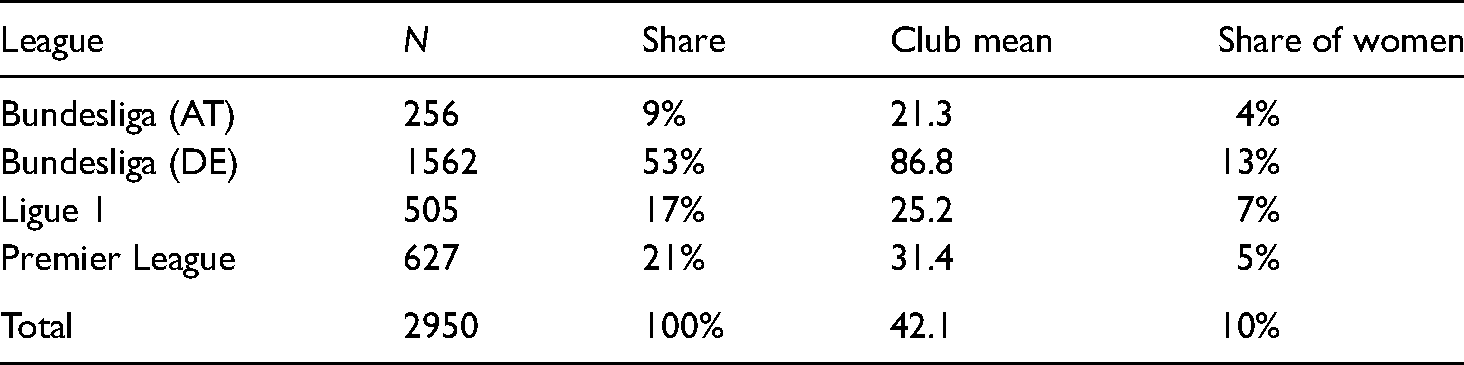
The following analysis is based on data from an online survey among football fans from clubs playing in the first leagues of Austria (Bundesliga), England (Premier League), France (Ligue 1) and Germany (Bundesliga) during the season 2018/2019. 2 It was conducted between March and July 2019. In total, 2950 fans completed the survey.
The survey addresses anyone who considered him-/herself to be a fan of a club playing in one of the four leagues during the time of the survey. It was disseminated through social media, via email to all relevant clubs and shared numerous times by different actors, fan groups or clubs through social media. Though it cannot claim representativeness of the fans of each club, it provides a starting point for analysing opinions of fans on important aspects of the game.
The return overview shows the distribution of responses across the four leagues and the mean return per club.
Table 1 shows that participation in the survey is unequal across the four leagues, with most responses coming from German Bundesliga supporters. The distribution of fans across clubs within the leagues is rather biased towards clubs that frequently appear on the European level. In all leagues, there are twice as many respondents who follow a team that frequently plays in the European competitions (at least eight appearances throughout the past 10 years). This likely has an influence on the interpretation of the results, as we can expect the respondents to be exposed to European competitions to an above-average extent as they come from a country that has a certain pro-European imprint. The implication for the results is that the size relations between the different types should not be considered as representative for football fans across the four leagues. Rather, the analysis and its interpretation focus on the patterns and the shape of the different types.
Survey responses, per league and total as well as mean return per club.
The following typology is developed using a latent class analysis approach (Collins and Lanza, 2010). The logic behind this approach is the assumption that potential (latent) similarities between groups of respondents exist. This method combines deductive and inductive approaches as it departs from the well-founded typologies of football fans elaborated above by choosing indicators that have been identified as decisive differences across fans. The indicator variables for the latent class analysis are deductively derived from the characteristics that Giulianotti (2002) and Redhead (2003) defined for their respective fan types. But the method also allows for a data-driven refinement of the fan types by inductively identifying the number of classes and refining the respective type characteristics based on the data. The method detects the best number of groups of similar cases in a data set based on statistical indicators. Latent class models group cases with similar answer schemes together. These similarities are indicated by a certain set of variables relevant to the research question. The number of groups is estimated, and the response pattern of each group can be identified. The method uses a maximum likelihood strategy. 3 Originally most prevalent in psychology and health sciences, it has recently been used across the social and political sciences, for example, to identify patterns of political participation (Weerts et al., 2014; Oser et al., 2013) or to test theoretical types of citizenship with empirical data (Hooghe and Oser, 2017).
The 15 indicator variables for the analysis measure differences across football fans regarding their attitudes towards local, national and European/international aspects of belonging and their intensity of fandom. The selected items can be divided into four areas:
Four items covering different aspects of fandom intensity: Match attention (home and away) and connection to the club, measured as a variable that let them pick up to seven different types of affiliations (club membership, official supporter's group, unofficial fan group, season ticket holder, owning club merchandise, receiving official news/magazine, other)
[4]
. Two items covering European competition-related aspects (relevance of European competition vis-à-vis the national competition and representative function of European competitions). Four transfer market-related items (relevance of local, national and European background of the players). Five items (player, manager and owner characteristics: being native, having native language knowledge) for team and club functioning.
[5]
Figure 1 shows the frequencies for all items in the model.
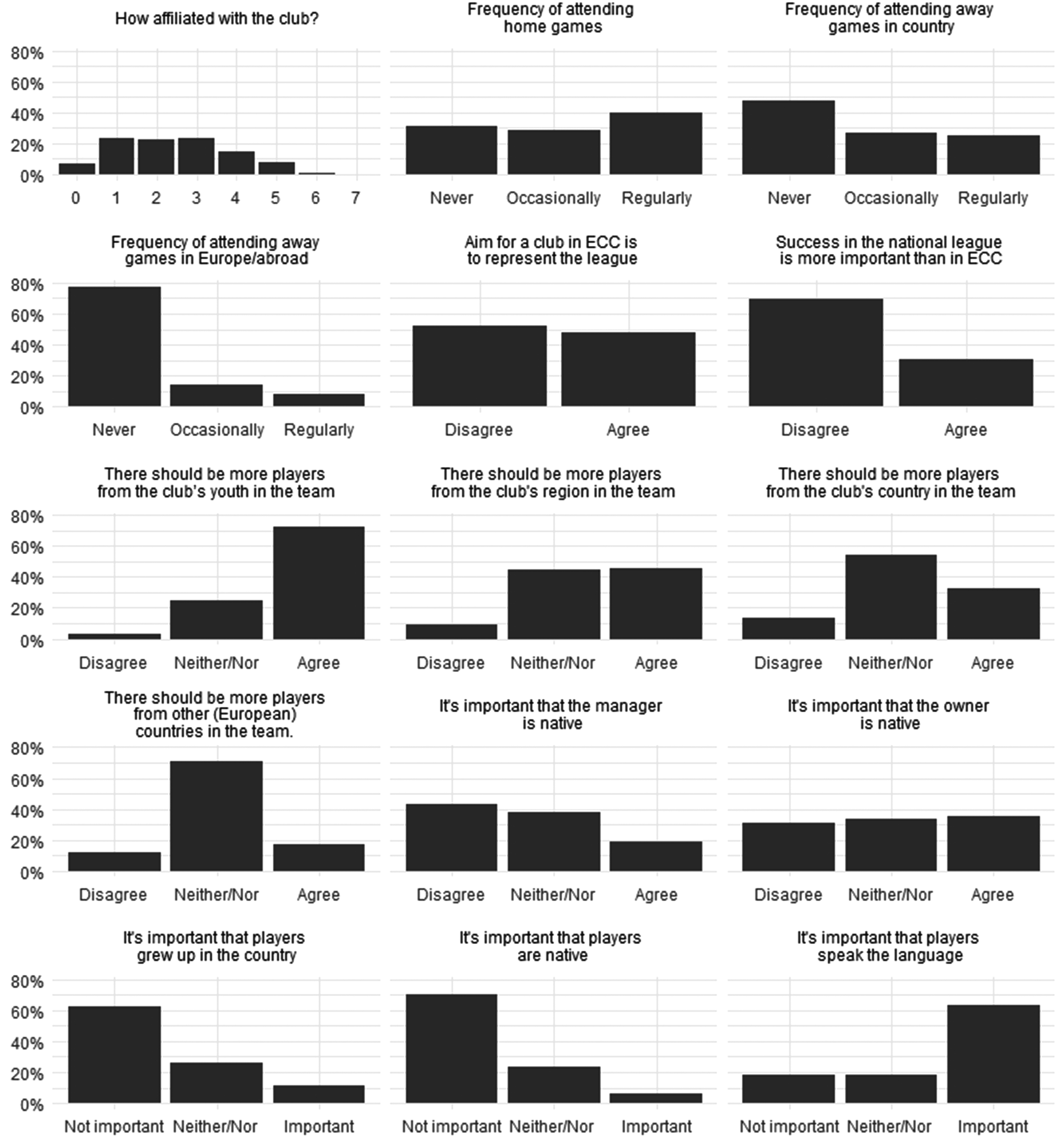
Frequencies of the indicator items for the latent class analysis. N = 2950, missing values for the whole data are imputed with the R-package mice.
The frequency analysis in Figure 1 demonstrates that the football fans differ significantly with regard to their intensity of fandom, measured through match attention (home, away national and away abroad) and through the intensity of their club affiliation. The distribution follows general expectations on fan involvement: attending home matches is most common across the sample, away matches in the same country are less commonly attended, and only a small share – 22% of fans – have ever attended an away match outside the club's home country.
The item on the relevance of European competitions shows that these competitions (CL and EL) are seen as more relevant than the national league. But what kind of role they play is contested; the fans are divided on whether the competitions are a place to represent the national league.
Regarding the items dealing with the transfer market and actor characteristics fans’ attitudes differ, with the exception of the role of players from the club's own youth system, which is important for most fans. The role of national belonging is complex. While fans on average do not consider it important that players are native to or grew up in the country, a majority thinks it is important that they speak the language of the club's country. Regarding managers and owners, the role of national belonging is much more important, especially owners from the same nation are important for many fans in the sample.
While these frequencies show only a simple distribution of answers across the sample, the following typology investigates how typical answer patterns are grouped together, and thus which types of fans exist regarding these important aspects of football-related Europeanisation.
A new typology of football fans: Making Europeanisation visible
Our typology of football fans has been developed in two steps: (1) identifying the number of groups (classes, here in the sense of different types of fans 6 ) in the population that fits the data best and (2) estimating the answer probabilities for the indicator items for all classes to be able to characterise the classes.
Identify the suitable number of classes – how many types of football fans are there?
The first step is to identify the best number of groups within the population. The best model is identified by comparing the results of different indicators that measure the improvement of the model compared to the null model (a model with one class) and the relative improvement of a model in comparison with a sparser model (model with fewer classes).
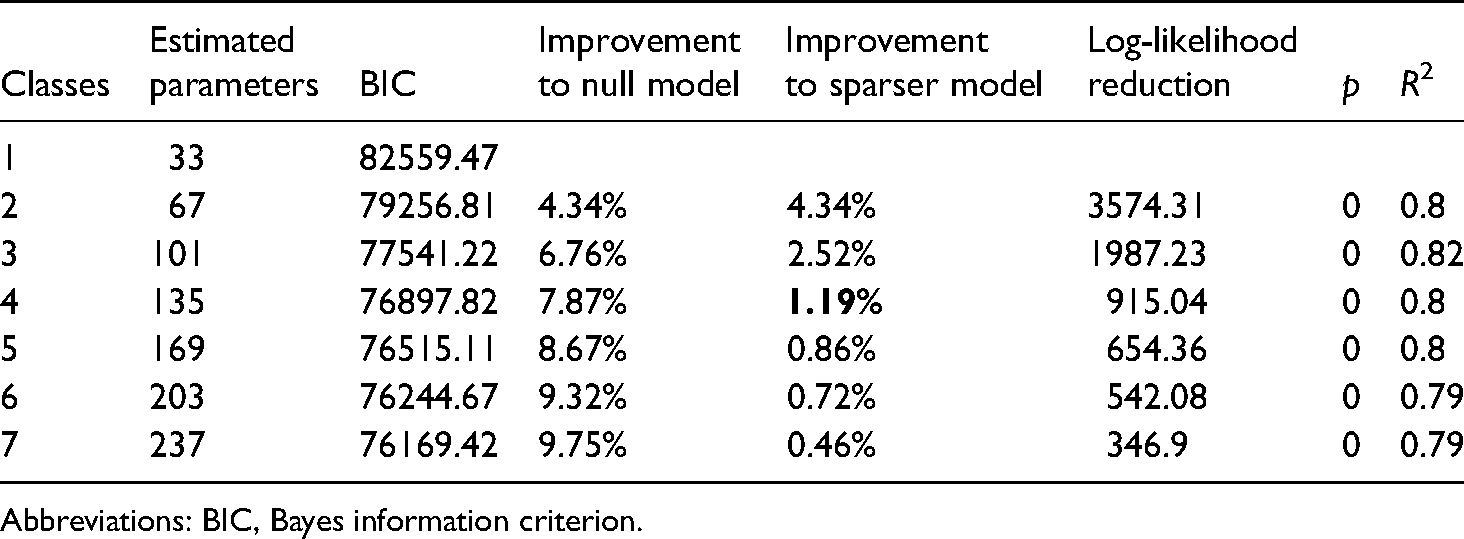
Table 2 shows the indicators for all models from the null model with one class to the over-complex model with seven classes. The criteria for selecting a model are sparsity of the model, separateness and distinctness of the classes.
Indicators for the quality of different models, the null model (1-class-model) to a 7-class-model, p = p-value of a χ2-distribution with the respective degrees of freedom, R2 = entropy-based R2-value [8] .
Abbreviations: BIC, Bayes information criterion.
The grey line indicates the best model, considering the combination of different indicators. The aim is to find the model that covers the complexity of the data and is as sparse as possible. While the relative improvement of the model compared to the null model increases in line with an increase in the number of classes, its relative improvement compared to a sparser model (with one classless) diminishes with every added class. A reasonable threshold for the relative improvement is 1% (Bacher and Vermunt, 2010). According to this, the four-class model is better than the three-class model, but the five-class model does not provide a significant improvement. Each case in the data has a probability of class membership for each class. To have separate classes, the probability for class membership should be high for one class and low for all other classes. The separateness of classes can be assessed by looking at the mean probability of class membership for each model. A test of the mean probability of class membership against a 0.9 threshold shows that the four-class model still reaches such a high mean class membership probability for all classes, while it shrinks for four out of five classes in the five-class-model. As a result of these tests, the four-class-model will be used for the following analysis. [7]
Characterisation of classes – what are the essential features of the four different types of football fans?
The four classes can be differentiated across two main lines: the fandom intensity of the fans and the degree of relevance they attribute to local and national aspects of belonging with regard to the transfer market and European competitions (identity characteristics). We can define four groups as follows, starting with the biggest group: occasional cosmopolitans (31%), occasional communitarians (29%), frequent cosmopolitans (25%) and frequent communitarians (15%). The sample contains a majority (60%) of occasional fans, which tends to be cosmopolitan, though the difference to the communitarian group is not as big. The frequent fans are also predominantly cosmopolitan, but here the difference from the communitarian group is bigger. Figure 2 shows the 2 × 2-matrix of these groups.
As our survey is built on a convenience sample and the data shows some biases (see Section 3), the sizes of the groups might be influenced by a biased sample. Thus, we focus not so much on the size differences of the groups but emphasise the underlying structure of characteristics of the fans. We see that both frequent and occasional fans show cosmopolitan and communitarian views on aspects of team composition and competitions. This result is in contrast to earlier typologies that often emphasised the connectedness and locality of engaged fans in opposition to rather casual or less involved fans (cf. the cited studies of Clarke, 1973 and Redhead, 2003). Our results can be seen as a development and empirical, comparative corroboration of Giulianotti's supporters, followers, fans and flaneurs in English football (Giulianotti, 2002), who were distinct both in their involvement in the game and their local connectedness. The following section elaborates what exactly characterises each of our four groups and how a typical representative of the group would answer the indicator items.
The differences between the four groups that relate to their fandom intensity are straightforward. The two groups of frequent fans and the two groups of occasional fans each have similar answer patterns with regards to all items that measure match-attention and connection to the club. The occasional fans occasionally visit home matches and almost never go to away matches. The frequent fans have a high probability of attending home matches and most of them are also frequent visitors at away matches within their country. All fans – irrespective of their group belonging – have in common that they barely visit away matches outside the country of their club. This shows that at least among the fans in the sample, visiting away matches outside of their home country is still not overly common.
The differences between the groups regarding aspects of Europeanisation of football are complex. The groups that we call cosmopolitans stick out in that they strictly refuse the relevance of national belongings and explicitly state that they do not consider them important. The groups that we call communitarians consider them at least somewhat important. The two main areas of Europeanisation in football that are immediately visible to the fans are the Europeanised transfer market and the prevalence of European competitions. Figure 3 shows the predicted answer probabilities of the most decisive items in the model for each of the four groups.
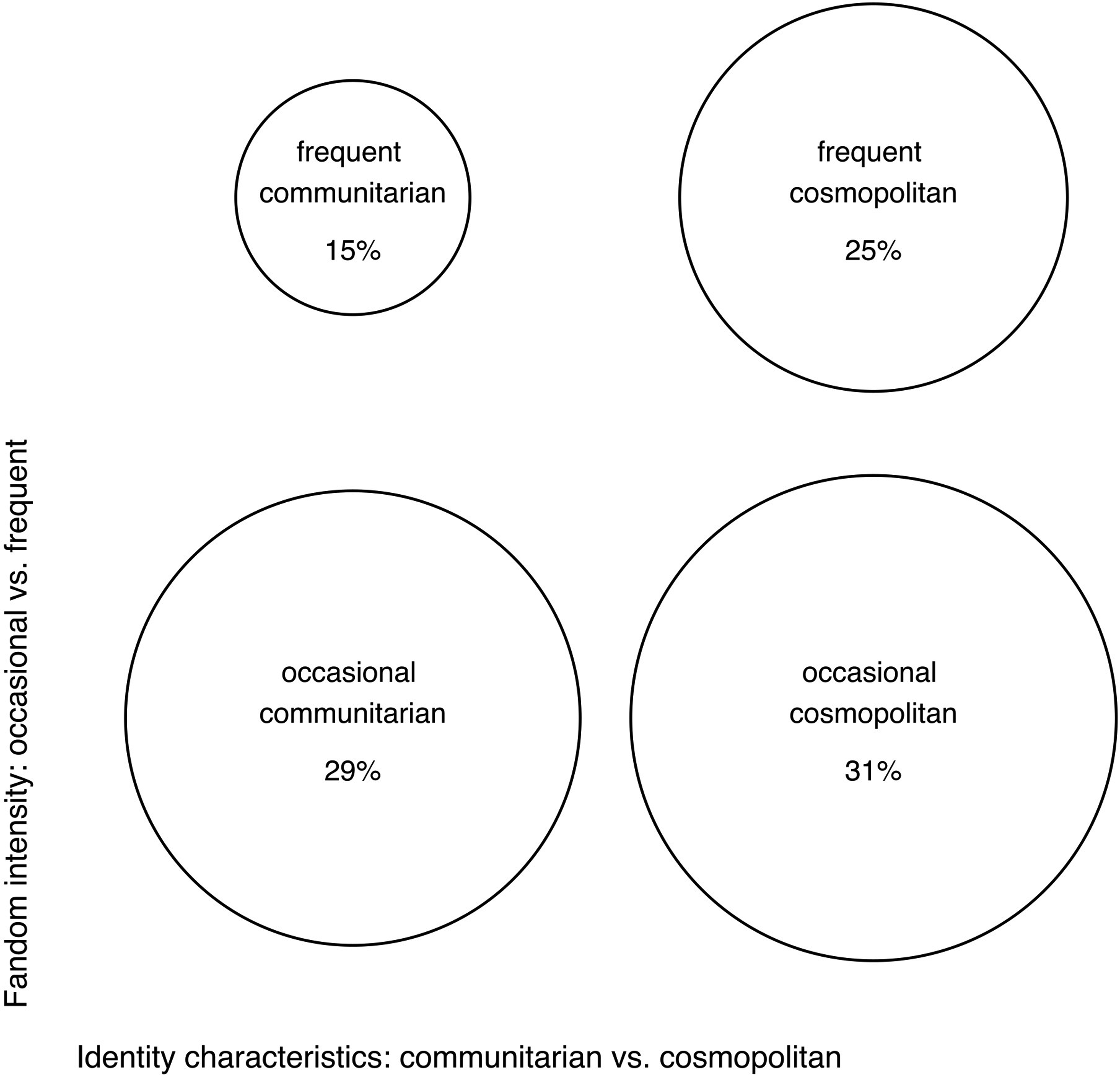
Fan types: Classes of the latent class analysis, group characteristics and sizes. N = 2950.
The decisive differences between the groups thus are the fans’ views (1) on the origin of players and club owners, and (2) on the role of the European competitions.
Players’ and owners’ origin
There is general agreement across all groups that it is important to have more players from the club's youth system in the team. Similarly, fans across all groups are indecisive about whether their club needs more players from abroad. The differences between the groups that we call cosmopolitans and those that we call communitarians are related to the relevance that group members attribute to the nation as a reference frame for belonging.
The two cosmopolitan groups do not consider national belonging of either players or owners of the club as important. They explicitly disagree with the notion that they should be native to the club's country or have grown up in the country. The two groups that have been labelled communitarians differ from the other two groups in that they predominantly agree with the two statements that their clubs need more players from the club's region and more players from the club's country in the team, whereas the cosmopolitans predominantly consider this either as unimportant or remain undecided. Regarding the national background of the players (nativity or growing up), communitarians attribute more relevance to such a background, while cosmopolitans almost unanimously reject the importance of such criteria. This establishes the nation as a reference frame as a key difference between cosmopolitans and communitarians.
The answer patterns of the groups show differences in the role of national belonging between different actors in football. The cosmopolitan groups attribute no relevance to the origin of players, managers and owners. For the communitarians, the picture is more heterogeneous. They are a bit ambiguous about the importance of players and managers being native, but regarding the club owner, they consider such an origin as important. This might hint at the normalisation of the internationalised player market, but less so when it comes to ownership structures. It definitively shows that there are no strong patterns of generic nationalism (even) among the communitarian fans – at least not in this sample.
European competitions
Analysing the question of the relevance and role of the European leagues vis-à-vis the national league, the distinction between the groups has two different facets. There is no difference between the fans regarding the relevance of the competitions. Fans answered almost unanimously that they consider the European leagues to be more important than the national league. But the question of whether the European competitions have a representative character is decisive for distinguishing between the groups. Those fans that have been called the communitarians predominantly consider the European competitions as an opportunity for a club to represent the national league, while the cosmopolitans disagree with such a statement and tend to see them as competitions between the best teams on the continent irrespective of the clubs’ national origin.
Conclusion
The starting point of this work was the assumption that the Europeanisation of football has left a mark on football fans’ attitudes, that is that fans have been assumed to have positioned themselves towards the results of objective structural changes. Of equal importance as a point of departure was the idea that fans might react differently to the ongoing Europeanisation and develop heterogeneous attitudes towards aspects such as European player markets and the role of European competitions. Despite the enormous body of literature dealing with football fan typologies, these attitudes towards Europeanisation and fan identification patterns have not received proper attention until recently. We draw on a survey in four leagues, covering a heterogeneous picture of a football in Europe to develop a data-based typology of fans in Europeanised football. Latent class analysis was used to have a statistically backed-up typology at hand.
The results show that football fans differ regarding their fandom intensity and their attitudes towards aspects that are directly connected with the Europeanisation of football structures, such as the composition of their teams and the perceived status of European competitions. Furthermore, there are four distinct types of football fans that can be distinguished along two lines: a fandom intensity line (frequent vs. occasional) and a Europeanisation of football line (cosmopolitan vs. communitarian). The fandom intensity line features two groups of fans: active fans with a high level of match attention and a close connection to their club and occasional fans with a low number of matches attended and a rather loose connection with their club. The Europeanisation line shows that fans also differ in how much importance they attribute to the role of national belonging for their identification with the club. These two lines make a 2 × 2-matrix of fans (see Figure 2), showing that the attitudes towards the Europeanisation aspects and fandom intensity are not linked.
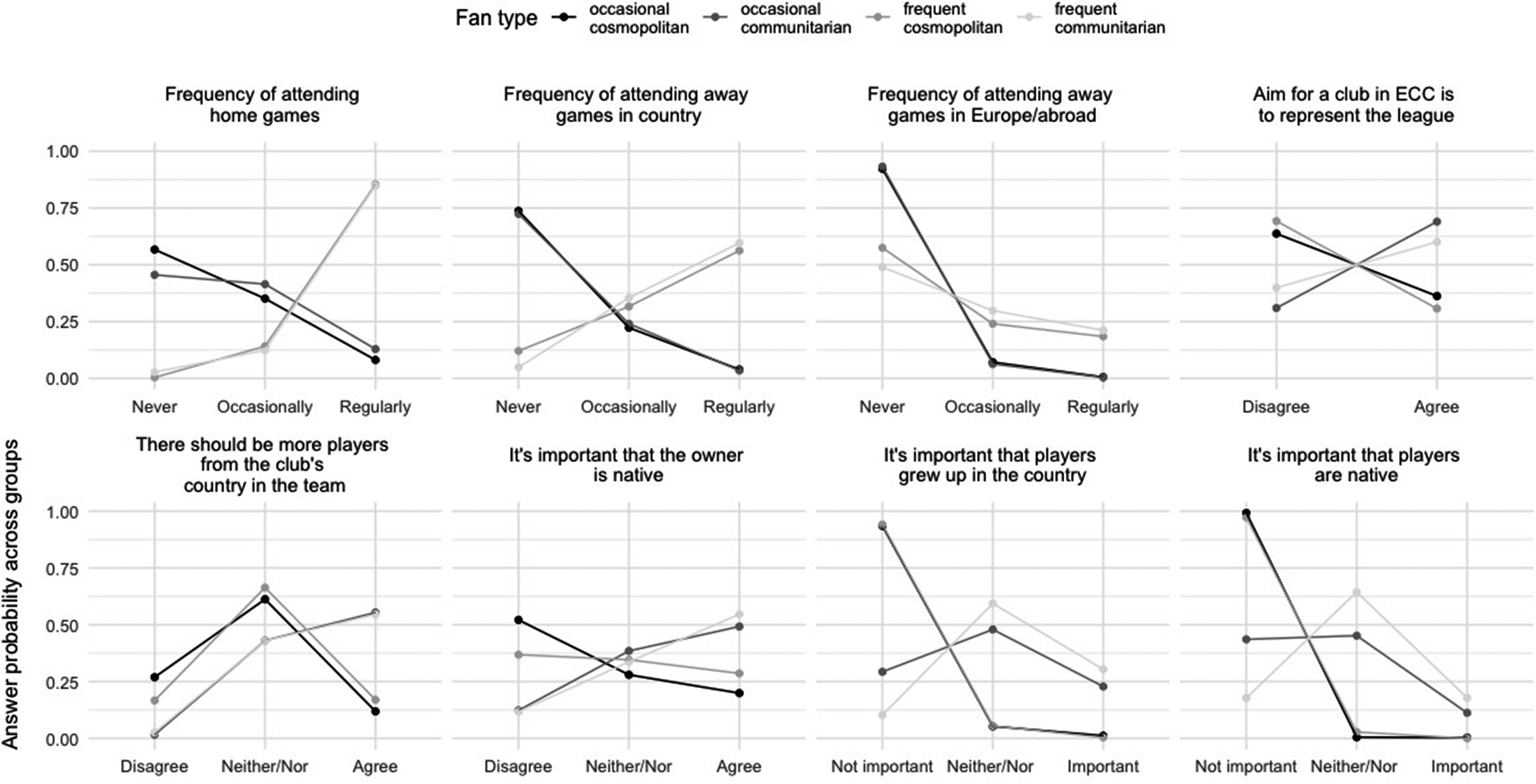
Decisive differences between fan types: Predicted answer probabilities of the decisive items at given group membership. Graphs show the answer probability of a certain item conditional on group membership for the four types of fans. N = 2950.
The Europeanisation line is complex. For the groups that we call the cosmopolitans, national belonging is not important, and they reject the relevance of nativity and language knowledge of players, managers, and owners. The communitarian groups tend to value such belonging more, especially ownership should remain within the club's nation in their view. This shows that the acceleration of the transfer market is viewed very differently across the fans. While the relevance of national belongings differs between the groups, the joint interest of fans is to include home-grown players. Such a strategy is often seen as an antithesis to the Europeanised player market: the direct access to cheap talent from numerous countries reduces incentives for clubs to nurture their own talent (Niemann et al., 2011). For fans, these home-grown players matter, regardless of whether they value national connections to their clubs.
Also, the attitude of fans towards the Europeanisation of competitions indicates a divide between the fans. In general, fans value the continent-wide competitions as being relevant and even as more important than national competition. But for those that we call the communitarians, the European competitions remain a place of national representation, while the cosmopolitans view them from a pan-European point of view, that is as competitions between the best teams in Europe regardless of national belonging.
These results go beyond older typologies which identified a stronger connection between the fandom intensity and their locality attitudes (Redhead, 2003; Clarke, 1978). The typology of Giulianotti (2002), distinguishing ‘hot’ and ‘cool’ fandom as well as traditional and consumer fan types, gets closer to our results, as it also identifies both intensity differences and connection differences among English football fans. Our results support Giulianotti's findings mainly on the fandom intensity line. We, however, complement his work through a quantitative empirical corroboration covering fans in four different European leagues in terms of a Europeanisation of their mindsets. The novel aspect is the complex distinction between cosmopolitans and communitarians in their attitudes towards the player market and European competitions which flow from that. While a local connection, and especially the relevance of home-grown players, is highly valued by all fans, we see that some supporters might be more prone to follow the trend of a Europeanisation of football than others. For some of the fans, the Europeanisation of football structures has a normalising effect as the relevance of national belonging diminishes.
Future research may want to analyse how the so far unsuccessful attempt to stage a European Super League on the part of 12 leading European football clubs – setting off major protests by fans of those clubs and beyond against this controversial project – has impacted (negatively) on the Europeanisation of football fan identities as well as patterns of communitarianism and cosmopolitanism among fans. Potential future research could also focus on the distribution of fan types across leagues and factors that influence who is in which group. The work shows an initial difference between fans along the communitarianism/cosmopolitanism divide. Such a divide that – broadly speaking – indicates a key difference between citizens that highly value national borders and those that do not, has been identified as a potential political and social cleavage in affluent societies (Wilde et al., 2019; Strijbis2020; Woodward et al., 2008).
This also indicates that our findings may be of relevance for investigating similar dynamics in other fields of sport. Patterns of intense fan identification have been ascertained, for example, in sports such as college basketball (Wann and Branscombe, 1990) or Aussie rules football (Lock et al., 2014). A key factor seems to be the sense of belonging to a local fan community, including the feeling of making an active contribution by supporting the team but also of contributing to the local community (Heere and James, 2007). Crawford (2003), using the example of ice hockey fans, and Heere et al. (2011) on American college football, demonstrate that identification with a team is significantly influenced by local communities. On the other hand, sports other than football display astonishing levels of Europeanisation, such as the Ryder's Cup tournament in professional Golf with a European team competing under the flag of Europe. How much of a cosmopolitan spirit is hence carried into the minds of spectators through such transnationalising dynamics? How much communitarian impulse is set free in followers and fans of other sports (basketball, handball, tennis etc.) which have been subject to similar forms of mediatisation, commercialisation and transnationalisation, and which have produced global as well as local heroes along the way?
For a thorough understanding of the splits between (football and sports) fans along the cosmopolitan-communitarian divide, it would be important to understand whether known influence factors on cosmopolitanism, such as socio-economic factors, are mirrored within these particular subgroups of society or whether sport in general, and football more particularly, could potentially serve as a mechanism to overcome such classic divisions.
Footnotes
Declaration of Conflicting Interests
The authors declared no potential conflicts of interest with respect to the research, authorship and/or publication of this article.
Funding
The authors disclosed receipt of the following financial support for the research, authorship and/or publication of this article: This work was supported by the Deutsche Forschungsgemeinschaft (grant no. 386268084).
